Categories
native plants Pollinator gardening

Feathery Purple Bobbles

Missouri Ironweed (Vernonia missurica)

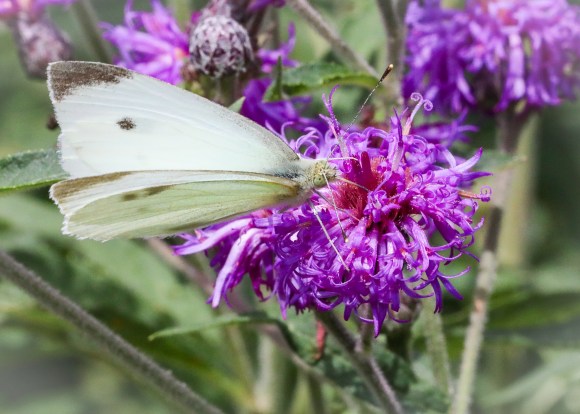
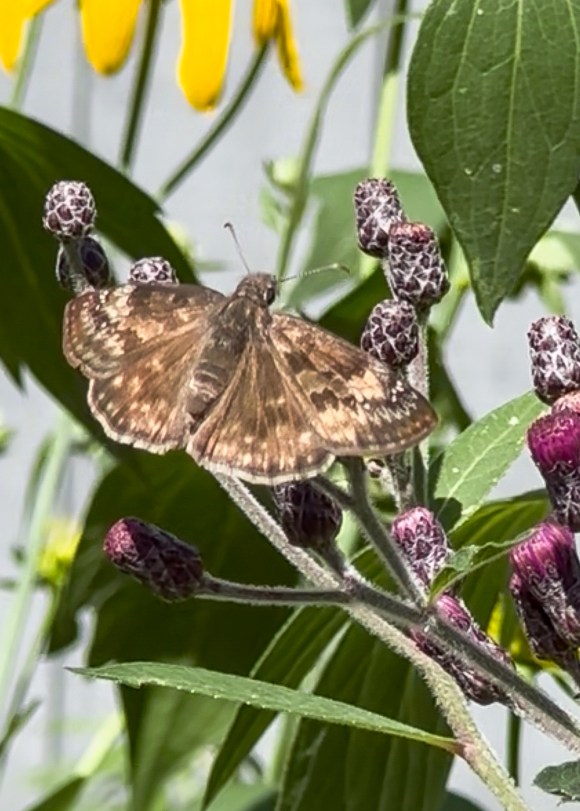
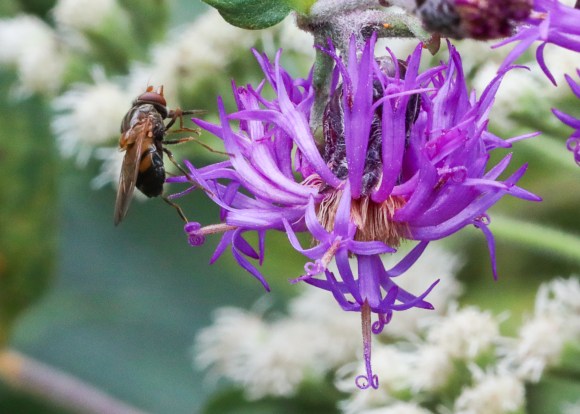
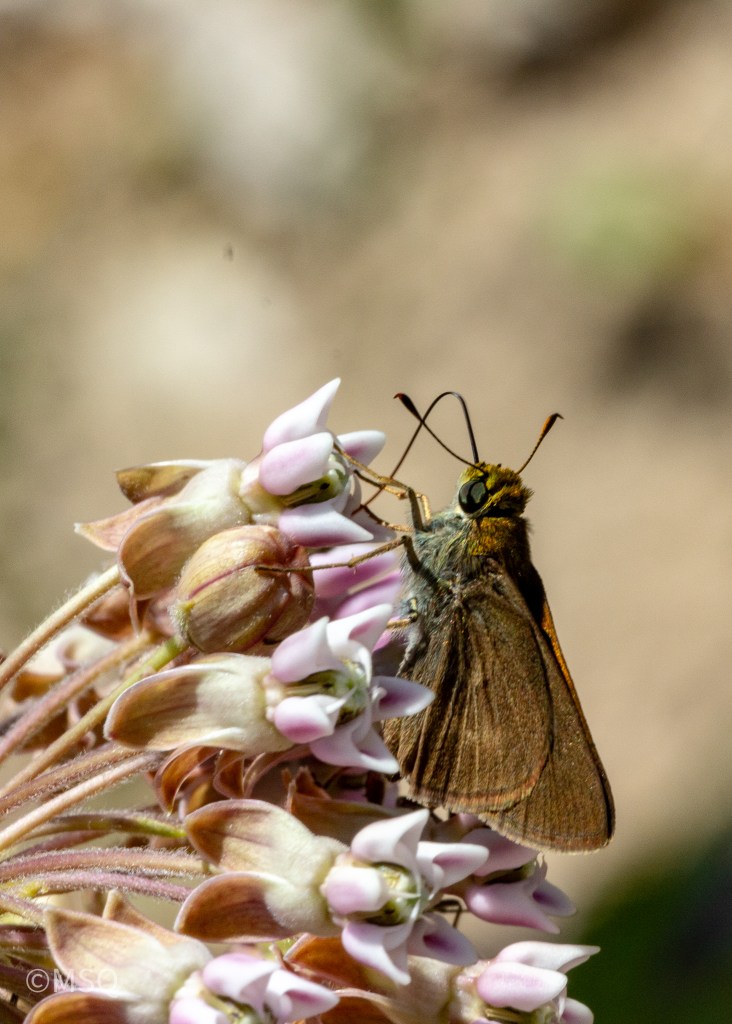
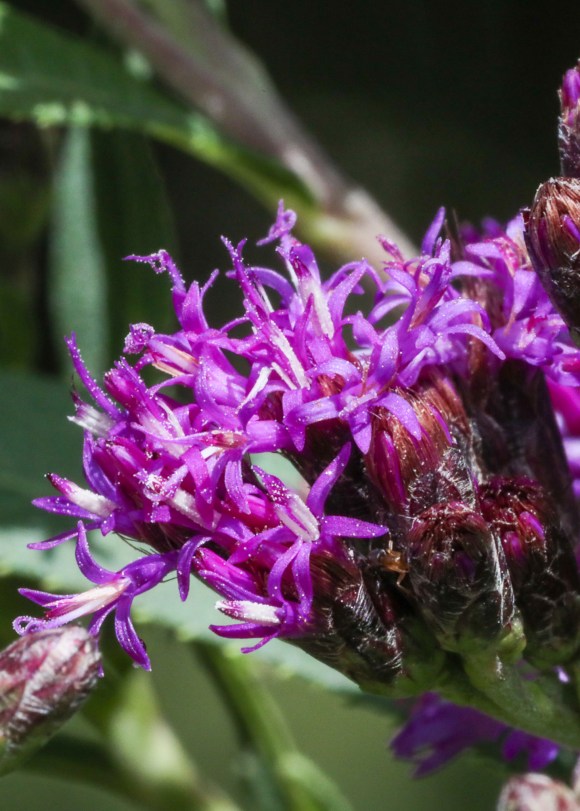
Late summer brings the furry, plum blooms of Missouri Ironweed (Vernonia missurica).  These vibrant flowers draw crowds of bees, wasps, and flies.  Butterflies, moths and skippers gather nectar at its flowers.

North America has several different species of Ironweed.  I have Missouri Ironweed in my garden.  This Ironweed is hardy from Zone 4 to 9.  It grows from 3 to 6.5 feet and spreads from 3 to 4 feet.  Missouri Ironweed tends to grow taller in wetter sites. 4,5,6  
Vernonia missurica is a prime candidate for the June haircut.  The June haircut method involve cutting a plant back by one-third to one-half at the end of June or the beginning of July.  No later than July 4th in a Zone 5 garden.  

Below is a grouping of Cut-Leaf Coneflower that didn’t have a June haircut.

Several things happen after the haircut.  The plant sprouts several shoots from the cut.  These shoots become flowering stalks—more flowers.  The plant flowers slightly later.  Finally, the overall plant height is shorter.  The shorter height has sturdier, stronger stems less likely to fall over.
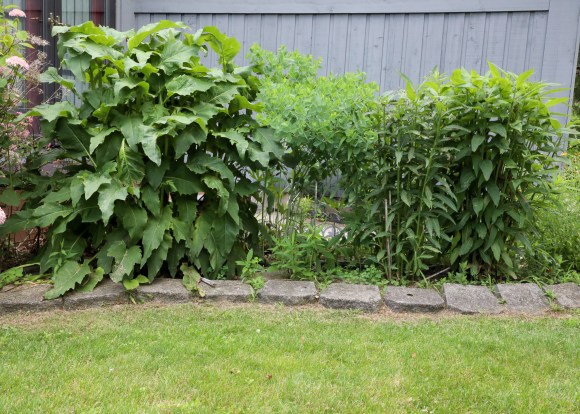
This method has made a real difference in my garden.  I used to spend hours staking and caging plants in the summer and fall.  Now they form beautiful, upright groupings.
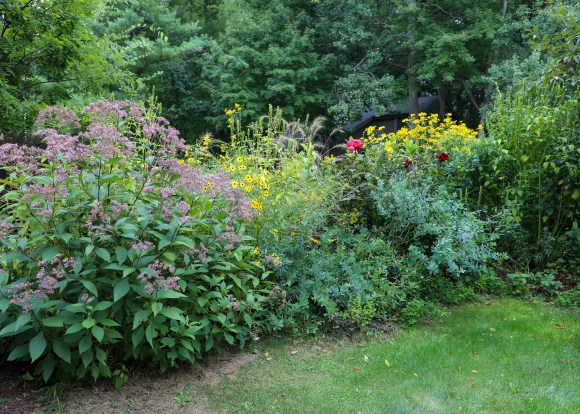
Missouri Ironweed thrives in full to part sun.  It enjoys average to moist soil conditions with fertile loam.  Ironweed also tolerates clay loam with grit or gravel.5

Ironweed accepts a variety of soil moistures.  Vernonia missurica does well in a rain garden since it tolerates flooding.  It also survives short periods of drought so can live in a drier location.5,6

Missouri Ironweed is another native with rhizomatous roots.  They are densely fibrous.  In time, Vernonia missurica forms small colonies.5

Missouri Ironweed’s dark green leaves grow alternately on its stem.  The lanceolate or ovate foliate can grow up to 7 inches long and 2 inches wide.  The lower side is paler with dense white, longish hairs.  Conveniently, these leaves are bitter tasting.  Livestock and other herbivores avoid eating it.5
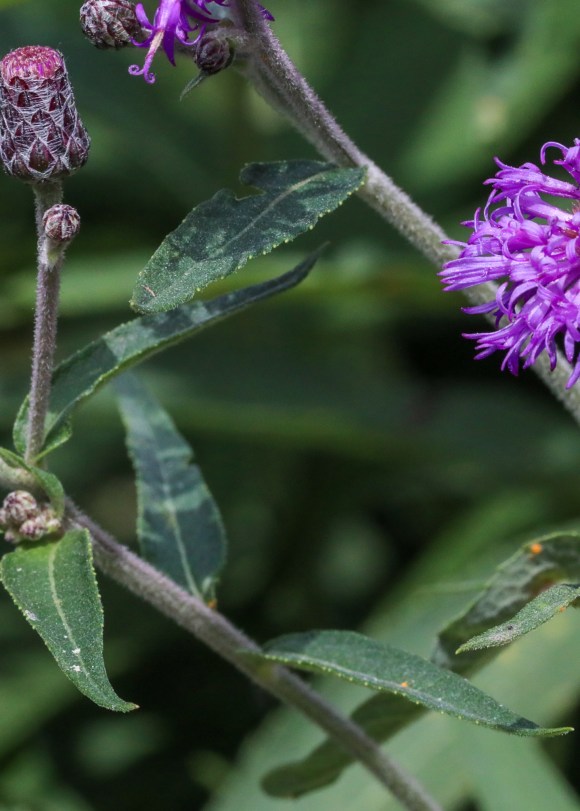
The magenta/purple flowers bloom at the top of the plant.  The buds form a corymb of many blossoms 6 to 16 inches across.  A corymb is a flat-topped or domed cluster of flowers.4,5,6,9

Vernonia missurica’s blossoms don’t have ray florets.  This means no petals.  Like Sweet Joe-Pye Weed (Eutrochium purpureum, https://wildthingsinthegarden.wordpress.com/wp-admin/post.php?post=2170&action=edit) and Boneset (Eupatorium perfoliatum, https://wildthingsinthe.garden/2025/05/30/a-white-frilly-flower/), these flowers have a fuzzy appearance.  30 to 60 disk florets make-up each bloom.4,5,6,9

Missouri Ironweed flowers in late summer.  The ½ to ¾ inch blooms usually open over a month.  Blossoms are usually magenta to purple but, rarely, white. 4,5,6,9

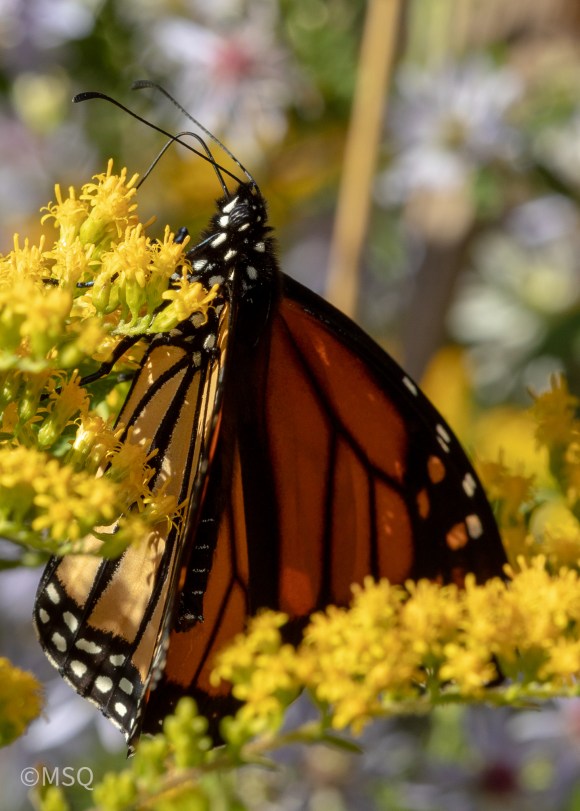
Late season pollinators and beneficial insects all harvest resources from Vernonia missurica.  Butterflies, moths and skippers gather nectar from the blooms.  
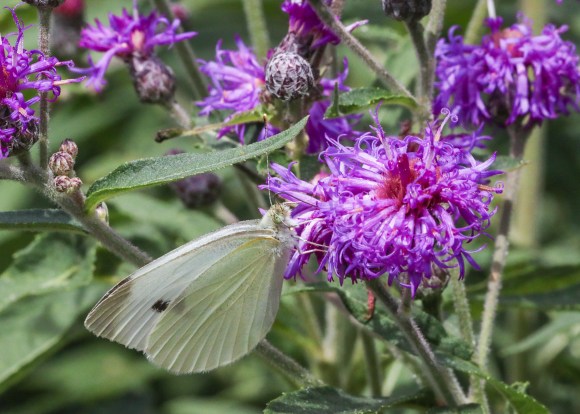
Missouri Ironweed serves as a larval host for the American Painted Lady Butterfly (Vanessa virginiensis).3,4,5,6

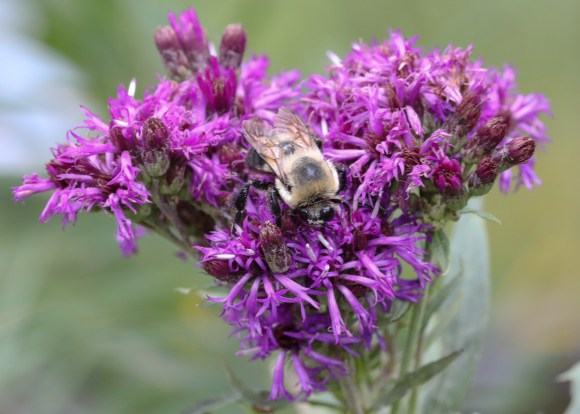
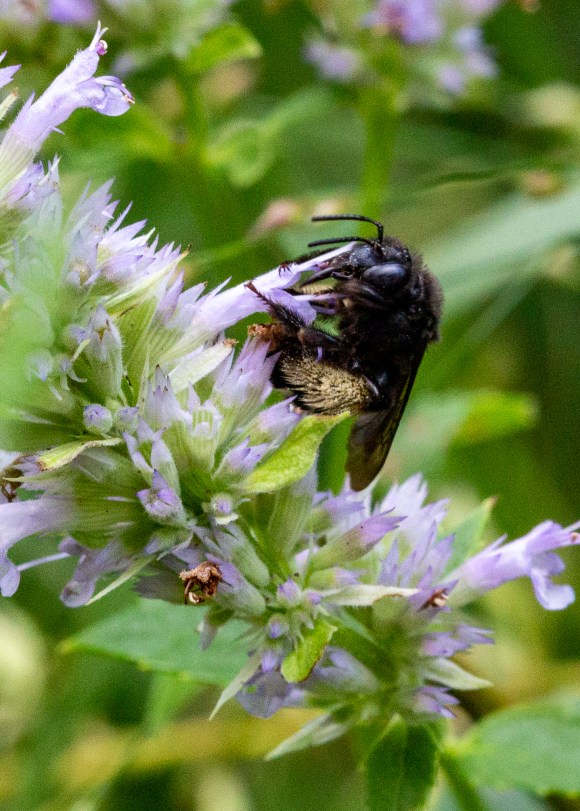
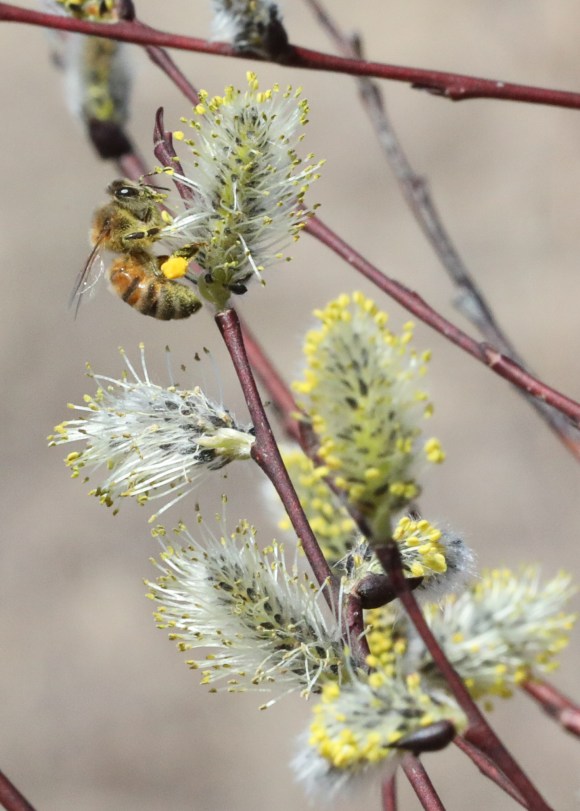
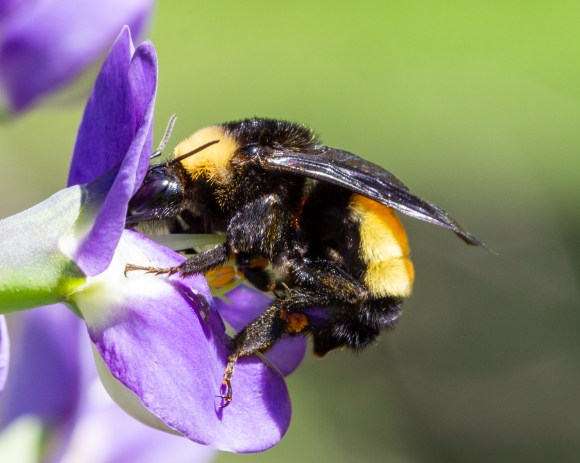
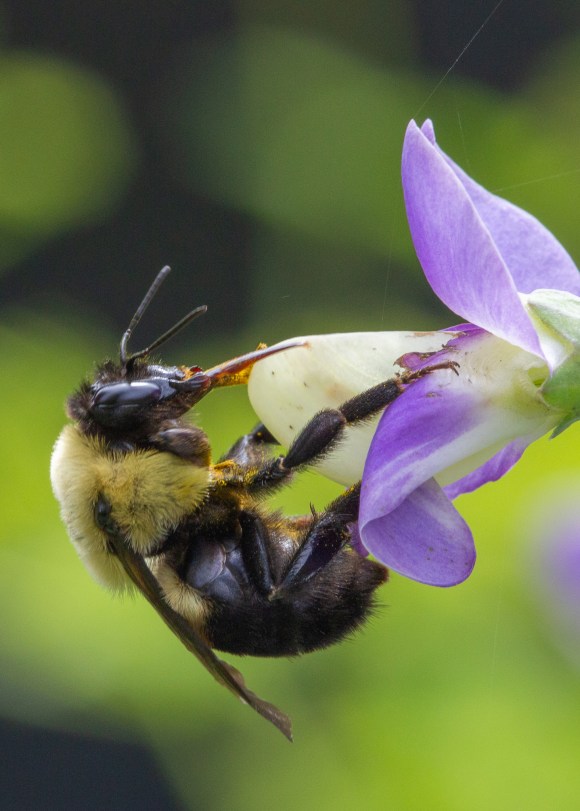
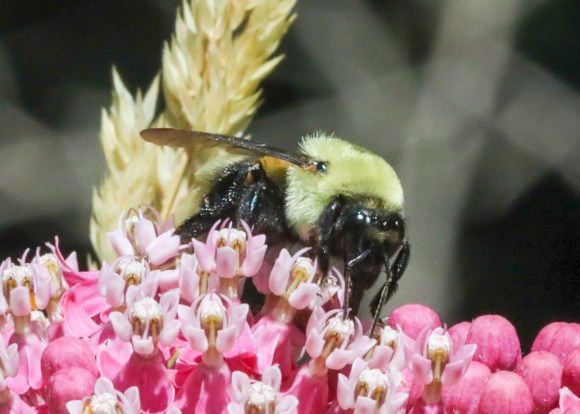
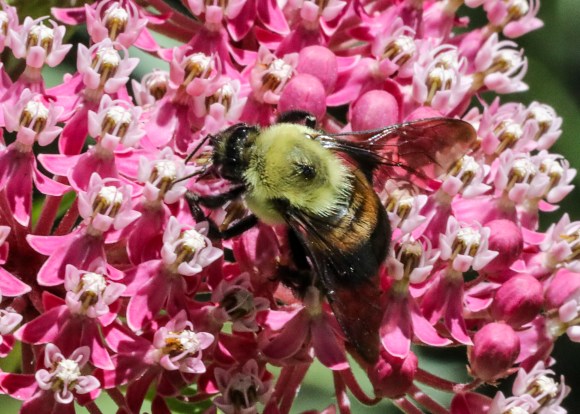
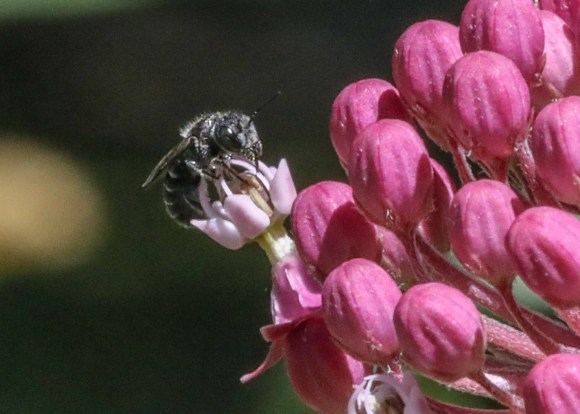
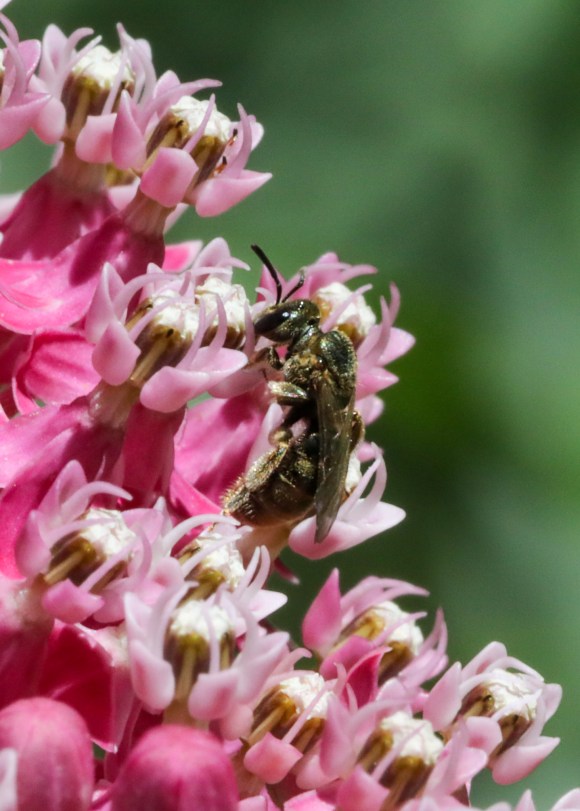
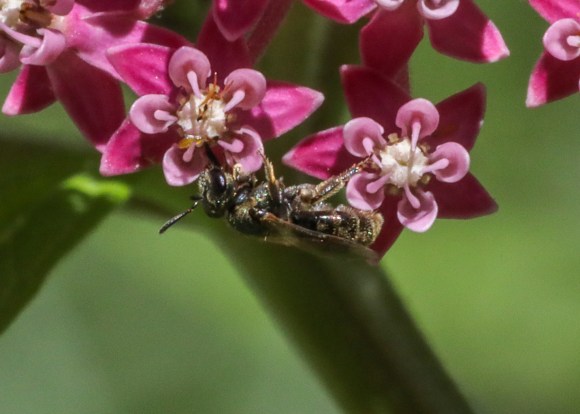
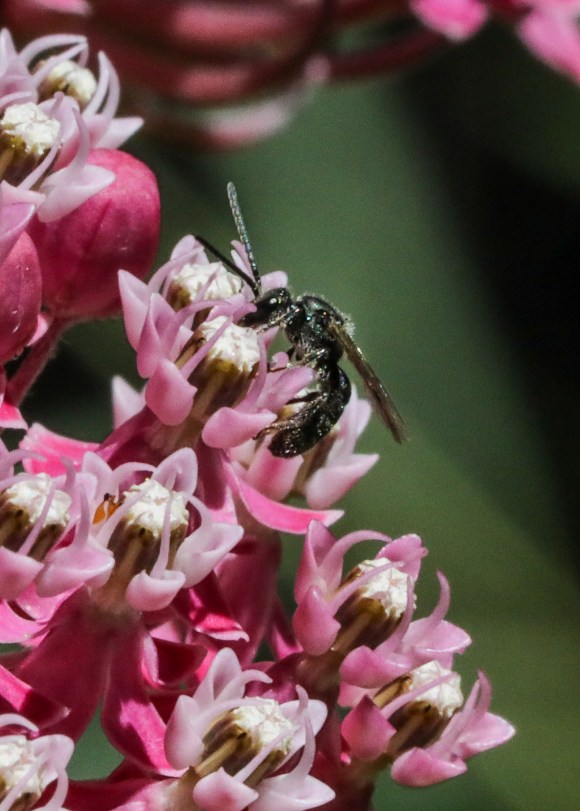
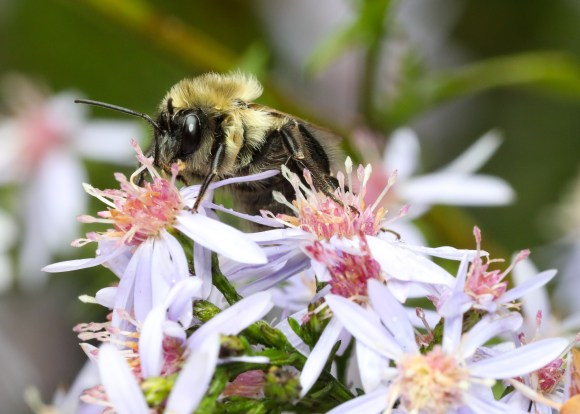
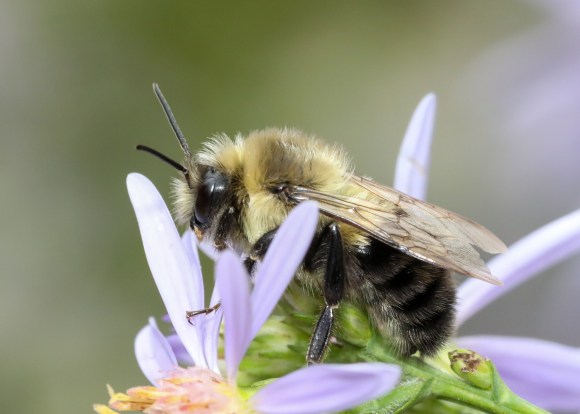
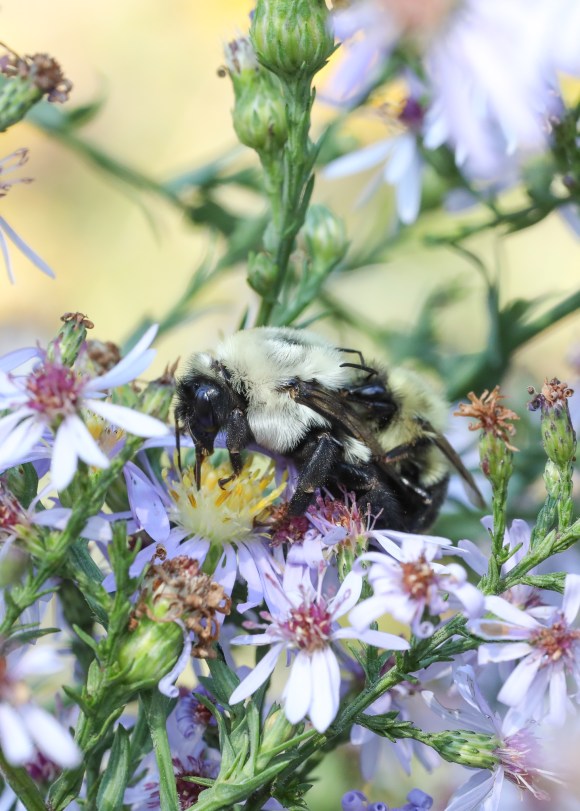
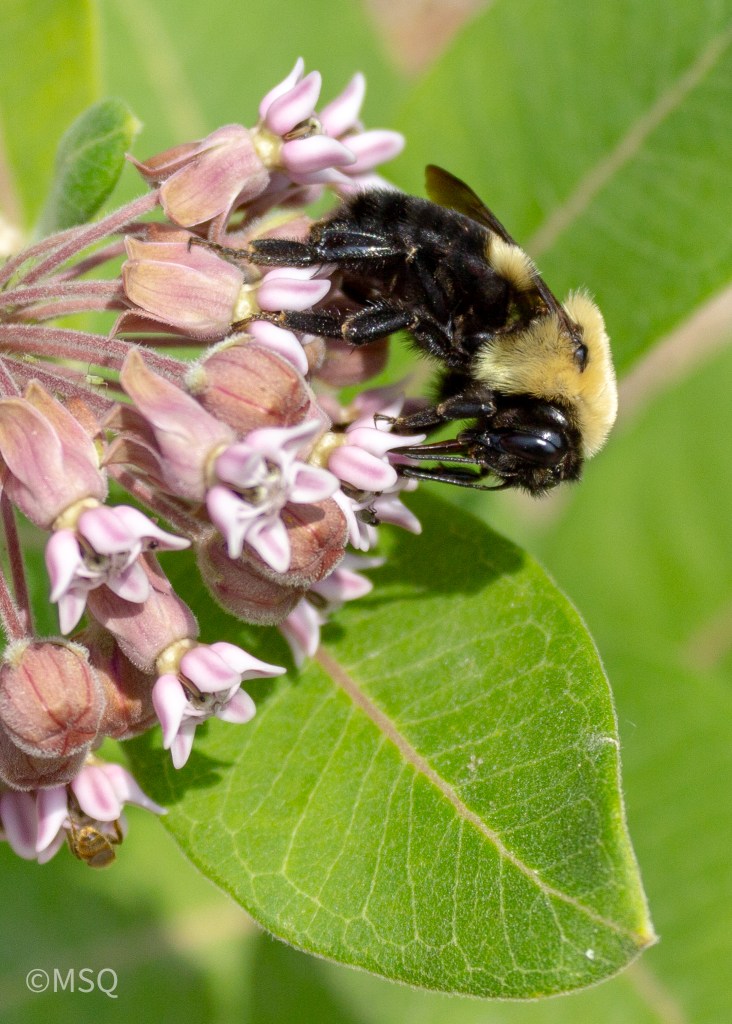
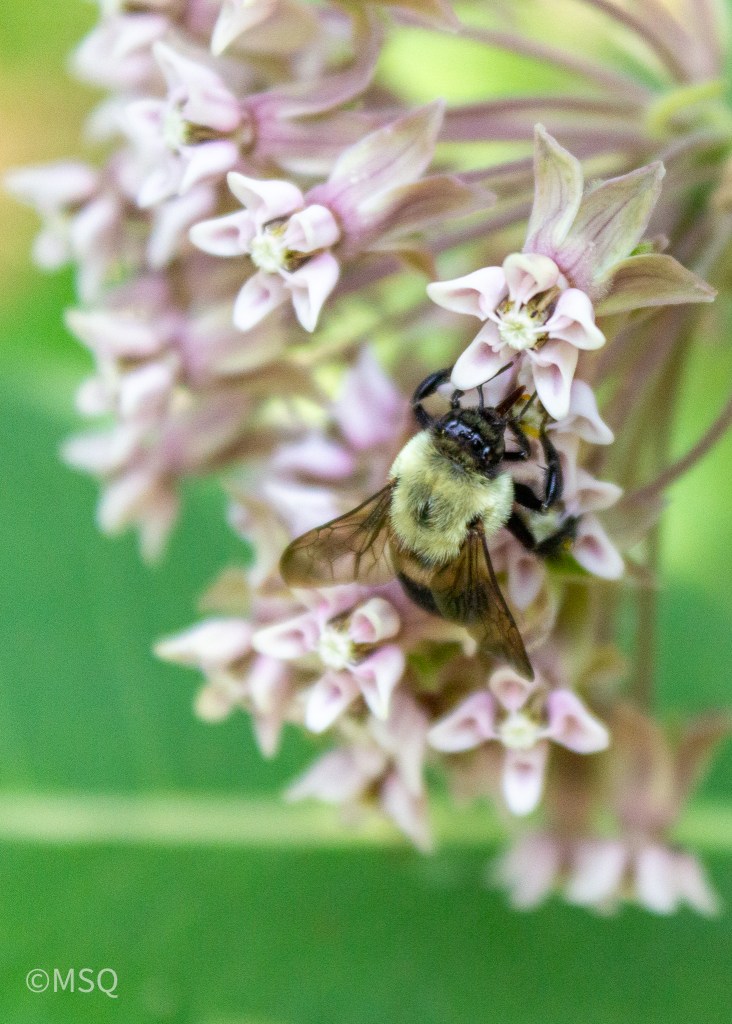
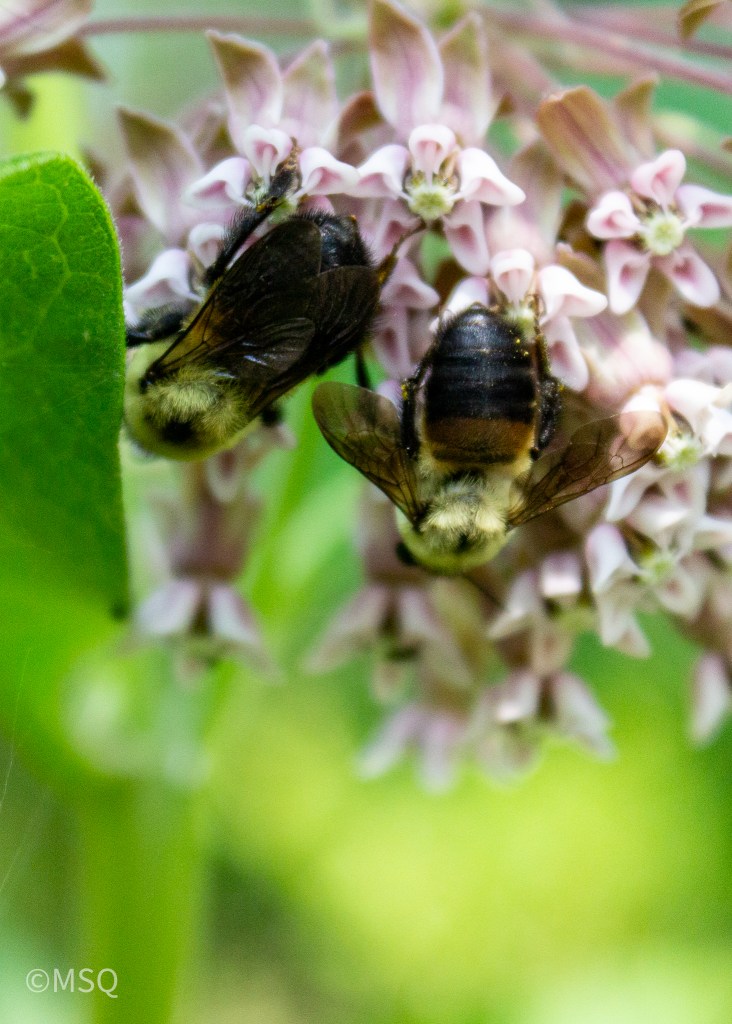
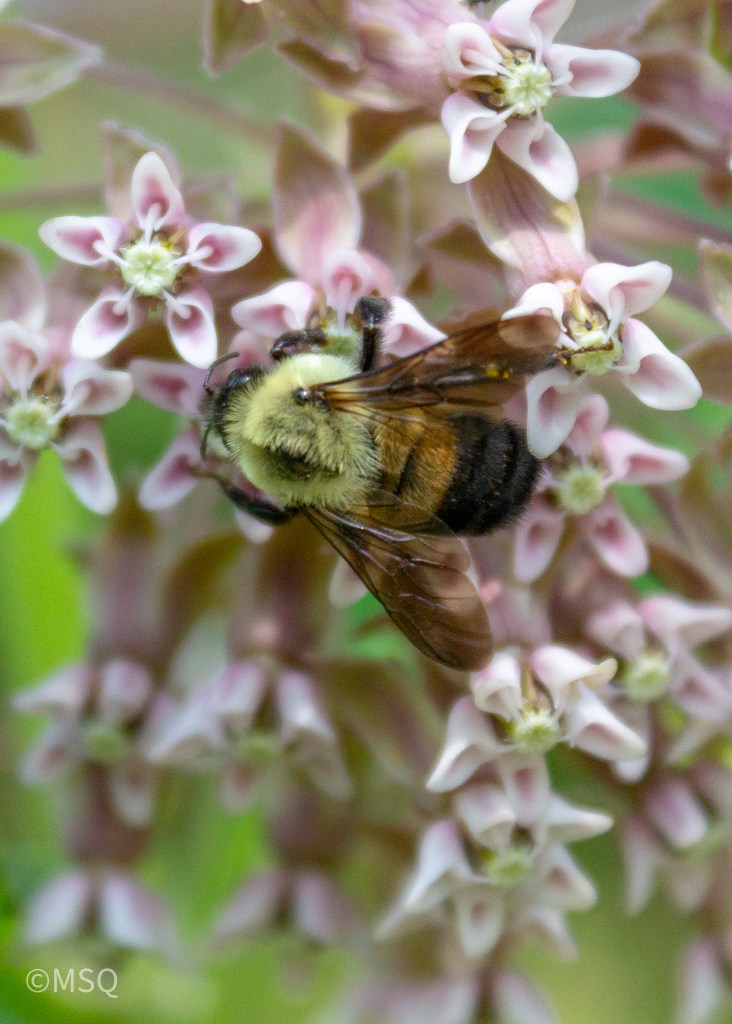
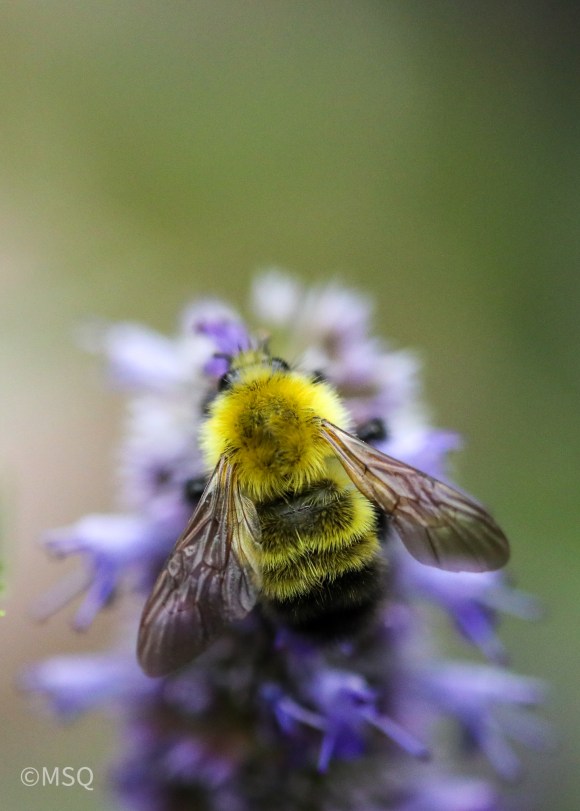
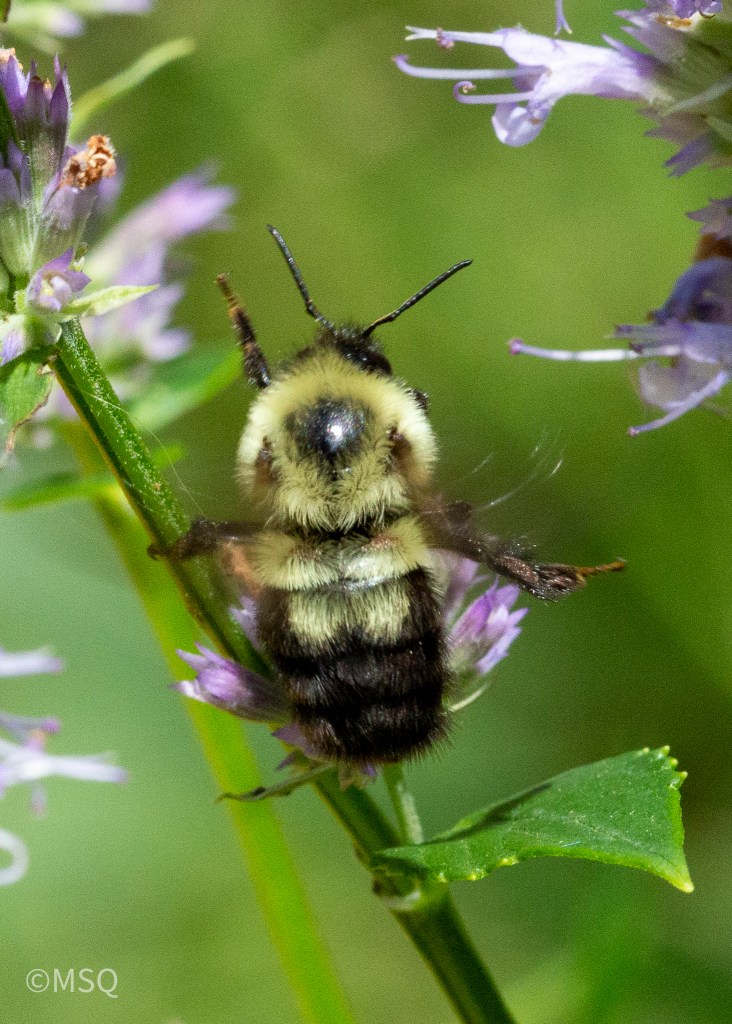
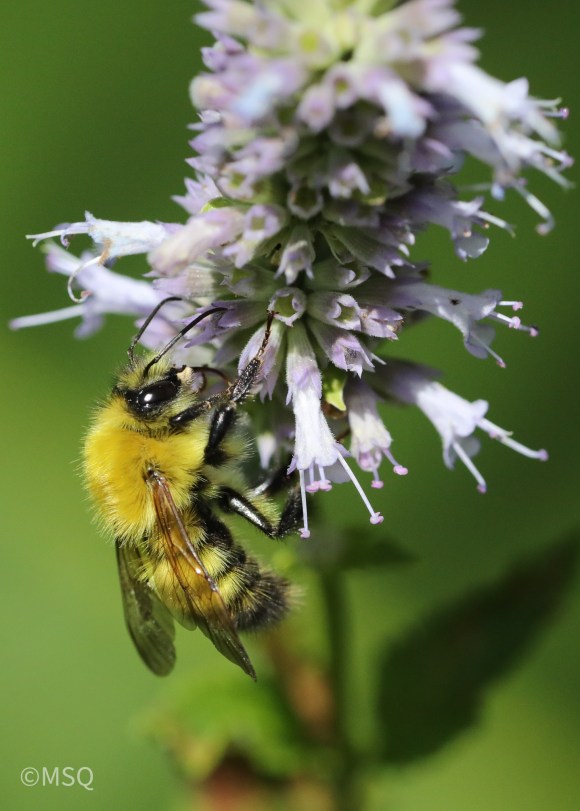
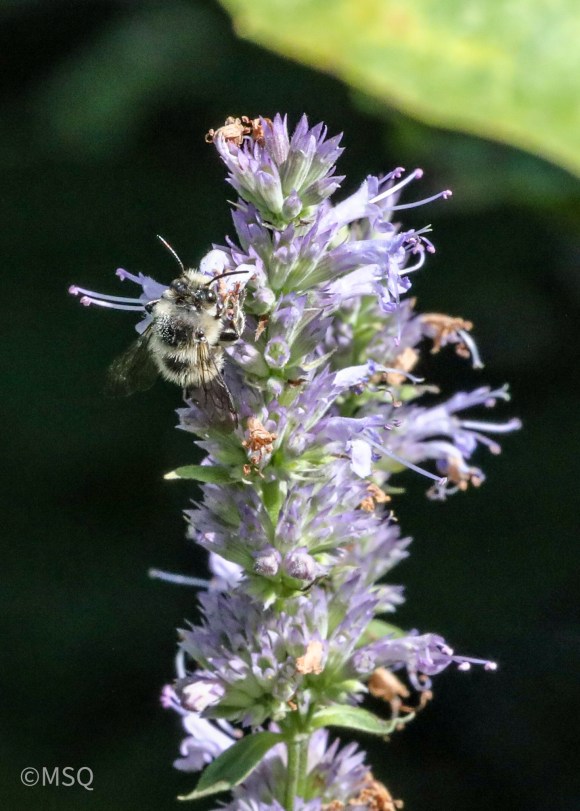
Bees gather pollen and nectar from Ironweed.  These bee visitors include Bumblebees (Bombus spp.),
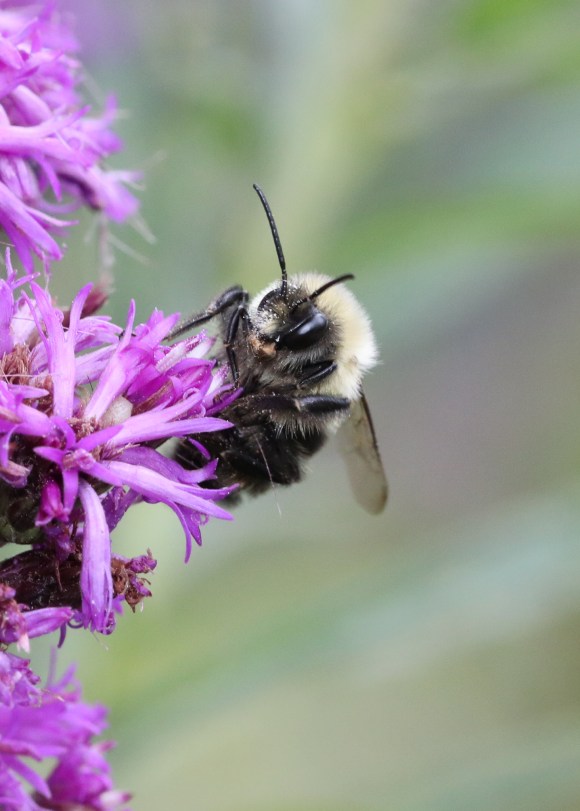
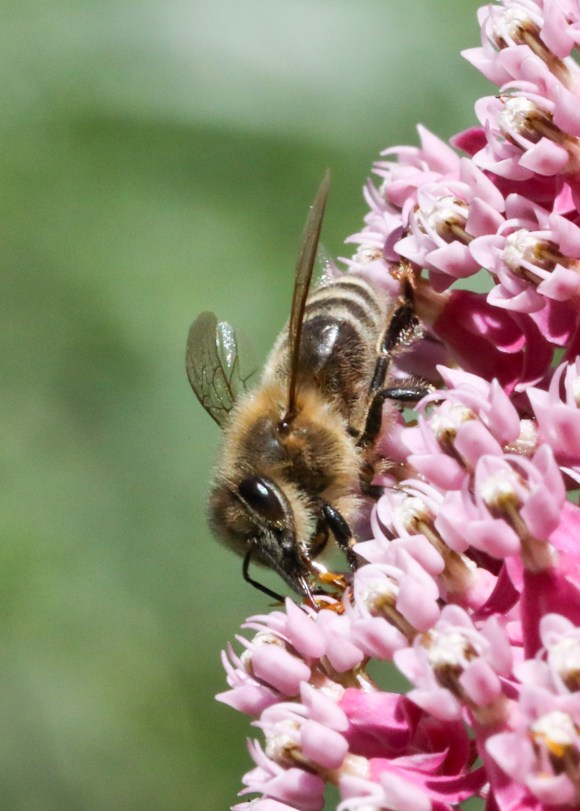
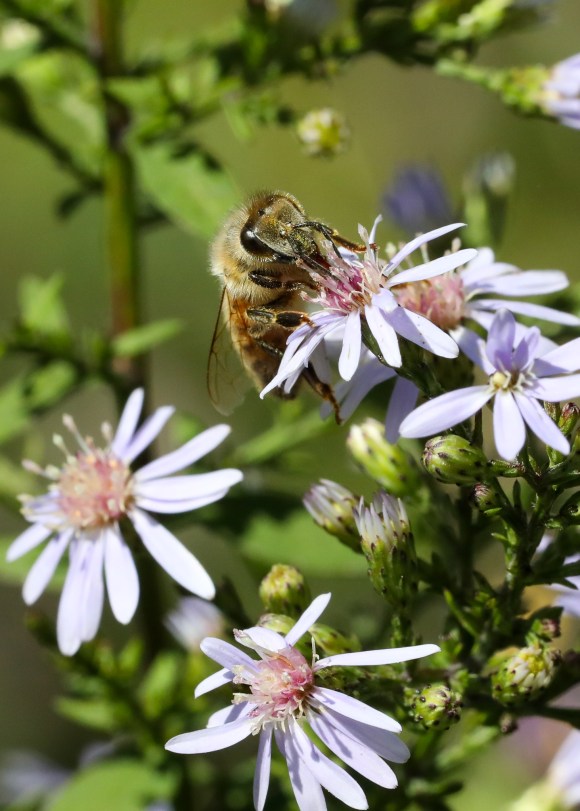
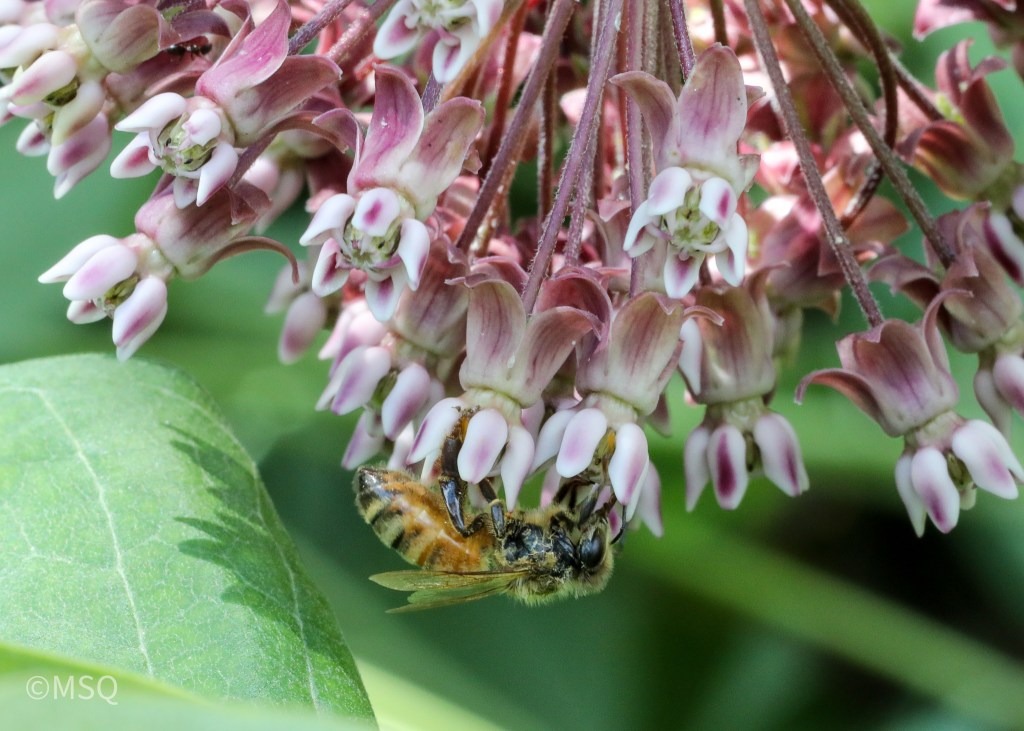
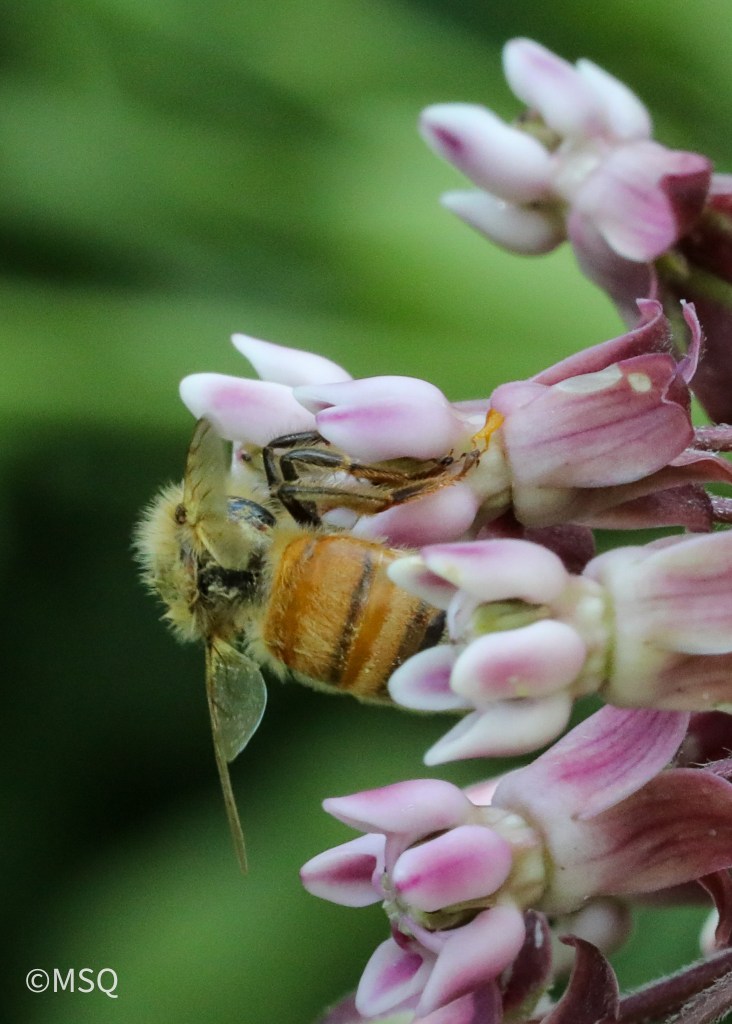
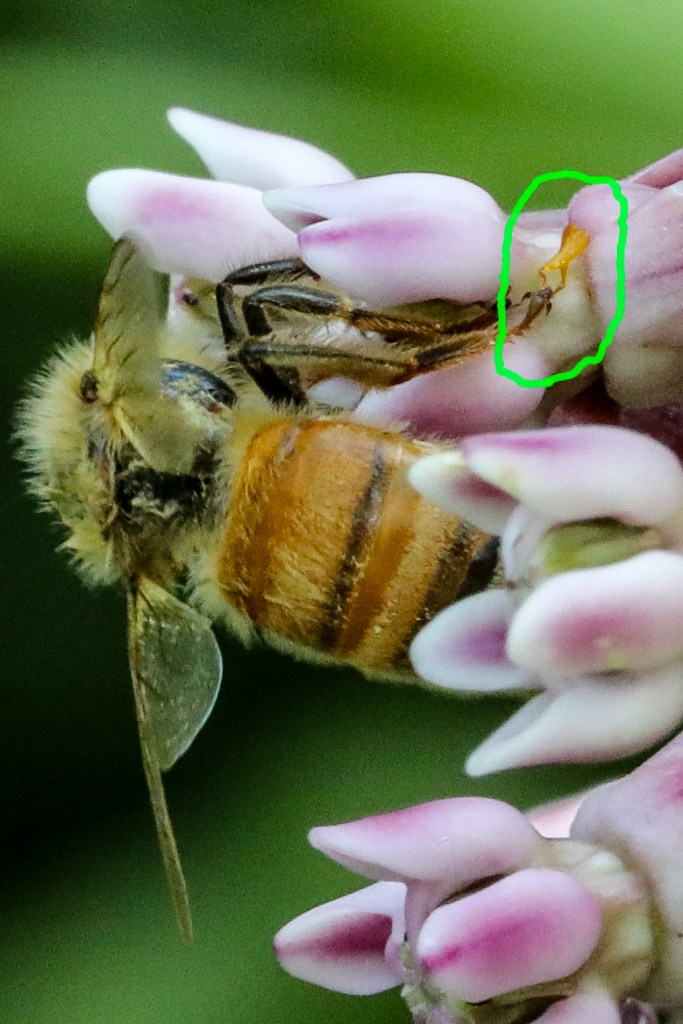
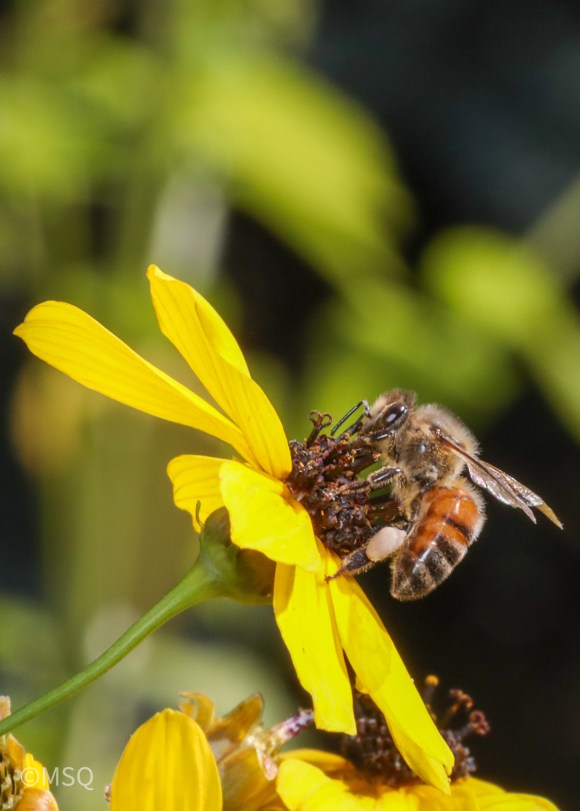
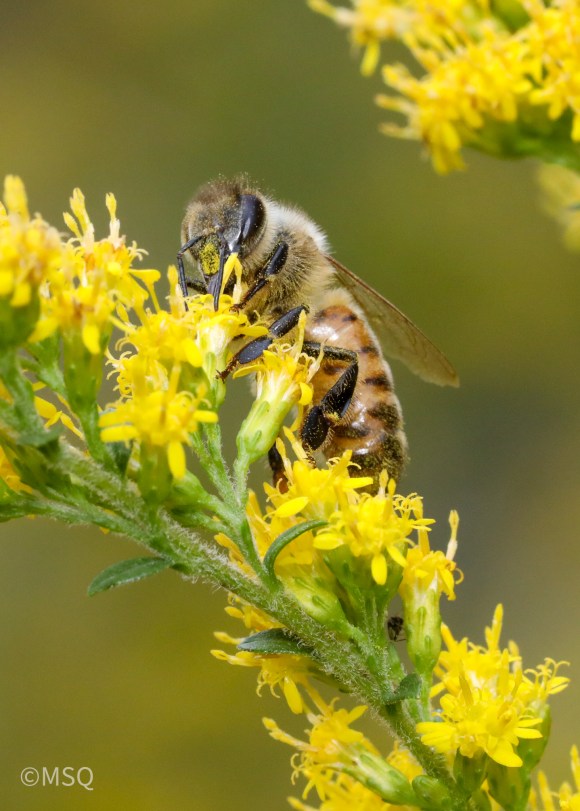
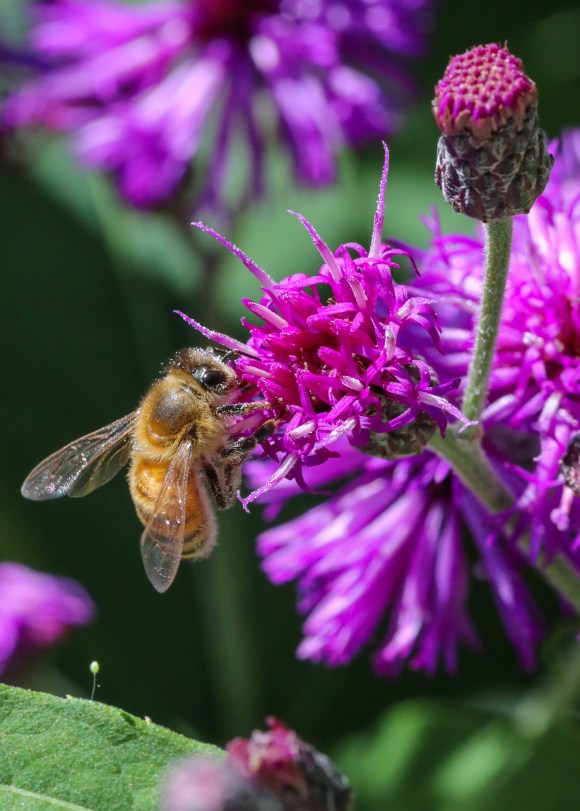
Honeybees (Apis spp.),
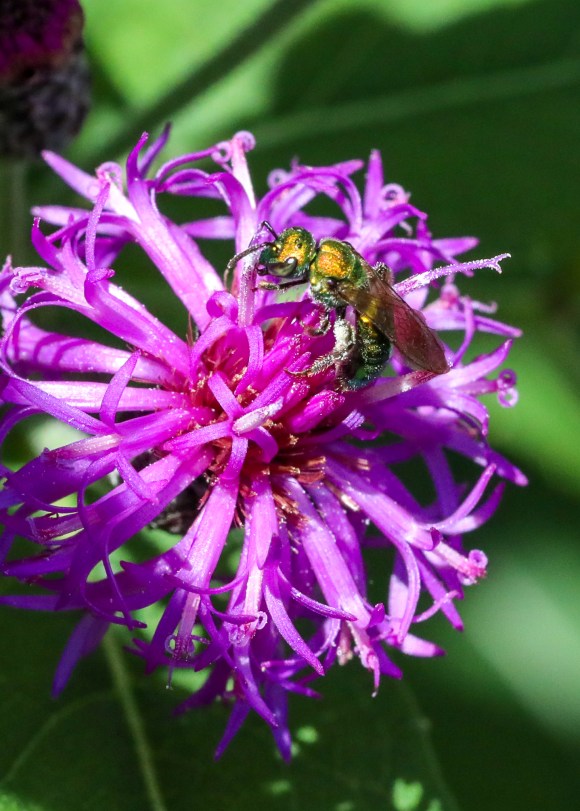
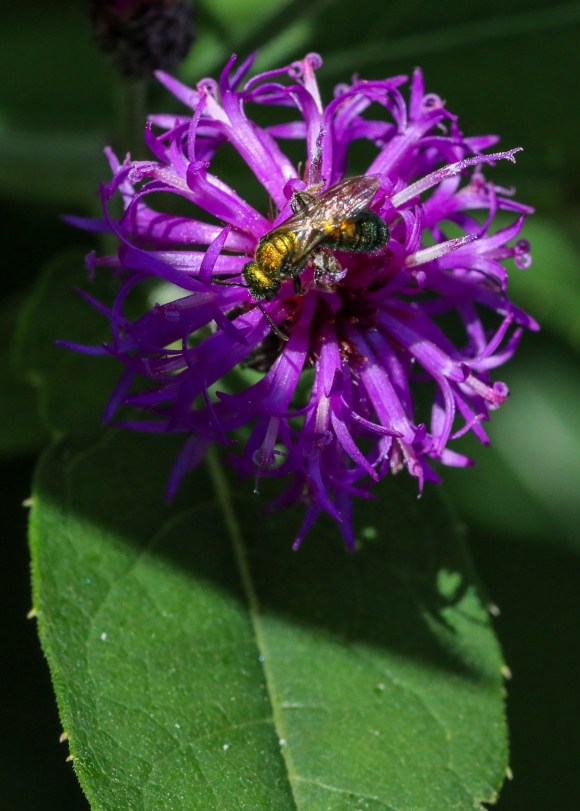
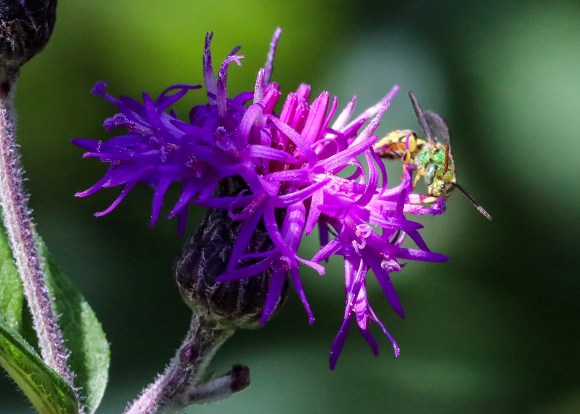
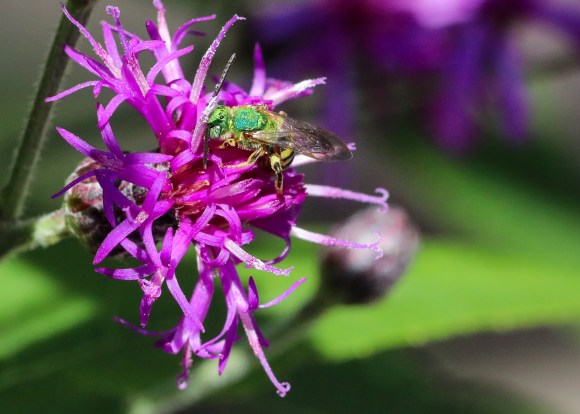
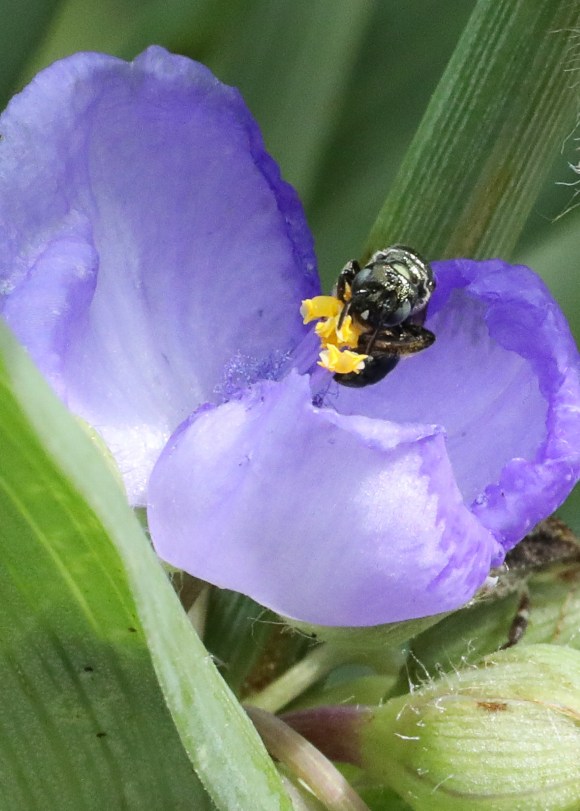
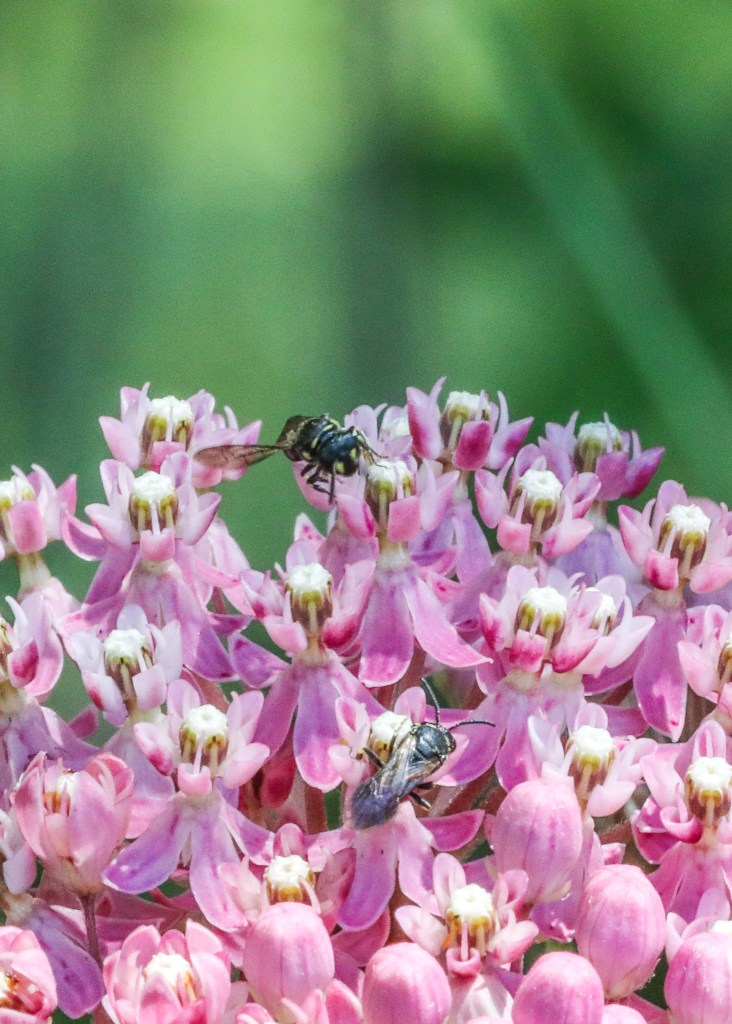
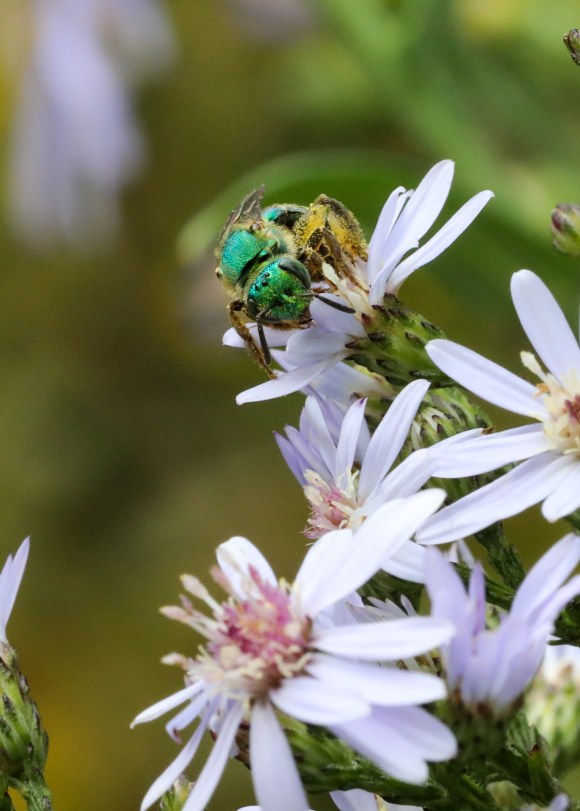
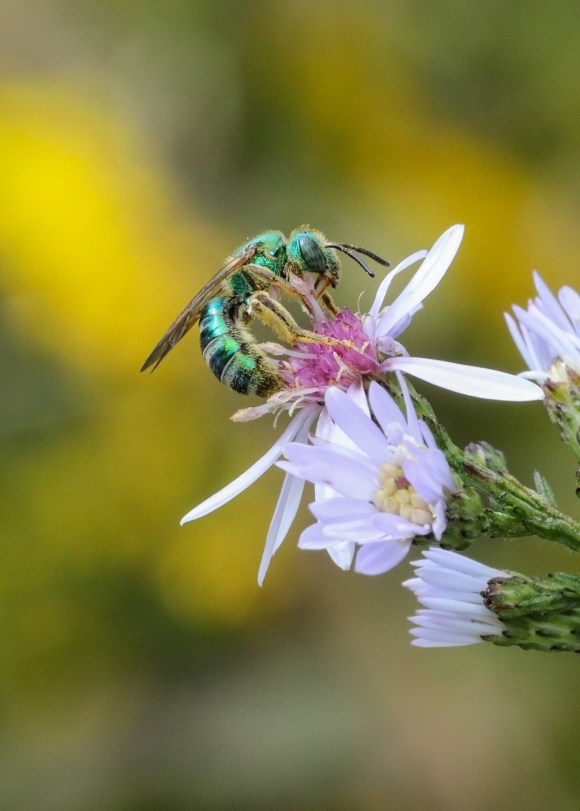
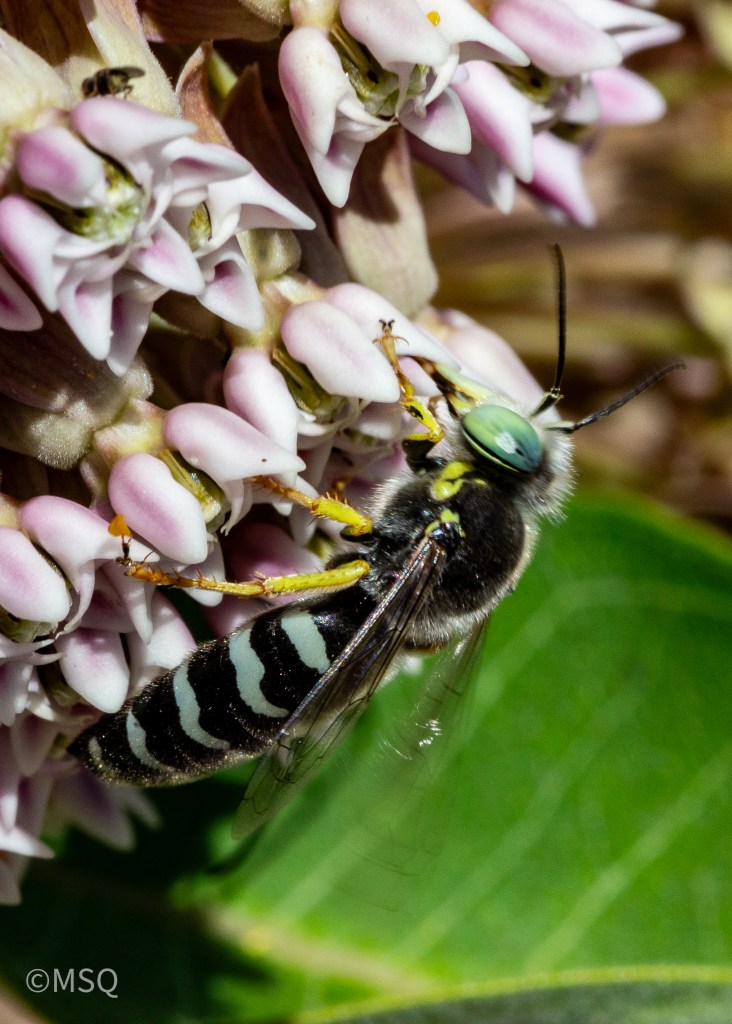
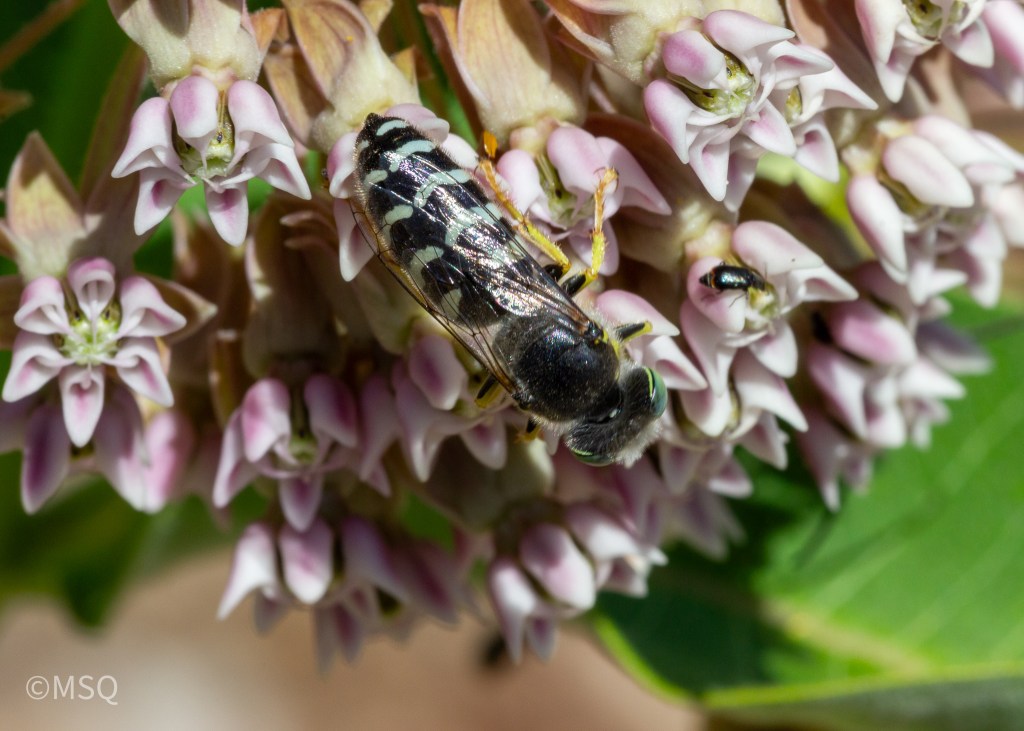
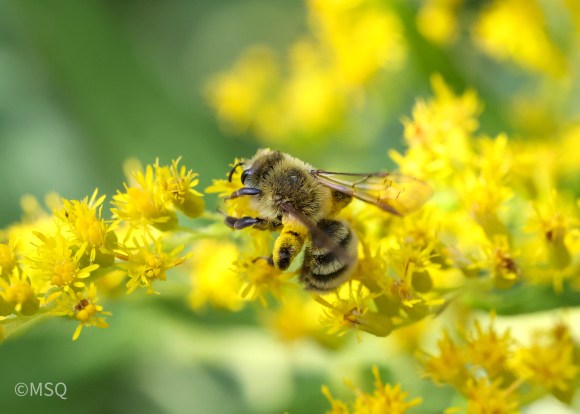
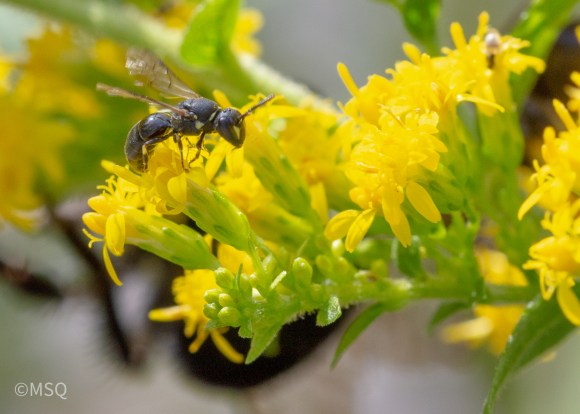
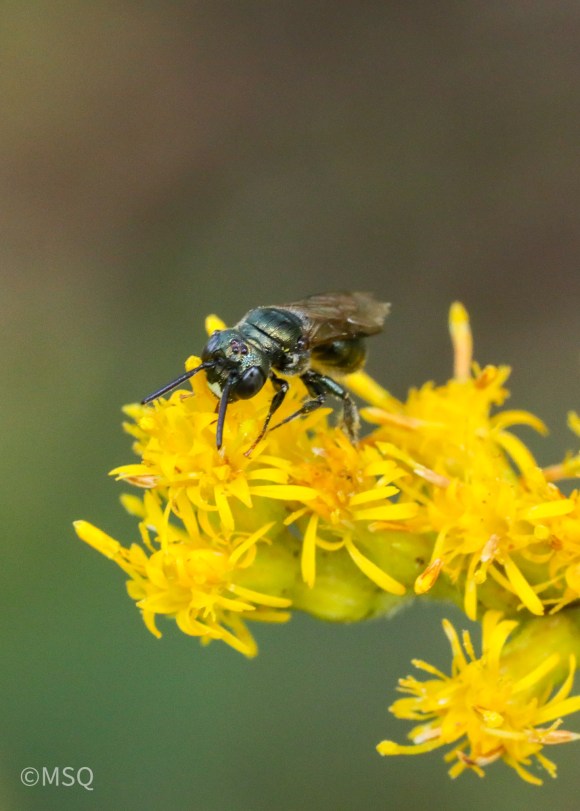
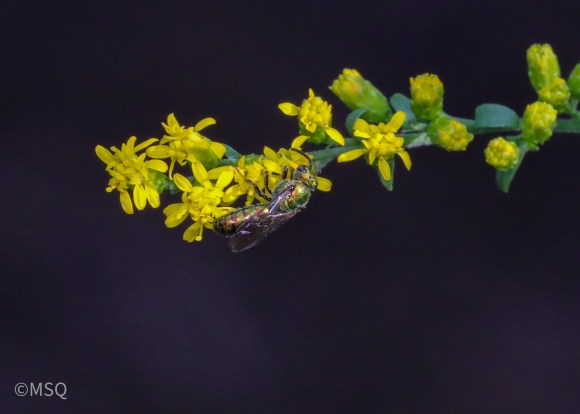
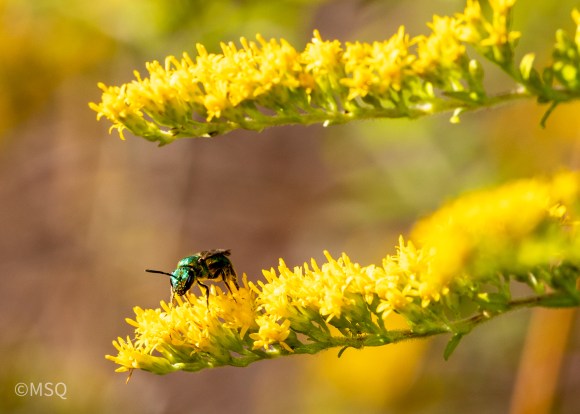
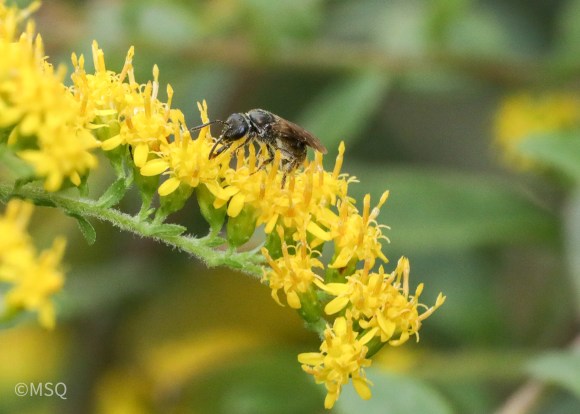
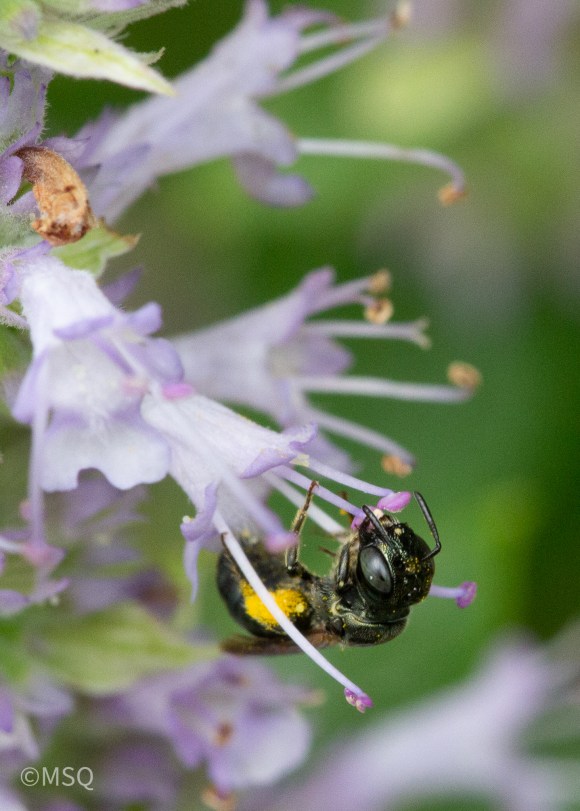
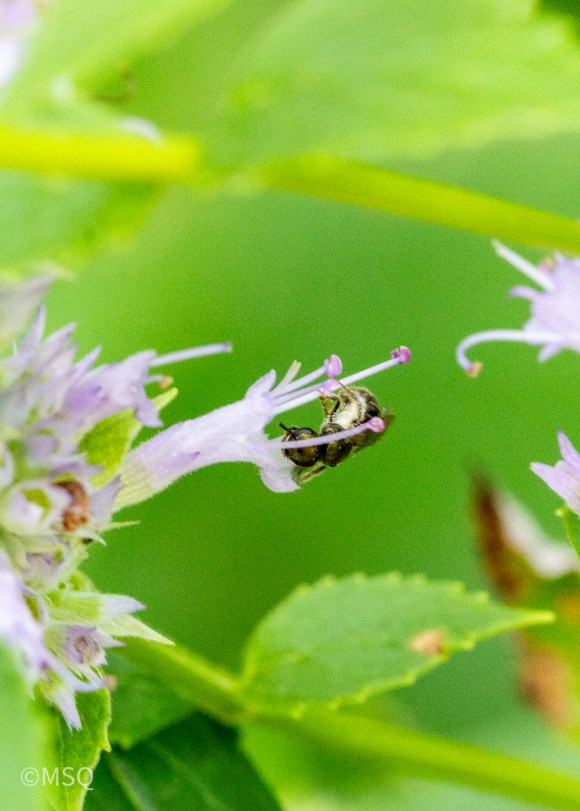
sweat bees (Halictus spp. and Lasioglossum spp), Metallic Green Sweat Bees,
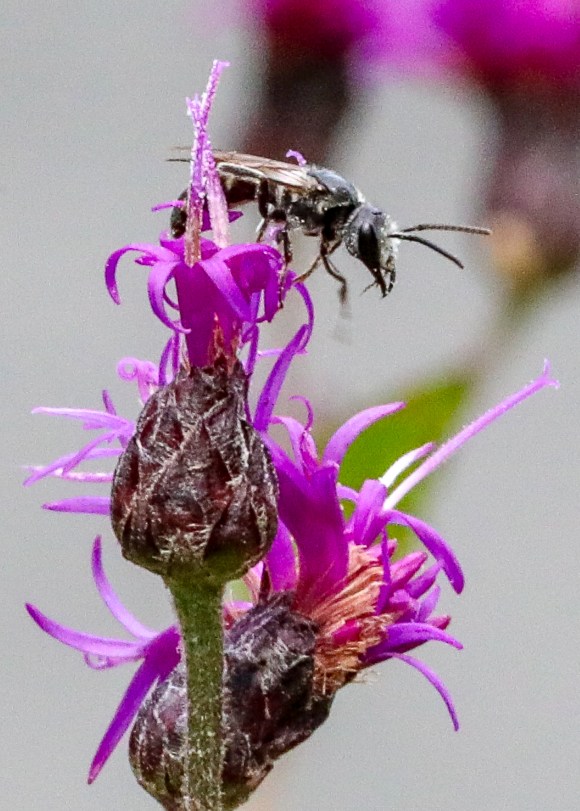
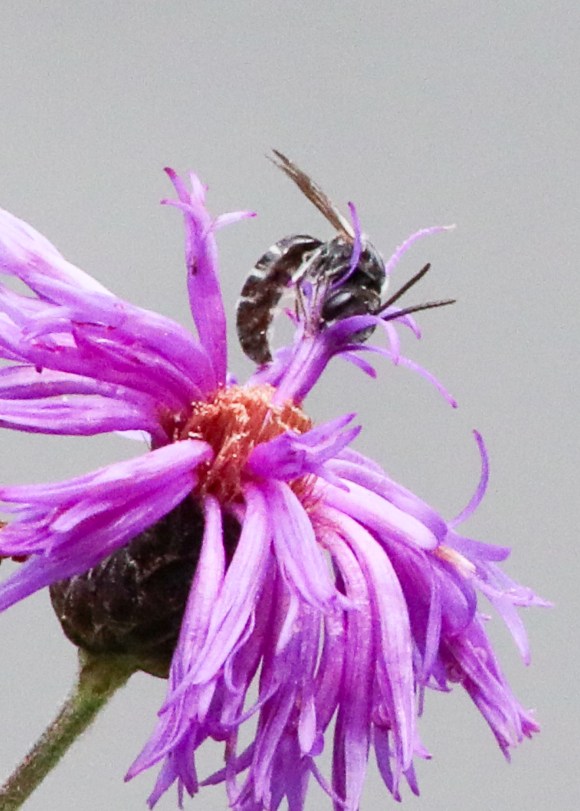
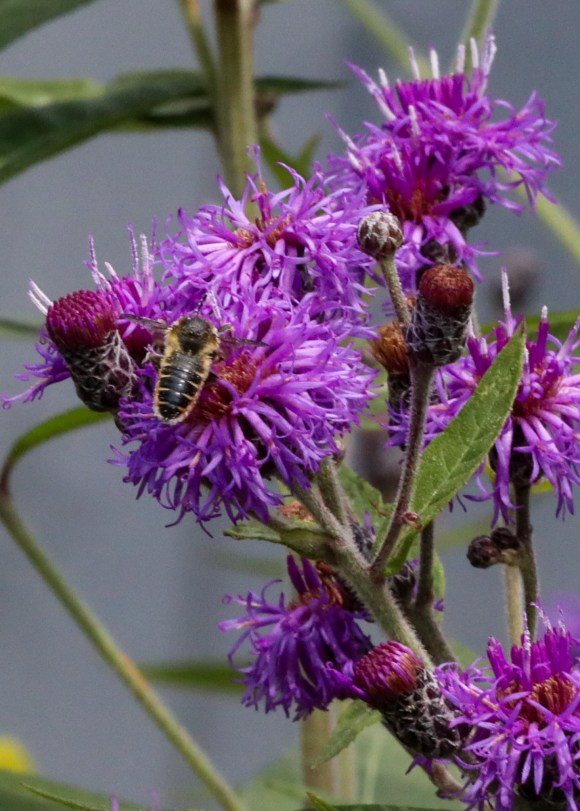
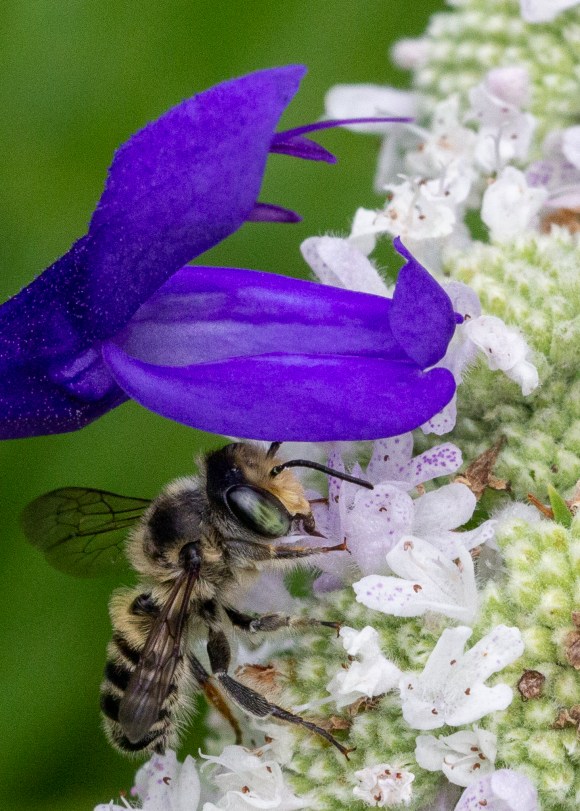
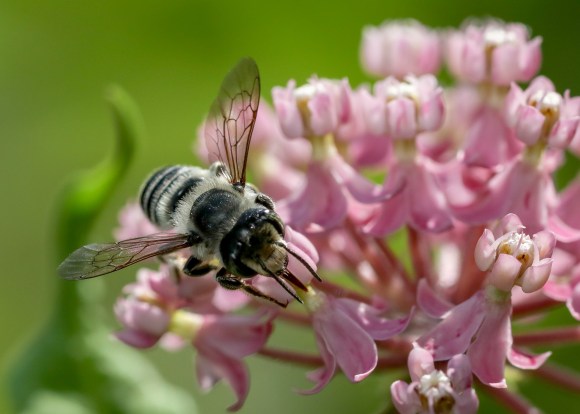
leafcutter bees (Megachile spp.),
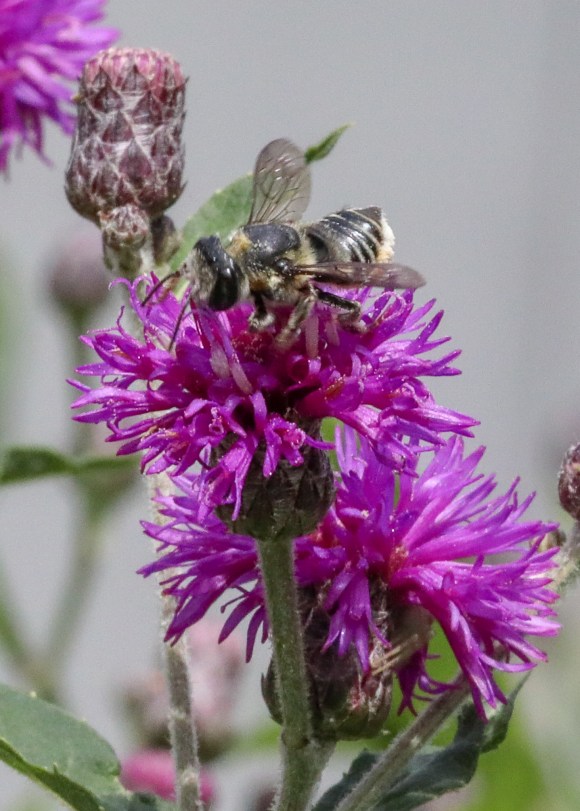
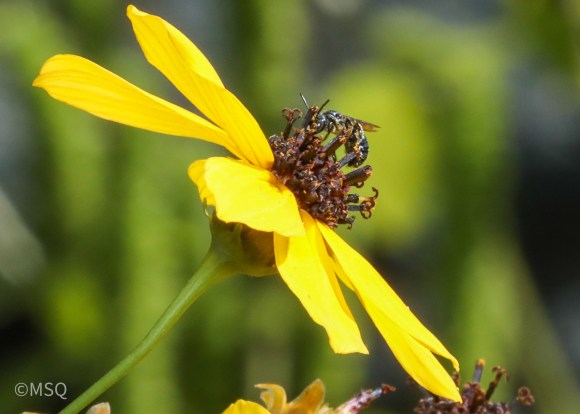
cuckoo bees, small carpenter bees (Ceratina spp.),
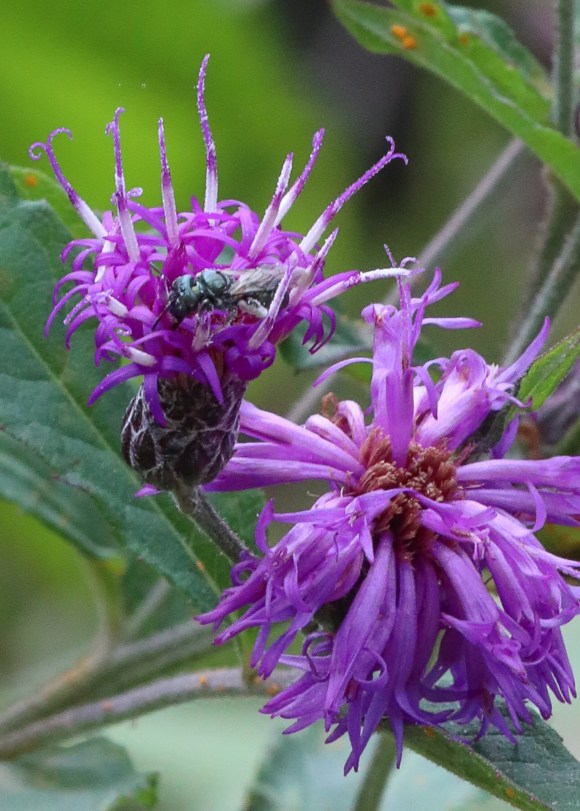
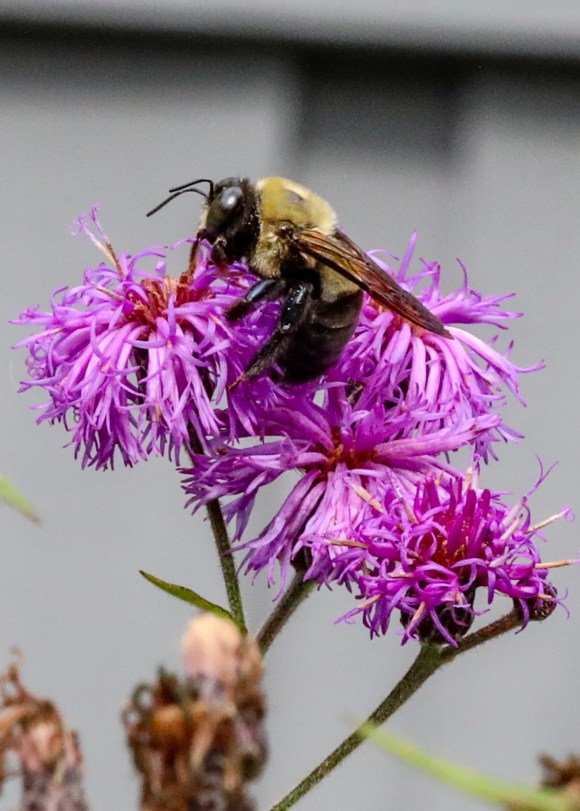
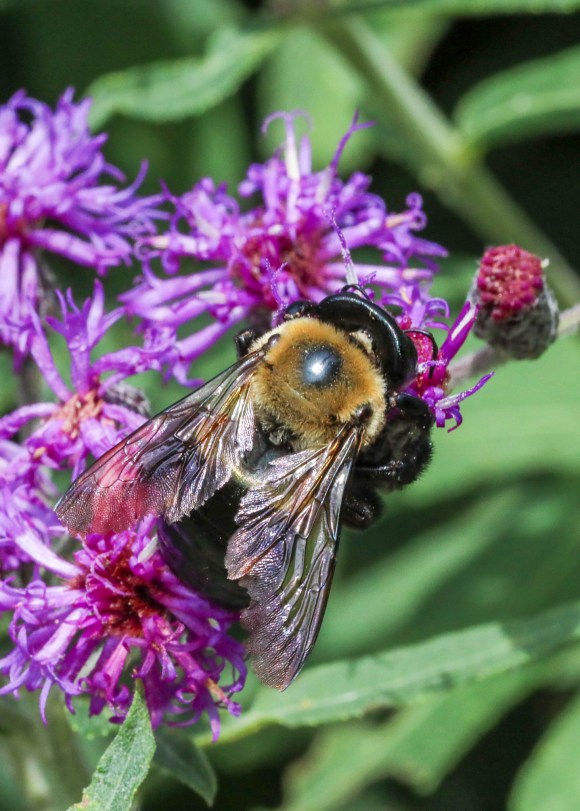
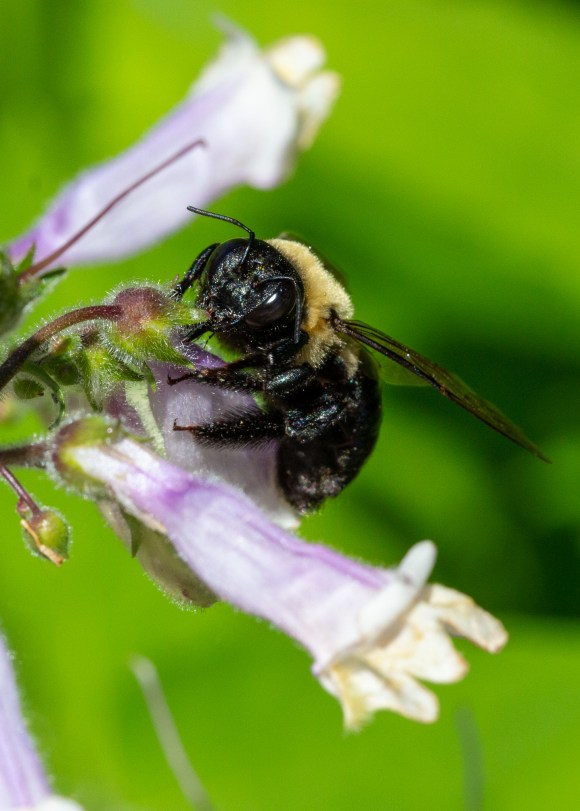
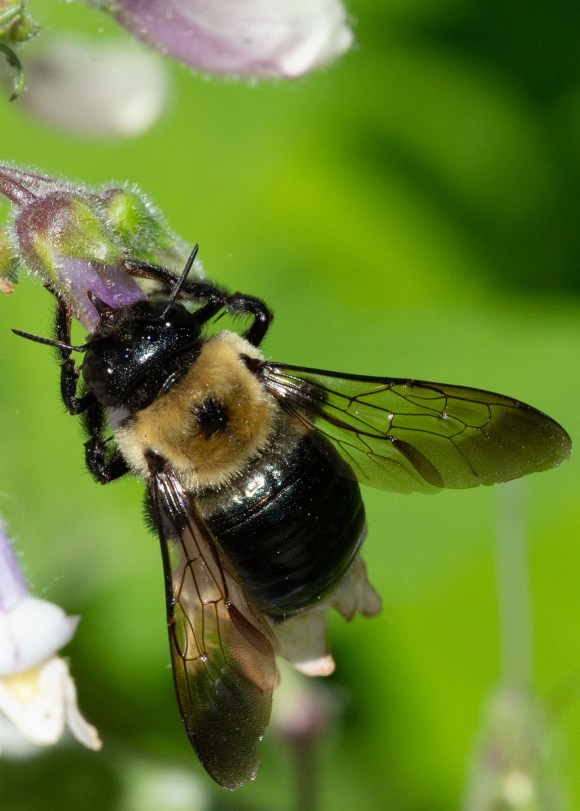
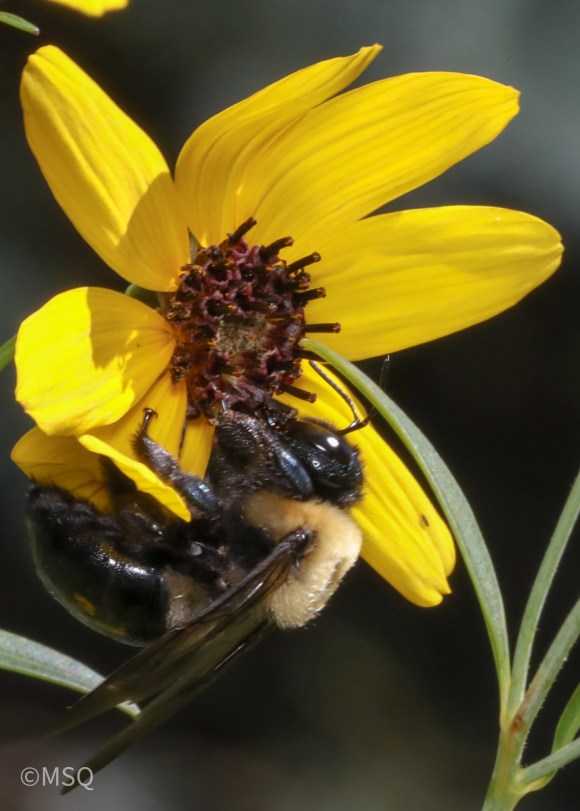
and large carpenter bees (Xylocopa spp.).  

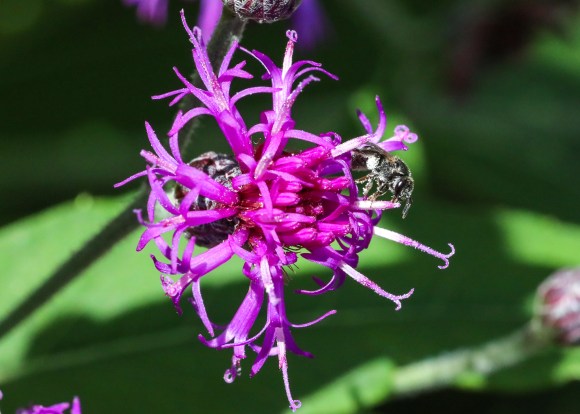
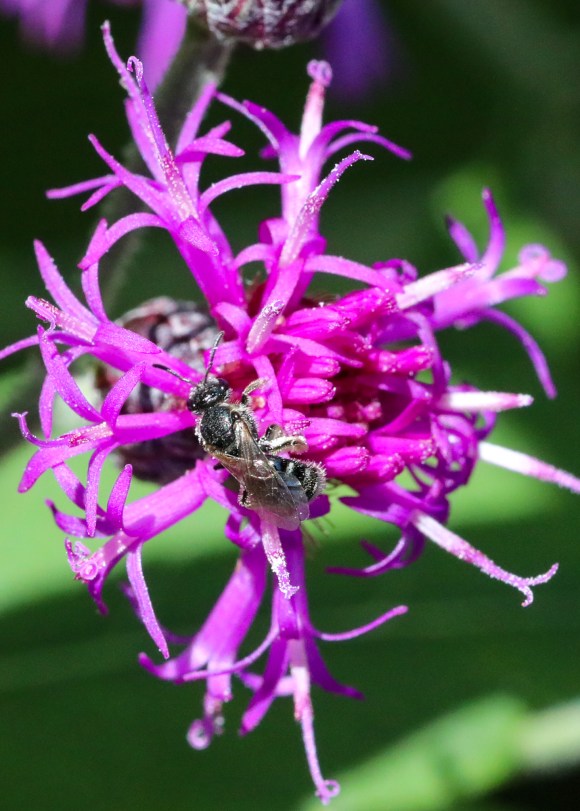
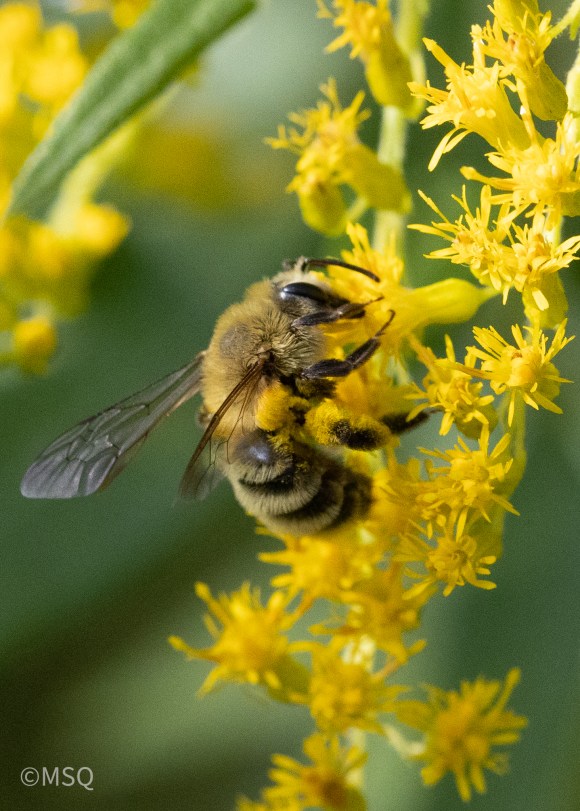
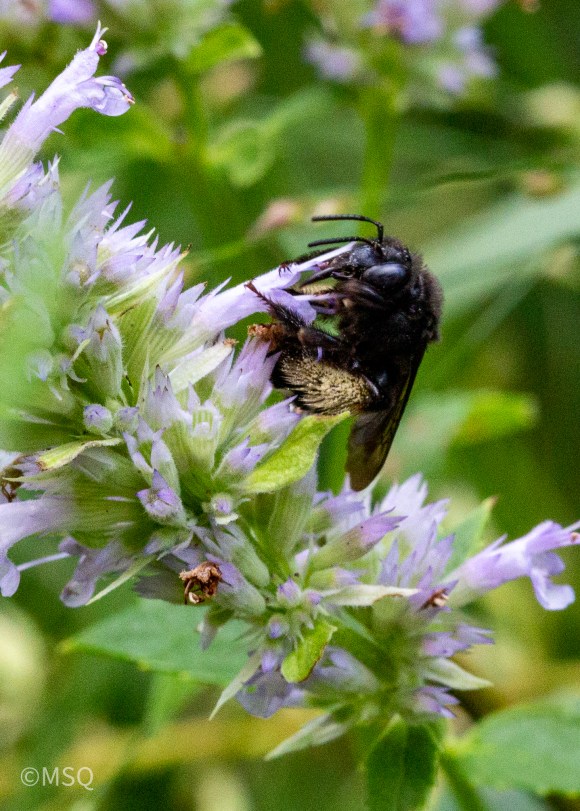
The Confused Long-Horned Bee (Melissodes confusiformis incondita) and the Denticulate Long-Horned Bee (Melissodes denticulatus) are specialist bees for Vernonia missurica.2,4,5

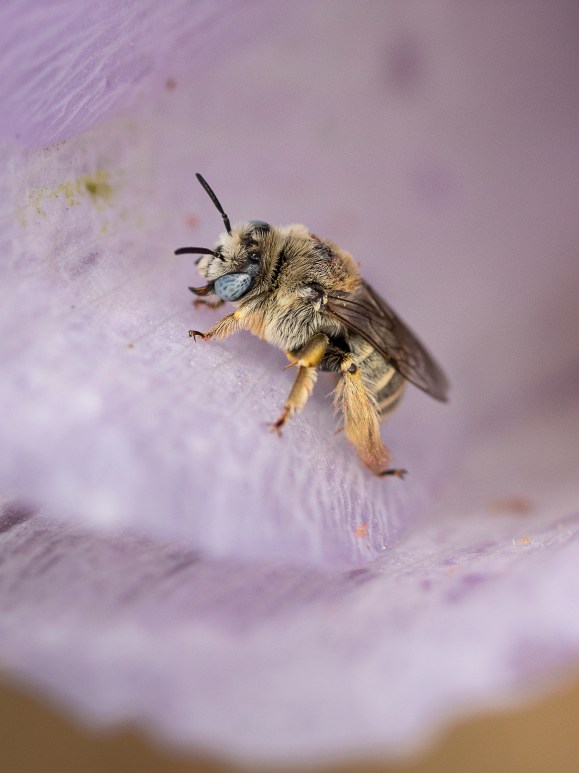
The Denticulate Long-Horned Bee is an oligolectic bee or a bee with just a few pollen sources.  The females have remarkably long antennae or “horns”.  Males’ antennae resemble other bees.1,2

Photo of Melissodes spp.

Melissodes Blue Eyed Bee Shot in Encinitas, San Diego County, California.

Melissodes denticulata flies from summer to early fall emerging in time for Ironweed’s bloom period.  They carry pollen on a hairy structure on their back legs called a scopa.  Look for Ironweed’s white pollen on their scopa, bodies and faces. 1,2  

These bees are solitary, ground-nesting bees.  Denticulate Long-Horned Bees line their nests with a waxy substance from their Dufour’s gland.  Located near the ovipositor, the Dufour’s gland discharges pheromones and secretions.  Bees mix secretions with food and/or use them to waterproof their nests.  M. denticulata’s young overwinter in the nest. 1,2

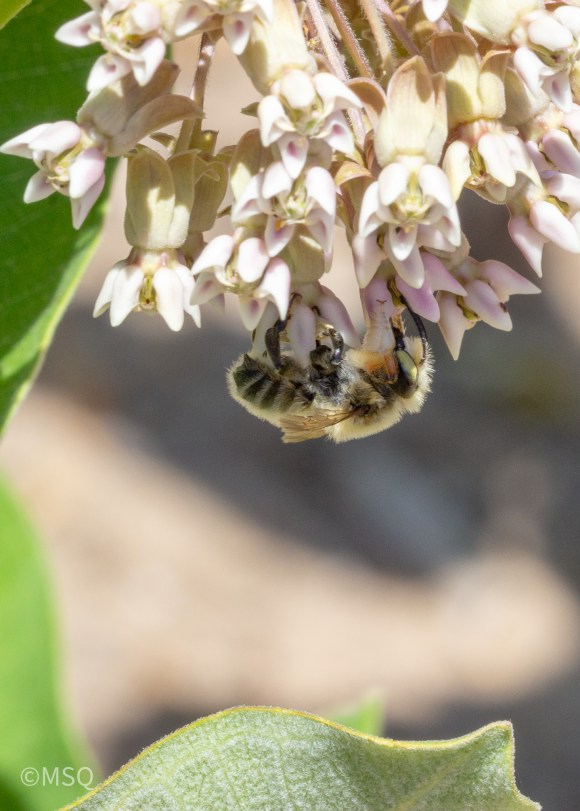
Once hatched, male M. denticulata don’t return to their home nest.  They spend their time eating and mating.  The male bees have an interesting behavior of gathering in groups on leaves or flowers overnight.  They cling there using their legs, mandibles, or both. 1,2

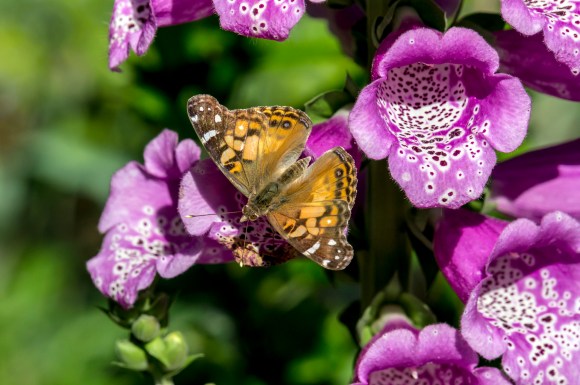
Missouri Ironweed acts as a larval host for the American Painted Lady Butterfly (Vanessa virginiensis).  The American Painted Lady or American Lady Butterfly overwinter as adults.  But they don’t survive very cold winters. 3,4

In colder areas, the population migrates from the south in the early spring.  The adults drink nectar from different plants.  They also visit tree wounds for sap and seek out the juices of decaying fruit. 3,4

American Painted Lady or American Lady (Vanessa virginiensis) butterfly

During mating periods, the males move to higher areas—hilltops or tops of large plants. These male butterflies keep watch for potential mates.  They also guard and defend their territory from other males. 3,4

Females lay eggs one at time on plant leaves.  When the larvae hatch, they use their silk to connect leaves together and make a shelter.  This is usually at the top of the plant.  The caterpillar stays in the tent eating and growing. 3,4  

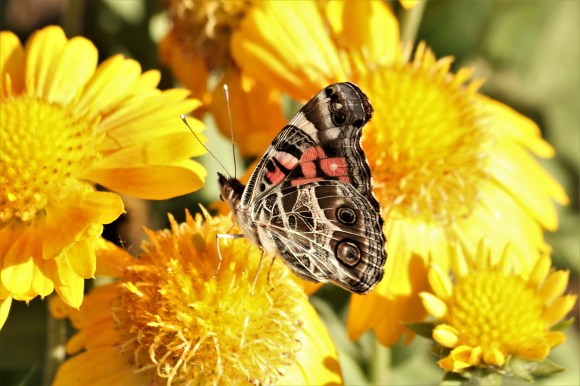
The American Painted Lady Butterfly looks like the Painted Lady butterfly (Vanessa cardui).  To identify them, look at the eyespots on the underside of the hindwing.  The American Painted Lady Butterfly has 2 large eyespots.  The Painted Lady Butterfly has 4 smaller eyespots. 3,4

Close-up of an American Lady butterfly, with wings folded, on bright yellow gaillardia flowers.

Eyespots are fascinating in nature.  Currently, they’re thought to direct a predator away from the head.  And, in fact, wing damage is often seen on butterfly’s with eyespots. 3,4

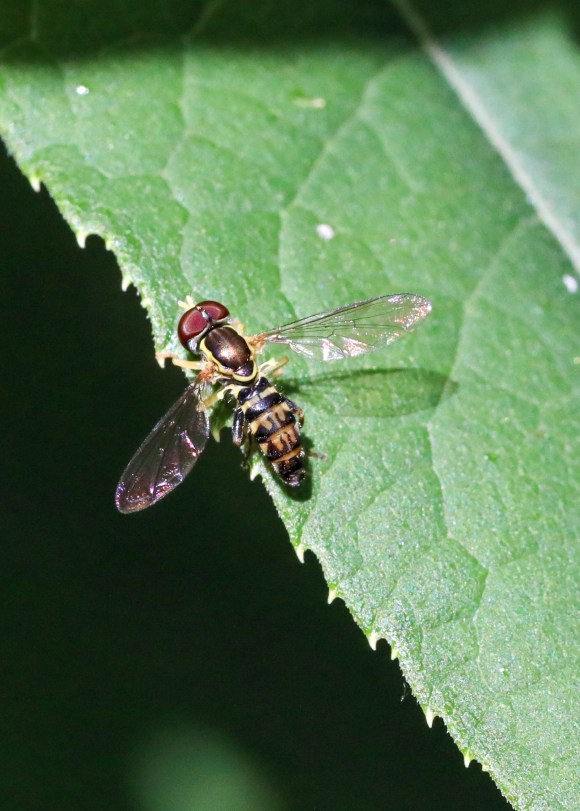
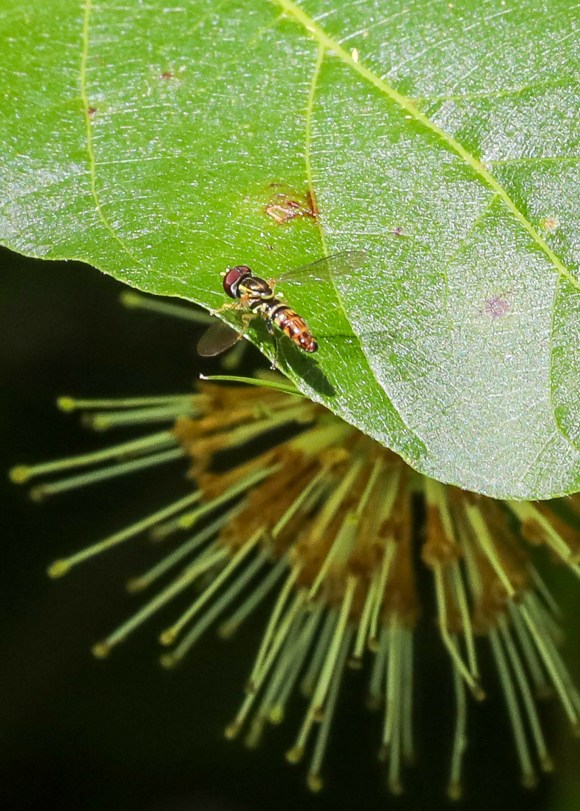
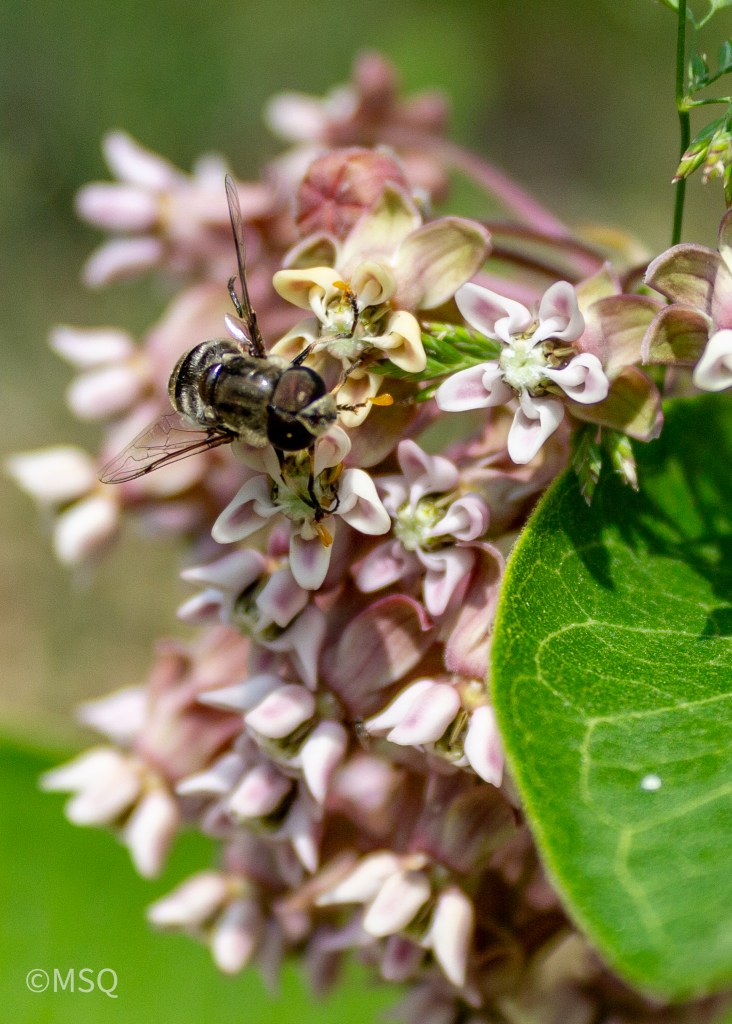
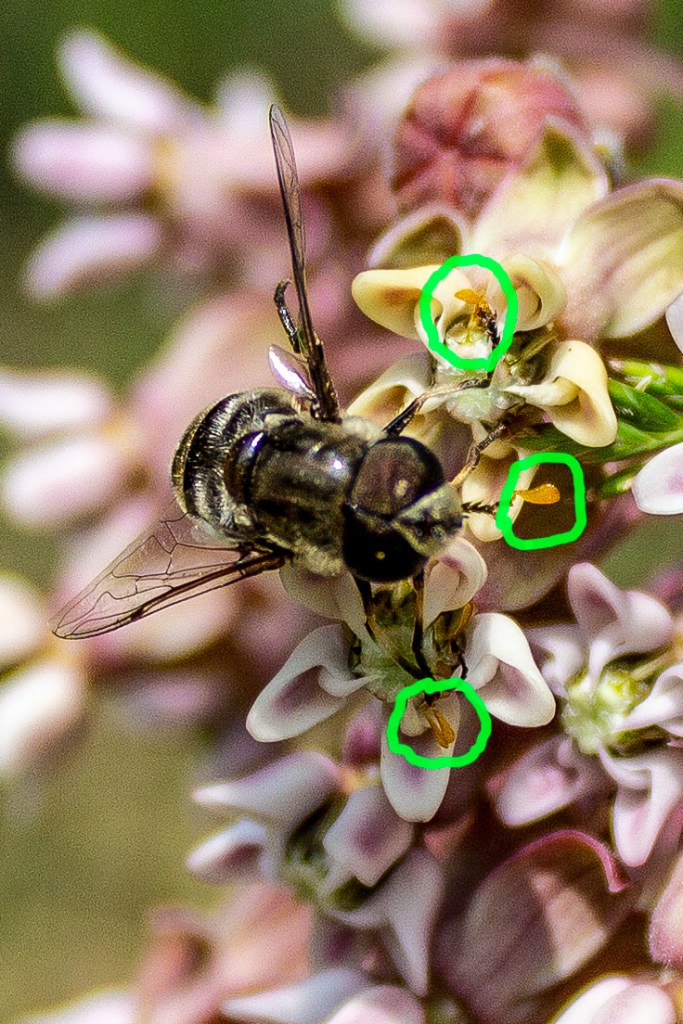
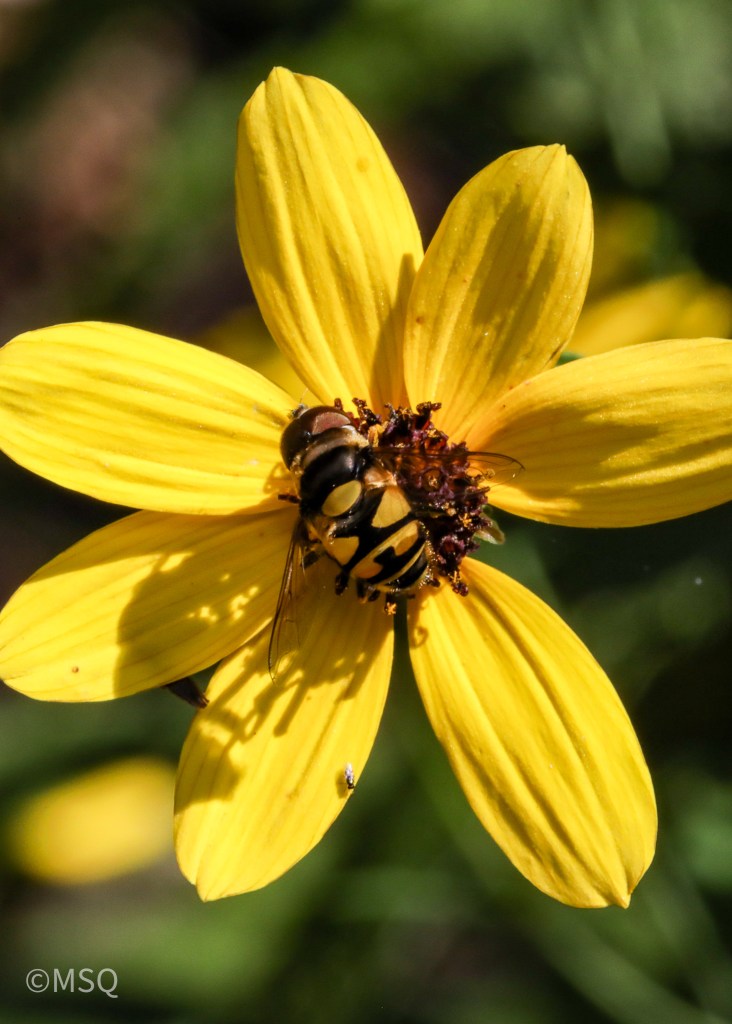
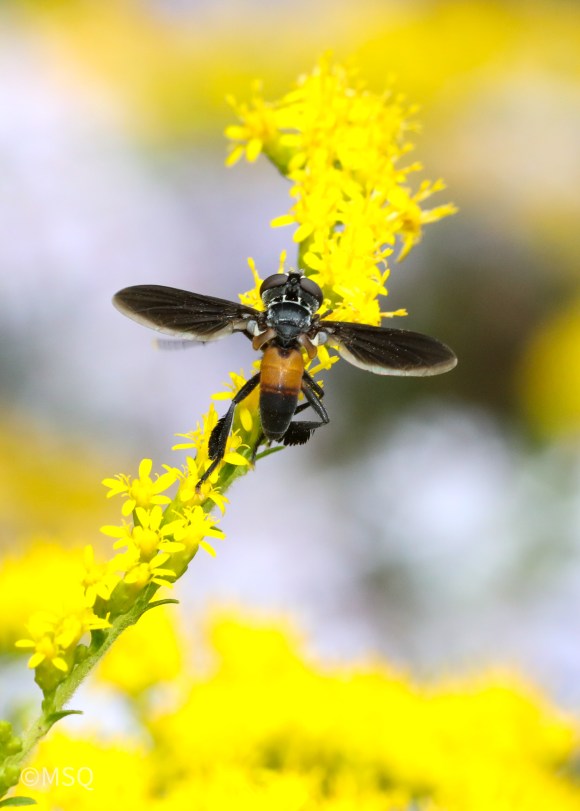
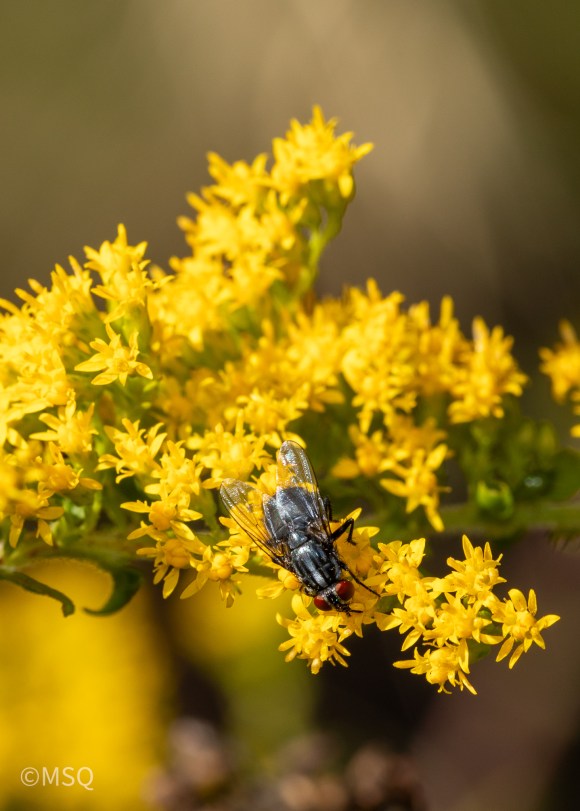
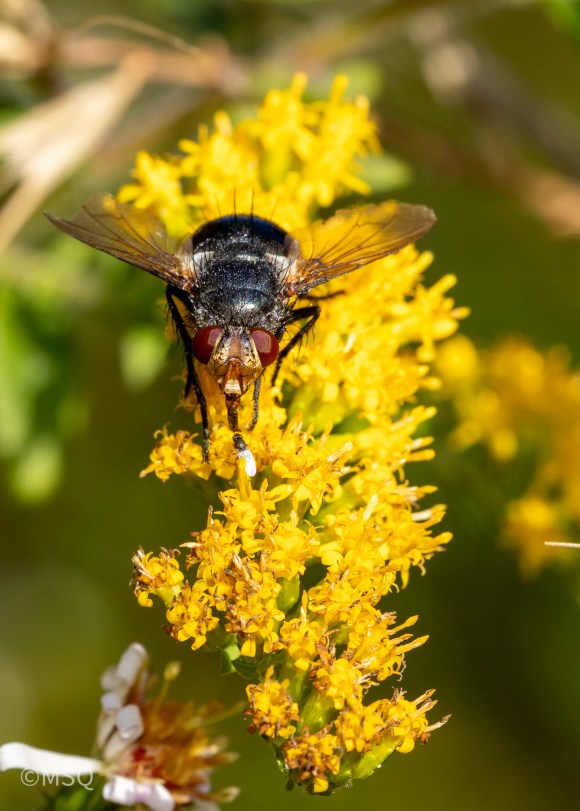
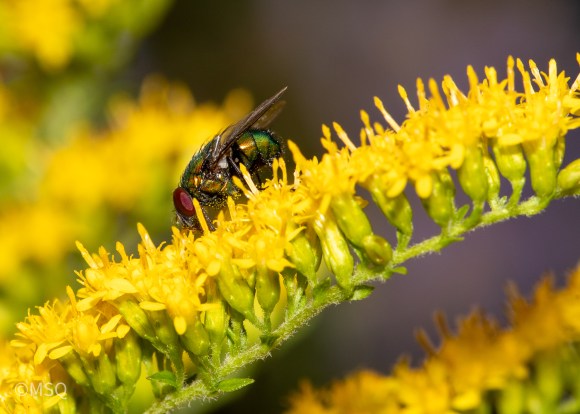
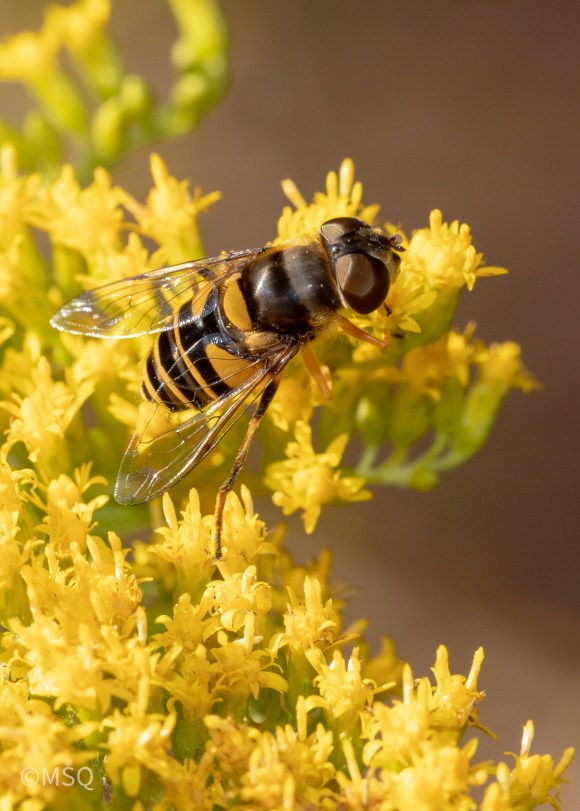
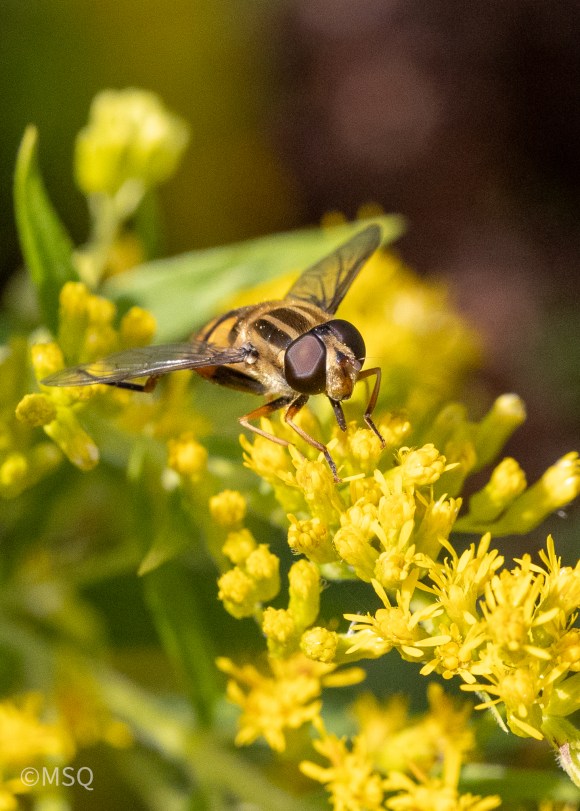
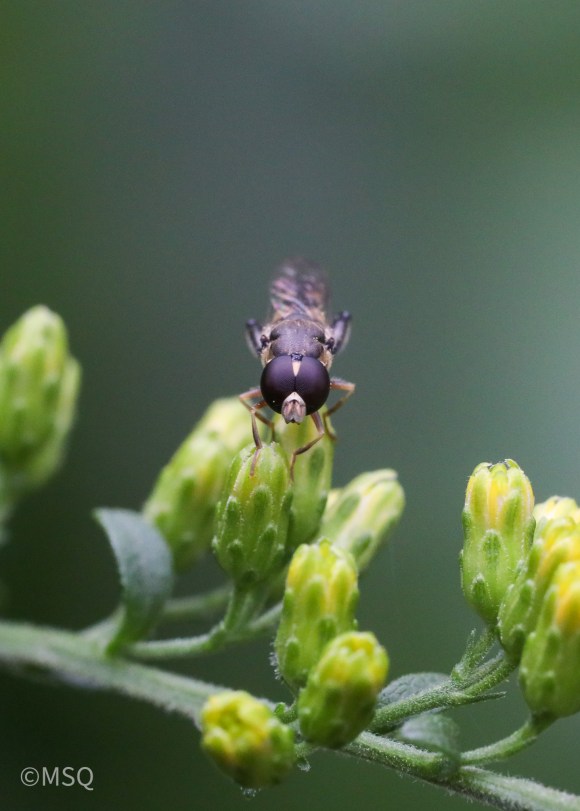
Flies also visit Vernonia missurica. These visitors include syrphid flies.

Hope you enjoyed this look at Missouri Ironweed and the creatures that share it.  I’d love to hear from you with a question or comment.  Hope all is going splendidly in your garden!

Warm Regards,

Mary

BIBLIOGRAPHY:

  1. Holm, Heather. 2017. Bees:  An Identification and Native Plant Forage Guide. Pollination Press LLC.
  2. “Ironweed Part 2: An Ironweed Specialist Bee.” 2023. August 15. https://bygl.osu.edu/index.php/node/2227.
  3. Missouri Department of Conservation. 2024. “American Lady.” March 7. https://mdc.mo.gov/discover-nature/field-guide/american-lady.
  4. Missouri Department of Conservation. n.d. “Missouri Ironweed.” Accessed October 28, 2025. https://mdc.mo.gov/discover-nature/field-guide/missouri-ironweed.
  5. “Missouri Ironweed (Vernonia Missurica).” n.d. Accessed October 28, 2025. https://www.illinoiswildflowers.info/prairie/plantx/ms_ironweedx.htm.
  6. “Vernonia Missurica – Plant Finder.” n.d. Accessed October 28, 2025. https://www.missouribotanicalgarden.org/plantfinder/PlantFinderDetails.aspx?taxonid=277486.
  7. “Vernonia Missurica (Missouri Ironweed).” n.d. Mt. Cuba Center. Accessed October 29, 2025. https://mtcubacenter.org/trials/vernonia/missurica/.
  8. “Where Do Wild Bees Go in Winter?” n.d. Accessed November 3, 2025. https://sites.tufts.edu/pollinators/2021/11/where-do-wild-bees-go-in-winter/.
  9. “You Can Never Have Too Much IRONWEED! Part 1.” 2023. August 15. https://bygl.osu.edu/index.php/node/2226.
Categories
native plants Pollinator gardening

Moons in the Wetlands

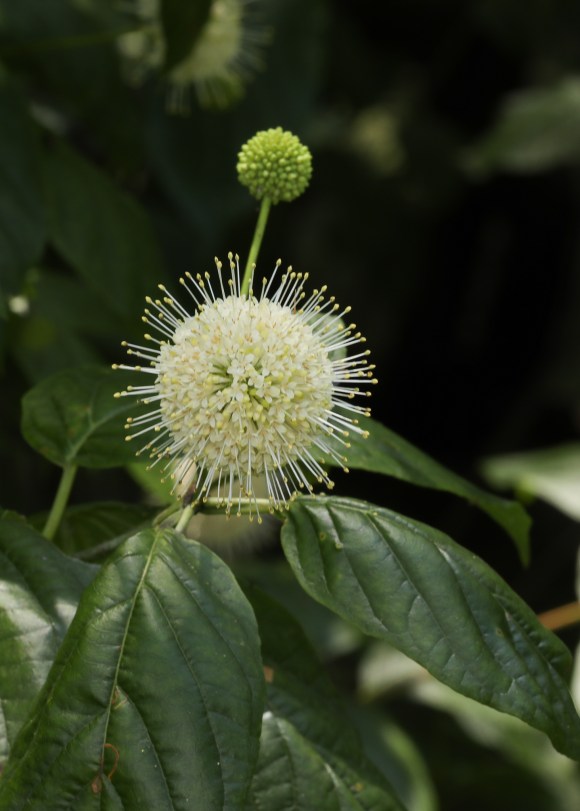
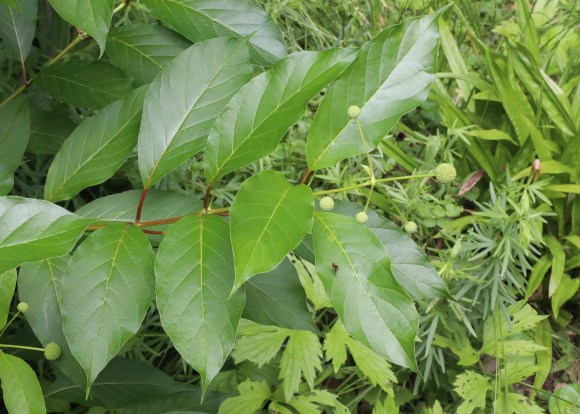
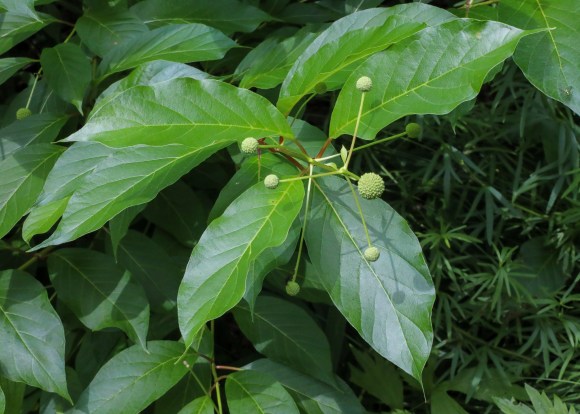
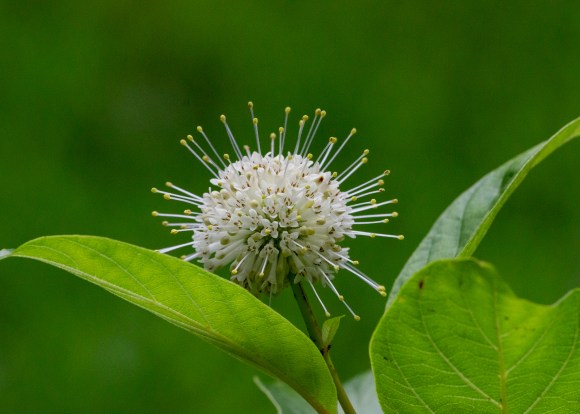
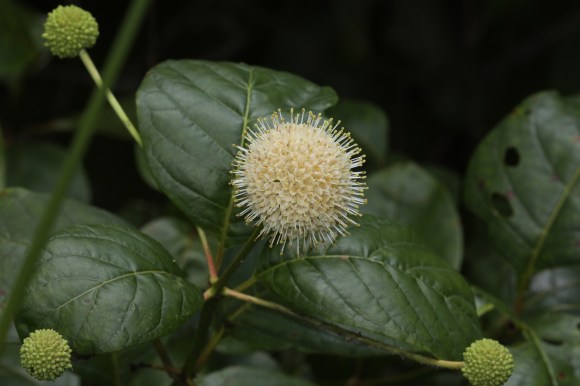
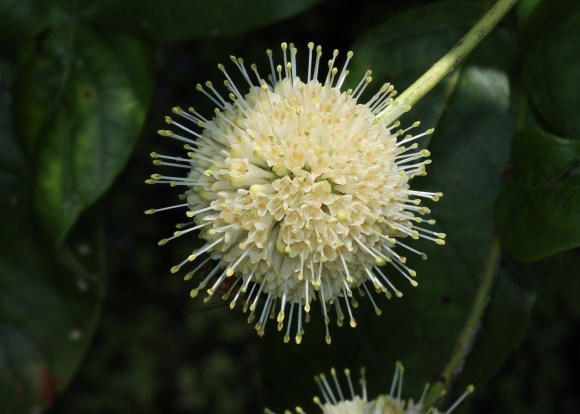
The glowing spheres of Buttonbush blooms shine in its dark foliage.  The 2023 North Carolina Wildflower of the Year, Buttonbush (Cephalanthus occidentalis) thrives in difficult wet, low spots, even shallow standing water.  It supports pollinators, beneficial insects and is a larval host.   Cephalanthus occidentalis is also a rare mid-summer blooming shrub.

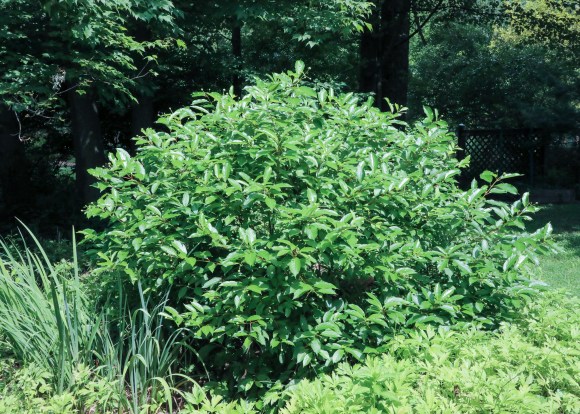
Buttonbush grows in zones 4-8.  It generally measures between 4 and 8 feet tall and spreads between 4 and 8 feet.  C. occidentalis enjoys full sun to part shade.  It flourishes in medium moisture to wet soils including shallow standing water and areas with occasional flooding.  Humusy soils, clay, loam, sand, shallow rocky soil, limestone soil, sandy loam, medium loam and clay loam all support Buttonbush.2, 3

Buttonbush grows in diverse wet habitats in nature.  These locations include wet open areas, low woods, floodplain forests, vernal pools in wooded areas, wet thickets, shrubby swamps, upland sinkholes, wet depressions in black soil prairies, marshes, bogs, seeps, seasonal wetlands, ponds, pond margins, lakes-often in water up to 3 inches, prairie swales, dry limestone bluffs, ditches, and borders of rivers, and streams.2,4

In addition to flourishing in wet conditions, Buttonbush tolerates various challenges.  It’s moderately deer resistant since its foliage contains a toxin.  This shrub works for erosion control.  Its swollen base stabilizes the plant.  It also survives competition, fire, and heat.4,12

If the species shrub becomes too big, rejuvenation pruning in early spring makes it more manageable.  Rejuvenation pruning is a technique used on multi-stemmed, twiggy shrubs.  The shrub is cut back to between 6 and 12 inches above the ground.  The individual stems are cut ¼ inch above a bud.  Cuts slope down and away from the bud at a 450 angle.   Remove dead wood as close to the ground as possible.  This method also works well Red-Twig Dogwood (Cornus sericea) and Pussy Willows (Salix discolor).7

If the species Cephalanthus occidentalis is still too large or unruly for your space, there is a smaller nativar. Buttonbush Sugar Shack grows to approximately 5 feet by 5 feet at maturity.  Sugar Shack is ball-shaped with compact growth.6

It enjoys the same conditions as the species-full to part sun and moist to wet soils.  The white flowers are similar in size and bloom from early to late summer (beginning to last blossom).  The seeds pods are red, becoming brown over the winter.  The foliage changes to burgundy in the fall.6

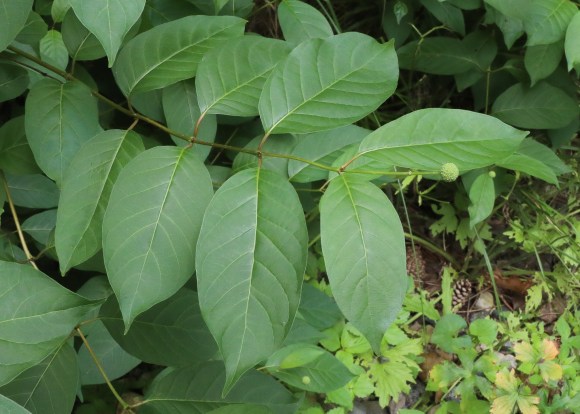
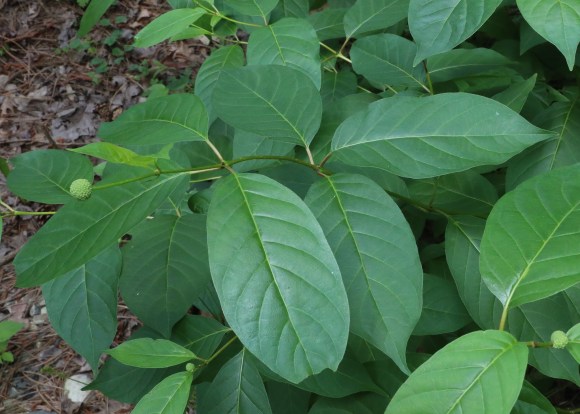
Foliage of Cephalanthus occidentalis is medium to dark green.  The leaves sit opposite each other in pairs or, occasionally, in whorls of 3.  They grow up to 6 inches long and 2.5 inches across.2

Each leaf has a smooth margin and an ovate or ovate-oblong shape.  Their upper surface is glossy, and the most common variety is hairless.  A pubescent (covered with soft, short hairs) variety also exists.  The foliage changes to yellow in the autumn.2

The spherical flowers start the show with Buttonbush.  They’re located at the top of branches or emerge from leaf axils.  These flowerheads grow from 1 to 2 inches across and are white or cream colored.2

Within the flowerhead, each floret consists of an approximately 1/3-inch-long corolla. It has 4 lobes at the opening.  There are 4 stamens and 1 undivided, white style.  The style extends beyond the floret opening.2

Buttonbush is self-incompatible and has an unusual way of releasing its pollen.  The stamens emerge first.  They shed pollen while the florets are still closed.  Then the florets open.  While the style elongates, it carries along the pollen and makes it accessible to bees and insects.

Cephalanthus occidentalis blooms for about 1 month.  The flowers are followed by red, round seedheads.  These remain throughout the winter turning brown and giving winter interest.2

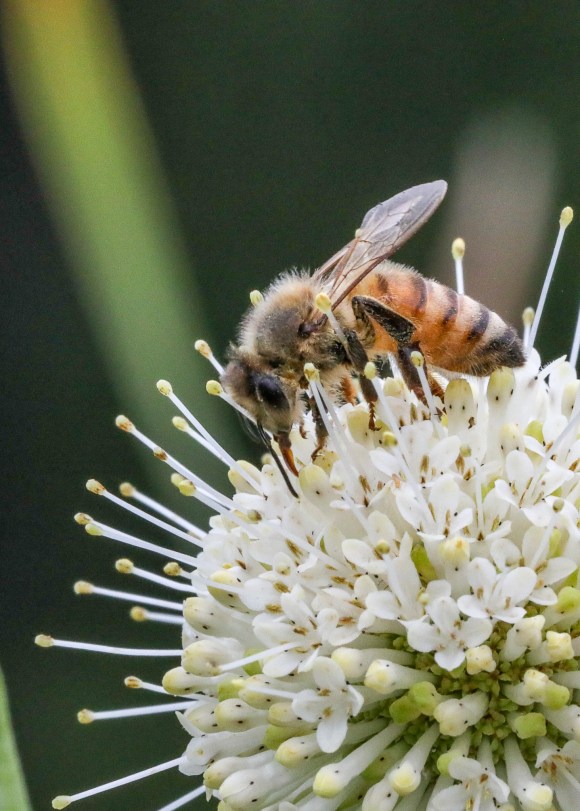
Buttonbush feeds numerous creatures.  For the insects, C. occidentalis provides nectar and pollen and is of Special Value to Native Bees, of Special Value to Bumble Bees and Special Value to Honey Bees. XERCES Butterflies, moths and skippers, also, harvest resources from the flowers as well as wasps and flies. It’s also a larval host for many moths including the spectacular Titan Sphinx Moth (Aellops titan).2

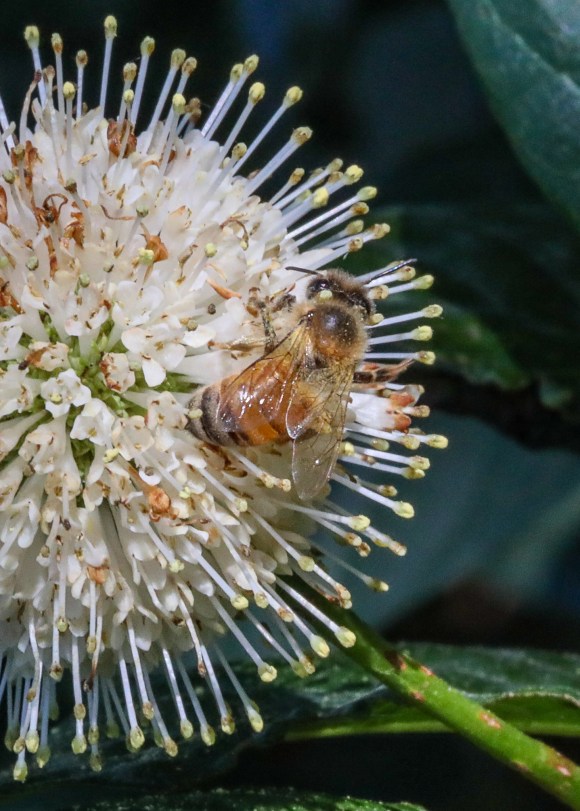
Many different bees gather nectar from Cephalanthus occidentalis.  These include  Honeybees (Apis mellifera), bumblebees (Bombus), cuckoo bees (Triepeolus spp.), long-horned bees (Melissodes spp.), leaf-cutting bees (Megachile spp.), green metallic bees (Agapostemon spp.), small carpenter bees (Ceratina spp.), yellow-faced bees (Hylaeus spp.) and large carpenter bees (Xylocopa spp.).2

In the past,  Buttonbush support a large beekeeping industry along the lower Mississippi River floodplain where the shrub thrived.  It’s still known by the common names of Honeybush, Honeybells and Honeyballs.  Honeybees continue to seek out its nectar and pollen.13

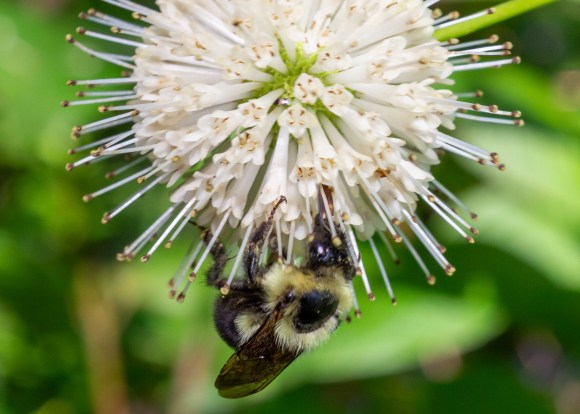
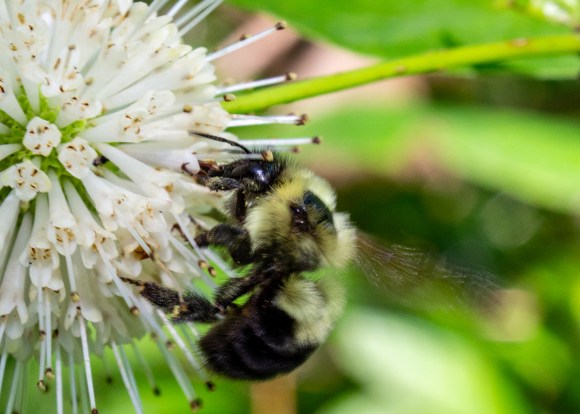
Bumble bees frequently visit C. occidentalis when it’s flowering.

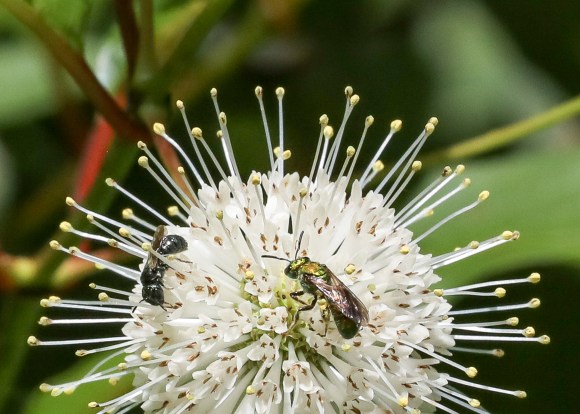
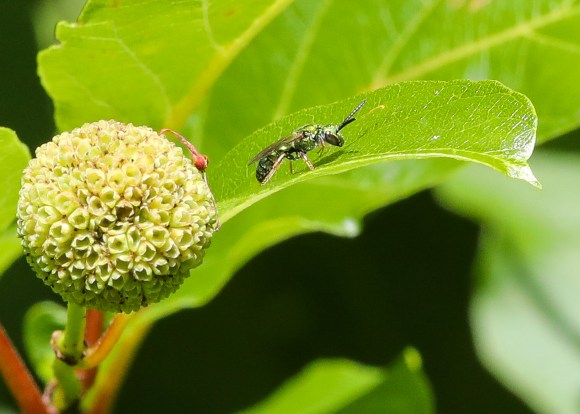
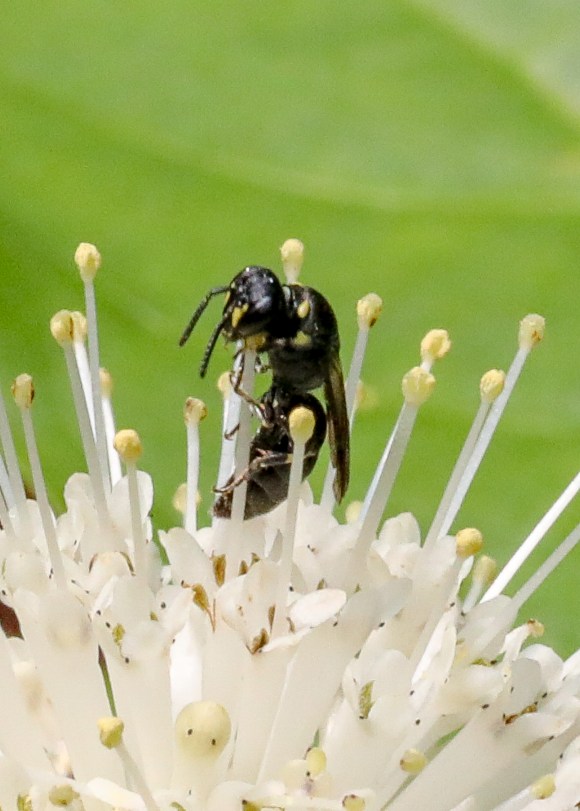
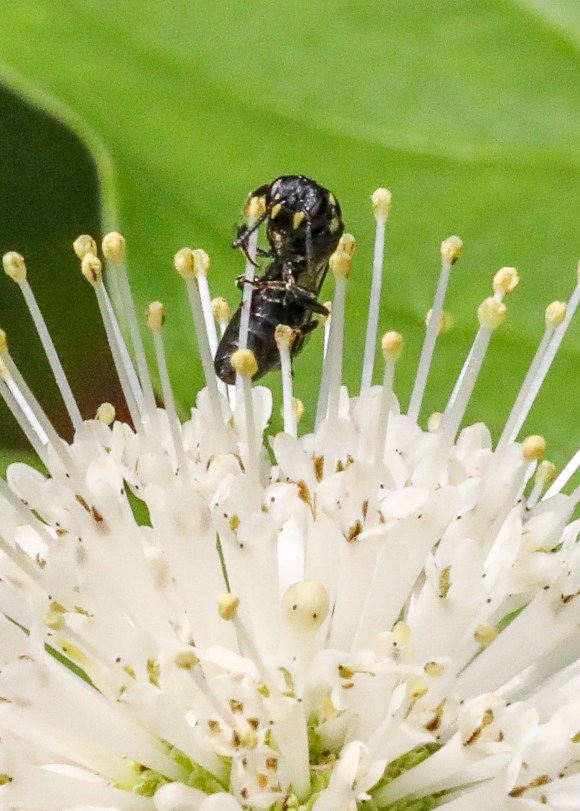
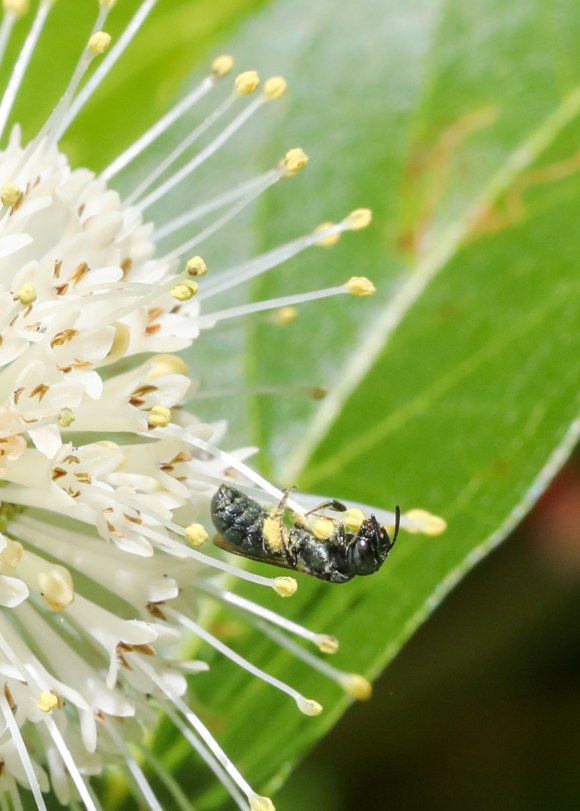
Small bees gather resources at Buttonbush, climbing in and out of the florets.  These pollinators include small carpenter bees (Ceratina spp.), green metallic bees (Agapostemon spp.), and yellow-faced bees (Hylaeus spp.).

There are 366 species of small carpenter bees (Ceratina spp.) throughout the world (except Oceania).  27 species live in the United States with 5 in the Eastern US and Canada.8,11  Despite their name, they’re not closely related to the carpenter bee, Xylocopa. 

 Ceratina are stem nesting bees that need pithy centers.  They nest in perennials and woody stems.  The female excavates a long nesting tunnel and uses the stem pith to create cell divisions.  Once the nest is full, the female guards the entrance.  She makes a yellow, strongly citral-scented secretion that is excreted from her mandibles (“jaws”).  The mother smears this on the nest entrance to repel predators.8,11

Ceratina show some unusual and fascinating social behaviors.  Unlike other bees, small carpenter bees live a long time, 12 to 16 months.  In temperate climates like the Northeast and Great Lake, this means through the winter.  

These bees care for their young throughout this time.  The mother removes the nest partitions each evening and grooms her young.  This behavior is believed to reduce parasites and remove any developing fungal infections from the nest.  These mother-offspring interactions separate Ceratina from other solitary bees and are considered subsocial.8,11

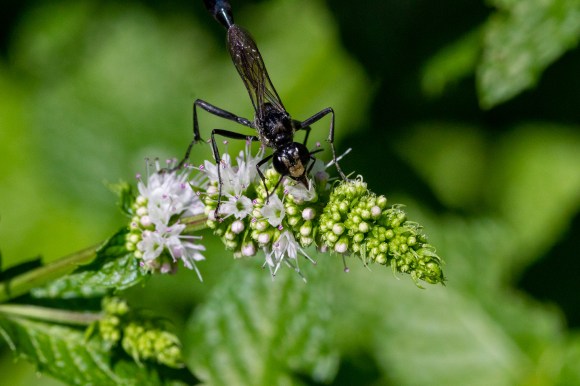
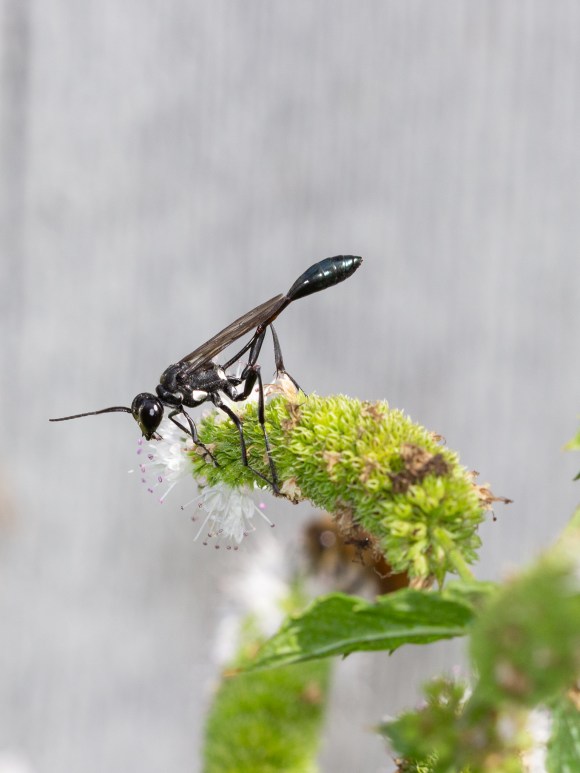
Various wasps drink nectar from Cephalanthus occidentalis.  Scoliid wasps (Dielis spp.), Carrot or Gasteruption wasps (Gasteruption spp.), and  Thynnid Flower wasps (Myzinum spp.) are solitary, parasitic or parasitoid wasps which visit Buttonbush.  In addition, the solitary wasps, Mason wasps (Monobia spp.), Cuckoo wasps (Parnopes spp.), (Pseudodynerus spp.), and Thread-Waisted wasp (Sphex spp). also use C. occidentalis.   Finally, the very social yellow jacket, (Vespula spp.) gathers nectar from this shrub.9

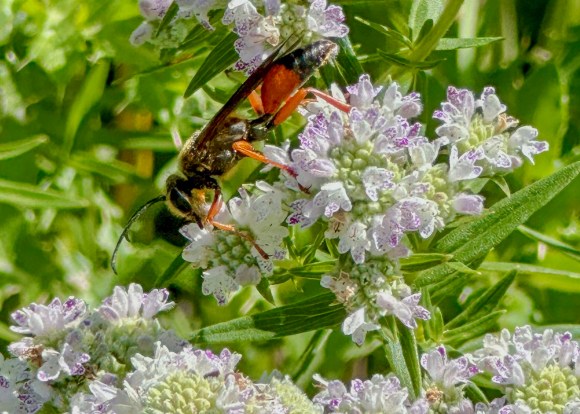
The Great Golden Sand Digger Wasp (Sphex ichneumoneus) is a beautiful, beneficial wasp.  This digger wasp hunts cicadas and true crickets to provision its nests.  The female constructs a vertical nest with 2 or 3 side cells for eggs. She lays her egg on the first prey and adds 1 to 5 more.  The number of nests per year vary depending on the length of growing season.  Like other solitary wasps, the Great Golden Sand Digger Wasp is not aggressive, and, in fact, the male doesn’t have a stinger.9,10

Thick-headed flies and Syrphid flies gather nectar from Buttonbush flowers.2

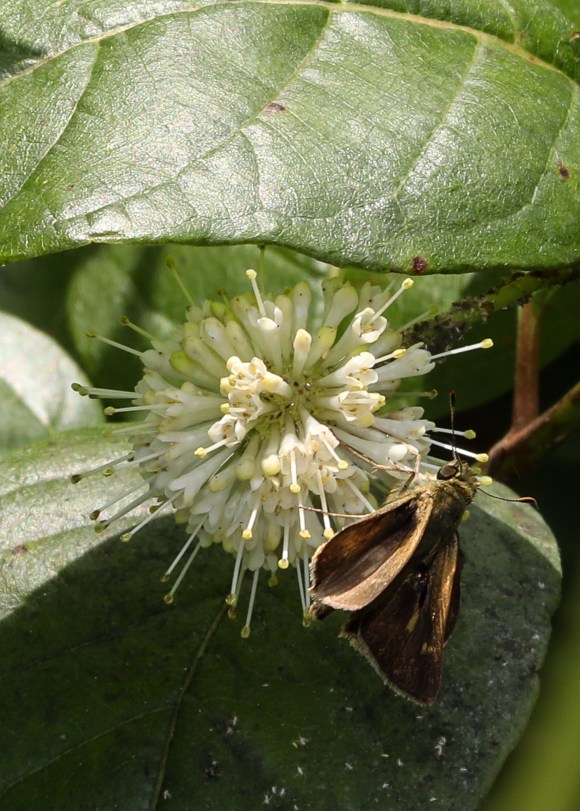
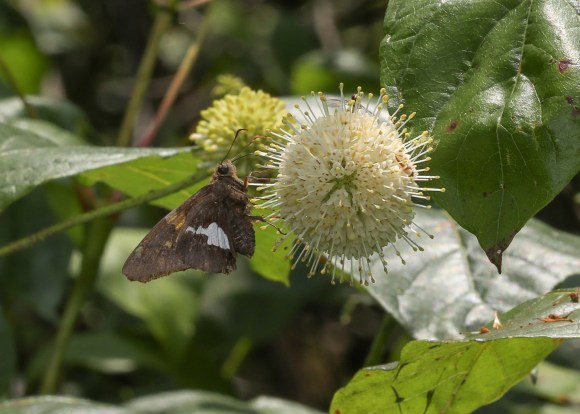
Buttonbush serves adult butterflies, moths and skippers.2,5,13  They visit its blooms for nectar.

Several moths use this shrub as a larval host including some spectacular ones.  The Titan Sphinx (Aellops titan), the Hydrangea Sphinx (Darapsa versicolor), and the  Royal Walnut Moth (Cithermia regalis) larvae all feed off the Cephalanthus occidentalis plant.2,5,13

Hope you’ve enjoyed this dive into Cephalanthus occidentalis!  Look for it blooming when you’re near water.  Check for it at the edges of wetlands by roadside ditches. 

Enjoy Summer and Happy Gardening,

Mary

BIBLIOGRAPHY:

  1. “Bird Table (Cephalanthus Occidentalis).” Accessed July 1, 2025. https://www.illinoiswildflowers.info/trees/tables/table283.html.
  2. “Buttonbush (Cephalanthus Occidentalis).” Accessed July 1, 2025. https://www.illinoiswildflowers.info/trees/plants/buttonbush.htm.
  3. “Cephalanthus Occidentalis – Plant Finder.” Accessed July 1, 2025. https://www.missouribotanicalgarden.org/PlantFinder/PlantFinderDetails.aspx?kempercode=g830.
  4. “Cephalanthus Occidentalis (Buttonbush, Button Bush) | North Carolina Extension Gardener Plant Toolbox.” Accessed July 1, 2025. https://plants.ces.ncsu.edu/plants/cephalanthus-occidentalis/.
  5. “Cephalanthus Occidentalis (Common Buttonbush) | Native Plants of North America.” Accessed July 1, 2025. https://www.wildflower.org/plants/result.php?id_plant=ceoc2.
  6. “Cephalanthus Occidentalis ‘SMCOSS’ SUGAR SHACK – Plant Finder.” Accessed July 1, 2025. https://www.missouribotanicalgarden.org/PlantFinder/PlantFinderDetails.aspx?taxonid=443503&isprofile=0&.
  7. Fogerty, Elane, New Jersey Agricultural Experiment Station.  Pruning Flowering Shrubs.  Cooperative Extension Fact Sheet FS1221.  December 2013.
  8. Holm, Heather. Bees:  An Identification and Native Plant Forage Guide. Minnetonka, MN: Pollination Press LLC, 2017.
  9. Holm, Heather. Wasps:  Their Biology, Diversity, and Role as Beneficial Insects and Pollinators of Native Plants. Minnesota: Pollination Press LLC, 2021.
  10. Missouri Department of Conservation. “Great Golden Digger Wasp.” Accessed July 1, 2025. https://mdc.mo.gov/discover-nature/field-guide/great-golden-digger-wasp.
  11. Rehan, Sandra M. “Small Carpenter Bees (Ceratina).” In Encyclopedia of Social Insects, edited by Christopher K. Starr, 1–4. Cham: Springer International Publishing, 2020. https://doi.org/10.1007/978-3-319-90306-4_106-1.
  12. Wennerberg, Sarah. USDA NRCS. Plant Guide:  Common Buttonbush, Cephalanthus occidentalis L. Plant Symbol=CEOC2, Last edit:  05 June 2006, https://plants.usda.gov/DocumentLibrary/plantguide/pdf/pg_ceoc2.pdf
  13. Xerces Society. “Planting for Pollinators: Button Bush.” Accessed July 1, 2025. https://www.xerces.org/blog/planting-for-pollinators-button-bush.
Categories
Pollinator gardening

Furry Little Tails

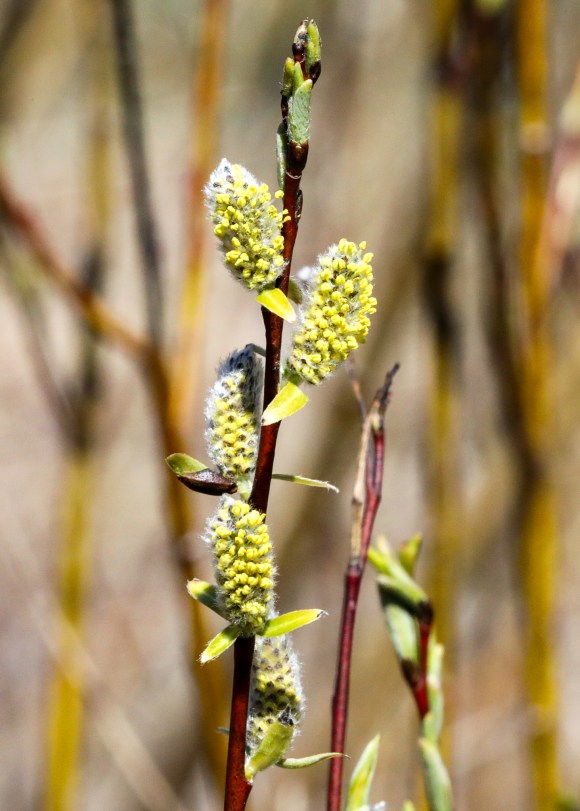
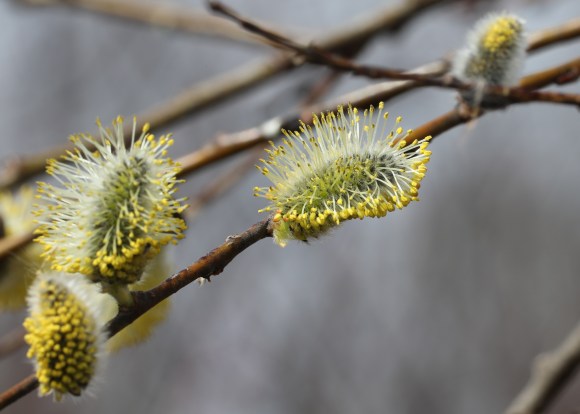
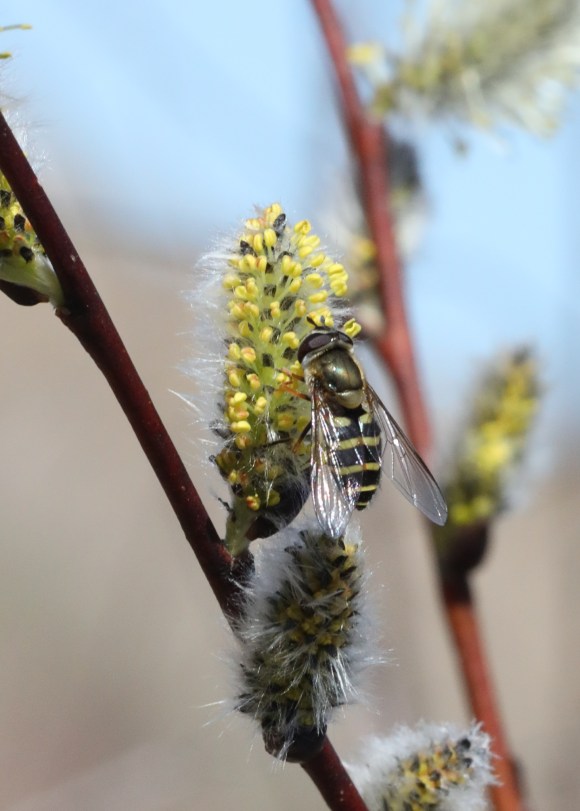
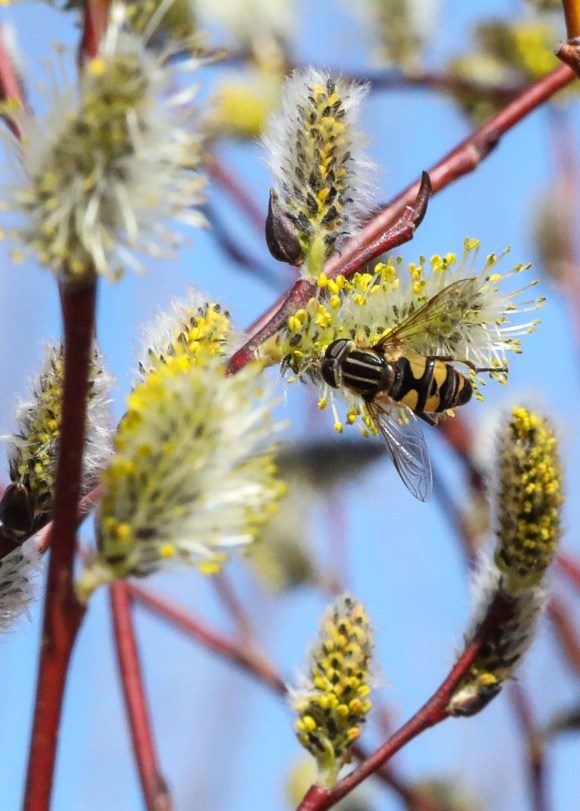
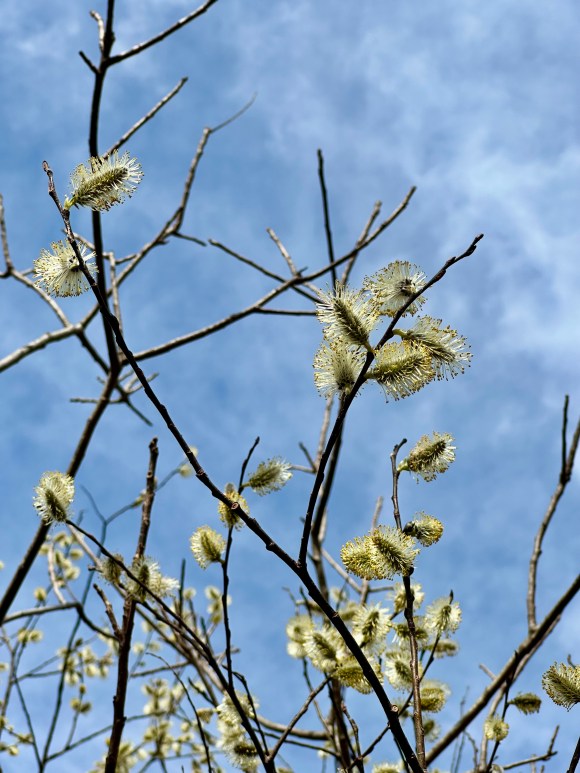
Just as the snow disappear, the small bumps on Pussy Willow (Salix discolor) branches lengthen into soft, furry, gray catkins.  Soon they burst into bright yellow blooms before spring ephemerals and other early trees and shrubs.  Their nectar and pollen draw early bees, flies, wasps, adult butterflies and other insects. 4,9

 Later, this willow is a larval host to many butterflies, moths and skippers.  In addition, many insects feed on and/or use this plant.  The caterpillars and insects support an abundance of bird life especially during nesting season.9

Salix discolor thrives in zones 2 through 8.  It generally grows from 6 to 15 feet and spreads from 4 to 12 feet.  For a smaller shrub, cut it back every 3 to 5 years after flowering.  This pruning encourages lots of new growth.5,6

Pruning is especially important when Salix is growing in wet conditions.  Pussy willow forms suckers freely.  Cutting helps control the suckers also.5,6,7

Pussy willows love wet soils but do tolerate medium moisture soils.  They grow in sandy and non-sandy soils with around neutral pH and some decaying matter.  Salix discolor enjoys part to full sun.  They’re resistant to deer, erosion and Black Walnuts (Juglans nigra).5,6

Its natural habitats include soggy thickets, fens, wet prairies, low ground, floodplain forests, marshes, low areas along rivers and other bodies of water, ditches, and shrub swamps.  If too many trees grow, the Pussy Willows die out.9

Salix discolor has male and female flowers on different shrubs, also called dioecious.  Males are yellow with pollen, females are green. The specific epithet discolor comes from the two different colored flowers.  Blooms develop on second year twigs.7,9

The male bloom starts as a furry pearl-gray catkin.  The soft dense hairs protect the florets from the cold.  As they open, tight round stamens poke through the fur.  When the stamens are fully extended, the male blossoms turn bright yellow.  Each floret has 2 stamens. The catkin grows up to 1 inch long.9

Spikey and green, the female catkins mature from 1 to 4 inches long.  Each floret has 1 pistil with a pair of tiny stigmata at the top.  The pistil forms a narrow lance-like shape and had tiny, fine, grayish-white hairs.9

Pussy Willow leaves are more oval than other willows.  They grow up to 4 inches long and 1.5 inches across and alternate on the stem.  The edges are irregularly toothed to smooth.  The leaves themselves are medium to dark green and hairless on top.  Underneath, they are hairless, covered with a greenish-white bloom and whitened.  Petioles are up to ¾ inches long and range from smooth to slightly hairy.9  

A few plant facts:  some petioles have stipules where they join the stem.  A stipule is a small structure at the base of a leaf and can be helpful in identifying a plant.  Pussy Willow have largish stipules on both sides of the petiole—1/4 inch long and across.  They are heart-shaped and toothed or lobed.

Salix discolor is a handful.  It’s known to grow tall and wide.  Why choose it for you garden?

S. discolor is a keystone plant and an outstanding one at that. For the Eastern Temperate forests, my area, Salix spp. appears on the Top Keystone Plant Genera list, Top 30 Keystone Plant Genera for Butterfly and Moth Caterpillars and Top 30 Native Host plants for Pollen Specialist Bees.  Keystone plants play an essentially role in their Ecoregions sustaining generalist and specialist pollinators.4

The Xerces Society for Invertebrate Conservation designates Salix discolor as of Special Value to Native Bees, Special Value to Bumble Bees and Special Value to Honey Bees.  While this Willow can become large, it is possible to contain it to a smaller site.  Other native Willows are trees which become much taller and aren’t suited to compact areas.6

A note to readers:  Usually I use all my own photos for my blogs.  Sadly, I don’t have all the images I want for this month.  I’ll be including pictures of pollinators and other insects on other plants and some stock photos.  Thank you for your patience!

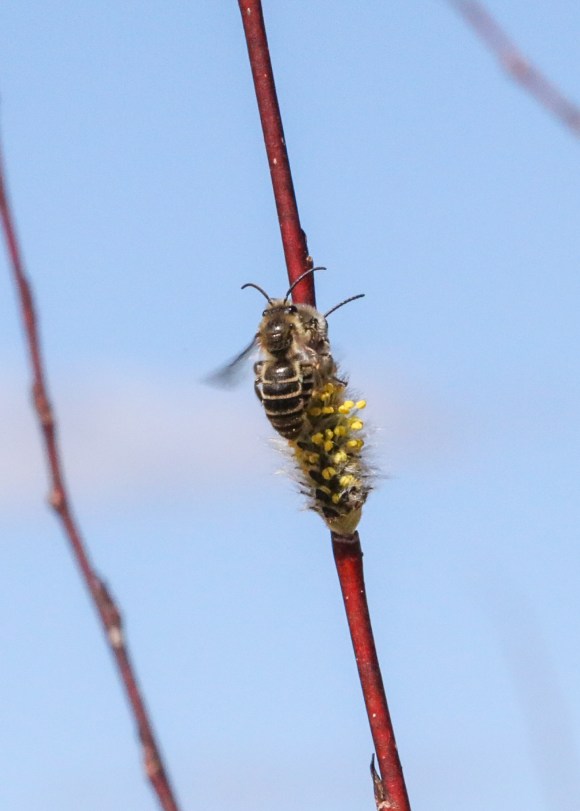
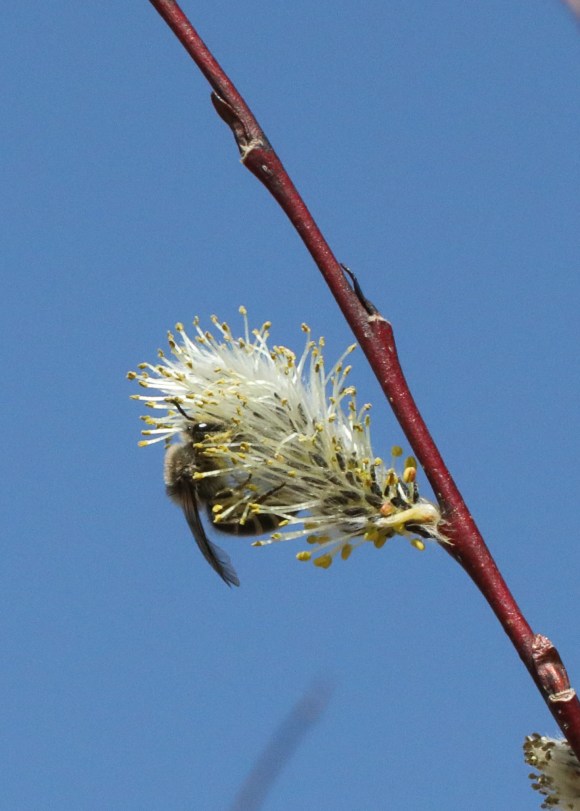
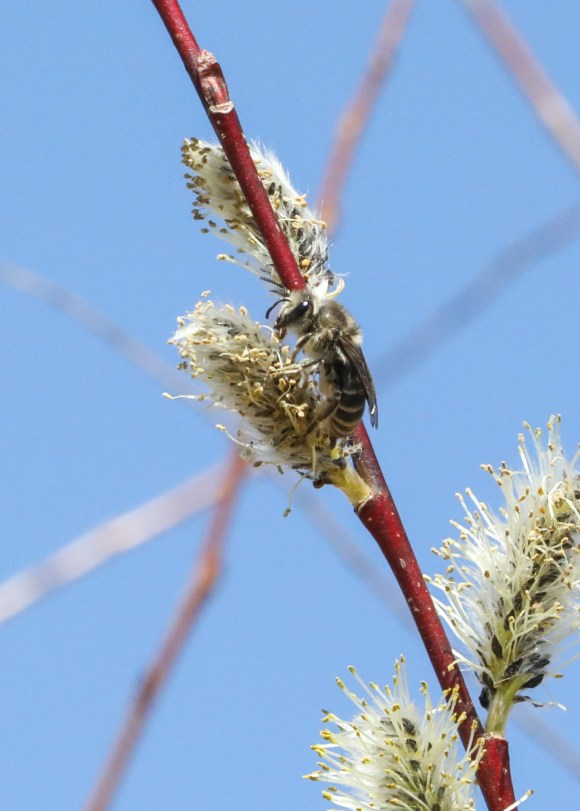
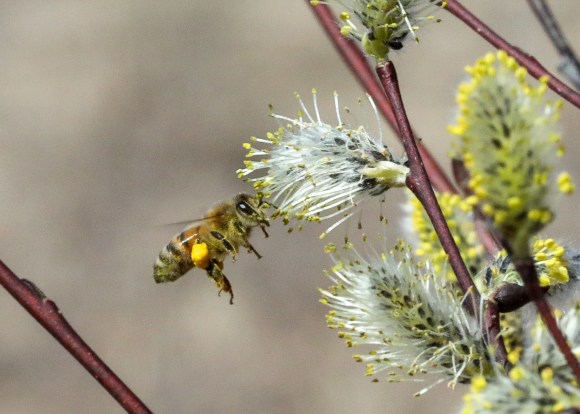
Insects are abundant on the Pussy Willow.  Many pollinators feed on the nectar and pollen.  Bee guests include honeybees, bumblebees, little carpenter bees (Ceratina spp.), cuckoo bees (Nomada spp.), mason bees (Osmia spp.), Halictid bees (including green metallic bees) and Andrenid bees (Andrena spp).

Several Andrenid bees are specialists of willows.  Specialists (aka oligoleges) collect pollen from only one genus or species or only a few genera or species.  These Andrenid bees include:  Andrena (Parandrena) andrenoides, Andrena (Thysandrena) bisalicis, Andrena (Tylandrena) erythrogaster, Andrena (Andrena) frigida, Andrena (Micrandrena) illinoiensis, Andrena (Andrena) macoupinensis, Andrena (Trachandrena) mariae, Andrena (Parandrena) nida, Andrena (Micrandrena) nigrae, Andrena (Micrandrena) salictaria, Andrena (Parandrena) wellesleyana.7,9

In addition to these oligoleges, generalists also collect resources from Salix discolor.  Honeybees and bumblebees are among them.

Small bees gather pollen and nectar from Pussy Willows including little carpenter bees (Ceratina spp.), mason bees (Osmia spp.) and Halictid bees (including green metallic sweat bees).

Ichneumonid wasps harvest pollen and nectar from  S. discolor.  These parasitoid wasps prey on immature stages of many insects and spiders.  They help control populations in natural and semi-natural systems.2

Willows are larval hosts for 289 different species of butterflies, skippers and moths.  Examples include many butterflies (i.e., Nymphalis spp. and Polygonia spp. ),  hairstreak butterflies (Satyrium spp.), Viceroy butterflies (Limenitis archippus) and other brush-footed butterflies (Nymphalidae).4,9

The Viceroy has a special relationship with willows.  Its larvae feed at night on the catkins and then the leaves after flowering.  Unlike other butterflies, adults don’t visit flowers.  They drink from tree sap, rotting fruit, honeydew-an excretion from aphids, animal droppings, and mud puddles.8

Large leaf being eaten by viceroy butterfly caterpillar

Honeydew is an excretion from sap-eating aphids.  These aphids concentrate the sap they drink to harvest the protein.  They excrete the excess liquid and sugars as honeydew.  Willows host 22 species of aphids providing an excellent place for Viceroys to hunt for food.3,8

Viceroy Butterfly feeding on nectar from a wildflower.

Moth larvae also consume Salix spp. including tiger moths (Arctiidae), Geometer moths, leaf blotch miner moths (Gracillariidae), slug caterpillar moths (Limacodidae), Lyonet moths, owlet moths (Noctuidae), prominent moths (Notodontidae), giant silk moths (Saturniidae), and Sphinx moths (Sphingidae).9

In addition, hordes of other kinds of insects use willows in various ways.  Among these are flies, beetles, borers, weevils, gall flies, various true bugs, thrips, sawflies, and 22 different kinds of aphids.  You can see a full list in the Insect Table from Illinois Wildflowers (https://www.illinoiswildflowers.info/trees/tables/table65.html).3  

OK, this doesn’t sound like great news.  But, because of all these insects, birds gather many resources from willows.  Wood Duck, Northern Pintail, Mallard, Common Redpoll, Evening Grosbeak, Pine Grosbeak, American Goldfinch, Common Grackle, and Ruffed Grouse all visit willows.  (Bird Table, https://www.illinoiswildflowers.info/trees/tables/table66.html)1

Even Salix discolor’s rapid growth is good news.  A variety of animals use or consume parts of the willow.  Prairie Voles, Meadow Voles, Fox Squirrels and Black Bears eat leaves, buds and/or catkins.  Cottontail Rabbits and Muskrats feed on the bark.  Beavers eat bark and wood and use the branches for dams and lodges.    Snapping Turtles and Wood Turtles forage on fallen leaves.9

There’s so much life around the Pussy Willow!  From the very beginning of Spring through the year, this shrub nurtures insects and animals.  What a grand addition to any garden!

I hope you enjoyed this blog!  Please send me your stories and questions. I’d love to hear from you!

Happy Gardening!

Mary

Bibliography:

  1. “Bird Table (Salix Spp.).” Accessed April 30, 2025. https://www.illinoiswildflowers.info/trees/tables/table66.html.
  2. Missouri Department of Conservation. “Ichneumon Wasps.” Accessed April 30, 2025. https://mdc.mo.gov/discover-nature/field-guide/ichneumon-wasps.
  3. “Insect Table (Salix Spp.).” Accessed April 30, 2025. https://www.illinoiswildflowers.info/trees/tables/table65.html.
  4. National Wildlife Federation. “Keystone Native Plants, Eastern Temperate Forests-Ecoregion 8.  Accessed April 29, 2025.  https://www.nwf.org/-/media/Documents/PDFs/Garden-for-Wildlife/Keystone-Plants/NWF-GFW-keystone-plant-list-ecoregion-8-eastern-temperate-forests.ashx?la=en&hash=1E180E2E5F2B06EB9ADF28882353B3BC7B3B247D
  5. “Salix Discolor – Plant Finder.” Accessed April 28, 2025. https://www.missouribotanicalgarden.org/PlantFinder/PlantFinderDetails.aspx?kempercode=c808.
  6. “Salix Discolor (Pussy Willow) | Native Plants of North America.” Accessed April 28, 2025. https://www.wildflower.org/plants/result.php?id_plant=sadi.
  7. “Salix Discolor (Pussy Willow) | North Carolina Extension Gardener Plant Toolbox.” Accessed April 28, 2025. https://plants.ces.ncsu.edu/plants/salix-discolor/.
  8. Missouri Department of Conservation. “Viceroy,” January 31, 2024. https://mdc.mo.gov/discover-nature/field-guide/viceroy.
  9. “Pussy Willow (Salix Discolor).” Accessed April 28, 2025. https://www.illinoiswildflowers.info/trees/plants/pussy_willow.htm.
Categories
native plants Pollinator gardening

A Delicate Pink Star

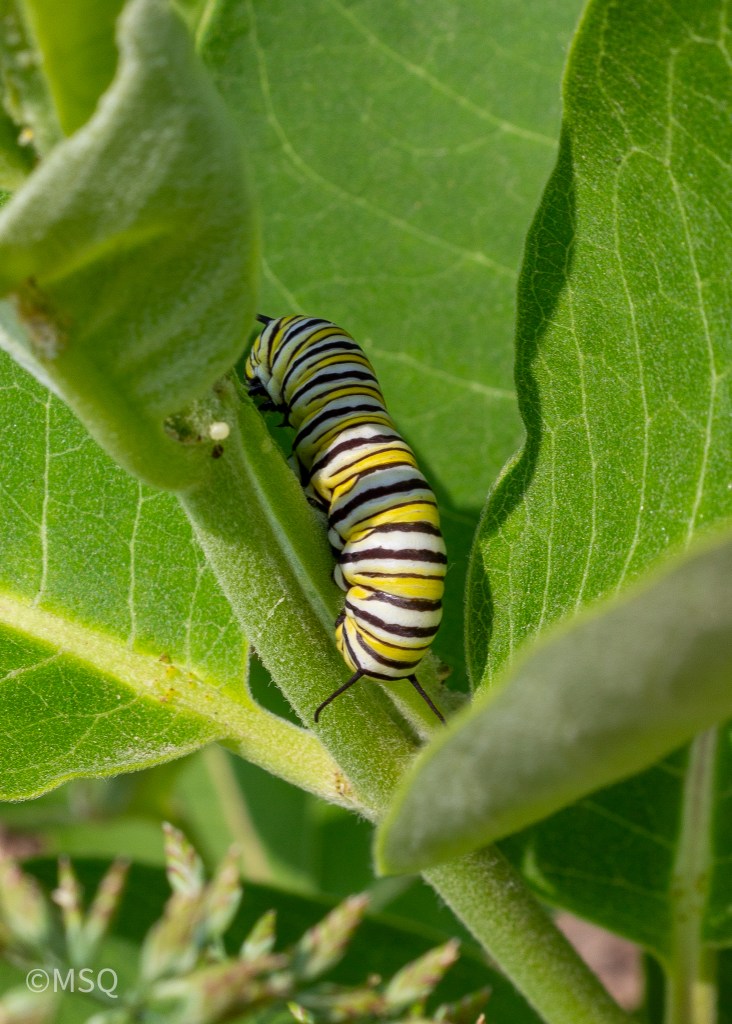
The elaborate blooms of Asclepias incarnata (a.k.a. Swamp Milkweed or Rose Milkweed) draws crowds of pollinators and beneficial insects.   Like other milkweeds, Rose Milkweed feeds Monarch butterfly caterpillars.  This milkweed received the 2005 North Carolina Wildflower of the Year award.  The North Carolina Botanical Garden and the North Carolina Garden Club co-sponsor this award.3

 Asclepias incarnata varies in height from 2 to 5 feet but is typically 3 to 4 feet.  It spreads from 2 to 3 feet.  Rose milkweed grows in zones 3 through 9.3

Although it thrives in medium to wet, neutral to slightly acidic soils with full sun, it adapts to a variety of conditions.  Rose milkweed is one of the few ornamentals that grows in mucky clay.  It tolerates average to occasionally wet soils. high organic matter soils and loam (silt) soils.3,4,5,6,7

In nature, Rose milkweed is found in sunny openings and edges of swamps, river bottomlands, wet meadows, marshes, bogs, fens, open areas along stream banks and ditches, open to partly shaded areas in floodplain forests, thickets, moist black soil prairies, low areas around rivers and ponds, seeps, fens and marshes.  It grows in both natural and disturbed areas.3,7

I’ve grown Rose Milkweed for several years.  Moisture varies across my garden from with average to wet.  In the average soils, Asclepias incarnata plants grow to gorgeous specimens 4 feet high and across.  Unfortunately, then it dies back to one or two shoots.  I never lose it completely though since it reseeds several new plants every year.

I’ve created a rain garden including Rose Milkweed.  The rabbits ate it the first year so I’m waiting to see how this milkweed recovers.  It’s unusual for herbivores to bother Asclepias incarnata.  This plant has the same milky latex sap as other milkweeds.  This sap has bitter tasting cardiac glycosides which taste bad and can make animals ill.3,7

The foliage of Rose Milkweed is medium to dark green on light green, smooth stems.  Its leaves are opposite and touching or clasping the stem.  They are usually 3 inches long and 0.5 inch wide but can grow up to 6 inches long and 1.5 inches wide.3

The leaves are narrowly lanceolate or oblong-lanceolate in shape.  Their edges are smooth (entire).  When the plants are stressed, in sunny, dry conditions, the leaves may turn yellowish-green or pale green.3,7

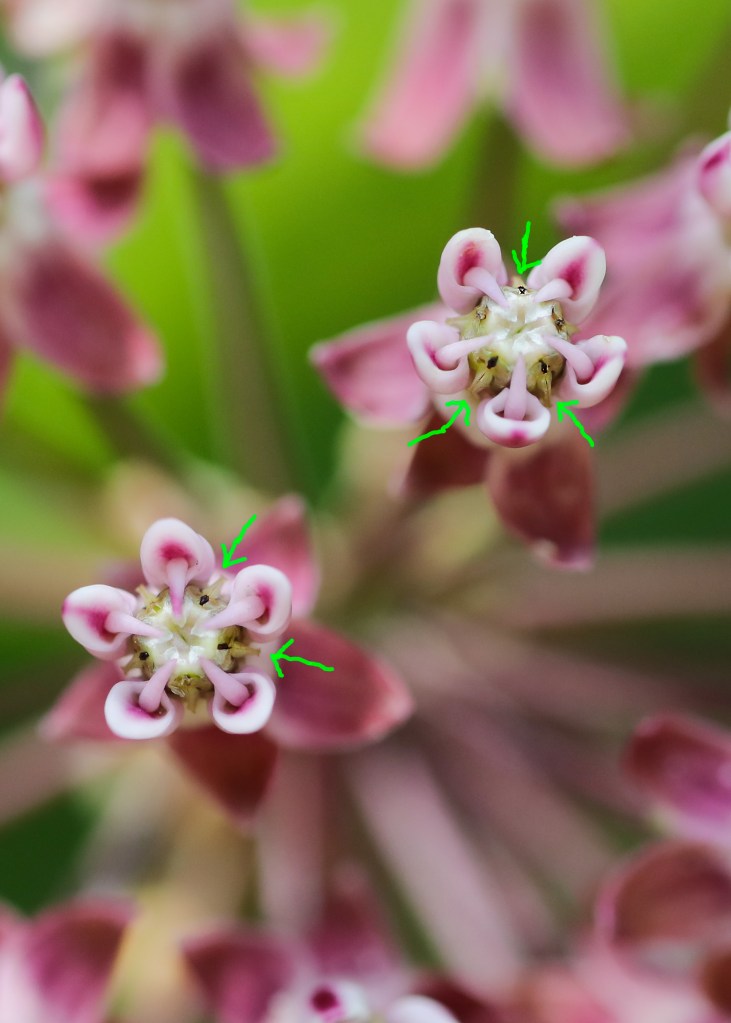
The wonderfully intricate flowers of Asclepias incarnate resemble those of other milkweeds.  They can be pink, purple or, rarely, white and bloom from early Summer to early Fall.  The umbels of florets form at the top of stems.  Each floret is 0.25 inch across with 5 upright lighter colored hood petals and 5 surrounding darker petals shape, fused stigmas (the female parts) form the column.2,3,7

Like other milkweeds, Rose milkweed carry their pollen in waxy sacs called pollinia.  Pollinarium (Pollinaria plural) is the structure that holds the pollinia.  Each pollinia has 2 pollinia attached to translator arms.2  

In the center is a blackish-brown gland (corpusculum) with a slit.  At the end of the translator arm, just before each sac, is a 900 bend.  This bend lets the sacs rotate during pollination.  Pollinaria sit in a slit in stigmatic column. The corpusculum rests on the outside.2

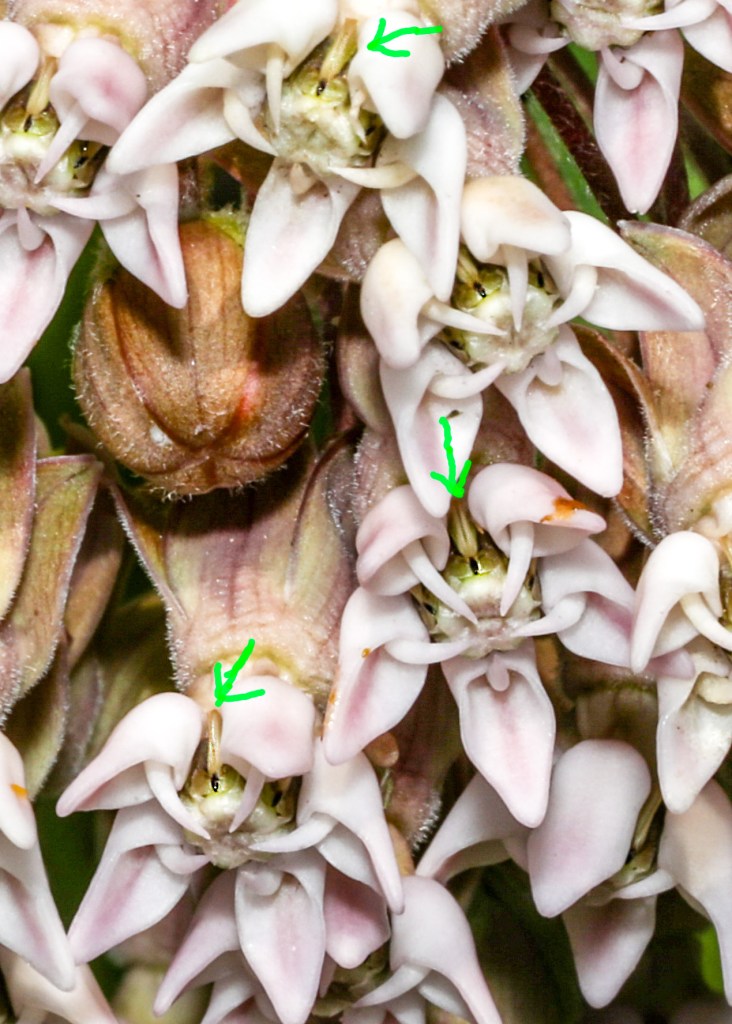
Insects land on  Asclepias incarnata looking for nectar.  The five intricate upright petals have cup-like nectar reserves and downward-curved horns.  Insects sometimes slip on the horns and a leg slides between two petals into the stigmatic slit.2  

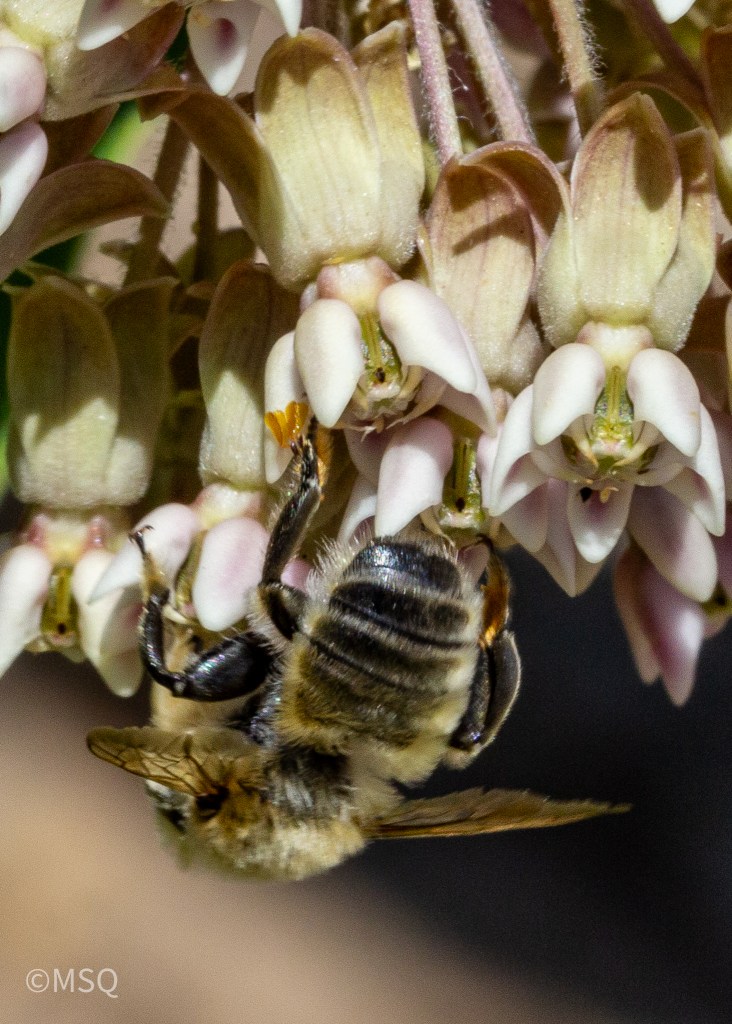
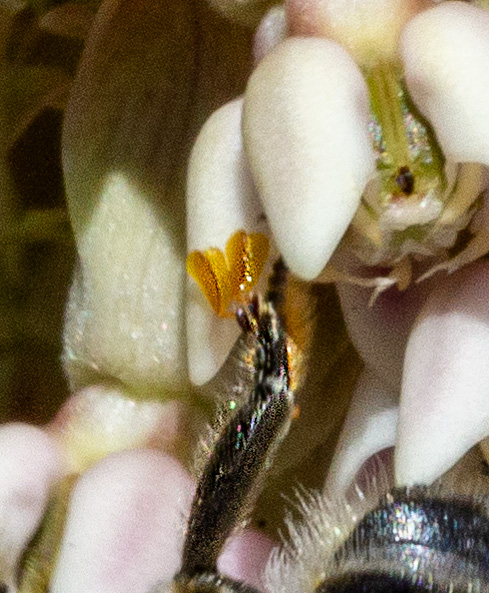
Large Carpenter Bee with pollinaria on front legs.

As it tries to get free, bristles in the chamber keep it from going back down.  Not all insects escape.  Small insects can be trapped and die.  Others lose legs.  But medium to large size bees, wasps and butterflies do remove pollinarium and go on to pollinate other milkweed plants.2

How does pollination actually occur?  I’m glad you ask because it’s amazing!  After it’s removed, the pollinarium starts drying out.  The sacs rotate 900 as it dries.  The rotation moves them into the correct position for pollination.2

Once the sacs are in position, the knee bend (not the center oval) slides into the space between the petals.  The arm follows the pollinial sac into the space in the stigmatic column. Then the arm breaks off releasing the insect and pollination is complete.2

An intricate and delicate process where timing (for drying) and the mechanics of the insect’s motion and the pollinaria all play a crucial role!

Like other milkweeds, Asclepias incarnata  supports numerous insects including pollinators and beneficial insects.  The Xerces Society for Invertebrate Conservation classifies Rose Milkweed as of Special Value to Native Bees, Special Value to Bumble Bees, and Special Value to Honey Bees.  In addition, they declare it Supports Conservation Biological Control (beneficial insects).  Milkweeds are also the only larval host for the Monarch butterfly (Danaus plexippus).3,5

Bee visitors include bumblebees (Bombus spp.),

honeybees (Apis),

long-horned bee (Melissodes ssp, Svastra spp.), Yellow-Faced Bees (Hylaeus spp.), Sweat Bees (Lasioglossum spp.), Halictid Bees, Green Sweat Bees (Augochlorini Tribe), Small Resin Bees (Heriades spp.)

and Leafcutter Bees (Megachilespp).5,7,8,9

Wasps also harvest nectar from Rose Milkweed.  They include Sphecid wasps, Vespid wasps (Vespulaspp.), Tiphiid wasps, Spider wasps, Paper Wasps (Polistes spp.) and Square-Headed Wasps (Tachytesspp.).  The Great Black Wasp (Sphex pensylvanicus) and Great Golden Digger Wasps (Sphex ichneumoneus) are two Sphecid wasps that use the nectar.5,7,9

Flies gather nectar from Asclepias incarnata.  Mydas flies, thick-headed flies, Tachinid flies (Archytas spp.), Bee flies (Bombylius spp. and Villa spp.), Green Bottle flies (Lucilia spp.) and Syrphid flies (Tropidiaspp.).5,7,9

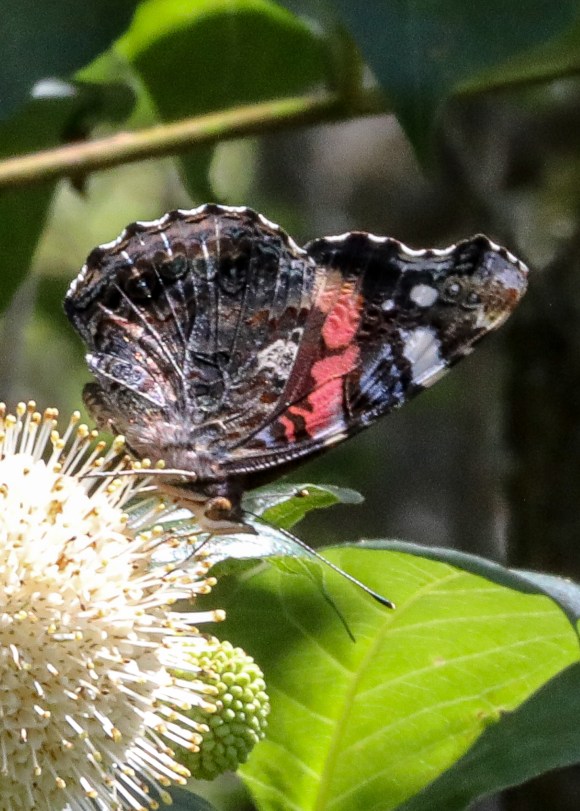
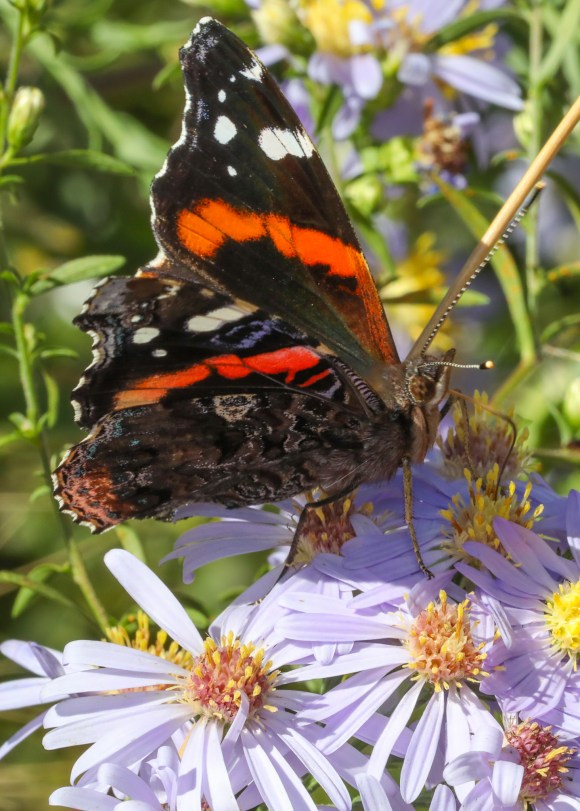
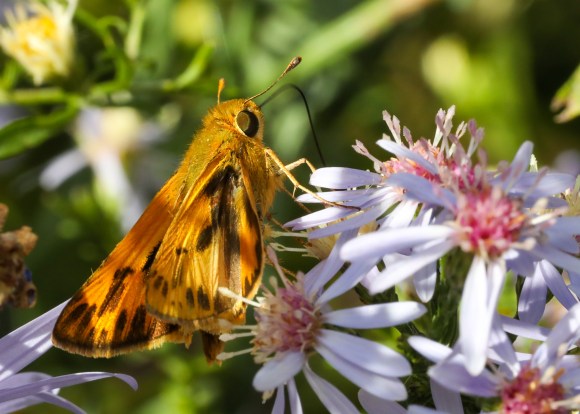
Butterflies, moths and skippers seek out Rose Milkweed for nectar and as a larval host.  Swallowtail butterflies, Greater Fritillaries, Great Spangled Fritillaries (Speyeria cybele), Red Admiral (Vanessa atalanta), Hummingbird Clearwing Moth (Hemaris spp.), Monarch butterflies, and skippers including the Family Hesperiidae.3,4,5,7

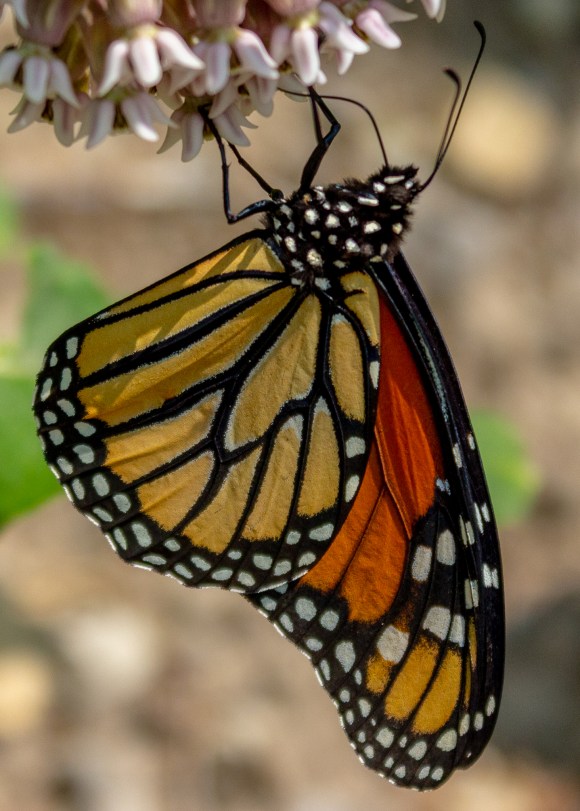
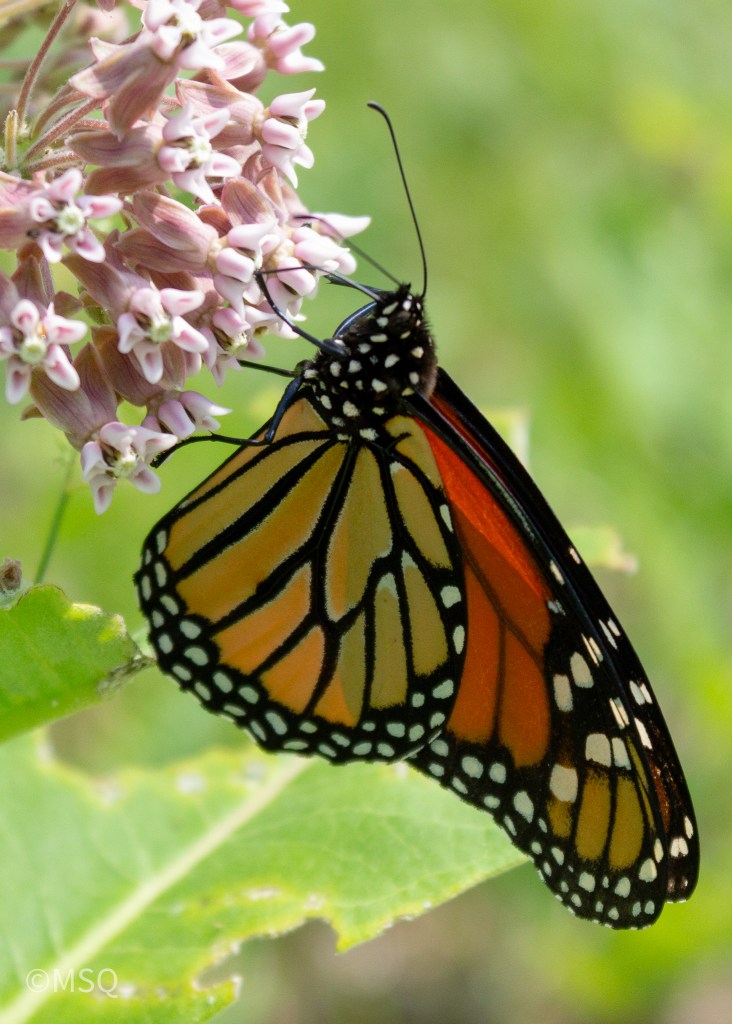
Monarch Butterfly on Common Milkweed
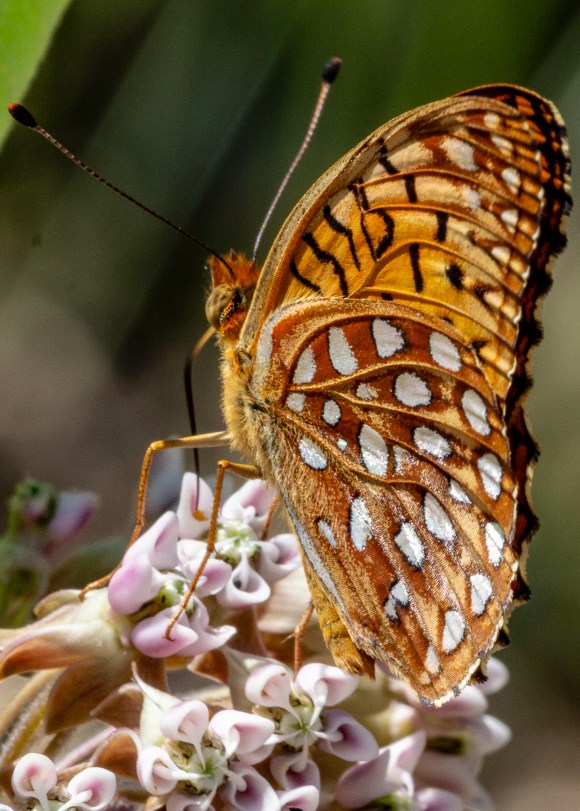
Fritillary butterfly on Common Milkweed
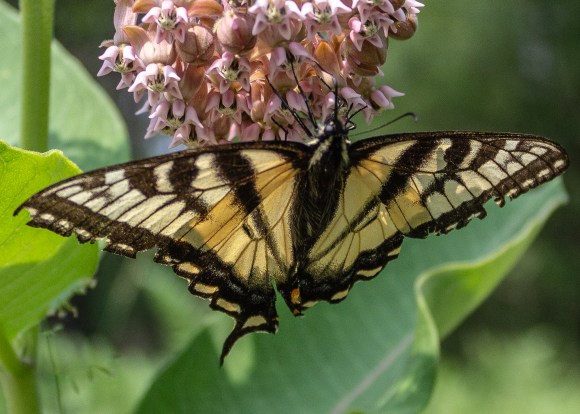
Eastern Tiger Swallowtail on Common Milkweed.

Another occasional visitor of the flowers is the Ruby-Throated Hummingbird.4,5,7

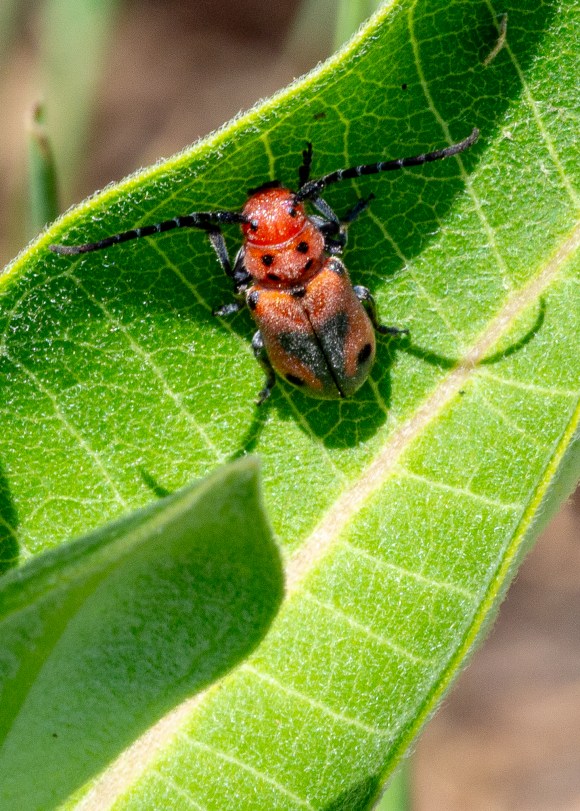
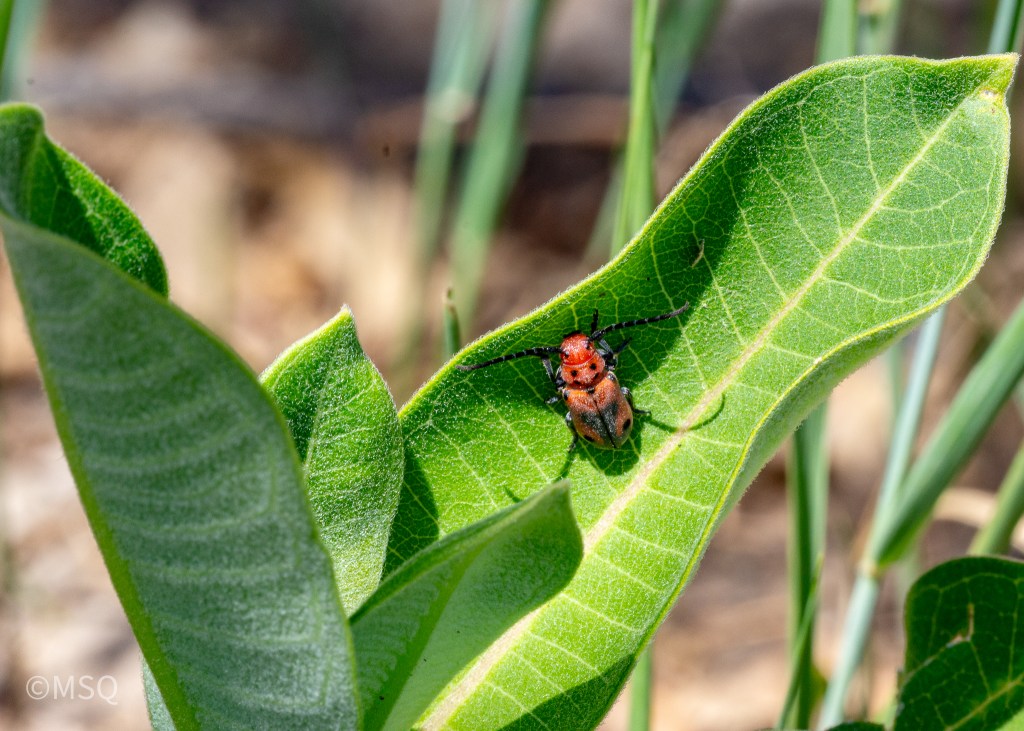
Various insect feed on parts of Asclepias incarnata including leaves, flowers and seeds.  These insect feeders include Labidomera clavicollis (Swamp Milkweed Leaf Beetle), Tetraopes spp. (Red Milkweed Beetles), Oncolites fasciatus (Large Milkweed Bug), and Aphis nerii (Yellow Milkweed Aphid).5,7,9 

Milkweed Bug on Common Milkweed

I hope you’ve enjoyed this adventure with Rose Milkweed.  All the insects love a milkweed and it’s always worth stopping by the milkweed patch to see whose around!

Hope you’re enjoying Spring!

Happy Gardening,

Mary

BIBLIOGRAPHY

  1. Borders, B., Casey, A., Row, J., Wynia, R., King, R., Jacobs, A., Taylor, C., & Mader, E., Pollinator Plants of the Central United States:  Native Milkweeds (Asclepias spp.), 2013.
  2. Eldredge, Eric. “Milkweed Pollination Biology,” n.d.
  3. Asclepias Incarnata (Marsh Milkweed, Swamp Butterfly Weed, Swamp Milkweed) | North Carolina Extension Gardener Plant Toolbox.” Accessed April 1, 2025.  https://plants.ces.ncsu.edu/plants/asclepias-incarnata/.
  4. “Asclepias Incarnata – Plant Finder.” Accessed April 1, 2025. https://www.missouribotanicalgarden.org/PlantFinder/PlantFinderDetails.aspx?kempercode=g410
  5. “Asclepias Incarnata (Swamp Milkweed) | Native Plants of North America.” Accessed April 1, 2025. https://www.wildflower.org/plants/result.php?id_plant=asin.
  6. “Plant of the Week:  Swamp Milkweed (Asclepias incarnata L.).” Accessed April 1, 2025. https://www.fs.usda.gov/wildflowers/plant-of-the-week/asclepias_incarnata.shtml.
  7. “Swamp Milkweed (Asclepias Incarnata).” Accessed April 1, 2025. https://www.illinoiswildflowers.info/wetland/plants/sw_milkweed.htm.
  8. Holm, Heather. Bees:  An Identification and Native Plant Forage Guide. Minnetonka, MN: Pollination Press LLC, 2017.
  9. Holm, Heather. Pollinators of Native Plants:  Attract, Observe and Identify Pollinators and Beneficial Insects with Native Plants. Minnesota: Pollination Press LLC, 2014.
Categories
native plants Pollinator gardening

A Constellation of Blue

A constellation of pale blue flowers tops each Heart-Leaved Aster (AKA Blue Wood Aster or Symphyotrichum cordifolium).  Like all asters, it offers precious pollen and nectar to pollinators and beneficial insects at summer’s end.  The plant itself is a larval host for butterflies and moths.1

In nature, Heart-Leaved Aster grows in moist to dry deciduous woodlands, woodland borders, next to woodland paths, rocky wooded slopes, upland meadows, thinly wooded bluffs, shaded stream banks, and upland forests.1,5

Highly adaptable, Symphyotrichum cordifolium accepts clay, loam and sandy soils.  It grows from one to three feet tall and spreads from eighteen inches to two feet.  This aster thrives in zones three to eight.  It grows in light shade to part sun and moist to dry conditions.1

The leaves of Symphyotrichum cordifolium are highlighted by its scientific name.  Unlike the thin, lance-shaped leaves of most asters, this plant has broader, heart shaped ones.  Cordifolium  means heart-shaped and (cordi-)  means leaves (folium).  And so, the Heart-Leaved Aster!  

The leaves can reach five inches long and three inches across.  They become smaller moving up the plant. The lower leaves are fully heart-shaped (or cordate).  But the upper leaves become more oval and may be fully ovate.  They are medium green and smooth.1

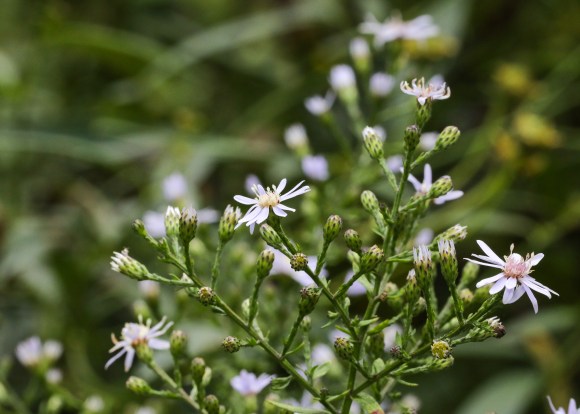
The flowerheads are the highlight of the Heart-Leaved Aster!  Ranging from six inches to eighteen inches long, these conical heads shine with lavender, light-blue violet or white florets.  Each of these half inch florets has seven to fifteen petals (ray florets) and a yellow center of disc florets.1  

Once the disc florets are fertilized, the center turns a mauve pink adding visual interest to the flowerhead.  Floral bracts cover the base of each floret.  The bracts are pale with dark green tips.1

One of the first natives in my garden, I’ve grown this plant for close to 20 years.  I’ve always found is covered with flowers, pollinators and beneficials of all kinds.  That said, it has a few challenges.

It spreads by runners and by self-seeding.  When Heart-Leaved Aster’s happy, it can really colonize a garden.  It is easy to pull, and you can clip the seed heads to prevent self-seeding.1

Poorly drained soil can lead to powdery mildew, leaf spots and rust.  If the weather is too hot and dry, this aster often loses its lower leaves.  I plant it in the middle of the bed.  This location hides leaf loss and helps cover any trouble on the other leaves.4

Finally, like other asters, herbivores love it.  Rabbits, deer, ground hogs, etc., eat it, especially in the Spring.  Use whatever repellents preferred.  I also plant asters among plants animal don’t like, such as, iris.

The free herbivore pruning helps later in season though.  In fact, Symphyotrichum cordifolium benefits from pruning back several times before mid-summer.  This attention helps increases bushiness, controls height and might even eliminate the need to stake it!4

Heart-Leaved Aster draws crowds of pollinators and beneficial insects.  Like all Symphyotrichum, it is a keystone plant.  There are two types of keystone species:  one type acts as hosts for butterfly and moth caterpillars and the other feeds specialist bees.  The bee associated keystone plants also serves generalist bees.  Asters are both.2

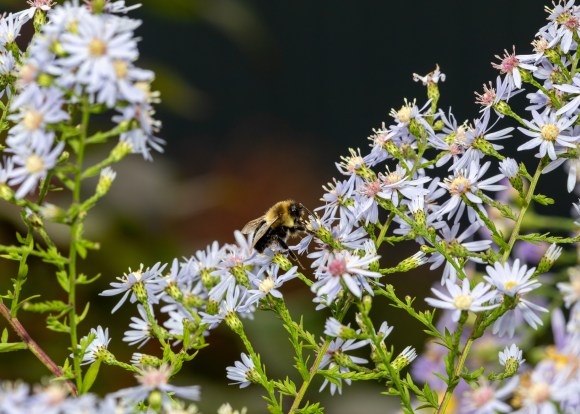
Long-tongued bees, short-tongued bees, butterflies, moths, skippers, wasps and beetles all seek out its nectar and pollen.  The Xerces Society for Invertebrate Conservation designate Symphyotrichum cordifoliumof Special Value to Native Bees and state it Supports Conservation Biological Control.  Bumblebees find it especially helpful.1,6 

S. cordifolium blooms when new bumblebee queens emerge, males hatch and mating flights occur.  I find males sleeping on the plants on cool late summer and early autumn mornings.  The flowers provide important energy resources for successful mating flights and overwintering queens.

Heart-Leaved Aster support many specialist bees.  As a keystone plant for pollen specialist bees, the Symphyotrichum genus feeds several mining bees in the Andrena genus.   Specifically, these include Andrena (Callandrena s.l.) asteris, Andrena (Callandrena s.l.) asteroides, Andrena (Cnemidandrena)hirticincta, Andrena (Cnemidandrena) nubecula, Andrena (Callandrena s.l.) placata, Andrena (Callandrena s.l.simplex, and Colletes simulans.5

Heart-Leaved Aster is also visited by metallic green sweat bees, Halictus (sweat bees), Ceratina (small carpenter bees) and honeybees (Apis).

Numerous adult butterflies and skippers nectar at the Heart-Leaved Asters including migrating Monarchs (Danaus plexippus) and Red Admirals (Vanessa atalanta).  In its role as a keystone plant, it feeds many caterpillars from butterflies and, especially, moths.  Different larvae eat every part of the plant.1

By supporting moths, Symphyotrichum cordifolium contributes to pollination of wild plants overall.  Some flowers evolved a plant pollinator relationship with moths.  These flowers usually open at night, are white or pale, and have a stronger fragrance at night.  Moths use scent to find food and mates.  Yucca is a well-known example.7  

However, moths provide much more extensive pollination services.  Like generalist bees, some moths also visit different types of flowers.  Most of these plants aren’t larval hosts.  Some are also pollinated by bees.  When they’re bee pollinated, moths supplement the bee’s work.7

In addition, moths are more efficient than bees in some cases.  In the past, studies only measured pollen on mouthparts.  But moths carry a lot of pollen on their hairy underbelly.  When they land on a flower, their belly presses against the stigma to transfer pollen.7,8

Moths usually fly over longer distances than bees.  Bees tend to stay near their nest when possible.  Moths add genetic diversity by bringing pollen from distant plant populations.7

A variety of moth and butterfly caterpillars use Symphyotrichum cordifolium.  Different larvae eat flowers, seeds, and leaves while others bore through stems and/or roots.  I’ve detailed some different species and which plant parts they eat in the next few paragraphs.3

Chlosyne nycteis (Silvery Checkerspot butterflies) and Phyciodes tharos (Pearl Crescent butterflies) consume foliage.  Some moths also devour the leaves, such as, Pale-Banded Dart (Agnorisma badinodis(syn. Xestia badinodis)), Sharp-Stigma Looper Moth (Ctenoplusia oxygramma (syn. Agrapha oxygramma)), Halloween Paint (Cucullia alfarata), Rusted Paint (Cucullia postera), Confused Eusarca (Eupithecia confusaria), Lost Sallow (Euplexia devia), Green Leuconycta (Leuconycta diphteroides), Small Brown Quaker (Pseudorthodes vecors) and Dimorphic Gray (Tornos scolopacinarius).3

Leaf miners include Gracillarlid Moth sp. (Acrocercops astericola), Tischeriid Moth sp. (Astrotischeria astericolaI), Scythridid Moth sp. (Landryia impositellaI) and Bucculatricid Moth sp. (Bucculatrix staintonella).3

Some feed on developing seeds and/or flowers including Blackberry Looper (Chlorochlamys chloroleucaria), White-Dotted Groundling (Condica videns (syn. Platysenta videns)), Common Pug (Eupithecia miserulata), Spotted Straw (HeIliothis turbatus), Tortricid Moth sp. (Phaneta parmatana), Tortricid Moth sp. (Phaneta tomonana), Common Tan Wave (Pleuroprucha insulsaria), Arcigera Flower Moth (Schinia arcigera), Goldenrod Flower Moth (Schinia nundina), Northern Flower Moth (Schinia septentrionalis), Wavy-Lined Emerald (Synchlora aerate) and Striped Garden Caterpillar (Trichordestra legitima).  Some moths consume foliage in addition to developing seeds and/or flowers.  These include Black Arches (Melanchra assimilis) and Dark-Spotted Palthis (Palthis angulalis).3

And finally, moth larva that bore through stems and/or roots are  Aster Borer Moth (Carmenta corn) , Tortricid Moth sp. (Eucosma robinsonana), Burdock Borer Moth (Papaipema cataphracta), Aster Borer Moth (Papaipema impecuniosa), Tortricid Moth sp. (Phaneta essexana) and Tortricid Moth sp. (Sonia canadana).3 

I hope you enjoyed this look at the Heart-Leaved Aster as much as I have.  I’d love to hear about your plant adventures in the garden or the wild!  Please feel free to contact me with a story, comment or question!

Happy Gardening,

Mary

Bibliography:

  1. “Blue Wood Aster (Symphyotrichum Cordifolium).” Accessed December 1, 2024. https://www.illinoiswildflowers.info/woodland/plants/bl_woodaster.htm. Accessed December 1, 2024.
  2. “Keystone Native Plants:  Eastern Temperate Forests-Ecoregion 8.” https://www.nwf.org/-/media/Documents/PDFs/Garden-for-Wildlife/Keystone-Plants/NWF-GFW-keystone-plant-list-ecoregion-8-eastern-temperate-forests.ashx?la=en&hash=1E180E2E5F2B06EB9ADF28882353B3BC7B3B247D
  3. “Moth Table (Symphyotrichum Spp.).” Accessed December 1, 2024. https://www.illinoiswildflowers.info/woodland/tables/table29.html.
  4. “Symphyotrichum Cordifolium – Plant Finder.” Accessed December 1, 2024. https://www.missouribotanicalgarden.org/PlantFinder/PlantFinderDetails.aspx?kempercode=a788.
  5. “Symphyotrichum Cordifolium (Blue Wood Aster, Common Blue Wood Aster, Heart-Leaved Aster) | North Carolina Extension Gardener Plant Toolbox.” Accessed December 1, 2024. https://plants.ces.ncsu.edu/plants/symphyotrichum-cordifolium/.
  6. “Symphyotrichum Cordifolium (Broad-Leaved Aster) | Native Plants of North America.” Accessed December 1, 2024. https://www.wildflower.org/plants/result.php?id_plant=syco4.
  7. Xerces Society. “The Night Shift: Moths as Nocturnal Pollinators.” Accessed December 1, 2024. https://xerces.org/blog/the-night-shift-moths-as-nocturnal-pollinators.
  8. “Moths are more efficient pollinators than bees, shows new research.”  Accessed December 1, 2024. Ellis, Lauren, https://www.sussex.ac.uk/broadcast/read/60568.
Categories
native plants Pollinator gardening

A Summer Cornucopia

Part 2

And we’re back for Part II of The Summer Cornucopia!  Today the focus is on insects and how they use Common Milkweed.  If you missed Part I and are interested in the plant and pollination, here’s a link: https://wordpress.com/post/wildthingsinthe.garden/1831.

Asclepias syriaca draws an abundance of insects.  The sap, leaves and flowers are all used for food while blooms provide nectar to many insects.  Common Milkweed supports different life stages of flies, wasps, bees, butterflies, moths, skippers, plant bugs and beneficial insects.  Even hummingbirds try to sip nectar although they can’t reach it.1,7  

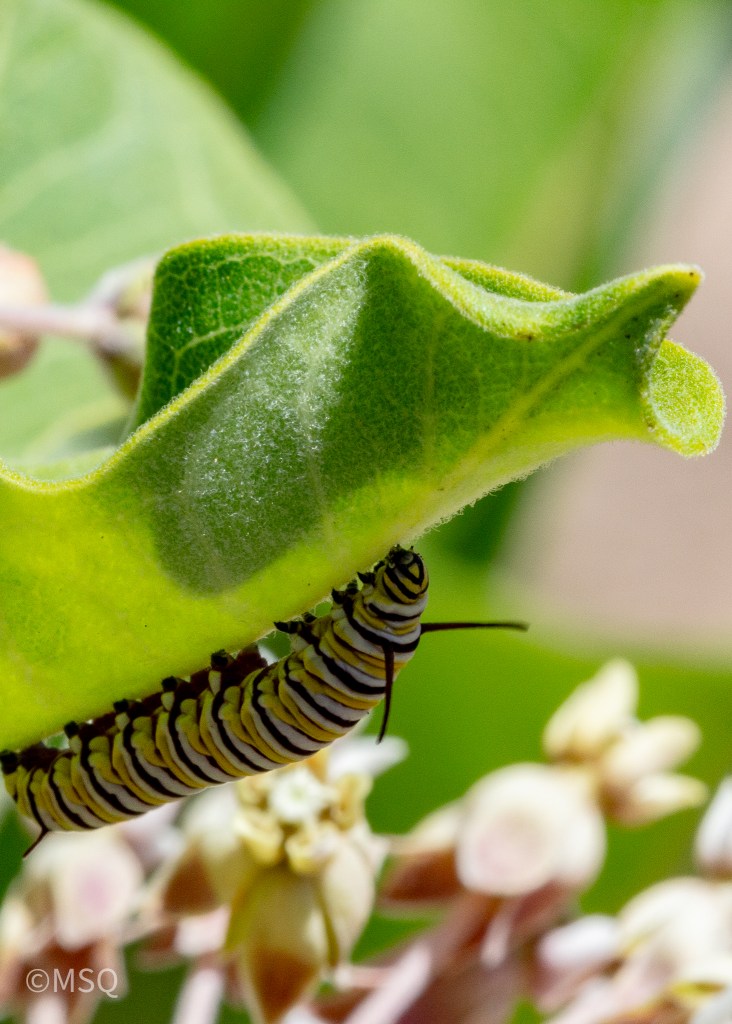
The most famous visitor to Common Milkweed is the Monarch butterfly (Danaus plexippus).  Monarchs can only use milkweeds (Asclepias) to feed their caterpillars. Growing milkweed supports the generations of Monarchs that hatch over the summer months.  When the last summer generation is born and transforms into an adult, they’ll drink nectar from milkweed and other flowers for food and fuel for their migration.8  

Growing native milkweeds helps preserve the existing Monarch population.  If you’re interested in helping Monarchs, Monarch Watch has excellent information on creating Monarch Waystations at https://www.monarchwatch.org/waystations/ .  Here are the highlights of the plan!8

How big does a waystation have to be?  Any size will help the Monarchs (and other pollinators!).  If possible, a 100 square foot waystation is highly effective.  The area doesn’t have to be all in one spot.  There can be several plantings throughout a property.

Sun is important for Monarchs.  Like other insects, they need heat and sunlight to warm themselves for flying and daily activities.  An area with six or more hours of sunlight is required.  Coincidentally, most milkweeds thrive under those conditions.

Milkweed also grow well in well-drained soil.  Place Monarch Waystations in low clay areas with fast draining soils.

Place plants close together (although not closer than recommended).  Monarchs and their caterpillars need shelter and protection from predators and the weather.

What about milkweed?  At least ten plants are recommended preferably with two or more types of milkweeds.  This planting scheme gives an extended season of bloom and allows the Monarchs longer access to the milkweed plants and nectar.  One type of milkweed is okay if more than ten plants are included.

Establish continuous supply of nectar plants.  Use annual, biennial and perennial plants.  Native plants are a great choice.  These plants also benefit the other pollinators.

Finally, create a management plan.  How will the waystation be maintained?  The plan contains basic garden maintenance:  mulching, fertilizing, removing invasive plants.  Additionally, it includes Monarch specific items:  eliminate insecticides, add more features like a water source or puddling spot.

Again, for more information on Monarch Waystations and other resources, including free milkweed programs, go to https://www.monarchwatch.org/waystations/

In addition to Monarchs, swallowtails (Papilio), fritillaries (Speyeria), viceroy butterflies (Limenitis), sulfurs (Pieris), and other butterflies also visit Asclepias syriaca.  Skippers use Asclepias syriaca for nectar including Ancyloxipha.1,7  

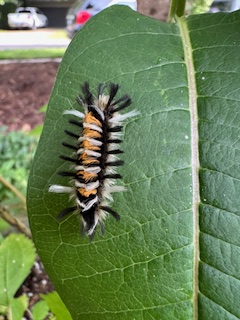
Common Milkweed is a larval host for the striking Milkweed Tussock Moth (Euchaetes egle) caterpillar, the Unexpected Cycnla (Cycnia inopinates) and the Delicate Cycnia (Cycnia tenera).  All are part of the group Artiinae or Tiger Moths.1  

The Delicate Cycnia (Cycnia tenera) lacks the usual aposematic coloration  It has a soft tan larva and a charming white adult with just a touch of orange on the head and wing edges.  Instead, it emits aposematic ultrasound calls when caught!  Bats release their prey when they hear the calls.  During the day, their color variation seems to keep birds away.1,9

Both long-tongued and short-tongued bees visit Common Milkweed for nectar.  These include honeybees (Apis),

Bumble Bees (Bombus),

leaf-cutter bees (Megachile),

cuckoo bees (Coelioxys), small carpenter bees (Ceratina)

and sweat bees (Halictus and Lasioglossum).1,7,10

Many wasps enjoy nectaring at Milkweed flowers especially Sphex, Tachytes, Polistes,  Myzinum, and ichneumon wasps.  Sphex ichneumoneus is a known pollinator of Common Milkweed.1,7

Numerous beneficial insects visit Asclepias syriaca including the delicate and diverse ichneumon wasps.  The adult wasps use milkweeds’ nectar for fuel while searching for insect prey.  They’re considered parasitoids and the females lay eggs inside grubs and caterpillars.  

Young of boll weevils, tomato hornworms and wood borers are all food for ichneumon wasps.  In addition to garden pests, adults hunt large insects such as spiders and butterflies.  

In general, ichneumon wasps help reduce the number of insects that reach reproductive age.  Many of these prey insects damage trees.  In this way, the wasps help keep trees healthy.11

Bembix americana, a predatory sand wasp, also gathers nectar from Common Milkweed.  B. americanafeeds their young true flies (Diptera).  Diptera include house flies, gnats and mosquitos.  

As populations of flies increase, B. americanas numbers rise.  A single larvae can eat two dozen flies.  B. americana uses a different strategy for provisioning its young.  Other wasps paralyze their prey and stock each cell with the required (living but paralyzed) insects.  This sand wasp kills the flies and adds more food as needed.12

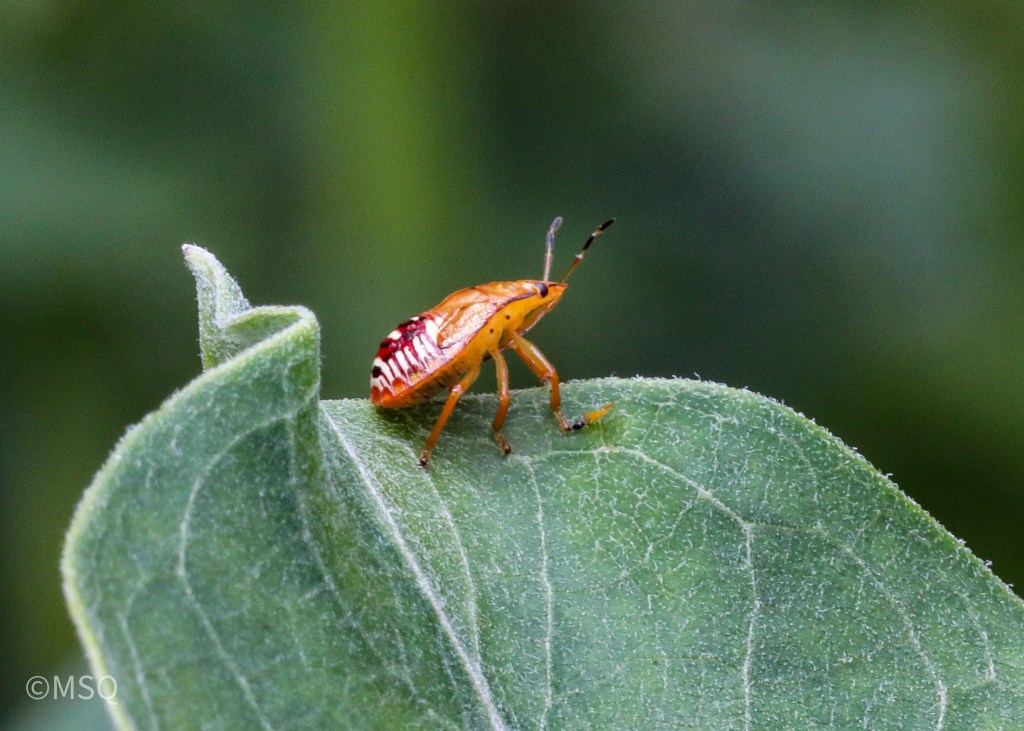
Asclepias syriaca hosts predatory stink bug larvae.  Stink bugs have a terrible reputation especially since the arrival of  the invasive Brown Marmorated Stink Bug.  But predatory stink bugs are a whole different category.  These are beneficial insects that hunt insect prey.  

Above, is a photo of a Spined Soldier Bug larvae on milkweed.  There are five larval stages (instars) and all eat insects.  Their preferred foods include Mexican bean beetle, Colorado potato beetle, and imported cabbageworm.  

Look for the adult Spined Soldier Bug on plants where prey may be located.  These plants include the melons/squash/cucumber (cucurbit), broccoli, cauliflower, kale, etc. (cruciferous) and tomatoes, peppers, eggplant (solanaceous) crops.  

If you’re looking for eggs, they’re an incredible metallic bronze color with a row of spines like a crown.  Just hatched larvae, cluster around the eggs eating necessary bacteria.  Spined Soldier Bug can be purchased commercially.13

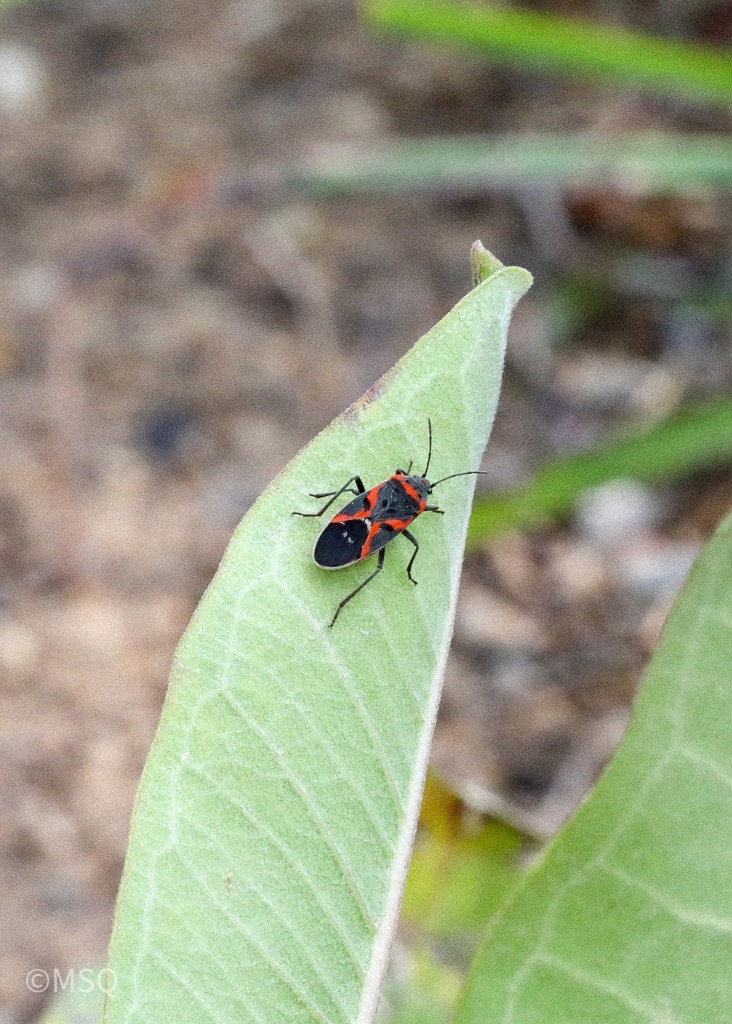
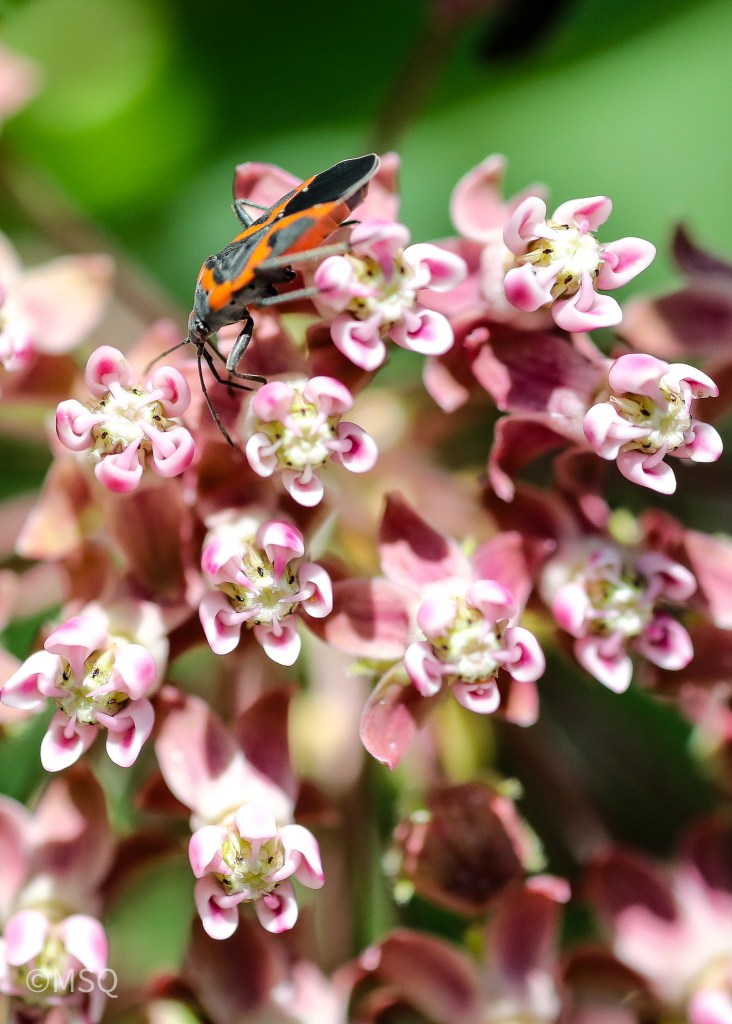
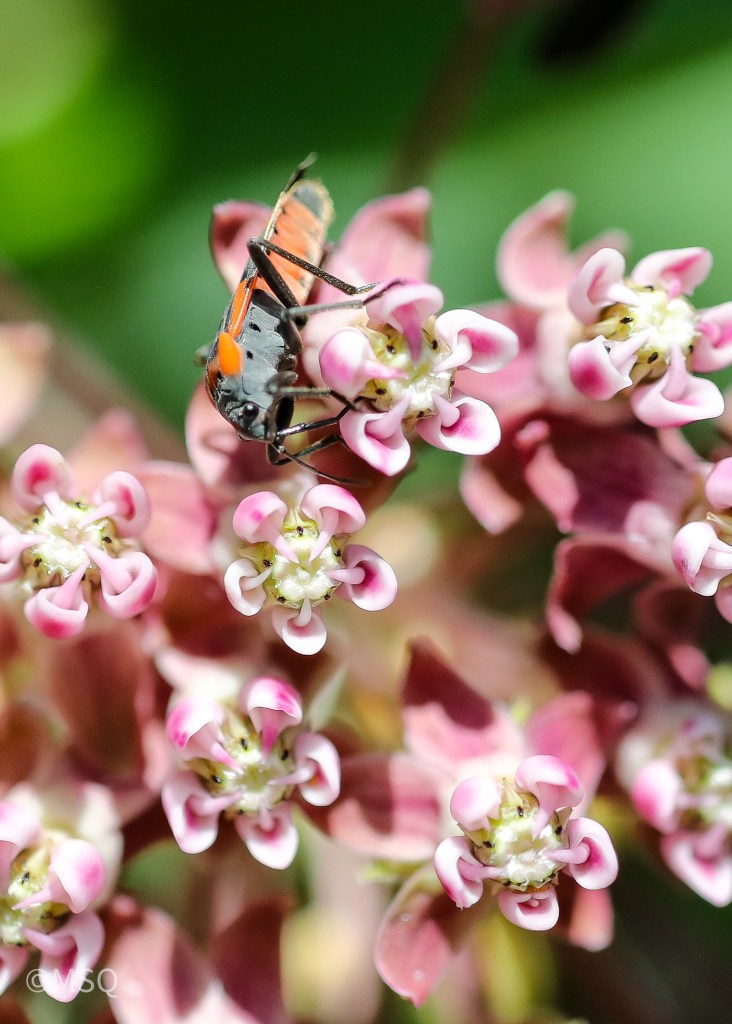
In addition to all these, Asclepius syriaca hosts many beetles and bugs,

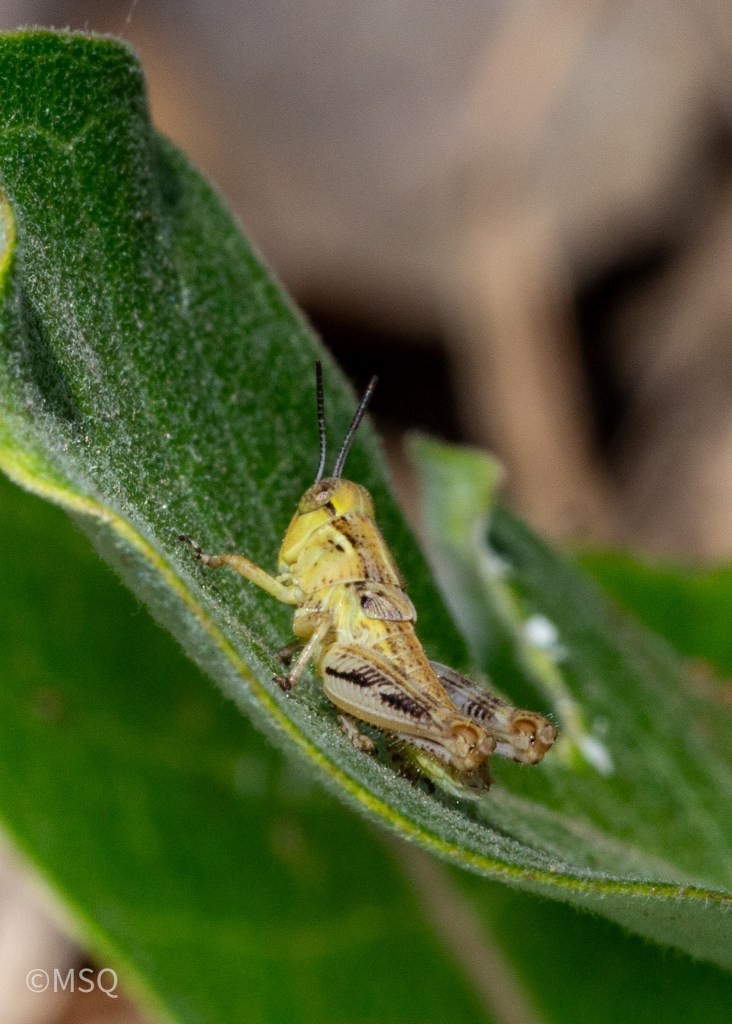
grasshoppers,

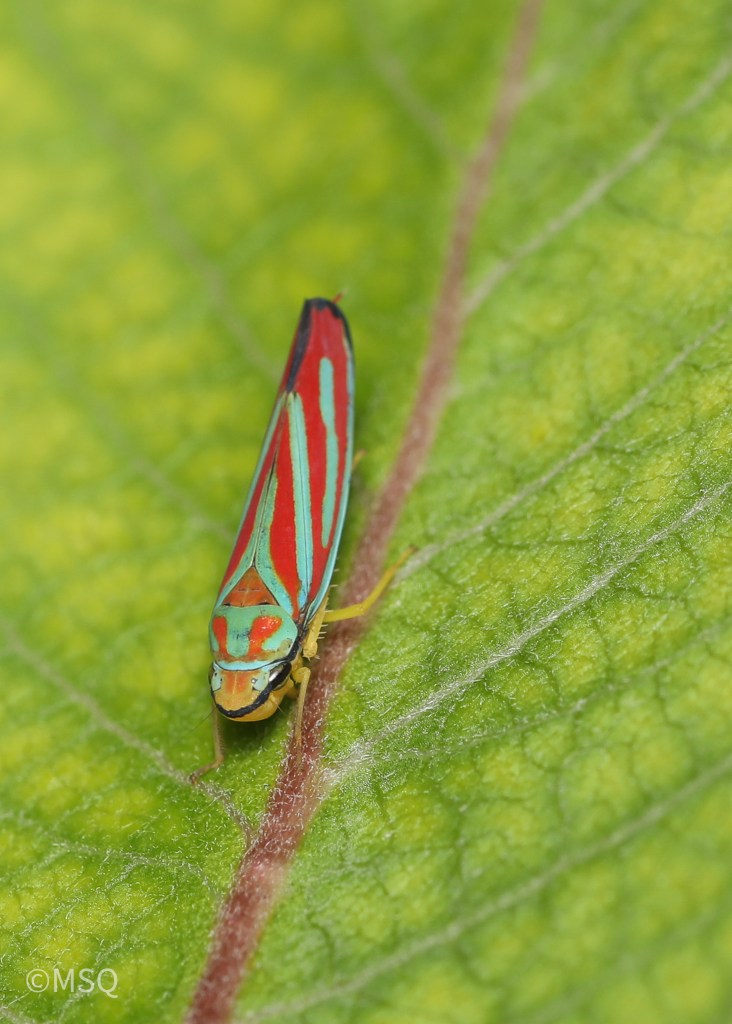
and leafhoppers

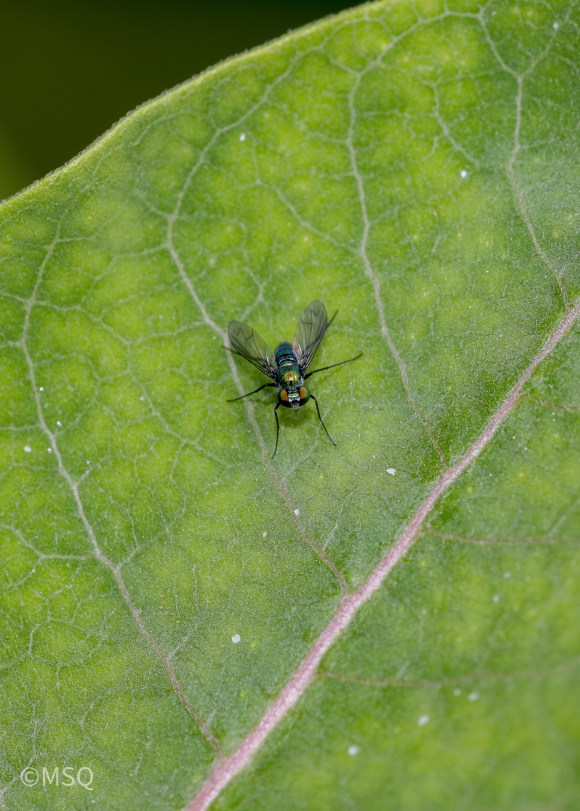
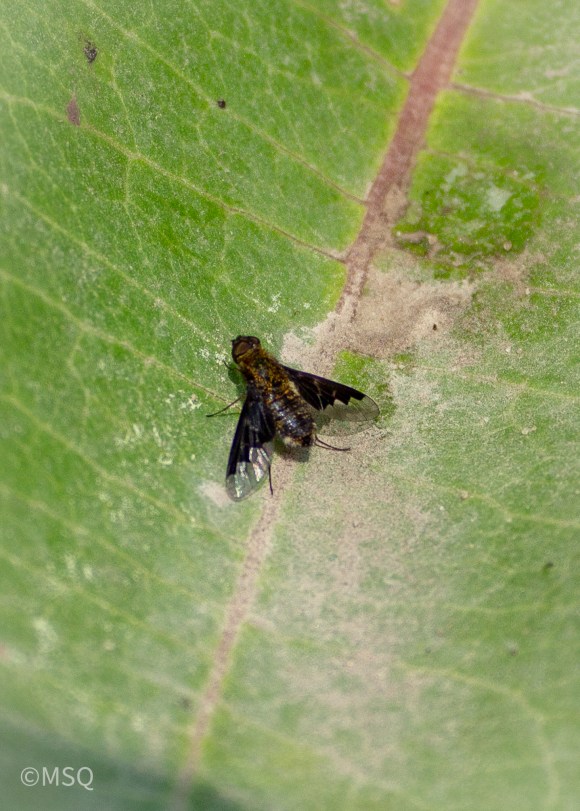
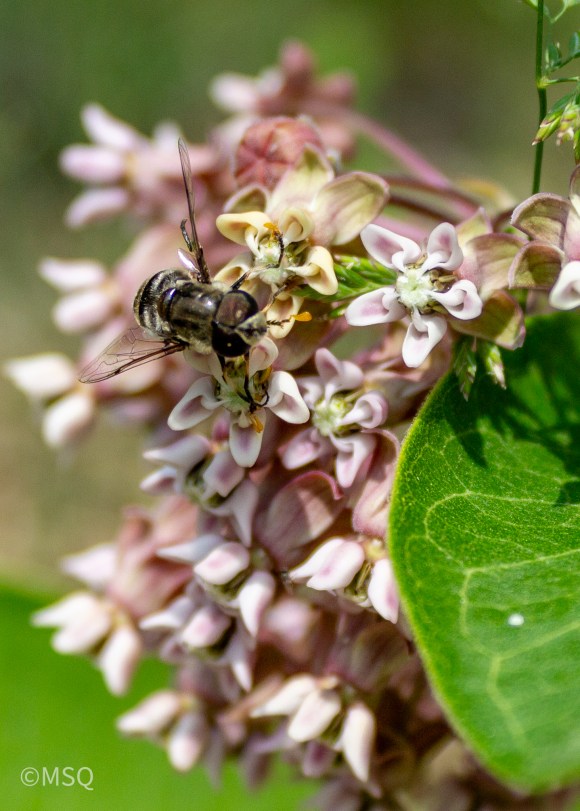
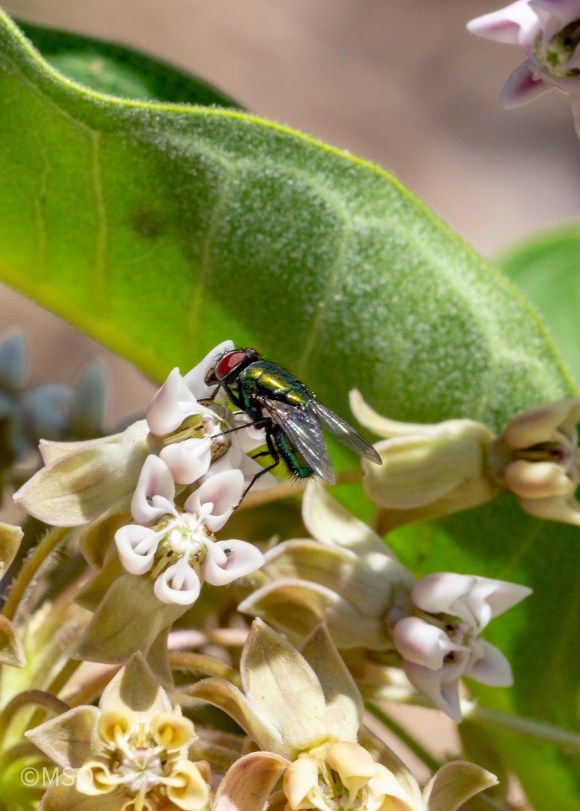
Finally, flies, including beneficial ones, nectar on Asclepius syriaca.

I hope you’ve enjoyed this exploration of the insects found on Common Milkweed.  Pollinators and beneficials all enjoy Asclepias.  It’s always worth stopping to see who’s home in the milkweed patch with or without flowers!

References

  1. Hilty, J., n.d., Common Milkweed, Asclepias syriaca, Milkweed family, (Asclepiadaceae),  https://www.illinoiswildflowers.info/weeds/plants/cm_milkweed.html
  2. Berkov, A., 28.October.2010, Plant Talk:  Inside the New York Botanical Garden; Plant Profile:  The Extraordinary Common Milkweed, How Do Insects Feed on this Plant with Sticky White Latex? https://www.nybg.org/blogs/plant-talk/2010/10/science/plant-profile-the-extraordinary-common-milkweed/#:~:text=Plants%20in%20the%20genus%20Asclepias,Asklepios%2C%20the%20ancient%20Greek%20physician.
  3. Bowe, Scott, 11.September.2018, Milkweed is More Than Just a Common Weed, WXPR, https://www.wxpr.org/natural-resources/2018-09-11/milkweed-is-more-than-just-a-common-weed
  4. Nelson, M. and Alfuth, D., 24.February.2021, Milkweed (Ornamental Plants Toxic to Animals), X-number:  XHT1276, https://hort.extension.wisc.edu/articles/milkweed-ornamental-plants-toxic-to-animals/
  5. Taylor, David, n.d., Common Milkweed, (Asclepias syriaca L.), Plant of the Week, https://www.fs.usda.gov/wildflowers/plant-of-the-week/asclepias_syriaca.shtml
  6. Eldredge, E.P., 2015,11,00, Milkweed Pollination Biology, Plant Materials Technical Note NV-58, Natural Resources Conservation Service, https://www.nrcs.usda.gov/plantmaterials/nvpmctn12764.pdf
  7. Betz, R.F., Struven, R.D., Wall, J.E. & Heitler, F.B., 1994, Insect Pollinators 12 Milkweed (Asclepias) Species, T.B. Bragg and J. Stubbendieck (eds.) Proc. Of the Thirteenth North American Prairie Conference. Univ. of Nebraska, Lincoln, NE.
  8. No author, n.d., Monarch Waystation Program, https://monarchwatch.org/waystations/
  9. Geere, Duncan, 2010. August.19, Tiger Moths Scare Bats with Ultrasonic Clicks, Wired, https://www.wired.com/2010/08/moth-jamming/
  10. Holm, Heather, 2017, Bees:  An Identification and Native Plant Forage Guide, Pollination Press LLC
  11. No author, n.d., Ichneumon Wasps, Discover Nature>Field Guide:  Missouri Department of Conservation, https://mdc.mo.gov/discover-nature/field-guide/ichneumon-wasps
  12. No author, n.d., Sand Wasps, Discover Nature>Field Guide:  Missouri Department of Conservation, https://mdc.mo.gov/discover-nature/field-guide/sand-wasps
  13. Berish, Chelsea, n.d., Spined Soldier Bug in Kentucky, ENTFACT-325: SPINED SOLDIER BUG IN KENTUCKY, University of Kentucky Department of Entomology, Martin Gatton College of Agriculture, Food and Environment
Categories
native plants Pollinator gardening

A Summer Cornucopia

Common Milkweed or Asclepias syriaca is a superb Monarch support and a mainstay of Monarch waystations.  But it is so much more.  This plant feeds more than 450 insects at different life stages. Diverse insects consume nectar, sap, leaves, flowers and seeds5.  Admittedly weedy, its lovely blooms are fragrant and enhance any scent garden1,5.

Common Milkweed thrives in full sun and well-drained soils.  Like other “weeds”, it’s not picky about growing conditions.  A. syriaca  grows in clayey, sandy or rocky calcareous soils, loamy soils and high clay or sand soils. 

Asclepias syriaca springs up in disrupted areas.  Human activity disrupts natural areas.  But natural disruptions occur where water rises and falls, for example, along streams and lakes.  

In nature, Common Milkweed is found in moist and dry black soil prairies, sand prairies, sand dunes along lake shores, fields, pastures, abandoned fields, vacant lots and along railroads, fence rows and roadsides. 

Common Milkweed absolutely lives up to its weedy name.  It spreads by seed and by long creeping rhizomes that pop up in unexpected places.  Once established, this plant is extremely difficult to remove. 

These habits are offset by Common Milkweed’s value to insects and pollinators.  It’s best to let it grow where you don’t mind its vigorous and abundant nature—a wild area, a meadow or a prairie garden.

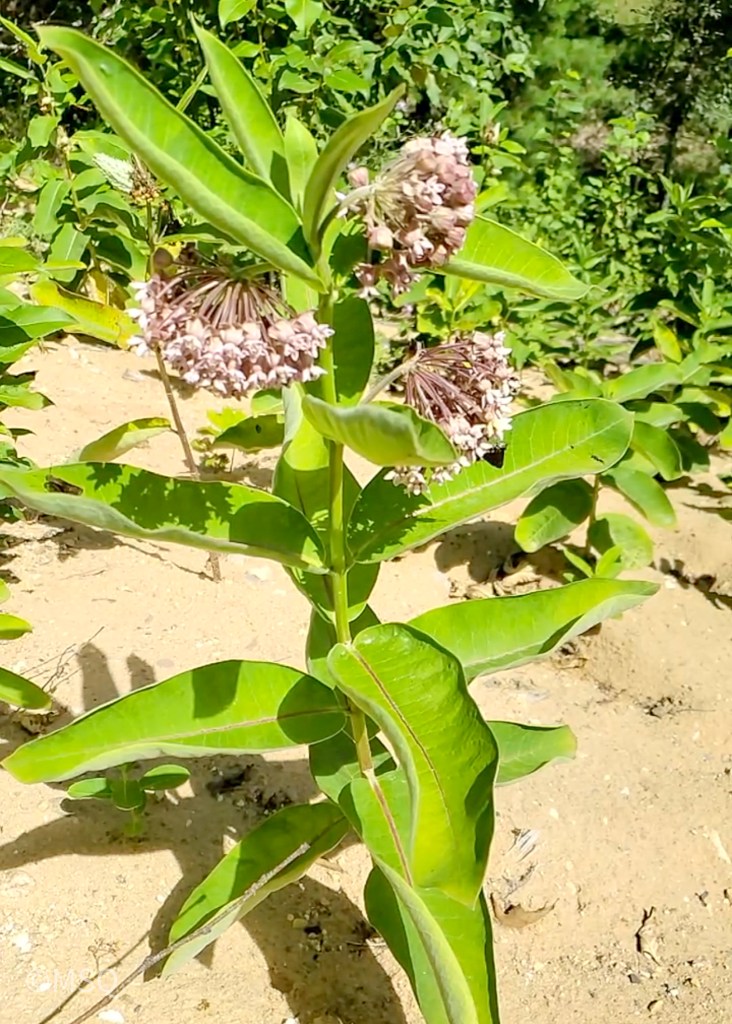
Asclepias syriaca offers a strong erect form in the garden.  The pale, cylindrical central stem supports opposite jade-green leaves.  These leaves range from pale to dark green on top and are pale green with short, dense hair underneath.  Each leaf has a distinctive central vein with small veins spreading to the edges.  

The milky sap, which gives Milkweed its name, oozes whenever part of the plant is broken.  The sap is called a latex and contains 2% latex.  The latex is thick and sticky.  

Most ingeniously, caterpillars will reduce the sap’s flow by taking tiny bites closer to the stem.  The sap leaks out there.  When the caterpillar begins to eat a leaf, there’s less latex at the feeding site.  Thus, less chance the sticky stuff will foul the larva’s mouth2,3.

For humans and other mammals, there are other concerns.  The milky sap contains cardenolides, specifically cardiac glycosides.  Contact with the skin or eyes causes irritation.  If eaten or exposed to mucous membranes, cardiac glycosides can disrupt the nervous system, the kidneys, the muscles (which includes the heart) and the human’s/animal’s acid/base balance3,4,5.  

The monarch and other insects that consume milkweed have turned this to their advantage.  As the caterpillars/insects consume milkweed their bodies store the cardiac glycosides.  If a bird or animal eats them, they taste bitter and can make the predator feel sick.  

Predators soon learn to leave them alone. The orange/black or red/black coloring of milkweed insects signals, “Stay away!  Not good for you!”  The technical term for this warning coloration is ‘aposematic’5.

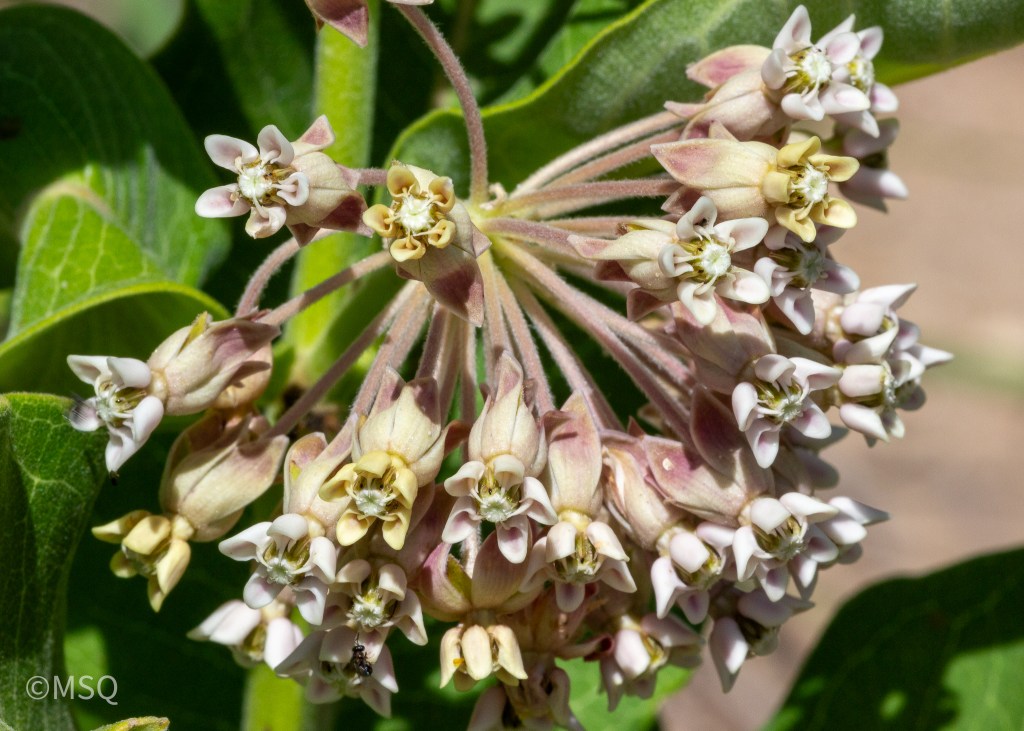
Milkweed blooms don’t dazzle but flower in 1930’s vintage shades.  The drooping balls of florets are soft and dusky lasting one to one and a half months.  Colors range from greenish white to greenish pink to rosy-pink to purplish-pink to reddish purple.  

Each cluster averages 30 individual florets but can have up to 100. Their sweet, vanilla fragrance drifts from the three to five umbels on each plant.  

Up close, each floret is a fascinating feat of engineering all directed toward an exceptional pollination system.  Each a quarter of an inch across, the florets have five reflexed (bent back) petals and five raised hoods with curved horns.  The hoods have lighter colors than the petals.  

In the center of each floret, is a cylindrical structure formed by two fused stigmas.  It’s called the stigmatic column.  

Between the hoods, are the stigmatic slits.  These slits hold the pollinaria.  Unique structures, pollinaria hold waxy sacs of pollen.  These are transferred instead of the loose, powdery pollen used by most flowers.  Milkweeds and orchids are the only known plants to have them6,7.

The milkweed pollinium (or pollinarium) consist of a blackish-brown oval gland (corpusculum) with a slit, two translator arms hanging from the gland and two pollinial sacs.  Before each sac, a knee bend of approximately 900 occurs in the arm.  This bend enables the rotation of each sac during pollination.

In the milkweeds, the pollinial sac sit inside the stigmatic column and only the corpusculum is visible between the hood structures.  When an insect lands on the flower, one of its legs may slip into the stigmatic slit between two hoods.   As it tries to free itself, the leg moves upward toward the slit in the corpusculum. Bristles in the chamber keep it from going back down.  

Insects must be strong to free themselves.  Large butterflies, predatory wasps and long tongue bees are most likely to remove pollinaria.  Lost legs and dead smaller insects both occur from failed escape attempts.

When a pollinaria is removed, it begins to dry.  The pollinial sacs rotate 90o during drying.  The rotation moves them into the correct position for pollination.  

When the insect lands on another milkweed,  the knee bend (not the corpusculum oval) slides into the space between the hood petals.  The translator arm follows then the rotated pollinial sac.  The pollinial sac slides into a space in the stigmatic column and pollination is completed.  

When the insect continues pulling upward, the translator arm breaks.  The insect keeps the remaining part of the pollinaria.  

It’s also possible to start a chain of pollinaria during this process.  As the broken translator arm slides between the hoods, it can hook the corpusculum slit of this floret’s pollinaria adding a fresh pollinaria to the partial remaining one.  Clumps and chains of all sorts develop this way.  These groups of pollinaria may increase chances of pollination6.7.

Part I, ends here, with the exciting conclusion of a fertilized milkweed.  Part II will continue with photos and information about the insects that use Common Milkweed.  What a crowd it is—including flies, wasps, bees, butterflies, moths, skippers, plant bugs and beneficial insects!

See you next time to discover what Wild Things are in the Garden!

Mary

References

  1. Hilty, J., n.d., Common Milkweed, Asclepias syriaca, Milkweed family, (Asclepiadaceae),  https://www.illinoiswildflowers.info/weeds/plants/cm_milkweed.html
  2. Berkov, A., 28.October.2010, Plant Talk:  Inside the New York Botanical Garden; Plant Profile:  The Extraordinary Common Milkweed, How Do Insects Feed on this Plant with Sticky White Latex? https://www.nybg.org/blogs/plant-talk/2010/10/science/plant-profile-the-extraordinary-common-milkweed/#:~:text=Plants%20in%20the%20genus%20Asclepias,Asklepios%2C%20the%20ancient%20Greek%20physician.
  3. Bowe, Scott, 11.September.2018, Milkweed is More Than Just a Common Weed, WXPR, https://www.wxpr.org/natural-resources/2018-09-11/milkweed-is-more-than-just-a-common-weed
  4. Nelson, M. and Alfuth, D., 24.February.2021, Milkweed (Ornamental Plants Toxic to Animals), X-number:  XHT1276, https://hort.extension.wisc.edu/articles/milkweed-ornamental-plants-toxic-to-animals/
  5. Taylor, David, n.d., Common Milkweed, (Asclepias syriaca L.), Plant of the Week, https://www.fs.usda.gov/wildflowers/plant-of-the-week/asclepias_syriaca.shtml
  6. Eldredge, E.P., 2015,11,00, Milkweed Pollination Biology, Plant Materials Technical Note NV-58, Natural Resources Conservation Service, https://www.nrcs.usda.gov/plantmaterials/nvpmctn12764.pdf
  7. Betz, R.F., Struven, R.D., Wall, J.E. & Heitler, F.B., 1994, Insect Pollinators 12 Milkweed (Asclepias) Species, T.B. Bragg and J. Stubbendieck (eds.) Proc. Of the Thirteenth North American Prairie Conference. Univ. of Nebraska, Lincoln, NE.

Categories
native plants Pollinator gardening

Shining Gold in the Garden

Fluttering above the other garden flowers, the yellow faces of Coreopsis tripterous welcome multitudes of bees.  This mid to late season bloomer supports an array of pollinators and beneficial insects, preparing them for the winter to come.  In addition, Coreopsis tripteris or Tall Tickseed offers an erect accent in the garden resembling bamboo.

Tall Tickseed thrives in Zones 3 through 8.  It grows from two to nine feet tall and spreads from two to eight feet.  Spacing is four to eight feet.  Coreopsis tripteris enjoys medium to moist soils but isn’t picky.  It can tolerate loam, clay-loam, gravel, and sand.  Poorly drained soils can encourage crown rot.  

Established plants tolerate drought and dry conditions.  In dry conditions, Tall Tickseed is shorter and more open.  In ideal conditions, it will self-seed freely.  Deadheading reduces this and may help rebloom.  Unfortunately deadheading, also, reduces seeds for the birds.  

Coreopsis tripteris does lean and often needs support.  This is especially a problem in windy areas and wet areas.  In 2024, I’m going to try a pruning technique called the ‘June haircut’ on my Tickseed.  This technique is used on asters to reduce flopping and increase bloom.  In mid-June, I’ll cut back a quarter to a third of each stem.  I hope to reduce flopping.  I’ll be sure to let you know what happens!

If pruning doesn’t appeal, there are Tall Tickseed nativars available.  Coreopsis tripteris ‘Gold Standard’ and Coreopsis tripteris ‘Flower Tower’ are two options for the native Coreopsis tripteris.  Both plants were originally found in wild populations.  Mt. Cuba Center in Delaware performed the plant trials on the seeds.  

Mt. Cuba is a wonderful botanical garden with a focus on native plants.  In their own words, “Our mission is to inspire an appreciation for the beauty and value of native plants and a commitment to protect the habitats that sustain them.”  As part of their mission, they perform plant trials and offer classes including a certification in Ecological Gardening.1

Coreopsis tripteris ‘Gold Standard’ is a shorter version of the native plant.  It grows to about five and a half feet tall on sturdy stems.  This plant maintains its upright habit throughout the growing season.  It is a slow spreader and fills only two feet.  Like the native, ‘Gold Standard’ has excellent resistance to powdery mildew and leaf spot.  This nativar attracts bees, wasps, skippers, and butterflies.  

Coreopsis tripteris ‘Flower Tower’ has all the native’s height, growing to eight feet tall.  But it has sturdy stems for support,  so it doesn’t lean or flop.  Its flowers are the largest of these three plants at two and half inches.  Unfortunately, those large, lovely flowers only last four to five weeks.  In contrast, both Coreopsis tripteris and Coreopsis tripteris ‘Gold Standard’ bloom for eight to nine weeks.  It spreads two feet over three years and is both hardy and disease resistant.  The Mt. Cuba review didn’t mention insect visits.

Where does Coreopsis tripteris grow in the wild?  It thrives in black soil prairies, cemetery prairies, sand prairies, typical savannas, and sandy savannas.  It can also be found in thickets, edges of seeps, thinly wooded bluffs, meadows in wooded areas and limestone glades.  In areas impacted by people, Tall Tickseed is found in abandoned fields, along railroads, along roadsides and in moderately disturbed areas.  It responds well to fire.2

The leaves of Coreopsis tripteris are a fascinating feature of the plant.  Most of the compound leaves are three parts, suggestive of bamboo. They even flutter in the wind like bamboo leaves.  Combined with the vertical lines of this plant, it creates the impression of bamboo grass in the garden–at least until the flower bloom.  It’s like two plants in one!

Aside from the three-part form, the leaves grow opposite  each other the entire length of the stem.  They are larger at the bottom where they have five parts.  Individual leaflets extend up to five inches long and spread three-quarter inches wide and are elliptic in shape.  The edges often have tiny hairs called ciliate.  Leaves are medium green on top and light green underneath with very small hairs (pubescent).2

Tall Tickseeds begins blooming in mid-summer and continues through the summer, trailing off into Fall.  Bright yellow flowers with flattened, velvety brown centers sit on top of the stems or emerge from upper leaf axils.  The flowers are one to three inches across with rounded, widely spread petals.  The petals give Tall Tickseed a lovely, Daisy-like form different from a Black-Eyed Susan

The blooms can be single or in a flat group resembling an open cyme—think yarrow with just a few large, yellow flowers.  The center flowers open first.  The petals are sterile ray florets while the center has disc florets.  These disc florets form five millimeter long, tubular, four to five lobed, reddish-brown florets.  The lobes’ edges have triangular shapes that are spreading to slightly recurved.

Like Solidago, Coreopsis is a keystone plant. There are two kinds of keystone plants.  One type supports caterpillars from 90% of moths and butterflies.  The other category has pollen used by specialist bees.  These plants feed both specialist and generalist bees.  Coreopsis is in the top 30 keystone plant genera for the Eastern Temperate Forests.  It is seventh on the Top 30 Native Plants for Pollen Specialist Bees (also for the Eastern Temperate Forests—Ecoregion 8).3,4

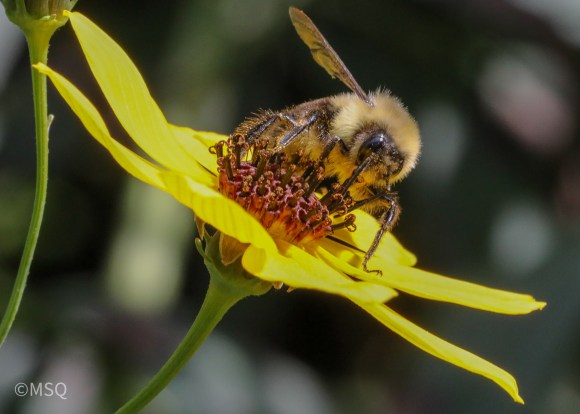
Tall Tickseed attracts numerous species of bees, butterflies, moth, skippers, and other beneficial insects.  The Xerces Society for Invertebrate Conservation considers it of Special Value to Native Bees and states it, Supports Conservation Biological Control.5  Coreopsis tripteris draws Bumblebees,

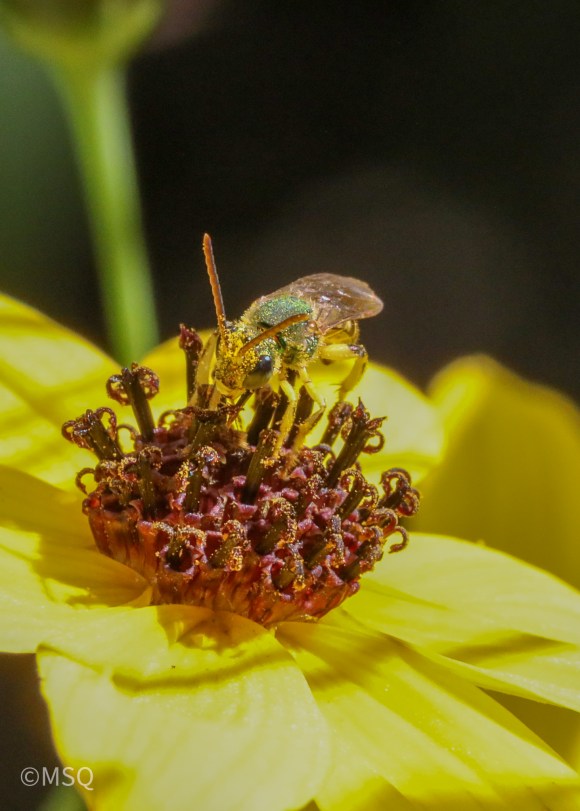
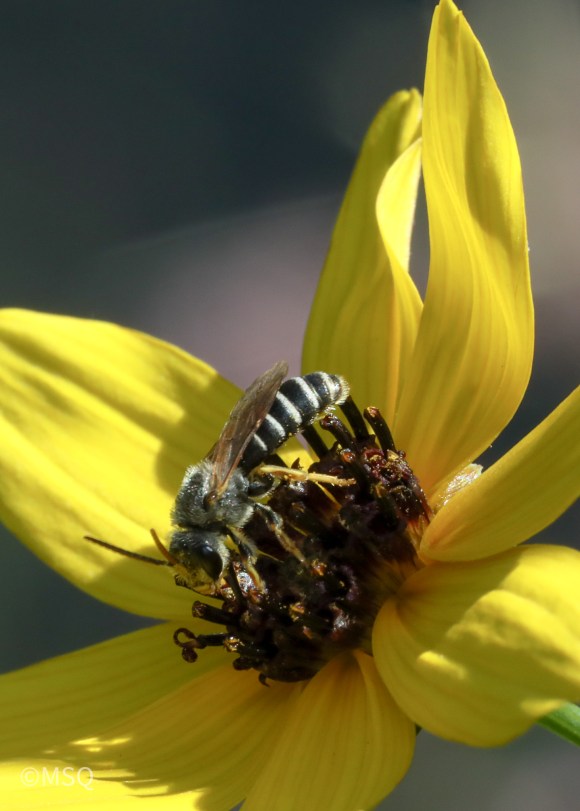
cuckoo bees,  digger bees (Melissodes spp.), leaf-cutter bees (Megachile spp.), Halictid bees (Halictus spp., Lasioglossom spp.), small green sweat bees,

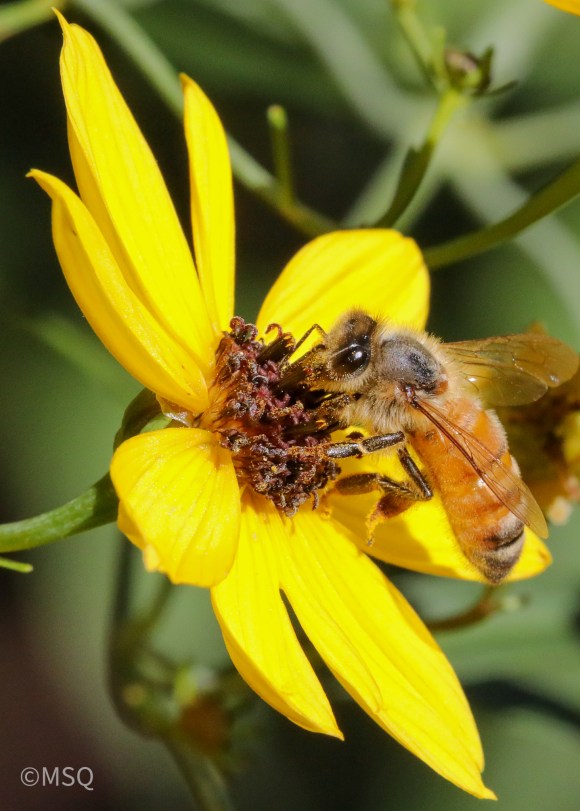
honey bees,

carpenter bees (Xylocopa spp. and Ceratina spp.) and dagger bees (Calliopsis spp., Heterosaurus spp.).2

Flies also visit Tall Tickseed.  Syrphid flies, Bee flies and Tachinid flies feed on nectar from the flowers.  Both Syrphid flies and the Tachinid flies can be beneficial insects.

The Goldenrod Soldier Beetle (Chauliognathus pennsylvanicus), another beneficial insect, eats both pollen and nectar from the Coreopsis blooms.  Over its life cycle, the Soldier beetle also preys on soil-dwelling invertebrates, aphids, and other soft-bodied insects.2

Butterflies, moths, and skippers gather resources from Coreopsis tripteris.  Adults nectar at the flowers for summer and early fall fuel.  Various moths use it as a larval host.  The Dimorphic Gray Moth (Tornosscolopacinarius) consumes the leaves of the Tall Tickseed as a caterpillar.  Both the Wavy-lined Emerald Moth (Synchlora aerata), and Common Tan Wave Moth (Pleuroprucha insulsaria) eat the flowers.  The Wavy-lined Emerald larva, also called the Camouflage Looper, not only dines on the flowers but wears them.  The larva use silk to attach pieces of the flower petals to its body.  If it moves to a different type of flower, the caterpillar will change its ‘clothes’ to match its meal.  In addition, it also seems to change clothes frequently since the observed petals are always fresh!6

I hope you’ve enjoyed this exploration into Coreopsis tripteris!  If you have any comments or suggestions about the post, I would love to hear them!  Enjoy your holiday season!

Warm Regards,

Mary

References:

  1. No author, (n.d.) Our Vision and Our Mission, Mt. Cuba Center, https://mtcubacenter.org/about/mission/#:~:text=Our%20mission%20is%20to%20inspire,the%20habitats%20that%20sustain%20them.
  2. Hilty, J., (n.d.) Tall Coreopsis, illinoiswildflowers.info, https://www.illinoiswildflowers.info/prairie/plantx/tl_coreopsisx.htm
  3. Keystone Plants by Ecoregion, The National Wildlife Federation, https://www.nwf.org/Garden-for-Wildlife/About/Native-Plants/keystone-plants-by-ecoregion
  4. National Wildlife Federation, Gardening for Wildlife, Keystone Native Plants Eastern Temperate Forests – Ecoregion 8, https://www.nwf.org/-/media/Documents/PDFs/Garden-for-Wildlife/Keystone-Plants/NWF-GFW-keystone-plant-list-ecoregion-8-eastern-temperate-forests.ashx?la=en&hash=1E180E2E5F2B06EB9ADF28882353B3BC7B3B247D
  5. No auther, n.d., Coreopsis tripteris, Lady Bird Johnson Wildflower Center, https://www.wildflower.org/plants/result.php?id_plant=cotr4
  6. Bzdyk, K., (2013, July 1), Wavy-lined Emerald Moth:  Master of Disguise, Loudoun Wildlife Conservancy, https://loudounwildlife.org/2013/07/wavy-lined-emerald-moth-master-of-disguise/
Categories
native plants Pollinator gardening

Sparks in the Garden

Every year in the early Fall, a glittering cloud of insects surrounds the arching stems of Solidago rugosa ‘Fireworks’.  Butterflies, moths, skippers, bees, wasps, beetles, beneficial insects, and flies all flock to this goldenrod for nectar, pollen and to use it as a larval host.  This feast helps prepare them for the cold months of winter.

The twinkling yellow flowers of ‘Fireworks’ goldenrod pop open along stems up to 18” long!  Held above the foliage, these stems resemble fireworks and give the plant its name.  Pompom blooms are tightly packed along the stems. Each one is about 1/8th inch in diameter.  The anthers are held above the stigmas and bright yellow ray flowers form the outer ring.  Peak bloom lasts two to three weeks.

Medium to dark green leaves grow alternately and are three to six inches long.  They range from ovate to lanceolate and their edges are toothed.  The deeply sunken veins in the leaves causing a wrinkled look. This feature gives them the name rugosa or wrinkled.  In fact, a common name for the native Solidago rugosa is Wrinkle-Leaved Goldenrod.

Solidago rugosa ‘Fireworks’ is a charming goldenrod cultivar.  Well-behaved, it sports abundant bloom for a grand show in the garden.  An erect plant, it forms dense clumps with slowly spreading rhizomes.  It grows three to four feet tall.  Spreading from two to three feet, ‘Fireworks’ will reseed if happy.  Space plants one to three feet apart.  

‘Fireworks’ thrives in zones four to eight.  It enjoys moist, well-drained soils although it can tolerate periods of drought or wet soil.  Highly adaptable to different soils, this goldenrod grows in clay, loam (silt), and sand as well as acid to neutral conditions. My plants have not been bothered by deer or rabbits.  It can withstand both heat and humidity. 

The genus Solidago, like Symphyotrichum, is an essential part of wildlife habitat, a keystone species.  In recent years, people have become interested in keystone species of all types.  A keystone species is one so crucial that the ecosystem will collapse without it.

How does this work with plants?  Key plants are native plants that are part of the local food web.  They play a role as a general or specific support for insects.  The general group are the 14% of native plants that support 90% of butterfly and moth Lepidoptera species.1  The specific group are the 40% of native plants that produce pollen for the 15% to 60% of North American native bee pollen specialists.1  Both these groups are listed in the Keystone Plants by Ecoregion from the National Wildlife Federation.  According to this information, Solidago sustains 104 species of caterpillars and 42 different specialist bees.2  (I have used the Eastern Temperate Forest list since this is my region.)  In addition to these categories, 145 different wasp species forage on Solidago.3

So, goldenrod offers abundant food at the end of the year, how is this valuable?  Fall is when next year’s insect generation is established.  Whether it’s healthy adults, well fed caterpillars or full provisions in nests, the foundations are laid with Autumn food harvest.  Goldenrod is one vital resource.

Different insects have different strategies for surviving the winter.  In the next few paragraphs, I’ll talk about what the pollinators do over the winter and where they might be.  Bumblebee and honeybee queens take mating flights in the late summer or fall.  Male bumblebees take advantage of nectar from Solidago ‘Fireworks’ to fuel up before pursuing their queen. When they’ve mated, the queens find a safe location to overwinter.  Some bumblebee queens hibernate in leaf litter and others burrow underground.4

Honeybee queens return to the hive.  During the winter, the honeybees form a ball in the hive.  If they become cold, they will vibrate for warmth.  The queen stays near the center of the mass.  Any resources gathered in the fall, are converted into honey, and used to help the honeybees survive the winter.5

Native bees overwinter as young in their nests.4  Active native bee queens use the resources from goldenrods to supply their nests.  Like SymphyotrichumSolidago has numerous bee specialists including:  Andrena (Callandrena) asteris, A. (Callandrena) braceata,  A. (Callandrena) simplex, Andrena (Cnemidandrena) hirtcincta, Andrena (Cnemidandrena) canadensis, Colletes simulans, Colletes solidaginis, Perdita (Perdita) octomaculata and Melissodes (Eumelissodes) fumosus.

Where are their nests?  70% of native bees nest underground!  Now is not the time to start digging.  Others nest in old beetle burrows and other holes in dead wood and still others in hollow stems.4  It’s better to wait until spring to cut back dead stems and clean up dead wood.

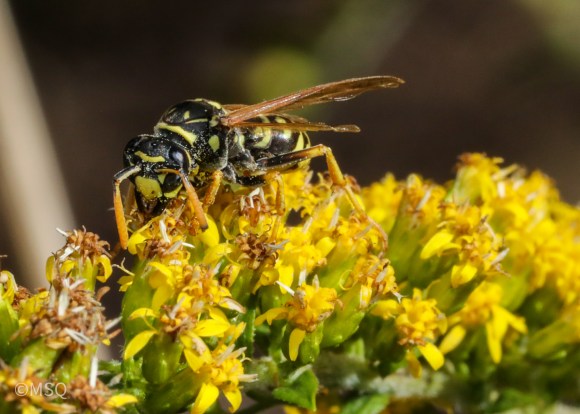
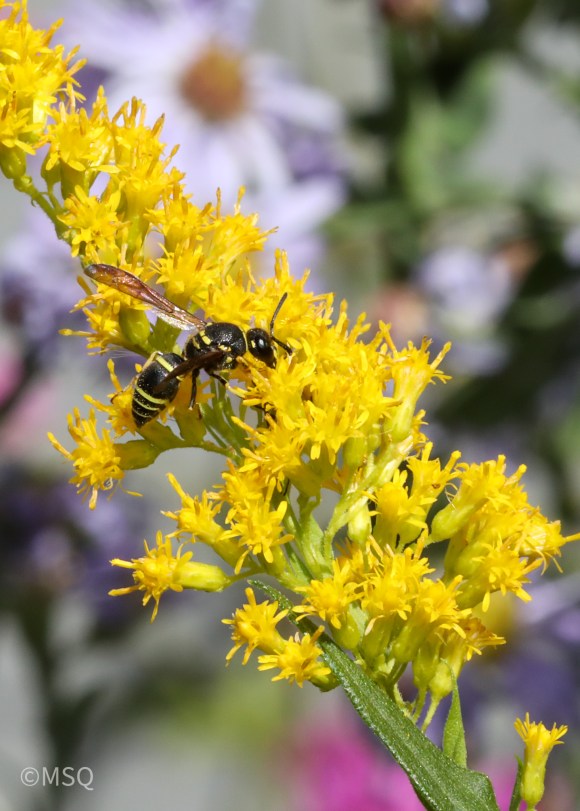
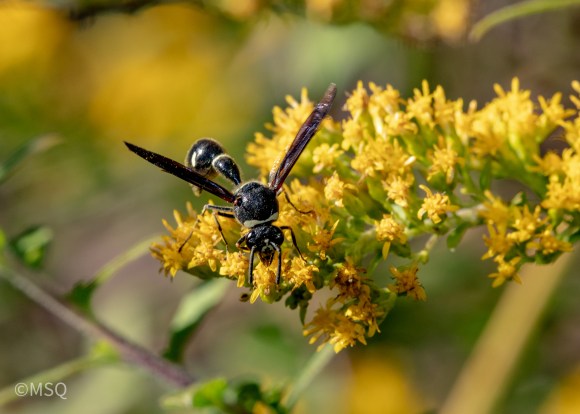
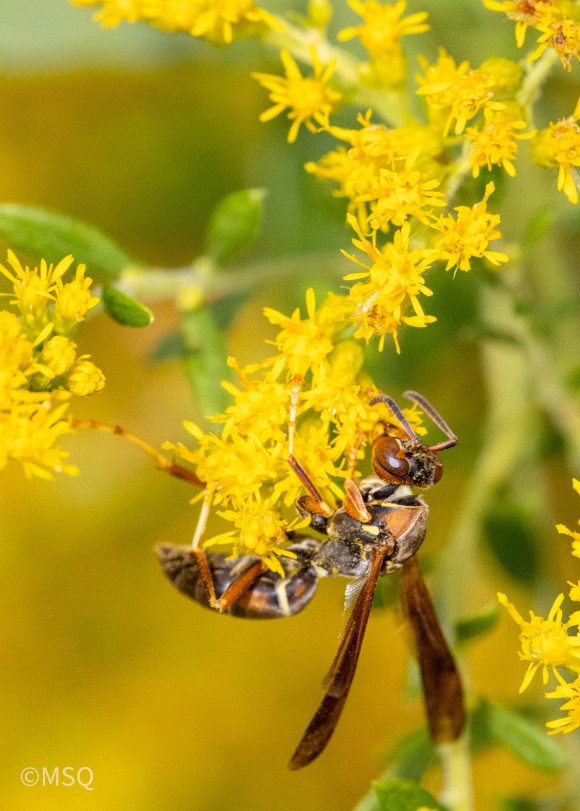
Solidago rugosa ‘Fireworks’ attracts numerous native wasps.  Indeed, unlike asters, I find wasps visiting my ‘Fireworks’ goldenrod in equal numbers with the bees.  These wasps serve as beneficial insects preying on or parasitizing pests that damage plants.  They also contribute to pollination as they drink nectar and, occasionally, eat pollen.  Native wasps spend the winter in different ways:  some as mated females called foundresses, some as young and some we don’t know yet.  The foundresses find dry, warm spots to hide in.  Other nesting locations are similar to bees including stems, wood, underground and old nests built by other wasps or bees.3

Many flies visit ‘Fireworks’ goldenrod to drink nectar and, incidentally, pollinate the flowers. The larval stage of some Tachinid and Syrphid flies are beneficial insects. Tachinid flies parasitize leaf eating insects. They over winter in the larval or pupal stage often in the shell of their host. The larvae or pupae can be found in piles of leaves or bush or burrowed into the soil.

Syrphid fly larva are excellent early and late season predators. They consume dozens of aphids each day. Most spend the winter as pupae or larvae in dead leaves or piles of brush.

Butterflies use goldenrod for nectar.  Monarchs fuel up for their migration and other butterflies build fat stores to hibernate as adults.  Not all butterflies overwinter as adults,  they can spend the cold months as eggs, caterpillar, chrysalis, or adults depending on the species.  The eggs are laid close to a spring food source.  Caterpillars deliberately hid in curled leaves, soil or under rocks for protection.  If becoming a chrysalis, the caterpillar will choose a protected location, for instance, under an overhang or deep in a shrub.  Adult butterflies and moths are very diverse when hiding.  Spaces under bark, crevices in trees, cracks in rock and the fall leaves all host butterflies and moths.6

Solidago serves as a larval host for 104 butterfly and moth caterpillars.  One unusual moth is the Wavy-Lined Emerald.  The caterpillar has a fascinating adaptation.  It decorates itself with the leaves or flowers from its host plant.  This camouflage hides it from predators.  The twirler moths (Gelechiidae), Geometer moths, Owlet Moths (Noctuidae), and Tortrix Moths also use Solidago.

The take home for today: Leaves are not Litter!  Stems Stand Tall!  Don’t Do that Digging!

Just take a rest, drink some cider, and enjoy those Fall colors!

References:

  1. Keystone Plants by Ecoregion, The National Wildlife Federation, https://www.nwf.org/Garden-for-Wildlife/About/Native-Plants/keystone-plants-by-ecoregion
  2. National Wildlife Federation, Gardening for Wildlife, Keystone Native Plants Eastern Temperate Forests – Ecoregion 8, https://www.nwf.org/-/media/Documents/PDFs/Garden-for-Wildlife/Keystone-Plants/NWF-GFW-keystone-plant-list-ecoregion-8-eastern-temperate-forests.ashx?la=en&hash=1E180E2E5F2B06EB9ADF28882353B3BC7B3B247D
  3. Holm, H., 2021 Wasps:  Their Biology, Diversity, and Role as Beneficial Insects and Pollinators of Native Plants, Minnetonka, MN, Pollination Press LLC.
  4. Morris, S. (2018, October 10). Where Do Pollinators Go In The Winter? Xerces Society for Invertebrate Conservation.  https://xerces.org/blog/where-do-pollinators-go-in-winter#:~:text=Most%20native%20bee%20species%20will,help%20to%20survive%20until%20spring.
  5. Hogeback, J. Where Do Honeybees Go In The Winter?  Britannica.  https://www.britannica.com/story/where-do-honeybees-go-in-the-winter
  6. Grisak, A. (2022, November 04). How Does A Butterfly Survive Winter? Birds & Blooms. https://www.birdsandblooms.com/gardening/attracting-butterflies/butterflies-in-winter/
Categories
native plants Pollinator gardening

Grist for the Bees

Purple Wheat in the garden?  Indeed, that’s what Agastache means ‘agan’ much, ‘stachys’ ear of grain, from the Greek.  Its flowers look like heads of wheat or rye and range from pale lavender to purple.  ‘Foeniculum’, the second part of the name, means fragrant for the scented leaves.  Agastache foeniculum (Fragrant or Anise Hyssop) is part of the mint family.  Like Pycnanthemum virginianum (https://wildthingsinthe.garden/2023/05/31/white-goes-with-everything/), also mints, it attracts an enormous variety of bees.  Fragrant Hyssop also supports numerous butterflies and skippers.

Anise Hyssop grows two to four feet tall and spreads eighteen inches to two feet.  It has an upright, clump-forming habit.  Anise Hyssop sports dark green, ovate to broadly lanceolate leaves up to four inches long.  Almost heart shaped, the leaves are one to three inches at the base and whitish underneath.  They sit opposite each other on the classic square stem of mint plants.  The foliage also gives off a strong anise or licorice-like scent that gives the plant its common and Latin name.

Agastache foeniculum can begin blooming in June and continues through August.  In zone 5, where I am, it doesn’t start until July.  Blooms appear as three- to six-inch-long flower spikes at the end of plant stalks.  The eye-catching blossoms range from pale lavender to true purple in color.  Tiny flowers make up each large spike.  They’re laid out in tightly packed rows although there can be gaps (think of an ear of corn).  This arrangement is called verticillasters or false whorls.  Each of the small flowers is tubular, 2-lipped and a 1/3’’ inch long.  Unlike the leaves, the blooms have no scent. 

Fragrant Hyssop plant grows best in full sun with dry to moderately moist soil.  Soil moisture is not a problem if the drainage is good.   Anise Hyssop is drought tolerant, more so after it is established.  It spreads by rhizomes and self-seeding especially under good conditions.  I have not found that this plant spreads obnoxiously.  I have far fewer Anise Hyssop seedlings than Monarda fistulosa seedlings.  Fragrant Hyssop may have problems with crown rot with soggy soil. Other issues include rust and powdery mildew.

Outside of cultivation, Agastache foeniculum grows in prairies, dry upland forests, plains, fields, roadsides, and other dry, open, semi-shaded areas.  In the past, it served as honeybee forage in Canada and parts of the Upper Midwest.  It works well in borders, wildflower gardens, herb gardens, butterfly gardens and meadows.

Agastache foeniculum and similar species inspire plant breeders around the world.  Too many nativars exist to explore them all, but I thought we could look at three very different plants.  Each of these was modified in a different way.

Agastache ‘Blue Fortune’ is a very popular hybrid created by crossing Agastache foeniculum with its East Asian relative, Agastache rugosa.  This compact plant has longer flower spikes than the species.  It blooms for an extended time because it’s bred to be sterile.  ‘Blue Fortune’ is widely reported to be a pollinator magnet.

Agastache ‘Golden Jubilee’ is an older hybrid with yellow-green foliage that’s pure yellow in the Spring. The flowers are identical to the species.  ‘Golden Jubilee’ received the All-American Selection Award in 2003 and is still being sold.  It will self-seed with a mix of species and golden seedlings.  There are mixed reports on how pollinators respond to ‘Golden Jubilee’.  Some sources say bees don’t seem to ‘see’ it and others say pollinators love it.

Agastache ‘Red Fortune’ has red to pink flowers.  The leaves are like the species.  Pollinators don’t like this plant as much as Agastache foeniculum.

These three plants give a nice snapshot of how natives are altered and some pollinator responses.  One idea is that nativars with flowers most like the species’ flowers would be most acceptable.1  Positive reports about ‘Blue Fortune’ and ‘Golden Jubilee seem to support this idea.2

In addition, red is a special case.  Bees see in the ultraviolet spectrum—from approximately 300 to 650 nm.  They can’t see red although they can see reddish tones like orange.  When native plants are hybridized for red flowers, bees often have trouble finding them.1,3

But wait!  There’s an exception.  Red flowers can have ultraviolet “nectar guides”  which the bees see perfectly well.  Plants use these guides to “direct” the pollinators to the nectar reward and encourage pollination.3  

It’s hard to say if a red native hybrid will still attract and support bee pollinators.  If they retain their ultraviolet nectar guides, then the bees should see them.  However, I’ve seen more than one report showing little to no bee activity on the red and pink hybrids.1,2

Anise Hyssop serves a multitude of pollinators providing nectar and pollen.  Like Monarda (https://wildthingsinthe.garden/2023/07/31/the-gardens-super-station/), Fragrant Hyssop has been identified by pollination ecologists as attracting large numbers of native bees.  The Xerces Society for Invertebrate Conservation also designated Fragrant Hyssop of Special Value to Bumble bees and Honeybees.  Butterflies and skippers use it for a nectar source.

Pollination in Fragrant Hyssop hinges on both the individual flowers’ structure and the different bees’ anatomies.  The nectar is secreted by a disc at the base of the flower.  Pollen-carrying anthers are located on the top lip of each flower.  When bees root for nectar, pollen rubs off onto their heads or thorax.  As they move to a bloom with a receptive stigma, female part, the pollen transfers and fertilization occurs.

The many native bees that visit Hyssop range from large to tiny.  Bumble bees are the largest.  I’ve seen Common Eastern Bumble bee (Bombus impatiens), Brown-Belted Bumble bee, (Bombus griseocollis), Two-Spotted Bumble bee (Bombus bimaculatus), and Golden Northern Bumble Bee (Bombus fervidus) on my Fragrant Hyssop. They use both nectar and pollen for their larva.  

Large Leaf-Cutter bees use Anise Hyssop’s nectar. In the process, they are efficient pollinators. In contrast to other bees, pollen accumulates on the Leaf-Cutter bees’ abdominal scopae (specialized pollen collecting hairs).  It is transferred to the stigmas from there.


Digger bees (Melissodes) and smaller Leaf-Cutter bees (Megachile) are mid-sized bees.  They also collect both pollen and nectar from Anise Hyssop.

The Halictid bees (Lasioglossom), small Resin bees (Heriades) and Masked bees (Hylaeus) are small bees that gather resources from Fragrant Hyssop.  Dufourea monardae is included in this group.  D. monardae is a specialist or oligolectic bee that visits Monarda fistulosa and Agastache foeniculum.  These small bees can collect pollen from the anthers extending from the flowers. When harvesting nectar, they climb the style to reach the base of the flower.  (The style is the stalk connecting the stigma and the ovary.)

Fragrant Hyssop provides an excellent late season nectar source for butterflies, skippers and moths including Silver Spotted Skipper Butterflies (Epargyreus clarus), Peck’s Skipper Butterflies (Polites peckius) and the Great Spangled Fritillary Butterfly (Speyeria cybele).  They reach their proboscis into each tiny bloom to find the nectar.  Hyssop also works well in Monarch Way Stations providing food after most milkweed has stopped blooming.  

I hope you enjoyed this exploration of Anise Hyssop and its wonderful visitors!  I’d love to hear your thought about this blog or stories about your own experiences in the garden.  Please leave me comment and let me know your thoughts!

References:

  1. Eierman, Kim,11 April 2014,  “Ecobeneficial Interview:  Annie White on Native Plant Cultivars, Native Plants and Pollinators”, Youtube, https://www.youtube.com/watch?v=HTmuDcEzTOw
  2. Caldwell, Cathy, (2021, August-Vol.7, No.8) Anise hyssop, Piedmont Master Gardeners, https://piedmontmastergardeners.org/article/anise-hyssop/
  3. Riddle, Sharla, (2016, May, 20) How Bees See And Why It Matters, Bee Culture:  The Magazine of American Beekeeping, https://www.beeculture.com/bees-see-matters/