Categories
native plants Pollinator gardening

Sparks in the Garden

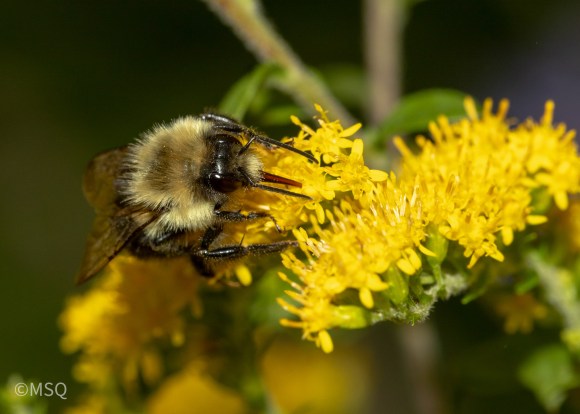
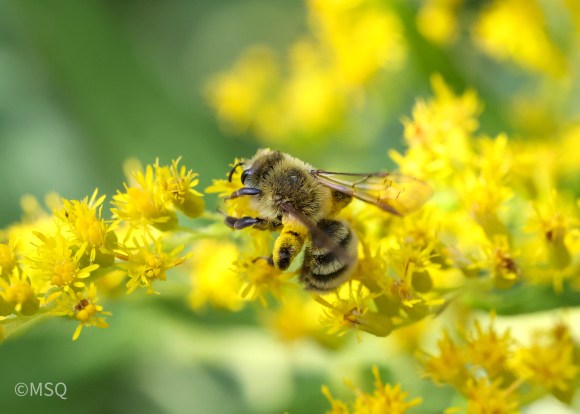
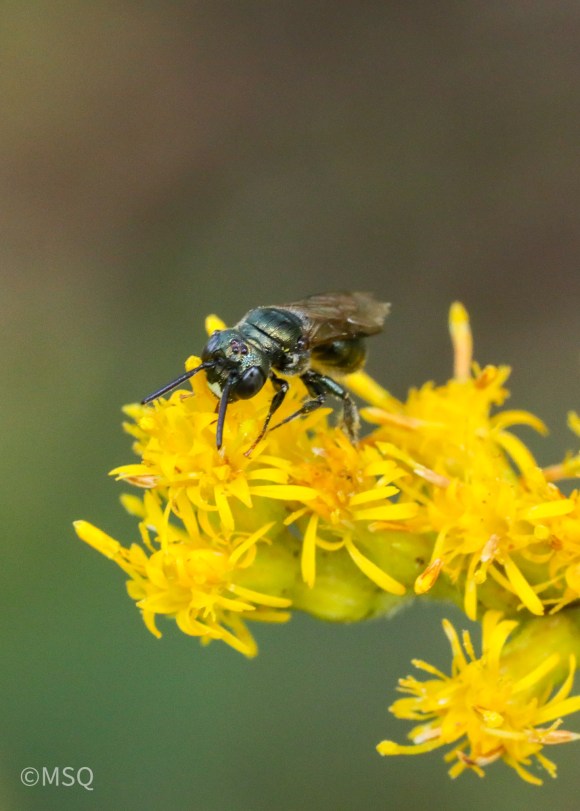
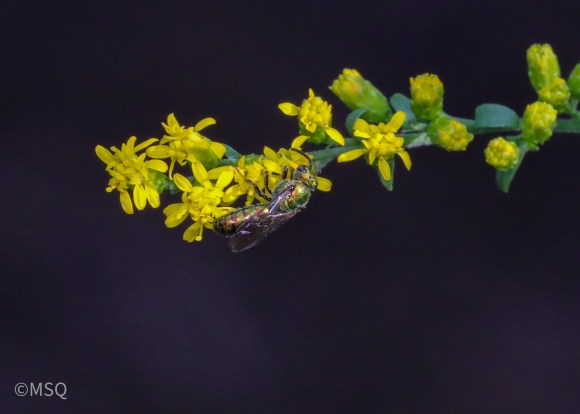
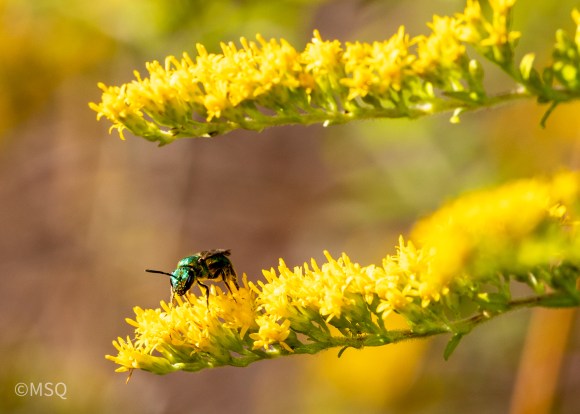
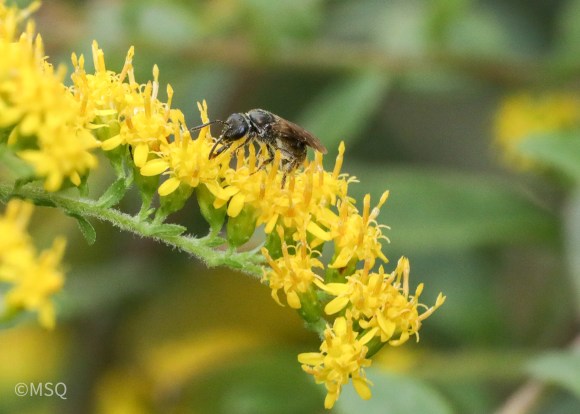
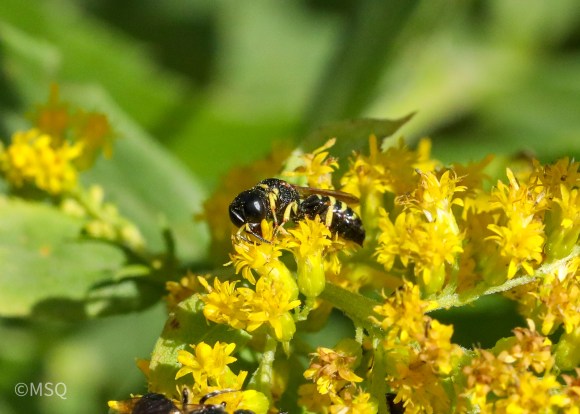
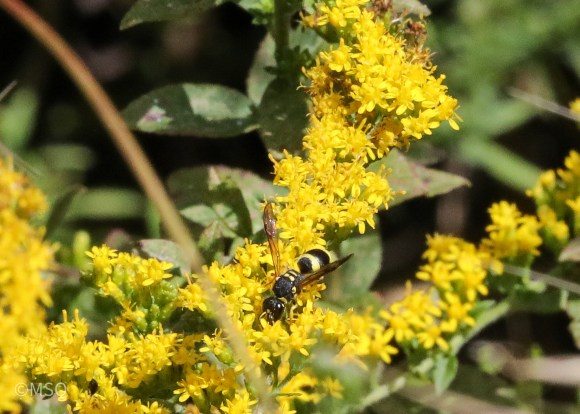
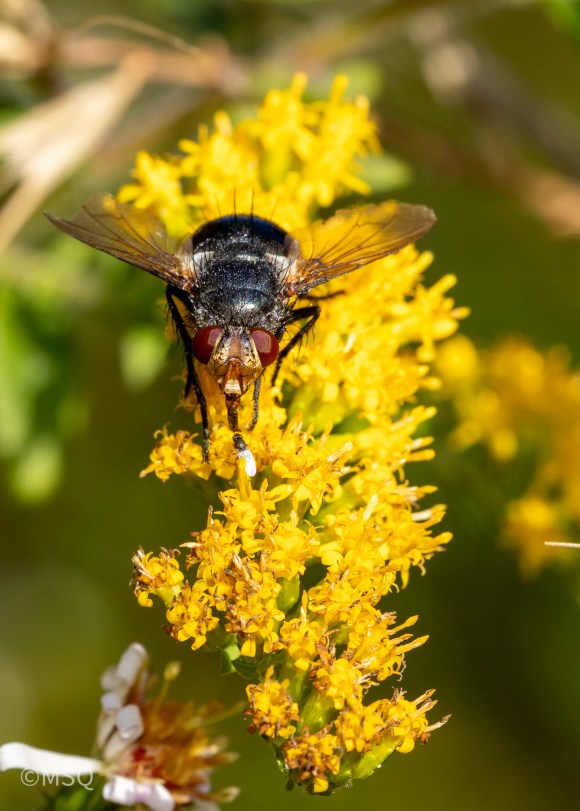
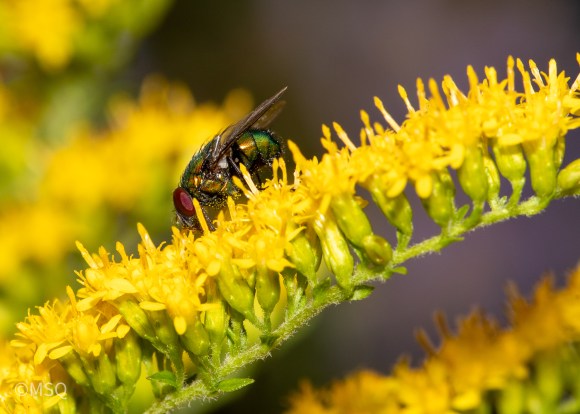
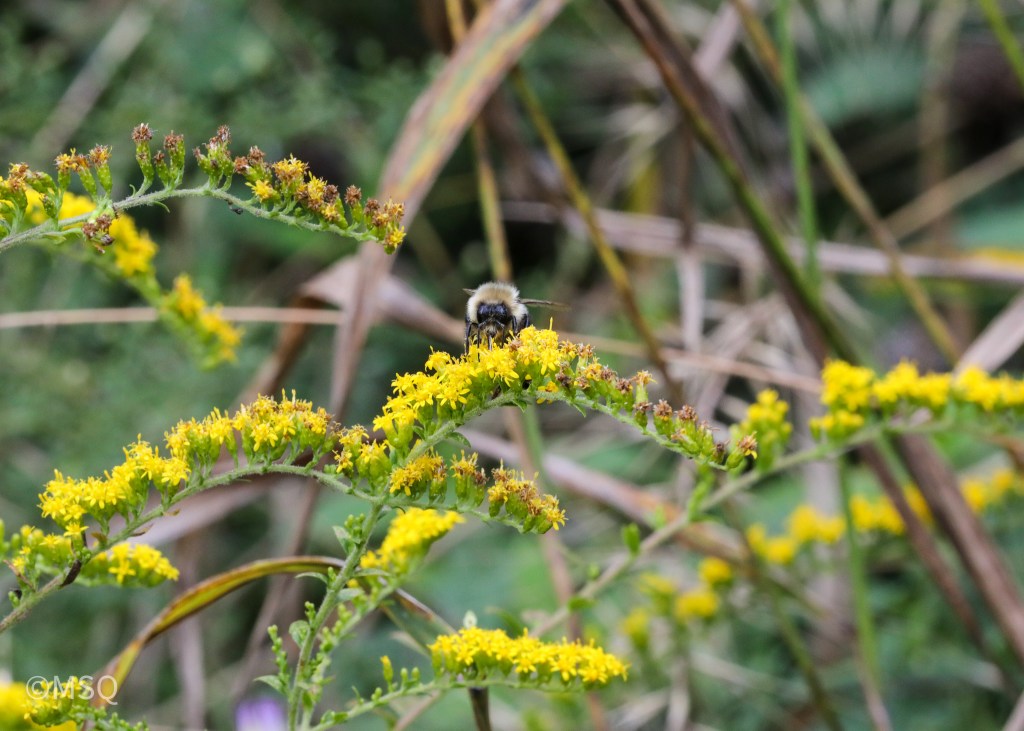
Every year in the early Fall, a glittering cloud of insects surrounds the arching stems of Solidago rugosa ‘Fireworks’.  Butterflies, moths, skippers, bees, wasps, beetles, beneficial insects, and flies all flock to this goldenrod for nectar, pollen and to use it as a larval host.  This feast helps prepare them for the cold months of winter.

The twinkling yellow flowers of ‘Fireworks’ goldenrod pop open along stems up to 18” long!  Held above the foliage, these stems resemble fireworks and give the plant its name.  Pompom blooms are tightly packed along the stems. Each one is about 1/8th inch in diameter.  The anthers are held above the stigmas and bright yellow ray flowers form the outer ring.  Peak bloom lasts two to three weeks.
Medium to dark green leaves grow alternately and are three to six inches long.  They range from ovate to lanceolate and their edges are toothed.  The deeply sunken veins in the leaves causing a wrinkled look. This feature gives them the name rugosa or wrinkled.  In fact, a common name for the native Solidago rugosa is Wrinkle-Leaved Goldenrod.

Solidago rugosa ‘Fireworks’ is a charming goldenrod cultivar.  Well-behaved, it sports abundant bloom for a grand show in the garden.  An erect plant, it forms dense clumps with slowly spreading rhizomes.  It grows three to four feet tall.  Spreading from two to three feet, ‘Fireworks’ will reseed if happy.  Space plants one to three feet apart.  

‘Fireworks’ thrives in zones four to eight.  It enjoys moist, well-drained soils although it can tolerate periods of drought or wet soil.  Highly adaptable to different soils, this goldenrod grows in clay, loam (silt), and sand as well as acid to neutral conditions. My plants have not been bothered by deer or rabbits.  It can withstand both heat and humidity. 

The genus Solidago, like Symphyotrichum, is an essential part of wildlife habitat, a keystone species.  In recent years, people have become interested in keystone species of all types.  A keystone species is one so crucial that the ecosystem will collapse without it.

How does this work with plants?  Key plants are native plants that are part of the local food web.  They play a role as a general or specific support for insects.  The general group are the 14% of native plants that support 90% of butterfly and moth Lepidoptera species.1  The specific group are the 40% of native plants that produce pollen for the 15% to 60% of North American native bee pollen specialists.1  Both these groups are listed in the Keystone Plants by Ecoregion from the National Wildlife Federation.  According to this information, Solidago sustains 104 species of caterpillars and 42 different specialist bees.2  (I have used the Eastern Temperate Forest list since this is my region.)  In addition to these categories, 145 different wasp species forage on Solidago.3

So, goldenrod offers abundant food at the end of the year, how is this valuable?  Fall is when next year’s insect generation is established.  Whether it’s healthy adults, well fed caterpillars or full provisions in nests, the foundations are laid with Autumn food harvest.  Goldenrod is one vital resource.

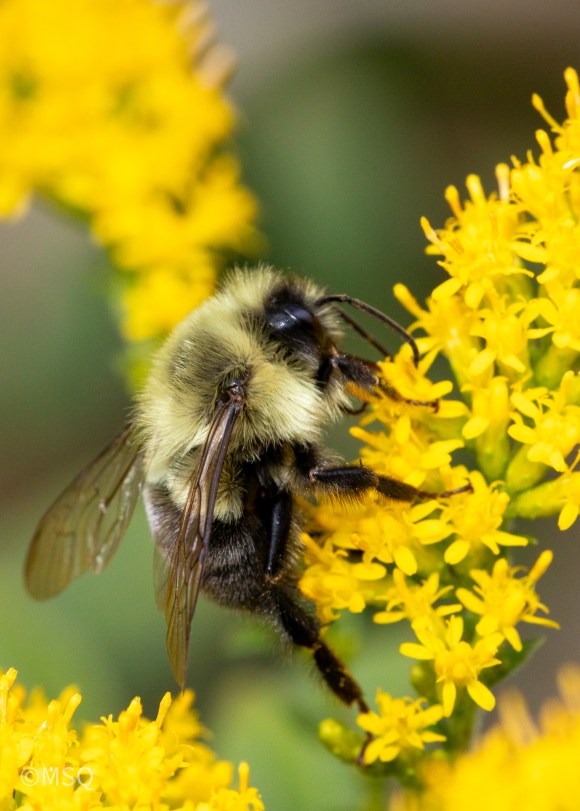
Different insects have different strategies for surviving the winter.  In the next few paragraphs, I’ll talk about what the pollinators do over the winter and where they might be.  Bumblebee and honeybee queens take mating flights in the late summer or fall.  Male bumblebees take advantage of nectar from Solidago ‘Fireworks’ to fuel up before pursuing their queen. When they’ve mated, the queens find a safe location to overwinter.  Some bumblebee queens hibernate in leaf litter and others burrow underground.4
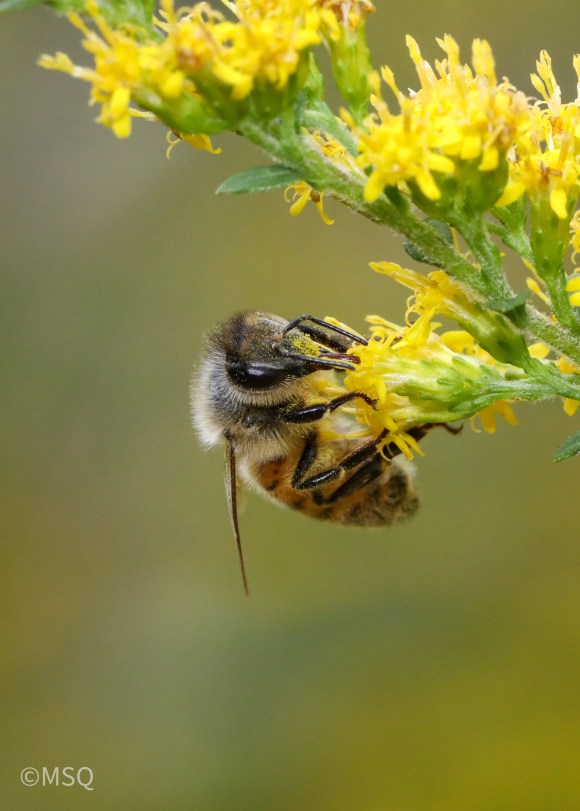
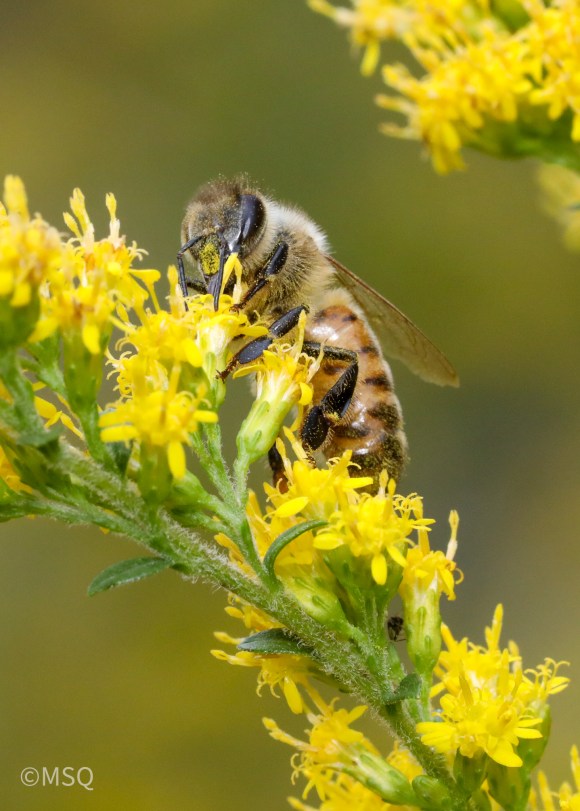
Honeybee queens return to the hive.  During the winter, the honeybees form a ball in the hive.  If they become cold, they will vibrate for warmth.  The queen stays near the center of the mass.  Any resources gathered in the fall, are converted into honey, and used to help the honeybees survive the winter.5
Native bees overwinter as young in their nests.4  Active native bee queens use the resources from goldenrods to supply their nests.  Like SymphyotrichumSolidago has numerous bee specialists including:  Andrena (Callandrena) asteris, A. (Callandrena) braceata,  A. (Callandrena) simplex, Andrena (Cnemidandrena) hirtcincta, Andrena (Cnemidandrena) canadensis, Colletes simulans, Colletes solidaginis, Perdita (Perdita) octomaculata and Melissodes (Eumelissodes) fumosus.
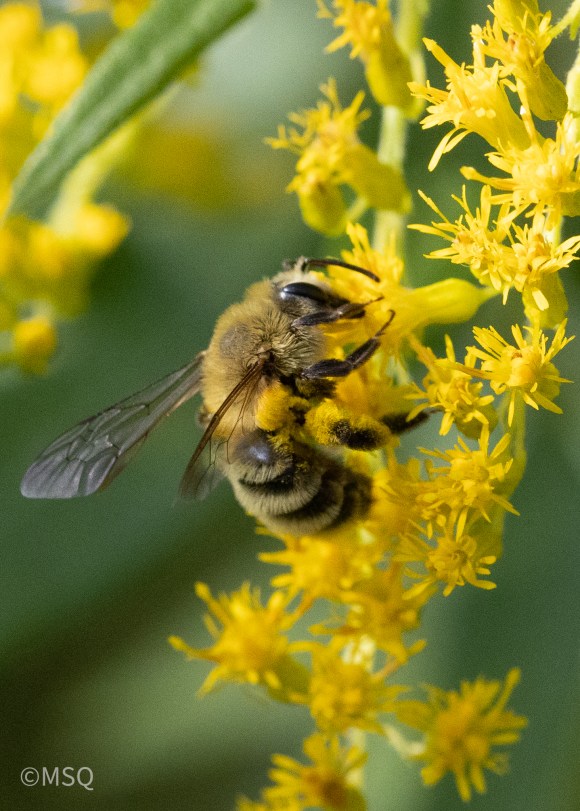
Where are their nests?  70% of native bees nest underground!  Now is not the time to start digging.  Others nest in old beetle burrows and other holes in dead wood and still others in hollow stems.4  It’s better to wait until spring to cut back dead stems and clean up dead wood.
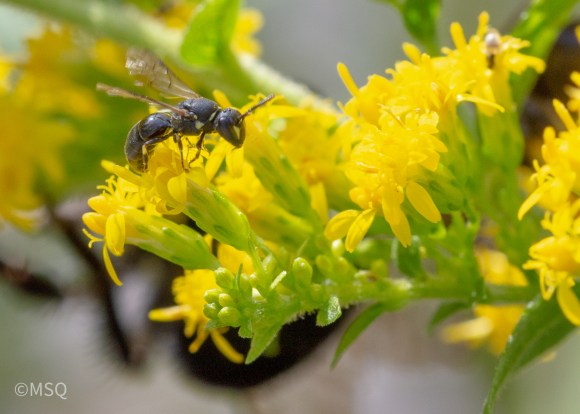
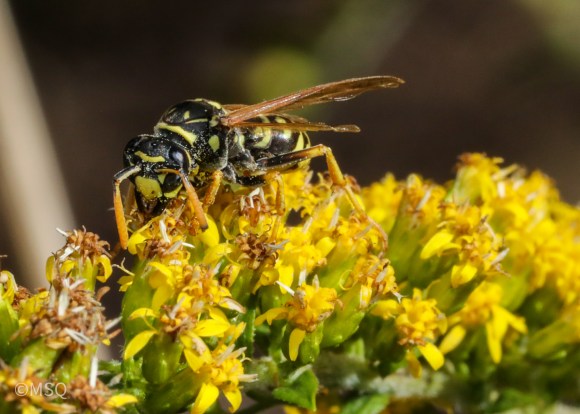
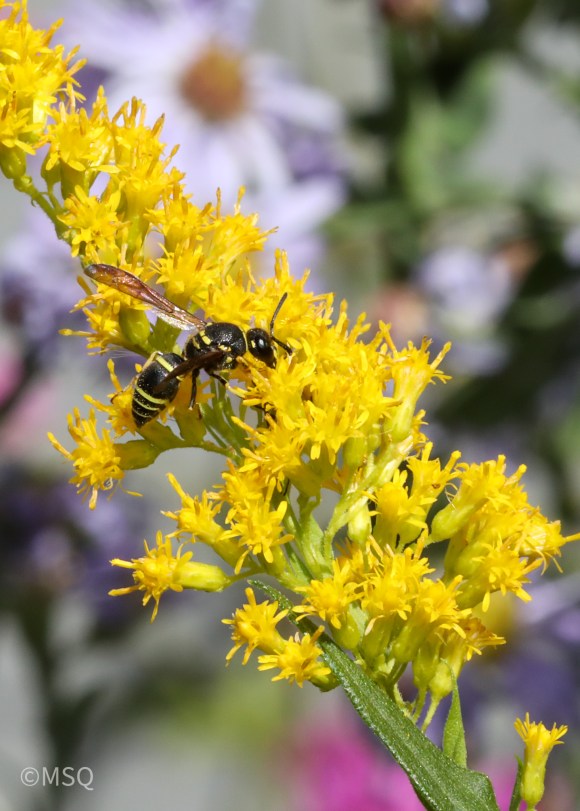
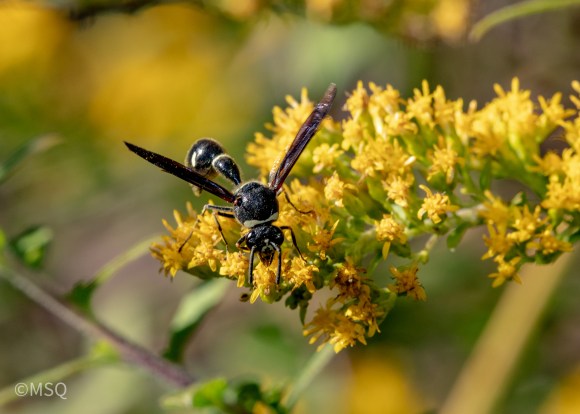
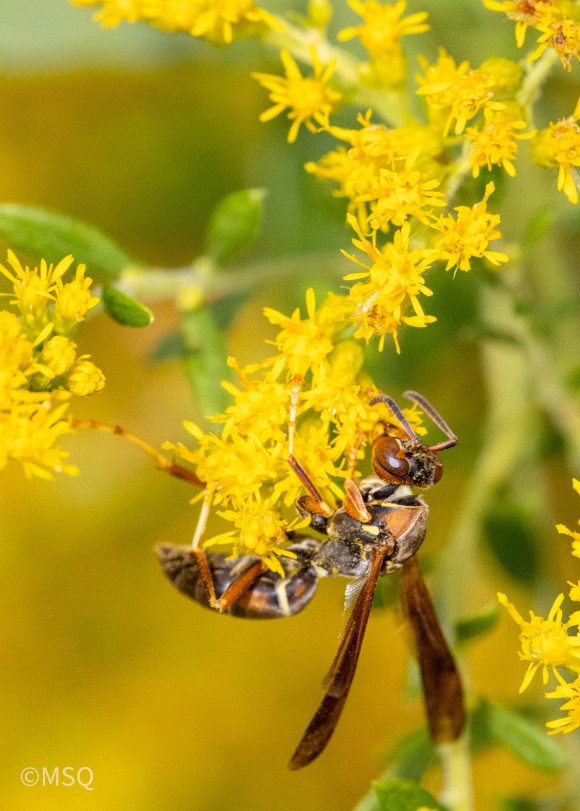
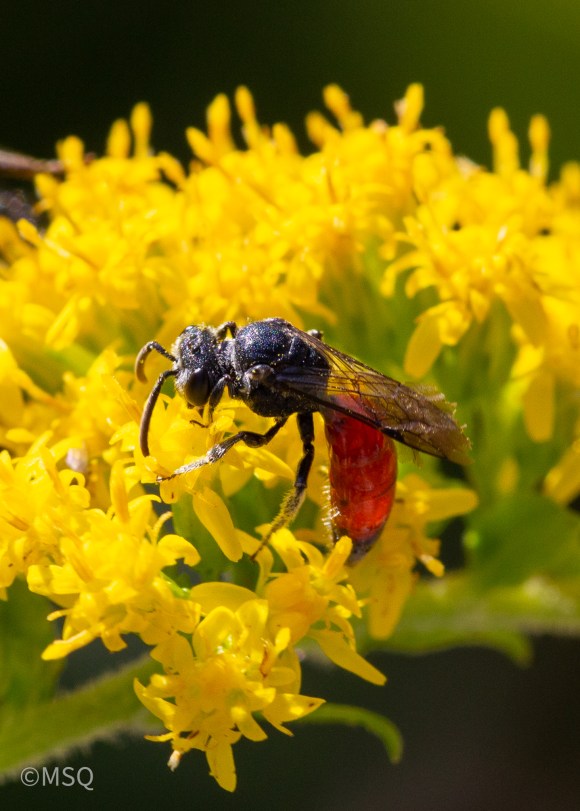
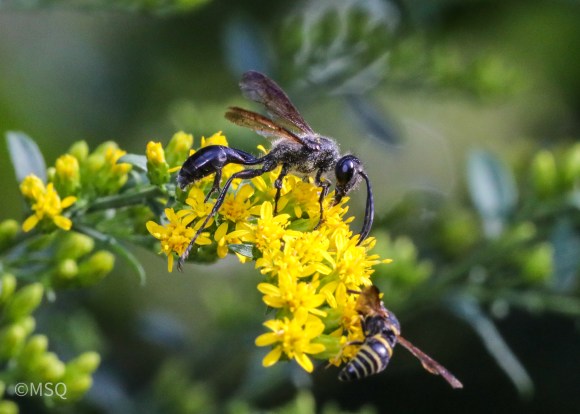
Solidago rugosa ‘Fireworks’ attracts numerous native wasps.  Indeed, unlike asters, I find wasps visiting my ‘Fireworks’ goldenrod in equal numbers with the bees.  These wasps serve as beneficial insects preying on or parasitizing pests that damage plants.  They also contribute to pollination as they drink nectar and, occasionally, eat pollen.  Native wasps spend the winter in different ways:  some as mated females called foundresses, some as young and some we don’t know yet.  The foundresses find dry, warm spots to hide in.  Other nesting locations are similar to bees including stems, wood, underground and old nests built by other wasps or bees.3
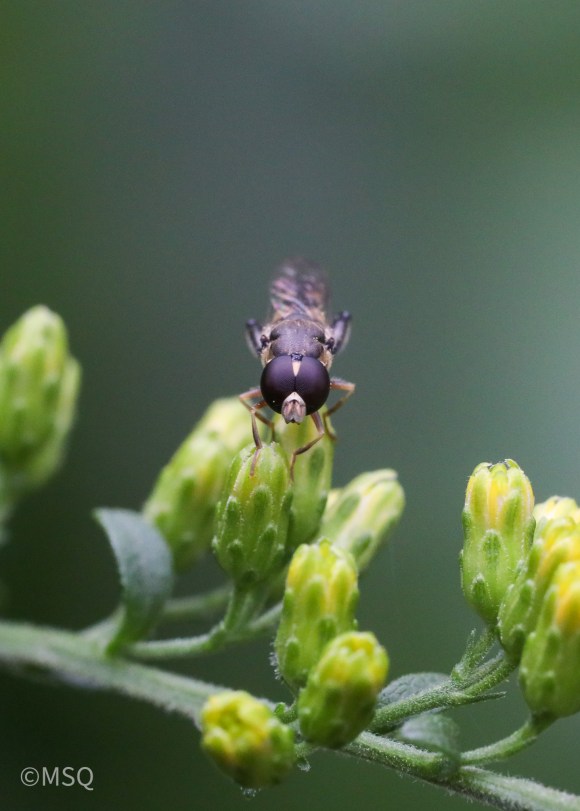
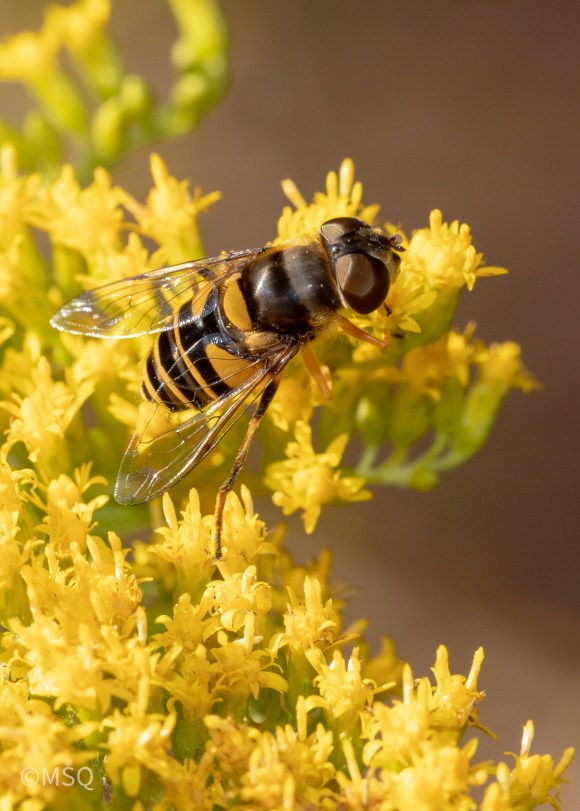
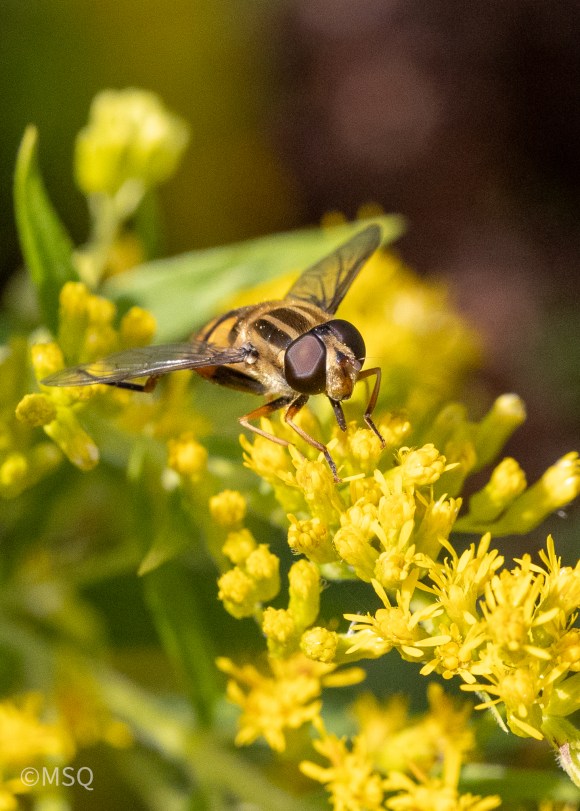
Many flies visit ‘Fireworks’ goldenrod to drink nectar and, incidentally, pollinate the flowers. The larval stage of some Tachinid and Syrphid flies are beneficial insects. Tachinid flies parasitize leaf eating insects. They over winter in the larval or pupal stage often in the shell of their host. The larvae or pupae can be found in piles of leaves or bush or burrowed into the soil.
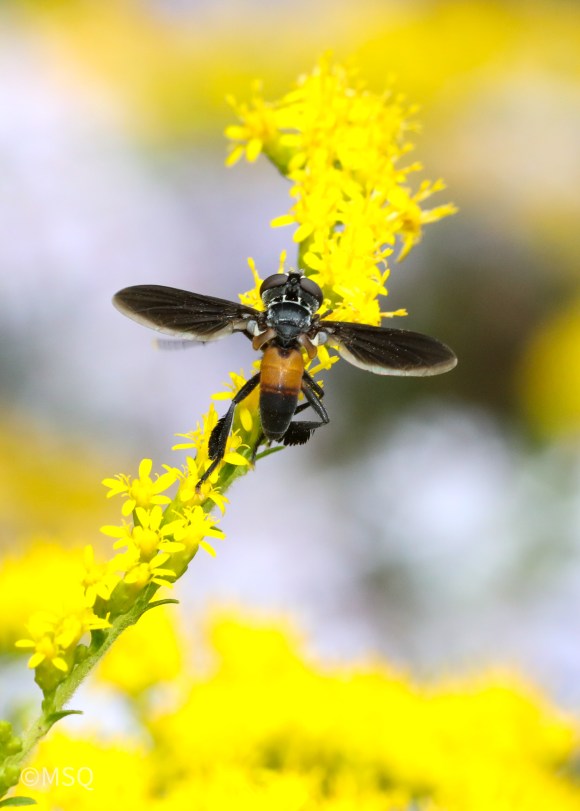
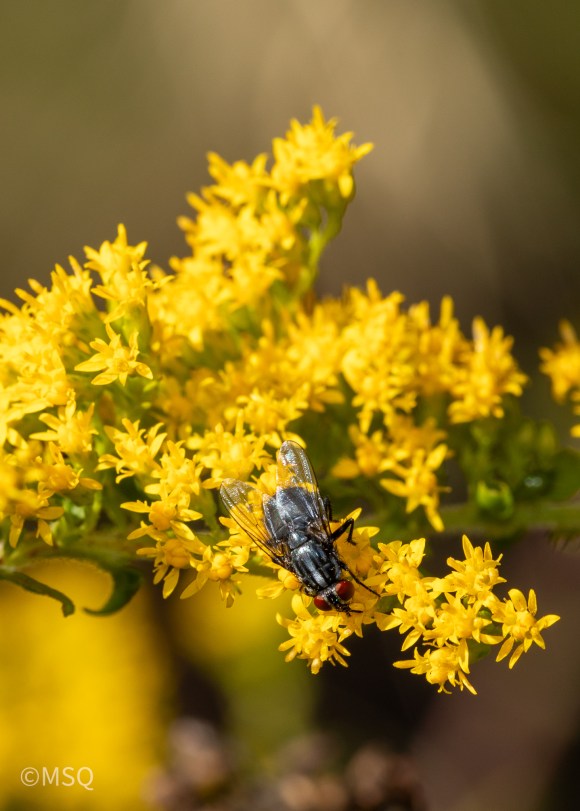
Syrphid fly larva are excellent early and late season predators. They consume dozens of aphids each day. Most spend the winter as pupae or larvae in dead leaves or piles of brush.
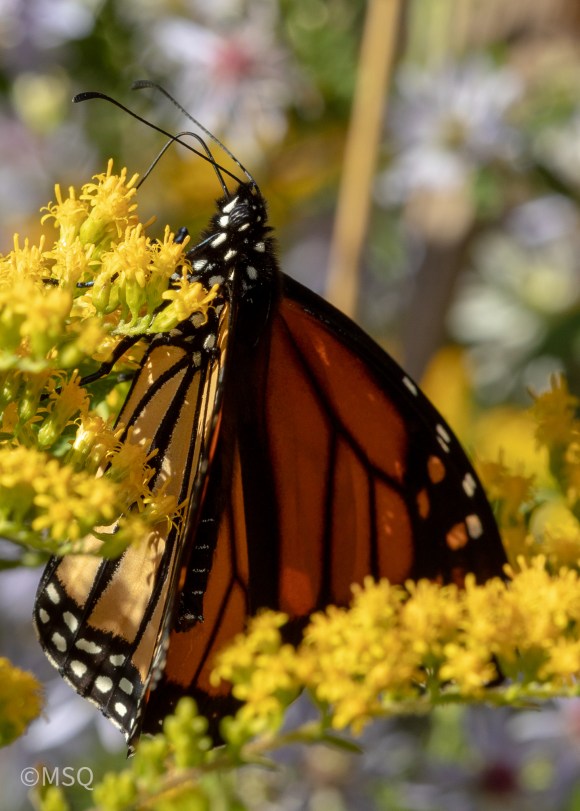
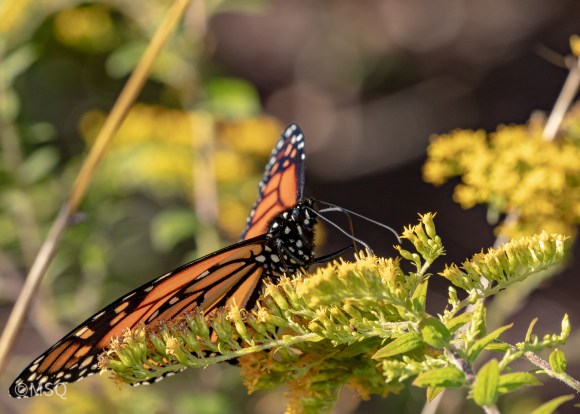
Butterflies use goldenrod for nectar.  Monarchs fuel up for their migration and other butterflies build fat stores to hibernate as adults.  Not all butterflies overwinter as adults,  they can spend the cold months as eggs, caterpillar, chrysalis, or adults depending on the species.  The eggs are laid close to a spring food source.  Caterpillars deliberately hid in curled leaves, soil or under rocks for protection.  If becoming a chrysalis, the caterpillar will choose a protected location, for instance, under an overhang or deep in a shrub.  Adult butterflies and moths are very diverse when hiding.  Spaces under bark, crevices in trees, cracks in rock and the fall leaves all host butterflies and moths.6
Solidago serves as a larval host for 104 butterfly and moth caterpillars.  One unusual moth is the Wavy-Lined Emerald.  The caterpillar has a fascinating adaptation.  It decorates itself with the leaves or flowers from its host plant.  This camouflage hides it from predators.  The twirler moths (Gelechiidae), Geometer moths, Owlet Moths (Noctuidae), and Tortrix Moths also use Solidago.

The take home for today: Leaves are not Litter!  Stems Stand Tall!  Don’t Do that Digging!

Just take a rest, drink some cider, and enjoy those Fall colors!

References:

  1. Keystone Plants by Ecoregion, The National Wildlife Federation, https://www.nwf.org/Garden-for-Wildlife/About/Native-Plants/keystone-plants-by-ecoregion
  2. National Wildlife Federation, Gardening for Wildlife, Keystone Native Plants Eastern Temperate Forests – Ecoregion 8, https://www.nwf.org/-/media/Documents/PDFs/Garden-for-Wildlife/Keystone-Plants/NWF-GFW-keystone-plant-list-ecoregion-8-eastern-temperate-forests.ashx?la=en&hash=1E180E2E5F2B06EB9ADF28882353B3BC7B3B247D
  3. Holm, H., 2021 Wasps:  Their Biology, Diversity, and Role as Beneficial Insects and Pollinators of Native Plants, Minnetonka, MN, Pollination Press LLC.
  4. Morris, S. (2018, October 10). Where Do Pollinators Go In The Winter? Xerces Society for Invertebrate Conservation.  https://xerces.org/blog/where-do-pollinators-go-in-winter#:~:text=Most%20native%20bee%20species%20will,help%20to%20survive%20until%20spring.
  5. Hogeback, J. Where Do Honeybees Go In The Winter?  Britannica.  https://www.britannica.com/story/where-do-honeybees-go-in-the-winter
  6. Grisak, A. (2022, November 04). How Does A Butterfly Survive Winter? Birds & Blooms. https://www.birdsandblooms.com/gardening/attracting-butterflies/butterflies-in-winter/
Categories
native plants Pollinator gardening

Grist for the Bees

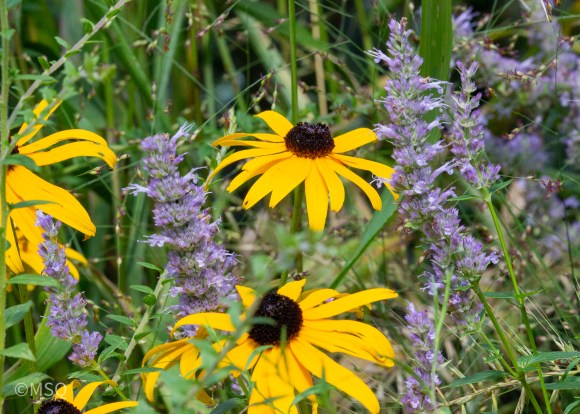
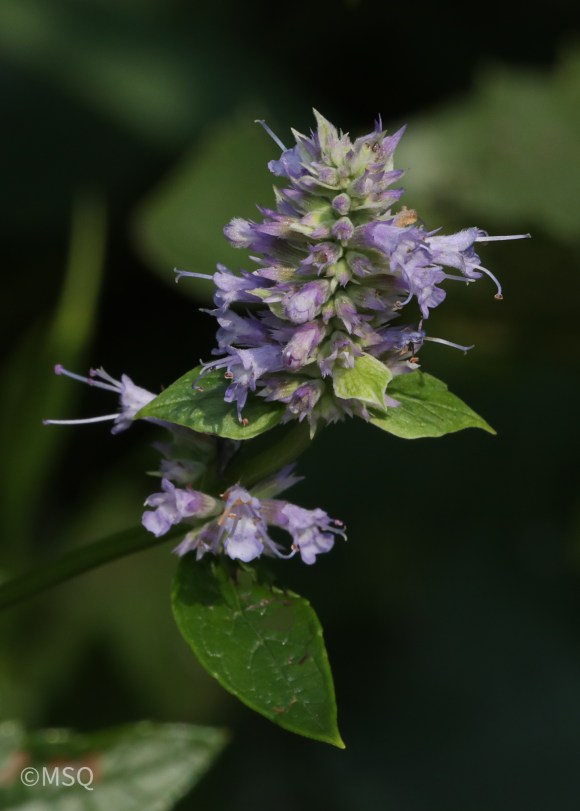
Purple Wheat in the garden?  Indeed, that’s what Agastache means ‘agan’ much, ‘stachys’ ear of grain, from the Greek.  Its flowers look like heads of wheat or rye and range from pale lavender to purple.  ‘Foeniculum’, the second part of the name, means fragrant for the scented leaves.  Agastache foeniculum (Fragrant or Anise Hyssop) is part of the mint family.  Like Pycnanthemum virginianum (https://wildthingsinthe.garden/2023/05/31/white-goes-with-everything/), also mints, it attracts an enormous variety of bees.  Fragrant Hyssop also supports numerous butterflies and skippers.

Anise Hyssop grows two to four feet tall and spreads eighteen inches to two feet.  It has an upright, clump-forming habit.  Anise Hyssop sports dark green, ovate to broadly lanceolate leaves up to four inches long.  Almost heart shaped, the leaves are one to three inches at the base and whitish underneath.  They sit opposite each other on the classic square stem of mint plants.  The foliage also gives off a strong anise or licorice-like scent that gives the plant its common and Latin name.

Agastache foeniculum can begin blooming in June and continues through August.  In zone 5, where I am, it doesn’t start until July.  Blooms appear as three- to six-inch-long flower spikes at the end of plant stalks.  The eye-catching blossoms range from pale lavender to true purple in color.  Tiny flowers make up each large spike.  They’re laid out in tightly packed rows although there can be gaps (think of an ear of corn).  This arrangement is called verticillasters or false whorls.  Each of the small flowers is tubular, 2-lipped and a 1/3’’ inch long.  Unlike the leaves, the blooms have no scent. 

Fragrant Hyssop plant grows best in full sun with dry to moderately moist soil.  Soil moisture is not a problem if the drainage is good.   Anise Hyssop is drought tolerant, more so after it is established.  It spreads by rhizomes and self-seeding especially under good conditions.  I have not found that this plant spreads obnoxiously.  I have far fewer Anise Hyssop seedlings than Monarda fistulosa seedlings.  Fragrant Hyssop may have problems with crown rot with soggy soil. Other issues include rust and powdery mildew.

Outside of cultivation, Agastache foeniculum grows in prairies, dry upland forests, plains, fields, roadsides, and other dry, open, semi-shaded areas.  In the past, it served as honeybee forage in Canada and parts of the Upper Midwest.  It works well in borders, wildflower gardens, herb gardens, butterfly gardens and meadows.

Agastache foeniculum and similar species inspire plant breeders around the world.  Too many nativars exist to explore them all, but I thought we could look at three very different plants.  Each of these was modified in a different way.

Agastache ‘Blue Fortune’ is a very popular hybrid created by crossing Agastache foeniculum with its East Asian relative, Agastache rugosa.  This compact plant has longer flower spikes than the species.  It blooms for an extended time because it’s bred to be sterile.  ‘Blue Fortune’ is widely reported to be a pollinator magnet.

Agastache ‘Golden Jubilee’ is an older hybrid with yellow-green foliage that’s pure yellow in the Spring. The flowers are identical to the species.  ‘Golden Jubilee’ received the All-American Selection Award in 2003 and is still being sold.  It will self-seed with a mix of species and golden seedlings.  There are mixed reports on how pollinators respond to ‘Golden Jubilee’.  Some sources say bees don’t seem to ‘see’ it and others say pollinators love it.

Agastache ‘Red Fortune’ has red to pink flowers.  The leaves are like the species.  Pollinators don’t like this plant as much as Agastache foeniculum.

These three plants give a nice snapshot of how natives are altered and some pollinator responses.  One idea is that nativars with flowers most like the species’ flowers would be most acceptable.1  Positive reports about ‘Blue Fortune’ and ‘Golden Jubilee seem to support this idea.2

In addition, red is a special case.  Bees see in the ultraviolet spectrum—from approximately 300 to 650 nm.  They can’t see red although they can see reddish tones like orange.  When native plants are hybridized for red flowers, bees often have trouble finding them.1,3

But wait!  There’s an exception.  Red flowers can have ultraviolet “nectar guides”  which the bees see perfectly well.  Plants use these guides to “direct” the pollinators to the nectar reward and encourage pollination.3  

It’s hard to say if a red native hybrid will still attract and support bee pollinators.  If they retain their ultraviolet nectar guides, then the bees should see them.  However, I’ve seen more than one report showing little to no bee activity on the red and pink hybrids.1,2

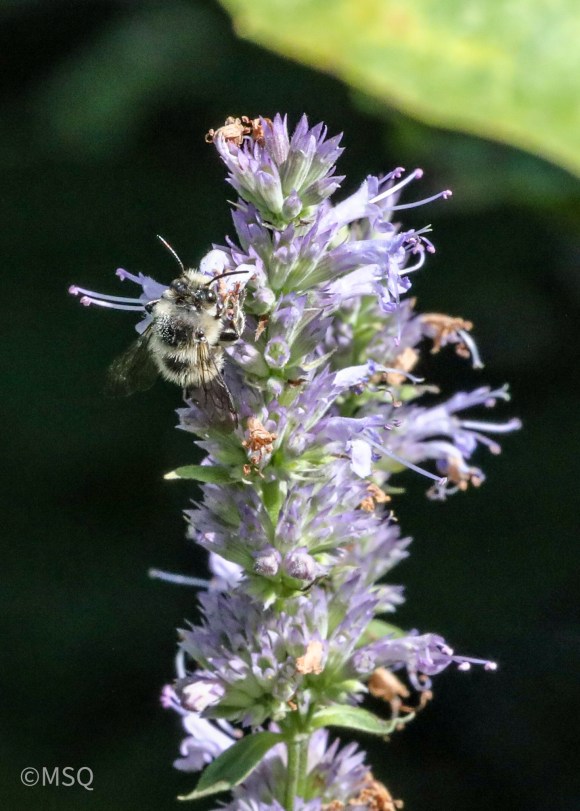
Anise Hyssop serves a multitude of pollinators providing nectar and pollen.  Like Monarda (https://wildthingsinthe.garden/2023/07/31/the-gardens-super-station/), Fragrant Hyssop has been identified by pollination ecologists as attracting large numbers of native bees.  The Xerces Society for Invertebrate Conservation also designated Fragrant Hyssop of Special Value to Bumble bees and Honeybees.  Butterflies and skippers use it for a nectar source.

Pollination in Fragrant Hyssop hinges on both the individual flowers’ structure and the different bees’ anatomies.  The nectar is secreted by a disc at the base of the flower.  Pollen-carrying anthers are located on the top lip of each flower.  When bees root for nectar, pollen rubs off onto their heads or thorax.  As they move to a bloom with a receptive stigma, female part, the pollen transfers and fertilization occurs.

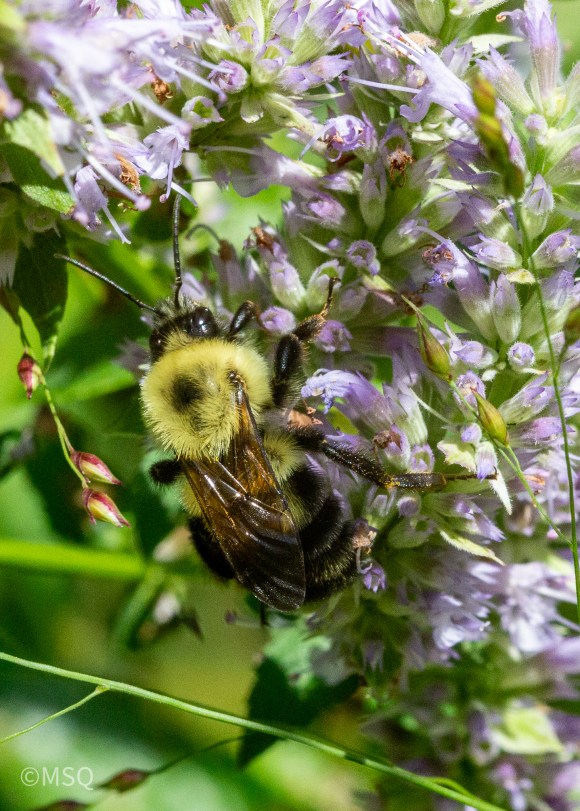
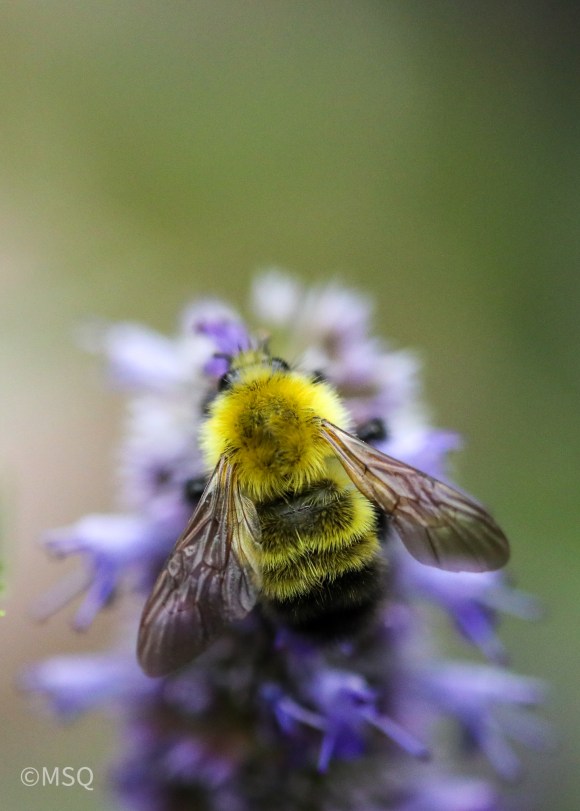
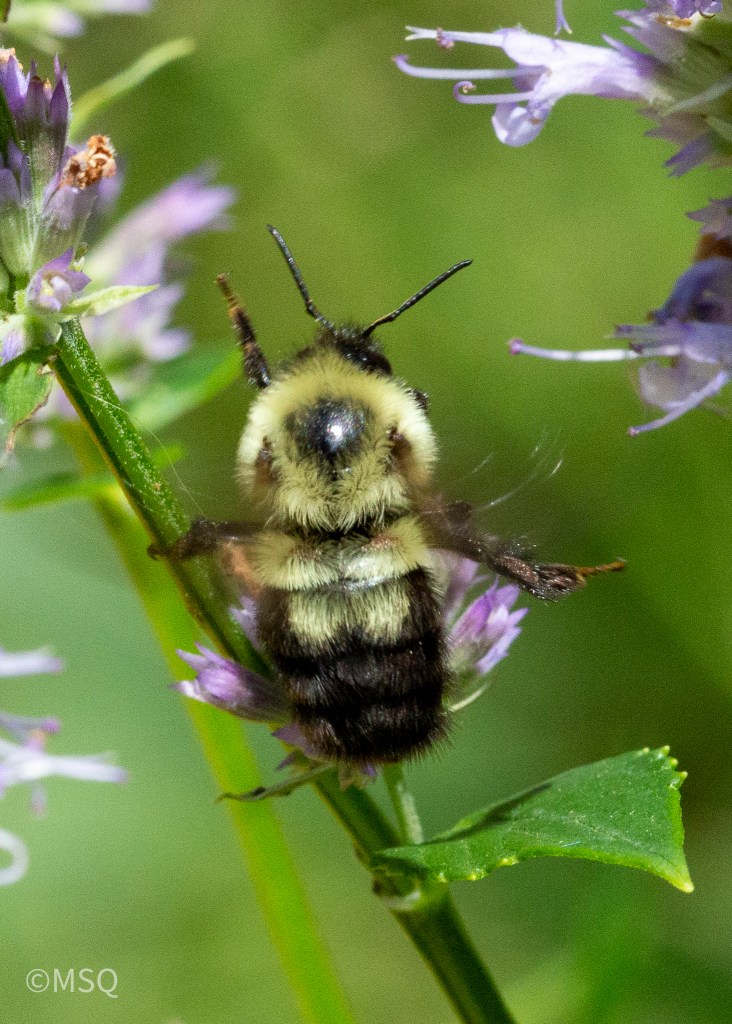
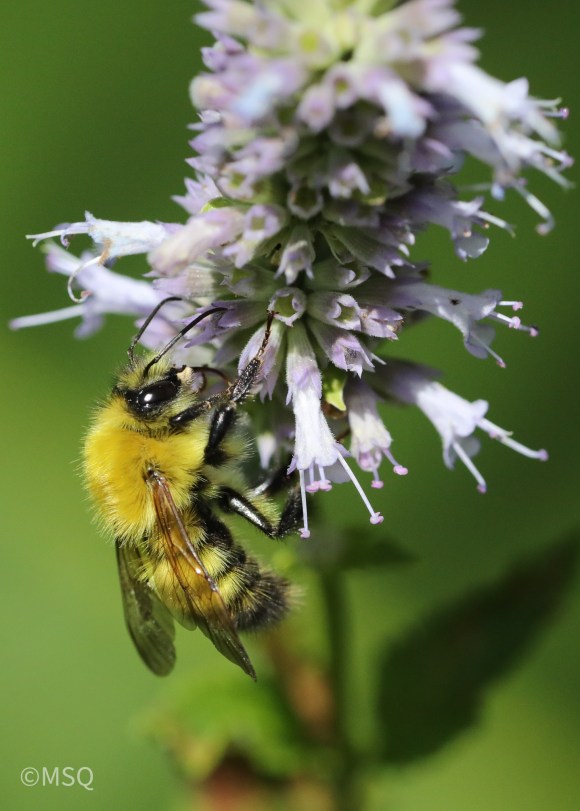
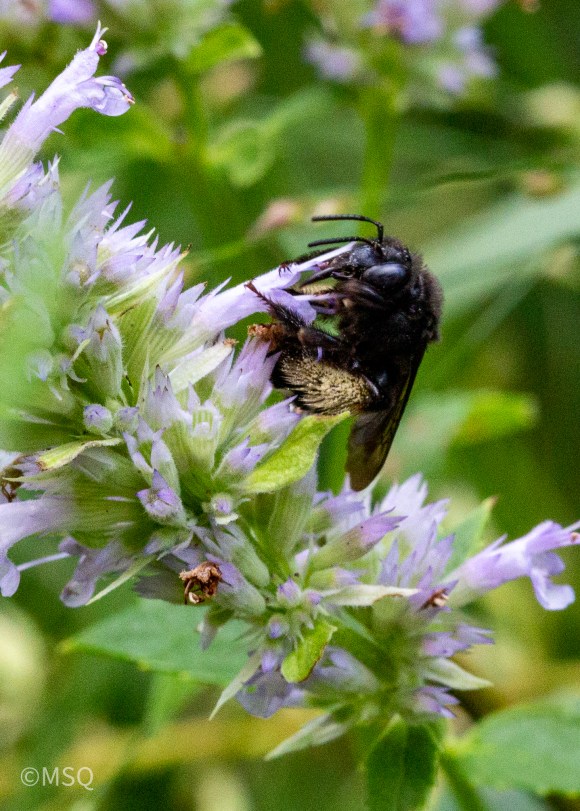
The many native bees that visit Hyssop range from large to tiny.  Bumble bees are the largest.  I’ve seen Common Eastern Bumble bee (Bombus impatiens), Brown-Belted Bumble bee, (Bombus griseocollis), Two-Spotted Bumble bee (Bombus bimaculatus), and Golden Northern Bumble Bee (Bombus fervidus) on my Fragrant Hyssop. They use both nectar and pollen for their larva.  

Large Leaf-Cutter bees use Anise Hyssop’s nectar. In the process, they are efficient pollinators. In contrast to other bees, pollen accumulates on the Leaf-Cutter bees’ abdominal scopae (specialized pollen collecting hairs).  It is transferred to the stigmas from there.


Digger bees (Melissodes) and smaller Leaf-Cutter bees (Megachile) are mid-sized bees.  They also collect both pollen and nectar from Anise Hyssop.

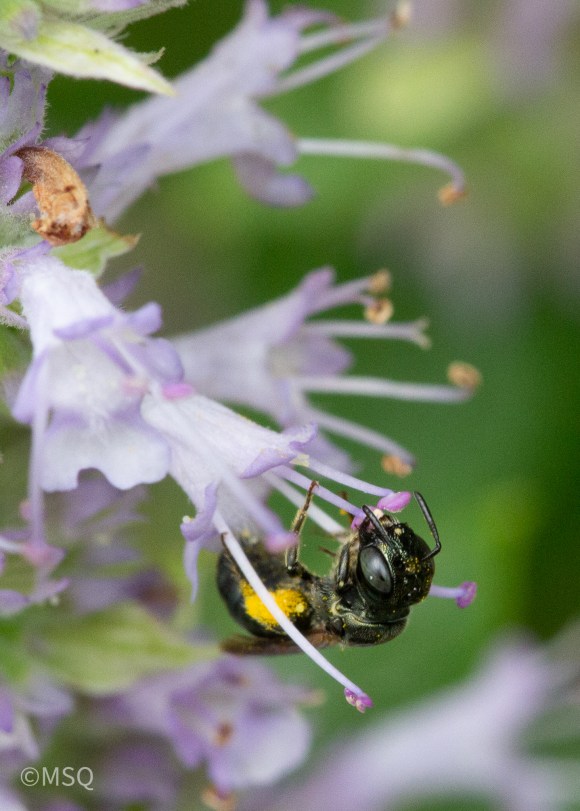
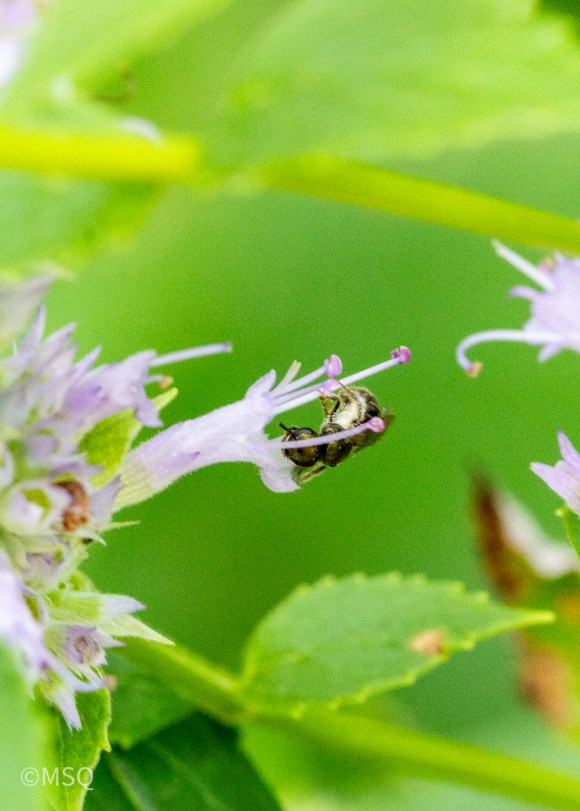
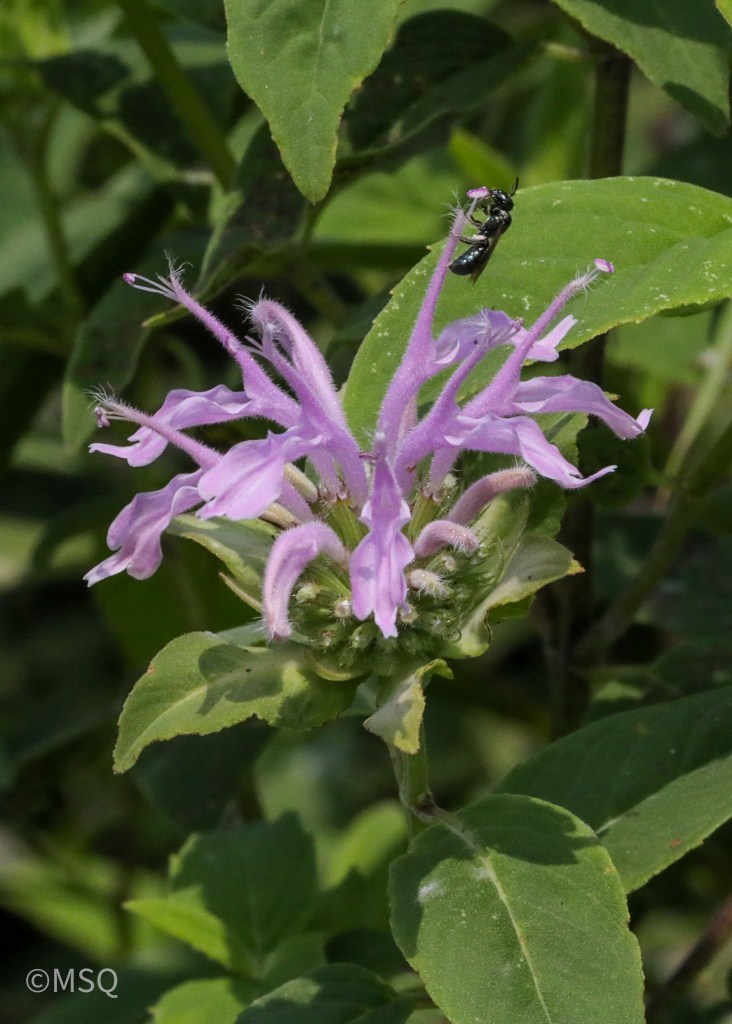
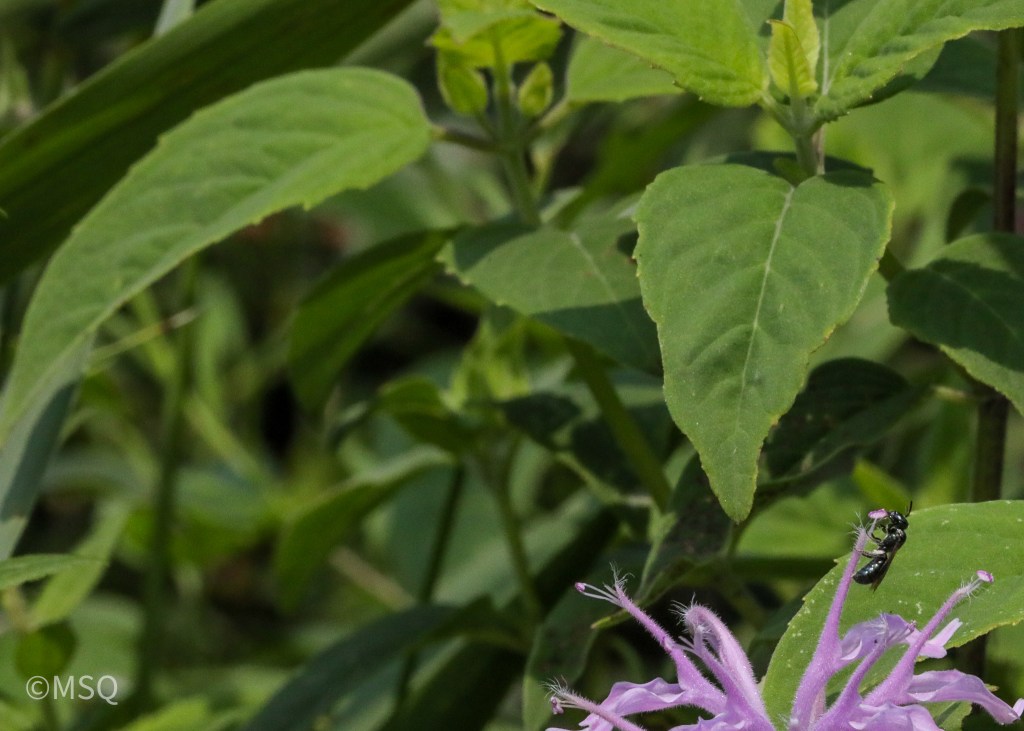
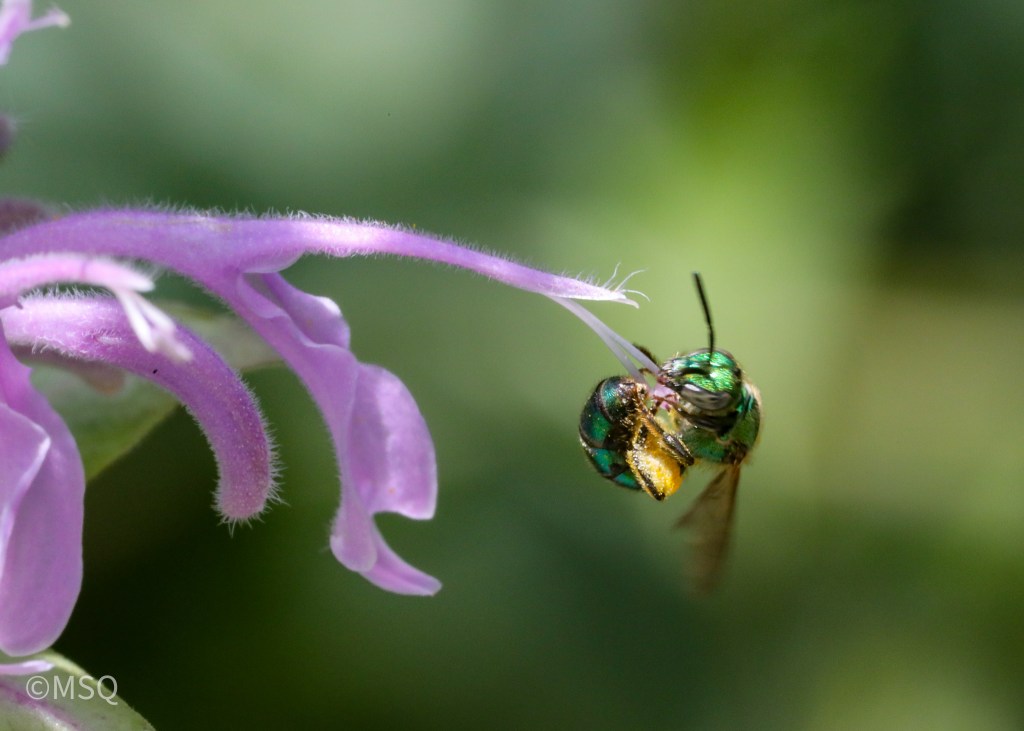
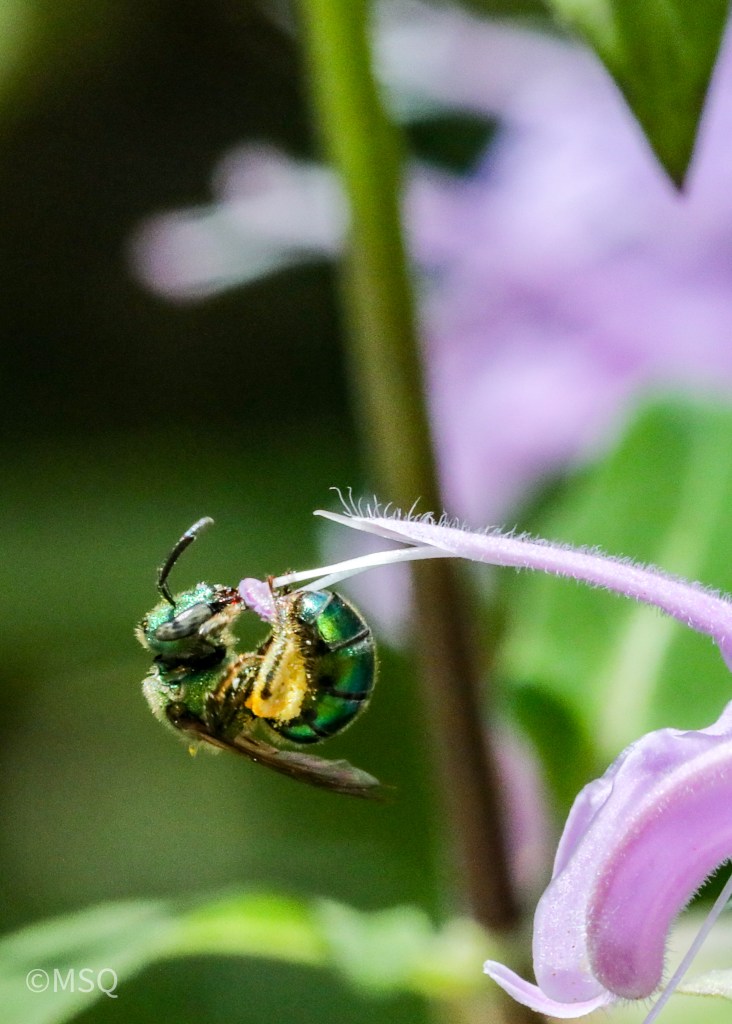
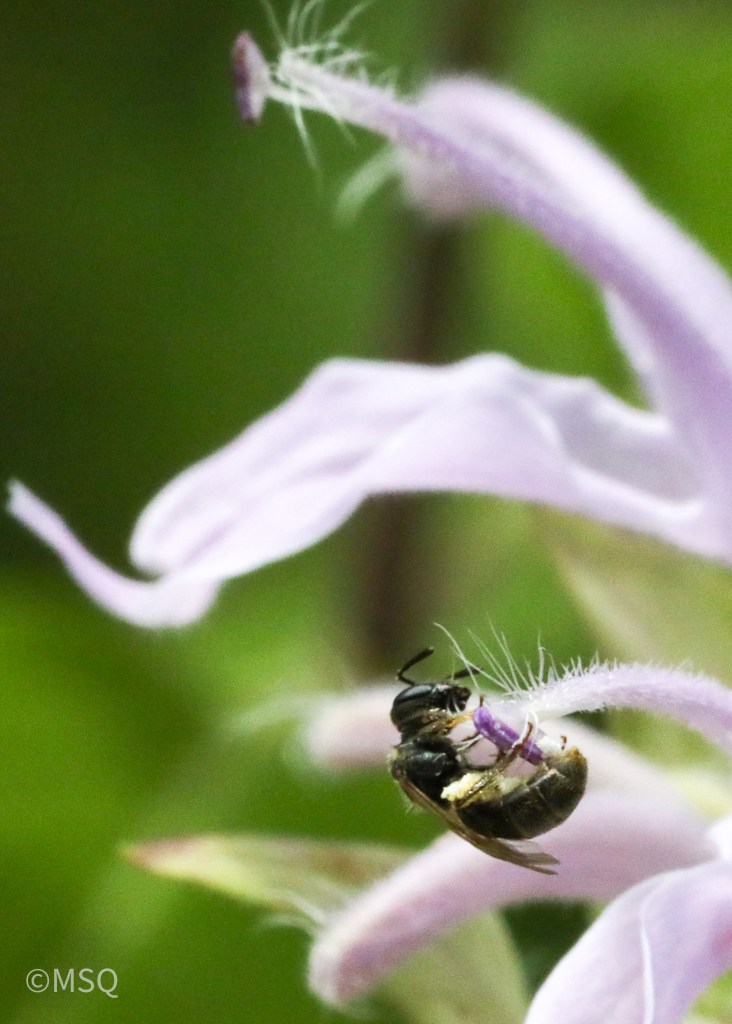
The Halictid bees (Lasioglossom), small Resin bees (Heriades) and Masked bees (Hylaeus) are small bees that gather resources from Fragrant Hyssop.  Dufourea monardae is included in this group.  D. monardae is a specialist or oligolectic bee that visits Monarda fistulosa and Agastache foeniculum.  These small bees can collect pollen from the anthers extending from the flowers. When harvesting nectar, they climb the style to reach the base of the flower.  (The style is the stalk connecting the stigma and the ovary.)

Fragrant Hyssop provides an excellent late season nectar source for butterflies, skippers and moths including Silver Spotted Skipper Butterflies (Epargyreus clarus), Peck’s Skipper Butterflies (Polites peckius) and the Great Spangled Fritillary Butterfly (Speyeria cybele).  They reach their proboscis into each tiny bloom to find the nectar.  Hyssop also works well in Monarch Way Stations providing food after most milkweed has stopped blooming.  

I hope you enjoyed this exploration of Anise Hyssop and its wonderful visitors!  I’d love to hear your thought about this blog or stories about your own experiences in the garden.  Please leave me comment and let me know your thoughts!

References:

  1. Eierman, Kim,11 April 2014,  “Ecobeneficial Interview:  Annie White on Native Plant Cultivars, Native Plants and Pollinators”, Youtube, https://www.youtube.com/watch?v=HTmuDcEzTOw
  2. Caldwell, Cathy, (2021, August-Vol.7, No.8) Anise hyssop, Piedmont Master Gardeners, https://piedmontmastergardeners.org/article/anise-hyssop/
  3. Riddle, Sharla, (2016, May, 20) How Bees See And Why It Matters, Bee Culture:  The Magazine of American Beekeeping, https://www.beeculture.com/bees-see-matters/
Categories
Pollinator gardening

The Garden’s Super Station

Like lavender lace, the intricate flowers of Wild Bee Balm shimmer in the summer sun.  Wild Bee Balm (Monarda or Monarda fistulosa) lures bees, wasps, butterflies and more.  The flowers unfold in the garden for a full month and its light, grey-green leaves contrast with darker foliage.

Monarda thrives in Zones 3 to 9.  It is an excellent mid-garden plant growing from two to four feet tall.  It spreads two to three feet and a three-foot spacing is recommended. An extremely adaptable plant, Wild Bee Balm tolerates clay, chalk, loam, sand and alkaline to acid soils.  It blooms in full to part sun.  Monarda also tolerates heat, drought and Black Walnut trees and is deer and rabbit resistant.   It only really struggles when flooded although it accepts some in the winter.

The flower heads are held singly at the top of each stalk and can be white, pink, or lavender.  Lavender is most common.  Flower heads can be up to four inches across!   They open from the center/top to the edges.  The corolla of each floret divides into a tubular upper lip and a three part slender lower lip for a landing pad.  The stamens and the stigma eventually protrude from the upper lip.  The name fistulosa means tubular. Linnaeus named Monarda after Nicolas Bautista Monardes, 16th century physician and botanist.

Monarda is in the mint family and has the classic square stem found in mints.  Its leaves are aromatic, lanceolate, and toothed.  The frosted, grey-green leaves can grow to 4 inches long.  Wild Bee Balm has an erect, clump-forming habit.

Each plant has deep roots for feeding.  They use rhizomes to spread as well as seeds.  The rhizomes can survive bulldozers and other earth moving machine to pop up in unexpected places.  In natural areas, Wild Bee Balm grows on prairies, in dry, rocky woods, at the edges and in open areas of woods, in unplanted fields, along roads and railroads.

I hesitated a long time before adding Monarda to my garden.  I knew it had several challenges that weren’t easily solved.  High winds and heavy rain knock it over.  It needs support in an unprotected area especially with repeated thunderstorms.  All the Monardas are susceptible to powdery mildew.  Good drainage and air circulation may help reduce the mildew, but I’ve never been able to prevent it.  I developed a different strategy. I let my Wild Bee Balm flower and then cut it back by one-third to one-half.  Since it’s in the middle of the bed, other plants hide it.  The Monarda recovers and regrows fresh leaves.

Monarda also loves to spread.  The rhizomes creep past their beds onto paths and into other plants’ spaces.  Some of the seeds will sprout new colonies.  These plants aren’t hard to pull.  Again, I let them blossom.  When they’ve finished, I put what I don’t want and trim back the rest.

So why do I keep a plant that’s going to be a problem?  Because it’s an amazing pollinator plant!  The Xerces Society of Invertebrate Conservation recognized Monarda fistula as particularly attractive to native pollinators and included in their book 100 Plants to Feed the Bees (written by Eric Lee-Mäder, Jarrod Fowler, Jillian Vento, and Jennifer Hopwood).

What is the Xerces Society?  Xerces Society of Invertebrate Conservation is an international group that protects the natural world by protecting invertebrates and their habitat.  Xerces Society is for pollinators and insects what the Audubon Society is for birds.

When in bloom, Monarda has a cloud of insects around it.  With the constant motion of small, medium, and large bees, it has been compared to a train station.  Butterflies, moths, and hummingbirds come and go, and wasps stop to refuel.

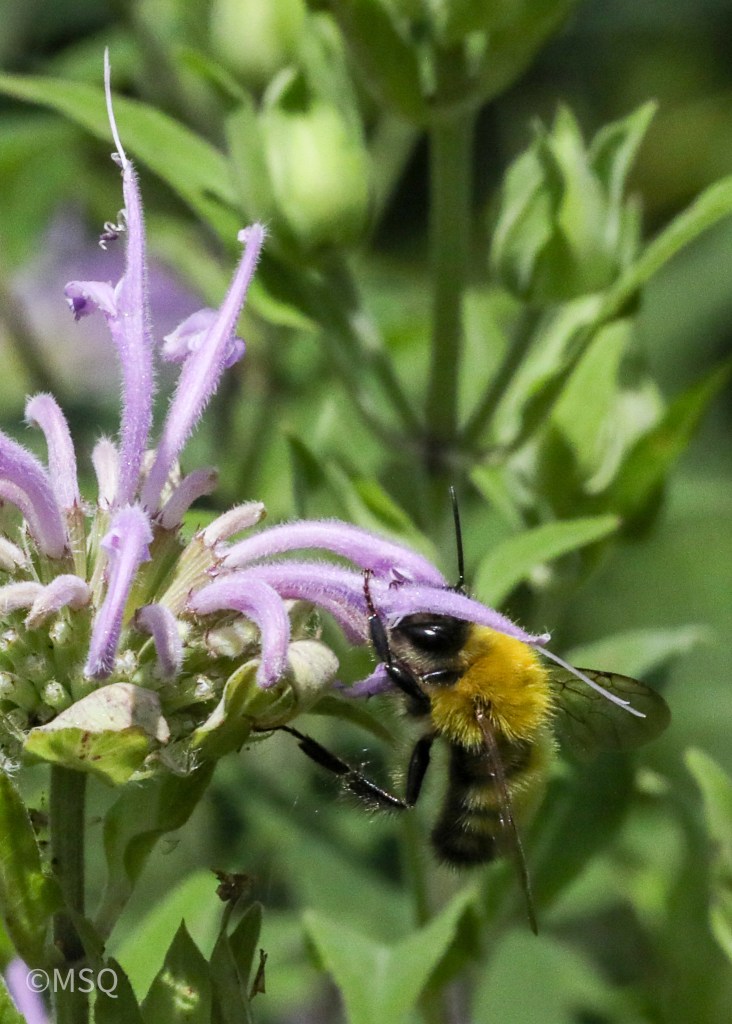
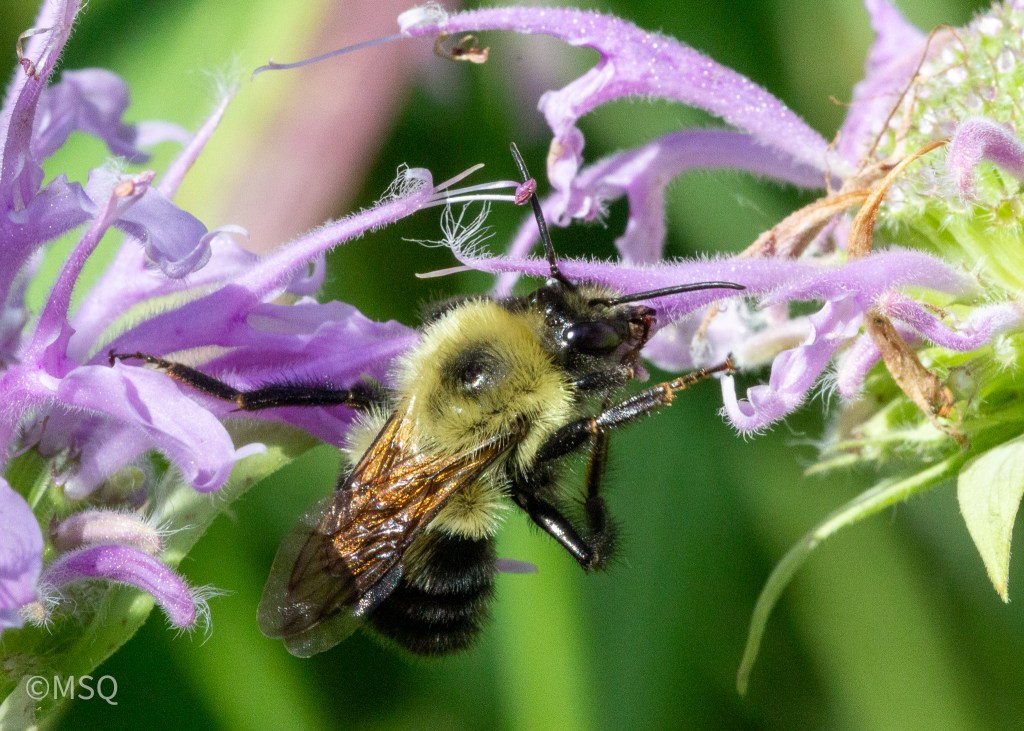
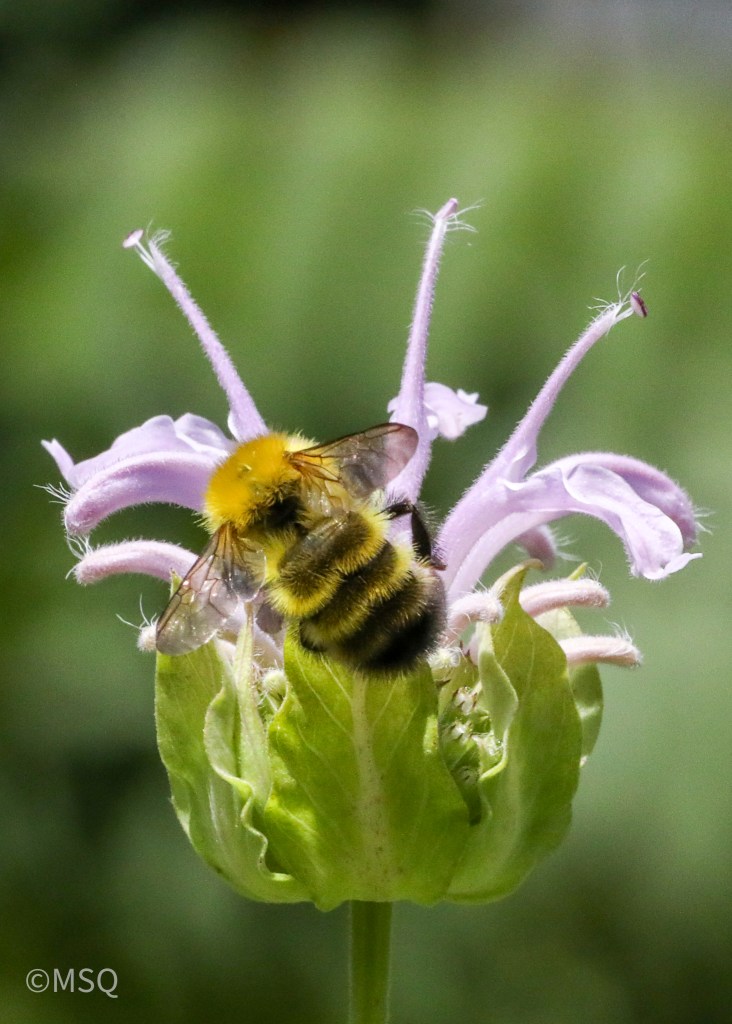
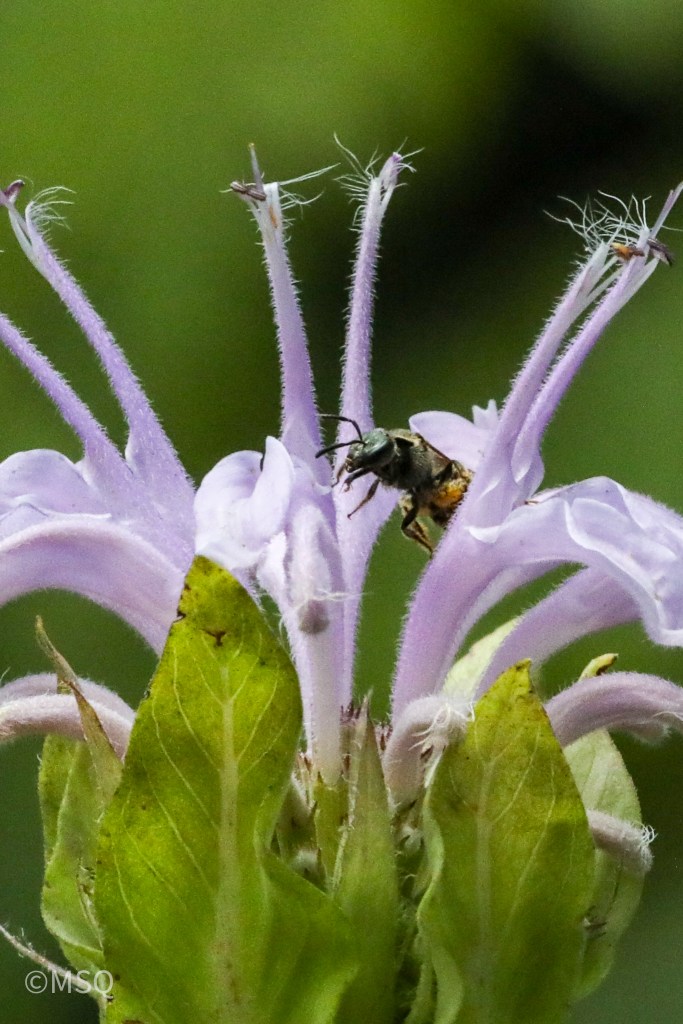
Bumblebees choose Monarda over other flowers.  When they find it, they work their way around the flower heads.  Hanging from each floret, bumblebees use their long tongues to reach the nectar reserves deep in the blooms. Wild Bee Balm has adapted its pollination behavior to bumblebees and the other bees that visit.  

The large bees, including bumblebees, avoid Monarda fistulosa’s anthers and stigmas when foraging for nectar.  They fly underneath them to sip nectar.  When they want pollen, these bees hover close to the flower and brush the anthers with their mid- and hind-legs. 

Monarda, for its part, opens only a few florets at a time.  It extends its anthers (male part) first before the stigma (female part).  Later, when the stigma lengthens and become fertile, the pollen is left by passing pollinators’ brushing against the stigma.  Individual floret nectar is only available until that floret is fertilized.  But the bees and other insects, don’t know which ones still contain nectar.  They must check all the florets until they find nectar.  In this way, Monarda entices them to move around the flower head and, all being well, leave pollen on the ripe stigmas.

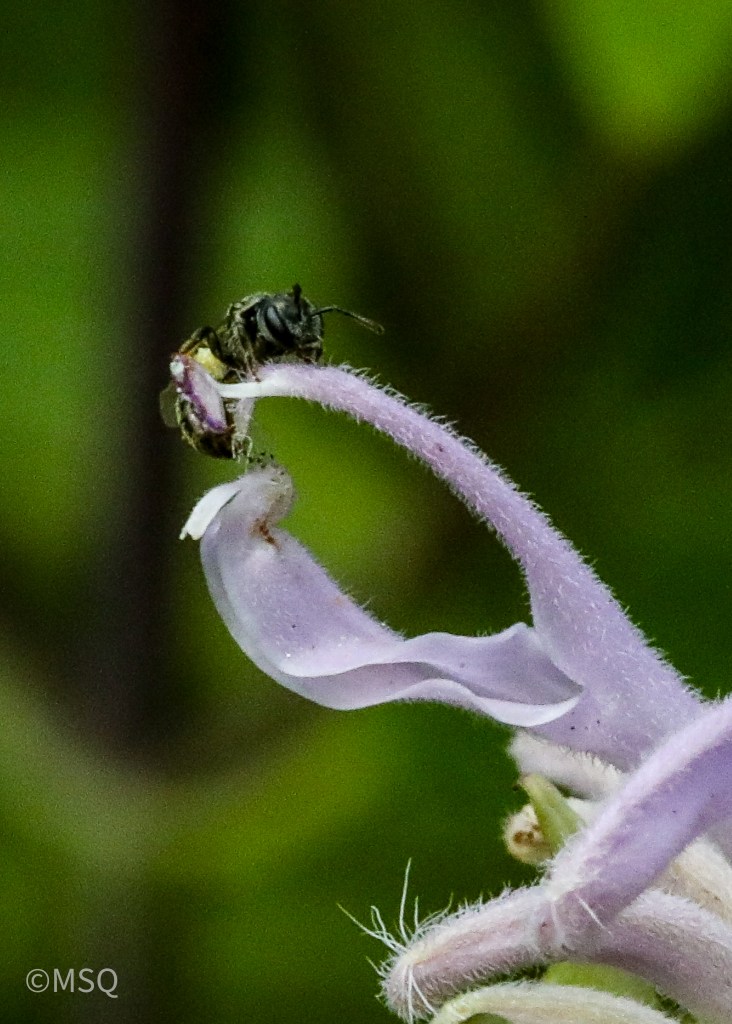
Medium and small sized bees forage on Monarda as a pollen source.  These medium bees include Anthophora, Megachile and Melissodes.  Lasioglossom and Halictus are two small bees that visit Monarda for pollen.  Monarda fistulosa  even has several specialist bees–Dufourea monardaePerdita gerhardi and Protandrena abdominalis.

Specialist bees visit only one or a very few types of the flowers.  This includes bees that forage on plants in only one family.

Wasps also use Wild Bee Balm for nectar.  Sand Wasps (Bicyrtes), Mason Wasps and the Great Black Wasp (Sphex pensylvanicus) all drink nectar from Monarda. They have short-tongues and can’t reach it like bumblebees.  The wasps chew a hole at the base of the tube and take nectar from there.  This is called nectar robbing and it bypasses the usual pollination routes.  Medium and small bees will occasionally drink from these holes.

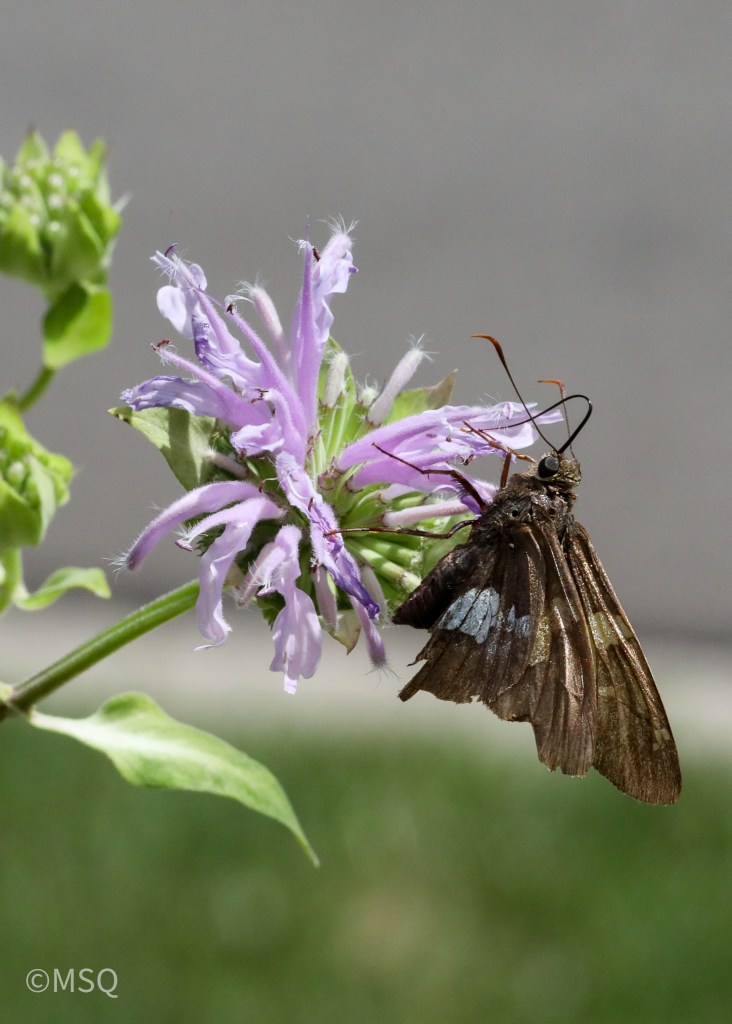
Butterflies, moths, and skippers forage for nectar at Monarda too.  The Xerces Society of Invertebrate Conservation suggests Monarda fistulosa in their Monarch Nectar Plant Guide – Midwest and for the other places it grows.  This is the Silver-Spotted Skipper, one of the most common skippers and a frequent visitor to my garden.  It’s impressive watching it maneuver its long proboscis into the Wild Bee Balm’s floret. 

Skippers are fascinating creatures!  Somewhere between a moth and a butterfly, they’re currently grouped with butterflies.  They have enormous round eyes and antennae that ending in clubs with hooks.  Some carry their wings together and raised like butterflies  The Silver-Spotted Skipper is one of these.  Others have folded wings at rest, looking like a colorful X-wing fighter.  Skippers have a rapid darting flight unlike the butterfly’s fluttering.  Some reach flight speeds of 30 mph.  They aren’t as colorful as the butterflies but usually have muted shades like moths.  They can have interesting patterns, reflective spots (like the Silver-Spotted) and include muted colors such as orange or pale blue.  Skippers fly day and night and many enjoy visiting the garden.  Keep a look out for them!

Monarda also serves as a larval host for several moths.  The Hermit Sphinx Moth Lintneria eremitus and Gray Marvel Moth caterpillars feed on Wild Bee Balm.  It also supports several mint moths including Orange Mint Moth Pyrausta orphisalis and Raspberry Pyrausta Moth P. signatalis.  We’re learning more and more about moths and their roles in the natural world.  Only a small fraction are pests.  They provide valuable food for songbirds, mammals, and other insects.  A study from the UK found that they visit more plants at night than bees do during the day.  Like bees, some moths focus on one plant species (“specialists”) while others forage on a variety of different plants (“generalists”).  (Fallon, Candace, “For the Love of Moths”, Web Blog Post, Xerces Blog, Xerces Society for Invertebrate Conservation, 14 July 2021)  Supporting moth reproduction in the garden, may be as important as supporting bees and other better known pollinators.

So, it turns out my initial concerns have disappeared in a flutter of wings!  Monarda’s role supporting insect life in all its phases is astonishing.  I just keep finding new creatures in the Wild Bee Balm bed.

Do you have Monarda in your garden? Please send me your stories and any thoughts on the blog. I’d love to hear about it!

Happy Gardening!

Mary