Categories
native plants Pollinator gardening

Fiery Flowers for Sunny Spaces

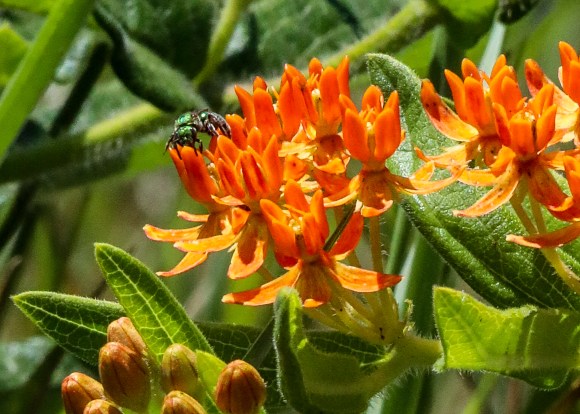
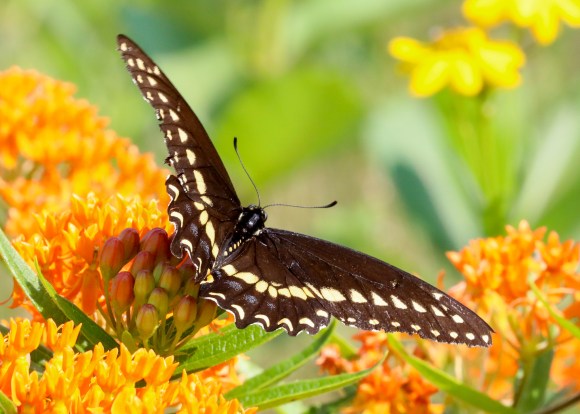
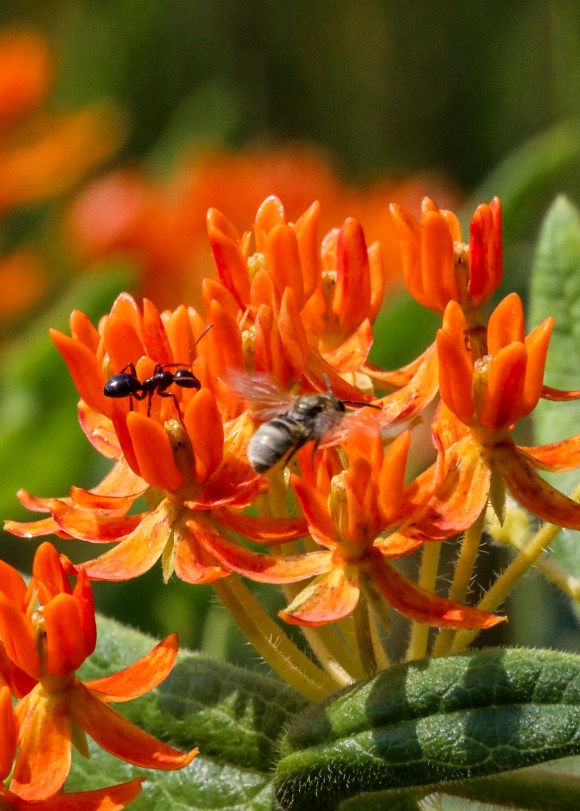
Vibrant orange blooms glow against lush green leaves.  Thriving in sunny, dry spots, Butterfly Milkweed (Asclepias tuberosa) calls insects of all kinds—bees, wasps, flies, beneficial insects and butterflies.  It also hosts caterpillars for some butterflies and moths.
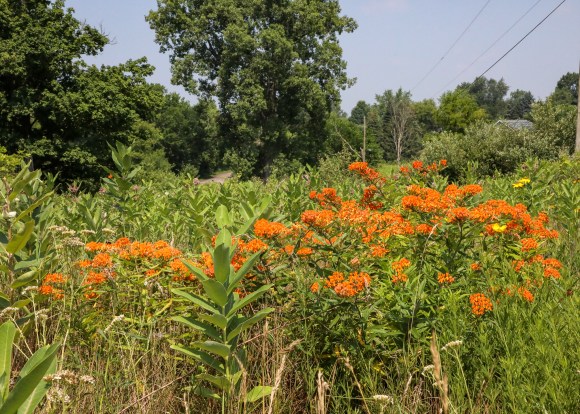
Butterfly Milkweed grows in Zones 3 through 9.  It reaches between 1 and 3 feet and spreads from 1 to 1.5 feet.  Its size makes it an excellent choice for the home garden.3,4

The best growing conditions include full to part sun.  It flourishes in sandy or rocky, acidic soil.  With good drainage, this plant tolerates other soils including loam and clay.3.4

Asclepias tuberosa lives in high quality natural areas and in disturbed places.  It’s found in upland sand prairies, hill prairies, cemeteries, open prairies, sandy savannas, open rocky woodlands, shale and sandstone glades, abandoned sandy fields, roadside embankments, areas along railroads and dry, open, rocky woods.  I primarily see it on roadside embankments.4
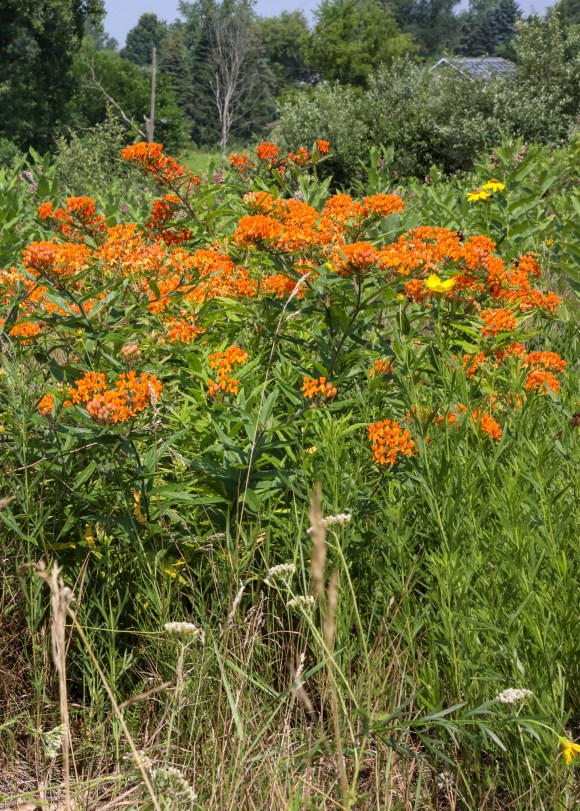
Unlike other milkweeds, Asclepias tuberosa’s leaves are closely spaced on the stem. The oblong leaves emerge alternately from the stem and have pointed tips.  They’re sessile (attached to the stem) or have short petioles (less than an 1/8 inch).4  
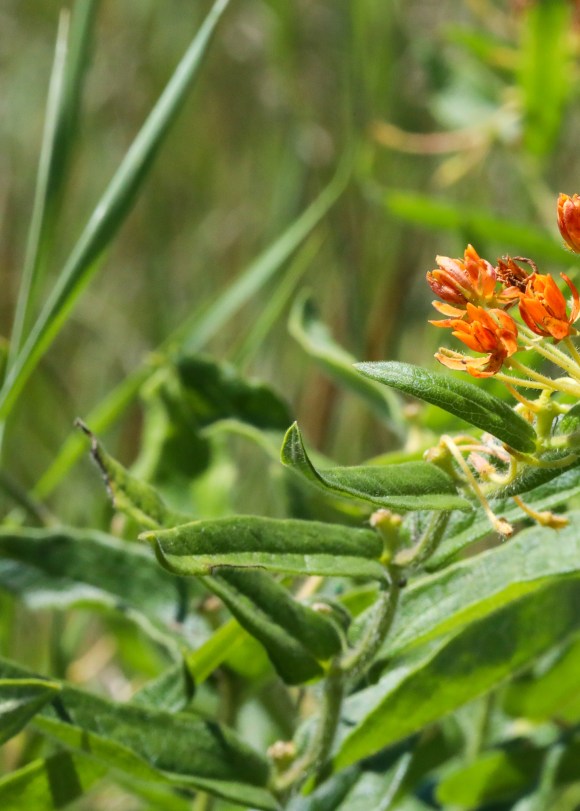
 The upper side of each leaf is medium to dark green and smooth or maybe with a few hairs.  The lower side is light to light medium green and covered with short hairs.  Foliage is 2.5 to 3.5 inches long and 0.5 to 0.75 inches wide.  This milkweed lacks the white-milky latex that gives milkweeds their name.  Its sap is clear and watery.4
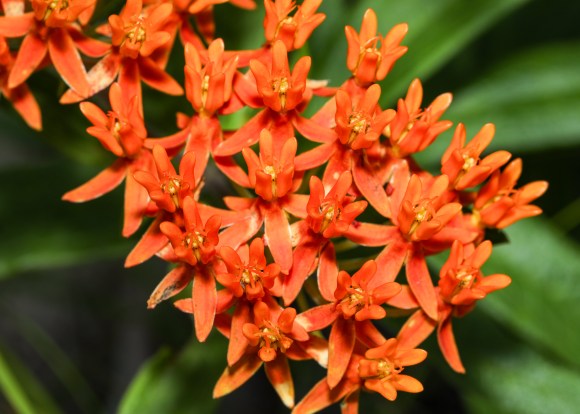
Butterfly Milkweed’s flowers are striking.  While I was looking through my photos, every picture of it jumped out immediately because of that distinctive orange color.  Blooms arise from the upper stem and axils of the upper leaves. 

Individual umbels (groups of florets) are 1 to 2.5 inches across.  They’re made up of 8 to 25 blooms.  Slightly domed, umbels often grow next to each other.  Groups of umbels form composite flowerheads 2 to 5 inches across.4

Individual flowers have the classic milkweed composition-5 petals, 5 hoods with horns and a central reproductive column.   The central column is called a gynostegium.  It’s composed of modified male and female floral parts.  For a full explanation of milkweed reproduction, see my blog (A Delicate Pink Star, https://wildthingsinthe.garden/?s=Common+Milkweed).4
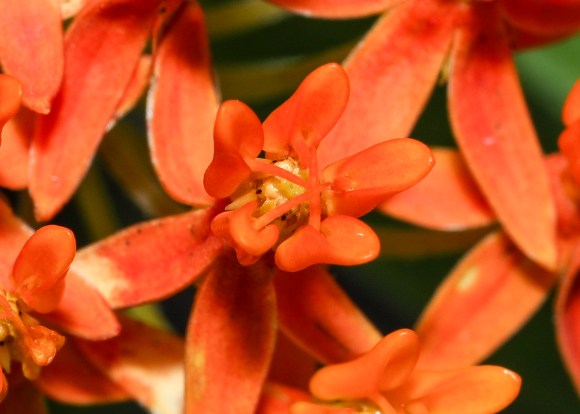
Blossom color naturally ranges from reddish orange to yellowish orange.  Bloom time runs from early to midsummer.  If deadheaded, A. tuberosa reblooms in late summer to early fall.  The flowers are long lasting although they have no noticeable fragrance.3,4

Butterfly Milkweed’s root system is the secret to its survival in dry conditions.  Thick and knobby, the tap root can grow several feet down.  One- to two-year-old plants have a generous tap root—2-3 inches long and 0.5 to 0.75 inches wide.  This root helps its survival but makes it difficult to transplant.  Generally, direct seeding works best.4

In addition to drought, Butterfly Milkweed resists deer, erosion, dry soil, shallow, rocky soil and has moderate salt tolerance.  Unfortunately, in wet, poorly drained soil conditions, it’s susceptible to crown rot, rust and leaf spot.4

Asclepias tuberosa is a wonderful plant for a dry spot in the garden.  The orange flowers catch the eye.  They also offer some variety from the usual yellow or white flowers found on summer-blooming native plants.  

Butterfly Milkweed has received a variety of awards.  These include Missouri Botanical Garden’s Plant of Merit, North Carolina Wildflower of the Year 1985 and Perennial Plant of the Year 2017.  All recognize that this milkweed is easy to grow, resistant to pests and disease and ornamental in the garden.1,2,5

As a native plant, Asclepias tuberosa entertains and feeds numerous native pollinators and beneficial insects.  It serves as a larval host for butterflies.  The Ruby-Throated Hummingbird drinks nectar from the blooms.4
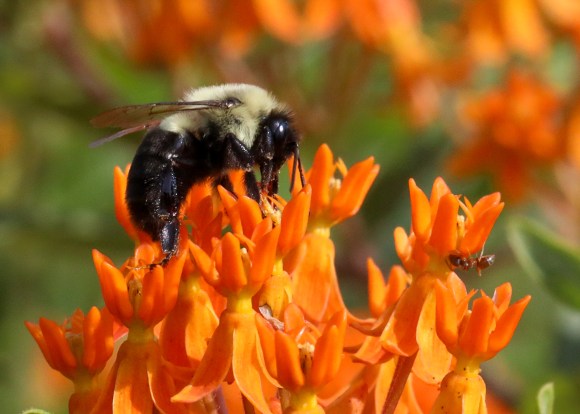
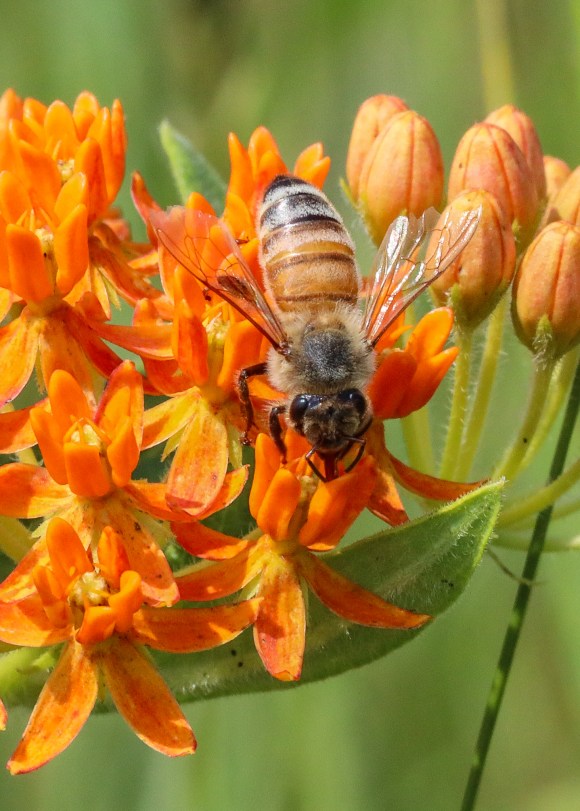
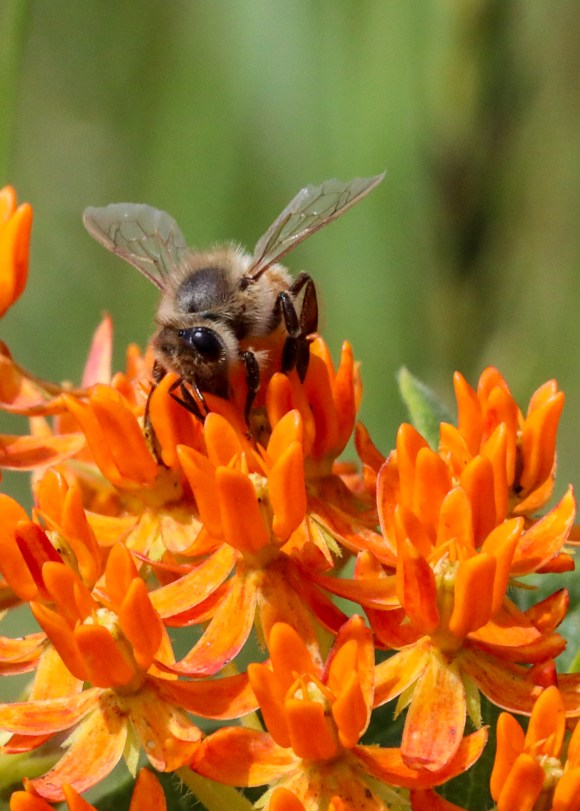
The Xerces Society for Invertebrate Conservation has declared Butterfly Milkweed of Special Value to Native Bees, Special Value to Bumble Bees, Special Value to Honeybees and that it Supports Conservation Biological Control.  A variety of bees visit its brilliant blooms.  These bees include:  Honeybees (Apis spp.),
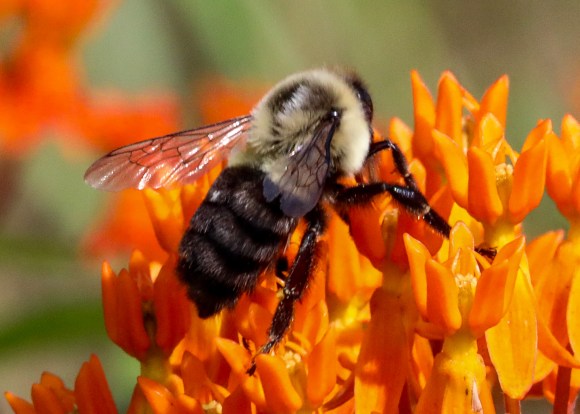
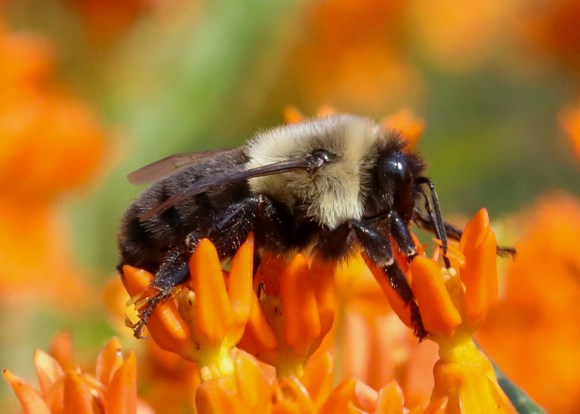
Bumble Bees (Bombus spp.),
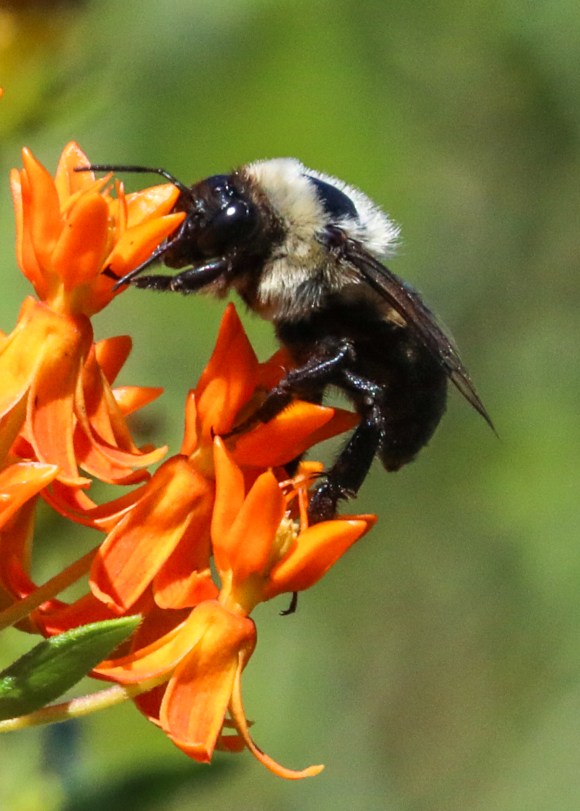
Large Carpenter Bees (Xylocopa spp.),
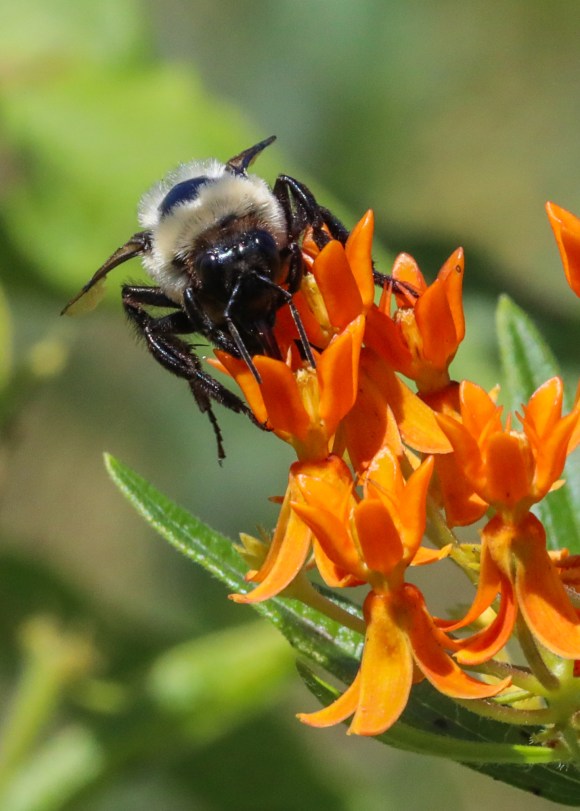
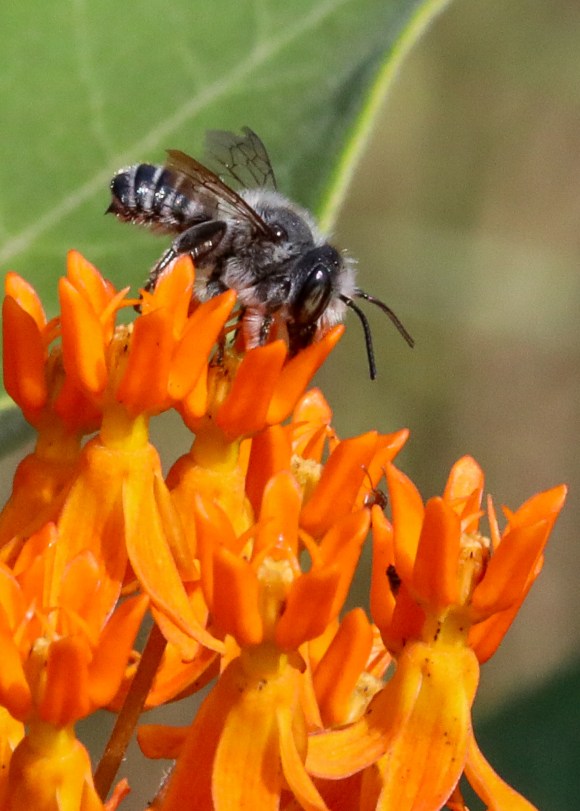
digger bees (Melissodes spp.), leaf-cutter bees (Megachile spp.),
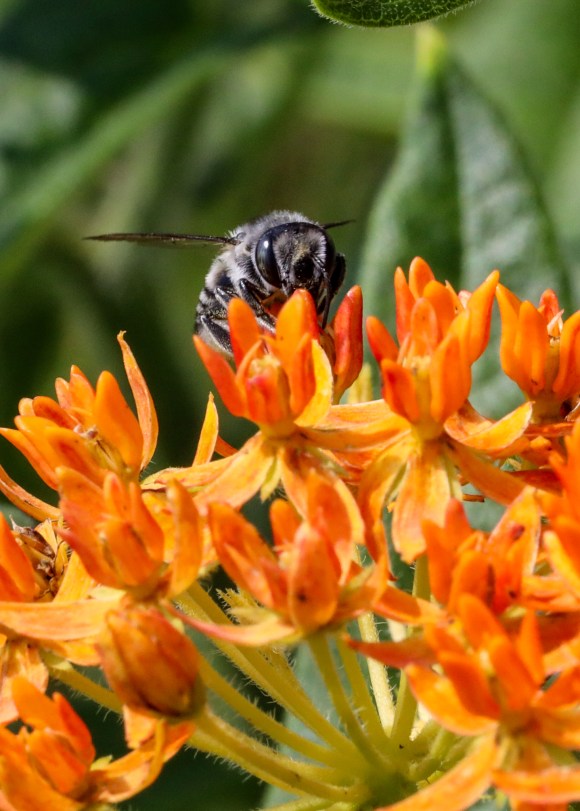
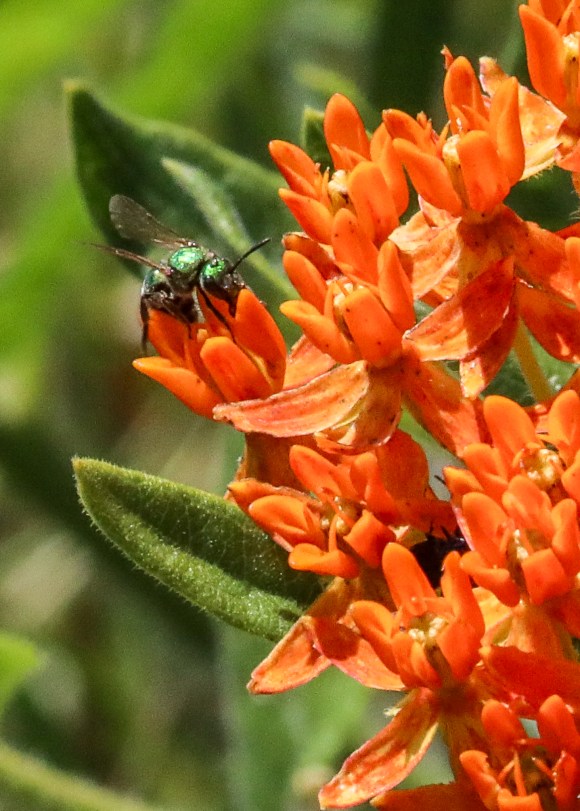
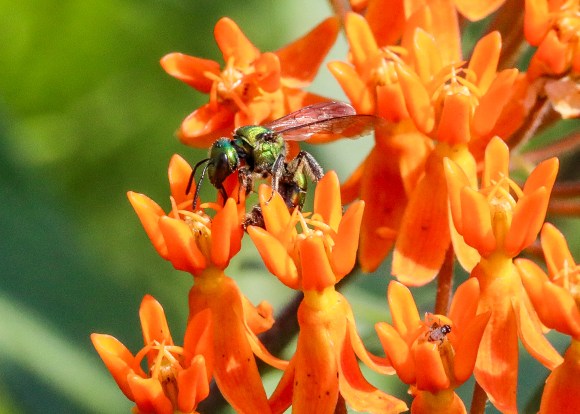
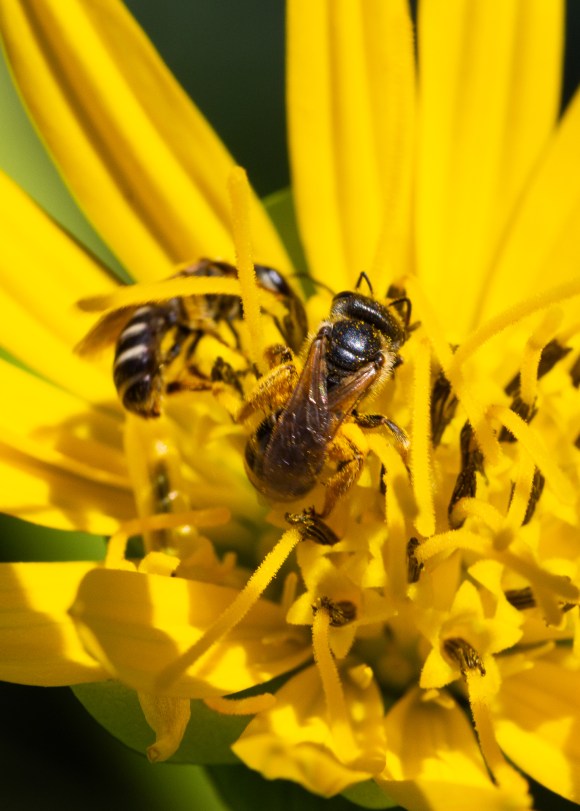
small resin bees (Heriades spp.), Halictid bees (including green metallic bees)
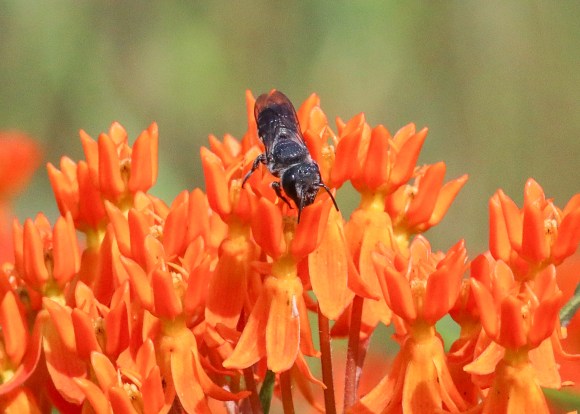
Lasioglossom spp. ,
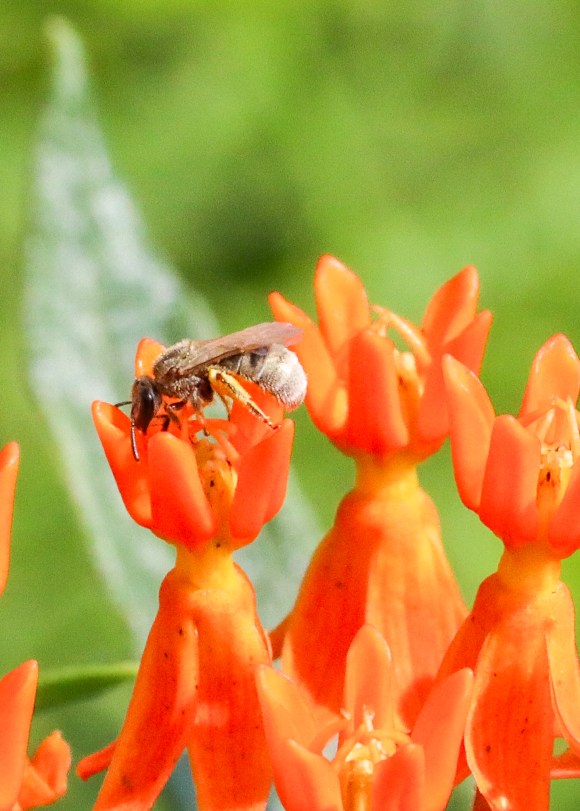
Augochlora pura,
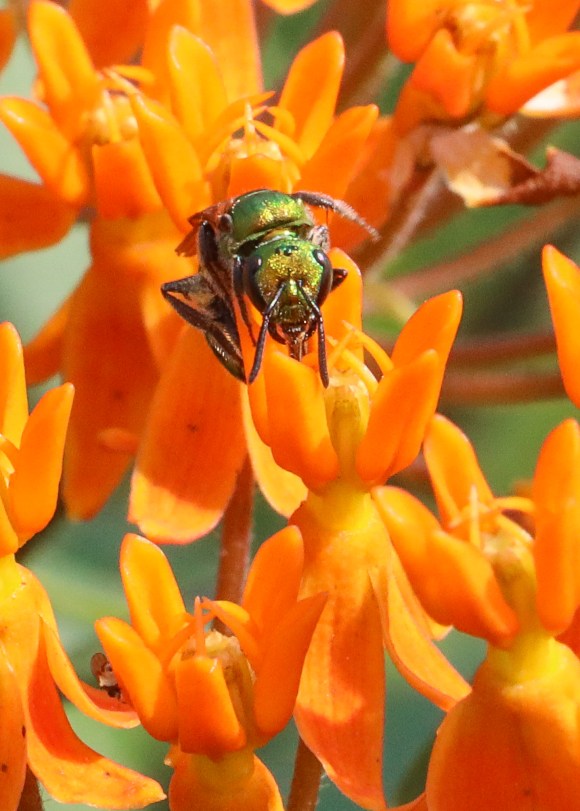
and small carpenter bees (Ceratina spp.).3,4

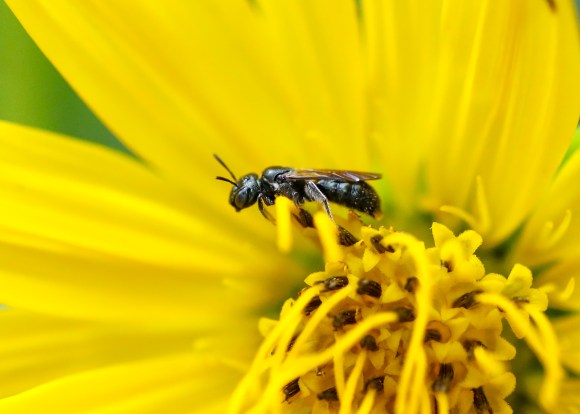
Heriades spp. or small resin bees gather pollen from Butterfly Weed, carrying it on their abdomens.  These bees build their nests in existing spaces or cavities in wood or hollow stems.  They gather resin from plants to separate each nest cell.6
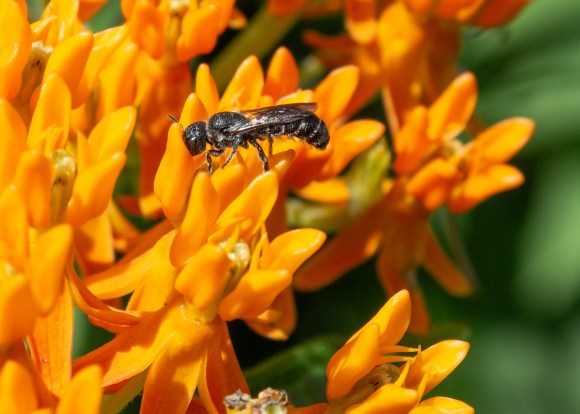
When building a nest in a long cavity, Heriades spp. often leaves a vestibule or space before the first nest cell.  She seals this space with a resin wall and begins making brood cells.  When the nest is closed, the small resin bee leaves another space between two resin plugs.  

Nesting begins in late spring to early summer.  Female offspring regularly outnumber males. They are usually laid at the back of the nest.6  

 These Small Resin Bees pollinate various native plants including Tickseed (Coreopsis spp.), Milkweed (Asclepias spp.), Wild Bergamot (Monarda fistulosa), Sunflower (Helianthus spp.), Coneflower (Ratibida spp.), Ironweed (Vernonia spp.) and Nodding Onion (Allium cernuum).  There are reports of Heriades happily pollinating onions and leeks.6

In addition to bees, Thread-Waisted wasps (Ammophila spp.) and other Sphecid Wasps gather nectar from Asclepias tuberosa.

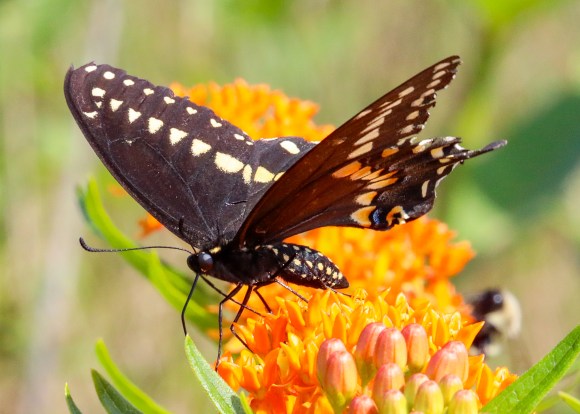
Living up to its name, Butterfly Milkweed feeds a variety of butterflies.  Fritillaries (Speyeria spp.), Swallowtails (Papilio spp.) and the Monarch (Danaus Plexippus).  
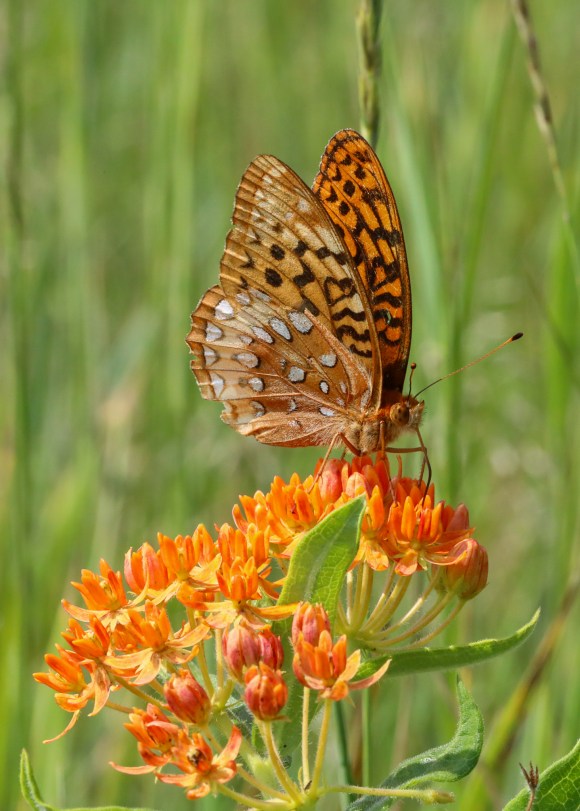
It’s also a larval host for the Monarch Butterfly (Danaus Plexippus), the Queen Butterfly (Danaus gilippus) and the Gray Hairstreak Butterfly (Strymon melinus).4

The Grey Hairstreak Butterfly (Strymon melinus) is in the Lycaenidae family and is one of the Gossamer wing butterflies.  They are pale grey with bright orange eyespots at bottom edge of their wings.  Near the eyespots, are very thin tails coming off the hindwings—one on each wing.  These tails inspired the common name Hairstreaks.5  

Many butterflies and moths have eyespots on the upper surface of their wings.  It’s thought that they startle predators while the butterfly/moth flies away.  This kind of adaptation is called mimicry.  The eyespots mimic eyes, perhaps even those from another species–like an owl.  
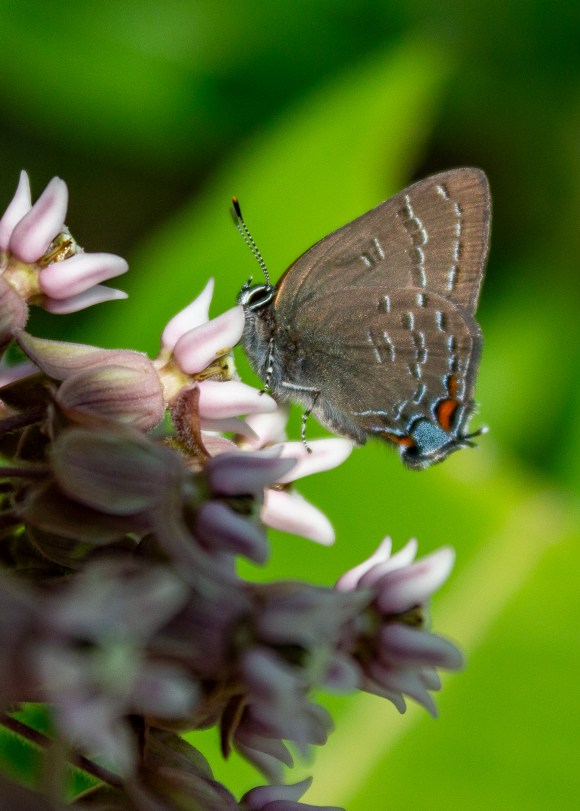
The Grey Hairstreak has a slightly different take on it.  Its eyespots are on the bottom of the wings so they’re visible when it’s perching.  The 2 antennae-like tails located next to the eyespots highlight the appearance of a second head.  This butterfly even moves its hindwings up and down to imitate antennae twitching.5  

If a predator strikes the eyespot, the butterfly has a chance to get away.  No doubt, this works on large predators like birds.  It also fools the jumping spiders often found on flower heads.  The spiders aim for their prey’s head.  Once there, they inject venom into the butterfly’s thorax.  When the jumping spiders land on the eyespots, there are no convenient body parts to bite!

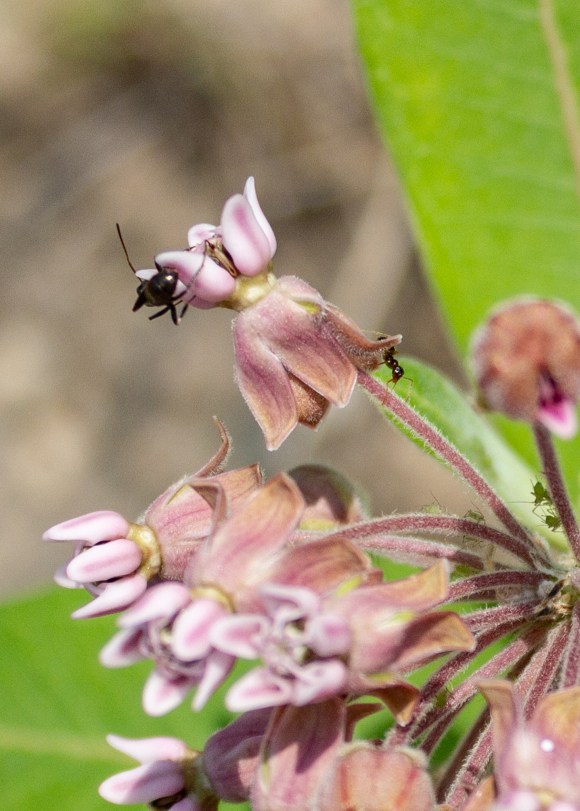
As if this weren’t amazing enough, Lycaenid caterpillars have a special relationship with ants.  I know ants are hard to love.  I, myself, declare a red alert when I see one in the house.  Yet, I have come across some wonderful things ants do for the ecosystem.5
For Strymon melinus, ants tend the larvae in a myrmecophilous relationship.  In return, the caterpillar feeds the ants and gives off an alarm pheromone-like chemical.  Since the ants get something in return, it’s a mutualistic relationship.

Grey Hairstreak larvae make a sweet liquid in the dorsal nectary organ on their seventh abdominal segment.  Ants harvest the liquid from this “honey gland.”  In return, they tend the caterpillar and protect it from predators.  These Strymon melinus larvae vary in color.  They can be pale yellow, purplish-white, pink, reddish-brown or green.  Some sources say the green larvae are so well camouflaged that it’s easier to follow the ants.5.7  
In addition, the larva has a tentacle organ that gives off a chemical.  This compound is like the ants’ alarm pheromone.  When the ants’ smell it, they become alert and protective.  An alternate suggestion for these behaviors, they keep the ants from preying on the caterpillars.5

Hope you enjoyed this exploration of  Butterfly Milkweed and some of the creatures that visit it.  Enjoy the coming Spring weather!  I hope you have plenty of time to spend in your garden.

Happy Gardening,

Mary

Bibliography:

  1. “Asclepias Tuberosa – Plant Finder.” n.d. Accessed November 15, 2025. https://www.missouribotanicalgarden.org/PlantFinder/PlantFinderDetails.aspx?kempercode=b490.
  2. “Asclepias Tuberosa (Butterfly Milkweed, Butterfly Weed, Chiggerflower, Common Butterfly-Weed, Indian Paintbrush, Milkweed, Pleurisy Root) | North Carolina Extension Gardener Plant Toolbox.” n.d. Accessed November 15, 2025. https://plants.ces.ncsu.edu/plants/asclepias-tuberosa/.
  3. “Asclepias Tuberosa (Butterflyweed) | Native Plants of North America.” n.d. Accessed November 15, 2025. https://www.wildflower.org/plants/result.php?id_plant=astu.
  4. “Butterfly Milkweed (Asclepias Tuberosa).” n.d. Accessed November 15, 2025. https://www.illinoiswildflowers.info/prairie/plantx/btf_milkweedx.htm.
  5. “Butterfly Weed | Chicago Botanic Garden.” n.d. Accessed November 16, 2025. https://www.chicagobotanic.org/plant-information/plant-profiles/butterfly-weed.
  6. “Gray Hairstreak Butterfly.” 2019. Field Station, April 17. https://uwm.edu/field-station/bug-of-the-week/gray-hairstreak-butterfly/.
  7. Holm, Heather. 2017. Bees:  An Identification and Native Plant Forage Guide. Pollination Press LLC.
  8. iNaturalist. n.d. “Gray Hairstreak (GTM Research Reserve Butterfly Guide) · iNaturalist.” Accessed March 5, 2026. https://www.inaturalist.org/guide_taxa/358983.
Categories
native plants Pollinator gardening

A Giant for Your Garden

Silphium terebinthaceum (Prairie Dock)

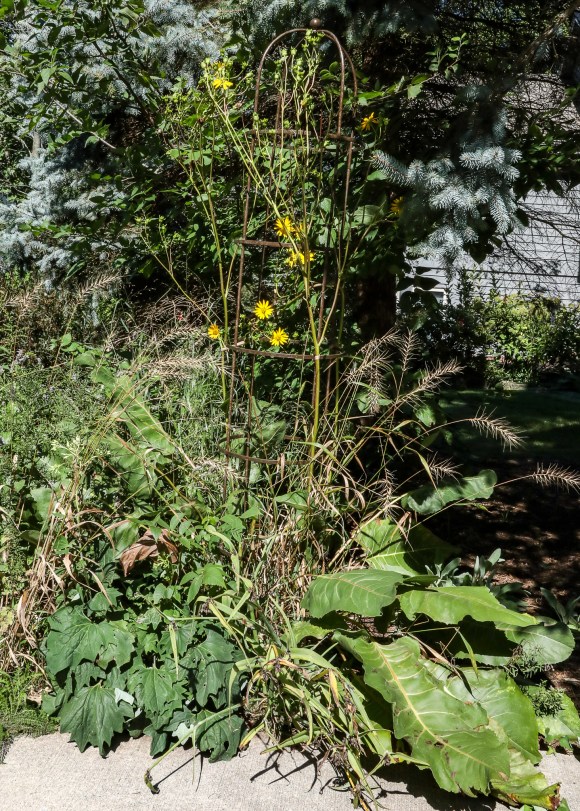
Rising high above tall grasses, Prairie Dock’s light-yellow blooms open in the sun.  Silphium terebinthinaceum or Prairie Dock is one of the Silphiums, often called the giants of the prairie.  It’s tall flower stalks live up to the name rising 8 to 10 feet.  Yet the base stays a manageable 1 to 3 feet across making it reasonable for the home garden.8,9  

One of the Keystone plants for Ecoregion 8-Eastern Temperate Forests, it supports specialist bees, native bees, bumbles bees and other long-tongued bees and bee flies.  Hummingbirds visit the flowers and finches eat the seeds.  Parasitic and Hyperparasitic wasps use Prairie Dock for nesting and reproduction.4,8,9

Silphium terebinthinaceum grows in zones 4 to 8.  The flower stalks reach up to 10 feet and the plant spreads from 1 to 3 feet.  This plant thrives in full sun but tolerates part shade.  Deep, loamy soil is ideal.  Rocky or gravelly soil, clay, limestone or dolomite rocky soil are all acceptable.8,9

In a natural setting, Prairie Dock lives in moist to dry black soil prairies, fens, shrub prairies, gravel prairies, hill prairies, tops of bluffs, seeps, upland or rocky prairies, savannas, old fields, prairie remnants, along roads and railways, glades, openings of dry upland forests, woodland borders, and, rarely, banks of streams.8,10

Prairie Dock’s leaves are remarkable!  Growing up to 18 inches long and 12 inches wide, they emerge in a vase-shaped rosette.  In full sun, the leaves orient from North to South.  This direction maximizes photosynthesis and reduces transpiration.6,8,9

The foliage itself is heart shaped or cordate.  It has a thick, sand papery texture.  The upper surface of young leaves is mostly hairless and shiny but older leaves become matte and rough.8

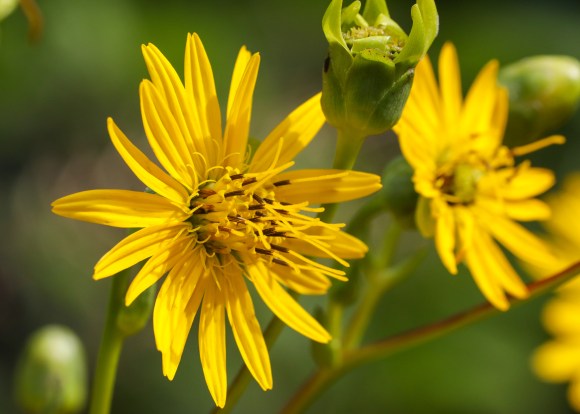
Its flowers bloom from summer into fall-opening from multiple buds.  These compound flowerheads have 15 to 30 ray florets and many disc florets.  They are 2 to 3 inches across.6,8

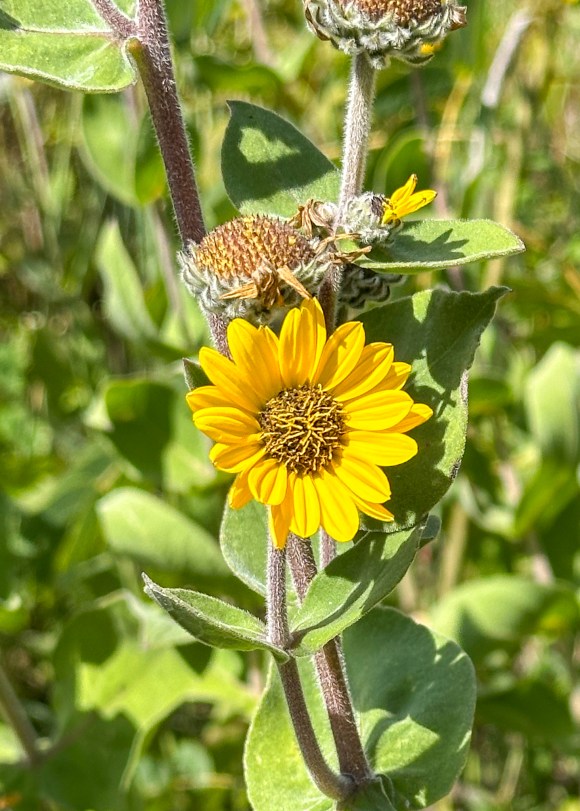
Here’s a fun botanical fact!  The flowers of Silphium and Helianthus (Wild Sunflower) are astonishingly similar but there is a key difference.  The centers (disc flowers) of Helianthus are the female or pistillate florets.  As seen in commercial sunflowers, these become seeds.  In the Silphium flowers, only the ray flowers (those attached to petals) are female.  Seeds only form around the edge of Silphium’s compound flower head.6

Silphium terebinthinaceum’s blooms on long, smooth stalks.  These rise from 3 to 10 feet and branch at the top to hold several blossoms.  The flower stalks don’t usually need support but often lean.  In fact, the only place I’ve seen them stand straight is on a median strip.8,9

The Prairie Dock plant is slow to establish taking 2 to 3 years flower in cultivation. In the wild, it can take considerably longer.  Once established it’s almost impossible to kill.  The tap root can grow to 12 feet and the plant resists drought, fire and herbivore predation.8

The deer ate my Prairie Dock to the ground for several years.  I assumed it was dead.  Then the township started a controlled hunt.  The deer population went down and my S. terebinthinaceum grew back.  Now it’s fully grown and blooms every year.

Prairie Dock attracts long-tongued and short-tongued insects.  It’s a Region 8 Keystone plant supporting pollen specialist bees.  In addition, The Xerces Society for Invertebrate Conservation has designated it of Special Value to Native Bees, of Special Value to Bumble Bees and declared it Provides Nesting Materials/Structure for Native Bees.4,8,10

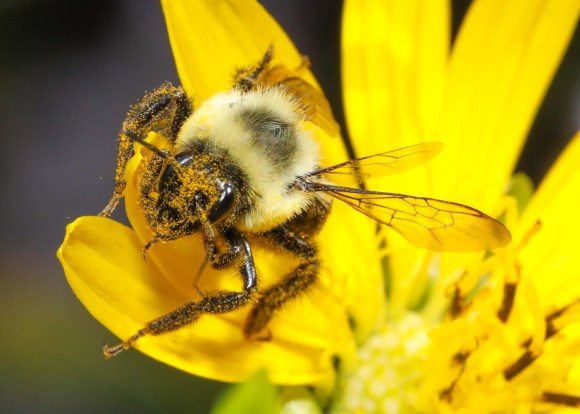
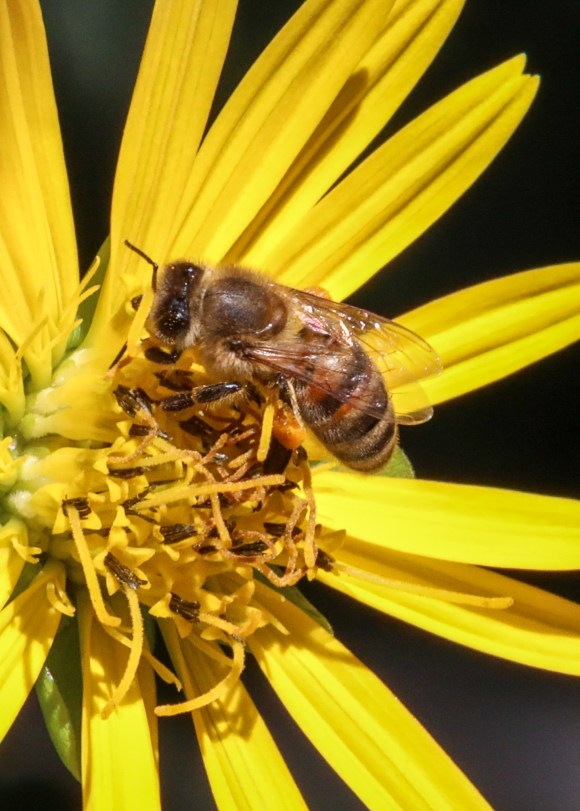
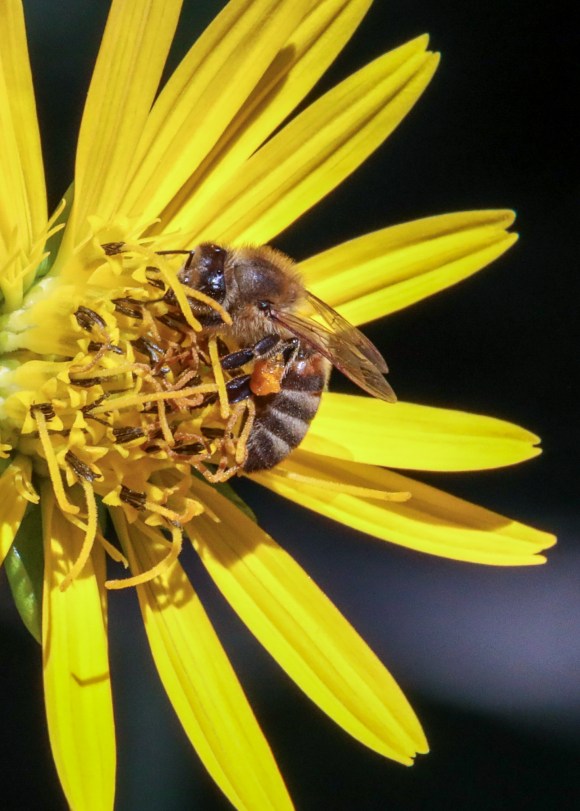
Honeybees,

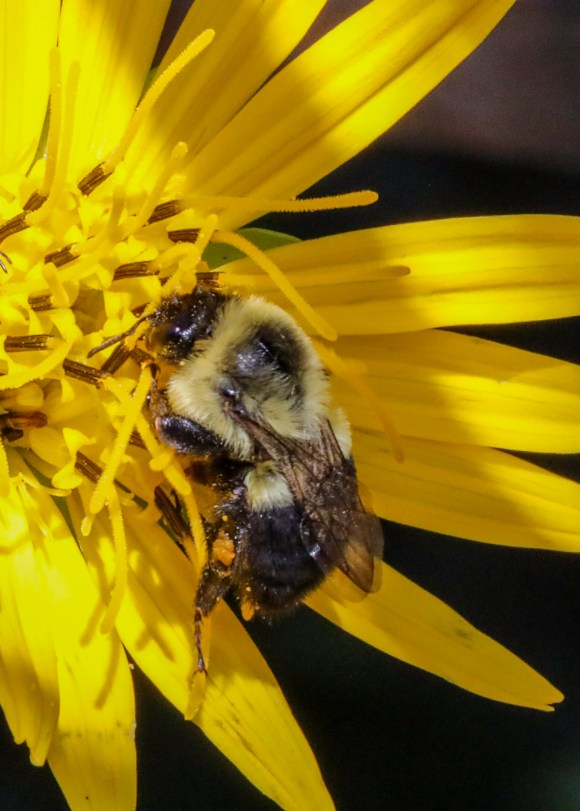
Bumblebees,

and Miner bees are among the long-tongued visitors.  

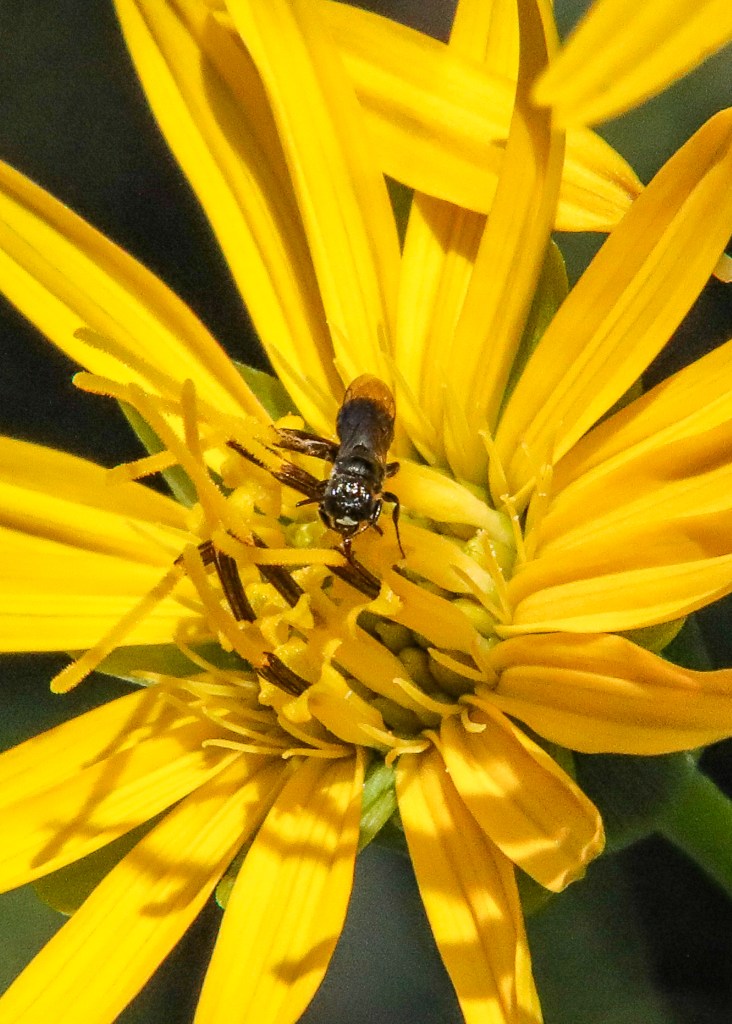
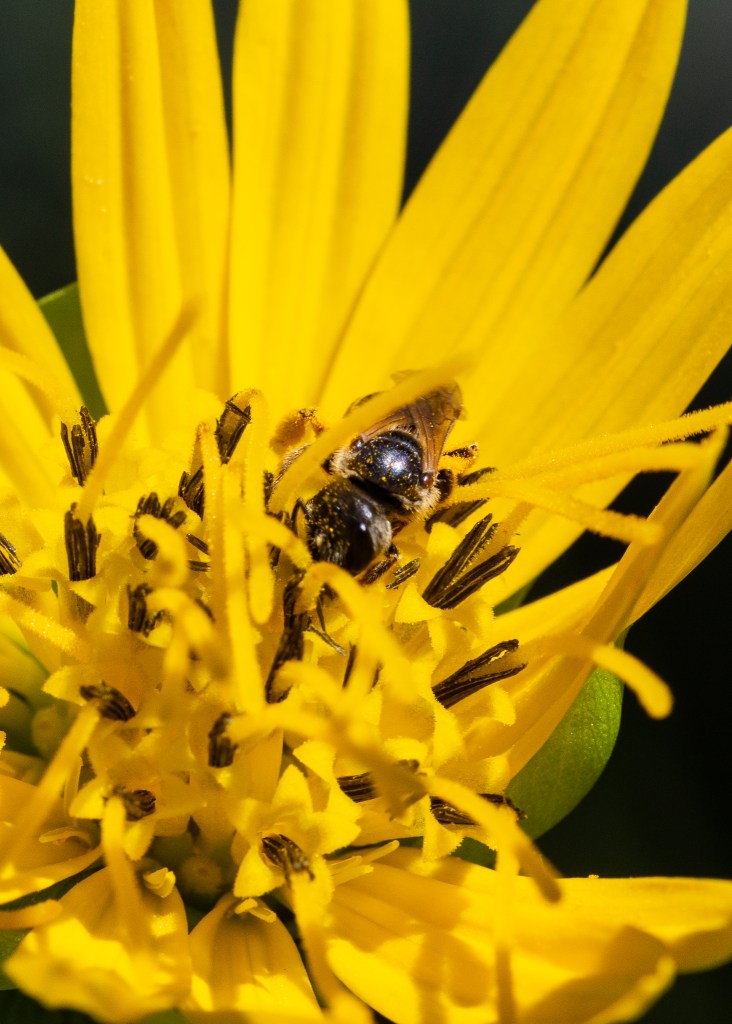
Short-tongued guests include Halictid bees, resin bees (Heriades spp. and Megachile spp.), small carpenter bees (Ceratina spp.),

beetles and bee flies.  The Ruby-Throated Hummingbird also uses S. terebinthinaceum for nectar and, possibly, small insects.  Small mammals, Goldfinches and other Finches eat the seeds.8

Silphium terebinthinaceum attracts resin bees.  Silphium is a very old name for a resinous plant and this whole group are commonly called rosinweeds.  The specific epithet ‘terebinthinaceum’  means ‘with

turpentine’ referring to the scent of the resinous sap.7

Heriades use resin from Prairie Dock to build their nests.  These bees use existing cavities for nests.  These cavities include beetle burrows, cavities in rocks, hollow stems and abandoned mud dauber nests.  Heriadeswill nest in bee hotels and nest boxes.3

In addition to nectar and pollen, Prairie Dock provides a home for a gall wasp and its parasite. The gall wasp, Antistrophus rufus,  nests in the stem where it forms small galls.  These insects each plant matter.  They’re considered a valuable prey animal for other insects, small insect-eating birds and woodpeckers.  A. rufus also indicates a healthy, diverse ecosystem.8

Eurytoma lutea parasitizes A. rufus.  When a parasite preys on another parasite, it’s called a hyperparasite. E. lutea feeds on a variety of gall-forming wasps which can damage plants.  This wasp is a beneficial insect since it helps control populations of the gall-forming wasps.8

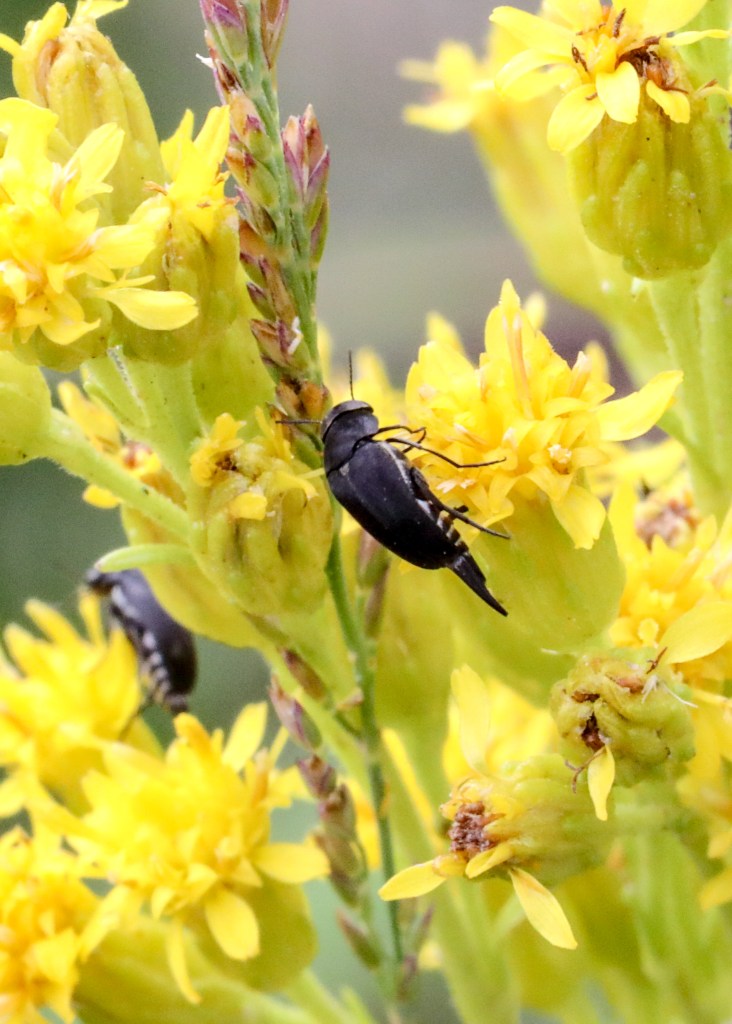
The Tumbling Flower Beetle (Mordellistena aethiops) lives in and on Prairie Dock.  The larvae stay inside the stem, and most are stem-borers.  They, also, eat other plant parts, decaying wood and fungus.1,5  

The adults are charming, shiny, black beetles.  They eat nectar and pollen.  While they move around the flower head, the Tumbling Flower Beetles contribute to pollination.  

These beetles are also known for…tumbling!  Just like their name, when startled, they look like their rolling rapidly off the flower.  The Tumbling Flower Beetle has a complex way of moving involving a series of short hops.  They alternate legs, leaping every 80 ms.  The goal is to evade a predator and get into a good flight position.  It also startles the person reaching for it!1,5

Hope you enjoyed our exploration of Prairie Dock—the garden-size Silphium!  This plant gives a home to a multitude of pollinators and other insects.  It’s also a stunning plant in the garden!

Happy Gardening,

Mary

Bibliography:

  1. Farley, Jeanine. 2025. “Getting a Kick out of the Tumbling Flower Beetle Means You’ve Caused the Critter to Panic and Flee.” Cambridge Day, July 19. https://www.cambridgeday.com/2025/07/19/getting-a-kick-out-of-the-tumbling-flower-beetle-means-youve-caused-the-critter-to-panic-and-flee/
  2. “Flower-Visiting Birds and Insects of Prairie Dock”, n.d. Accessed September 3, 2025, https://www.illinoiswildflowers.info/flower_insects/plants/prairie_dock.htm
  3. Holm, Heather. 2017. Bees:  An Identification and Native Plant Forage Guide. Pollination Press LLC.
  4. “Keystone Native Plants:  Eastern Temperate Forests-Ecoregion 8” n.d. Accessed September 3, 2025, https://www.nwf.org/-/media/Documents/PDFs/Garden-for-Wildlife/Keystone-Plants/NWF-GFW-keystone-plant-list-ecoregion-8-eastern-temperate-forests.pdf
  5. “Mordellidae – an Overview | ScienceDirect Topics.” n.d. Accessed September 3, 2025. https://www.sciencedirect.com/topics/agricultural-and-biological-sciences/mordellidae
  6. Missouri Department of Conservation. n.d. “Prairie Dock (Prairie Rosinweed).” Accessed September 3, 2025. https://mdc.mo.gov/discover-nature/field-guide/prairie-dock-prairie-rosinweed.
  7. Missouri Department of Conservation. n.d. “Silphium.” Accessed September 3, 2025. https://mdc.mo.gov/magazines/conservationist/2000-08/silphium.
  8. “Prairie Dock (Silphium Terebinthinaceum).” n.d. Accessed September 3, 2025. https://www.illinoiswildflowers.info/prairie/plantx/pr_dockx.htm.
  9. “Silphium Terebinthinaceum – Plant Finder.” n.d. Accessed September 3, 2025. https://www.missouribotanicalgarden.org/PlantFinder/PlantFinderDetails.aspx?kempercode=f590.
  10. “Silphium Terebinthinaceum (Prairie Rosinweed) | Native Plants of North America.” n.d. Accessed September 3, 2025. https://www.wildflower.org/plants/result.php?id_plant=site.
Categories
native plants Pollinator gardening

Grist for the Bees

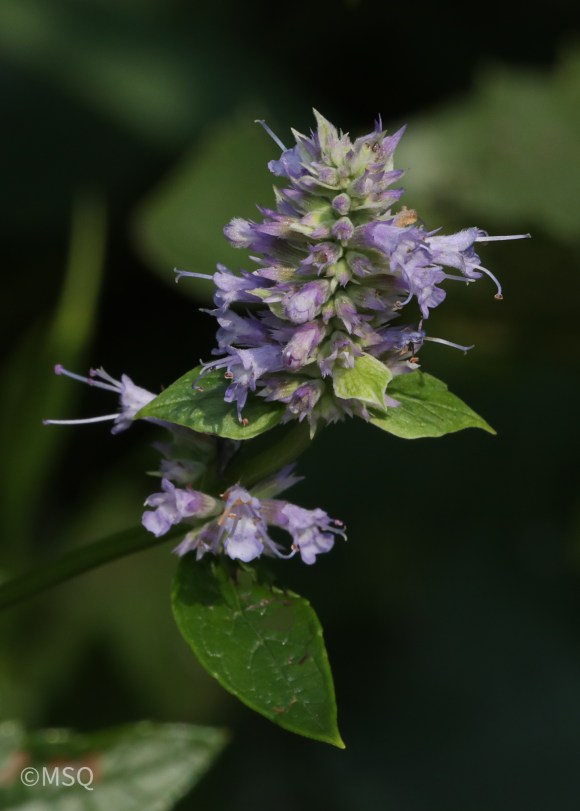
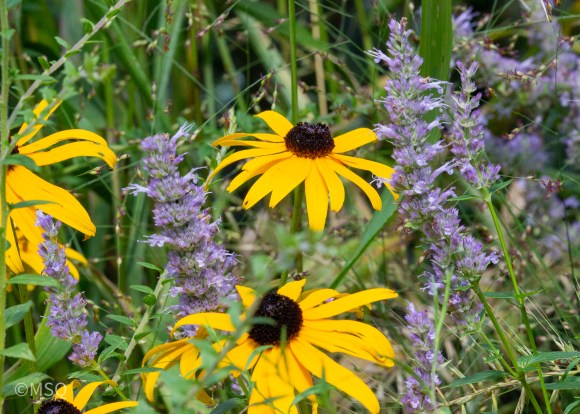
Purple Wheat in the garden?  Indeed, that’s what Agastache means ‘agan’ much, ‘stachys’ ear of grain, from the Greek.  Its flowers look like heads of wheat or rye and range from pale lavender to purple.  ‘Foeniculum’, the second part of the name, means fragrant for the scented leaves.  Agastache foeniculum (Fragrant or Anise Hyssop) is part of the mint family.  Like Pycnanthemum virginianum (https://wildthingsinthe.garden/2023/05/31/white-goes-with-everything/), also mints, it attracts an enormous variety of bees.  Fragrant Hyssop also supports numerous butterflies and skippers.

Anise Hyssop grows two to four feet tall and spreads eighteen inches to two feet.  It has an upright, clump-forming habit.  Anise Hyssop sports dark green, ovate to broadly lanceolate leaves up to four inches long.  Almost heart shaped, the leaves are one to three inches at the base and whitish underneath.  They sit opposite each other on the classic square stem of mint plants.  The foliage also gives off a strong anise or licorice-like scent that gives the plant its common and Latin name.

Agastache foeniculum can begin blooming in June and continues through August.  In zone 5, where I am, it doesn’t start until July.  Blooms appear as three- to six-inch-long flower spikes at the end of plant stalks.  The eye-catching blossoms range from pale lavender to true purple in color.  Tiny flowers make up each large spike.  They’re laid out in tightly packed rows although there can be gaps (think of an ear of corn).  This arrangement is called verticillasters or false whorls.  Each of the small flowers is tubular, 2-lipped and a 1/3’’ inch long.  Unlike the leaves, the blooms have no scent. 

Fragrant Hyssop plant grows best in full sun with dry to moderately moist soil.  Soil moisture is not a problem if the drainage is good.   Anise Hyssop is drought tolerant, more so after it is established.  It spreads by rhizomes and self-seeding especially under good conditions.  I have not found that this plant spreads obnoxiously.  I have far fewer Anise Hyssop seedlings than Monarda fistulosa seedlings.  Fragrant Hyssop may have problems with crown rot with soggy soil. Other issues include rust and powdery mildew.

Outside of cultivation, Agastache foeniculum grows in prairies, dry upland forests, plains, fields, roadsides, and other dry, open, semi-shaded areas.  In the past, it served as honeybee forage in Canada and parts of the Upper Midwest.  It works well in borders, wildflower gardens, herb gardens, butterfly gardens and meadows.

Agastache foeniculum and similar species inspire plant breeders around the world.  Too many nativars exist to explore them all, but I thought we could look at three very different plants.  Each of these was modified in a different way.

Agastache ‘Blue Fortune’ is a very popular hybrid created by crossing Agastache foeniculum with its East Asian relative, Agastache rugosa.  This compact plant has longer flower spikes than the species.  It blooms for an extended time because it’s bred to be sterile.  ‘Blue Fortune’ is widely reported to be a pollinator magnet.

Agastache ‘Golden Jubilee’ is an older hybrid with yellow-green foliage that’s pure yellow in the Spring. The flowers are identical to the species.  ‘Golden Jubilee’ received the All-American Selection Award in 2003 and is still being sold.  It will self-seed with a mix of species and golden seedlings.  There are mixed reports on how pollinators respond to ‘Golden Jubilee’.  Some sources say bees don’t seem to ‘see’ it and others say pollinators love it.

Agastache ‘Red Fortune’ has red to pink flowers.  The leaves are like the species.  Pollinators don’t like this plant as much as Agastache foeniculum.

These three plants give a nice snapshot of how natives are altered and some pollinator responses.  One idea is that nativars with flowers most like the species’ flowers would be most acceptable.1  Positive reports about ‘Blue Fortune’ and ‘Golden Jubilee seem to support this idea.2

In addition, red is a special case.  Bees see in the ultraviolet spectrum—from approximately 300 to 650 nm.  They can’t see red although they can see reddish tones like orange.  When native plants are hybridized for red flowers, bees often have trouble finding them.1,3

But wait!  There’s an exception.  Red flowers can have ultraviolet “nectar guides”  which the bees see perfectly well.  Plants use these guides to “direct” the pollinators to the nectar reward and encourage pollination.3  

It’s hard to say if a red native hybrid will still attract and support bee pollinators.  If they retain their ultraviolet nectar guides, then the bees should see them.  However, I’ve seen more than one report showing little to no bee activity on the red and pink hybrids.1,2

Anise Hyssop serves a multitude of pollinators providing nectar and pollen.  Like Monarda (https://wildthingsinthe.garden/2023/07/31/the-gardens-super-station/), Fragrant Hyssop has been identified by pollination ecologists as attracting large numbers of native bees.  The Xerces Society for Invertebrate Conservation also designated Fragrant Hyssop of Special Value to Bumble bees and Honeybees.  Butterflies and skippers use it for a nectar source.

Pollination in Fragrant Hyssop hinges on both the individual flowers’ structure and the different bees’ anatomies.  The nectar is secreted by a disc at the base of the flower.  Pollen-carrying anthers are located on the top lip of each flower.  When bees root for nectar, pollen rubs off onto their heads or thorax.  As they move to a bloom with a receptive stigma, female part, the pollen transfers and fertilization occurs.

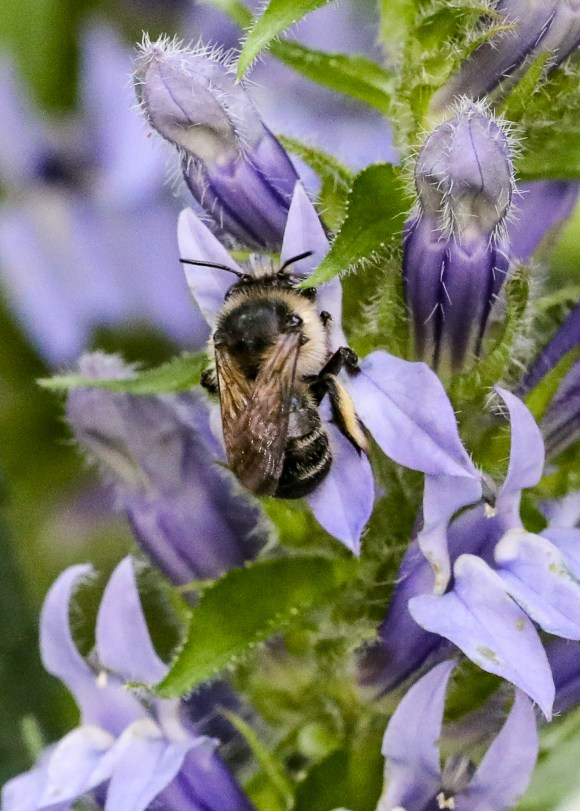
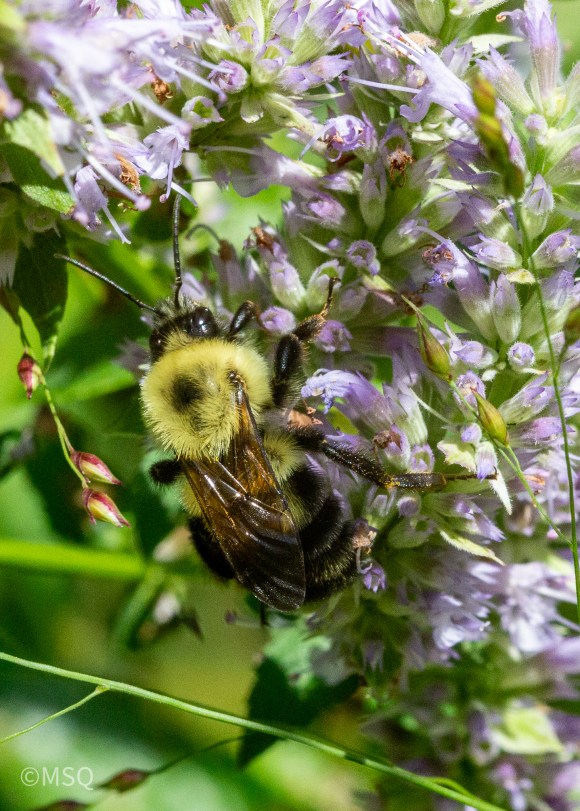
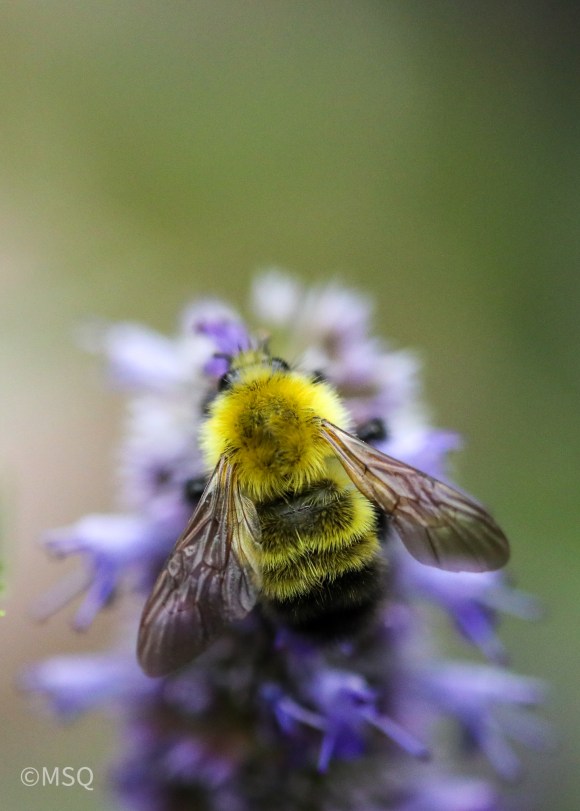
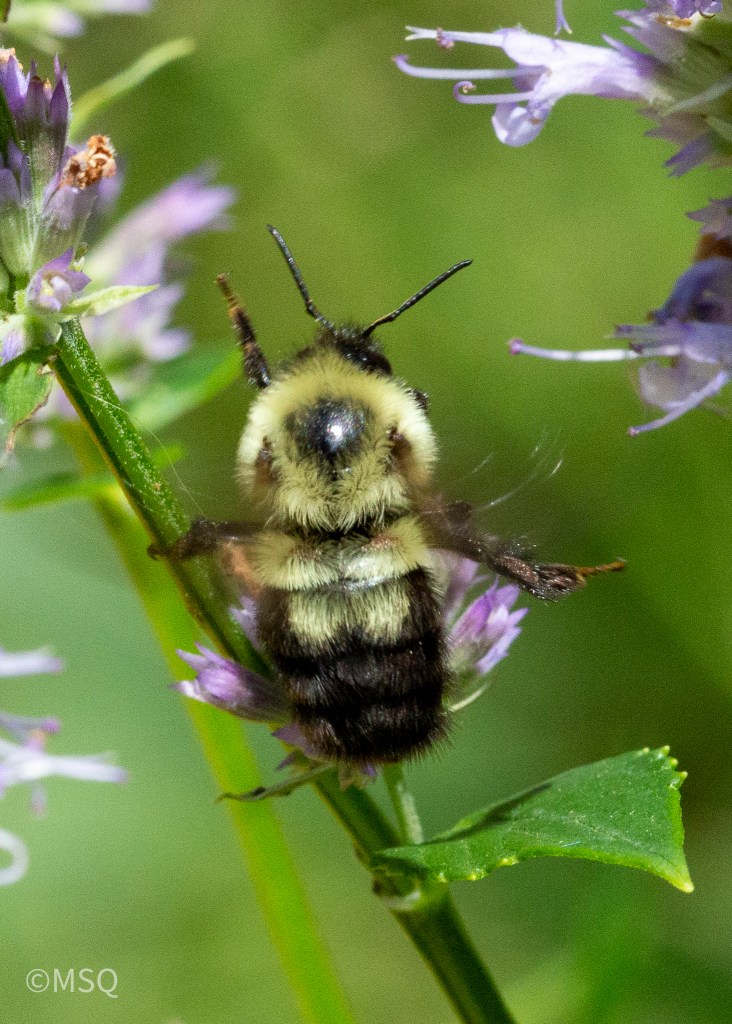
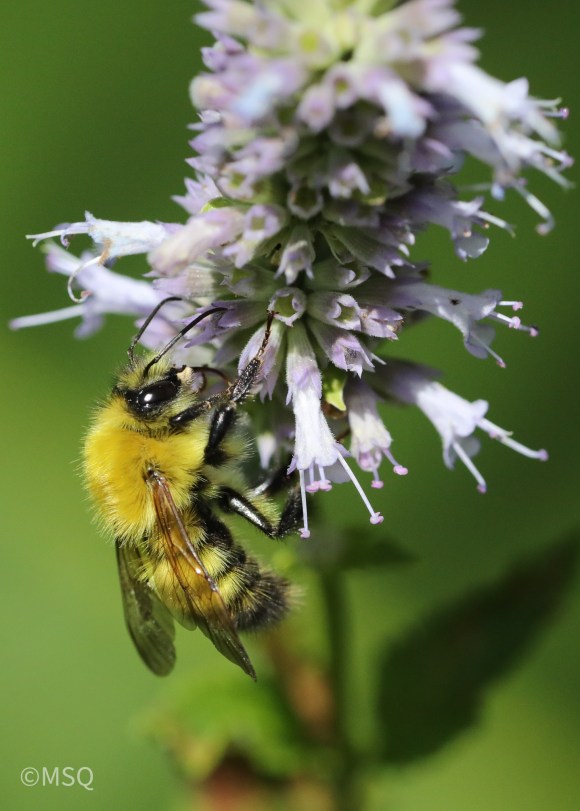
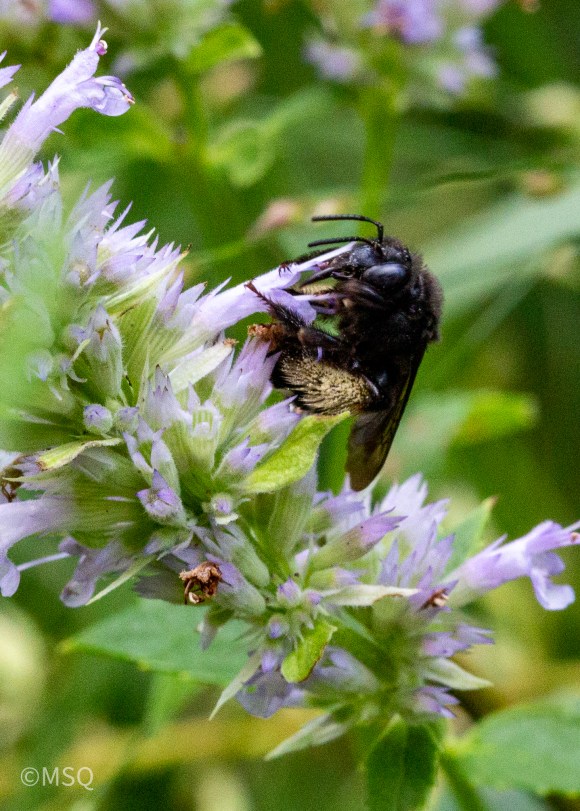
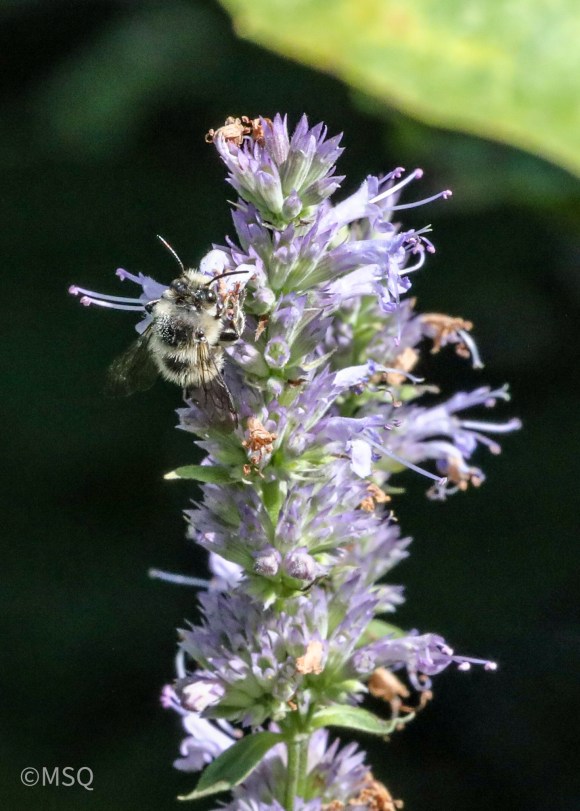
The many native bees that visit Hyssop range from large to tiny.  Bumble bees are the largest.  I’ve seen Common Eastern Bumble bee (Bombus impatiens), Brown-Belted Bumble bee, (Bombus griseocollis), Two-Spotted Bumble bee (Bombus bimaculatus), and Golden Northern Bumble Bee (Bombus fervidus) on my Fragrant Hyssop. They use both nectar and pollen for their larva.  

Large Leaf-Cutter bees use Anise Hyssop’s nectar. In the process, they are efficient pollinators. In contrast to other bees, pollen accumulates on the Leaf-Cutter bees’ abdominal scopae (specialized pollen collecting hairs).  It is transferred to the stigmas from there.


Digger bees (Melissodes) and smaller Leaf-Cutter bees (Megachile) are mid-sized bees.  They also collect both pollen and nectar from Anise Hyssop.

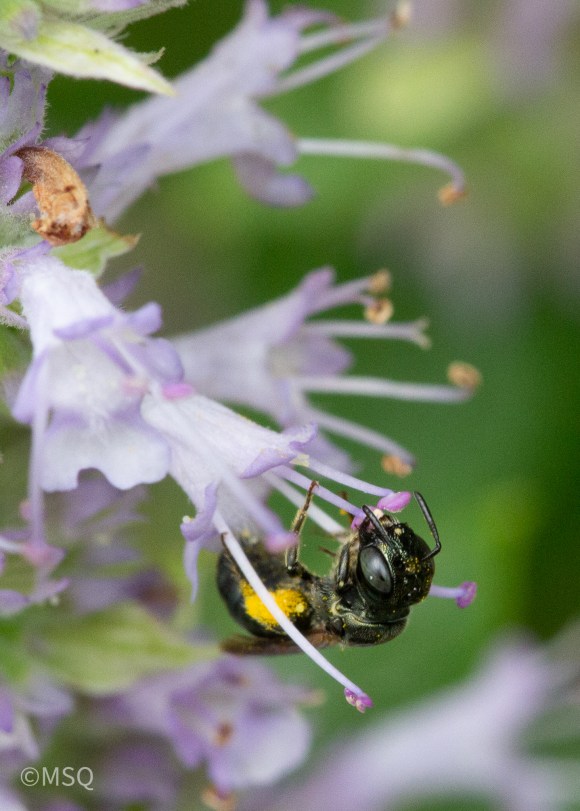
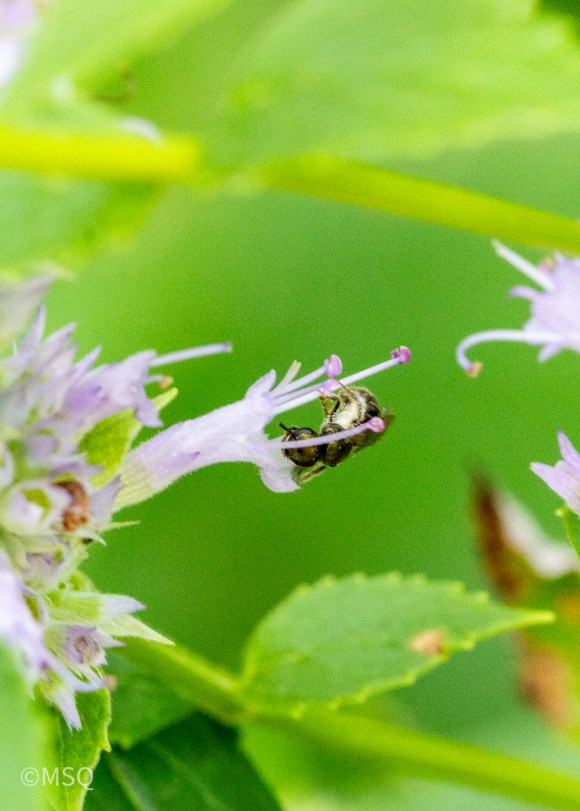
The Halictid bees (Lasioglossom), small Resin bees (Heriades) and Masked bees (Hylaeus) are small bees that gather resources from Fragrant Hyssop.  Dufourea monardae is included in this group.  D. monardae is a specialist or oligolectic bee that visits Monarda fistulosa and Agastache foeniculum.  These small bees can collect pollen from the anthers extending from the flowers. When harvesting nectar, they climb the style to reach the base of the flower.  (The style is the stalk connecting the stigma and the ovary.)

Fragrant Hyssop provides an excellent late season nectar source for butterflies, skippers and moths including Silver Spotted Skipper Butterflies (Epargyreus clarus), Peck’s Skipper Butterflies (Polites peckius) and the Great Spangled Fritillary Butterfly (Speyeria cybele).  They reach their proboscis into each tiny bloom to find the nectar.  Hyssop also works well in Monarch Way Stations providing food after most milkweed has stopped blooming.  

I hope you enjoyed this exploration of Anise Hyssop and its wonderful visitors!  I’d love to hear your thought about this blog or stories about your own experiences in the garden.  Please leave me comment and let me know your thoughts!

References:

  1. Eierman, Kim,11 April 2014,  “Ecobeneficial Interview:  Annie White on Native Plant Cultivars, Native Plants and Pollinators”, Youtube, https://www.youtube.com/watch?v=HTmuDcEzTOw
  2. Caldwell, Cathy, (2021, August-Vol.7, No.8) Anise hyssop, Piedmont Master Gardeners, https://piedmontmastergardeners.org/article/anise-hyssop/
  3. Riddle, Sharla, (2016, May, 20) How Bees See And Why It Matters, Bee Culture:  The Magazine of American Beekeeping, https://www.beeculture.com/bees-see-matters/