Categories
native plants Pollinator gardening

Brilliant Golden Puffs

In late summer, feathery, golden puffs burst open in the wetlands. The blooms of Euthamia graminifolia or Grass-Leaved Goldenrod light these moist places drawing pollinators, beneficial insects and butterflies.  It’s slender leaves giving it an open, airy look.
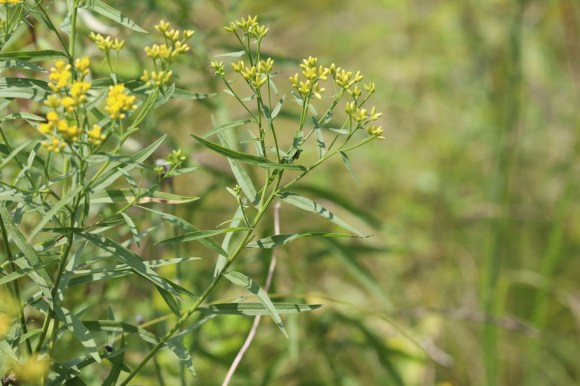
Highly adaptable, Grass-Leaved Goldenrod thrives in many areas.  It lives in Zones 3 through 9.  Euthamia graminifolia grows from 2 to 5 feet tall and should be planted about 1 foot apart.2,4  

Grass-Leaved Goldenrod loves a sunny, moist site.  But it will grow in a variety of conditions.  Soils include sandy to gravelly with some organic matter.  Once establish, this goldenrod tolerates drought.  In drier locations, it’s often outcompeted by other plants.2,3,4
Powdery mildew is less of a problem for Euthamia graminifolia than other goldenrods.  It has fibrous roots and spreads by rhizomes.  When planted in a wet, sunny spot, E. graminifolia can be aggressive.4

Grass-Leaved Goldenrod flourishes in many wild and disturbed areas.  The areas include:  some wetlands, moist black prairies, edges of marshes, sandy pannes between dunes, calcareous seeps, borders of lakes, abandoned fields, ditches along railroads, fens, damp to drier thickets, open areas, meadows and fields, shores of rivers, wetland margins.2,3,4

The Grass-Leaved Goldenrod plant has a lovely growth habit.  It can be slender with only a few branches or have many branches to form a full-looking plant.  Its appearance varies depending on the site.4
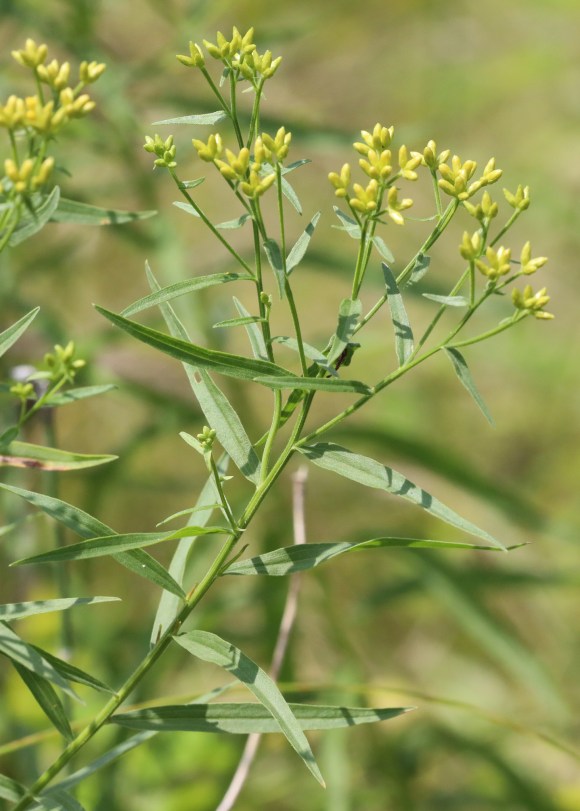
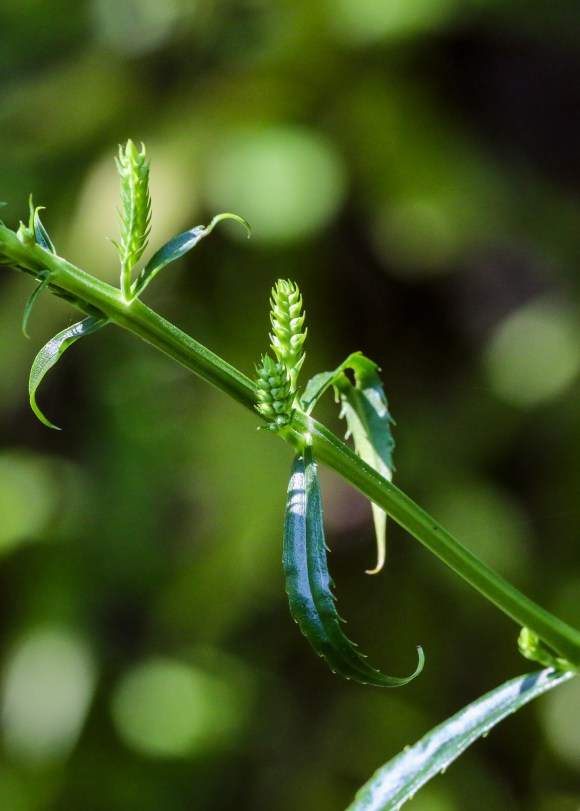
Euthamia graminifolia takes its name from its slender leaves.  These leaves alternate along the stem and have smooth margins.  The large ones have 3 well-defined veins.  Small leaves have only 1 noticeable vein.4
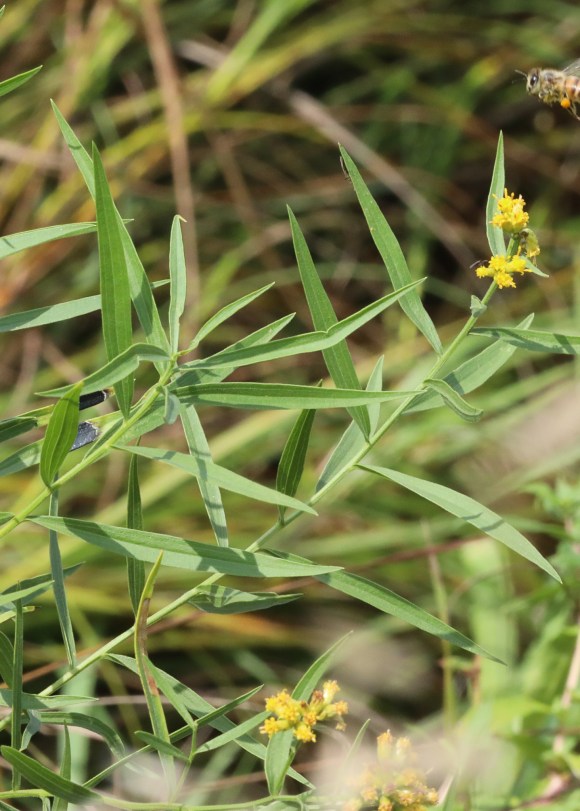
Leaves grow up to 5 inches long and 0.5 inches wide.  They are stalkless and end in sharp points.  Medium green, the upper surface is smooth or has short hairs especially along the veins and edges.  Veins on the underside also have short hairs.3,4

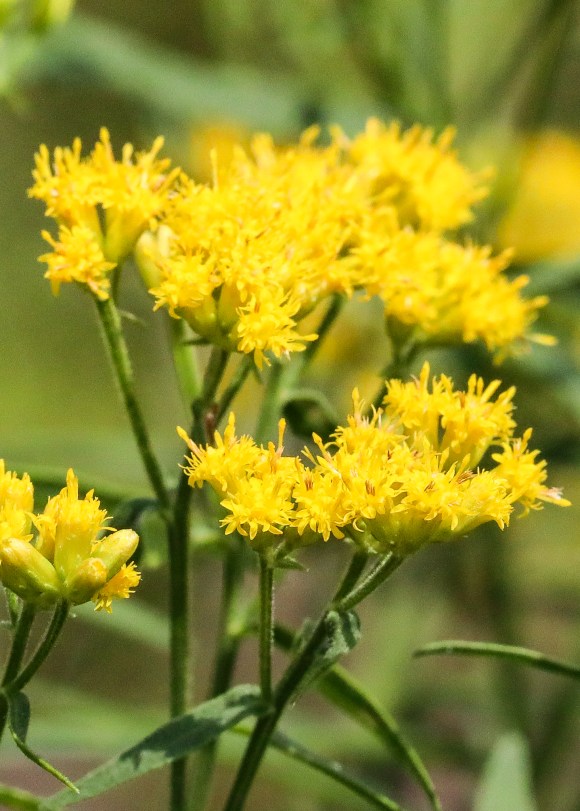
Euthamia graminifolia’s blooms appear at the top of the main stem.  If there are any upper side stems, they can have flowerheads also.  The flowerheads are usually flat-topped leading to another common name—Flat-Topped Goldenrod.  Although occasionally, they’re round topped.4  
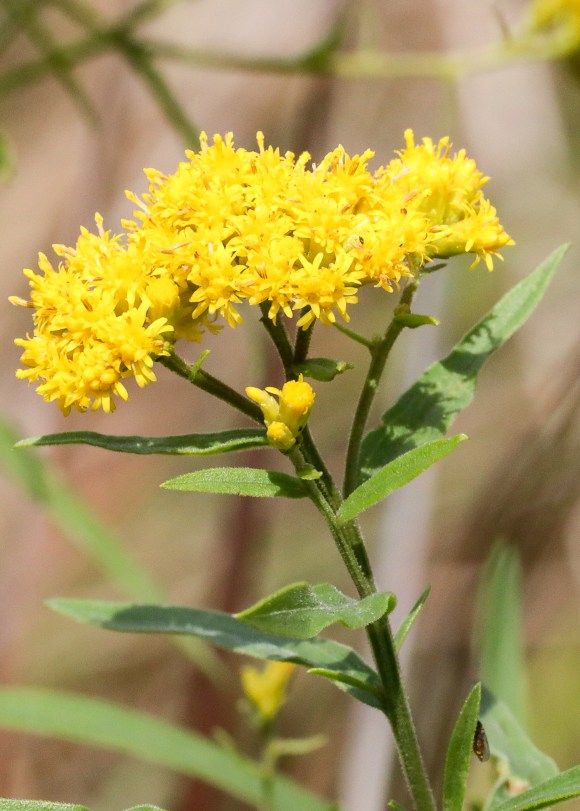
Like other goldenrod, 20 to 35 composite blooms make up the flowerheads.  Each bloom has 15 to 25 ray florets and 5 to 10 disk florets.  Altogether, the blossoms are approximately 1/8th inch across, smaller than other goldenrods.3,4

The blossoms open gradually.  It’s possible to have buds, open, and spent flowers all on the same head.  Bloom period is late summer to early fall.  Flowering time is about one month.  Blossoms sometimes have a light floral scent.4

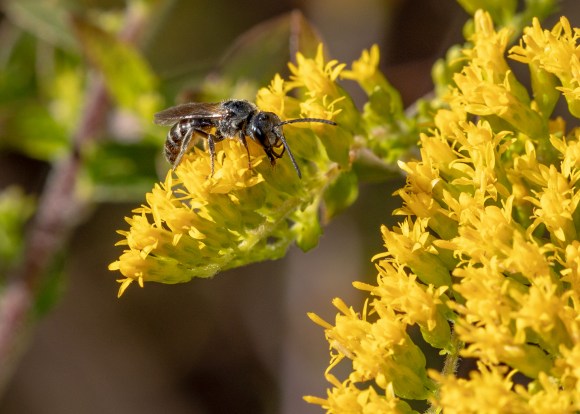
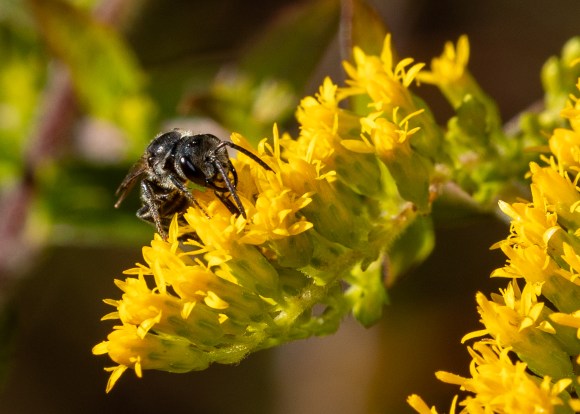
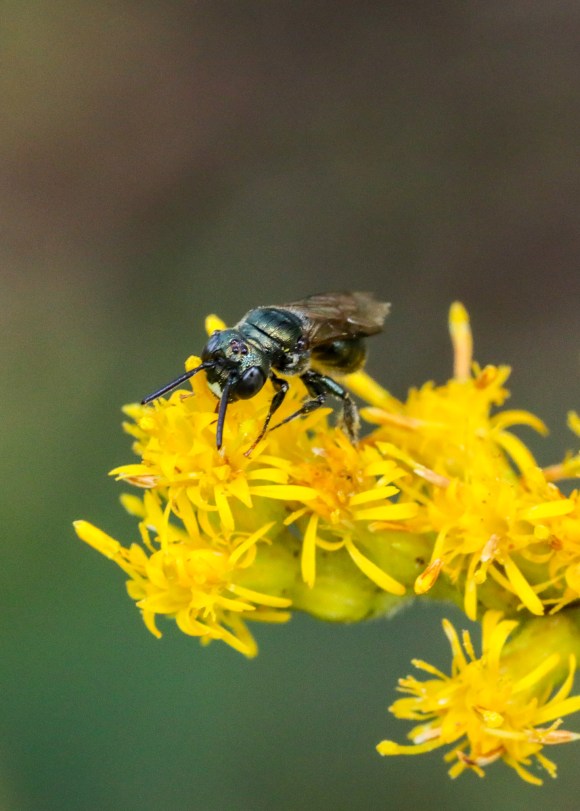
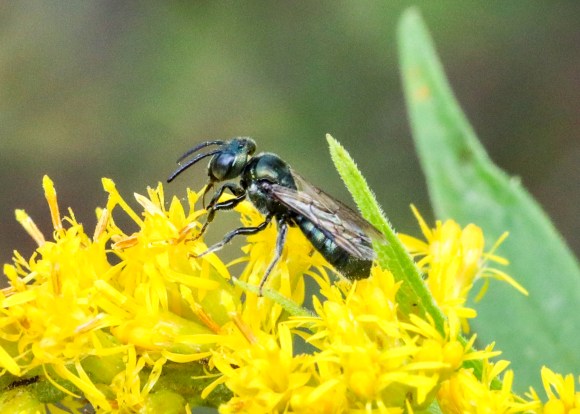
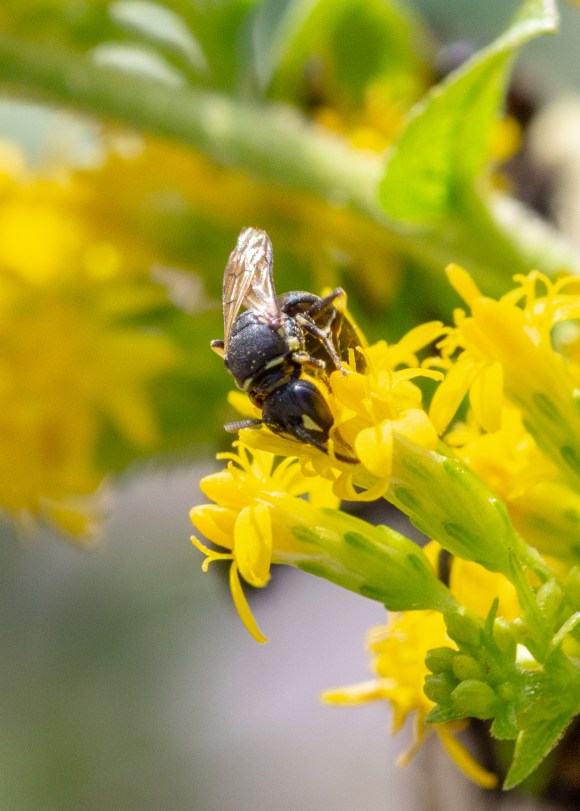
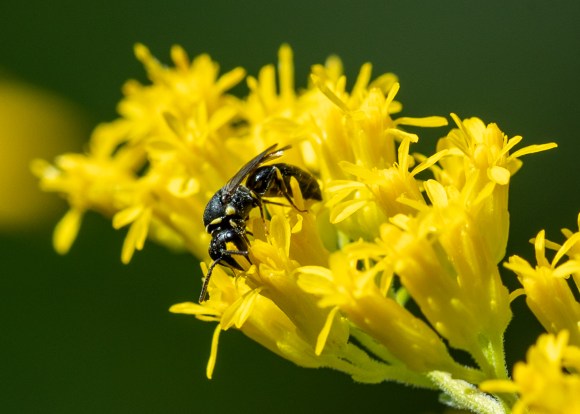
Grass-Leaved Goldenrod attracts numerous different pollinators, butterflies, moths, beetles and insects.  These include long-tongued bees, short-tongued bees, wasps and flies.  The Pollinator Program at The Xerces Society for Invertebrate Conservation designated this goldenrod of Special Value to Native Bees and declared it Supports Conservation Biological Control.4 This information was provided by the Pollinator Program at The Xerces Society for Invertebrate Conservation.
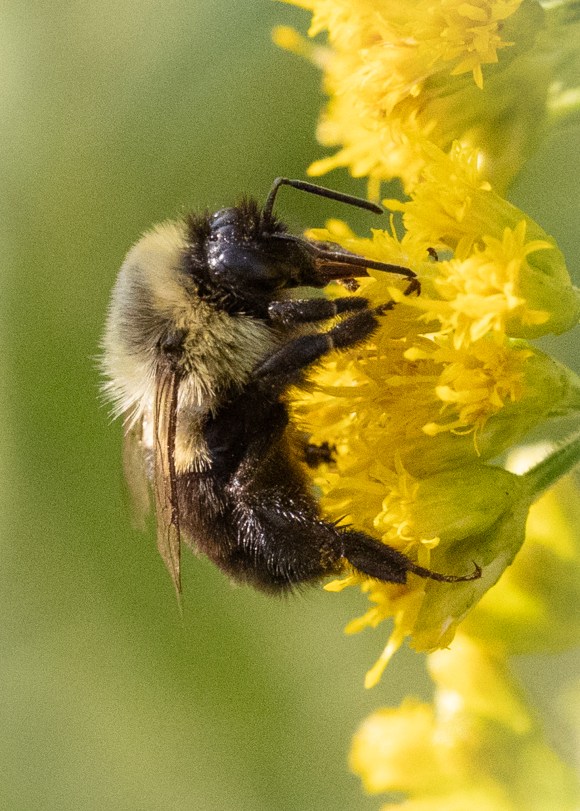
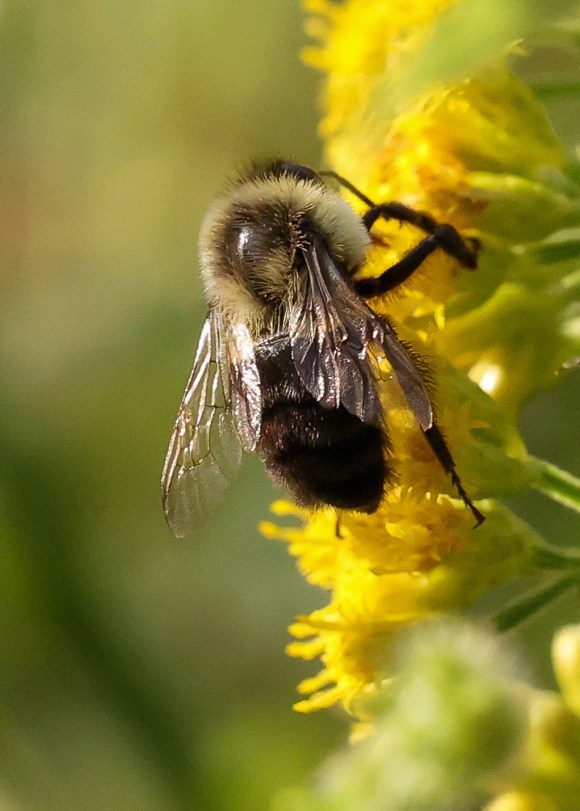
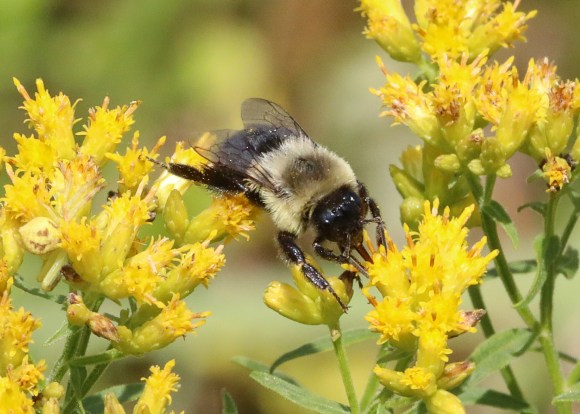
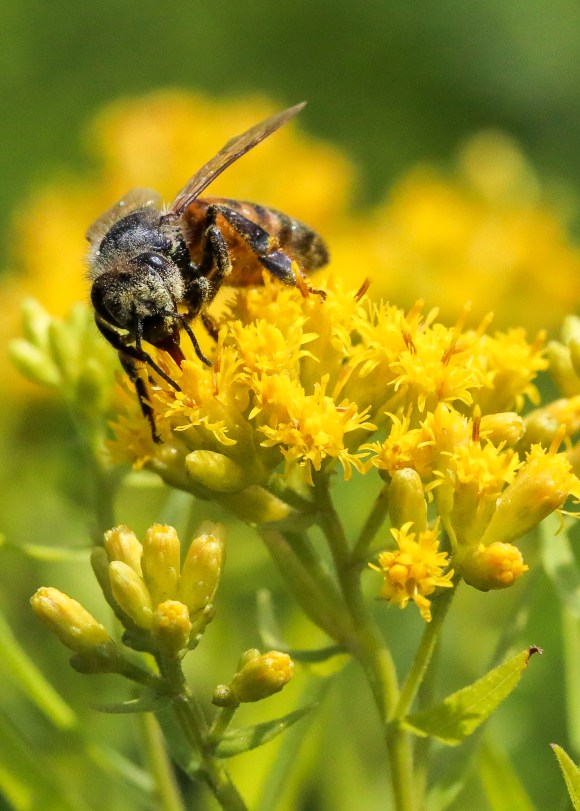
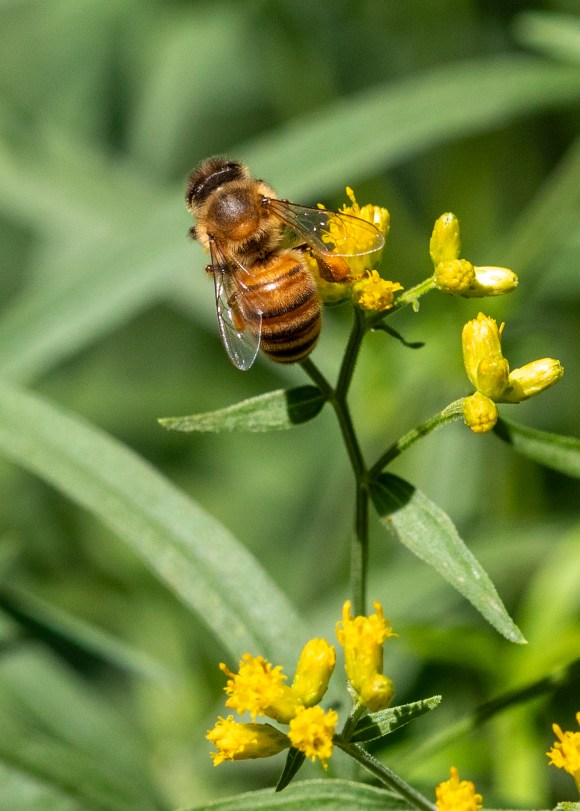
Long-tongued bee visitors include bumblebees (Bombus spp.) and honeybees (Aphis mellifera).
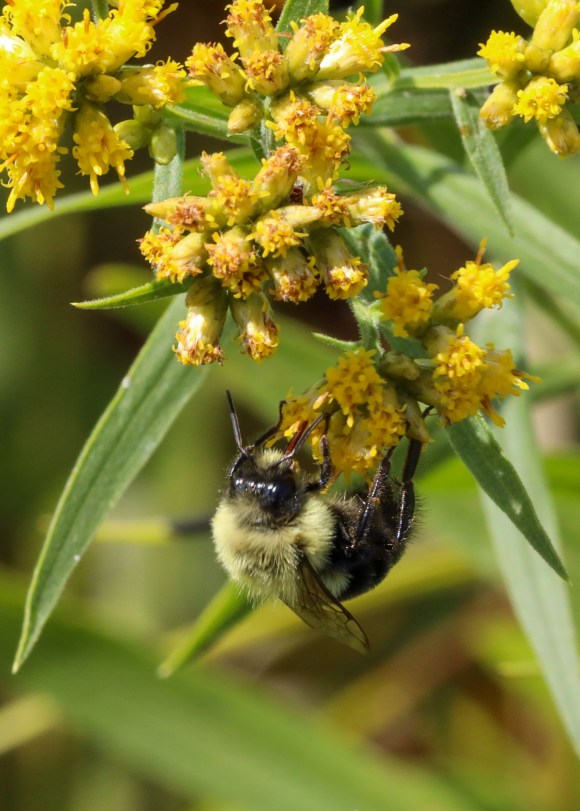
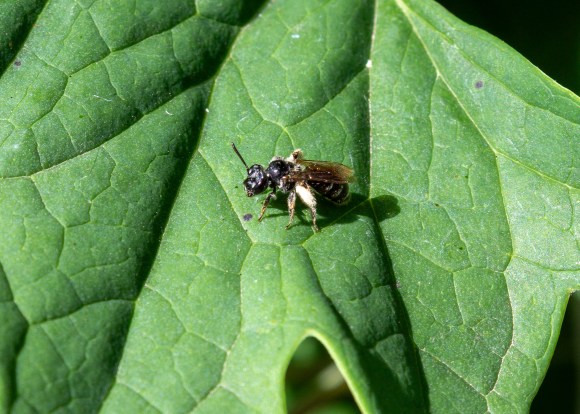
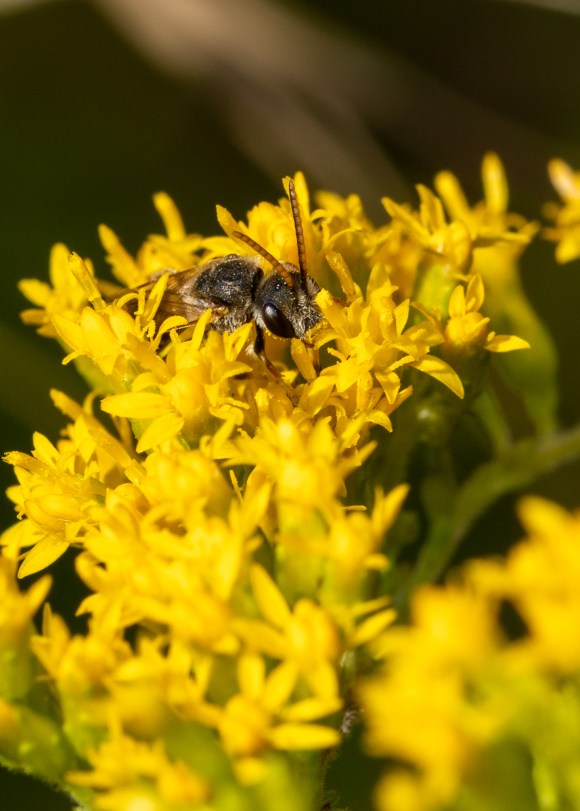
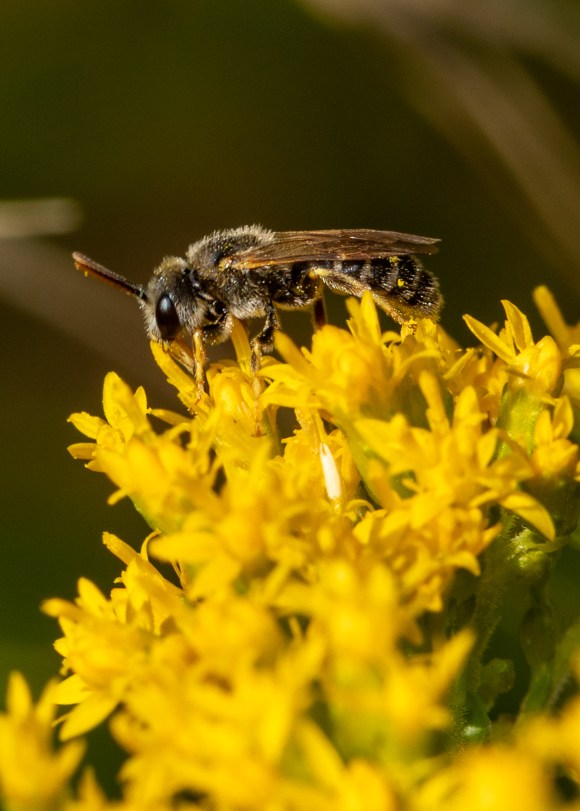
Short-tongued bees include Halictids, small carpenter bees (Ceratina spp.) and Yellow-Faced bees (Hylaeus spp.).
The charismatic Large Carpenter Bee (Xylocopa virginica) resembles a large bumblebee with a mostly smooth abdomen and large, bulbous eyes.  They pollinate garden flowers, natural areas and farms.  Their name Xylocopa means woodcutter chosen because they make holes in wood for their nests.8
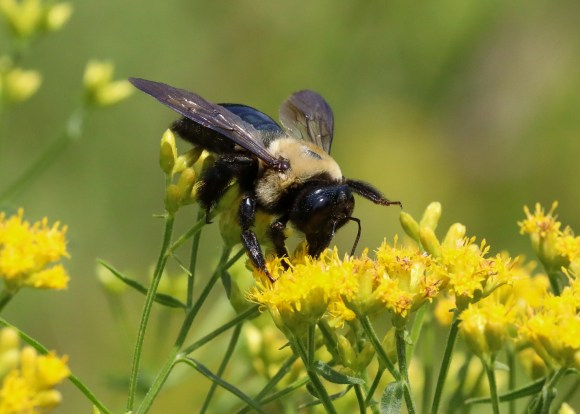
Most native bees nest in the ground or use existing holes.  Carpenter bees use their mandibles to chew perfectly round holes in wood.  Their nests have a series of tunnels with nesting chambers off them. Wood shavings from the nest construction are used for the chamber walls. 

Female Carpenter Bees will reuse an old nest if they can find them.  These recycled nests are extended each year.  Some are truly huge!8

Recycled nests increase the Queen’s productivity.  A single female Carpenter Bee only has 4 or 5 young if she creates a new nest.  With the recycled nest, she’s able to have more offspring.8
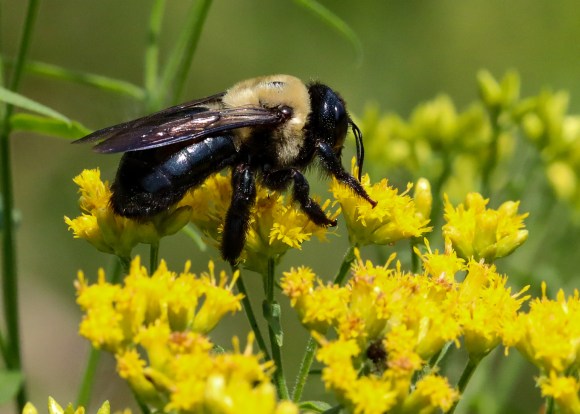
Carpenter Bees used to be considered solitary although they nested close to each other in loose groups.  Recently, social nests have been found.  These nests usually occur where resources are scarce.8 

The social aspect is different than Honeybees or Bumblebees.  All the Carpenter Bee Queens are able to mate.  The primary Queen does all the foraging and feeds the young balls of pollen and nectar.  Sometimes she even feeds the subordinate Queens.  The subordinate Queens defend the nest from predators, parasites and competing Carpenter Bee Queens.8

Carpenter Bees are quite bold about defending their nest.  Males have a white patch on their faces.  They hover in front of people and will even bump them if the nest is threatened.  Male Carpenter Bees don’t have a stinger.8

The females also defend the nest if the nest is threatened.  These Queens have a stinger.  Usually, they only sting when handled roughly or actually physically threatened.8

The social structure affects the life span of the Queens.  The primary Queen only lives 1 year.  The wear and tear of foraging and nest building shorten her life.  The subordinate Queens can live up to 3 years.  These subordinate Queens wait for another nest to become available  before becoming the primary Queen.8
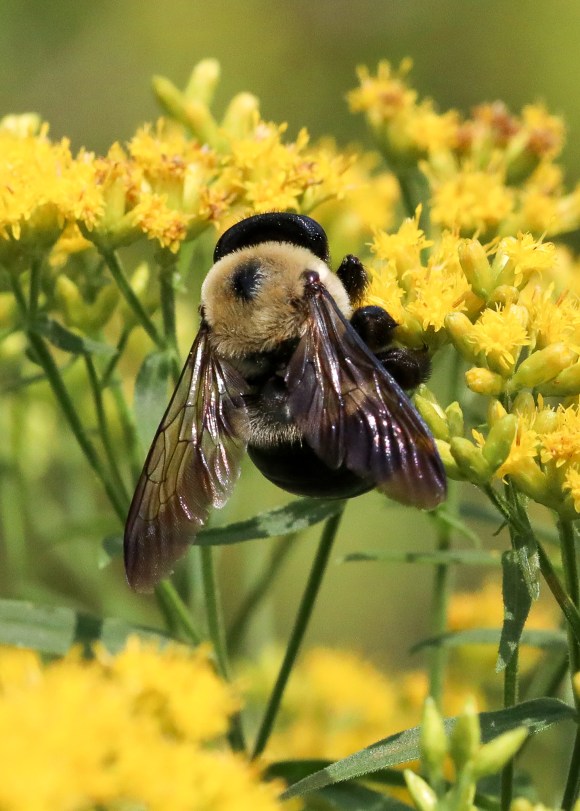
Carpenter Bees emerge in early Spring.  They forage throughout the Spring and Summer.  New adults appear in late Summer.  They’ll forage from late Summer through Fall.  When the temperature drop and flower start to die, new Carpenter Bees return to the nest to hibernate as adults.8

So why are Carpenter Bees considered a foe or pest?  The conflict happens because of  the nesting behavior.  In the past, these bees used dead trees to build their nests.  Now, they will use unfinished wood on human structures.8

Since this a pollinator blog, I’ll highlight ways to deter them.  The best way is to use materials other than wood.  Composite works well.  When using wood, finish it with paint, stain or a yearly coat of almond oil.  Be sure to keep it sealed.8

Provide an alternative nesting site.  This idea is similar to installing a bat house to lure bats out of the attic.  The Carpenter Bees will use the pile of unfinished pine or cedar and leave the structures alone.8

Once a nest is begun, the queen won’t be deterred.  The best solution is to remove the damaged wood (unless structural, of course).  Place this elsewhere.  The bees will continue to use it.  Then repair the damage and seal the wood.8

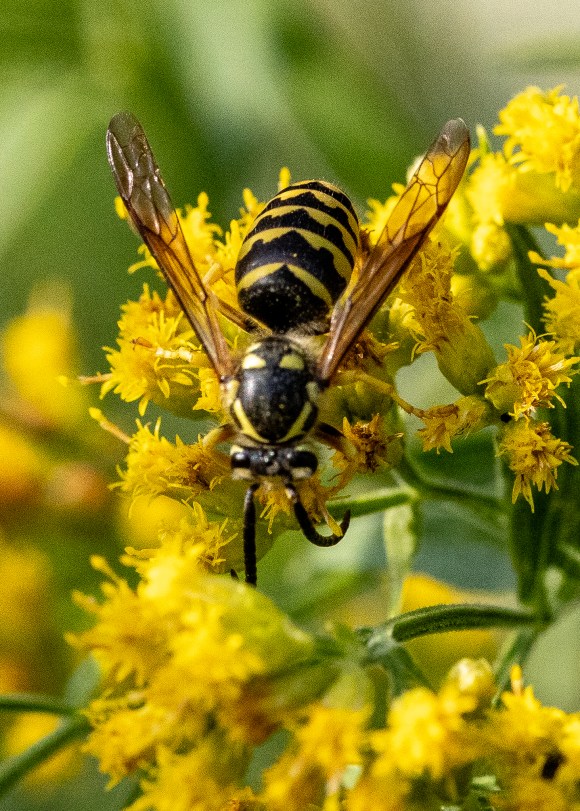
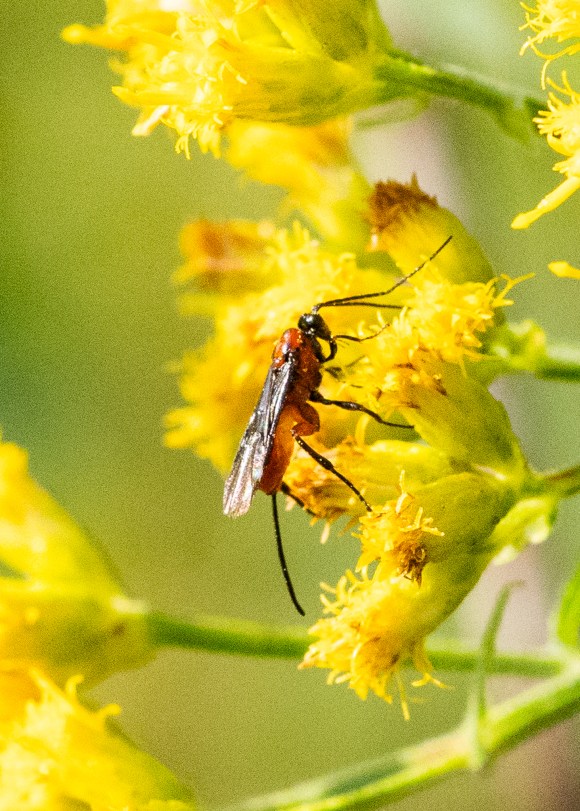
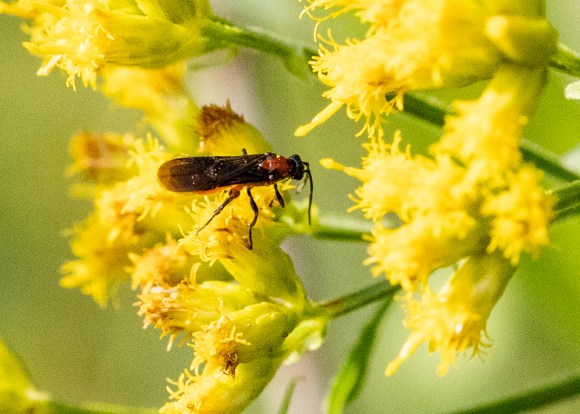
Numerous wasps gather resources at Euthamia graminifolia.4 Potters wasps,
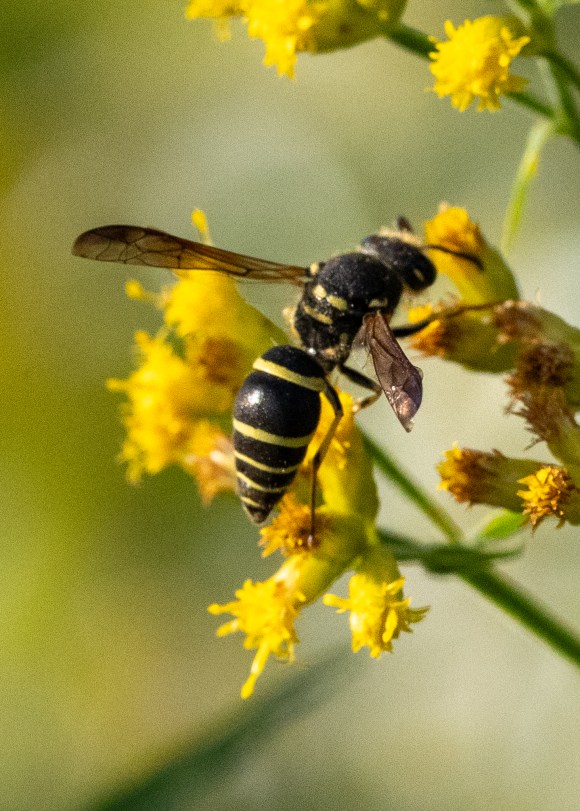
Northern Paper Wasps (Polistes fuscatus),
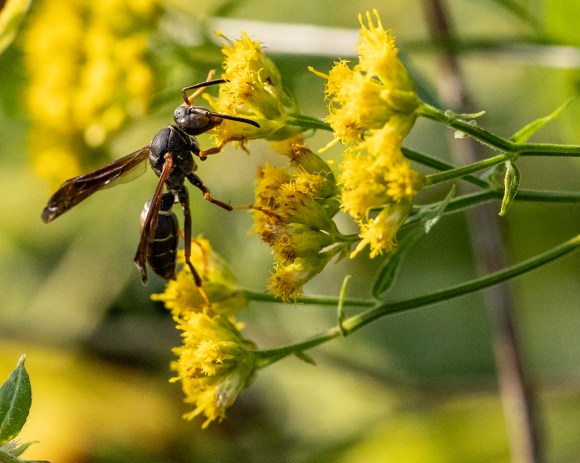
Sphex Wasps
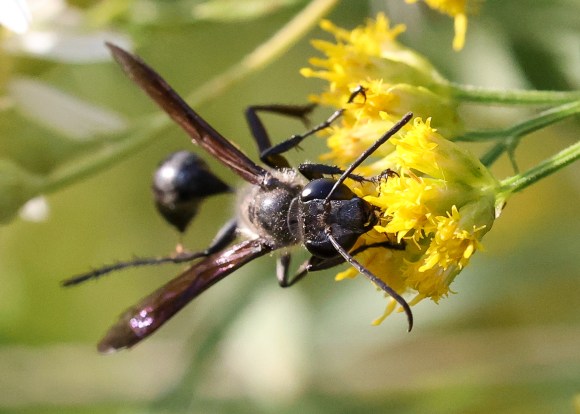
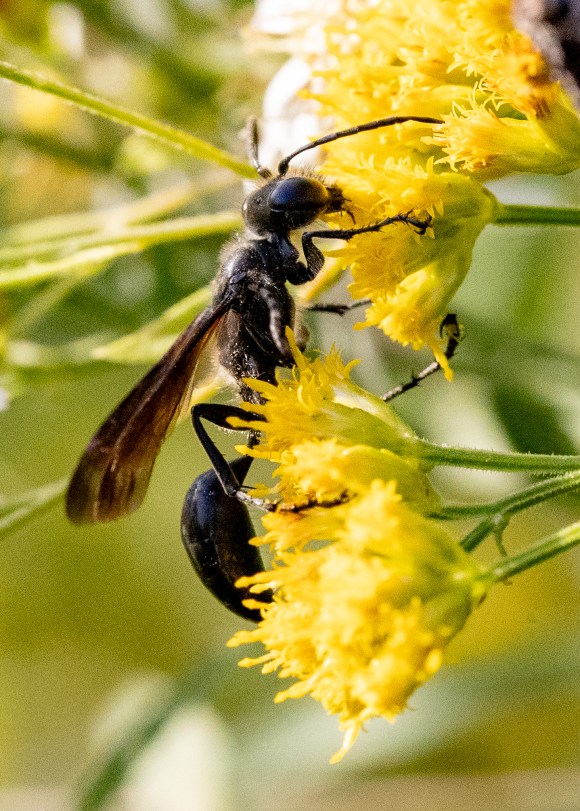
and Aerial Yellowjackets (Dolichovespula spp.) all use its nectar.
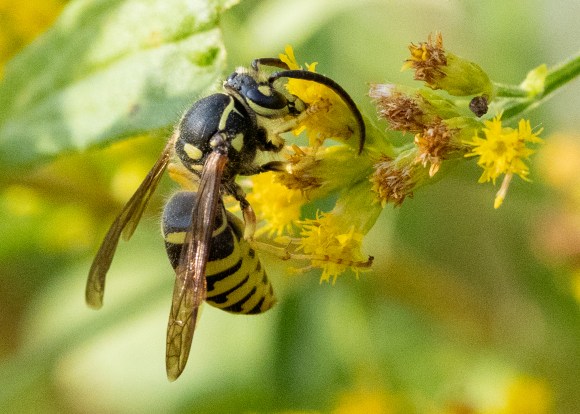
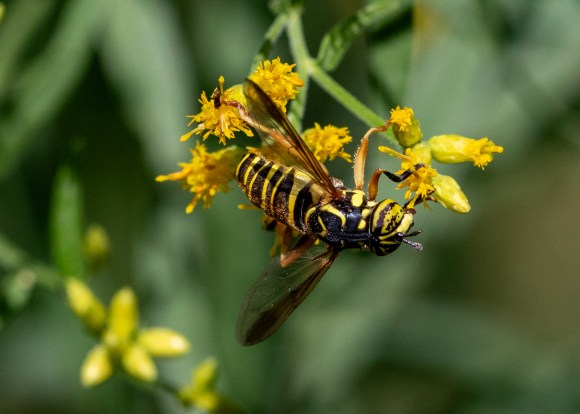
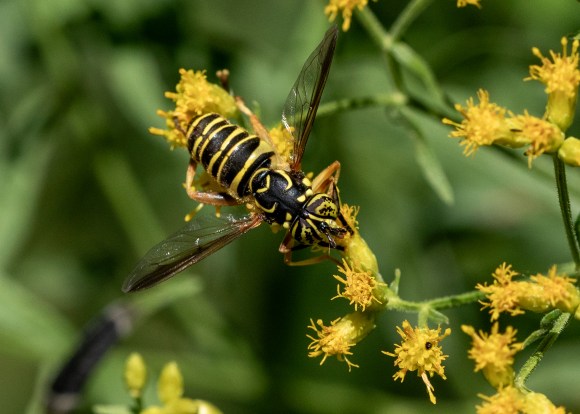
Flies also use Euthamia graminifolia including Eastern Hornet Fly (Spilomyia Longicornis).1
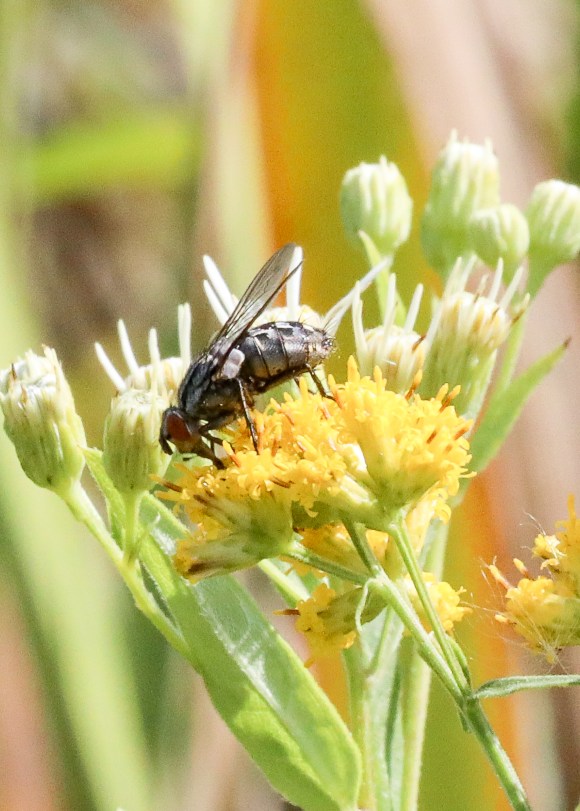
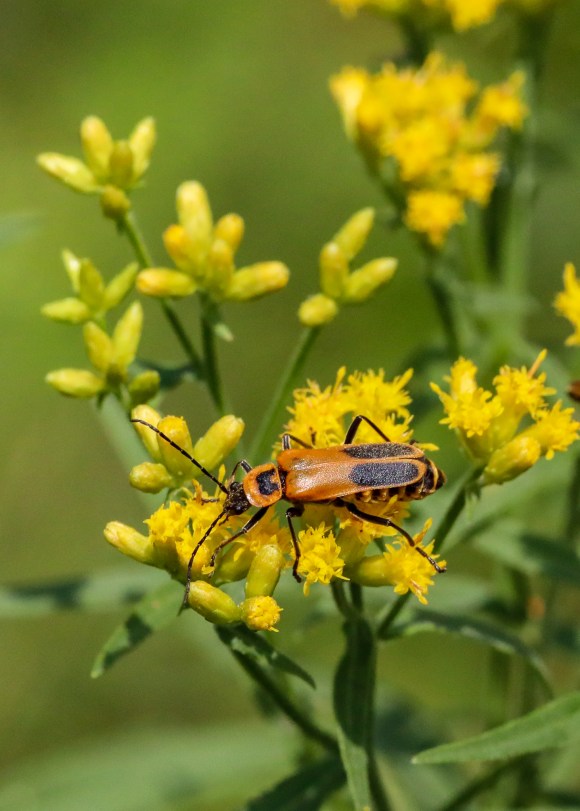
Several beetle species visit the Grass-Leaved Goldenrod.  Goldenrod Soldier Beetle (Chauliognathus pennsylvanicus), Flower Lebia Beetle (Lebia viridis) and Winter Firefly (Ellychnia corrusca) can all be found on this goldenrod.  They’re looking for nectar, pollen and/or prey.4
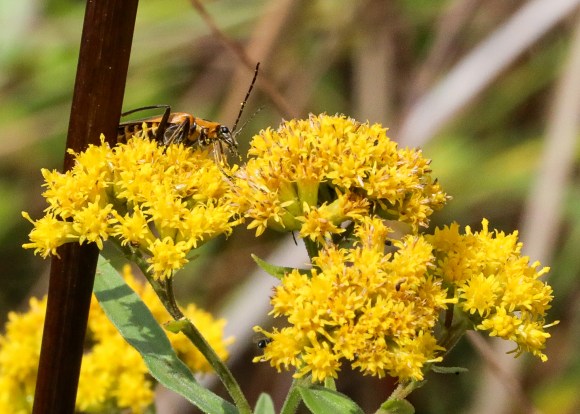
I talked about Soldier Beetles in Autumn Stars (https://wildthingsinthe.garden/2023/10/01/autumn-stars/).  Like the other Soldier Beetles, the Goldenrod Soldier Beetle adults gather nectar and pollen from flowers.  They may also eat small prey like caterpillars, eggs, or aphids.  Their larvae consume other soft bodied insects like grasshopper eggs and caterpillars.5
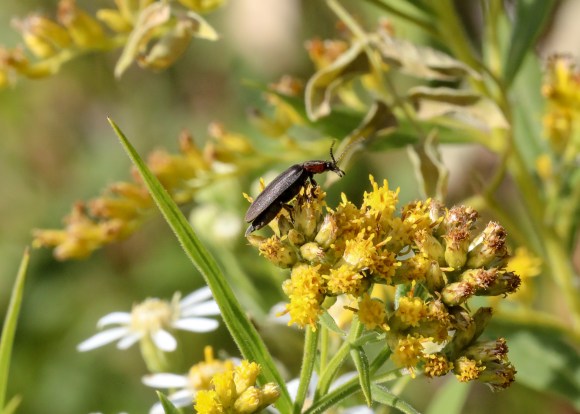
The Winter Firefly is a dark firefly.  I didn’t realize they existed, but these adults don’t glow.  They use pheromones to find mates.  Adults eat tree sap and flower nectar especially from asters and goldenrods.7,10  
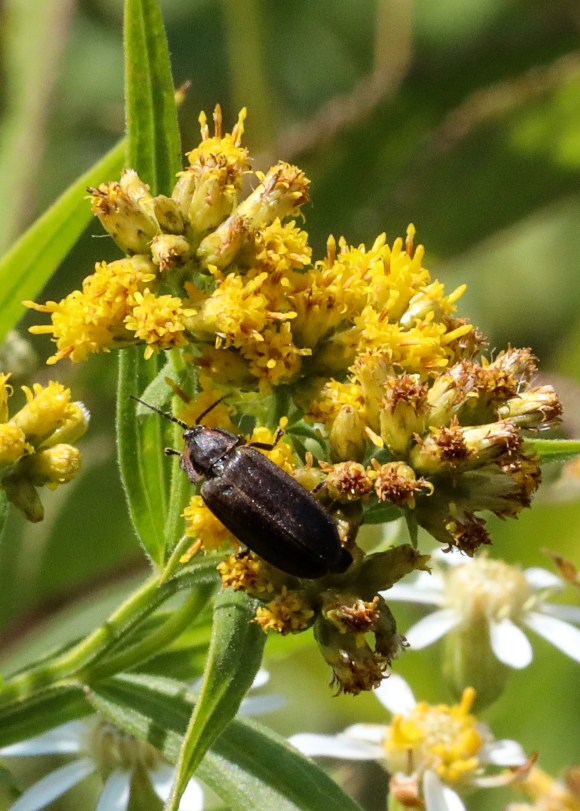
The larvae do light up and have the nickname glow worms.  These predatory larvae feed on soft bodied invertebrates like snail, slugs and earthworms.  They also eat rotting wood.7,10
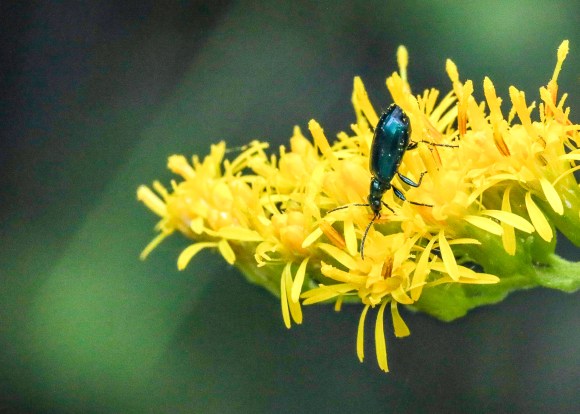
The striking Flower Lebia Beetle (Lebia viridis) hunts food on plants and on the ground.  Adults eat the eggs and larvae of at least 4 metallic flea beetles (Altica spp.)  They lay their eggs on the soil attaching it with an adhesive secretion.  The larva hatches and starts looking for a leaf beetle pupa, especially Altica spp.  The larva attaches itself and parasitizes the pupa.6
I hope you enjoyed this journey into the Grass-Leaved Goldenrod and its guests. This is a charming example of a goldenrod and an excellent rain garden plant.  It provides a wonderful source of late season nectar and pollen.

Happy Gardening,

Mary

BIBLIOGRAPHY:

  1. “Eastern Hornet Fly (Spilomyia Longicornis) · iNaturalist.” n.d. Accessed June 18, 2026. https://www.inaturalist.org/taxa/325509-Spilomyia-longicornis.
  2. “Euthamia Graminifolia (Flat-Top Goldentop) | Native Plants of North America.” n.d. Accessed May 3, 2026. https://www.wildflower.org/plants/result.php?id_plant=EUGR5.
  3. “Euthamia Graminifolia (Grass-Leaved Goldenrod): Minnesota Wildflowers.” n.d. Accessed May 3, 2026. https://www.minnesotawildflowers.info/flower/grass-leaved-goldenrod.
  4. “Grass-Leaved Goldenrod (Euthamia Graminifolia).” n.d. Accessed May 3, 2026. https://www.illinoiswildflowers.info/prairie/plantx/gr_goldenrodx.htm.
  5. “Goldenrod Soldier Beetle, Chauliognathus Pensylvanicus – Wisconsin Horticulture.” n.d. Accessed June 18, 2026. https://hort.extension.wisc.edu/articles/goldenrod-soldier-beetl
  6. “Minnesota Seasons – Flower Lebia Beetle.” n.d. Accessed July 1, 2026. https://www.minnesotaseasons.com/Insects/flower_lebia_beetle.html.
  7. “Photinus Corruscus | NatureServe Explorer.” n.d. Accessed June 18, 2026. https://explorer.natureserve.org/Taxon/ELEMENT_GLOBAL.2.746911/Photinus_corruscus.
  8. “The Eastern Carpenter Bee: Beneficial Pollinator or Unwelcome Houseguest?” n.d. Accessed June 18, 2026. https://extension.psu.edu/the-eastern-carpenter-bee-beneficial-pollinator-or-unwelcome-houseguest.
  9. Sheahan, C.M. 2012. Fact sheet for flat-top goldentop (Euthamia graminifolia). USDA-NRCS, Cape May Plant Materials Center. Cape May, NJ. 08210,
  10. “Winter Firefly (Photinus Corruscus) — Minnesota Seasons.” n.d. Accessed June 18, 2026. https://www.minnesotaseasons.com/Insects/winter_firefly.html.
Categories
native plants Pollinator gardening

Pink Dragons in the Wet

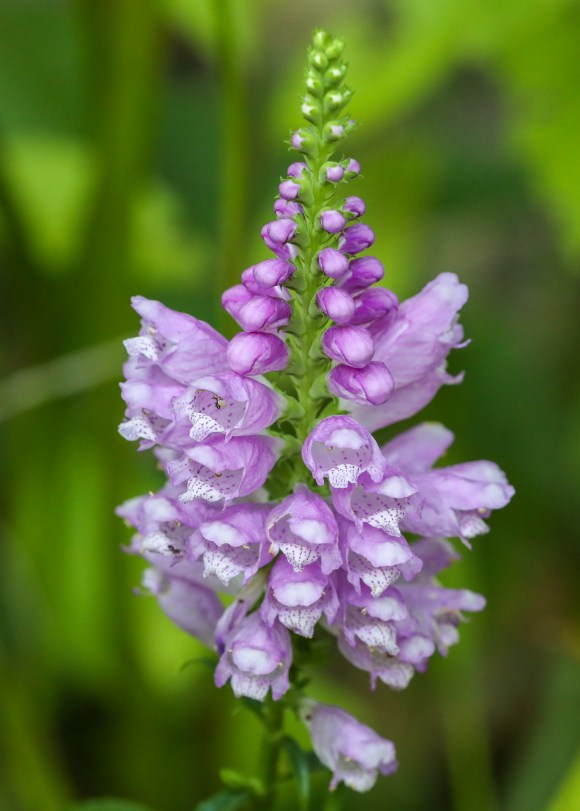
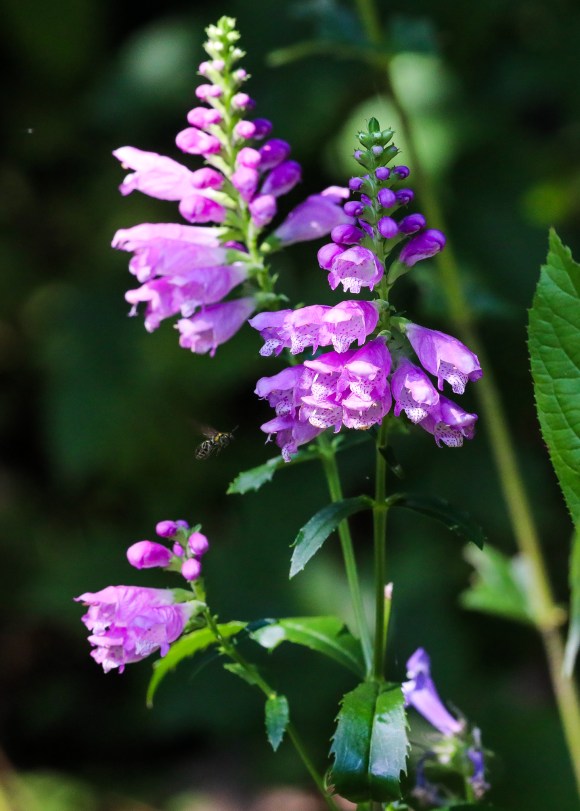
The vivid, mauve mouths of Obedient Plant or False Dragonhead (Physostegia virginiana) open in late summer and fall.  They welcome numerous bees, butterflies, beneficial insects and, even, a bird—the Ruby-Throated Hummingbird.  These creatures gather nectar and/or pollen to survive the coming winter.

Obedient Plant grows from 4 to 5 feet tall and spreads from 2 to 3 feet wide.  It lives in Zones 3 to 9.  This erect plant only branches near the flowers.  The stem is hairless and square.  The common name began because the flowers can be moved and they stay in the new position for a while.7,9,11

Another excellent rain garden candidate, Physostegia virginiana thrives in moist to wet conditions and can tolerate occasional flooding.  During drought, the lower leaves turn yellow.  It enjoys full sun to part shade.  P. virginiana accepts full shade although it will need support.  Rich, loamy soil is ideal.  Obedient Plant tolerates some clay or gravel.7,9 

False Dragonhead is usually easy to grow.  But it is vulnerable under some conditions and to some pest.   It flops in really hot summer temperatures.  Plants can get aphids or spider mites.

Under ideal conditions, full to part sun, moist, loamy sites, Physostegia virginiana can spread aggressively.  A member of the mint family, this plant creates a tap root and uses rhizomes to establish new colonies.  Still, it is easy to weed out!7,9

Obedient Plant lives in many natural habitats including limestone glades, seeps, moist to mesic black soil prairies, open moist areas near railroads, wet thickets, openings in woodlands, borders of lakes, edges of woodlands, moist meadows, gravel banks, wooded bluff bases, and stream banks.7,9

The dark green leaves of False Dragonhead grow in opposite pairs along the stem.  They are sessile (attached to the stem), hairless and lanceolate or oblanceolate.  The margins (edges) have teeth.  These teeth are sharply pointed and widely spaced.  The leaves can grow up to 5 inches long and 1.5 inches wide.7

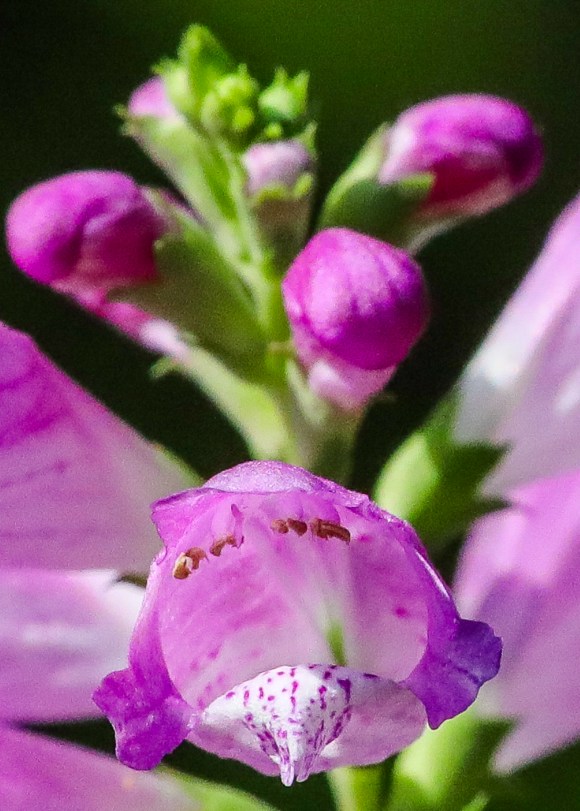
Obedient Plant’s flowers emerge in a spike at the top of the stem.  The flowerhead can be 10 to 18 inches long.  Individual blooms develop as 4 vertical rows, tightly packed together.  They open from the bottom to the top of the spike.7

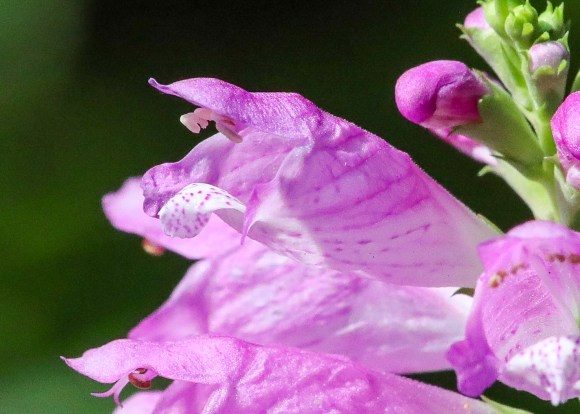
Blossoms can be white, lavender, or pinkish purple. Dots, fine stripes or swirls of a slightly darker color often decorate the flowers.  About 1 inch long, each floret is tubular with 2 lips and 4 purple anthers. The upper lip forms a broad hood.7

Obedient plant blooms from late summer through fall.  The flowers have no scent.  The bloom time lasts for about 1.5 months providing important late season resources.7  

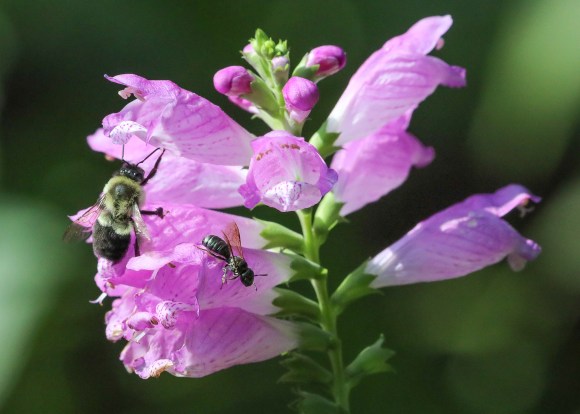
False Dragonhead’s graceful, tubular flowers host long-tongued bees, short-tongued bees, butterflies, beneficial insects and the Ruby-Throated Hummingbirds (Archilochus colubris).  Long-tongued bees and hummingbirds are the primary pollinators.  The short-tongued bees probably only gather pollen.3,4,7,9,10

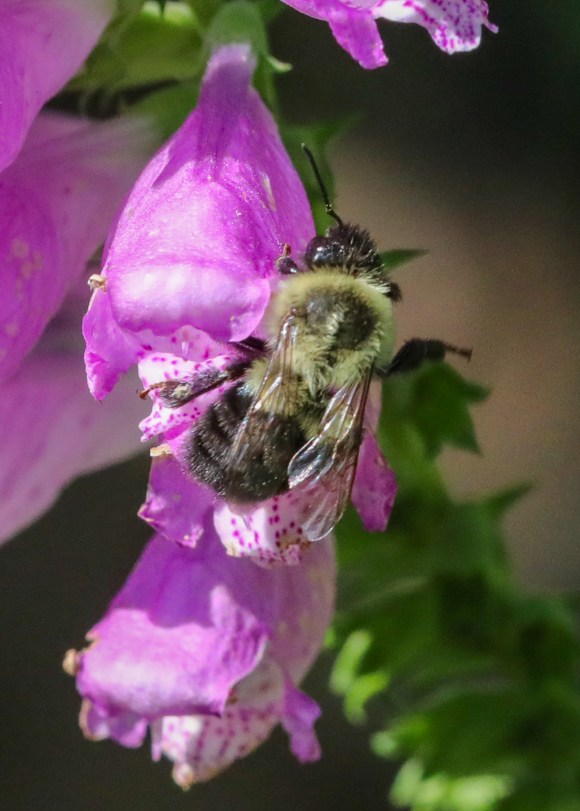
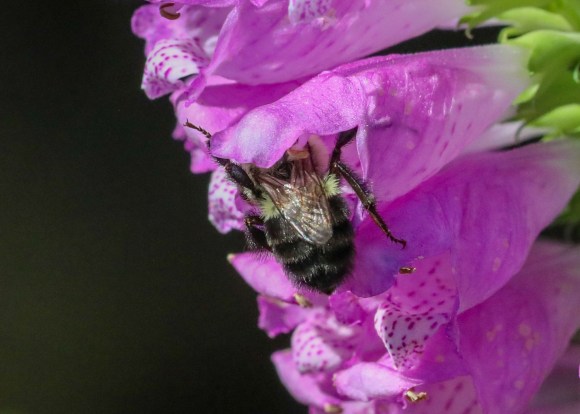
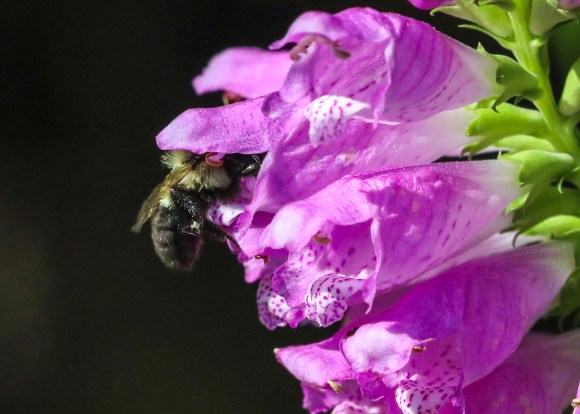
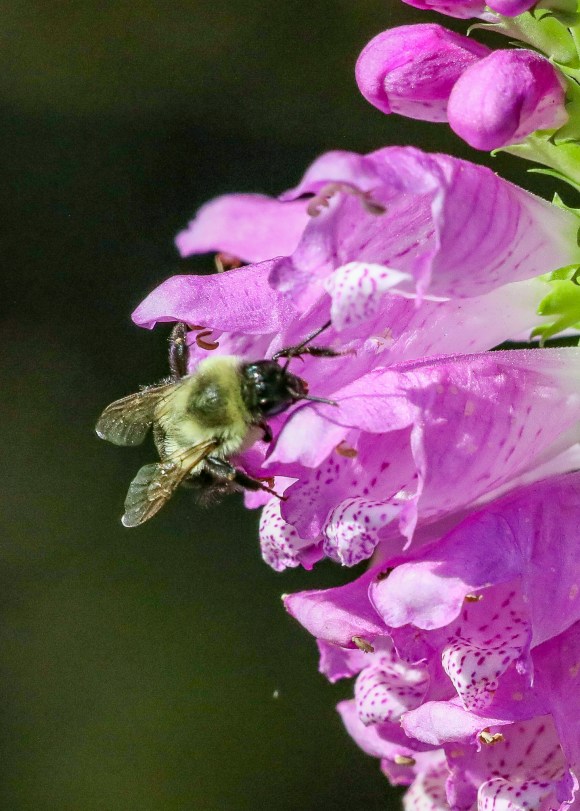
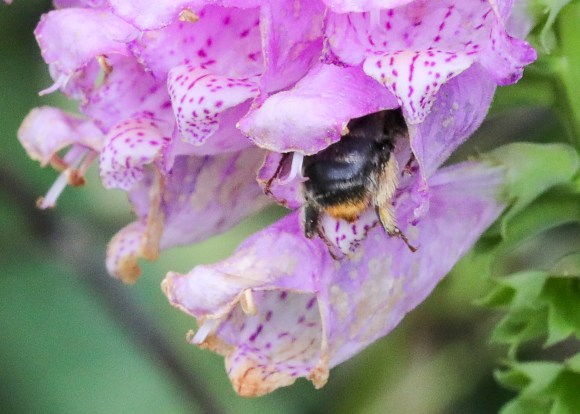
Bumblebees (Bombus spp.)Large Carpenter Bees (Xylocopa virginica), Long Horned Bees (Melissodes spp.), Leaf Cutter Bees (Megachile spp.) and Digger Bees (Anthophora spp.) are all long-tongued bees that visit Obedient Plant.  

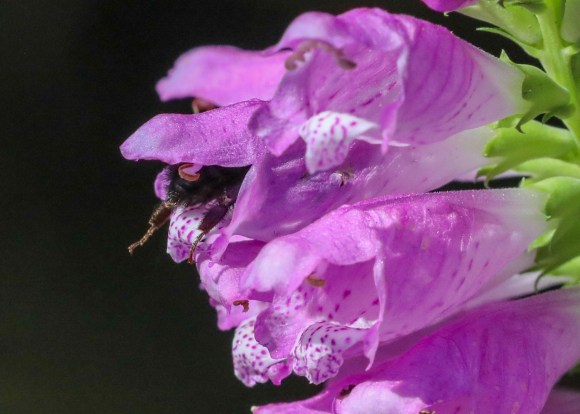
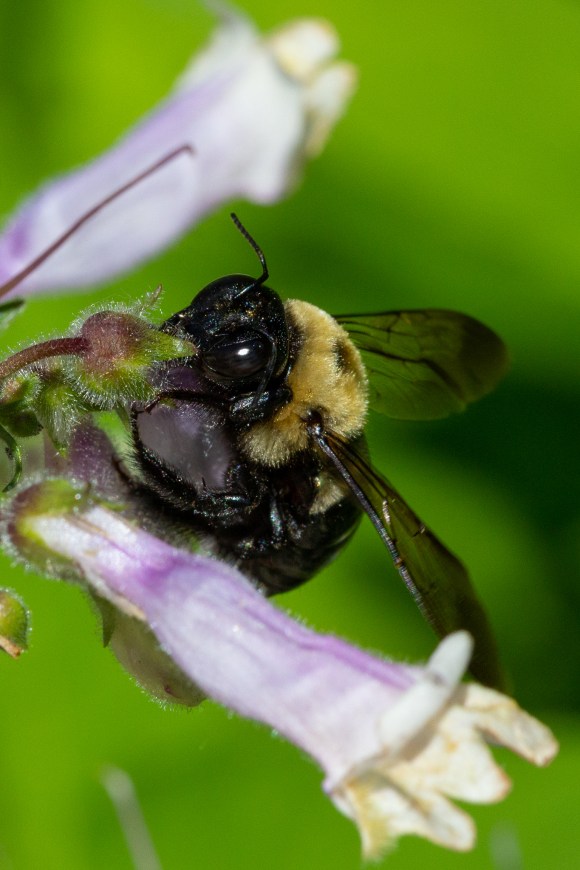
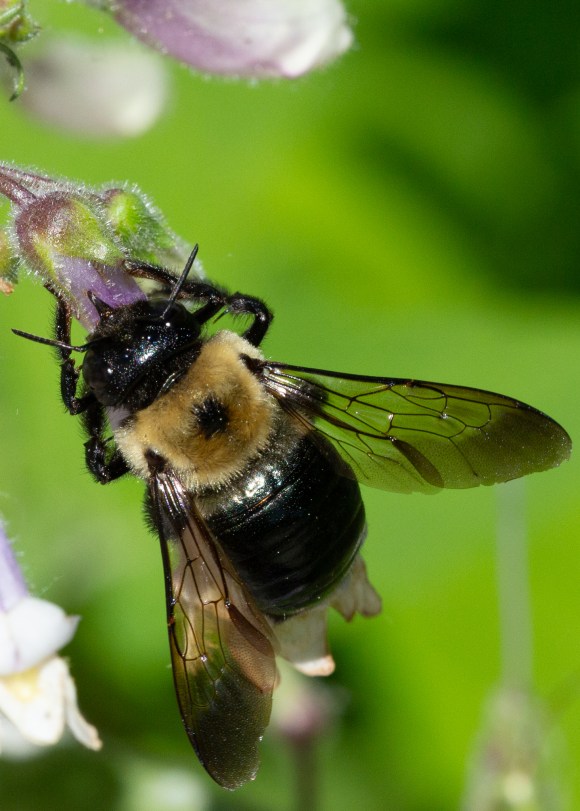
Large Carpenter Bees are included in long-tongued bees, but their tongues won’t reach the base of this plant.  These bees are known for cutting holes at the base of flowers and stealing nectar.  Other insects, like Bumblebees and soldier beetles (Chauliognathus pennsylvanicus.), use these holes to access nectar.3,4,7,10

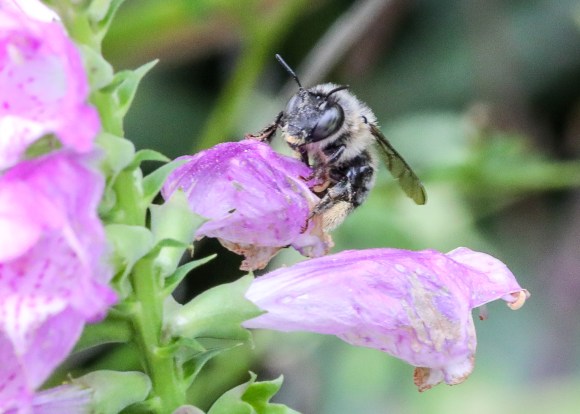
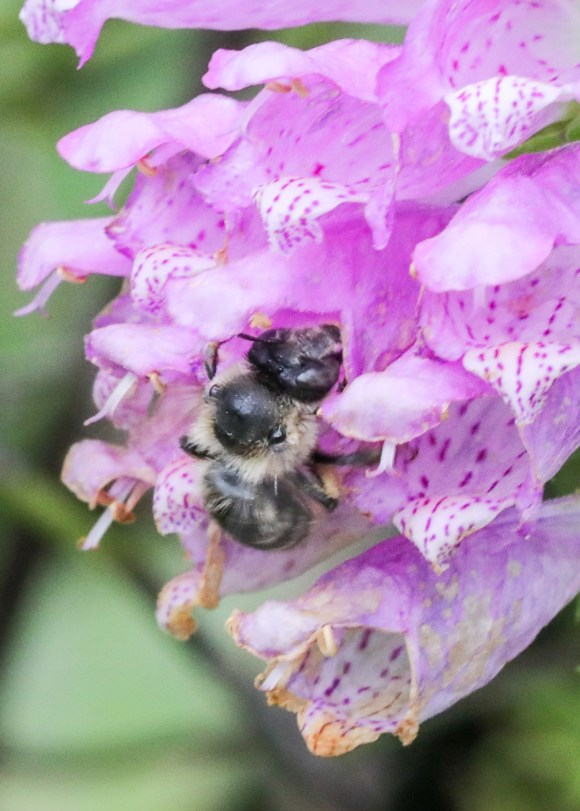
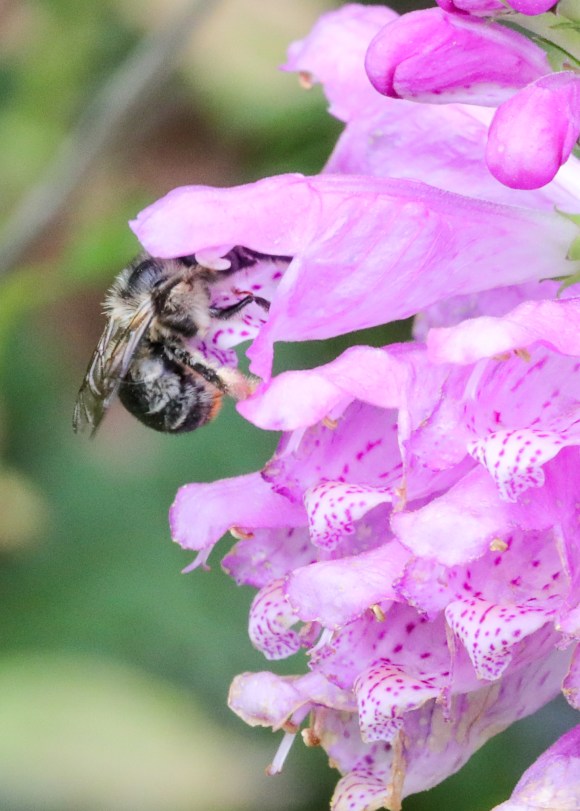
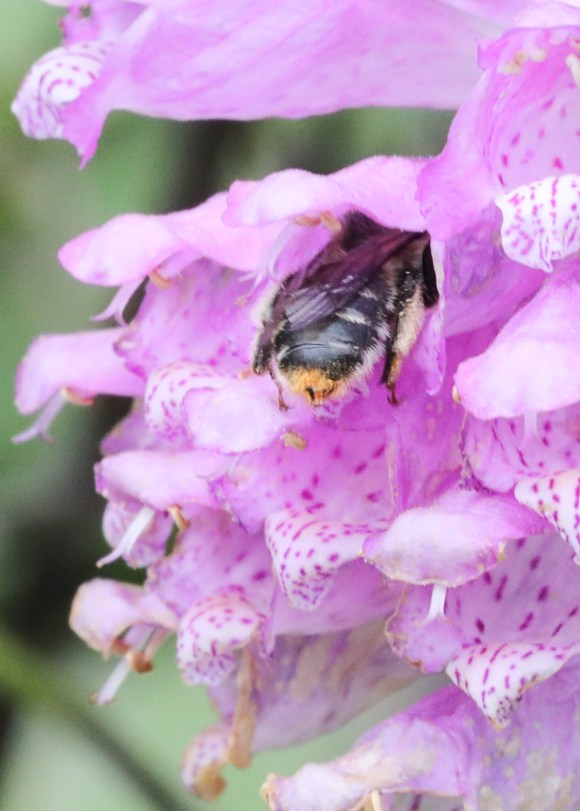
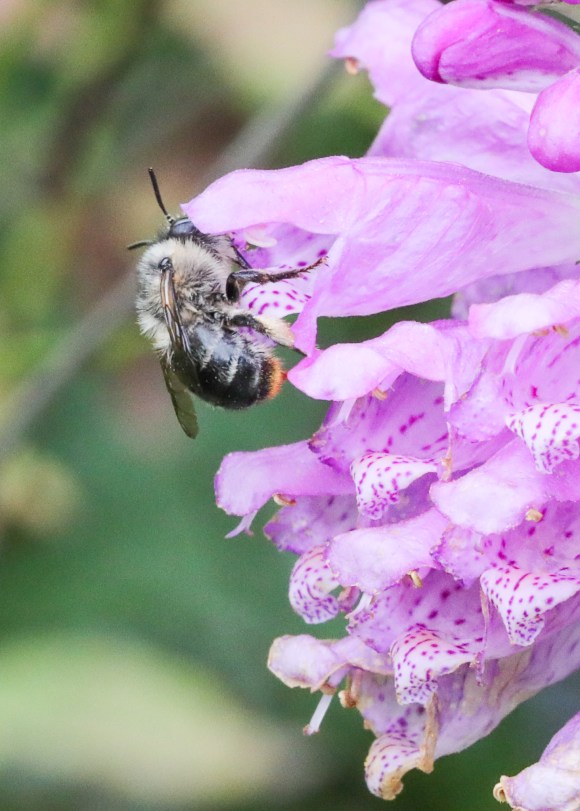
Anthophora terminalis or the Orange-tipped Wood-digger Bee is a charming, medium-sized bee that gathers both nectar and pollen from the flowers.  Furry with a round, striped abdomen, this bee is a bumblebee look-alike.  The orange-tip refers to a spot of orange at the end of the abdomen on females.  It can be hard to see until the female has climbed into the flower.1,

While most Anthophora bees nest in soil banks or flat ground, the Orange-tipped Wood-digger Bee nests in pithy stems or wood.  It can choose fallen pine trees, sumac stems, driftwood and solid wood bee hotels/trap-nests.  These bees use saw dust and chewed wood-pulp for cell divisions.  A. terminalis builds nests in woodlands, wetlands near forests, and suburban and urban gardens.1

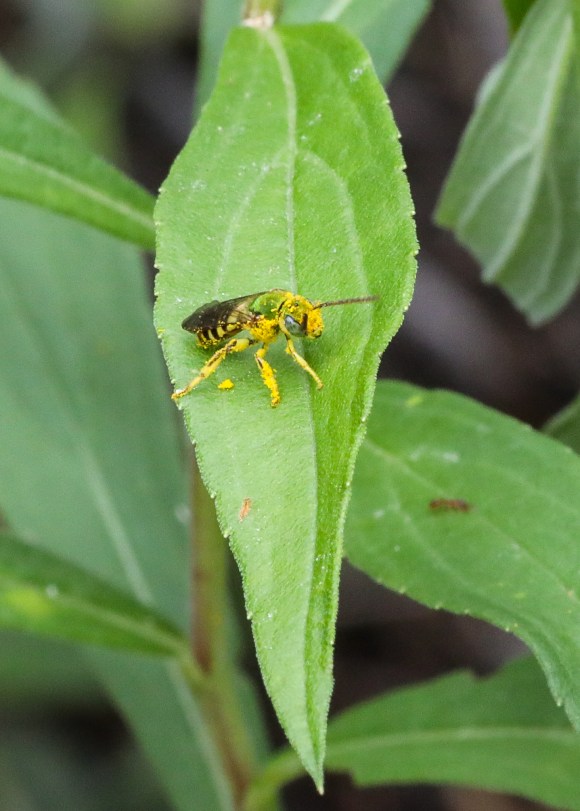
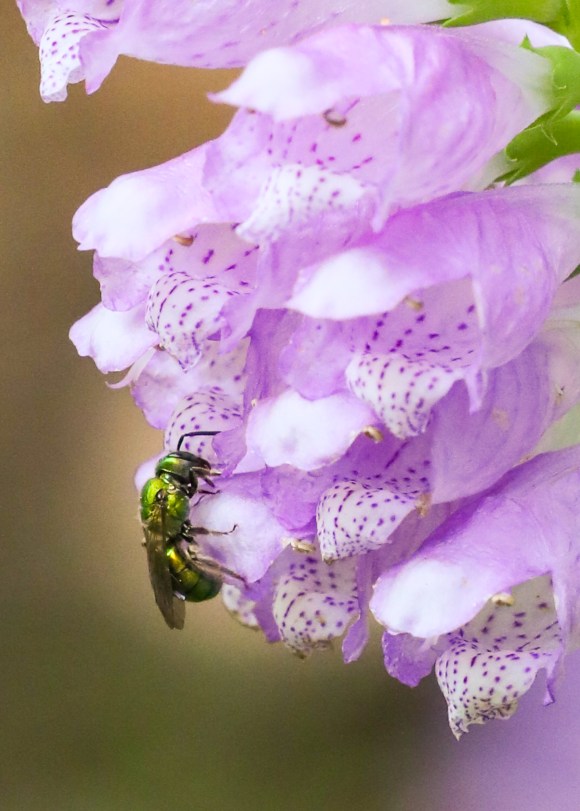
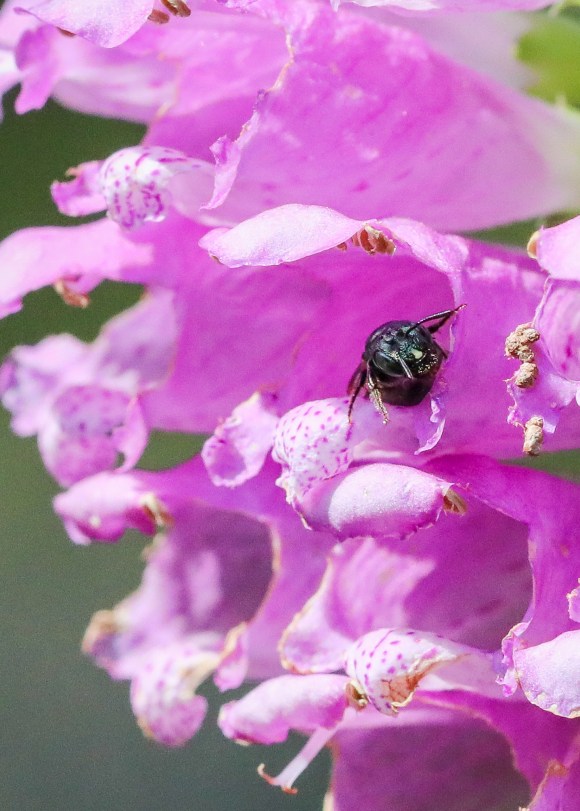
Short-tongued bees enjoy climbing into the P. virginiana’s flowers to gather pollen.  Green metallic sweat bees (Augochlorella spp. and Agapostemon spp.),

Sweat bees (Lasioglossom spp. and Halictus spp.),

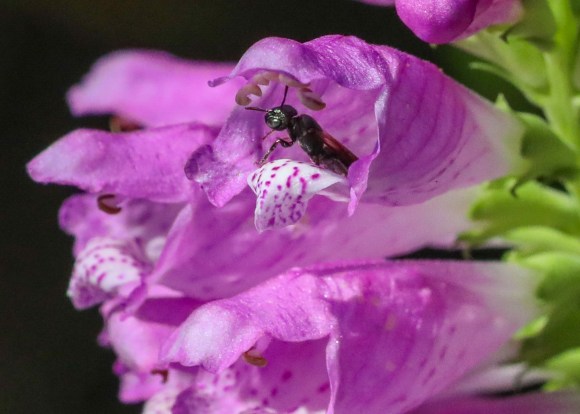
small carpenter bees (Ceratina spp.)

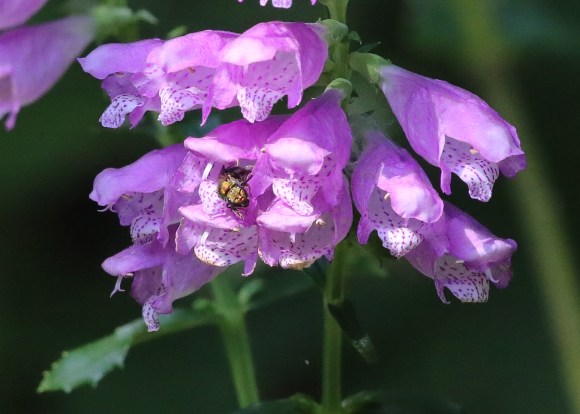
and Yellow-Faced bees (Hylaeus spp.) all harvest from Obedient Plant.3,4,10

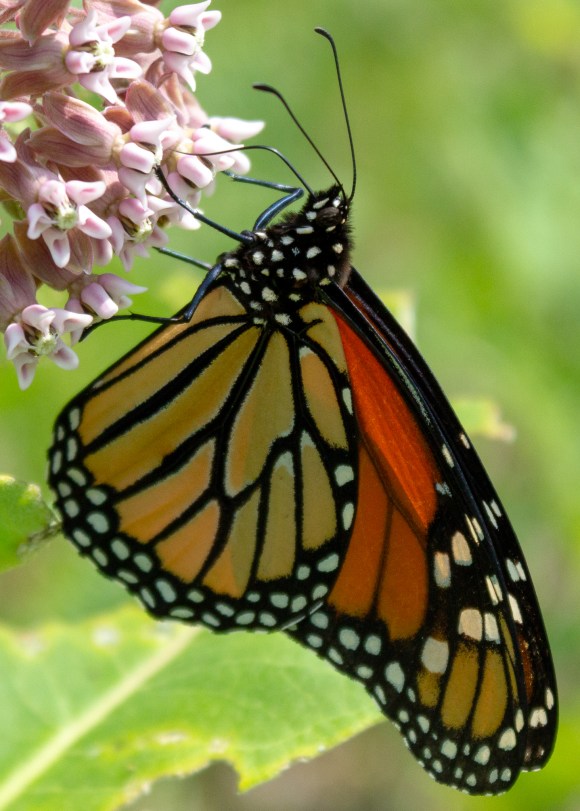
A variety of butterflies, moths and skippers nectar at Obedient Plant’s blooms.  Examples include Monarchs (Danaus Plexippus),

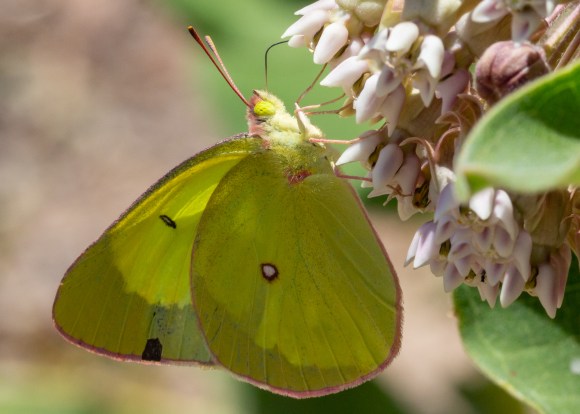
Sulfurs (Phoebis spp.),

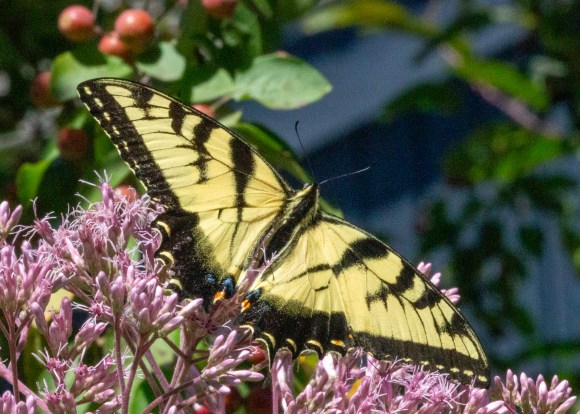
and Swallowtails, especially the Eastern Tiger Swallowtail (Papilio glaucus).  

Dayflying Clearwing Moths (Hummingbird Moths (Hemaris spp.)) also visit occasionally.2,8

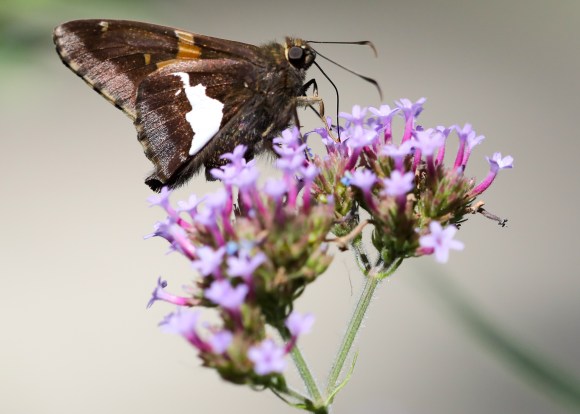
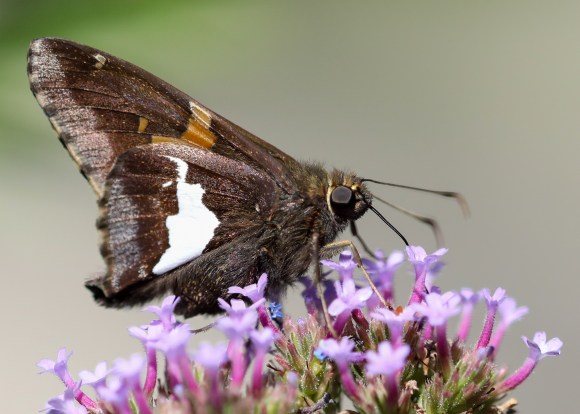
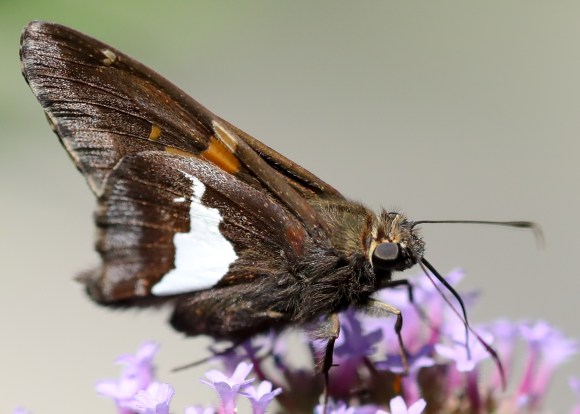
The Silver-Spotted Skipper (Epargyreus clarus) commonly sips nectar from False Dragonhead.  This large skipper lives throughout North America.  Although common, it’s not seen in groups.  The Silver-Spotted Skipper lives in open woods, in fields and prairies, along forest edges and streams, on roadsides, and in gardens.2,5,6,12

Adult skippers gather nectar from many different flowers.  They markedly prefer pink, purple, red and blue blooms and rarely stop at yellow flowers.  These skippers also “puddle”, stopping at mud puddles to drink.5,6,12

Most sources say they puddle for nutrients and to improve reproduction.  But it turns out there’s more to the story.  Here’s what we know and don’t know about puddling.6,13

  • It’s more common with males than females.
  • Not all skippers/butterflies do it.
  • Skippers/butterflies take in nutrients, but which ones depends on their diet.  Those that drink nectar are more likely to collect sodium.  Tropical butterflies, who’s diet includes carrion, pollen and fruit, gather nitrogen and amino acids.
  • They often gather in groups.  Some groups are mixed species and others are all the same.  We don’t know if it’s a social activity, predator protection, helps locate a puddling source, or some other reason.
  • We don’t know how they find the puddling source—see, smell, something else?
  • The nutrients are passed on in sperm packets but the effect on reproduction is unknown.
  • I’ll keep an eye out for future articles and see if I can give you some more information on this fascinating behavior.13

With a 1.75-to-2.5-inch wingspan, the Silver-Spotted Skipper is recognized by its flashing silvery-white spot on the lower wing.  The upper wings have yellowish-gold spots on the upper forewing.  Like other skippers, its black eyes are round and slightly bulging.11  

This skipper’s larva starts out medium green with dark green, lengthwise strips and a reddish-brown head.  As it grows, they become distinctly yellowish green, with redder heads and 2 orange eye spots.  These caterpillars have a narrow band behind the head called a neck collar.  They feed on members of the pea family, both woody and herbaceous.  Although they feed on peas and beans, the Silver-Spotted Skipper isn’t considered a major pest.  Native plant hosts include False Indigo (Baptisia spp.) and Wild Senna (Senna spp.).12

Skipper larvae have a delightful behavior of building leaf houses for themselves.  The Silver-Spotted Skipper is no exception.  When small, the caterpillars cut the leaf and tie the piece with silk.  As they grow, the shelters become larger and larger.12  

The final one consists of several leaves tied with silk.  Here they pupate.  When winter arrives, the entire structure, pupa and all, falls to the ground and overwinters in the leaf litter.  The skipper emerges in early summer once nectar flowers are available.12

Obedient plant offers an easy to grow, late season plant for those pesky wet spots.  The vibrant lavender/mauve blooms change up the late season color palette of yellow/white/pastels.  Late season nectar lovers flock to the tubular blooms to prepare for their long cold winter.

BIBLIOGRAPHY:

  1. Bee Watching. 2023a. “Orange-Tipped Wood-Digger Bee (Anthophora Terminalis).” January 9. https://watchingbees.com/species-accounts/anthophora-terminalis/.
  2. Edgewater Glen Native Plant Gardening & Wildlife. n.d. “Physostegia Virginiana (Obedient Plant).” Accessed April 2, 2026. https://www.glennatives.com/plant-profiles/project-two-ky966-6lmsr.
  3. Holm, Heather. 2017. Bees:  An Identification and Native Plant Forage Guide. Pollination Press LLC.
  4. Holm, Heather. 2014. Pollinators of Native Plants:  Attract, Observe and Identify Pollinators and Beneficial Insects with Native Plants. Pollination Press LLC.
  5. Missouri Department of Conservation. 2024a. “Silver-Spotted Skipper.” March 7. https://mdc.mo.gov/discover-nature/field-guide/silver-spotted-skipper.
  6. Missouri Department of Conservation. 2024b. “Skippers.” March 7. https://mdc.mo.gov/discover-nature/field-guide/skippers
  7. “Obedient Plant (Physostegia Virginiana).” n.d. Accessed March 27, 2026. https://www.illinoiswildflowers.info/prairie/plantx/obed_plantx.htm.
  8. “Obedient Plant | Physostegia Virginiana.” n.d. The Morton Arboretum. Accessed March 27, 2026. https://mortonarb.org/plant-and-protect/trees-and-plants/obedient-plant/.
  9. “Physostegia Virginiana (Fall Obedient Plant) | Native Plants of North America.” n.d. Accessed April 2, 2026. https://www.wildflower.org/plants/result.php?id_plant=phvi8.
  10. “Physostegia Virginiana (Floral Visitors).” n.d. Accessed April 3, 2026. https://illinoiswildflowers.info/flower_insects/plants/obedient_plant.htm.
  11. “Physostegia Virginiana – Plant Finder.” n.d. Accessed March 27, 2026. https://www.missouribotanicalgarden.org/PlantFinder/PlantFinderDetails.aspx?kempercode=g620.
  12. “Silver Spotted Skipper, <em>Epargyreus Clarus</Em>.” n.d. Wisconsin Horticulture. Accessed April 2, 2026. https://hort.extension.wisc.edu/articles/silver-spotted-skipper-epargyreus-clarus/.
  13. Today, Entomology. 2025. “To Puddle or Not To Puddle: Review Highlights Unanswered Questions About Butterfly Behavior.” Entomology Today, May 13. https://entomologytoday.org/2025/05/13/puddling-butterflies-review-unanswered-questions/.