Purple Wheat in the garden? Indeed, that’s what Agastache means ‘agan’ much, ‘stachys’ ear of grain, from the Greek. Its flowers look like heads of wheat or rye and range from pale lavender to purple. ‘Foeniculum’, the second part of the name, means fragrant for the scented leaves. Agastache foeniculum (Fragrant or Anise Hyssop) is part of the mint family. Like Pycnanthemum virginianum (https://wildthingsinthe.garden/2023/05/31/white-goes-with-everything/), also mints, it attracts an enormous variety of bees. Fragrant Hyssop also supports numerous butterflies and skippers.
Anise Hyssop grows two to four feet tall and spreads eighteen inches to two feet. It has an upright, clump-forming habit. Anise Hyssop sports dark green, ovate to broadly lanceolate leaves up to four inches long. Almost heart shaped, the leaves are one to three inches at the base and whitish underneath. They sit opposite each other on the classic square stem of mint plants. The foliage also gives off a strong anise or licorice-like scent that gives the plant its common and Latin name.
Agastache foeniculum can begin blooming in June and continues through August. In zone 5, where I am, it doesn’t start until July. Blooms appear as three- to six-inch-long flower spikes at the end of plant stalks. The eye-catching blossoms range from pale lavender to true purple in color. Tiny flowers make up each large spike. They’re laid out in tightly packed rows although there can be gaps (think of an ear of corn). This arrangement is called verticillasters or false whorls. Each of the small flowers is tubular, 2-lipped and a 1/3’’ inch long. Unlike the leaves, the blooms have no scent.
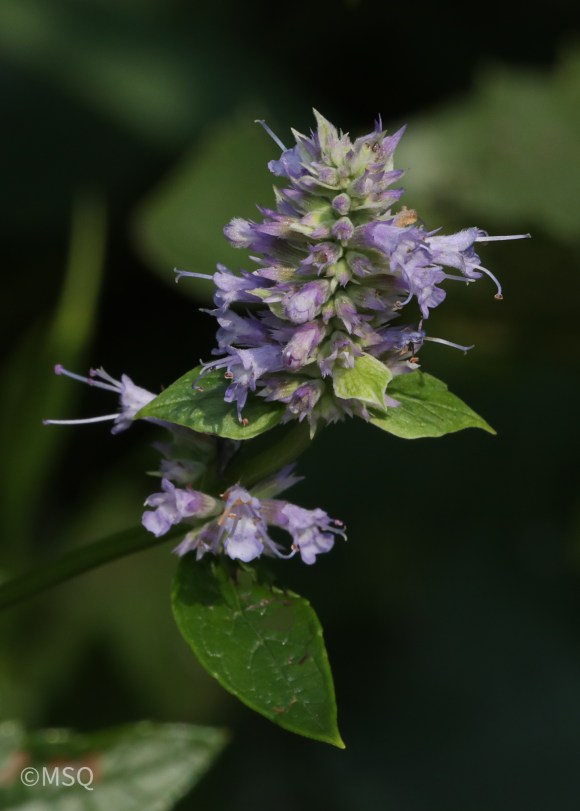
Fragrant Hyssop plant grows best in full sun with dry to moderately moist soil. Soil moisture is not a problem if the drainage is good. Anise Hyssop is drought tolerant, more so after it is established. It spreads by rhizomes and self-seeding especially under good conditions. I have not found that this plant spreads obnoxiously. I have far fewer Anise Hyssop seedlings than Monarda fistulosa seedlings. Fragrant Hyssop may have problems with crown rot with soggy soil. Other issues include rust and powdery mildew.
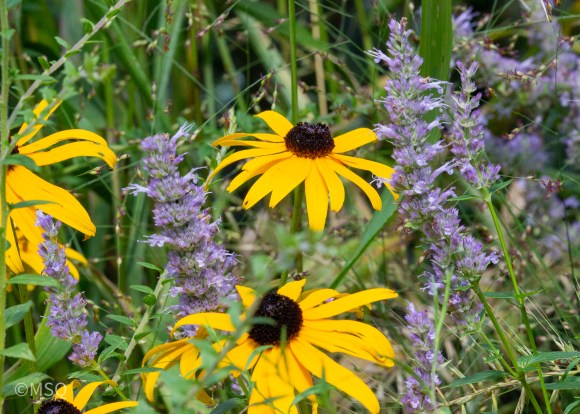
Outside of cultivation, Agastache foeniculum grows in prairies, dry upland forests, plains, fields, roadsides, and other dry, open, semi-shaded areas. In the past, it served as honeybee forage in Canada and parts of the Upper Midwest. It works well in borders, wildflower gardens, herb gardens, butterfly gardens and meadows.
Agastache foeniculum and similar species inspire plant breeders around the world. Too many nativars exist to explore them all, but I thought we could look at three very different plants. Each of these was modified in a different way.
Agastache ‘Blue Fortune’ is a very popular hybrid created by crossing Agastache foeniculum with its East Asian relative, Agastache rugosa. This compact plant has longer flower spikes than the species. It blooms for an extended time because it’s bred to be sterile. ‘Blue Fortune’ is widely reported to be a pollinator magnet.
Agastache ‘Golden Jubilee’ is an older hybrid with yellow-green foliage that’s pure yellow in the Spring. The flowers are identical to the species. ‘Golden Jubilee’ received the All-American Selection Award in 2003 and is still being sold. It will self-seed with a mix of species and golden seedlings. There are mixed reports on how pollinators respond to ‘Golden Jubilee’. Some sources say bees don’t seem to ‘see’ it and others say pollinators love it.
Agastache ‘Red Fortune’ has red to pink flowers. The leaves are like the species. Pollinators don’t like this plant as much as Agastache foeniculum.
These three plants give a nice snapshot of how natives are altered and some pollinator responses. One idea is that nativars with flowers most like the species’ flowers would be most acceptable.1 Positive reports about ‘Blue Fortune’ and ‘Golden Jubilee seem to support this idea.2
In addition, red is a special case. Bees see in the ultraviolet spectrum—from approximately 300 to 650 nm. They can’t see red although they can see reddish tones like orange. When native plants are hybridized for red flowers, bees often have trouble finding them.1,3
But wait! There’s an exception. Red flowers can have ultraviolet “nectar guides” which the bees see perfectly well. Plants use these guides to “direct” the pollinators to the nectar reward and encourage pollination.3
It’s hard to say if a red native hybrid will still attract and support bee pollinators. If they retain their ultraviolet nectar guides, then the bees should see them. However, I’ve seen more than one report showing little to no bee activity on the red and pink hybrids.1,2
Anise Hyssop serves a multitude of pollinators providing nectar and pollen. Like Monarda (https://wildthingsinthe.garden/2023/07/31/the-gardens-super-station/), Fragrant Hyssop has been identified by pollination ecologists as attracting large numbers of native bees. The Xerces Society for Invertebrate Conservation also designated Fragrant Hyssop of Special Value to Bumble bees and Honeybees. Butterflies and skippers use it for a nectar source.
Pollination in Fragrant Hyssop hinges on both the individual flowers’ structure and the different bees’ anatomies. The nectar is secreted by a disc at the base of the flower. Pollen-carrying anthers are located on the top lip of each flower. When bees root for nectar, pollen rubs off onto their heads or thorax. As they move to a bloom with a receptive stigma, female part, the pollen transfers and fertilization occurs.
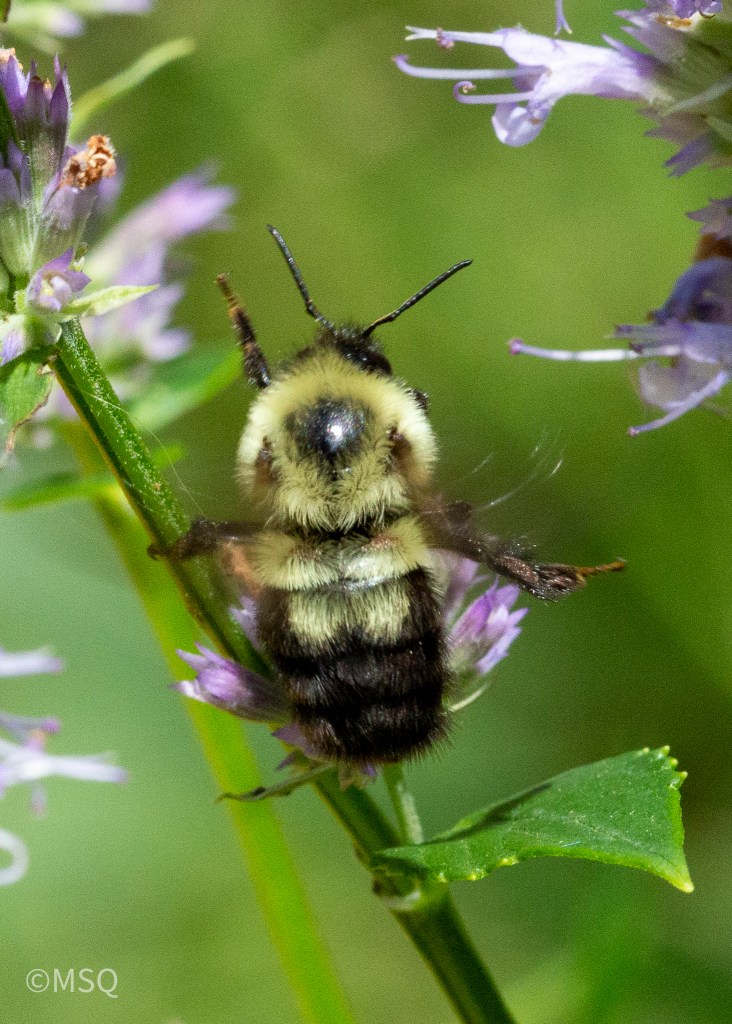
The many native bees that visit Hyssop range from large to tiny. Bumble bees are the largest. I’ve seen Common Eastern Bumble bee (Bombus impatiens), Brown-Belted Bumble bee, (Bombus griseocollis), Two-Spotted Bumble bee (Bombus bimaculatus), and Golden Northern Bumble Bee (Bombus fervidus) on my Fragrant Hyssop. They use both nectar and pollen for their larva.
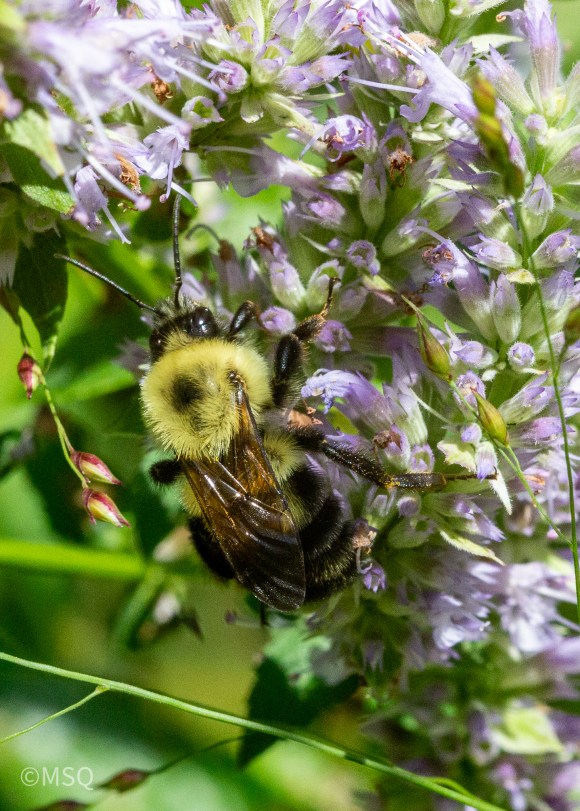
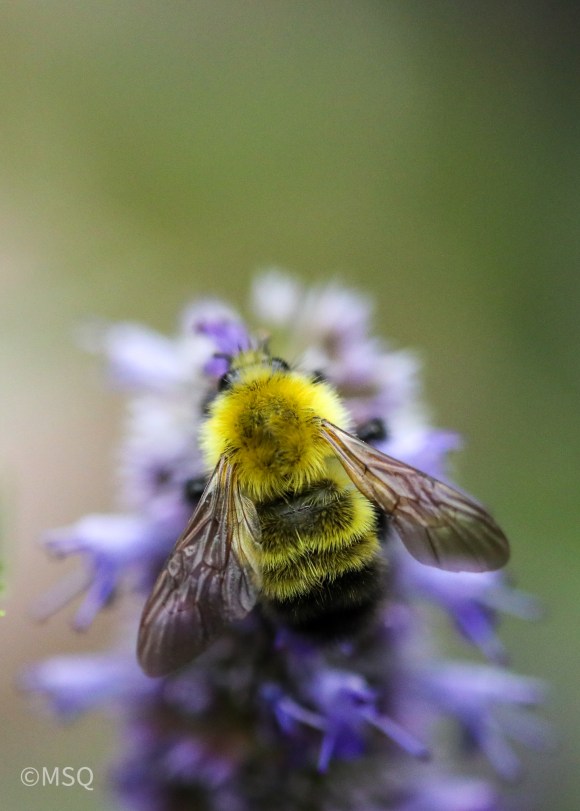
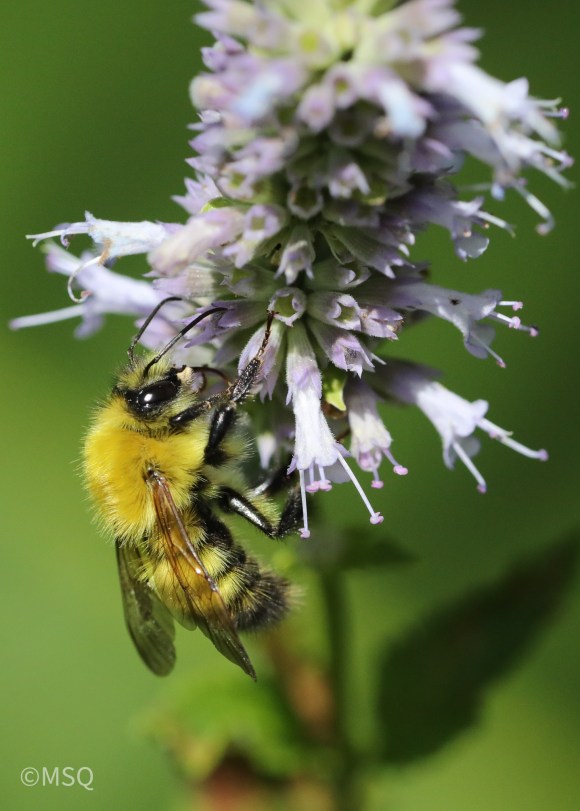
Large Leaf-Cutter bees use Anise Hyssop’s nectar. In the process, they are efficient pollinators. In contrast to other bees, pollen accumulates on the Leaf-Cutter bees’ abdominal scopae (specialized pollen collecting hairs). It is transferred to the stigmas from there.
Digger bees (Melissodes) and smaller Leaf-Cutter bees (Megachile) are mid-sized bees. They also collect both pollen and nectar from Anise Hyssop.
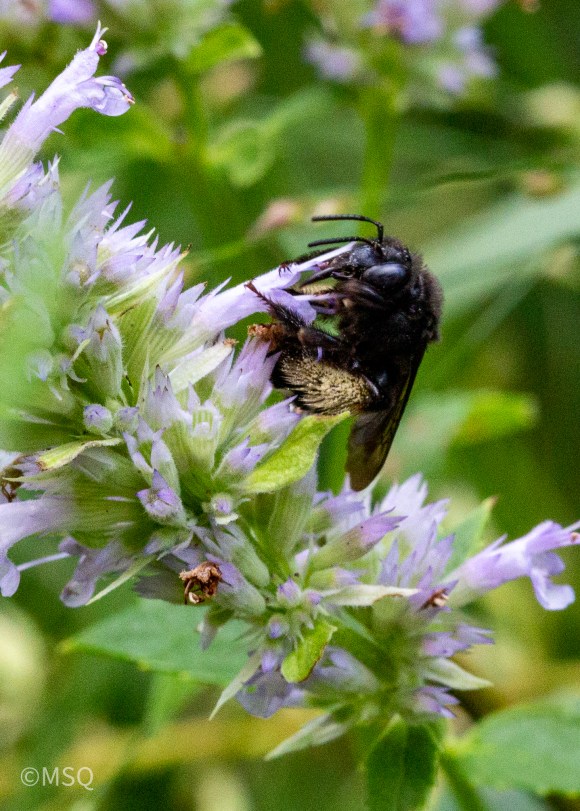
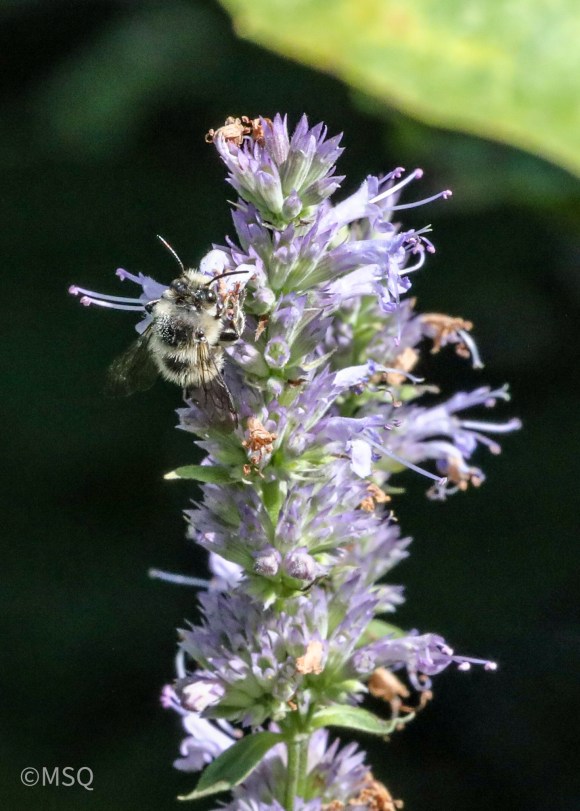
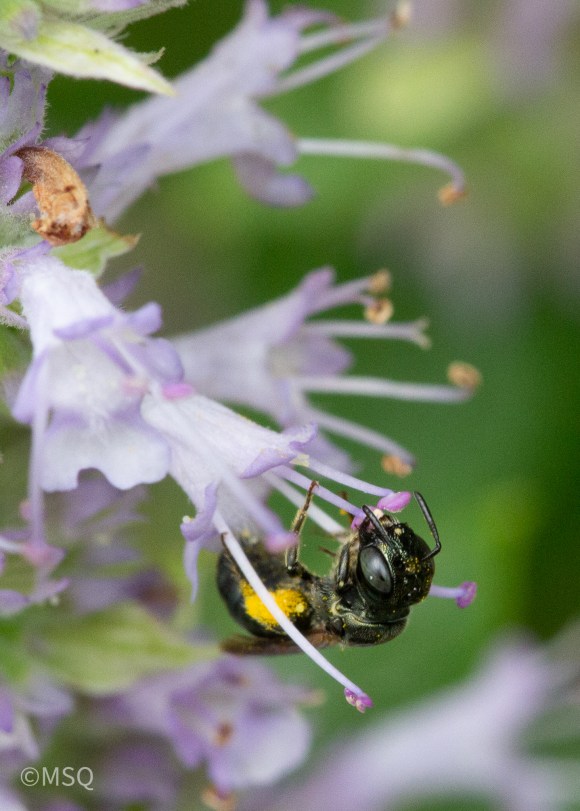
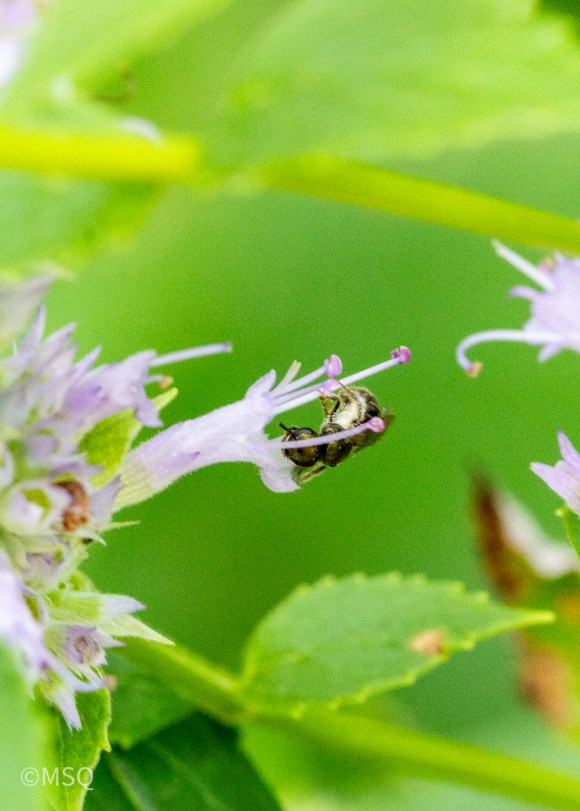
The Halictid bees (Lasioglossom), small Resin bees (Heriades) and Masked bees (Hylaeus) are small bees that gather resources from Fragrant Hyssop. Dufourea monardae is included in this group. D. monardae is a specialist or oligolectic bee that visits Monarda fistulosa and Agastache foeniculum. These small bees can collect pollen from the anthers extending from the flowers. When harvesting nectar, they climb the style to reach the base of the flower. (The style is the stalk connecting the stigma and the ovary.)
Fragrant Hyssop provides an excellent late season nectar source for butterflies, skippers and moths including Silver Spotted Skipper Butterflies (Epargyreus clarus), Peck’s Skipper Butterflies (Polites peckius) and the Great Spangled Fritillary Butterfly (Speyeria cybele). They reach their proboscis into each tiny bloom to find the nectar. Hyssop also works well in Monarch Way Stations providing food after most milkweed has stopped blooming.
I hope you enjoyed this exploration of Anise Hyssop and its wonderful visitors! I’d love to hear your thought about this blog or stories about your own experiences in the garden. Please leave me comment and let me know your thoughts!
References:
- Eierman, Kim,11 April 2014, “Ecobeneficial Interview: Annie White on Native Plant Cultivars, Native Plants and Pollinators”, Youtube, https://www.youtube.com/watch?v=HTmuDcEzTOw
- Caldwell, Cathy, (2021, August-Vol.7, No.8) Anise hyssop, Piedmont Master Gardeners, https://piedmontmastergardeners.org/article/anise-hyssop/
- Riddle, Sharla, (2016, May, 20) How Bees See And Why It Matters, Bee Culture: The Magazine of American Beekeeping, https://www.beeculture.com/bees-see-matters/
 Wild Things in the Garden