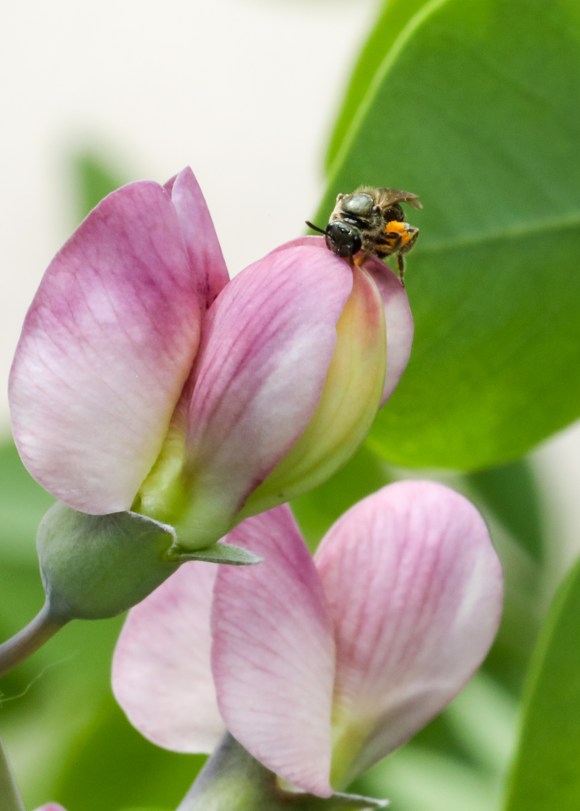
Categories
native plants Pollinator gardening

Sparks in the Garden

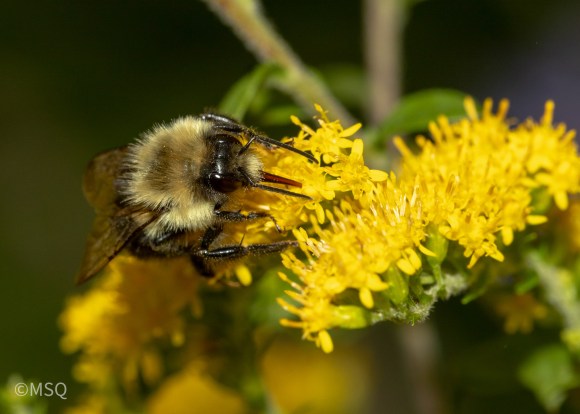
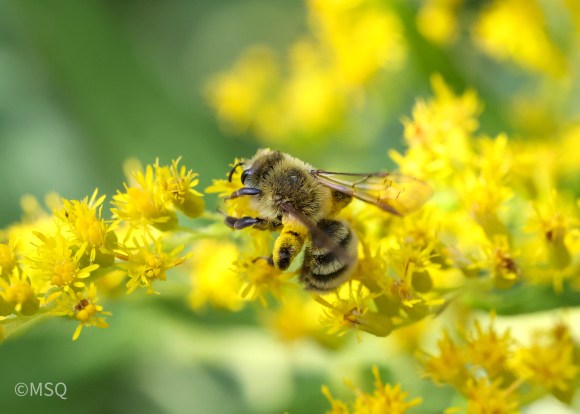
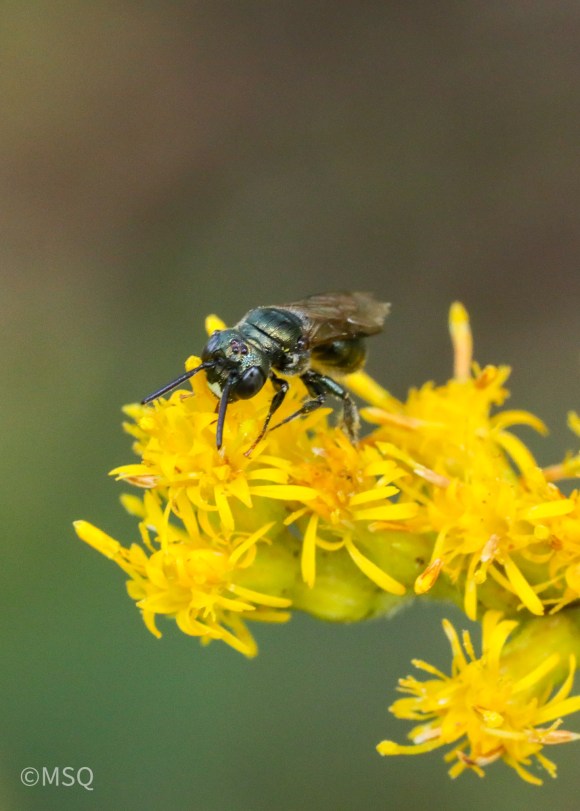
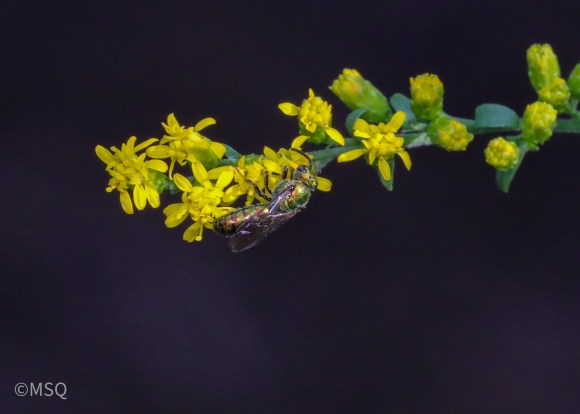
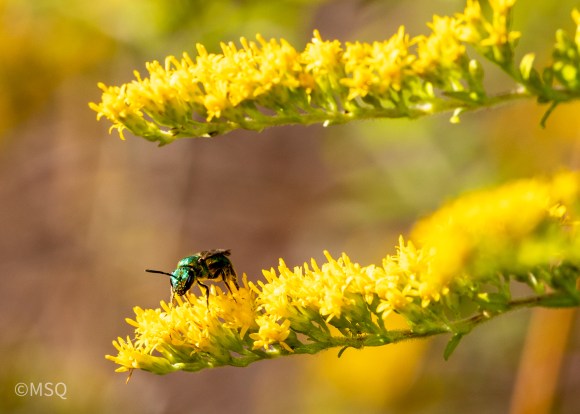
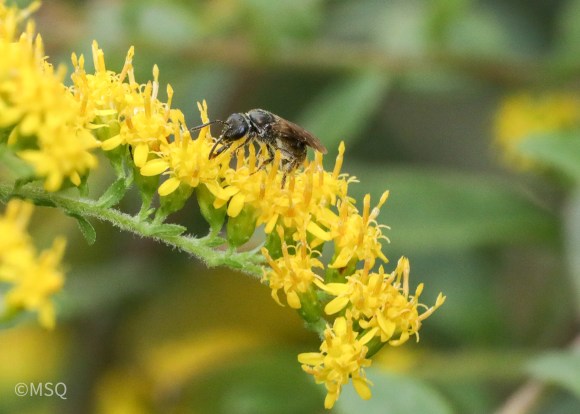
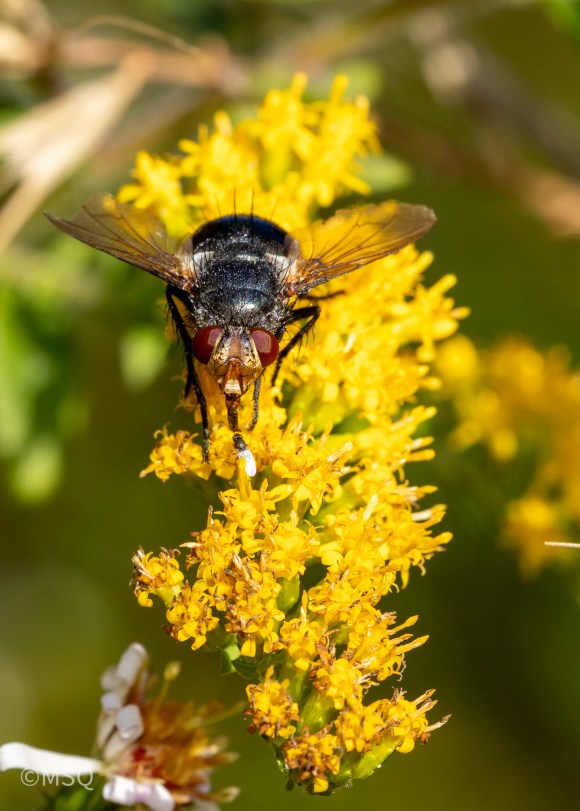
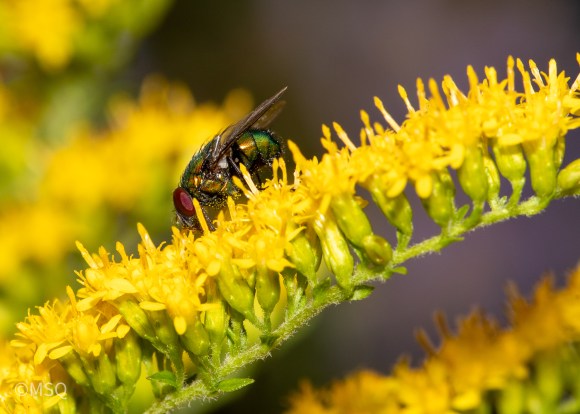
Every year in the early Fall, a glittering cloud of insects surrounds the arching stems of Solidago rugosa ‘Fireworks’.  Butterflies, moths, skippers, bees, wasps, beetles, beneficial insects, and flies all flock to this goldenrod for nectar, pollen and to use it as a larval host.  This feast helps prepare them for the cold months of winter.

The twinkling yellow flowers of ‘Fireworks’ goldenrod pop open along stems up to 18” long!  Held above the foliage, these stems resemble fireworks and give the plant its name.  Pompom blooms are tightly packed along the stems. Each one is about 1/8th inch in diameter.  The anthers are held above the stigmas and bright yellow ray flowers form the outer ring.  Peak bloom lasts two to three weeks.
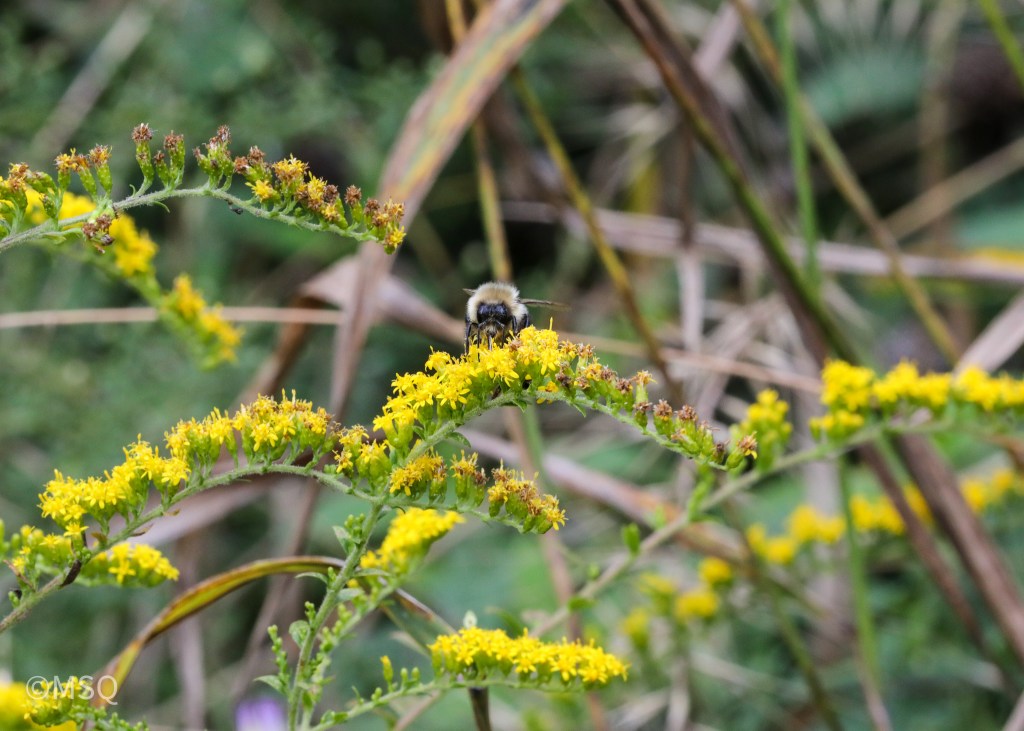
Medium to dark green leaves grow alternately and are three to six inches long.  They range from ovate to lanceolate and their edges are toothed.  The deeply sunken veins in the leaves causing a wrinkled look. This feature gives them the name rugosa or wrinkled.  In fact, a common name for the native Solidago rugosa is Wrinkle-Leaved Goldenrod.

Solidago rugosa ‘Fireworks’ is a charming goldenrod cultivar.  Well-behaved, it sports abundant bloom for a grand show in the garden.  An erect plant, it forms dense clumps with slowly spreading rhizomes.  It grows three to four feet tall.  Spreading from two to three feet, ‘Fireworks’ will reseed if happy.  Space plants one to three feet apart.  

‘Fireworks’ thrives in zones four to eight.  It enjoys moist, well-drained soils although it can tolerate periods of drought or wet soil.  Highly adaptable to different soils, this goldenrod grows in clay, loam (silt), and sand as well as acid to neutral conditions. My plants have not been bothered by deer or rabbits.  It can withstand both heat and humidity. 

The genus Solidago, like Symphyotrichum, is an essential part of wildlife habitat, a keystone species.  In recent years, people have become interested in keystone species of all types.  A keystone species is one so crucial that the ecosystem will collapse without it.

How does this work with plants?  Key plants are native plants that are part of the local food web.  They play a role as a general or specific support for insects.  The general group are the 14% of native plants that support 90% of butterfly and moth Lepidoptera species.1  The specific group are the 40% of native plants that produce pollen for the 15% to 60% of North American native bee pollen specialists.1  Both these groups are listed in the Keystone Plants by Ecoregion from the National Wildlife Federation.  According to this information, Solidago sustains 104 species of caterpillars and 42 different specialist bees.2  (I have used the Eastern Temperate Forest list since this is my region.)  In addition to these categories, 145 different wasp species forage on Solidago.3

So, goldenrod offers abundant food at the end of the year, how is this valuable?  Fall is when next year’s insect generation is established.  Whether it’s healthy adults, well fed caterpillars or full provisions in nests, the foundations are laid with Autumn food harvest.  Goldenrod is one vital resource.

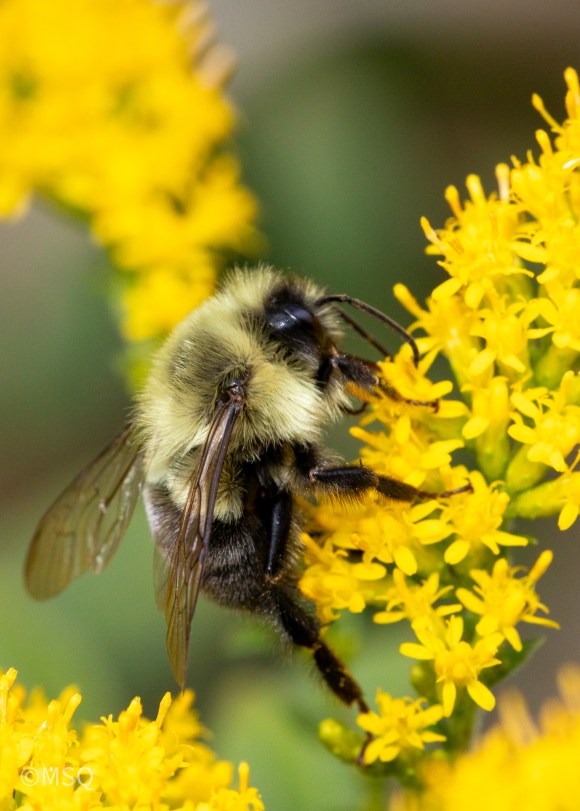
Different insects have different strategies for surviving the winter.  In the next few paragraphs, I’ll talk about what the pollinators do over the winter and where they might be.  Bumblebee and honeybee queens take mating flights in the late summer or fall.  Male bumblebees take advantage of nectar from Solidago ‘Fireworks’ to fuel up before pursuing their queen. When they’ve mated, the queens find a safe location to overwinter.  Some bumblebee queens hibernate in leaf litter and others burrow underground.4
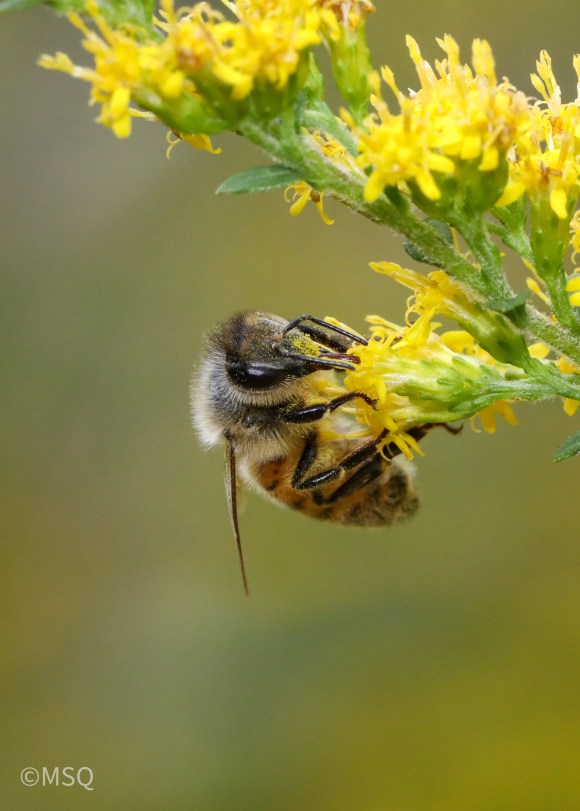
Honeybee queens return to the hive.  During the winter, the honeybees form a ball in the hive.  If they become cold, they will vibrate for warmth.  The queen stays near the center of the mass.  Any resources gathered in the fall, are converted into honey, and used to help the honeybees survive the winter.5
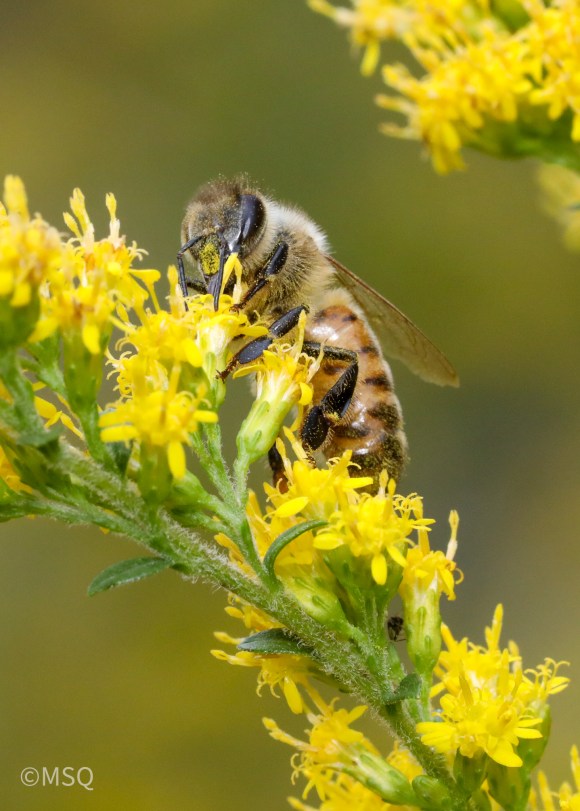
Native bees overwinter as young in their nests.4  Active native bee queens use the resources from goldenrods to supply their nests.  Like SymphyotrichumSolidago has numerous bee specialists including:  Andrena (Callandrena) asteris, A. (Callandrena) braceata,  A. (Callandrena) simplex, Andrena (Cnemidandrena) hirtcincta, Andrena (Cnemidandrena) canadensis, Colletes simulans, Colletes solidaginis, Perdita (Perdita) octomaculata and Melissodes (Eumelissodes) fumosus.
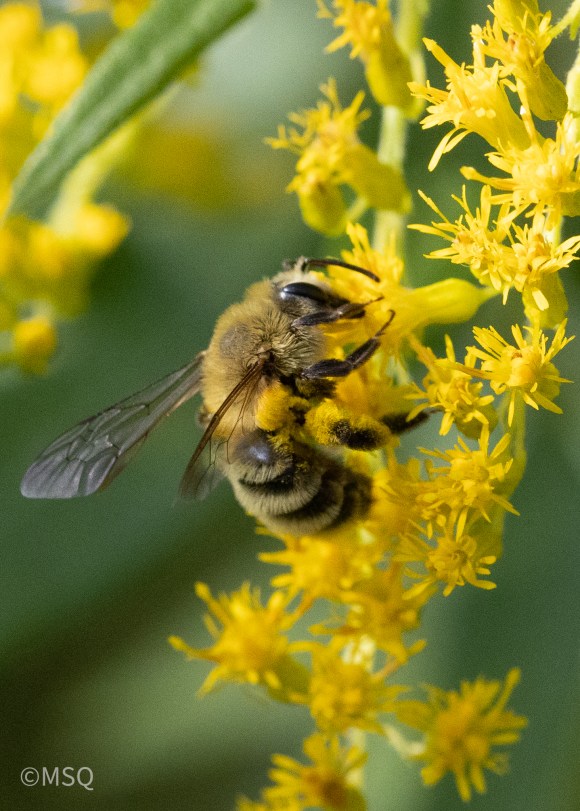
Where are their nests?  70% of native bees nest underground!  Now is not the time to start digging.  Others nest in old beetle burrows and other holes in dead wood and still others in hollow stems.4  It’s better to wait until spring to cut back dead stems and clean up dead wood.
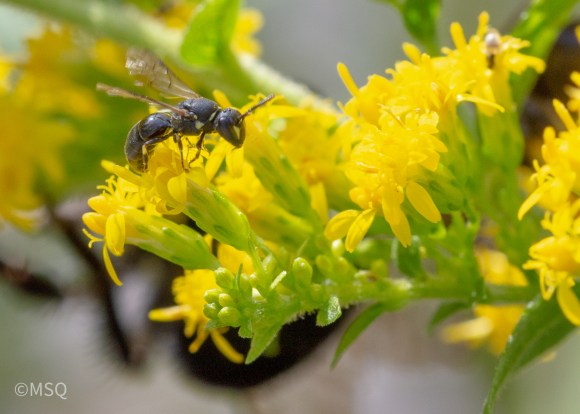
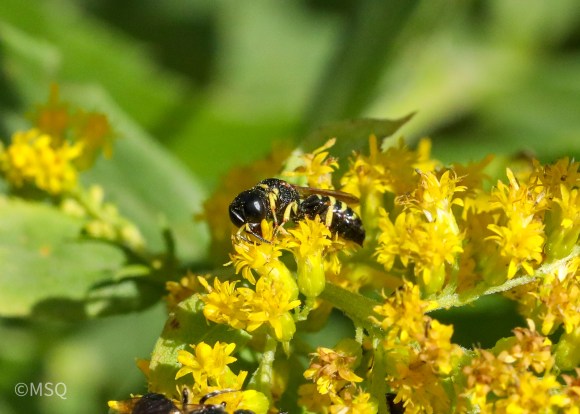
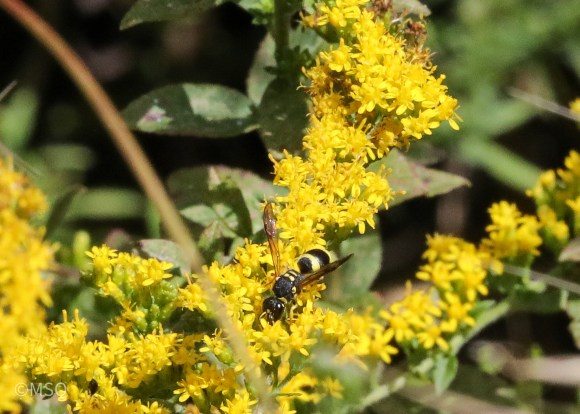
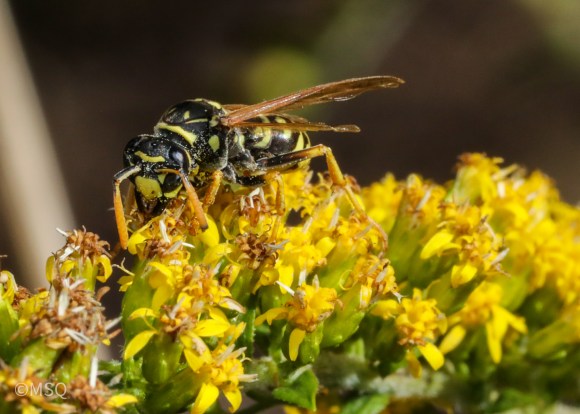
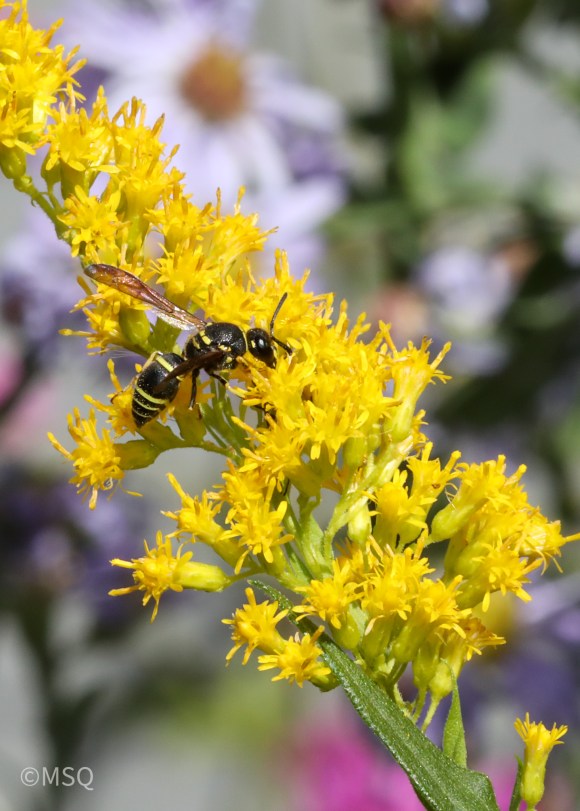
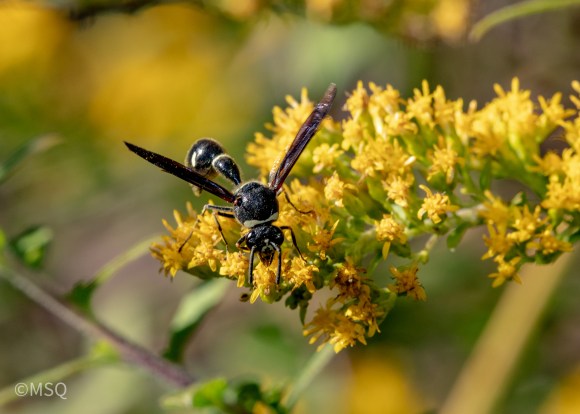
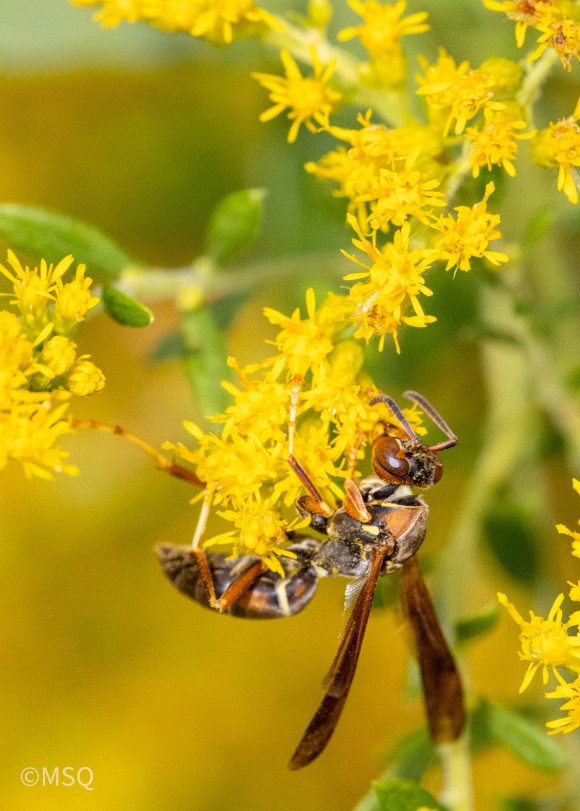
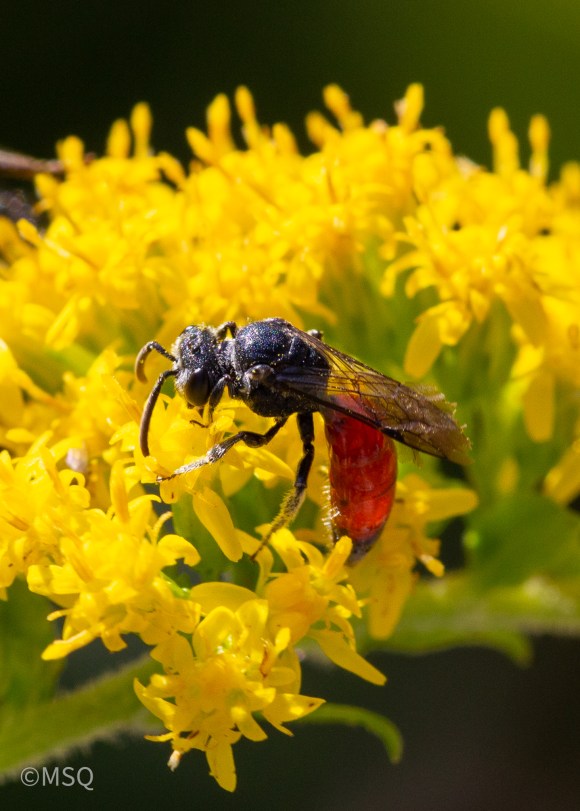
Solidago rugosa ‘Fireworks’ attracts numerous native wasps.  Indeed, unlike asters, I find wasps visiting my ‘Fireworks’ goldenrod in equal numbers with the bees.  These wasps serve as beneficial insects preying on or parasitizing pests that damage plants.  They also contribute to pollination as they drink nectar and, occasionally, eat pollen.  Native wasps spend the winter in different ways:  some as mated females called foundresses, some as young and some we don’t know yet.  The foundresses find dry, warm spots to hide in.  Other nesting locations are similar to bees including stems, wood, underground and old nests built by other wasps or bees.3
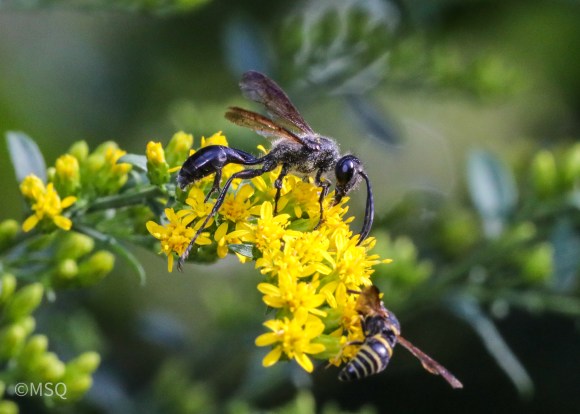
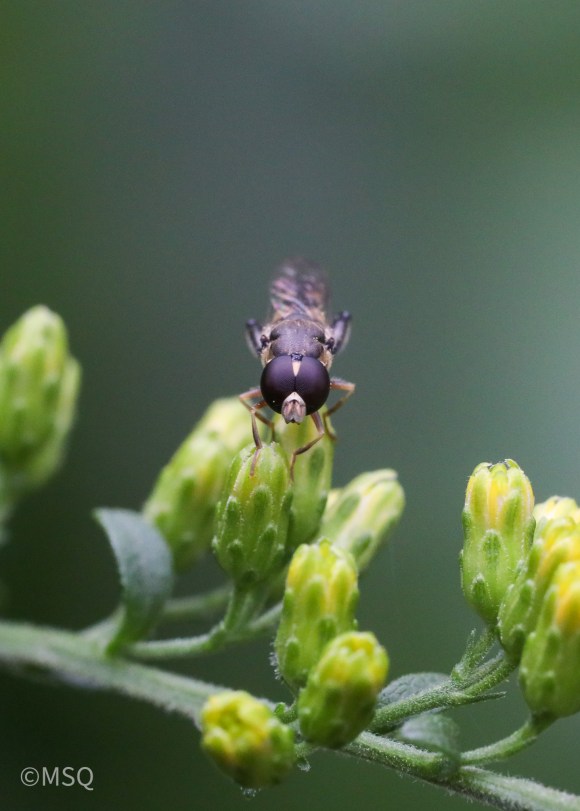
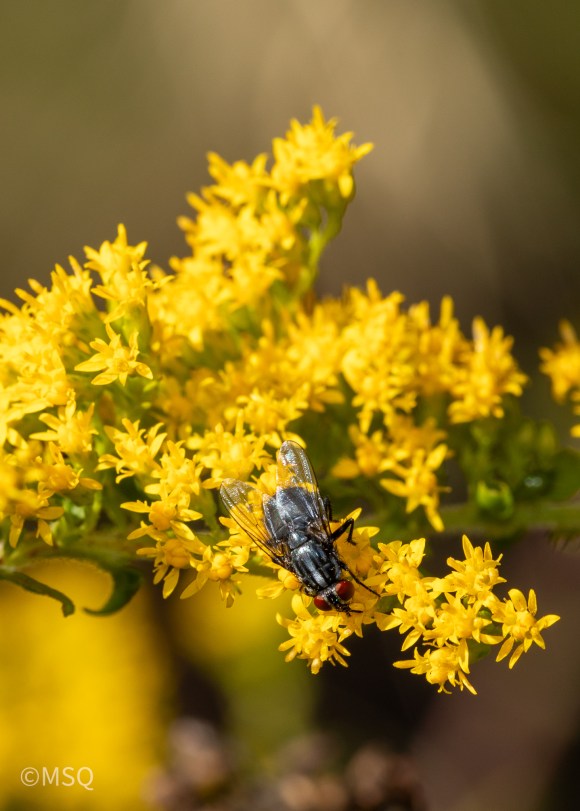
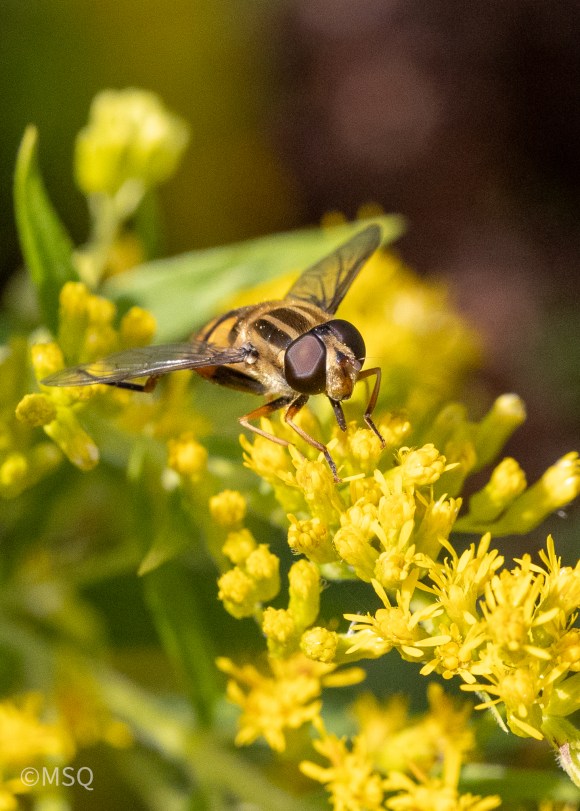
Many flies visit ‘Fireworks’ goldenrod to drink nectar and, incidentally, pollinate the flowers. The larval stage of some Tachinid and Syrphid flies are beneficial insects. Tachinid flies parasitize leaf eating insects. They over winter in the larval or pupal stage often in the shell of their host. The larvae or pupae can be found in piles of leaves or bush or burrowed into the soil.
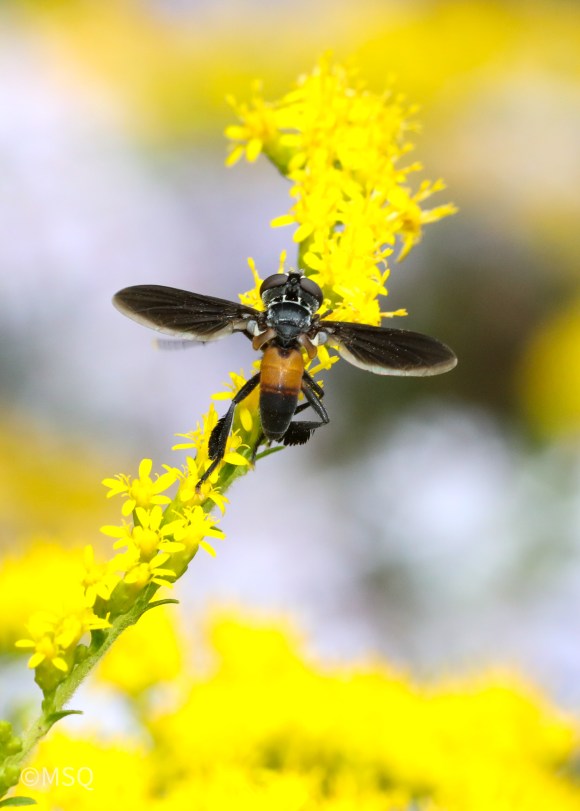
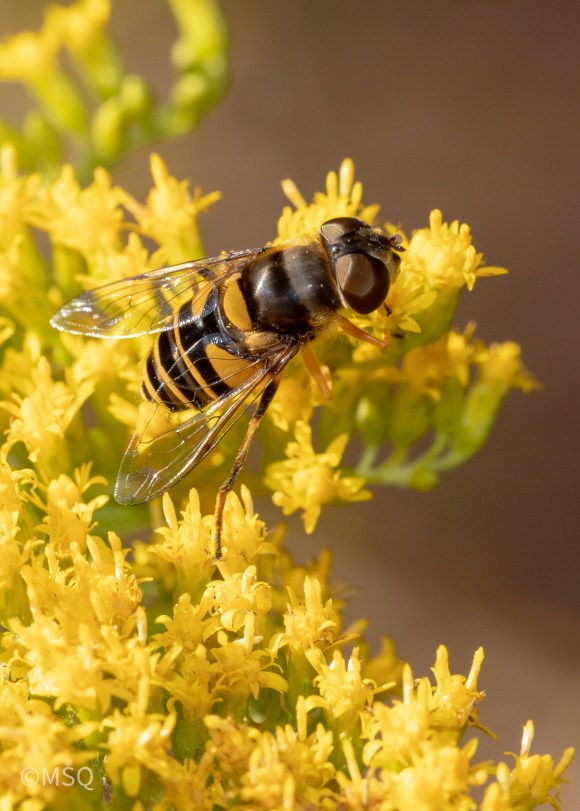
Syrphid fly larva are excellent early and late season predators. They consume dozens of aphids each day. Most spend the winter as pupae or larvae in dead leaves or piles of brush.
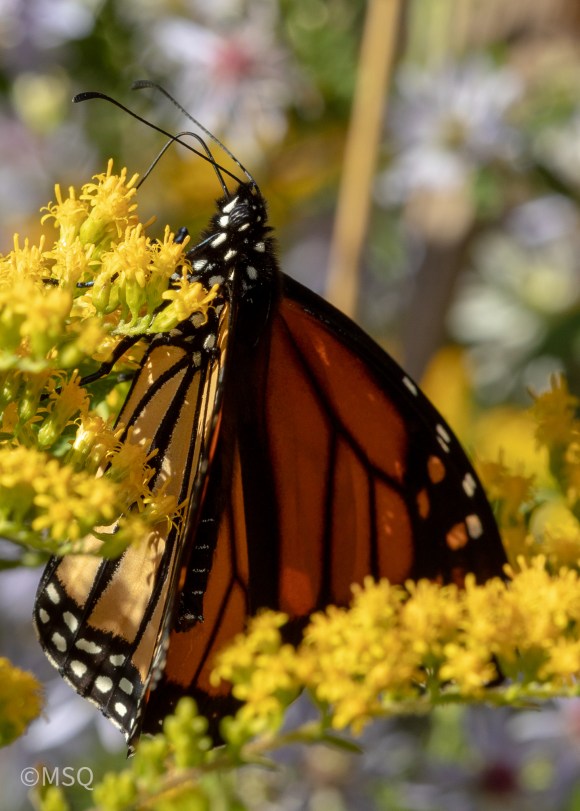
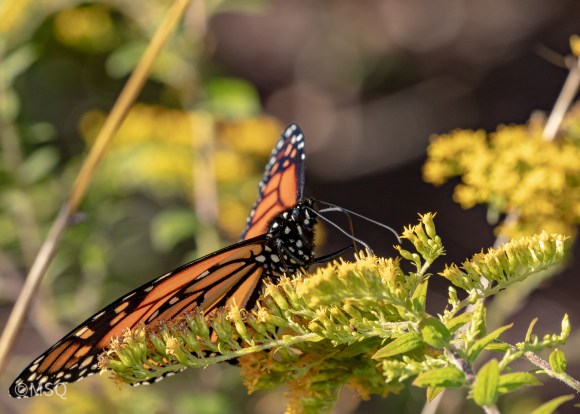
Butterflies use goldenrod for nectar.  Monarchs fuel up for their migration and other butterflies build fat stores to hibernate as adults.  Not all butterflies overwinter as adults,  they can spend the cold months as eggs, caterpillar, chrysalis, or adults depending on the species.  The eggs are laid close to a spring food source.  Caterpillars deliberately hid in curled leaves, soil or under rocks for protection.  If becoming a chrysalis, the caterpillar will choose a protected location, for instance, under an overhang or deep in a shrub.  Adult butterflies and moths are very diverse when hiding.  Spaces under bark, crevices in trees, cracks in rock and the fall leaves all host butterflies and moths.6
Solidago serves as a larval host for 104 butterfly and moth caterpillars.  One unusual moth is the Wavy-Lined Emerald.  The caterpillar has a fascinating adaptation.  It decorates itself with the leaves or flowers from its host plant.  This camouflage hides it from predators.  The twirler moths (Gelechiidae), Geometer moths, Owlet Moths (Noctuidae), and Tortrix Moths also use Solidago.

The take home for today: Leaves are not Litter!  Stems Stand Tall!  Don’t Do that Digging!

Just take a rest, drink some cider, and enjoy those Fall colors!

References:

  1. Keystone Plants by Ecoregion, The National Wildlife Federation, https://www.nwf.org/Garden-for-Wildlife/About/Native-Plants/keystone-plants-by-ecoregion
  2. National Wildlife Federation, Gardening for Wildlife, Keystone Native Plants Eastern Temperate Forests – Ecoregion 8, https://www.nwf.org/-/media/Documents/PDFs/Garden-for-Wildlife/Keystone-Plants/NWF-GFW-keystone-plant-list-ecoregion-8-eastern-temperate-forests.ashx?la=en&hash=1E180E2E5F2B06EB9ADF28882353B3BC7B3B247D
  3. Holm, H., 2021 Wasps:  Their Biology, Diversity, and Role as Beneficial Insects and Pollinators of Native Plants, Minnetonka, MN, Pollination Press LLC.
  4. Morris, S. (2018, October 10). Where Do Pollinators Go In The Winter? Xerces Society for Invertebrate Conservation.  https://xerces.org/blog/where-do-pollinators-go-in-winter#:~:text=Most%20native%20bee%20species%20will,help%20to%20survive%20until%20spring.
  5. Hogeback, J. Where Do Honeybees Go In The Winter?  Britannica.  https://www.britannica.com/story/where-do-honeybees-go-in-the-winter
  6. Grisak, A. (2022, November 04). How Does A Butterfly Survive Winter? Birds & Blooms. https://www.birdsandblooms.com/gardening/attracting-butterflies/butterflies-in-winter/
Categories
Pollinator gardening

Autumn Stars

Fall–the finale of the gardening and the pollinator season!  It’s time to fill your garden with the frothy, bright flowers of asters and the cheerful yellow plumes of goldenrod.  This month, asters are the stars and the Smooth Blue Aster, Symphyotrichum laeve, is our focus.  These Fall flowers provide invaluable resources to pollinators preparing for the quiet season of winter and for Monarchs preparing to migrate.

Not as common as other asters, Smooth Blue Aster is a lovely plant growing up to four feet.  It spreads from one to two feet wide.  The plants can be spaced anywhere from one to three feet apart.  It tolerates a wide variety of soils including clay, loam (silt) and sand.  This aster thrives in dry to medium moisture conditions with well-drained soils and can tolerate drought.  Smooth Blue Aster enjoys part shade to full sun and grows in zones 4 through 8.  In the garden,  S. laeve provides an erect plant with medium-textured leaves. 

In natural areas, Smooth Blue Aster grows in dry open woods, thickets, clearings in the woods, borders, roadsides, prairies and especially in fields and meadows.  Several sources say it doesn’t like to grow in wet areas, but I’ve seen it thriving in wet  meadows.  It can be used in Butterfly Gardens, Pollinator Gardens, Drought Tolerant Gardens, and/or Perennial Borders.

The leaves of Symphyotrichum laeve are part of its Latin name.  In taxonomy, the specific epithet is the second part of the binomial name and often refers to a characteristic of the plant.  These descriptions could be physical traits (like leaf texture), colors (like bimaculatus) or the location where the plant was first identified (like virginianum) among many others.  The specific epithet of Symphyotrichum laeve comes from the leaves.  Laeve means smooth and its leaves are without hairs or wrinkles or other textures.  I always enjoy looking at specific epithets because they’re usually directly related to the individual plant.  This contrasts with the genus name which looks at broad groups and may or may not be easily linked to the plant.

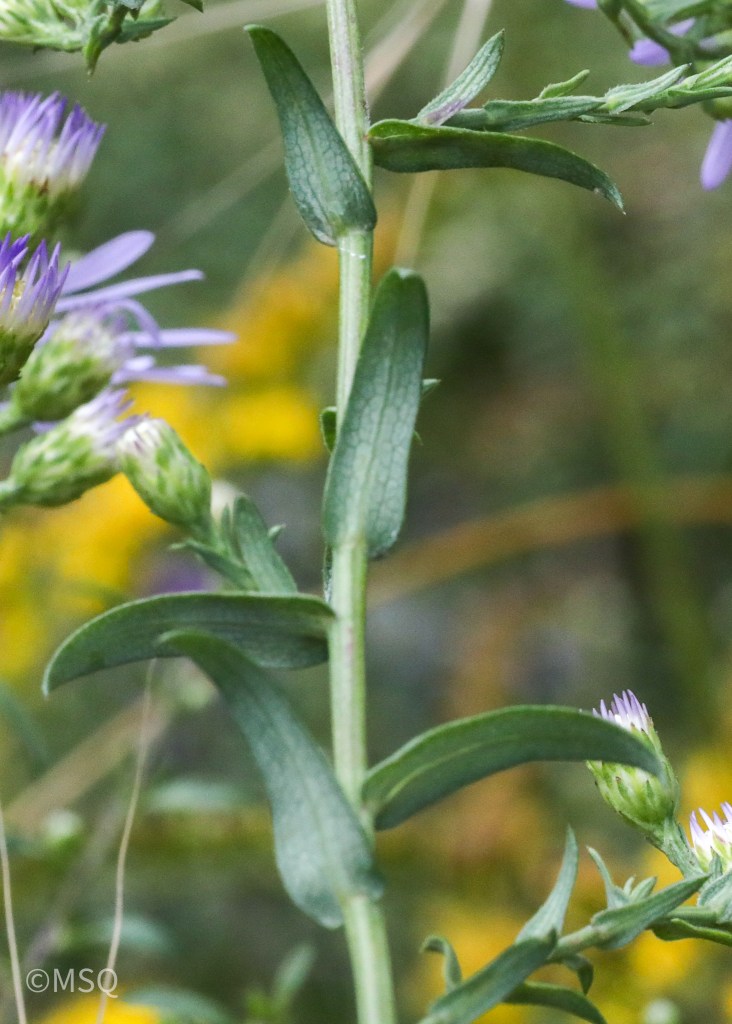
In addition, this aster’s leaves are blue green with a grayish frost and clasp the stem.  Lanceolate to ovate in shape, they alternate along the stem.  Additional flowering stems grow from the leaf axils at the top of the plant.

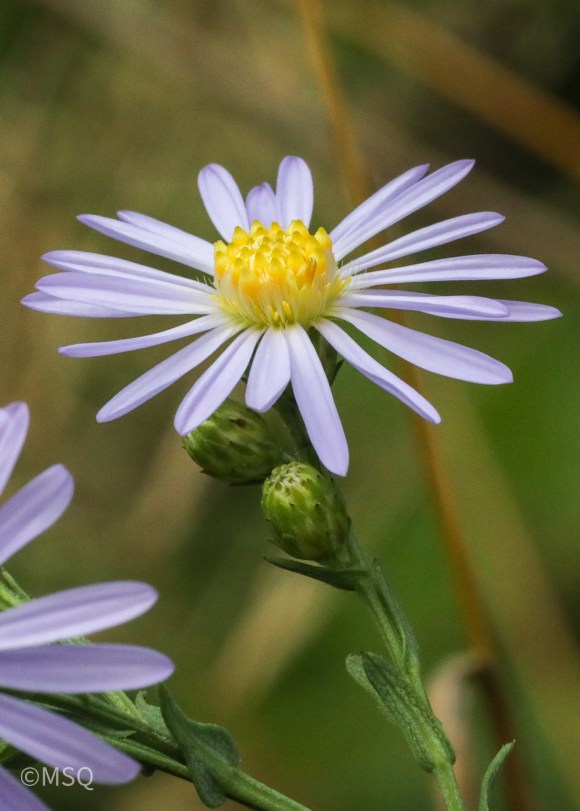
The flowers are not large—one half to one inch across.  Classic aster flowers,  these blooms have a yellow center with many slender petals surrounding it.  The petal color ranges from pale violet to blue.  The showiness of this aster comes from many flowers blooming on the stalks, all at the same time, and lasting a long time.  As the flowers age, the center turns from yellow to pinkish purple.

In the garden, the Smooth Blue Aster behaves well and doesn’t spread excessively.  In my experience, rabbits enjoy eating the tender shoots in the Spring.  They stop browsing as the plant grows larger.  I’ve used several strategies to protect this and my other treasured asters.  When possible, I plant them behind or among plants that rabbits do not like.  Irises are good for this, as are ornamental grasses and scented plants like Monarda.  Herbivore deterrents, like sprays and powders, work but add more garden chores at a busy time of year.  Finally, I have an aster that just spreads like crazy.  For Spring and early Summer, I let it grow in paths and inconspicuous areas so the bunnies can graze on it rather than my favorite asters.

Rabbit nibbling leads us to the June Hair Cut.  This cut is a pruning technique used on asters to increase bloom while decreasing height and flopping.  In some plants like asters, trimming stems causes more stems to grow but overall height is sacrificed.  In the case of the S. leave, less height is a good thing.  I find the tall plants, over five feet in some cases, definitely sprawl.  And they really flop during a rainy fall as the water weighs down the flowers.  

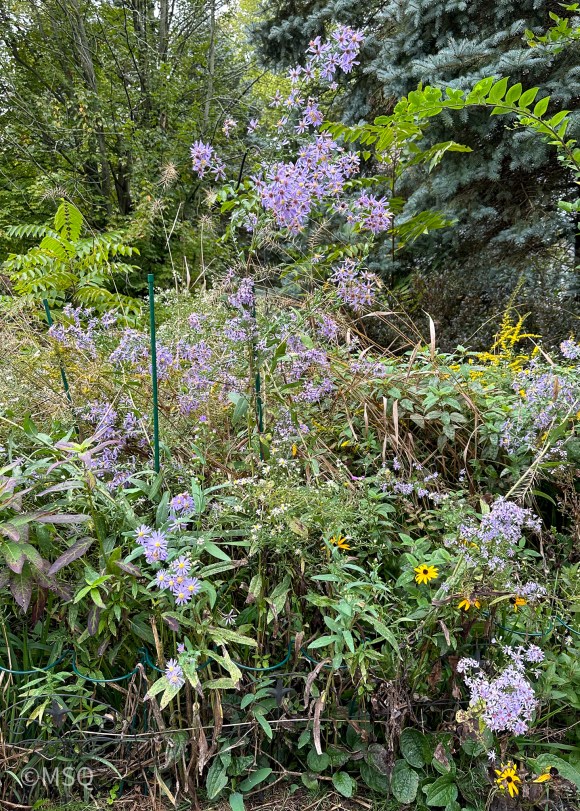
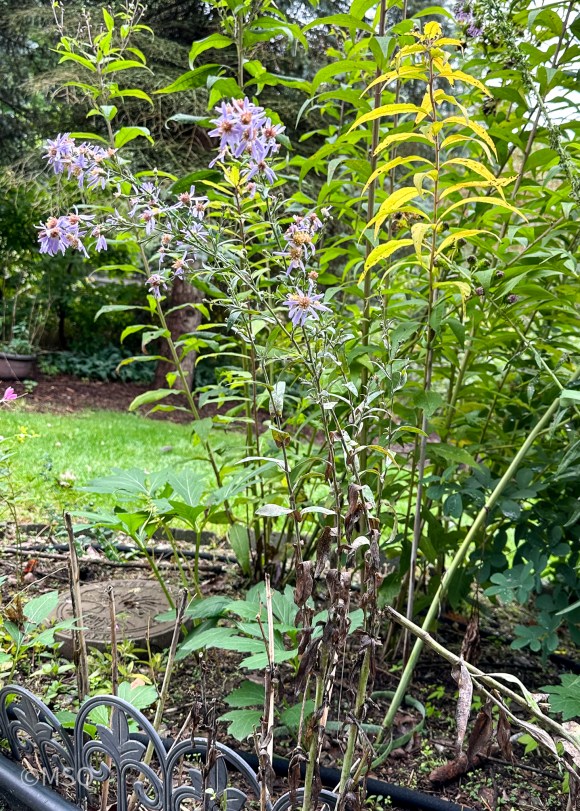
These plants can be staked but it must be done individually.  In the garden bed pictured on the top, the Smooth Aster (five feet, two inches tall) is supported and hides the Goldenrod ‘Fireworks’ behind it.  On the bottom, the local rabbits pruned the Smooth Aster.  It is three feet, one and half inches tall and stands on its own.  The pruned aster works well as a front or middle bed plant.  If I take on this chore,  I’ll plan to do it at the end of June or the first part of July.  This timing gives the plants time to recover, grow and bloom during their usual season in my zone 5 garden.

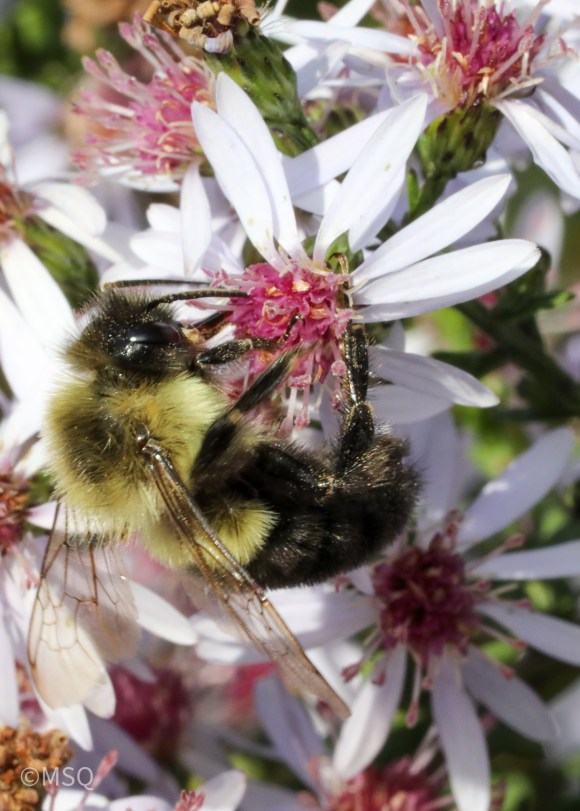
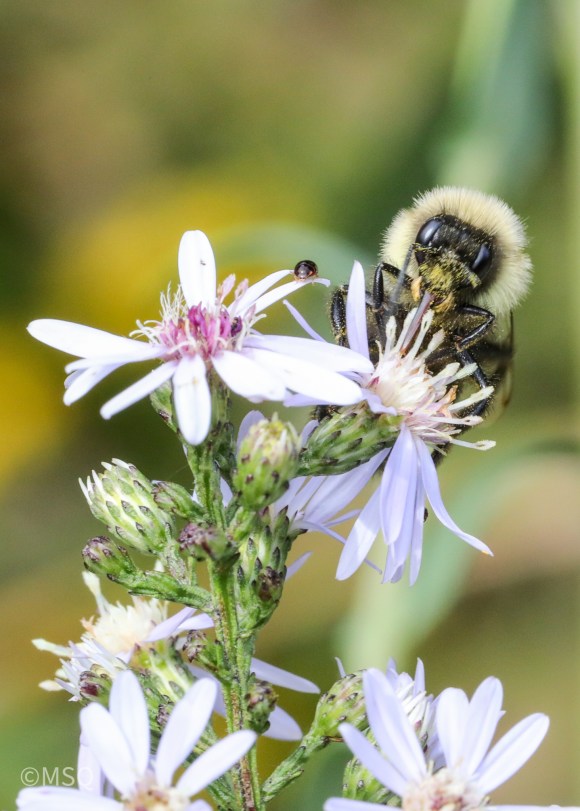
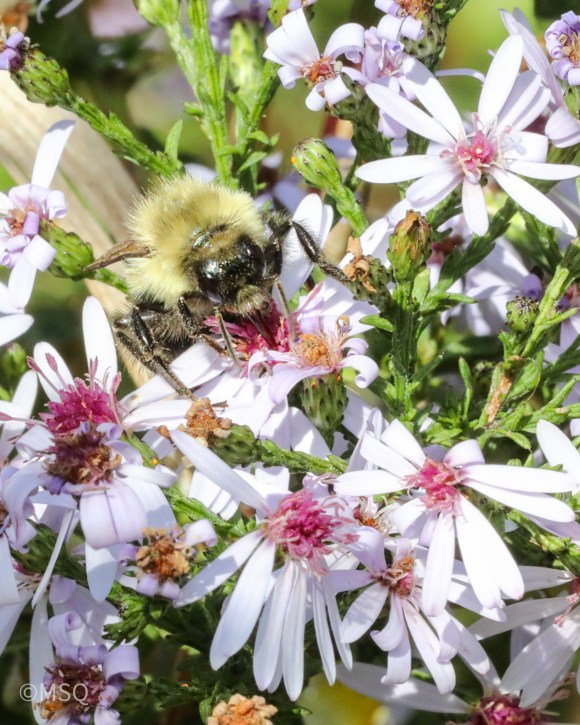
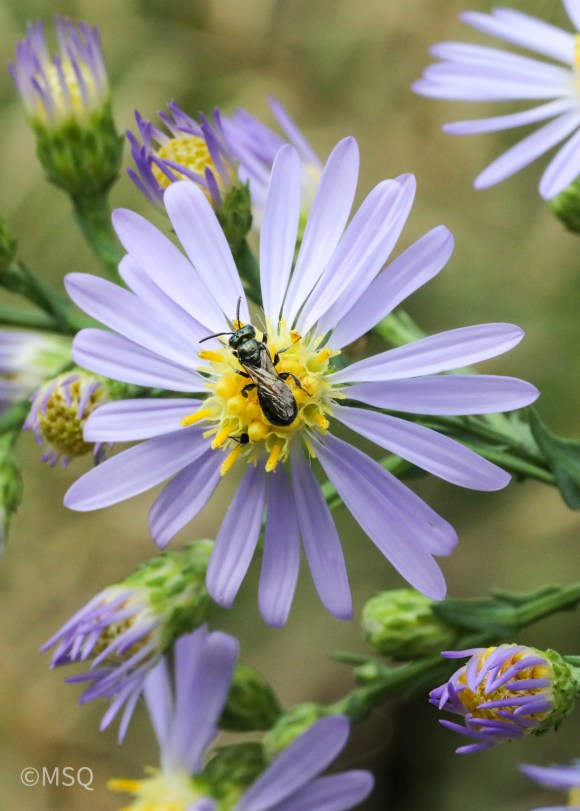
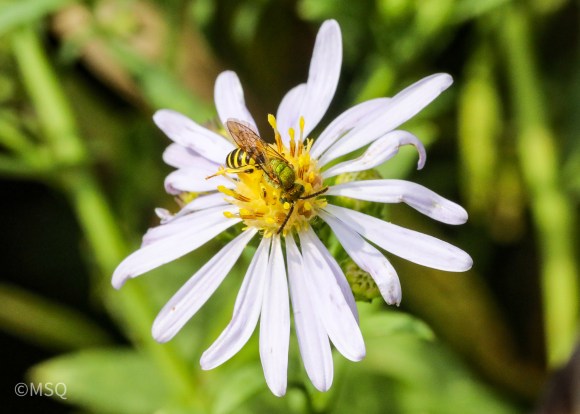
The Xerces Society for Invertebrate Conservation has designated Symphyotrichum laeve of Special Value to Native Bees.  It provides nectar and pollen to pollinators and other insects.  Long- and short-tongued bees, honeybees, bumblebees, bee flies and butterflies all visit this plant.  Monarchs use Smooth Aster during their migration.  Like other Symphyotrichum, Smooth Blue Aster has several specialized bees (oligoleges).  These bees forage from members of the Asteraceae family and include Andrena asteris, A. asteroides,  A. placata, A. simplex, Cnemidandrena hirtcincta, C. nubecula, and Colletes simulans.  This aster also serves as a larval host for the Pearly Crescent Butterfly (Phyciodes thanos).  

Bumblebees are the some of the long-tongue bees foraging on Smooth Blue Aster.

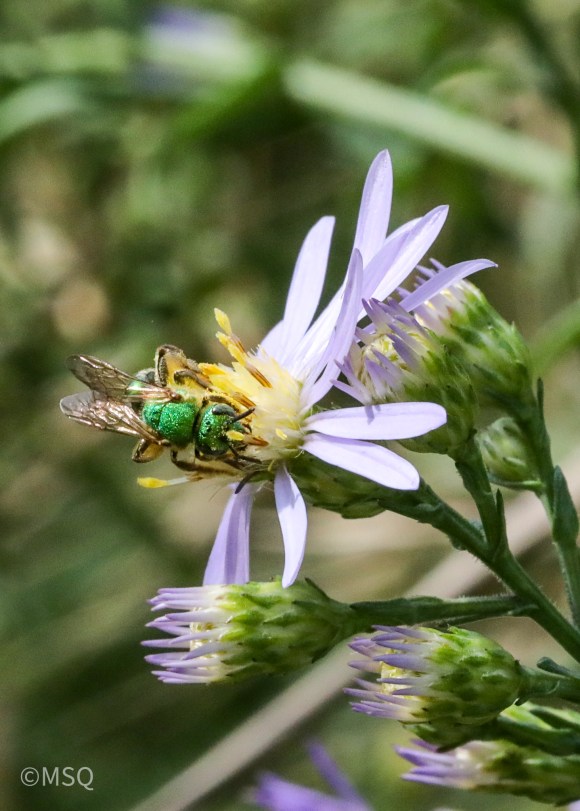
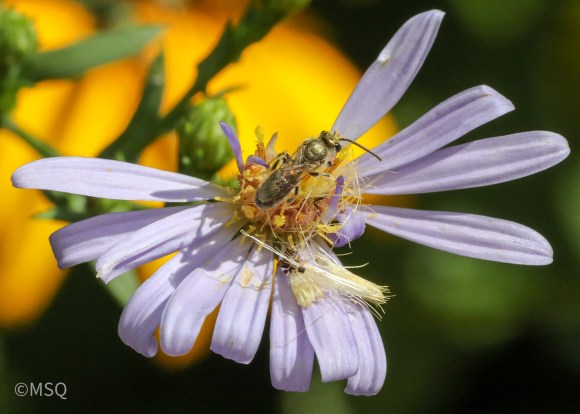
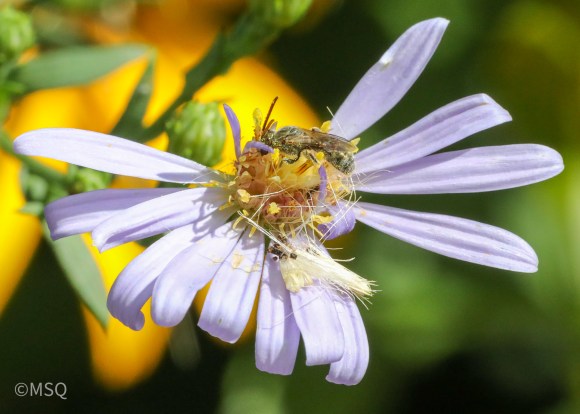
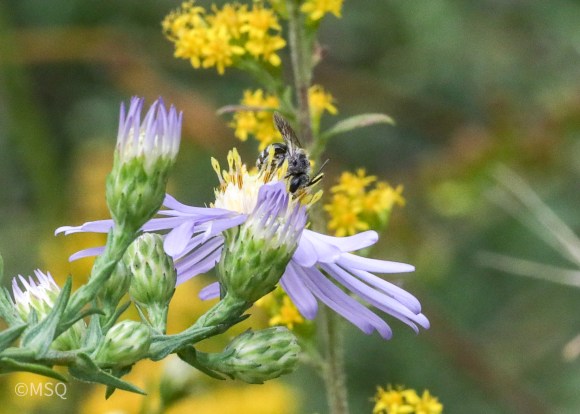
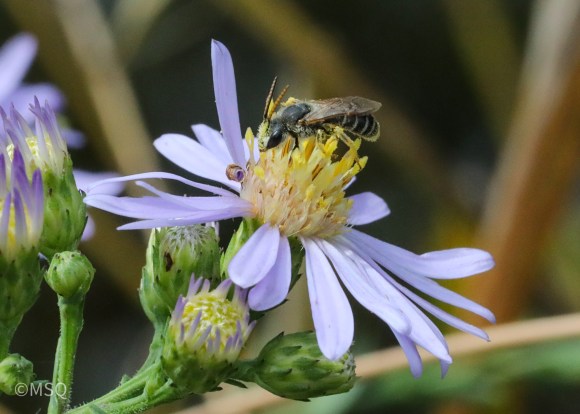
Short-tongued bees include metallic green and gold sweat bees, Halictus, and small carpenter bees–Ceratina.

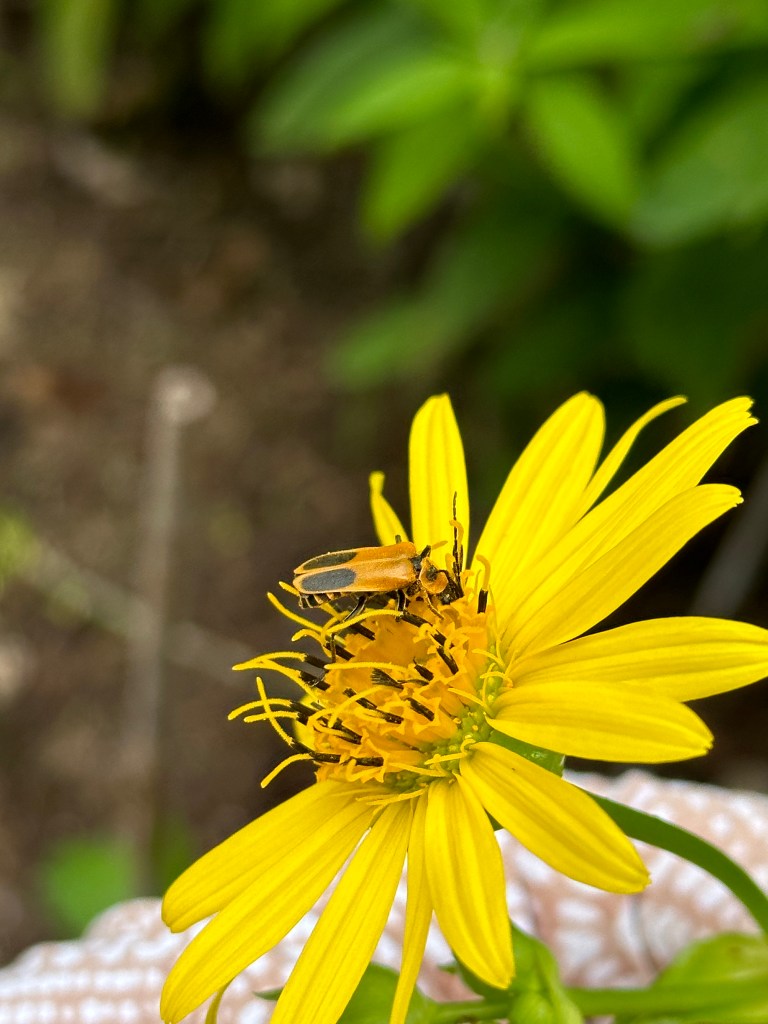
Symphyotrichum laeve also plays host to a variety of late season beneficial insects. Soldier Beetles (Chauliognathus spp.) harvest both pollen and nectar from this aster. The larval phase act as beneficials eating aphids, fly larvae, small caterpillars, beetle larvae, small caterpillars, and grasshopper eggs.

Insidious Flower Bug (Prius insidious) also frequents Smooth Blue Aster. The Insidious Flower Bug eats many different plant and crop pests including: plant-eating mites and their eggs, various insect eggs and other soft-bodied insects–thrips, spider mites, small caterpillars. It’s an important biological control and is sold commercially for thrips. This bug will feed on pollen and plants if it can’t find enough prey.

Finally, chalcid wasps enjoy S. laeve. This 1.5 to 3 mm long wasp searches for prey on the late blooming flowers. It parasitizes moth, fly, beetle and butterfly larvae.

Smooth Blue Aster is a charming addition to the garden with its unusual blue-green leaves and violet flowers.  It provides an extended season of interest–first offering resources to bees, butterflies, and other insects.  Then, when blooms transform into seeds, birds and small mammals visit to prepare for and endure the cold winter months.

I hope you’ve enjoyed this month’s blog!  I’d love to hear about your experiences with this plant or in your garden.  Please leave a comment below and tell me about it!

Categories
native plants Pollinator gardening

Grist for the Bees

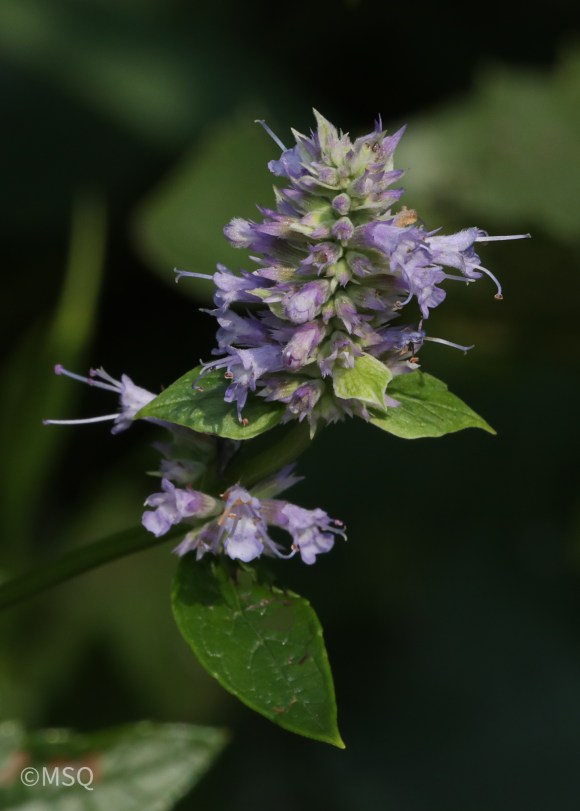
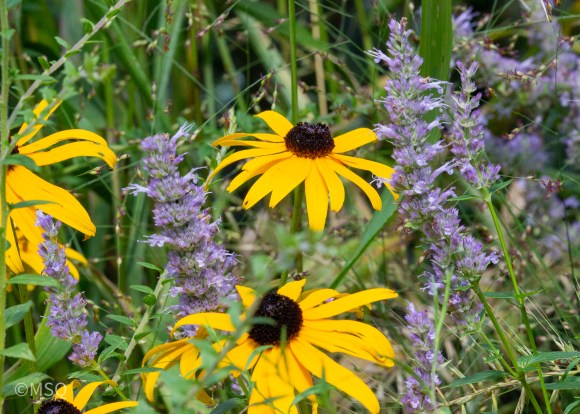
Purple Wheat in the garden?  Indeed, that’s what Agastache means ‘agan’ much, ‘stachys’ ear of grain, from the Greek.  Its flowers look like heads of wheat or rye and range from pale lavender to purple.  ‘Foeniculum’, the second part of the name, means fragrant for the scented leaves.  Agastache foeniculum (Fragrant or Anise Hyssop) is part of the mint family.  Like Pycnanthemum virginianum (https://wildthingsinthe.garden/2023/05/31/white-goes-with-everything/), also mints, it attracts an enormous variety of bees.  Fragrant Hyssop also supports numerous butterflies and skippers.

Anise Hyssop grows two to four feet tall and spreads eighteen inches to two feet.  It has an upright, clump-forming habit.  Anise Hyssop sports dark green, ovate to broadly lanceolate leaves up to four inches long.  Almost heart shaped, the leaves are one to three inches at the base and whitish underneath.  They sit opposite each other on the classic square stem of mint plants.  The foliage also gives off a strong anise or licorice-like scent that gives the plant its common and Latin name.

Agastache foeniculum can begin blooming in June and continues through August.  In zone 5, where I am, it doesn’t start until July.  Blooms appear as three- to six-inch-long flower spikes at the end of plant stalks.  The eye-catching blossoms range from pale lavender to true purple in color.  Tiny flowers make up each large spike.  They’re laid out in tightly packed rows although there can be gaps (think of an ear of corn).  This arrangement is called verticillasters or false whorls.  Each of the small flowers is tubular, 2-lipped and a 1/3’’ inch long.  Unlike the leaves, the blooms have no scent. 

Fragrant Hyssop plant grows best in full sun with dry to moderately moist soil.  Soil moisture is not a problem if the drainage is good.   Anise Hyssop is drought tolerant, more so after it is established.  It spreads by rhizomes and self-seeding especially under good conditions.  I have not found that this plant spreads obnoxiously.  I have far fewer Anise Hyssop seedlings than Monarda fistulosa seedlings.  Fragrant Hyssop may have problems with crown rot with soggy soil. Other issues include rust and powdery mildew.

Outside of cultivation, Agastache foeniculum grows in prairies, dry upland forests, plains, fields, roadsides, and other dry, open, semi-shaded areas.  In the past, it served as honeybee forage in Canada and parts of the Upper Midwest.  It works well in borders, wildflower gardens, herb gardens, butterfly gardens and meadows.

Agastache foeniculum and similar species inspire plant breeders around the world.  Too many nativars exist to explore them all, but I thought we could look at three very different plants.  Each of these was modified in a different way.

Agastache ‘Blue Fortune’ is a very popular hybrid created by crossing Agastache foeniculum with its East Asian relative, Agastache rugosa.  This compact plant has longer flower spikes than the species.  It blooms for an extended time because it’s bred to be sterile.  ‘Blue Fortune’ is widely reported to be a pollinator magnet.

Agastache ‘Golden Jubilee’ is an older hybrid with yellow-green foliage that’s pure yellow in the Spring. The flowers are identical to the species.  ‘Golden Jubilee’ received the All-American Selection Award in 2003 and is still being sold.  It will self-seed with a mix of species and golden seedlings.  There are mixed reports on how pollinators respond to ‘Golden Jubilee’.  Some sources say bees don’t seem to ‘see’ it and others say pollinators love it.

Agastache ‘Red Fortune’ has red to pink flowers.  The leaves are like the species.  Pollinators don’t like this plant as much as Agastache foeniculum.

These three plants give a nice snapshot of how natives are altered and some pollinator responses.  One idea is that nativars with flowers most like the species’ flowers would be most acceptable.1  Positive reports about ‘Blue Fortune’ and ‘Golden Jubilee seem to support this idea.2

In addition, red is a special case.  Bees see in the ultraviolet spectrum—from approximately 300 to 650 nm.  They can’t see red although they can see reddish tones like orange.  When native plants are hybridized for red flowers, bees often have trouble finding them.1,3

But wait!  There’s an exception.  Red flowers can have ultraviolet “nectar guides”  which the bees see perfectly well.  Plants use these guides to “direct” the pollinators to the nectar reward and encourage pollination.3  

It’s hard to say if a red native hybrid will still attract and support bee pollinators.  If they retain their ultraviolet nectar guides, then the bees should see them.  However, I’ve seen more than one report showing little to no bee activity on the red and pink hybrids.1,2

Anise Hyssop serves a multitude of pollinators providing nectar and pollen.  Like Monarda (https://wildthingsinthe.garden/2023/07/31/the-gardens-super-station/), Fragrant Hyssop has been identified by pollination ecologists as attracting large numbers of native bees.  The Xerces Society for Invertebrate Conservation also designated Fragrant Hyssop of Special Value to Bumble bees and Honeybees.  Butterflies and skippers use it for a nectar source.

Pollination in Fragrant Hyssop hinges on both the individual flowers’ structure and the different bees’ anatomies.  The nectar is secreted by a disc at the base of the flower.  Pollen-carrying anthers are located on the top lip of each flower.  When bees root for nectar, pollen rubs off onto their heads or thorax.  As they move to a bloom with a receptive stigma, female part, the pollen transfers and fertilization occurs.

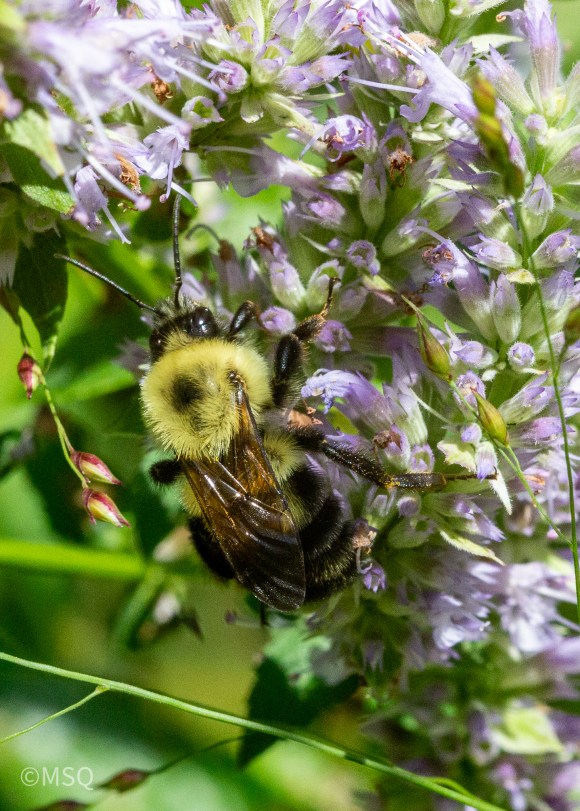
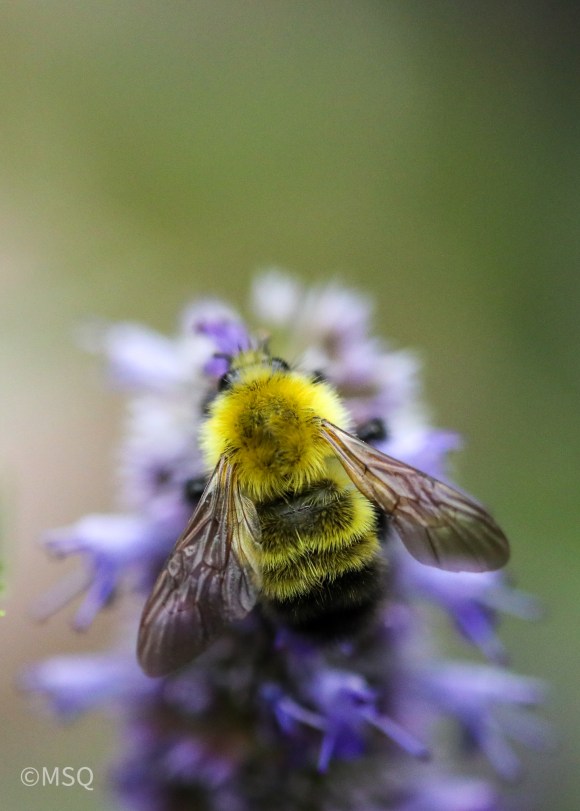
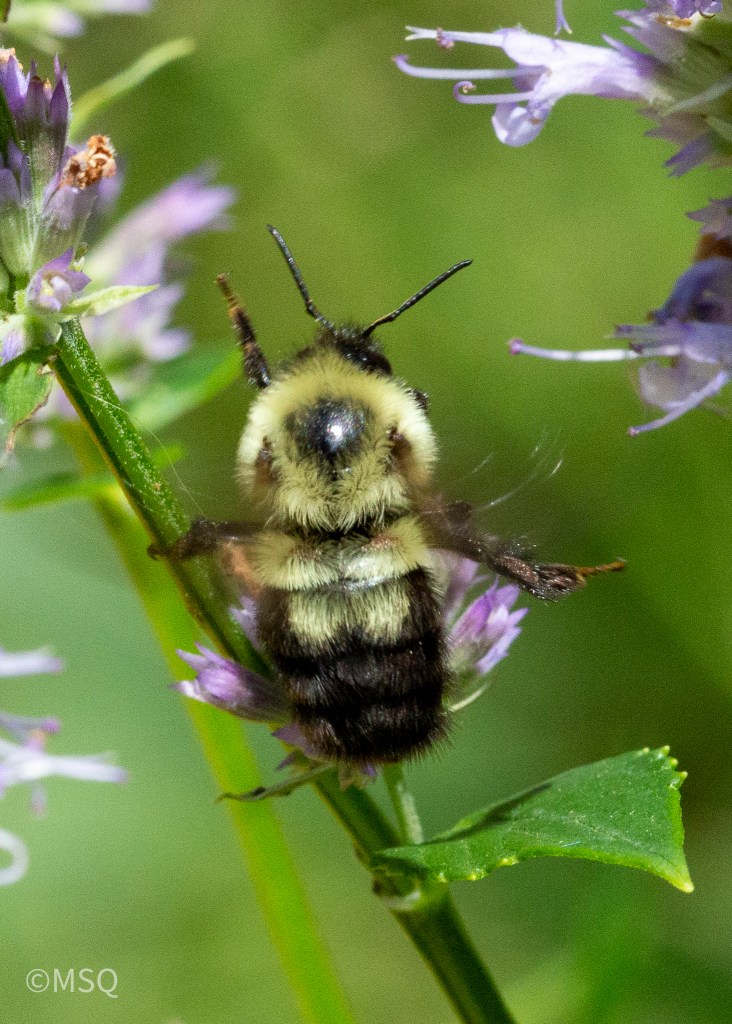
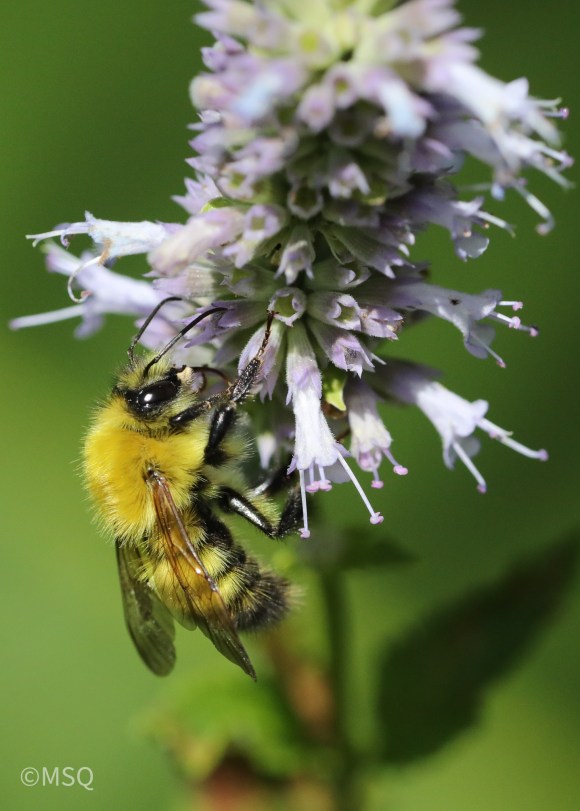
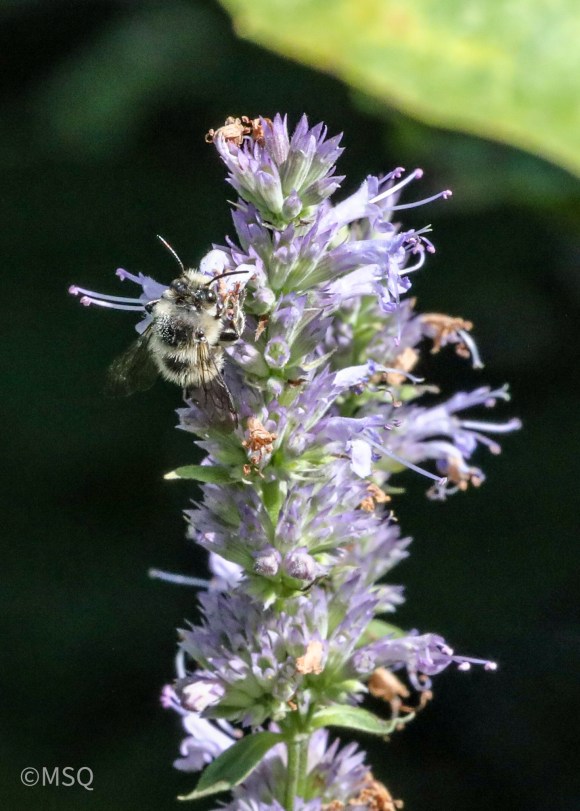
The many native bees that visit Hyssop range from large to tiny.  Bumble bees are the largest.  I’ve seen Common Eastern Bumble bee (Bombus impatiens), Brown-Belted Bumble bee, (Bombus griseocollis), Two-Spotted Bumble bee (Bombus bimaculatus), and Golden Northern Bumble Bee (Bombus fervidus) on my Fragrant Hyssop. They use both nectar and pollen for their larva.  

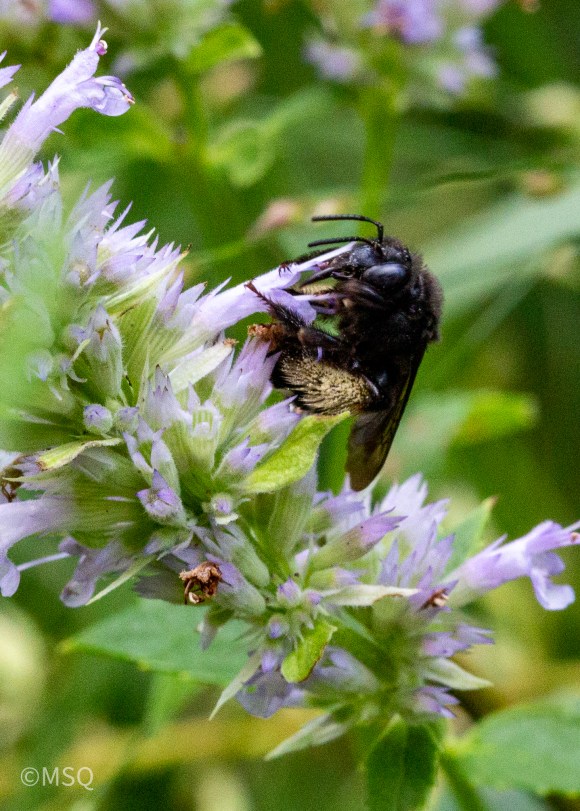
Large Leaf-Cutter bees use Anise Hyssop’s nectar. In the process, they are efficient pollinators. In contrast to other bees, pollen accumulates on the Leaf-Cutter bees’ abdominal scopae (specialized pollen collecting hairs).  It is transferred to the stigmas from there.


Digger bees (Melissodes) and smaller Leaf-Cutter bees (Megachile) are mid-sized bees.  They also collect both pollen and nectar from Anise Hyssop.

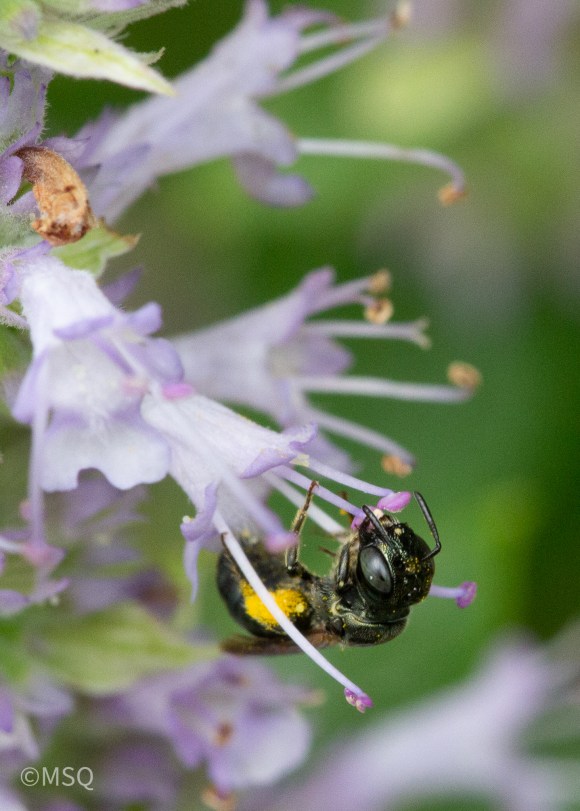
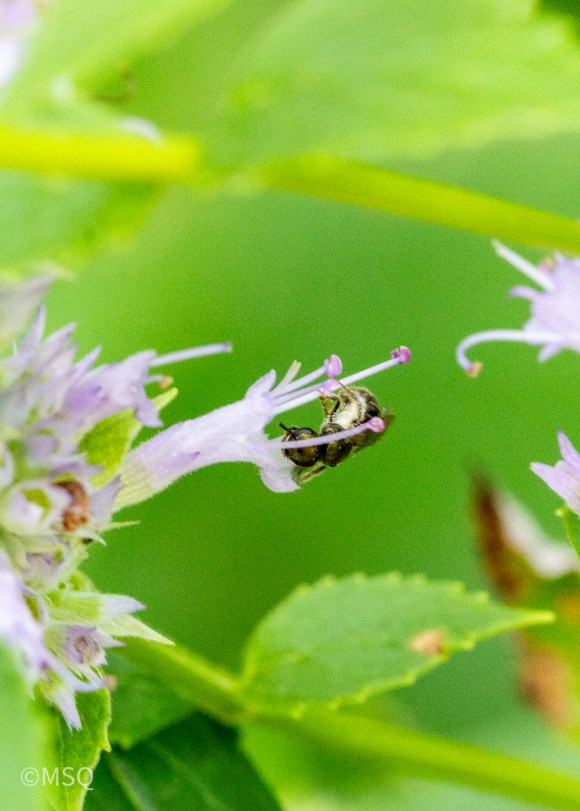
The Halictid bees (Lasioglossom), small Resin bees (Heriades) and Masked bees (Hylaeus) are small bees that gather resources from Fragrant Hyssop.  Dufourea monardae is included in this group.  D. monardae is a specialist or oligolectic bee that visits Monarda fistulosa and Agastache foeniculum.  These small bees can collect pollen from the anthers extending from the flowers. When harvesting nectar, they climb the style to reach the base of the flower.  (The style is the stalk connecting the stigma and the ovary.)

Fragrant Hyssop provides an excellent late season nectar source for butterflies, skippers and moths including Silver Spotted Skipper Butterflies (Epargyreus clarus), Peck’s Skipper Butterflies (Polites peckius) and the Great Spangled Fritillary Butterfly (Speyeria cybele).  They reach their proboscis into each tiny bloom to find the nectar.  Hyssop also works well in Monarch Way Stations providing food after most milkweed has stopped blooming.  

I hope you enjoyed this exploration of Anise Hyssop and its wonderful visitors!  I’d love to hear your thought about this blog or stories about your own experiences in the garden.  Please leave me comment and let me know your thoughts!

References:

  1. Eierman, Kim,11 April 2014,  “Ecobeneficial Interview:  Annie White on Native Plant Cultivars, Native Plants and Pollinators”, Youtube, https://www.youtube.com/watch?v=HTmuDcEzTOw
  2. Caldwell, Cathy, (2021, August-Vol.7, No.8) Anise hyssop, Piedmont Master Gardeners, https://piedmontmastergardeners.org/article/anise-hyssop/
  3. Riddle, Sharla, (2016, May, 20) How Bees See And Why It Matters, Bee Culture:  The Magazine of American Beekeeping, https://www.beeculture.com/bees-see-matters/
Categories
Pollinator gardening

The Garden’s Super Station

Like lavender lace, the intricate flowers of Wild Bee Balm shimmer in the summer sun.  Wild Bee Balm (Monarda or Monarda fistulosa) lures bees, wasps, butterflies and more.  The flowers unfold in the garden for a full month and its light, grey-green leaves contrast with darker foliage.

Monarda thrives in Zones 3 to 9.  It is an excellent mid-garden plant growing from two to four feet tall.  It spreads two to three feet and a three-foot spacing is recommended. An extremely adaptable plant, Wild Bee Balm tolerates clay, chalk, loam, sand and alkaline to acid soils.  It blooms in full to part sun.  Monarda also tolerates heat, drought and Black Walnut trees and is deer and rabbit resistant.   It only really struggles when flooded although it accepts some in the winter.

The flower heads are held singly at the top of each stalk and can be white, pink, or lavender.  Lavender is most common.  Flower heads can be up to four inches across!   They open from the center/top to the edges.  The corolla of each floret divides into a tubular upper lip and a three part slender lower lip for a landing pad.  The stamens and the stigma eventually protrude from the upper lip.  The name fistulosa means tubular. Linnaeus named Monarda after Nicolas Bautista Monardes, 16th century physician and botanist.

Monarda is in the mint family and has the classic square stem found in mints.  Its leaves are aromatic, lanceolate, and toothed.  The frosted, grey-green leaves can grow to 4 inches long.  Wild Bee Balm has an erect, clump-forming habit.

Each plant has deep roots for feeding.  They use rhizomes to spread as well as seeds.  The rhizomes can survive bulldozers and other earth moving machine to pop up in unexpected places.  In natural areas, Wild Bee Balm grows on prairies, in dry, rocky woods, at the edges and in open areas of woods, in unplanted fields, along roads and railroads.

I hesitated a long time before adding Monarda to my garden.  I knew it had several challenges that weren’t easily solved.  High winds and heavy rain knock it over.  It needs support in an unprotected area especially with repeated thunderstorms.  All the Monardas are susceptible to powdery mildew.  Good drainage and air circulation may help reduce the mildew, but I’ve never been able to prevent it.  I developed a different strategy. I let my Wild Bee Balm flower and then cut it back by one-third to one-half.  Since it’s in the middle of the bed, other plants hide it.  The Monarda recovers and regrows fresh leaves.

Monarda also loves to spread.  The rhizomes creep past their beds onto paths and into other plants’ spaces.  Some of the seeds will sprout new colonies.  These plants aren’t hard to pull.  Again, I let them blossom.  When they’ve finished, I put what I don’t want and trim back the rest.

So why do I keep a plant that’s going to be a problem?  Because it’s an amazing pollinator plant!  The Xerces Society of Invertebrate Conservation recognized Monarda fistula as particularly attractive to native pollinators and included in their book 100 Plants to Feed the Bees (written by Eric Lee-Mäder, Jarrod Fowler, Jillian Vento, and Jennifer Hopwood).

What is the Xerces Society?  Xerces Society of Invertebrate Conservation is an international group that protects the natural world by protecting invertebrates and their habitat.  Xerces Society is for pollinators and insects what the Audubon Society is for birds.

When in bloom, Monarda has a cloud of insects around it.  With the constant motion of small, medium, and large bees, it has been compared to a train station.  Butterflies, moths, and hummingbirds come and go, and wasps stop to refuel.

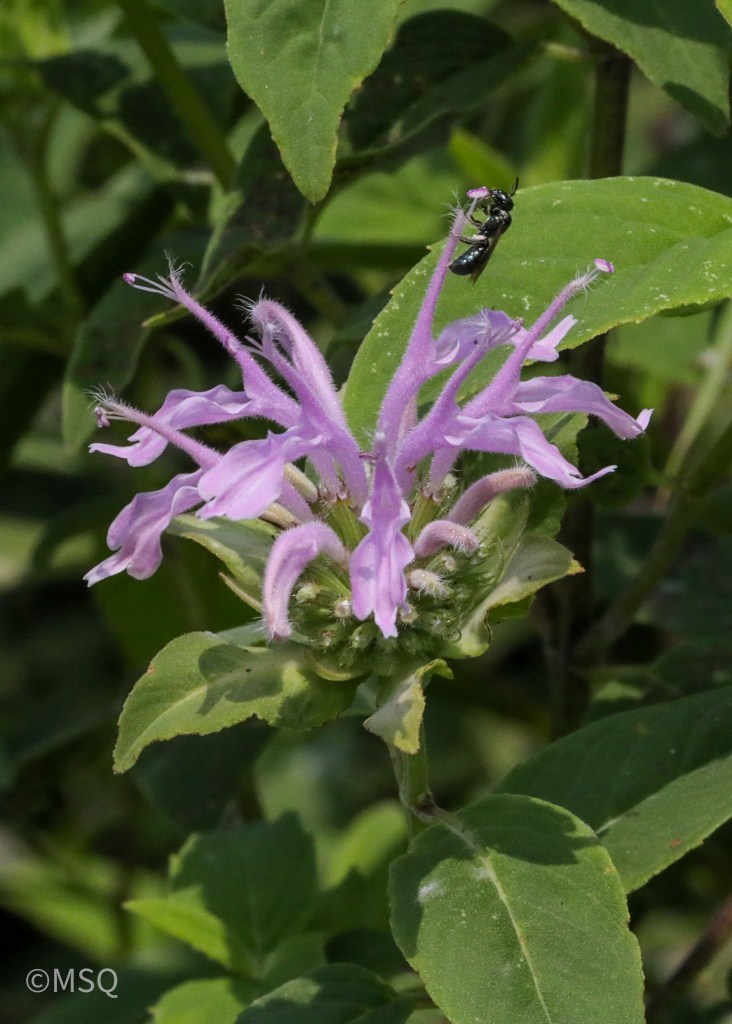
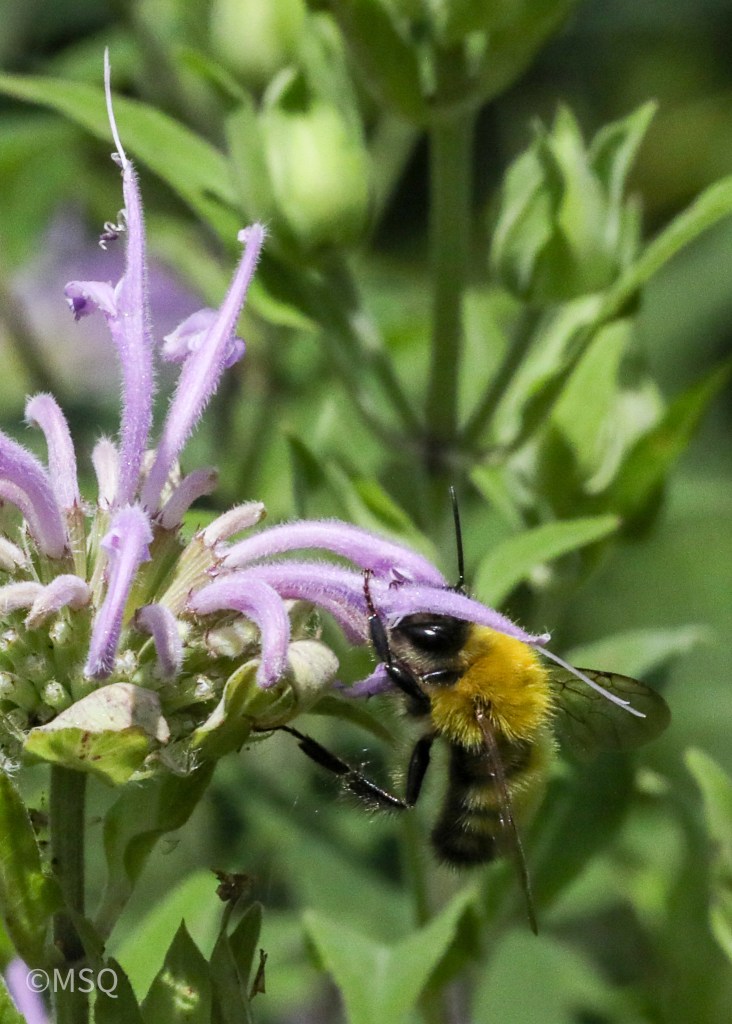
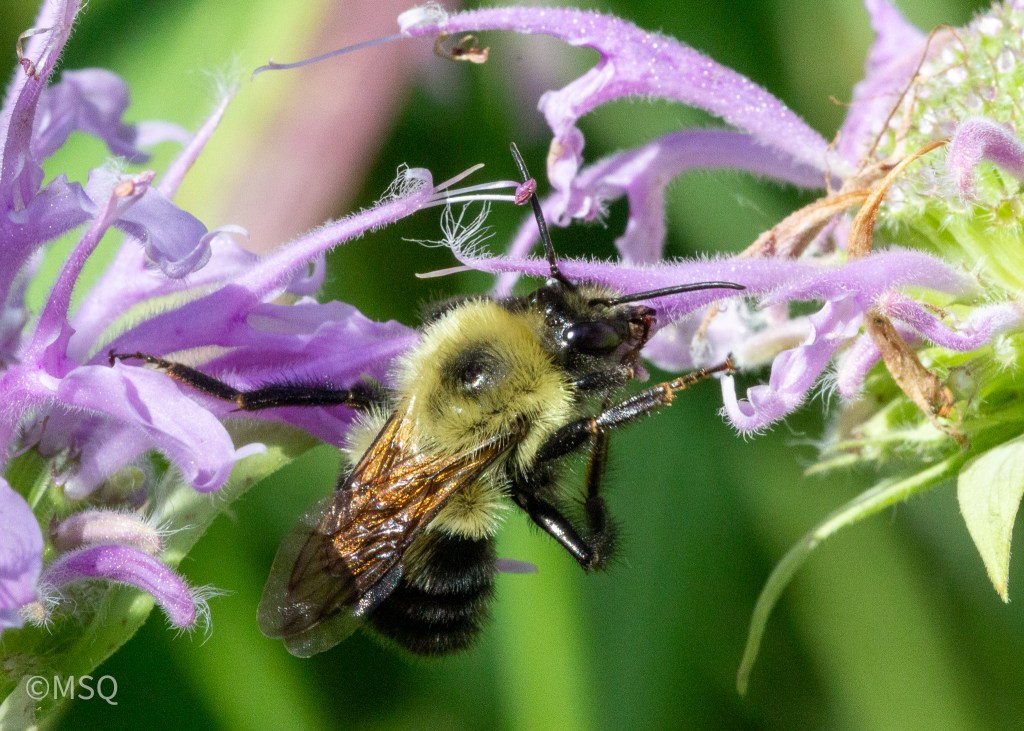
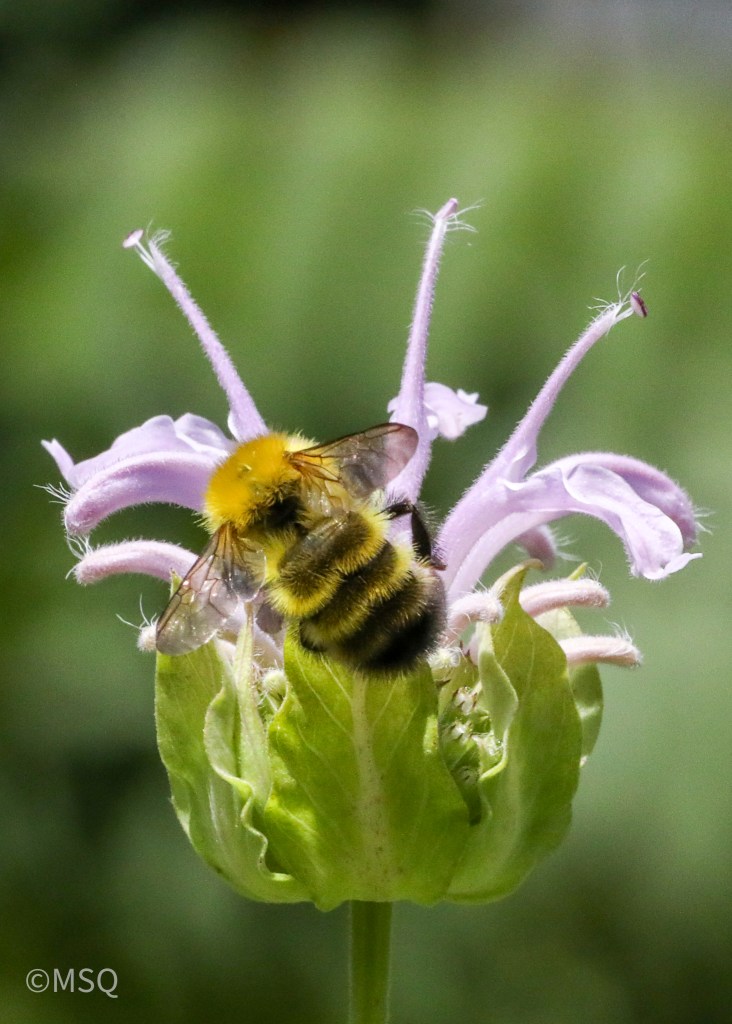
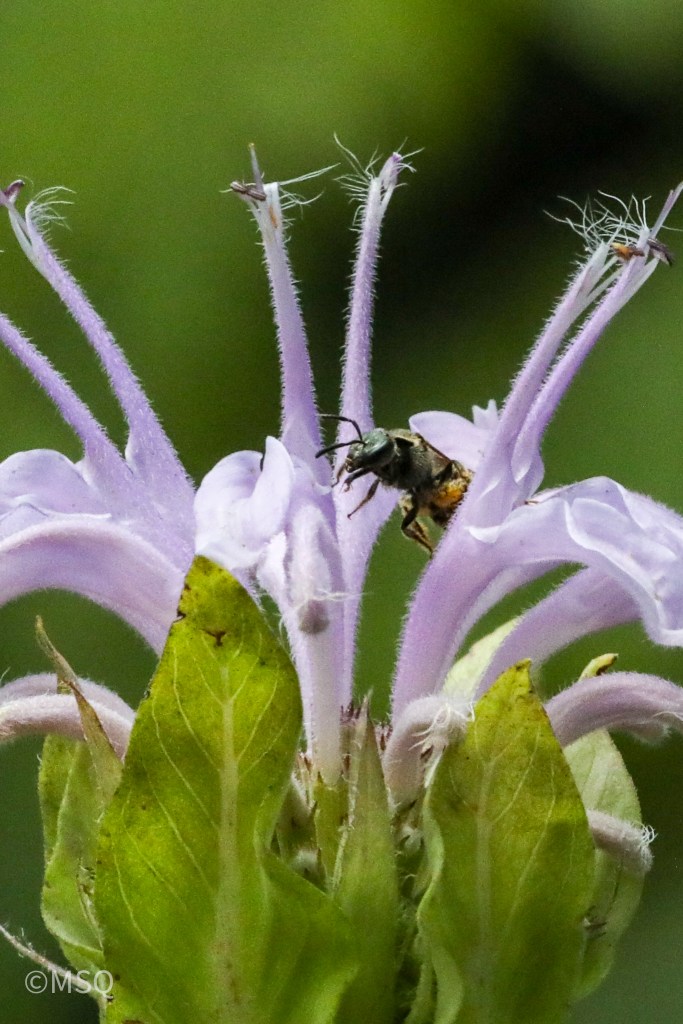
Bumblebees choose Monarda over other flowers.  When they find it, they work their way around the flower heads.  Hanging from each floret, bumblebees use their long tongues to reach the nectar reserves deep in the blooms. Wild Bee Balm has adapted its pollination behavior to bumblebees and the other bees that visit.  

The large bees, including bumblebees, avoid Monarda fistulosa’s anthers and stigmas when foraging for nectar.  They fly underneath them to sip nectar.  When they want pollen, these bees hover close to the flower and brush the anthers with their mid- and hind-legs. 

Monarda, for its part, opens only a few florets at a time.  It extends its anthers (male part) first before the stigma (female part).  Later, when the stigma lengthens and become fertile, the pollen is left by passing pollinators’ brushing against the stigma.  Individual floret nectar is only available until that floret is fertilized.  But the bees and other insects, don’t know which ones still contain nectar.  They must check all the florets until they find nectar.  In this way, Monarda entices them to move around the flower head and, all being well, leave pollen on the ripe stigmas.

Medium and small sized bees forage on Monarda as a pollen source.  These medium bees include Anthophora, Megachile and Melissodes.  Lasioglossom and Halictus are two small bees that visit Monarda for pollen.  Monarda fistulosa  even has several specialist bees–Dufourea monardaePerdita gerhardi and Protandrena abdominalis.

Specialist bees visit only one or a very few types of the flowers.  This includes bees that forage on plants in only one family.

Wasps also use Wild Bee Balm for nectar.  Sand Wasps (Bicyrtes), Mason Wasps and the Great Black Wasp (Sphex pensylvanicus) all drink nectar from Monarda. They have short-tongues and can’t reach it like bumblebees.  The wasps chew a hole at the base of the tube and take nectar from there.  This is called nectar robbing and it bypasses the usual pollination routes.  Medium and small bees will occasionally drink from these holes.

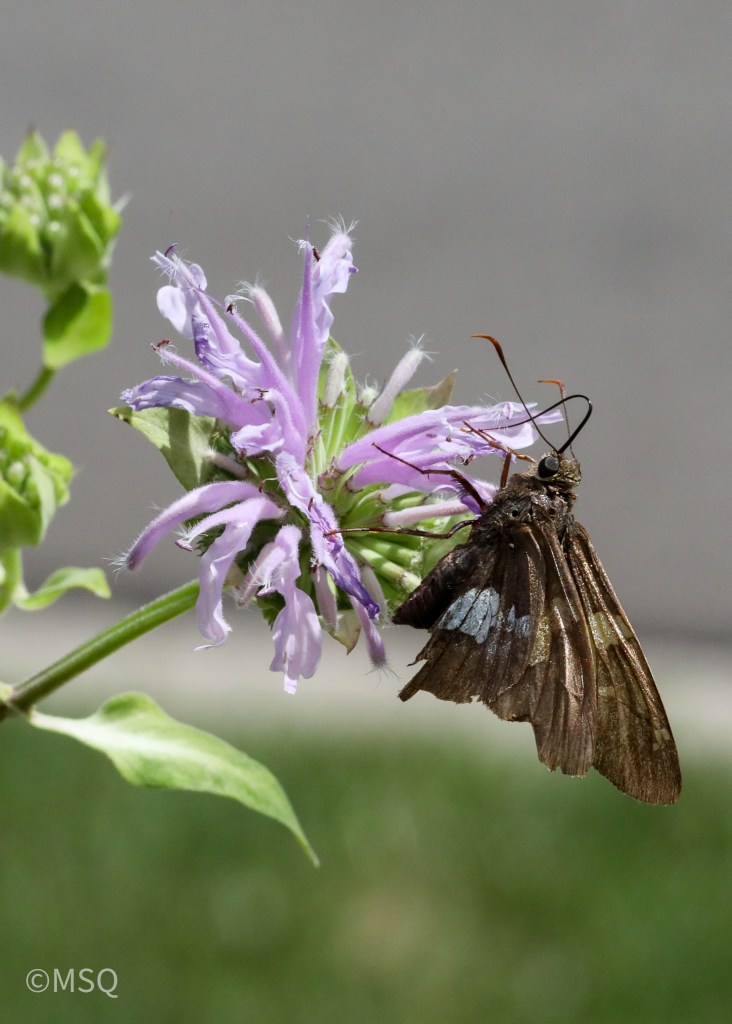
Butterflies, moths, and skippers forage for nectar at Monarda too.  The Xerces Society of Invertebrate Conservation suggests Monarda fistulosa in their Monarch Nectar Plant Guide – Midwest and for the other places it grows.  This is the Silver-Spotted Skipper, one of the most common skippers and a frequent visitor to my garden.  It’s impressive watching it maneuver its long proboscis into the Wild Bee Balm’s floret. 

Skippers are fascinating creatures!  Somewhere between a moth and a butterfly, they’re currently grouped with butterflies.  They have enormous round eyes and antennae that ending in clubs with hooks.  Some carry their wings together and raised like butterflies  The Silver-Spotted Skipper is one of these.  Others have folded wings at rest, looking like a colorful X-wing fighter.  Skippers have a rapid darting flight unlike the butterfly’s fluttering.  Some reach flight speeds of 30 mph.  They aren’t as colorful as the butterflies but usually have muted shades like moths.  They can have interesting patterns, reflective spots (like the Silver-Spotted) and include muted colors such as orange or pale blue.  Skippers fly day and night and many enjoy visiting the garden.  Keep a look out for them!

Monarda also serves as a larval host for several moths.  The Hermit Sphinx Moth Lintneria eremitus and Gray Marvel Moth caterpillars feed on Wild Bee Balm.  It also supports several mint moths including Orange Mint Moth Pyrausta orphisalis and Raspberry Pyrausta Moth P. signatalis.  We’re learning more and more about moths and their roles in the natural world.  Only a small fraction are pests.  They provide valuable food for songbirds, mammals, and other insects.  A study from the UK found that they visit more plants at night than bees do during the day.  Like bees, some moths focus on one plant species (“specialists”) while others forage on a variety of different plants (“generalists”).  (Fallon, Candace, “For the Love of Moths”, Web Blog Post, Xerces Blog, Xerces Society for Invertebrate Conservation, 14 July 2021)  Supporting moth reproduction in the garden, may be as important as supporting bees and other better known pollinators.

So, it turns out my initial concerns have disappeared in a flutter of wings!  Monarda’s role supporting insect life in all its phases is astonishing.  I just keep finding new creatures in the Wild Bee Balm bed.

Do you have Monarda in your garden? Please send me your stories and any thoughts on the blog. I’d love to hear about it!

Happy Gardening!

Mary

Categories
native plants Pollinator gardening

THE GARDEN BY CANDLELIGHT

Okay, not actual candlelight, but the ethereal candelabra blooms of Veronicastrum virginicum, Culver’s Root.  This striking, upright plant provides a strong vertical accent in any garden.  It’s long, tapered flower spikes attract pollinators of all kinds while dark green whorls of leaves provide plenty of visual interest.

Growing in zones 3 to 8, this plant stretches from four to seven feet and spreads between two to four feet.  Culver’s Root grows in medium to wet, well-drained soils.  It tolerates standing water for a short time and thrives in rain gardens.  Culver’s Root accepts full sun to light shade and is suited to growing at the woodland’s edge.  In very warm zones, it enjoys afternoon shade.  

Culver’s Root’s flowers unfold slowly in mid to late summer.  Here in zone 5b, it starts in mid-July and continues to the end of August.  You can deadhead to encourage rebloom.  

The flower color varies slightly with the location.  Primarily white, the blooms can have tones of very pale pink, lavender or blue.  The blossoms are most often described as candelabra-like with four or more in a whorl at the top of each stem.  In mature plants, flower spikes can be 8” in length!  

Culver’s Root tends to flop without support especially in shadier areas.  I’ve used a peony ring with internal supports.  The deer have also trimmed my plant in mid-June by about one-third to one-half.  The pruning helped and more flowers formed at each cut.  Culver’s Root won’t grow to full height after being cut back. 

Its leaf structure is unusual and offers a contrast to surrounding plants.  The leaves are whorled in groups of three to seven.  Each leaf is lance shaped with slight serrations and attached directly to the stem (sessile) or nearly so.  They can be up to 6” long and 1.5” wide.  The long stems and whorled leaves give the plant an upright, medium texture.  Culver’s Root is not aggressive although it can self-seed.  Some good companion plants include blazing star, monarda, milkweed, rattlesnake master, goldenrod, and asters.

V. virginicum has successfully entered the world of horticulture and numerous nativars exist.  These nativars have been bred to prevent flopping and to bring more color to the flowers.  Some are more compact to fit in small gardens.  Here is a sampling of what’s available:  ‘Fascination’, 5’ tall, 2’ width, lavender bloom, ‘Red Arrow’, 3-4’ tall, 2-3’ width, purple bloom, ‘Album’, 3-4’ tall, 3-4’ width, white bloom, and ‘Cupid’, 2-3’ tall, 1-2’ width, purple.  Like the native plant, all these nativars can grow in zones 3 to 8. 

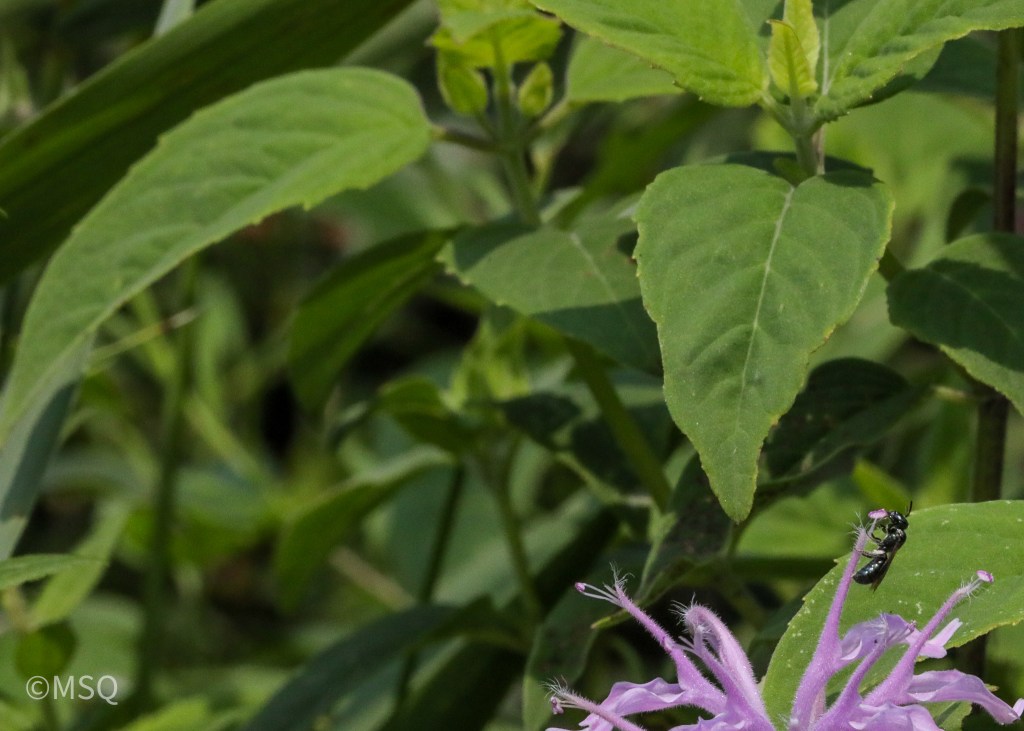
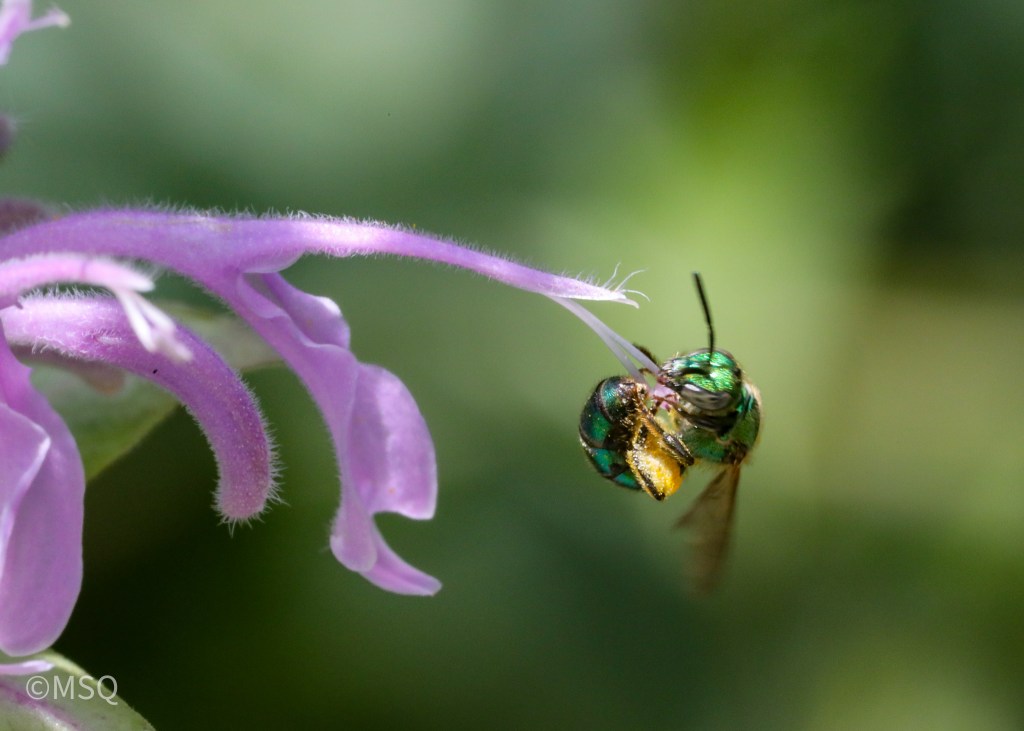
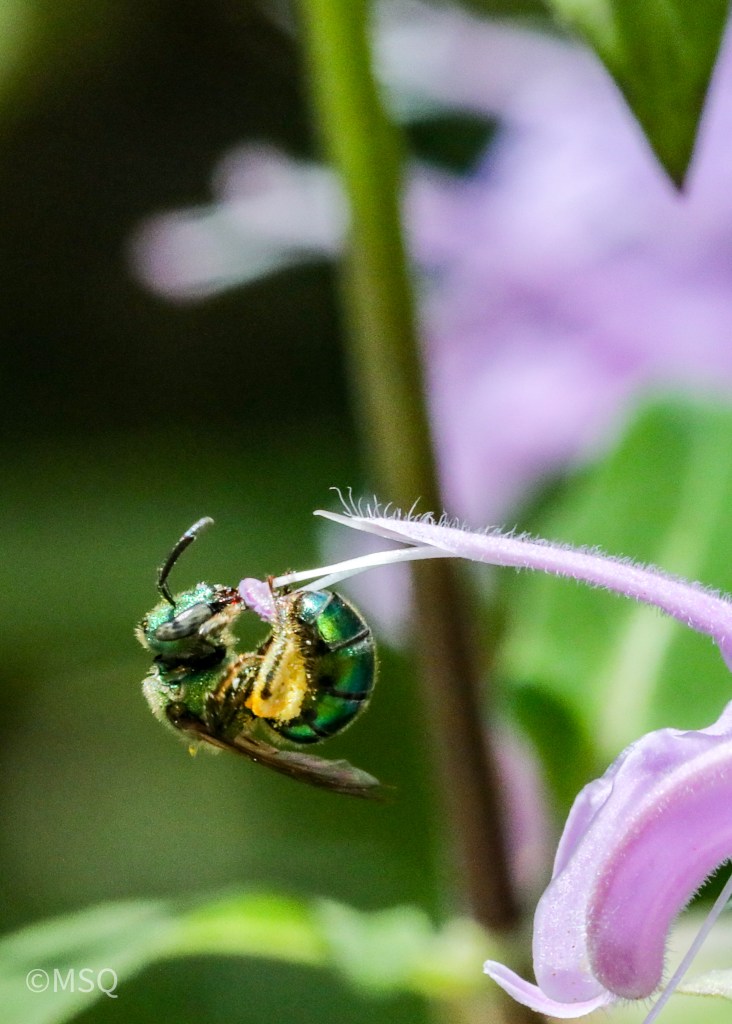
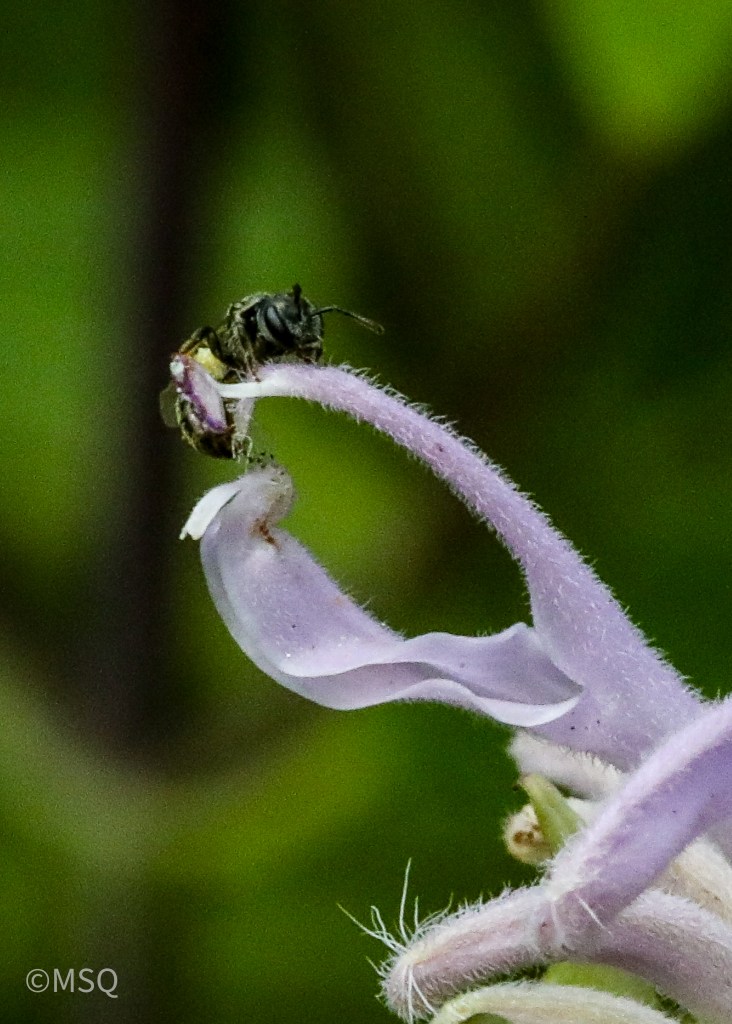
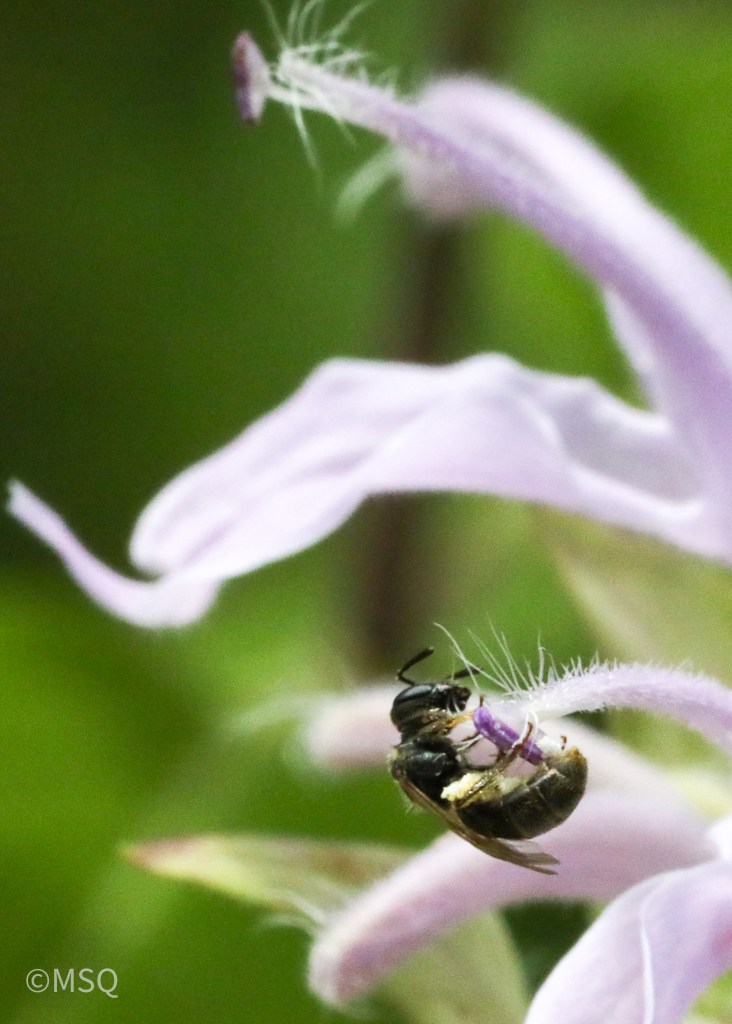
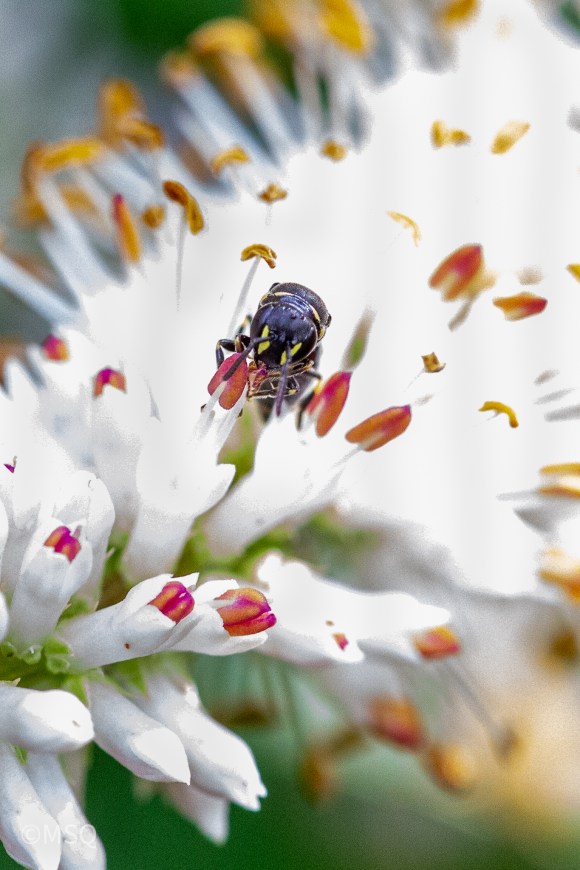
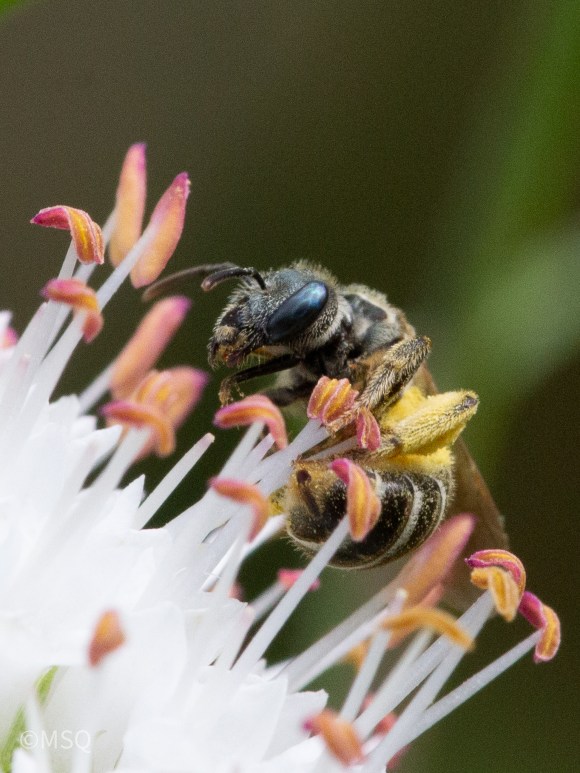
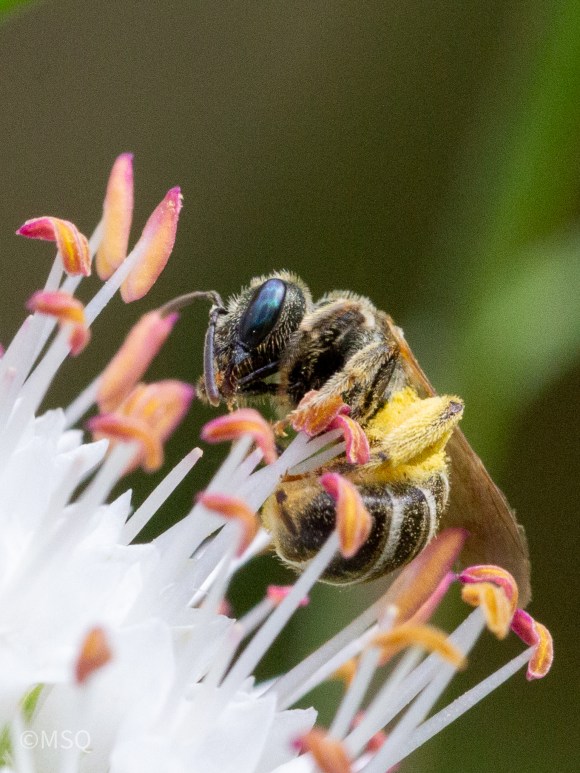
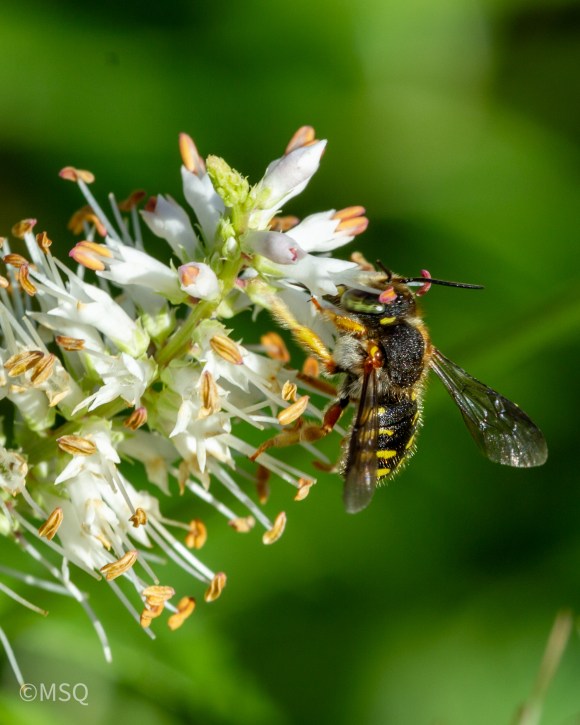
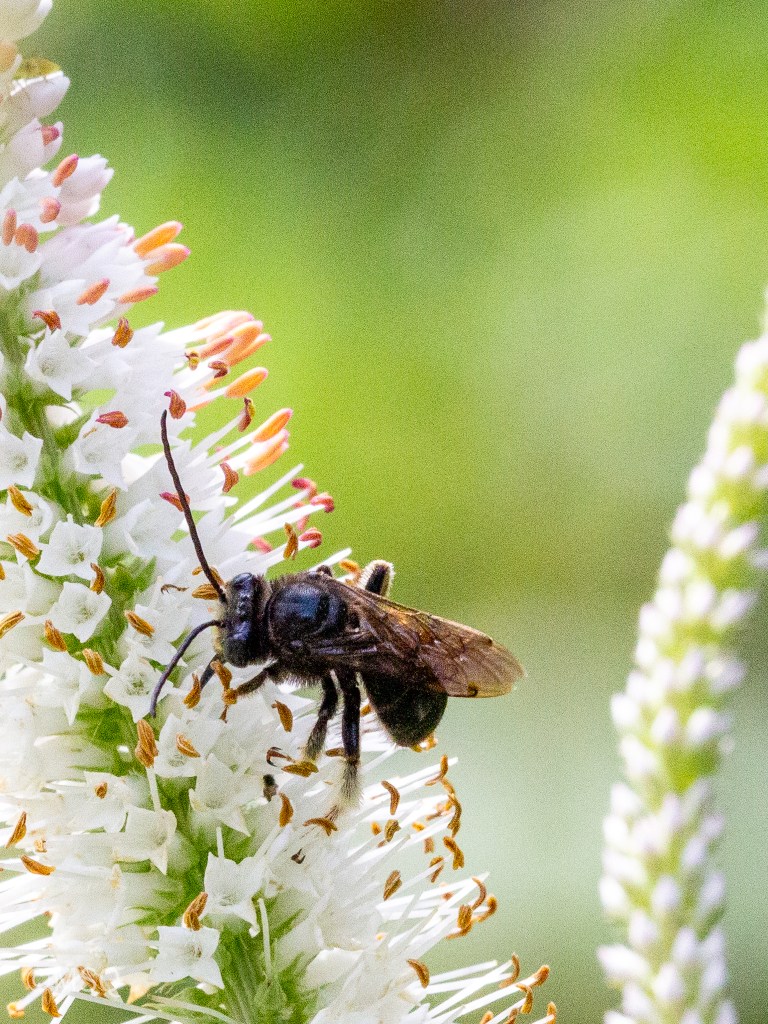
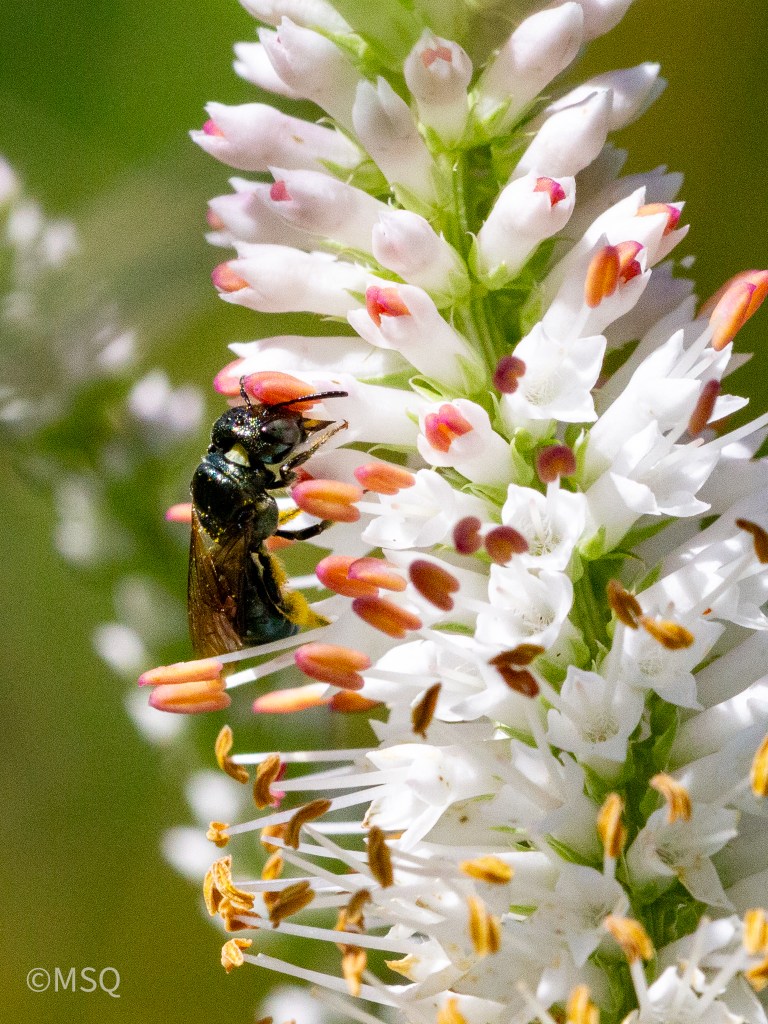
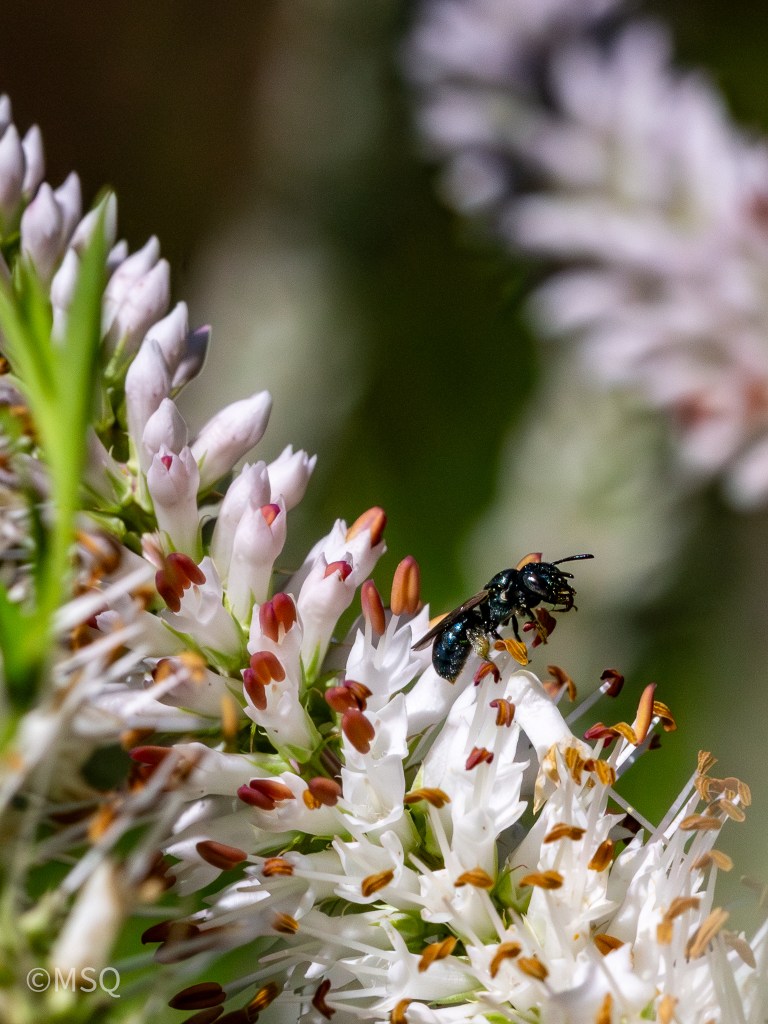
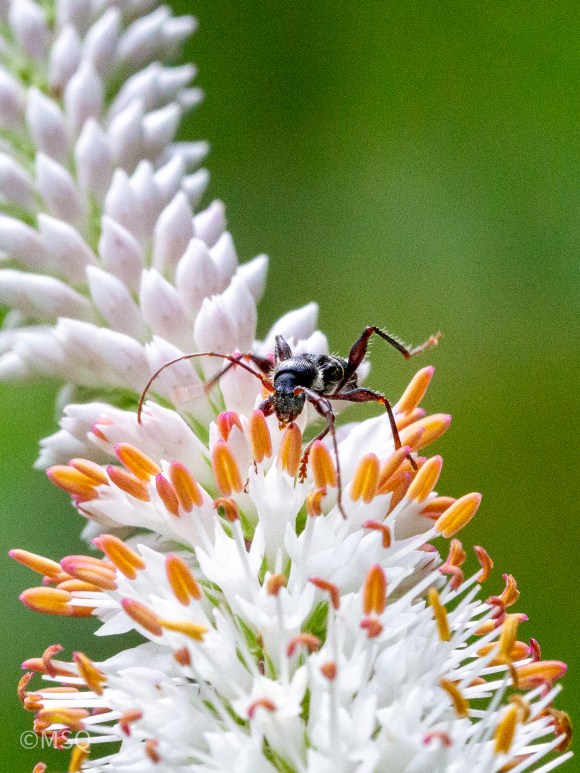
Culver’s Root feeds native bees, honeybees, and beneficial insects.  A range of native bees visit it including short and long tongued bees.  V. virginicum begins bloom by protruding its anthers outside the bud.  Small bees take advantage of this by collecting pollen. These pollinators include Hylaeus (yellow-faced bees).

Hylaeus or yellow-faced bees are one of the most recognizable small bees.  Mostly black, they have yellow or white markings on their faces.  These marking make them identifiable as Hylaeus although species determination can be tricky.  Yellow-faced bees grow from 5 mm (0.2”) to 7 mm (0.27”).  They nest in existing hollow cavities primarily in hollow stems or holes in wood. Some have been known to nest in stone.  Hylaeus line their nests with a silk or cellophane-like substance produced by the salivary gland.  The bee uses her bilobed tongue to paint on the secretions.  The lining is waterproof and protects the young from bacteria.  Chewed stem pith mixed with saliva is used for cell divisions and salivary gland secretions seal the completed nest.

One fascinating fact, yellow-faced bees are practically hairless.  Hylaeus don’t have any scopa or specialized hairs dedicated to holding pollen like other bees.  They also have short tongues and so can’t reach deeply into flowers.  These bees use their slender bodies to work their way into flowers to reach nectar and pollen.  They also chew on anthers to extract pollen.  Then Hylaeus swallow the nectar and pollen and hold it in their crop.  The crop is a sac separate from the stomach.  This fluid mixture is regurgitated and left for the larva to eat. 

Another fun fact, yellow-faced bees occur all over the world.  However, Hawaii is known for having 63 different species.  The yellow-faced bee is the only bee native there.  All the species found there are unique to Hawaii.

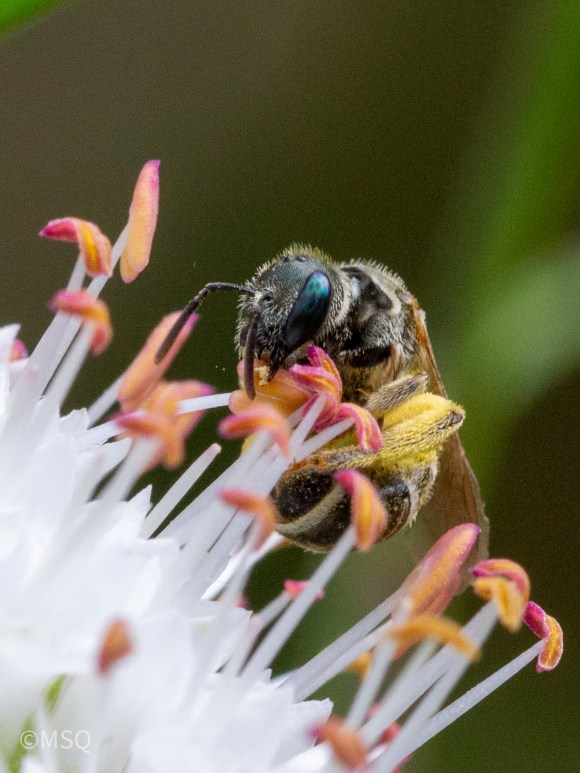
Lasioglossum (small sweat bees) visit Culver’s root and collect pollen and nectar. They use the hair or scopae on the hind femur and tibia to hold the pollen as well as the bottom of their abdomen.

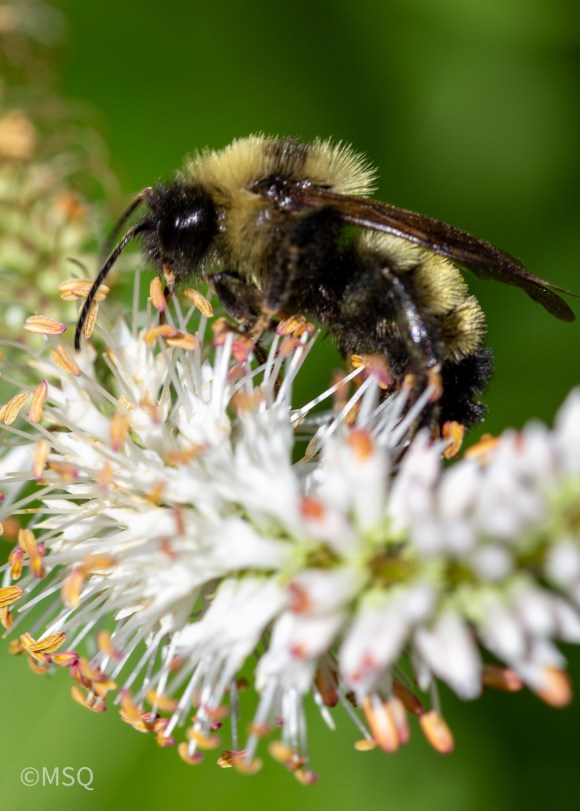
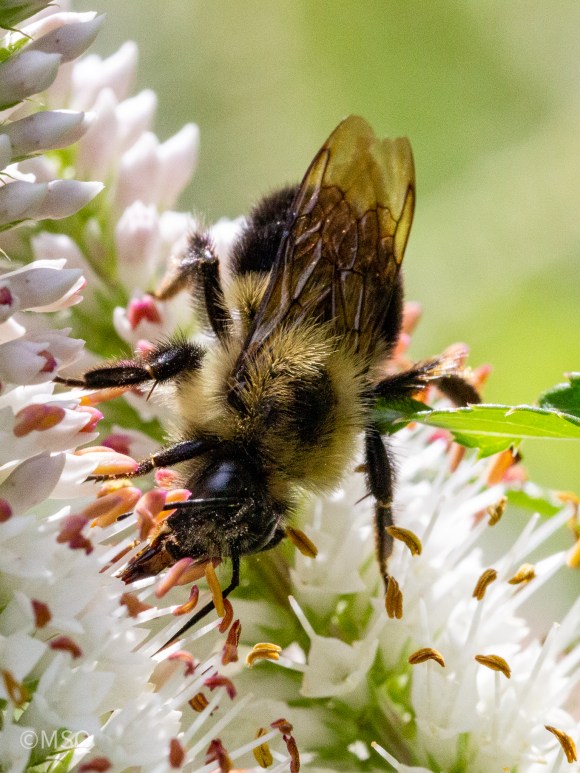
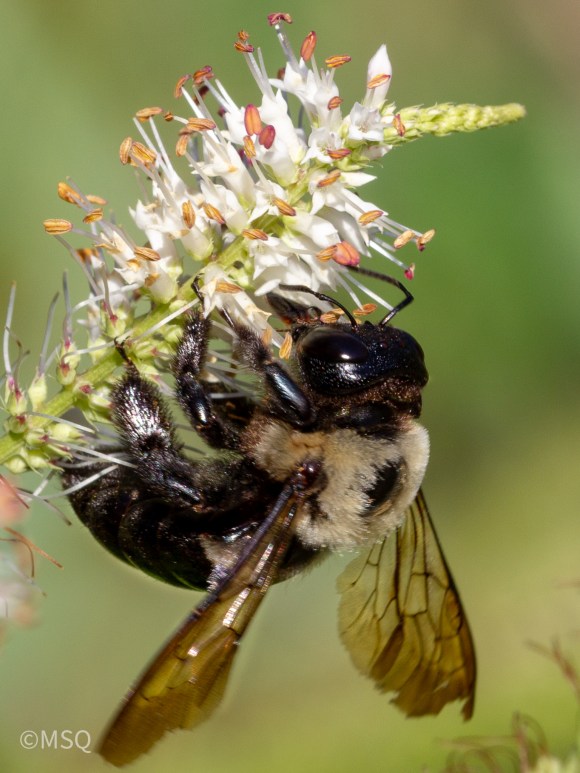
Once the flowers opens larger visitor arrive including bumblebees (Bombus)

and Leaf-Cutter bees (Megachile)

and Long Horned bees (Melissodes). 

Mason bees (Osmia) stop at V. virginicum to collect resources.

Large and small carpenter bees (Xylocopa and Ceratina) also gather nectar and pollen from Culver’s Root.  

This is also a plant for beekeepers.  Honeybees enjoy V. virginicum when they can find it.  I’ve often seen them gathering nectar from this plant in my garden.

                                                    ­

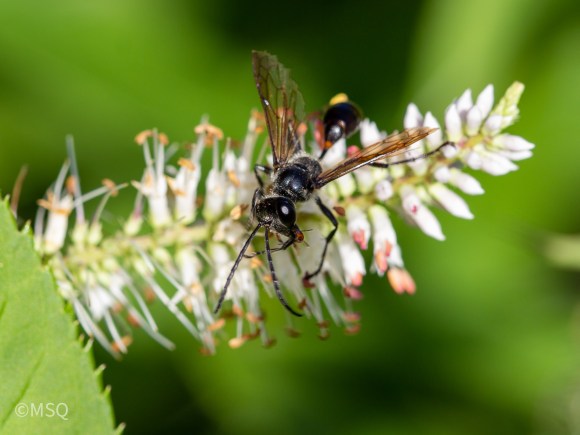
The sphecid and the potter wasps also benefit from the flowers.  They gather nectar to support them while building and filling their nests. I often see the thread-waisted Mexican Grass-carrying wasp (discussed in “White Goes With Everything”, https://wildthingsinthe.garden/2023/05/31/white-goes-with-everything/) on this plant.

These groups of scary insects look nothing like our sweet fluffy bumblebees.  Sphecid wasps resemble nightmare creations with bizarre tiny waists, long thin legs, and triangular heads.  The vespid wasps, which include the potter wasp Eumenes fraternas, can resemble sphecid wasps.   Sadly, they can also look like yellowjackets, hornets and paper wasps who share their family.  Yet when I meet these wasps in the garden, they’re gentle and shy.  

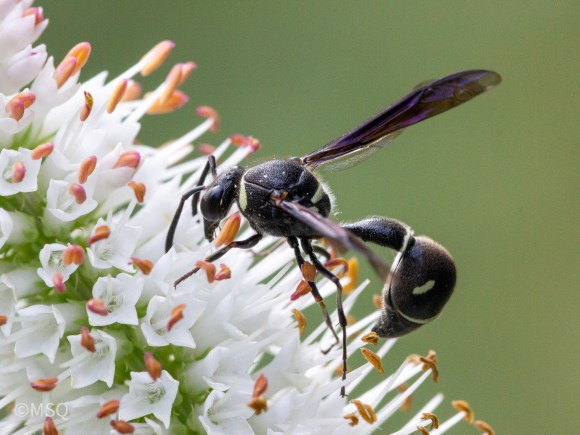
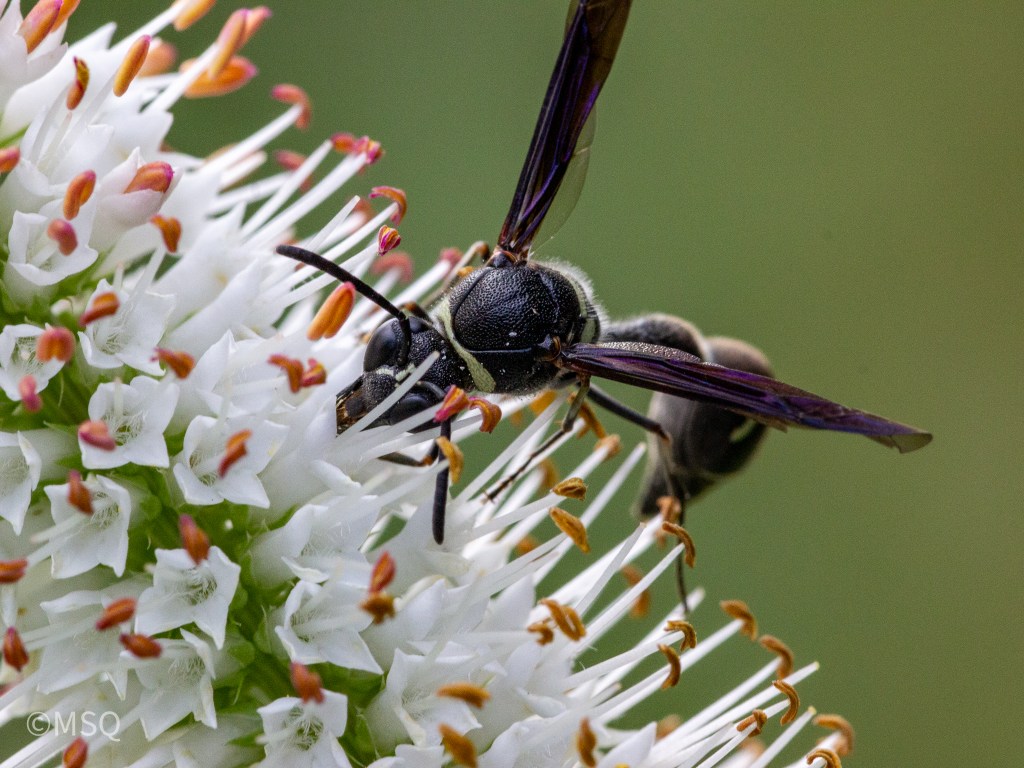
Today, let’s talk about Eumenes fraternas. This wasp is in Vespidae family, subfamily Eumeninae, also called potter and mason wasps.  Eumenes fraternas is a potter wasp that regularly visits the Culver’s root in my garden.  She creates her nest using soil and water.  This wasp collects, mixes, and shapes her mud until she completes a small pot with a flared rim.  The nest is built on a large leaf, sturdy stem, or a home/structure.

Then, the wasp lays a single egg fastening it to the top of the pot with a silk-like thread.  The nest pot is provisioned with several caterpillars.  E. fraternas preys on cankerworms or inchworms.  The potter wasps frequently hunt moth larva in the Geometridae family.  Geometer caterpillars are often pests of native trees eating large amounts of leaves, in some cases, stripping them.

Like other solitary pollinators,  E. fraternas is entirely responsible for her eggs.  It is in her best interest not to sting.  I have found these solitary wasps to be quite cautious.  This holds true for the thread-waisted wasps in my garden and the Mexican Grass-carrying wasp.  If I bump a plant, they’ll fly away while bumblebees persistently keep feeding.  Still, they can sting if handle roughly.

Thank you so much for joining me!  I hope you enjoyed reading about Veronicastrum virginicum, Culver’s root, and consider adding it to your garden. Please let me know what you think of the post and tell me what’s going on it your garden by leaving a comment!

Many Thanks!

Mary

Categories
Pollinator gardening

White Goes with Everything

Summer comes with a tidal wave of pollinators in all shapes and sizes.  The garden itself explodes in a celebration of flowers.  With so many plants blooming in July and August–Why add more?  Because this native shines.  It serves a huge number  of pollinators, flowers for weeks and pairs well with a diversity of other colors.  The pale flowers literally glow in the dazzling summer sun or in dusky evening light.

Mountain Mint, Pycnanthemum virginianum, begins opening its blooms in early July.  The flowers grow as flat-topped clusters of many tiny lavender-spotted florets.  The florets open from the outermost ring to the center.  This pattern of florets opening one by one prolongs the bloom time.

The plant provides a wonderfully stiff, erect form in the garden.  The leaves can be up to two inches with a thin, lance shape and a strong center vein, almost a crease.  They have a spicy, minty fragrance.  Overall, Pycnanthemum virginianum has fine textured foliage with medium green color.  Liatris spicata grows beautifully with Mountain Mint.  The dense, purple pillars of the Liatris blooms offset Mountain Mint’s flat white flowers.

Mountain Mint enjoys growing in zones 3 through 7 in full to part sun.  It will grow two to three feet high and should be spaced 12 to 18 inches apart.  It grows in wet to medium-dry soil.  I grow one clump next to my south-facing sidewalk with some afternoon shade.  It’s thriving and only occasionally needs staking on the sidewalk side.  

This plant will self-seed once mature.  Pull seedlings immediately if you don’t want the plant.  They have deep, tough roots even when young. Also, there are reports of Mountain Mint taking over gardens with humous rich, wet soils.  If that’s the case, plant it in sunken pots as you might do with other mints.

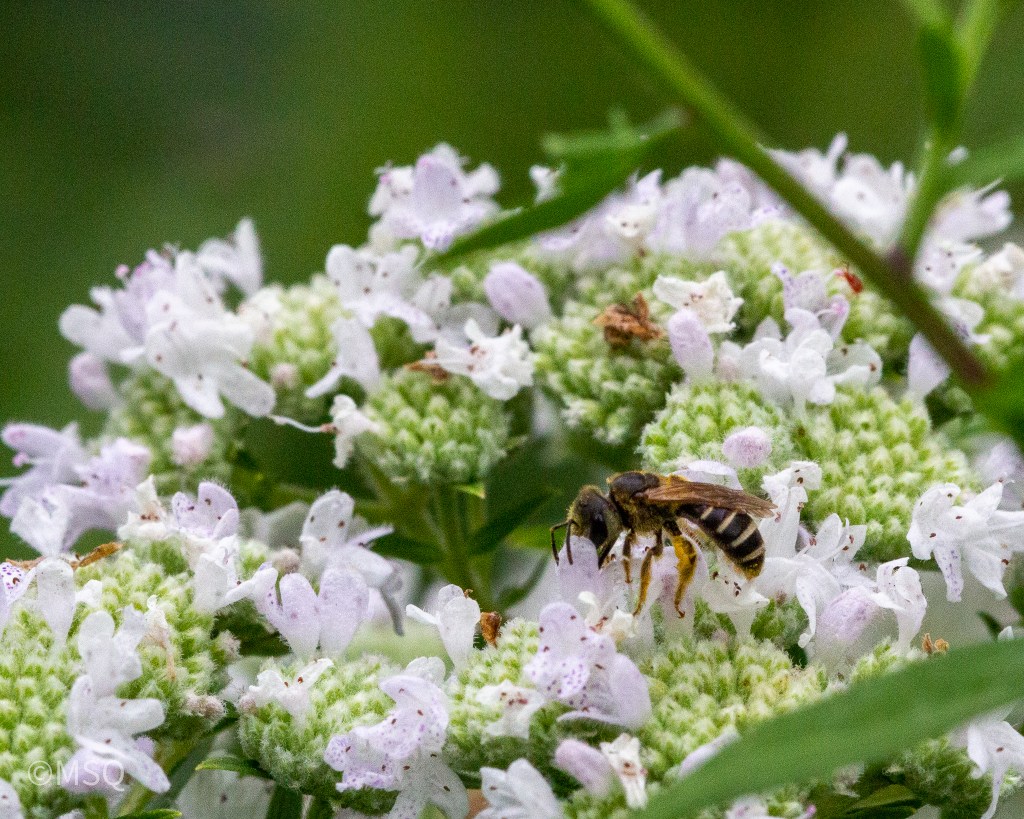
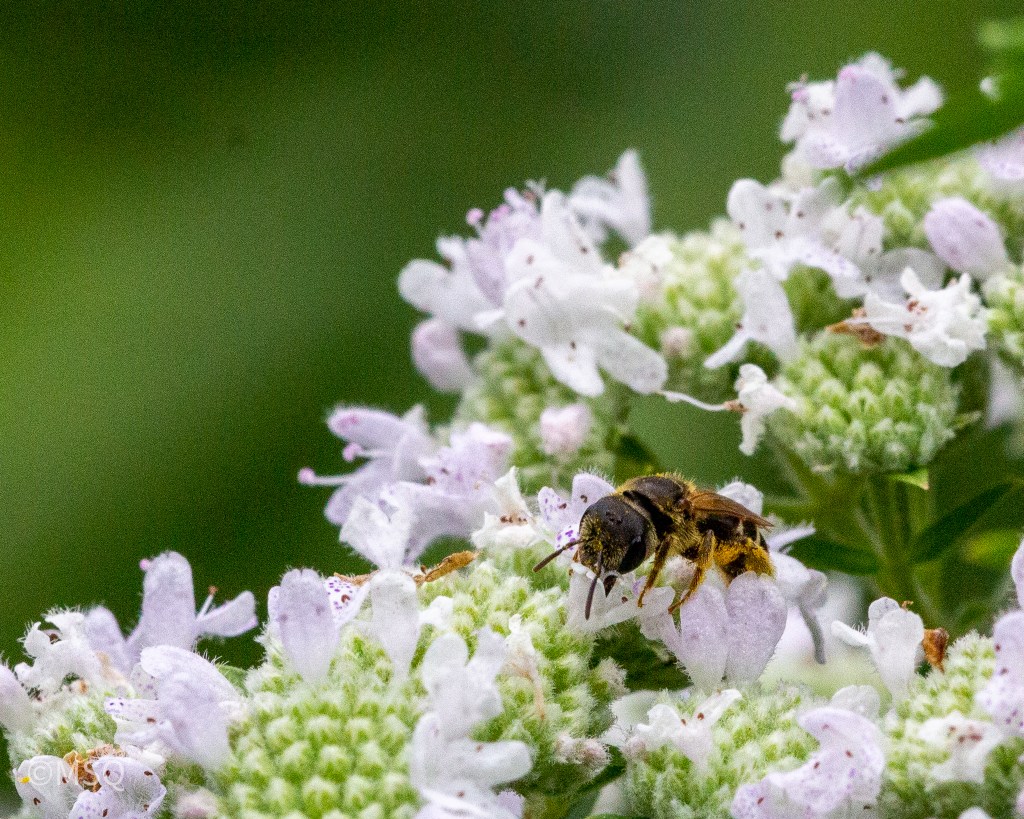
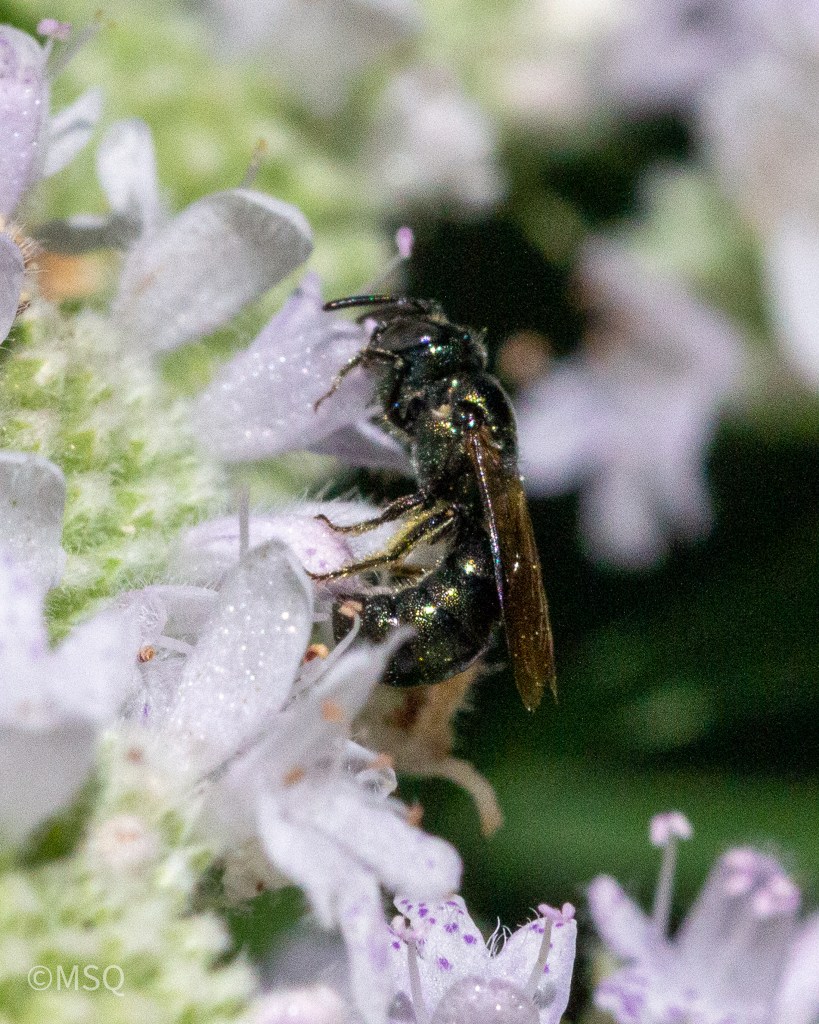
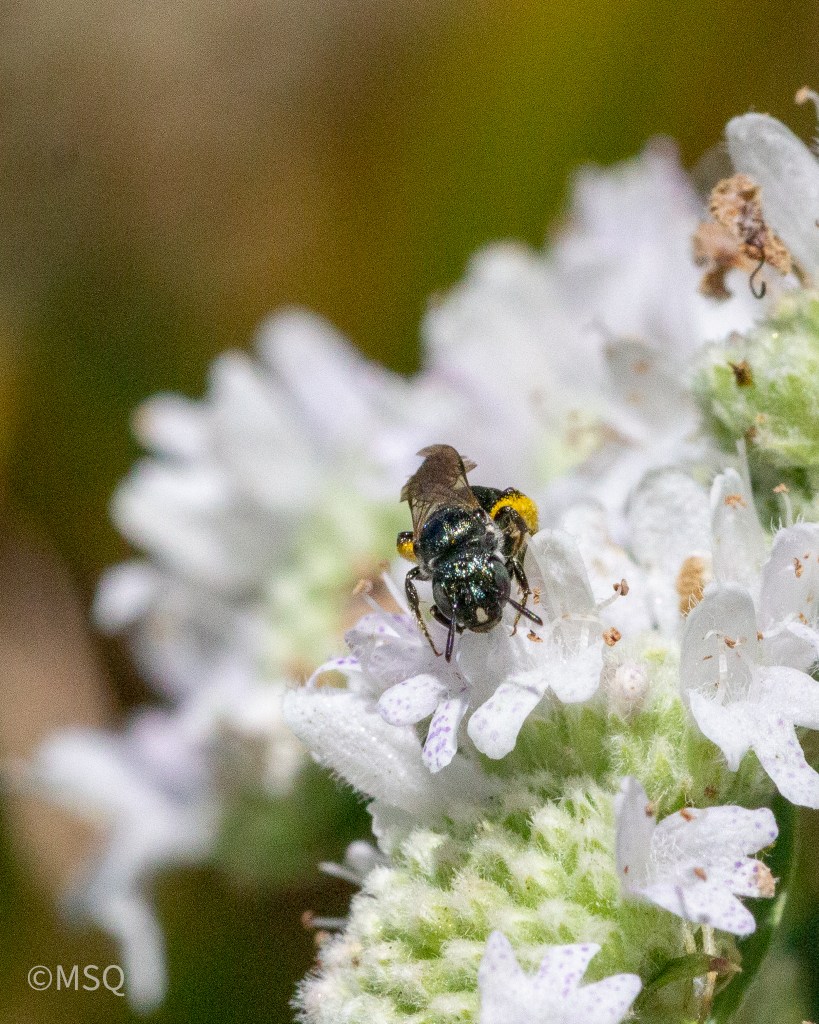
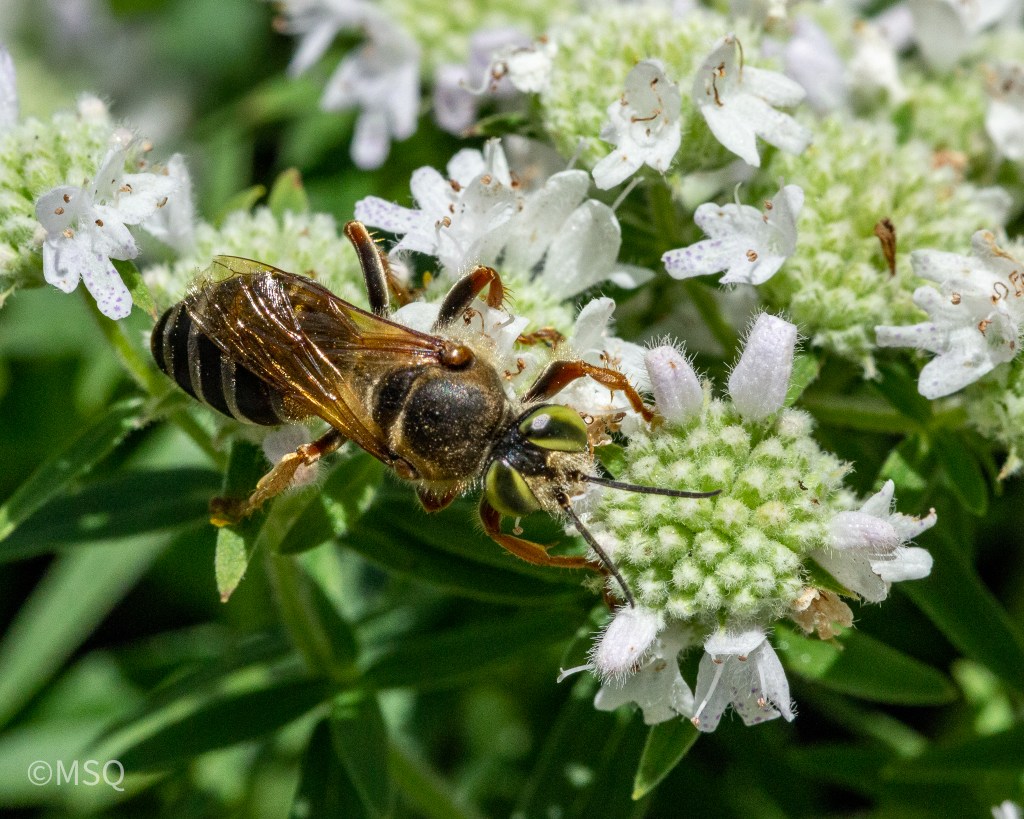
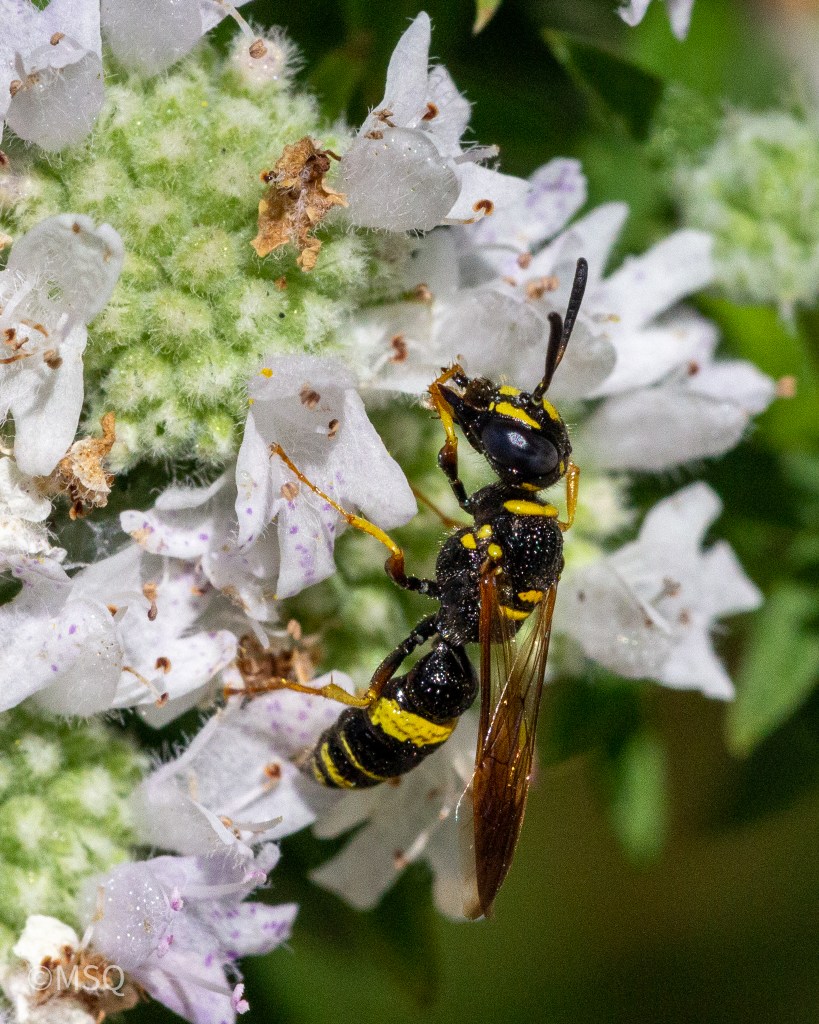
While a brilliant plant all on its own, Mountain Mint is also hugely popular with pollinators and beneficial insects, large and small.  It’s visited by yellow-faced bees (Hylaeus), metallic green sweat bees (Agapostemon and Aurochloropsis), and small resin bees (Heriades)—all tiny bees.

Carpenter bees enjoy Mountain Mint. These gentle bees concentrate on gathering nectar and pollen for their young.  Carpenter bees pollinate wild plants while gathering food.The males cannot sting and the female rarely do.

In nature, these bees nest in soft wood and pithy plant stems.  They can be pests if they nest in the wood of a house and seem to like cedar, redwood, pines, and other soft woods.  If they are nesting in your siding, eaves, deck, etc., it’s because the wood is weathered or unfinished.    Keep your wood painted or stained regularly and carpenter bees shouldn’t bother you. 

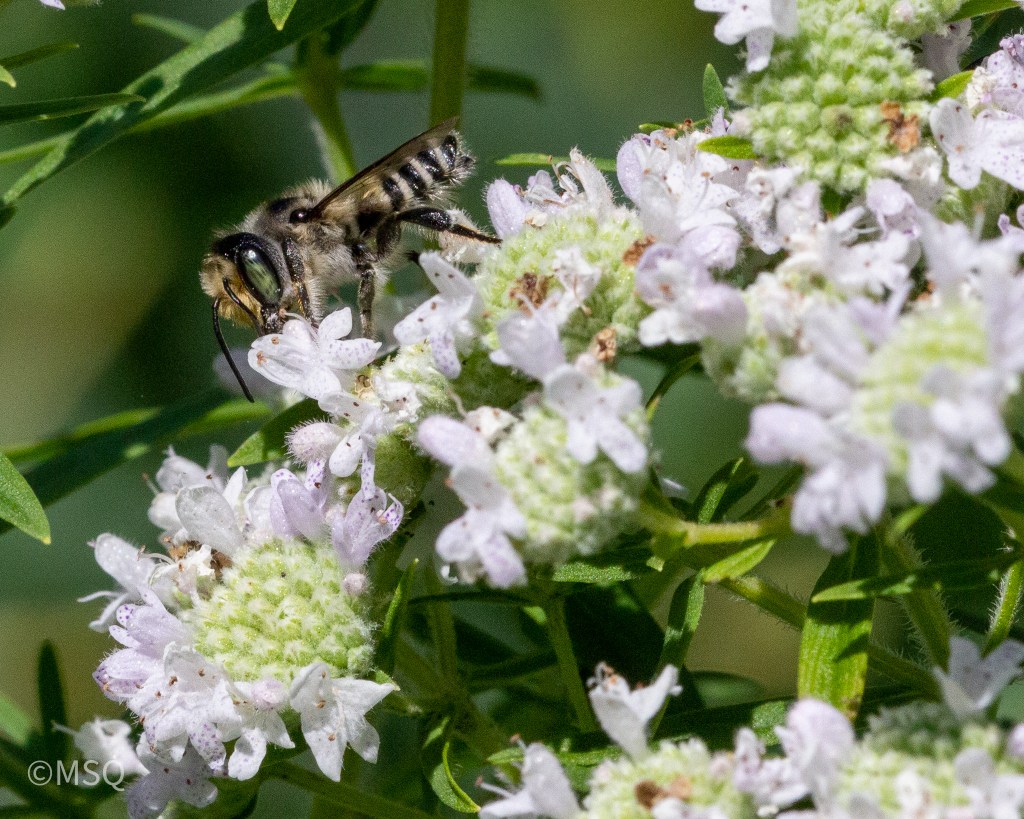
Leaf Cutter Bees also visit Pycnanthemum virginianum for food.  These medium-sized bees use P. virginianum for food.  Their name comes from using pieces of soft leaves to create nest cells.

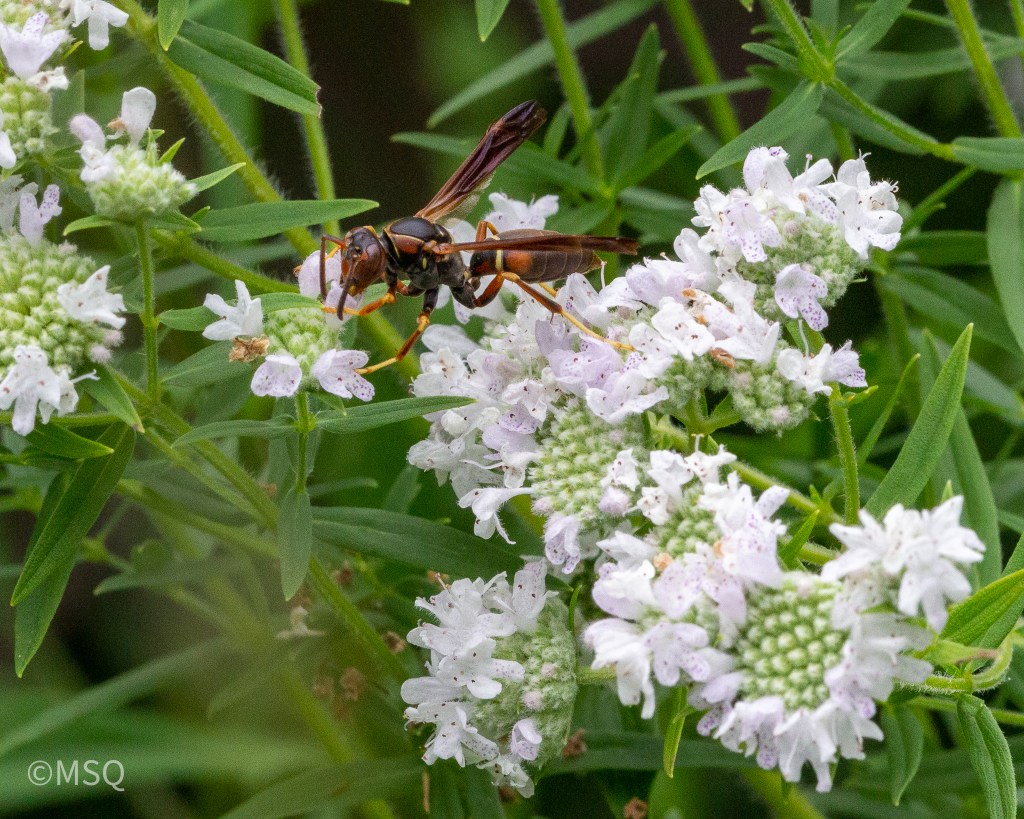
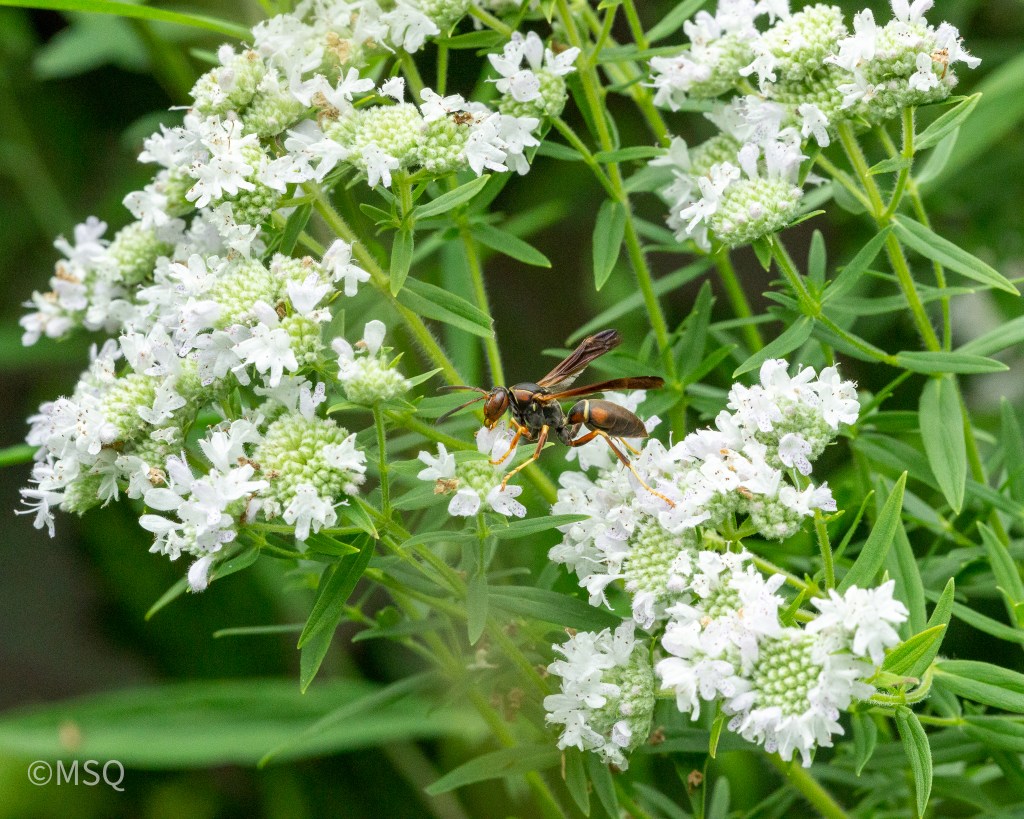
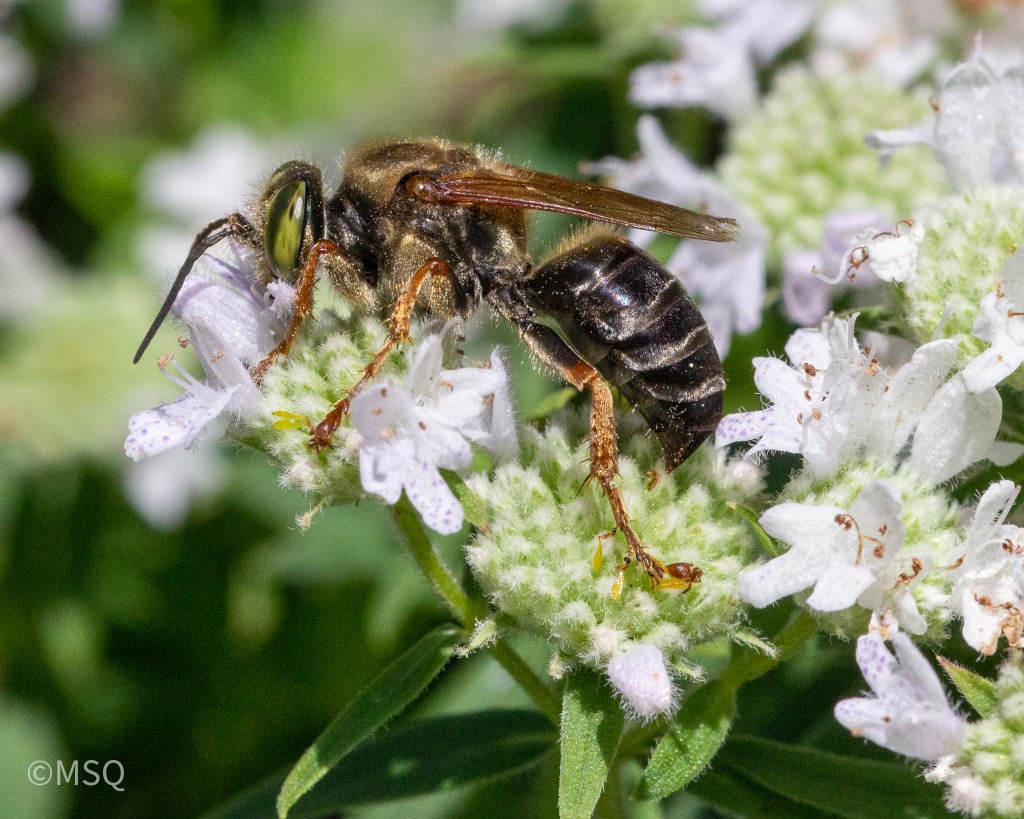
Mountain Mint also hosts a variety of wasps.  Some of these wasps serve as beneficial insects feeding pests to their young.  The Tachytes wasp or Sand Wasp hunts katydids and grasshoppers.  They use either nymphs (young) or adult insects depending on what’s available.  These wasps most frequently nest in sandy soil.

The Gold-marked Thread-waisted Wasp, Eremnophila aureonotata, is a gorgeous wasp with metallic markings and a strikingly triangular face.  I usually see silver-marked individuals whose spots look white in some lights.  This handsome pair is on their mating flight.  The larger female in on the bottom.  Eremnophila aureonotata is one of the thread-waisted wasps.  These wasps have reduced their “waist” to a thin tube called a petiole.  The shape of the petiole helps with identification. 

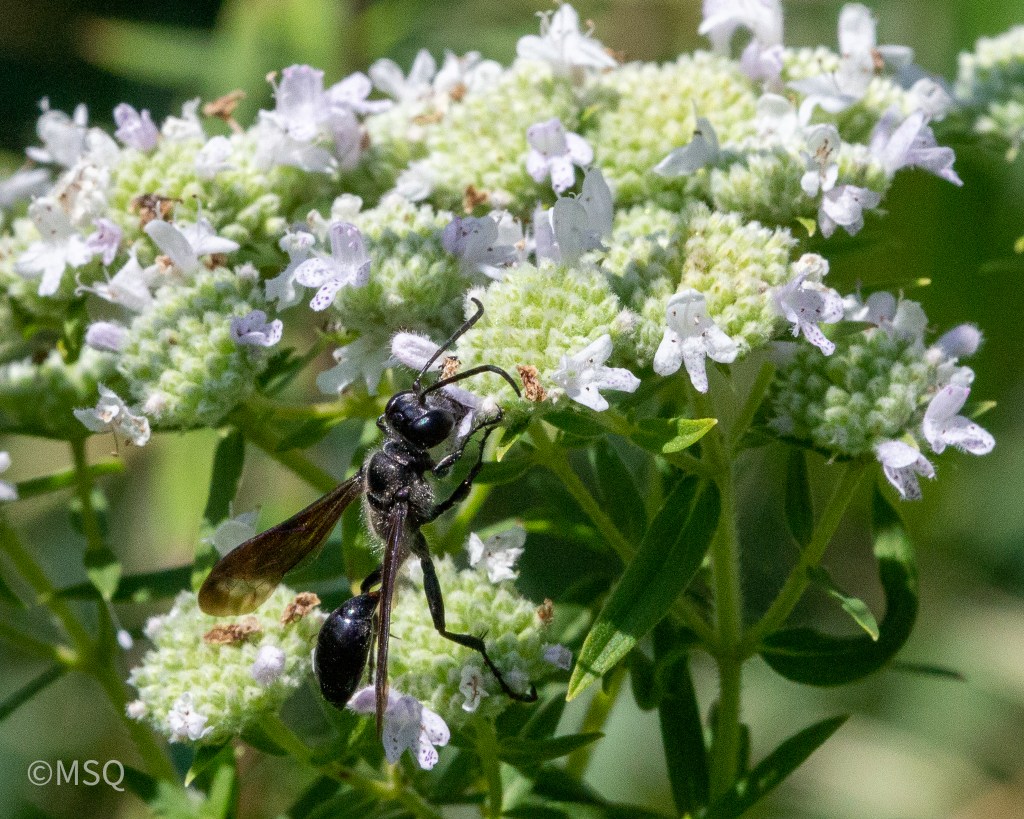
Isodontia mexicana, Mexican Grass-carrying Wasp, is another thread-waisted wasp.  Despite its name, Isodontia mexicana is native to all North America.  In addition, it’s been accidentally introduced into Europe.  It hunts tree crickets or katydids—both nymphs and adults.  This wasp builds its nest in hollow cavities and lines the nest with pieces of grass.  Grass-carrying wasp can nest in screen windows.

On Mountain Mint

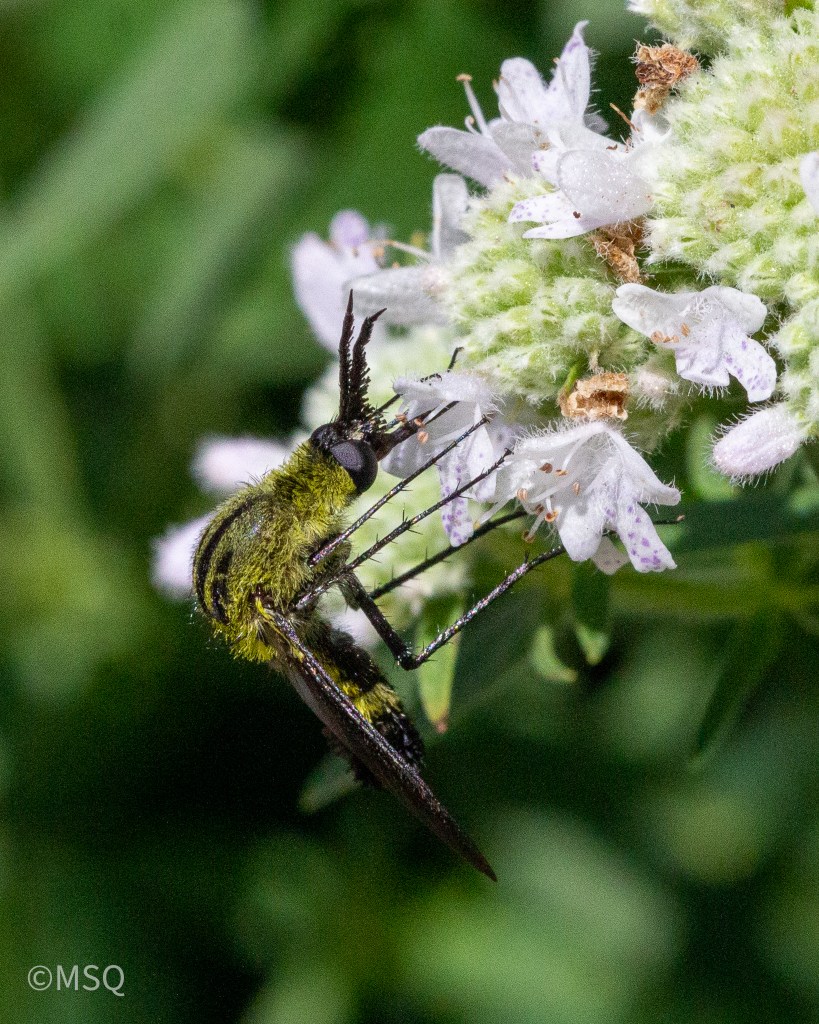
Interestingly, several bee predators also come to my Mountain Mint.  The bee fly, Lepidophora lepidocera, and the bee wolf, Philanthus.  I had mixed feelings about them when I realized they were bee hunters.  But then I remembered, predators are a sign of a healthy ecosystem.  The garden has enough bees to also support them.

The bee fly is an active and efficient pollinator of early spring wildflowers such as Spring Beauty, Claytonia virginica.  They visit some of the same flowers that bees do but make many more trips.  In this way, these flies may be even more effective pollinators.

Here’s the downside of Lepidophora lepidocera—it eats bee’s larva!  And uses an extraordinary tactic to deposit its egg.  The fly covers its egg with sand or dirt, possibly for camouflage.  It hovers around the nest entrance until the bee leaves.  The fly flips an egg in or near the nest with its abdomen.  Then larva eat both stored pollen and the bee larva.  The maggot pupates in the burrow waiting until next Spring to emerge.

What an amazing diversity of insects on one plant!  Alone it can increase pollinator visits to any garden.  With its long-lasting bloom, easy care needs and versatile color, Mountain Mint makes a wonderful addition for the summer garden.

Categories
Pollinator gardening

A Surprising Vine

Filling the lull between early Spring and Summer flowers

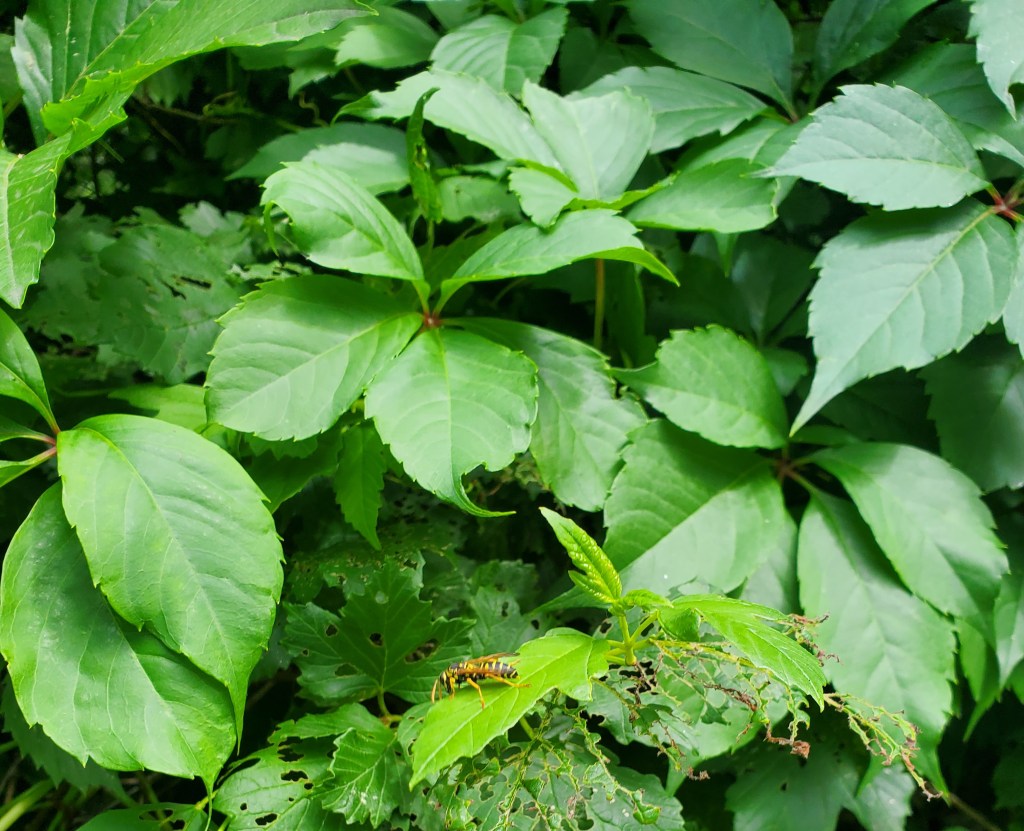
Virginia Creeper—people love it or hate it.  When hated, it’s an invasive, woody vine that kills trees and is impossible to control.  When lovable, Virginia Creeper is an adaptable climber with abundant dark green leaves that doubles as a ground cover.  To add to the controversy, there are two plants commonly called Virginia Creeper-Parthenocissus inserta and Parthenocissus quinquefoliaP. inserta even has a Latin synonym of Parthenocissus vitacea.  The two Virginia Creepers grow over essentially the same range and, except for subtle differences, look basically the same.  

Today, I’m loving Parthenocissus inserta (Virginia Creeper or Woodbine) for the value of its late Spring flowers.  Parthenocissus inserta begins blooming as Baptisia australis  (False indigo, as discussed in my last blog post, https://wildthingsinthe.garden/2023/03/06/the-magnificent-month-of-may-and-june/) starts to fade and continues until early summer.  In a sunny spot, the small blooms form lavish clusters available to mid- to late Spring native pollinators.   

But there’s more!  This vine is incredibly versatile.  P. inserta climbs when given a little support for its twining tendrils.  It works as a tough groundcover too.  In the end, P. inserta rewards you with charming clusters of bloom and vibrant green leaves. These are followed by bright red fall color and blue-black berries enjoyed by birds and wildlife.

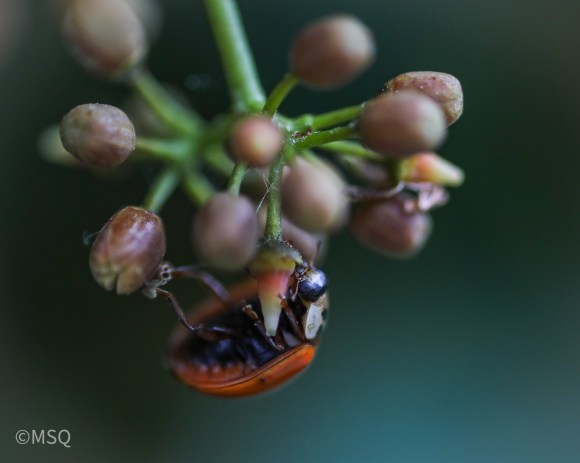
Virginia Creeper’s flowers appear in late Spring.  Grouped in clusters, they begin as green buds.  As they develop, these buds turn rosy.  Then the petals open to bend completely backward against the base (or recurve).  Petal color can vary from deep green with just a touch of yellow at the base to a deep reddish-brown fading slightly toward the center.  In both cases, the petals have white to pale yellow edges.  The stamens rise from a cone-shaped pistil.  Yellow pollen rests on red anthers and these are held on white filaments.  The bi-colored pistil has a red base tipped with yellow.  Nectaries are located around the base of the pistil.  Different insects explore this nectar supply and drink.

Once fertilized, the blooms change into 1/4-3/8”, blue-black berries with a slightly frosted exterior.  They’re poisonous to most mammals – although deer do eat them and survive.  Birds appreciate the berries.  Woodpeckers, flycatchers, vireos, bluebirds, and thrush visit Woodbine.

The leaves are really the main attraction of Woodbine for the gardener.  They’re richly green all spring and summer, screening whatever is underneath or behind.  Palmately compound, in five sections, each part is coarsely toothed.  The upper part is medium green and more or less glossy, the lower side pale.  Usually smooth, the lower leaf will sometimes have hairs along the veins.  In early fall, they turn a brilliant scarlet.   

Woodbine’s stalks and stem are hairless and green when young.  They turn brown or reddish–brown and become woody as the plant grows.  Length estimates range from 20 to almost 100 feet although most of them fall between 40 and 60 feet.  The fall leaves often shine above the trees where the vines have grown up a dead tree trunk.

Woodbine climbs using single curling tendrils that wrap around a support.  The tendrils develop opposite leaves and can have 2 to 3 branches.  These tendrils separate P. inserta from Parthenocissus quinquefolia(the other Virginia creeper).  P. quinquefolia has branching tendrils (up to 10 branches) with adhesive pads at the end of each.  The curling tendrils of P. inserta mean it cannot grow on a smooth support like a pole.  Woodbine can and does grow over rocks and shrubs.  It will push its tendrils into crevices in rocks and wood to climb.  The tendrils expand to help hold it in place. 

P. inserta grows in full sun to full shade and dry to wet conditions.  It tolerates all types of soil and pH.  Woodbine can even be used as a xeriscape plant.  In the garden, it can be used as a climbing vine or as a groundcover.  

However  it does require regular maintenance.  Prune to keep vines in check.  Pull and prune back groundcover.  For best Fall leaf color and best chance of bloom, plant in a sunny location.  Overall, the best growing conditions are part to full sun and moist, well-drained soil with high organic matter.  

I’ve already talked about how Parthenocissus inserta looks like Parthenocissus quinquefolia and both have been called Virginia Creeper.  When I searched for information on pollinators and/or beneficial insects using Woodbine or Virginia Creeper, there was confusion between the two plants.  P. quinquefolia was listed with photos that looked like P. vitacea.  For the insect facts, I’ll use information from sources where photos confirm P. inserta, sources listing P. vitacea or P. inserta or from my own photos.

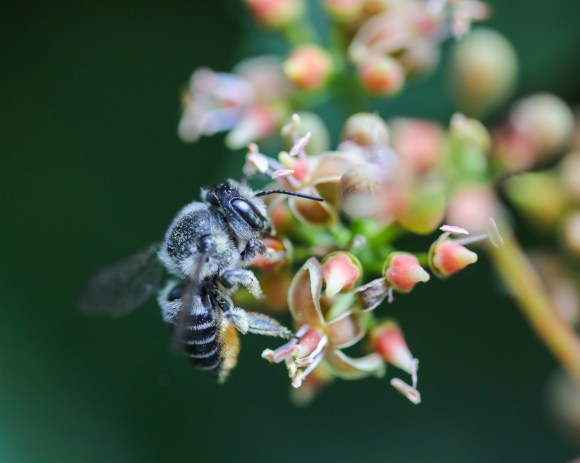
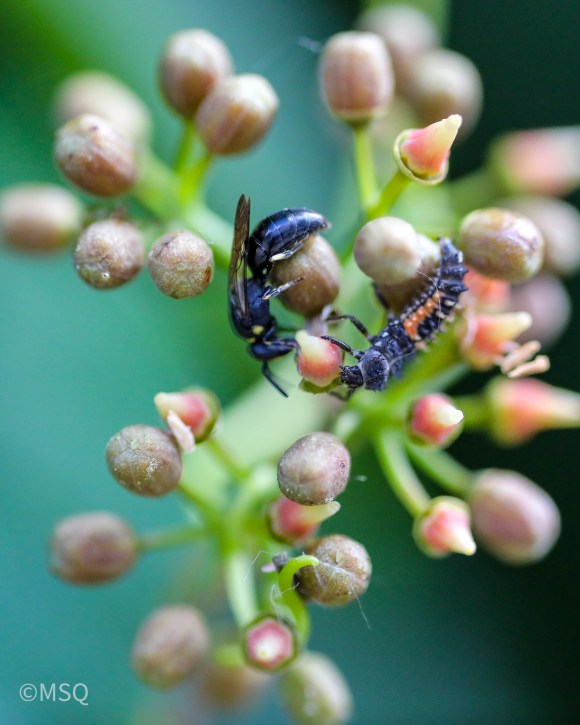
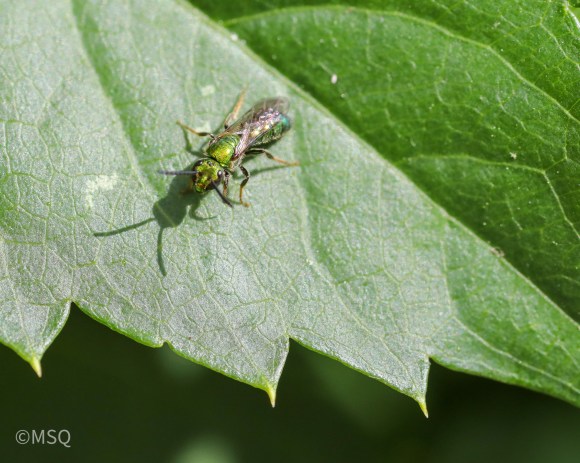
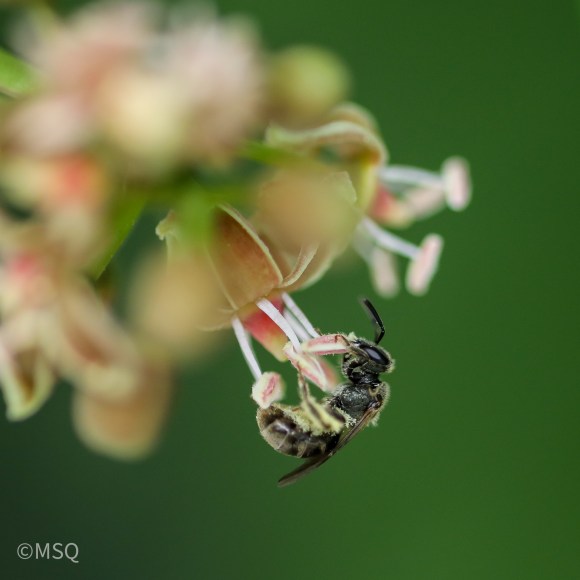
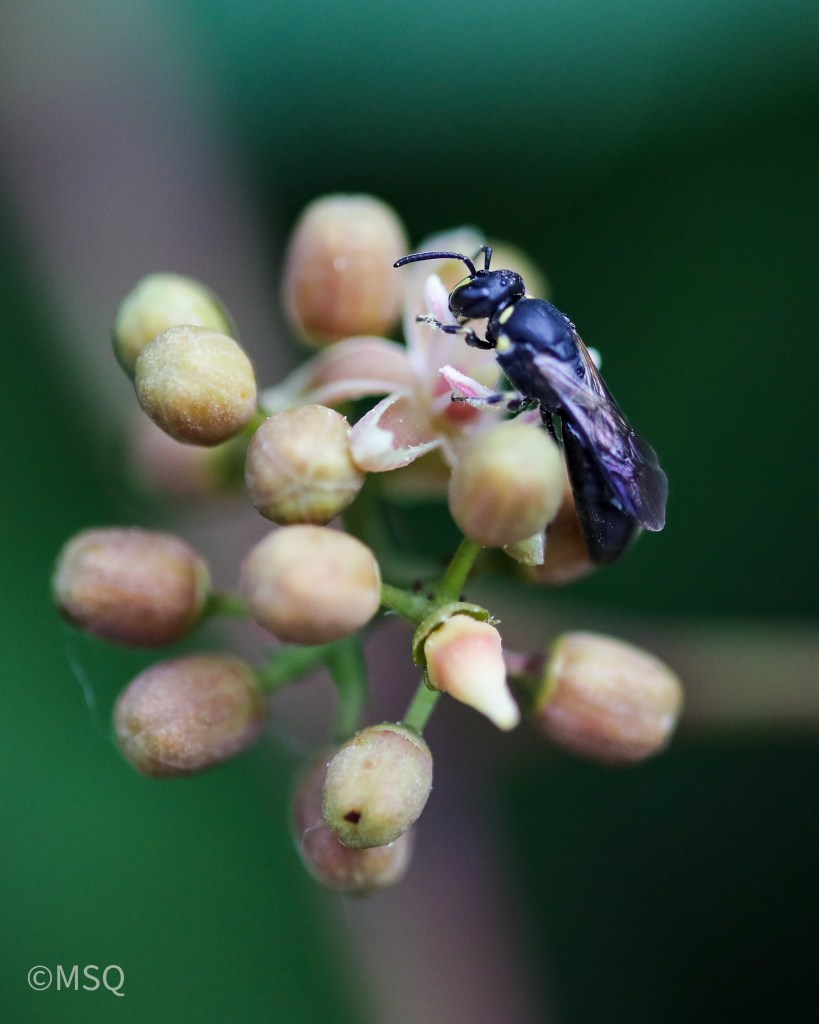
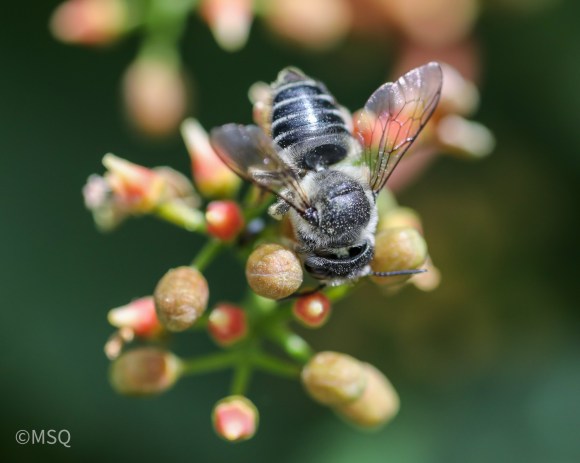
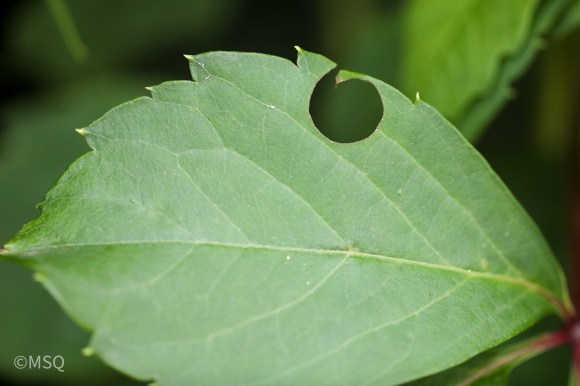
Many early pollinators visit P. inserta blooms.  Small metallic sweat bees use pollen and nectar.  Leafcutter bees, Megachile, use the flowers for food and cut pieces of the leaves to line their nest cells.  Masked-face bees, Hylaeus, stop at Woodbine for pollen and nectar.  Bumblebees and Honeybees also use its resources.

P. inserta is also a host for a variety of Sphinx moths including the Lettered Sphinx Moth (Deidamia inscriptum) and the Pandorus Sphinx Moth (Eumorpha pandorus).  The Sphinx moths produce enormous larva followed by large adult moths.  The Lettered Sphinx Moth has a 1 ¾” to 2 ¾’ wingspan while the Pandorus Sphinx Moth ranges from 3 ¼” to 4 ½”.  

Sphinx moths serve as pollinators by chance.  They often drink nectar by hovering in front of the plant and using their long proboscis.  The proboscis is a very long mouth tube, the equivalent of the moth’s tongue.  Pollen grains stick to the proboscis after nectaring.  When the moth travels to another flower, it can transfer some pollen to the next bloom.

Virginia Creeper or Parthenocissus inserta supplies many resources to native pollinators.  It’ll thrive in an abundance of locations and, as a vine, can be used in various ways in the garden.  Enjoy this grand plant in Spring, Summer and Fall! 

I hope you enjoyed reading my blog!  Please contact me with any questions or to subscribe.  I’d love to hear about your adventures with wild plants and pollinators!

Categories
native plants Pollinator gardening

The Magnificent Month of May—and June

Or when we’re ready for Summer but it’s not ready for us

Late Spring and the first burst of flowers has come and gone.  Delicate and lovely, these early flowers always warm our hearts after Winter but it’s still a long wait for the wild, abundant bloom of summer.  While we wait, let’s fill these late Spring days with more flowers.  And for those flowers, enter my next two plants—Baptisia australis and Parthenocissus vitacea.  

These two stars of late Spring and early Summer are big, bold, and versatile but very different.  And as I wrote I realized they’re too big to share one post.  Today’s post is about Baptisia australis and I’ll save Parthenocissus vitacea for next time.  Baptisia australis is a beloved, award-winning garden plant.  As well behaved, as it is beautiful, it’s perfect for any garden with enough space and sun.

Baptisia australis, (Baptisia), also called False Indigo or Wild Indigo, gives a glorious burst of late Spring bloom beginning at the end May and extending into early June.  Truly a special plant, Baptisia australis was the first straight species native (non-hybrid) chosen as Perennial of the Year in 2010 by the Perennial Plant Association.  This award draws a lot of interest because the chosen plant must be low maintenance, grow in a wide range of climates, be interesting in several seasons and relatively pest and disease-free.  B. australis manages to do all that naturally.

A plant so large it could be a shrub, Wild Indigo serves as a stunning accent plant!  It grows three to four feet wide and high.  Unlike its cousins the lupines, Baptisia isn’t picky about growing conditions.  Give it sun and some water and you can expect beautiful full growth and lush flowers.  It’s also deer resistant, salt tolerant and suitable for xeriscaping once established.

Xeriscaping is landscaping using little or no water from irrigation.  Some people extend the definition to include little to no maintenance.  If your Baptisia breaks off and rolls way to have its own adventure, then it’s absolutely no upkeep.

The Baptisia does have to become established in the garden before it’s fully resistant.  As it grows, Baptisia develops an extensive root system.  The roots can grow up to 12 feet deep and 3 to 4 feet wide.  Choose its location carefully, Baptisia does not take transplanting well.

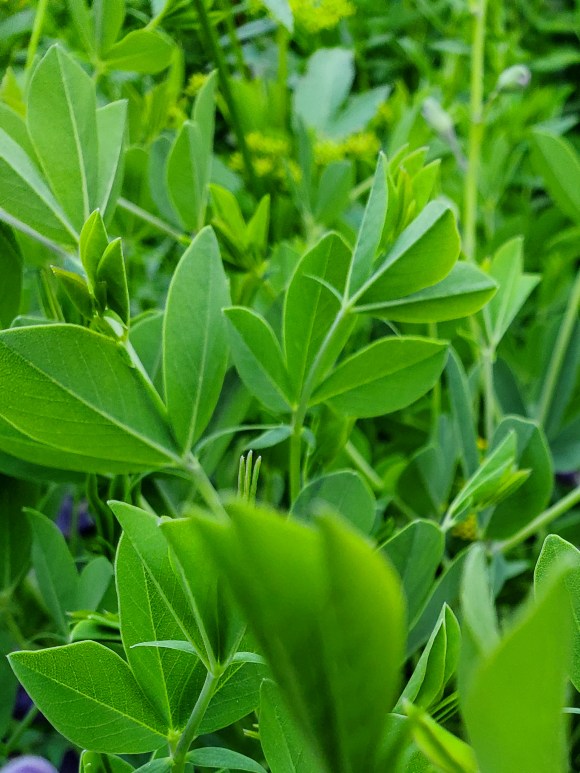
Baptisia’s leaves are three part and slightly creased at the center vein.  Light green with a slightly bluish tinge, the foliage provides a highlight in the garden.  Some Baptisias, like B. australis, have a rounded form down to the grown.  Other Baptisias are vase shaped with bare stems at the base of the plant.  

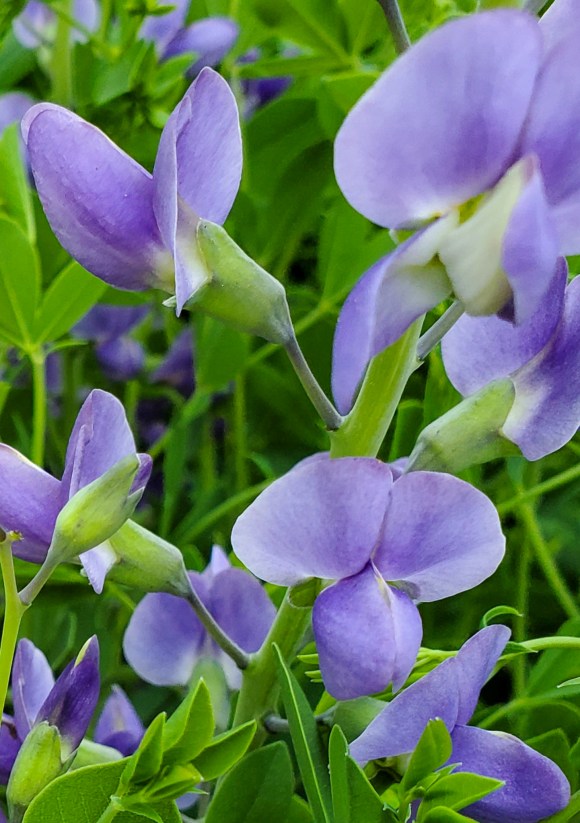
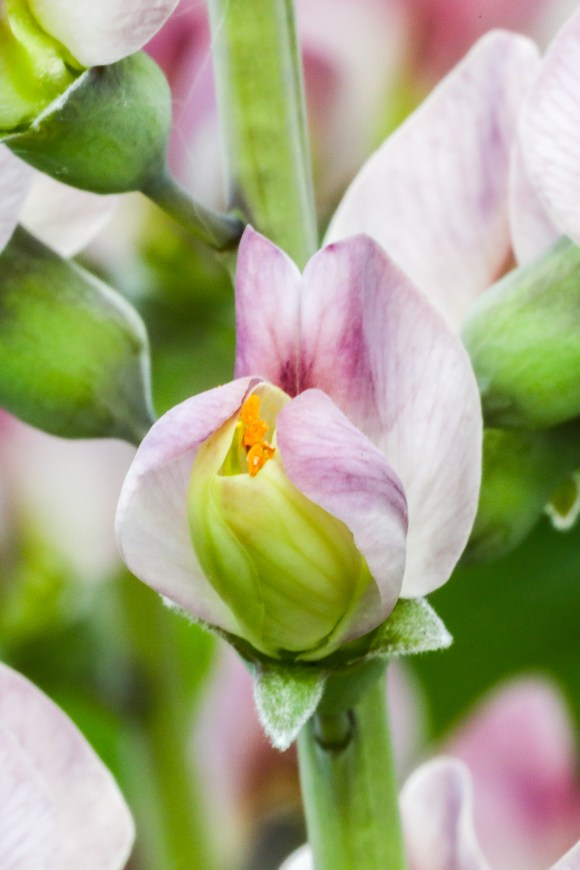
Flower spikes rise over the foliage.  Spikes are 4” to 16” and densely packed with blue-purple blooms.  Blossoms open from the base to the top.  Once pollinated, large oval pods form.  They turn from yellow green to black when ripe.  The pods can be pruned off, especially if weighing down the plant. One year, after an especially heavy bloom, my Wild Indigo ended up about one foot tall under the weight of the seed pods.  I’ve also partially pruned to enjoy the effect of black pods against the green foliage without all the weight.  In Fall, the leaves turn to gray or black and curl but remain on the plant.  If the Baptisia is growing in an exposed location, it can break off at the base and roll away like a tumbleweed.  I have one plant at the top of a hill which does this every year.  The remaining stalks look like a very clean pruning.

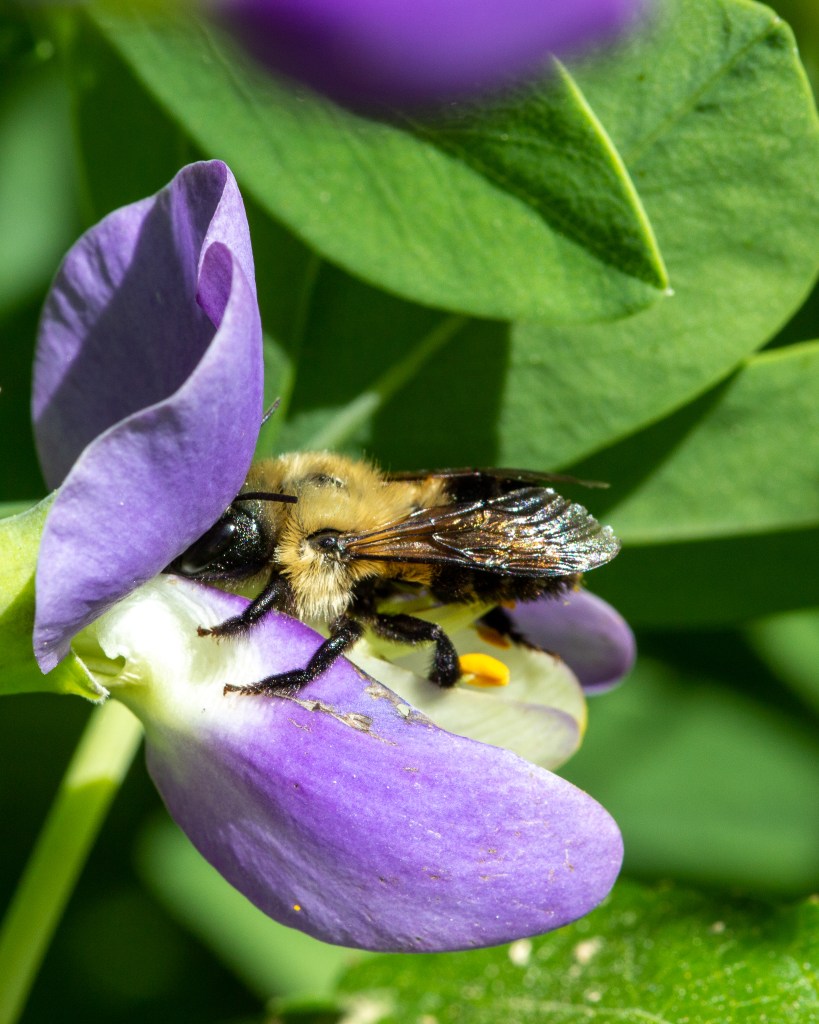
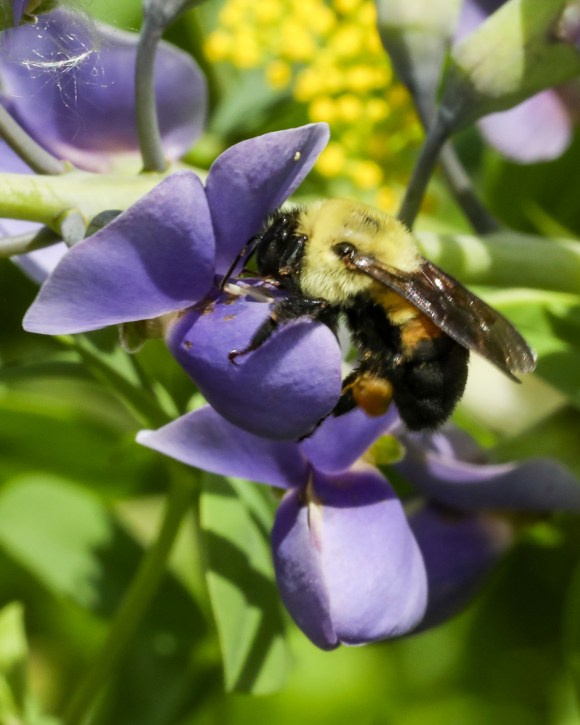
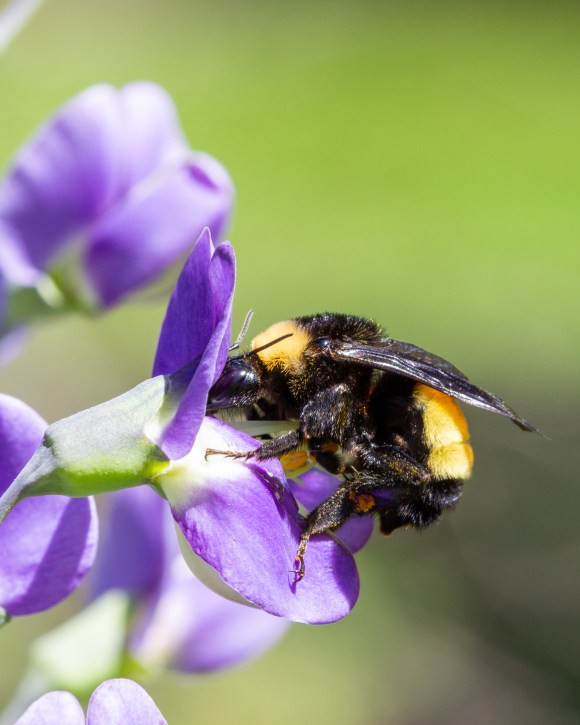
Baptisia is best known for supporting bumblebees especially the newly emerged Queens.   Many kinds of Bumblebees visit these plants looking for nectar.  

Each bloom has a nectary deep in its base.  The location is part of a remarkable pollination system.  Baptisias try to avoid self-pollination.  Its strategy depends on the physical structure of the flower and the timing of bud opening.  Each blossom has a petal that the stands up (the banner) and two petals that stick out like a dog’s muzzle (the keel).  The keel holds the pistil (female part) and stamens (male parts with pollen).   Between the banner and keep, inside the flower is the nectar.  The bumblebee holds the keel with her mid- and hind legs and pushes her way deep into the flower to get to the nectar.  When held, the keel opens and its pollen sticks to the bee’s fuzzy belly.

When it comes to reproducing, plants have all different structures and methods to regulate when and how fertilization happens.  Why?  It gives plants some ability to control self-pollination vs cross pollination.  Self-pollination won’t change the gene pool in a population (ignoring mutations!)  But cross pollination increases chances of introducing different genes and more diversity into a population.  This is usually considered a good thing.

Baptisia has a fascinating system for reducing self-pollination.  When the bumblebees begin feeding at a bloom spike, they start at the bottom.  These lower flowers have more nectar and the female part is extended.  But the bumblebee doesn’t have much pollen at this point.  As she goes up the bloom spike, there is less nectar and more pollen.  When the bumblebee finishes and flies to the next stalk, she’ll start at the bottom again.  

As before, she finds more nectar and the pistil (female part) available on the lower flowers.  But this time, the bee has lots of pollen and there’s a higher chance of pollination.  The first plant “hopes” that the bee flew to a second plant with the pollen and cross pollination occurred!

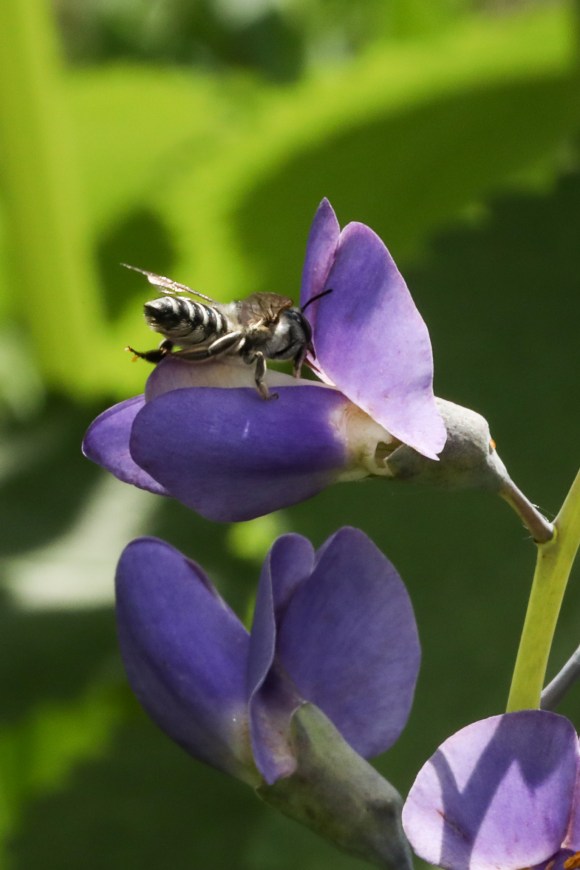
Megachile, Leaf-Cutter Bees, a medium-sized bee also drinks nectar from Baptisia.  These medium-sized bees clearly have the strength to reach and enjoy B. australis’ floral rewards.  The Leaf-Cutter Bees use a method similar to Bumblebees when opening the flower.

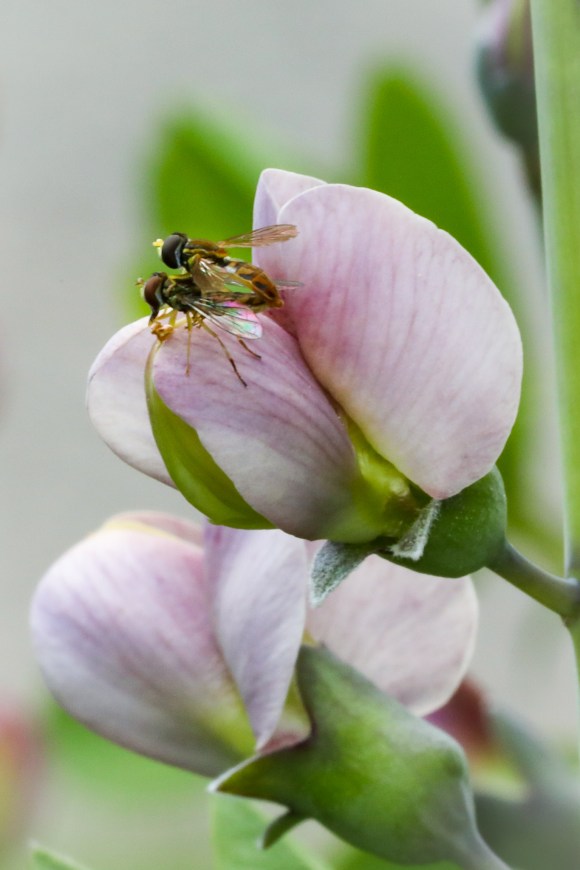
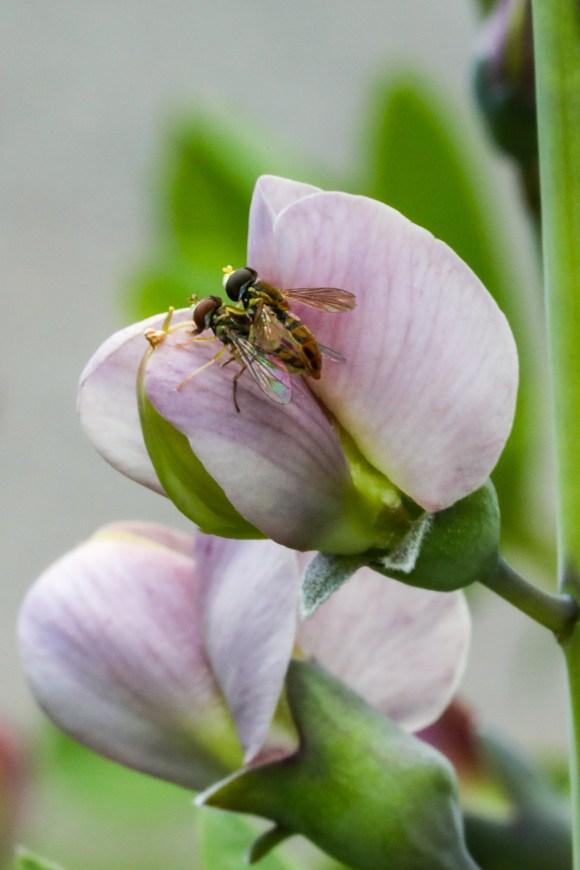
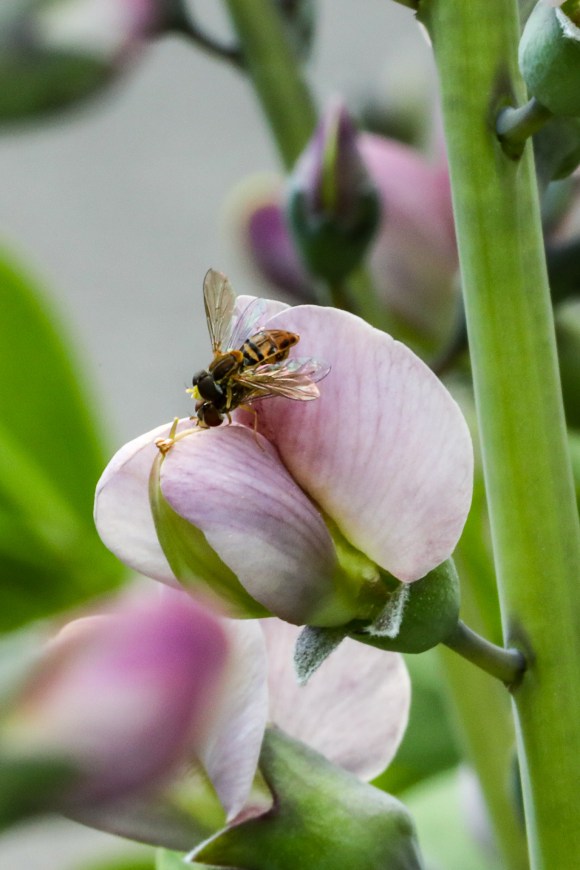
Amazingly, small bees and insects also visit Baptisias.  In my garden, I’ve included both native plants and nativars.  One afternoon, I spotted the following behavior on my ‘Pink Truffles’ Baptisia.  I observed a mating flight of syrphid flies (also called hoverflies or flower flies).  The pair landed on a Baptisia bloom and the female began teasing out the stamens from inside the keel!  Adult hoverflies feed on nectar and pollen.  They spent several minutes easing them out and feeding.  Not B. australis but an interesting behavior!

Depending on the species, the syrphid fly’s larvae (maggots) can eat a variety of food.  Some maggots eat decaying plant and animal matter.  But other larvae eat aphid, thrips, and other plant-sucking insects.

After the hoverflies, metallic green sweat bees arrived to eat the exposed pollen.  Once the stamens are uncovered, Lasioglossum, small sweat bees, also join these other pollinators using the Baptisia.

In addition to bees, Wild Indigo is a larval host for butterflies and skippers.  The Wild Indigo Duskywing (Erynnis baptisiae) and Hoary Edge (Achalarus lyciades) caterpillars both eat Baptisia.  The larvae of three butterflies, the Frosted Elfin (Callophrys irus), Marine Blue (Leptotes marina), and Orange Sulfur (Colias eurytheme) also use it.  Adult Frosted Elfin Butterflies and other butterflies nectar at B. australis.

I hope you enjoyed this adventure with Baptisia australis-a gorgeous plant for a wonderful time of year.  Next time, I’ll talk about Parthenocissus vitacea aka Virginia Creeper aka Woodbine.  A very different plant, it’s well known as a wild plant but not in the garden.  I plan to show the benefits of including Woodbine in the garden for the landscape and the pollinators.

Please contact me to share your stories, questions, and observations!

Thanks for reading,

Mary