Categories
native plants Pollinator gardening

Grist for the Bees

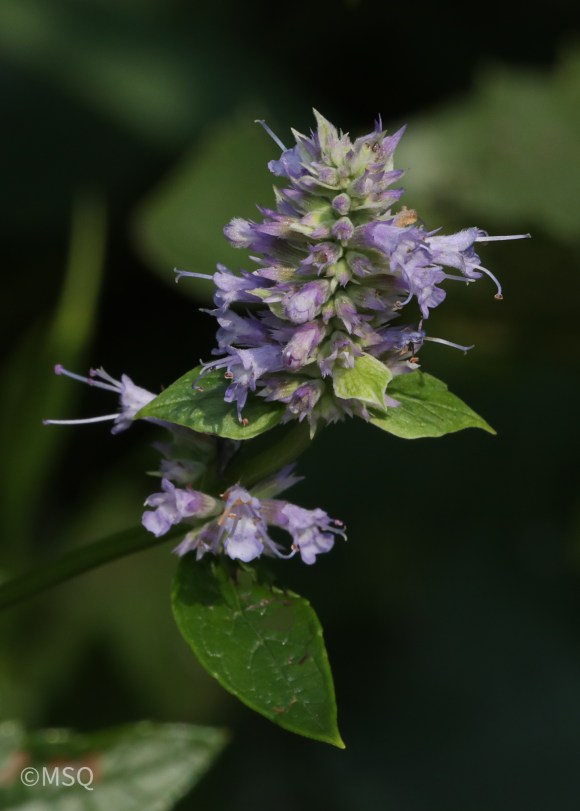
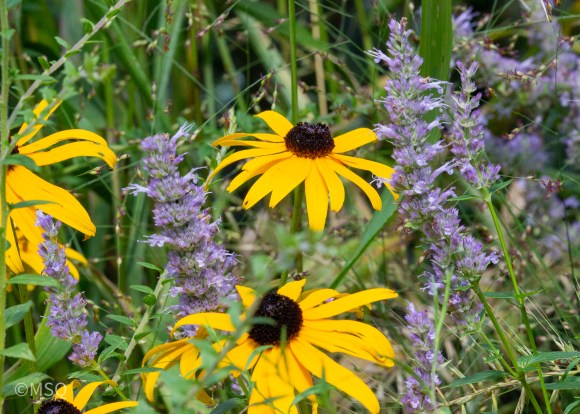
Purple Wheat in the garden?  Indeed, that’s what Agastache means ‘agan’ much, ‘stachys’ ear of grain, from the Greek.  Its flowers look like heads of wheat or rye and range from pale lavender to purple.  ‘Foeniculum’, the second part of the name, means fragrant for the scented leaves.  Agastache foeniculum (Fragrant or Anise Hyssop) is part of the mint family.  Like Pycnanthemum virginianum (https://wildthingsinthe.garden/2023/05/31/white-goes-with-everything/), also mints, it attracts an enormous variety of bees.  Fragrant Hyssop also supports numerous butterflies and skippers.

Anise Hyssop grows two to four feet tall and spreads eighteen inches to two feet.  It has an upright, clump-forming habit.  Anise Hyssop sports dark green, ovate to broadly lanceolate leaves up to four inches long.  Almost heart shaped, the leaves are one to three inches at the base and whitish underneath.  They sit opposite each other on the classic square stem of mint plants.  The foliage also gives off a strong anise or licorice-like scent that gives the plant its common and Latin name.

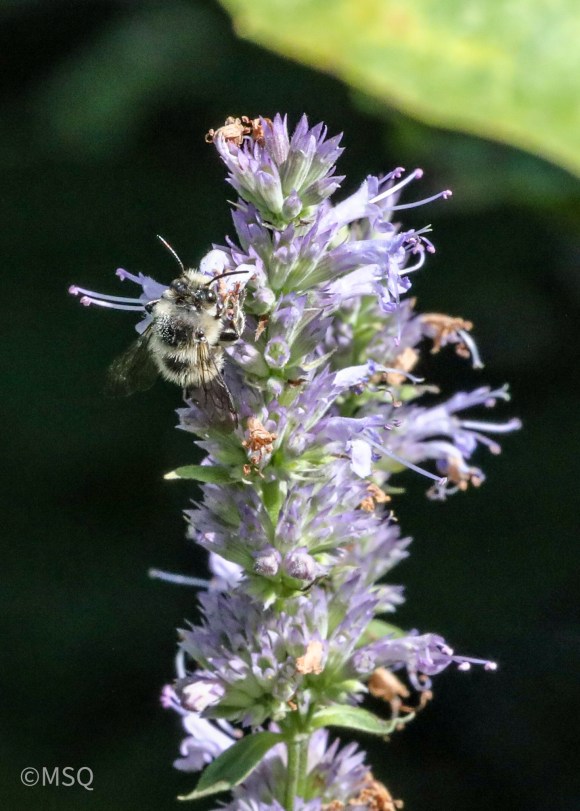
Agastache foeniculum can begin blooming in June and continues through August.  In zone 5, where I am, it doesn’t start until July.  Blooms appear as three- to six-inch-long flower spikes at the end of plant stalks.  The eye-catching blossoms range from pale lavender to true purple in color.  Tiny flowers make up each large spike.  They’re laid out in tightly packed rows although there can be gaps (think of an ear of corn).  This arrangement is called verticillasters or false whorls.  Each of the small flowers is tubular, 2-lipped and a 1/3’’ inch long.  Unlike the leaves, the blooms have no scent. 

Fragrant Hyssop plant grows best in full sun with dry to moderately moist soil.  Soil moisture is not a problem if the drainage is good.   Anise Hyssop is drought tolerant, more so after it is established.  It spreads by rhizomes and self-seeding especially under good conditions.  I have not found that this plant spreads obnoxiously.  I have far fewer Anise Hyssop seedlings than Monarda fistulosa seedlings.  Fragrant Hyssop may have problems with crown rot with soggy soil. Other issues include rust and powdery mildew.

Outside of cultivation, Agastache foeniculum grows in prairies, dry upland forests, plains, fields, roadsides, and other dry, open, semi-shaded areas.  In the past, it served as honeybee forage in Canada and parts of the Upper Midwest.  It works well in borders, wildflower gardens, herb gardens, butterfly gardens and meadows.

Agastache foeniculum and similar species inspire plant breeders around the world.  Too many nativars exist to explore them all, but I thought we could look at three very different plants.  Each of these was modified in a different way.

Agastache ‘Blue Fortune’ is a very popular hybrid created by crossing Agastache foeniculum with its East Asian relative, Agastache rugosa.  This compact plant has longer flower spikes than the species.  It blooms for an extended time because it’s bred to be sterile.  ‘Blue Fortune’ is widely reported to be a pollinator magnet.

Agastache ‘Golden Jubilee’ is an older hybrid with yellow-green foliage that’s pure yellow in the Spring. The flowers are identical to the species.  ‘Golden Jubilee’ received the All-American Selection Award in 2003 and is still being sold.  It will self-seed with a mix of species and golden seedlings.  There are mixed reports on how pollinators respond to ‘Golden Jubilee’.  Some sources say bees don’t seem to ‘see’ it and others say pollinators love it.

Agastache ‘Red Fortune’ has red to pink flowers.  The leaves are like the species.  Pollinators don’t like this plant as much as Agastache foeniculum.

These three plants give a nice snapshot of how natives are altered and some pollinator responses.  One idea is that nativars with flowers most like the species’ flowers would be most acceptable.1  Positive reports about ‘Blue Fortune’ and ‘Golden Jubilee seem to support this idea.2

In addition, red is a special case.  Bees see in the ultraviolet spectrum—from approximately 300 to 650 nm.  They can’t see red although they can see reddish tones like orange.  When native plants are hybridized for red flowers, bees often have trouble finding them.1,3

But wait!  There’s an exception.  Red flowers can have ultraviolet “nectar guides”  which the bees see perfectly well.  Plants use these guides to “direct” the pollinators to the nectar reward and encourage pollination.3  

It’s hard to say if a red native hybrid will still attract and support bee pollinators.  If they retain their ultraviolet nectar guides, then the bees should see them.  However, I’ve seen more than one report showing little to no bee activity on the red and pink hybrids.1,2

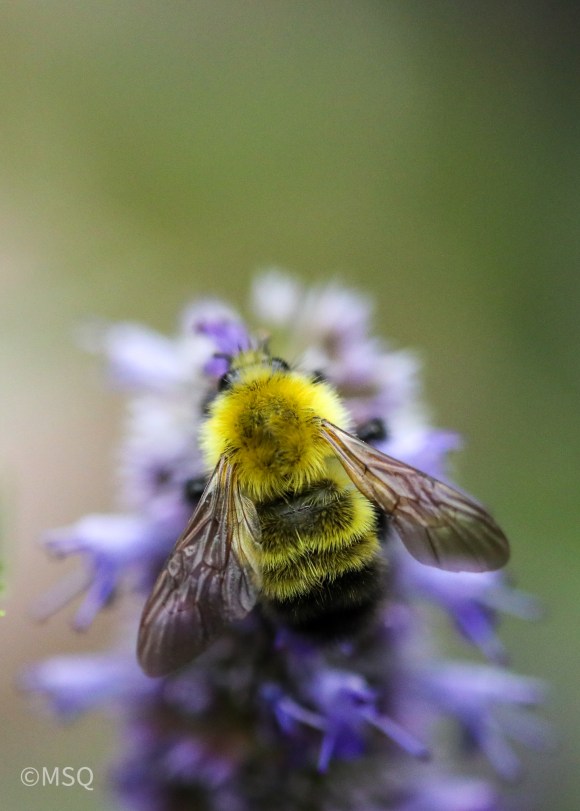
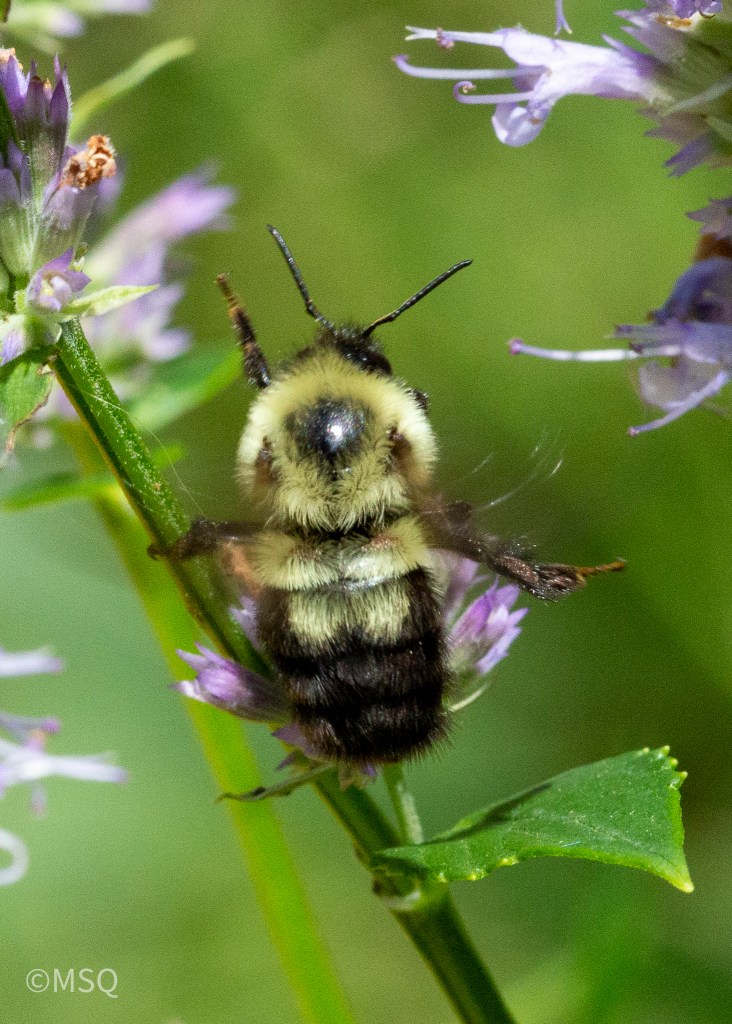
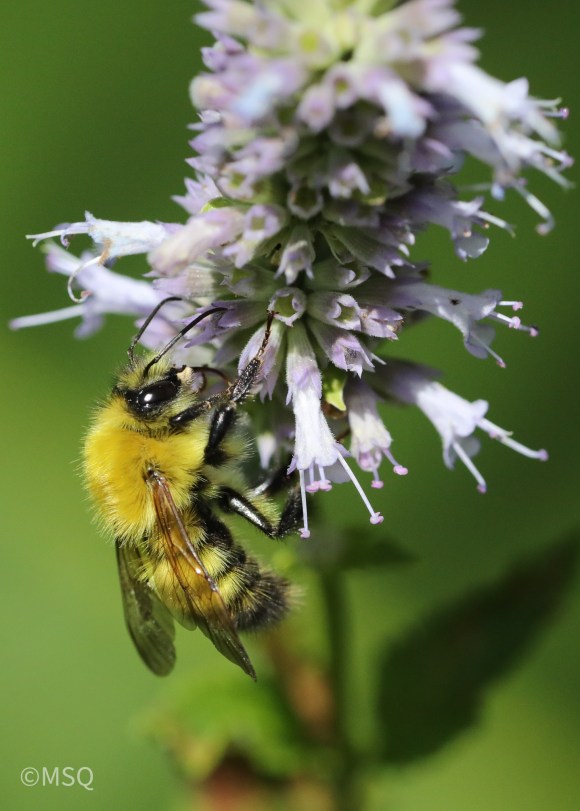
Anise Hyssop serves a multitude of pollinators providing nectar and pollen.  Like Monarda (https://wildthingsinthe.garden/2023/07/31/the-gardens-super-station/), Fragrant Hyssop has been identified by pollination ecologists as attracting large numbers of native bees.  The Xerces Society for Invertebrate Conservation also designated Fragrant Hyssop of Special Value to Bumble bees and Honeybees.  Butterflies and skippers use it for a nectar source.

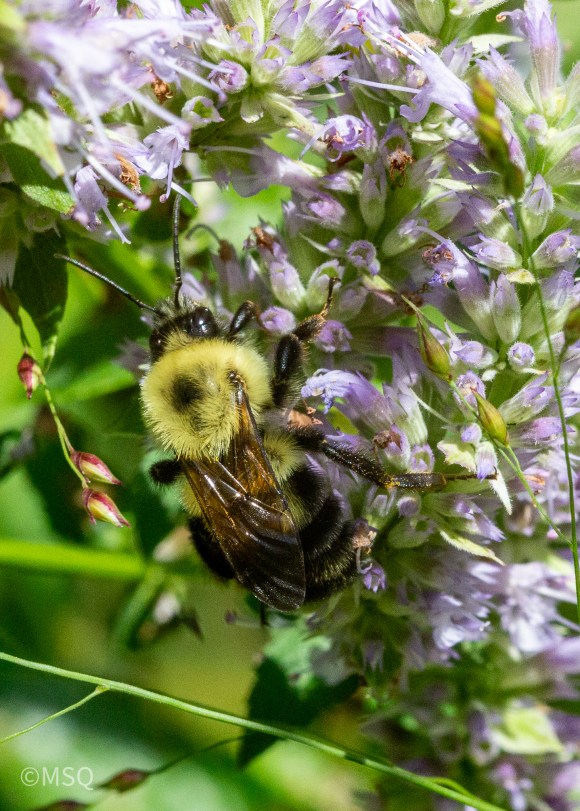
Pollination in Fragrant Hyssop hinges on both the individual flowers’ structure and the different bees’ anatomies.  The nectar is secreted by a disc at the base of the flower.  Pollen-carrying anthers are located on the top lip of each flower.  When bees root for nectar, pollen rubs off onto their heads or thorax.  As they move to a bloom with a receptive stigma, female part, the pollen transfers and fertilization occurs.

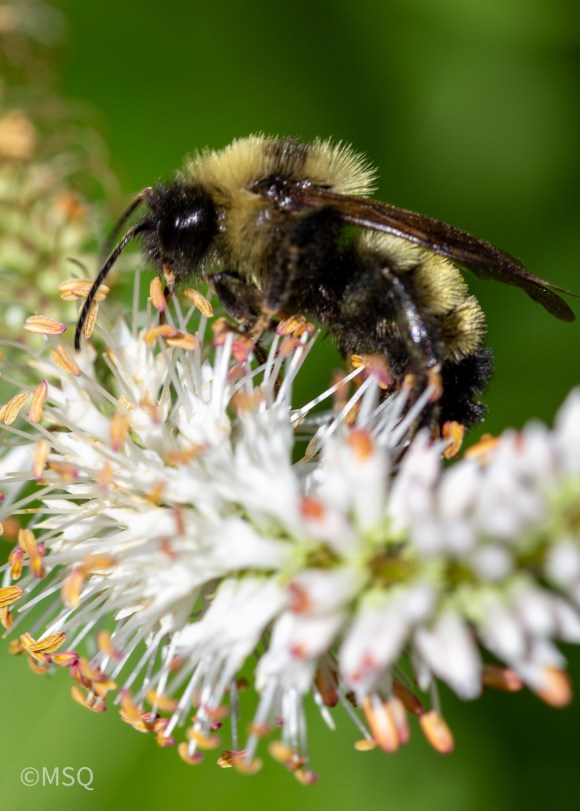
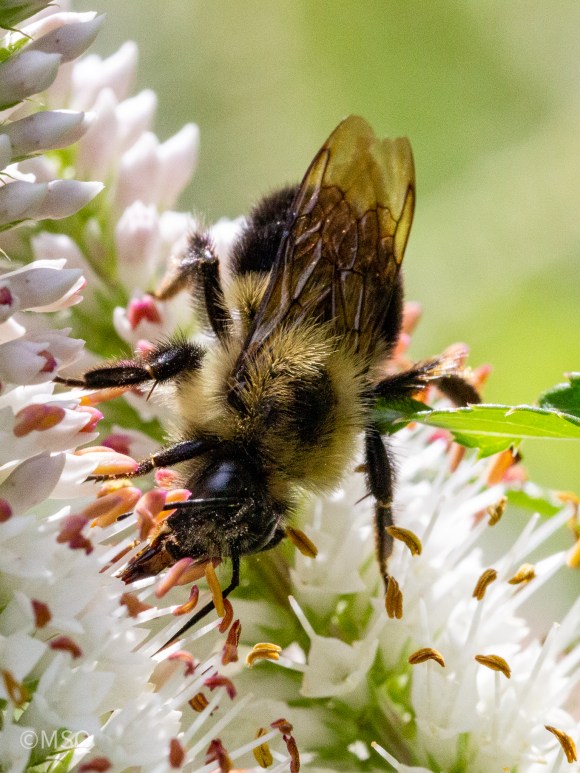
The many native bees that visit Hyssop range from large to tiny.  Bumble bees are the largest.  I’ve seen Common Eastern Bumble bee (Bombus impatiens), Brown-Belted Bumble bee, (Bombus griseocollis), Two-Spotted Bumble bee (Bombus bimaculatus), and Golden Northern Bumble Bee (Bombus fervidus) on my Fragrant Hyssop. They use both nectar and pollen for their larva.  

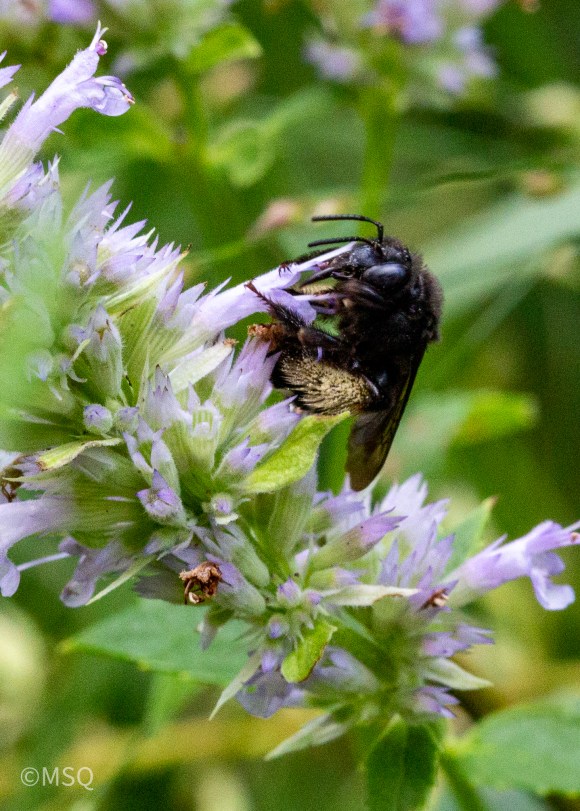
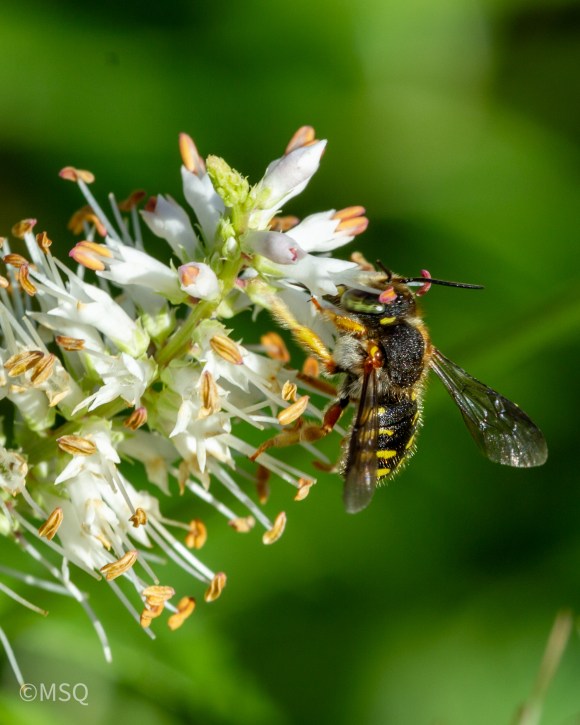
Large Leaf-Cutter bees use Anise Hyssop’s nectar. In the process, they are efficient pollinators. In contrast to other bees, pollen accumulates on the Leaf-Cutter bees’ abdominal scopae (specialized pollen collecting hairs).  It is transferred to the stigmas from there.


Digger bees (Melissodes) and smaller Leaf-Cutter bees (Megachile) are mid-sized bees.  They also collect both pollen and nectar from Anise Hyssop.

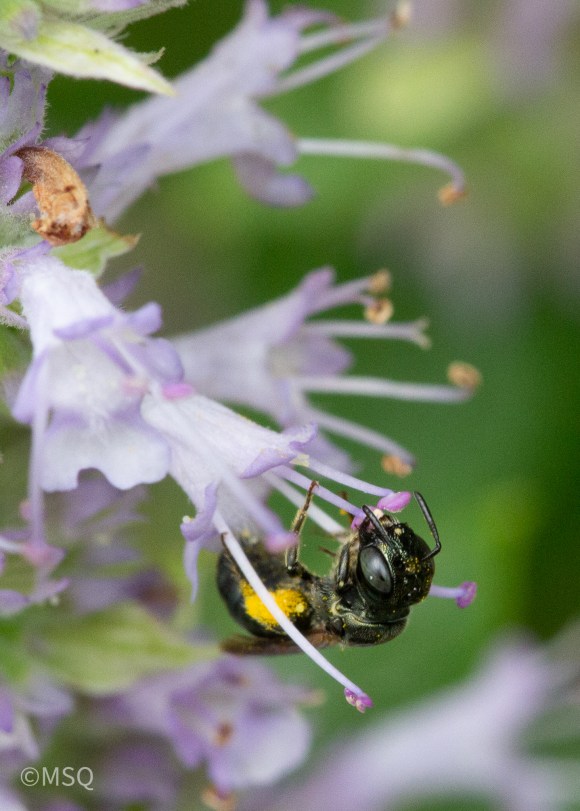
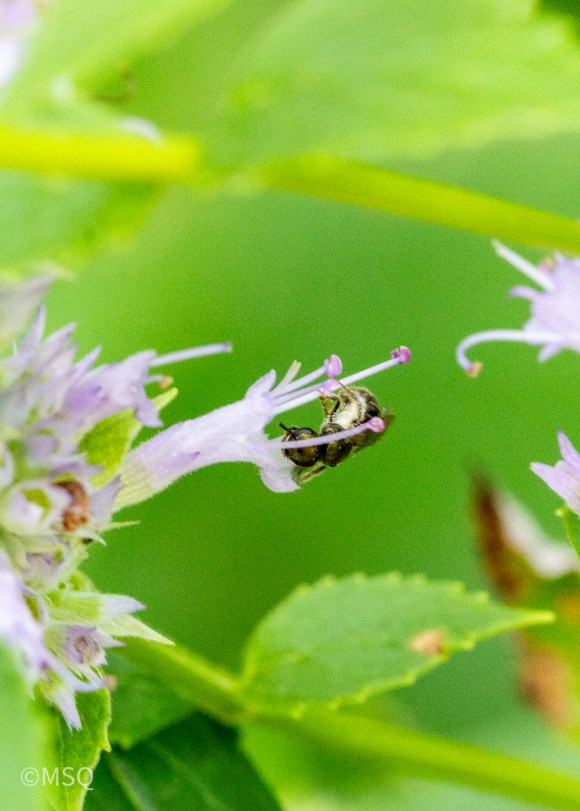
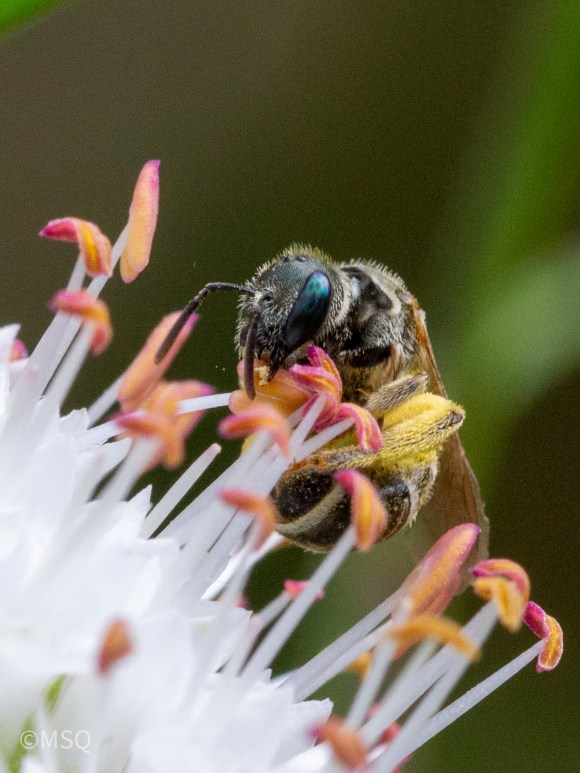
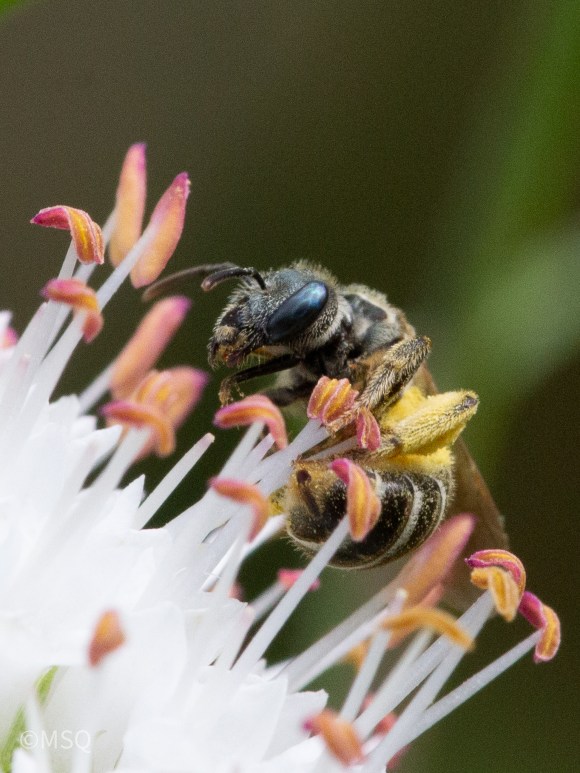
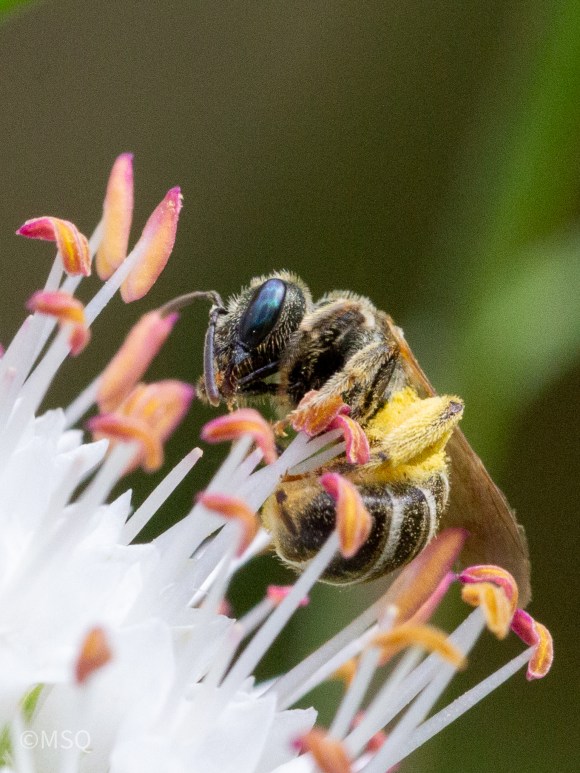
The Halictid bees (Lasioglossom), small Resin bees (Heriades) and Masked bees (Hylaeus) are small bees that gather resources from Fragrant Hyssop.  Dufourea monardae is included in this group.  D. monardae is a specialist or oligolectic bee that visits Monarda fistulosa and Agastache foeniculum.  These small bees can collect pollen from the anthers extending from the flowers. When harvesting nectar, they climb the style to reach the base of the flower.  (The style is the stalk connecting the stigma and the ovary.)

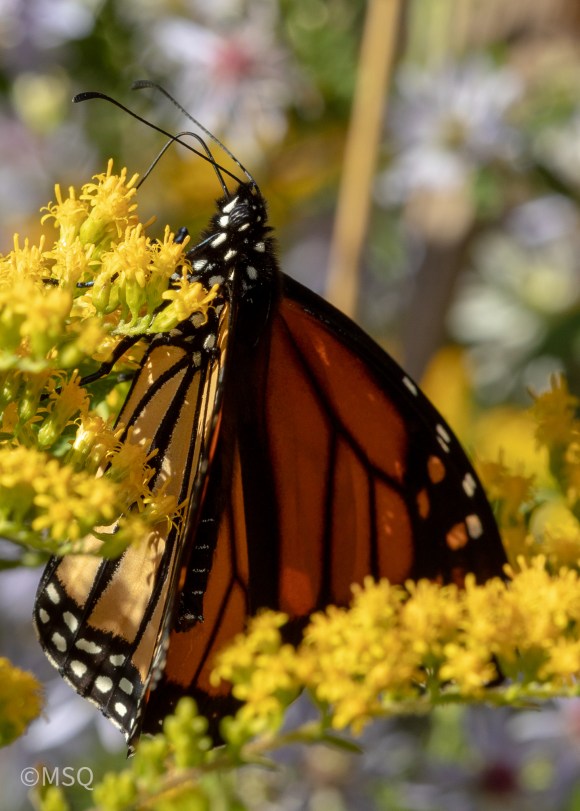
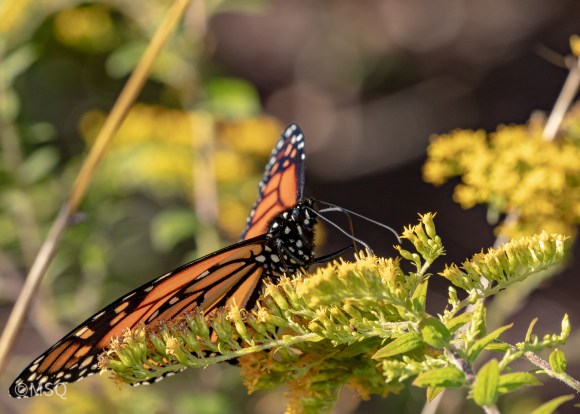
Fragrant Hyssop provides an excellent late season nectar source for butterflies, skippers and moths including Silver Spotted Skipper Butterflies (Epargyreus clarus), Peck’s Skipper Butterflies (Polites peckius) and the Great Spangled Fritillary Butterfly (Speyeria cybele).  They reach their proboscis into each tiny bloom to find the nectar.  Hyssop also works well in Monarch Way Stations providing food after most milkweed has stopped blooming.  

I hope you enjoyed this exploration of Anise Hyssop and its wonderful visitors!  I’d love to hear your thought about this blog or stories about your own experiences in the garden.  Please leave me comment and let me know your thoughts!

References:

  1. Eierman, Kim,11 April 2014,  “Ecobeneficial Interview:  Annie White on Native Plant Cultivars, Native Plants and Pollinators”, Youtube, https://www.youtube.com/watch?v=HTmuDcEzTOw
  2. Caldwell, Cathy, (2021, August-Vol.7, No.8) Anise hyssop, Piedmont Master Gardeners, https://piedmontmastergardeners.org/article/anise-hyssop/
  3. Riddle, Sharla, (2016, May, 20) How Bees See And Why It Matters, Bee Culture:  The Magazine of American Beekeeping, https://www.beeculture.com/bees-see-matters/
Categories
native plants Pollinator gardening

THE GARDEN BY CANDLELIGHT

Okay, not actual candlelight, but the ethereal candelabra blooms of Veronicastrum virginicum, Culver’s Root.  This striking, upright plant provides a strong vertical accent in any garden.  It’s long, tapered flower spikes attract pollinators of all kinds while dark green whorls of leaves provide plenty of visual interest.

Growing in zones 3 to 8, this plant stretches from four to seven feet and spreads between two to four feet.  Culver’s Root grows in medium to wet, well-drained soils.  It tolerates standing water for a short time and thrives in rain gardens.  Culver’s Root accepts full sun to light shade and is suited to growing at the woodland’s edge.  In very warm zones, it enjoys afternoon shade.  

Culver’s Root’s flowers unfold slowly in mid to late summer.  Here in zone 5b, it starts in mid-July and continues to the end of August.  You can deadhead to encourage rebloom.  

The flower color varies slightly with the location.  Primarily white, the blooms can have tones of very pale pink, lavender or blue.  The blossoms are most often described as candelabra-like with four or more in a whorl at the top of each stem.  In mature plants, flower spikes can be 8” in length!  

Culver’s Root tends to flop without support especially in shadier areas.  I’ve used a peony ring with internal supports.  The deer have also trimmed my plant in mid-June by about one-third to one-half.  The pruning helped and more flowers formed at each cut.  Culver’s Root won’t grow to full height after being cut back. 

Its leaf structure is unusual and offers a contrast to surrounding plants.  The leaves are whorled in groups of three to seven.  Each leaf is lance shaped with slight serrations and attached directly to the stem (sessile) or nearly so.  They can be up to 6” long and 1.5” wide.  The long stems and whorled leaves give the plant an upright, medium texture.  Culver’s Root is not aggressive although it can self-seed.  Some good companion plants include blazing star, monarda, milkweed, rattlesnake master, goldenrod, and asters.

V. virginicum has successfully entered the world of horticulture and numerous nativars exist.  These nativars have been bred to prevent flopping and to bring more color to the flowers.  Some are more compact to fit in small gardens.  Here is a sampling of what’s available:  ‘Fascination’, 5’ tall, 2’ width, lavender bloom, ‘Red Arrow’, 3-4’ tall, 2-3’ width, purple bloom, ‘Album’, 3-4’ tall, 3-4’ width, white bloom, and ‘Cupid’, 2-3’ tall, 1-2’ width, purple.  Like the native plant, all these nativars can grow in zones 3 to 8. 

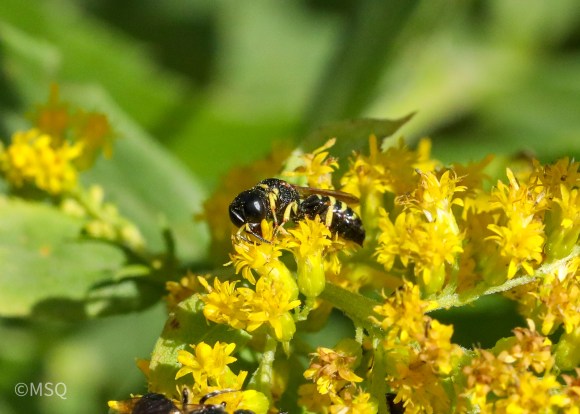
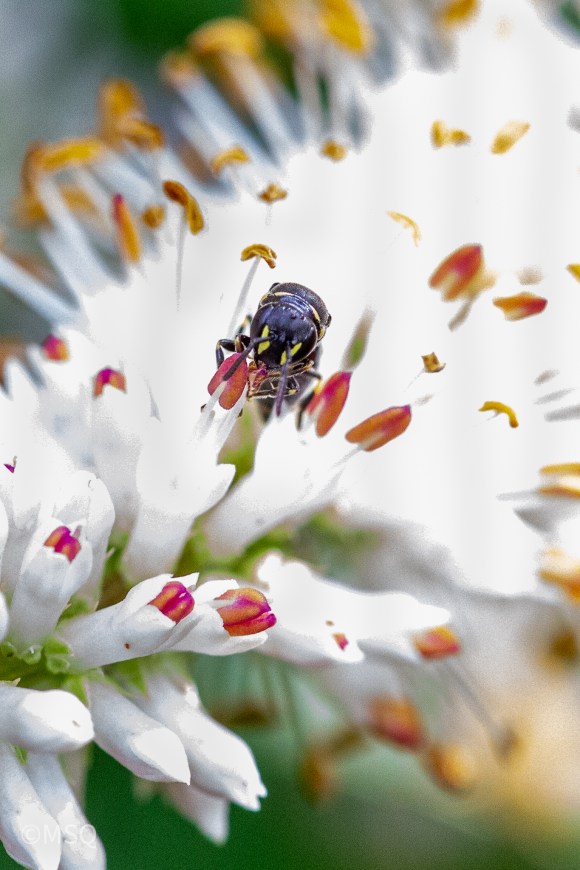
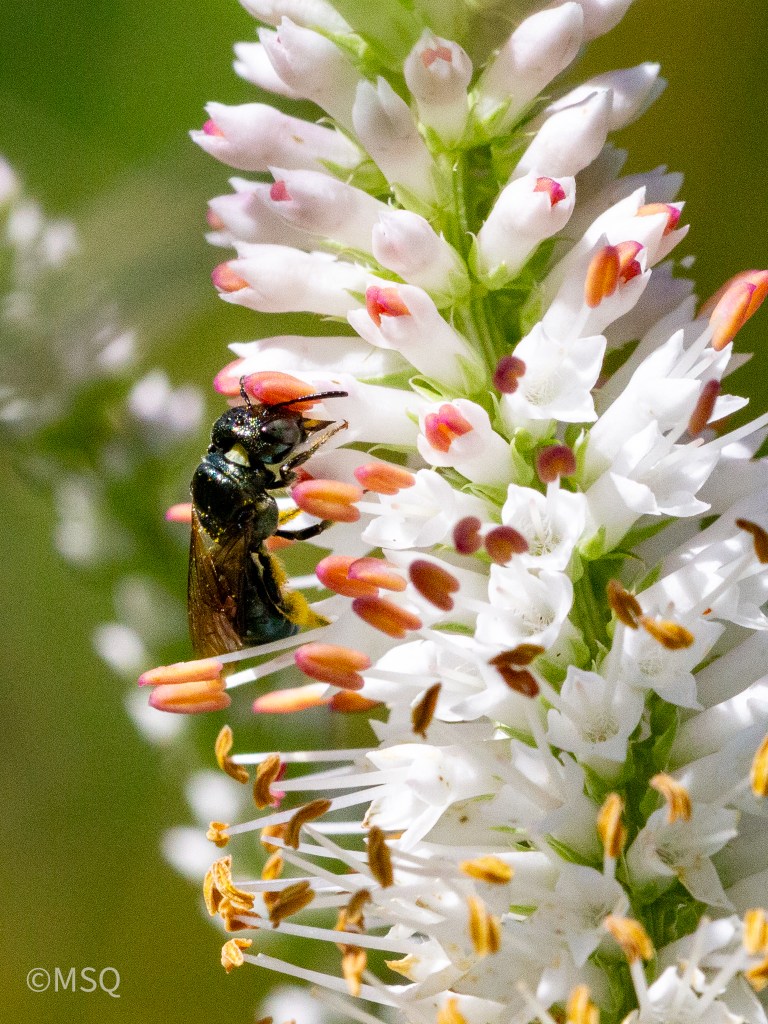
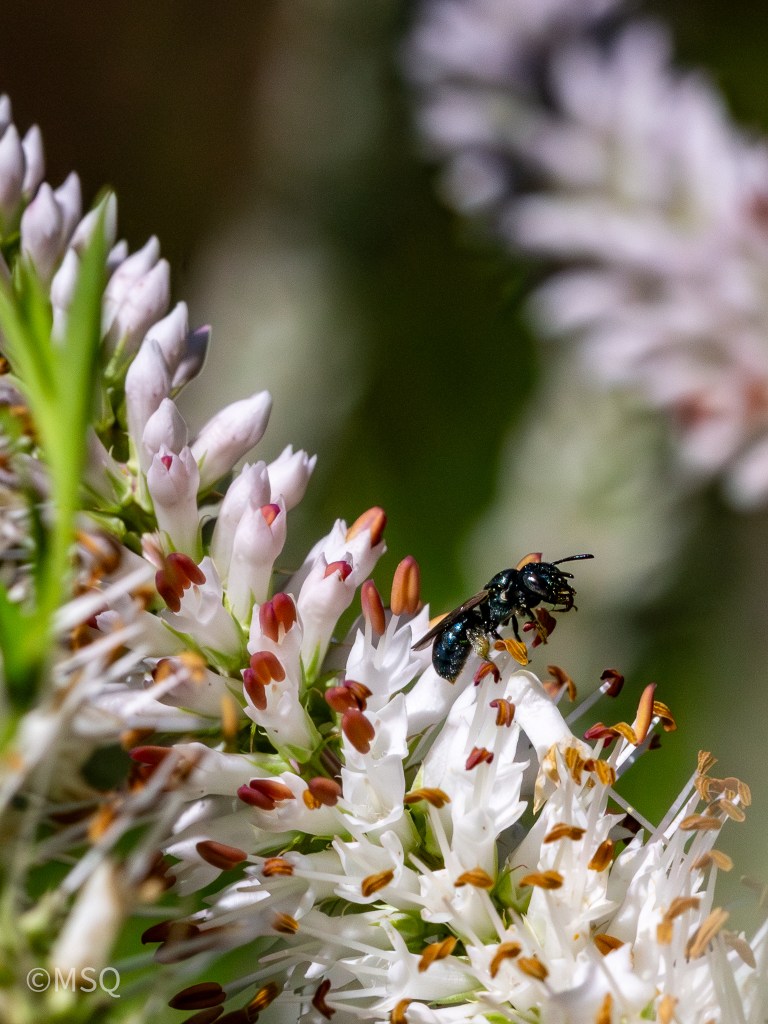
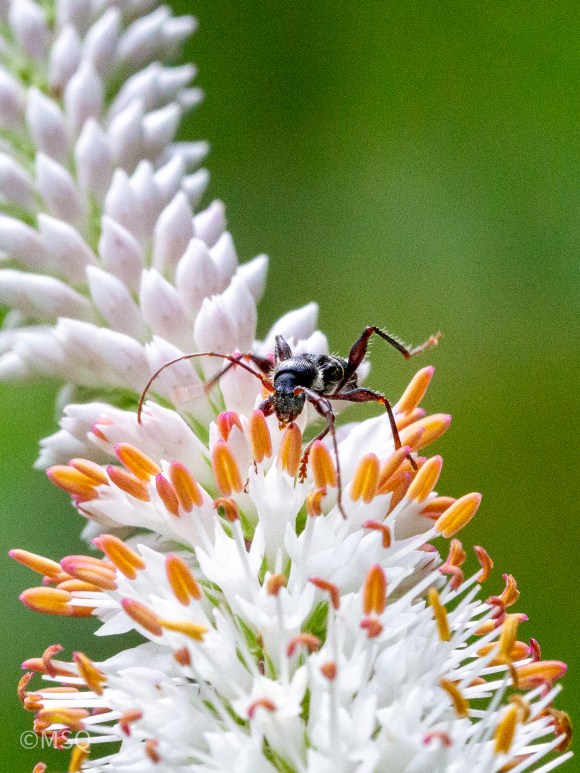
Culver’s Root feeds native bees, honeybees, and beneficial insects.  A range of native bees visit it including short and long tongued bees.  V. virginicum begins bloom by protruding its anthers outside the bud.  Small bees take advantage of this by collecting pollen. These pollinators include Hylaeus (yellow-faced bees).

Hylaeus or yellow-faced bees are one of the most recognizable small bees.  Mostly black, they have yellow or white markings on their faces.  These marking make them identifiable as Hylaeus although species determination can be tricky.  Yellow-faced bees grow from 5 mm (0.2”) to 7 mm (0.27”).  They nest in existing hollow cavities primarily in hollow stems or holes in wood. Some have been known to nest in stone.  Hylaeus line their nests with a silk or cellophane-like substance produced by the salivary gland.  The bee uses her bilobed tongue to paint on the secretions.  The lining is waterproof and protects the young from bacteria.  Chewed stem pith mixed with saliva is used for cell divisions and salivary gland secretions seal the completed nest.

One fascinating fact, yellow-faced bees are practically hairless.  Hylaeus don’t have any scopa or specialized hairs dedicated to holding pollen like other bees.  They also have short tongues and so can’t reach deeply into flowers.  These bees use their slender bodies to work their way into flowers to reach nectar and pollen.  They also chew on anthers to extract pollen.  Then Hylaeus swallow the nectar and pollen and hold it in their crop.  The crop is a sac separate from the stomach.  This fluid mixture is regurgitated and left for the larva to eat. 

Another fun fact, yellow-faced bees occur all over the world.  However, Hawaii is known for having 63 different species.  The yellow-faced bee is the only bee native there.  All the species found there are unique to Hawaii.

Lasioglossum (small sweat bees) visit Culver’s root and collect pollen and nectar. They use the hair or scopae on the hind femur and tibia to hold the pollen as well as the bottom of their abdomen.

Once the flowers opens larger visitor arrive including bumblebees (Bombus)

and Leaf-Cutter bees (Megachile)

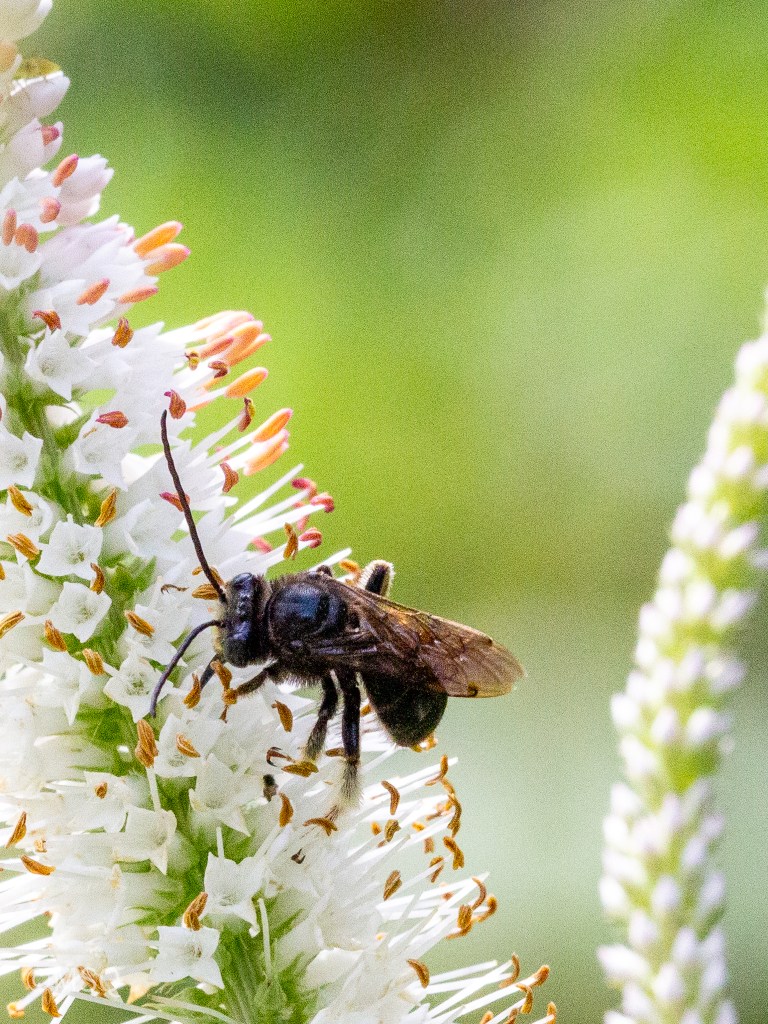
and Long Horned bees (Melissodes). 

Mason bees (Osmia) stop at V. virginicum to collect resources.

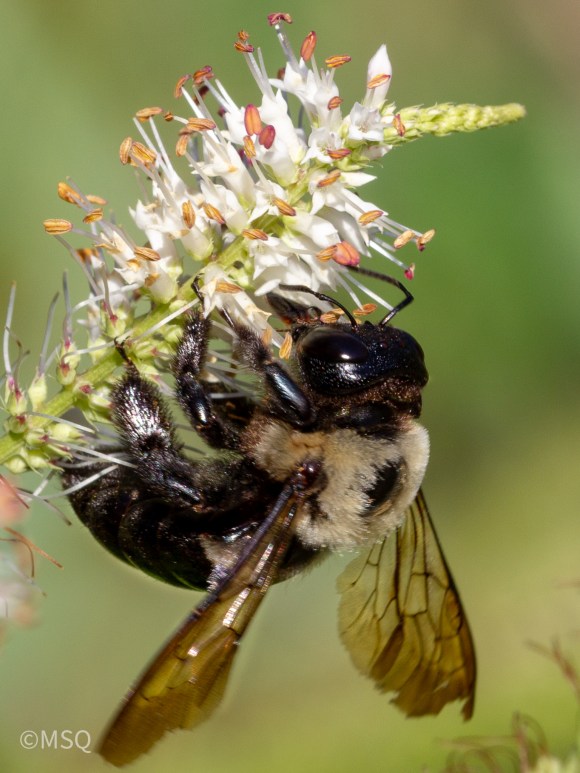
Large and small carpenter bees (Xylocopa and Ceratina) also gather nectar and pollen from Culver’s Root.  

This is also a plant for beekeepers.  Honeybees enjoy V. virginicum when they can find it.  I’ve often seen them gathering nectar from this plant in my garden.

                                                    ­

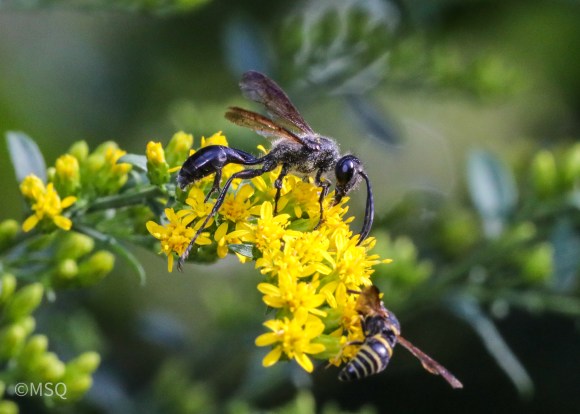
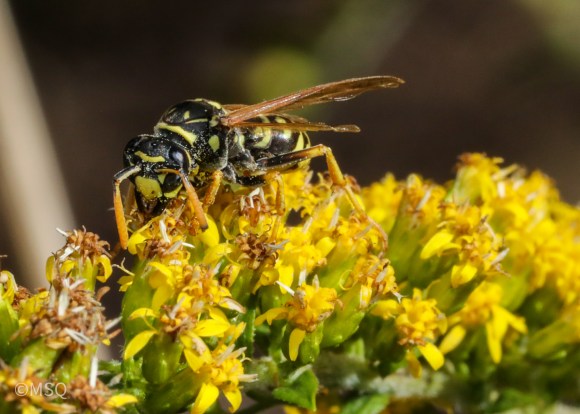
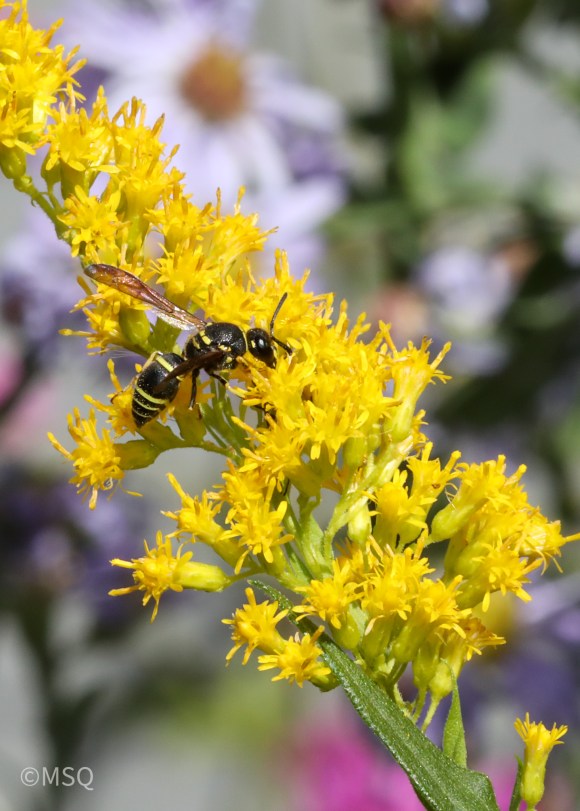
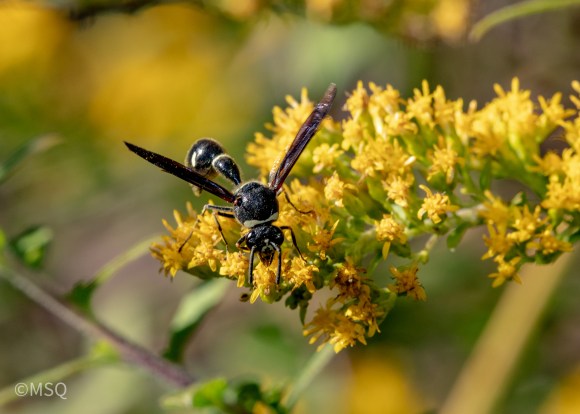
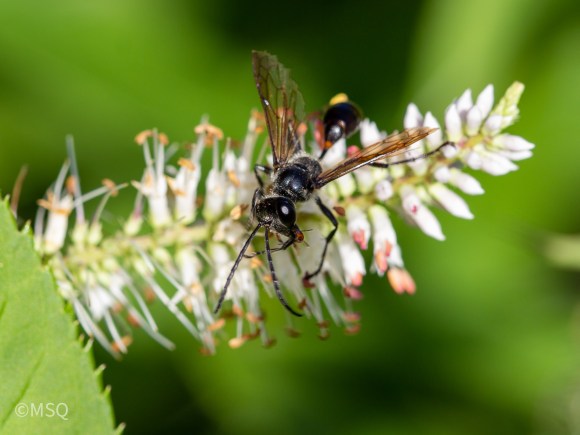
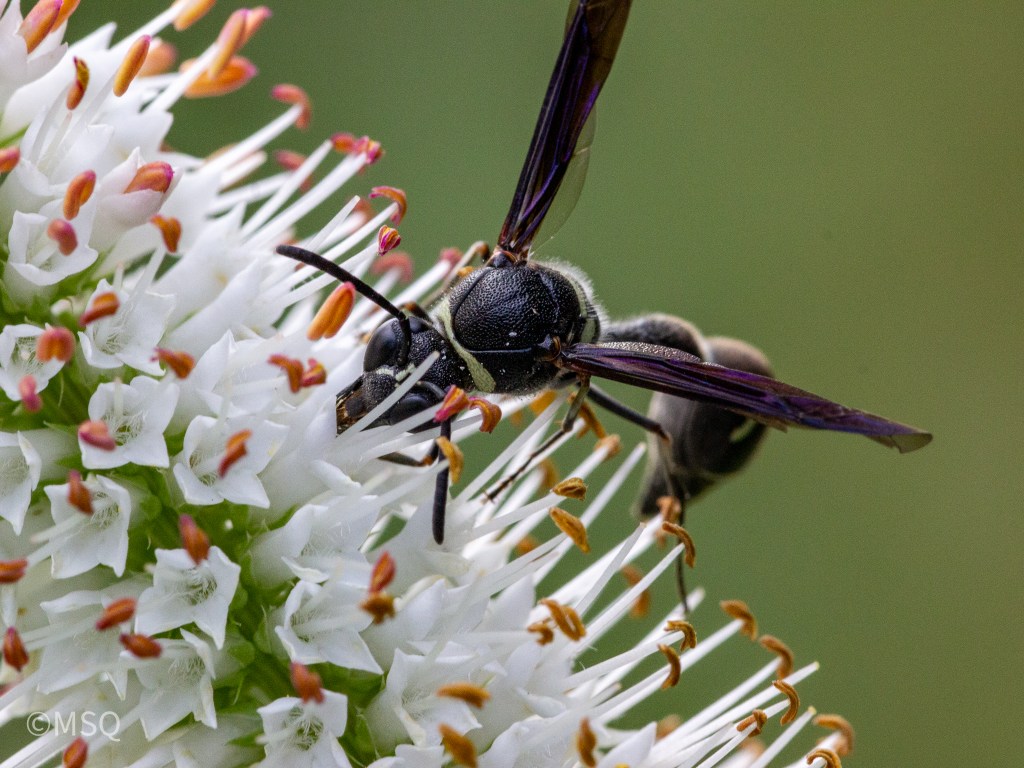
The sphecid and the potter wasps also benefit from the flowers.  They gather nectar to support them while building and filling their nests. I often see the thread-waisted Mexican Grass-carrying wasp (discussed in “White Goes With Everything”, https://wildthingsinthe.garden/2023/05/31/white-goes-with-everything/) on this plant.

These groups of scary insects look nothing like our sweet fluffy bumblebees.  Sphecid wasps resemble nightmare creations with bizarre tiny waists, long thin legs, and triangular heads.  The vespid wasps, which include the potter wasp Eumenes fraternas, can resemble sphecid wasps.   Sadly, they can also look like yellowjackets, hornets and paper wasps who share their family.  Yet when I meet these wasps in the garden, they’re gentle and shy.  

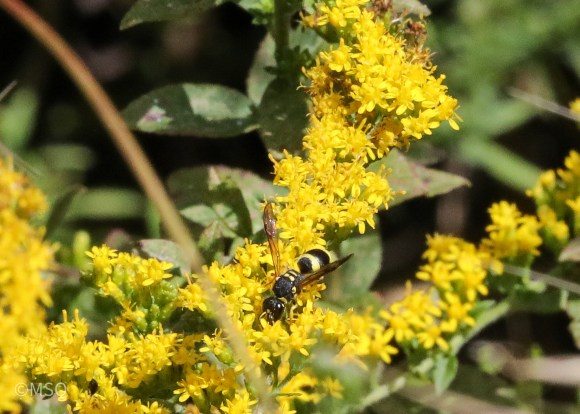
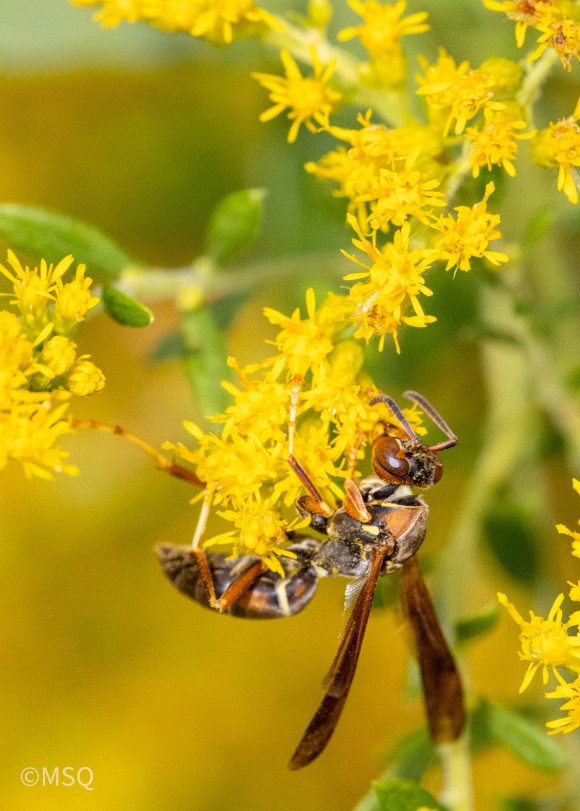
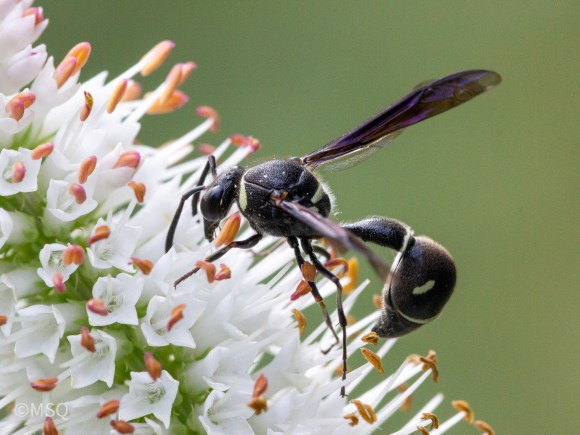
Today, let’s talk about Eumenes fraternas. This wasp is in Vespidae family, subfamily Eumeninae, also called potter and mason wasps.  Eumenes fraternas is a potter wasp that regularly visits the Culver’s root in my garden.  She creates her nest using soil and water.  This wasp collects, mixes, and shapes her mud until she completes a small pot with a flared rim.  The nest is built on a large leaf, sturdy stem, or a home/structure.

Then, the wasp lays a single egg fastening it to the top of the pot with a silk-like thread.  The nest pot is provisioned with several caterpillars.  E. fraternas preys on cankerworms or inchworms.  The potter wasps frequently hunt moth larva in the Geometridae family.  Geometer caterpillars are often pests of native trees eating large amounts of leaves, in some cases, stripping them.

Like other solitary pollinators,  E. fraternas is entirely responsible for her eggs.  It is in her best interest not to sting.  I have found these solitary wasps to be quite cautious.  This holds true for the thread-waisted wasps in my garden and the Mexican Grass-carrying wasp.  If I bump a plant, they’ll fly away while bumblebees persistently keep feeding.  Still, they can sting if handle roughly.

Thank you so much for joining me!  I hope you enjoyed reading about Veronicastrum virginicum, Culver’s root, and consider adding it to your garden. Please let me know what you think of the post and tell me what’s going on it your garden by leaving a comment!

Many Thanks!

Mary

Categories
native plants Pollinator gardening

The Magnificent Month of May—and June

Or when we’re ready for Summer but it’s not ready for us

Late Spring and the first burst of flowers has come and gone.  Delicate and lovely, these early flowers always warm our hearts after Winter but it’s still a long wait for the wild, abundant bloom of summer.  While we wait, let’s fill these late Spring days with more flowers.  And for those flowers, enter my next two plants—Baptisia australis and Parthenocissus vitacea.  

These two stars of late Spring and early Summer are big, bold, and versatile but very different.  And as I wrote I realized they’re too big to share one post.  Today’s post is about Baptisia australis and I’ll save Parthenocissus vitacea for next time.  Baptisia australis is a beloved, award-winning garden plant.  As well behaved, as it is beautiful, it’s perfect for any garden with enough space and sun.

Baptisia australis, (Baptisia), also called False Indigo or Wild Indigo, gives a glorious burst of late Spring bloom beginning at the end May and extending into early June.  Truly a special plant, Baptisia australis was the first straight species native (non-hybrid) chosen as Perennial of the Year in 2010 by the Perennial Plant Association.  This award draws a lot of interest because the chosen plant must be low maintenance, grow in a wide range of climates, be interesting in several seasons and relatively pest and disease-free.  B. australis manages to do all that naturally.

A plant so large it could be a shrub, Wild Indigo serves as a stunning accent plant!  It grows three to four feet wide and high.  Unlike its cousins the lupines, Baptisia isn’t picky about growing conditions.  Give it sun and some water and you can expect beautiful full growth and lush flowers.  It’s also deer resistant, salt tolerant and suitable for xeriscaping once established.

Xeriscaping is landscaping using little or no water from irrigation.  Some people extend the definition to include little to no maintenance.  If your Baptisia breaks off and rolls way to have its own adventure, then it’s absolutely no upkeep.

The Baptisia does have to become established in the garden before it’s fully resistant.  As it grows, Baptisia develops an extensive root system.  The roots can grow up to 12 feet deep and 3 to 4 feet wide.  Choose its location carefully, Baptisia does not take transplanting well.

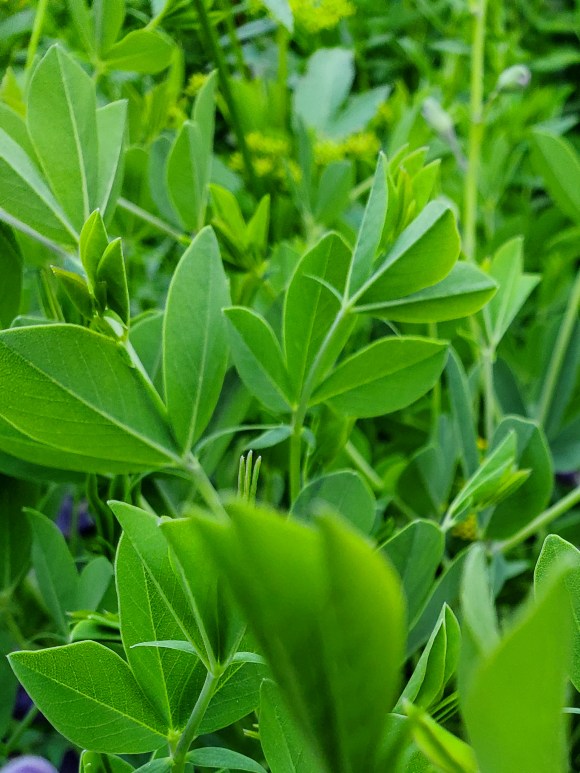
Baptisia’s leaves are three part and slightly creased at the center vein.  Light green with a slightly bluish tinge, the foliage provides a highlight in the garden.  Some Baptisias, like B. australis, have a rounded form down to the grown.  Other Baptisias are vase shaped with bare stems at the base of the plant.  

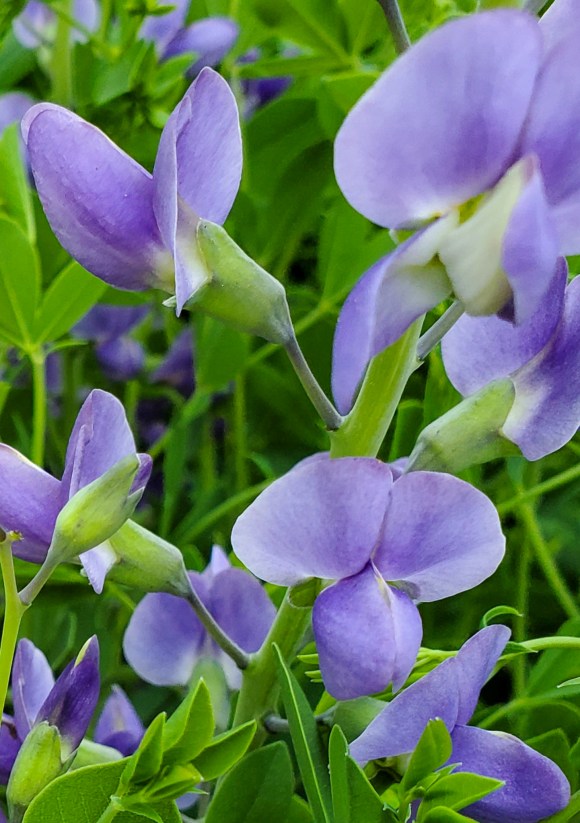
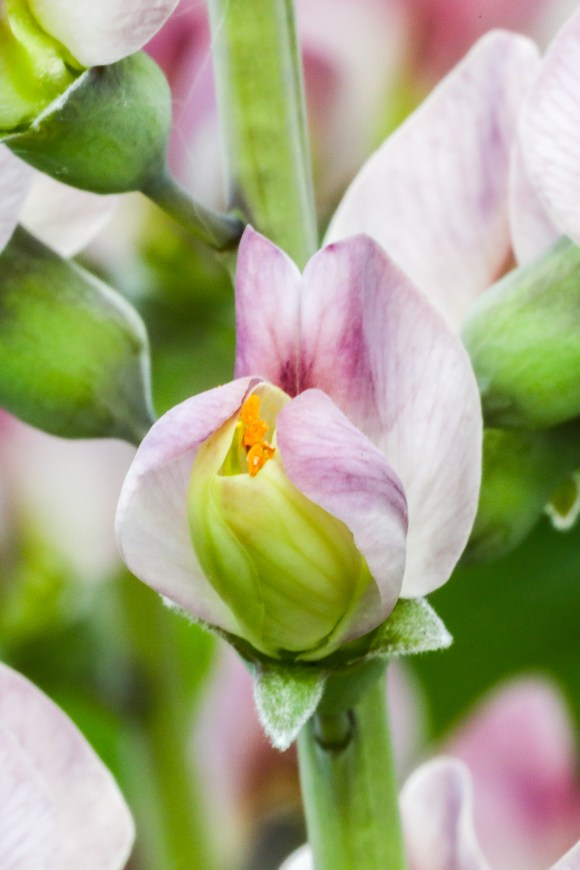
Flower spikes rise over the foliage.  Spikes are 4” to 16” and densely packed with blue-purple blooms.  Blossoms open from the base to the top.  Once pollinated, large oval pods form.  They turn from yellow green to black when ripe.  The pods can be pruned off, especially if weighing down the plant. One year, after an especially heavy bloom, my Wild Indigo ended up about one foot tall under the weight of the seed pods.  I’ve also partially pruned to enjoy the effect of black pods against the green foliage without all the weight.  In Fall, the leaves turn to gray or black and curl but remain on the plant.  If the Baptisia is growing in an exposed location, it can break off at the base and roll away like a tumbleweed.  I have one plant at the top of a hill which does this every year.  The remaining stalks look like a very clean pruning.

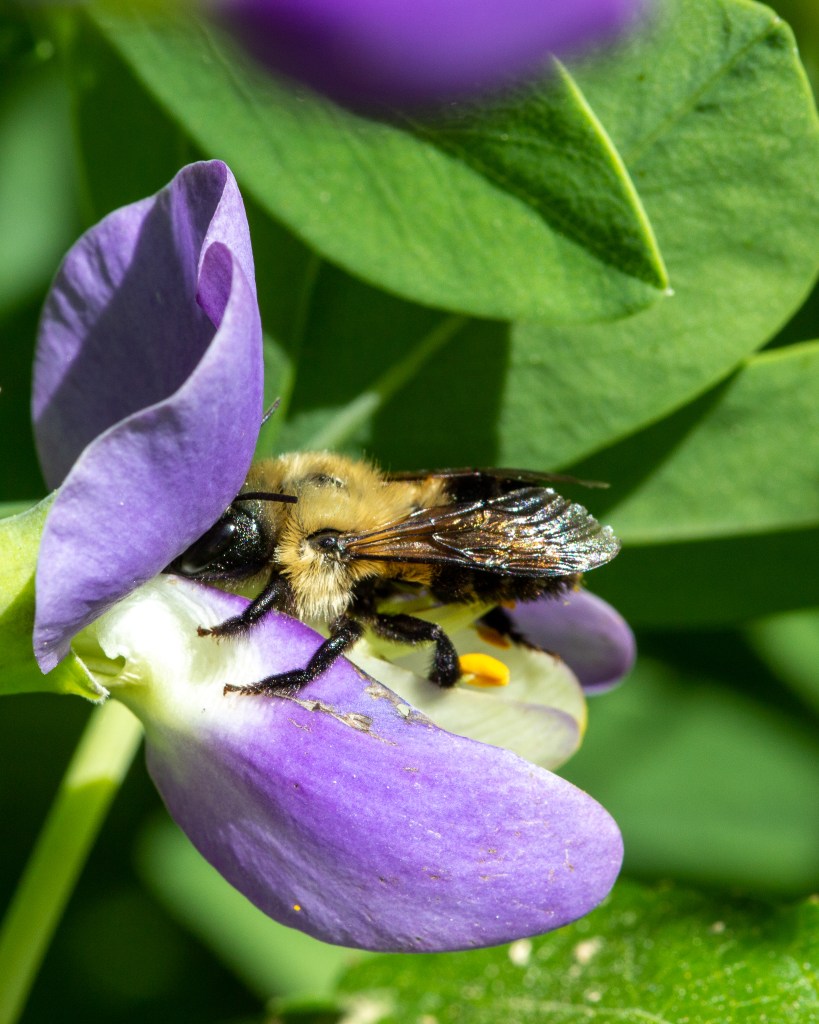
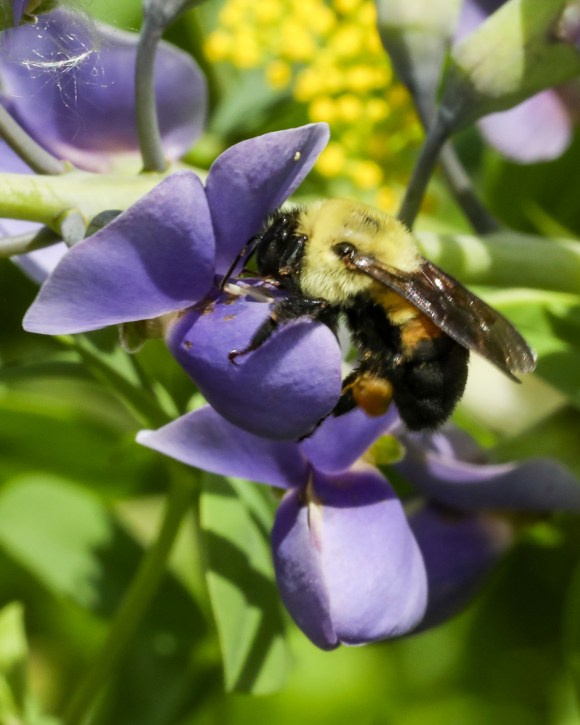
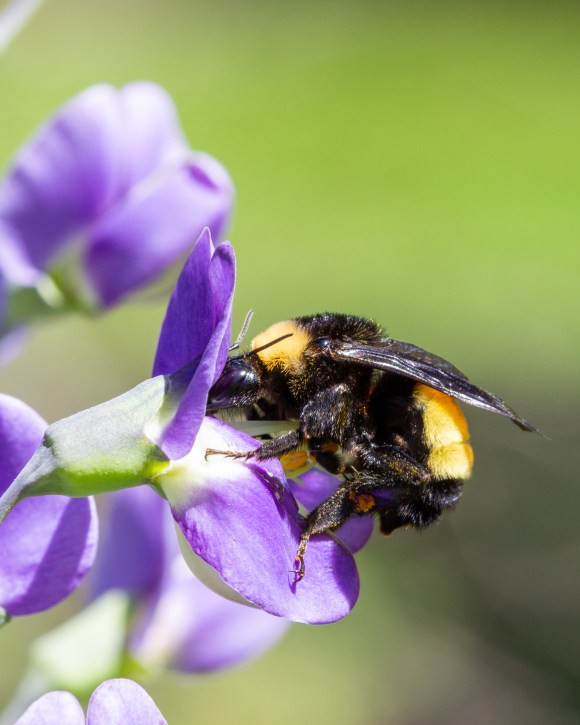
Baptisia is best known for supporting bumblebees especially the newly emerged Queens.   Many kinds of Bumblebees visit these plants looking for nectar.  

Each bloom has a nectary deep in its base.  The location is part of a remarkable pollination system.  Baptisias try to avoid self-pollination.  Its strategy depends on the physical structure of the flower and the timing of bud opening.  Each blossom has a petal that the stands up (the banner) and two petals that stick out like a dog’s muzzle (the keel).  The keel holds the pistil (female part) and stamens (male parts with pollen).   Between the banner and keep, inside the flower is the nectar.  The bumblebee holds the keel with her mid- and hind legs and pushes her way deep into the flower to get to the nectar.  When held, the keel opens and its pollen sticks to the bee’s fuzzy belly.

When it comes to reproducing, plants have all different structures and methods to regulate when and how fertilization happens.  Why?  It gives plants some ability to control self-pollination vs cross pollination.  Self-pollination won’t change the gene pool in a population (ignoring mutations!)  But cross pollination increases chances of introducing different genes and more diversity into a population.  This is usually considered a good thing.

Baptisia has a fascinating system for reducing self-pollination.  When the bumblebees begin feeding at a bloom spike, they start at the bottom.  These lower flowers have more nectar and the female part is extended.  But the bumblebee doesn’t have much pollen at this point.  As she goes up the bloom spike, there is less nectar and more pollen.  When the bumblebee finishes and flies to the next stalk, she’ll start at the bottom again.  

As before, she finds more nectar and the pistil (female part) available on the lower flowers.  But this time, the bee has lots of pollen and there’s a higher chance of pollination.  The first plant “hopes” that the bee flew to a second plant with the pollen and cross pollination occurred!

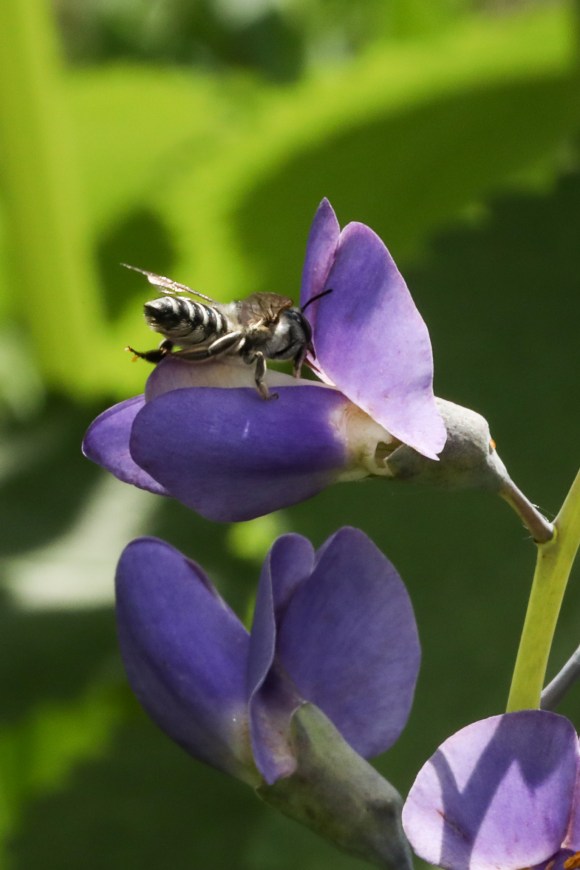
Megachile, Leaf-Cutter Bees, a medium-sized bee also drinks nectar from Baptisia.  These medium-sized bees clearly have the strength to reach and enjoy B. australis’ floral rewards.  The Leaf-Cutter Bees use a method similar to Bumblebees when opening the flower.

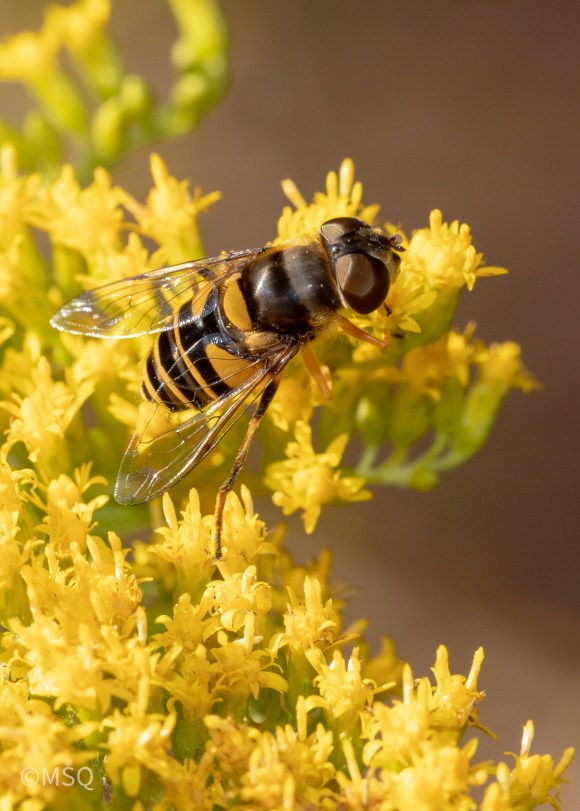
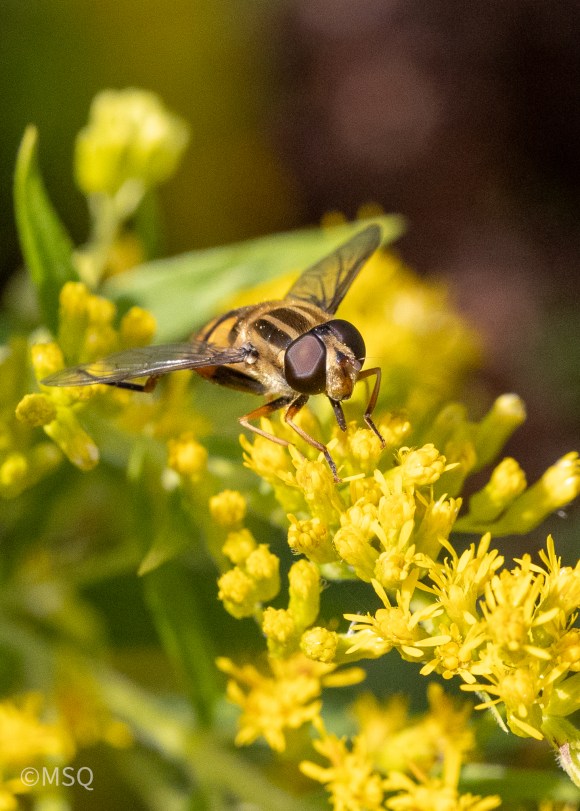
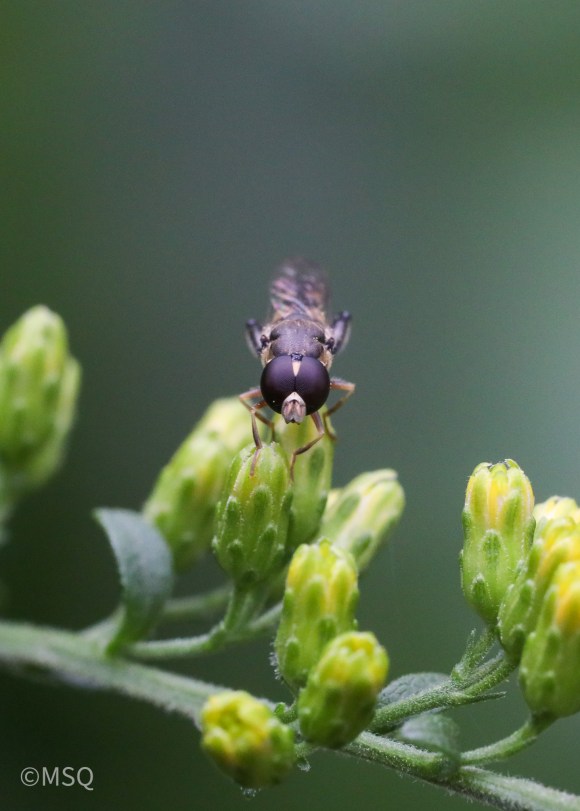
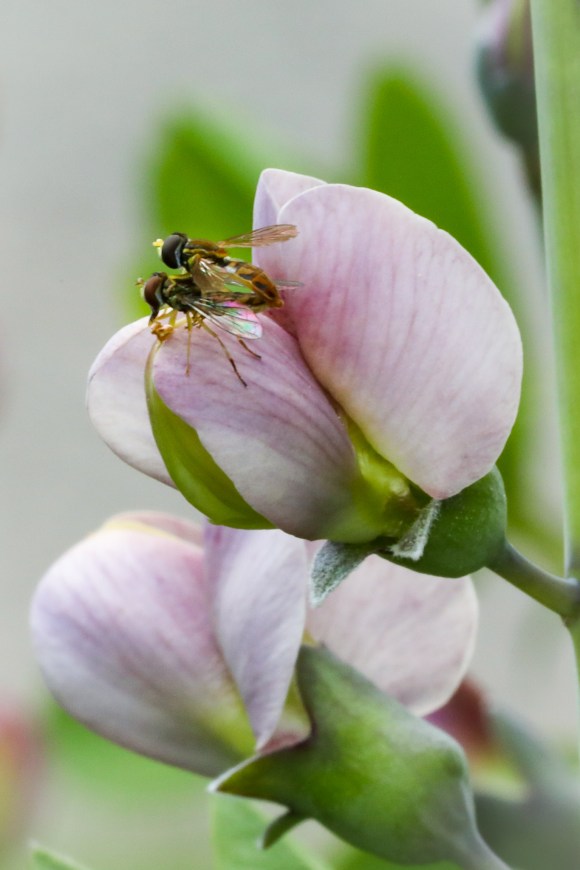
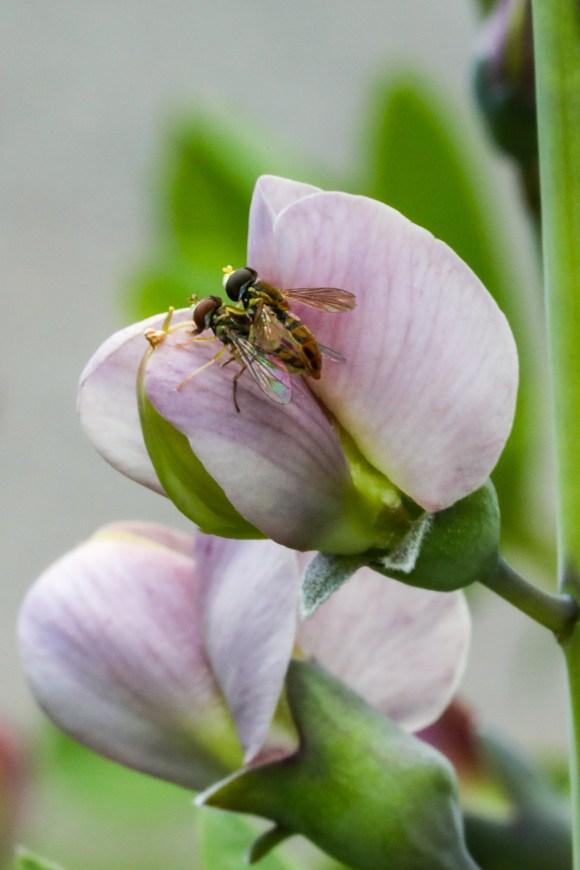
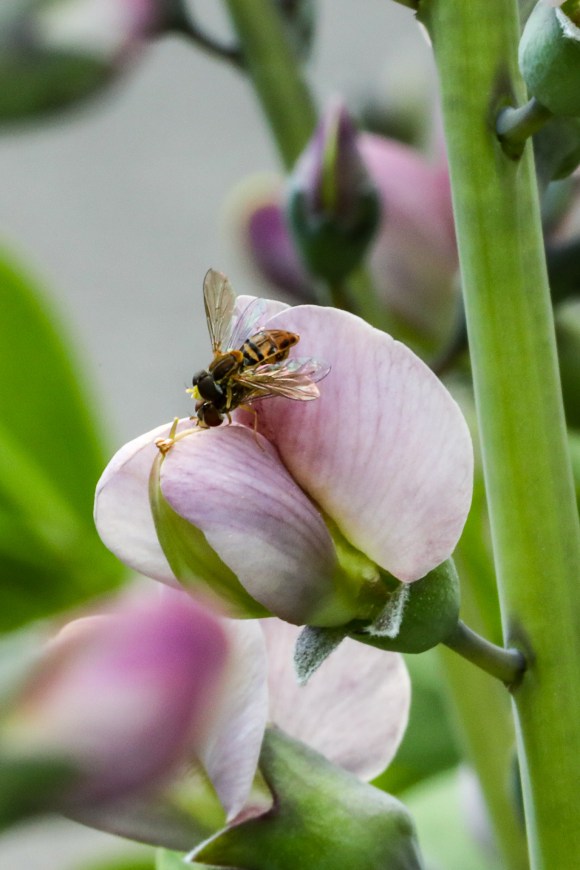
Amazingly, small bees and insects also visit Baptisias.  In my garden, I’ve included both native plants and nativars.  One afternoon, I spotted the following behavior on my ‘Pink Truffles’ Baptisia.  I observed a mating flight of syrphid flies (also called hoverflies or flower flies).  The pair landed on a Baptisia bloom and the female began teasing out the stamens from inside the keel!  Adult hoverflies feed on nectar and pollen.  They spent several minutes easing them out and feeding.  Not B. australis but an interesting behavior!

Depending on the species, the syrphid fly’s larvae (maggots) can eat a variety of food.  Some maggots eat decaying plant and animal matter.  But other larvae eat aphid, thrips, and other plant-sucking insects.

After the hoverflies, metallic green sweat bees arrived to eat the exposed pollen.  Once the stamens are uncovered, Lasioglossum, small sweat bees, also join these other pollinators using the Baptisia.

In addition to bees, Wild Indigo is a larval host for butterflies and skippers.  The Wild Indigo Duskywing (Erynnis baptisiae) and Hoary Edge (Achalarus lyciades) caterpillars both eat Baptisia.  The larvae of three butterflies, the Frosted Elfin (Callophrys irus), Marine Blue (Leptotes marina), and Orange Sulfur (Colias eurytheme) also use it.  Adult Frosted Elfin Butterflies and other butterflies nectar at B. australis.

I hope you enjoyed this adventure with Baptisia australis-a gorgeous plant for a wonderful time of year.  Next time, I’ll talk about Parthenocissus vitacea aka Virginia Creeper aka Woodbine.  A very different plant, it’s well known as a wild plant but not in the garden.  I plan to show the benefits of including Woodbine in the garden for the landscape and the pollinators.

Please contact me to share your stories, questions, and observations!

Thanks for reading,

Mary