Silphium terebinthaceum (Prairie Dock)
Rising high above tall grasses, Prairie Dock’s light-yellow blooms open in the sun. Silphium terebinthinaceum or Prairie Dock is one of the Silphiums, often called the giants of the prairie. It’s tall flower stalks live up to the name rising 8 to 10 feet. Yet the base stays a manageable 1 to 3 feet across making it reasonable for the home garden.8,9

One of the Keystone plants for Ecoregion 8-Eastern Temperate Forests, it supports specialist bees, native bees, bumbles bees and other long-tongued bees and bee flies. Hummingbirds visit the flowers and finches eat the seeds. Parasitic and Hyperparasitic wasps use Prairie Dock for nesting and reproduction.4,8,9
Silphium terebinthinaceum grows in zones 4 to 8. The flower stalks reach up to 10 feet and the plant spreads from 1 to 3 feet. This plant thrives in full sun but tolerates part shade. Deep, loamy soil is ideal. Rocky or gravelly soil, clay, limestone or dolomite rocky soil are all acceptable.8,9
In a natural setting, Prairie Dock lives in moist to dry black soil prairies, fens, shrub prairies, gravel prairies, hill prairies, tops of bluffs, seeps, upland or rocky prairies, savannas, old fields, prairie remnants, along roads and railways, glades, openings of dry upland forests, woodland borders, and, rarely, banks of streams.8,10
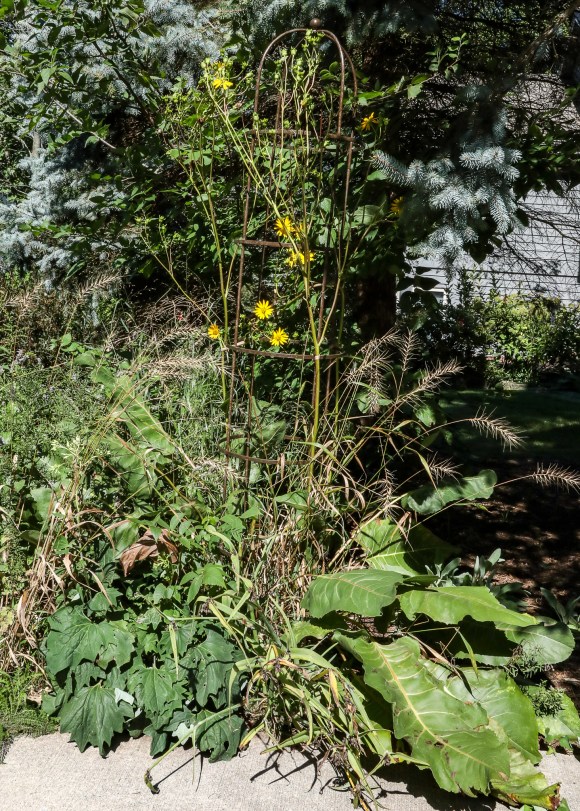
Prairie Dock’s leaves are remarkable! Growing up to 18 inches long and 12 inches wide, they emerge in a vase-shaped rosette. In full sun, the leaves orient from North to South. This direction maximizes photosynthesis and reduces transpiration.6,8,9
The foliage itself is heart shaped or cordate. It has a thick, sand papery texture. The upper surface of young leaves is mostly hairless and shiny but older leaves become matte and rough.8
Its flowers bloom from summer into fall-opening from multiple buds. These compound flowerheads have 15 to 30 ray florets and many disc florets. They are 2 to 3 inches across.6,8
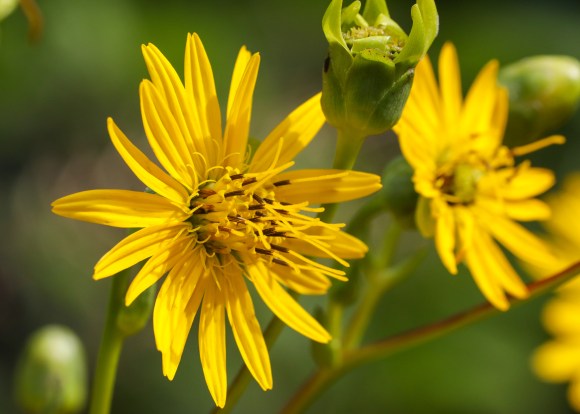
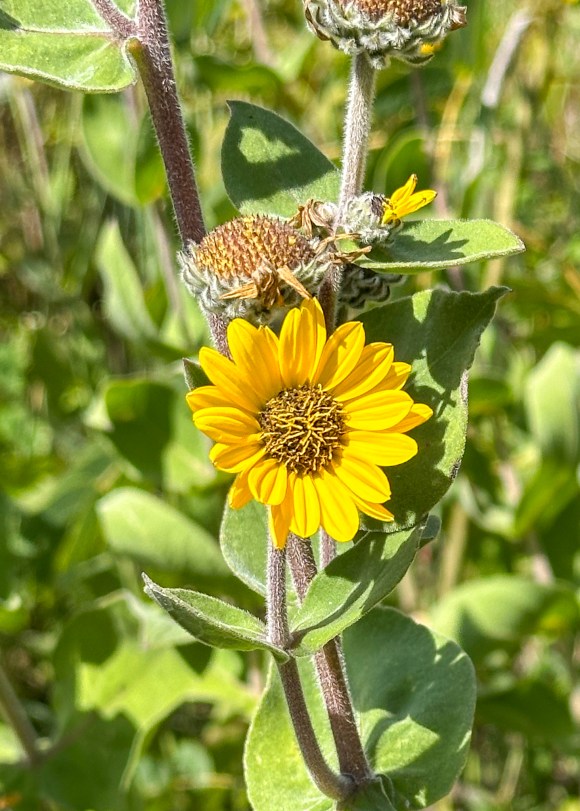
Here’s a fun botanical fact! The flowers of Silphium and Helianthus (Wild Sunflower) are astonishingly similar but there is a key difference. The centers (disc flowers) of Helianthus are the female or pistillate florets. As seen in commercial sunflowers, these become seeds. In the Silphium flowers, only the ray flowers (those attached to petals) are female. Seeds only form around the edge of Silphium’s compound flower head.6
Silphium terebinthinaceum’s blooms on long, smooth stalks. These rise from 3 to 10 feet and branch at the top to hold several blossoms. The flower stalks don’t usually need support but often lean. In fact, the only place I’ve seen them stand straight is on a median strip.8,9
The Prairie Dock plant is slow to establish taking 2 to 3 years flower in cultivation. In the wild, it can take considerably longer. Once established it’s almost impossible to kill. The tap root can grow to 12 feet and the plant resists drought, fire and herbivore predation.8
The deer ate my Prairie Dock to the ground for several years. I assumed it was dead. Then the township started a controlled hunt. The deer population went down and my S. terebinthinaceum grew back. Now it’s fully grown and blooms every year.
Prairie Dock attracts long-tongued and short-tongued insects. It’s a Region 8 Keystone plant supporting pollen specialist bees. In addition, The Xerces Society for Invertebrate Conservation has designated it of Special Value to Native Bees, of Special Value to Bumble Bees and declared it Provides Nesting Materials/Structure for Native Bees.4,8,10
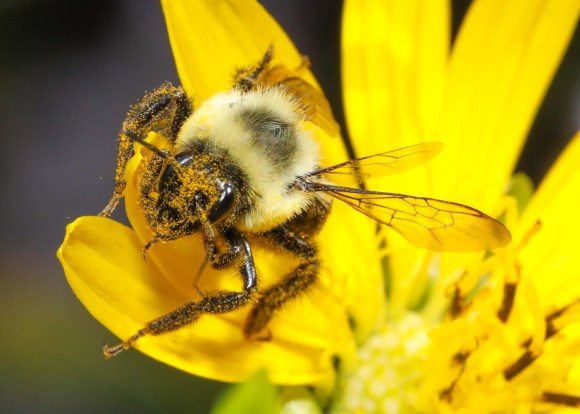
Honeybees,
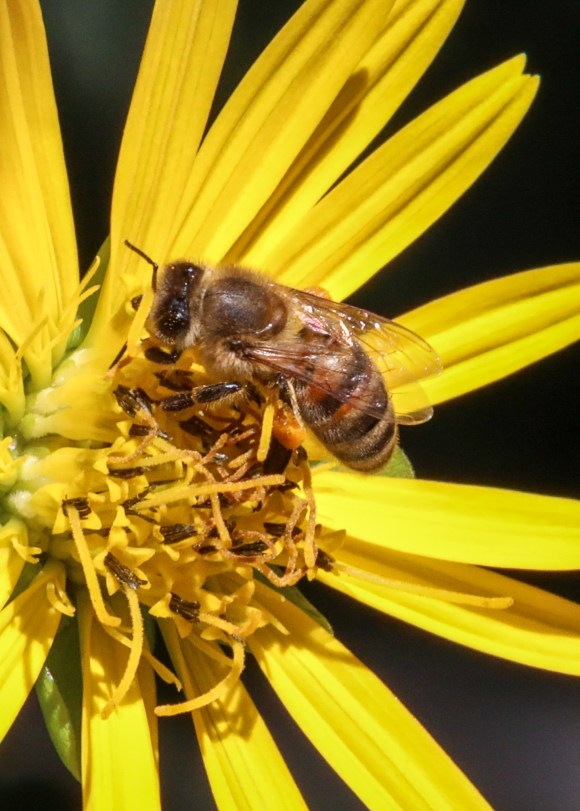
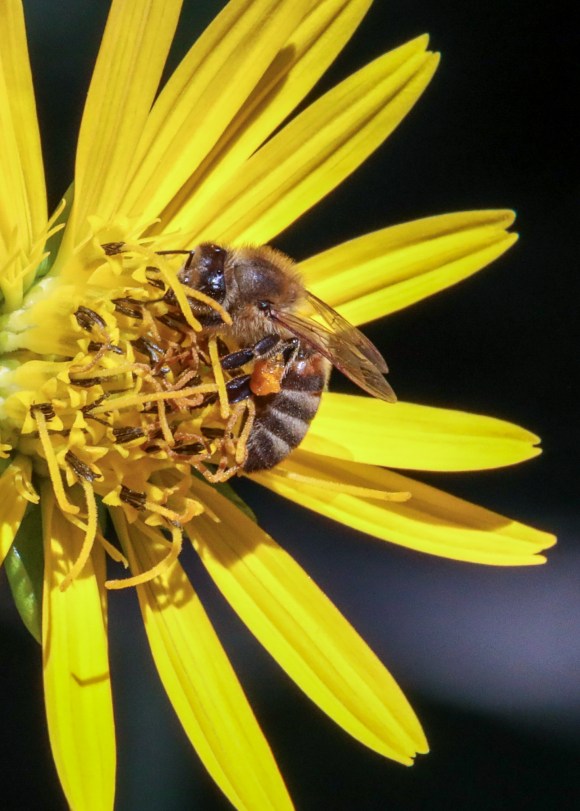
Bumblebees,

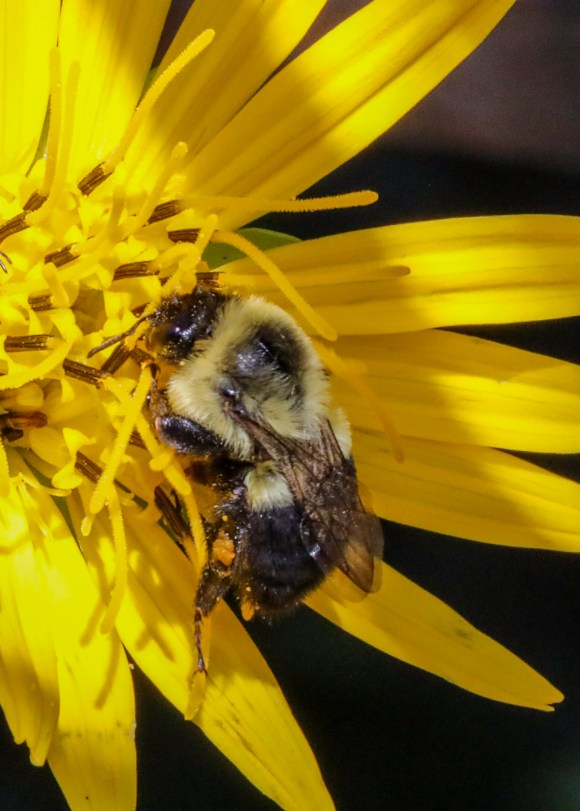
and Miner bees are among the long-tongued visitors.

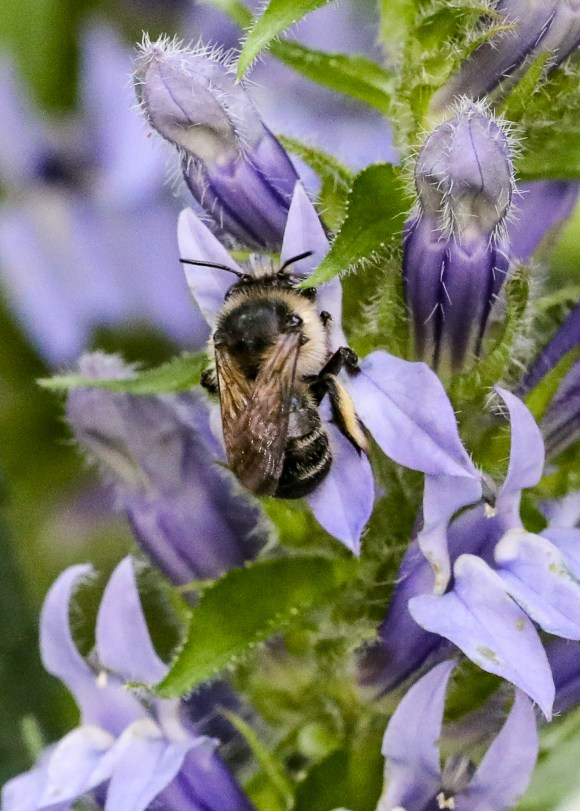
Short-tongued guests include Halictid bees, resin bees (Heriades spp. and Megachile spp.), small carpenter bees (Ceratina spp.),
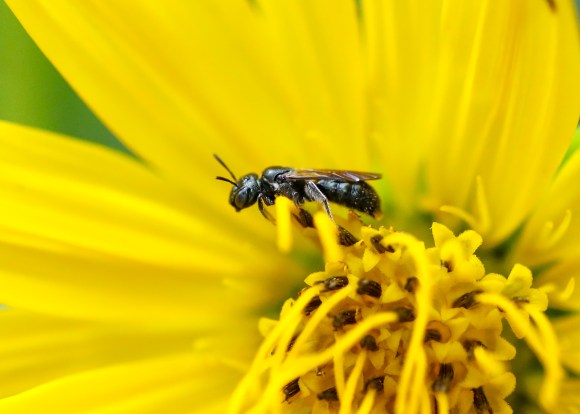
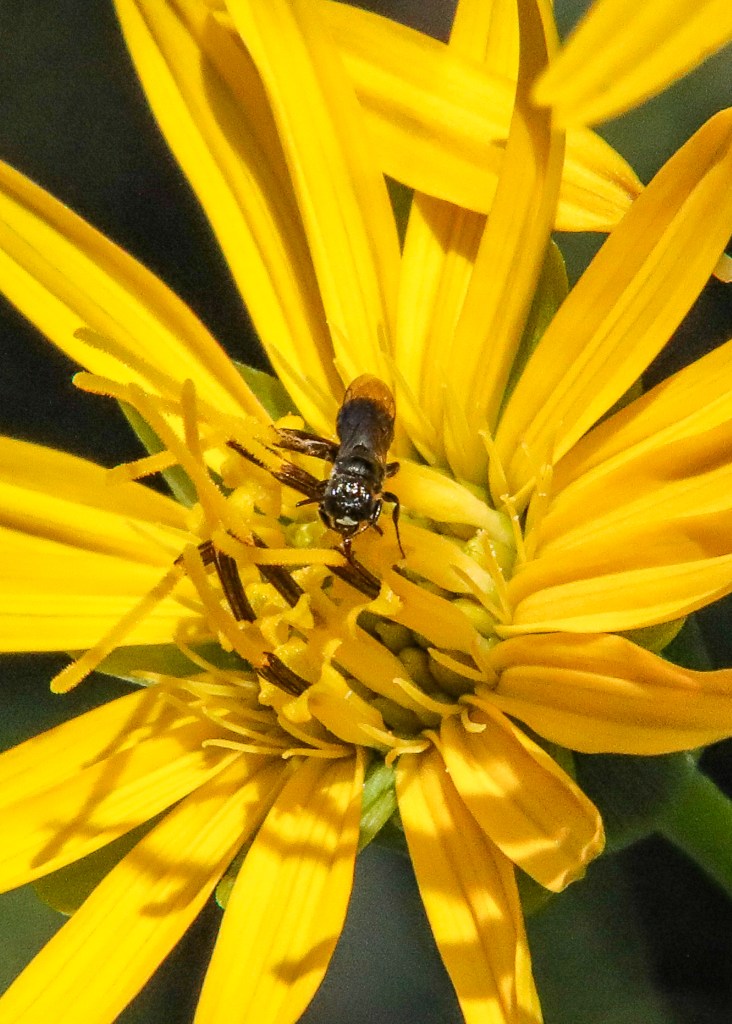
beetles and bee flies. The Ruby-Throated Hummingbird also uses S. terebinthinaceum for nectar and, possibly, small insects. Small mammals, Goldfinches and other Finches eat the seeds.8
Silphium terebinthinaceum attracts resin bees. Silphium is a very old name for a resinous plant and this whole group are commonly called rosinweeds. The specific epithet ‘terebinthinaceum’ means ‘with
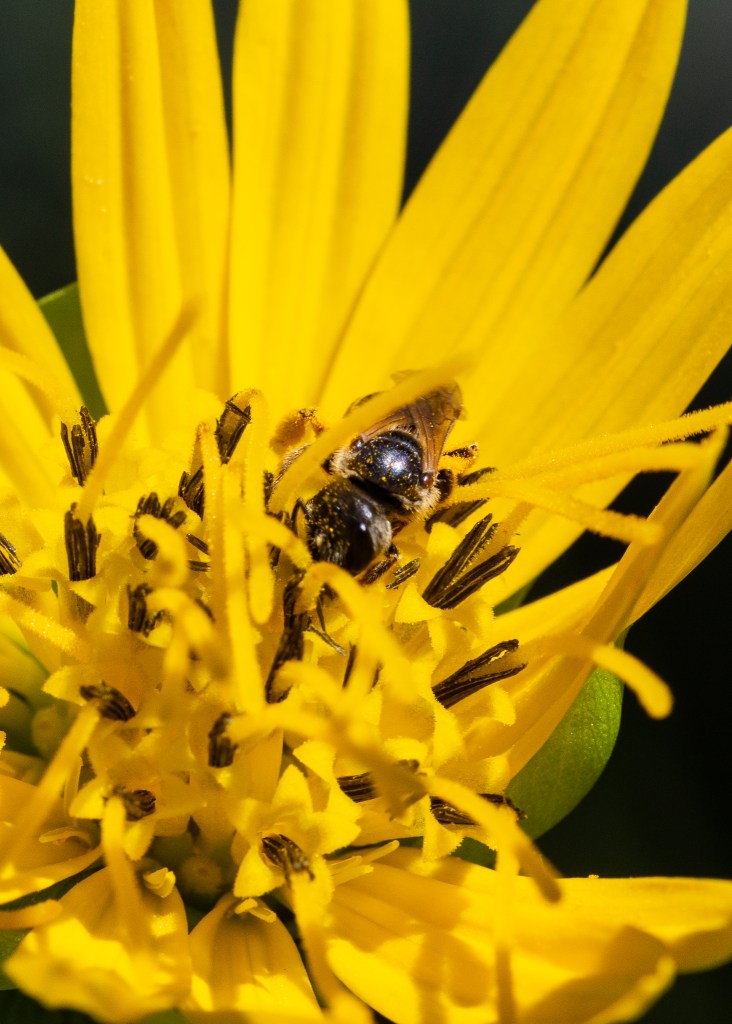
turpentine’ referring to the scent of the resinous sap.7
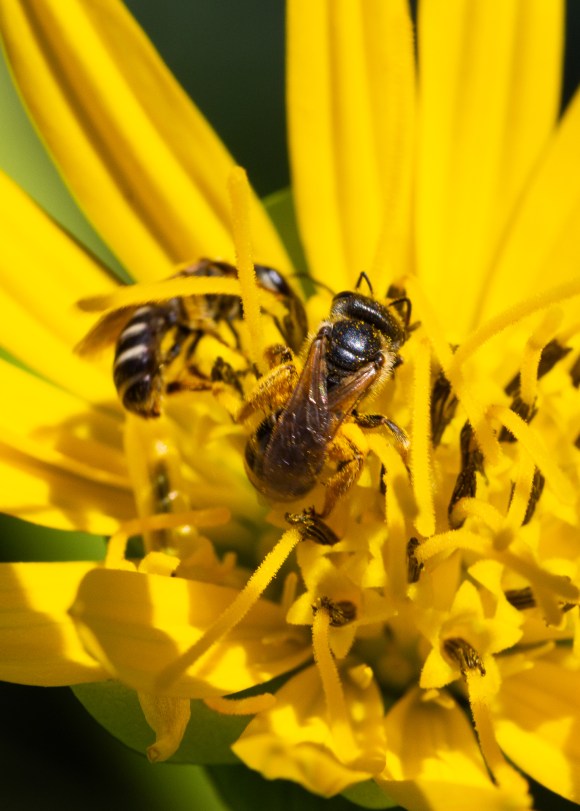
Heriades use resin from Prairie Dock to build their nests. These bees use existing cavities for nests. These cavities include beetle burrows, cavities in rocks, hollow stems and abandoned mud dauber nests. Heriadeswill nest in bee hotels and nest boxes.3
In addition to nectar and pollen, Prairie Dock provides a home for a gall wasp and its parasite. The gall wasp, Antistrophus rufus, nests in the stem where it forms small galls. These insects each plant matter. They’re considered a valuable prey animal for other insects, small insect-eating birds and woodpeckers. A. rufus also indicates a healthy, diverse ecosystem.8
Eurytoma lutea parasitizes A. rufus. When a parasite preys on another parasite, it’s called a hyperparasite. E. lutea feeds on a variety of gall-forming wasps which can damage plants. This wasp is a beneficial insect since it helps control populations of the gall-forming wasps.8
The Tumbling Flower Beetle (Mordellistena aethiops) lives in and on Prairie Dock. The larvae stay inside the stem, and most are stem-borers. They, also, eat other plant parts, decaying wood and fungus.1,5

The adults are charming, shiny, black beetles. They eat nectar and pollen. While they move around the flower head, the Tumbling Flower Beetles contribute to pollination.
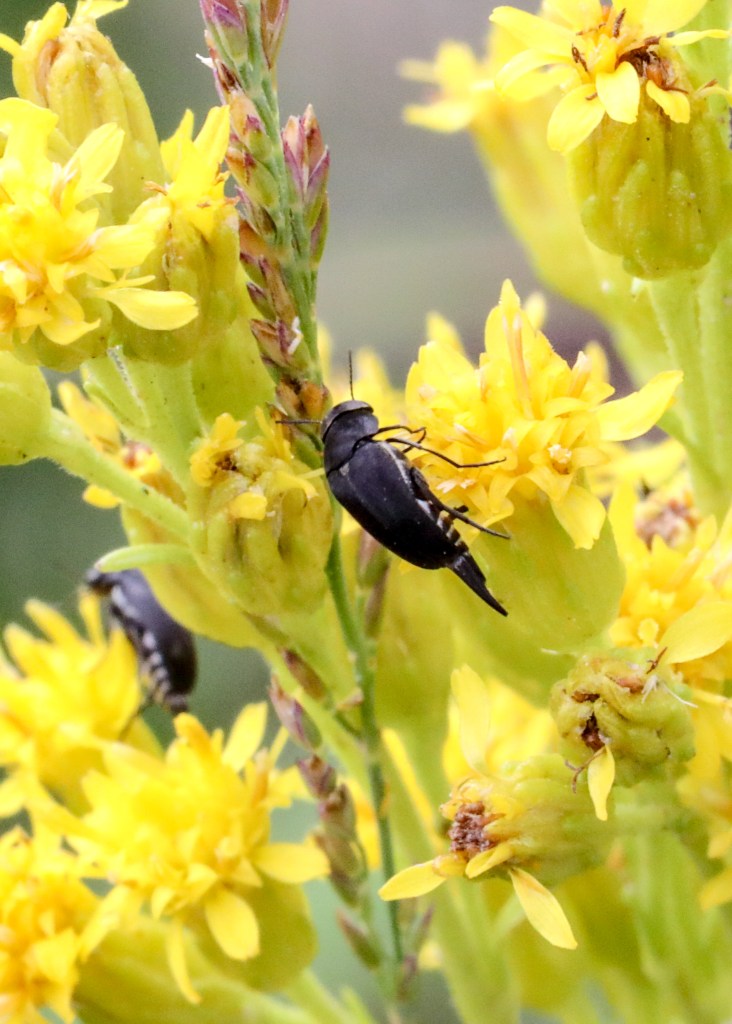
These beetles are also known for…tumbling! Just like their name, when startled, they look like their rolling rapidly off the flower. The Tumbling Flower Beetle has a complex way of moving involving a series of short hops. They alternate legs, leaping every 80 ms. The goal is to evade a predator and get into a good flight position. It also startles the person reaching for it!1,5
Hope you enjoyed our exploration of Prairie Dock—the garden-size Silphium! This plant gives a home to a multitude of pollinators and other insects. It’s also a stunning plant in the garden!
Happy Gardening,
Mary
Bibliography:
- Farley, Jeanine. 2025. “Getting a Kick out of the Tumbling Flower Beetle Means You’ve Caused the Critter to Panic and Flee.” Cambridge Day, July 19. https://www.cambridgeday.com/2025/07/19/getting-a-kick-out-of-the-tumbling-flower-beetle-means-youve-caused-the-critter-to-panic-and-flee/
- “Flower-Visiting Birds and Insects of Prairie Dock”, n.d. Accessed September 3, 2025, https://www.illinoiswildflowers.info/flower_insects/plants/prairie_dock.htm
- Holm, Heather. 2017. Bees: An Identification and Native Plant Forage Guide. Pollination Press LLC.
- “Keystone Native Plants: Eastern Temperate Forests-Ecoregion 8” n.d. Accessed September 3, 2025, https://www.nwf.org/-/media/Documents/PDFs/Garden-for-Wildlife/Keystone-Plants/NWF-GFW-keystone-plant-list-ecoregion-8-eastern-temperate-forests.pdf
- “Mordellidae – an Overview | ScienceDirect Topics.” n.d. Accessed September 3, 2025. https://www.sciencedirect.com/topics/agricultural-and-biological-sciences/mordellidae
- Missouri Department of Conservation. n.d. “Prairie Dock (Prairie Rosinweed).” Accessed September 3, 2025. https://mdc.mo.gov/discover-nature/field-guide/prairie-dock-prairie-rosinweed.
- Missouri Department of Conservation. n.d. “Silphium.” Accessed September 3, 2025. https://mdc.mo.gov/magazines/conservationist/2000-08/silphium.
- “Prairie Dock (Silphium Terebinthinaceum).” n.d. Accessed September 3, 2025. https://www.illinoiswildflowers.info/prairie/plantx/pr_dockx.htm.
- “Silphium Terebinthinaceum – Plant Finder.” n.d. Accessed September 3, 2025. https://www.missouribotanicalgarden.org/PlantFinder/PlantFinderDetails.aspx?kempercode=f590.
- “Silphium Terebinthinaceum (Prairie Rosinweed) | Native Plants of North America.” n.d. Accessed September 3, 2025. https://www.wildflower.org/plants/result.php?id_plant=site.
 Wild Things in the Garden