Vibrant orange blooms glow against lush green leaves. Thriving in sunny, dry spots, Butterfly Milkweed (Asclepias tuberosa) calls insects of all kinds—bees, wasps, flies, beneficial insects and butterflies. It also hosts caterpillars for some butterflies and moths.
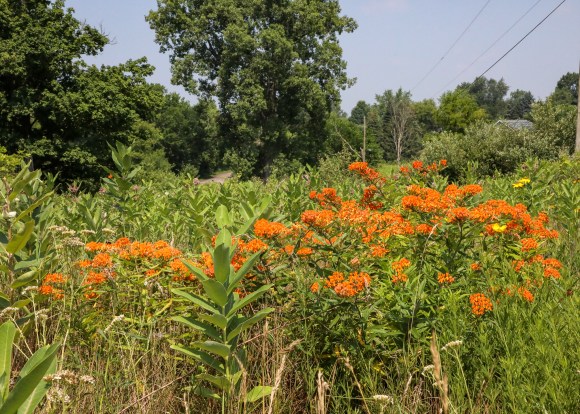
Butterfly Milkweed grows in Zones 3 through 9. It reaches between 1 and 3 feet and spreads from 1 to 1.5 feet. Its size makes it an excellent choice for the home garden.3,4
The best growing conditions include full to part sun. It flourishes in sandy or rocky, acidic soil. With good drainage, this plant tolerates other soils including loam and clay.3.4
Asclepias tuberosa lives in high quality natural areas and in disturbed places. It’s found in upland sand prairies, hill prairies, cemeteries, open prairies, sandy savannas, open rocky woodlands, shale and sandstone glades, abandoned sandy fields, roadside embankments, areas along railroads and dry, open, rocky woods. I primarily see it on roadside embankments.4
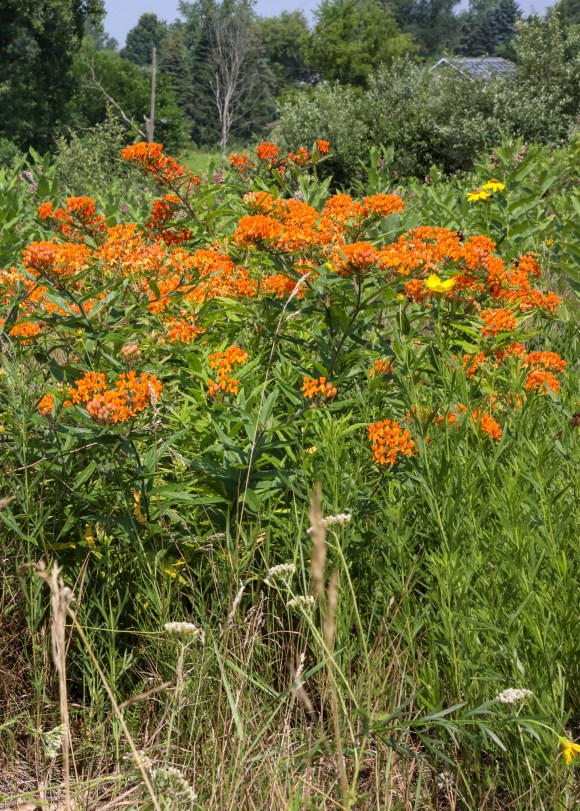
Unlike other milkweeds, Asclepias tuberosa’s leaves are closely spaced on the stem. The oblong leaves emerge alternately from the stem and have pointed tips. They’re sessile (attached to the stem) or have short petioles (less than an 1/8 inch).4
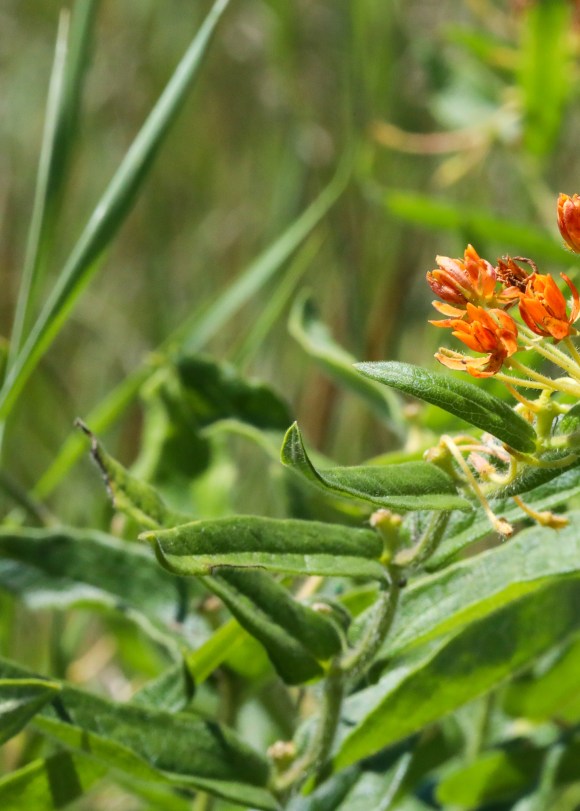
The upper side of each leaf is medium to dark green and smooth or maybe with a few hairs. The lower side is light to light medium green and covered with short hairs. Foliage is 2.5 to 3.5 inches long and 0.5 to 0.75 inches wide. This milkweed lacks the white-milky latex that gives milkweeds their name. Its sap is clear and watery.4
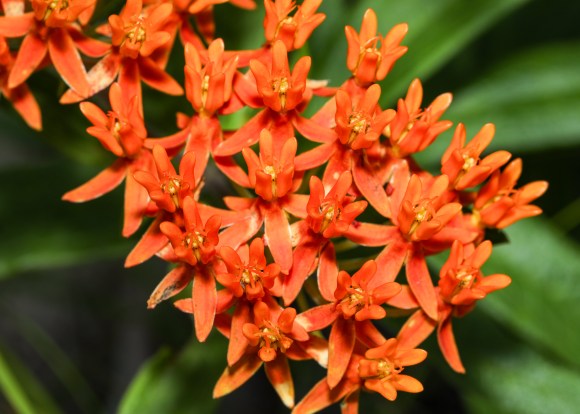
Butterfly Milkweed’s flowers are striking. While I was looking through my photos, every picture of it jumped out immediately because of that distinctive orange color. Blooms arise from the upper stem and axils of the upper leaves.
Individual umbels (groups of florets) are 1 to 2.5 inches across. They’re made up of 8 to 25 blooms. Slightly domed, umbels often grow next to each other. Groups of umbels form composite flowerheads 2 to 5 inches across.4
Individual flowers have the classic milkweed composition-5 petals, 5 hoods with horns and a central reproductive column. The central column is called a gynostegium. It’s composed of modified male and female floral parts. For a full explanation of milkweed reproduction, see my blog (A Delicate Pink Star, https://wildthingsinthe.garden/?s=Common+Milkweed).4
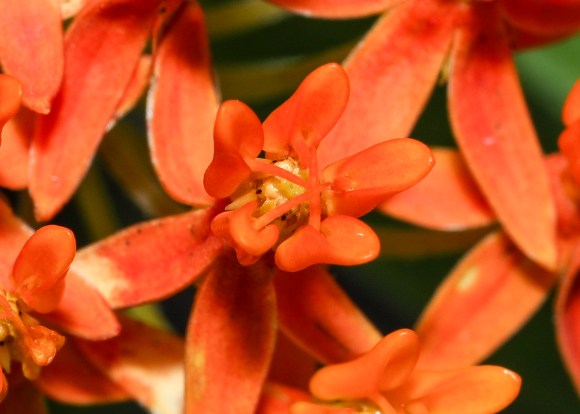
Blossom color naturally ranges from reddish orange to yellowish orange. Bloom time runs from early to midsummer. If deadheaded, A. tuberosa reblooms in late summer to early fall. The flowers are long lasting although they have no noticeable fragrance.3,4
Butterfly Milkweed’s root system is the secret to its survival in dry conditions. Thick and knobby, the tap root can grow several feet down. One- to two-year-old plants have a generous tap root—2-3 inches long and 0.5 to 0.75 inches wide. This root helps its survival but makes it difficult to transplant. Generally, direct seeding works best.4
In addition to drought, Butterfly Milkweed resists deer, erosion, dry soil, shallow, rocky soil and has moderate salt tolerance. Unfortunately, in wet, poorly drained soil conditions, it’s susceptible to crown rot, rust and leaf spot.4
Asclepias tuberosa is a wonderful plant for a dry spot in the garden. The orange flowers catch the eye. They also offer some variety from the usual yellow or white flowers found on summer-blooming native plants.
Butterfly Milkweed has received a variety of awards. These include Missouri Botanical Garden’s Plant of Merit, North Carolina Wildflower of the Year 1985 and Perennial Plant of the Year 2017. All recognize that this milkweed is easy to grow, resistant to pests and disease and ornamental in the garden.1,2,5
As a native plant, Asclepias tuberosa entertains and feeds numerous native pollinators and beneficial insects. It serves as a larval host for butterflies. The Ruby-Throated Hummingbird drinks nectar from the blooms.4
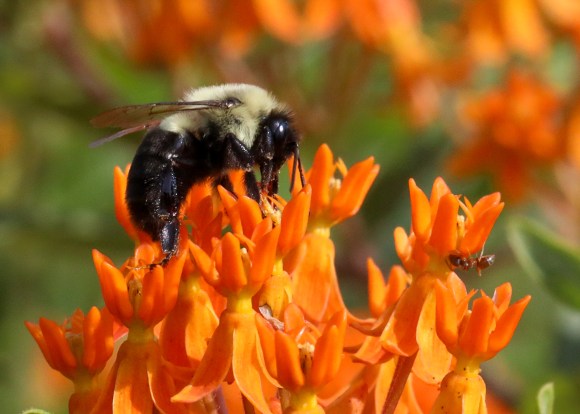
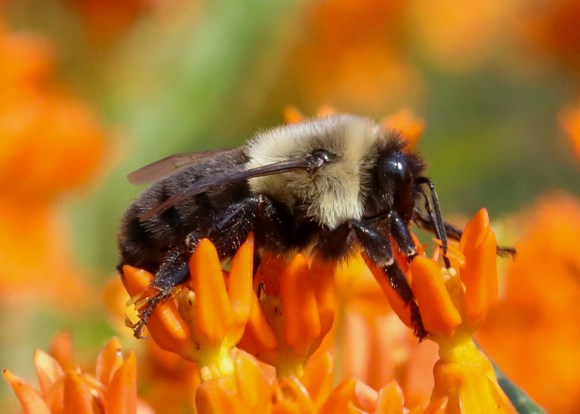
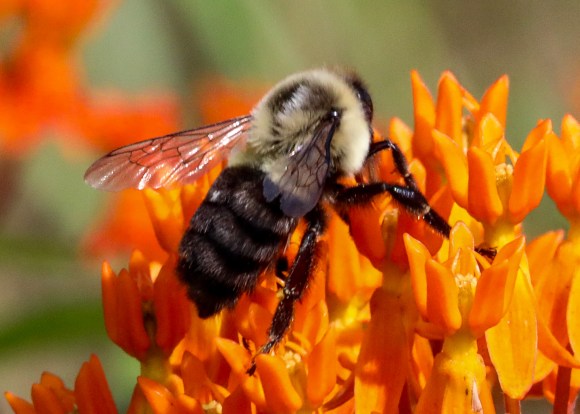
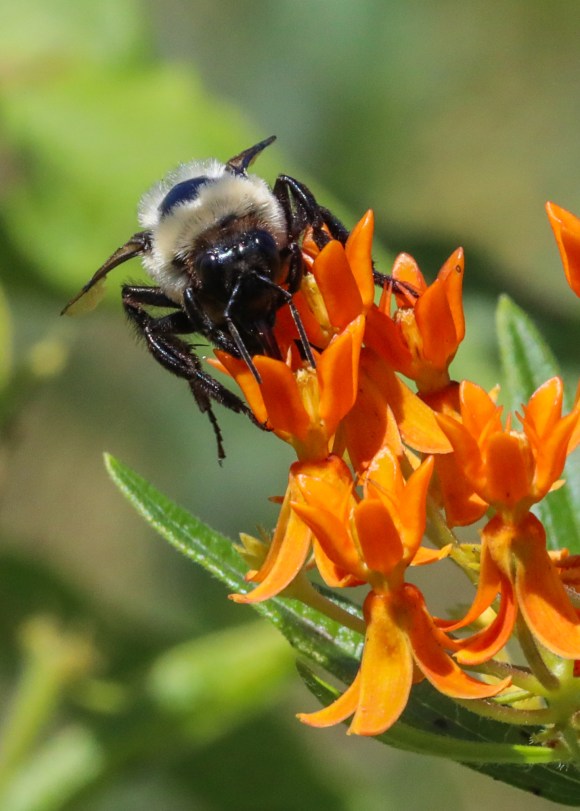
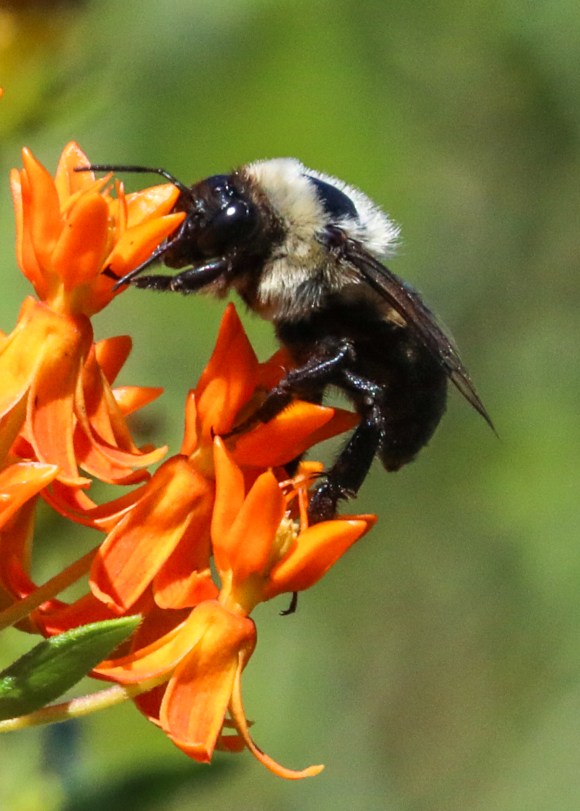
The Xerces Society for Invertebrate Conservation has declared Butterfly Milkweed of Special Value to Native Bees, Special Value to Bumble Bees, Special Value to Honeybees and that it Supports Conservation Biological Control. A variety of bees visit its brilliant blooms. These bees include: Honeybees (Apis spp.),
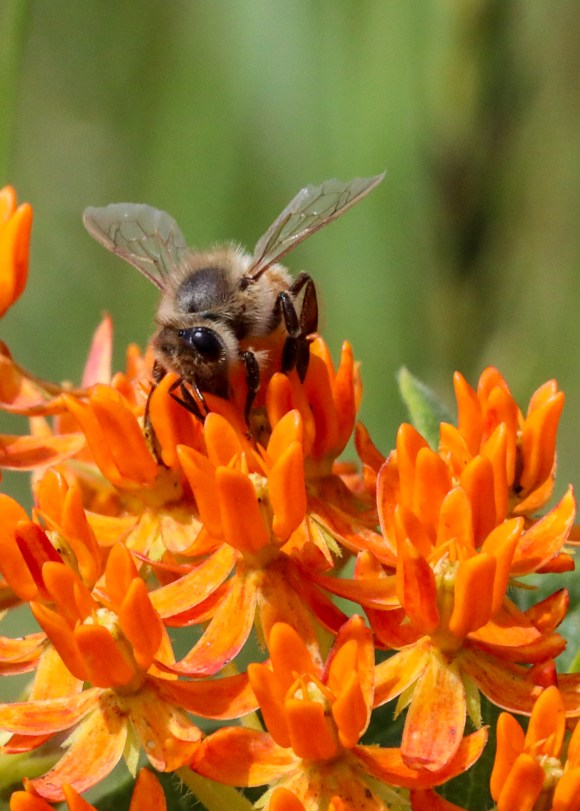
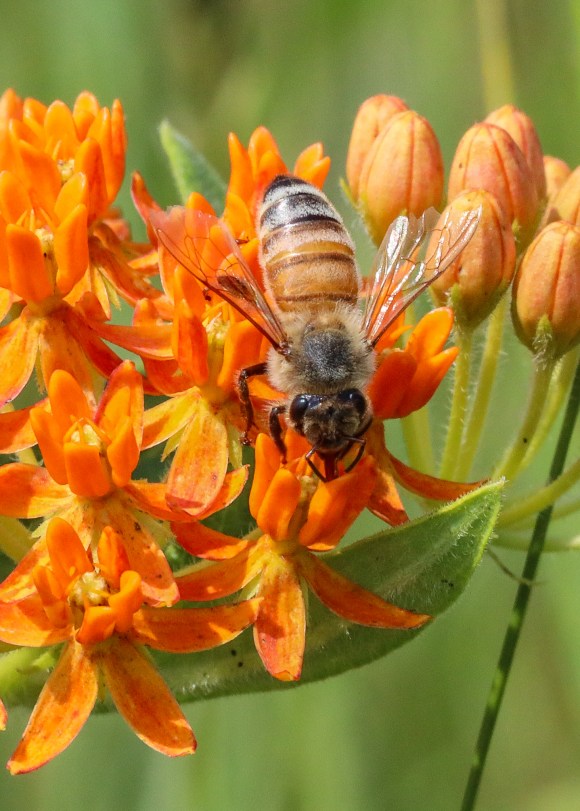
Bumble Bees (Bombus spp.),
Large Carpenter Bees (Xylocopa spp.),
digger bees (Melissodes spp.), leaf-cutter bees (Megachile spp.),
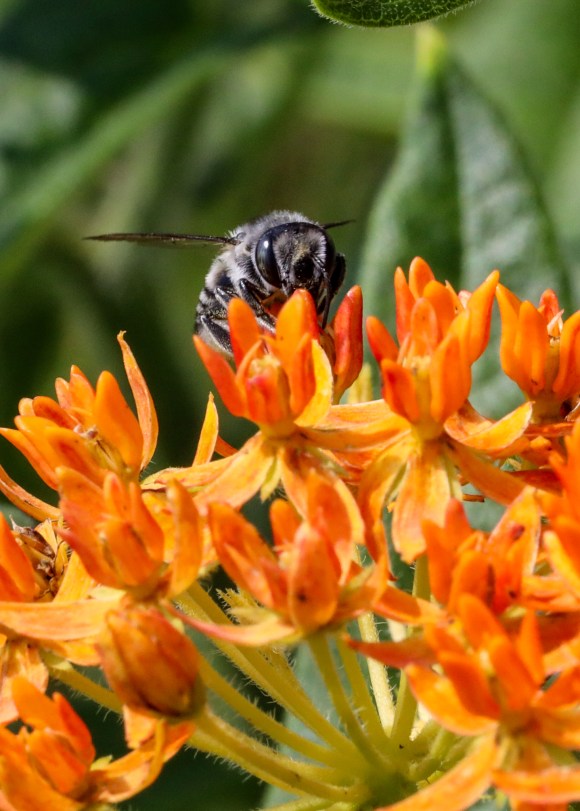
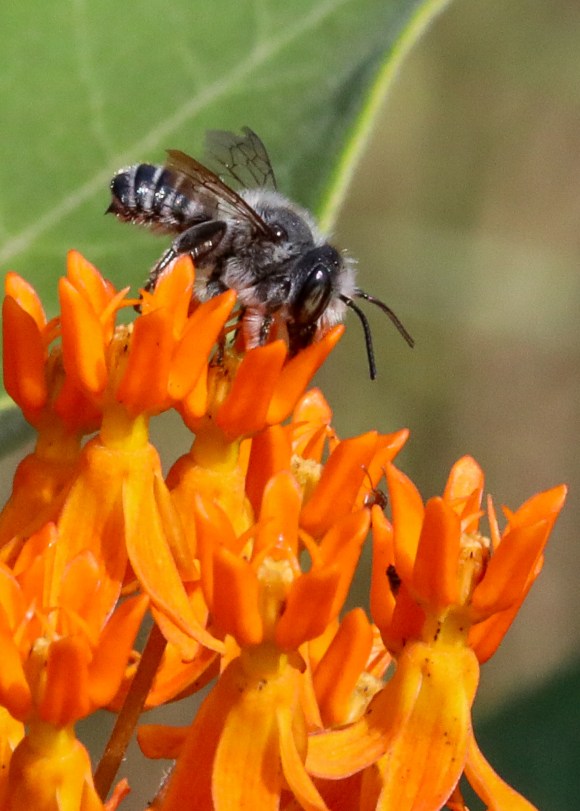
small resin bees (Heriades spp.), Halictid bees (including green metallic bees)
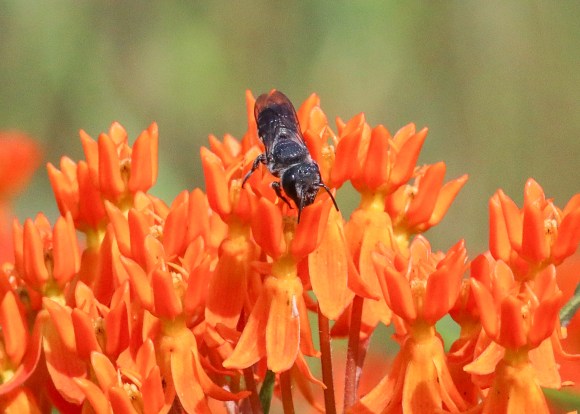
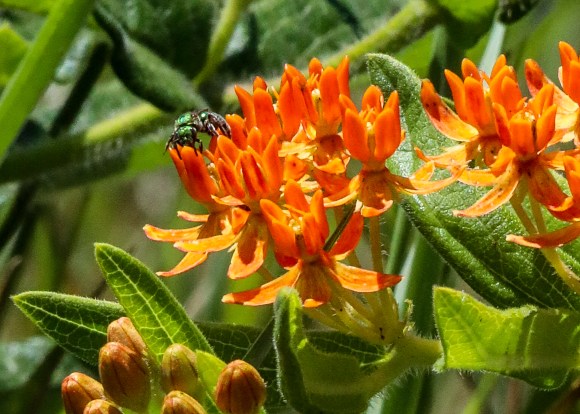
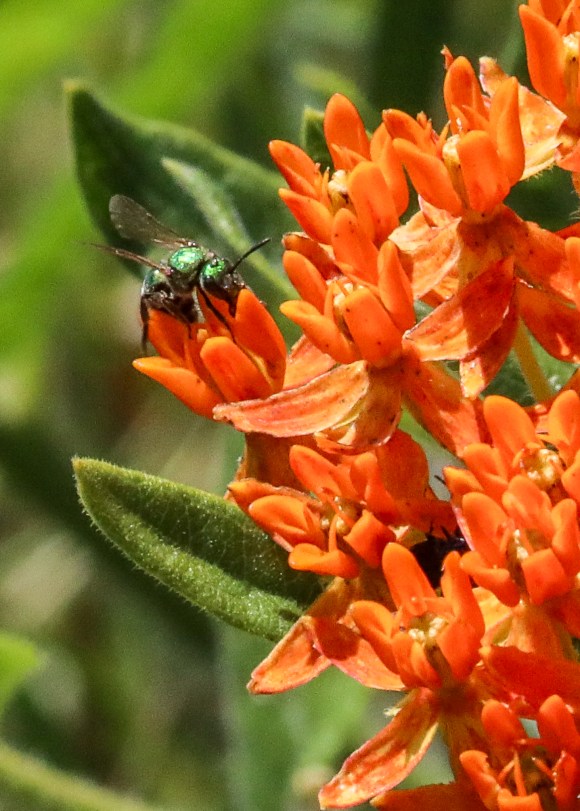
Lasioglossom spp. ,
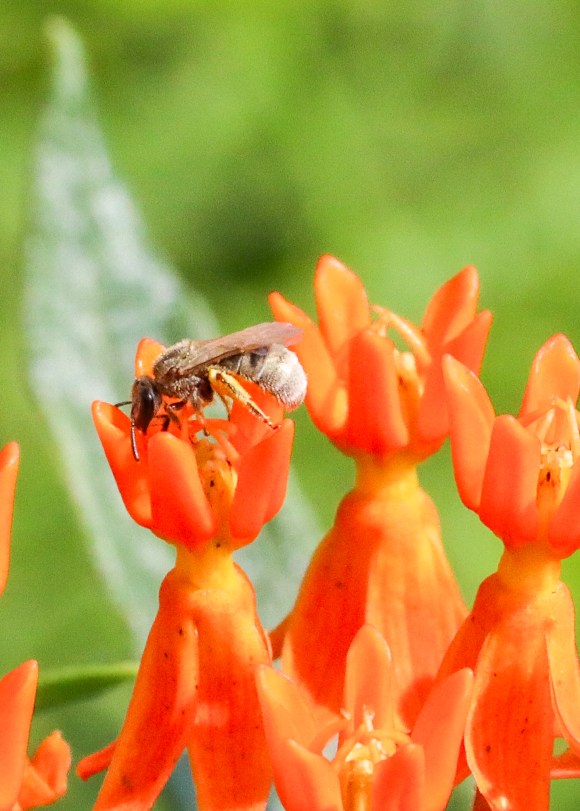
Augochlora pura,
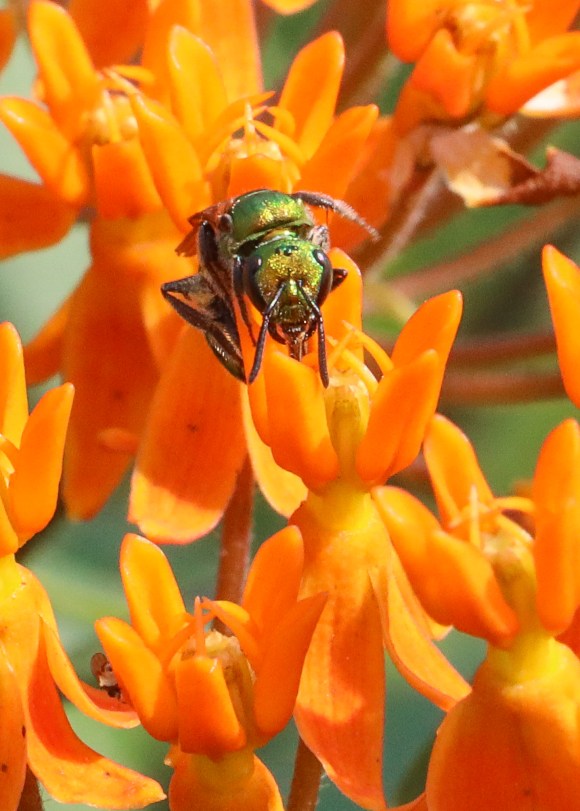
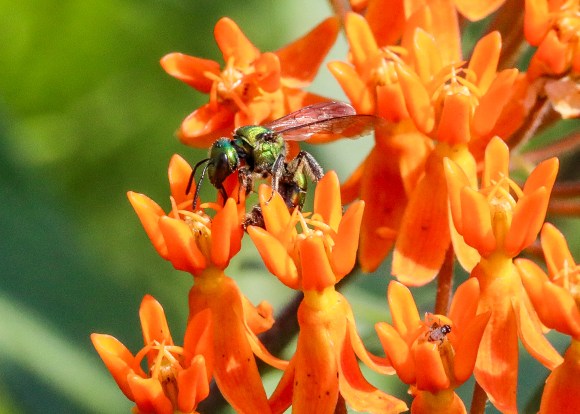
and small carpenter bees (Ceratina spp.).3,4
Heriades spp. or small resin bees gather pollen from Butterfly Weed, carrying it on their abdomens. These bees build their nests in existing spaces or cavities in wood or hollow stems. They gather resin from plants to separate each nest cell.6
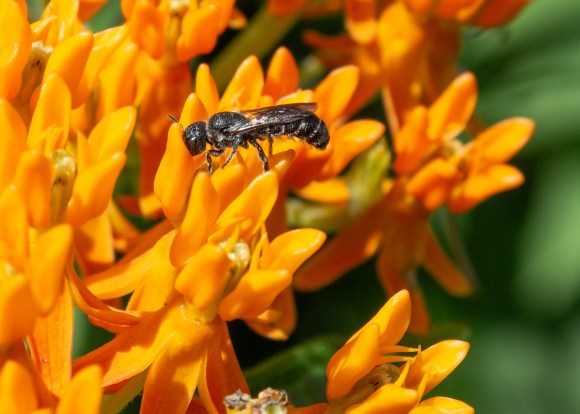
When building a nest in a long cavity, Heriades spp. often leaves a vestibule or space before the first nest cell. She seals this space with a resin wall and begins making brood cells. When the nest is closed, the small resin bee leaves another space between two resin plugs.
Nesting begins in late spring to early summer. Female offspring regularly outnumber males. They are usually laid at the back of the nest.6
These Small Resin Bees pollinate various native plants including Tickseed (Coreopsis spp.), Milkweed (Asclepias spp.), Wild Bergamot (Monarda fistulosa), Sunflower (Helianthus spp.), Coneflower (Ratibida spp.), Ironweed (Vernonia spp.) and Nodding Onion (Allium cernuum). There are reports of Heriades happily pollinating onions and leeks.6
In addition to bees, Thread-Waisted wasps (Ammophila spp.) and other Sphecid Wasps gather nectar from Asclepias tuberosa.
Living up to its name, Butterfly Milkweed feeds a variety of butterflies. Fritillaries (Speyeria spp.), Swallowtails (Papilio spp.) and the Monarch (Danaus Plexippus).
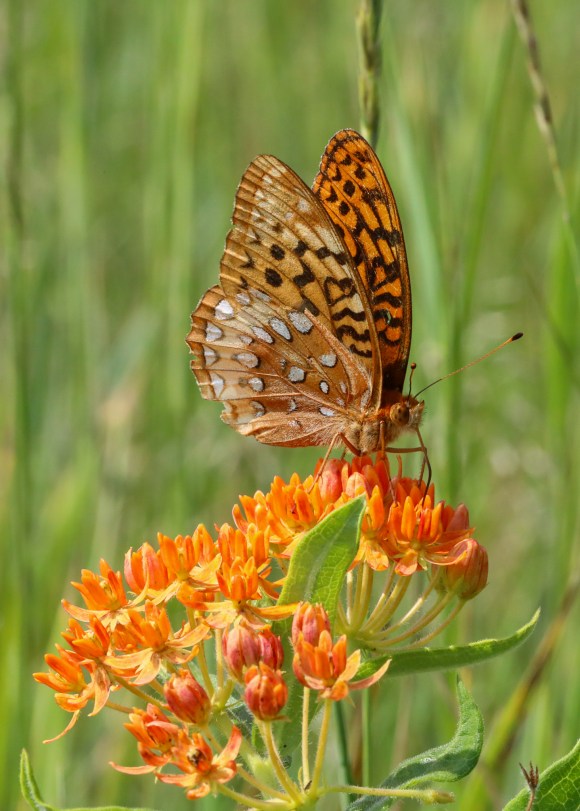
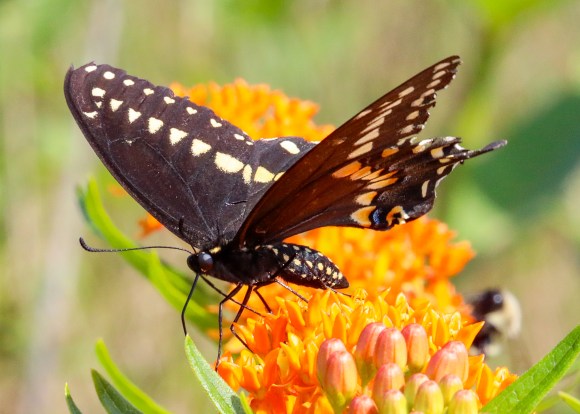
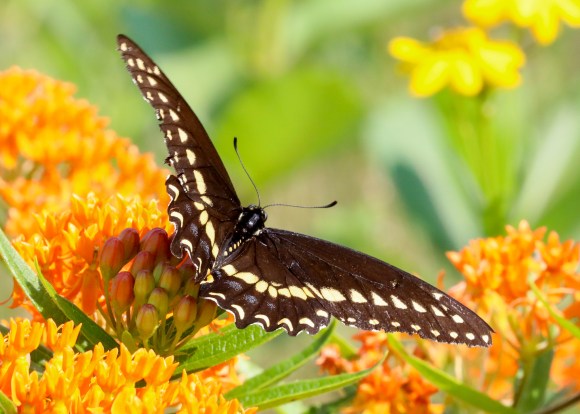
It’s also a larval host for the Monarch Butterfly (Danaus Plexippus), the Queen Butterfly (Danaus gilippus) and the Gray Hairstreak Butterfly (Strymon melinus).4
The Grey Hairstreak Butterfly (Strymon melinus) is in the Lycaenidae family and is one of the Gossamer wing butterflies. They are pale grey with bright orange eyespots at bottom edge of their wings. Near the eyespots, are very thin tails coming off the hindwings—one on each wing. These tails inspired the common name Hairstreaks.5
Many butterflies and moths have eyespots on the upper surface of their wings. It’s thought that they startle predators while the butterfly/moth flies away. This kind of adaptation is called mimicry. The eyespots mimic eyes, perhaps even those from another species–like an owl.
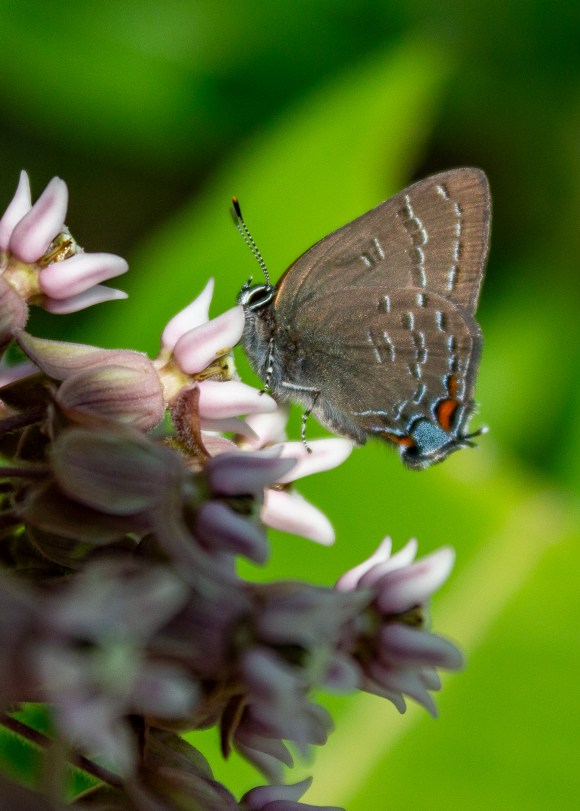
The Grey Hairstreak has a slightly different take on it. Its eyespots are on the bottom of the wings so they’re visible when it’s perching. The 2 antennae-like tails located next to the eyespots highlight the appearance of a second head. This butterfly even moves its hindwings up and down to imitate antennae twitching.5
If a predator strikes the eyespot, the butterfly has a chance to get away. No doubt, this works on large predators like birds. It also fools the jumping spiders often found on flower heads. The spiders aim for their prey’s head. Once there, they inject venom into the butterfly’s thorax. When the jumping spiders land on the eyespots, there are no convenient body parts to bite!
As if this weren’t amazing enough, Lycaenid caterpillars have a special relationship with ants. I know ants are hard to love. I, myself, declare a red alert when I see one in the house. Yet, I have come across some wonderful things ants do for the ecosystem.5
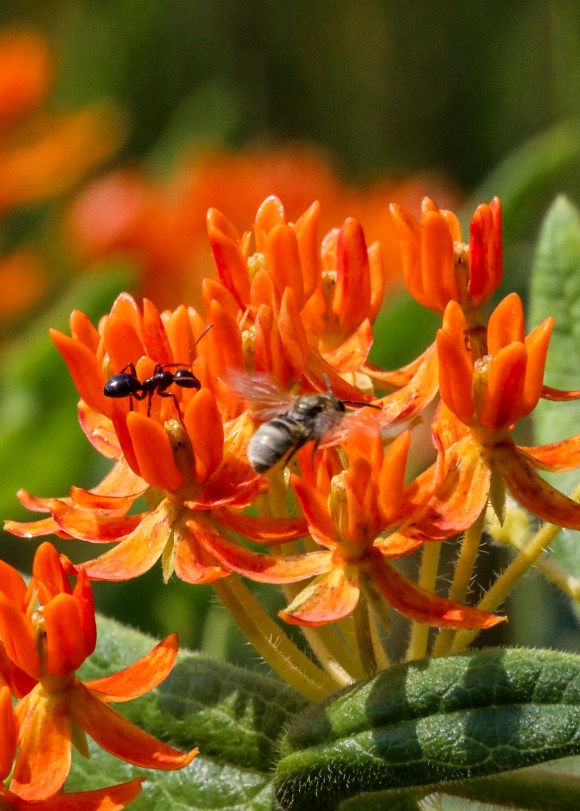
For Strymon melinus, ants tend the larvae in a myrmecophilous relationship. In return, the caterpillar feeds the ants and gives off an alarm pheromone-like chemical. Since the ants get something in return, it’s a mutualistic relationship.
Grey Hairstreak larvae make a sweet liquid in the dorsal nectary organ on their seventh abdominal segment. Ants harvest the liquid from this “honey gland.” In return, they tend the caterpillar and protect it from predators. These Strymon melinus larvae vary in color. They can be pale yellow, purplish-white, pink, reddish-brown or green. Some sources say the green larvae are so well camouflaged that it’s easier to follow the ants.5.7
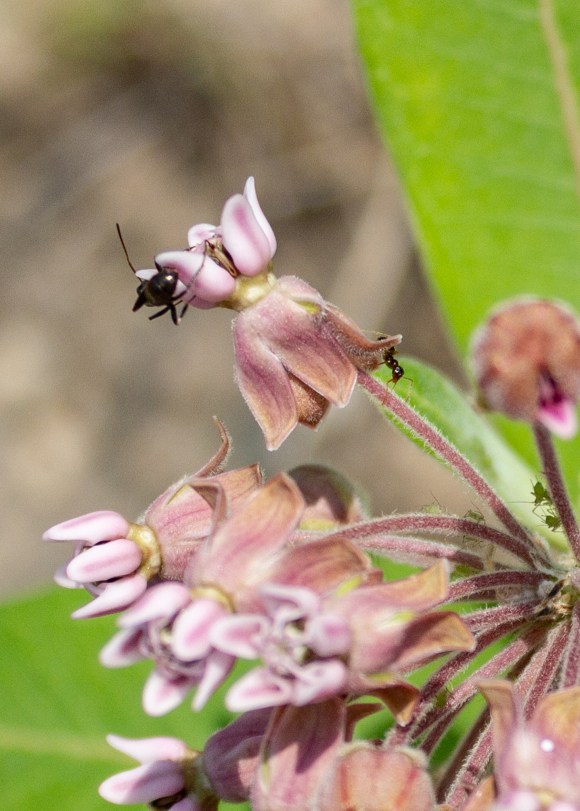
In addition, the larva has a tentacle organ that gives off a chemical. This compound is like the ants’ alarm pheromone. When the ants’ smell it, they become alert and protective. An alternate suggestion for these behaviors, they keep the ants from preying on the caterpillars.5
Hope you enjoyed this exploration of Butterfly Milkweed and some of the creatures that visit it. Enjoy the coming Spring weather! I hope you have plenty of time to spend in your garden.
Happy Gardening,
Mary
Bibliography:
- “Asclepias Tuberosa – Plant Finder.” n.d. Accessed November 15, 2025. https://www.missouribotanicalgarden.org/PlantFinder/PlantFinderDetails.aspx?kempercode=b490.
- “Asclepias Tuberosa (Butterfly Milkweed, Butterfly Weed, Chiggerflower, Common Butterfly-Weed, Indian Paintbrush, Milkweed, Pleurisy Root) | North Carolina Extension Gardener Plant Toolbox.” n.d. Accessed November 15, 2025. https://plants.ces.ncsu.edu/plants/asclepias-tuberosa/.
- “Asclepias Tuberosa (Butterflyweed) | Native Plants of North America.” n.d. Accessed November 15, 2025. https://www.wildflower.org/plants/result.php?id_plant=astu.
- “Butterfly Milkweed (Asclepias Tuberosa).” n.d. Accessed November 15, 2025. https://www.illinoiswildflowers.info/prairie/plantx/btf_milkweedx.htm.
- “Butterfly Weed | Chicago Botanic Garden.” n.d. Accessed November 16, 2025. https://www.chicagobotanic.org/plant-information/plant-profiles/butterfly-weed.
- “Gray Hairstreak Butterfly.” 2019. Field Station, April 17. https://uwm.edu/field-station/bug-of-the-week/gray-hairstreak-butterfly/.
- Holm, Heather. 2017. Bees: An Identification and Native Plant Forage Guide. Pollination Press LLC.
- iNaturalist. n.d. “Gray Hairstreak (GTM Research Reserve Butterfly Guide) · iNaturalist.” Accessed March 5, 2026. https://www.inaturalist.org/guide_taxa/358983.
 Wild Things in the Garden