Or when we’re ready for Summer but it’s not ready for us
Late Spring and the first burst of flowers has come and gone. Delicate and lovely, these early flowers always warm our hearts after Winter but it’s still a long wait for the wild, abundant bloom of summer. While we wait, let’s fill these late Spring days with more flowers. And for those flowers, enter my next two plants—Baptisia australis and Parthenocissus vitacea.
These two stars of late Spring and early Summer are big, bold, and versatile but very different. And as I wrote I realized they’re too big to share one post. Today’s post is about Baptisia australis and I’ll save Parthenocissus vitacea for next time. Baptisia australis is a beloved, award-winning garden plant. As well behaved, as it is beautiful, it’s perfect for any garden with enough space and sun.
Baptisia australis, (Baptisia), also called False Indigo or Wild Indigo, gives a glorious burst of late Spring bloom beginning at the end May and extending into early June. Truly a special plant, Baptisia australis was the first straight species native (non-hybrid) chosen as Perennial of the Year in 2010 by the Perennial Plant Association. This award draws a lot of interest because the chosen plant must be low maintenance, grow in a wide range of climates, be interesting in several seasons and relatively pest and disease-free. B. australis manages to do all that naturally.
A plant so large it could be a shrub, Wild Indigo serves as a stunning accent plant! It grows three to four feet wide and high. Unlike its cousins the lupines, Baptisia isn’t picky about growing conditions. Give it sun and some water and you can expect beautiful full growth and lush flowers. It’s also deer resistant, salt tolerant and suitable for xeriscaping once established.
Xeriscaping is landscaping using little or no water from irrigation. Some people extend the definition to include little to no maintenance. If your Baptisia breaks off and rolls way to have its own adventure, then it’s absolutely no upkeep.
The Baptisia does have to become established in the garden before it’s fully resistant. As it grows, Baptisia develops an extensive root system. The roots can grow up to 12 feet deep and 3 to 4 feet wide. Choose its location carefully, Baptisia does not take transplanting well.
Baptisia’s leaves are three part and slightly creased at the center vein. Light green with a slightly bluish tinge, the foliage provides a highlight in the garden. Some Baptisias, like B. australis, have a rounded form down to the grown. Other Baptisias are vase shaped with bare stems at the base of the plant.
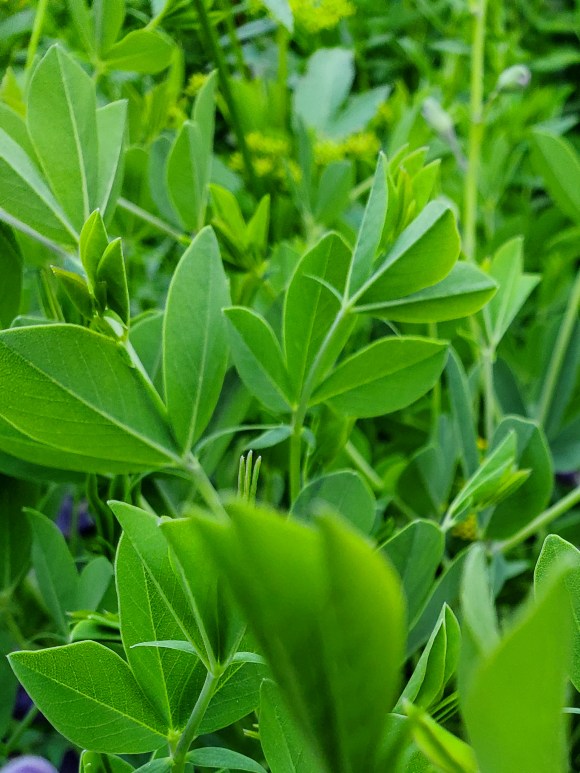
Flower spikes rise over the foliage. Spikes are 4” to 16” and densely packed with blue-purple blooms. Blossoms open from the base to the top. Once pollinated, large oval pods form. They turn from yellow green to black when ripe. The pods can be pruned off, especially if weighing down the plant. One year, after an especially heavy bloom, my Wild Indigo ended up about one foot tall under the weight of the seed pods. I’ve also partially pruned to enjoy the effect of black pods against the green foliage without all the weight. In Fall, the leaves turn to gray or black and curl but remain on the plant. If the Baptisia is growing in an exposed location, it can break off at the base and roll away like a tumbleweed. I have one plant at the top of a hill which does this every year. The remaining stalks look like a very clean pruning.
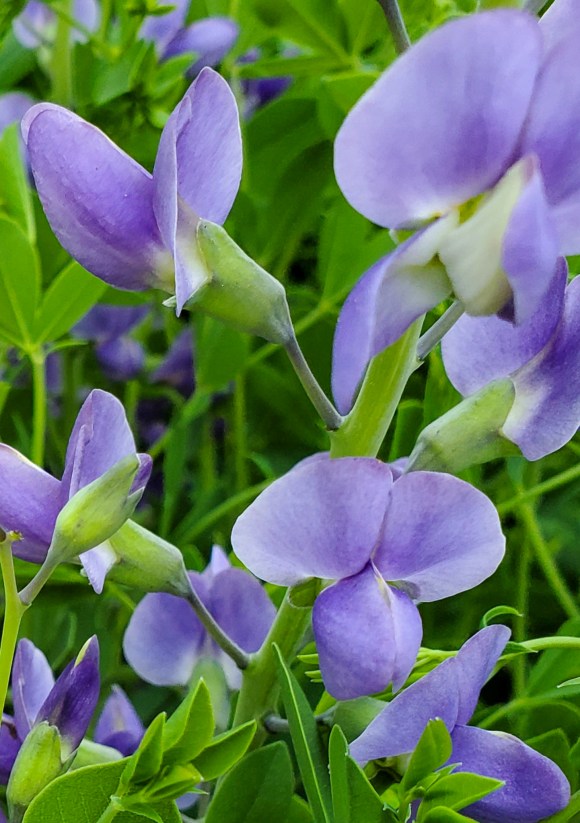
Baptisia is best known for supporting bumblebees especially the newly emerged Queens. Many kinds of Bumblebees visit these plants looking for nectar.
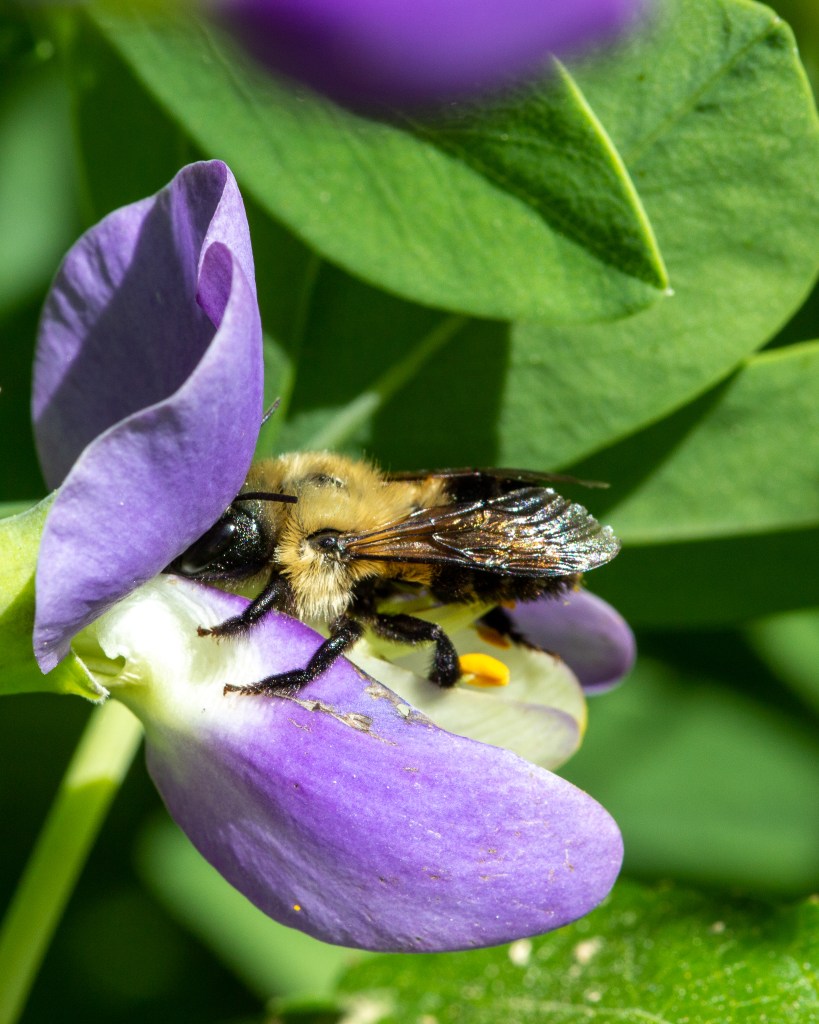
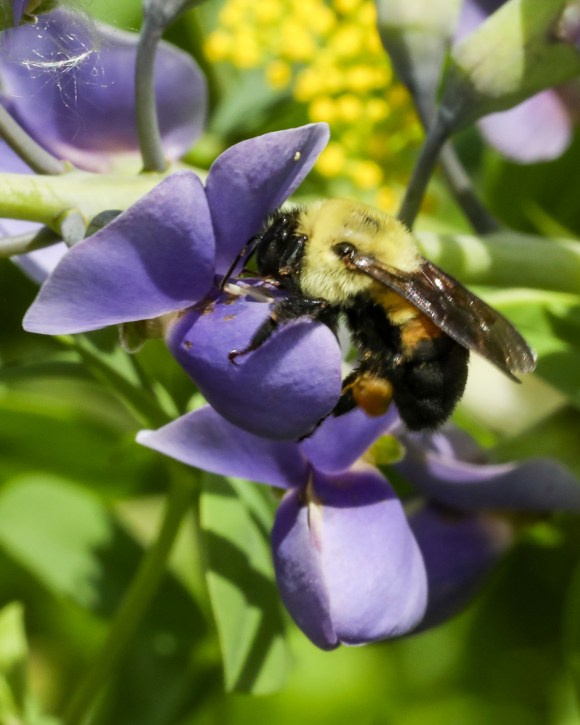
Each bloom has a nectary deep in its base. The location is part of a remarkable pollination system. Baptisias try to avoid self-pollination. Its strategy depends on the physical structure of the flower and the timing of bud opening. Each blossom has a petal that the stands up (the banner) and two petals that stick out like a dog’s muzzle (the keel). The keel holds the pistil (female part) and stamens (male parts with pollen). Between the banner and keep, inside the flower is the nectar. The bumblebee holds the keel with her mid- and hind legs and pushes her way deep into the flower to get to the nectar. When held, the keel opens and its pollen sticks to the bee’s fuzzy belly.
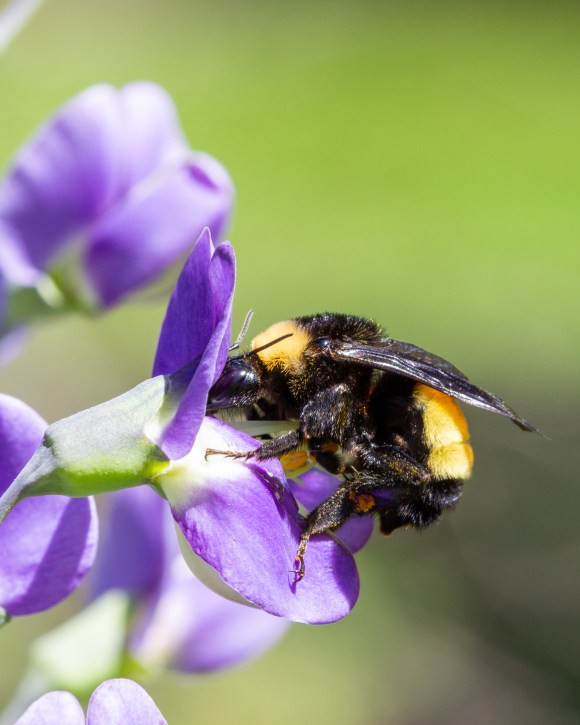
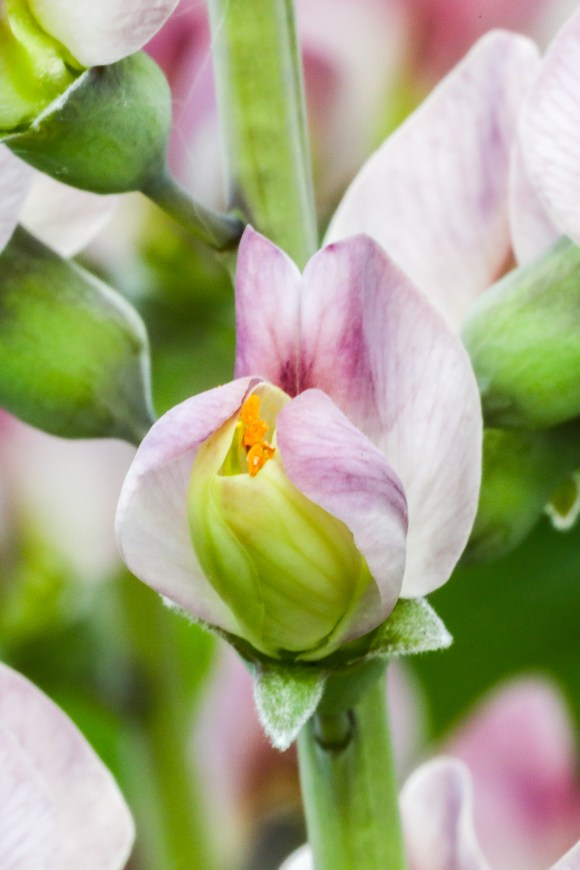
When it comes to reproducing, plants have all different structures and methods to regulate when and how fertilization happens. Why? It gives plants some ability to control self-pollination vs cross pollination. Self-pollination won’t change the gene pool in a population (ignoring mutations!) But cross pollination increases chances of introducing different genes and more diversity into a population. This is usually considered a good thing.
Baptisia has a fascinating system for reducing self-pollination. When the bumblebees begin feeding at a bloom spike, they start at the bottom. These lower flowers have more nectar and the female part is extended. But the bumblebee doesn’t have much pollen at this point. As she goes up the bloom spike, there is less nectar and more pollen. When the bumblebee finishes and flies to the next stalk, she’ll start at the bottom again.
As before, she finds more nectar and the pistil (female part) available on the lower flowers. But this time, the bee has lots of pollen and there’s a higher chance of pollination. The first plant “hopes” that the bee flew to a second plant with the pollen and cross pollination occurred!
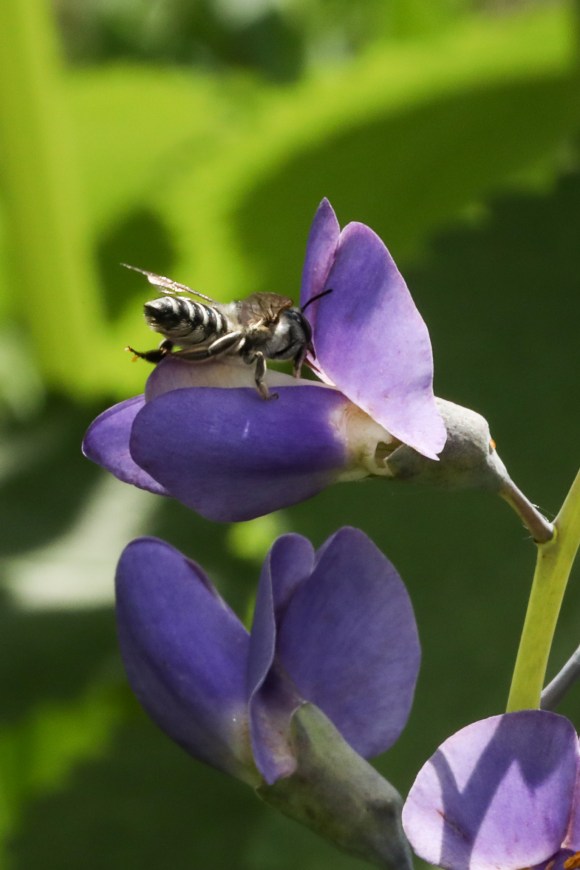
Megachile, Leaf-Cutter Bees, a medium-sized bee also drinks nectar from Baptisia. These medium-sized bees clearly have the strength to reach and enjoy B. australis’ floral rewards. The Leaf-Cutter Bees use a method similar to Bumblebees when opening the flower.
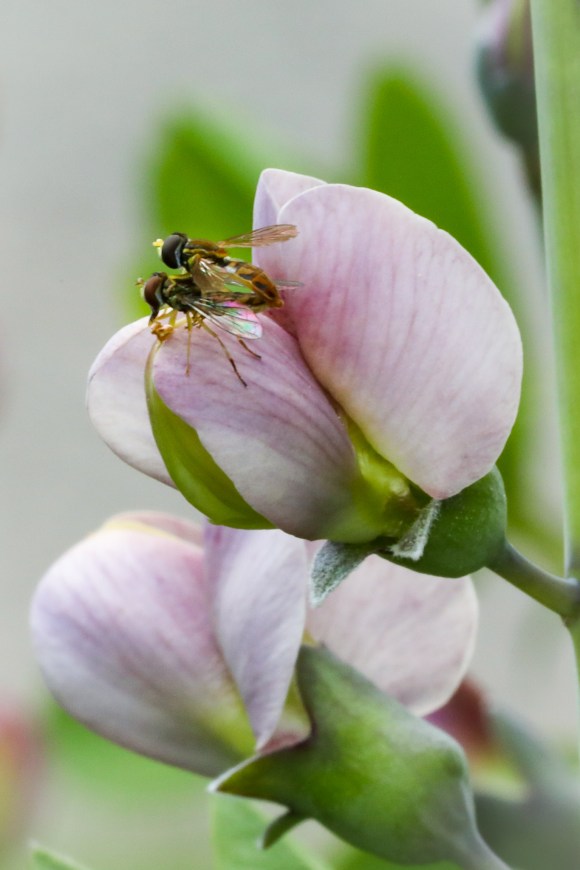
Amazingly, small bees and insects also visit Baptisias. In my garden, I’ve included both native plants and nativars. One afternoon, I spotted the following behavior on my ‘Pink Truffles’ Baptisia. I observed a mating flight of syrphid flies (also called hoverflies or flower flies). The pair landed on a Baptisia bloom and the female began teasing out the stamens from inside the keel! Adult hoverflies feed on nectar and pollen. They spent several minutes easing them out and feeding. Not B. australis but an interesting behavior!
Depending on the species, the syrphid fly’s larvae (maggots) can eat a variety of food. Some maggots eat decaying plant and animal matter. But other larvae eat aphid, thrips, and other plant-sucking insects.
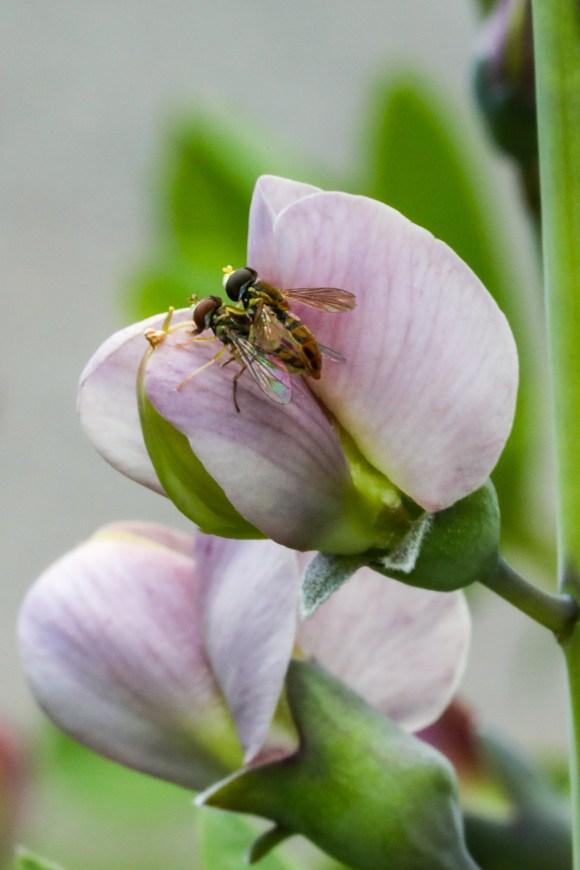
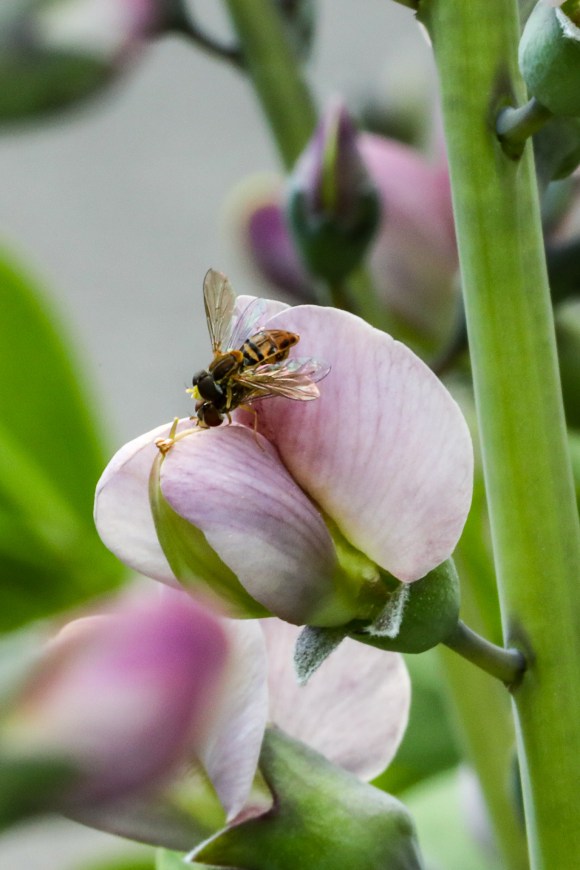
After the hoverflies, metallic green sweat bees arrived to eat the exposed pollen. Once the stamens are uncovered, Lasioglossum, small sweat bees, also join these other pollinators using the Baptisia.
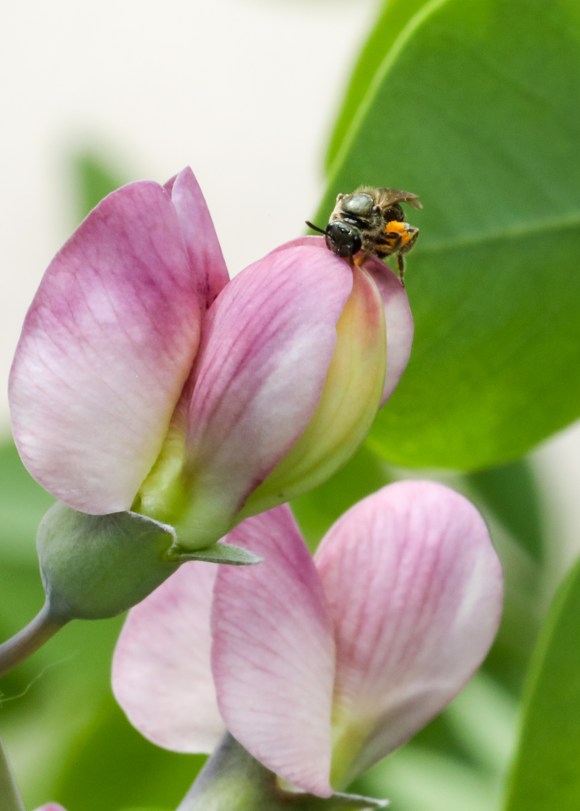
In addition to bees, Wild Indigo is a larval host for butterflies and skippers. The Wild Indigo Duskywing (Erynnis baptisiae) and Hoary Edge (Achalarus lyciades) caterpillars both eat Baptisia. The larvae of three butterflies, the Frosted Elfin (Callophrys irus), Marine Blue (Leptotes marina), and Orange Sulfur (Colias eurytheme) also use it. Adult Frosted Elfin Butterflies and other butterflies nectar at B. australis.
I hope you enjoyed this adventure with Baptisia australis-a gorgeous plant for a wonderful time of year. Next time, I’ll talk about Parthenocissus vitacea aka Virginia Creeper aka Woodbine. A very different plant, it’s well known as a wild plant but not in the garden. I plan to show the benefits of including Woodbine in the garden for the landscape and the pollinators.
Please contact me to share your stories, questions, and observations!
Thanks for reading,
Mary


3 replies on “The Magnificent Month of May—and June”
So interesting. Thanks for all the useful information and wonderful pics. 😊
LikeLike
So glad you enjoyed it!
LikeLiked by 1 person
[…] inserta begins blooming as Baptisia australis (False indigo, as discussed in my last blog post, https://wildthingsinthe.garden/2023/03/06/the-magnificent-month-of-may-and-june/) starts to fade and continues until early summer. In a sunny spot, the small blooms form lavish […]
LikeLiked by 1 person