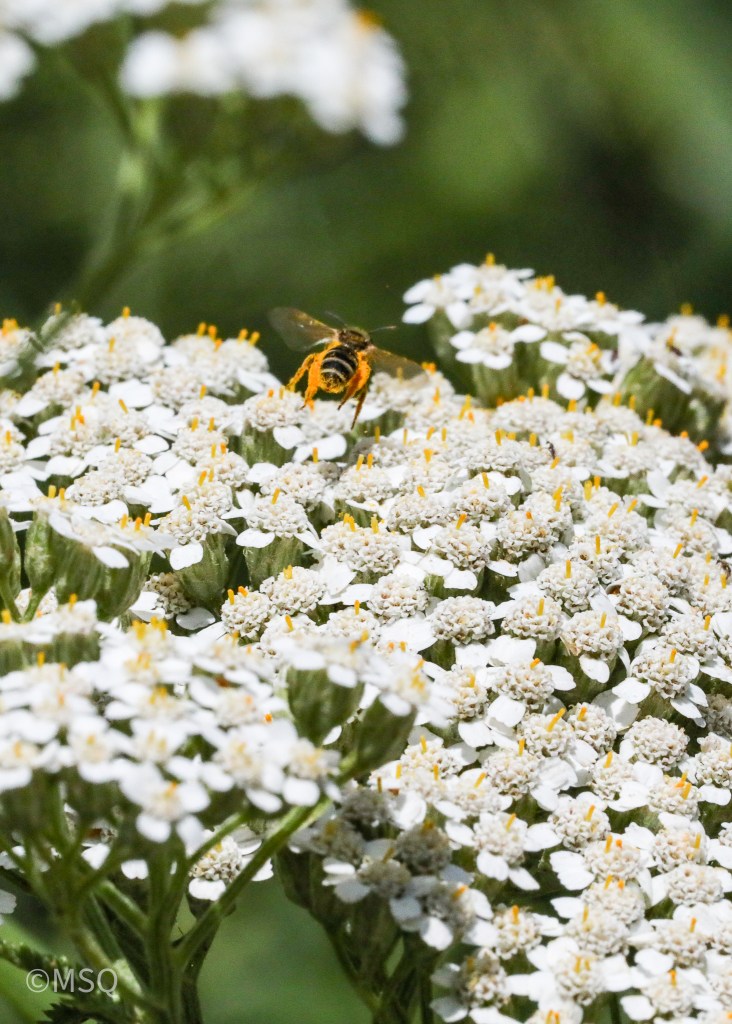
In late Spring, the parasol blooms of Yarrow (Achillea millefolium) open. The intricate creamy-white flowerheads draw every type of pollinator offering nectar and pollen to active insects. An assortment of caterpillars nibble on its stem, leaves, and flowers.
While yarrow grows in a range of habitats, it prefers full or part sun and medium to dry soils. It’s not picky about soil type if the soils are well drained. Yarrow likes disturbed areas. In nature, soil disturbances happens where water rises or falls (for example, lakes and rivers) and where large animals gather (such as, at a watering hole). Humans, of course, add to land disturbance. Habitats with yarrow include medium to dry prairies, pastures, unused fields, grassy waste areas, and edges of paths, yards, or hedges.1,2
Like so many native plants, yarrow reseeds freely when happy. You can limit this by cutting off seedheads and weeding out seedlings. Its seedlings are distinctive with their delicate, lacy foliage. Beware the rhizomes. Yarrow can form large colonies from spreading rhizomes. Root prune a clump with a sharp shovel or pull the shoots to keep it in check.
Achillea millefolium is all about multiples with compound flowers and doubly divided leaves. The elaborate, ruffled “flowerheads” are held on single stems. What looks a flowerhead is really a group of smaller flower heads called pedicels. These pedicels together form a compound corymb and that’s what we see as a flower. Yarrow’s corymbs can have 150 to 200+ individual florets! (Arkansas native plant society) Each floret is about of a quarter inch across and has ray and disk parts. It has three to eight ray florets around the edge and six to forty disk florets in the center. Florets begin opening in May and can last as late as August.1,2,3.4.5
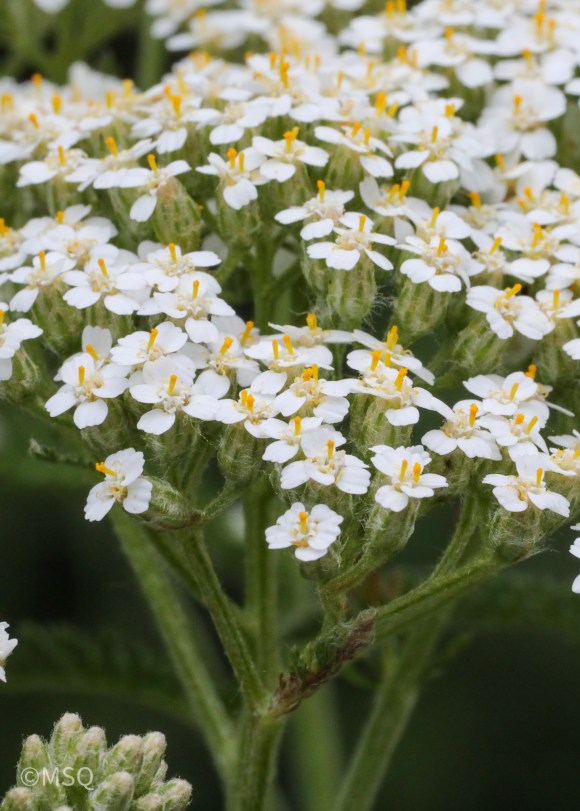
Yarrow’s foliage adds a fine, lacy note to the garden. It ranges from pale to medium green. The leaves are approximately six inches long and one inch wide becoming smaller toward the top of the stem. Their overall outline is elliptical but each pointed leaf is divided and subdivided. Leaflets and sub-leaflets curve and turn in different directions creating a soft and delicate appearance. The sessile (leaves touch the stem) or almost sessile leaves grow in a spiral along the stem. They can have fine hairs or be smooth.
Achillea millefolium is listed as native and introduced in most of the United States.4 It’s also called a species complex not a species. But what does that mean? Let’s talk about why this yarrow is so diverse and, briefly, what is says about the classification system. If that doesn’t interest you, please skip down to the section labeled POLLINATORS.
Part of Yarrow’s story stems from a long history of human use going back thousands of years. Yarrow’s been found in Neanderthal burial sites dating back as far as 65,000 years. Although it probably originated in Asia, peoples in Europe, the Americas and Asia have used it for millennia. Like any useful plant, it was transported and planted wherever people went. So now we have Yarrow in Asia, throughout Europe, throughout the Americas, as well as on distant islands like Greenland, Patagonia, New Zealand, and Hawaii.
To make matters more difficult, Achillea millefolium is complicated genetically. It adapts expertly to different environments and so changes its genes. Yarrow is also one of many plants that can increase its number of genes. For instances, humans have two sets of genes or are diploid. Yarrow can double that-tetraploid and sometimes add one more set-hexaploid and again-octoploid. All those variations can successfully breed together producing more Achillea millefolium. (Animals with different polyploidy can’t usually breed together.) All this genetic diversity doesn’t change the appearance very much—some are taller or shorter or have more petals (ray flower) or less. It does matter to the insects that use Yarrow either.
The species complex designation allows for one species with a lot of diversity in morphology (physical characteristics) and genetics. It acknowledges that those differences aren’t enough to indicate separate species.
So, what does this have to do with native plants and pollinators? Only that, things are sometime more complicated than they seem. Botanists trying to classify plants are applying human rules to a system not controlled by humans. This blog (https://khkeeler.blogspot.com/2014/04/plant-story-yarrow-achillea-millefolium.html) is a great read by a botanist about Yarrow’s history and botanical classification.
POLLINATORS
Achillea millefolium cannot pollinate itself and relies on insects. The Pollinator Program at The Xerces Society for Invertebrate Conservation declared it Supports Conservation Biological Control and of Special Value to Native Bees. The Biological Control designations means it provides resource to beneficial insects. Its visitors include bees, wasps, beetles, butterflies, moths, true bugs, and others.1
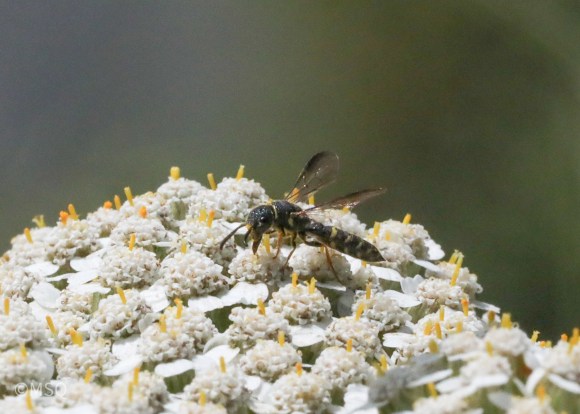
All parts of Achillea millefolium have a distinct scent. It’s been described as resinous, like fresh pine needles, a combination of chamomile and thyme, a mixture of rosemary, oregano, and other cooking herbs and, finally, soapy and astringent. All these descriptions hint at how different people perceive smells but none of them mention sweet or flowery. The fragrance of a plant or flower affects which pollinators it attracts. Generally, more savory ranging to rotting odors attract flies and beetles. Information about yarrow mentions many different flies visiting the flowers.6
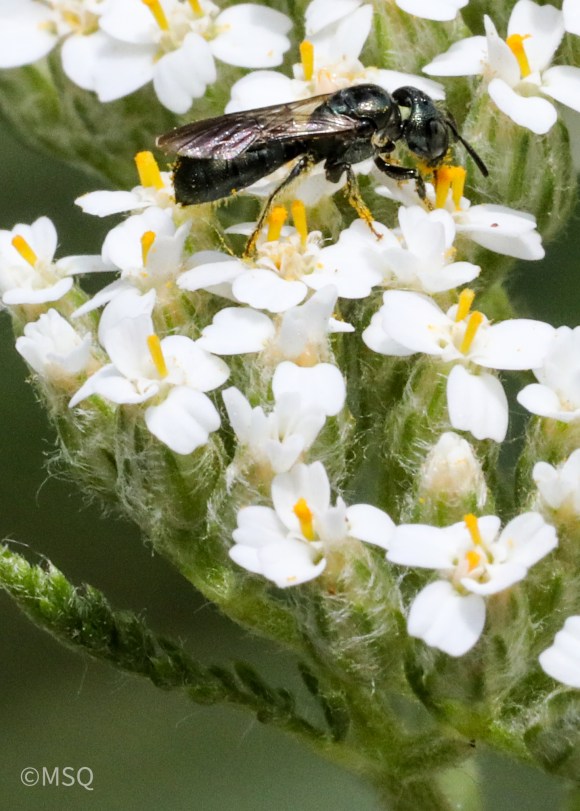
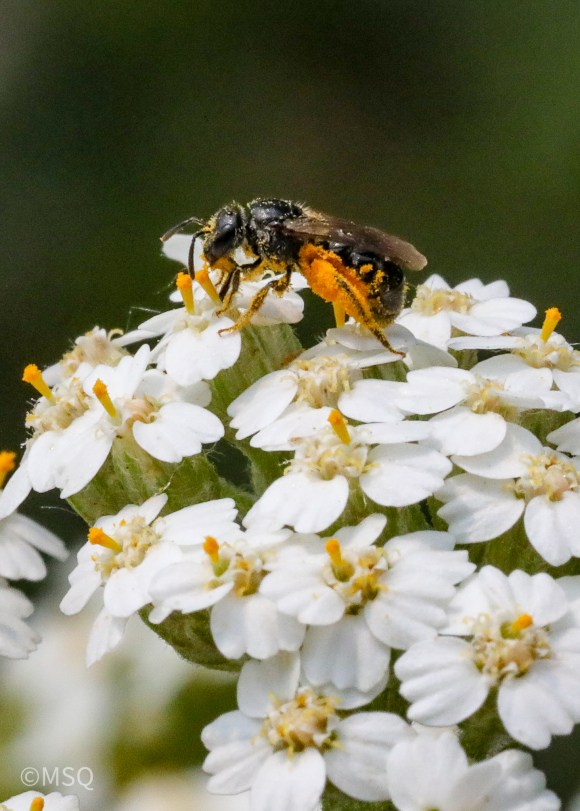
In my garden, I see many small bees gathering pollen and nectar. Ceratina (small carpenter bee), Lasioglossum (small sweat bee), Megachile (leafcutter bee), Andrena (mining bee), and Nomada (cuckoo bee) collect resources on Yarrow. These small bees visit the flowers throughout the summer. Even when the Yarrow flowerheads seem finished, bees continue to visit harvesting every last bit of pollen and nectar.
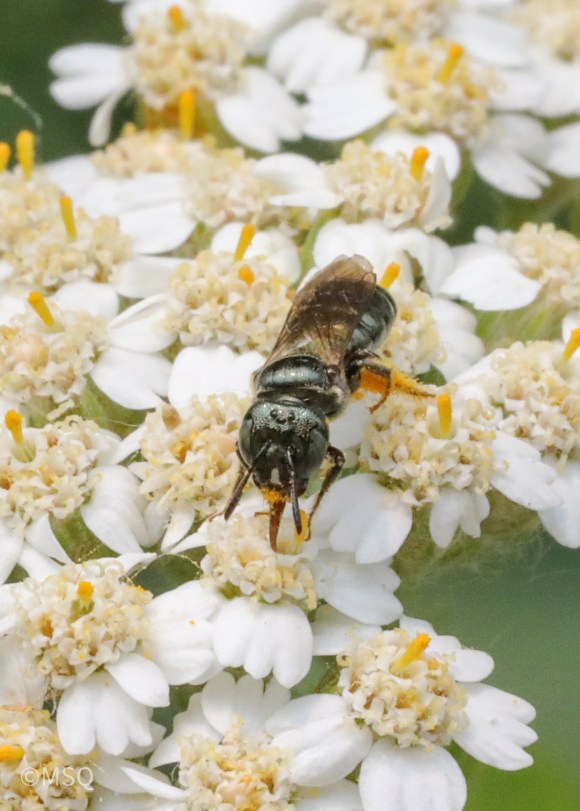
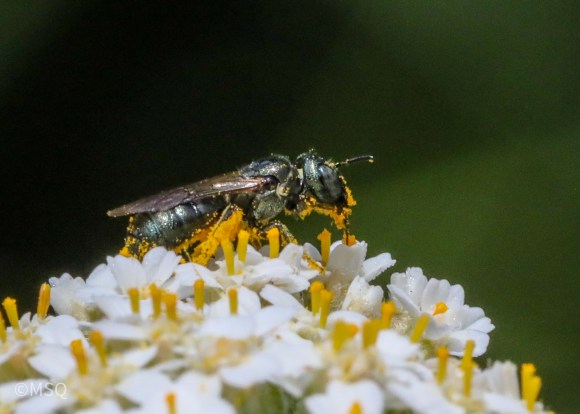
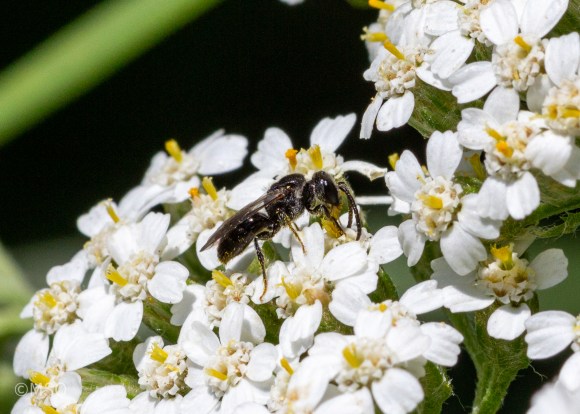
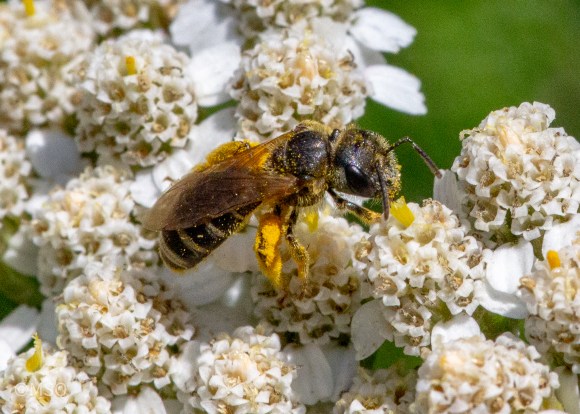
Beneficial insects enjoy Achillea millefolium throughout the blooming season. Green lace wings, lady beetles, and a variety of flies harvest resources on Yarrow. The flies include bee flies (Bombyliidae), soldier flies (Stratiomyidae), Syrphid flies, Tachinid flies, thick-headed flies (Conopidae), flesh flies (Sarcophagidae), blow flies (Calliphoridae), Muscid flies, and Anthomyiid flies.
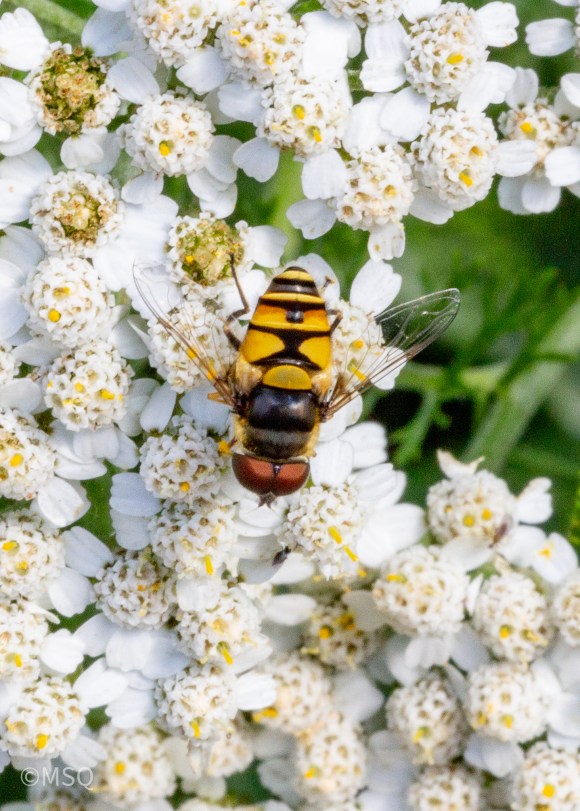
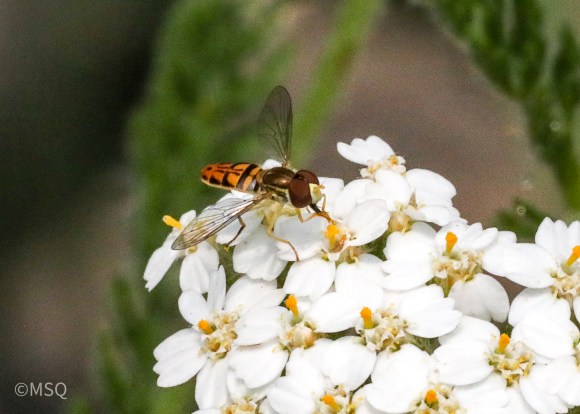

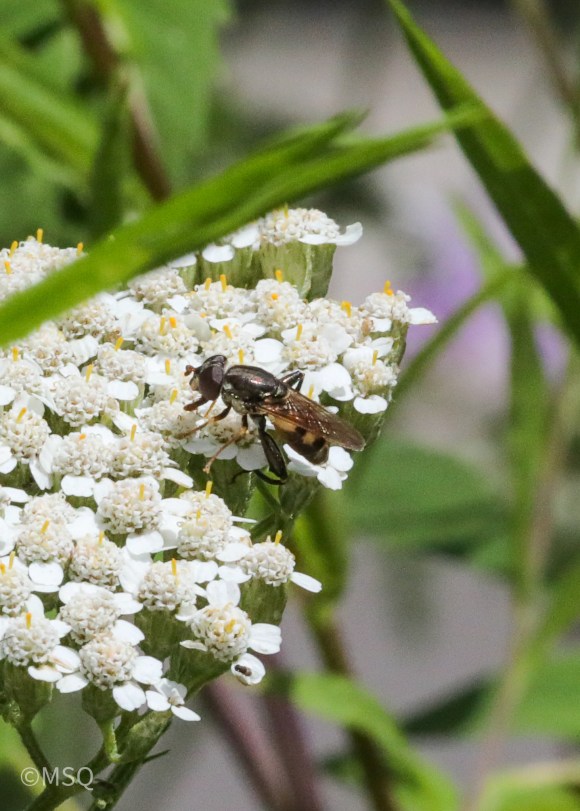
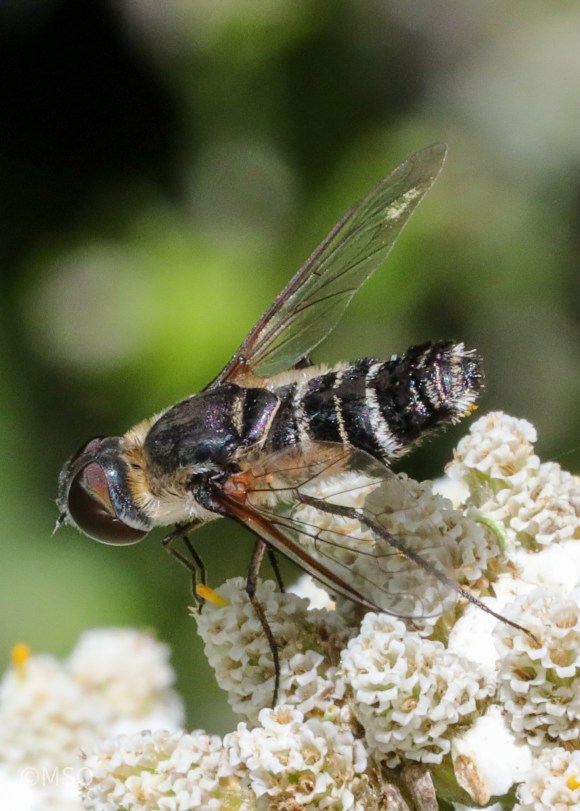
Adult bee flies gather nectar while their larvae act as beneficial insects. This is Villa lateralis. Specific studies of V. lateralis are difficult to find. However, several species of Villa destroy grasshopper eggs in the larva stage. Others parasitize caterpillars.8
Butterflies and moths use Yarrow as well. Numerous butterflies nectar at the flowers including blue copper butterflies (Lycaena heteronea heteronea). Achillea millefolium is a larval host for many moth species. Some eat the leaves while others bore through its stem or feed on the flowerhead. Papaipema nebris (Stalk borer Moth) is a stem borer. Flower eaters include Chlorochlamys chloroleucaria (Blackberry Looper Moth), Eupithecia absinthiata (Wormwood Pug), Eupithecia miserulata (Common Pug), Synchlora aerate (Wavy-lined Emerald), Heliothis phloxiphaga (Darker-spotted Straw), and Depressaria alienella (no common name). Moths and a butterfly that feed on leaves include the American Painted Lady (Vanessa virginiensis), Agrotis volubilis
(Voluble Dart), Cryptocala acadiensis (Catocaline Dart), Lacinipolia olivacea (Olive Arches), Orthodes cynica (Cynical Quaker), Paradiarsia littoralis (Labrador Dart), Pseudorthodes vecors (Small Brown Quaker), Trichordestra legitima (Striped Garden Caterpillar) and Gillmeria pallidactyla (Yarrow Plume Moth).
I hope you enjoyed this journey into Achillea millefolium or Yarrow. If you don’t have it in your garden, take a look at it in nature. See who’s visiting those adaptable plants that have traveled so far!
Bye now,
Mary
REFERENCES:
- Hilty, J., n.d., Yarrow, Achillea millefolium, Aster Family (Asteraceae), illinoiswildflowers.info,https://www.illinoiswildflowers.info/weeds/plants/yarrow.htm
- Keeler, K.H., 04/13/2014, Plant Story – Yarrow, Achillea millefolium, a plant species complex, http://khkeeler.blogspot.com/2014/04/plant-story-yarrow-achillea-millefolium.htm
- Anonymous, 02/13/2020, Know Your Natives – Yarrow, https://anps.org/2020/02/13/know-your-natives-yarrow/#:~:text=Yarrow%20(Achillea%20millefolium)%20of%20the,ranges%20among%20the%20flowering%20plants.
- Anonymous, n.d., Common Yarrow, https://www.nrcs.usda.gov/plantmaterials/mtpmcpg13974.pdf
- Anonymous, n.d., Achillea millefolium, https://www.wildflower.org/plants/result.php?id_plant=acmi2
- Rupp, T., Oelschlägel, B., Rabitsch, K., Mahfoud, H., Wenke, T., Henry L. Disney, R., Neinhuis, C., Wanke, S., and Dötterl, S., (2021). Flowers of Deceptive Aristolochia microstoma Are Pollinated by Phorid Flies and Emit Volatiles Known From Invertebrate Carrion, Front. Ecol. Evol., 05/21/2021, Sec. Chemical Ecology, (9) 2021 | https://doi.org/10.3389/fevo.2021.658441
- Holm, Heather, 2017, Bees: Includes Tree, Shrub, and Perennial Plant Profiles for the Midwest, Great Lakes, and Northeast Regions, Pollinator Press LLC
- Editors of the Encyclopedia Britannica, n.d., https://www.britannica.com/animal/bee-fly
 Wild Things in the Garden