Categories
native plants Pollinator gardening

A Wild and Wacky Plant

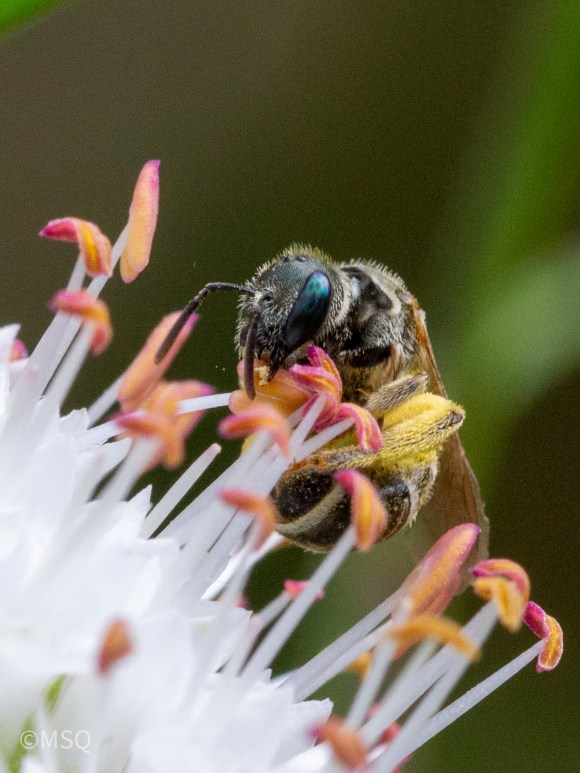
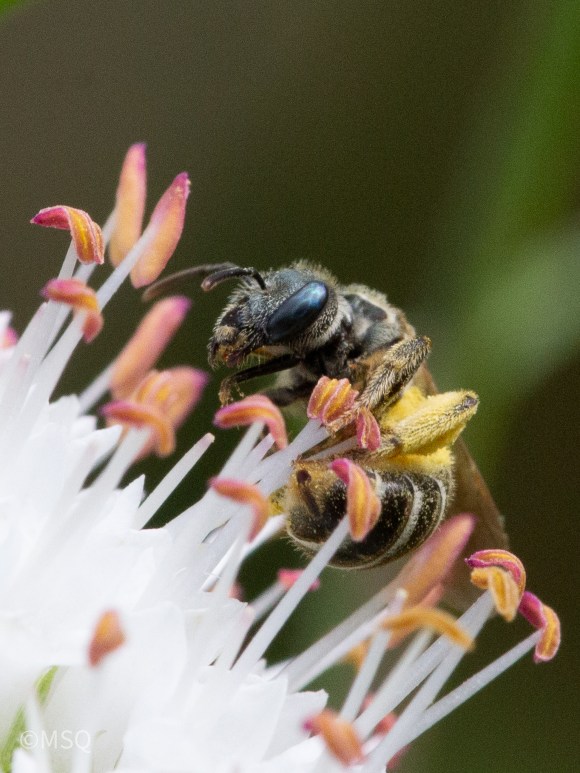
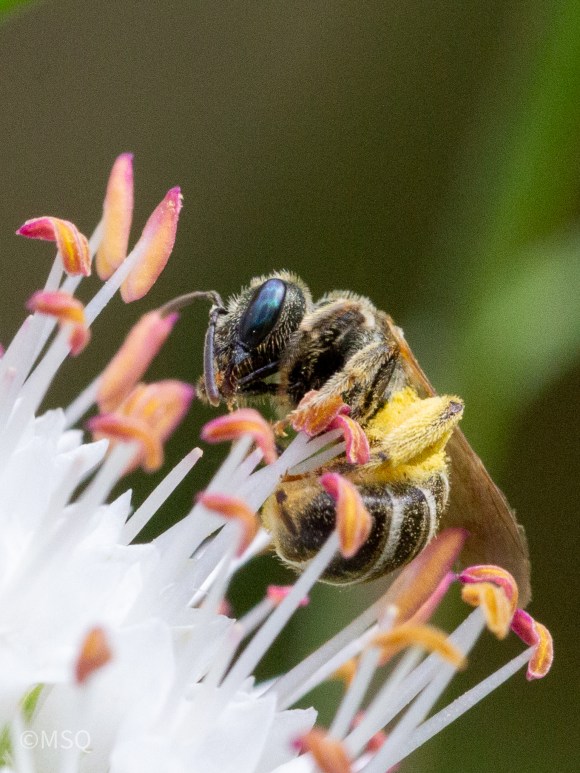
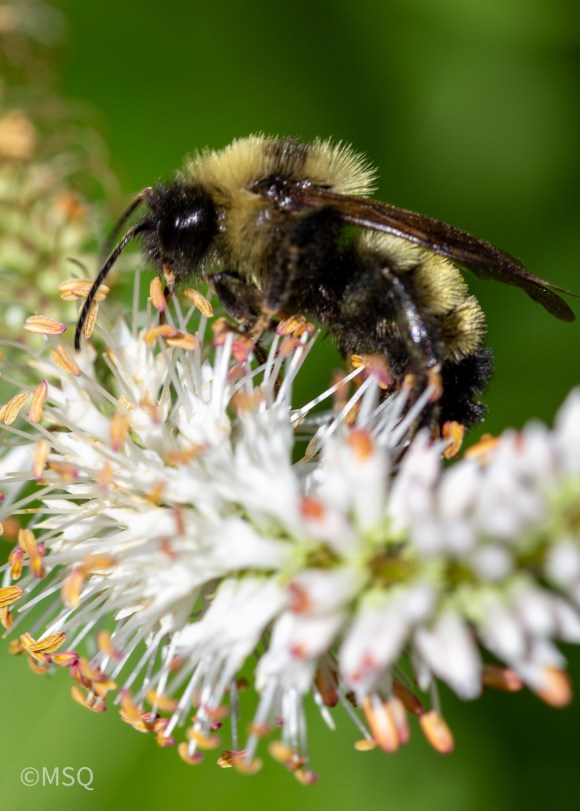
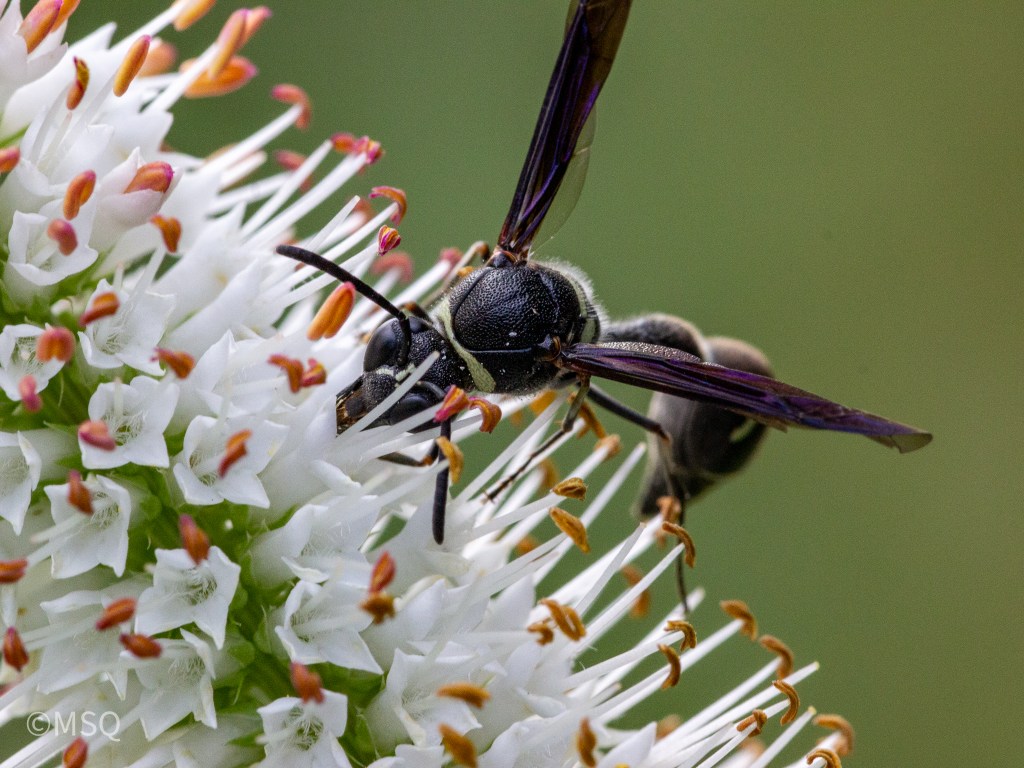
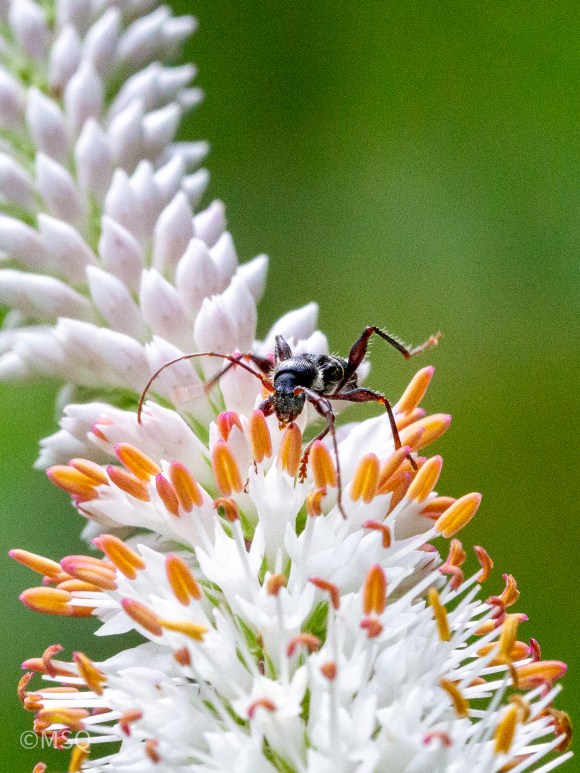
Clouds of beneficial wasps and small bees swarm the crown of tiny, white flowers.  Flowerheads rise on stalks up to nine feet tall offering stunning vertical accents in the garden.  This is Arnoglossum atriplicifolium one of several Arnoglossums native to Eastern North America.  
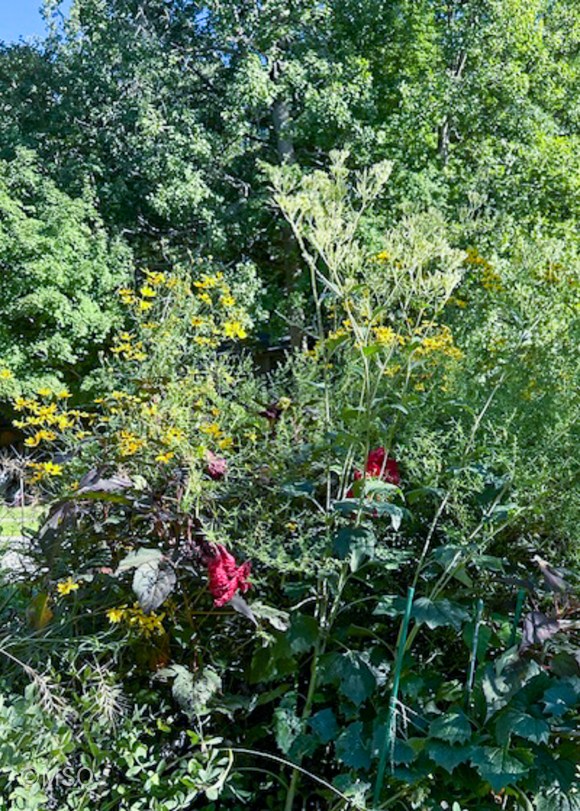
Why is this plant so different? The flowers don’t have any petals, only disk florets.  Disk florets usually make up the center of a bloom and are surrounded by ray florets or petals.

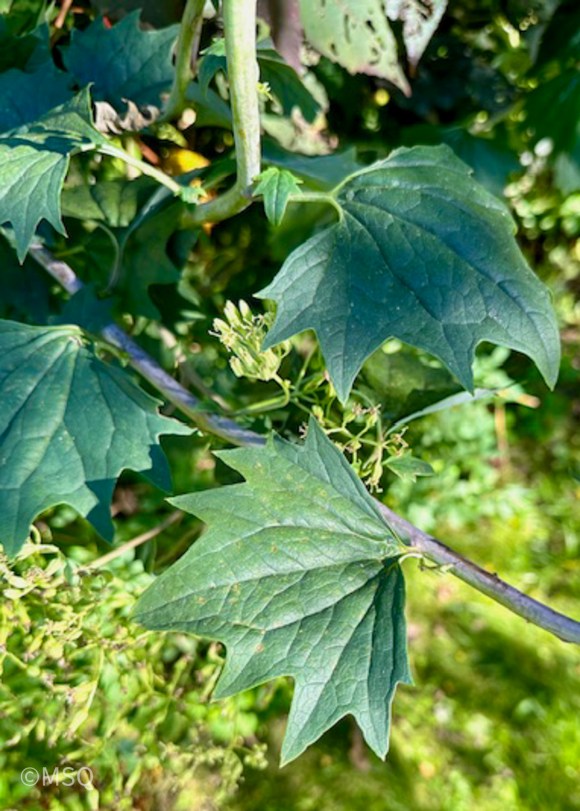
The leaves seem to defy description.  They’ve been called triangular or oval-cordate or oval but none of these is right.  The closest I’ve heard is Sycamore-like, with undulate edges (rippled edges).

The leaf texture is also unique.  Thick and shiny, it’s been compared to leather or plastic.  All these characteristics come together in a striking plant.2,6

Arnoglossum atriplicifolium grows in full sun to light shade.  Loamy, rocky or sandy soil are all acceptable.  But this plant loves evenly moist soil that stays constantly wet.  When Arnoglossum is happy, it reseeds freely.  Cut back the flower stalks to avoid this issue.1,6,9

In nature, Arnoglossum appears in open and rocky woodlands, thickets, wet meadows, along streams, in mesic forests, savannahs, woodland edges, sand dunes, rocky clearings in woodlands, prairies, meadows, upland woodlands, wooded slopes, slopes of ravines, sandy savannahs, sandy thickets, partly shaded thickets, and partly shaded banks near Lake Michigan.2,6

The first year, Arnoglossum atriplicifolium forms as a basal rosette of medium to dark green leaves.  These leaves grow up to eight inches long and six inches across.  While the top sides are green, the lower leaf surfaces are pale greenish white to bright white.  
In the second or third year, a stalk appears in Spring and grows to between three and nine feet tall with alternate leaves.  The unbranched stalk provides an erect accent in the garden.  These leaves become smaller as they go up the stalk.  Cavity nesting bees and wasps use the hollow stems for nesting.1,2,6,9
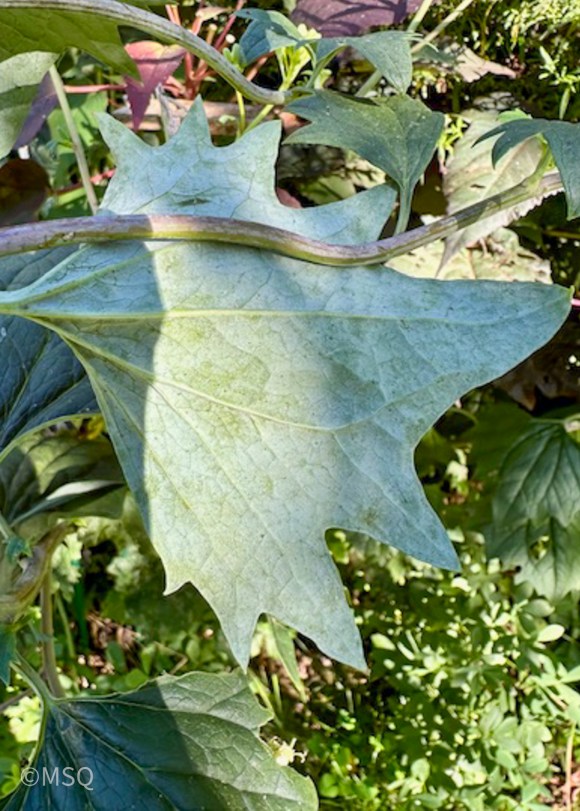
Flat-topped flowerheads (technically called a compound corymb) develop at the top of the plant stalk.  Without petals, the flowerhead make up their size by grouping four to fifteen florets together into corymbs.  These corymbs grow together to form the whole flowerhead.9  
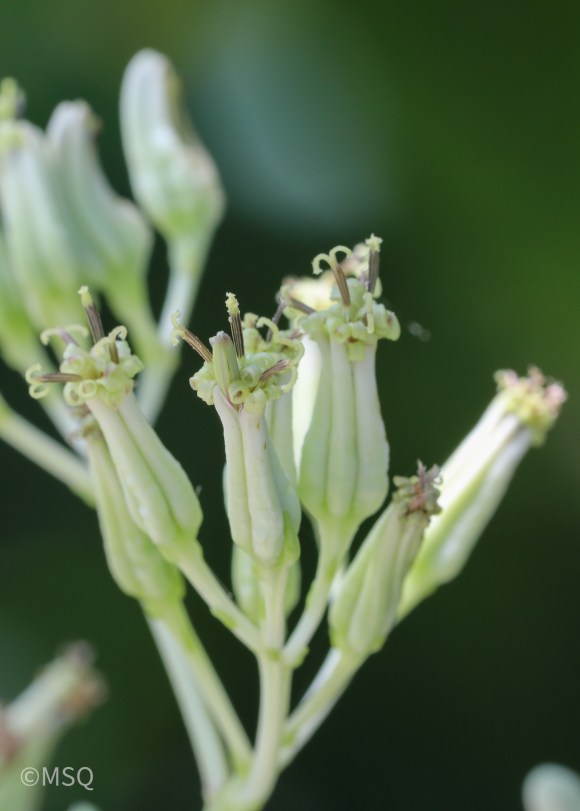
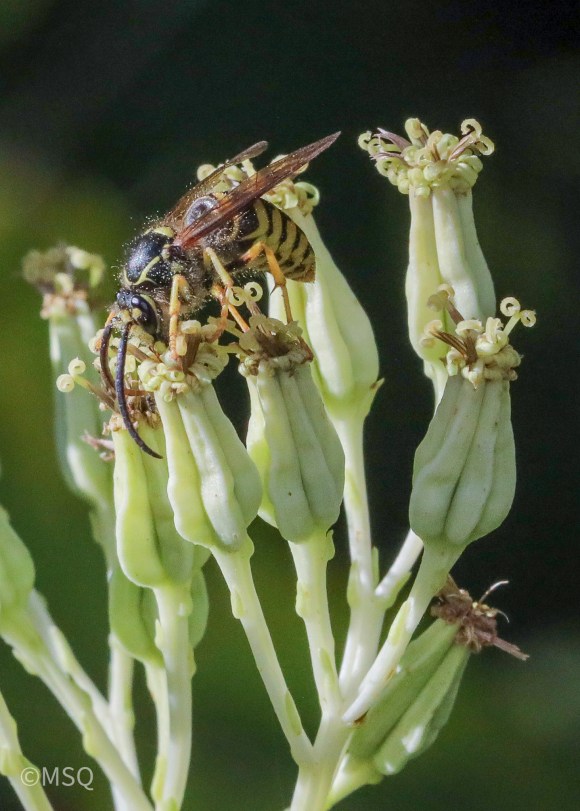
The individual florets are about an eighth inch across and a third inch long with five disk florets.  Each one has a style that extends beyond its end.  The styles are bipartite which means two styles joined together.  As they mature, the tips curl away from each other forming circles.  Anthers also reach past the end of the floret.6

Arnoglossum atriplicifolium is self-incompatible.  Each floret must be fertilized with pollen from a different plant. Wasps, small bees and flies provide pollination.3

Blooms appear in mid-Summer and continue into early Fall.   Total flowering time is about one month.  Cut it back for a smaller second bloom.6

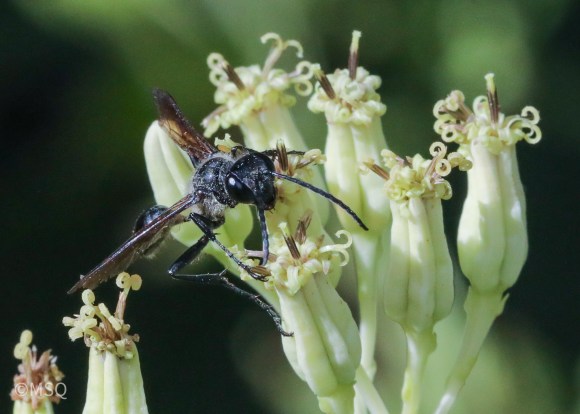
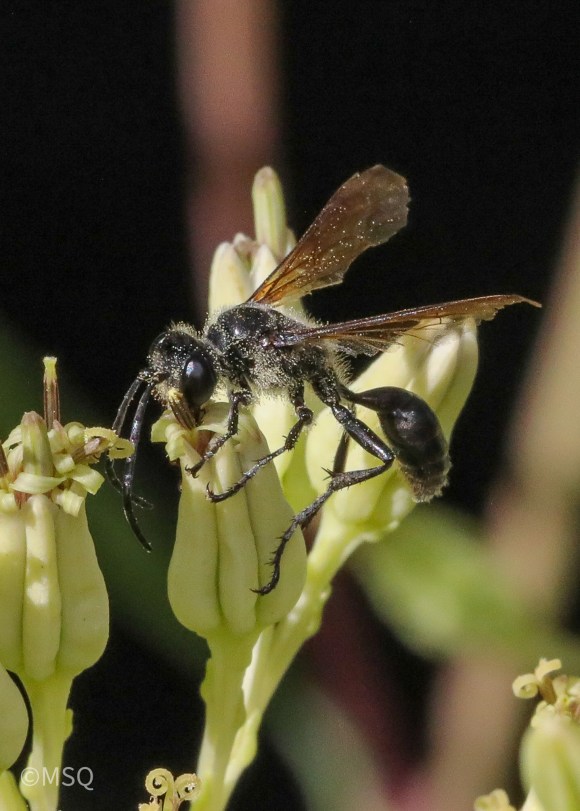
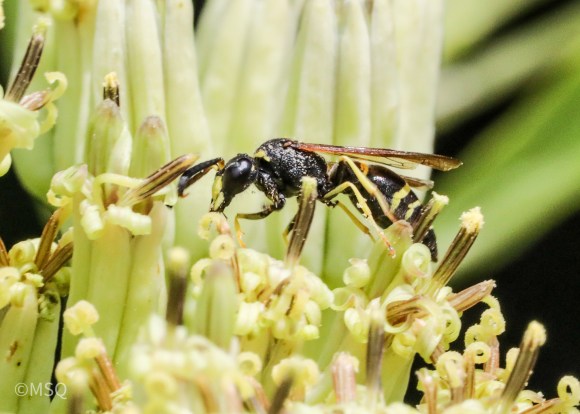
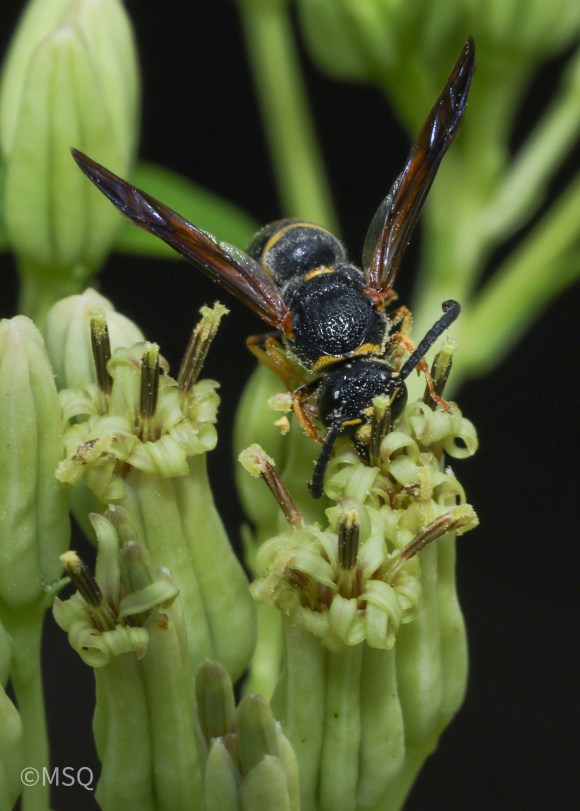
Adding to the overall wackiness of Arnoglossum, the most common visitors are predatory or parasitoid wasps.  Some of which look very scary indeed!  These wasps are also beneficial insects helping to control many garden pests.  In fact, the Xerces Society for Invertebrate Conservation labeled Arnoglossum as Supports Conservation Biological Control.

Wasps prefer dilute nectar on hot summer days and Arnoglossum is an excellent source of late season nectar.  The nectar secretes at the base of the style.  It’s drawn up the corolla so even short-tongued wasps.  White flowers keep the nectar cool and dilute.3

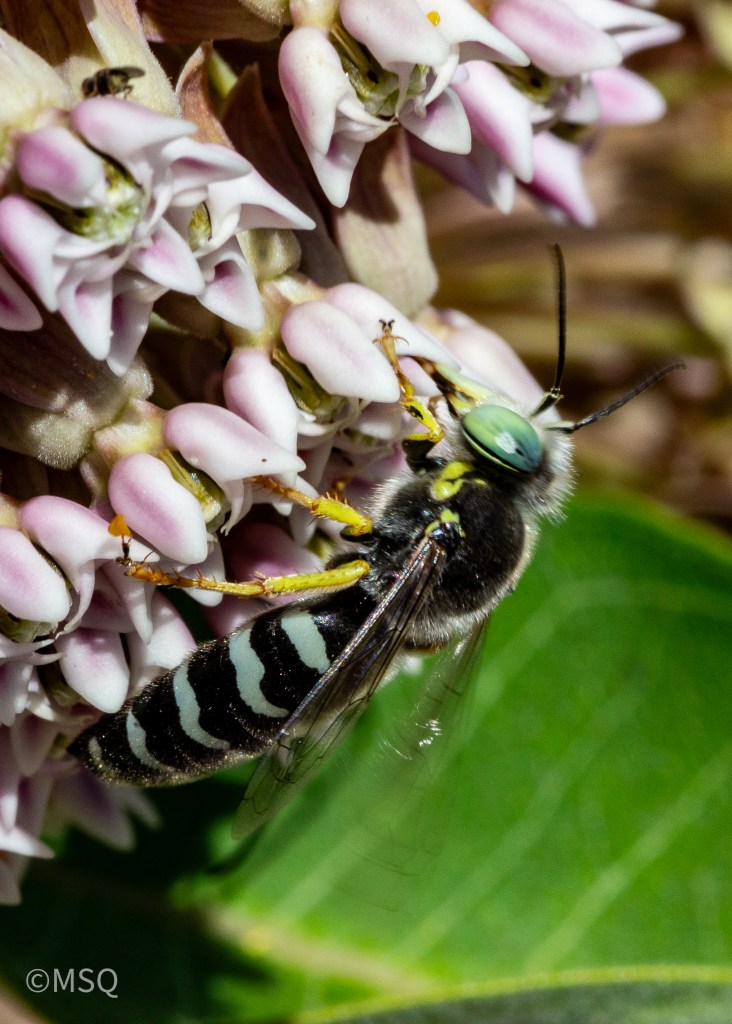
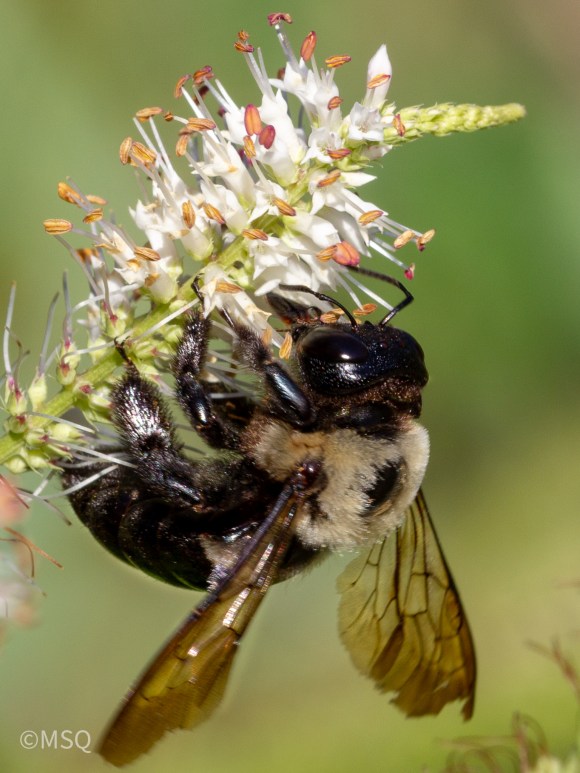
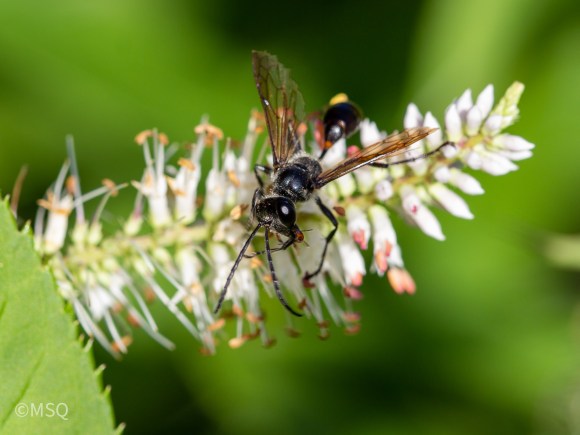
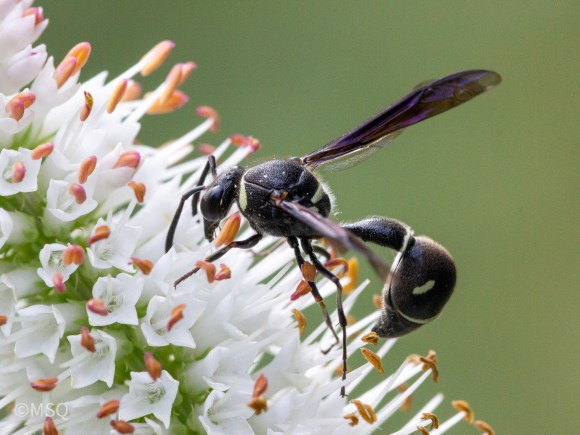
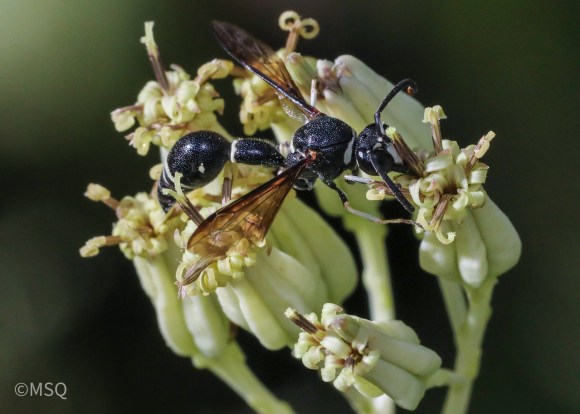
Thirty-four different species of wasps visit Arnoglossum atriplicifolium.4  These include, Sand Wasps (Bicyrtes spp.), Great Black Wasps (Sphex pensylvanicus), Great Golden Digger Wasps (Sphex ichneumoneus), Thread-Waisted Wasps (Ammophila spp.), Potter Wasps (Eumenes spp.), the Common Yellowjacket Wasp (Vespula spp.), and Grass-Carrying Wasps (Isodontia spp.).3
Are Yellowjackets beneficial?  It’s hard to feel that way.  They’re scary, the stings are painful, and they can ruin your picnic.  Vespids or Yellowjacket wasps can send you to the ER too, if you’re allergic to their sting.  So, is there an upside?

OK back to beneficial insects—Yellowjacket wasps build yearly nests.  Their mated queens overwinter in cozy spots like bumblebees.  In the Spring, the queens establish a nest and lay eggs to become workers.  The workers will continue building the nest and gathering prey.

Almost all Vespid wasps (Yellowjackets), use chewed wood pulp and saliva to create paper nests.  Different types of Vespids choose different locations for homes.  Options include holes like openings in trees, structural walls, abandoned animal burrows or rotting tree stumps or aerial places in trees or under building eaves.  Often nests aren’t noticed until they’re large or disturbed.11
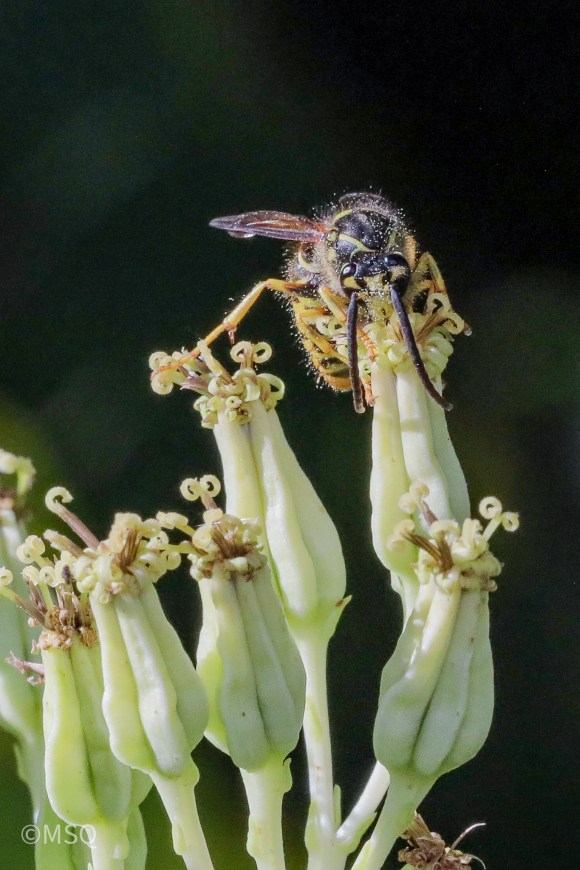
But what good are they?  Colony size ranges from a few hundred to over 5,000.  Almost all these wasps hunt for insect prey and many prey on pests.  Depending on the species, Vespids target crickets, grasshoppers, spiders, flies, and fall webworms.  Those that live in trees and high places frequently gather food there.11

I wouldn’t let Yellowjacket set up housekeeping in my yard especially near children, animals, individuals allergic to bee stings or other human activity.  But you have a place on your property, where they won’t be disturbed, a Vespid nest is like a small army of pest control.

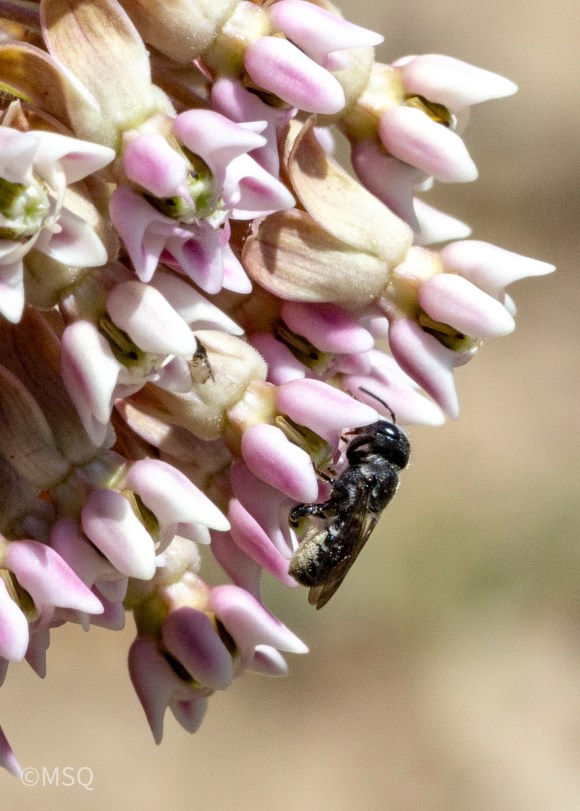
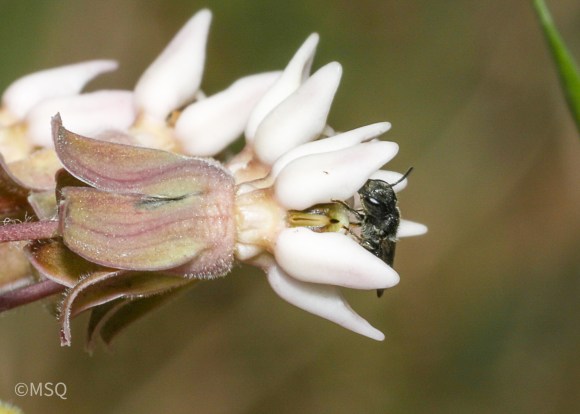
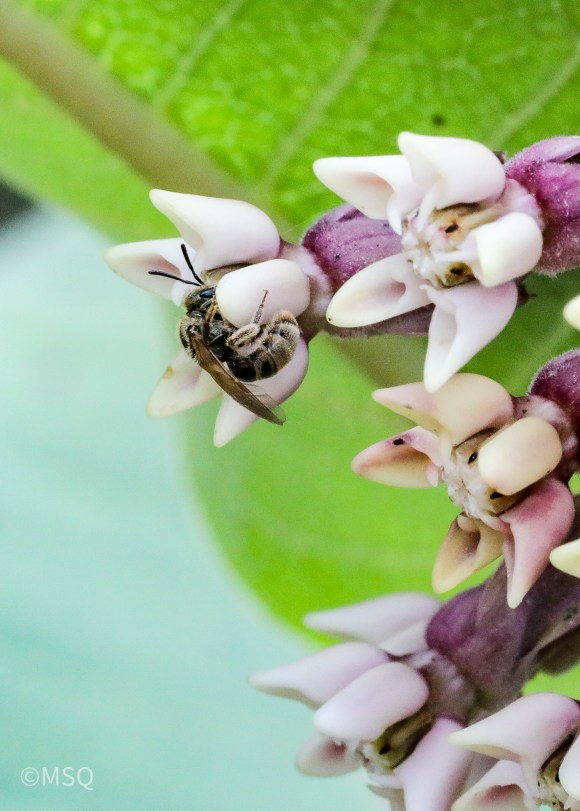
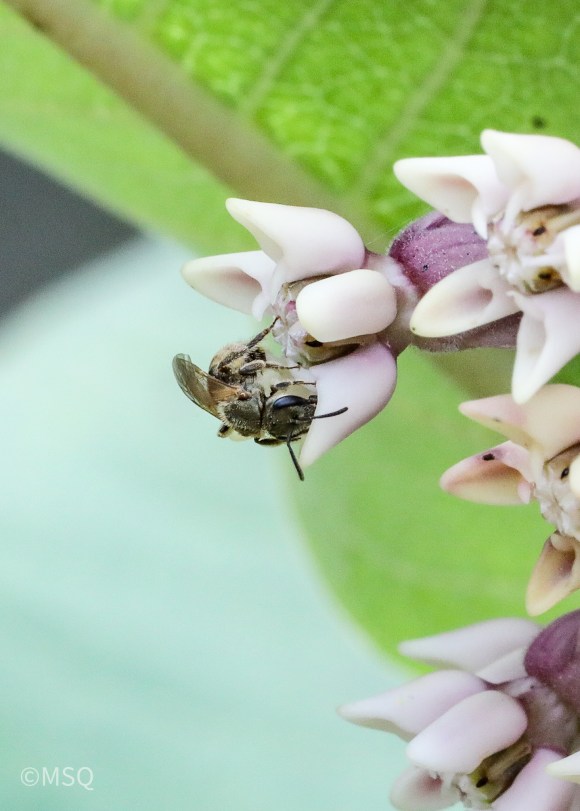
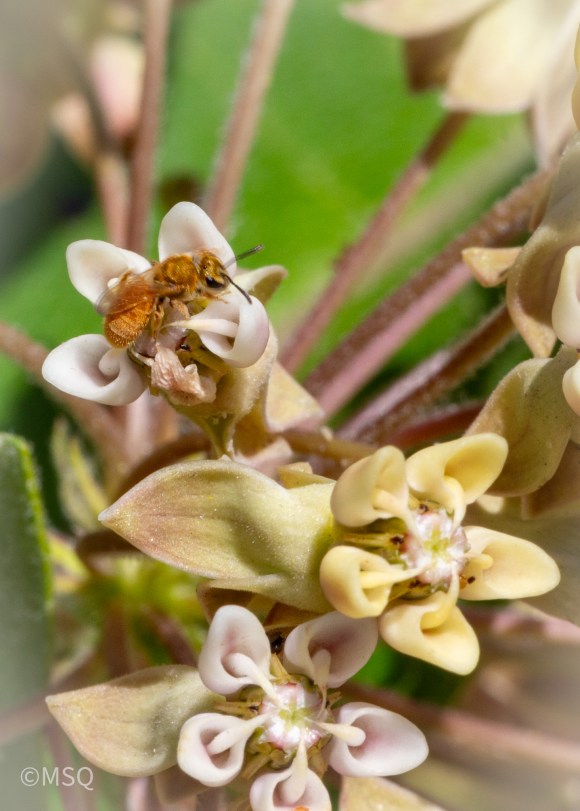
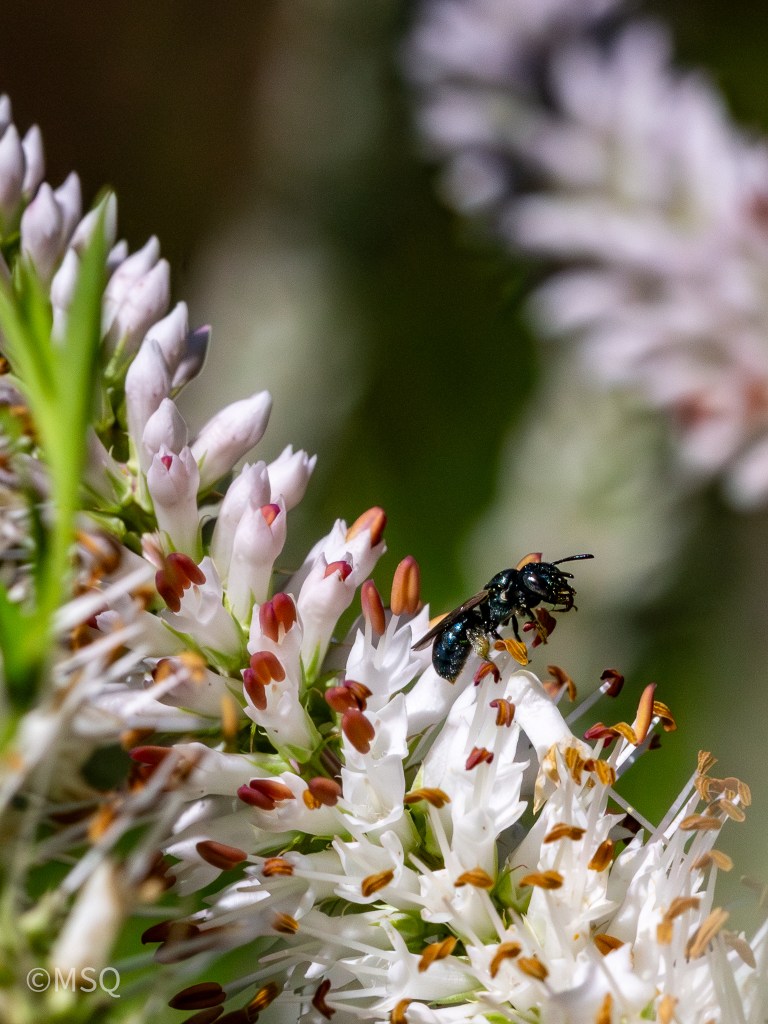
Many small bees gather nectar and pollen from Arnoglossum atriplicifolium.  Sweat Bees (Halictus sp. and Lasioglossum sp.) and small Carpenter Bees (Ceratina sp.) are some of the short-tongued bees seen.
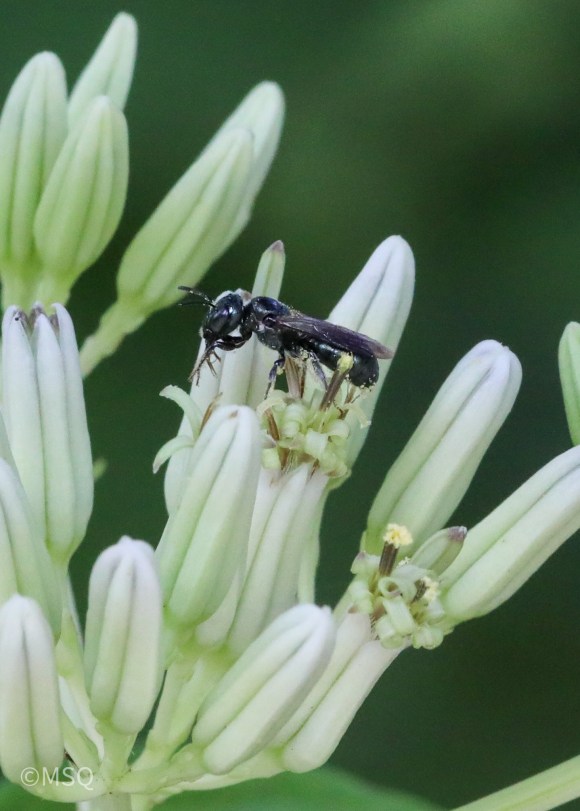
Halictid or Sweat Bees fall in the small and mighty category of pollinators.  There are more than 500 species in North America.  In the garden and in natural area, they are more plentiful than most other native bees.7,8
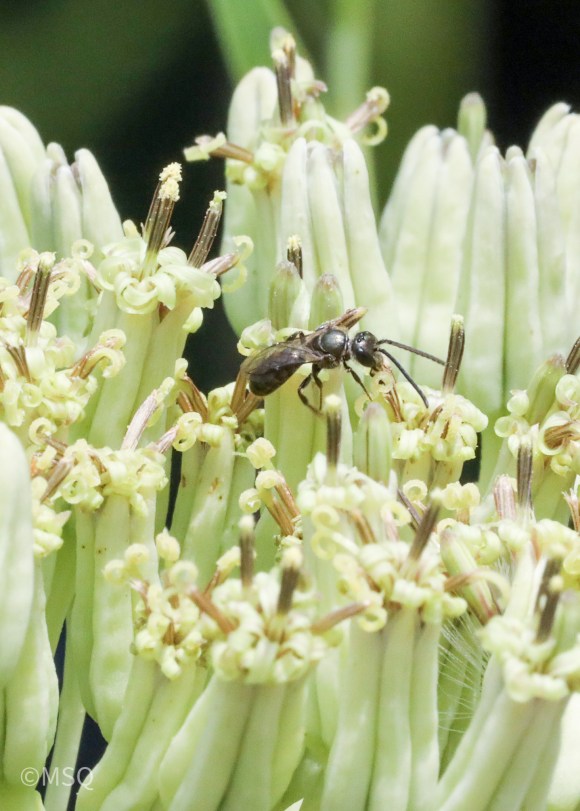
Almost all are ground nesting but the colony structure can be solitary, communal, semi-social or eusocial.  Sometimes these nesting behaviors vary with time of year, location-geographic and altitude, and for reasons we don’t understand.5,7,8

Two fun facts about the Halictid bees are:  they drink human sweat and they can buzz pollinate.  Why do they lap up sweat?  It’s like an electrolyte drink for them.  On hot summer day, Halictid bees need some salt and other minerals.  Human perspiration is one easy source!5,7,8
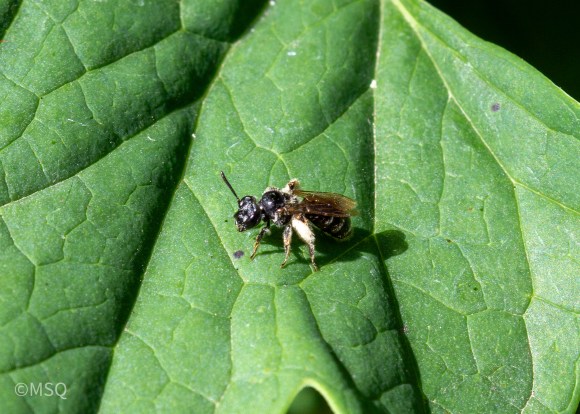
What about buzz pollination?  Buzz pollination is sometimes called sonication.  A sweat bee holds onto a flower’s anther with its mandibles and curls its abdomen around the anther.  It vibrates its wing muscles to release pollen.5  

Many flowers need buzz pollination to effectively free their pollen.  These plants include the heath family (blueberry, cranberry) and nightshade (tomato, groundcherry, pepper, eggplant, potato),  A number of native bees can buzz pollinate, most famously, the Bumblebee.  Honeybees cannot.5,10

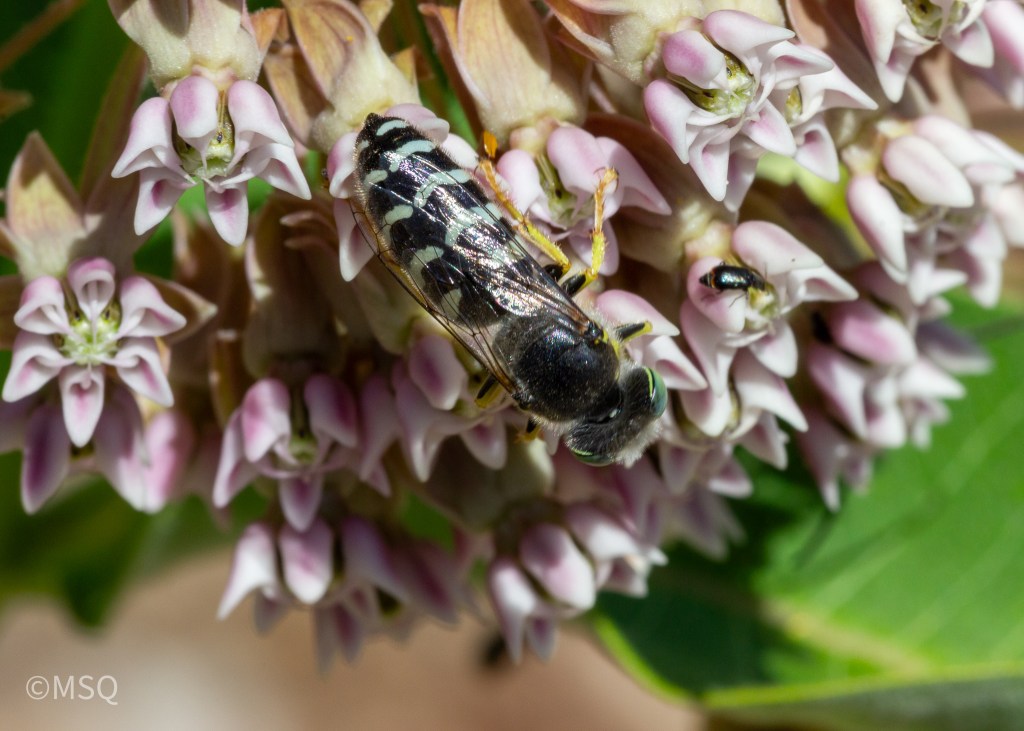
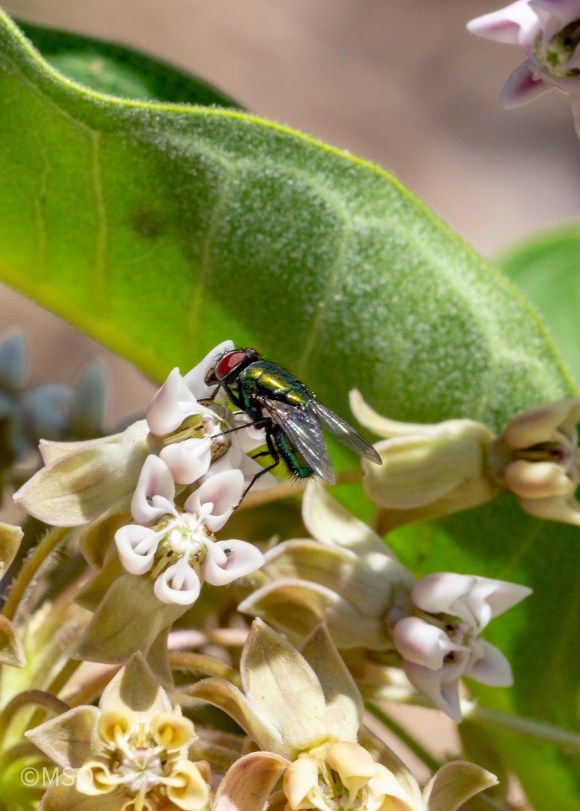
Lastly, flies gather nectar and pollen at Arnoglossum atriplicifolium.  Syrphid flies frequently stop to sip the accessible nectar.3
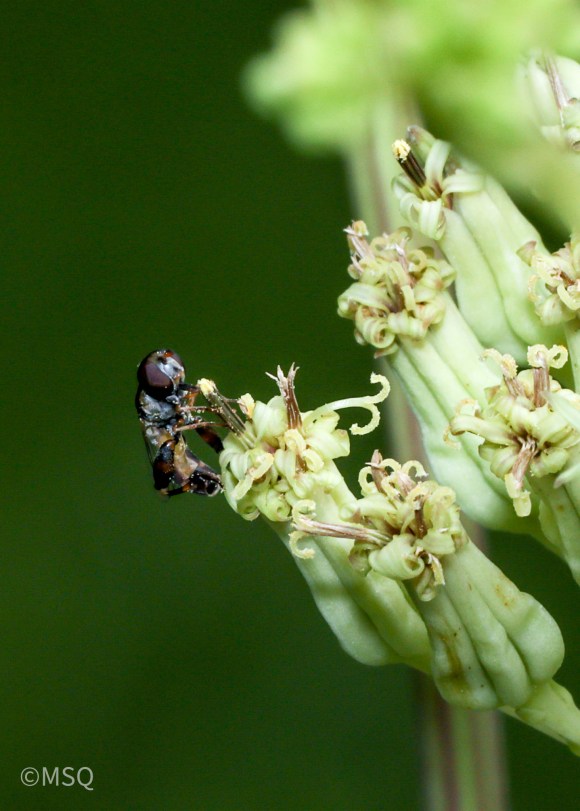
Bonus Bug: Both male and female mosquitos visit flowers for nectar. Females need blood for the protein and most use a sugar source. Males need a sugar source, like nectar, to survive. We don’t know how they choose particular flowers but they are attracted to some chemical compounds.12
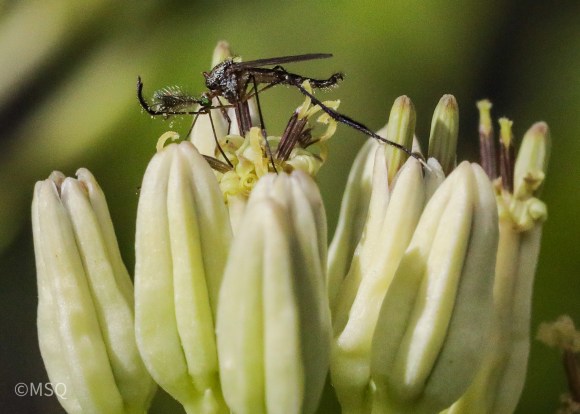
Hope you enjoyed this look into a Wild and Wacky plant!  Arnoglossum atriplicifolium benefits some bizarre and wonderful insects as well as some more familiar ones.  It delivers a wonder accent in the garden and is an excellent source of late summer nectar!

Warm Regards,

Mary                            

References:

  1. “Arnoglossum Atriplicifolium – Plant Finder.” Accessed September 2, 2024 https://www.missouribotanicalgarden.org/PlantFinder/PlantFinderDetails.aspx?taxonid=293225.
  2. “Arnoglossum Atriplicifolium (Pale Indian Plantain) | North Carolina Extension Gardener Plant Toolbox.” Accessed September 2, 2024. https://plants.ces.ncsu.edu/plants/arnoglossum-atriplicifolium/.
  3. Holm, Heather. Pollinators of Native Plants:  Attract, Observe and Identify Pollinators and Beneficial Insects with Native Plants. Minnesota: Pollination Press LLC, 2014.
  4. Holm, Heather. Wasps:  Their Biology, Diversity, and Role as Beneficial Insects and Pollinators of Native Plants. Minnesota: Pollination Press LLC, 2021.
  5. Missouri Department of Conservation. “Halictid Bees (Sweat Bees).” Accessed September 2, 2024. https://mdc.mo.gov/discover-nature/field-guide/halictid-bees-sweat-bees.
  6. “Pale Indian Plantain (Arnoglossum Atriplicifolium).” Accessed September 2, 2024. https://www.illinoiswildflowers.info/savanna/plants/pale_indplant.htm.
  7. “SWEAT BEES: GENUS LASIOGLOSSUM | The Great Sunflower Project.” Accessed September 2, 2024. https://www.greatsunflower.org/Lasioglossum#.
  8. “Sweat or Halictid Bees.” Accessed September 2, 2024. https://entnemdept.ufl.edu/creatures/misc/bees/halictid_bees.htm#
  9. “Weird and Wonderful Plants for Pollinators: Pale Indian Plantain | Xerces Society.” Accessed September 1, 2024. https://xerces.org/blog/pale-indian-plantain.
  10. Xerces Society. “Delectable Native Plants Attract a Very Special Crowd.” Accessed September 2, 2024. https://xerces.org/blog/delectable-native-plants-attract-very-special-crowd.
  11. “Yellowjackets and Baldfaced Hornets | CALS.” Accessed September 2, 2024. https://cals.cornell.edu/new-york-state-integrated-pest-management/outreach-education/whats-bugging-you/bees-and-wasps/identifying-bees-and-wasps/yellowjackets-and-baldfaced-hornets
  12. “Not Just from Blood: Mosquito Nutrient Acquisition from Nectar Sources – ScienceDirect.” Accessed September 2, 2024. https://www.sciencedirect.com/science/article/pii/S1471492220300404#.
Categories
native plants Pollinator gardening

Ephemeral Purple Pinwheels

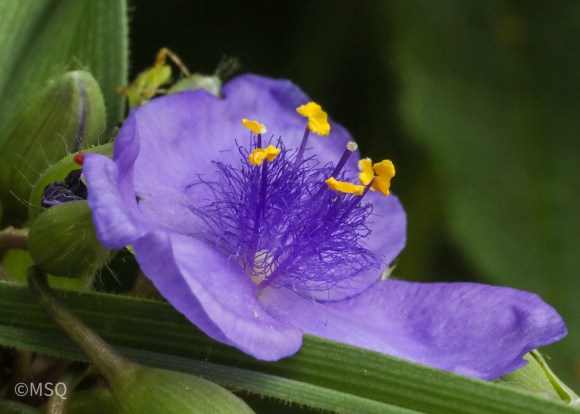
From late Spring to mid-Summer, the blue-purple flowers of Spiderwort decorate the morning garden.  These three petalled flowers offer pollen for pollinators and beneficial insects.  While the flowers fade by afternoon, the lovely blue-green foliage graces the garden throughout the bloom period. 
An adaptable plant, Tradescantia ohiensis thrives in acid-based, calcareous, limestone-based, sandy, sandy loam, medium loam and clay.  It prefers full or part sun and the whole range from wet to dry conditions.  The root system is not only fibrous but thick and fleshy.1

In natural settings, Spiderwort is widely scattered except in disturbed areas.  It can create sizable colonies in these areas.  Tradescantia ohiensis can be found in moist to mesic black soil prairies, sand prairies, thickets, limestone glades, woodland borders, Bur Oak savannas, sandy black oak savannas, roadside ditches, areas along railroads—including the ballast, and moist meadows near woods or rivers.1,3

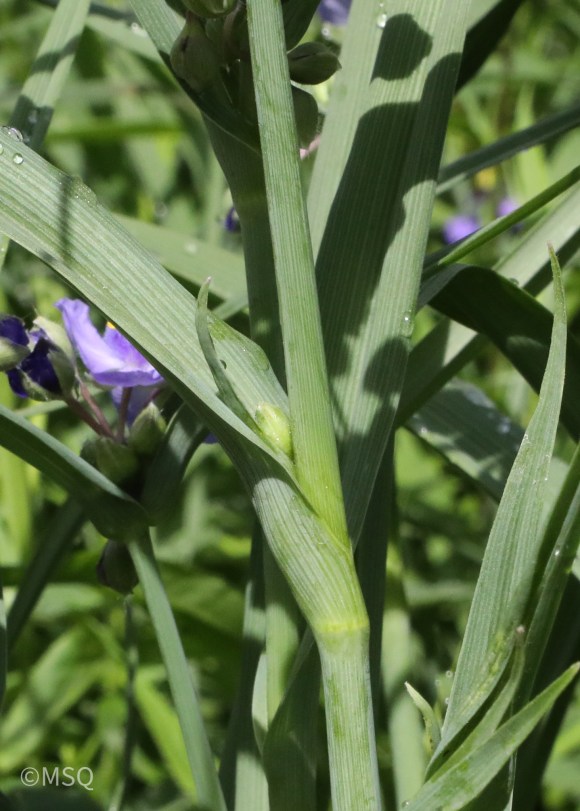
The foliage of Tradescantia ohiensis is vase-shaped with soft blue-green color.  Its leaves wrap around the stems and then arch gently down narrowing to a point.  Leaves are up to 15” long and one inch wide at the base.  Stems are round.  Both leaves and stems are usually glabrous (smooth with no hair or down).1

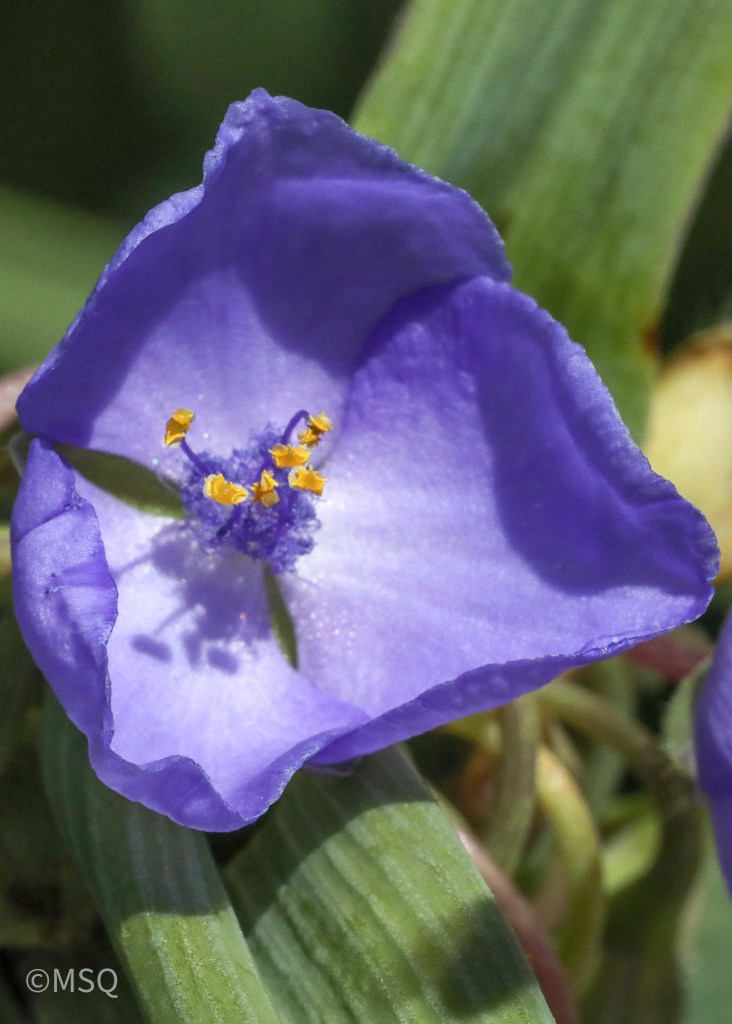
The charming flowers have three petals, an unusual number and shape combined with their unusual color.  Blue is the rarest color bloom for native plants.  These two features add to the plants’ garden appeal.  

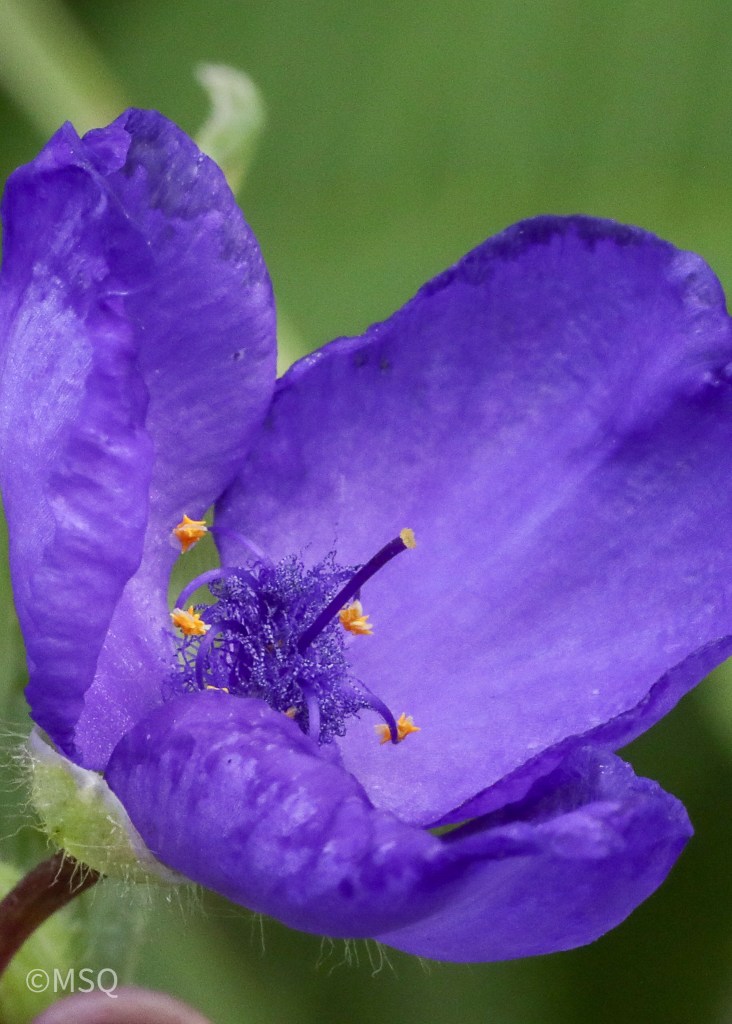
The top of the petals forms a rounded triangle.  Each bloom has six bright, yellow anthers and fine hairy filaments under the anthers.  The filaments are a slightly darker version of the flower color.1,3

To avoid self-pollination, the anthers release their pollen first.  Then they curve away from the style as it extends and becomes receptive.  Essentially, the anthers move any remaining pollen away from the stigma (area on the top of the style).4

As it spreads and multiplies in the garden, color variations appear.  In my garden, I have deep blue-purple flowers and blooms that are pale lavender with white centers.

The blossoms have unusual schedule.  Each morning one to a few buds open from each group.  They stay open until mid-day, sometimes longer on cloudy days.  Then they wither and fade.  All the buds finish by mid-summer.3  

At that time, cut the plants back to between six  and twelve inches.  This pruning increases chances of a second bloom and helps keep the plants tidy.3,5

In some climates, Spiderwort dies back completely after blooming.  This happens in my garden in the Great Lakes area.  I have fall plants that fill in the space.  This is similar to having perennials grow to cover where bulbs have faded.  In the past, I’ve also used planters in the bare spots.

Managing Tradescantia ohiensis can be a bit of a challenge.  In the garden, Spiderwort spreads easily to form large clumps.  It can also self-seed when conditions are right.  Sometimes considered a problem plant, Spiderwort is easily pulled.  

Deer, rabbits and other herbivores eat Tradescantia ohiensis especially in the early Spring.  I find this happens more when the plants are within the garden, away from foot traffic and people.  A good herbivore deterrent helps.1

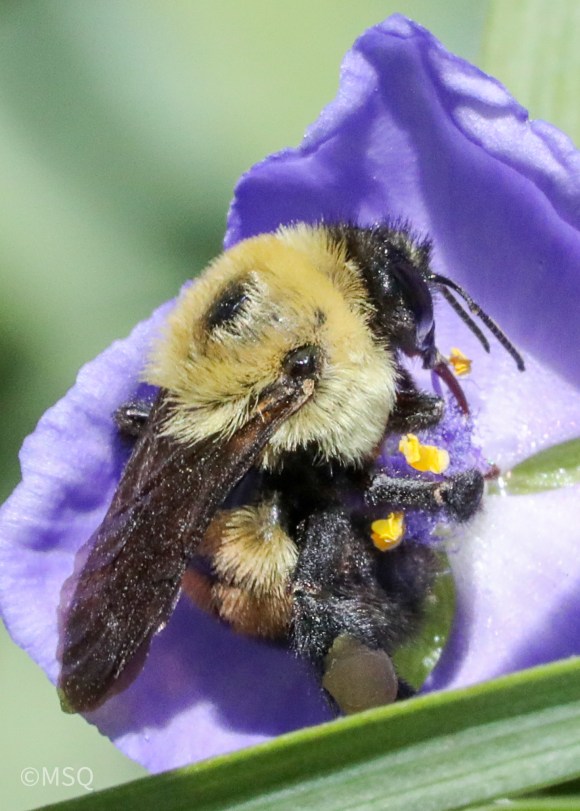
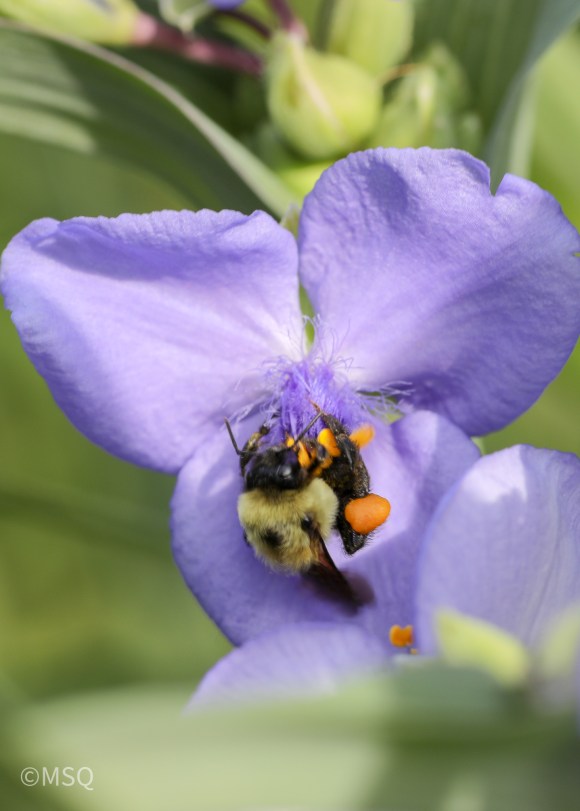
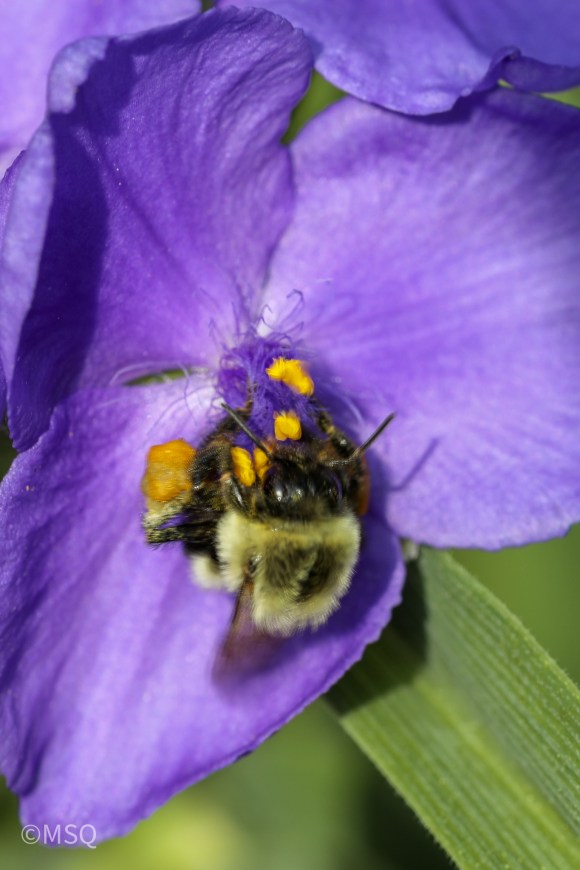
Xerces Society for Invertebrate Conservation declares Spiderwort of Special Value to Native Bees, Special Value to Bumblebees and (it) Attracts Beneficial Insects.  Numerous bees, flies and beneficial insects visit these plants.  Its long bloom season provides a reliable pollen source for many weeks.  Bumblebees are primary pollinators for Tradescantia ohiensis.  

Bumblebees pollinate native and horticultural plants.  They’re even used in some commercial agricultural settings.  As a vital pollinator, I’ll be shining a spotlight on the lifecycle of one particular bumblebee–the Eastern Bumblebee (Bombus impatiens).6

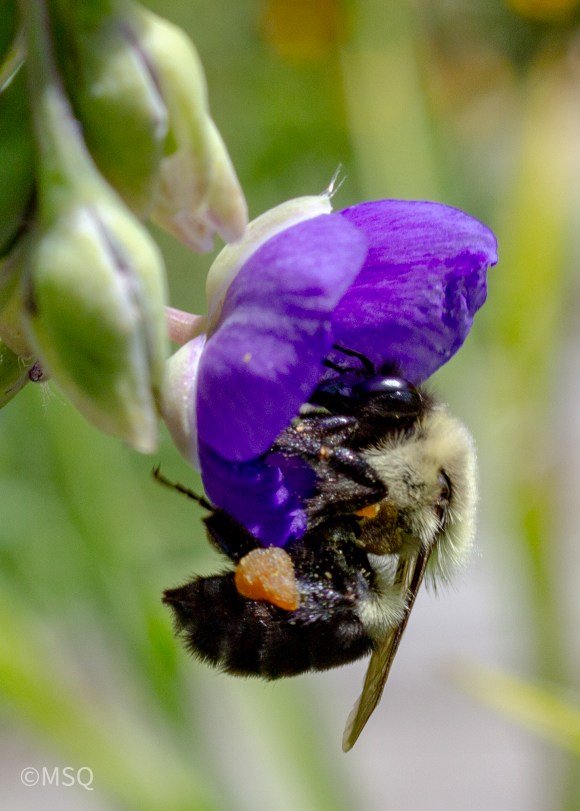
Bumblebees fly from early spring through fall and need resources for all this time.  As generalists, they forage on many different flowers.  The Eastern Bumblebee (Bombus impatiens) is a common visitor to Tradescantia ohiensis.

Bumblebees are social bees, living and raising their young in colonies.  Colonies range from around 50 to hundreds of bees.  The life of the colony begins in the Fall.  Fertile female and male bumblebees hatch and go out to mate.  The males search for females from a different colony.

After mating, the gynes (inseminated females) forage for about two weeks building up fat stores to support them for the winter.  Then, they’ll look for a cozy place to overwinter.  The gynes often choose old rodent holes or they burrow a few inches underground.

In Spring, the gynes emerge when the soil warms and flowers begin blooming.  They search carefully for a nesting site.  Possible spots include old rodent holes, spaces between two rocks, deep thatch in grass, tufts of dead grass, old bird feeders, and unused sheds or barns.  The gyne looks for a sheltered, dry space for her colony.

I’ve followed several gynes in the Spring and I’ve yet to see one find her spot.  The gyne spend a lot of time landing and exploring each area until she finds the perfect one.

Once the nesting spot is chosen, she creates a honey pot.  The pot is made from wax secreted between her abdominal segments.  The gyne fills this with nectar she has collected.  

This nectar tides her over on cold, rainy Spring days when she can’t forage.  The mature colony will maintain several honey pots for similar weather conditions and for workers who remain in the colony and don’t forage.

At this point, the gyne begins collecting pollen.  She mixes the pollen with a little nectar and forms a ball.  Multiple fertile (female) eggs are laid on the ball.  Then she covers it with a wax coating.  

The foundress (a gyne who has established a nest) continues foraging.  When it is too cool to fly, she incubates her eggs by sitting on top of the wax and shivering.  The eggs hatch in three to five days.  If the foundress dies during this time, the larvae also die, and the nest will fail.

Once the eggs have become adult workers, the foundress at last becomes the queen.  Unlike honeybees, the queen continues to gather food and the workers help her with harvesting and with caring for the larva.  Also, unlike honeybees, workers can lay eggs.  The queen suppresses this behavior with pheromones or aggression.  If an egg  is laid, the queen destroys it.  

The colony life ends in late Summer or Fall.  Close to this time, the queen lays unfertilized eggs which become male bumblebees.  She also lays fertilized eggs that are feed additional pollen.  These eggs become next year’s gynes.6

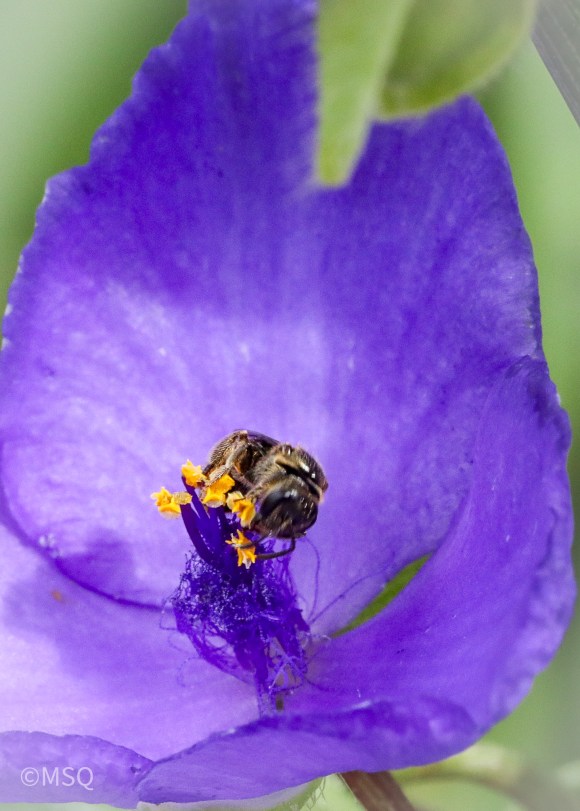
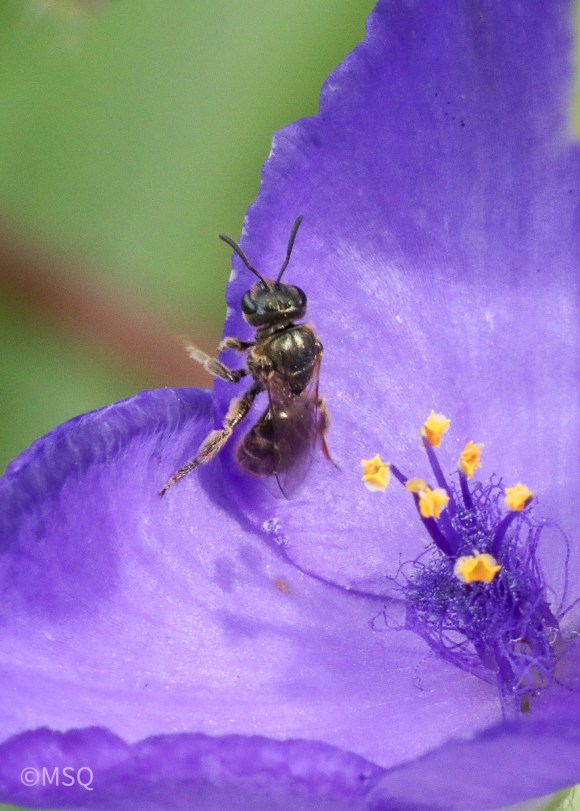
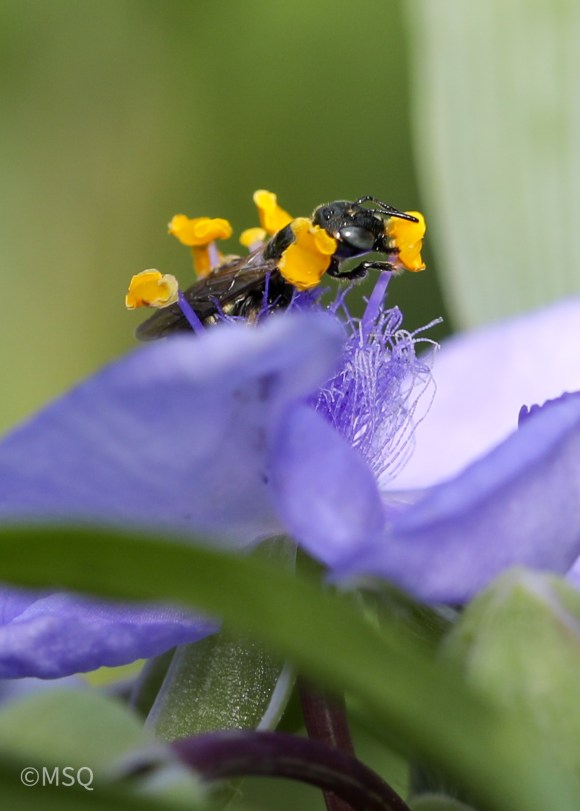
While Bumblebees, honeybees and other long tongued bees pollinate Spiderwort, numerous small bees and flies visit the flowers.  The small bees include Sweat Bees (Lasioglossum spp.),

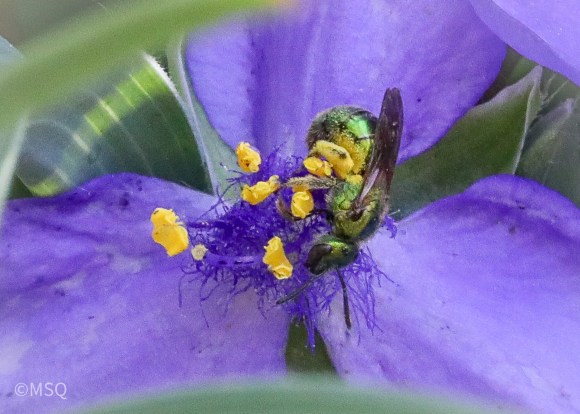
Green Sweat Bees (Agapostemon spp.),

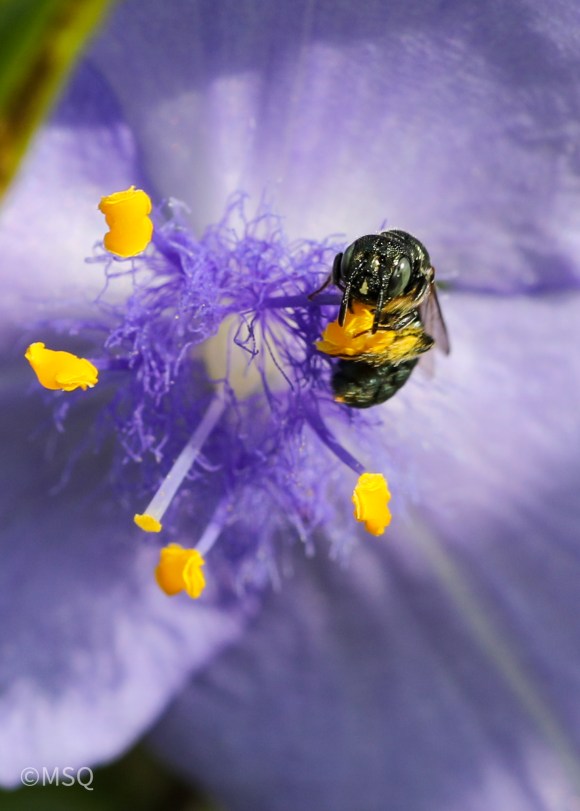
small Carpenter bees (Ceratina),

Mason Bees (Osmia spp.), European Wool Carder bee (Anthidium maculatum).1,4

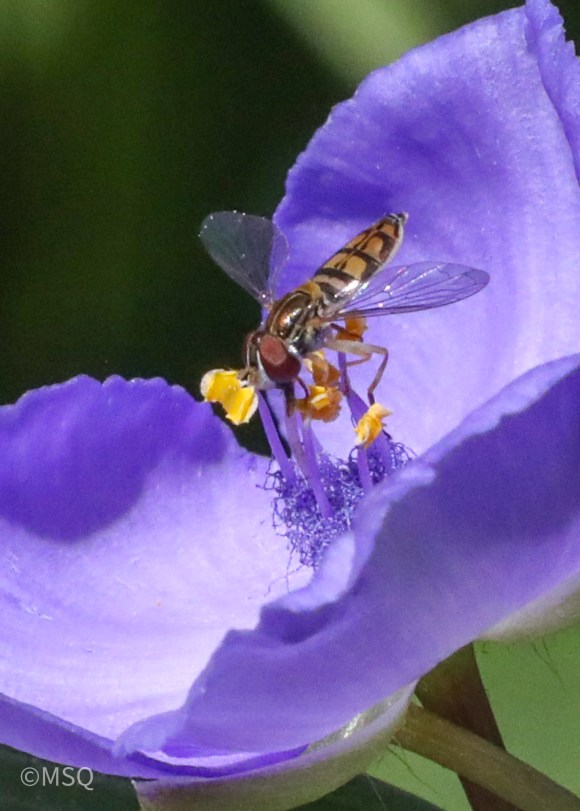
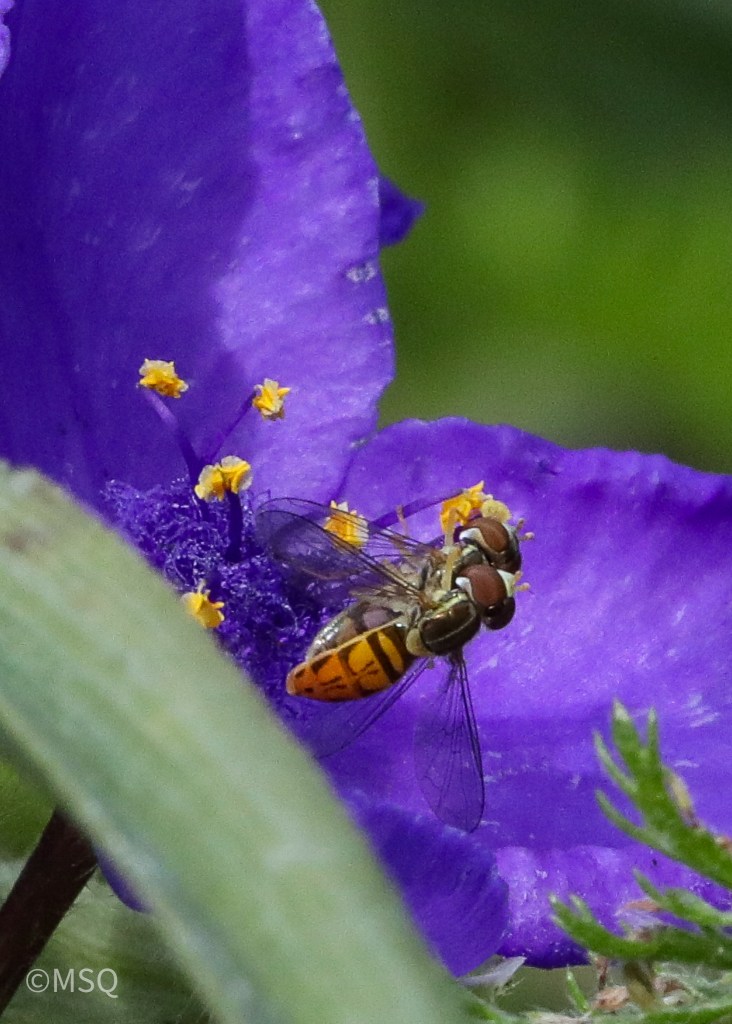
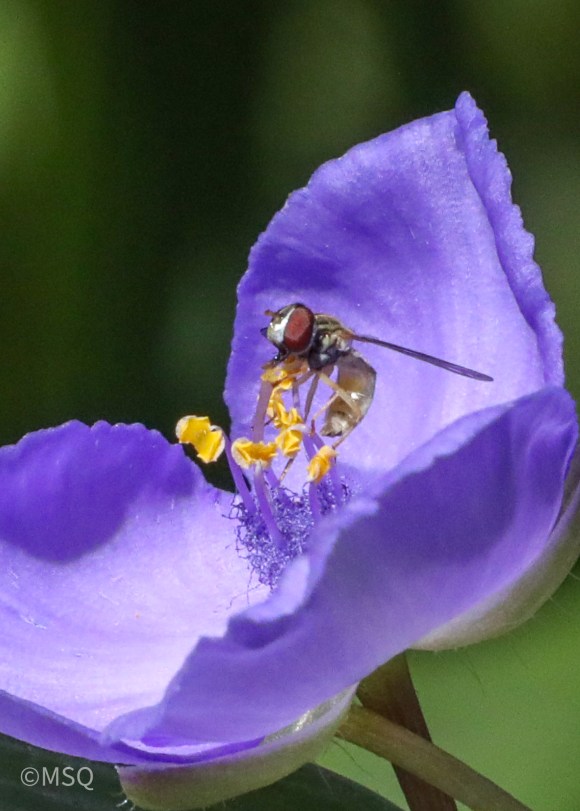
Both syrphid flies and bee flies are among the fly visitors.  I’ve mentioned syrphid flies in many posts.  Their larvae  consume huge numbers of aphids.  Today let’s shine a spotlight on the insects themselves.1,4

The names syrphid, hover or flower flies all mean the same group of insects—Syrphidae.  Most have yellow and black stripes that make them resemble bees or wasps.  Others are hairy with long thin abdomens.   They range from less than a quarter of an inch to more than three-quarters of an inch.  Their antennae are short.7

Adults seek out flowers for nectar and pollen.  They’re particularly attracted to tiny flowers.  Yarrow, wild mustard, fennel, coriander and sweet alyssum are all favorites.  

Reproduction usually centers around aphid colonies.  The female lays a single egg on a leaf near the colony.  She may produce hundreds of eggs throughout the growing season.

Eggs hatch into small, legless maggots varying in color from creamy-white to green to brown.  With a slug-like appears, they taper near the head.  The larvae mature in one to three weeks depending on the species, temperature, and amount of food. There are five to seven generation per year.  The final generation overwinters as pupae either on a leaf or in the soil.

These larvae are the beneficial insects.  A single larva can eat up to 400 aphids.  They effectively control aphids in a mixed plot or in a garden.  Although, syrphid fly larvae haven’t been studied commercially.

These larvae mostly hunt aphids.  They can also consume small caterpillars, thrips and other slow-moving insects.  In addition, syrphid fly larvae have been observed preying on small European corn borer and corn earworm larvae.7

Thank you so much for joining me for this long look at Spiderwort, Tradescantia ohiensis.  I hope you enjoyed the information on this beautiful and versatile plant and the spotlights  on the life cycle of the Eastern Bumblebee, Bombus impatiens, and the Syrphid flies.  

I’d love to answer questions or hear your stories!  Please let me know what’s going on in your garden!

Warm Regards,

Mary

References

  1. Hilty, J., n.d., Ohio Spiderwort, Tradescantia ohiensis, Dayflower family (Commelinaceae), http://www.illinoiswildflowers.info/prairie/plantx/oh_spiderwortx.htm
  2. No author, n. d., Tradescantia ohiensis, Ohio Spiderwort, Bluejacket, Commelinaceae, (Spiderwort Family), https://www.wildflower.org/plants/result.php?id_plant=TROH
  3. No author, n. d., Tradescantia ohiensis, BluejacketOhio Spiderwort; Smooth Spiderwort, https://plants.ces.ncsu.edu/plants/tradescantia-ohiensis/
  4. Holm, H., 2014, Pollinator of Native Plants:  Attract, Observe and Identify Pollinators and Beneficial Insects with Native Plants, Pollination Press LLC., Minnesota
  5. No author, n. d., Tradescantia ohiensis,https://www.missouribotanicalgarden.org/PlantFinder/PlantFinderDetails.aspx?taxonid=279262&isprofile=1&basic=Tradescantia%20ohiensis
  6. Holm, Heather, 2017, Bees:  An Identification and Native Plant Forage Guide, Pollination Press LLC, Minnesota
  7. Mahr, Susan, n.d., Hover, Flower or Syrphid Flies (Syrphidae), https://hort.extension.wisc.edu/articles/hover-flower-or-syrphid-flies-syrphidae/#:~:text=Hover%20flies%20(or%20flower%20flies,the%20flowers%20and%20darting%20around.
Categories
native plants Pollinator gardening

A Summer Cornucopia

Part 2

And we’re back for Part II of The Summer Cornucopia!  Today the focus is on insects and how they use Common Milkweed.  If you missed Part I and are interested in the plant and pollination, here’s a link: https://wordpress.com/post/wildthingsinthe.garden/1831.

Asclepias syriaca draws an abundance of insects.  The sap, leaves and flowers are all used for food while blooms provide nectar to many insects.  Common Milkweed supports different life stages of flies, wasps, bees, butterflies, moths, skippers, plant bugs and beneficial insects.  Even hummingbirds try to sip nectar although they can’t reach it.1,7  

The most famous visitor to Common Milkweed is the Monarch butterfly (Danaus plexippus).  Monarchs can only use milkweeds (Asclepias) to feed their caterpillars. Growing milkweed supports the generations of Monarchs that hatch over the summer months.  When the last summer generation is born and transforms into an adult, they’ll drink nectar from milkweed and other flowers for food and fuel for their migration.8  

Growing native milkweeds helps preserve the existing Monarch population.  If you’re interested in helping Monarchs, Monarch Watch has excellent information on creating Monarch Waystations at https://www.monarchwatch.org/waystations/ .  Here are the highlights of the plan!8

How big does a waystation have to be?  Any size will help the Monarchs (and other pollinators!).  If possible, a 100 square foot waystation is highly effective.  The area doesn’t have to be all in one spot.  There can be several plantings throughout a property.

Sun is important for Monarchs.  Like other insects, they need heat and sunlight to warm themselves for flying and daily activities.  An area with six or more hours of sunlight is required.  Coincidentally, most milkweeds thrive under those conditions.

Milkweed also grow well in well-drained soil.  Place Monarch Waystations in low clay areas with fast draining soils.

Place plants close together (although not closer than recommended).  Monarchs and their caterpillars need shelter and protection from predators and the weather.

What about milkweed?  At least ten plants are recommended preferably with two or more types of milkweeds.  This planting scheme gives an extended season of bloom and allows the Monarchs longer access to the milkweed plants and nectar.  One type of milkweed is okay if more than ten plants are included.

Establish continuous supply of nectar plants.  Use annual, biennial and perennial plants.  Native plants are a great choice.  These plants also benefit the other pollinators.

Finally, create a management plan.  How will the waystation be maintained?  The plan contains basic garden maintenance:  mulching, fertilizing, removing invasive plants.  Additionally, it includes Monarch specific items:  eliminate insecticides, add more features like a water source or puddling spot.

Again, for more information on Monarch Waystations and other resources, including free milkweed programs, go to https://www.monarchwatch.org/waystations/

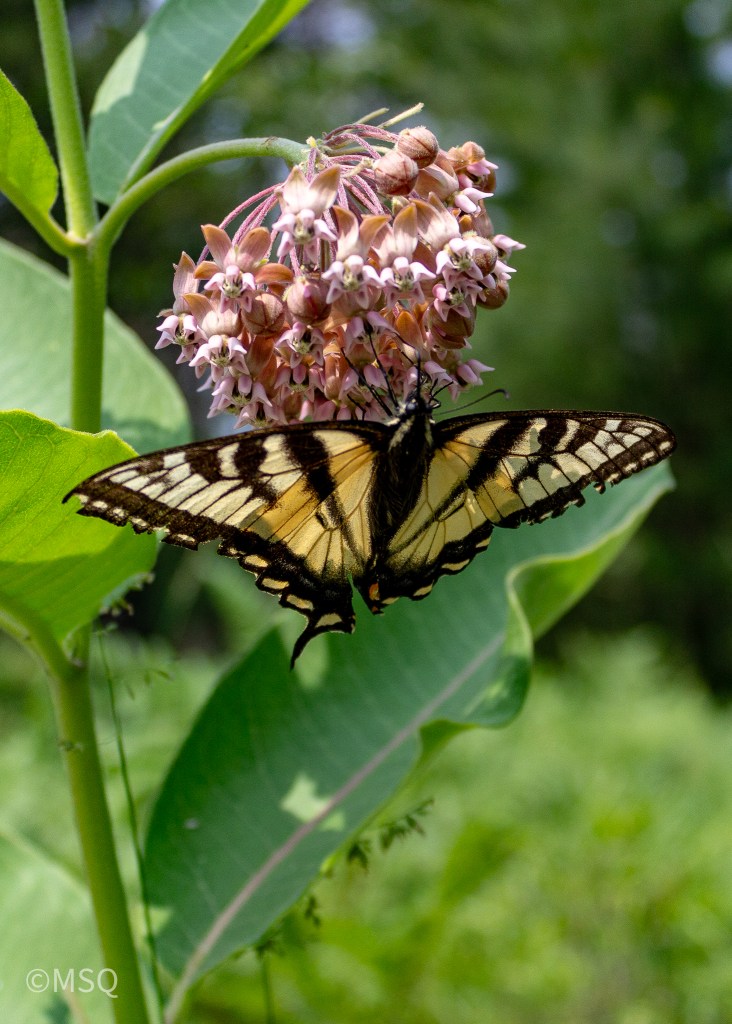
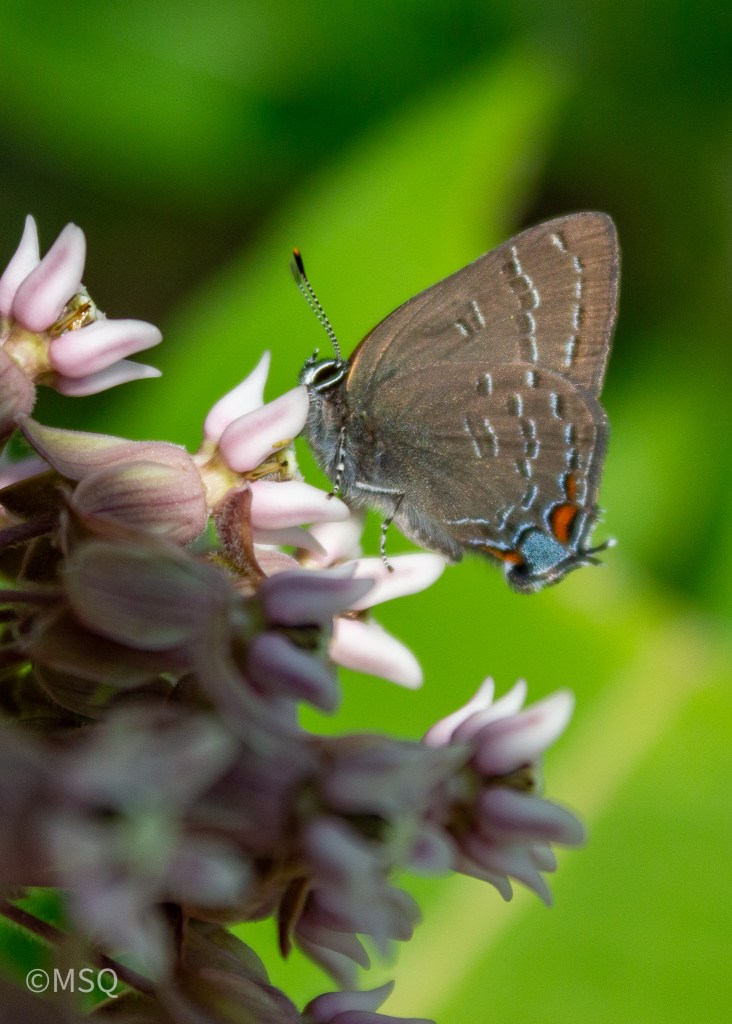
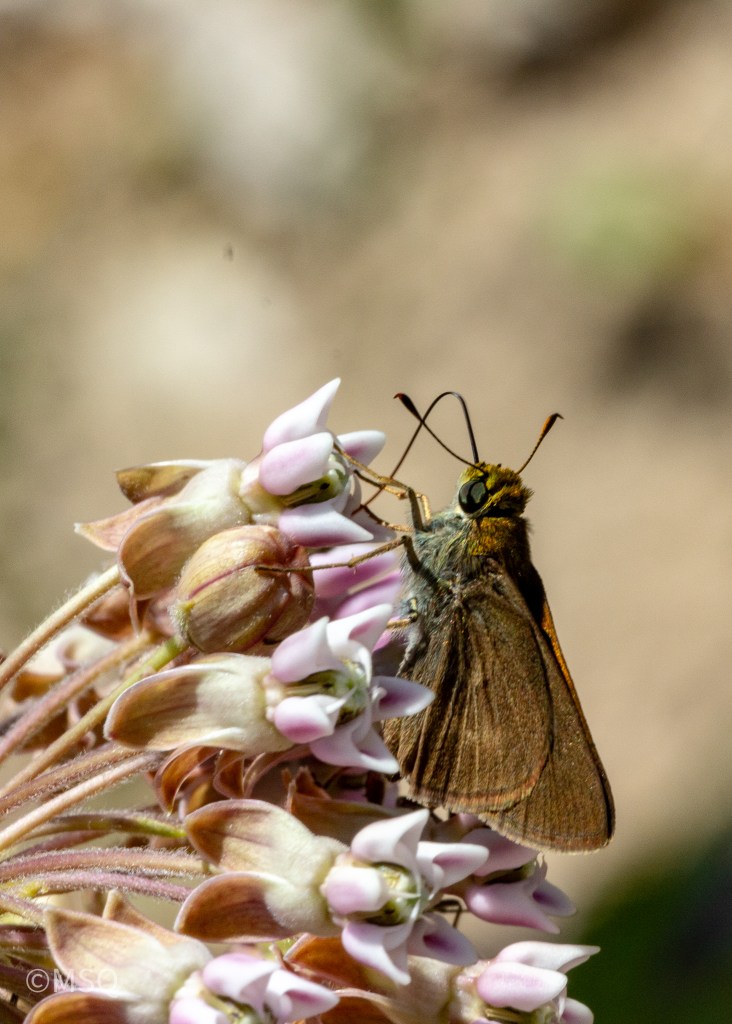
In addition to Monarchs, swallowtails (Papilio), fritillaries (Speyeria), viceroy butterflies (Limenitis), sulfurs (Pieris), and other butterflies also visit Asclepias syriaca.  Skippers use Asclepias syriaca for nectar including Ancyloxipha.1,7  

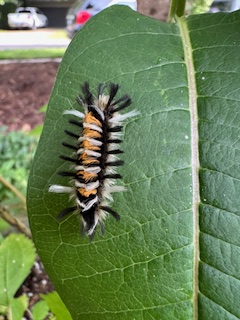
Common Milkweed is a larval host for the striking Milkweed Tussock Moth (Euchaetes egle) caterpillar, the Unexpected Cycnla (Cycnia inopinates) and the Delicate Cycnia (Cycnia tenera).  All are part of the group Artiinae or Tiger Moths.1  

The Delicate Cycnia (Cycnia tenera) lacks the usual aposematic coloration  It has a soft tan larva and a charming white adult with just a touch of orange on the head and wing edges.  Instead, it emits aposematic ultrasound calls when caught!  Bats release their prey when they hear the calls.  During the day, their color variation seems to keep birds away.1,9

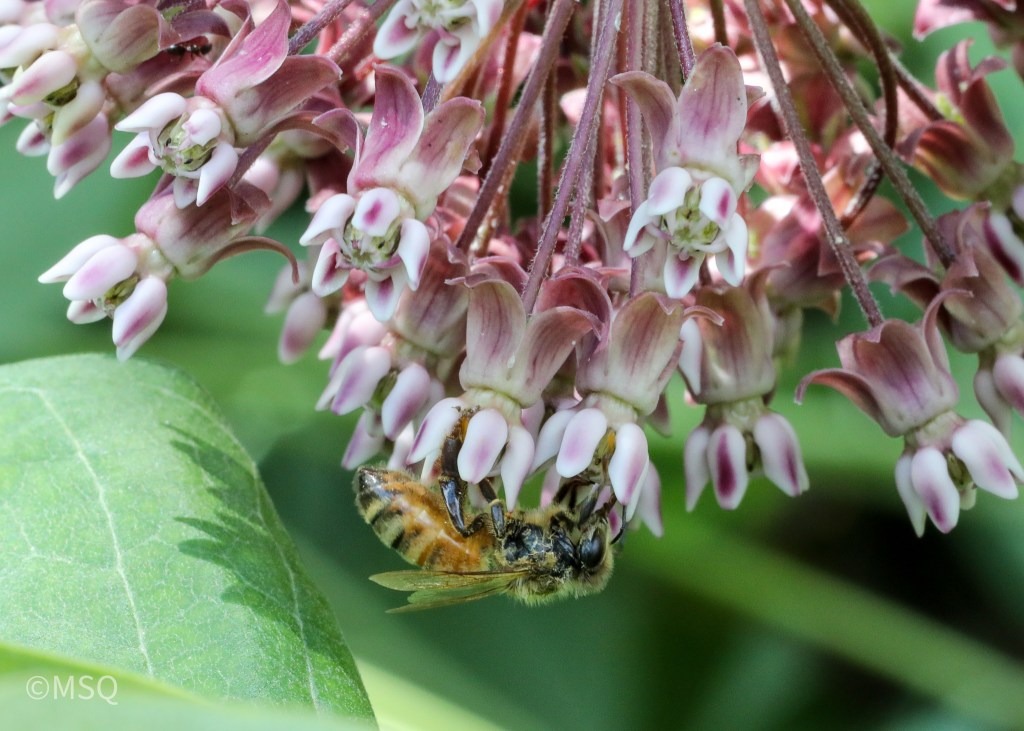
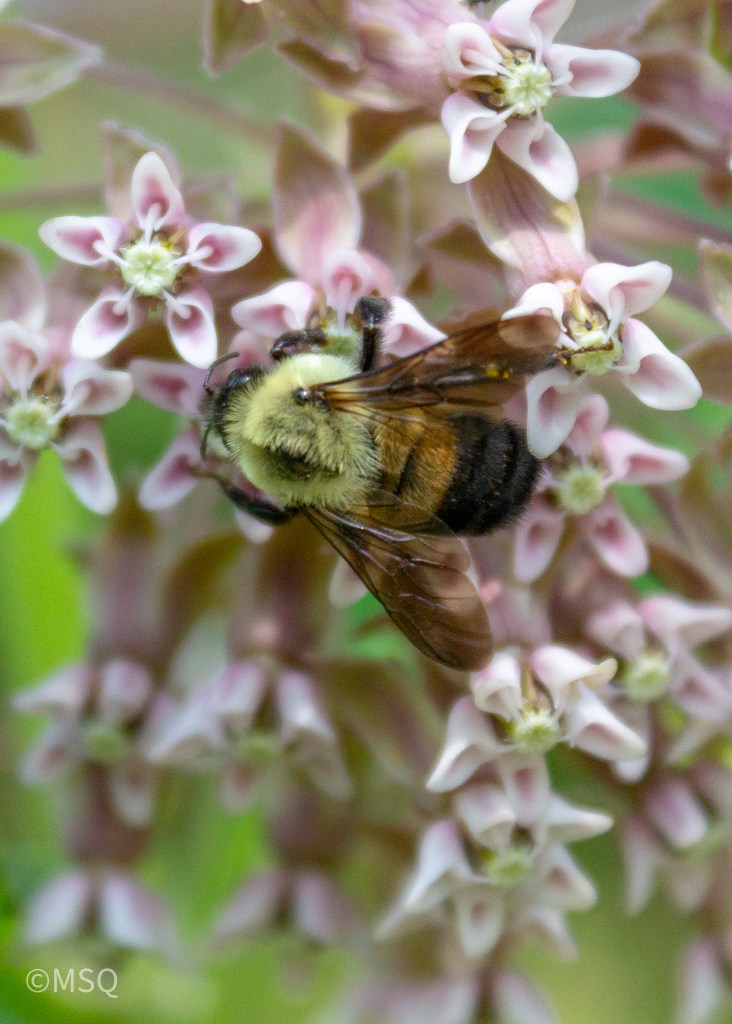
Both long-tongued and short-tongued bees visit Common Milkweed for nectar.  These include honeybees (Apis),

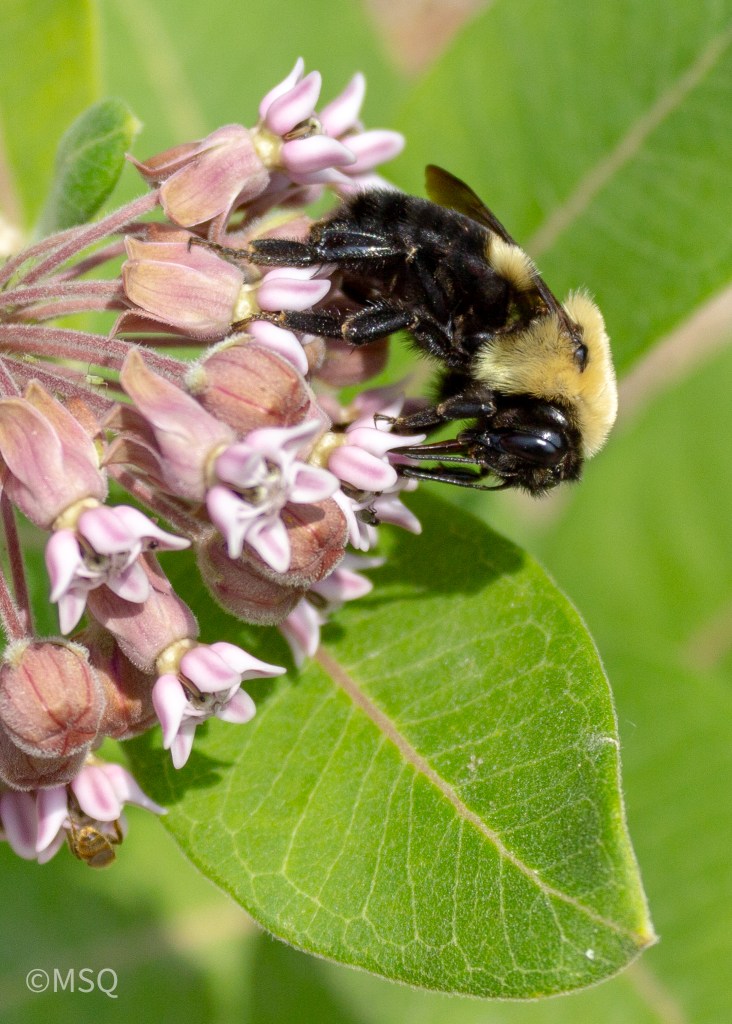
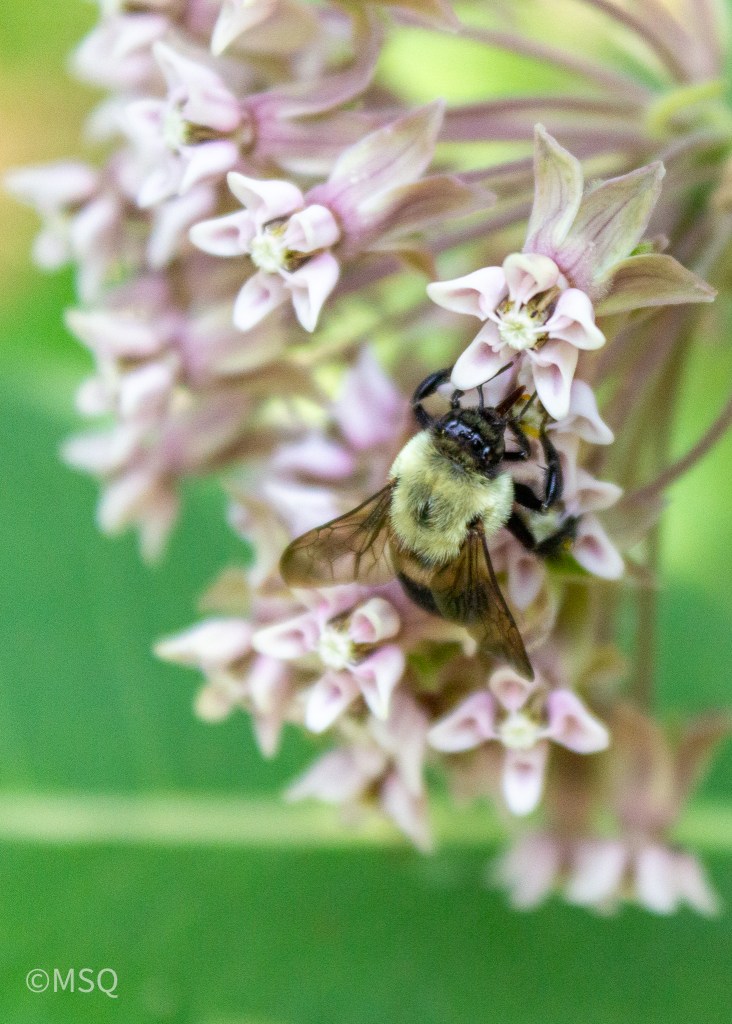
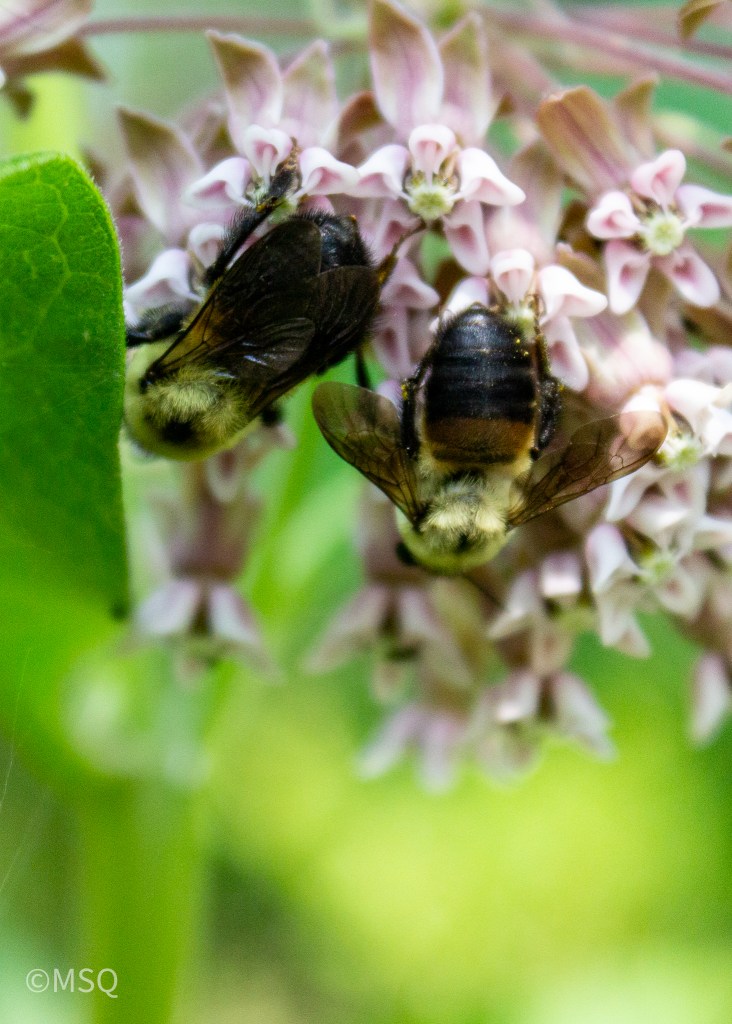
Bumble Bees (Bombus),

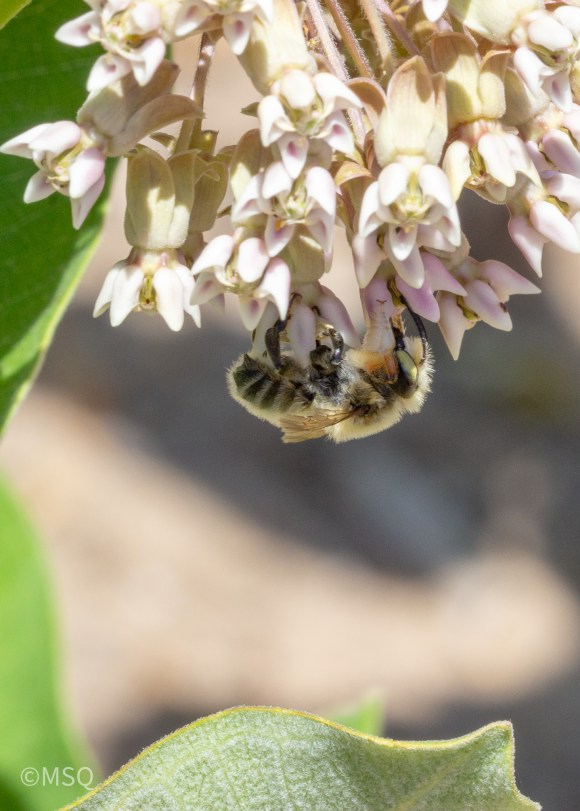
leaf-cutter bees (Megachile),

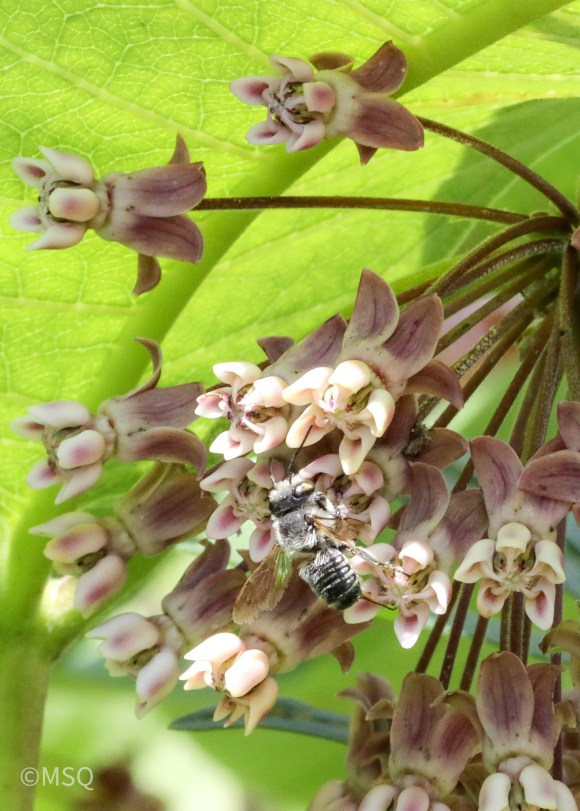
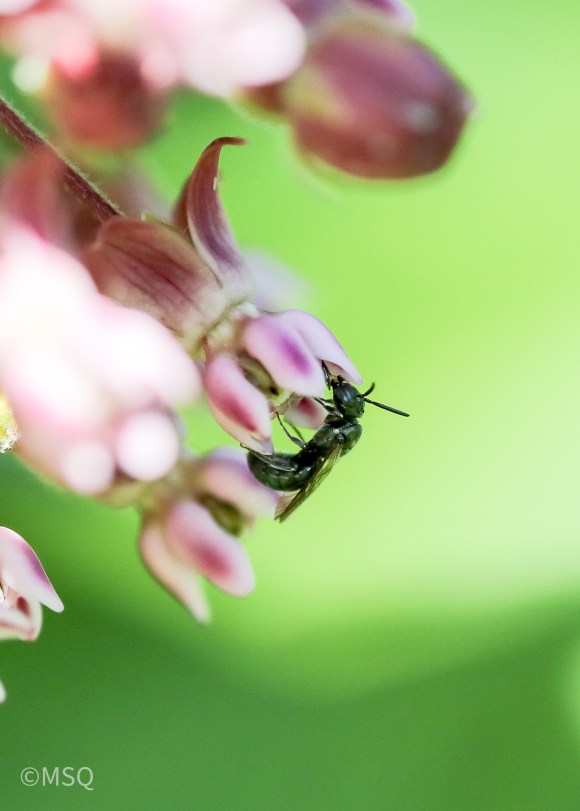
cuckoo bees (Coelioxys), small carpenter bees (Ceratina)

and sweat bees (Halictus and Lasioglossum).1,7,10

Many wasps enjoy nectaring at Milkweed flowers especially Sphex, Tachytes, Polistes,  Myzinum, and ichneumon wasps.  Sphex ichneumoneus is a known pollinator of Common Milkweed.1,7

Numerous beneficial insects visit Asclepias syriaca including the delicate and diverse ichneumon wasps.  The adult wasps use milkweeds’ nectar for fuel while searching for insect prey.  They’re considered parasitoids and the females lay eggs inside grubs and caterpillars.  

Young of boll weevils, tomato hornworms and wood borers are all food for ichneumon wasps.  In addition to garden pests, adults hunt large insects such as spiders and butterflies.  

In general, ichneumon wasps help reduce the number of insects that reach reproductive age.  Many of these prey insects damage trees.  In this way, the wasps help keep trees healthy.11

Bembix americana, a predatory sand wasp, also gathers nectar from Common Milkweed.  B. americanafeeds their young true flies (Diptera).  Diptera include house flies, gnats and mosquitos.  

As populations of flies increase, B. americanas numbers rise.  A single larvae can eat two dozen flies.  B. americana uses a different strategy for provisioning its young.  Other wasps paralyze their prey and stock each cell with the required (living but paralyzed) insects.  This sand wasp kills the flies and adds more food as needed.12

Asclepias syriaca hosts predatory stink bug larvae.  Stink bugs have a terrible reputation especially since the arrival of  the invasive Brown Marmorated Stink Bug.  But predatory stink bugs are a whole different category.  These are beneficial insects that hunt insect prey.  

Above, is a photo of a Spined Soldier Bug larvae on milkweed.  There are five larval stages (instars) and all eat insects.  Their preferred foods include Mexican bean beetle, Colorado potato beetle, and imported cabbageworm.  

Look for the adult Spined Soldier Bug on plants where prey may be located.  These plants include the melons/squash/cucumber (cucurbit), broccoli, cauliflower, kale, etc. (cruciferous) and tomatoes, peppers, eggplant (solanaceous) crops.  

If you’re looking for eggs, they’re an incredible metallic bronze color with a row of spines like a crown.  Just hatched larvae, cluster around the eggs eating necessary bacteria.  Spined Soldier Bug can be purchased commercially.13

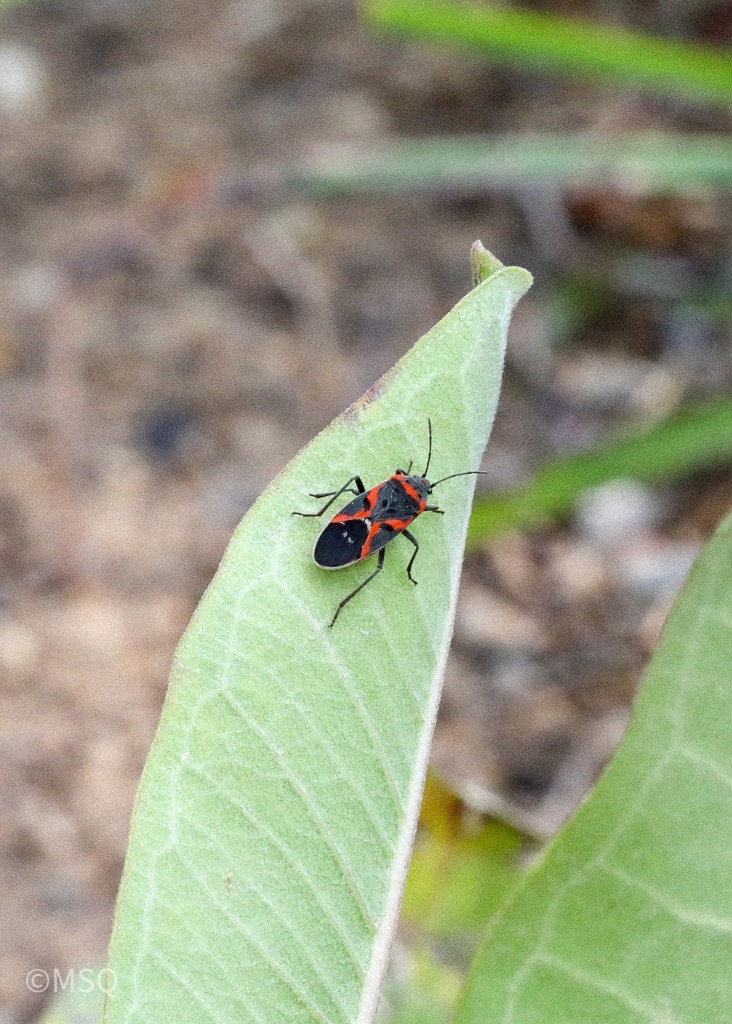
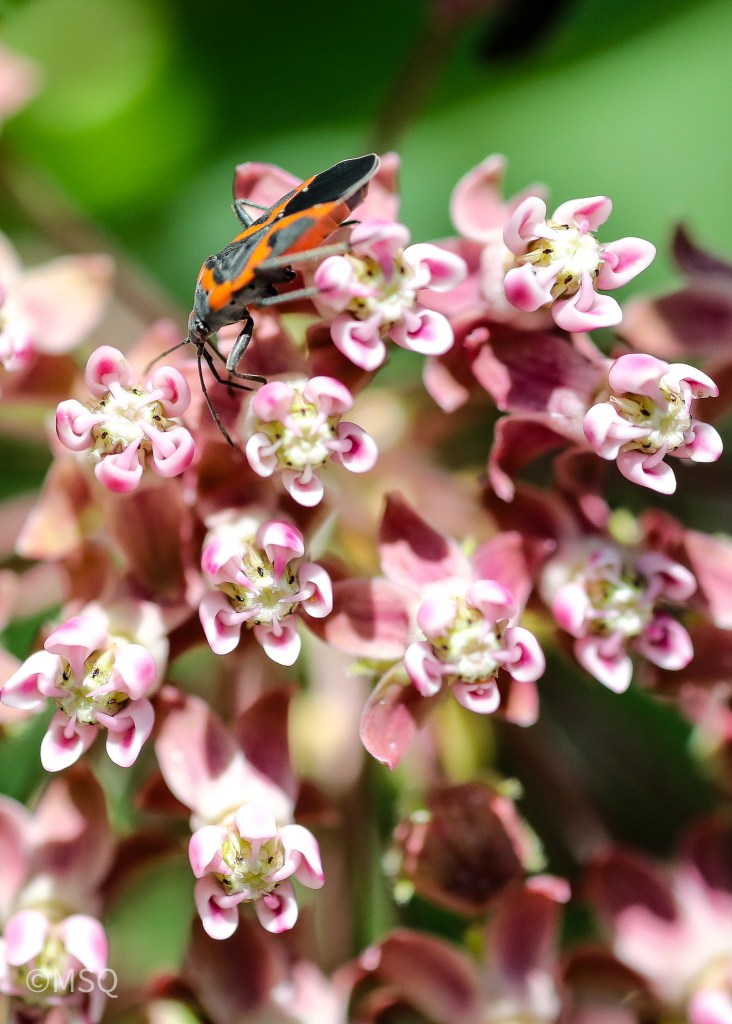
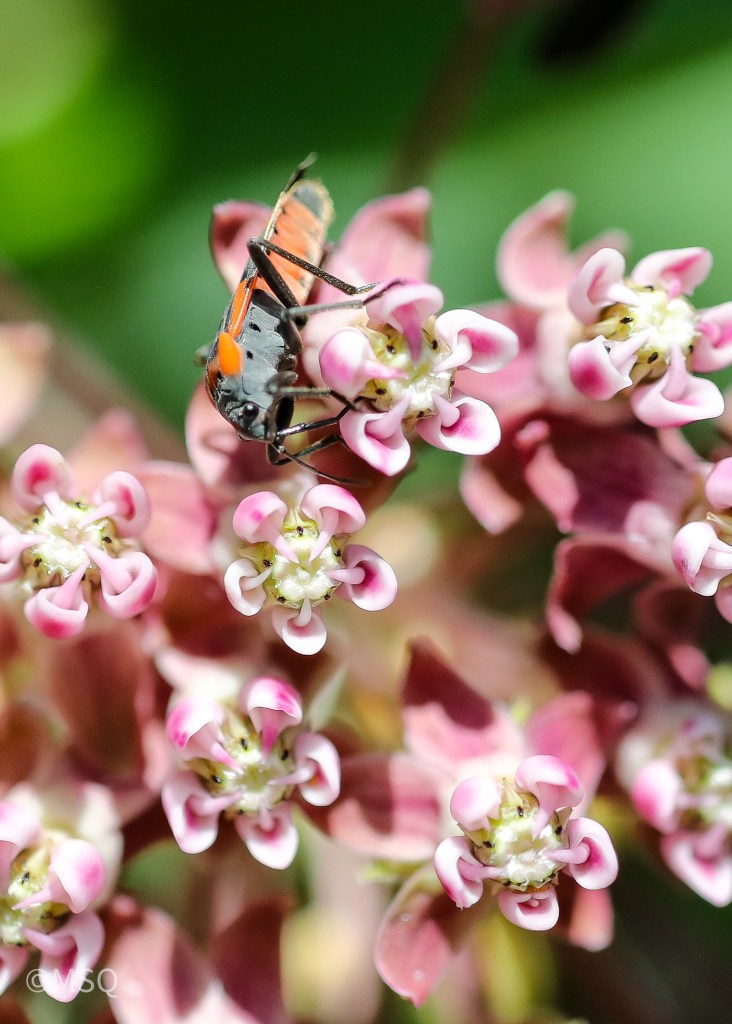
In addition to all these, Asclepius syriaca hosts many beetles and bugs,

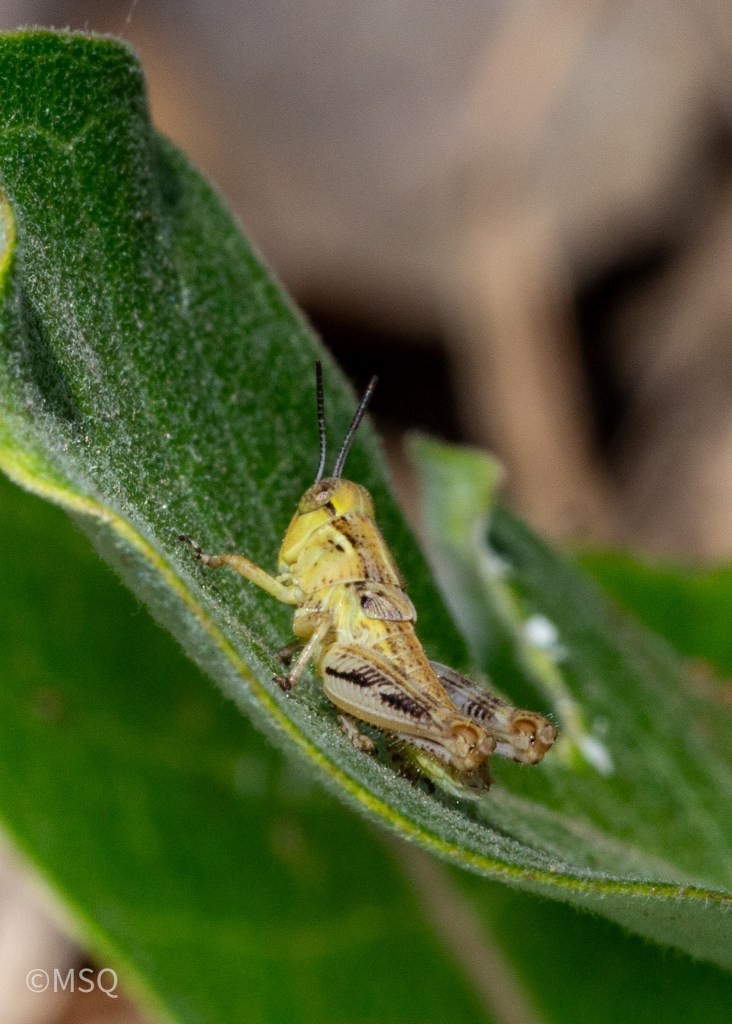
grasshoppers,

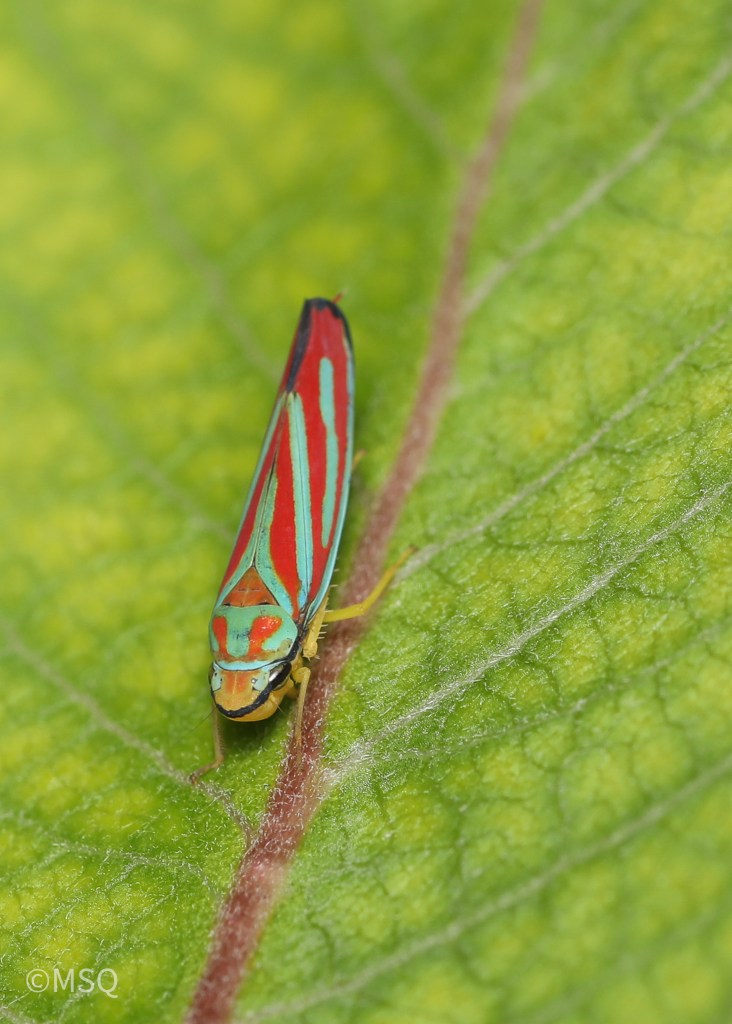
and leafhoppers

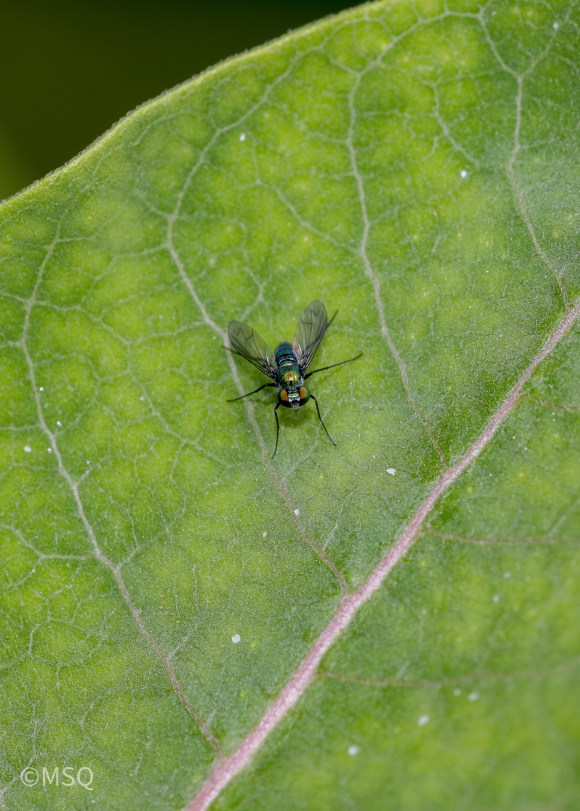
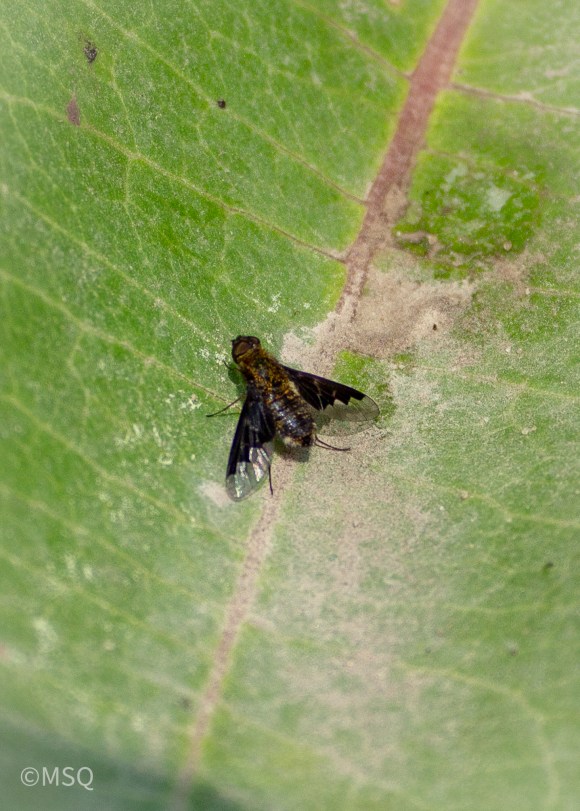
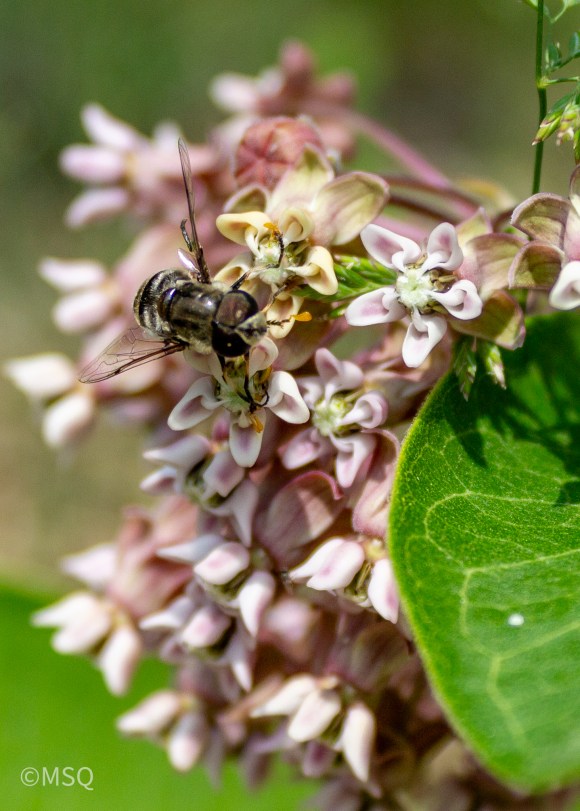
Finally, flies, including beneficial ones, nectar on Asclepius syriaca.

I hope you’ve enjoyed this exploration of the insects found on Common Milkweed.  Pollinators and beneficials all enjoy Asclepias.  It’s always worth stopping to see who’s home in the milkweed patch with or without flowers!

References

  1. Hilty, J., n.d., Common Milkweed, Asclepias syriaca, Milkweed family, (Asclepiadaceae),  https://www.illinoiswildflowers.info/weeds/plants/cm_milkweed.html
  2. Berkov, A., 28.October.2010, Plant Talk:  Inside the New York Botanical Garden; Plant Profile:  The Extraordinary Common Milkweed, How Do Insects Feed on this Plant with Sticky White Latex? https://www.nybg.org/blogs/plant-talk/2010/10/science/plant-profile-the-extraordinary-common-milkweed/#:~:text=Plants%20in%20the%20genus%20Asclepias,Asklepios%2C%20the%20ancient%20Greek%20physician.
  3. Bowe, Scott, 11.September.2018, Milkweed is More Than Just a Common Weed, WXPR, https://www.wxpr.org/natural-resources/2018-09-11/milkweed-is-more-than-just-a-common-weed
  4. Nelson, M. and Alfuth, D., 24.February.2021, Milkweed (Ornamental Plants Toxic to Animals), X-number:  XHT1276, https://hort.extension.wisc.edu/articles/milkweed-ornamental-plants-toxic-to-animals/
  5. Taylor, David, n.d., Common Milkweed, (Asclepias syriaca L.), Plant of the Week, https://www.fs.usda.gov/wildflowers/plant-of-the-week/asclepias_syriaca.shtml
  6. Eldredge, E.P., 2015,11,00, Milkweed Pollination Biology, Plant Materials Technical Note NV-58, Natural Resources Conservation Service, https://www.nrcs.usda.gov/plantmaterials/nvpmctn12764.pdf
  7. Betz, R.F., Struven, R.D., Wall, J.E. & Heitler, F.B., 1994, Insect Pollinators 12 Milkweed (Asclepias) Species, T.B. Bragg and J. Stubbendieck (eds.) Proc. Of the Thirteenth North American Prairie Conference. Univ. of Nebraska, Lincoln, NE.
  8. No author, n.d., Monarch Waystation Program, https://monarchwatch.org/waystations/
  9. Geere, Duncan, 2010. August.19, Tiger Moths Scare Bats with Ultrasonic Clicks, Wired, https://www.wired.com/2010/08/moth-jamming/
  10. Holm, Heather, 2017, Bees:  An Identification and Native Plant Forage Guide, Pollination Press LLC
  11. No author, n.d., Ichneumon Wasps, Discover Nature>Field Guide:  Missouri Department of Conservation, https://mdc.mo.gov/discover-nature/field-guide/ichneumon-wasps
  12. No author, n.d., Sand Wasps, Discover Nature>Field Guide:  Missouri Department of Conservation, https://mdc.mo.gov/discover-nature/field-guide/sand-wasps
  13. Berish, Chelsea, n.d., Spined Soldier Bug in Kentucky, ENTFACT-325: SPINED SOLDIER BUG IN KENTUCKY, University of Kentucky Department of Entomology, Martin Gatton College of Agriculture, Food and Environment
Categories
native plants Pollinator gardening

Shining Gold in the Garden

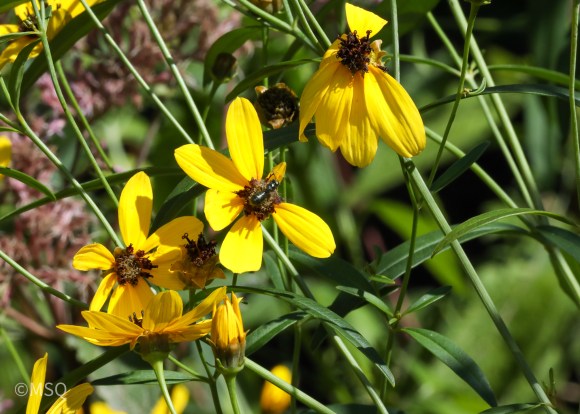
Fluttering above the other garden flowers, the yellow faces of Coreopsis tripterous welcome multitudes of bees.  This mid to late season bloomer supports an array of pollinators and beneficial insects, preparing them for the winter to come.  In addition, Coreopsis tripteris or Tall Tickseed offers an erect accent in the garden resembling bamboo.

Tall Tickseed thrives in Zones 3 through 8.  It grows from two to nine feet tall and spreads from two to eight feet.  Spacing is four to eight feet.  Coreopsis tripteris enjoys medium to moist soils but isn’t picky.  It can tolerate loam, clay-loam, gravel, and sand.  Poorly drained soils can encourage crown rot.  

Established plants tolerate drought and dry conditions.  In dry conditions, Tall Tickseed is shorter and more open.  In ideal conditions, it will self-seed freely.  Deadheading reduces this and may help rebloom.  Unfortunately deadheading, also, reduces seeds for the birds.  

Coreopsis tripteris does lean and often needs support.  This is especially a problem in windy areas and wet areas.  In 2024, I’m going to try a pruning technique called the ‘June haircut’ on my Tickseed.  This technique is used on asters to reduce flopping and increase bloom.  In mid-June, I’ll cut back a quarter to a third of each stem.  I hope to reduce flopping.  I’ll be sure to let you know what happens!

If pruning doesn’t appeal, there are Tall Tickseed nativars available.  Coreopsis tripteris ‘Gold Standard’ and Coreopsis tripteris ‘Flower Tower’ are two options for the native Coreopsis tripteris.  Both plants were originally found in wild populations.  Mt. Cuba Center in Delaware performed the plant trials on the seeds.  

Mt. Cuba is a wonderful botanical garden with a focus on native plants.  In their own words, “Our mission is to inspire an appreciation for the beauty and value of native plants and a commitment to protect the habitats that sustain them.”  As part of their mission, they perform plant trials and offer classes including a certification in Ecological Gardening.1

Coreopsis tripteris ‘Gold Standard’ is a shorter version of the native plant.  It grows to about five and a half feet tall on sturdy stems.  This plant maintains its upright habit throughout the growing season.  It is a slow spreader and fills only two feet.  Like the native, ‘Gold Standard’ has excellent resistance to powdery mildew and leaf spot.  This nativar attracts bees, wasps, skippers, and butterflies.  

Coreopsis tripteris ‘Flower Tower’ has all the native’s height, growing to eight feet tall.  But it has sturdy stems for support,  so it doesn’t lean or flop.  Its flowers are the largest of these three plants at two and half inches.  Unfortunately, those large, lovely flowers only last four to five weeks.  In contrast, both Coreopsis tripteris and Coreopsis tripteris ‘Gold Standard’ bloom for eight to nine weeks.  It spreads two feet over three years and is both hardy and disease resistant.  The Mt. Cuba review didn’t mention insect visits.

Where does Coreopsis tripteris grow in the wild?  It thrives in black soil prairies, cemetery prairies, sand prairies, typical savannas, and sandy savannas.  It can also be found in thickets, edges of seeps, thinly wooded bluffs, meadows in wooded areas and limestone glades.  In areas impacted by people, Tall Tickseed is found in abandoned fields, along railroads, along roadsides and in moderately disturbed areas.  It responds well to fire.2

The leaves of Coreopsis tripteris are a fascinating feature of the plant.  Most of the compound leaves are three parts, suggestive of bamboo. They even flutter in the wind like bamboo leaves.  Combined with the vertical lines of this plant, it creates the impression of bamboo grass in the garden–at least until the flower bloom.  It’s like two plants in one!

Aside from the three-part form, the leaves grow opposite  each other the entire length of the stem.  They are larger at the bottom where they have five parts.  Individual leaflets extend up to five inches long and spread three-quarter inches wide and are elliptic in shape.  The edges often have tiny hairs called ciliate.  Leaves are medium green on top and light green underneath with very small hairs (pubescent).2

Tall Tickseeds begins blooming in mid-summer and continues through the summer, trailing off into Fall.  Bright yellow flowers with flattened, velvety brown centers sit on top of the stems or emerge from upper leaf axils.  The flowers are one to three inches across with rounded, widely spread petals.  The petals give Tall Tickseed a lovely, Daisy-like form different from a Black-Eyed Susan

The blooms can be single or in a flat group resembling an open cyme—think yarrow with just a few large, yellow flowers.  The center flowers open first.  The petals are sterile ray florets while the center has disc florets.  These disc florets form five millimeter long, tubular, four to five lobed, reddish-brown florets.  The lobes’ edges have triangular shapes that are spreading to slightly recurved.

Like Solidago, Coreopsis is a keystone plant. There are two kinds of keystone plants.  One type supports caterpillars from 90% of moths and butterflies.  The other category has pollen used by specialist bees.  These plants feed both specialist and generalist bees.  Coreopsis is in the top 30 keystone plant genera for the Eastern Temperate Forests.  It is seventh on the Top 30 Native Plants for Pollen Specialist Bees (also for the Eastern Temperate Forests—Ecoregion 8).3,4

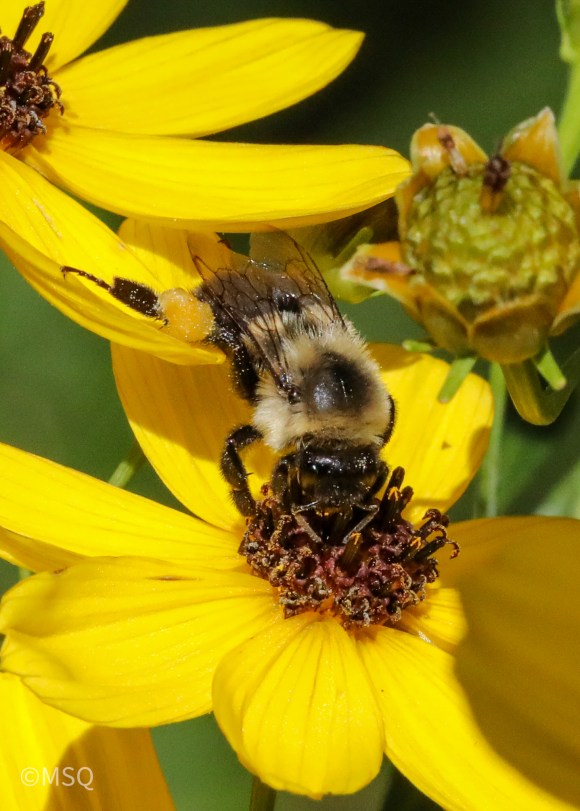
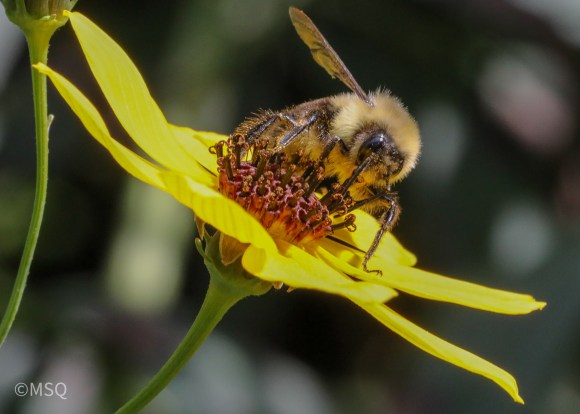
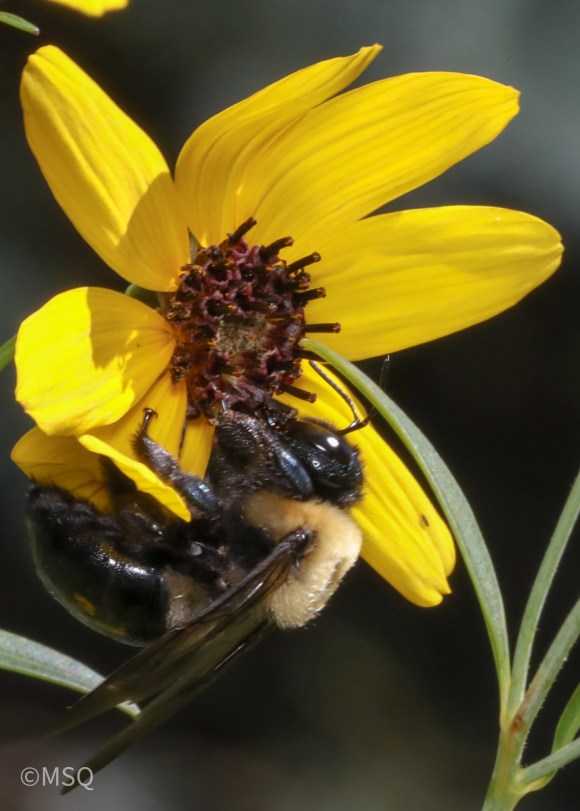
Tall Tickseed attracts numerous species of bees, butterflies, moth, skippers, and other beneficial insects.  The Xerces Society for Invertebrate Conservation considers it of Special Value to Native Bees and states it, Supports Conservation Biological Control.5  Coreopsis tripteris draws Bumblebees,

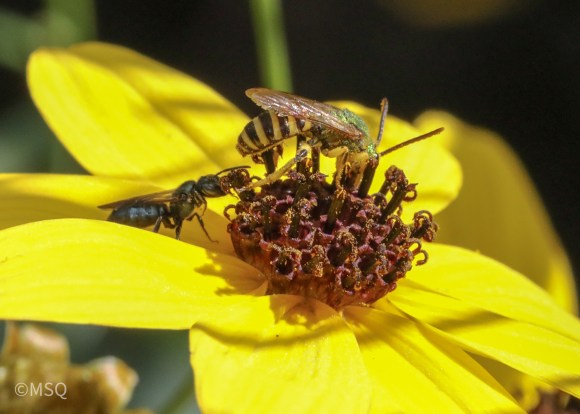
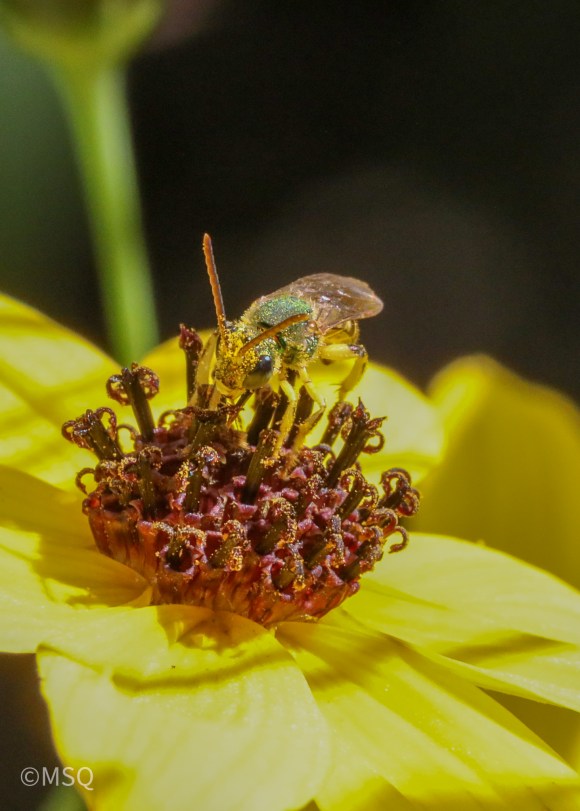
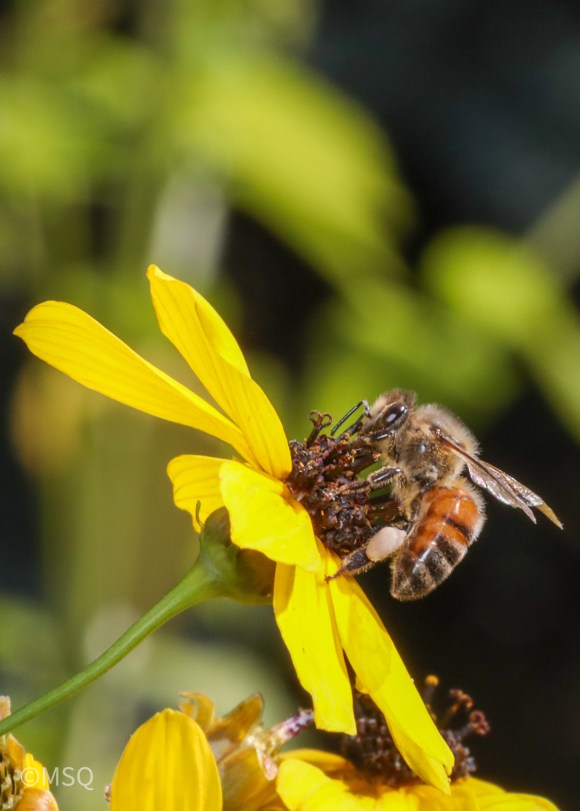
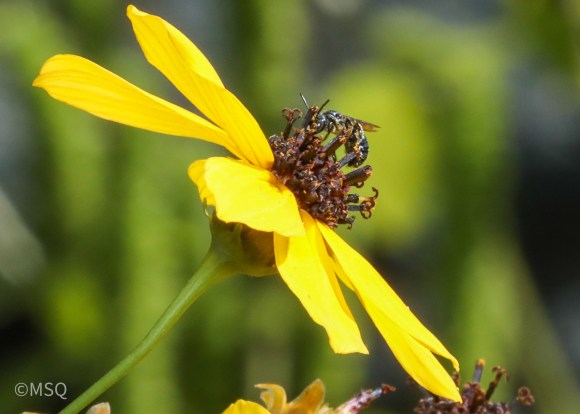
cuckoo bees,  digger bees (Melissodes spp.), leaf-cutter bees (Megachile spp.), Halictid bees (Halictus spp., Lasioglossom spp.), small green sweat bees,

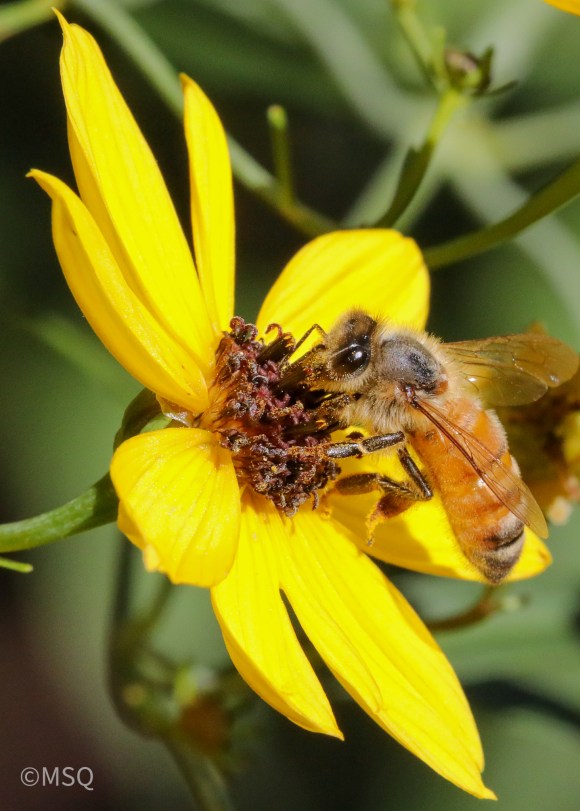
honey bees,

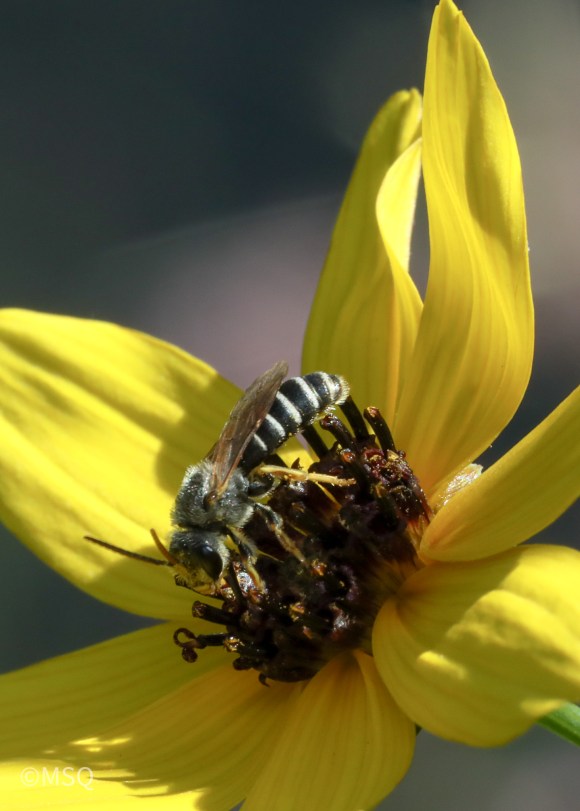
carpenter bees (Xylocopa spp. and Ceratina spp.) and dagger bees (Calliopsis spp., Heterosaurus spp.).2

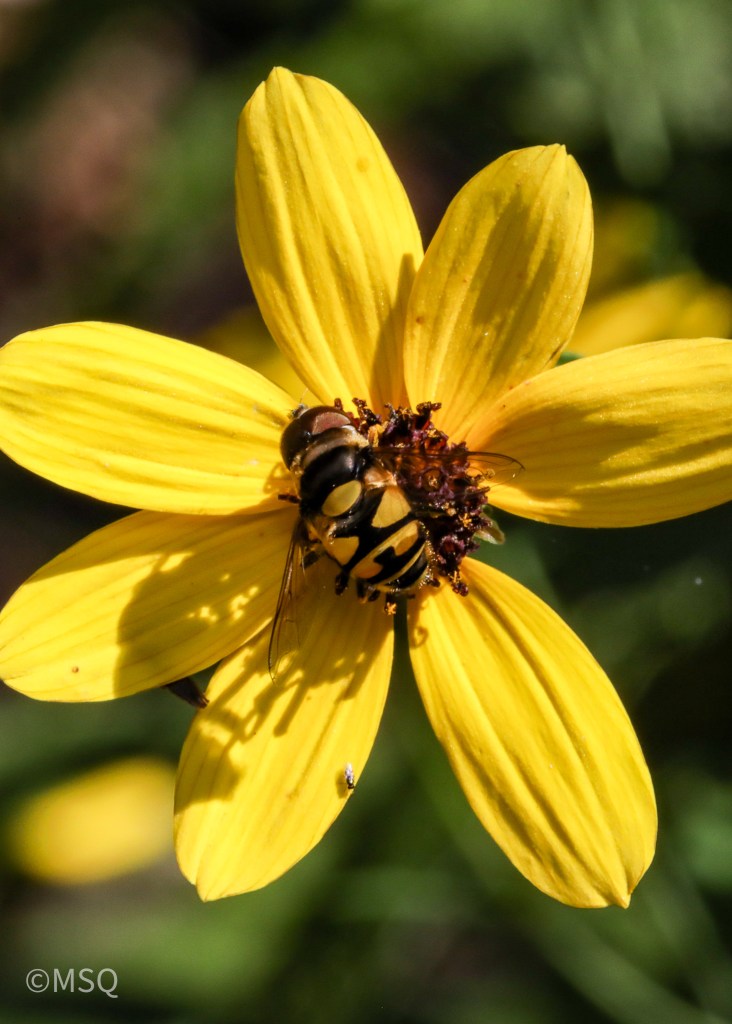
Flies also visit Tall Tickseed.  Syrphid flies, Bee flies and Tachinid flies feed on nectar from the flowers.  Both Syrphid flies and the Tachinid flies can be beneficial insects.

The Goldenrod Soldier Beetle (Chauliognathus pennsylvanicus), another beneficial insect, eats both pollen and nectar from the Coreopsis blooms.  Over its life cycle, the Soldier beetle also preys on soil-dwelling invertebrates, aphids, and other soft-bodied insects.2

Butterflies, moths, and skippers gather resources from Coreopsis tripteris.  Adults nectar at the flowers for summer and early fall fuel.  Various moths use it as a larval host.  The Dimorphic Gray Moth (Tornosscolopacinarius) consumes the leaves of the Tall Tickseed as a caterpillar.  Both the Wavy-lined Emerald Moth (Synchlora aerata), and Common Tan Wave Moth (Pleuroprucha insulsaria) eat the flowers.  The Wavy-lined Emerald larva, also called the Camouflage Looper, not only dines on the flowers but wears them.  The larva use silk to attach pieces of the flower petals to its body.  If it moves to a different type of flower, the caterpillar will change its ‘clothes’ to match its meal.  In addition, it also seems to change clothes frequently since the observed petals are always fresh!6

I hope you’ve enjoyed this exploration into Coreopsis tripteris!  If you have any comments or suggestions about the post, I would love to hear them!  Enjoy your holiday season!

Warm Regards,

Mary

References:

  1. No author, (n.d.) Our Vision and Our Mission, Mt. Cuba Center, https://mtcubacenter.org/about/mission/#:~:text=Our%20mission%20is%20to%20inspire,the%20habitats%20that%20sustain%20them.
  2. Hilty, J., (n.d.) Tall Coreopsis, illinoiswildflowers.info, https://www.illinoiswildflowers.info/prairie/plantx/tl_coreopsisx.htm
  3. Keystone Plants by Ecoregion, The National Wildlife Federation, https://www.nwf.org/Garden-for-Wildlife/About/Native-Plants/keystone-plants-by-ecoregion
  4. National Wildlife Federation, Gardening for Wildlife, Keystone Native Plants Eastern Temperate Forests – Ecoregion 8, https://www.nwf.org/-/media/Documents/PDFs/Garden-for-Wildlife/Keystone-Plants/NWF-GFW-keystone-plant-list-ecoregion-8-eastern-temperate-forests.ashx?la=en&hash=1E180E2E5F2B06EB9ADF28882353B3BC7B3B247D
  5. No auther, n.d., Coreopsis tripteris, Lady Bird Johnson Wildflower Center, https://www.wildflower.org/plants/result.php?id_plant=cotr4
  6. Bzdyk, K., (2013, July 1), Wavy-lined Emerald Moth:  Master of Disguise, Loudoun Wildlife Conservancy, https://loudounwildlife.org/2013/07/wavy-lined-emerald-moth-master-of-disguise/
Categories
Pollinator gardening

The Garden’s Super Station

Like lavender lace, the intricate flowers of Wild Bee Balm shimmer in the summer sun.  Wild Bee Balm (Monarda or Monarda fistulosa) lures bees, wasps, butterflies and more.  The flowers unfold in the garden for a full month and its light, grey-green leaves contrast with darker foliage.

Monarda thrives in Zones 3 to 9.  It is an excellent mid-garden plant growing from two to four feet tall.  It spreads two to three feet and a three-foot spacing is recommended. An extremely adaptable plant, Wild Bee Balm tolerates clay, chalk, loam, sand and alkaline to acid soils.  It blooms in full to part sun.  Monarda also tolerates heat, drought and Black Walnut trees and is deer and rabbit resistant.   It only really struggles when flooded although it accepts some in the winter.

The flower heads are held singly at the top of each stalk and can be white, pink, or lavender.  Lavender is most common.  Flower heads can be up to four inches across!   They open from the center/top to the edges.  The corolla of each floret divides into a tubular upper lip and a three part slender lower lip for a landing pad.  The stamens and the stigma eventually protrude from the upper lip.  The name fistulosa means tubular. Linnaeus named Monarda after Nicolas Bautista Monardes, 16th century physician and botanist.

Monarda is in the mint family and has the classic square stem found in mints.  Its leaves are aromatic, lanceolate, and toothed.  The frosted, grey-green leaves can grow to 4 inches long.  Wild Bee Balm has an erect, clump-forming habit.

Each plant has deep roots for feeding.  They use rhizomes to spread as well as seeds.  The rhizomes can survive bulldozers and other earth moving machine to pop up in unexpected places.  In natural areas, Wild Bee Balm grows on prairies, in dry, rocky woods, at the edges and in open areas of woods, in unplanted fields, along roads and railroads.

I hesitated a long time before adding Monarda to my garden.  I knew it had several challenges that weren’t easily solved.  High winds and heavy rain knock it over.  It needs support in an unprotected area especially with repeated thunderstorms.  All the Monardas are susceptible to powdery mildew.  Good drainage and air circulation may help reduce the mildew, but I’ve never been able to prevent it.  I developed a different strategy. I let my Wild Bee Balm flower and then cut it back by one-third to one-half.  Since it’s in the middle of the bed, other plants hide it.  The Monarda recovers and regrows fresh leaves.

Monarda also loves to spread.  The rhizomes creep past their beds onto paths and into other plants’ spaces.  Some of the seeds will sprout new colonies.  These plants aren’t hard to pull.  Again, I let them blossom.  When they’ve finished, I put what I don’t want and trim back the rest.

So why do I keep a plant that’s going to be a problem?  Because it’s an amazing pollinator plant!  The Xerces Society of Invertebrate Conservation recognized Monarda fistula as particularly attractive to native pollinators and included in their book 100 Plants to Feed the Bees (written by Eric Lee-Mäder, Jarrod Fowler, Jillian Vento, and Jennifer Hopwood).

What is the Xerces Society?  Xerces Society of Invertebrate Conservation is an international group that protects the natural world by protecting invertebrates and their habitat.  Xerces Society is for pollinators and insects what the Audubon Society is for birds.

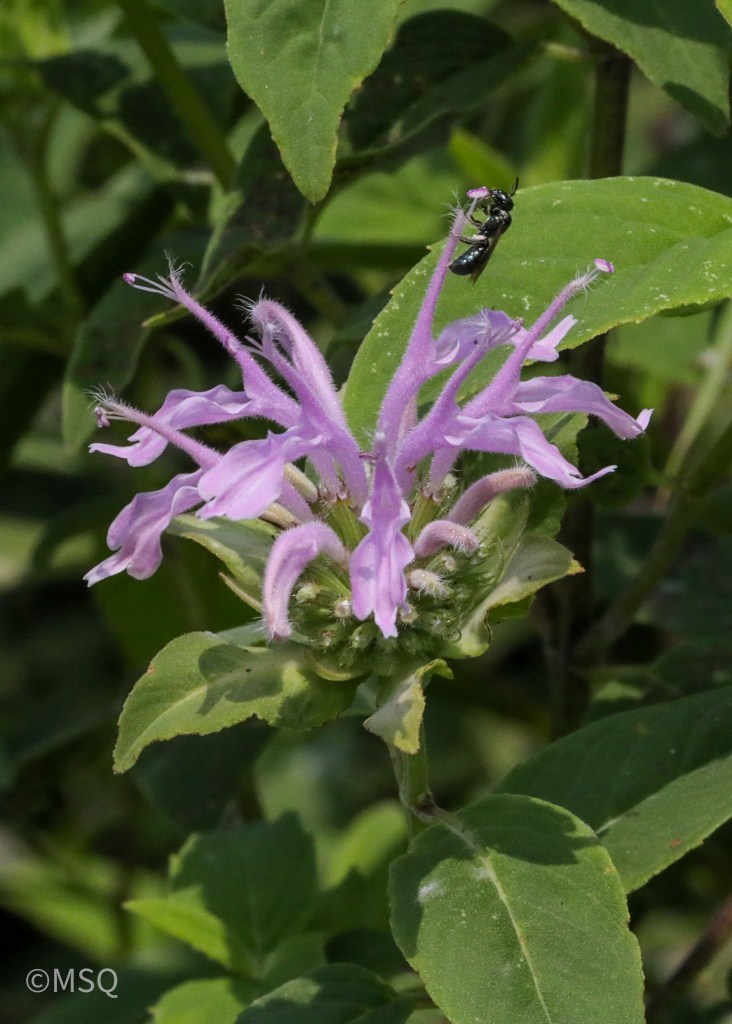
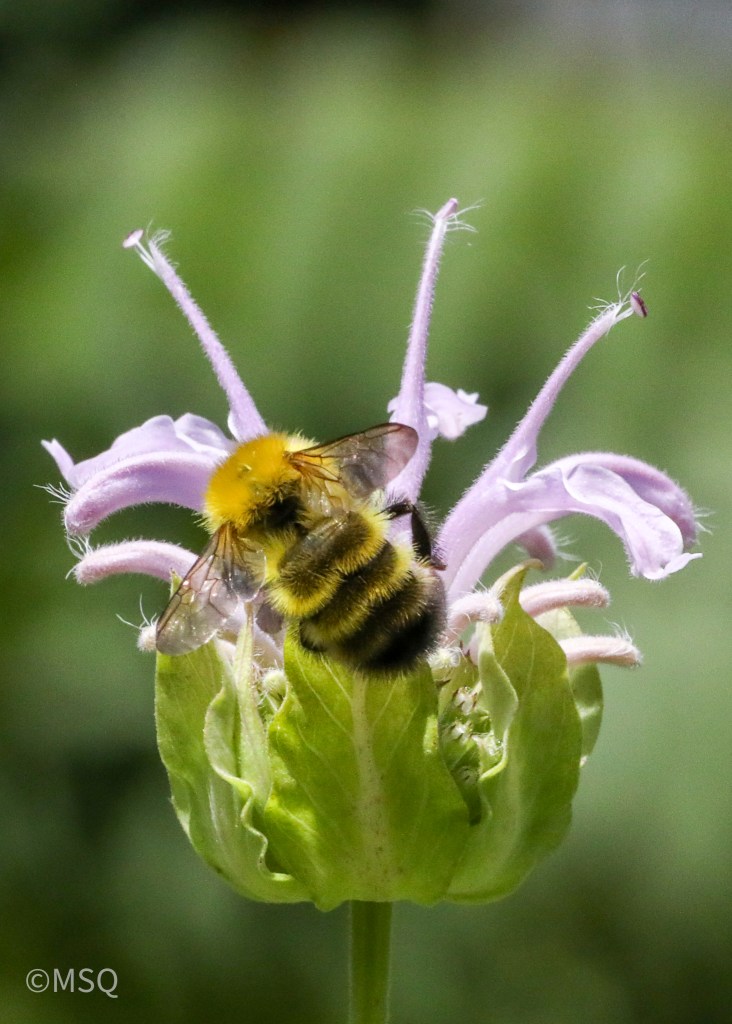
When in bloom, Monarda has a cloud of insects around it.  With the constant motion of small, medium, and large bees, it has been compared to a train station.  Butterflies, moths, and hummingbirds come and go, and wasps stop to refuel.

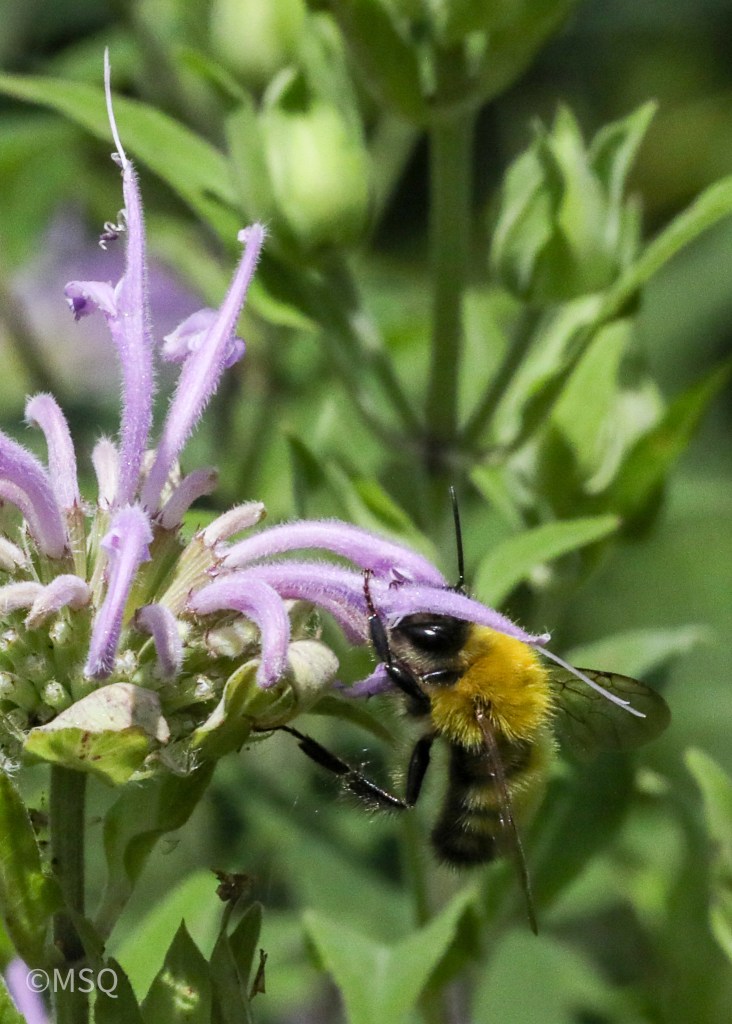
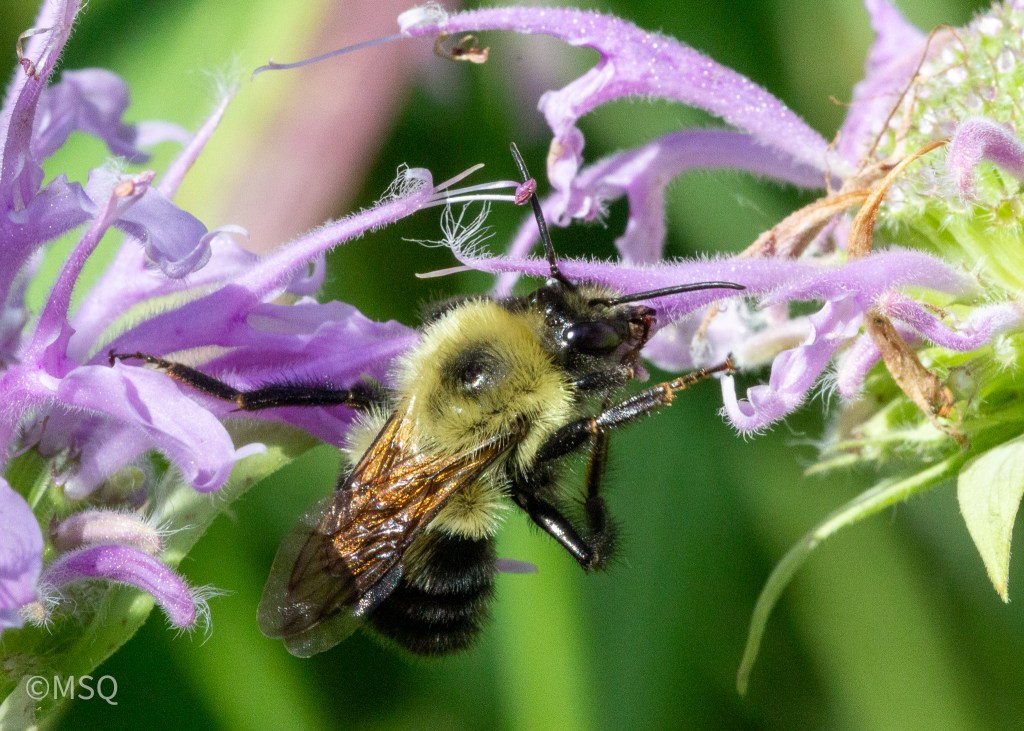
Bumblebees choose Monarda over other flowers.  When they find it, they work their way around the flower heads.  Hanging from each floret, bumblebees use their long tongues to reach the nectar reserves deep in the blooms. Wild Bee Balm has adapted its pollination behavior to bumblebees and the other bees that visit.  

The large bees, including bumblebees, avoid Monarda fistulosa’s anthers and stigmas when foraging for nectar.  They fly underneath them to sip nectar.  When they want pollen, these bees hover close to the flower and brush the anthers with their mid- and hind-legs. 

Monarda, for its part, opens only a few florets at a time.  It extends its anthers (male part) first before the stigma (female part).  Later, when the stigma lengthens and become fertile, the pollen is left by passing pollinators’ brushing against the stigma.  Individual floret nectar is only available until that floret is fertilized.  But the bees and other insects, don’t know which ones still contain nectar.  They must check all the florets until they find nectar.  In this way, Monarda entices them to move around the flower head and, all being well, leave pollen on the ripe stigmas.

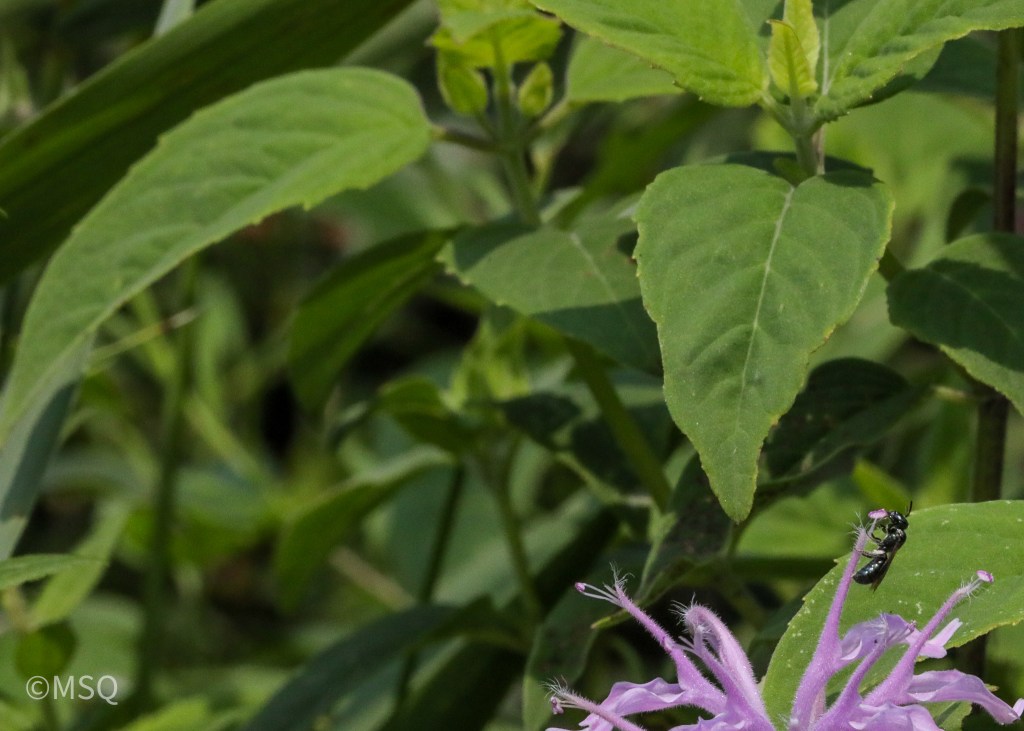
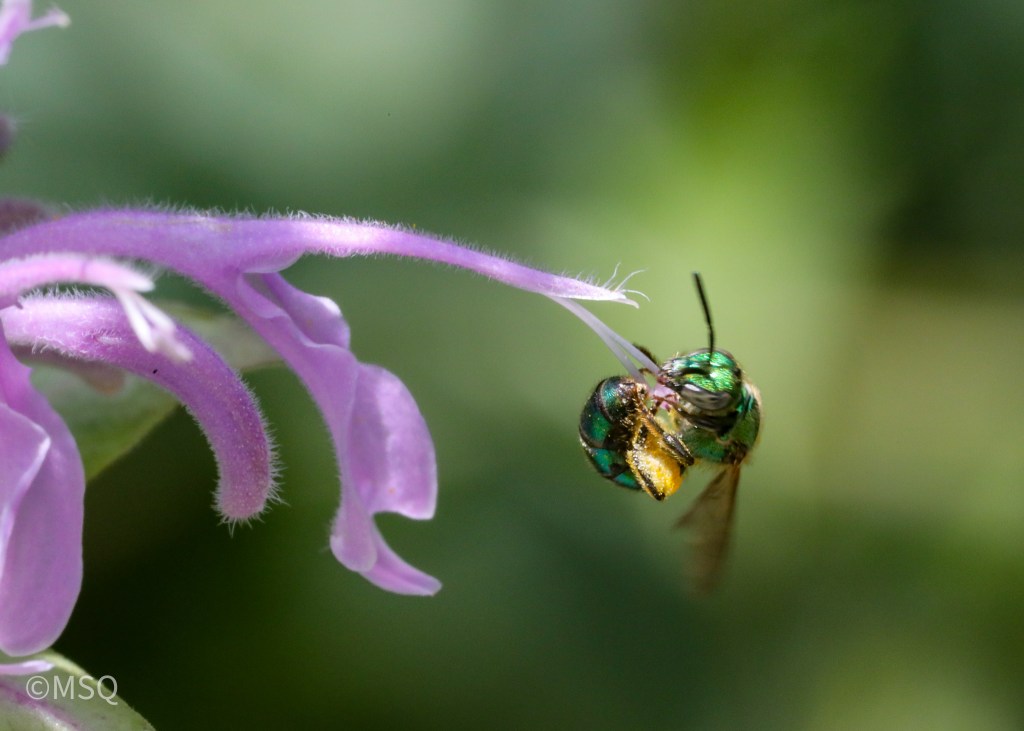
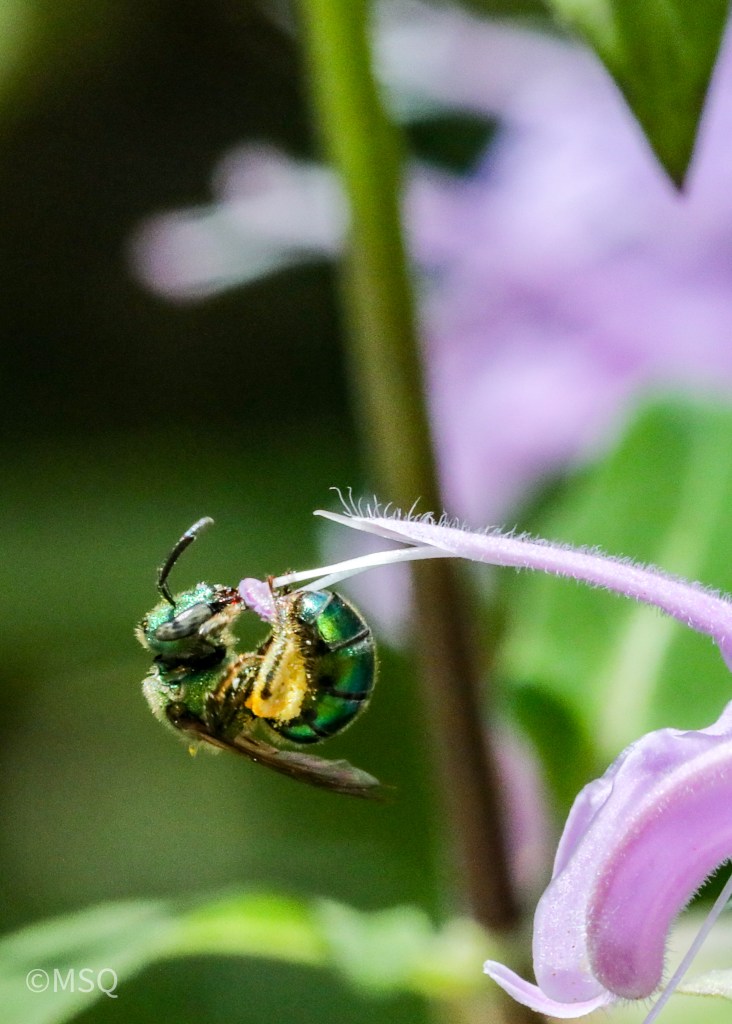
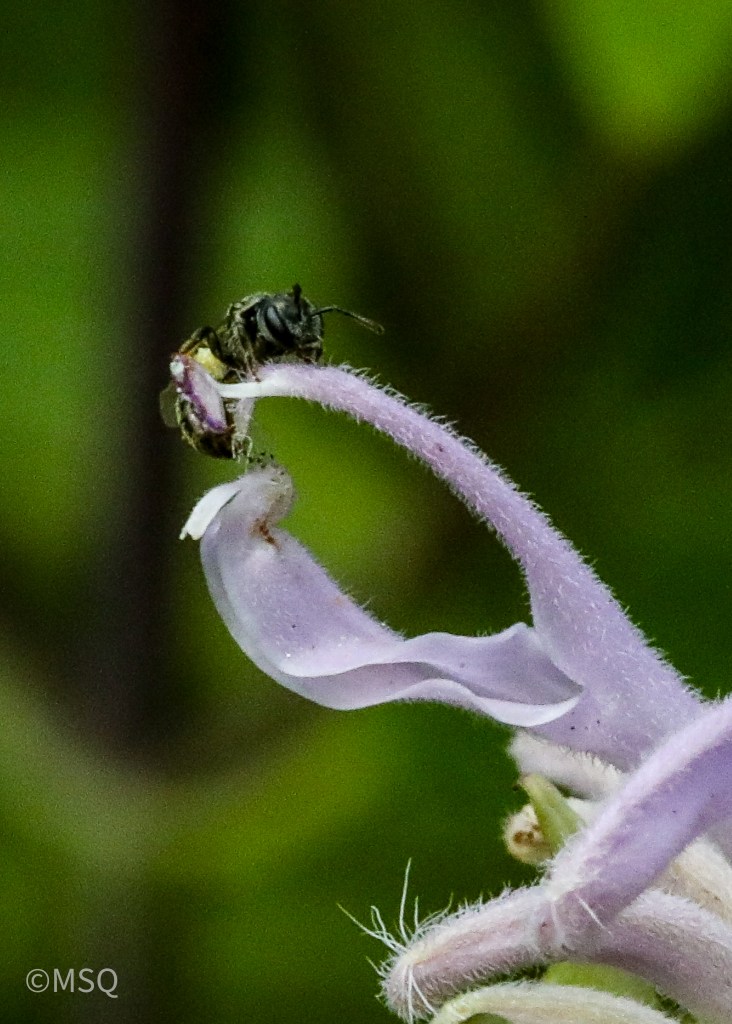
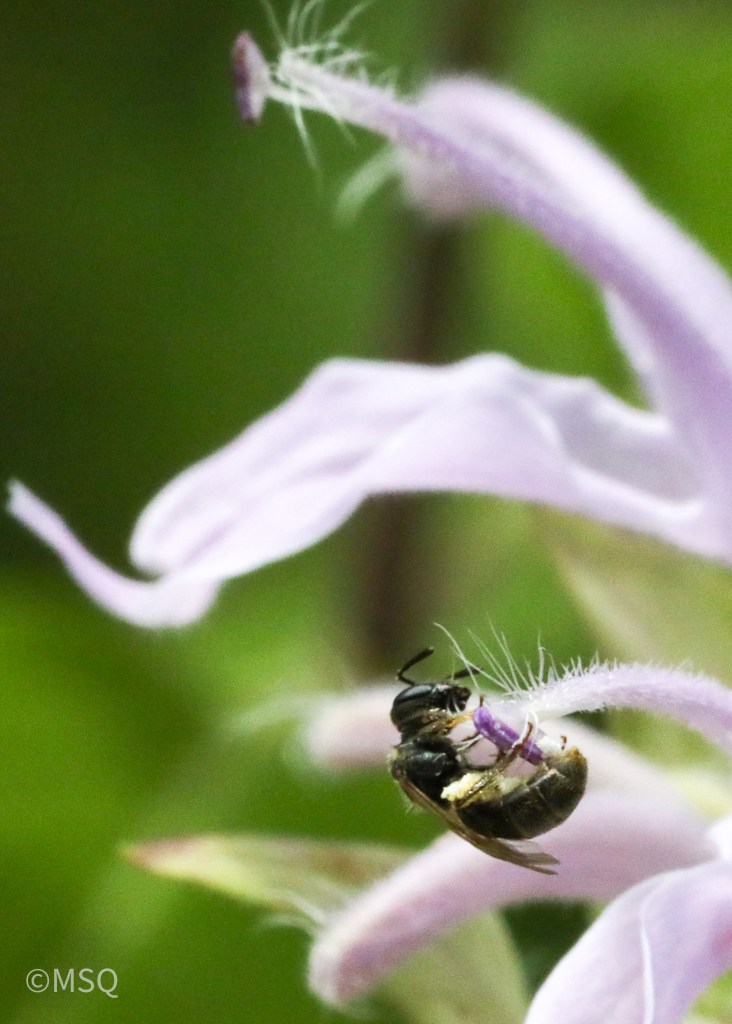
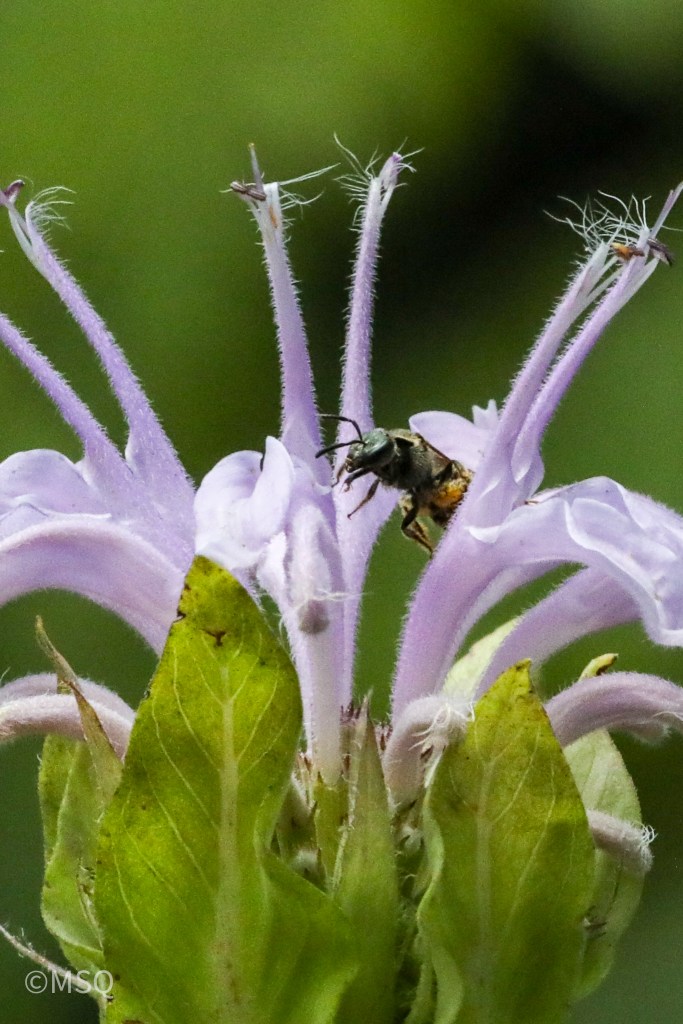
Medium and small sized bees forage on Monarda as a pollen source.  These medium bees include Anthophora, Megachile and Melissodes.  Lasioglossom and Halictus are two small bees that visit Monarda for pollen.  Monarda fistulosa  even has several specialist bees–Dufourea monardaePerdita gerhardi and Protandrena abdominalis.

Specialist bees visit only one or a very few types of the flowers.  This includes bees that forage on plants in only one family.

Wasps also use Wild Bee Balm for nectar.  Sand Wasps (Bicyrtes), Mason Wasps and the Great Black Wasp (Sphex pensylvanicus) all drink nectar from Monarda. They have short-tongues and can’t reach it like bumblebees.  The wasps chew a hole at the base of the tube and take nectar from there.  This is called nectar robbing and it bypasses the usual pollination routes.  Medium and small bees will occasionally drink from these holes.

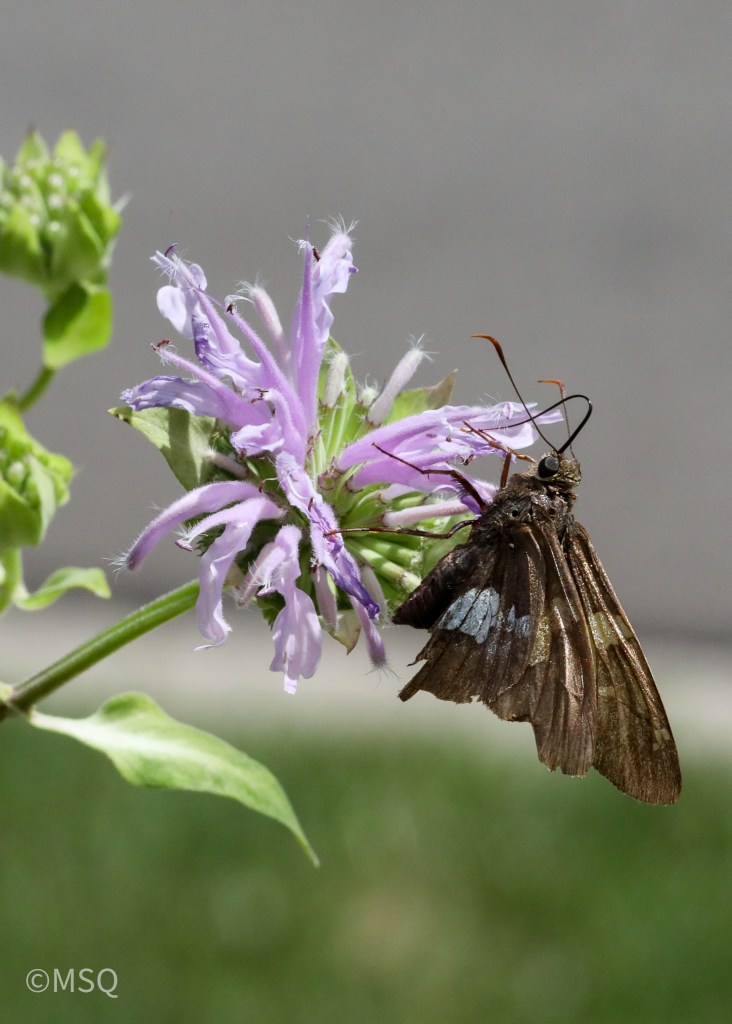
Butterflies, moths, and skippers forage for nectar at Monarda too.  The Xerces Society of Invertebrate Conservation suggests Monarda fistulosa in their Monarch Nectar Plant Guide – Midwest and for the other places it grows.  This is the Silver-Spotted Skipper, one of the most common skippers and a frequent visitor to my garden.  It’s impressive watching it maneuver its long proboscis into the Wild Bee Balm’s floret. 

Skippers are fascinating creatures!  Somewhere between a moth and a butterfly, they’re currently grouped with butterflies.  They have enormous round eyes and antennae that ending in clubs with hooks.  Some carry their wings together and raised like butterflies  The Silver-Spotted Skipper is one of these.  Others have folded wings at rest, looking like a colorful X-wing fighter.  Skippers have a rapid darting flight unlike the butterfly’s fluttering.  Some reach flight speeds of 30 mph.  They aren’t as colorful as the butterflies but usually have muted shades like moths.  They can have interesting patterns, reflective spots (like the Silver-Spotted) and include muted colors such as orange or pale blue.  Skippers fly day and night and many enjoy visiting the garden.  Keep a look out for them!

Monarda also serves as a larval host for several moths.  The Hermit Sphinx Moth Lintneria eremitus and Gray Marvel Moth caterpillars feed on Wild Bee Balm.  It also supports several mint moths including Orange Mint Moth Pyrausta orphisalis and Raspberry Pyrausta Moth P. signatalis.  We’re learning more and more about moths and their roles in the natural world.  Only a small fraction are pests.  They provide valuable food for songbirds, mammals, and other insects.  A study from the UK found that they visit more plants at night than bees do during the day.  Like bees, some moths focus on one plant species (“specialists”) while others forage on a variety of different plants (“generalists”).  (Fallon, Candace, “For the Love of Moths”, Web Blog Post, Xerces Blog, Xerces Society for Invertebrate Conservation, 14 July 2021)  Supporting moth reproduction in the garden, may be as important as supporting bees and other better known pollinators.

So, it turns out my initial concerns have disappeared in a flutter of wings!  Monarda’s role supporting insect life in all its phases is astonishing.  I just keep finding new creatures in the Wild Bee Balm bed.

Do you have Monarda in your garden? Please send me your stories and any thoughts on the blog. I’d love to hear about it!

Happy Gardening!

Mary

Categories
native plants Pollinator gardening

THE GARDEN BY CANDLELIGHT

Okay, not actual candlelight, but the ethereal candelabra blooms of Veronicastrum virginicum, Culver’s Root.  This striking, upright plant provides a strong vertical accent in any garden.  It’s long, tapered flower spikes attract pollinators of all kinds while dark green whorls of leaves provide plenty of visual interest.

Growing in zones 3 to 8, this plant stretches from four to seven feet and spreads between two to four feet.  Culver’s Root grows in medium to wet, well-drained soils.  It tolerates standing water for a short time and thrives in rain gardens.  Culver’s Root accepts full sun to light shade and is suited to growing at the woodland’s edge.  In very warm zones, it enjoys afternoon shade.  

Culver’s Root’s flowers unfold slowly in mid to late summer.  Here in zone 5b, it starts in mid-July and continues to the end of August.  You can deadhead to encourage rebloom.  

The flower color varies slightly with the location.  Primarily white, the blooms can have tones of very pale pink, lavender or blue.  The blossoms are most often described as candelabra-like with four or more in a whorl at the top of each stem.  In mature plants, flower spikes can be 8” in length!  

Culver’s Root tends to flop without support especially in shadier areas.  I’ve used a peony ring with internal supports.  The deer have also trimmed my plant in mid-June by about one-third to one-half.  The pruning helped and more flowers formed at each cut.  Culver’s Root won’t grow to full height after being cut back. 

Its leaf structure is unusual and offers a contrast to surrounding plants.  The leaves are whorled in groups of three to seven.  Each leaf is lance shaped with slight serrations and attached directly to the stem (sessile) or nearly so.  They can be up to 6” long and 1.5” wide.  The long stems and whorled leaves give the plant an upright, medium texture.  Culver’s Root is not aggressive although it can self-seed.  Some good companion plants include blazing star, monarda, milkweed, rattlesnake master, goldenrod, and asters.

V. virginicum has successfully entered the world of horticulture and numerous nativars exist.  These nativars have been bred to prevent flopping and to bring more color to the flowers.  Some are more compact to fit in small gardens.  Here is a sampling of what’s available:  ‘Fascination’, 5’ tall, 2’ width, lavender bloom, ‘Red Arrow’, 3-4’ tall, 2-3’ width, purple bloom, ‘Album’, 3-4’ tall, 3-4’ width, white bloom, and ‘Cupid’, 2-3’ tall, 1-2’ width, purple.  Like the native plant, all these nativars can grow in zones 3 to 8. 

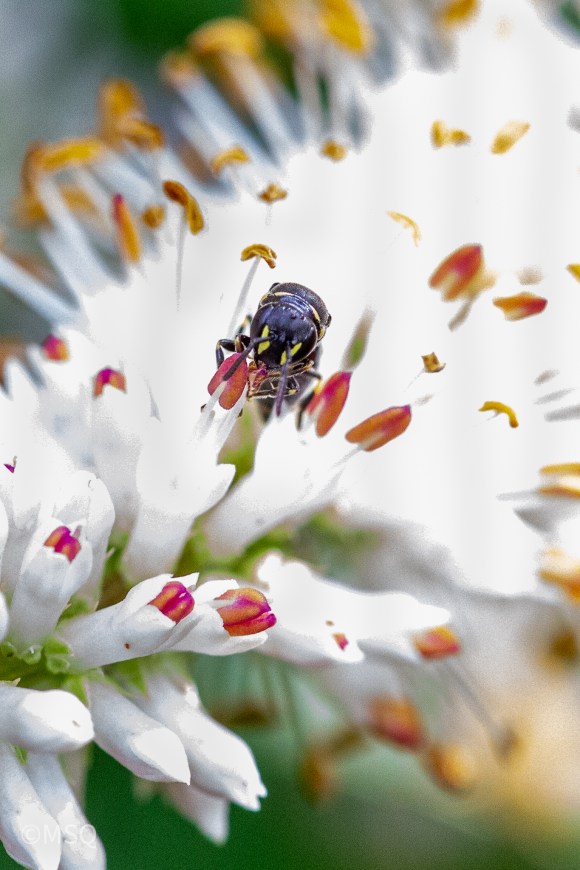
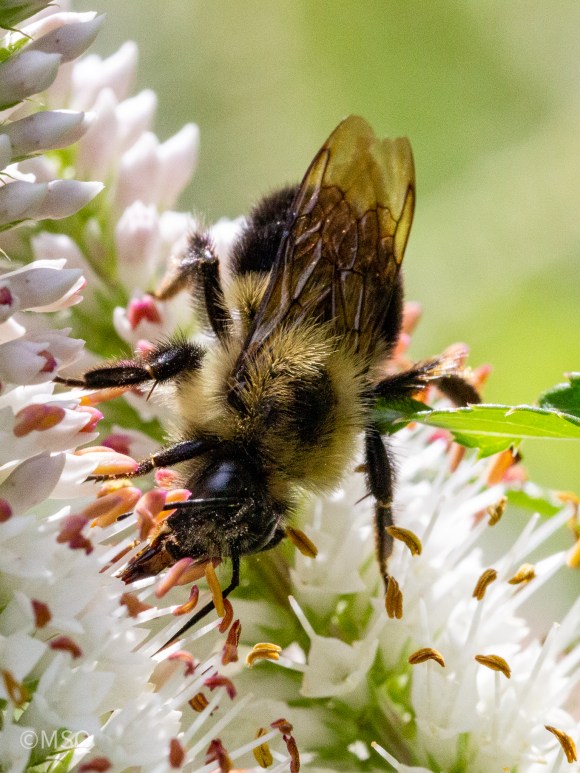
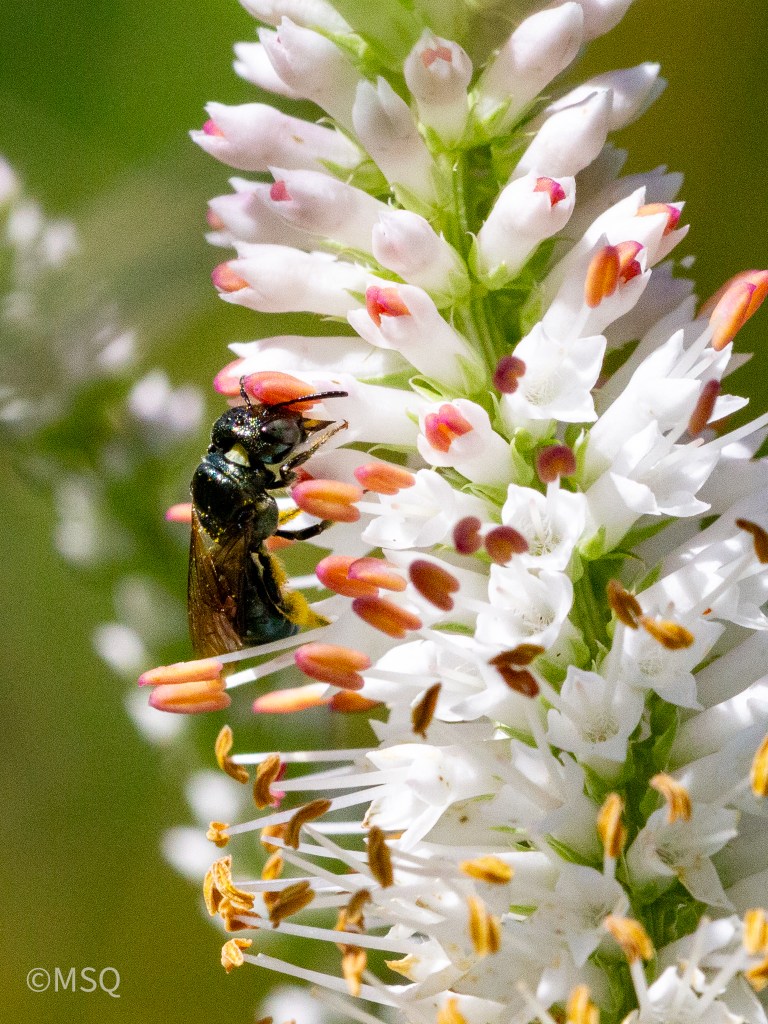
Culver’s Root feeds native bees, honeybees, and beneficial insects.  A range of native bees visit it including short and long tongued bees.  V. virginicum begins bloom by protruding its anthers outside the bud.  Small bees take advantage of this by collecting pollen. These pollinators include Hylaeus (yellow-faced bees).

Hylaeus or yellow-faced bees are one of the most recognizable small bees.  Mostly black, they have yellow or white markings on their faces.  These marking make them identifiable as Hylaeus although species determination can be tricky.  Yellow-faced bees grow from 5 mm (0.2”) to 7 mm (0.27”).  They nest in existing hollow cavities primarily in hollow stems or holes in wood. Some have been known to nest in stone.  Hylaeus line their nests with a silk or cellophane-like substance produced by the salivary gland.  The bee uses her bilobed tongue to paint on the secretions.  The lining is waterproof and protects the young from bacteria.  Chewed stem pith mixed with saliva is used for cell divisions and salivary gland secretions seal the completed nest.

One fascinating fact, yellow-faced bees are practically hairless.  Hylaeus don’t have any scopa or specialized hairs dedicated to holding pollen like other bees.  They also have short tongues and so can’t reach deeply into flowers.  These bees use their slender bodies to work their way into flowers to reach nectar and pollen.  They also chew on anthers to extract pollen.  Then Hylaeus swallow the nectar and pollen and hold it in their crop.  The crop is a sac separate from the stomach.  This fluid mixture is regurgitated and left for the larva to eat. 

Another fun fact, yellow-faced bees occur all over the world.  However, Hawaii is known for having 63 different species.  The yellow-faced bee is the only bee native there.  All the species found there are unique to Hawaii.

Lasioglossum (small sweat bees) visit Culver’s root and collect pollen and nectar. They use the hair or scopae on the hind femur and tibia to hold the pollen as well as the bottom of their abdomen.

Once the flowers opens larger visitor arrive including bumblebees (Bombus)

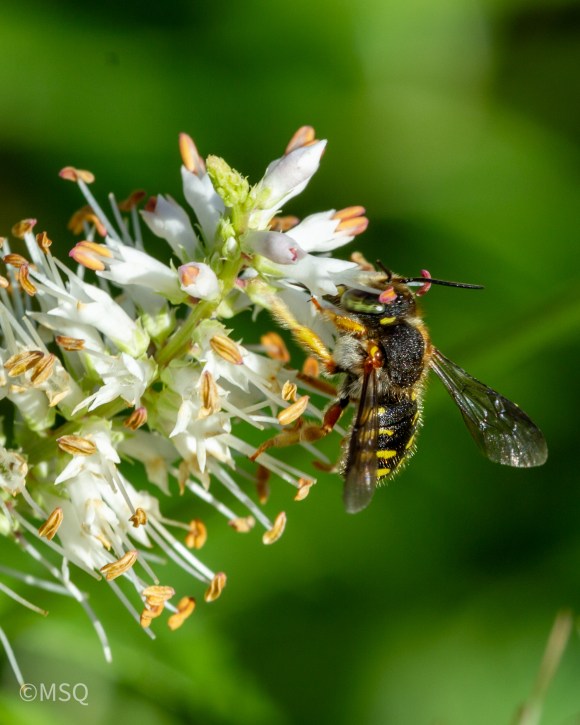
and Leaf-Cutter bees (Megachile)

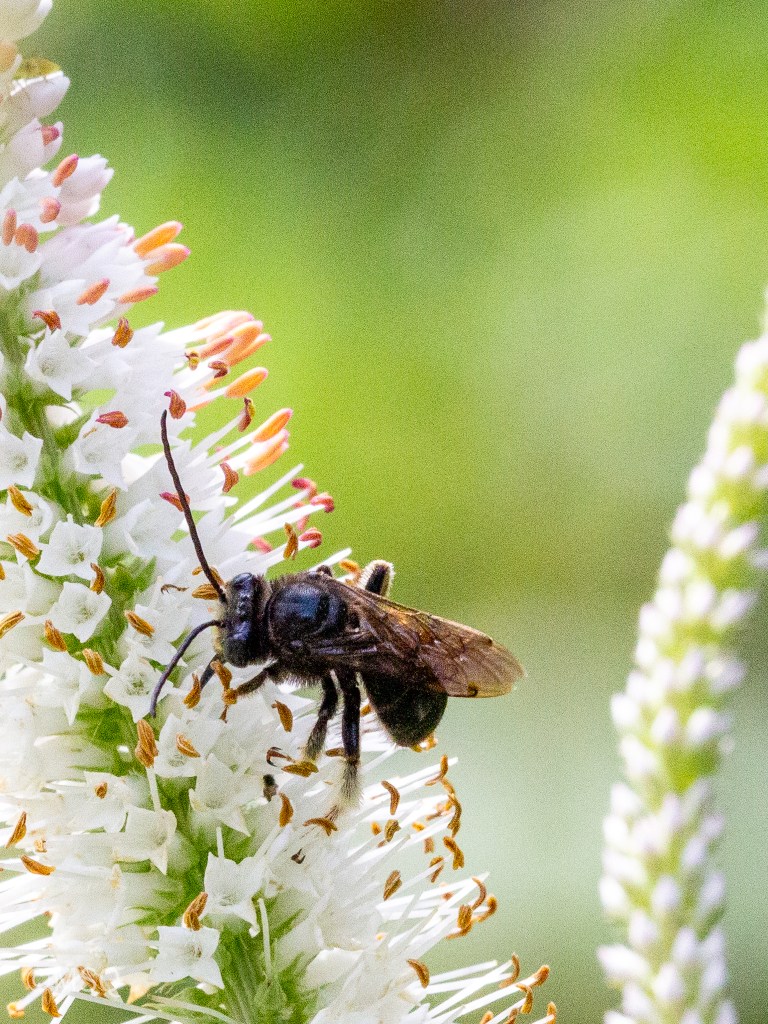
and Long Horned bees (Melissodes). 

Mason bees (Osmia) stop at V. virginicum to collect resources.

Large and small carpenter bees (Xylocopa and Ceratina) also gather nectar and pollen from Culver’s Root.  

This is also a plant for beekeepers.  Honeybees enjoy V. virginicum when they can find it.  I’ve often seen them gathering nectar from this plant in my garden.

                                                    ­

The sphecid and the potter wasps also benefit from the flowers.  They gather nectar to support them while building and filling their nests. I often see the thread-waisted Mexican Grass-carrying wasp (discussed in “White Goes With Everything”, https://wildthingsinthe.garden/2023/05/31/white-goes-with-everything/) on this plant.

These groups of scary insects look nothing like our sweet fluffy bumblebees.  Sphecid wasps resemble nightmare creations with bizarre tiny waists, long thin legs, and triangular heads.  The vespid wasps, which include the potter wasp Eumenes fraternas, can resemble sphecid wasps.   Sadly, they can also look like yellowjackets, hornets and paper wasps who share their family.  Yet when I meet these wasps in the garden, they’re gentle and shy.  

Today, let’s talk about Eumenes fraternas. This wasp is in Vespidae family, subfamily Eumeninae, also called potter and mason wasps.  Eumenes fraternas is a potter wasp that regularly visits the Culver’s root in my garden.  She creates her nest using soil and water.  This wasp collects, mixes, and shapes her mud until she completes a small pot with a flared rim.  The nest is built on a large leaf, sturdy stem, or a home/structure.

Then, the wasp lays a single egg fastening it to the top of the pot with a silk-like thread.  The nest pot is provisioned with several caterpillars.  E. fraternas preys on cankerworms or inchworms.  The potter wasps frequently hunt moth larva in the Geometridae family.  Geometer caterpillars are often pests of native trees eating large amounts of leaves, in some cases, stripping them.

Like other solitary pollinators,  E. fraternas is entirely responsible for her eggs.  It is in her best interest not to sting.  I have found these solitary wasps to be quite cautious.  This holds true for the thread-waisted wasps in my garden and the Mexican Grass-carrying wasp.  If I bump a plant, they’ll fly away while bumblebees persistently keep feeding.  Still, they can sting if handle roughly.

Thank you so much for joining me!  I hope you enjoyed reading about Veronicastrum virginicum, Culver’s root, and consider adding it to your garden. Please let me know what you think of the post and tell me what’s going on it your garden by leaving a comment!

Many Thanks!

Mary