Like lavender lace, the intricate flowers of Wild Bee Balm shimmer in the summer sun. Wild Bee Balm (Monarda or Monarda fistulosa) lures bees, wasps, butterflies and more. The flowers unfold in the garden for a full month and its light, grey-green leaves contrast with darker foliage.
Monarda thrives in Zones 3 to 9. It is an excellent mid-garden plant growing from two to four feet tall. It spreads two to three feet and a three-foot spacing is recommended. An extremely adaptable plant, Wild Bee Balm tolerates clay, chalk, loam, sand and alkaline to acid soils. It blooms in full to part sun. Monarda also tolerates heat, drought and Black Walnut trees and is deer and rabbit resistant. It only really struggles when flooded although it accepts some in the winter.
The flower heads are held singly at the top of each stalk and can be white, pink, or lavender. Lavender is most common. Flower heads can be up to four inches across! They open from the center/top to the edges. The corolla of each floret divides into a tubular upper lip and a three part slender lower lip for a landing pad. The stamens and the stigma eventually protrude from the upper lip. The name fistulosa means tubular. Linnaeus named Monarda after Nicolas Bautista Monardes, 16th century physician and botanist.
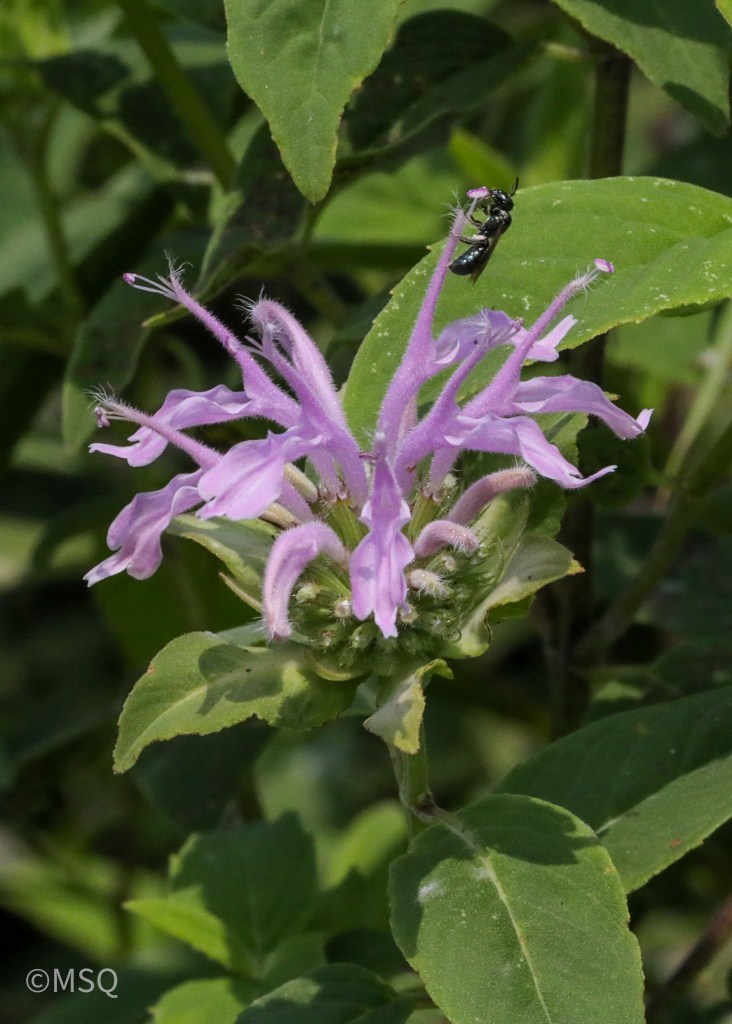
Monarda is in the mint family and has the classic square stem found in mints. Its leaves are aromatic, lanceolate, and toothed. The frosted, grey-green leaves can grow to 4 inches long. Wild Bee Balm has an erect, clump-forming habit.
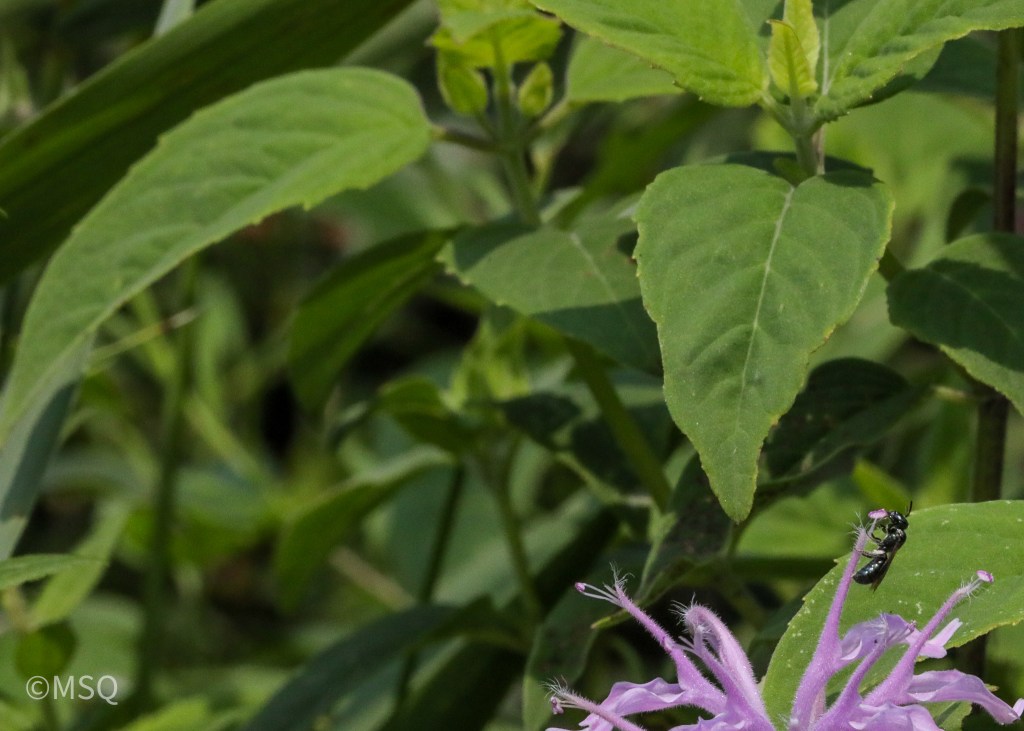
Each plant has deep roots for feeding. They use rhizomes to spread as well as seeds. The rhizomes can survive bulldozers and other earth moving machine to pop up in unexpected places. In natural areas, Wild Bee Balm grows on prairies, in dry, rocky woods, at the edges and in open areas of woods, in unplanted fields, along roads and railroads.
I hesitated a long time before adding Monarda to my garden. I knew it had several challenges that weren’t easily solved. High winds and heavy rain knock it over. It needs support in an unprotected area especially with repeated thunderstorms. All the Monardas are susceptible to powdery mildew. Good drainage and air circulation may help reduce the mildew, but I’ve never been able to prevent it. I developed a different strategy. I let my Wild Bee Balm flower and then cut it back by one-third to one-half. Since it’s in the middle of the bed, other plants hide it. The Monarda recovers and regrows fresh leaves.
Monarda also loves to spread. The rhizomes creep past their beds onto paths and into other plants’ spaces. Some of the seeds will sprout new colonies. These plants aren’t hard to pull. Again, I let them blossom. When they’ve finished, I put what I don’t want and trim back the rest.
So why do I keep a plant that’s going to be a problem? Because it’s an amazing pollinator plant! The Xerces Society of Invertebrate Conservation recognized Monarda fistula as particularly attractive to native pollinators and included in their book 100 Plants to Feed the Bees (written by Eric Lee-Mäder, Jarrod Fowler, Jillian Vento, and Jennifer Hopwood).
What is the Xerces Society? Xerces Society of Invertebrate Conservation is an international group that protects the natural world by protecting invertebrates and their habitat. Xerces Society is for pollinators and insects what the Audubon Society is for birds.
When in bloom, Monarda has a cloud of insects around it. With the constant motion of small, medium, and large bees, it has been compared to a train station. Butterflies, moths, and hummingbirds come and go, and wasps stop to refuel.
Bumblebees choose Monarda over other flowers. When they find it, they work their way around the flower heads. Hanging from each floret, bumblebees use their long tongues to reach the nectar reserves deep in the blooms. Wild Bee Balm has adapted its pollination behavior to bumblebees and the other bees that visit.
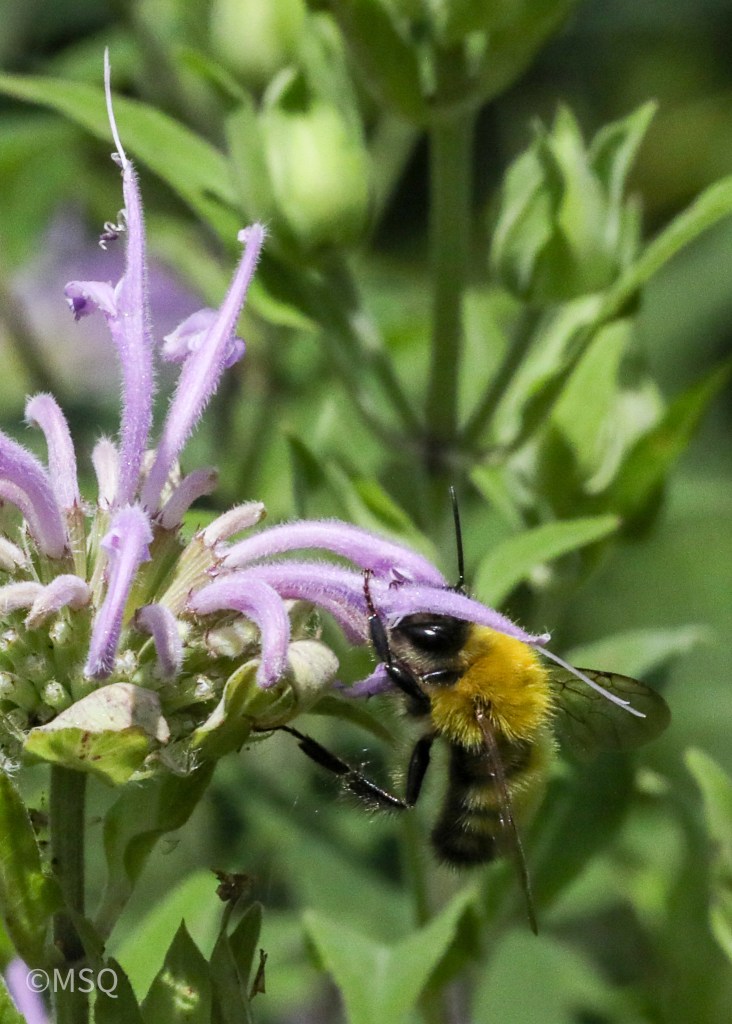
The large bees, including bumblebees, avoid Monarda fistulosa’s anthers and stigmas when foraging for nectar. They fly underneath them to sip nectar. When they want pollen, these bees hover close to the flower and brush the anthers with their mid- and hind-legs.
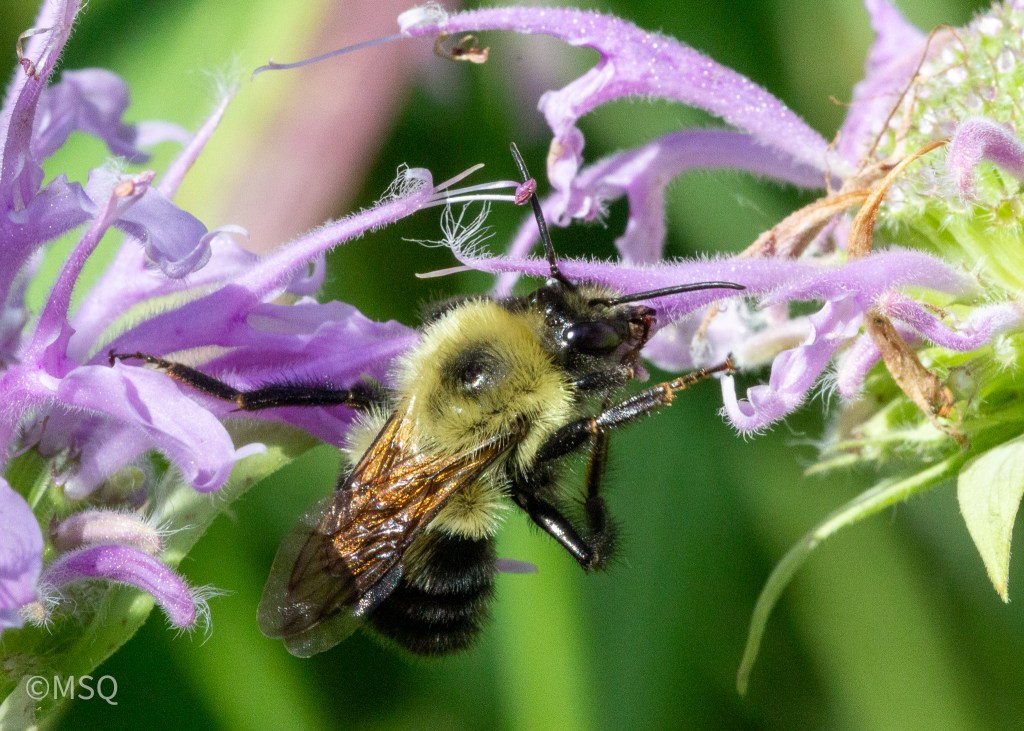
Monarda, for its part, opens only a few florets at a time. It extends its anthers (male part) first before the stigma (female part). Later, when the stigma lengthens and become fertile, the pollen is left by passing pollinators’ brushing against the stigma. Individual floret nectar is only available until that floret is fertilized. But the bees and other insects, don’t know which ones still contain nectar. They must check all the florets until they find nectar. In this way, Monarda entices them to move around the flower head and, all being well, leave pollen on the ripe stigmas.
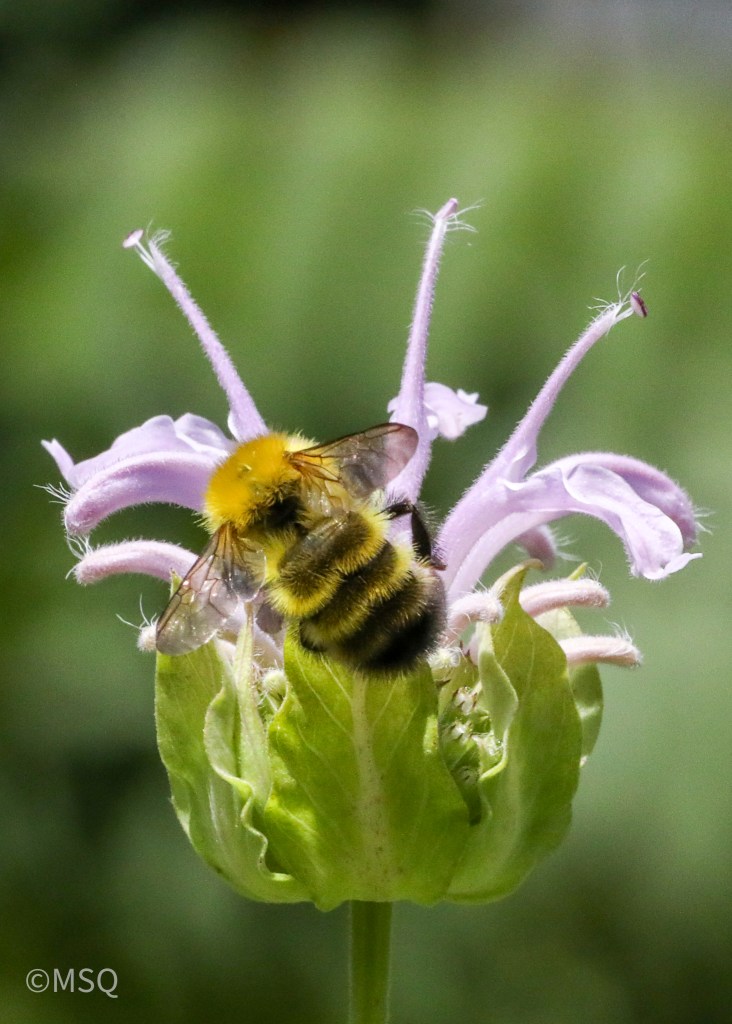
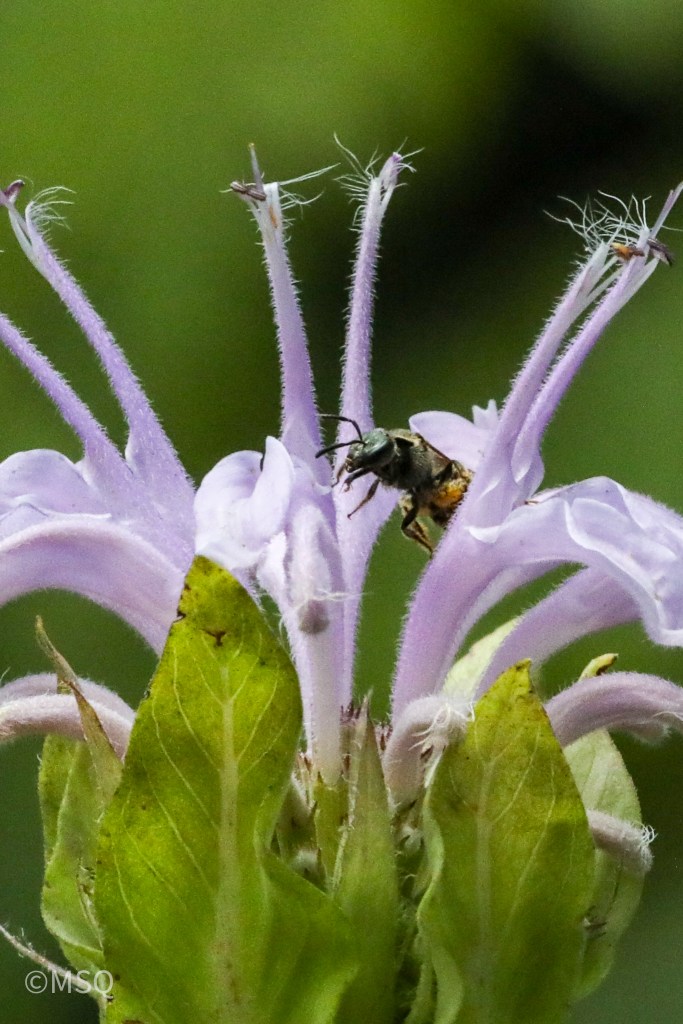
Medium and small sized bees forage on Monarda as a pollen source. These medium bees include Anthophora, Megachile and Melissodes. Lasioglossom and Halictus are two small bees that visit Monarda for pollen. Monarda fistulosa even has several specialist bees–Dufourea monardae, Perdita gerhardi and Protandrena abdominalis.
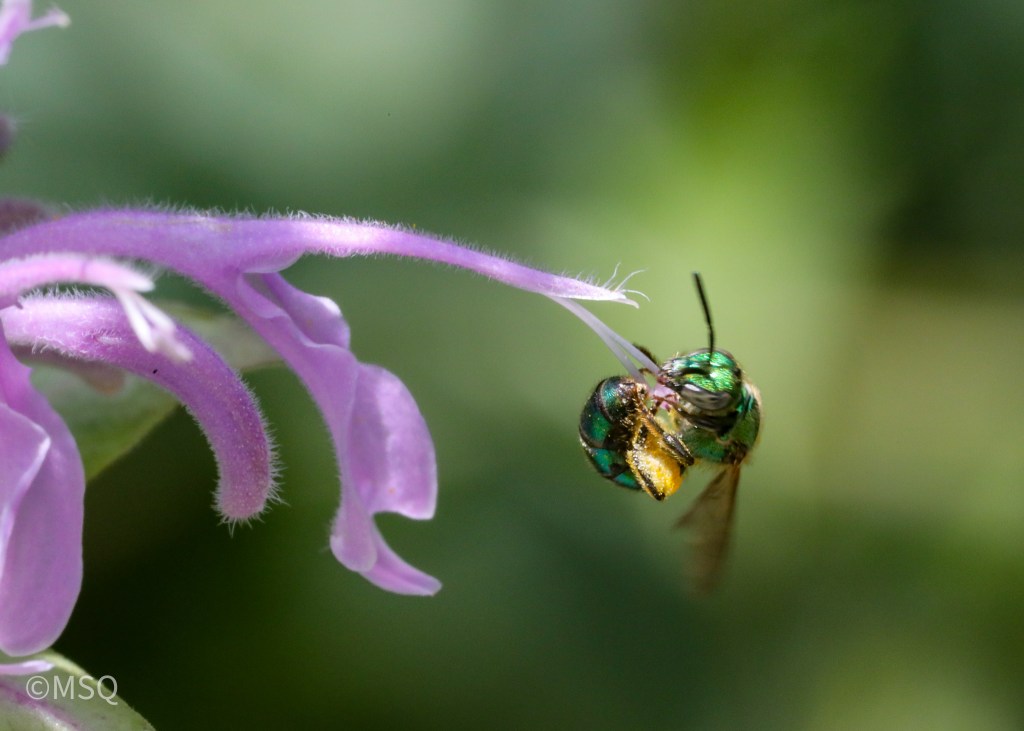
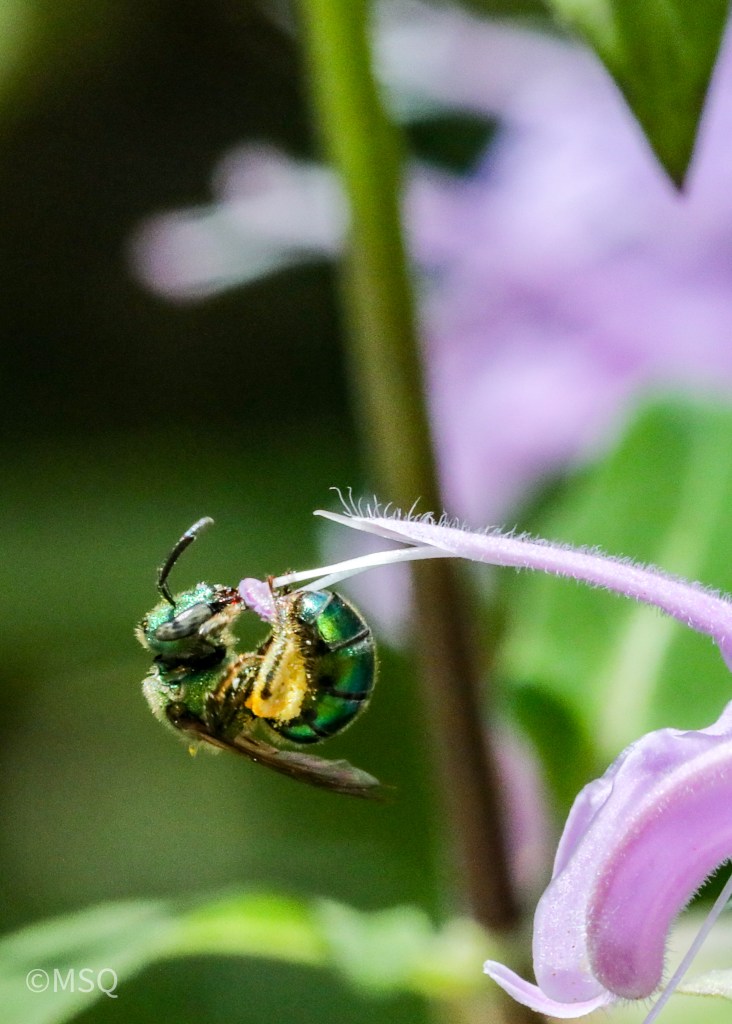
Specialist bees visit only one or a very few types of the flowers. This includes bees that forage on plants in only one family.
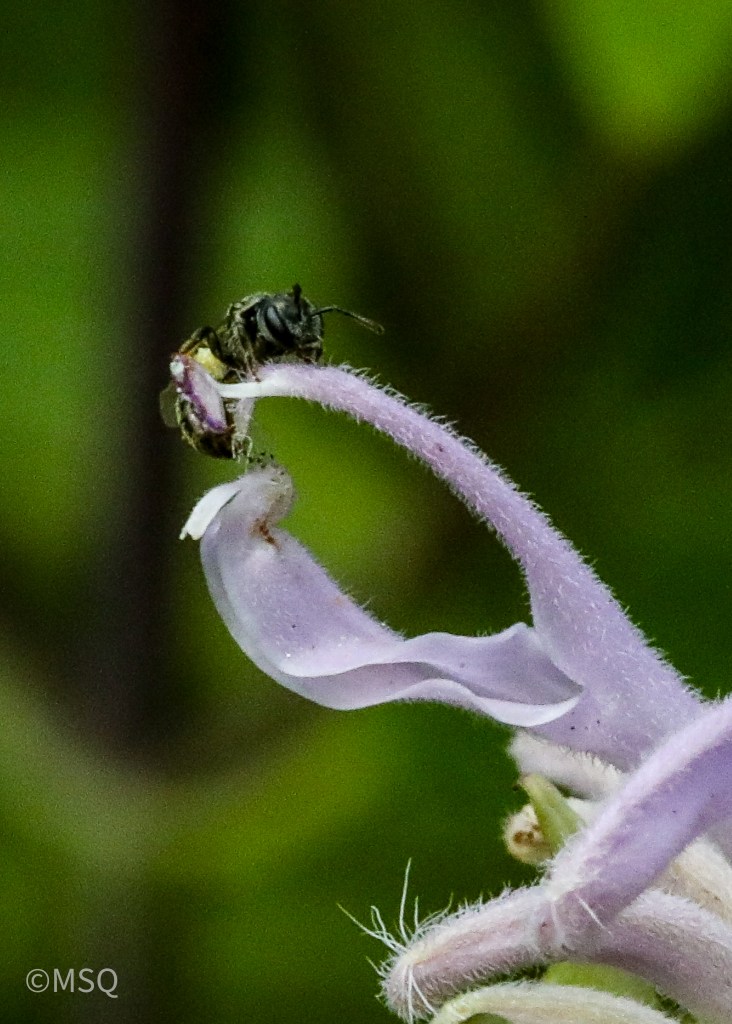
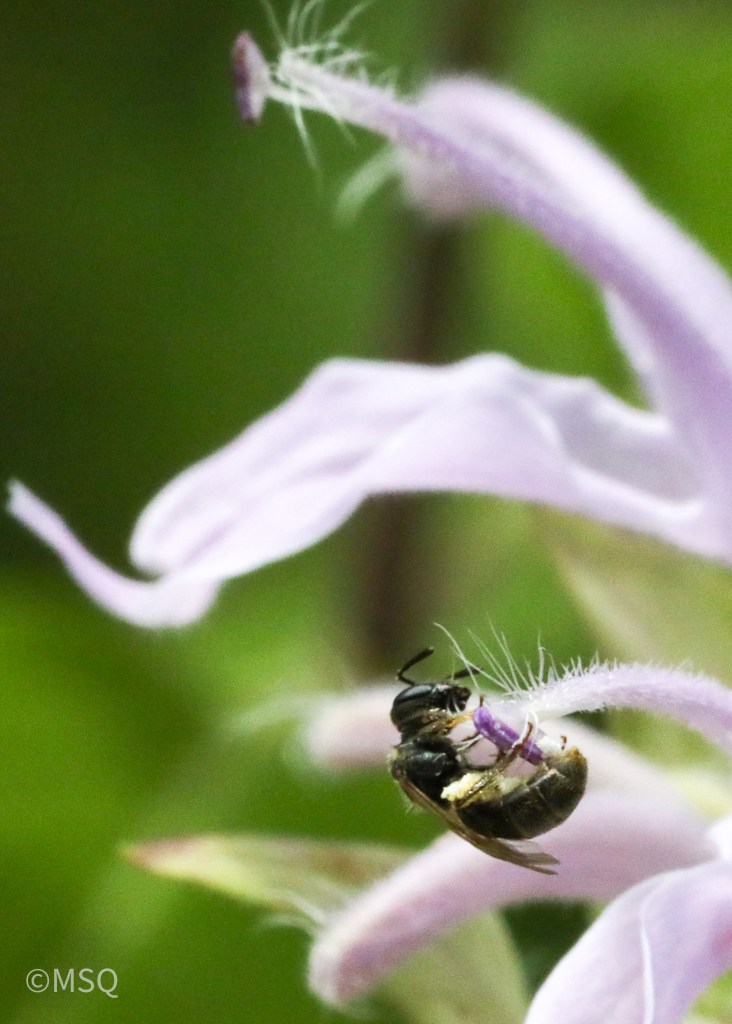
Wasps also use Wild Bee Balm for nectar. Sand Wasps (Bicyrtes), Mason Wasps and the Great Black Wasp (Sphex pensylvanicus) all drink nectar from Monarda. They have short-tongues and can’t reach it like bumblebees. The wasps chew a hole at the base of the tube and take nectar from there. This is called nectar robbing and it bypasses the usual pollination routes. Medium and small bees will occasionally drink from these holes.

Butterflies, moths, and skippers forage for nectar at Monarda too. The Xerces Society of Invertebrate Conservation suggests Monarda fistulosa in their Monarch Nectar Plant Guide – Midwest and for the other places it grows. This is the Silver-Spotted Skipper, one of the most common skippers and a frequent visitor to my garden. It’s impressive watching it maneuver its long proboscis into the Wild Bee Balm’s floret.
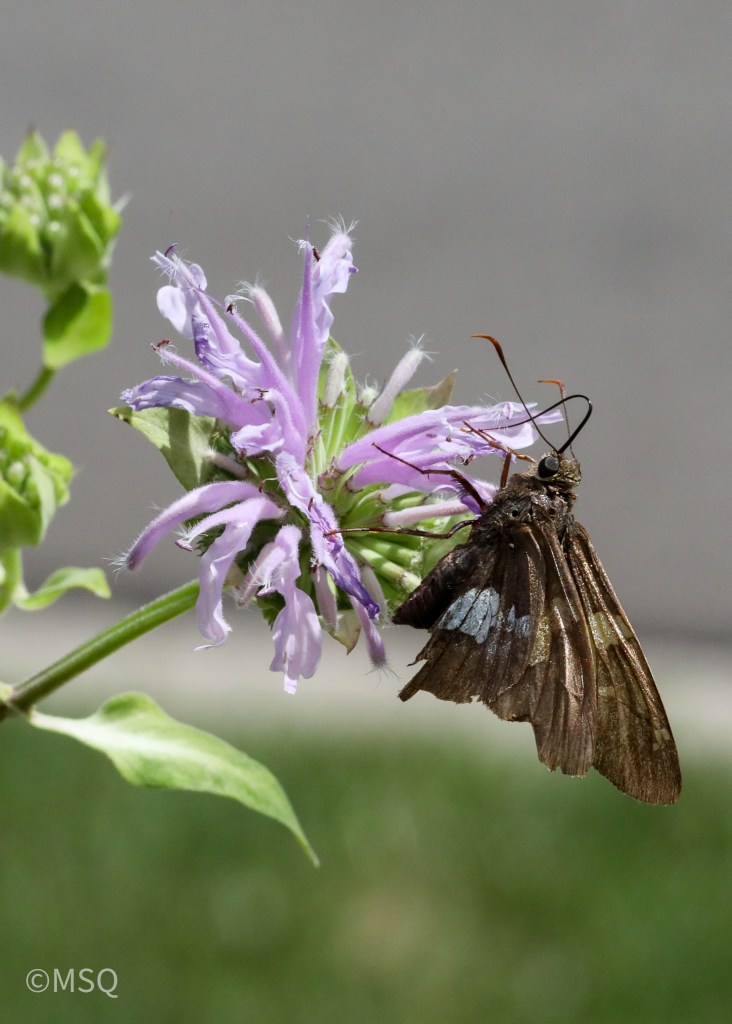
Skippers are fascinating creatures! Somewhere between a moth and a butterfly, they’re currently grouped with butterflies. They have enormous round eyes and antennae that ending in clubs with hooks. Some carry their wings together and raised like butterflies The Silver-Spotted Skipper is one of these. Others have folded wings at rest, looking like a colorful X-wing fighter. Skippers have a rapid darting flight unlike the butterfly’s fluttering. Some reach flight speeds of 30 mph. They aren’t as colorful as the butterflies but usually have muted shades like moths. They can have interesting patterns, reflective spots (like the Silver-Spotted) and include muted colors such as orange or pale blue. Skippers fly day and night and many enjoy visiting the garden. Keep a look out for them!


Monarda also serves as a larval host for several moths. The Hermit Sphinx Moth Lintneria eremitus and Gray Marvel Moth caterpillars feed on Wild Bee Balm. It also supports several mint moths including Orange Mint Moth Pyrausta orphisalis and Raspberry Pyrausta Moth P. signatalis. We’re learning more and more about moths and their roles in the natural world. Only a small fraction are pests. They provide valuable food for songbirds, mammals, and other insects. A study from the UK found that they visit more plants at night than bees do during the day. Like bees, some moths focus on one plant species (“specialists”) while others forage on a variety of different plants (“generalists”). (Fallon, Candace, “For the Love of Moths”, Web Blog Post, Xerces Blog, Xerces Society for Invertebrate Conservation, 14 July 2021) Supporting moth reproduction in the garden, may be as important as supporting bees and other better known pollinators.
So, it turns out my initial concerns have disappeared in a flutter of wings! Monarda’s role supporting insect life in all its phases is astonishing. I just keep finding new creatures in the Wild Bee Balm bed.
Do you have Monarda in your garden? Please send me your stories and any thoughts on the blog. I’d love to hear about it!
Happy Gardening!
Mary
 Wild Things in the Garden