Clouds of beneficial wasps and small bees swarm the crown of tiny, white flowers. Flowerheads rise on stalks up to nine feet tall offering stunning vertical accents in the garden. This is Arnoglossum atriplicifolium one of several Arnoglossums native to Eastern North America.
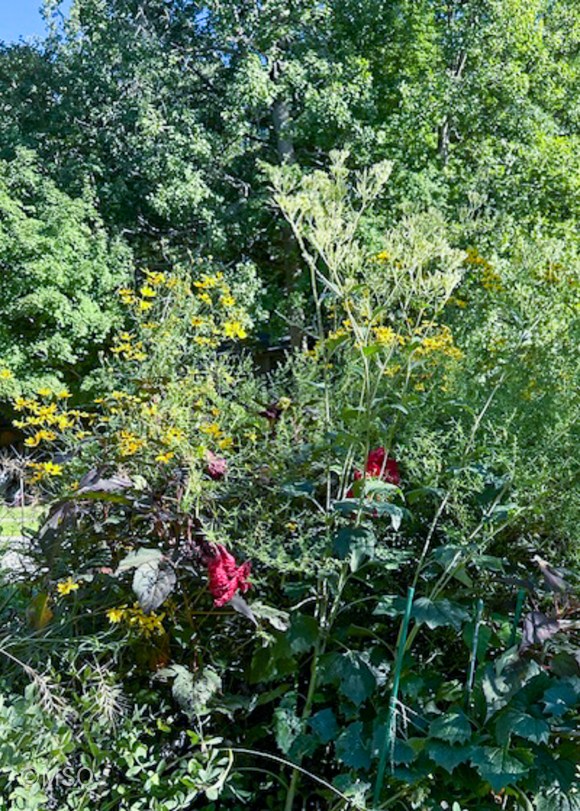
Why is this plant so different? The flowers don’t have any petals, only disk florets. Disk florets usually make up the center of a bloom and are surrounded by ray florets or petals.
The leaves seem to defy description. They’ve been called triangular or oval-cordate or oval but none of these is right. The closest I’ve heard is Sycamore-like, with undulate edges (rippled edges).
The leaf texture is also unique. Thick and shiny, it’s been compared to leather or plastic. All these characteristics come together in a striking plant.2,6
Arnoglossum atriplicifolium grows in full sun to light shade. Loamy, rocky or sandy soil are all acceptable. But this plant loves evenly moist soil that stays constantly wet. When Arnoglossum is happy, it reseeds freely. Cut back the flower stalks to avoid this issue.1,6,9
In nature, Arnoglossum appears in open and rocky woodlands, thickets, wet meadows, along streams, in mesic forests, savannahs, woodland edges, sand dunes, rocky clearings in woodlands, prairies, meadows, upland woodlands, wooded slopes, slopes of ravines, sandy savannahs, sandy thickets, partly shaded thickets, and partly shaded banks near Lake Michigan.2,6
The first year, Arnoglossum atriplicifolium forms as a basal rosette of medium to dark green leaves. These leaves grow up to eight inches long and six inches across. While the top sides are green, the lower leaf surfaces are pale greenish white to bright white.
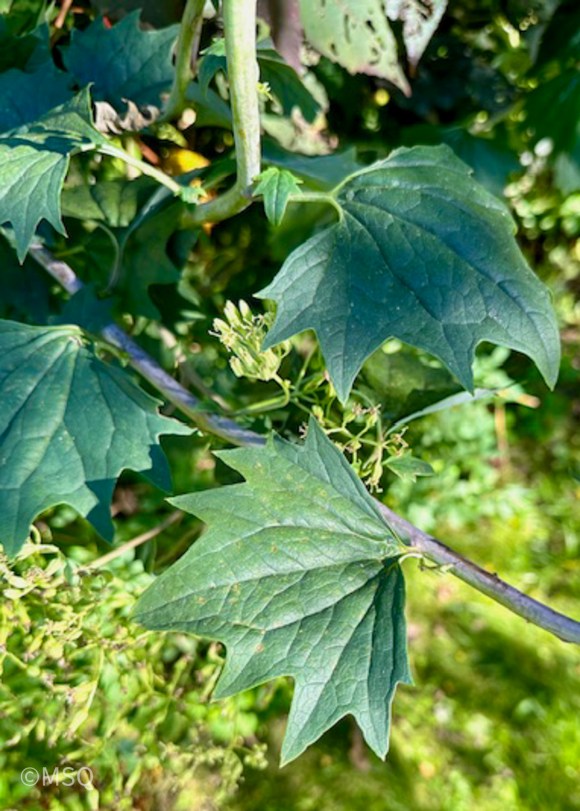
In the second or third year, a stalk appears in Spring and grows to between three and nine feet tall with alternate leaves. The unbranched stalk provides an erect accent in the garden. These leaves become smaller as they go up the stalk. Cavity nesting bees and wasps use the hollow stems for nesting.1,2,6,9
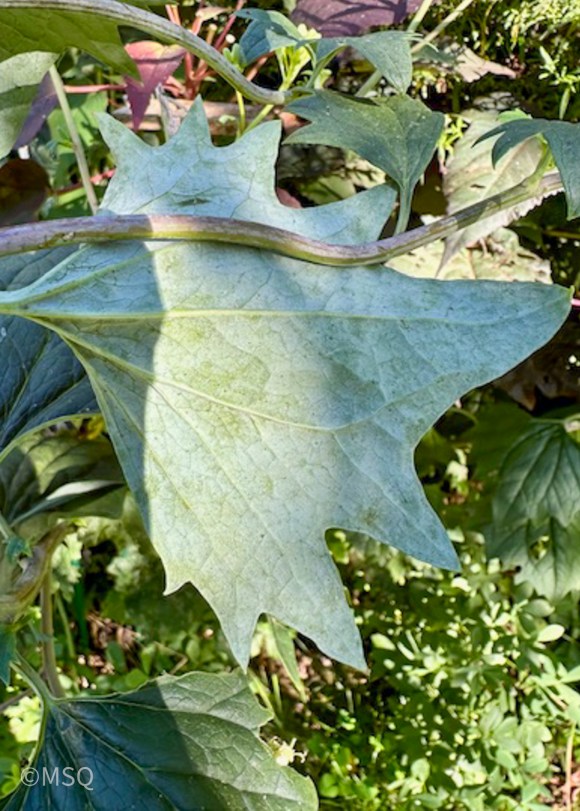
Flat-topped flowerheads (technically called a compound corymb) develop at the top of the plant stalk. Without petals, the flowerhead make up their size by grouping four to fifteen florets together into corymbs. These corymbs grow together to form the whole flowerhead.9
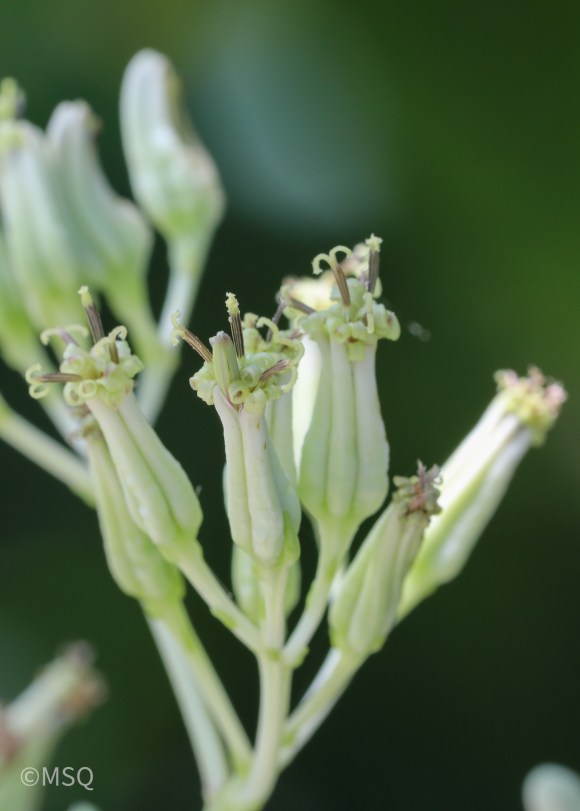
The individual florets are about an eighth inch across and a third inch long with five disk florets. Each one has a style that extends beyond its end. The styles are bipartite which means two styles joined together. As they mature, the tips curl away from each other forming circles. Anthers also reach past the end of the floret.6
Arnoglossum atriplicifolium is self-incompatible. Each floret must be fertilized with pollen from a different plant. Wasps, small bees and flies provide pollination.3
Blooms appear in mid-Summer and continue into early Fall. Total flowering time is about one month. Cut it back for a smaller second bloom.6
Adding to the overall wackiness of Arnoglossum, the most common visitors are predatory or parasitoid wasps. Some of which look very scary indeed! These wasps are also beneficial insects helping to control many garden pests. In fact, the Xerces Society for Invertebrate Conservation labeled Arnoglossum as Supports Conservation Biological Control.
Wasps prefer dilute nectar on hot summer days and Arnoglossum is an excellent source of late season nectar. The nectar secretes at the base of the style. It’s drawn up the corolla so even short-tongued wasps. White flowers keep the nectar cool and dilute.3
Thirty-four different species of wasps visit Arnoglossum atriplicifolium.4 These include, Sand Wasps (Bicyrtes spp.), Great Black Wasps (Sphex pensylvanicus), Great Golden Digger Wasps (Sphex ichneumoneus), Thread-Waisted Wasps (Ammophila spp.), Potter Wasps (Eumenes spp.), the Common Yellowjacket Wasp (Vespula spp.), and Grass-Carrying Wasps (Isodontia spp.).3
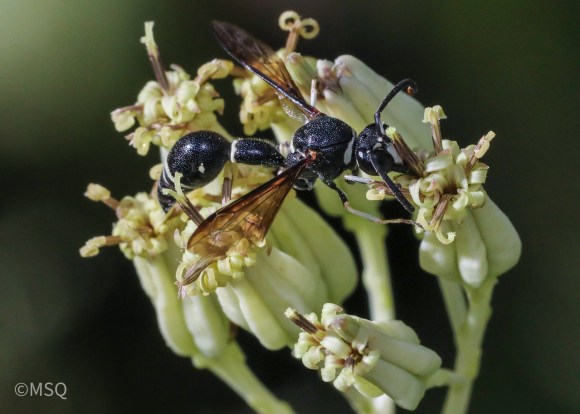
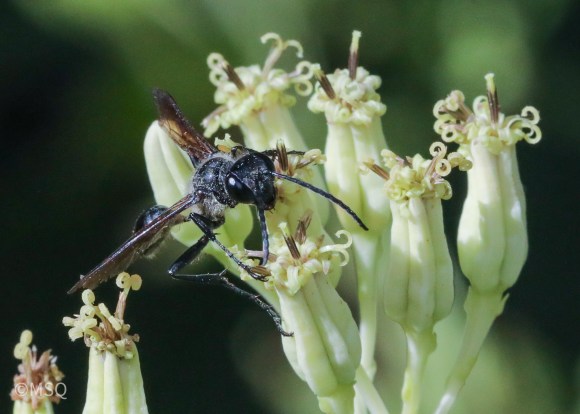
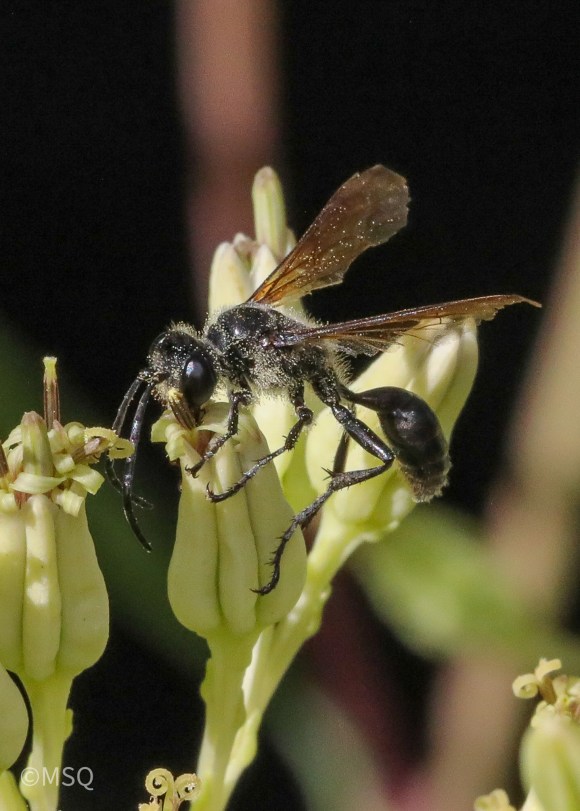
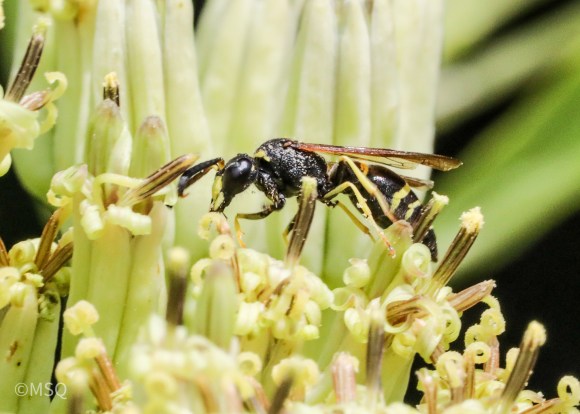
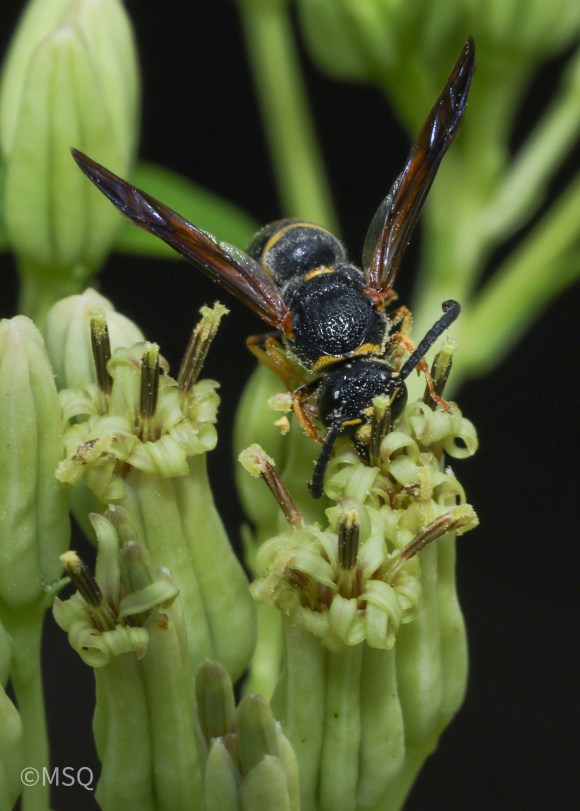
Are Yellowjackets beneficial? It’s hard to feel that way. They’re scary, the stings are painful, and they can ruin your picnic. Vespids or Yellowjacket wasps can send you to the ER too, if you’re allergic to their sting. So, is there an upside?
WARNING: Yellowjacket or Vespid wasps form large colonies. When disturbed, they’ll attack as a group. Multiple stings are dangerous even to non-allergic individuals.
Do not allow nests around people, especially children, animals and especially those with allergies. Also, do not attempt nest removal yourself! Use a professional exterminator!
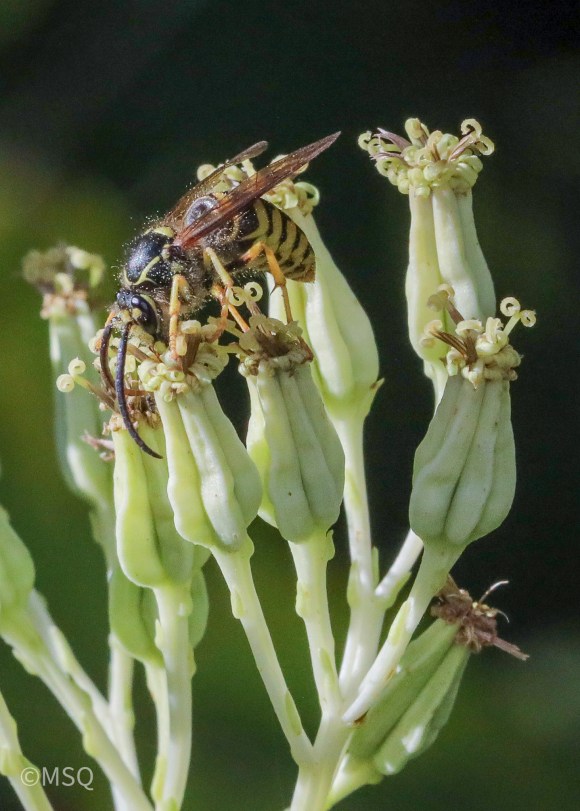
OK back to beneficial insects—Yellowjacket wasps build yearly nests. Their mated queens overwinter in cozy spots like bumblebees. In the Spring, the queens establish a nest and lay eggs to become workers. The workers will continue building the nest and gathering prey.
Almost all Vespid wasps (Yellowjackets), use chewed wood pulp and saliva to create paper nests. Different types of Vespids choose different locations for homes. Options include holes like openings in trees, structural walls, abandoned animal burrows or rotting tree stumps or aerial places in trees or under building eaves. Often nests aren’t noticed until they’re large or disturbed.11
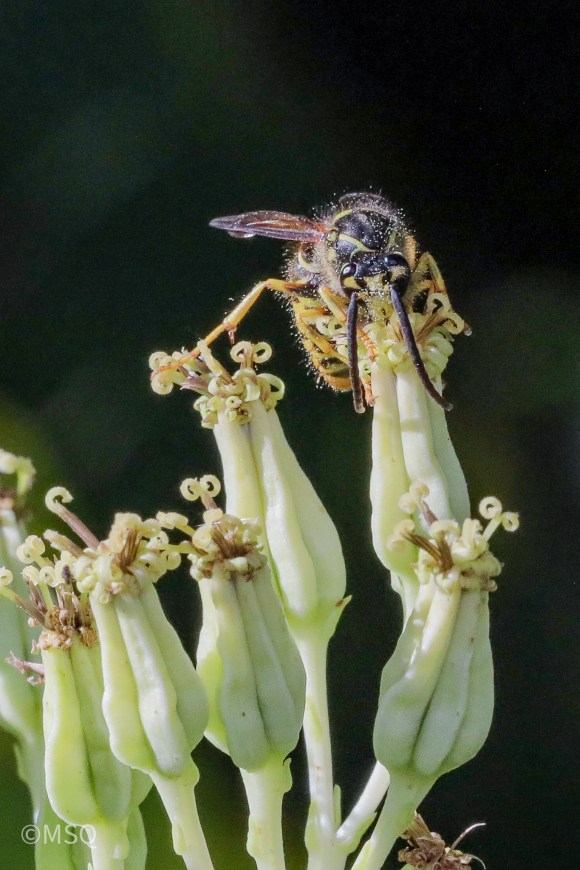
But what good are they? Colony size ranges from a few hundred to over 5,000. Almost all these wasps hunt for insect prey and many prey on pests. Depending on the species, Vespids target crickets, grasshoppers, spiders, flies, and fall webworms. Those that live in trees and high places frequently gather food there.11
I wouldn’t let Yellowjacket set up housekeeping in my yard especially near children, animals, individuals allergic to bee stings or other human activity. But you have a place on your property, where they won’t be disturbed, a Vespid nest is like a small army of pest control.
Many small bees gather nectar and pollen from Arnoglossum atriplicifolium. Sweat Bees (Halictus sp. and Lasioglossum sp.) and small Carpenter Bees (Ceratina sp.) are some of the short-tongued bees seen.
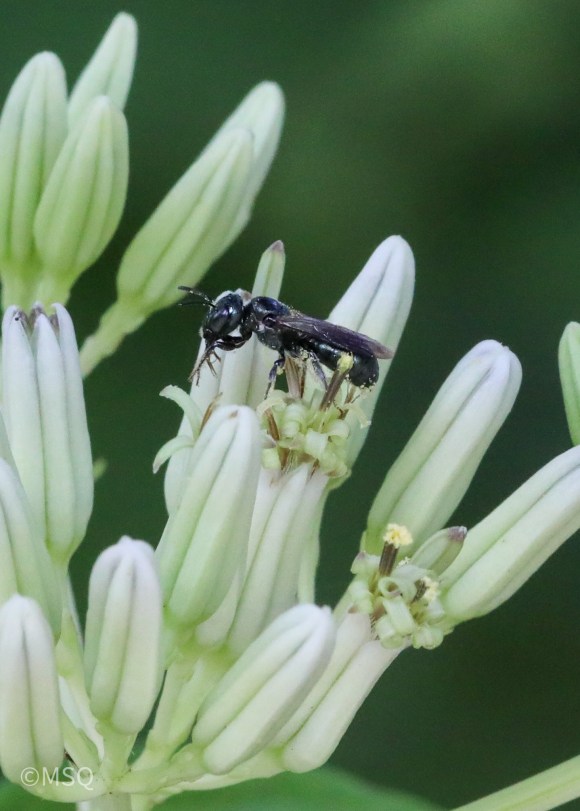

Halictid or Sweat Bees fall in the small and mighty category of pollinators. There are more than 500 species in North America. In the garden and in natural area, they are more plentiful than most other native bees.7,8
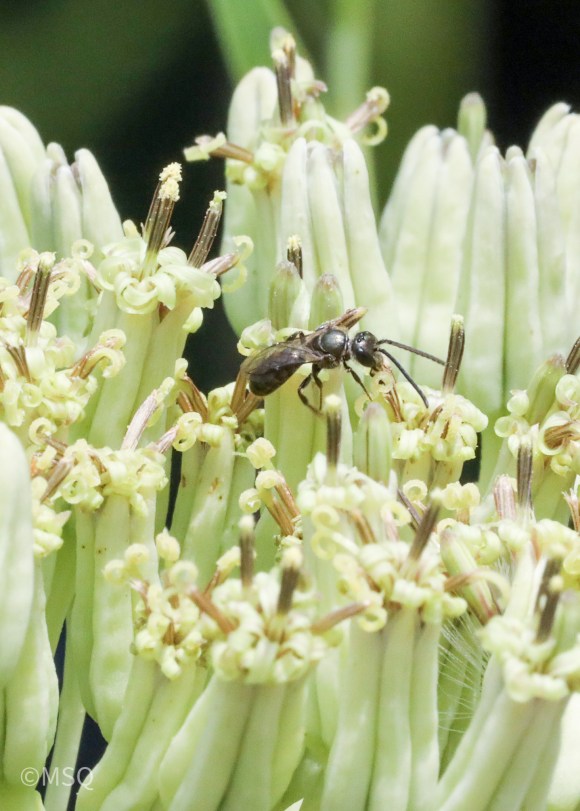
Almost all are ground nesting but the colony structure can be solitary, communal, semi-social or eusocial. Sometimes these nesting behaviors vary with time of year, location-geographic and altitude, and for reasons we don’t understand.5,7,8
Two fun facts about the Halictid bees are: they drink human sweat and they can buzz pollinate. Why do they lap up sweat? It’s like an electrolyte drink for them. On hot summer day, Halictid bees need some salt and other minerals. Human perspiration is one easy source!5,7,8
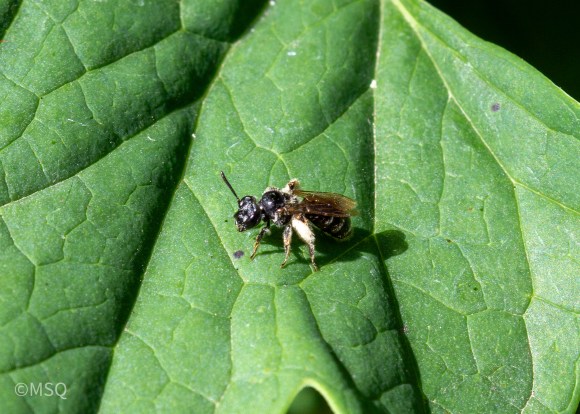
What about buzz pollination? Buzz pollination is sometimes called sonication. A sweat bee holds onto a flower’s anther with its mandibles and curls its abdomen around the anther. It vibrates its wing muscles to release pollen.5
Many flowers need buzz pollination to effectively free their pollen. These plants include the heath family (blueberry, cranberry) and nightshade (tomato, groundcherry, pepper, eggplant, potato), A number of native bees can buzz pollinate, most famously, the Bumblebee. Honeybees cannot.5,10
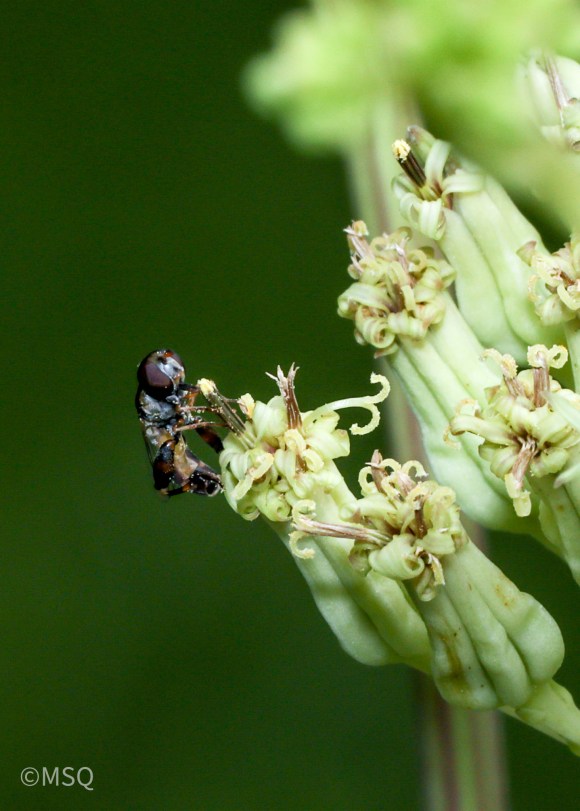
Lastly, flies gather nectar and pollen at Arnoglossum atriplicifolium. Syrphid flies frequently stop to sip the accessible nectar.3
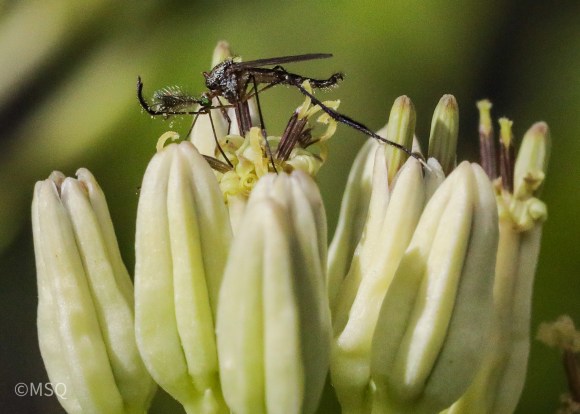
Bonus Bug: Both male and female mosquitos visit flowers for nectar. Females need blood for the protein and most use a sugar source. Males need a sugar source, like nectar, to survive. We don’t know how they choose particular flowers but they are attracted to some chemical compounds.12
Hope you enjoyed this look into a Wild and Wacky plant! Arnoglossum atriplicifolium benefits some bizarre and wonderful insects as well as some more familiar ones. It delivers a wonder accent in the garden and is an excellent source of late summer nectar!
Warm Regards,
Mary
References:
- “Arnoglossum Atriplicifolium – Plant Finder.” Accessed September 2, 2024 https://www.missouribotanicalgarden.org/PlantFinder/PlantFinderDetails.aspx?taxonid=293225.
- “Arnoglossum Atriplicifolium (Pale Indian Plantain) | North Carolina Extension Gardener Plant Toolbox.” Accessed September 2, 2024. https://plants.ces.ncsu.edu/plants/arnoglossum-atriplicifolium/.
- Holm, Heather. Pollinators of Native Plants: Attract, Observe and Identify Pollinators and Beneficial Insects with Native Plants. Minnesota: Pollination Press LLC, 2014.
- Holm, Heather. Wasps: Their Biology, Diversity, and Role as Beneficial Insects and Pollinators of Native Plants. Minnesota: Pollination Press LLC, 2021.
- Missouri Department of Conservation. “Halictid Bees (Sweat Bees).” Accessed September 2, 2024. https://mdc.mo.gov/discover-nature/field-guide/halictid-bees-sweat-bees.
- “Pale Indian Plantain (Arnoglossum Atriplicifolium).” Accessed September 2, 2024. https://www.illinoiswildflowers.info/savanna/plants/pale_indplant.htm.
- “SWEAT BEES: GENUS LASIOGLOSSUM | The Great Sunflower Project.” Accessed September 2, 2024. https://www.greatsunflower.org/Lasioglossum#.
- “Sweat or Halictid Bees.” Accessed September 2, 2024. https://entnemdept.ufl.edu/creatures/misc/bees/halictid_bees.htm#
- “Weird and Wonderful Plants for Pollinators: Pale Indian Plantain | Xerces Society.” Accessed September 1, 2024. https://xerces.org/blog/pale-indian-plantain.
- Xerces Society. “Delectable Native Plants Attract a Very Special Crowd.” Accessed September 2, 2024. https://xerces.org/blog/delectable-native-plants-attract-very-special-crowd.
- “Yellowjackets and Baldfaced Hornets | CALS.” Accessed September 2, 2024. https://cals.cornell.edu/new-york-state-integrated-pest-management/outreach-education/whats-bugging-you/bees-and-wasps/identifying-bees-and-wasps/yellowjackets-and-baldfaced-hornets
- “Not Just from Blood: Mosquito Nutrient Acquisition from Nectar Sources – ScienceDirect.” Accessed September 2, 2024. https://www.sciencedirect.com/science/article/pii/S1471492220300404#.
 Wild Things in the Garden