Categories
native plants Pollinator gardening

Sunny Faces

Dedicated to Dad who taught me the names of all the wildflowers.

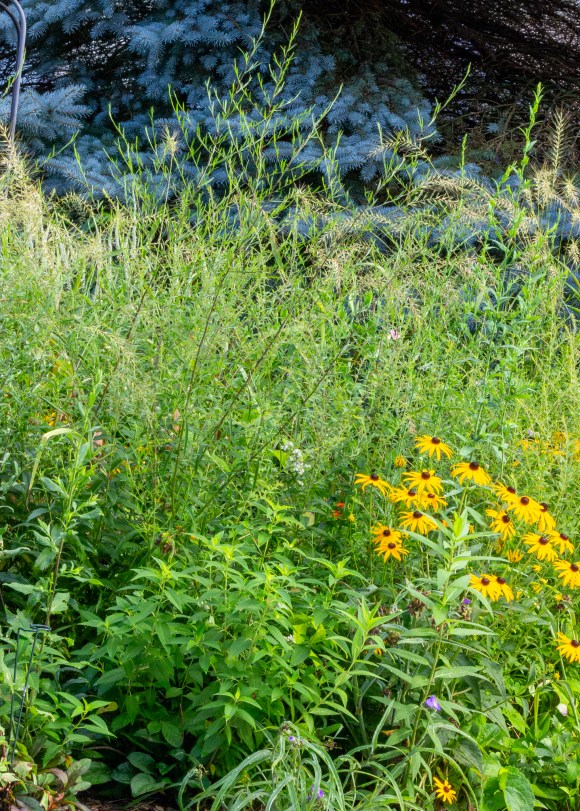
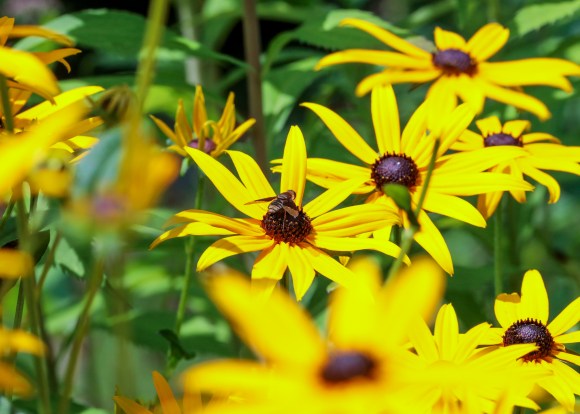
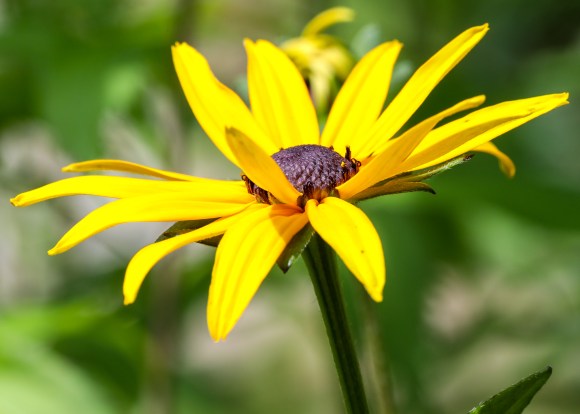
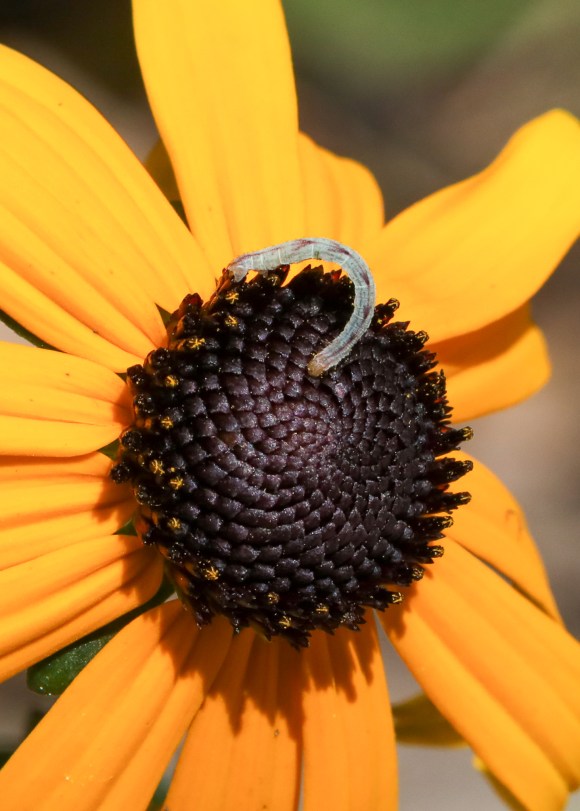
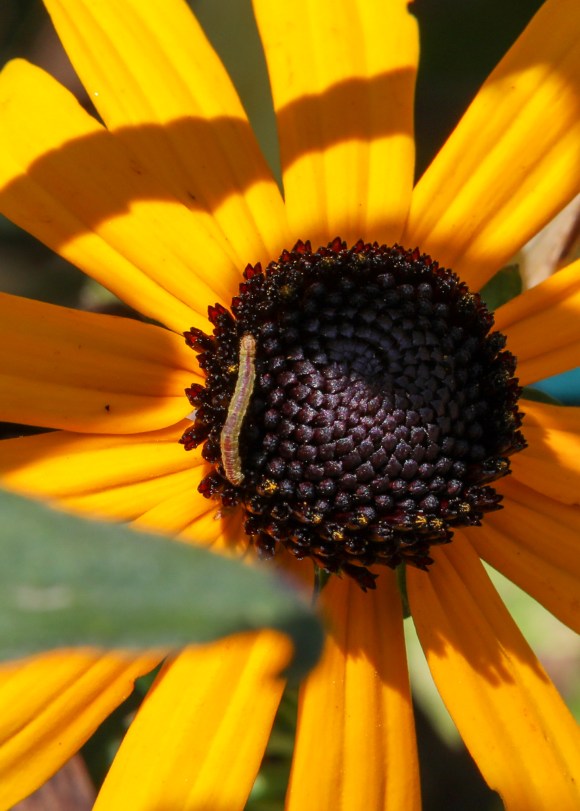
Sunny faces shine from summer into fall on the Black-eyed Susans (Rudbeckia hirta).  Their long bloom season and tidy habit makes them a super star of the native plant world.  R. hirta has long been popular in landscaping but works well in the wild garden and in land restorations.  On top of all this, it supports pollinators and beneficial insects with its pollen and nectar and serves as a larval host.  

Rudbeckia hirta grows in Zones 3 through 8.  It reaches from one to three feet and spreads between one and two feet.  R. hirta’s height is a real bonus.  It’s difficult to find native plants in that middle height range.  Another reason to use it in a planned garden.2,3,4

Black-eyed Susans adapts to a variety of conditions but does enjoy some ideal conditions.  Full sun and slightly moist to moderately dry soil with moderate fertility gives the best bloom to foliage ratio.3  

But Black-eyed Susans also grow in moist, well-drained clay, loam or sandy soil.  Any fairly fertile soil will do.  Too many nutrients, such as near a fertilized lawn, encourage leaves over flowers.

In natural areas, Rudbeckia hirta lives in mesic to dry prairies, woodland edges and openings, mesic to dry upland forests–particularly rocky areas, meadows, limestone glades, plains and savannas.  In developed areas, Black-eyed Susans grow along railroads and roadsides, in waste areas, on eroded clay slopes, pastures, abandoned fields and assorted waste areas.  They thrive on disturbed sites and recover well from fire.4

In the garden, Rudbeckia hirta grows quickly from seed and often flowers the first year.  Each plant is short-lived acting as an annual, biennial or short-lived perennial depending on the growing conditions.  Black-eyed Susans remain in the garden by reseeding.  They don’t reproduce by rhizomes.

It’s a good plant for prairie restorations and wildflower gardens since it blooms the first year.  In the beginning, R. hirta appears to dominate the plantings.  Longer lived perennials generally outcompete it for a better balance.

For those interested is in restoration or land management, the USDA-Forest Service has  excellent resources in their Fire Effects Information System (FEIS).  The publications are peer-reviewed.  Four types of publications are created at the USDA-FS with information drawn from peer-reviewed sources.  Lists of reference articles are available.1

Two document types help when looking for information on a specific species.  I used a Species Review to find associate plants for Black-eyed Susans in natural ecosystems.  There are 1,100 Species Reviews available.1

In addition, FEIS has Fire Studies.  These contain much information on the fire itself but also how different species react to fire.  The best way to find information is to search the species name on the FEIS home page.  It’s also possible to do an advance search for the species in the Species Reviews or Fire Studies.1

The Species Reviews have a section on Habitat Types and Plant Communities that provides lists for plant associates.  This information could be useful for creating more natural wild gardens, restorations and in land managements.  One example is a wet prairie in southwest Michigan included Black-eyed Susans with goldenrods (Solidago spp.), sedges (Carex spp.), Indian grass (Sorghastrum nutans), marsh fern (Thelypteris palustris), queen-of-the-prairie (Filipendula rubra), purple meadowrue (Thalictrum dasycarpum), prairie cordgrass (Spartina pectinata), and cowbane (Oxypolis pectinata).1

In addition to natural communities, the USDA-Forest Service FEIS document discusses several restorations using R. hirta.  It covers this plants’ reactions to pollutants like ozone and cadmium and a great deal more.  The FEIS material is an excellent resource for anyone interested in Rudbeckia hirta either in the garden, in managing lands or in a nature area.1

Disease and pests don’t usually bother Black-eyed Susans.  They may have powdery mildew especially when planted in moist places and in the Fall.  Slugs and snails are also occasionally a problem.  Deer and other herbivore rarely eat it since the stems, leaves and phyllaries are covered in tiny hairs and it has little food value.

The greyish-green leaves of Rudbeckia hirta alternate along the stem.  Covered in stiff, short hairs, they grow up to 7 inches long and 2 inches wide. These hairs provide part of its name.  Hirta means hairy.

The foliage is lanceolate, oblanceolate or ovate in shape.  Leaf margins may or may not have blunt teeth and are fringed with tiny hairs.  Long petioles attach lower leaves while middle and upper leaves have short petioles or clasp the stem.

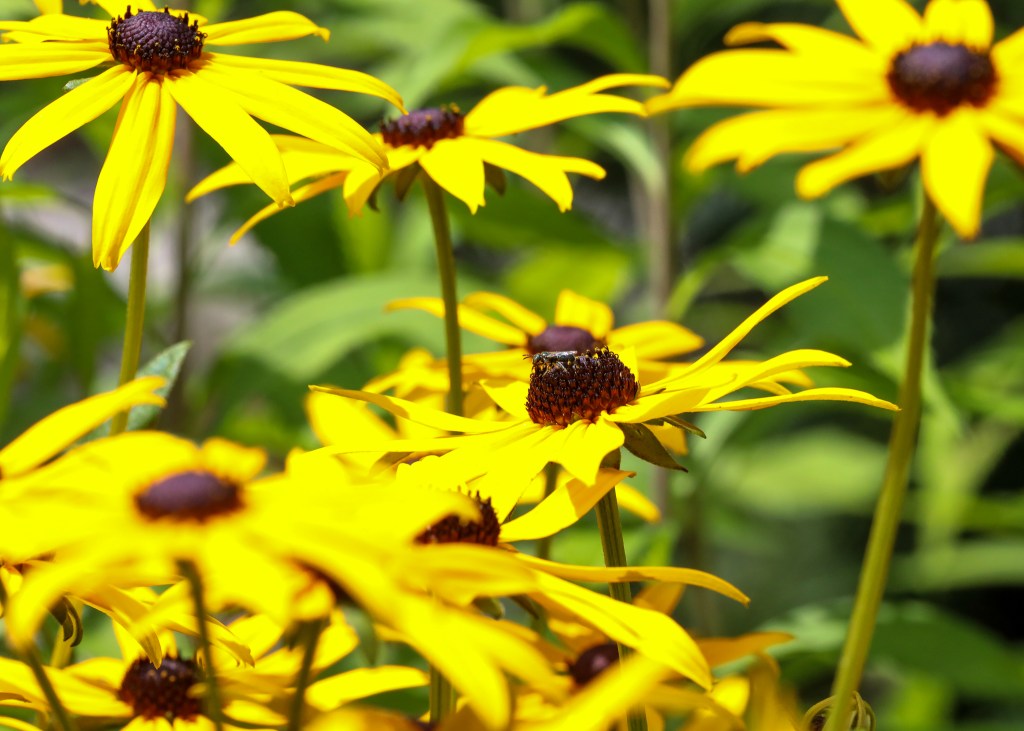
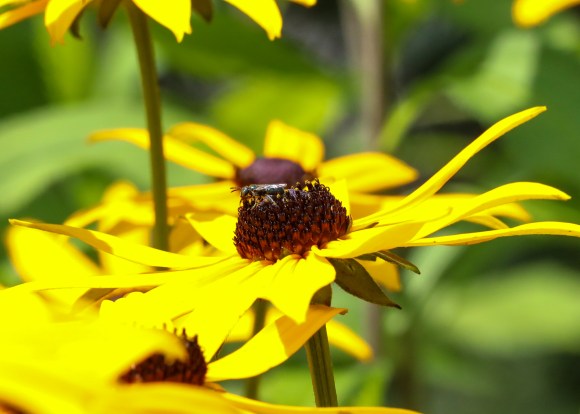
Black-eyed Susans blooms from early Summer into the Fall and blooms are carried singly on each stem.  As composite flowers, each is made up of disc florets and ray florets.  Many dark brown disc florets fill the center of each flower.  They start out as a tightly packed, flattened disc.  As each one opens, the anthers appear.  The yellow pollen creates a ring that moves up as the florets open.   The disc of florets expands until it forms a cone.

Each bloom has 8 to 20 bright yellow ray florets a.k.a. The whole flower is 2 to 3 inches across.  They last a long time since the bright yellow petals  continue after the disc florets finish blooming.  In hot areas, plants flower longer with some afternoon sun.

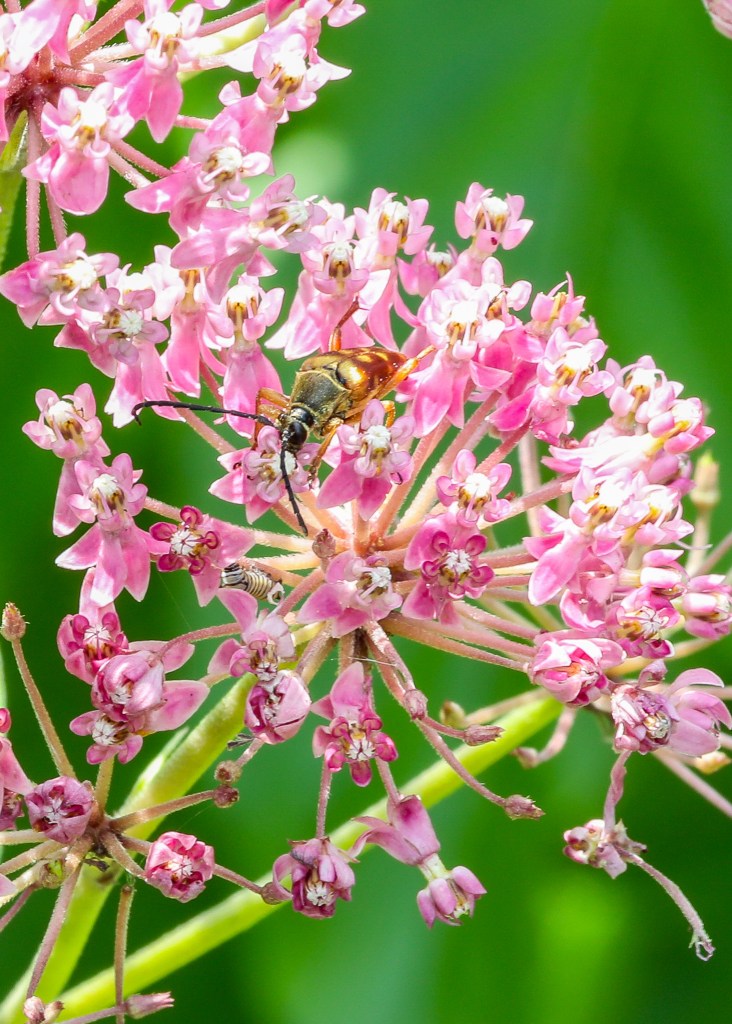
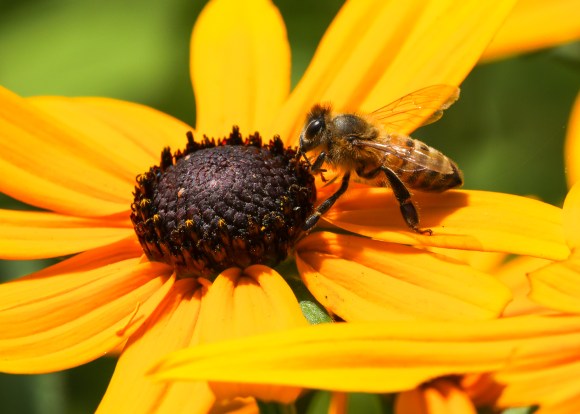
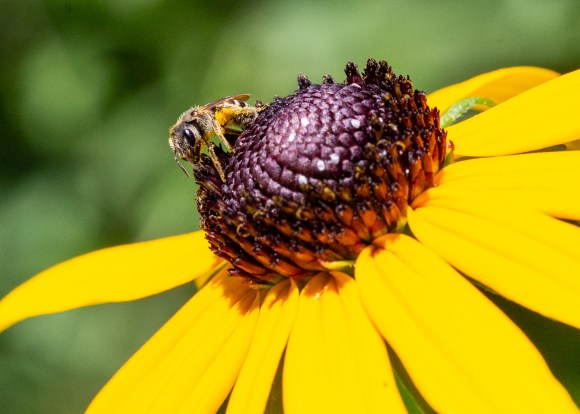
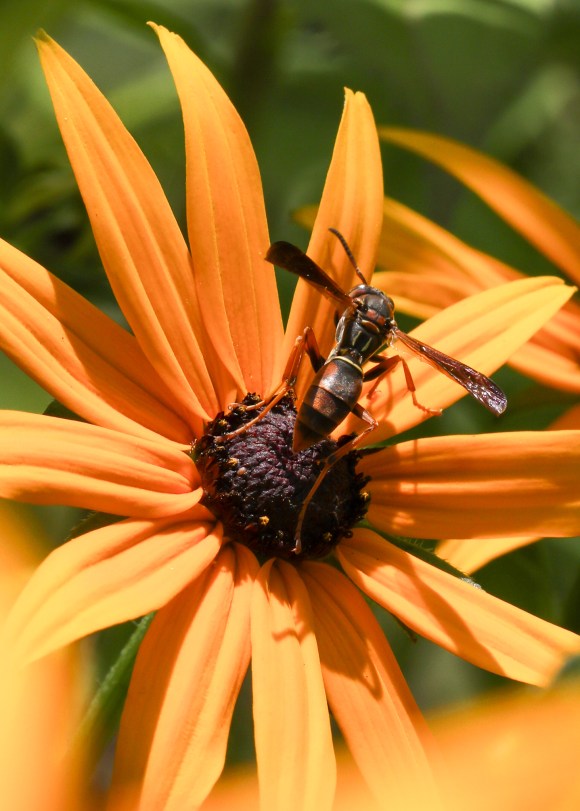
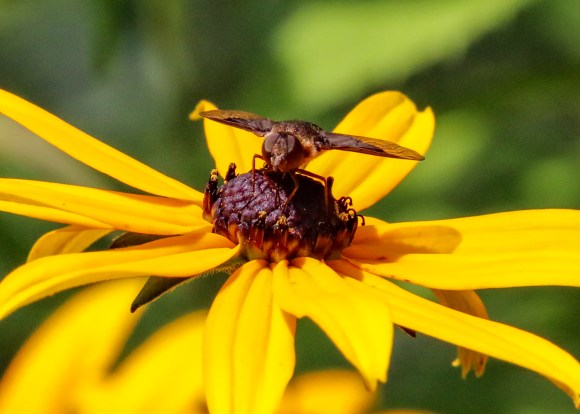
Black-eyed Susans host numerous insects providing pollen and nectar.  It serves as a larval host.  Bees and flies, some wasps, beetles and butterflies visit it.5,6  

Rudbeckia hirta is one of those flowers with nectar guides or landing zones for bees.  Bees  see into the ultraviolet zone unlike humans.  Certain flowers have special marking to lead the bees to their resources.5,6  

Possible markings include lines going to the flower center or spots near the center.  R. hirta has patches forming a ring around the center.  This area absorbs UV and has a dark brown color in UV light.  This visual clue can be seen from a distance to advertise the floral resources.5,6

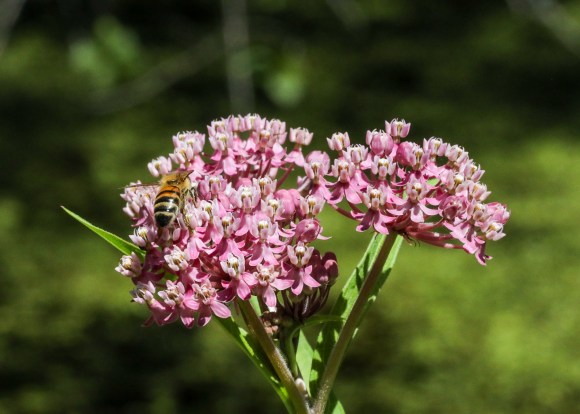
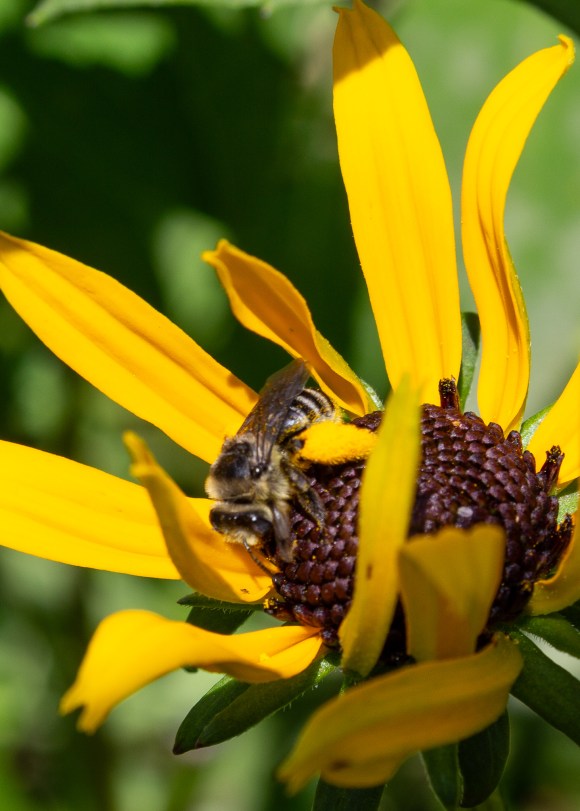
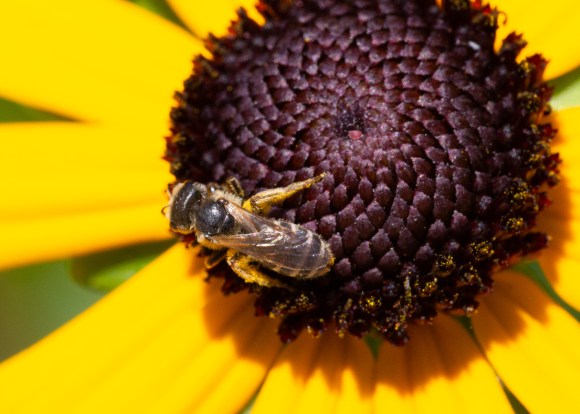
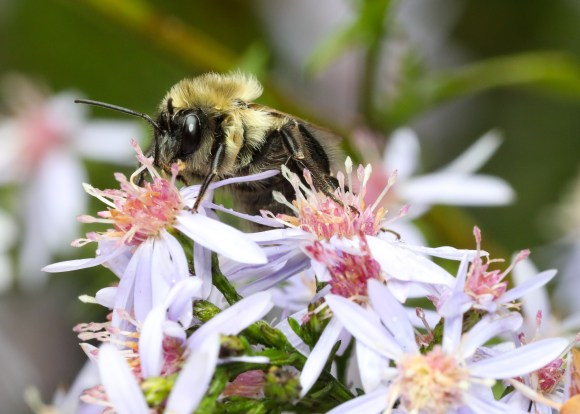
Numerous middle-sized bees visit the Black-eyed Susans.  These include Honeybees (Apis spp.), Long-Horned Bees (Melissodes spp.), Leafcutter Bees (Megachile spp.), and Cuckoo Bees (Coelioxys spp.)  Long-Horned Bees (and others) collect pollen by following the ring of open florets around the cone.5,6

It also has several specialist bees including Andrena rudbeckiae, Pseudopanurgus albitarsis, P. rudbeckiae, Melissodes denticulatus, M. druriellus, M. illatus, Megachile pugnata, and M. xylocopoides.

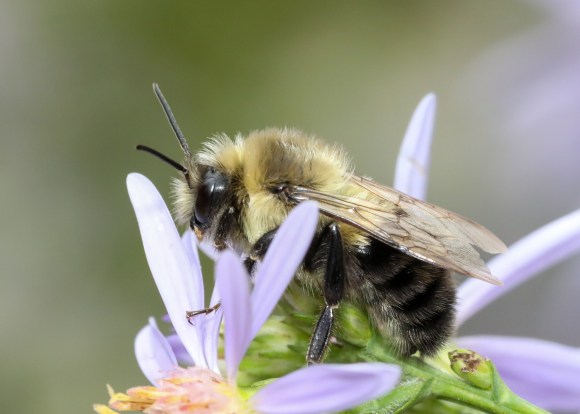
Many references list Bumble Bees (Bombus spp.) using Rudbeckia hirta.  In my garden, I see mostly small bees and flies.  I wonder if this because I have Bumble bee magnets like  Coreopsis, Silphium, Monarda, Veronicastrum, Agastache and Rudbeckia lanciata.5,6

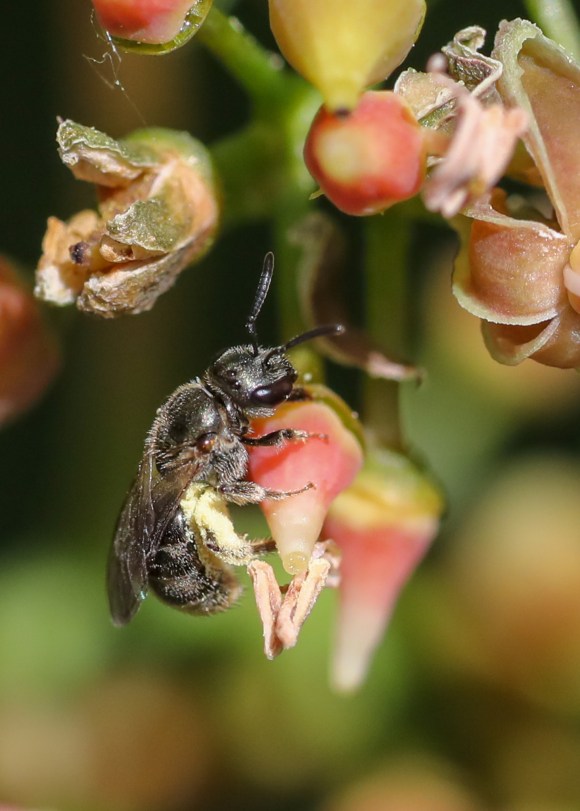
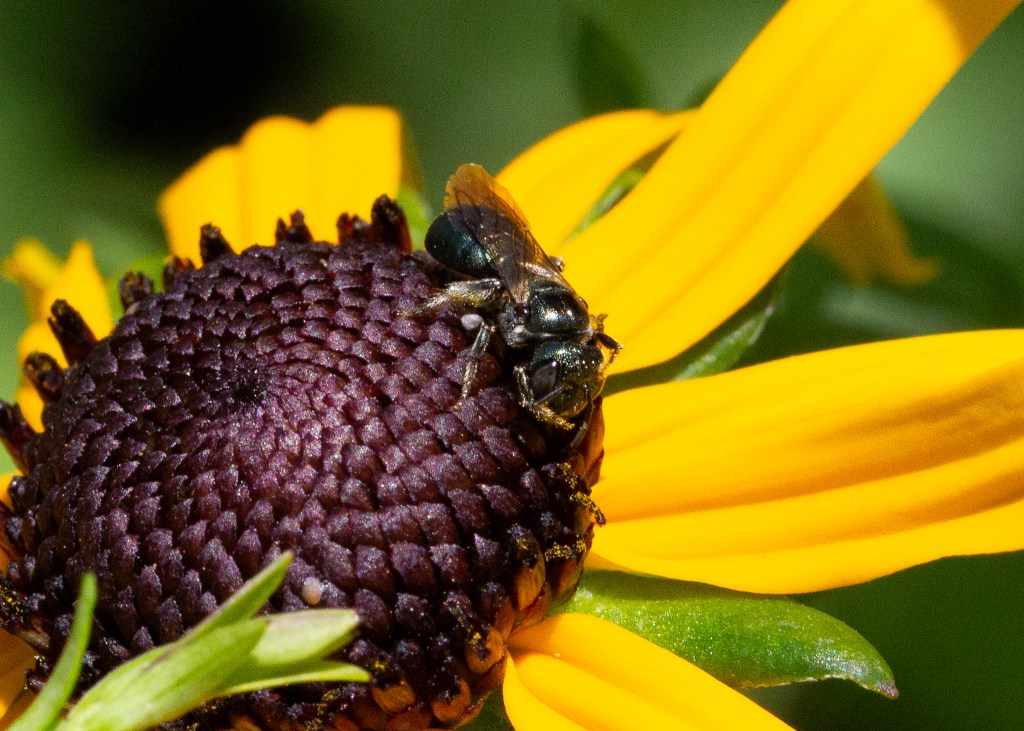
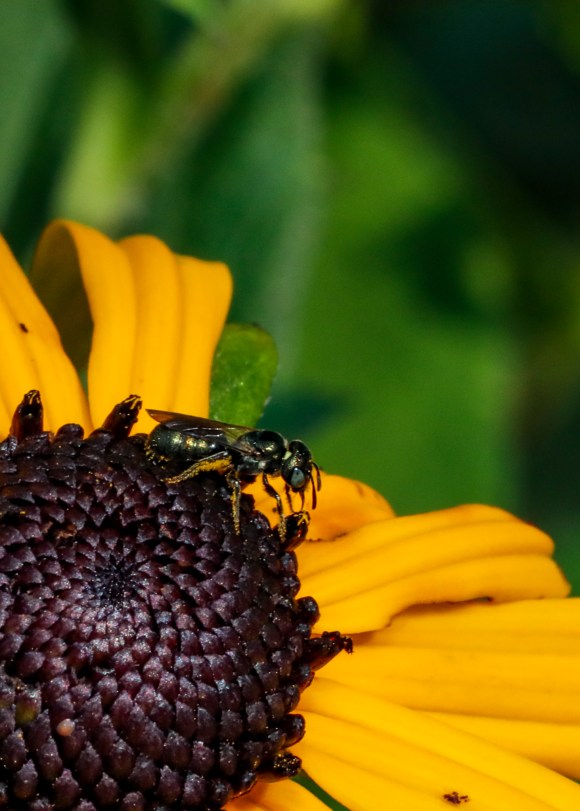
The small bees visiting Black-eyed Susans included Sweat Bees (Halictus spp.), Green Sweat Bees (Agapostemon spp., Augochlorini Tribe), and Small Carpenter Bees (Ceratina spp.).5,6

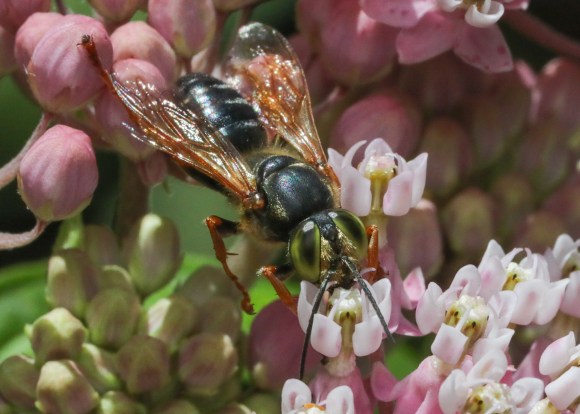
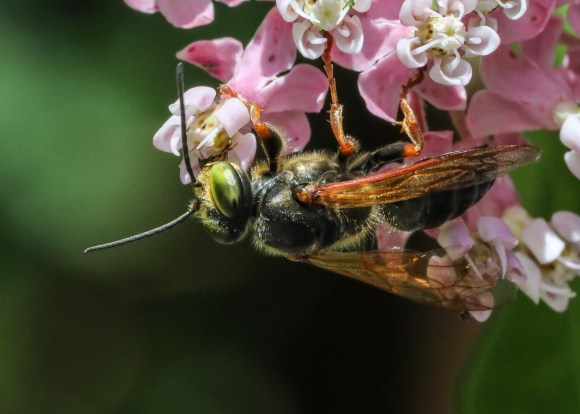
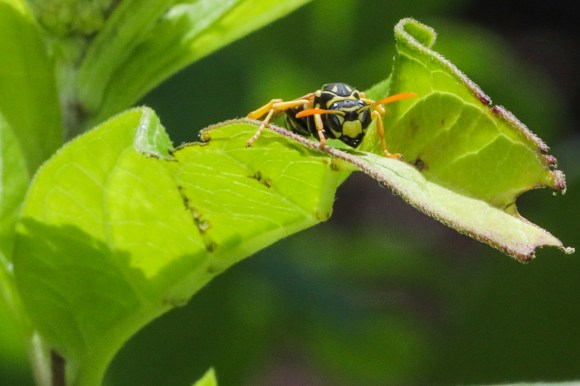
Many wasps use Rudbeckia hirta including Bee Wolves (Philanthes spp.), sand wasps, mason wasps, thread-waisted wasps .6

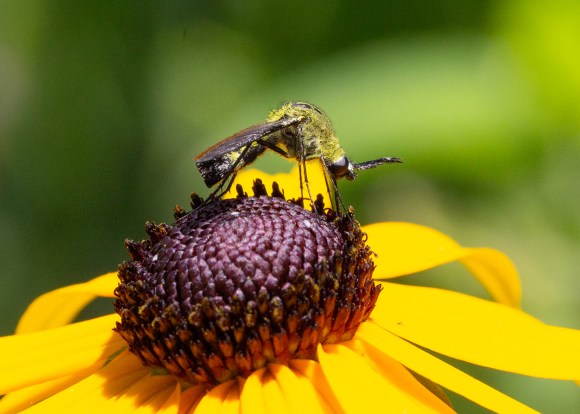
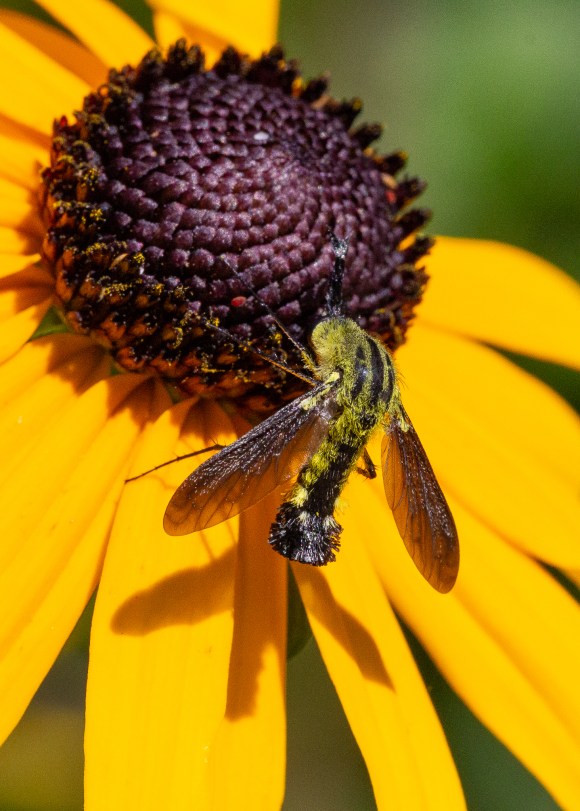
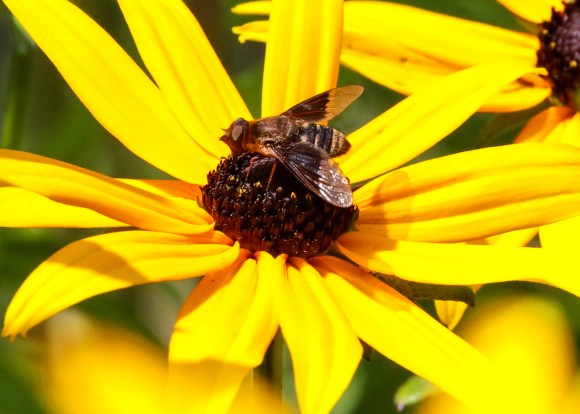
Bee flies visit Black-eyed Susans especially those from the family Bombyliidae. They gather both pollen and nectar.6

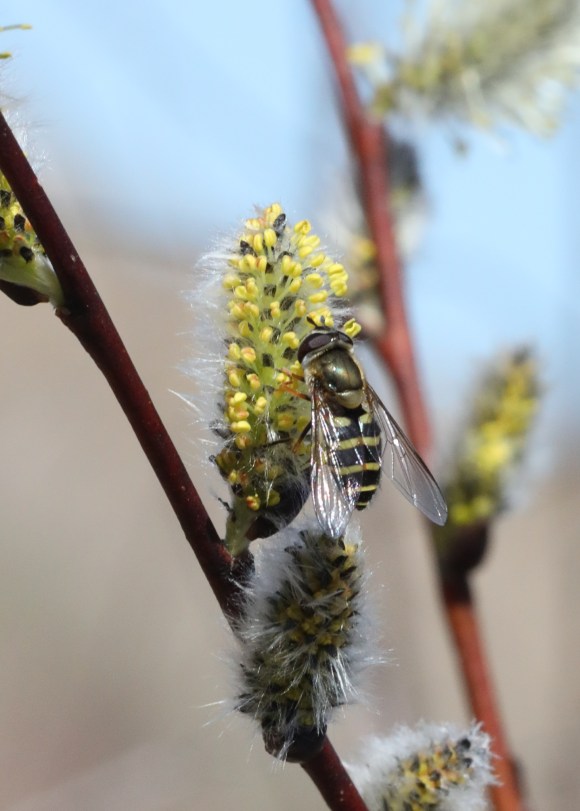
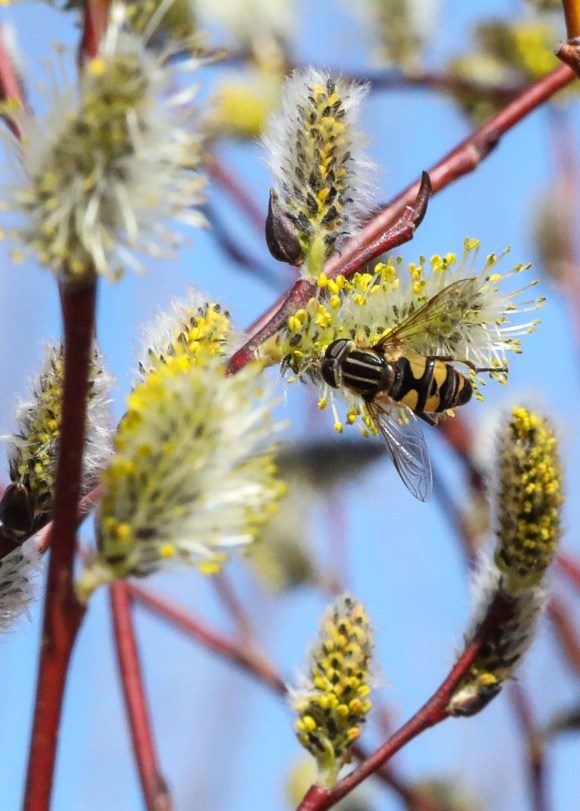
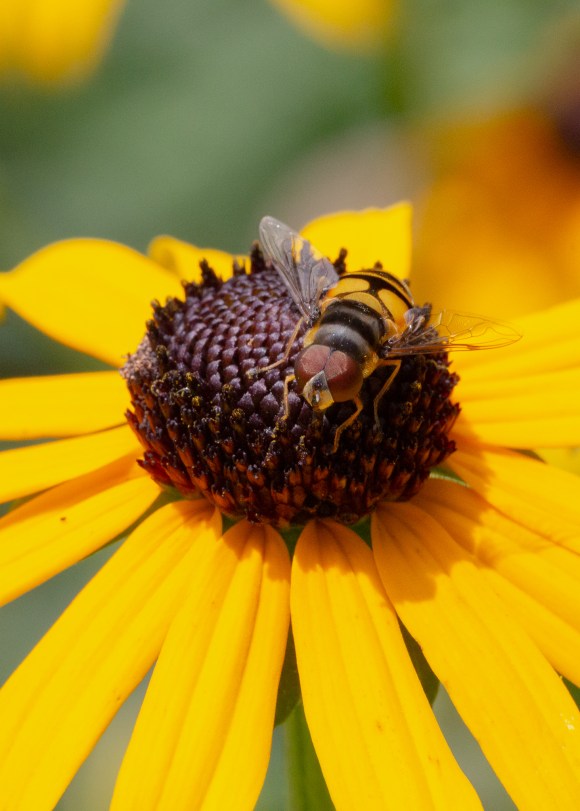
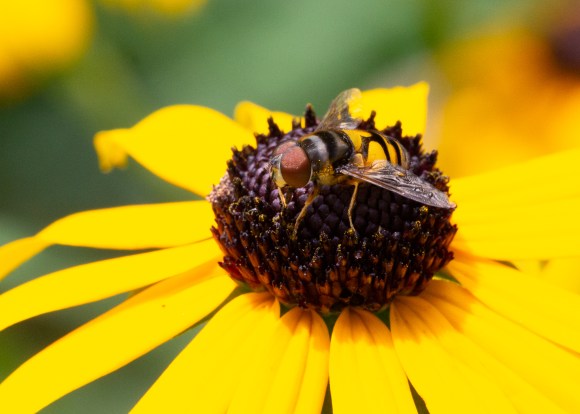
In addition, Syrphid flies harvest pollen and nectar.  They use their front legs to hold the anthers.  Then they lap up the pollen with their mouthparts.6

Rudbeckia hirta serves as a larval host for both moths and butterflies.  Wavy-Lined Emerald Moth ( Synchlora aerata) and Southern Emerald Moth (Synchlora frondaria),  Common Eupithecia (Eupithecia miserulata), Gorgone Checkerspot Butterfly (Chlosyne gorgone), Bordered Patch Butterfly (Chlosyne lacinia) and Silvery Checkerspot Butterfly (Chlosyne nycteis) all lay eggs on R. hirta.4,6

The Silvery Checkerspot Butterfly is an intricately marked, 1.25- to 2-inch-wide butterfly.  It’s part of the Brush-footed family (Nymphalidae)—the largest family of butterflies in the world.  Brush-footed butterflies include monarchs, fritillaries, crescents, anglewings, ladies, admirals, emperors, satyrs, and more.7

The name comes from the brush-like hairs on their short forelegs.  These hairs are sensitive to taste and touch.  Females use them to find larval host plants.  These brush feet also locate nectar and other high sugar liquids the adult butterflies need for food.7

The Silvery Checkerspot Butterfly uses many members of the aster family for larval hosts including Black-eyed Susans, native asters (Symphyotrichum), and sunflowers (Helianthus).  Females lay eggs on the bottoms of leaves.  

Young caterpillars stay in groups with up to 50 on a leaf.  They eat the entire leaf except the veins and then move on.  The third-instar larvae winter over.7

I hope you enjoyed reading about Black-eyed Susans as much as I have.  I’d love to hear about your plant adventures in the garden or the wild!  Please feel free to contact me with a story, comment or question! 

Happy Gardening,

Mary

BIBLIOGRAPHY:

  1. “Rudbeckia Hirta.” Accessed March 4, 2025. https://www.fs.usda.gov/database/feis/plants/forb/rudhir/all.html.
  2. “Rudbeckia Hirta – Plant Finder.” Accessed March 4, 2025. https://www.missouribotanicalgarden.org/PlantFinder/PlantFinderDetails.aspx?taxonid=277225.
  3. “Rudbeckia Hirta (Black Eyed Susan, Black-Eyed Susan, Gloriosa Daisy) | North Carolina Extension Gardener Plant Toolbox.” Accessed March 4, 2025. https://plants.ces.ncsu.edu/plants/rudbeckia-hirta/.
  4. “Rudbeckia Hirta (Black-Eyed Susan) | Native Plants of North America.” Accessed March 4, 2025. https://www.wildflower.org/plants/result.php?id_plant=ruhi2.
  5. Holm, Heather. Bees:  An Identification and Native Plant Forage Guide. Minnetonka, MN: Pollination Press LLC, 2017.
  6. Holm, Heather. Pollinators of Native Plants:  Attract, Observe and Identify Pollinators and Beneficial Insects with Native Plants. Minnesota: Pollination Press LLC, 2014.
  7. Missouri Department of Conservation. “Silvery Checkerspot,” January 31, 2024. https://mdc.mo.gov/discover-nature/field-guide/silvery-checkerspot.
  8. NC State News. “What Colors Do Bees See? And How Do We Know?,” July 27, 2024. https://news.ncsu.edu/2024/07/27/wms-what-bees-see/
Categories
native plants Pollinator gardening

Violet Peaks in Shadows

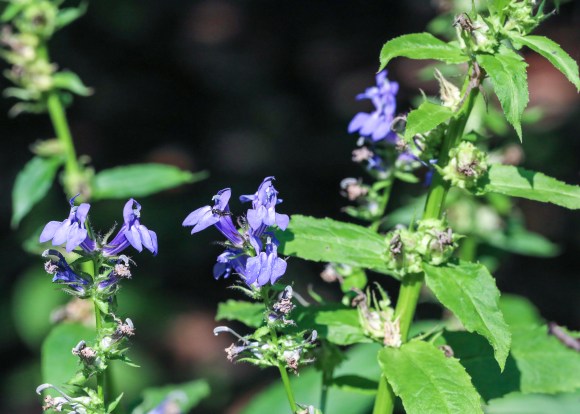
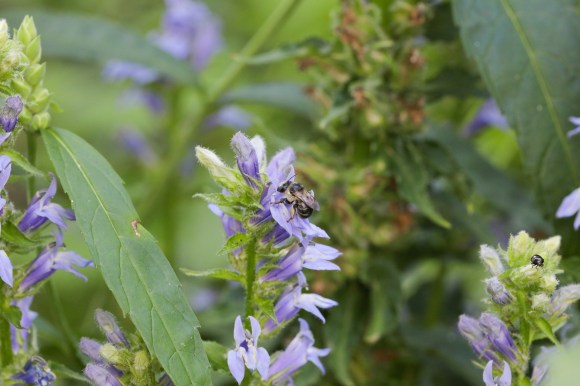
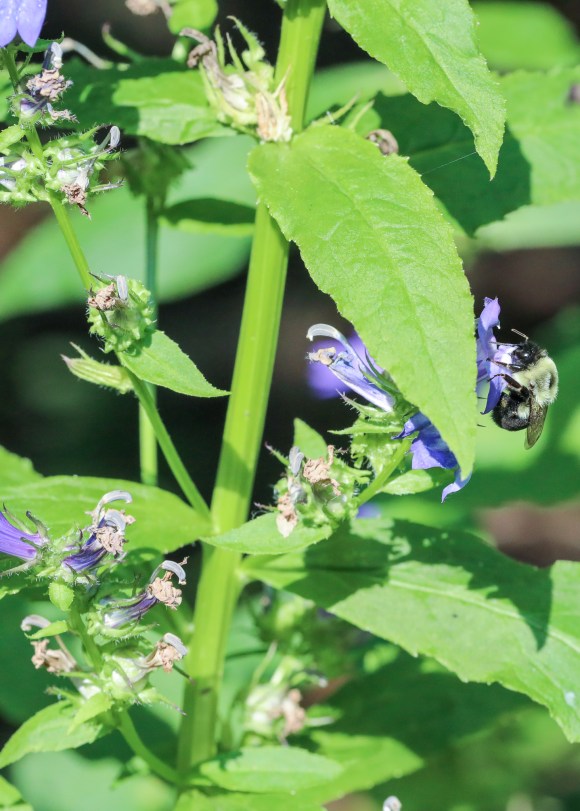
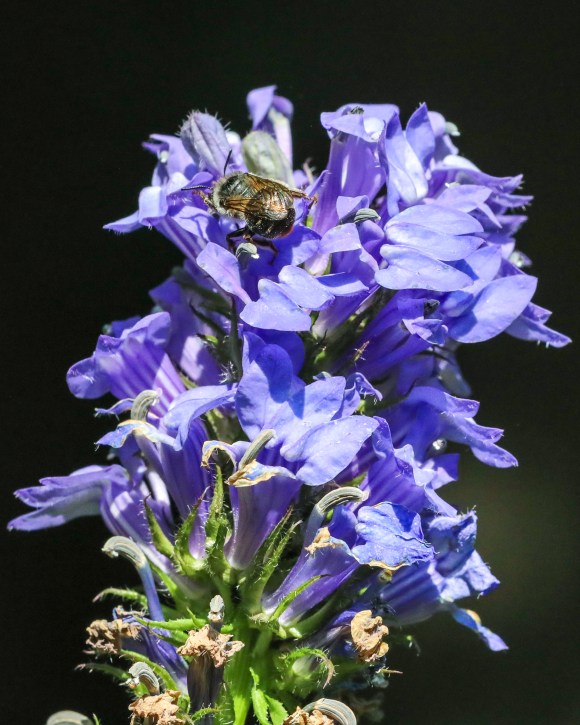
Lilac blue spires of  Great Blue Lobelia (Lobelia siphilitica) grace the late season garden.  With vivid color and abundant resources, they lure pollinators.   Their intricate, multi-lobed blooms offer both nectar and pollen.

Lobelia siphilitica enjoys moist to wet conditions in Zones 4 through 9.  Fertile, loamy soil is best.  Great Blue Lobelia grows in part sun to light shade.  In general, the plant is one to four feet tall and has a one foot to eighteen inch spread.2,4

This lobelia adapts to many environments.  It tolerates occasional flooding making it a good candidate for the rain garden.  In northern climates, with consistently moist soil, it can grow in full sun.  The height varies based on the growing conditions.  If under too much stress, Lobelia siphilitica gets ragged.2

In natural habitats, L. siphilitica lives in disturbed areas and high-quality habitats.  It’s found in moist black soil prairies, soggy meadows near rivers, low areas along rivers, ponds, floodplains, bottomland woodlands, woodland borders, bottoms of sandstone canyons, along streams, in swamps, fens, gravelly seeps and springs, ditches, and moist areas of pastures.2

Great Blue Lobelia plants form clumps that can be divided in Spring or Fall.  In my garden, seedlings thrive in areas that flood.  Otherwise, it doesn’t spread aggressively.4

The medium to dark green foliage forms a lovely background for the L. siphilitica’s striking blooms.  Its leaves alternate along Great Blue Lobelia’s stem.  They are ovate to lanceolate and lightly covered with short hairs.2  

Foliage can grow up to five inches long and two inches wide.  The bottom leaves can have a short stem.  Leaves at the top of the plant are sessile (touching) to the stem.2  

Lobelia siphilitica blooms for about two months from late summer into fall.  The intense blue-violet (occasionally white) flowers are packed closely on the raceme.  Each blossom is an inch to one and a half inches long.2

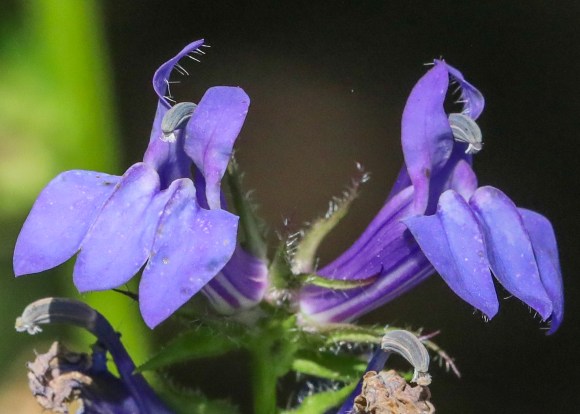
Flowers are two-lipped.  The upper lip had two lobes while the lower lip had three.  The lower lip offers a landing pad for pollinators.1,2,4  

Its green calyx has five lance-shaped teeth.  They are hairy, long and spreading.  Individual blooms emerge from the upper leaf axils.2

Great Blue Lobelia serves numerous insects late in the growing season.  The Xerces Society for Invertebrate Conservation designated it of Special Value to Native Bees and Special Value to Bumble Bees. It also Supports Conservation Biological Control according to the Xerces Society.6

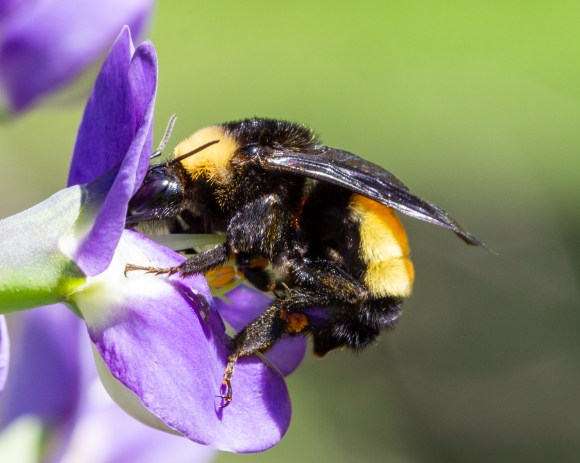
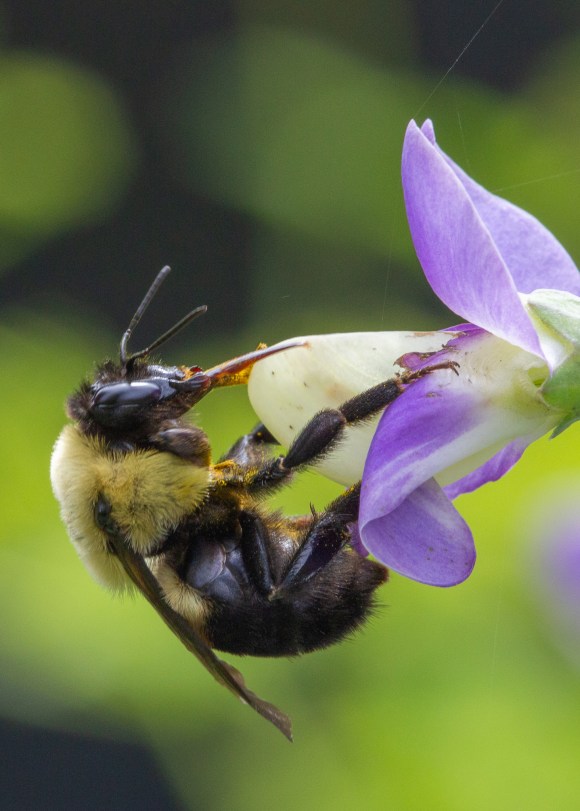
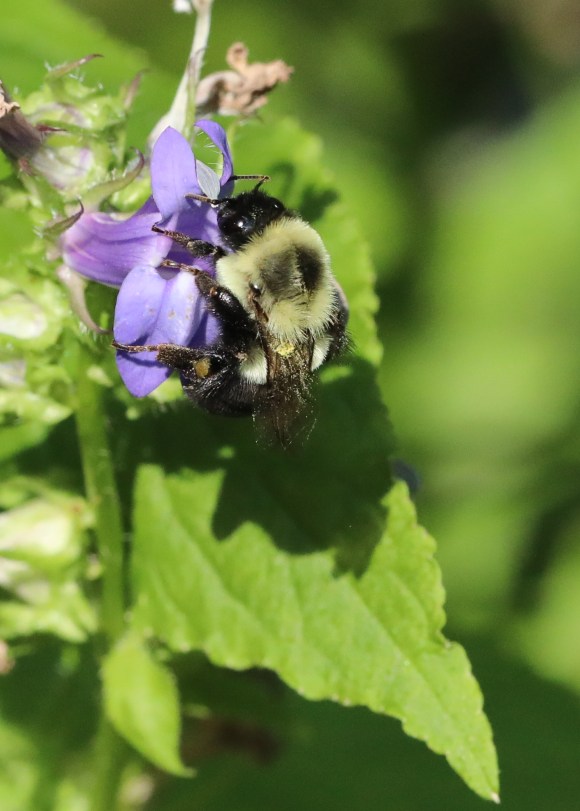
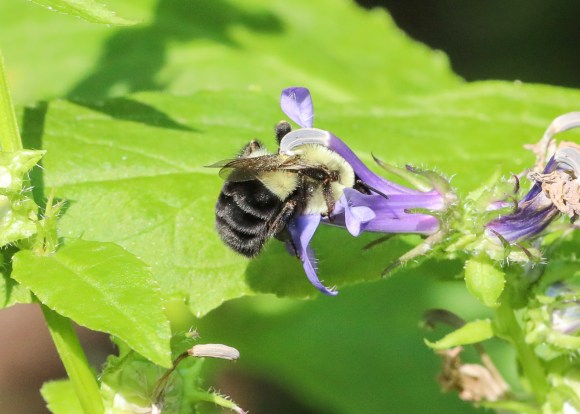
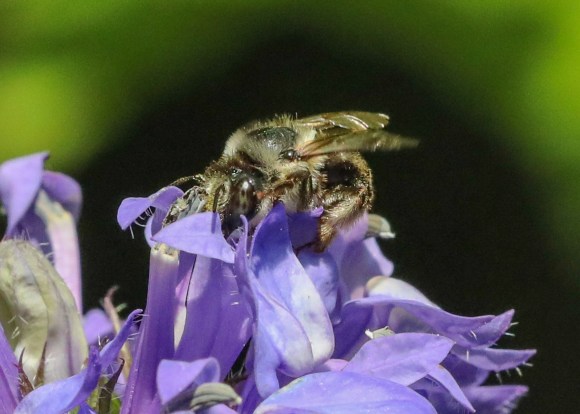
Large to medium, long-tongued bees primarily serve as pollinators.  Bumblebees (Bombus spp), Digger bees  (Anthophora spp), Wool Carder Bees (Anthidium spp) and Long-horned bees (Melissodes spp and Svastra spp) all successfully pollinate this Lobelia.  Additionally, these bees steal nectar from outside the flower sidestepping the pollination process.1,2,4  

L. siphilitica uses a remarkable system for pollination.  The five stamens (male parts) form a ring around the style (female part).  This whole grouping runs along the inside top of the flower and curls down ending with the stigma (area for pollen deposit).  It appears to be one structure.1

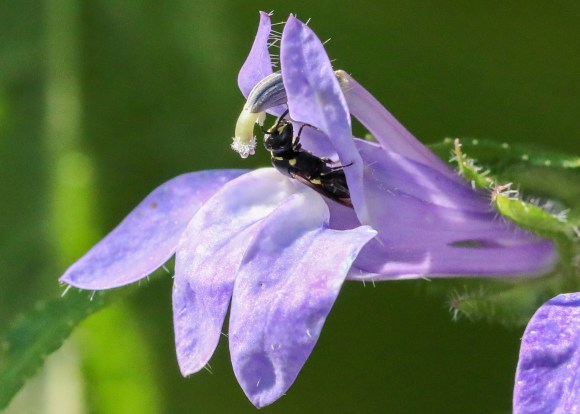
Lobelia flowers secrete nectar at the bottom to lure bees deep inside.  Small bees can just climb down to it and drink.  They may or may not get any pollen on their bodies.  

Medium and large bees need to wiggle their way inside the flower.  It’s a tight fit and they invariable rub against the anthers.  Pollen deposits on their backs.1,4

The weight of these bees causes several physical changes to the flower.  The three lower lobes form a landing place.  The bee’s weight pushes the lobes down and the style/anther structure arches down.  The stigma, at the end, rubs against any pollen on the bee’s back successfully transferring it.1,4

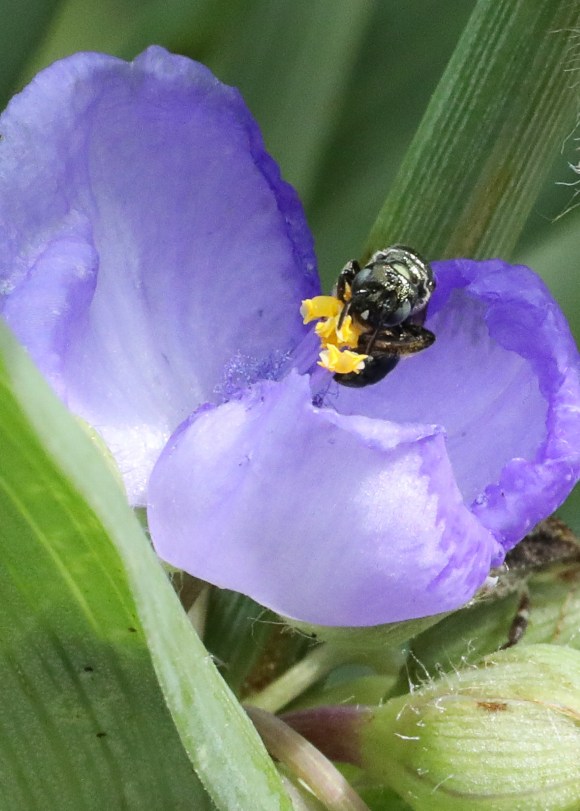
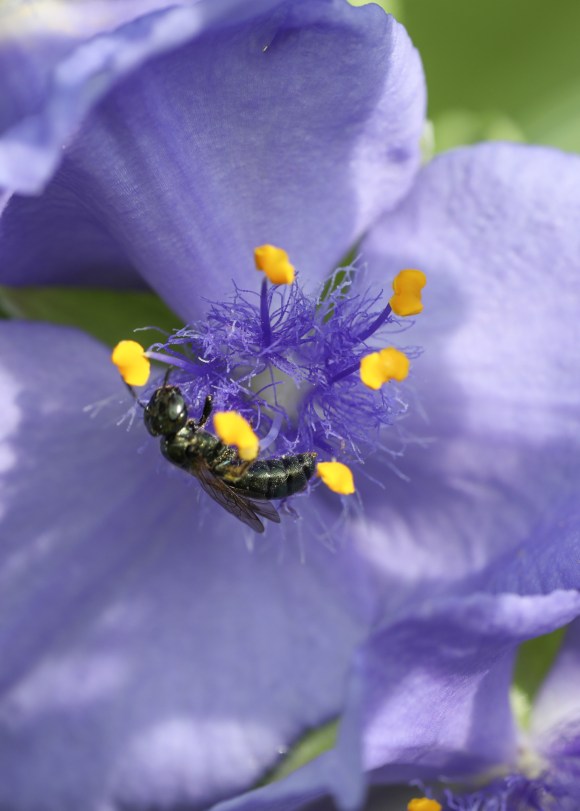
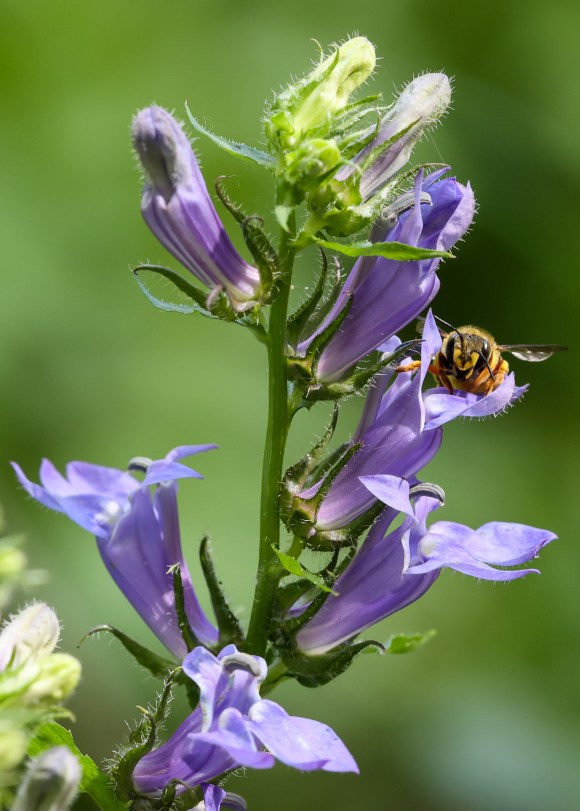
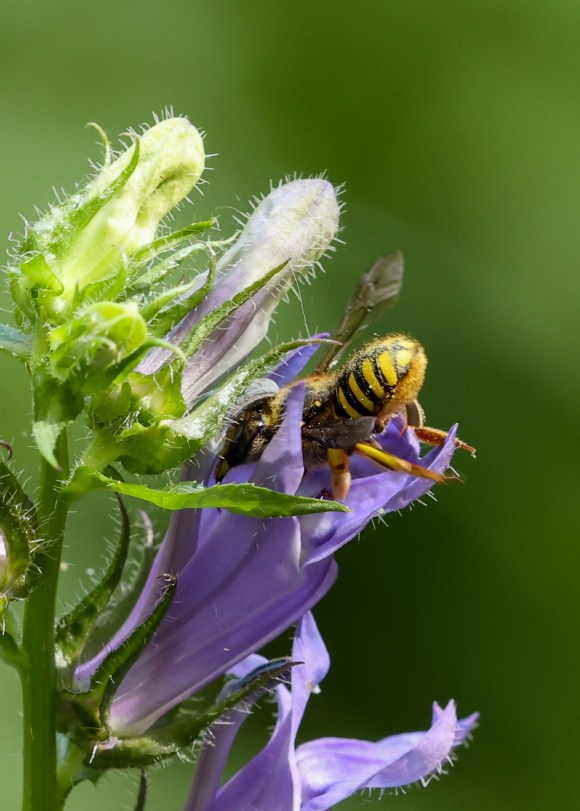
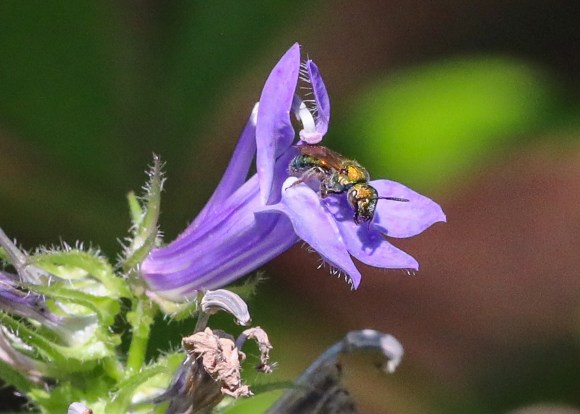
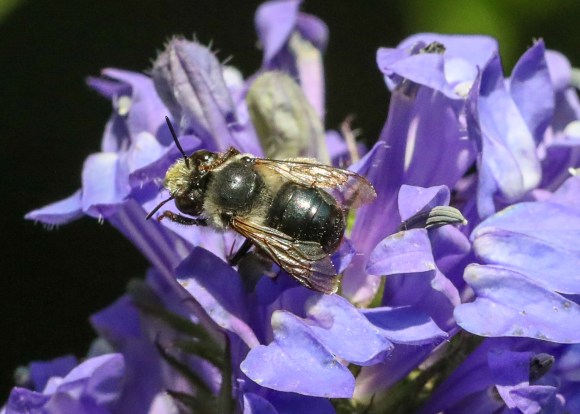
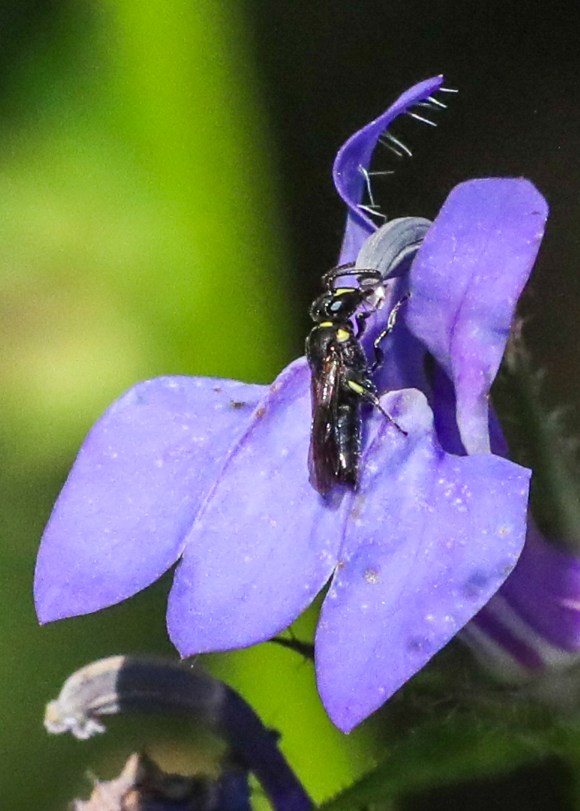
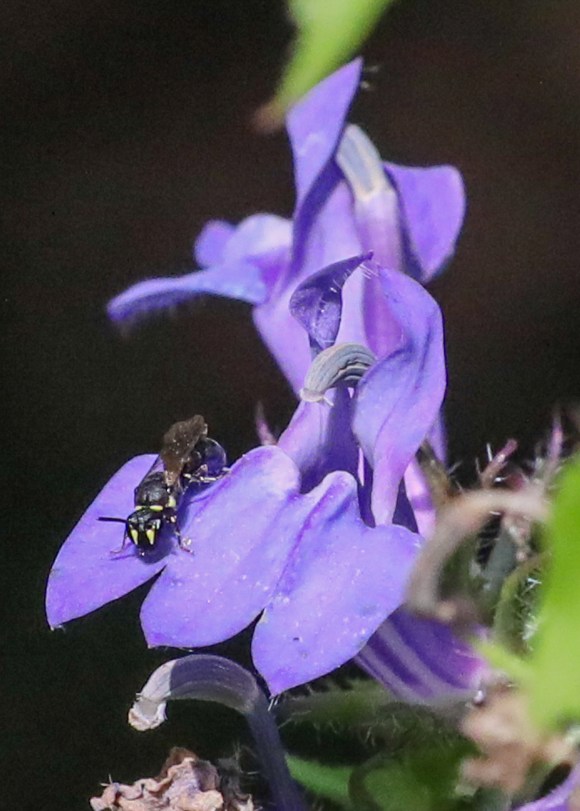
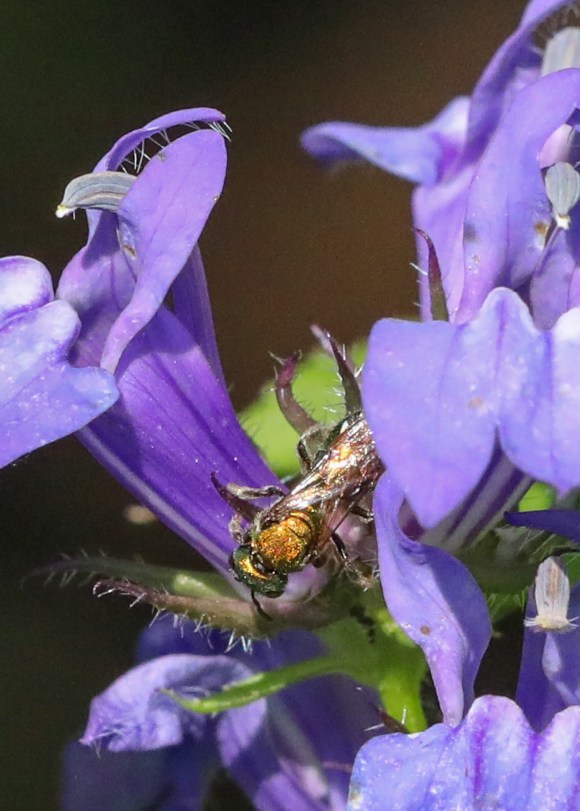
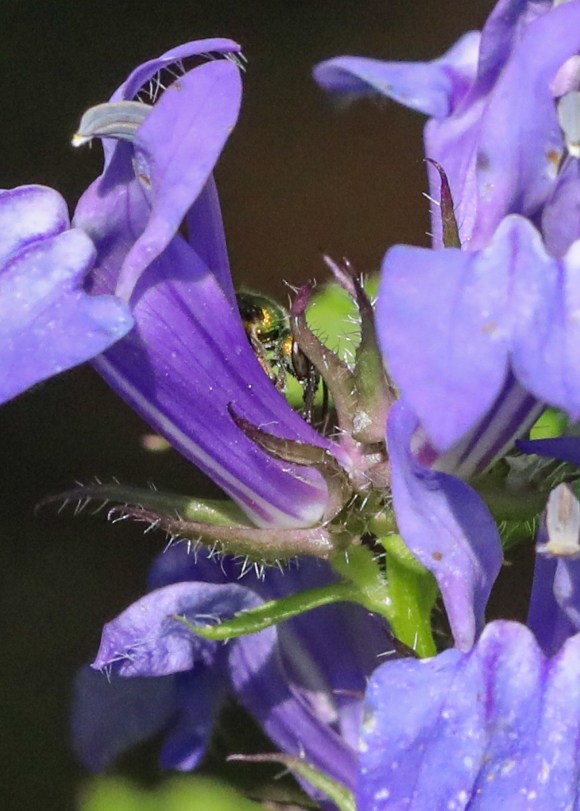
In addition to the medium and large bees, numerous small bees harvest nectar and pollen from Lobelia siphilitica.  The Masked Bees (Hylaeus spp) and Halictid bees are frequent visitors.  The Halictids include small dark sweat bees like Lasioglossum spp. and the green metallic sweat bees such as Agapostemon spp. and Augochlora spp.4  

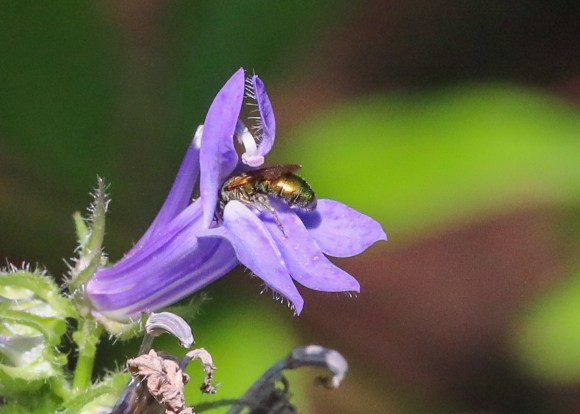
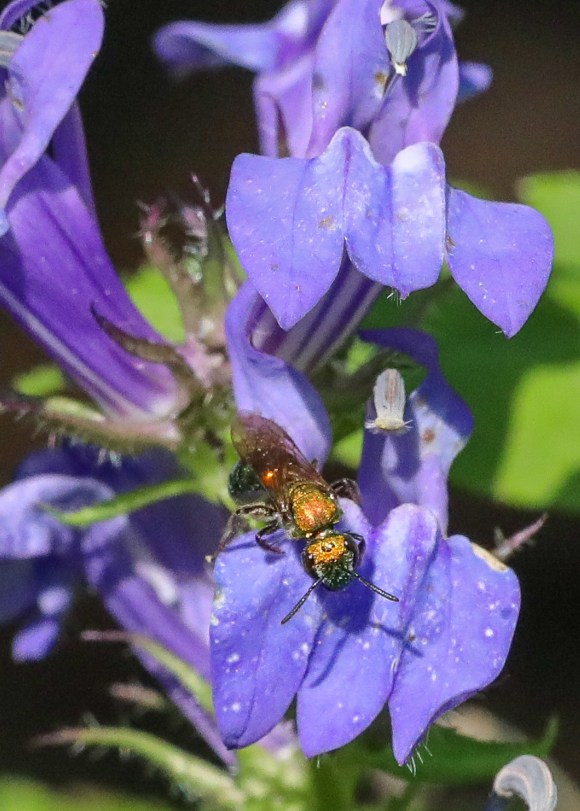
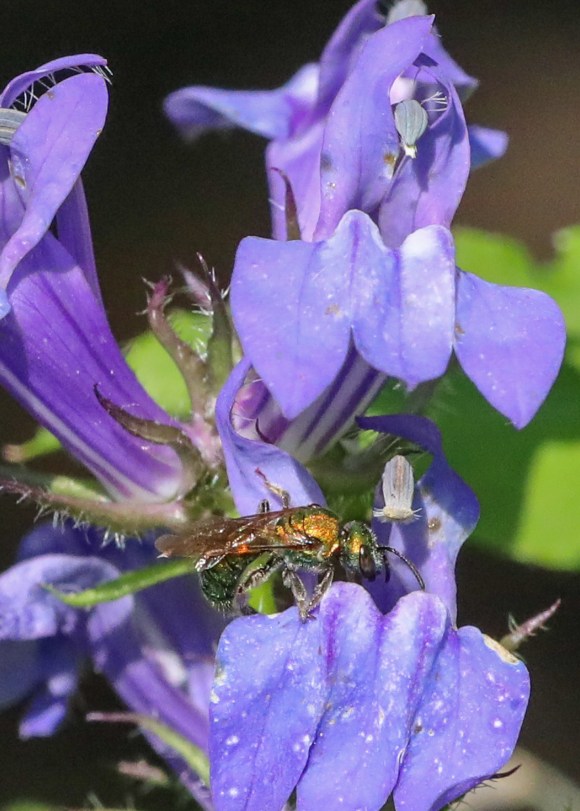
Augochlora pura is a stunning small bee that enjoys visiting this Lobelia.  Augochlora pura means pure golden green.  This metallic green sweat bee can be all green but can also have patches of copper, gold or very dark green that looks blue.7 

With an extremely long active season, A. pura usually flies from April to October.  In a warm year, you can see it from February to November.  This tiny bee gathers resources from diverse flowers including Maple tree flowers (Acer spp.), the Rosaceae family (apples, strawberries, cherries, roses, etc.), the Asteraceae family (asters, goldenrods, coreopsis, etc.), milkweeds, hydrangeas, spiderworts, verbena and others.7

Augochlora pura  has an unusual nesting strategy unlike the other Halictid bees.  They nest under loose bark of fallen trees.  Females glues together mud and debris from under the bark to make nesting cavities.7

She then gathers pollen on her hind legs and nectar.  Back at the nest, the female mixes pollen with nectar and her saliva.  The saliva may have antiseptic qualities.7  

When there’s enough food in a cavity, she lays an egg.  Each nest cell is lined with an impermeable lining produced by one of the bee’s glands.  This lining protects the egg and developing larva from predators.7  

Augochlora pura may have more than one generation in a growing season.  The final generation is in Fall.  Males and females hatch and mate.7

Males then die.  The females continue gathering resources and eating.  They build up fat to survive the long Winter hibernation.  Augochlora pura females overwinter in existing cavities in fallen rotting logs or wood stumps.4,7

Less common visitors include Ruby Throated Hummingbirds and large butterflies.  Although, in my garden, I often see hummingbirds nectaring at my Great Blue Lobelia.2

I hope you’ve enjoyed this deep dive into Great Blue Lobelia (Lobelia siphilitica).  I’d love to hear about your plant adventures in the garden or the wild!  Please feel free to contact me with a story, comment or question!

Happy Gardening,

Mary

Bibliography:

  1. “Great Blue Lobelia.” Accessed February 1, 2025. https://www.fs.usda.gov/wildflowers/plant-of-the-week/lobelia_siphilitica.shtml.
  2. “Great Blue Lobelia (Lobelia Siphilitica).” Accessed February 1, 2025. https://www.illinoiswildflowers.info/wetland/plants/gb_lobeliax.htm.
  3. “Great Blue Lobelia, Lobelia Siphilitica L.” Accessed February 1, 2025. https://friendsofeloisebutler.org/pages/plants/greatbluelobelia.html.
  4. Holm, Heather. Bees:  An Identification and Native Plant Forage Guide. Minnetonka, MN: Pollination Press LLC, 2017.
  5. “Lobelia Siphilitica – Plant Finder.” Accessed February 1, 2025. https://www.missouribotanicalgarden.org/PlantFinder/PlantFinderDetails.aspx?kempercode=i460.
  6. “Lobelia Siphilitica (Great Blue Lobelia) | Native Plants of North America.” Accessed February 1, 2025. https://www.wildflower.org/plants/result.php?id_plant=losi.
  7. “The Pure Golden Green Sweat Bee.” Accessed February 1, 2025. https://www.fs.usda.gov/wildflowers/pollinators/pollinator-of-the-month/augochlora_pura.shtml.
Categories
native plants Pollinator gardening

A Constellation of Blue

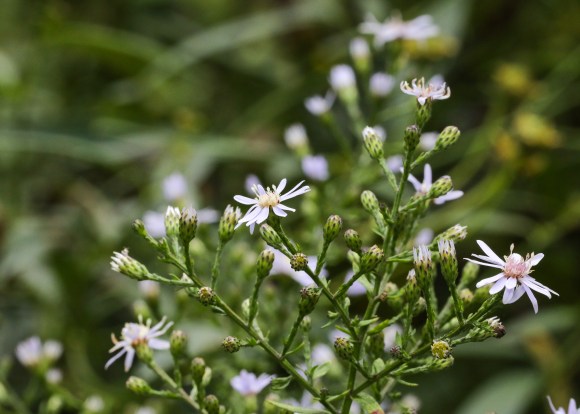
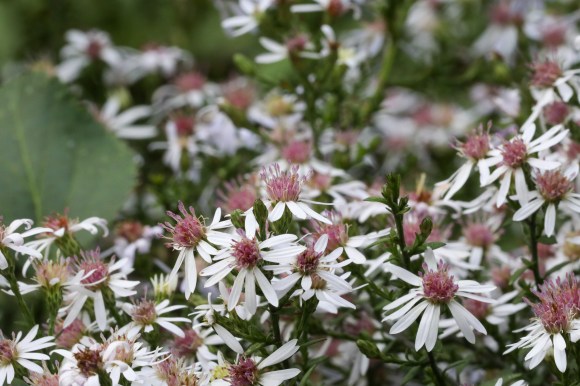
A constellation of pale blue flowers tops each Heart-Leaved Aster (AKA Blue Wood Aster or Symphyotrichum cordifolium).  Like all asters, it offers precious pollen and nectar to pollinators and beneficial insects at summer’s end.  The plant itself is a larval host for butterflies and moths.1

In nature, Heart-Leaved Aster grows in moist to dry deciduous woodlands, woodland borders, next to woodland paths, rocky wooded slopes, upland meadows, thinly wooded bluffs, shaded stream banks, and upland forests.1,5

Highly adaptable, Symphyotrichum cordifolium accepts clay, loam and sandy soils.  It grows from one to three feet tall and spreads from eighteen inches to two feet.  This aster thrives in zones three to eight.  It grows in light shade to part sun and moist to dry conditions.1

The leaves of Symphyotrichum cordifolium are highlighted by its scientific name.  Unlike the thin, lance-shaped leaves of most asters, this plant has broader, heart shaped ones.  Cordifolium  means heart-shaped and (cordi-)  means leaves (folium).  And so, the Heart-Leaved Aster!  

The leaves can reach five inches long and three inches across.  They become smaller moving up the plant. The lower leaves are fully heart-shaped (or cordate).  But the upper leaves become more oval and may be fully ovate.  They are medium green and smooth.1

The flowerheads are the highlight of the Heart-Leaved Aster!  Ranging from six inches to eighteen inches long, these conical heads shine with lavender, light-blue violet or white florets.  Each of these half inch florets has seven to fifteen petals (ray florets) and a yellow center of disc florets.1  

Once the disc florets are fertilized, the center turns a mauve pink adding visual interest to the flowerhead.  Floral bracts cover the base of each floret.  The bracts are pale with dark green tips.1

One of the first natives in my garden, I’ve grown this plant for close to 20 years.  I’ve always found is covered with flowers, pollinators and beneficials of all kinds.  That said, it has a few challenges.

It spreads by runners and by self-seeding.  When Heart-Leaved Aster’s happy, it can really colonize a garden.  It is easy to pull, and you can clip the seed heads to prevent self-seeding.1

Poorly drained soil can lead to powdery mildew, leaf spots and rust.  If the weather is too hot and dry, this aster often loses its lower leaves.  I plant it in the middle of the bed.  This location hides leaf loss and helps cover any trouble on the other leaves.4

Finally, like other asters, herbivores love it.  Rabbits, deer, ground hogs, etc., eat it, especially in the Spring.  Use whatever repellents preferred.  I also plant asters among plants animal don’t like, such as, iris.

The free herbivore pruning helps later in season though.  In fact, Symphyotrichum cordifolium benefits from pruning back several times before mid-summer.  This attention helps increases bushiness, controls height and might even eliminate the need to stake it!4

Heart-Leaved Aster draws crowds of pollinators and beneficial insects.  Like all Symphyotrichum, it is a keystone plant.  There are two types of keystone species:  one type acts as hosts for butterfly and moth caterpillars and the other feeds specialist bees.  The bee associated keystone plants also serves generalist bees.  Asters are both.2

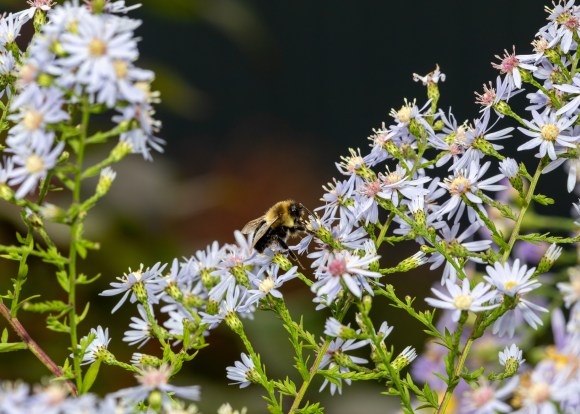
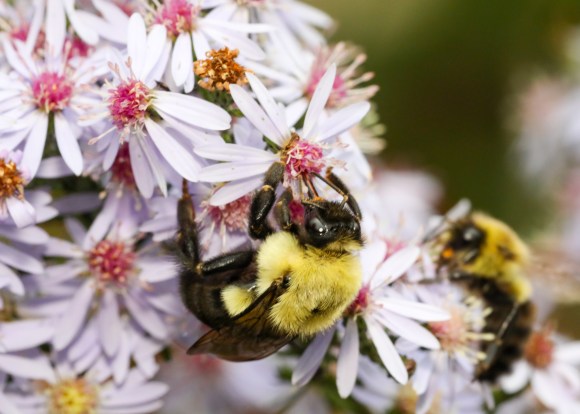
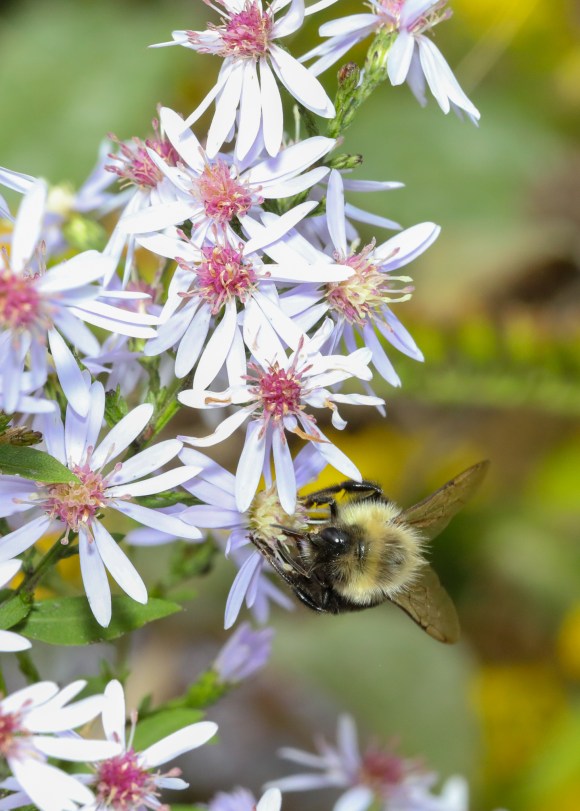
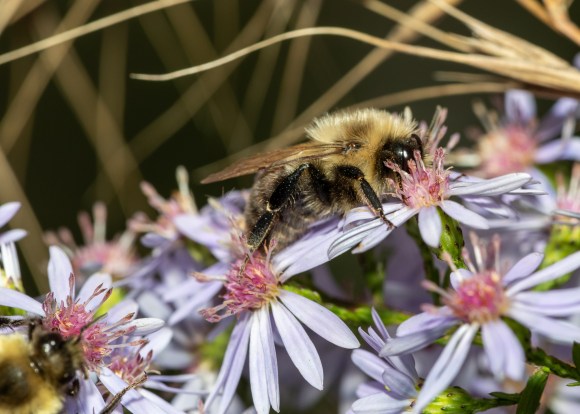
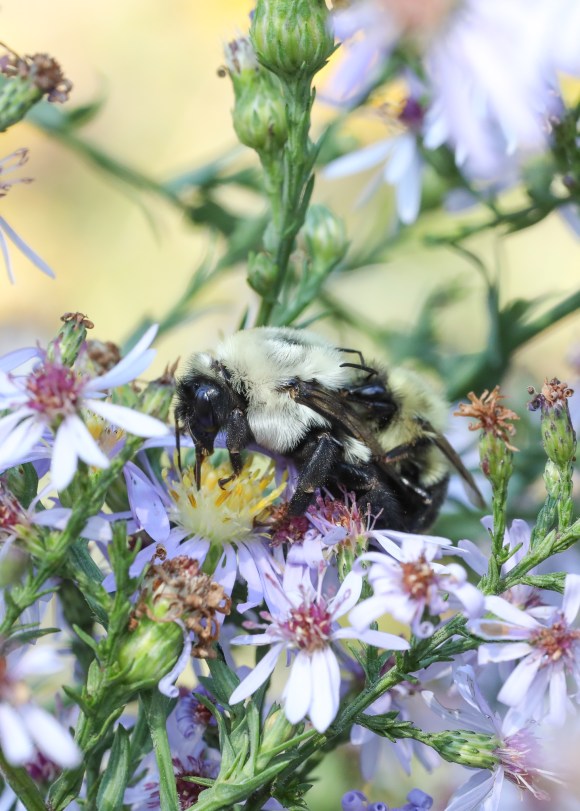
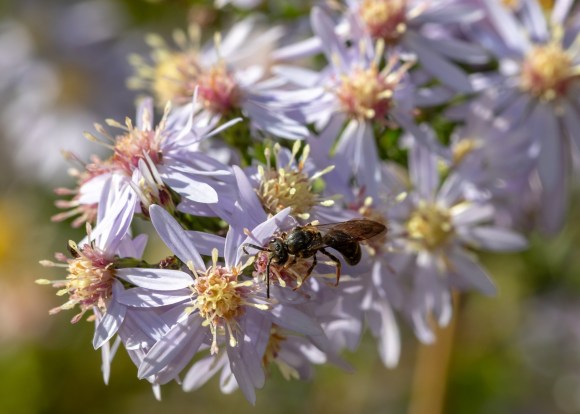
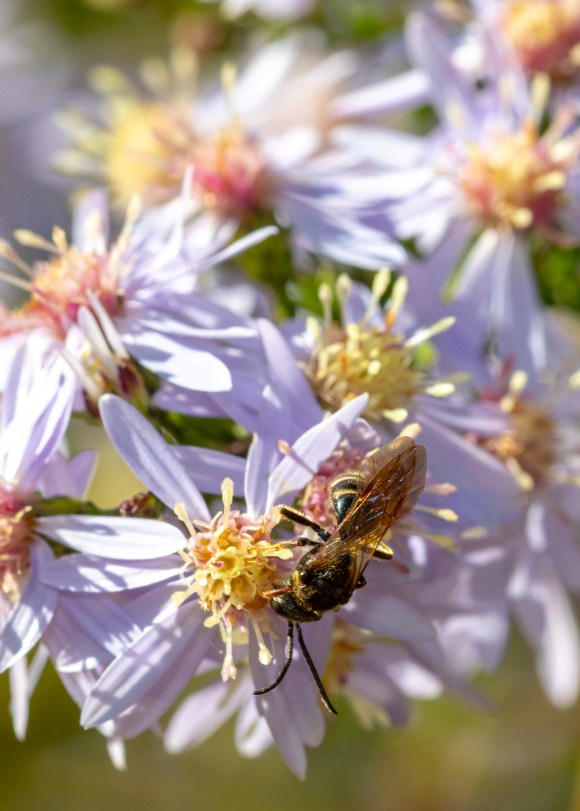
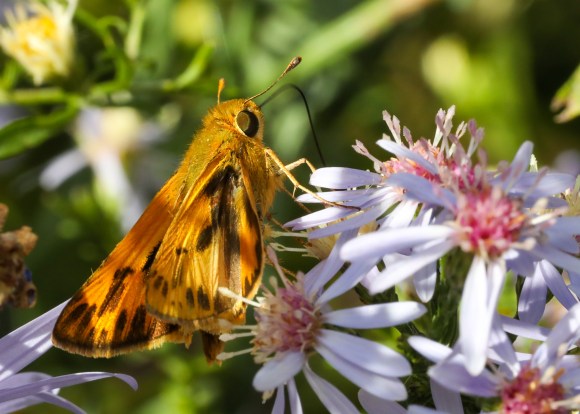
Long-tongued bees, short-tongued bees, butterflies, moths, skippers, wasps and beetles all seek out its nectar and pollen.  The Xerces Society for Invertebrate Conservation designate Symphyotrichum cordifoliumof Special Value to Native Bees and state it Supports Conservation Biological Control.  Bumblebees find it especially helpful.1,6 

S. cordifolium blooms when new bumblebee queens emerge, males hatch and mating flights occur.  I find males sleeping on the plants on cool late summer and early autumn mornings.  The flowers provide important energy resources for successful mating flights and overwintering queens.

Heart-Leaved Aster support many specialist bees.  As a keystone plant for pollen specialist bees, the Symphyotrichum genus feeds several mining bees in the Andrena genus.   Specifically, these include Andrena (Callandrena s.l.) asteris, Andrena (Callandrena s.l.) asteroides, Andrena (Cnemidandrena)hirticincta, Andrena (Cnemidandrena) nubecula, Andrena (Callandrena s.l.) placata, Andrena (Callandrena s.l.simplex, and Colletes simulans.5

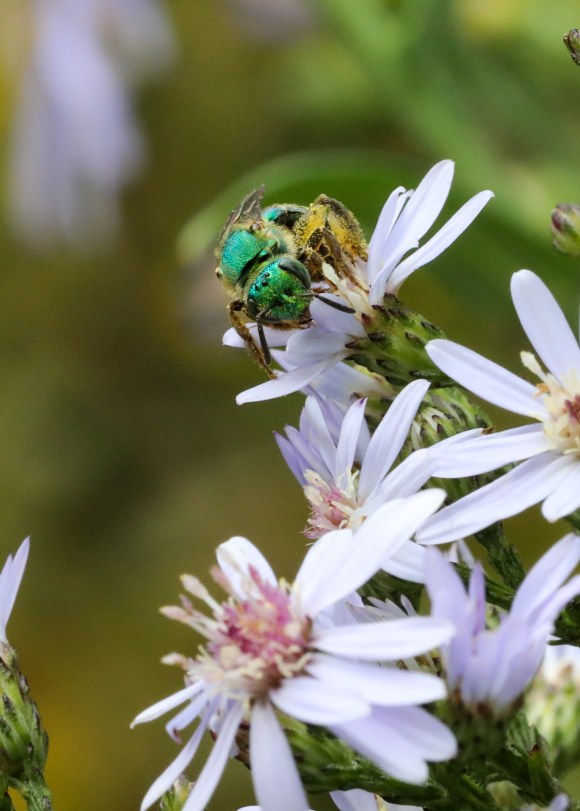
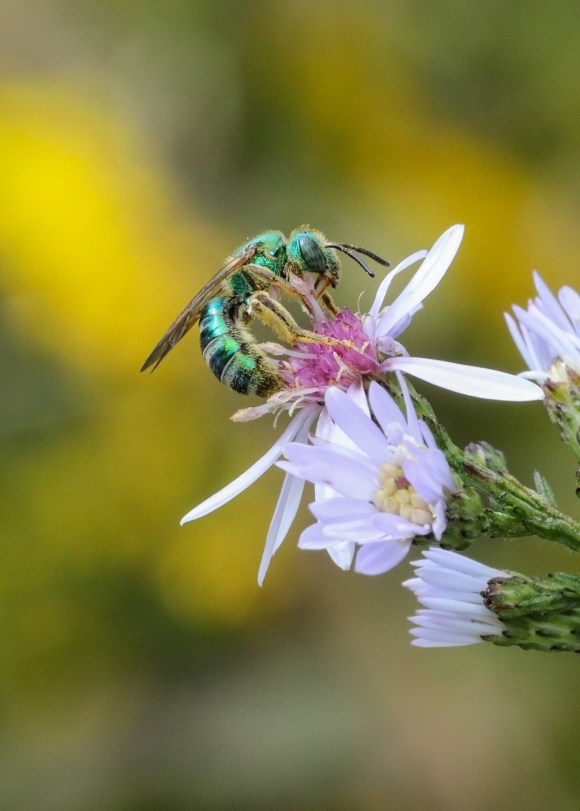
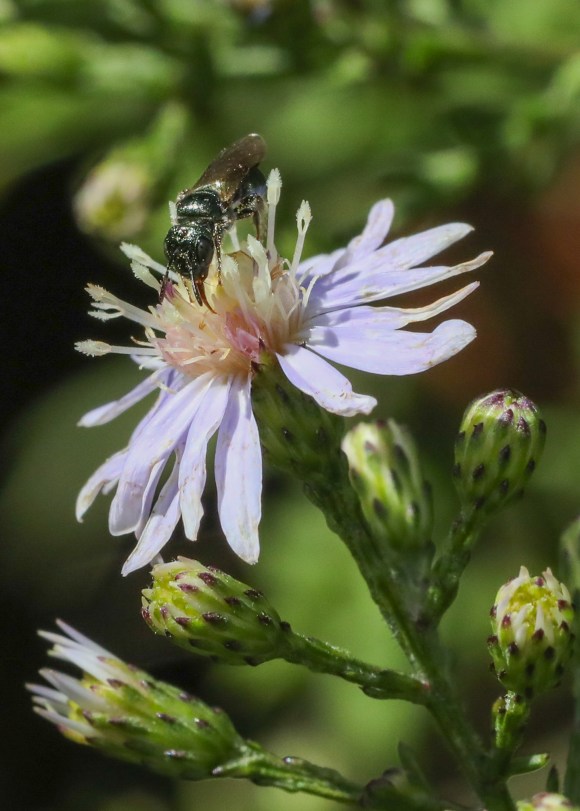
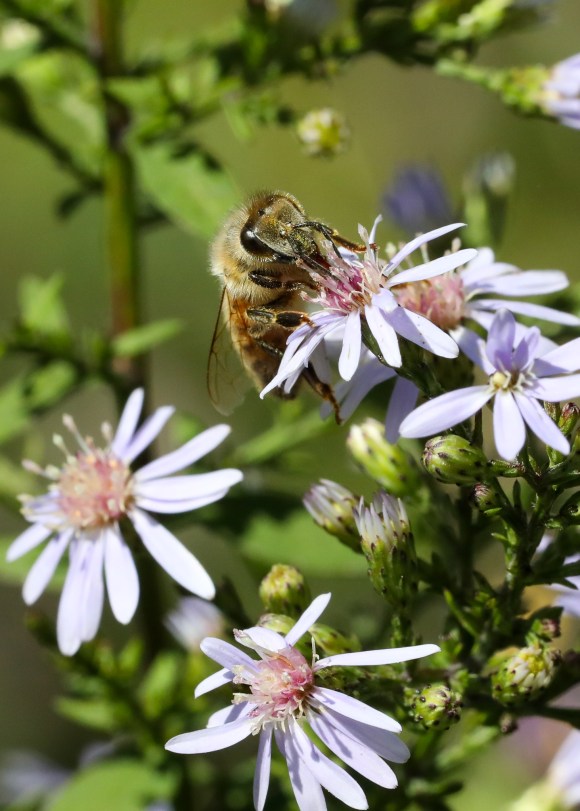
Heart-Leaved Aster is also visited by metallic green sweat bees, Halictus (sweat bees), Ceratina (small carpenter bees) and honeybees (Apis).

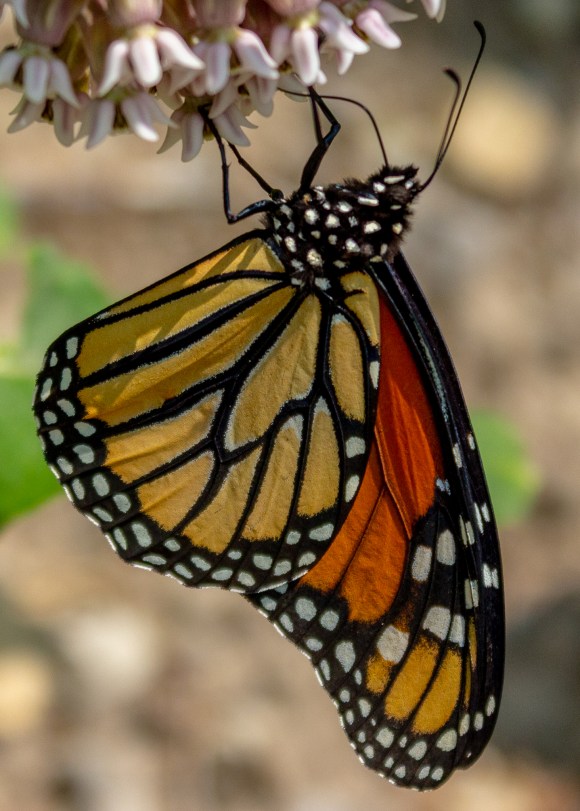
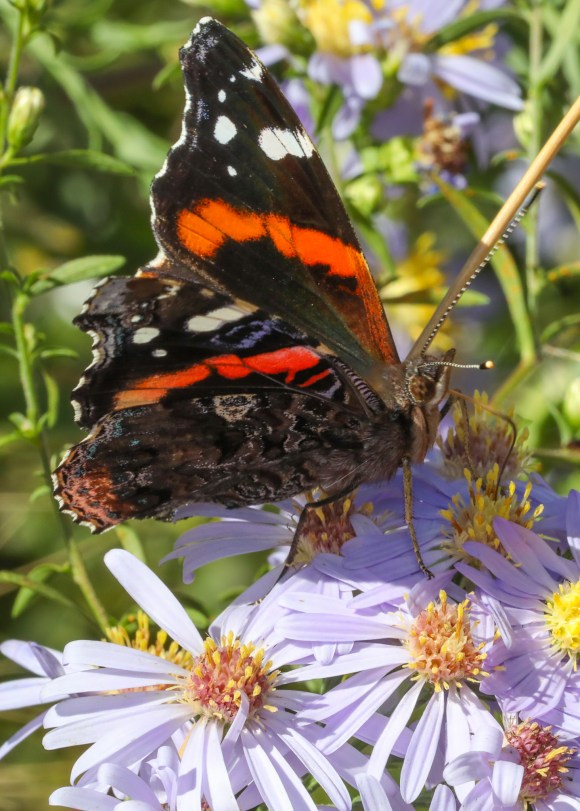
Numerous adult butterflies and skippers nectar at the Heart-Leaved Asters including migrating Monarchs (Danaus plexippus) and Red Admirals (Vanessa atalanta).  In its role as a keystone plant, it feeds many caterpillars from butterflies and, especially, moths.  Different larvae eat every part of the plant.1

By supporting moths, Symphyotrichum cordifolium contributes to pollination of wild plants overall.  Some flowers evolved a plant pollinator relationship with moths.  These flowers usually open at night, are white or pale, and have a stronger fragrance at night.  Moths use scent to find food and mates.  Yucca is a well-known example.7  

However, moths provide much more extensive pollination services.  Like generalist bees, some moths also visit different types of flowers.  Most of these plants aren’t larval hosts.  Some are also pollinated by bees.  When they’re bee pollinated, moths supplement the bee’s work.7

In addition, moths are more efficient than bees in some cases.  In the past, studies only measured pollen on mouthparts.  But moths carry a lot of pollen on their hairy underbelly.  When they land on a flower, their belly presses against the stigma to transfer pollen.7,8

Moths usually fly over longer distances than bees.  Bees tend to stay near their nest when possible.  Moths add genetic diversity by bringing pollen from distant plant populations.7

A variety of moth and butterfly caterpillars use Symphyotrichum cordifolium.  Different larvae eat flowers, seeds, and leaves while others bore through stems and/or roots.  I’ve detailed some different species and which plant parts they eat in the next few paragraphs.3

Chlosyne nycteis (Silvery Checkerspot butterflies) and Phyciodes tharos (Pearl Crescent butterflies) consume foliage.  Some moths also devour the leaves, such as, Pale-Banded Dart (Agnorisma badinodis(syn. Xestia badinodis)), Sharp-Stigma Looper Moth (Ctenoplusia oxygramma (syn. Agrapha oxygramma)), Halloween Paint (Cucullia alfarata), Rusted Paint (Cucullia postera), Confused Eusarca (Eupithecia confusaria), Lost Sallow (Euplexia devia), Green Leuconycta (Leuconycta diphteroides), Small Brown Quaker (Pseudorthodes vecors) and Dimorphic Gray (Tornos scolopacinarius).3

Leaf miners include Gracillarlid Moth sp. (Acrocercops astericola), Tischeriid Moth sp. (Astrotischeria astericolaI), Scythridid Moth sp. (Landryia impositellaI) and Bucculatricid Moth sp. (Bucculatrix staintonella).3

Some feed on developing seeds and/or flowers including Blackberry Looper (Chlorochlamys chloroleucaria), White-Dotted Groundling (Condica videns (syn. Platysenta videns)), Common Pug (Eupithecia miserulata), Spotted Straw (HeIliothis turbatus), Tortricid Moth sp. (Phaneta parmatana), Tortricid Moth sp. (Phaneta tomonana), Common Tan Wave (Pleuroprucha insulsaria), Arcigera Flower Moth (Schinia arcigera), Goldenrod Flower Moth (Schinia nundina), Northern Flower Moth (Schinia septentrionalis), Wavy-Lined Emerald (Synchlora aerate) and Striped Garden Caterpillar (Trichordestra legitima).  Some moths consume foliage in addition to developing seeds and/or flowers.  These include Black Arches (Melanchra assimilis) and Dark-Spotted Palthis (Palthis angulalis).3

And finally, moth larva that bore through stems and/or roots are  Aster Borer Moth (Carmenta corn) , Tortricid Moth sp. (Eucosma robinsonana), Burdock Borer Moth (Papaipema cataphracta), Aster Borer Moth (Papaipema impecuniosa), Tortricid Moth sp. (Phaneta essexana) and Tortricid Moth sp. (Sonia canadana).3 

I hope you enjoyed this look at the Heart-Leaved Aster as much as I have.  I’d love to hear about your plant adventures in the garden or the wild!  Please feel free to contact me with a story, comment or question!

Happy Gardening,

Mary

Bibliography:

  1. “Blue Wood Aster (Symphyotrichum Cordifolium).” Accessed December 1, 2024. https://www.illinoiswildflowers.info/woodland/plants/bl_woodaster.htm. Accessed December 1, 2024.
  2. “Keystone Native Plants:  Eastern Temperate Forests-Ecoregion 8.” https://www.nwf.org/-/media/Documents/PDFs/Garden-for-Wildlife/Keystone-Plants/NWF-GFW-keystone-plant-list-ecoregion-8-eastern-temperate-forests.ashx?la=en&hash=1E180E2E5F2B06EB9ADF28882353B3BC7B3B247D
  3. “Moth Table (Symphyotrichum Spp.).” Accessed December 1, 2024. https://www.illinoiswildflowers.info/woodland/tables/table29.html.
  4. “Symphyotrichum Cordifolium – Plant Finder.” Accessed December 1, 2024. https://www.missouribotanicalgarden.org/PlantFinder/PlantFinderDetails.aspx?kempercode=a788.
  5. “Symphyotrichum Cordifolium (Blue Wood Aster, Common Blue Wood Aster, Heart-Leaved Aster) | North Carolina Extension Gardener Plant Toolbox.” Accessed December 1, 2024. https://plants.ces.ncsu.edu/plants/symphyotrichum-cordifolium/.
  6. “Symphyotrichum Cordifolium (Broad-Leaved Aster) | Native Plants of North America.” Accessed December 1, 2024. https://www.wildflower.org/plants/result.php?id_plant=syco4.
  7. Xerces Society. “The Night Shift: Moths as Nocturnal Pollinators.” Accessed December 1, 2024. https://xerces.org/blog/the-night-shift-moths-as-nocturnal-pollinators.
  8. “Moths are more efficient pollinators than bees, shows new research.”  Accessed December 1, 2024. Ellis, Lauren, https://www.sussex.ac.uk/broadcast/read/60568.