Categories
Pollinator gardening

Furry Little Tails

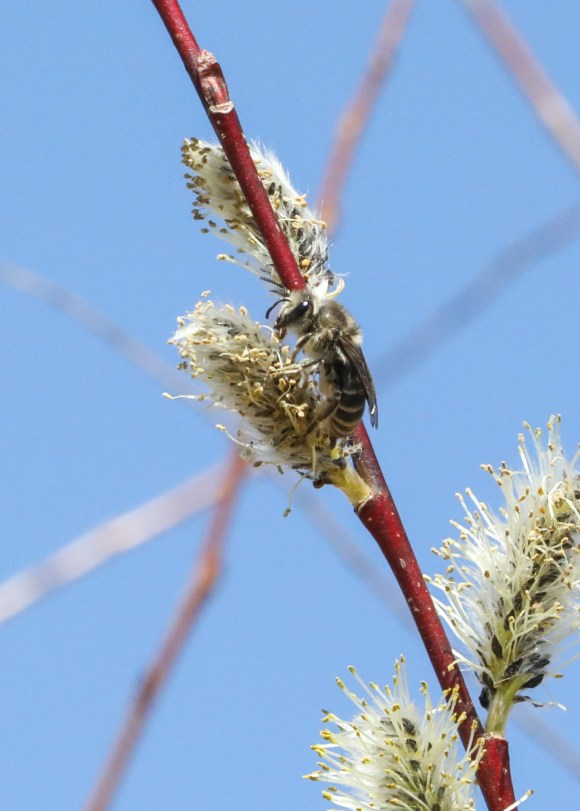
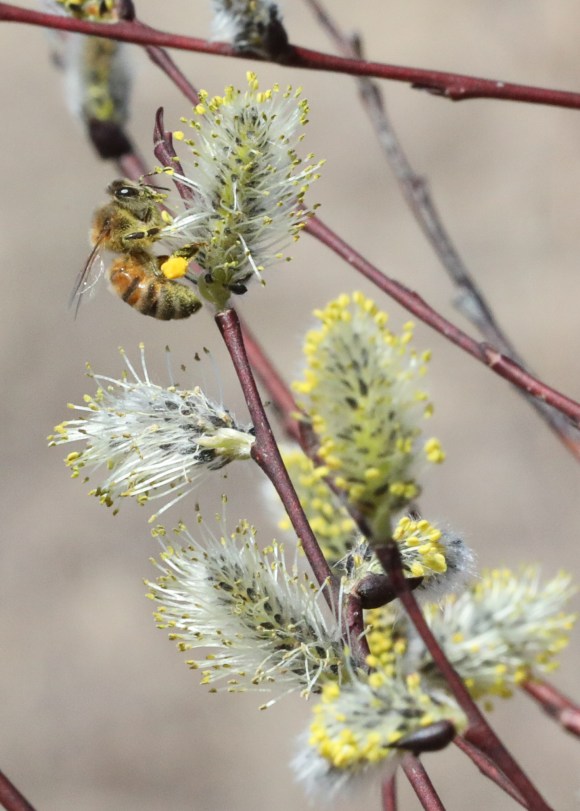
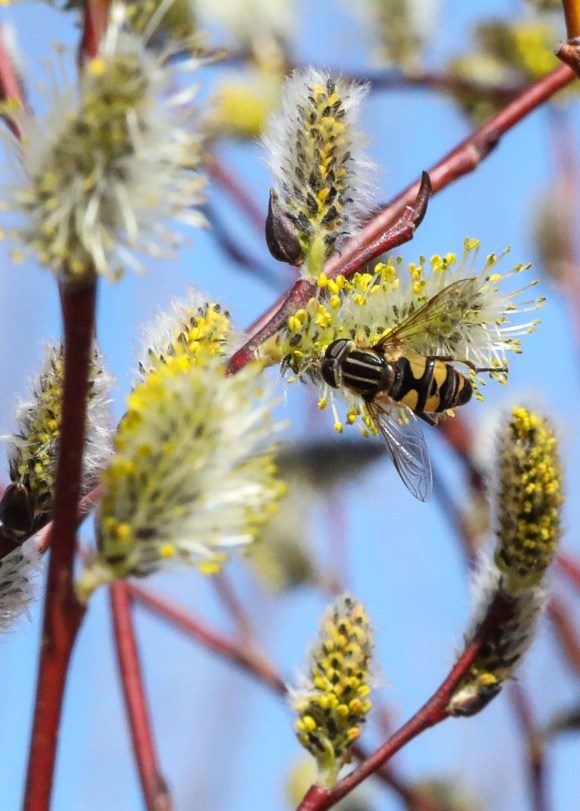
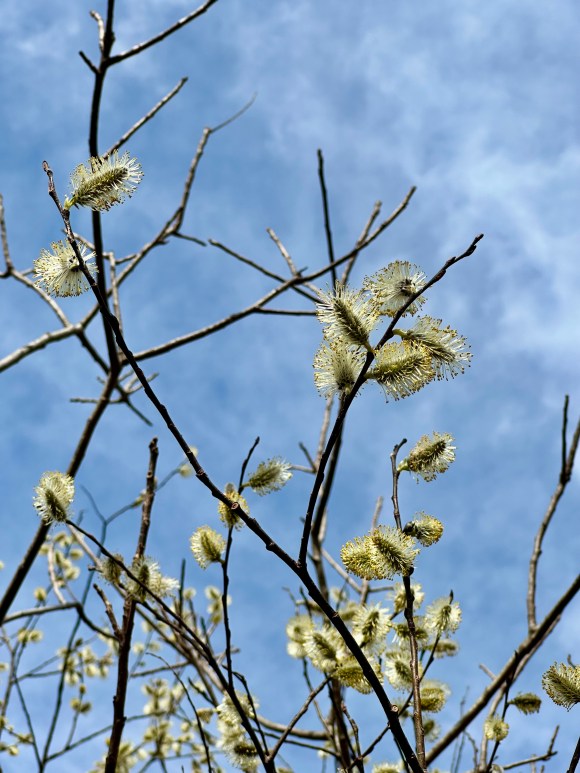
Just as the snow disappear, the small bumps on Pussy Willow (Salix discolor) branches lengthen into soft, furry, gray catkins.  Soon they burst into bright yellow blooms before spring ephemerals and other early trees and shrubs.  Their nectar and pollen draw early bees, flies, wasps, adult butterflies and other insects. 4,9

 Later, this willow is a larval host to many butterflies, moths and skippers.  In addition, many insects feed on and/or use this plant.  The caterpillars and insects support an abundance of bird life especially during nesting season.9

Salix discolor thrives in zones 2 through 8.  It generally grows from 6 to 15 feet and spreads from 4 to 12 feet.  For a smaller shrub, cut it back every 3 to 5 years after flowering.  This pruning encourages lots of new growth.5,6

Pruning is especially important when Salix is growing in wet conditions.  Pussy willow forms suckers freely.  Cutting helps control the suckers also.5,6,7

Pussy willows love wet soils but do tolerate medium moisture soils.  They grow in sandy and non-sandy soils with around neutral pH and some decaying matter.  Salix discolor enjoys part to full sun.  They’re resistant to deer, erosion and Black Walnuts (Juglans nigra).5,6
Its natural habitats include soggy thickets, fens, wet prairies, low ground, floodplain forests, marshes, low areas along rivers and other bodies of water, ditches, and shrub swamps.  If too many trees grow, the Pussy Willows die out.9

Salix discolor has male and female flowers on different shrubs, also called dioecious.  Males are yellow with pollen, females are green. The specific epithet discolor comes from the two different colored flowers.  Blooms develop on second year twigs.7,9

The male bloom starts as a furry pearl-gray catkin.  The soft dense hairs protect the florets from the cold.  As they open, tight round stamens poke through the fur.  When the stamens are fully extended, the male blossoms turn bright yellow.  Each floret has 2 stamens. The catkin grows up to 1 inch long.9
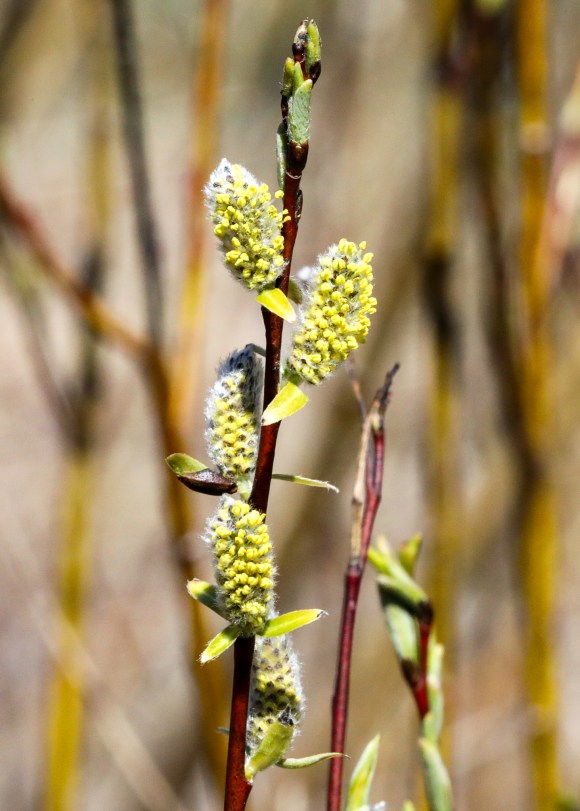
Spikey and green, the female catkins mature from 1 to 4 inches long.  Each floret has 1 pistil with a pair of tiny stigmata at the top.  The pistil forms a narrow lance-like shape and had tiny, fine, grayish-white hairs.9

Pussy Willow leaves are more oval than other willows.  They grow up to 4 inches long and 1.5 inches across and alternate on the stem.  The edges are irregularly toothed to smooth.  The leaves themselves are medium to dark green and hairless on top.  Underneath, they are hairless, covered with a greenish-white bloom and whitened.  Petioles are up to ¾ inches long and range from smooth to slightly hairy.9  

A few plant facts:  some petioles have stipules where they join the stem.  A stipule is a small structure at the base of a leaf and can be helpful in identifying a plant.  Pussy Willow have largish stipules on both sides of the petiole—1/4 inch long and across.  They are heart-shaped and toothed or lobed.

Salix discolor is a handful.  It’s known to grow tall and wide.  Why choose it for you garden?
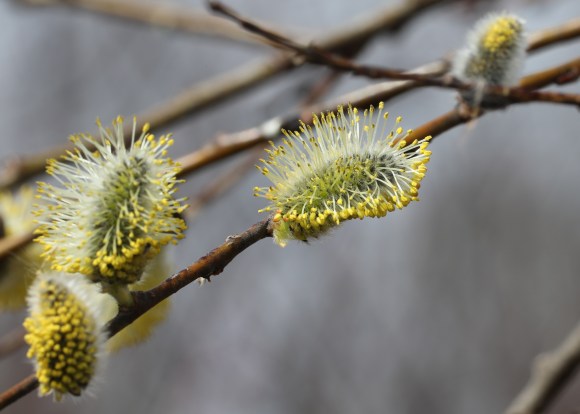
S. discolor is a keystone plant and an outstanding one at that. For the Eastern Temperate forests, my area, Salix spp. appears on the Top Keystone Plant Genera list, Top 30 Keystone Plant Genera for Butterfly and Moth Caterpillars and Top 30 Native Host plants for Pollen Specialist Bees.  Keystone plants play an essentially role in their Ecoregions sustaining generalist and specialist pollinators.4

The Xerces Society for Invertebrate Conservation designates Salix discolor as of Special Value to Native Bees, Special Value to Bumble Bees and Special Value to Honey Bees.  While this Willow can become large, it is possible to contain it to a smaller site.  Other native Willows are trees which become much taller and aren’t suited to compact areas.6

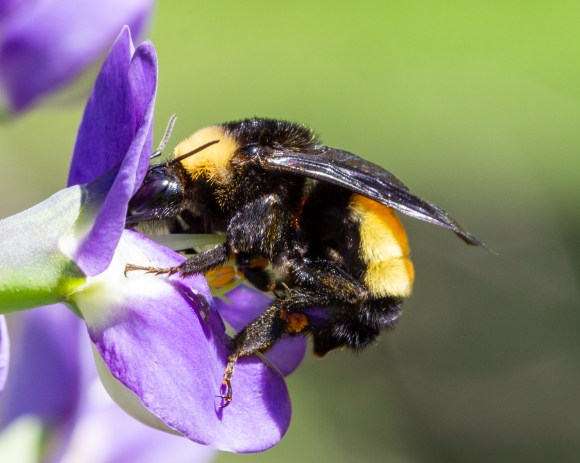
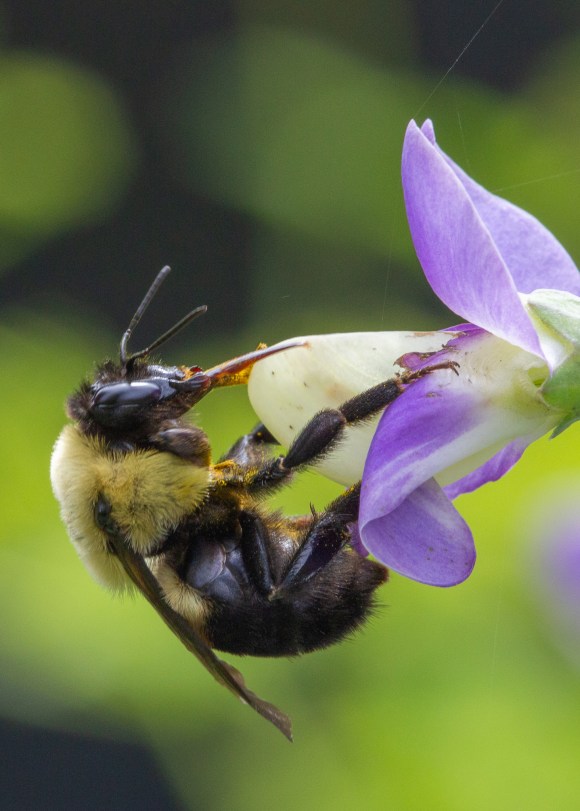
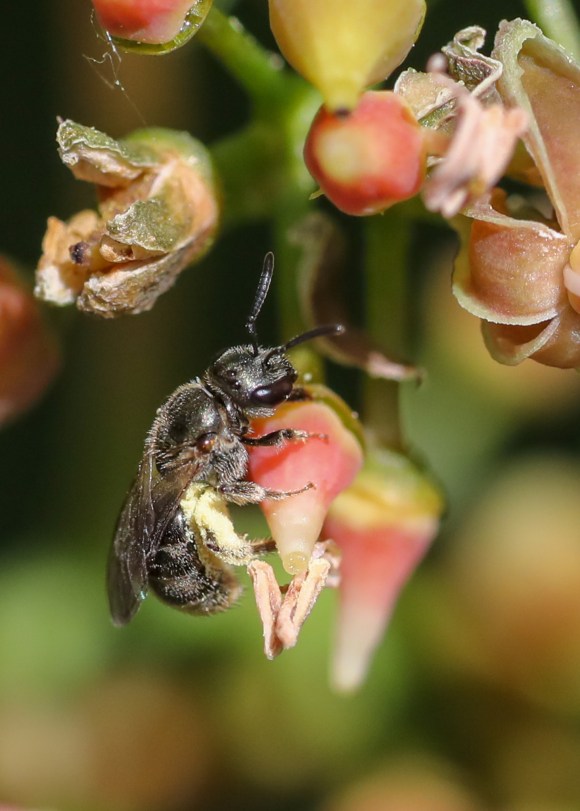
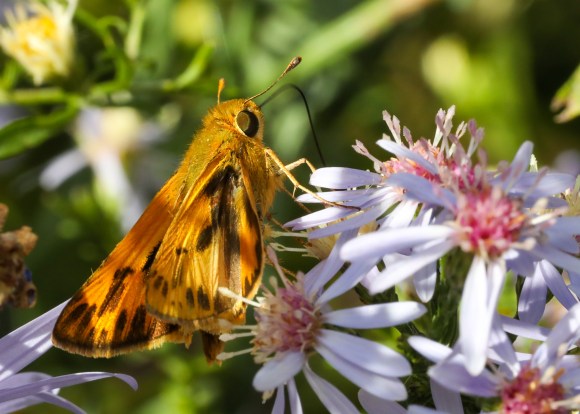
A note to readers:  Usually I use all my own photos for my blogs.  Sadly, I don’t have all the images I want for this month.  I’ll be including pictures of pollinators and other insects on other plants and some stock photos.  Thank you for your patience!

Insects are abundant on the Pussy Willow.  Many pollinators feed on the nectar and pollen.  Bee guests include honeybees, bumblebees, little carpenter bees (Ceratina spp.), cuckoo bees (Nomada spp.), mason bees (Osmia spp.), Halictid bees (including green metallic bees) and Andrenid bees (Andrena spp).
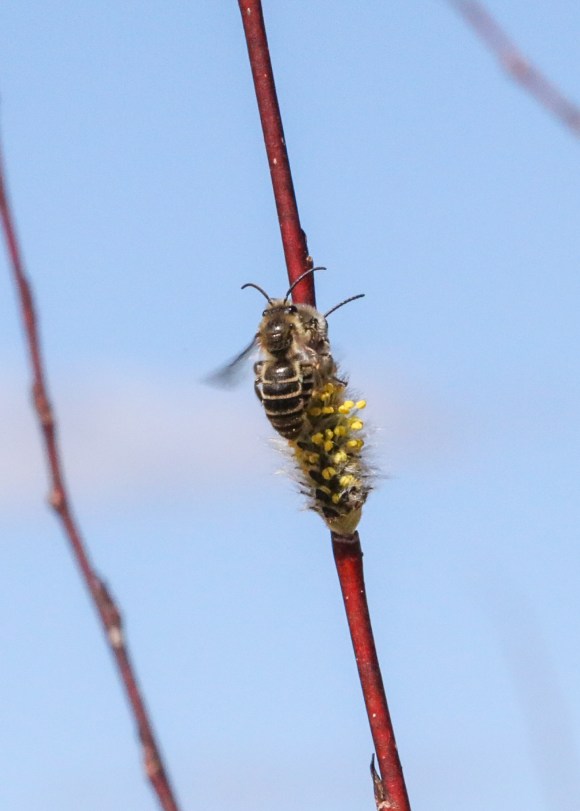
Several Andrenid bees are specialists of willows.  Specialists (aka oligoleges) collect pollen from only one genus or species or only a few genera or species.  These Andrenid bees include:  Andrena (Parandrena) andrenoides, Andrena (Thysandrena) bisalicis, Andrena (Tylandrena) erythrogaster, Andrena (Andrena) frigida, Andrena (Micrandrena) illinoiensis, Andrena (Andrena) macoupinensis, Andrena (Trachandrena) mariae, Andrena (Parandrena) nida, Andrena (Micrandrena) nigrae, Andrena (Micrandrena) salictaria, Andrena (Parandrena) wellesleyana.7,9
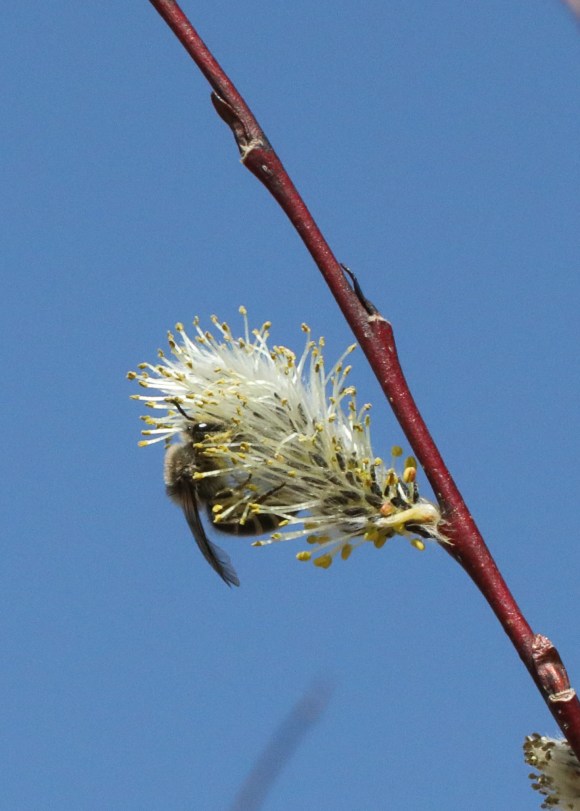
In addition to these oligoleges, generalists also collect resources from Salix discolor.  Honeybees and bumblebees are among them.
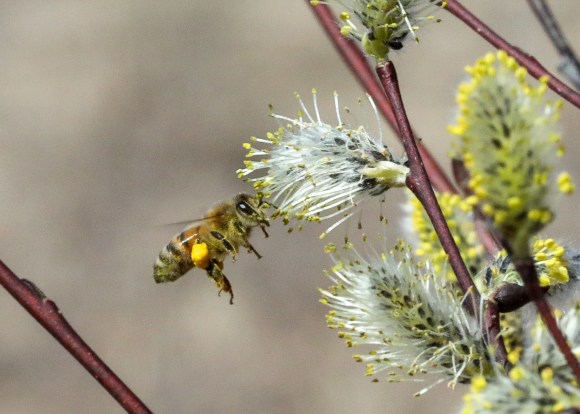
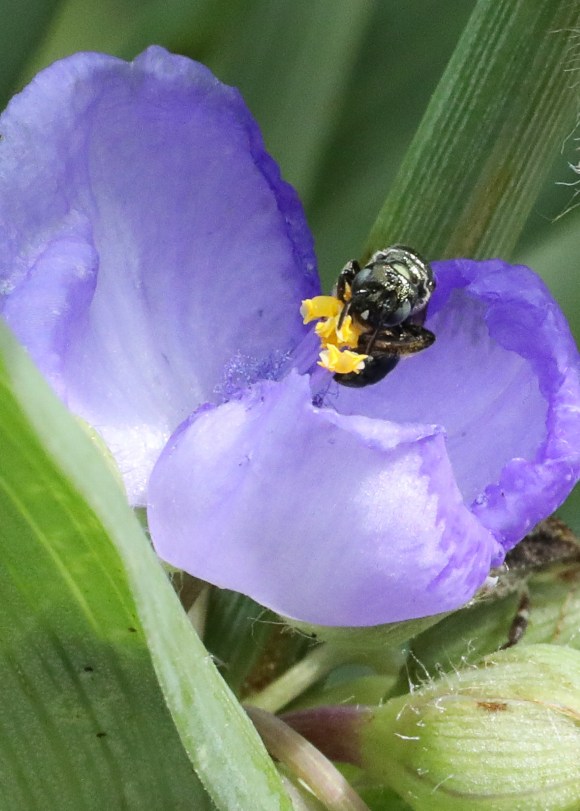
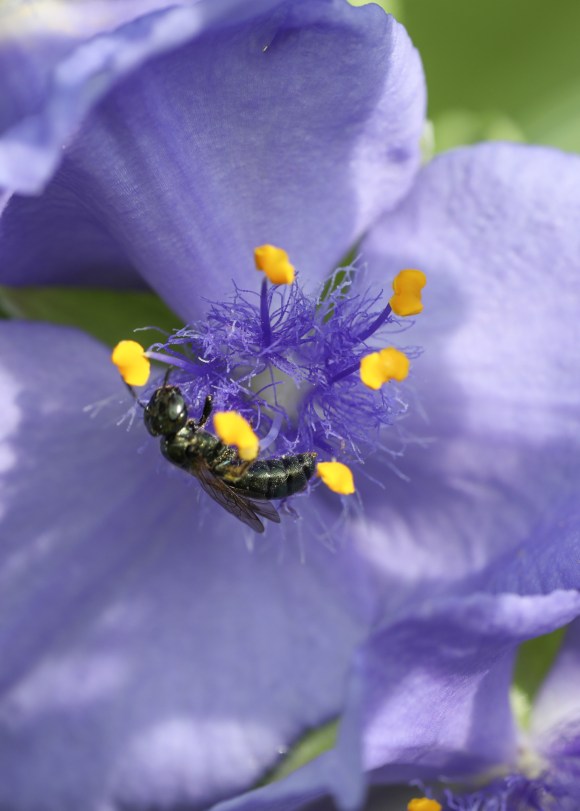
Small bees gather pollen and nectar from Pussy Willows including little carpenter bees (Ceratina spp.), mason bees (Osmia spp.) and Halictid bees (including green metallic sweat bees).
Ichneumonid wasps harvest pollen and nectar from  S. discolor.  These parasitoid wasps prey on immature stages of many insects and spiders.  They help control populations in natural and semi-natural systems.2

Willows are larval hosts for 289 different species of butterflies, skippers and moths.  Examples include many butterflies (i.e., Nymphalis spp. and Polygonia spp. ),  hairstreak butterflies (Satyrium spp.), Viceroy butterflies (Limenitis archippus) and other brush-footed butterflies (Nymphalidae).4,9

The Viceroy has a special relationship with willows.  Its larvae feed at night on the catkins and then the leaves after flowering.  Unlike other butterflies, adults don’t visit flowers.  They drink from tree sap, rotting fruit, honeydew-an excretion from aphids, animal droppings, and mud puddles.8

Large leaf being eaten by viceroy butterfly caterpillar

Honeydew is an excretion from sap-eating aphids.  These aphids concentrate the sap they drink to harvest the protein.  They excrete the excess liquid and sugars as honeydew.  Willows host 22 species of aphids providing an excellent place for Viceroys to hunt for food.3,8

Viceroy Butterfly feeding on nectar from a wildflower.

Moth larvae also consume Salix spp. including tiger moths (Arctiidae), Geometer moths, leaf blotch miner moths (Gracillariidae), slug caterpillar moths (Limacodidae), Lyonet moths, owlet moths (Noctuidae), prominent moths (Notodontidae), giant silk moths (Saturniidae), and Sphinx moths (Sphingidae).9

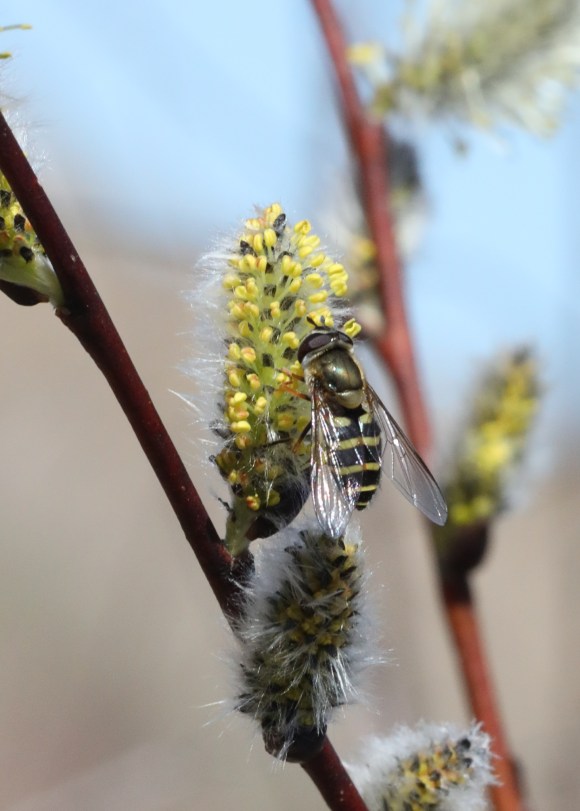
In addition, hordes of other kinds of insects use willows in various ways.  Among these are flies, beetles, borers, weevils, gall flies, various true bugs, thrips, sawflies, and 22 different kinds of aphids.  You can see a full list in the Insect Table from Illinois Wildflowers (https://www.illinoiswildflowers.info/trees/tables/table65.html).3  
OK, this doesn’t sound like great news.  But, because of all these insects, birds gather many resources from willows.  Wood Duck, Northern Pintail, Mallard, Common Redpoll, Evening Grosbeak, Pine Grosbeak, American Goldfinch, Common Grackle, and Ruffed Grouse all visit willows.  (Bird Table, https://www.illinoiswildflowers.info/trees/tables/table66.html)1

Even Salix discolor’s rapid growth is good news.  A variety of animals use or consume parts of the willow.  Prairie Voles, Meadow Voles, Fox Squirrels and Black Bears eat leaves, buds and/or catkins.  Cottontail Rabbits and Muskrats feed on the bark.  Beavers eat bark and wood and use the branches for dams and lodges.    Snapping Turtles and Wood Turtles forage on fallen leaves.9

There’s so much life around the Pussy Willow!  From the very beginning of Spring through the year, this shrub nurtures insects and animals.  What a grand addition to any garden!

I hope you enjoyed this blog!  Please send me your stories and questions. I’d love to hear from you!

Happy Gardening!

Mary

Bibliography:

  1. “Bird Table (Salix Spp.).” Accessed April 30, 2025. https://www.illinoiswildflowers.info/trees/tables/table66.html.
  2. Missouri Department of Conservation. “Ichneumon Wasps.” Accessed April 30, 2025. https://mdc.mo.gov/discover-nature/field-guide/ichneumon-wasps.
  3. “Insect Table (Salix Spp.).” Accessed April 30, 2025. https://www.illinoiswildflowers.info/trees/tables/table65.html.
  4. National Wildlife Federation. “Keystone Native Plants, Eastern Temperate Forests-Ecoregion 8.  Accessed April 29, 2025.  https://www.nwf.org/-/media/Documents/PDFs/Garden-for-Wildlife/Keystone-Plants/NWF-GFW-keystone-plant-list-ecoregion-8-eastern-temperate-forests.ashx?la=en&hash=1E180E2E5F2B06EB9ADF28882353B3BC7B3B247D
  5. “Salix Discolor – Plant Finder.” Accessed April 28, 2025. https://www.missouribotanicalgarden.org/PlantFinder/PlantFinderDetails.aspx?kempercode=c808.
  6. “Salix Discolor (Pussy Willow) | Native Plants of North America.” Accessed April 28, 2025. https://www.wildflower.org/plants/result.php?id_plant=sadi.
  7. “Salix Discolor (Pussy Willow) | North Carolina Extension Gardener Plant Toolbox.” Accessed April 28, 2025. https://plants.ces.ncsu.edu/plants/salix-discolor/.
  8. Missouri Department of Conservation. “Viceroy,” January 31, 2024. https://mdc.mo.gov/discover-nature/field-guide/viceroy.
  9. “Pussy Willow (Salix Discolor).” Accessed April 28, 2025. https://www.illinoiswildflowers.info/trees/plants/pussy_willow.htm.
Categories
native plants Pollinator gardening

A Constellation of Blue

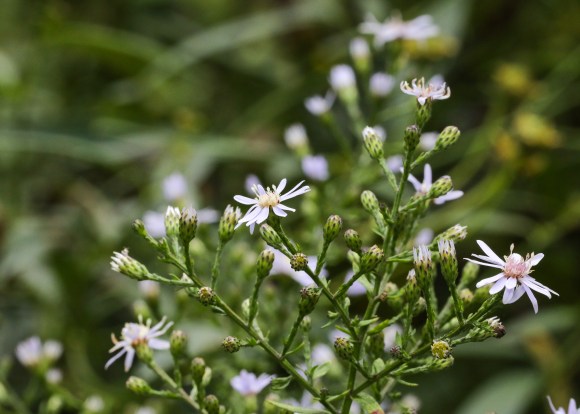
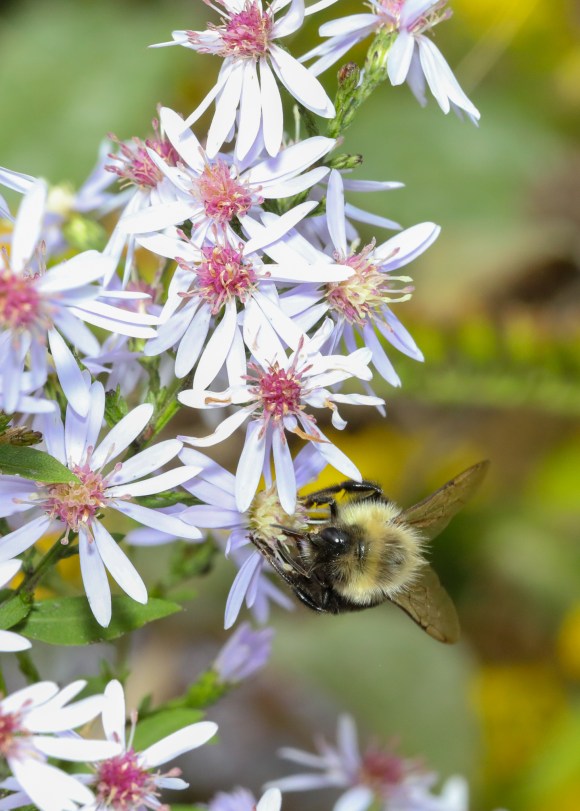
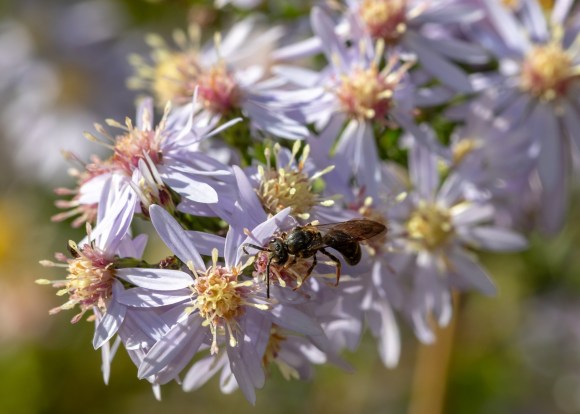
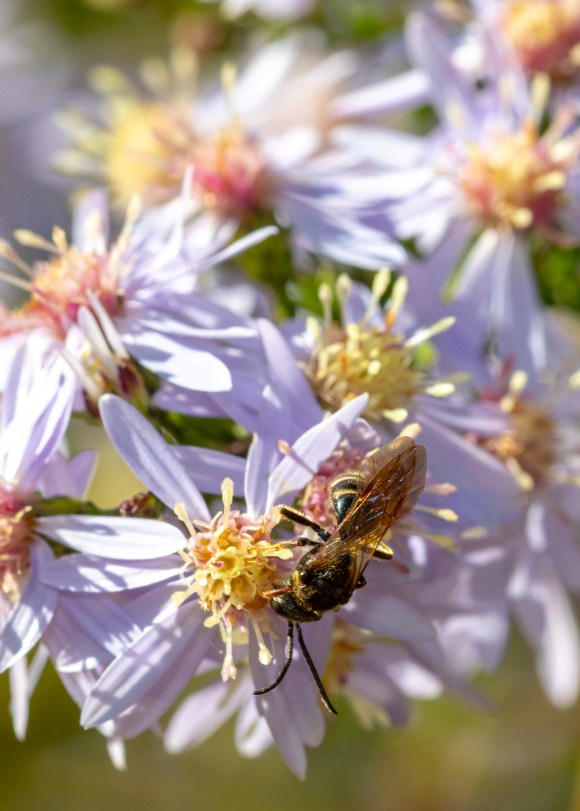
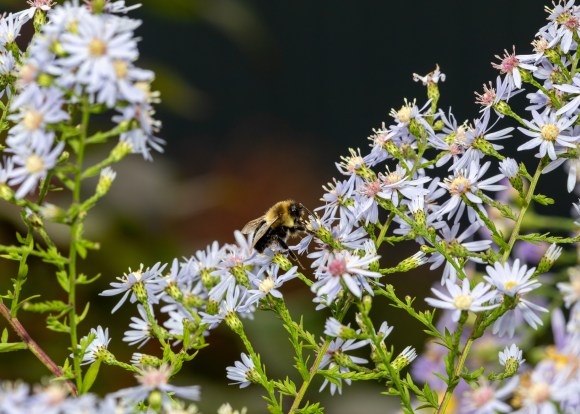
A constellation of pale blue flowers tops each Heart-Leaved Aster (AKA Blue Wood Aster or Symphyotrichum cordifolium).  Like all asters, it offers precious pollen and nectar to pollinators and beneficial insects at summer’s end.  The plant itself is a larval host for butterflies and moths.1

In nature, Heart-Leaved Aster grows in moist to dry deciduous woodlands, woodland borders, next to woodland paths, rocky wooded slopes, upland meadows, thinly wooded bluffs, shaded stream banks, and upland forests.1,5

Highly adaptable, Symphyotrichum cordifolium accepts clay, loam and sandy soils.  It grows from one to three feet tall and spreads from eighteen inches to two feet.  This aster thrives in zones three to eight.  It grows in light shade to part sun and moist to dry conditions.1

The leaves of Symphyotrichum cordifolium are highlighted by its scientific name.  Unlike the thin, lance-shaped leaves of most asters, this plant has broader, heart shaped ones.  Cordifolium  means heart-shaped and (cordi-)  means leaves (folium).  And so, the Heart-Leaved Aster!  

The leaves can reach five inches long and three inches across.  They become smaller moving up the plant. The lower leaves are fully heart-shaped (or cordate).  But the upper leaves become more oval and may be fully ovate.  They are medium green and smooth.1

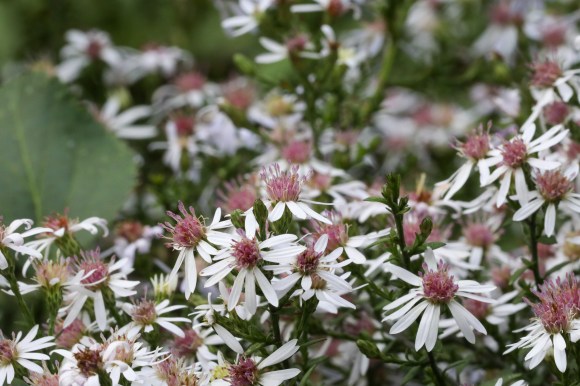
The flowerheads are the highlight of the Heart-Leaved Aster!  Ranging from six inches to eighteen inches long, these conical heads shine with lavender, light-blue violet or white florets.  Each of these half inch florets has seven to fifteen petals (ray florets) and a yellow center of disc florets.1  

Once the disc florets are fertilized, the center turns a mauve pink adding visual interest to the flowerhead.  Floral bracts cover the base of each floret.  The bracts are pale with dark green tips.1

One of the first natives in my garden, I’ve grown this plant for close to 20 years.  I’ve always found is covered with flowers, pollinators and beneficials of all kinds.  That said, it has a few challenges.

It spreads by runners and by self-seeding.  When Heart-Leaved Aster’s happy, it can really colonize a garden.  It is easy to pull, and you can clip the seed heads to prevent self-seeding.1

Poorly drained soil can lead to powdery mildew, leaf spots and rust.  If the weather is too hot and dry, this aster often loses its lower leaves.  I plant it in the middle of the bed.  This location hides leaf loss and helps cover any trouble on the other leaves.4

Finally, like other asters, herbivores love it.  Rabbits, deer, ground hogs, etc., eat it, especially in the Spring.  Use whatever repellents preferred.  I also plant asters among plants animal don’t like, such as, iris.

The free herbivore pruning helps later in season though.  In fact, Symphyotrichum cordifolium benefits from pruning back several times before mid-summer.  This attention helps increases bushiness, controls height and might even eliminate the need to stake it!4

Heart-Leaved Aster draws crowds of pollinators and beneficial insects.  Like all Symphyotrichum, it is a keystone plant.  There are two types of keystone species:  one type acts as hosts for butterfly and moth caterpillars and the other feeds specialist bees.  The bee associated keystone plants also serves generalist bees.  Asters are both.2

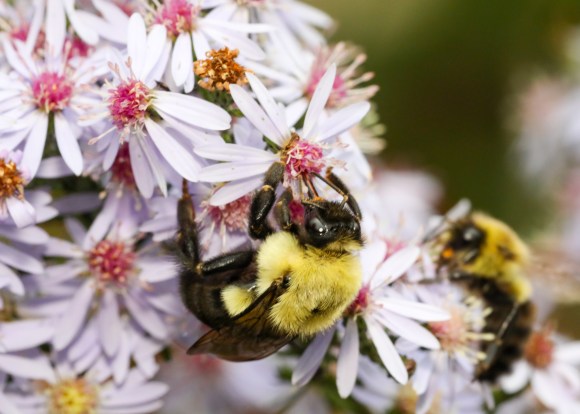
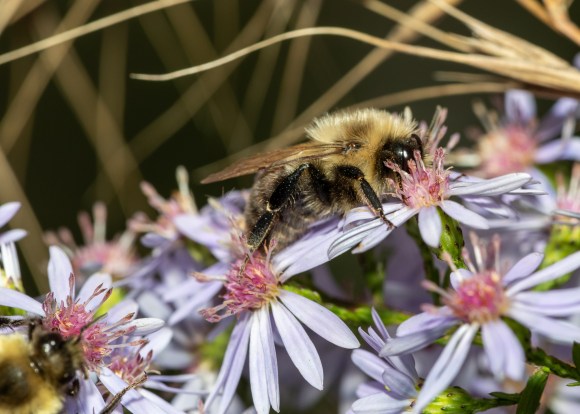
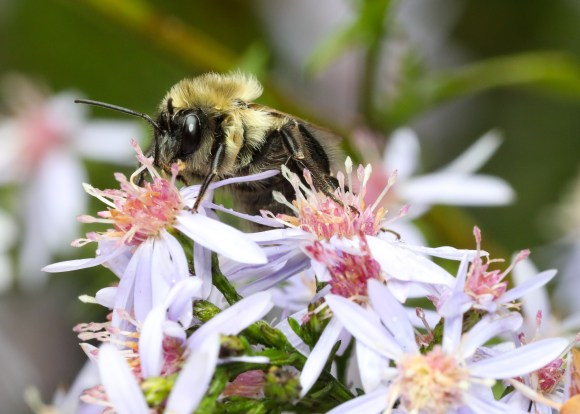
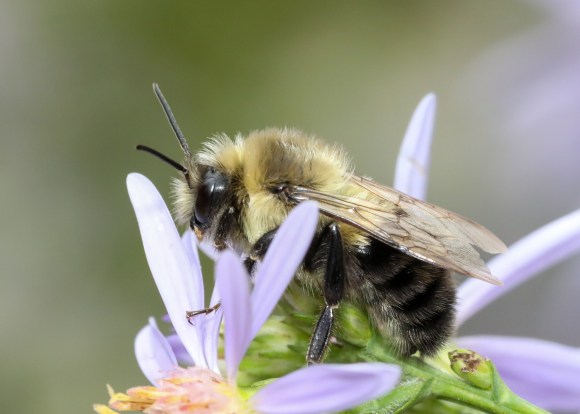
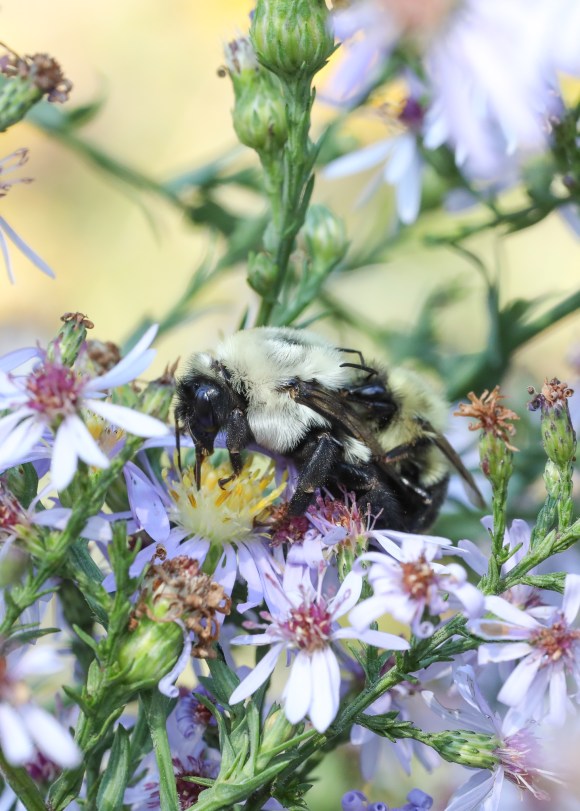
Long-tongued bees, short-tongued bees, butterflies, moths, skippers, wasps and beetles all seek out its nectar and pollen.  The Xerces Society for Invertebrate Conservation designate Symphyotrichum cordifoliumof Special Value to Native Bees and state it Supports Conservation Biological Control.  Bumblebees find it especially helpful.1,6 

S. cordifolium blooms when new bumblebee queens emerge, males hatch and mating flights occur.  I find males sleeping on the plants on cool late summer and early autumn mornings.  The flowers provide important energy resources for successful mating flights and overwintering queens.

Heart-Leaved Aster support many specialist bees.  As a keystone plant for pollen specialist bees, the Symphyotrichum genus feeds several mining bees in the Andrena genus.   Specifically, these include Andrena (Callandrena s.l.) asteris, Andrena (Callandrena s.l.) asteroides, Andrena (Cnemidandrena)hirticincta, Andrena (Cnemidandrena) nubecula, Andrena (Callandrena s.l.) placata, Andrena (Callandrena s.l.simplex, and Colletes simulans.5

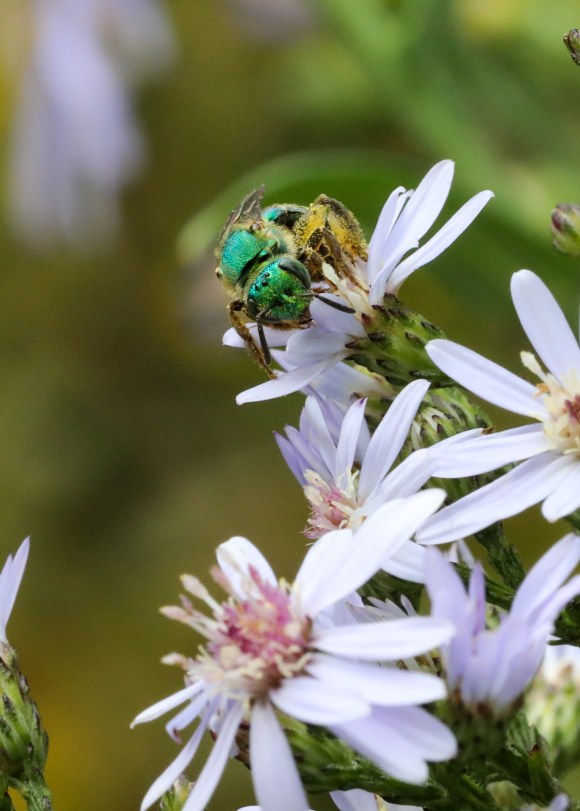
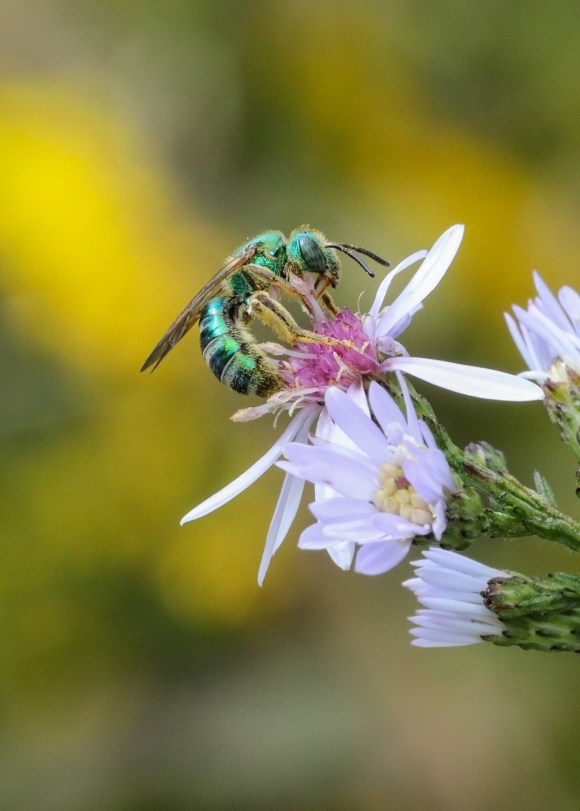
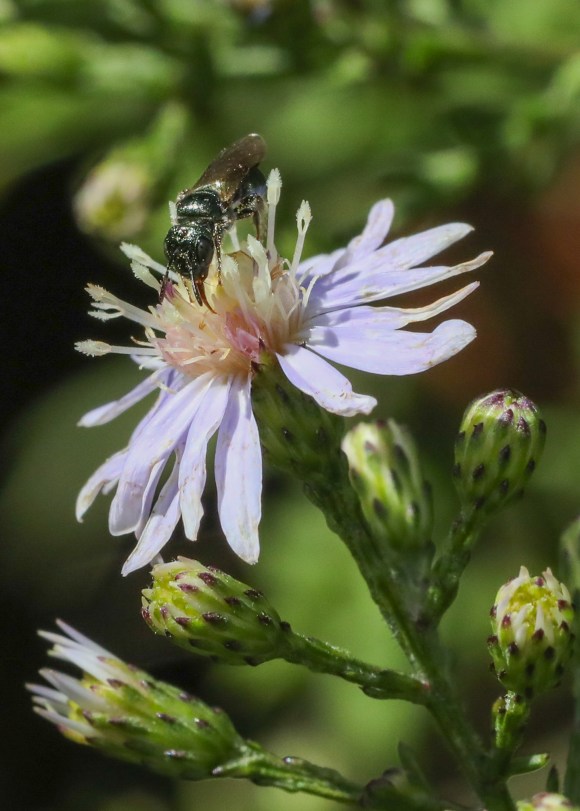
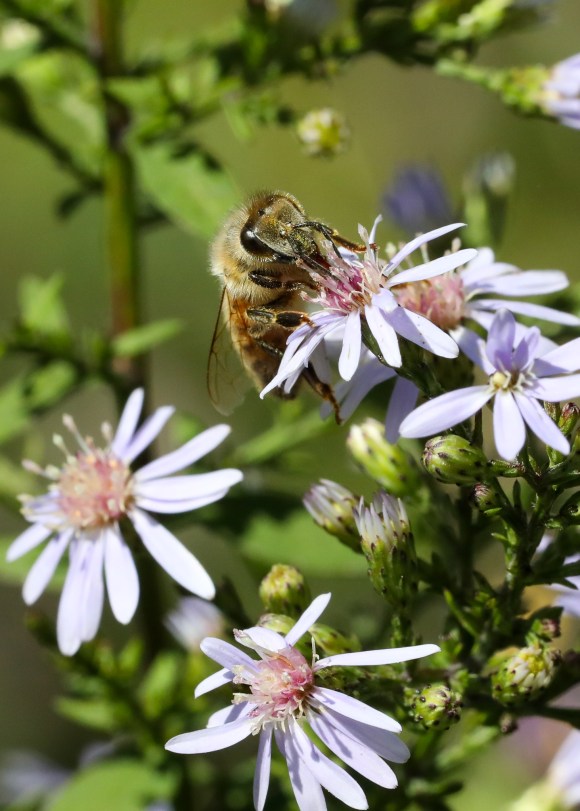
Heart-Leaved Aster is also visited by metallic green sweat bees, Halictus (sweat bees), Ceratina (small carpenter bees) and honeybees (Apis).

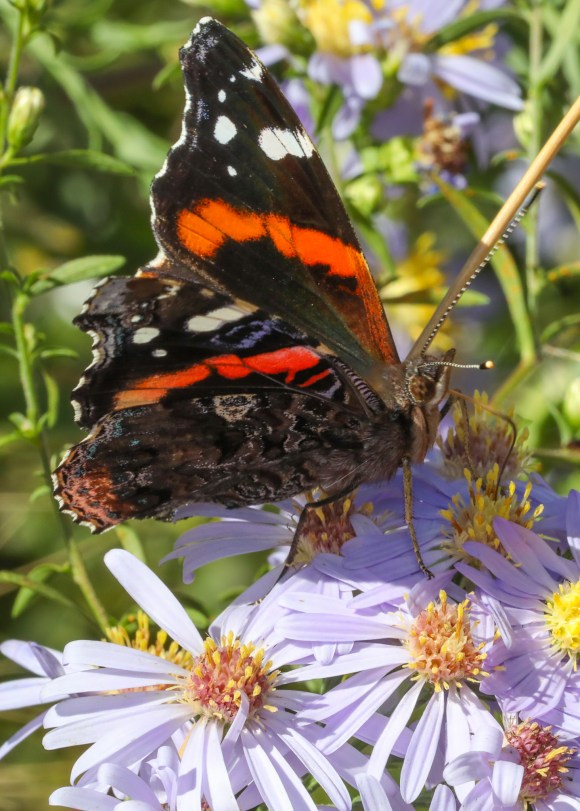
Numerous adult butterflies and skippers nectar at the Heart-Leaved Asters including migrating Monarchs (Danaus plexippus) and Red Admirals (Vanessa atalanta).  In its role as a keystone plant, it feeds many caterpillars from butterflies and, especially, moths.  Different larvae eat every part of the plant.1

By supporting moths, Symphyotrichum cordifolium contributes to pollination of wild plants overall.  Some flowers evolved a plant pollinator relationship with moths.  These flowers usually open at night, are white or pale, and have a stronger fragrance at night.  Moths use scent to find food and mates.  Yucca is a well-known example.7  

However, moths provide much more extensive pollination services.  Like generalist bees, some moths also visit different types of flowers.  Most of these plants aren’t larval hosts.  Some are also pollinated by bees.  When they’re bee pollinated, moths supplement the bee’s work.7

In addition, moths are more efficient than bees in some cases.  In the past, studies only measured pollen on mouthparts.  But moths carry a lot of pollen on their hairy underbelly.  When they land on a flower, their belly presses against the stigma to transfer pollen.7,8

Moths usually fly over longer distances than bees.  Bees tend to stay near their nest when possible.  Moths add genetic diversity by bringing pollen from distant plant populations.7

A variety of moth and butterfly caterpillars use Symphyotrichum cordifolium.  Different larvae eat flowers, seeds, and leaves while others bore through stems and/or roots.  I’ve detailed some different species and which plant parts they eat in the next few paragraphs.3

Chlosyne nycteis (Silvery Checkerspot butterflies) and Phyciodes tharos (Pearl Crescent butterflies) consume foliage.  Some moths also devour the leaves, such as, Pale-Banded Dart (Agnorisma badinodis(syn. Xestia badinodis)), Sharp-Stigma Looper Moth (Ctenoplusia oxygramma (syn. Agrapha oxygramma)), Halloween Paint (Cucullia alfarata), Rusted Paint (Cucullia postera), Confused Eusarca (Eupithecia confusaria), Lost Sallow (Euplexia devia), Green Leuconycta (Leuconycta diphteroides), Small Brown Quaker (Pseudorthodes vecors) and Dimorphic Gray (Tornos scolopacinarius).3

Leaf miners include Gracillarlid Moth sp. (Acrocercops astericola), Tischeriid Moth sp. (Astrotischeria astericolaI), Scythridid Moth sp. (Landryia impositellaI) and Bucculatricid Moth sp. (Bucculatrix staintonella).3

Some feed on developing seeds and/or flowers including Blackberry Looper (Chlorochlamys chloroleucaria), White-Dotted Groundling (Condica videns (syn. Platysenta videns)), Common Pug (Eupithecia miserulata), Spotted Straw (HeIliothis turbatus), Tortricid Moth sp. (Phaneta parmatana), Tortricid Moth sp. (Phaneta tomonana), Common Tan Wave (Pleuroprucha insulsaria), Arcigera Flower Moth (Schinia arcigera), Goldenrod Flower Moth (Schinia nundina), Northern Flower Moth (Schinia septentrionalis), Wavy-Lined Emerald (Synchlora aerate) and Striped Garden Caterpillar (Trichordestra legitima).  Some moths consume foliage in addition to developing seeds and/or flowers.  These include Black Arches (Melanchra assimilis) and Dark-Spotted Palthis (Palthis angulalis).3

And finally, moth larva that bore through stems and/or roots are  Aster Borer Moth (Carmenta corn) , Tortricid Moth sp. (Eucosma robinsonana), Burdock Borer Moth (Papaipema cataphracta), Aster Borer Moth (Papaipema impecuniosa), Tortricid Moth sp. (Phaneta essexana) and Tortricid Moth sp. (Sonia canadana).3 

I hope you enjoyed this look at the Heart-Leaved Aster as much as I have.  I’d love to hear about your plant adventures in the garden or the wild!  Please feel free to contact me with a story, comment or question!

Happy Gardening,

Mary

Bibliography:

  1. “Blue Wood Aster (Symphyotrichum Cordifolium).” Accessed December 1, 2024. https://www.illinoiswildflowers.info/woodland/plants/bl_woodaster.htm. Accessed December 1, 2024.
  2. “Keystone Native Plants:  Eastern Temperate Forests-Ecoregion 8.” https://www.nwf.org/-/media/Documents/PDFs/Garden-for-Wildlife/Keystone-Plants/NWF-GFW-keystone-plant-list-ecoregion-8-eastern-temperate-forests.ashx?la=en&hash=1E180E2E5F2B06EB9ADF28882353B3BC7B3B247D
  3. “Moth Table (Symphyotrichum Spp.).” Accessed December 1, 2024. https://www.illinoiswildflowers.info/woodland/tables/table29.html.
  4. “Symphyotrichum Cordifolium – Plant Finder.” Accessed December 1, 2024. https://www.missouribotanicalgarden.org/PlantFinder/PlantFinderDetails.aspx?kempercode=a788.
  5. “Symphyotrichum Cordifolium (Blue Wood Aster, Common Blue Wood Aster, Heart-Leaved Aster) | North Carolina Extension Gardener Plant Toolbox.” Accessed December 1, 2024. https://plants.ces.ncsu.edu/plants/symphyotrichum-cordifolium/.
  6. “Symphyotrichum Cordifolium (Broad-Leaved Aster) | Native Plants of North America.” Accessed December 1, 2024. https://www.wildflower.org/plants/result.php?id_plant=syco4.
  7. Xerces Society. “The Night Shift: Moths as Nocturnal Pollinators.” Accessed December 1, 2024. https://xerces.org/blog/the-night-shift-moths-as-nocturnal-pollinators.
  8. “Moths are more efficient pollinators than bees, shows new research.”  Accessed December 1, 2024. Ellis, Lauren, https://www.sussex.ac.uk/broadcast/read/60568.