The Rain Garden
Why talk about rain gardens? Different from my usual blogs, rain gardens are a wonderful application for native plants. In my yard, there are several wet and soggy areas especially in spring. I’ve installed several rain gardens since 2020. They move the water through quickly and make the space usable. As a bonus, these gardens are beautiful and filled with life-butterflies, bees, other pollinators and birds.
Why do we need a special garden? Before people, rain on land fell mostly over forests and grasslands. These ecosystems slowed it down before and after it hit the soil surface. Instead of running rapidly into lakes, streams, and other bodies of water, it was absorbed into the soil. The soil system filtered and cleaned it. Then, the water returned to underground aquifers.
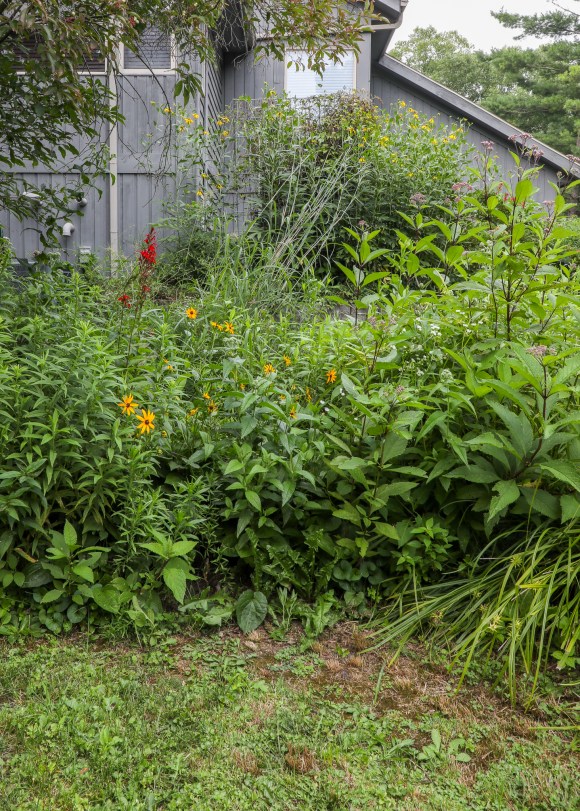
Now, many areas are impacted by humans. Vehicle and foot traffic compacts the soil and hard rains runs off it. Rainwater falls on hard surfaces such as roofs, pavement, even lawns. As it runs across these, the water picks up dirt, oil, gas, other auto fluids and lawn fertilizers and pesticides. It also gets warm.
Once it enters the storm sewer it flows rapidly into rivers and lakes. Once there, silt clogs creatures gills, fertilizers promote algae growth and pesticides, and other chemicals cause many problems.
But the good news! Rain gardens can help. Rain garden are specially constructed gardens that hold water for short periods of time (usually less than 24 hours and not more than 48 hours). While it’s held, natural processes slow its path.
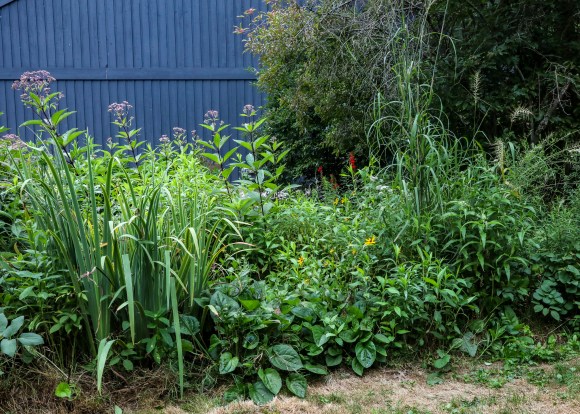
Thick vegetation catches and holds it. In the soil, plant roots absorbed some of the water. More water is held in small spaces in the soil. These spaces are created by plant roots, fungi and other microorganisms, soil-dwelling animals and insects.
Some chemicals adsorb to soil particles. Certain soil microbes digest chemicals like those in gasoline converting them it carbon dioxide and water. Through these pathways, the rainwater slowly works its way to the groundwater aquifer. It arrives cleaner than it fell.
Designing and building a rain garden involves a detailed process. Some features are specified by states. Detailed plans are beyond this blog, but I’ll provide references for free resources.
If you have questions, especially regarding garden placement near drinking water wells and septic fields, I suggest contacting local water quality officials for information. In Michigan, this would be the Department of Environment, Great Lakes and Energy.

But here is some fun information. Again, check with your state for specifics.
*The rain garden location should be away from the house, sewer lines and underground utilities.
*Keep away from drinking water wells and septic fields.
*The size depends on soil type as well as the size of the home, driveway, sidewalks and lawn. Remember the garden probably won’t receive all the runoff. It’s OK to design it to fit the amount received.
*A rain garden can handle runoff from an area 3 times its size.
* Soil test and drainage tests are important These tests help determine the size of your garden and ensure it works.
*The garden must be located at a spot that drains well. A functioning rain gardens absorbs water in 24 to 48 hours.
In addition to the benefits of rain gardens, now is the time to plan a new garden! Late summer/early fall is a great time to plant. Planting then allows plants to establish their roots before the winter season. By next spring, it’s like an extra year has passed.
What do I mean by “an extra year”? There’s a saying about native plants, “They sleep, creep and then leap.” The first year, the plant pretty much stays the same. The second year, some slow growth happens. The third year, the plant really takes off and grow by leaps and bounds. When you plant in late summer/early fall, you get sleep and creep in 1 year. The following spring should be time for the plant to put on a lot of growth (leap!).
What about choosing plants? I like small plants—2” pots or plugs. These tend to adapt well to a new site and, after 2 or 3 years, they look the same as quart-sized plants. Look for shorter, compact plants. More than one plant in a pot is fine if they all look healthy. A few roots coming out the bottom shows good root development. A tangle of roots means a pot-bound plant that may not grow well in its new home.
Which plants do well in a rain garden? Surprisingly, all the plants need to tolerate dry periods. That said, there are 3 zones in a raingarden. Plants in the deepest zone tolerate recurring flooding or flow and dry spells. These are usually tall to overcome the depth of the garden.
Intermediate zone plants thrive in average soil moisture but accept short periods of flooding or flow. Finally, the plants on the edges grow well in dry conditions. Edge plants are generally shorter.
As always, when planting a pollinator garden, choose a selection of plants that bloom from spring to fall. In my rain gardens, I’ve used Golden Zizias (Zizia aurea), Black-Eyed Susans (Rudbeckia hirta), Rose Milkweed (Asclepias incarnata), Joe-Pye Weed (Eutrochium purpureum), and Smooth Aster (Symphyotrichum laeve). I’ve discussed these plants before, but I thought I would discuss them as rain garden plants.

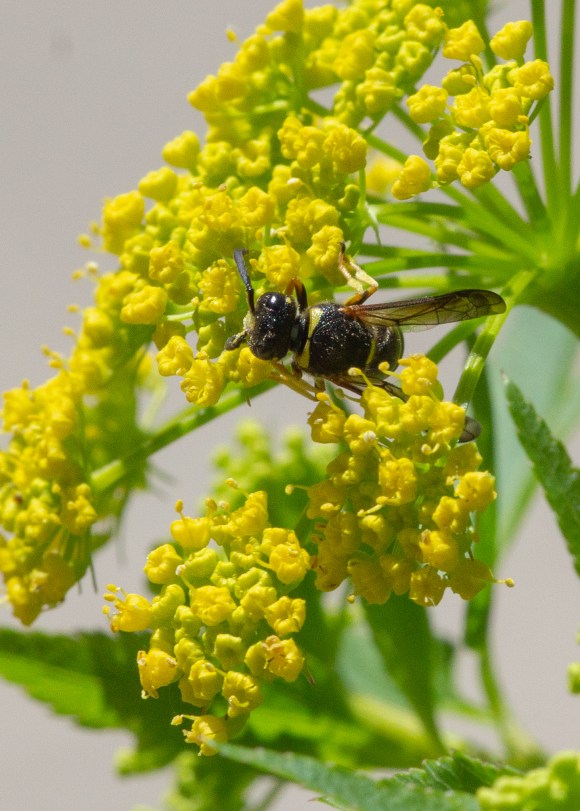
Spring in the rain garden starts with Golden Zizias or Zizia aurea (https://wildthingsinthe.garden/2024/02/29/golden-lace-for-spring/). In late spring to early summer, these lacey golden flowers welcome bees, wasps and beneficial insects. These plants thrive in the intermediate areas and on the edges of the rain garden.
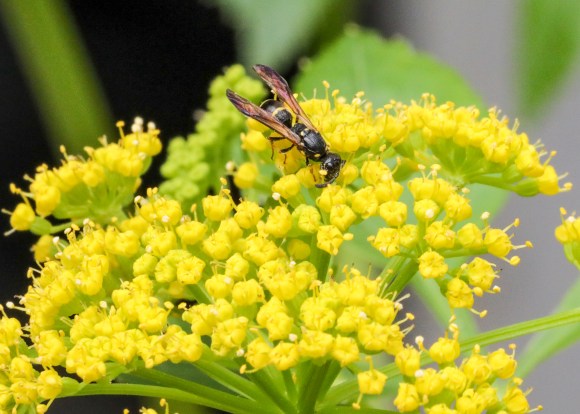
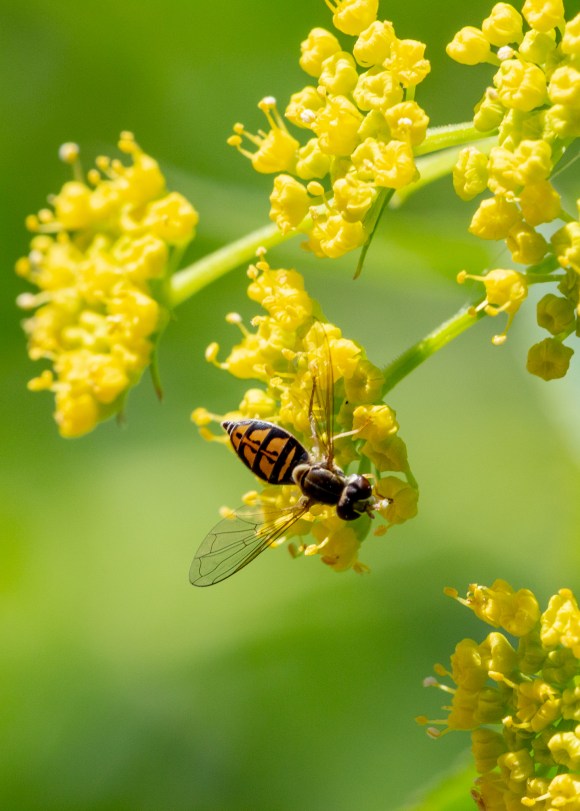
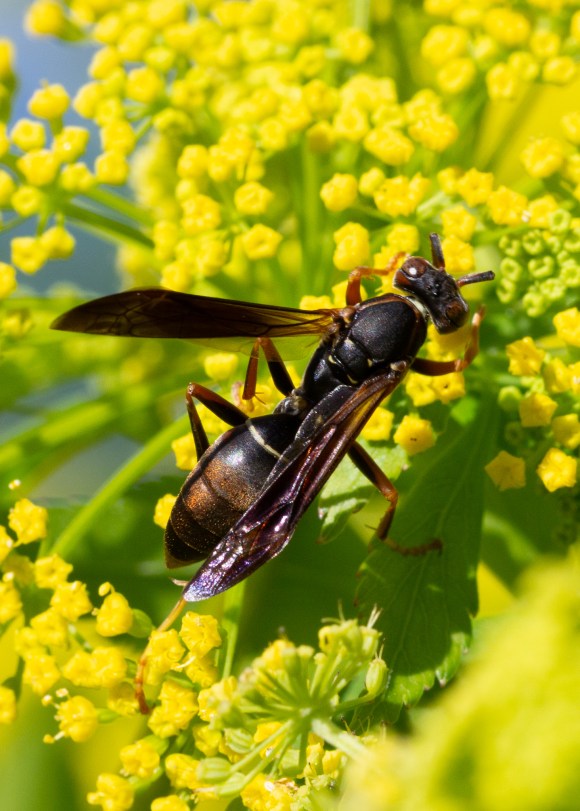
As an early bloomer, Zizia provides resources before many other plants and are always busy. Some of its visitors include: Hylaeus (Yellow-faced bees), Andrenid bees, Ceratina (small carpenter bees), Osmia (Mason bees), Halictid bees including Lasioglossum, green metallic bees, wasps and its specialist bee Andrena ziziae.

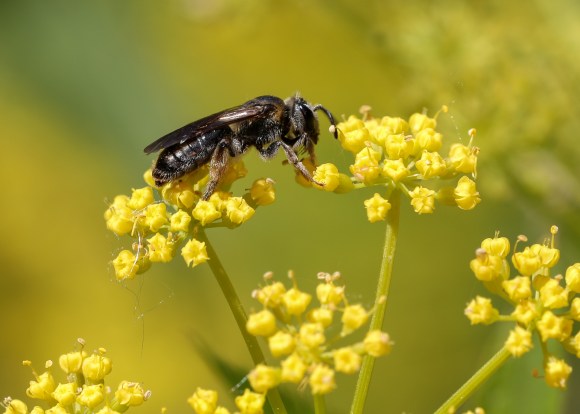
Black-Eyed Susans or Rudbeckia hirta (https://wildthingsinthe.garden/2025/03/05/sunny-faces/) open next and continue into early fall. Black-Eyed Susans, also, grow well on the edges and in the intermediate areas of the rain garden.
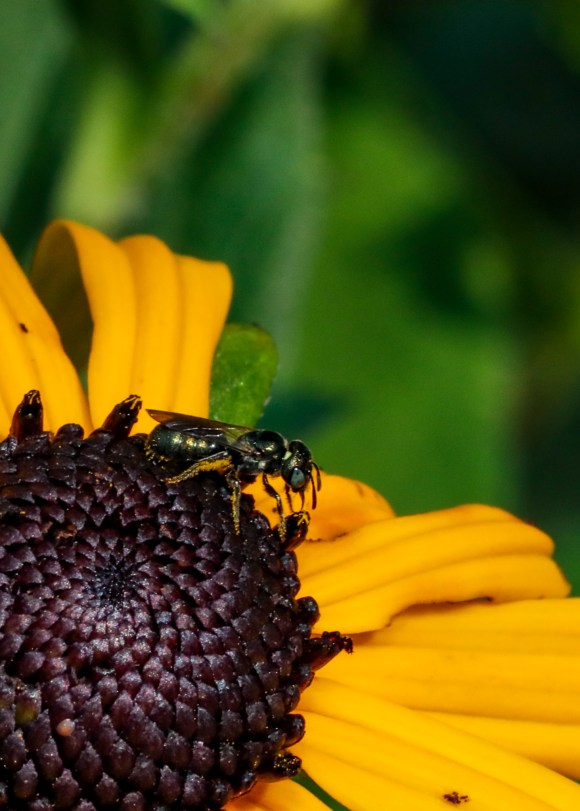
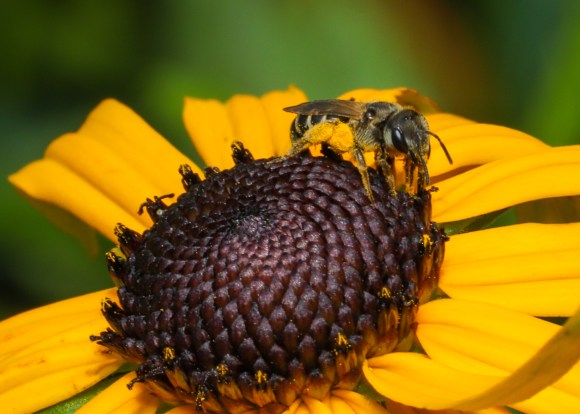
Numerous bees visit these cheerful flowers. They include Honeybees (Apis spp.), Long-Horned Bees (Melissodes spp.), Leafcutter Bees (Megachile spp.), Cuckoo Bees (Coelioxys spp.), Sweat Bees (Halictus spp.), Green Sweat Bees (Agapostemon spp., Augochlorini Tribe), and Small Carpenter Bees (Ceratina spp.). Rudbeckia hirta feeds several specialist bees, i.e. including Andrena rudbeckiae, Pseudopanurgus albitarsis, P. rudbeckiae, Melissodes denticulatus, M. druriellus, M. illatus, Megachile pugnata, and M. xylocopoides.
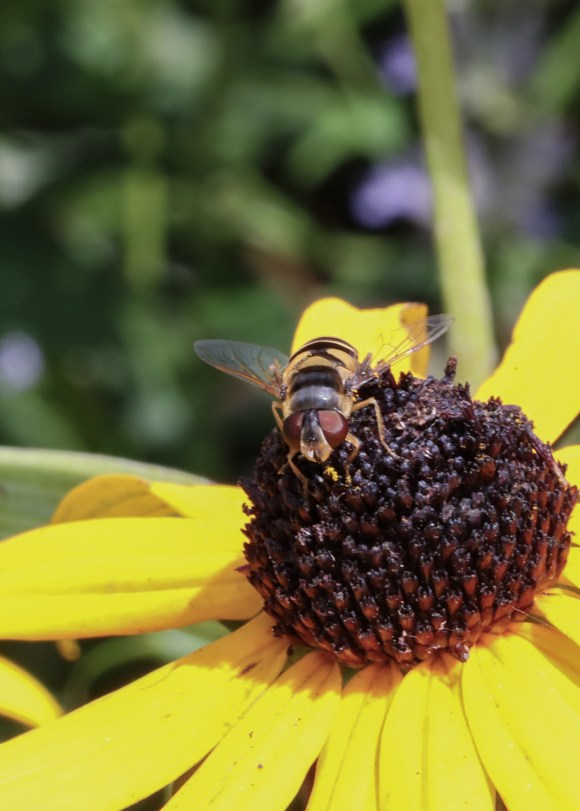
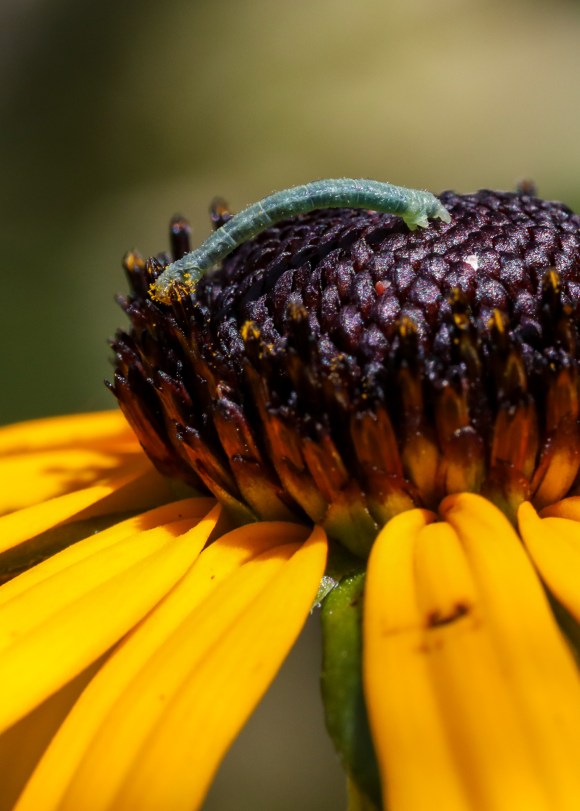
Black-Eye Susan serves as a larval host for both moths and butterflies. Wavy-Lined Emerald Moth ( Synchlora aerata), Southern Emerald Moth (Synchlora frondaria), Common Eupithecia (Eupithecia miserulata), Gorgone Checkerspot Butterfly (Chlosyne gorgone), Bordered Patch Butterfly (Chlosyne lacinia) and Silvery Checkerspot Butterfly (Chlosyne nycteis) all lay eggs on R. hirta,
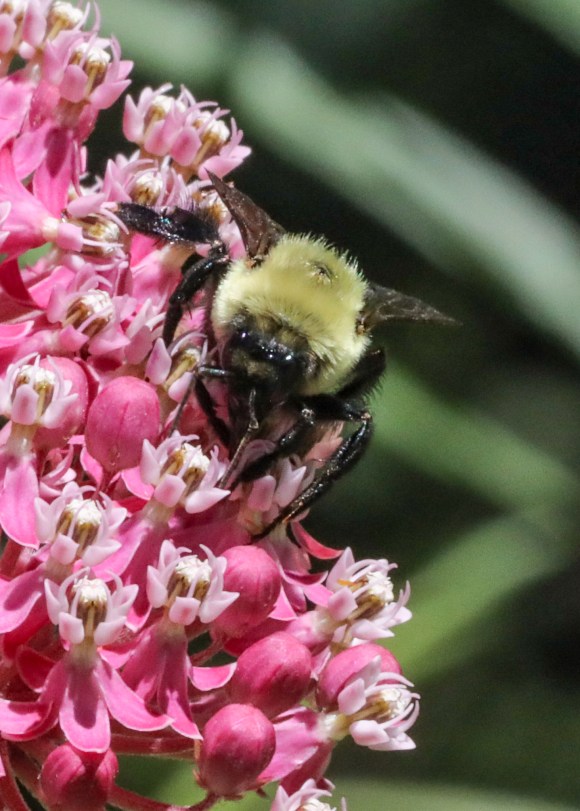
Rose Milkweed or Asclepias incarnata (https://wildthingsinthe.garden/2025/04/01/a-delicate-pink-star/) begins flowering slightly later than Black-Eyed Susans and continues into the early fall. Rose Milkweed serves well in the intermediate and deep portions of the rain garden.
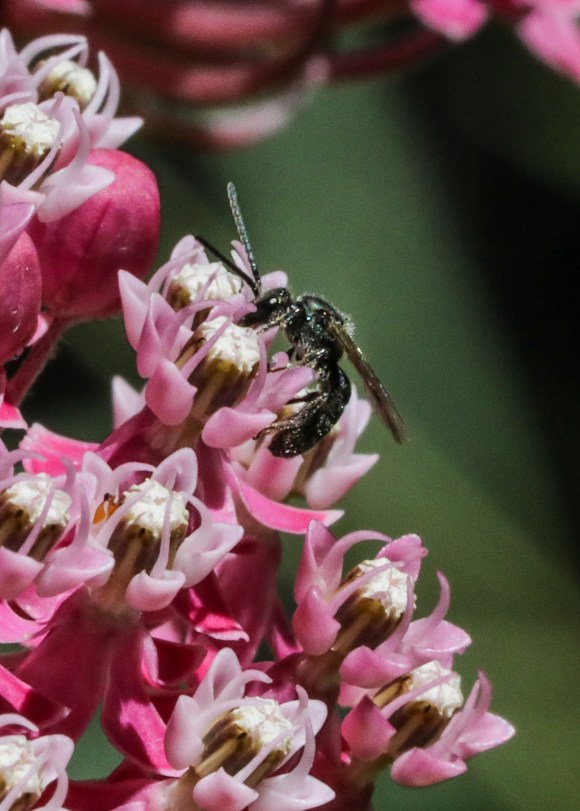

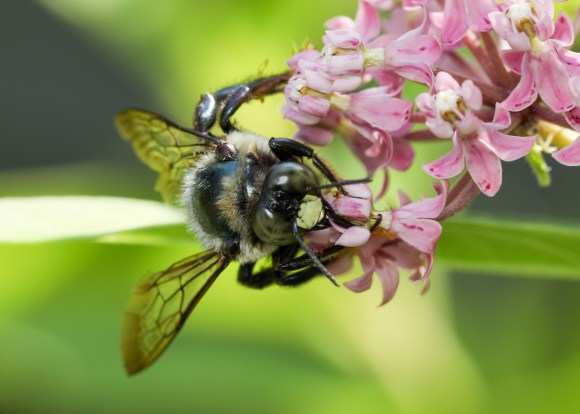
As a Milkweed, it hosts the adult Monarch Butterflies at its blooms and is also a larval host. In addition to supporting Monarch Butterflies, Rose Milkweed provides resources to native bees, Bumble Bees, Honeybees, beneficial insects and wasps. Some specific examples are Sphecid wasps including the Great Black Wasp (Sphex pensylvanicus) and Great Golden Digger Wasps (Sphex ichneumoneus), Vespid wasps (Vespula spp.), Tiphiid wasps, Spider wasps, Paper Wasps (Polistes spp.), Square-Headed Wasps (Tachytesspp.), Bumblebees, honeybees, long-horned bees (Melissodes ssp, Svastra spp.), Yellow-Faced Bees (Hylaeus spp.), Sweat Bees (Lasioglossum spp.), Halictid Bees, Green Sweat Bees (Augochlorini Tribe), and Small Resin Bees (Heriades spp.).
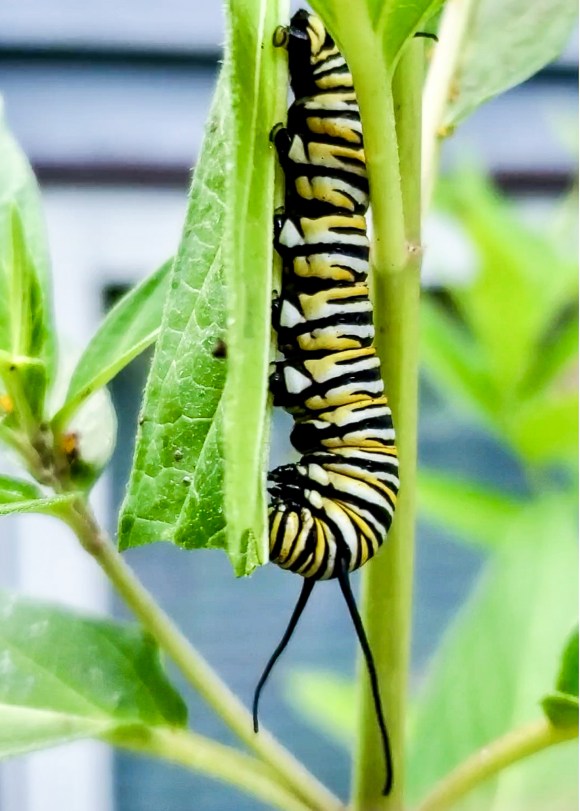
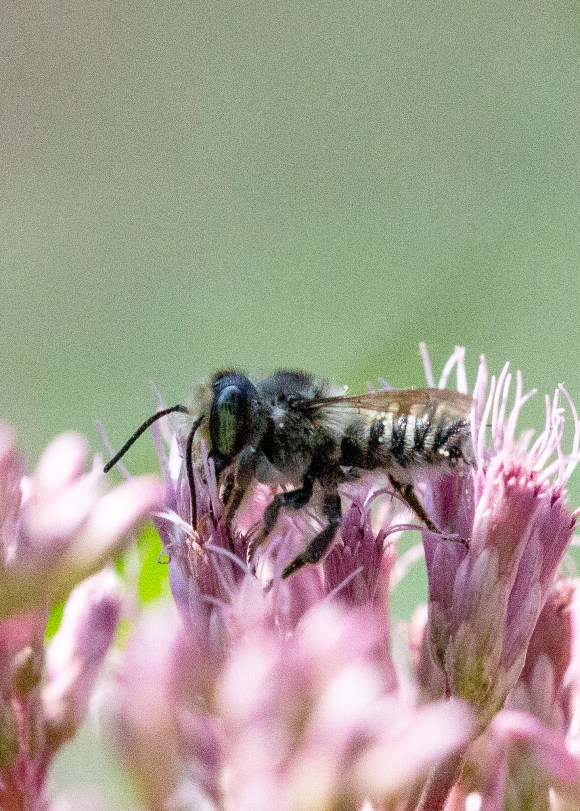
Joe-Pye Weed or Eutrochium purpureum (https://wildthingsinthe.garden/2024/10/31/a-fabulous-fuzzy-flower/) blooms from mid-summer to early fall adding an additional source of pollen and nectar during the height of the season. Plant Joe-Pye Weed in the intermediate and deep areas of the rain garden.
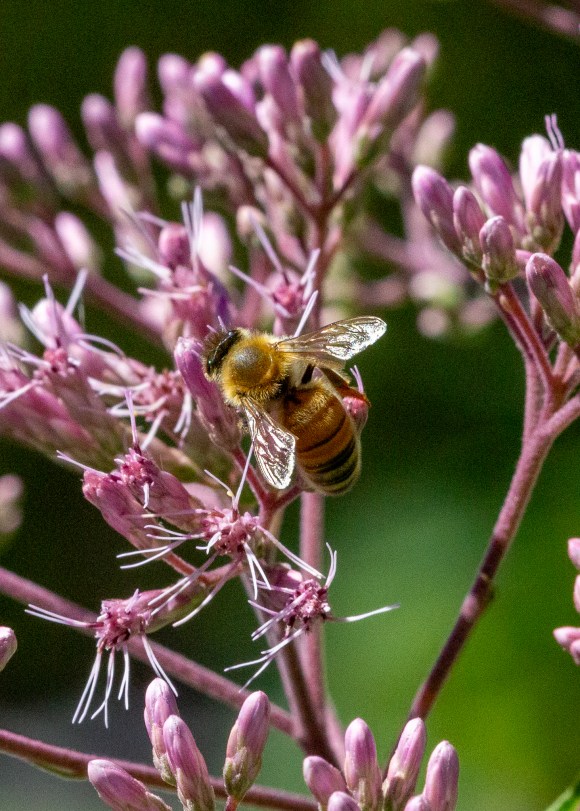

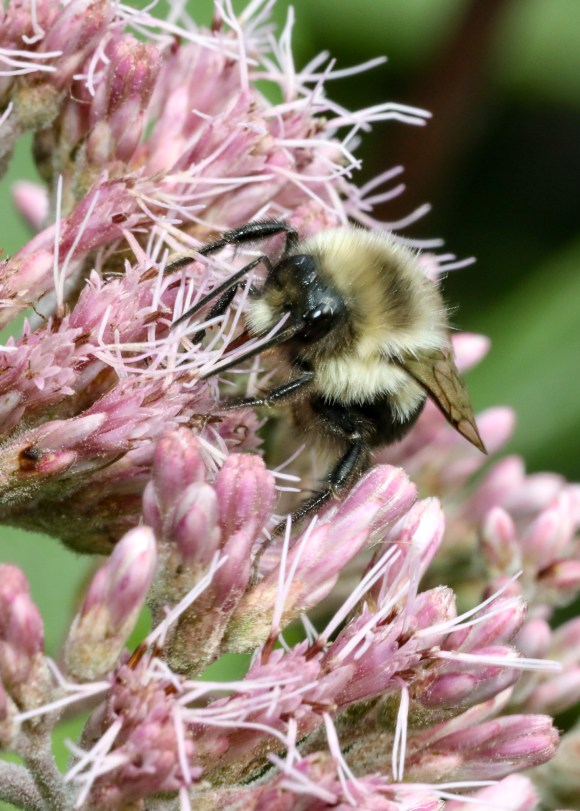
It’s especially beloved by bees. The bee visitors include Bombus spp. (bumblebees), Melissodes spp. (miner bees), Coelioxys (cuckoo bees), Agapostemon (metallic green sweat bees), Megachile spp. (leaf-cutting bees), Halictus spp., honeybees (Apis app.) and large and small carpenter bees, Xylocopa spp. and Ceratina spp.,
E. purpureum also invites a host of butterflies, moths, and skippers. Celastrina (Azure Butterflies), Epargyreus clarus (Silver Spotted Skipper), Limenitis arthemis (White Admiral Butterflies), Nymphalis urticae (Milbert’s Tortoiseshell Butterflies), Papilio glaucus (Eastern Tiger Swallowtail Butterflies), and Danaus plexippus (Monarch Butterflies) sip the nectar from the fluffy, pink flowerheads

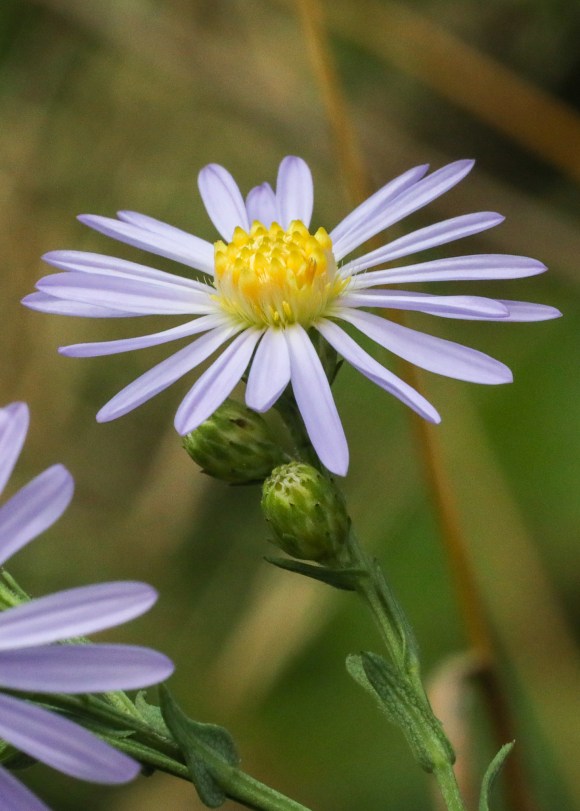
Smooth Blue Aster or Symphyotrichum laeve (https://wildthingsinthe.garden/2023/10/01/autumn-stars/) finish the growing season, blossoming from early to late fall. Place this aster in the intermediate area or on the edge of a rain garden,
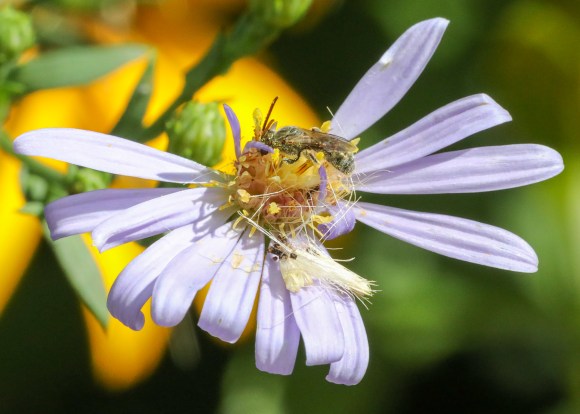
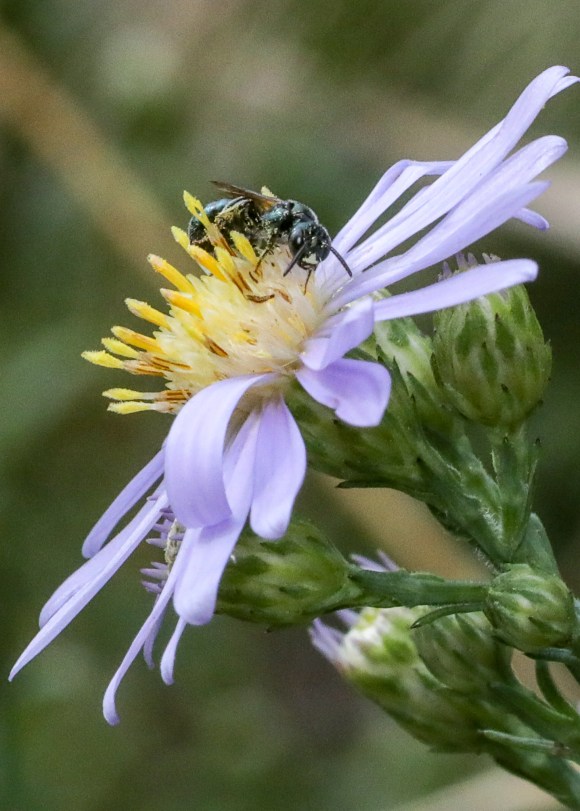
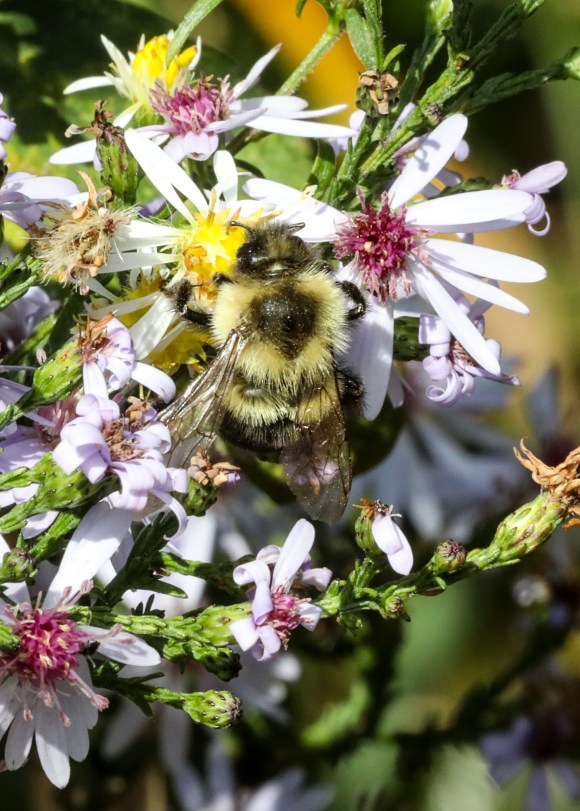
Enjoyed by native bees, this aster supplies nectar and pollen before the winter season. Long- and short-tongued bees, honeybees, bumblebees, bee flies, wasps, butterflies, and beneficial insects all visit this plant. Several specialist bees forage on Asteraceae plants including Andrena asteris, A. asteroides, A. placata, A. simplex, Cnemidandrena hirtcincta, C. nubecula, and Colletes simulans.
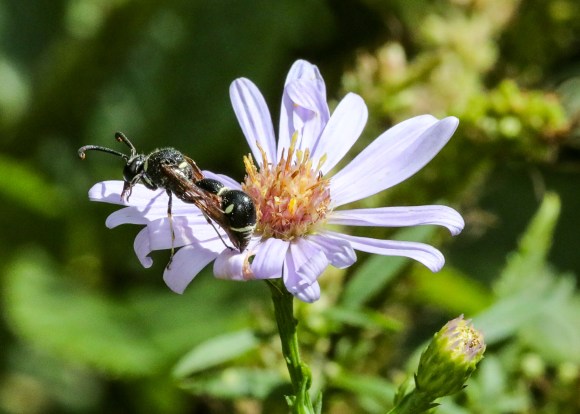
Soldier Beetles (Chauliognathus spp.), Insidious Flower Bug (Prius insidious), and chalcid wasps are beneficial insects that enjoy S. laeve. Monarchs and other butterflies visit this aster for nectar during their fall migration.This aster also serves as a larval host for the Pearly Crescent Butterfly (Phyciodes thanos).
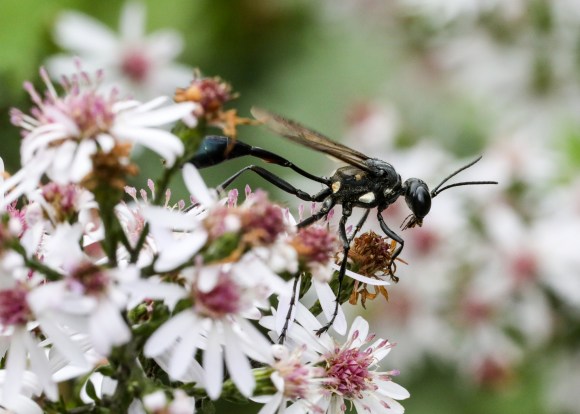
I hope you’ve enjoyed this application for your native plants. It a wonderful time of year to begin a new garden area and rain gardens help your yard and the ecosystem!
Happy planting!
Mary
BIBIOGRAPHY:
- “Building a Rain Garden.” n.d. Accessed August 5, 2025. https://extension.umn.edu/landscape-design/rain-gardens.
- “Rain Gardens: A Guide for Homeowners and Landscapers.” November 2018. Wisconsin Standards Oversight Council/Wisconsin Department of Natural Resources.
- Hinman, Curtis. June 2013. “Rain Garden Handbook for Western Washingtion: A Guide for Design, Installation, and Maintenance.” Washington State Extension.
- Steiner, Lynn M. and Domm, Robert W. 2012. Rain Gardens: Sustainable Landscaping for a Beautiful Yard and a Healthy World. Voyageur Press.
 Wild Things in the Garden