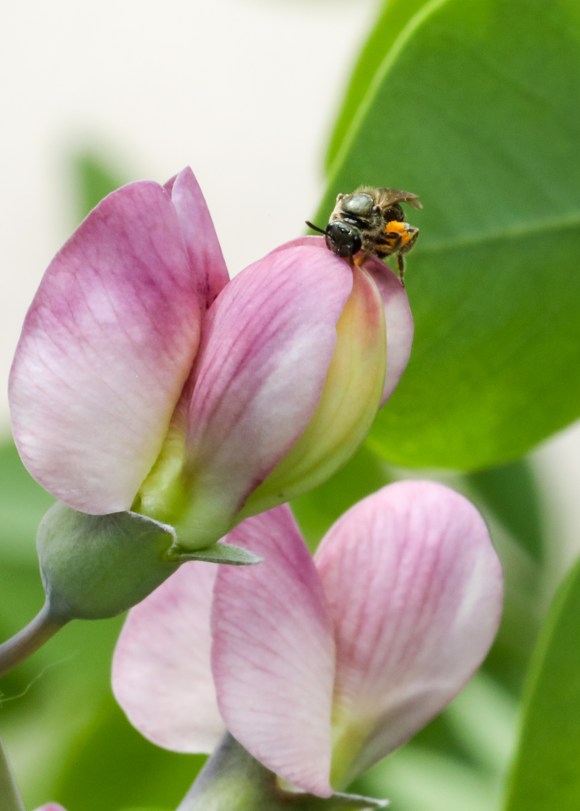
Categories
native plants Pollinator gardening

A Summer Cornucopia

Common Milkweed or Asclepias syriaca is a superb Monarch support and a mainstay of Monarch waystations.  But it is so much more.  This plant feeds more than 450 insects at different life stages. Diverse insects consume nectar, sap, leaves, flowers and seeds5.  Admittedly weedy, its lovely blooms are fragrant and enhance any scent garden1,5.
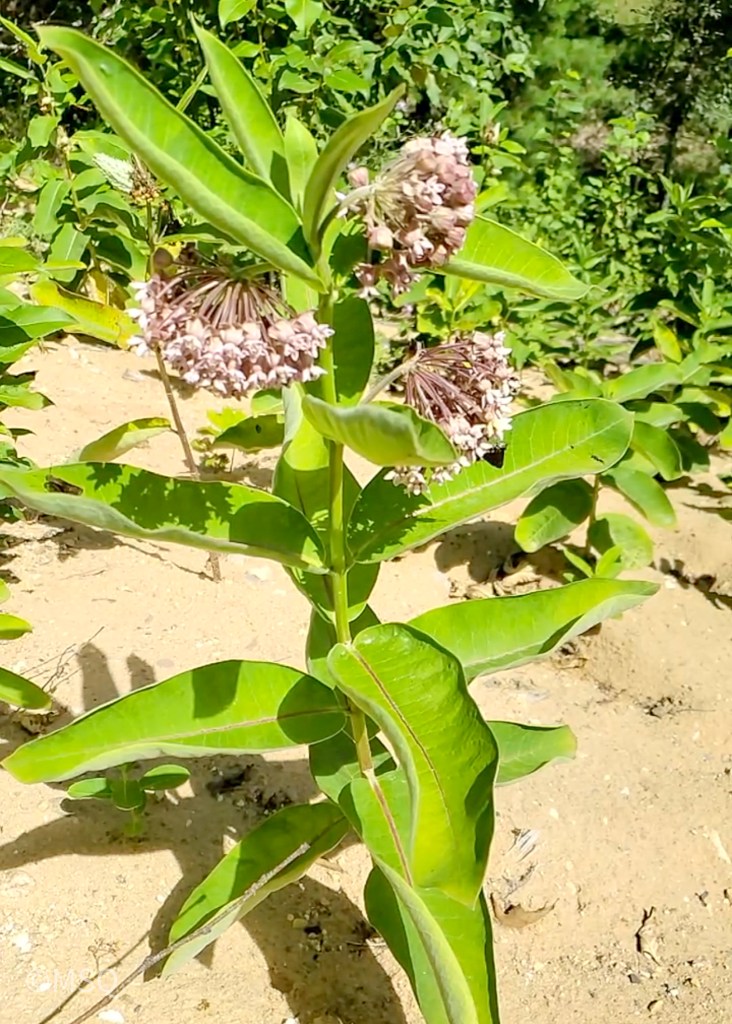
Common Milkweed thrives in full sun and well-drained soils.  Like other “weeds”, it’s not picky about growing conditions.  A. syriaca  grows in clayey, sandy or rocky calcareous soils, loamy soils and high clay or sand soils. 

Asclepias syriaca springs up in disrupted areas.  Human activity disrupts natural areas.  But natural disruptions occur where water rises and falls, for example, along streams and lakes.  

In nature, Common Milkweed is found in moist and dry black soil prairies, sand prairies, sand dunes along lake shores, fields, pastures, abandoned fields, vacant lots and along railroads, fence rows and roadsides. 

Common Milkweed absolutely lives up to its weedy name.  It spreads by seed and by long creeping rhizomes that pop up in unexpected places.  Once established, this plant is extremely difficult to remove. 

These habits are offset by Common Milkweed’s value to insects and pollinators.  It’s best to let it grow where you don’t mind its vigorous and abundant nature—a wild area, a meadow or a prairie garden.
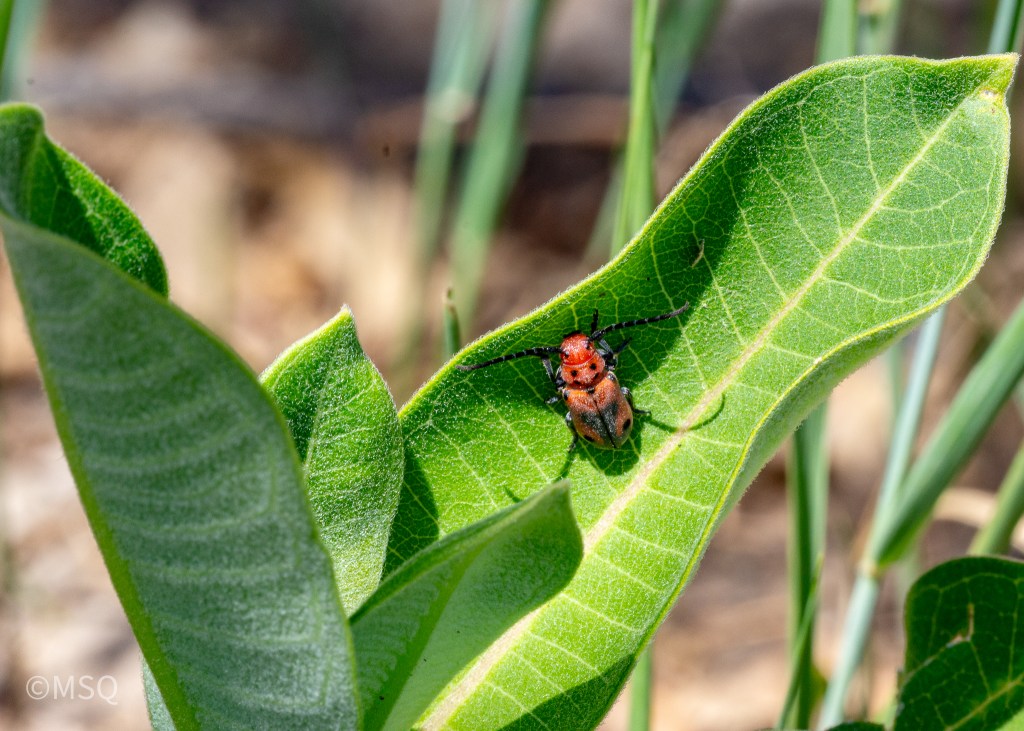
Asclepias syriaca offers a strong erect form in the garden.  The pale, cylindrical central stem supports opposite jade-green leaves.  These leaves range from pale to dark green on top and are pale green with short, dense hair underneath.  Each leaf has a distinctive central vein with small veins spreading to the edges.  
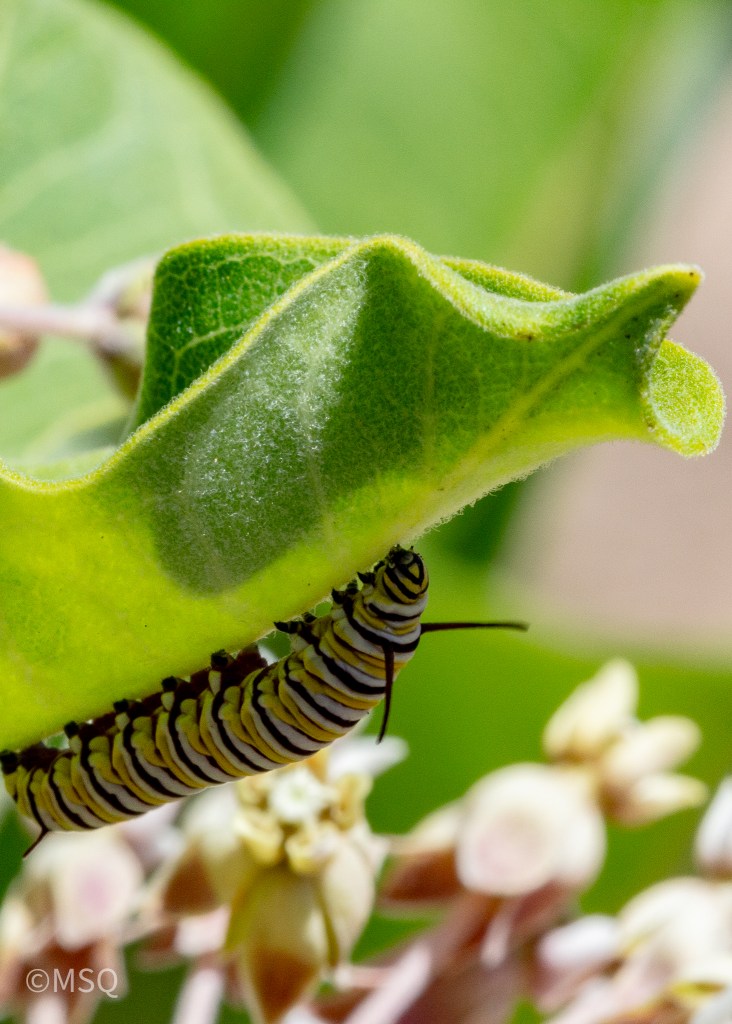
The milky sap, which gives Milkweed its name, oozes whenever part of the plant is broken.  The sap is called a latex and contains 2% latex.  The latex is thick and sticky.  

Most ingeniously, caterpillars will reduce the sap’s flow by taking tiny bites closer to the stem.  The sap leaks out there.  When the caterpillar begins to eat a leaf, there’s less latex at the feeding site.  Thus, less chance the sticky stuff will foul the larva’s mouth2,3.

For humans and other mammals, there are other concerns.  The milky sap contains cardenolides, specifically cardiac glycosides.  Contact with the skin or eyes causes irritation.  If eaten or exposed to mucous membranes, cardiac glycosides can disrupt the nervous system, the kidneys, the muscles (which includes the heart) and the human’s/animal’s acid/base balance3,4,5.  

The monarch and other insects that consume milkweed have turned this to their advantage.  As the caterpillars/insects consume milkweed their bodies store the cardiac glycosides.  If a bird or animal eats them, they taste bitter and can make the predator feel sick.  

Predators soon learn to leave them alone. The orange/black or red/black coloring of milkweed insects signals, “Stay away!  Not good for you!”  The technical term for this warning coloration is ‘aposematic’5.

Milkweed blooms don’t dazzle but flower in 1930’s vintage shades.  The drooping balls of florets are soft and dusky lasting one to one and a half months.  Colors range from greenish white to greenish pink to rosy-pink to purplish-pink to reddish purple.  

Each cluster averages 30 individual florets but can have up to 100. Their sweet, vanilla fragrance drifts from the three to five umbels on each plant.  
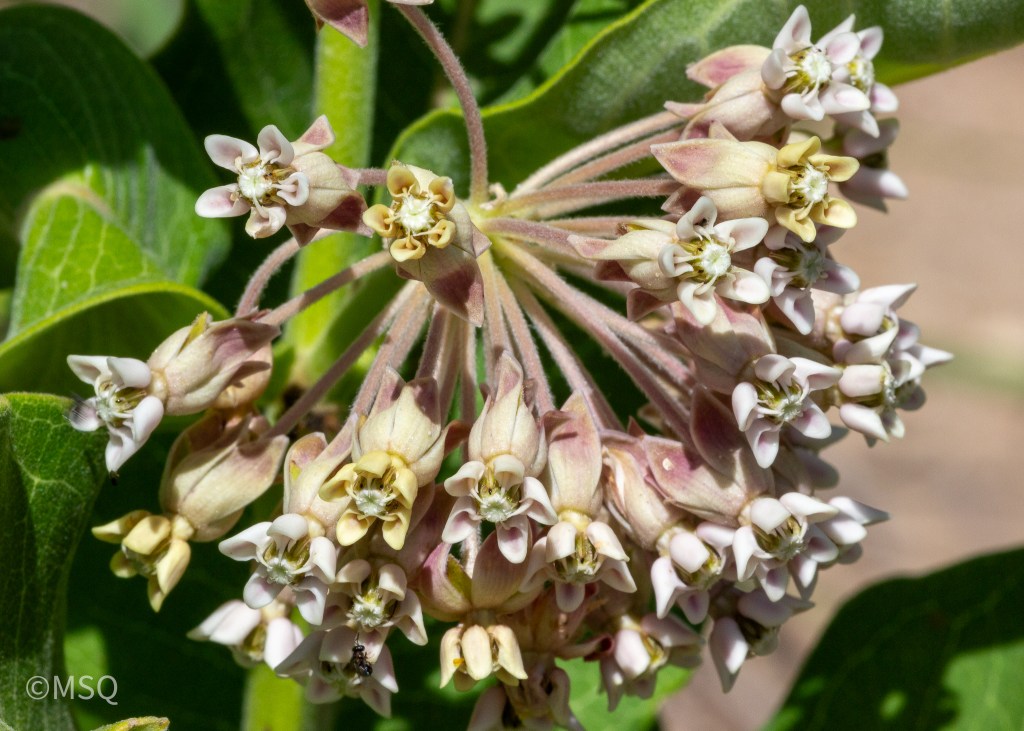
Up close, each floret is a fascinating feat of engineering all directed toward an exceptional pollination system.  Each a quarter of an inch across, the florets have five reflexed (bent back) petals and five raised hoods with curved horns.  The hoods have lighter colors than the petals.  

In the center of each floret, is a cylindrical structure formed by two fused stigmas.  It’s called the stigmatic column.  

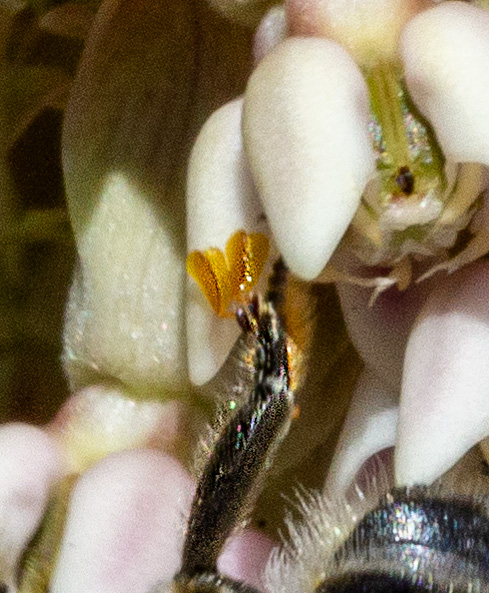
Between the hoods, are the stigmatic slits.  These slits hold the pollinaria.  Unique structures, pollinaria hold waxy sacs of pollen.  These are transferred instead of the loose, powdery pollen used by most flowers.  Milkweeds and orchids are the only known plants to have them6,7.
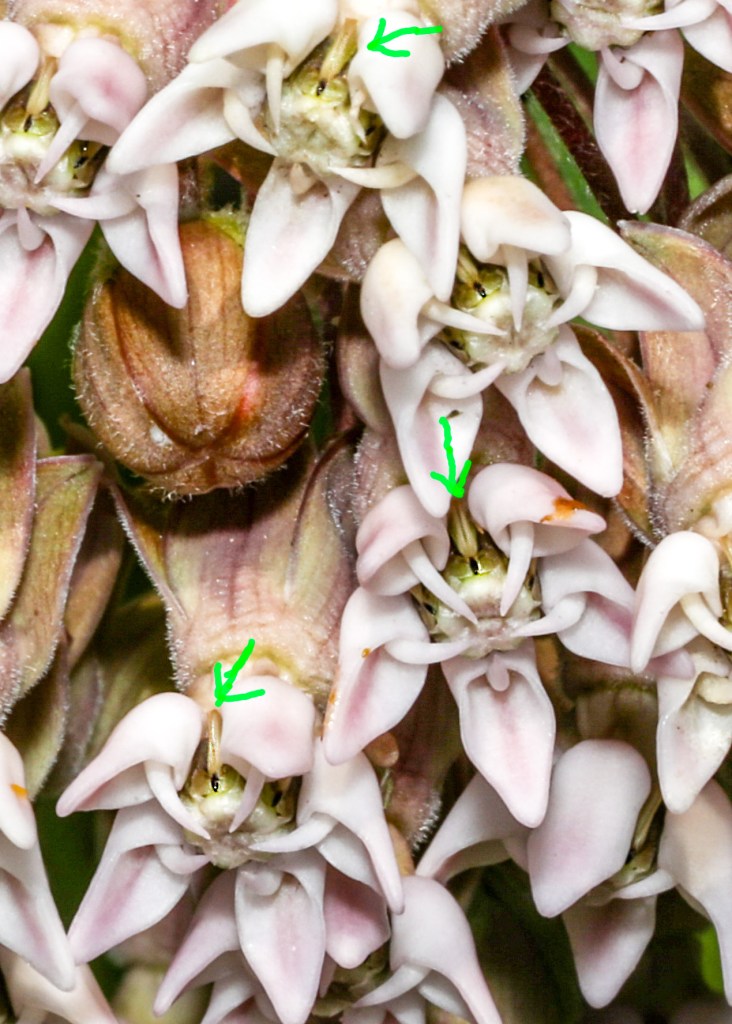
The milkweed pollinium (or pollinarium) consist of a blackish-brown oval gland (corpusculum) with a slit, two translator arms hanging from the gland and two pollinial sacs.  Before each sac, a knee bend of approximately 900 occurs in the arm.  This bend enables the rotation of each sac during pollination.
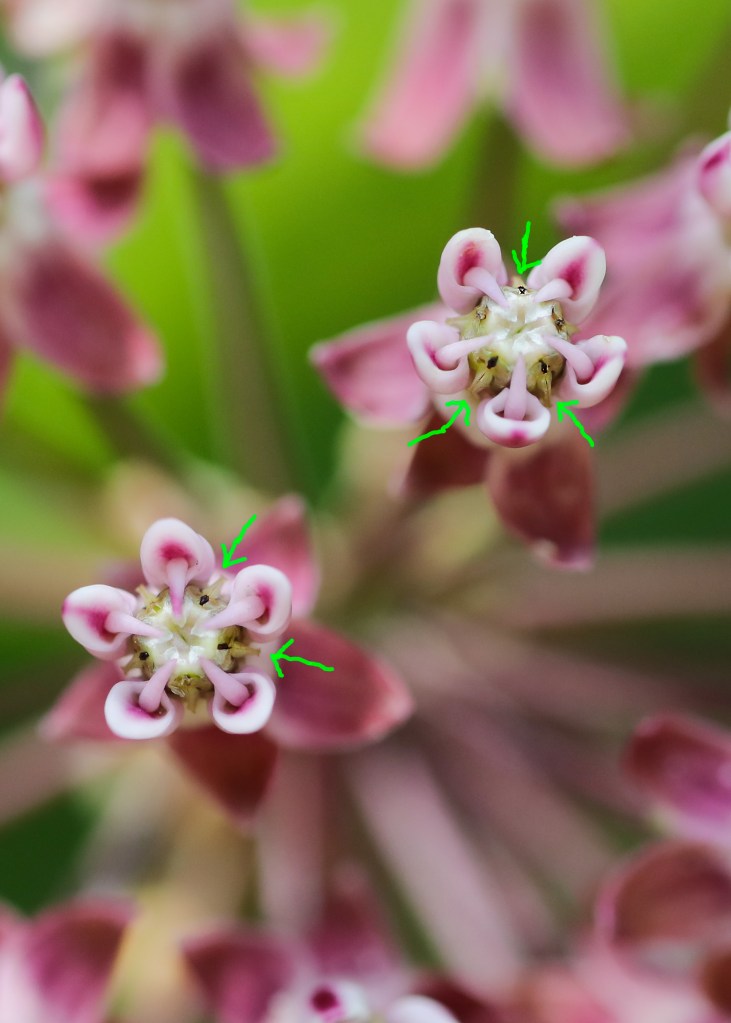
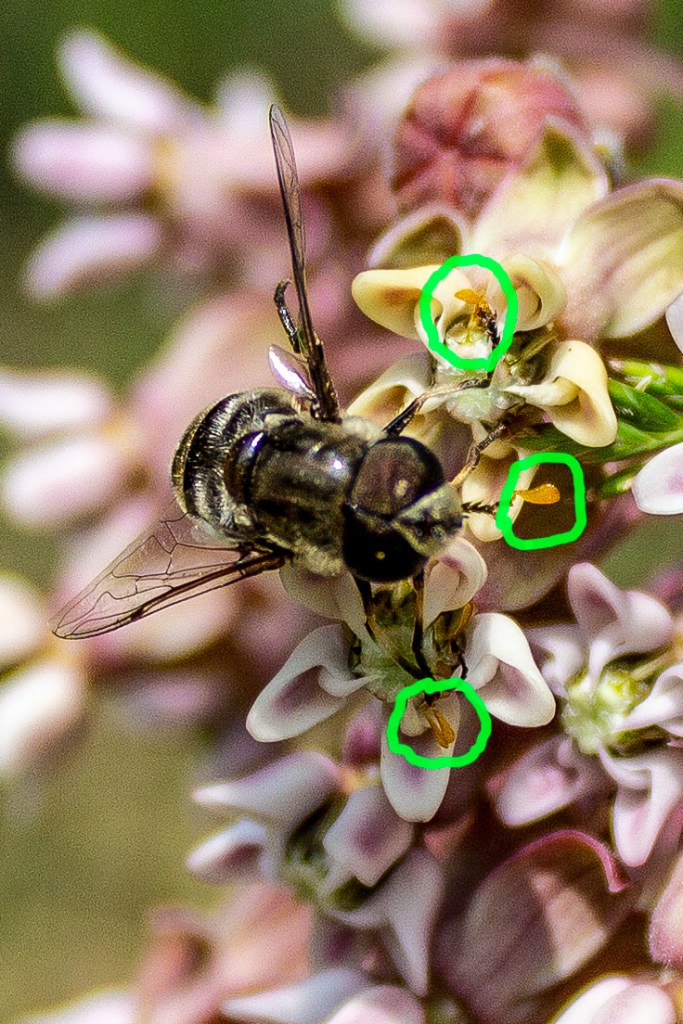
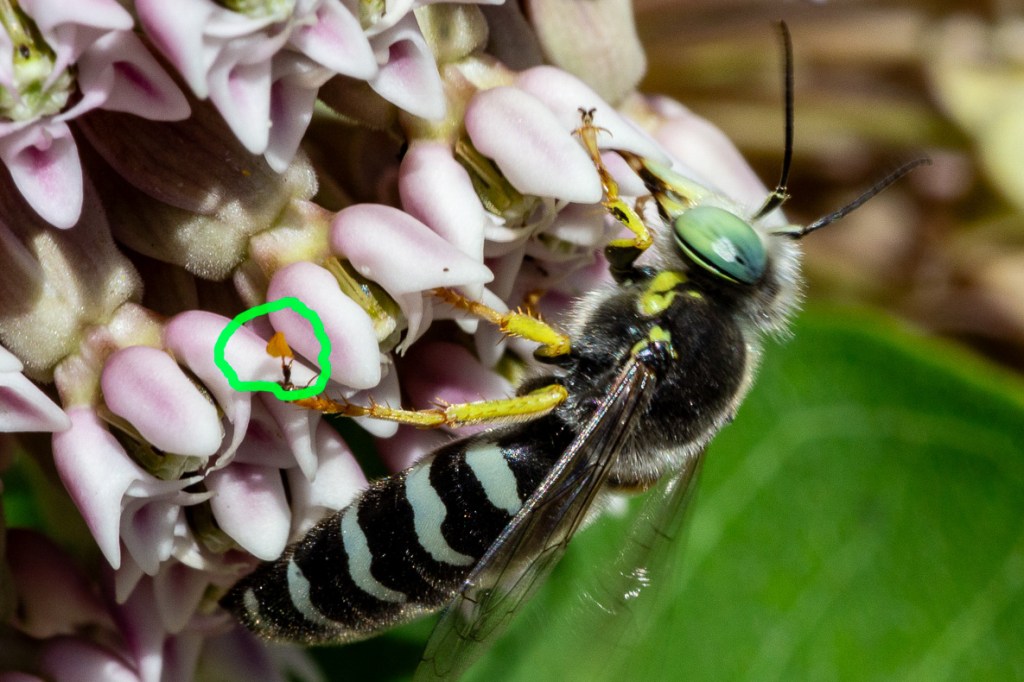
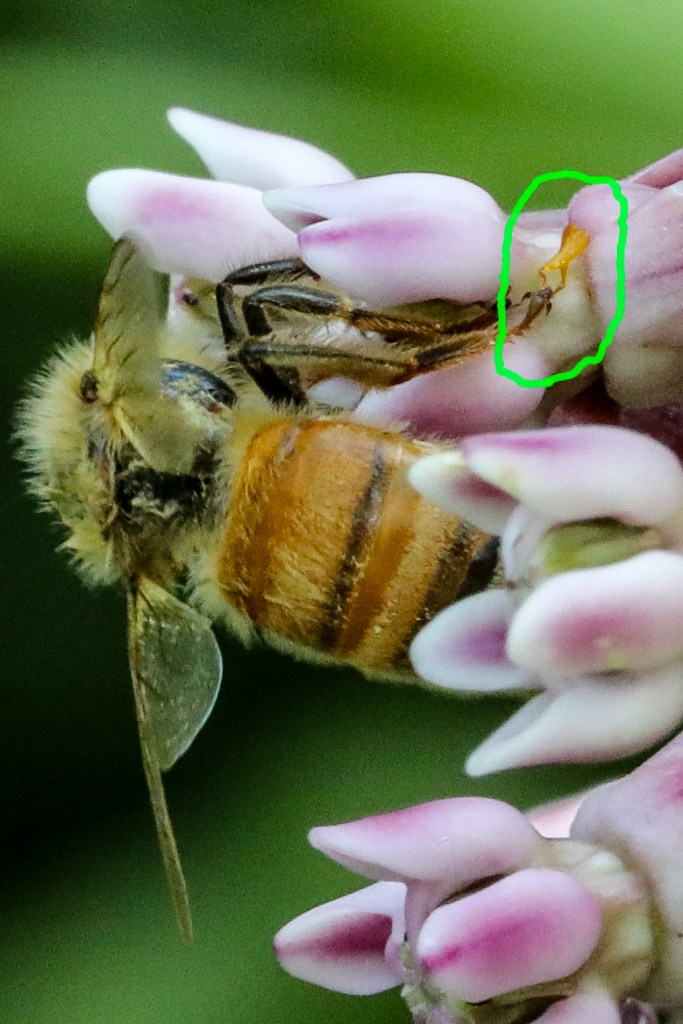
In the milkweeds, the pollinial sac sit inside the stigmatic column and only the corpusculum is visible between the hood structures.  When an insect lands on the flower, one of its legs may slip into the stigmatic slit between two hoods.   As it tries to free itself, the leg moves upward toward the slit in the corpusculum. Bristles in the chamber keep it from going back down.  
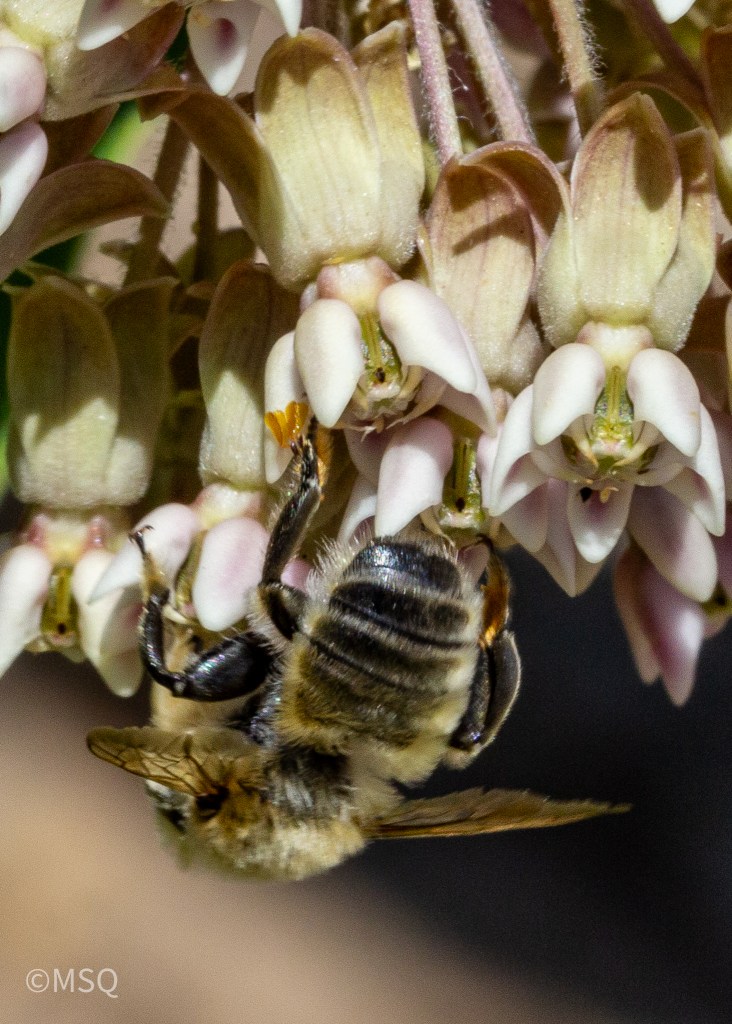
Insects must be strong to free themselves.  Large butterflies, predatory wasps and long tongue bees are most likely to remove pollinaria.  Lost legs and dead smaller insects both occur from failed escape attempts.
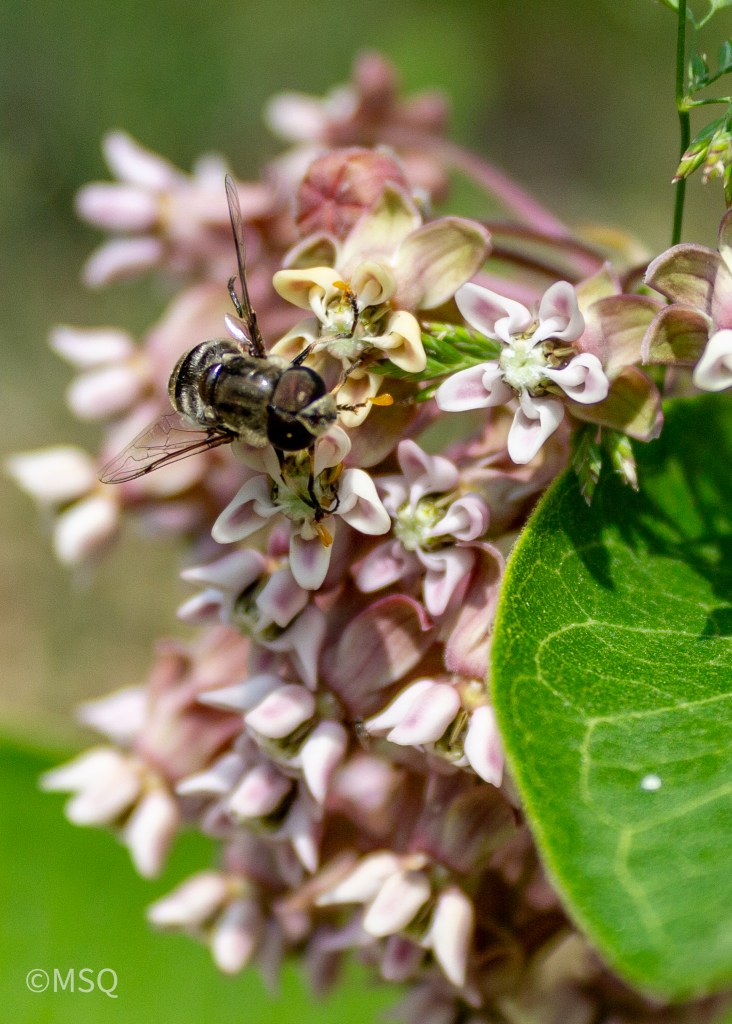
When a pollinaria is removed, it begins to dry.  The pollinial sacs rotate 90o during drying.  The rotation moves them into the correct position for pollination.  

When the insect lands on another milkweed,  the knee bend (not the corpusculum oval) slides into the space between the hood petals.  The translator arm follows then the rotated pollinial sac.  The pollinial sac slides into a space in the stigmatic column and pollination is completed.  
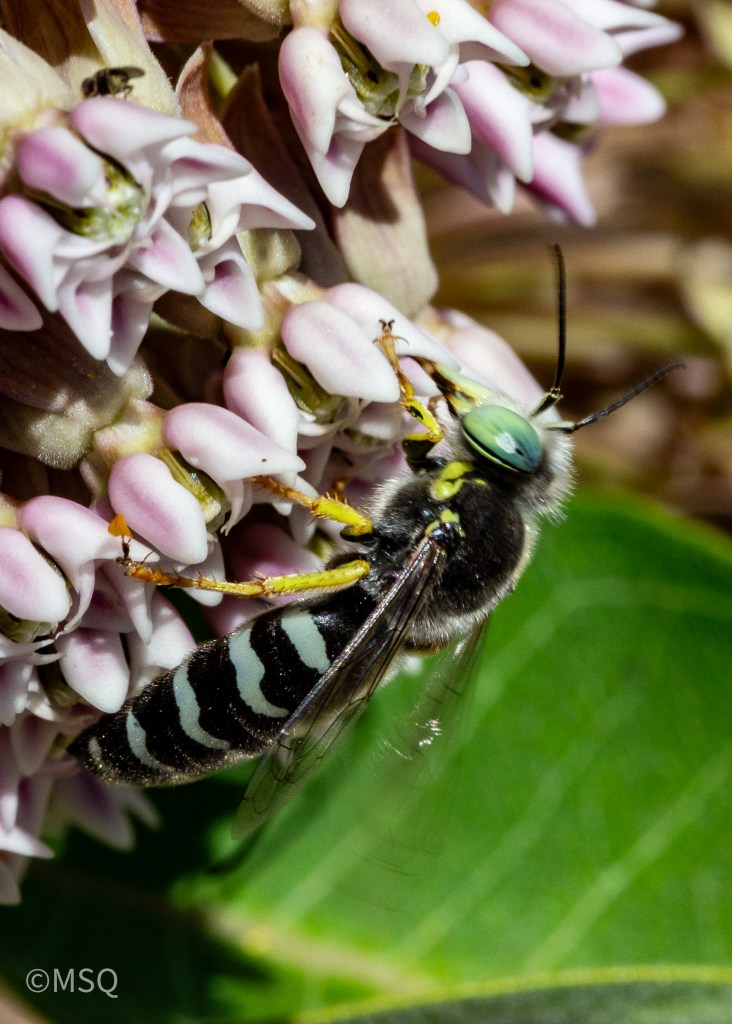
When the insect continues pulling upward, the translator arm breaks.  The insect keeps the remaining part of the pollinaria.  
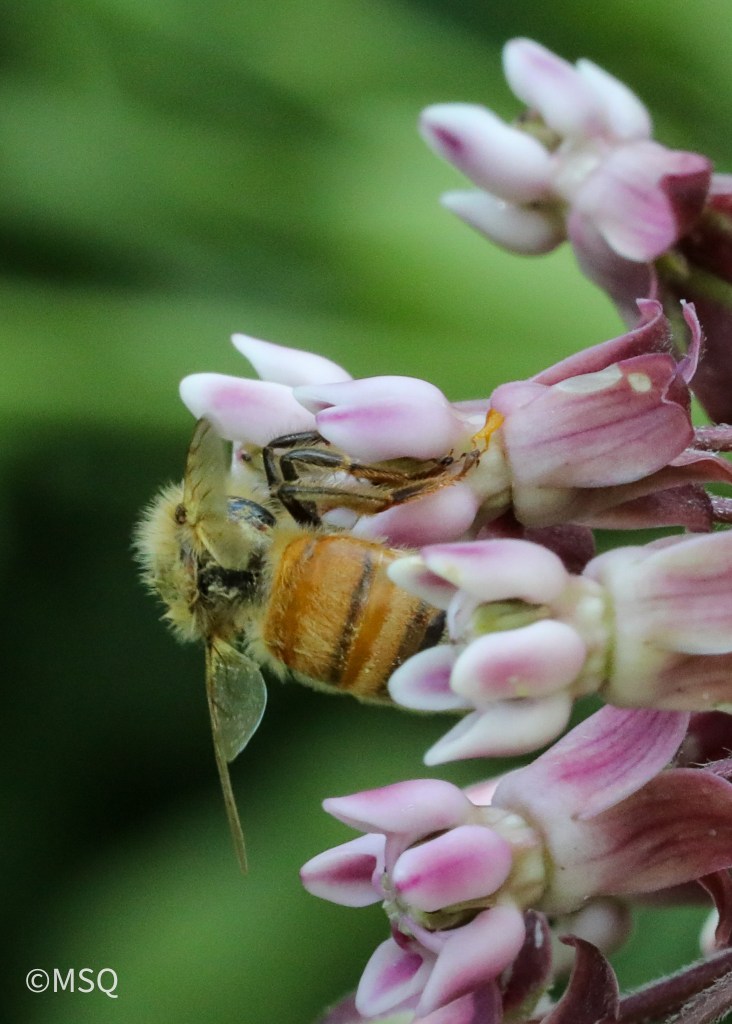
It’s also possible to start a chain of pollinaria during this process.  As the broken translator arm slides between the hoods, it can hook the corpusculum slit of this floret’s pollinaria adding a fresh pollinaria to the partial remaining one.  Clumps and chains of all sorts develop this way.  These groups of pollinaria may increase chances of pollination6.7.
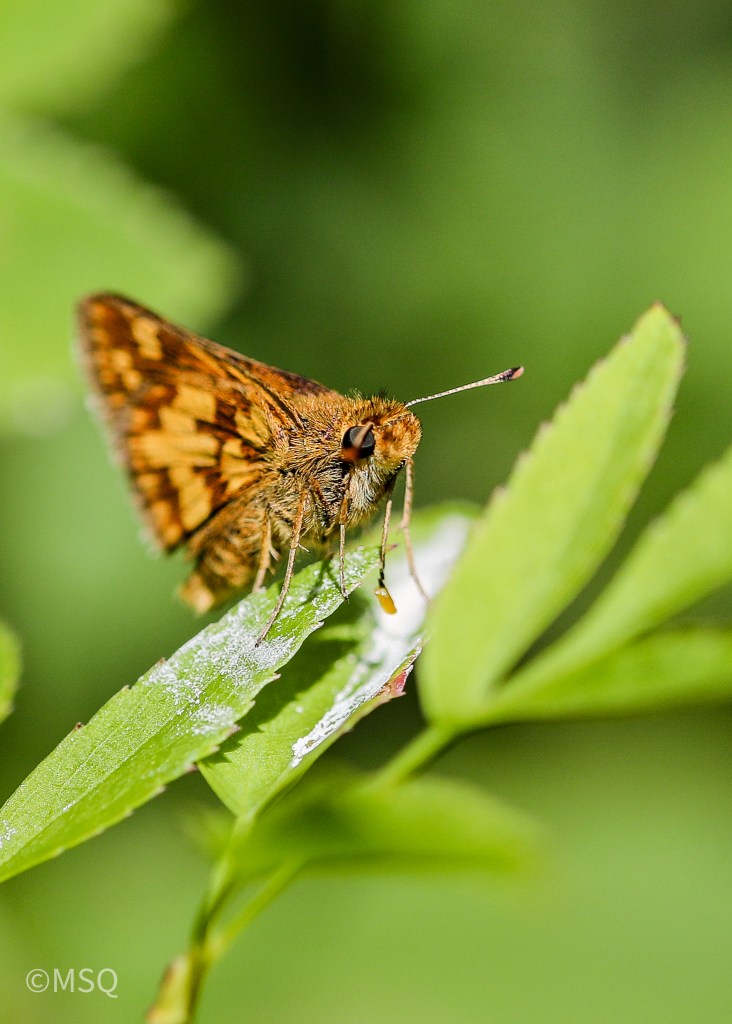
Part I, ends here, with the exciting conclusion of a fertilized milkweed.  Part II will continue with photos and information about the insects that use Common Milkweed.  What a crowd it is—including flies, wasps, bees, butterflies, moths, skippers, plant bugs and beneficial insects!

See you next time to discover what Wild Things are in the Garden!

Mary

References

  1. Hilty, J., n.d., Common Milkweed, Asclepias syriaca, Milkweed family, (Asclepiadaceae),  https://www.illinoiswildflowers.info/weeds/plants/cm_milkweed.html
  2. Berkov, A., 28.October.2010, Plant Talk:  Inside the New York Botanical Garden; Plant Profile:  The Extraordinary Common Milkweed, How Do Insects Feed on this Plant with Sticky White Latex? https://www.nybg.org/blogs/plant-talk/2010/10/science/plant-profile-the-extraordinary-common-milkweed/#:~:text=Plants%20in%20the%20genus%20Asclepias,Asklepios%2C%20the%20ancient%20Greek%20physician.
  3. Bowe, Scott, 11.September.2018, Milkweed is More Than Just a Common Weed, WXPR, https://www.wxpr.org/natural-resources/2018-09-11/milkweed-is-more-than-just-a-common-weed
  4. Nelson, M. and Alfuth, D., 24.February.2021, Milkweed (Ornamental Plants Toxic to Animals), X-number:  XHT1276, https://hort.extension.wisc.edu/articles/milkweed-ornamental-plants-toxic-to-animals/
  5. Taylor, David, n.d., Common Milkweed, (Asclepias syriaca L.), Plant of the Week, https://www.fs.usda.gov/wildflowers/plant-of-the-week/asclepias_syriaca.shtml
  6. Eldredge, E.P., 2015,11,00, Milkweed Pollination Biology, Plant Materials Technical Note NV-58, Natural Resources Conservation Service, https://www.nrcs.usda.gov/plantmaterials/nvpmctn12764.pdf
  7. Betz, R.F., Struven, R.D., Wall, J.E. & Heitler, F.B., 1994, Insect Pollinators 12 Milkweed (Asclepias) Species, T.B. Bragg and J. Stubbendieck (eds.) Proc. Of the Thirteenth North American Prairie Conference. Univ. of Nebraska, Lincoln, NE.
Categories
native plants Pollinator gardening

Shining Gold in the Garden

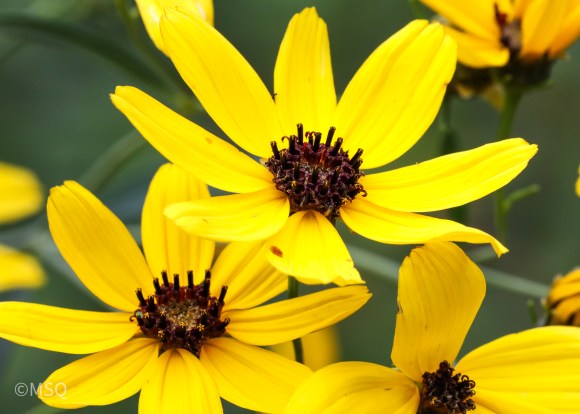
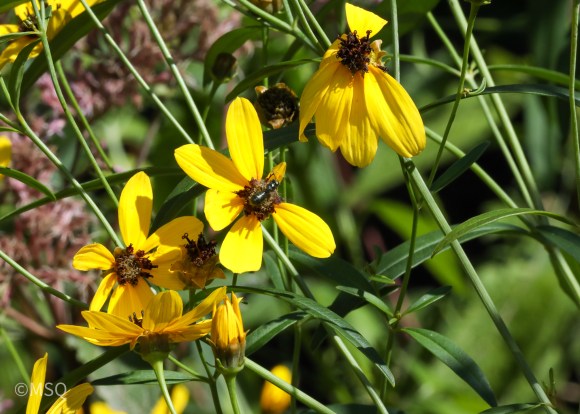
Fluttering above the other garden flowers, the yellow faces of Coreopsis tripterous welcome multitudes of bees.  This mid to late season bloomer supports an array of pollinators and beneficial insects, preparing them for the winter to come.  In addition, Coreopsis tripteris or Tall Tickseed offers an erect accent in the garden resembling bamboo.
Tall Tickseed thrives in Zones 3 through 8.  It grows from two to nine feet tall and spreads from two to eight feet.  Spacing is four to eight feet.  Coreopsis tripteris enjoys medium to moist soils but isn’t picky.  It can tolerate loam, clay-loam, gravel, and sand.  Poorly drained soils can encourage crown rot.  

Established plants tolerate drought and dry conditions.  In dry conditions, Tall Tickseed is shorter and more open.  In ideal conditions, it will self-seed freely.  Deadheading reduces this and may help rebloom.  Unfortunately deadheading, also, reduces seeds for the birds.  

Coreopsis tripteris does lean and often needs support.  This is especially a problem in windy areas and wet areas.  In 2024, I’m going to try a pruning technique called the ‘June haircut’ on my Tickseed.  This technique is used on asters to reduce flopping and increase bloom.  In mid-June, I’ll cut back a quarter to a third of each stem.  I hope to reduce flopping.  I’ll be sure to let you know what happens!

If pruning doesn’t appeal, there are Tall Tickseed nativars available.  Coreopsis tripteris ‘Gold Standard’ and Coreopsis tripteris ‘Flower Tower’ are two options for the native Coreopsis tripteris.  Both plants were originally found in wild populations.  Mt. Cuba Center in Delaware performed the plant trials on the seeds.  

Mt. Cuba is a wonderful botanical garden with a focus on native plants.  In their own words, “Our mission is to inspire an appreciation for the beauty and value of native plants and a commitment to protect the habitats that sustain them.”  As part of their mission, they perform plant trials and offer classes including a certification in Ecological Gardening.1

Coreopsis tripteris ‘Gold Standard’ is a shorter version of the native plant.  It grows to about five and a half feet tall on sturdy stems.  This plant maintains its upright habit throughout the growing season.  It is a slow spreader and fills only two feet.  Like the native, ‘Gold Standard’ has excellent resistance to powdery mildew and leaf spot.  This nativar attracts bees, wasps, skippers, and butterflies.  

Coreopsis tripteris ‘Flower Tower’ has all the native’s height, growing to eight feet tall.  But it has sturdy stems for support,  so it doesn’t lean or flop.  Its flowers are the largest of these three plants at two and half inches.  Unfortunately, those large, lovely flowers only last four to five weeks.  In contrast, both Coreopsis tripteris and Coreopsis tripteris ‘Gold Standard’ bloom for eight to nine weeks.  It spreads two feet over three years and is both hardy and disease resistant.  The Mt. Cuba review didn’t mention insect visits.

Where does Coreopsis tripteris grow in the wild?  It thrives in black soil prairies, cemetery prairies, sand prairies, typical savannas, and sandy savannas.  It can also be found in thickets, edges of seeps, thinly wooded bluffs, meadows in wooded areas and limestone glades.  In areas impacted by people, Tall Tickseed is found in abandoned fields, along railroads, along roadsides and in moderately disturbed areas.  It responds well to fire.2

The leaves of Coreopsis tripteris are a fascinating feature of the plant.  Most of the compound leaves are three parts, suggestive of bamboo. They even flutter in the wind like bamboo leaves.  Combined with the vertical lines of this plant, it creates the impression of bamboo grass in the garden–at least until the flower bloom.  It’s like two plants in one!

Aside from the three-part form, the leaves grow opposite  each other the entire length of the stem.  They are larger at the bottom where they have five parts.  Individual leaflets extend up to five inches long and spread three-quarter inches wide and are elliptic in shape.  The edges often have tiny hairs called ciliate.  Leaves are medium green on top and light green underneath with very small hairs (pubescent).2

Tall Tickseeds begins blooming in mid-summer and continues through the summer, trailing off into Fall.  Bright yellow flowers with flattened, velvety brown centers sit on top of the stems or emerge from upper leaf axils.  The flowers are one to three inches across with rounded, widely spread petals.  The petals give Tall Tickseed a lovely, Daisy-like form different from a Black-Eyed Susan

The blooms can be single or in a flat group resembling an open cyme—think yarrow with just a few large, yellow flowers.  The center flowers open first.  The petals are sterile ray florets while the center has disc florets.  These disc florets form five millimeter long, tubular, four to five lobed, reddish-brown florets.  The lobes’ edges have triangular shapes that are spreading to slightly recurved.

Like Solidago, Coreopsis is a keystone plant. There are two kinds of keystone plants.  One type supports caterpillars from 90% of moths and butterflies.  The other category has pollen used by specialist bees.  These plants feed both specialist and generalist bees.  Coreopsis is in the top 30 keystone plant genera for the Eastern Temperate Forests.  It is seventh on the Top 30 Native Plants for Pollen Specialist Bees (also for the Eastern Temperate Forests—Ecoregion 8).3,4

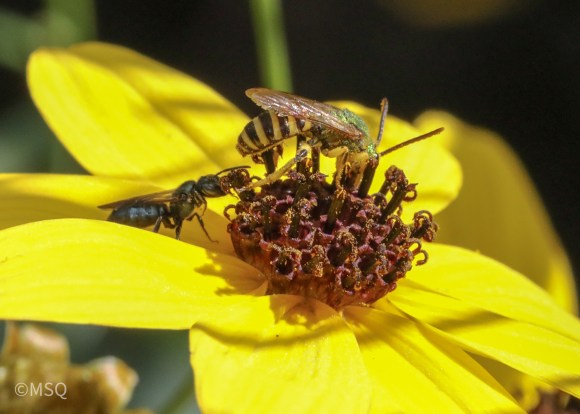
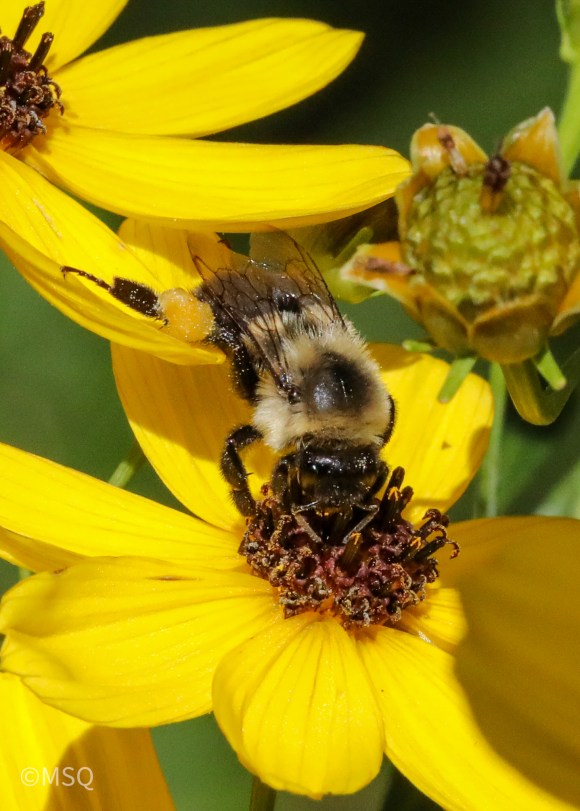
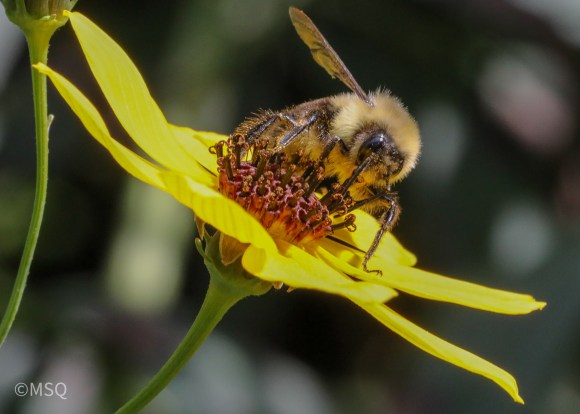
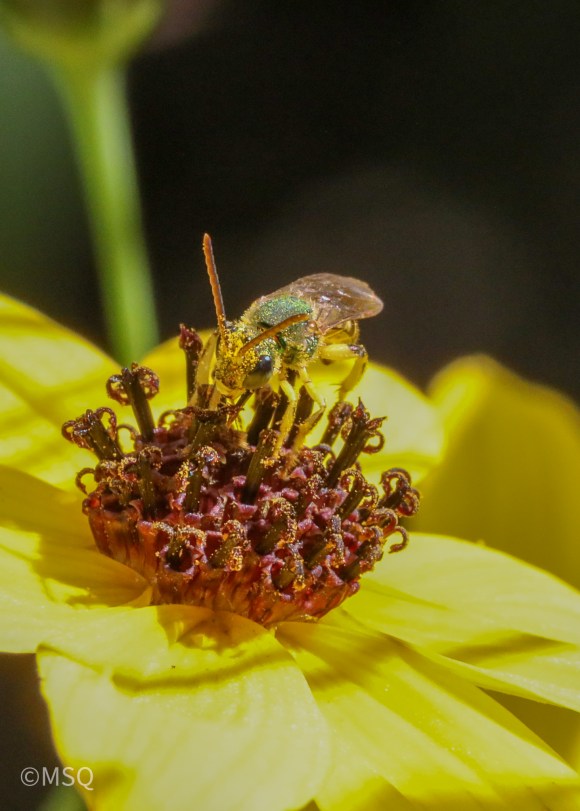
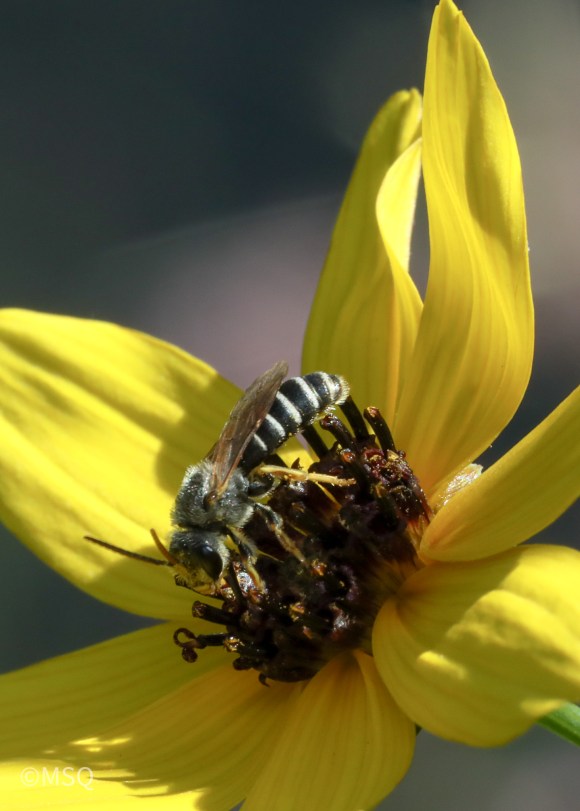
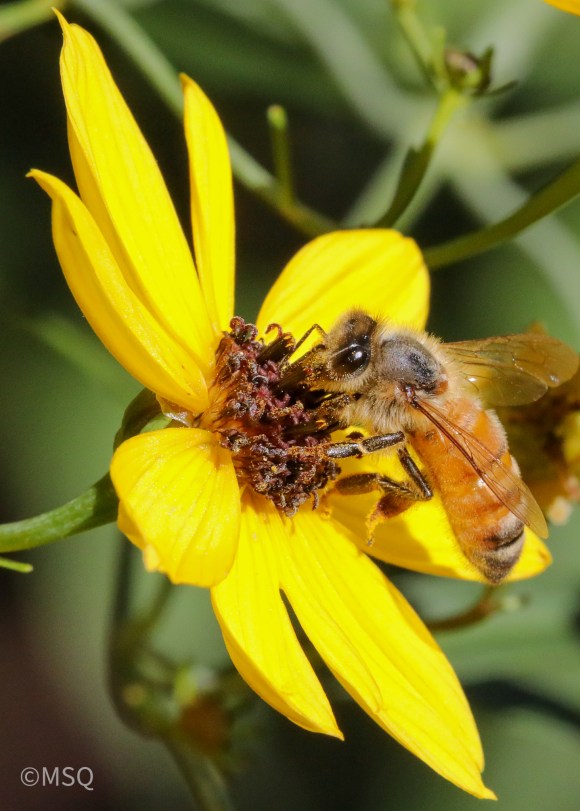
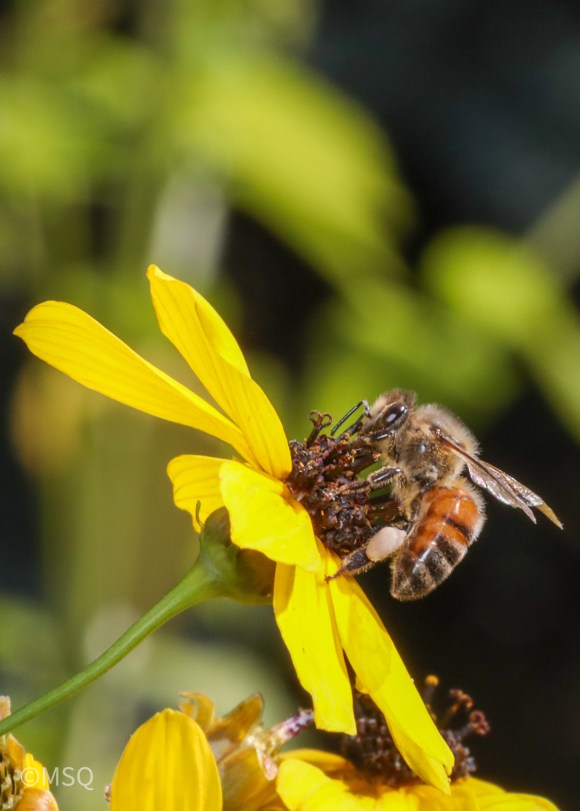
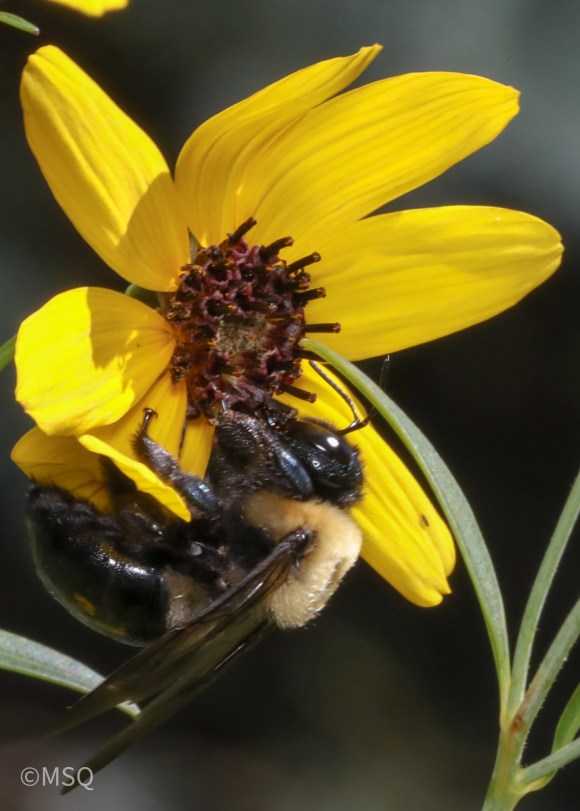
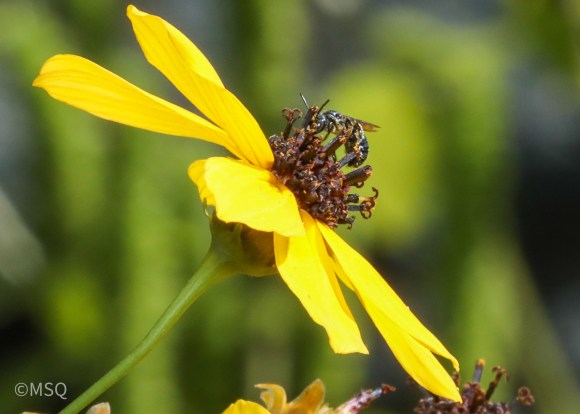
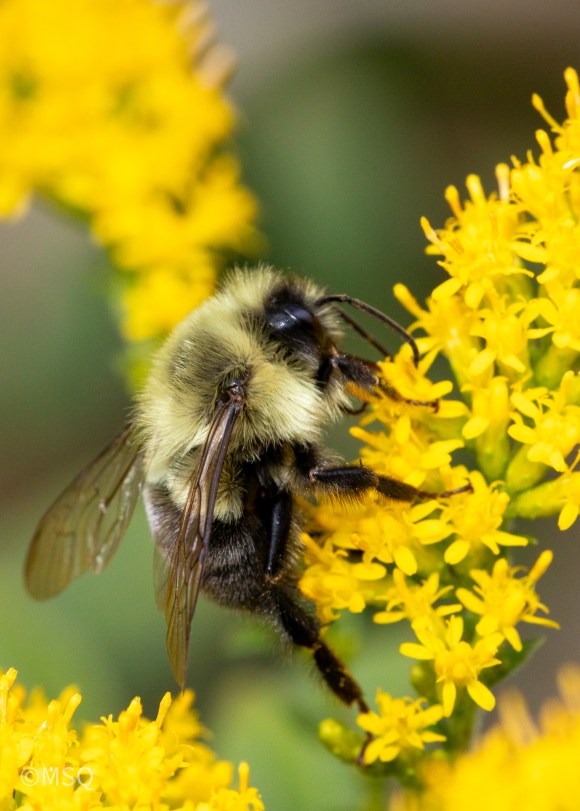
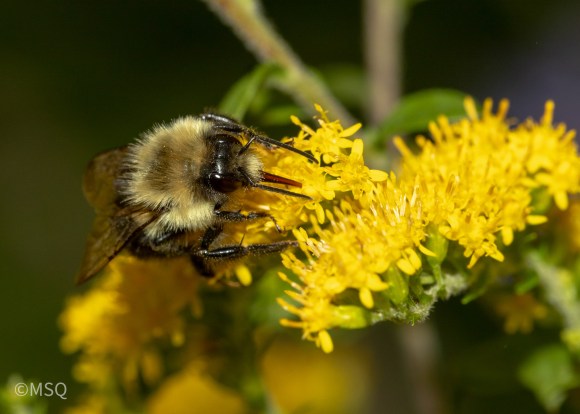
Tall Tickseed attracts numerous species of bees, butterflies, moth, skippers, and other beneficial insects.  The Xerces Society for Invertebrate Conservation considers it of Special Value to Native Bees and states it, Supports Conservation Biological Control.5  Coreopsis tripteris draws Bumblebees,

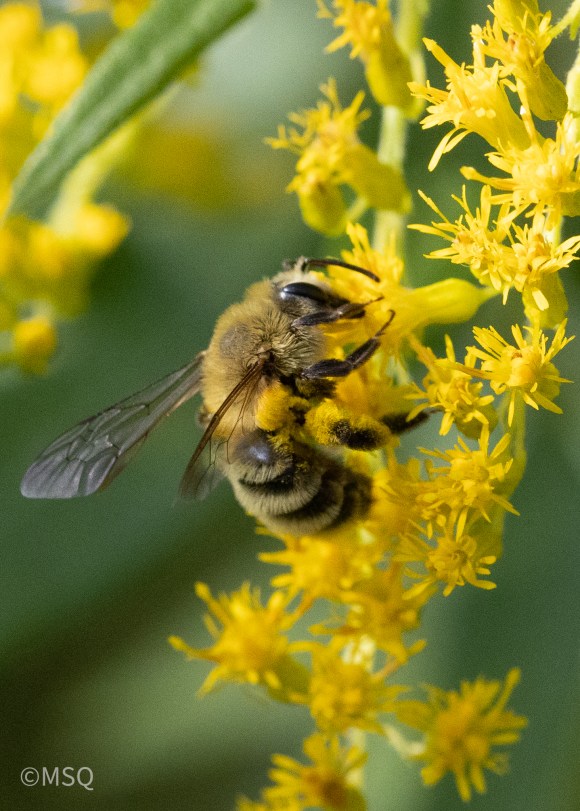
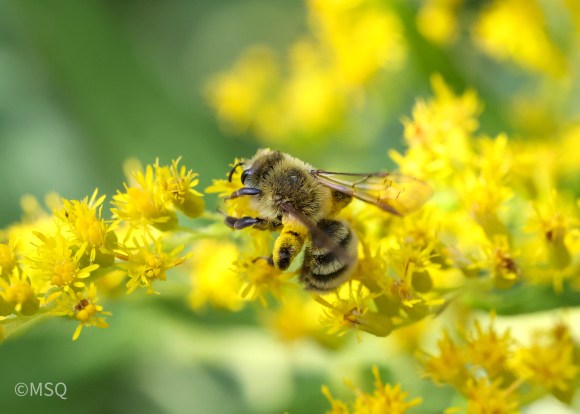
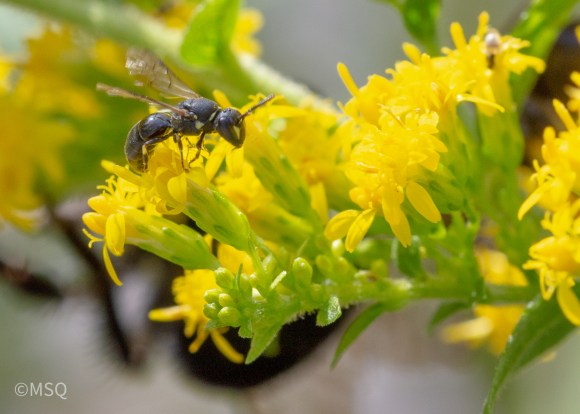
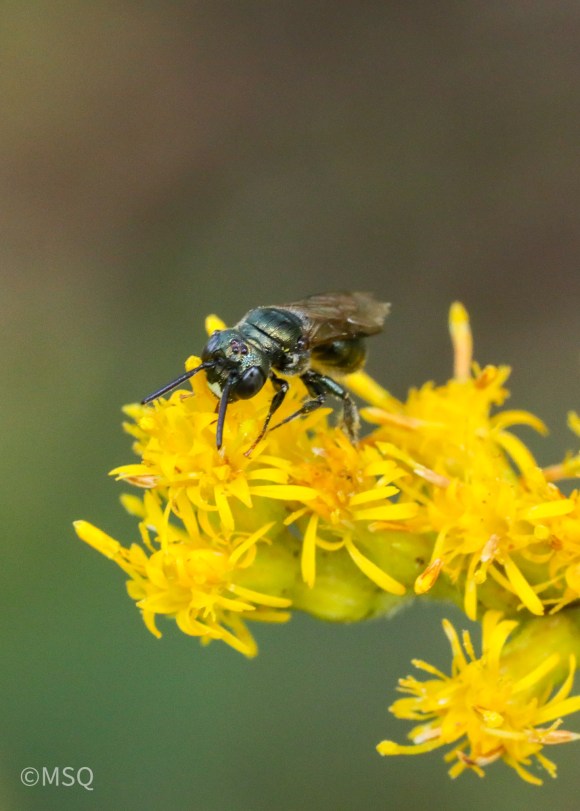
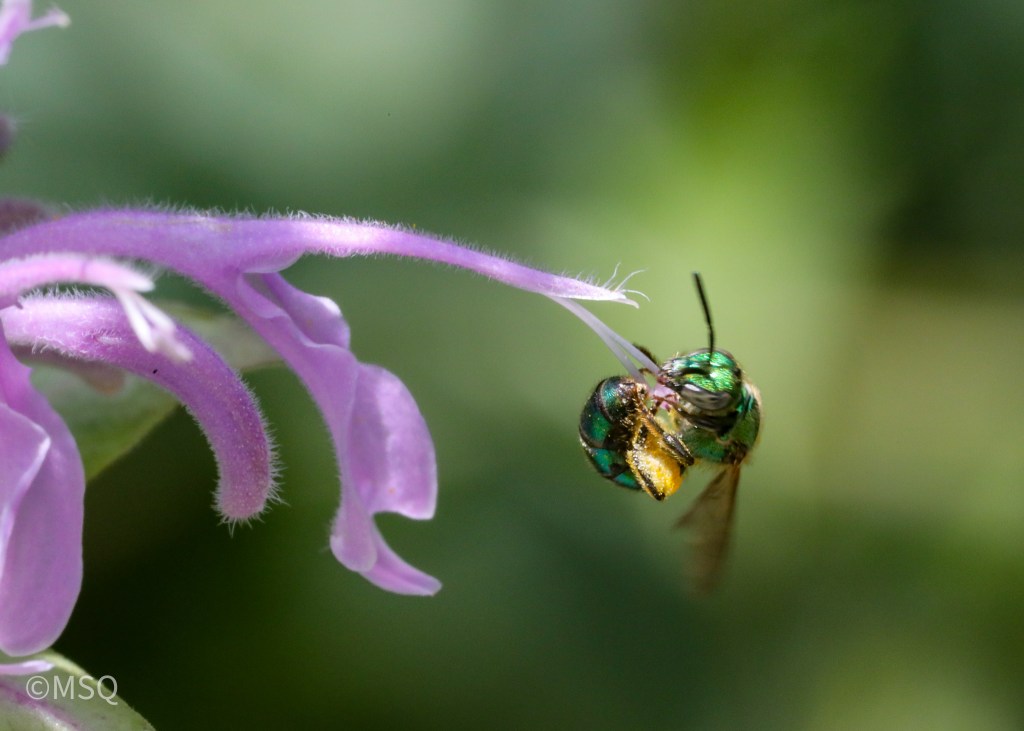
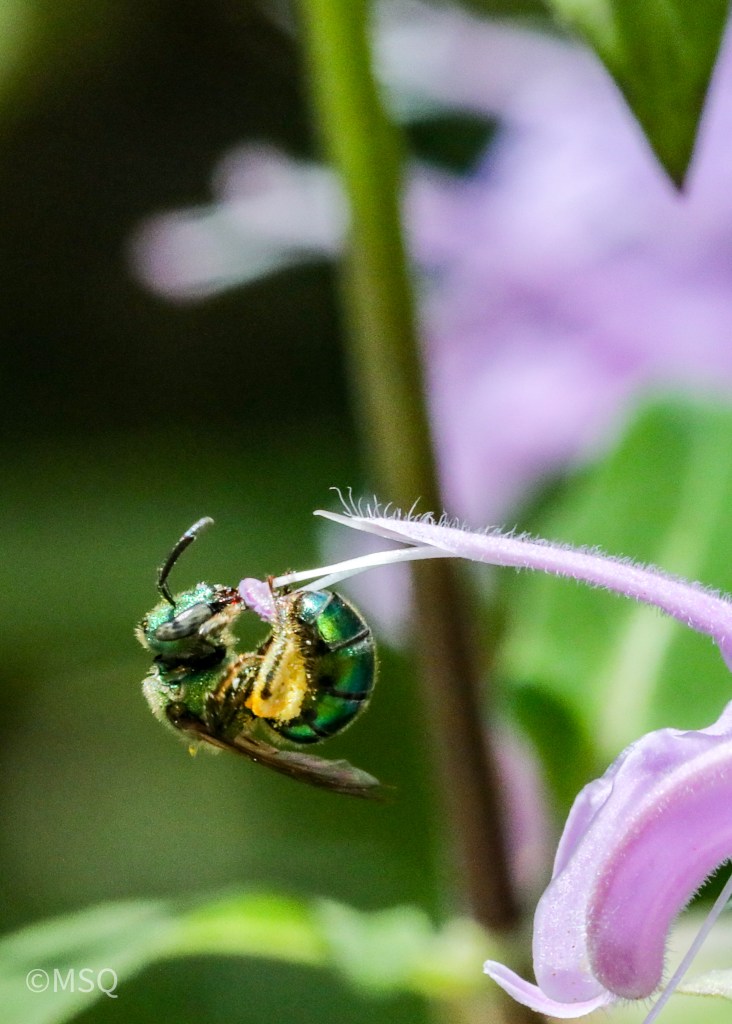
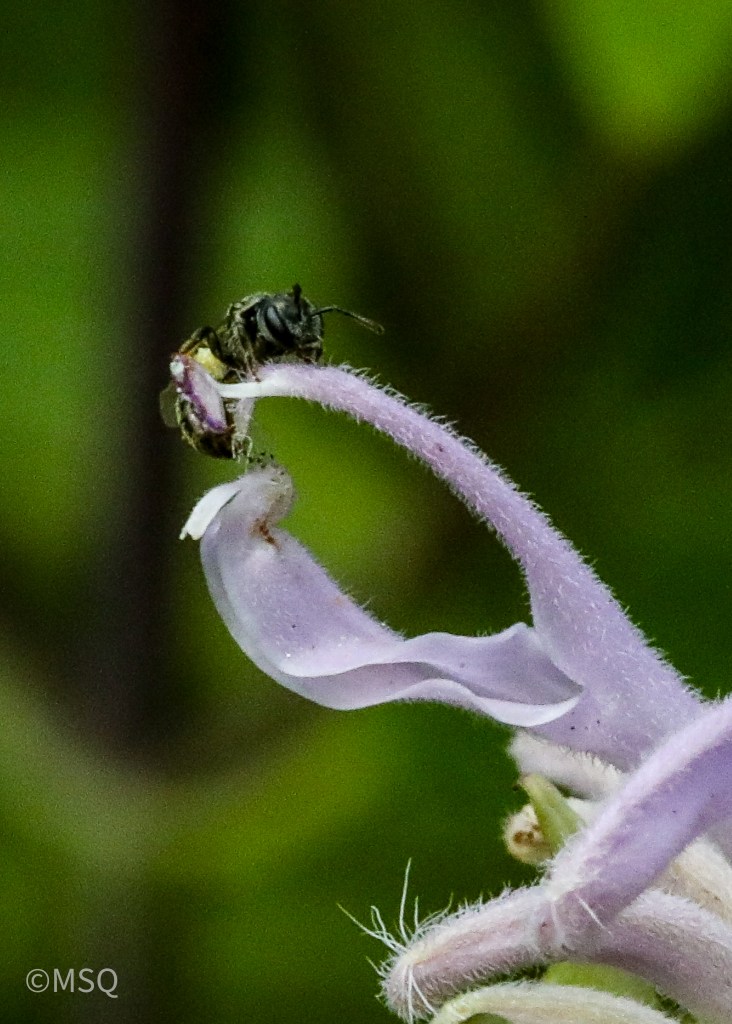
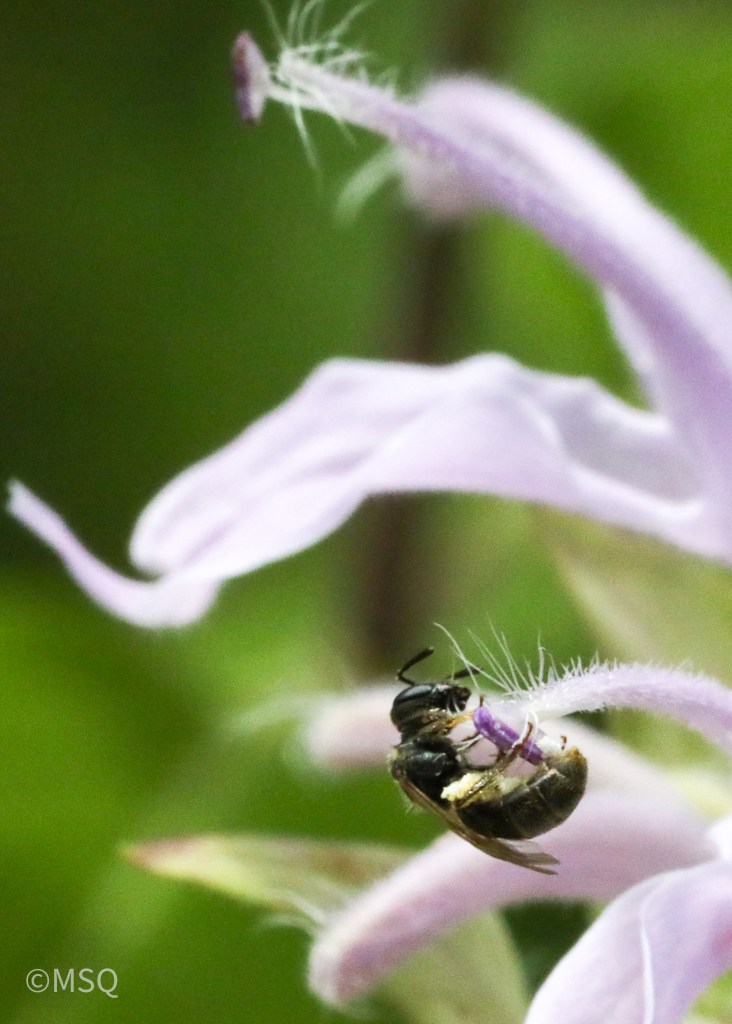
cuckoo bees,  digger bees (Melissodes spp.), leaf-cutter bees (Megachile spp.), Halictid bees (Halictus spp., Lasioglossom spp.), small green sweat bees,

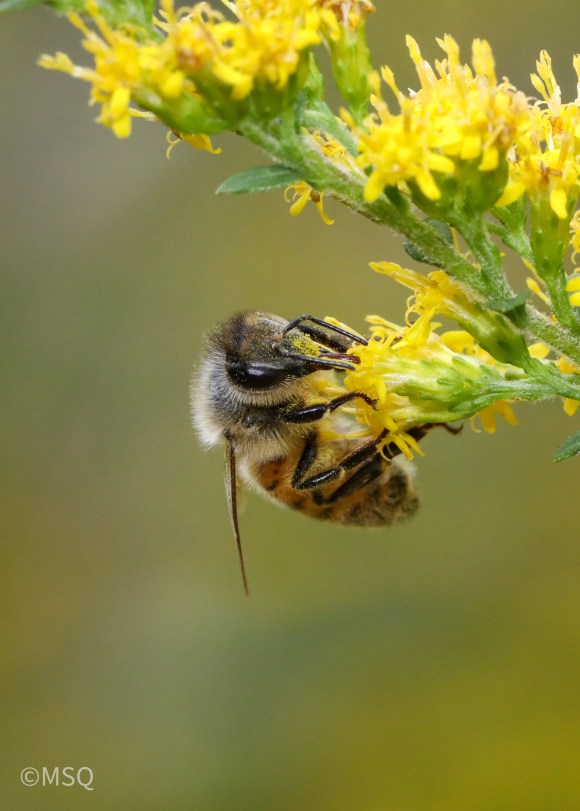
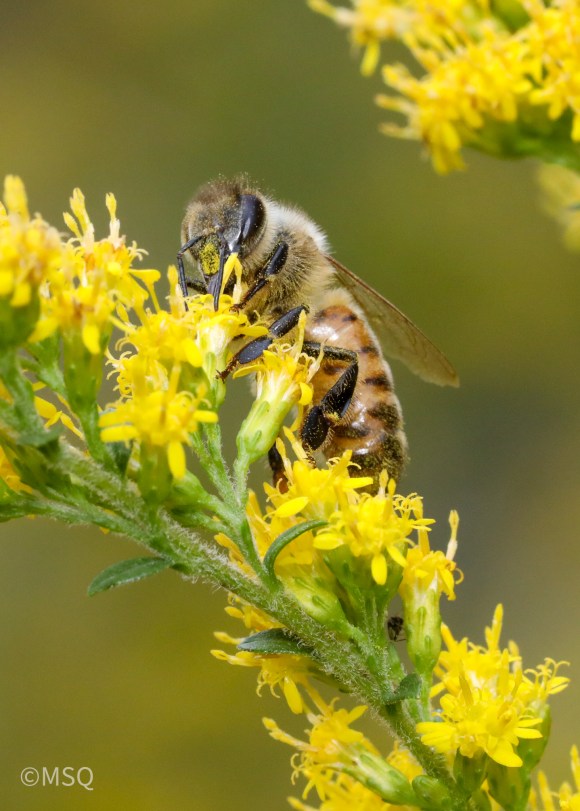
honey bees,

carpenter bees (Xylocopa spp. and Ceratina spp.) and dagger bees (Calliopsis spp., Heterosaurus spp.).2

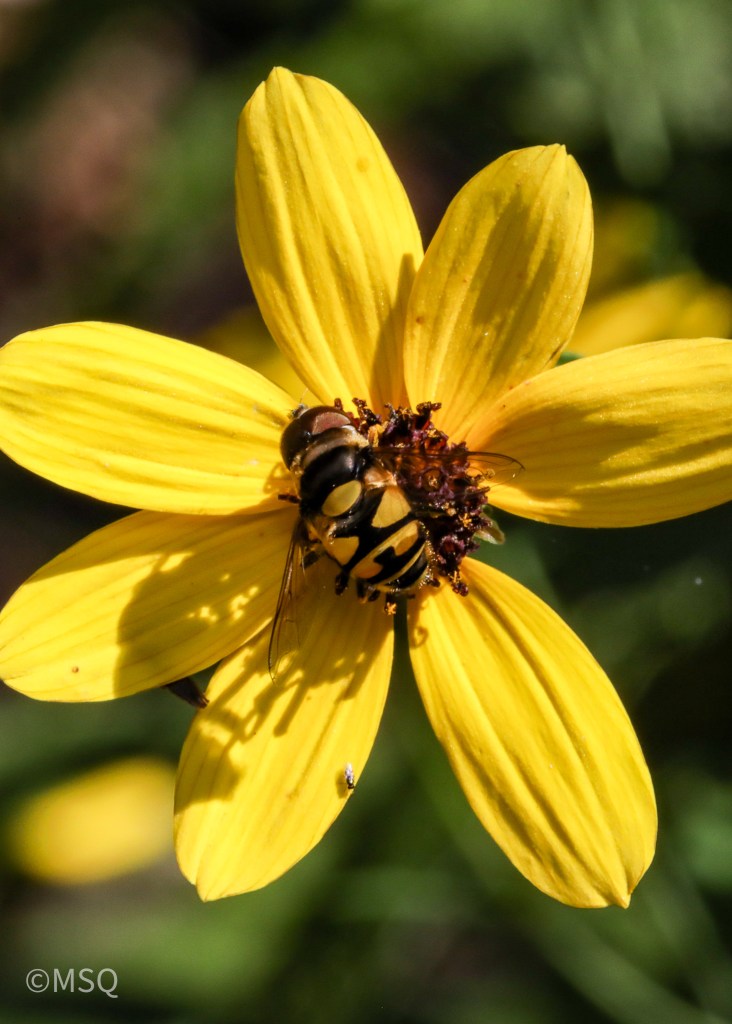
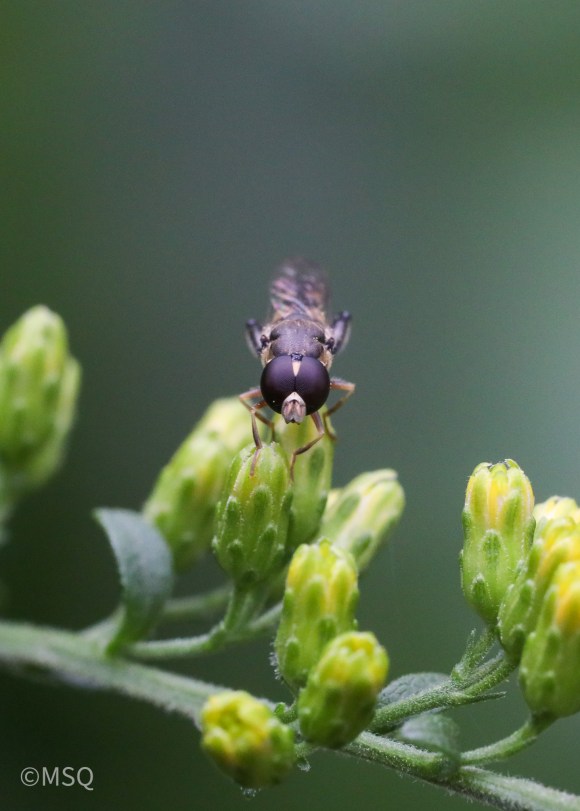
Flies also visit Tall Tickseed.  Syrphid flies, Bee flies and Tachinid flies feed on nectar from the flowers.  Both Syrphid flies and the Tachinid flies can be beneficial insects.

The Goldenrod Soldier Beetle (Chauliognathus pennsylvanicus), another beneficial insect, eats both pollen and nectar from the Coreopsis blooms.  Over its life cycle, the Soldier beetle also preys on soil-dwelling invertebrates, aphids, and other soft-bodied insects.2

Butterflies, moths, and skippers gather resources from Coreopsis tripteris.  Adults nectar at the flowers for summer and early fall fuel.  Various moths use it as a larval host.  The Dimorphic Gray Moth (Tornosscolopacinarius) consumes the leaves of the Tall Tickseed as a caterpillar.  Both the Wavy-lined Emerald Moth (Synchlora aerata), and Common Tan Wave Moth (Pleuroprucha insulsaria) eat the flowers.  The Wavy-lined Emerald larva, also called the Camouflage Looper, not only dines on the flowers but wears them.  The larva use silk to attach pieces of the flower petals to its body.  If it moves to a different type of flower, the caterpillar will change its ‘clothes’ to match its meal.  In addition, it also seems to change clothes frequently since the observed petals are always fresh!6

I hope you’ve enjoyed this exploration into Coreopsis tripteris!  If you have any comments or suggestions about the post, I would love to hear them!  Enjoy your holiday season!

Warm Regards,

Mary

References:

  1. No author, (n.d.) Our Vision and Our Mission, Mt. Cuba Center, https://mtcubacenter.org/about/mission/#:~:text=Our%20mission%20is%20to%20inspire,the%20habitats%20that%20sustain%20them.
  2. Hilty, J., (n.d.) Tall Coreopsis, illinoiswildflowers.info, https://www.illinoiswildflowers.info/prairie/plantx/tl_coreopsisx.htm
  3. Keystone Plants by Ecoregion, The National Wildlife Federation, https://www.nwf.org/Garden-for-Wildlife/About/Native-Plants/keystone-plants-by-ecoregion
  4. National Wildlife Federation, Gardening for Wildlife, Keystone Native Plants Eastern Temperate Forests – Ecoregion 8, https://www.nwf.org/-/media/Documents/PDFs/Garden-for-Wildlife/Keystone-Plants/NWF-GFW-keystone-plant-list-ecoregion-8-eastern-temperate-forests.ashx?la=en&hash=1E180E2E5F2B06EB9ADF28882353B3BC7B3B247D
  5. No auther, n.d., Coreopsis tripteris, Lady Bird Johnson Wildflower Center, https://www.wildflower.org/plants/result.php?id_plant=cotr4
  6. Bzdyk, K., (2013, July 1), Wavy-lined Emerald Moth:  Master of Disguise, Loudoun Wildlife Conservancy, https://loudounwildlife.org/2013/07/wavy-lined-emerald-moth-master-of-disguise/
Categories
native plants Pollinator gardening

Sparks in the Garden

Every year in the early Fall, a glittering cloud of insects surrounds the arching stems of Solidago rugosa ‘Fireworks’.  Butterflies, moths, skippers, bees, wasps, beetles, beneficial insects, and flies all flock to this goldenrod for nectar, pollen and to use it as a larval host.  This feast helps prepare them for the cold months of winter.

The twinkling yellow flowers of ‘Fireworks’ goldenrod pop open along stems up to 18” long!  Held above the foliage, these stems resemble fireworks and give the plant its name.  Pompom blooms are tightly packed along the stems. Each one is about 1/8th inch in diameter.  The anthers are held above the stigmas and bright yellow ray flowers form the outer ring.  Peak bloom lasts two to three weeks.

Medium to dark green leaves grow alternately and are three to six inches long.  They range from ovate to lanceolate and their edges are toothed.  The deeply sunken veins in the leaves causing a wrinkled look. This feature gives them the name rugosa or wrinkled.  In fact, a common name for the native Solidago rugosa is Wrinkle-Leaved Goldenrod.

Solidago rugosa ‘Fireworks’ is a charming goldenrod cultivar.  Well-behaved, it sports abundant bloom for a grand show in the garden.  An erect plant, it forms dense clumps with slowly spreading rhizomes.  It grows three to four feet tall.  Spreading from two to three feet, ‘Fireworks’ will reseed if happy.  Space plants one to three feet apart.  

‘Fireworks’ thrives in zones four to eight.  It enjoys moist, well-drained soils although it can tolerate periods of drought or wet soil.  Highly adaptable to different soils, this goldenrod grows in clay, loam (silt), and sand as well as acid to neutral conditions. My plants have not been bothered by deer or rabbits.  It can withstand both heat and humidity. 

The genus Solidago, like Symphyotrichum, is an essential part of wildlife habitat, a keystone species.  In recent years, people have become interested in keystone species of all types.  A keystone species is one so crucial that the ecosystem will collapse without it.

How does this work with plants?  Key plants are native plants that are part of the local food web.  They play a role as a general or specific support for insects.  The general group are the 14% of native plants that support 90% of butterfly and moth Lepidoptera species.1  The specific group are the 40% of native plants that produce pollen for the 15% to 60% of North American native bee pollen specialists.1  Both these groups are listed in the Keystone Plants by Ecoregion from the National Wildlife Federation.  According to this information, Solidago sustains 104 species of caterpillars and 42 different specialist bees.2  (I have used the Eastern Temperate Forest list since this is my region.)  In addition to these categories, 145 different wasp species forage on Solidago.3

So, goldenrod offers abundant food at the end of the year, how is this valuable?  Fall is when next year’s insect generation is established.  Whether it’s healthy adults, well fed caterpillars or full provisions in nests, the foundations are laid with Autumn food harvest.  Goldenrod is one vital resource.

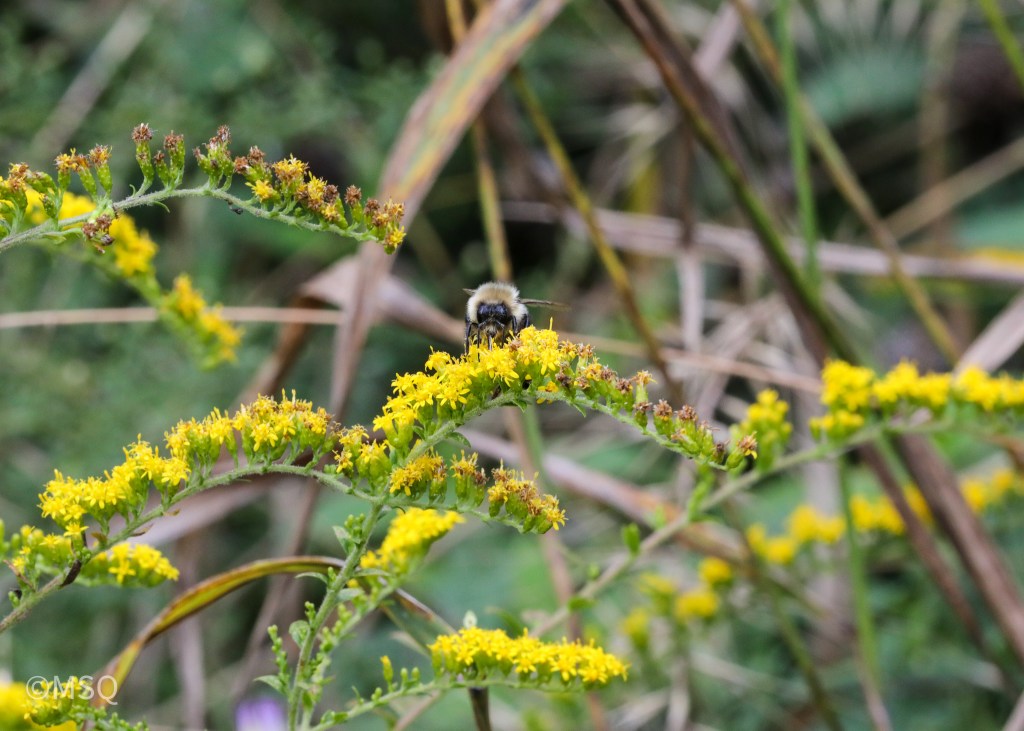
Different insects have different strategies for surviving the winter.  In the next few paragraphs, I’ll talk about what the pollinators do over the winter and where they might be.  Bumblebee and honeybee queens take mating flights in the late summer or fall.  Male bumblebees take advantage of nectar from Solidago ‘Fireworks’ to fuel up before pursuing their queen. When they’ve mated, the queens find a safe location to overwinter.  Some bumblebee queens hibernate in leaf litter and others burrow underground.4

Honeybee queens return to the hive.  During the winter, the honeybees form a ball in the hive.  If they become cold, they will vibrate for warmth.  The queen stays near the center of the mass.  Any resources gathered in the fall, are converted into honey, and used to help the honeybees survive the winter.5

Native bees overwinter as young in their nests.4  Active native bee queens use the resources from goldenrods to supply their nests.  Like SymphyotrichumSolidago has numerous bee specialists including:  Andrena (Callandrena) asteris, A. (Callandrena) braceata,  A. (Callandrena) simplex, Andrena (Cnemidandrena) hirtcincta, Andrena (Cnemidandrena) canadensis, Colletes simulans, Colletes solidaginis, Perdita (Perdita) octomaculata and Melissodes (Eumelissodes) fumosus.

Where are their nests?  70% of native bees nest underground!  Now is not the time to start digging.  Others nest in old beetle burrows and other holes in dead wood and still others in hollow stems.4  It’s better to wait until spring to cut back dead stems and clean up dead wood.

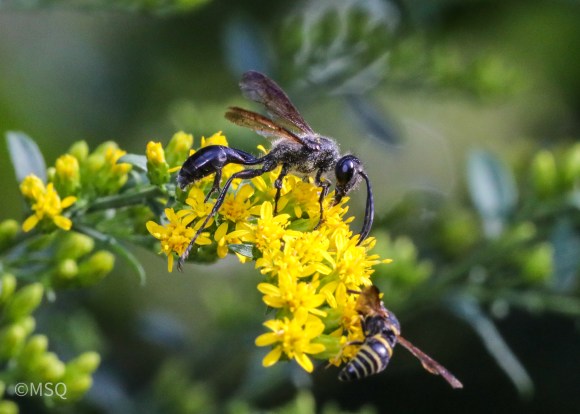
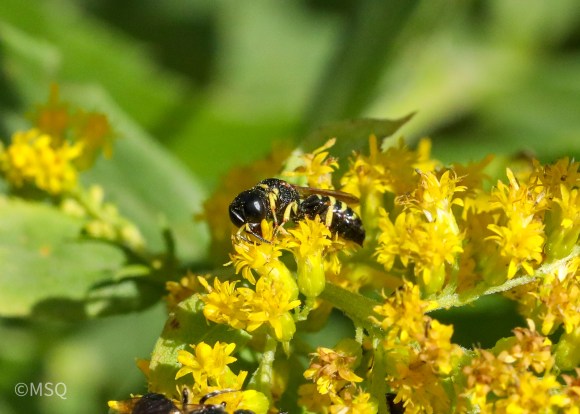
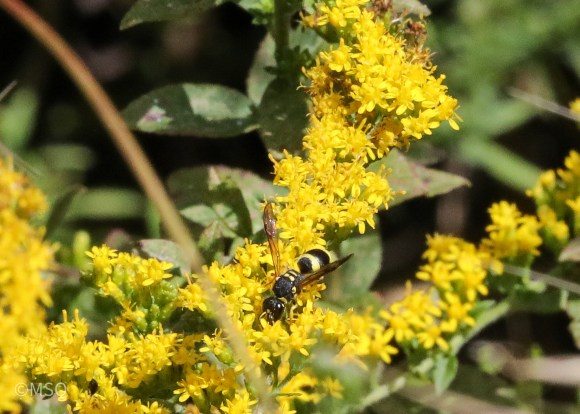
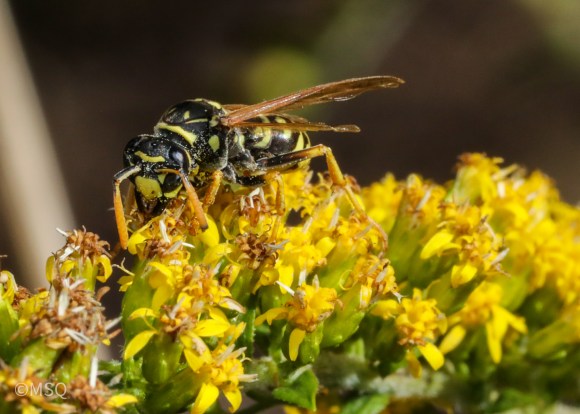
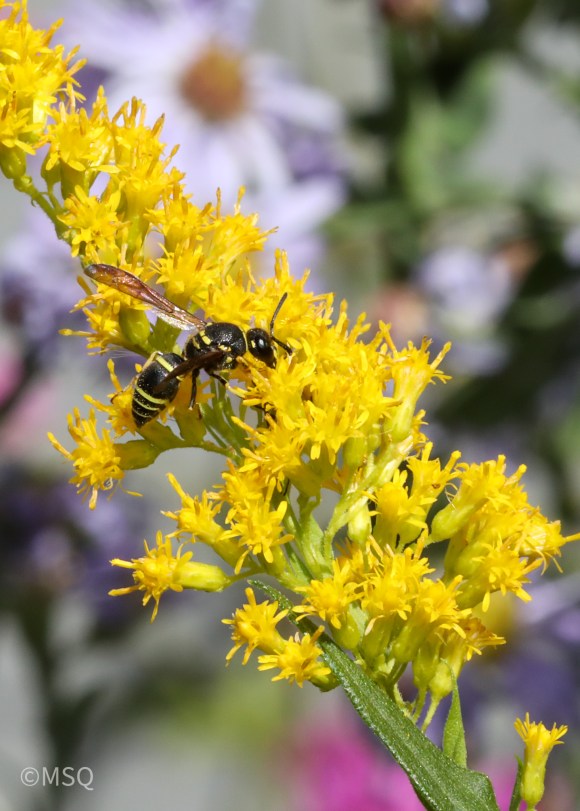
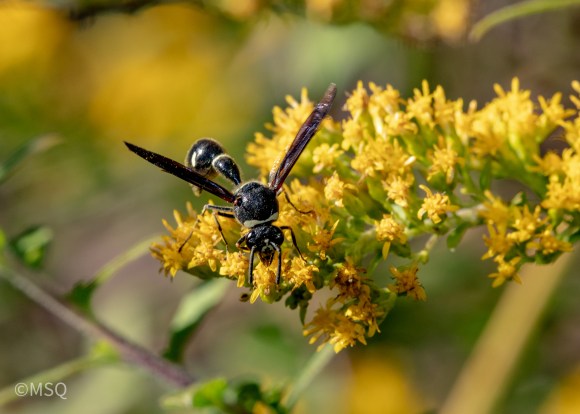
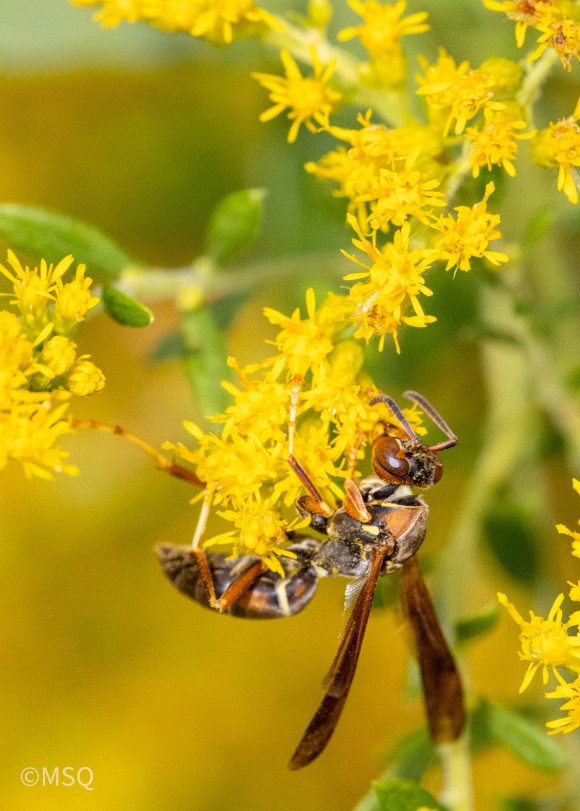
Solidago rugosa ‘Fireworks’ attracts numerous native wasps.  Indeed, unlike asters, I find wasps visiting my ‘Fireworks’ goldenrod in equal numbers with the bees.  These wasps serve as beneficial insects preying on or parasitizing pests that damage plants.  They also contribute to pollination as they drink nectar and, occasionally, eat pollen.  Native wasps spend the winter in different ways:  some as mated females called foundresses, some as young and some we don’t know yet.  The foundresses find dry, warm spots to hide in.  Other nesting locations are similar to bees including stems, wood, underground and old nests built by other wasps or bees.3

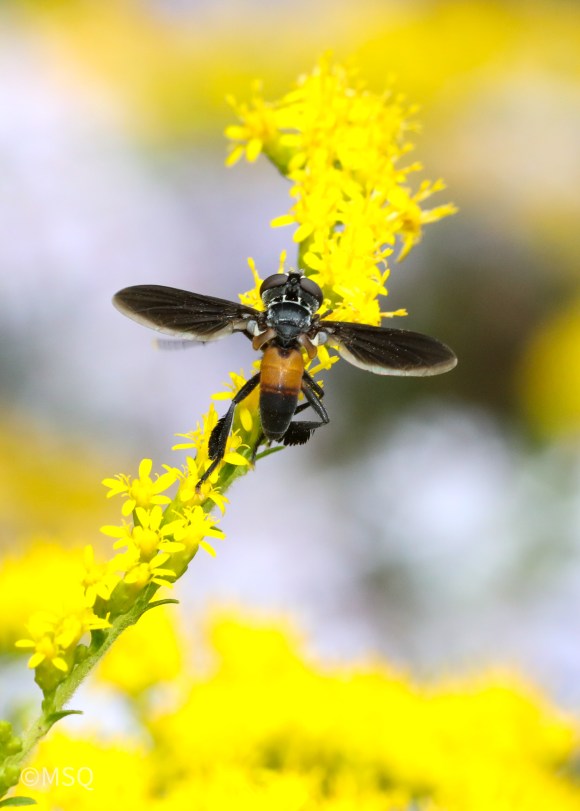
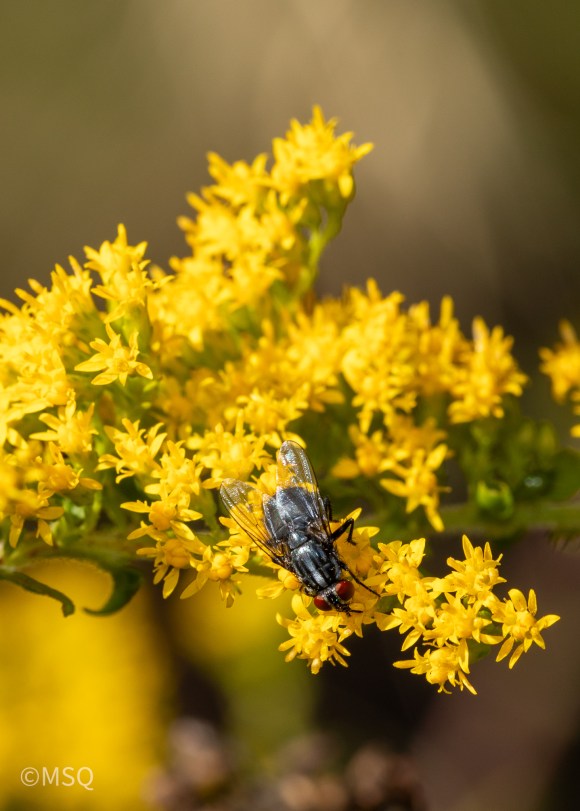
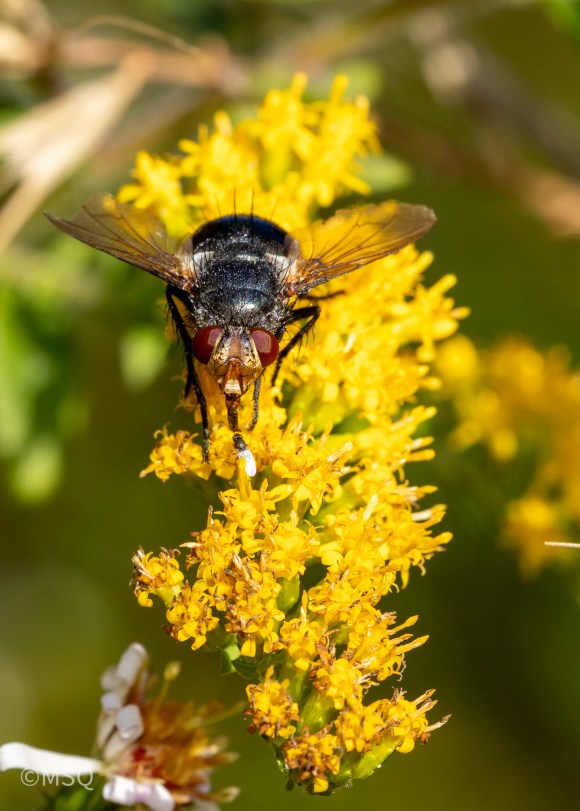
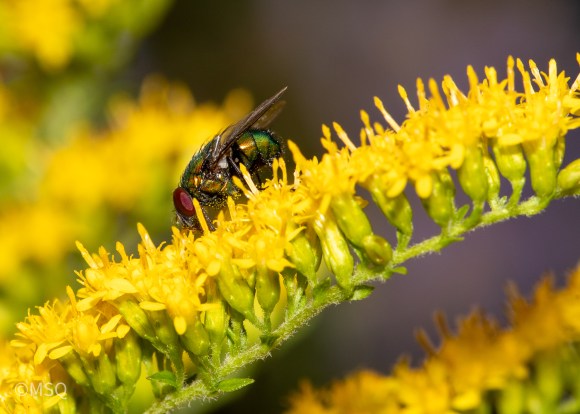
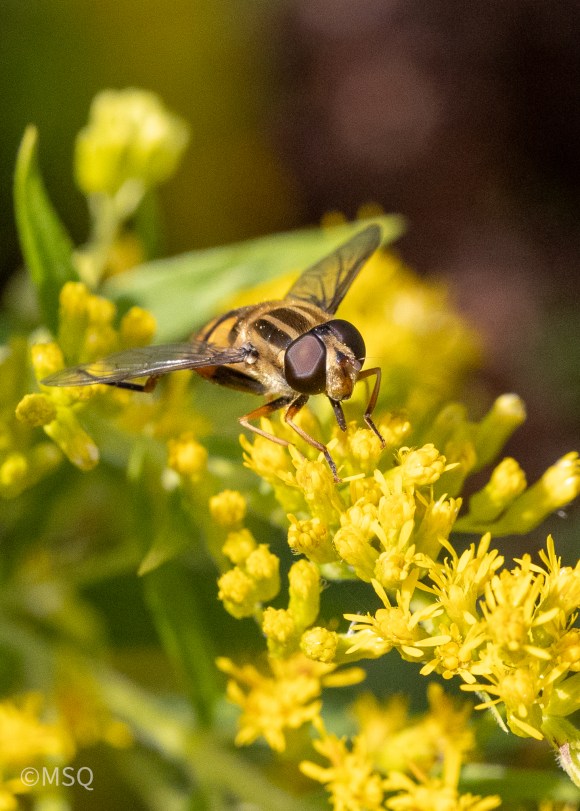
Many flies visit ‘Fireworks’ goldenrod to drink nectar and, incidentally, pollinate the flowers. The larval stage of some Tachinid and Syrphid flies are beneficial insects. Tachinid flies parasitize leaf eating insects. They over winter in the larval or pupal stage often in the shell of their host. The larvae or pupae can be found in piles of leaves or bush or burrowed into the soil.

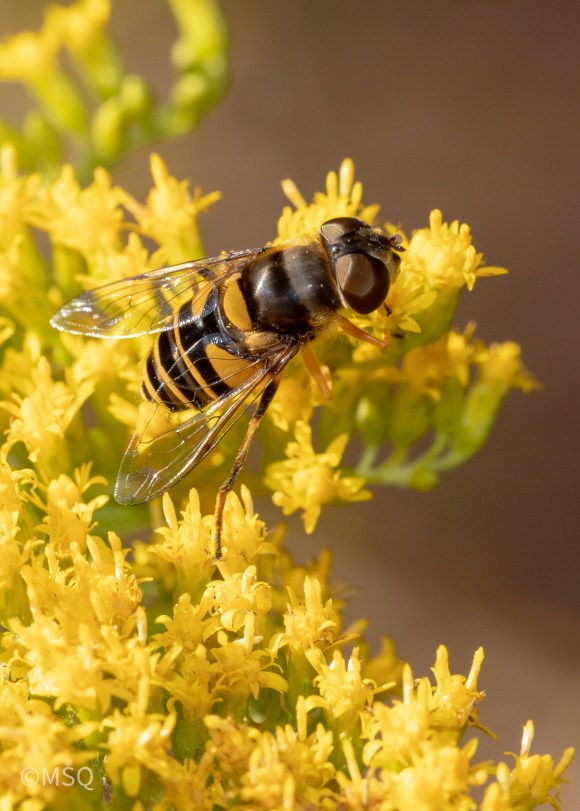
Syrphid fly larva are excellent early and late season predators. They consume dozens of aphids each day. Most spend the winter as pupae or larvae in dead leaves or piles of brush.

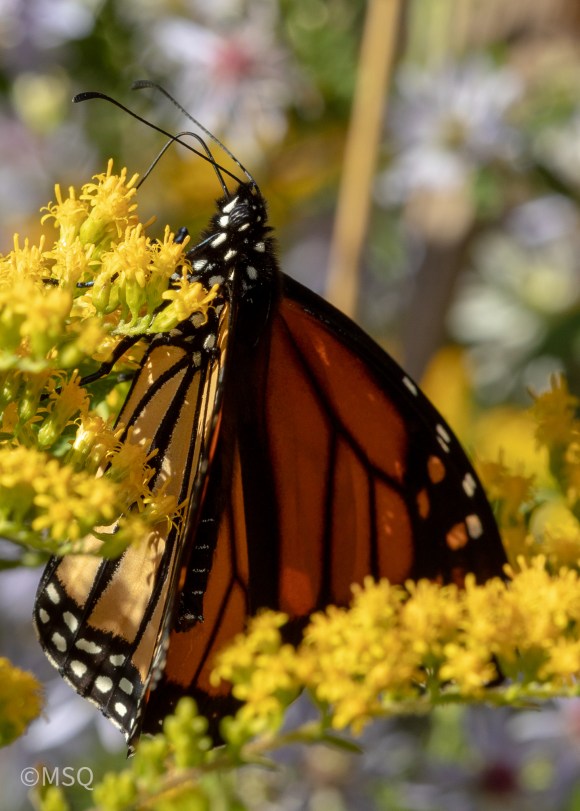
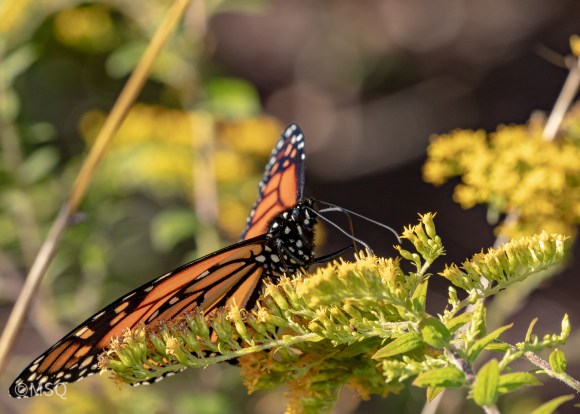
Butterflies use goldenrod for nectar.  Monarchs fuel up for their migration and other butterflies build fat stores to hibernate as adults.  Not all butterflies overwinter as adults,  they can spend the cold months as eggs, caterpillar, chrysalis, or adults depending on the species.  The eggs are laid close to a spring food source.  Caterpillars deliberately hid in curled leaves, soil or under rocks for protection.  If becoming a chrysalis, the caterpillar will choose a protected location, for instance, under an overhang or deep in a shrub.  Adult butterflies and moths are very diverse when hiding.  Spaces under bark, crevices in trees, cracks in rock and the fall leaves all host butterflies and moths.6

Solidago serves as a larval host for 104 butterfly and moth caterpillars.  One unusual moth is the Wavy-Lined Emerald.  The caterpillar has a fascinating adaptation.  It decorates itself with the leaves or flowers from its host plant.  This camouflage hides it from predators.  The twirler moths (Gelechiidae), Geometer moths, Owlet Moths (Noctuidae), and Tortrix Moths also use Solidago.

The take home for today: Leaves are not Litter!  Stems Stand Tall!  Don’t Do that Digging!

Just take a rest, drink some cider, and enjoy those Fall colors!

References:

  1. Keystone Plants by Ecoregion, The National Wildlife Federation, https://www.nwf.org/Garden-for-Wildlife/About/Native-Plants/keystone-plants-by-ecoregion
  2. National Wildlife Federation, Gardening for Wildlife, Keystone Native Plants Eastern Temperate Forests – Ecoregion 8, https://www.nwf.org/-/media/Documents/PDFs/Garden-for-Wildlife/Keystone-Plants/NWF-GFW-keystone-plant-list-ecoregion-8-eastern-temperate-forests.ashx?la=en&hash=1E180E2E5F2B06EB9ADF28882353B3BC7B3B247D
  3. Holm, H., 2021 Wasps:  Their Biology, Diversity, and Role as Beneficial Insects and Pollinators of Native Plants, Minnetonka, MN, Pollination Press LLC.
  4. Morris, S. (2018, October 10). Where Do Pollinators Go In The Winter? Xerces Society for Invertebrate Conservation.  https://xerces.org/blog/where-do-pollinators-go-in-winter#:~:text=Most%20native%20bee%20species%20will,help%20to%20survive%20until%20spring.
  5. Hogeback, J. Where Do Honeybees Go In The Winter?  Britannica.  https://www.britannica.com/story/where-do-honeybees-go-in-the-winter
  6. Grisak, A. (2022, November 04). How Does A Butterfly Survive Winter? Birds & Blooms. https://www.birdsandblooms.com/gardening/attracting-butterflies/butterflies-in-winter/
Categories
Pollinator gardening

The Garden’s Super Station

Like lavender lace, the intricate flowers of Wild Bee Balm shimmer in the summer sun.  Wild Bee Balm (Monarda or Monarda fistulosa) lures bees, wasps, butterflies and more.  The flowers unfold in the garden for a full month and its light, grey-green leaves contrast with darker foliage.

Monarda thrives in Zones 3 to 9.  It is an excellent mid-garden plant growing from two to four feet tall.  It spreads two to three feet and a three-foot spacing is recommended. An extremely adaptable plant, Wild Bee Balm tolerates clay, chalk, loam, sand and alkaline to acid soils.  It blooms in full to part sun.  Monarda also tolerates heat, drought and Black Walnut trees and is deer and rabbit resistant.   It only really struggles when flooded although it accepts some in the winter.

The flower heads are held singly at the top of each stalk and can be white, pink, or lavender.  Lavender is most common.  Flower heads can be up to four inches across!   They open from the center/top to the edges.  The corolla of each floret divides into a tubular upper lip and a three part slender lower lip for a landing pad.  The stamens and the stigma eventually protrude from the upper lip.  The name fistulosa means tubular. Linnaeus named Monarda after Nicolas Bautista Monardes, 16th century physician and botanist.

Monarda is in the mint family and has the classic square stem found in mints.  Its leaves are aromatic, lanceolate, and toothed.  The frosted, grey-green leaves can grow to 4 inches long.  Wild Bee Balm has an erect, clump-forming habit.

Each plant has deep roots for feeding.  They use rhizomes to spread as well as seeds.  The rhizomes can survive bulldozers and other earth moving machine to pop up in unexpected places.  In natural areas, Wild Bee Balm grows on prairies, in dry, rocky woods, at the edges and in open areas of woods, in unplanted fields, along roads and railroads.

I hesitated a long time before adding Monarda to my garden.  I knew it had several challenges that weren’t easily solved.  High winds and heavy rain knock it over.  It needs support in an unprotected area especially with repeated thunderstorms.  All the Monardas are susceptible to powdery mildew.  Good drainage and air circulation may help reduce the mildew, but I’ve never been able to prevent it.  I developed a different strategy. I let my Wild Bee Balm flower and then cut it back by one-third to one-half.  Since it’s in the middle of the bed, other plants hide it.  The Monarda recovers and regrows fresh leaves.

Monarda also loves to spread.  The rhizomes creep past their beds onto paths and into other plants’ spaces.  Some of the seeds will sprout new colonies.  These plants aren’t hard to pull.  Again, I let them blossom.  When they’ve finished, I put what I don’t want and trim back the rest.

So why do I keep a plant that’s going to be a problem?  Because it’s an amazing pollinator plant!  The Xerces Society of Invertebrate Conservation recognized Monarda fistula as particularly attractive to native pollinators and included in their book 100 Plants to Feed the Bees (written by Eric Lee-Mäder, Jarrod Fowler, Jillian Vento, and Jennifer Hopwood).

What is the Xerces Society?  Xerces Society of Invertebrate Conservation is an international group that protects the natural world by protecting invertebrates and their habitat.  Xerces Society is for pollinators and insects what the Audubon Society is for birds.

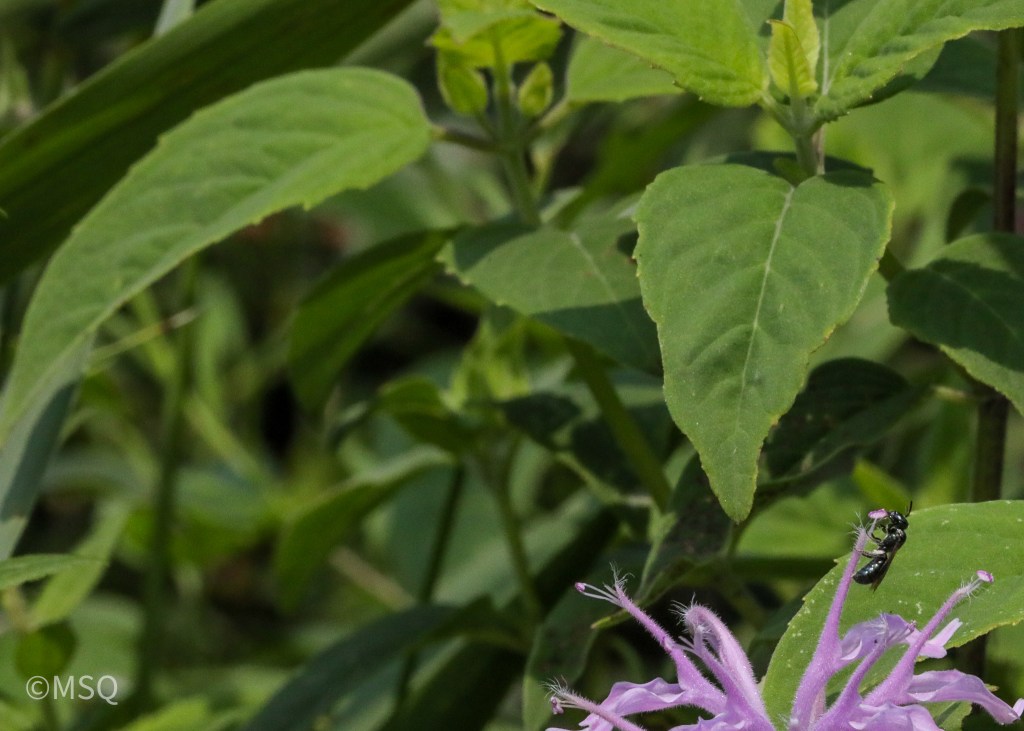
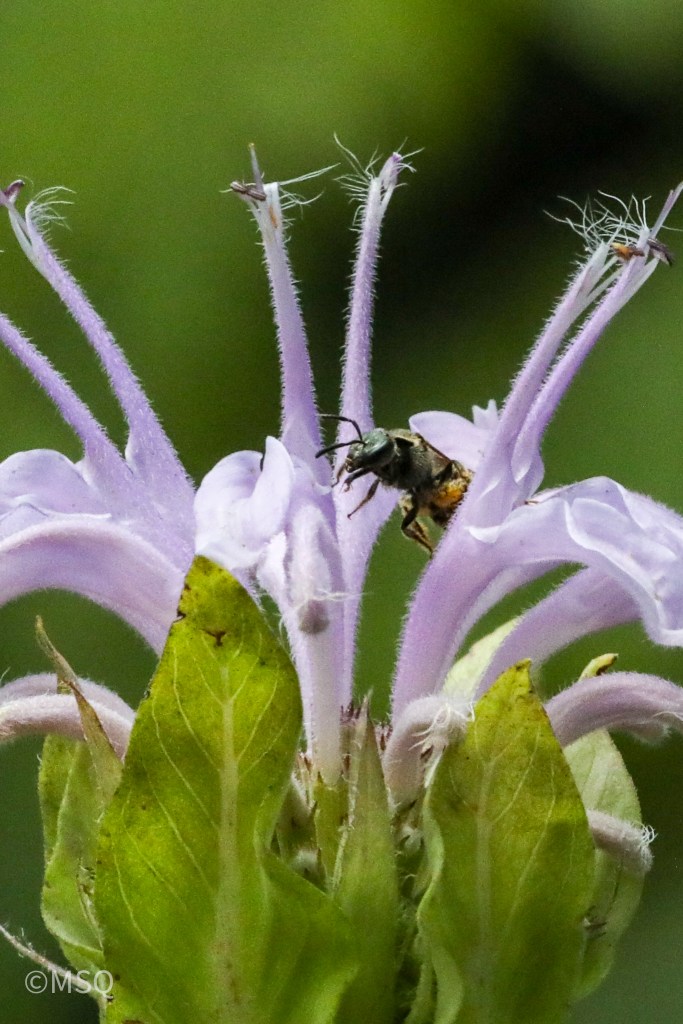
When in bloom, Monarda has a cloud of insects around it.  With the constant motion of small, medium, and large bees, it has been compared to a train station.  Butterflies, moths, and hummingbirds come and go, and wasps stop to refuel.

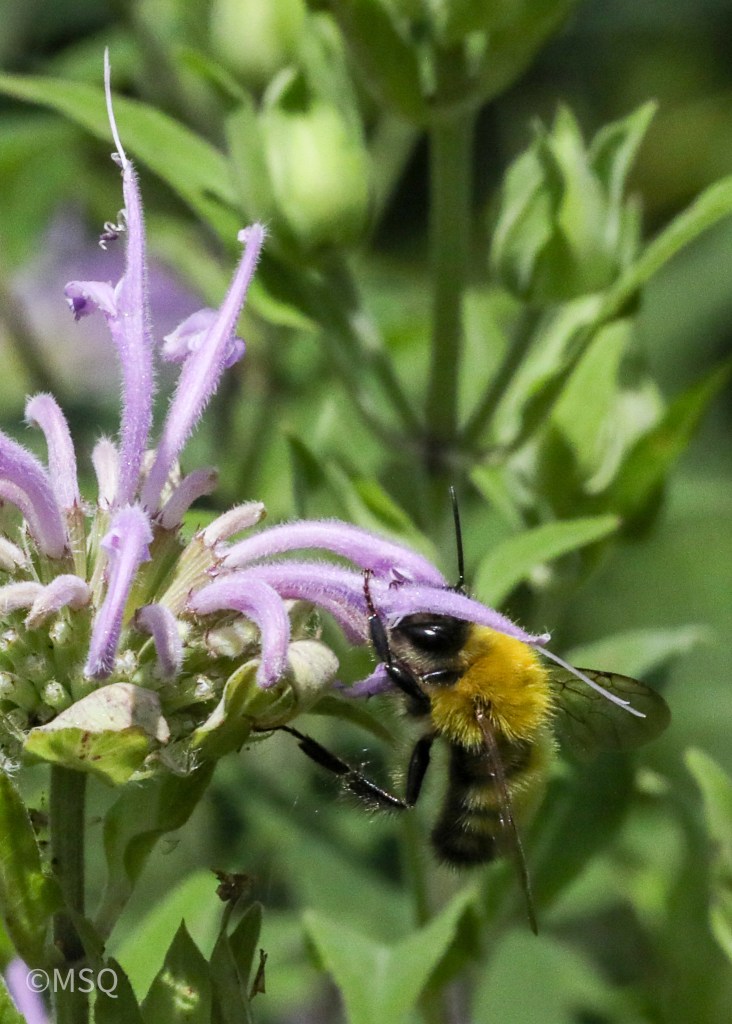
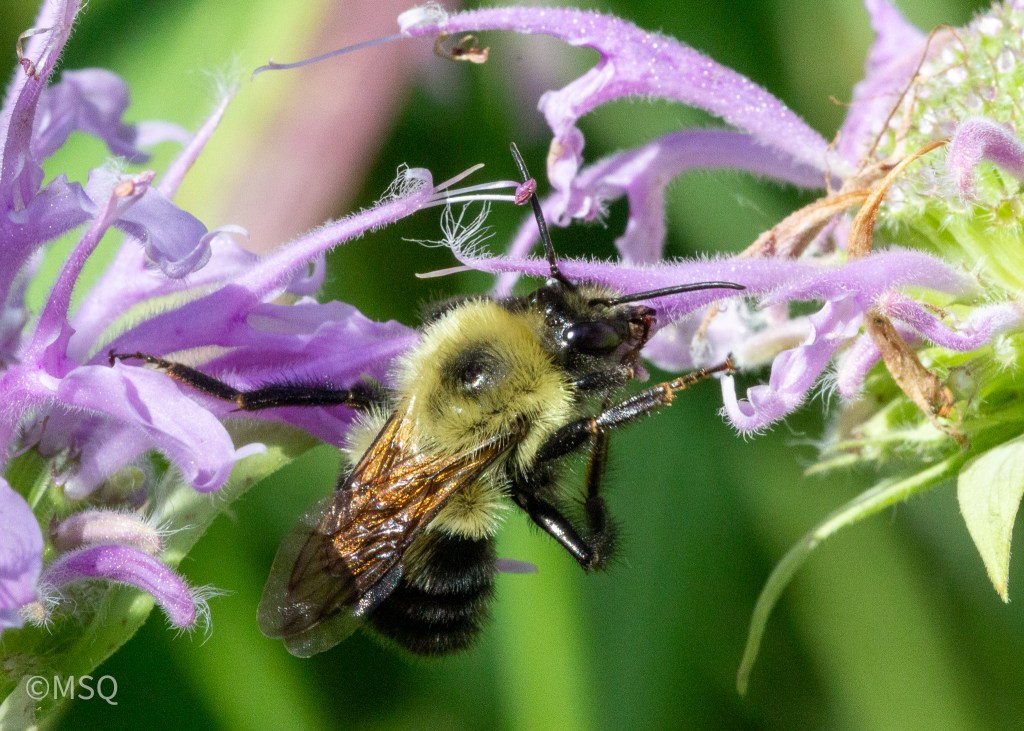
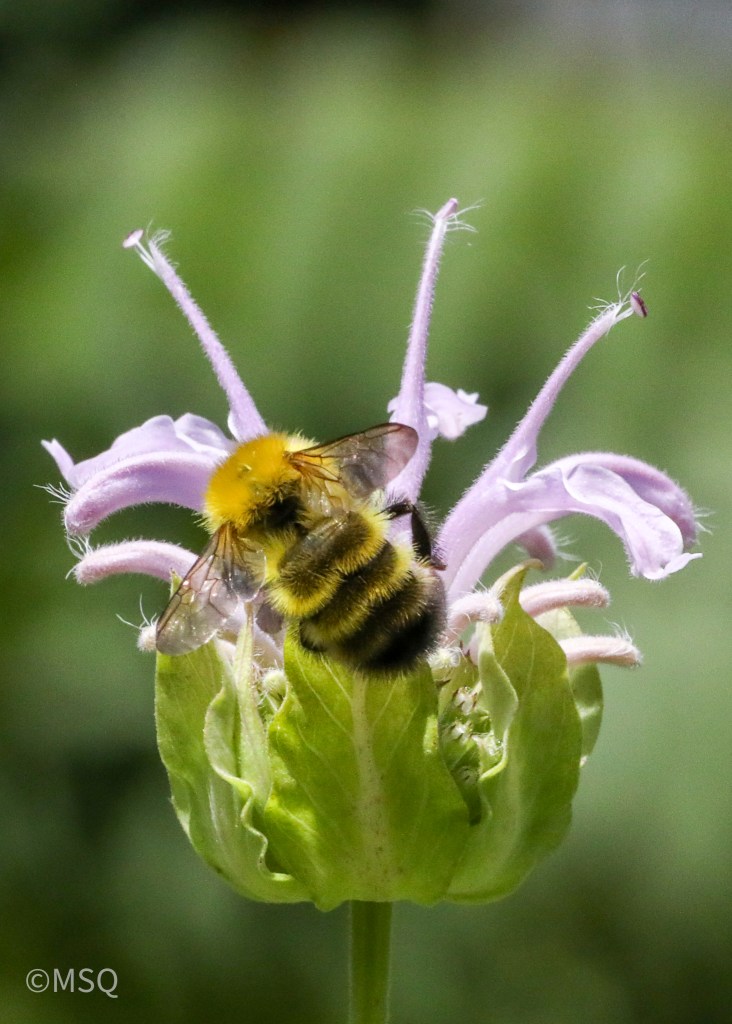
Bumblebees choose Monarda over other flowers.  When they find it, they work their way around the flower heads.  Hanging from each floret, bumblebees use their long tongues to reach the nectar reserves deep in the blooms. Wild Bee Balm has adapted its pollination behavior to bumblebees and the other bees that visit.  

The large bees, including bumblebees, avoid Monarda fistulosa’s anthers and stigmas when foraging for nectar.  They fly underneath them to sip nectar.  When they want pollen, these bees hover close to the flower and brush the anthers with their mid- and hind-legs. 

Monarda, for its part, opens only a few florets at a time.  It extends its anthers (male part) first before the stigma (female part).  Later, when the stigma lengthens and become fertile, the pollen is left by passing pollinators’ brushing against the stigma.  Individual floret nectar is only available until that floret is fertilized.  But the bees and other insects, don’t know which ones still contain nectar.  They must check all the florets until they find nectar.  In this way, Monarda entices them to move around the flower head and, all being well, leave pollen on the ripe stigmas.

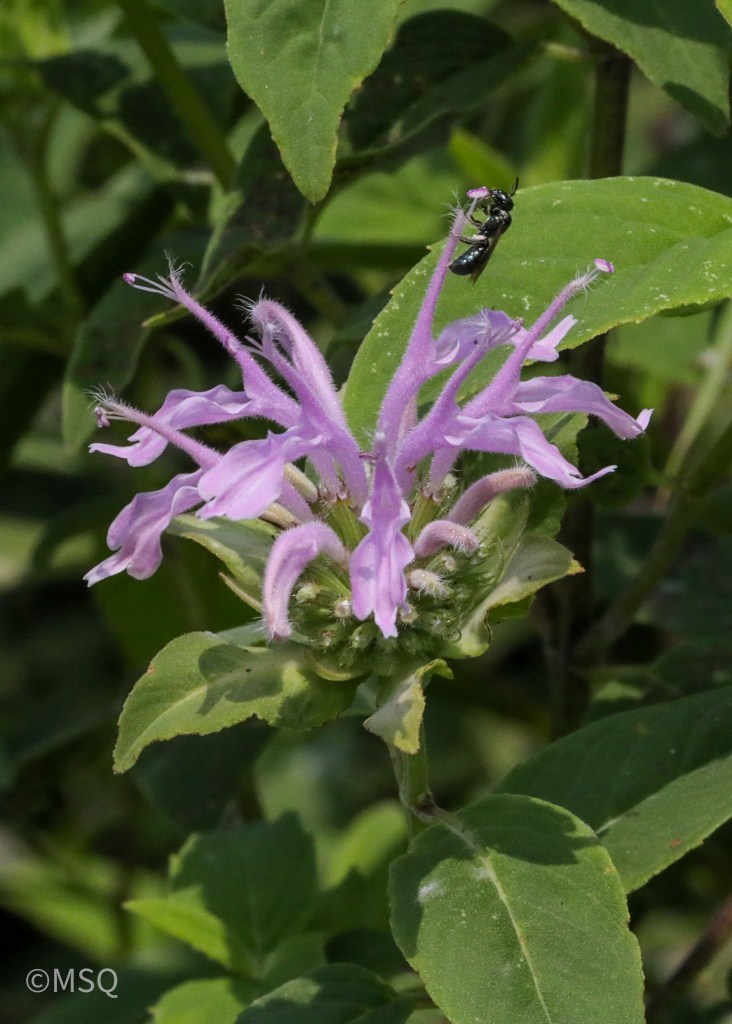
Medium and small sized bees forage on Monarda as a pollen source.  These medium bees include Anthophora, Megachile and Melissodes.  Lasioglossom and Halictus are two small bees that visit Monarda for pollen.  Monarda fistulosa  even has several specialist bees–Dufourea monardaePerdita gerhardi and Protandrena abdominalis.

Specialist bees visit only one or a very few types of the flowers.  This includes bees that forage on plants in only one family.

Wasps also use Wild Bee Balm for nectar.  Sand Wasps (Bicyrtes), Mason Wasps and the Great Black Wasp (Sphex pensylvanicus) all drink nectar from Monarda. They have short-tongues and can’t reach it like bumblebees.  The wasps chew a hole at the base of the tube and take nectar from there.  This is called nectar robbing and it bypasses the usual pollination routes.  Medium and small bees will occasionally drink from these holes.

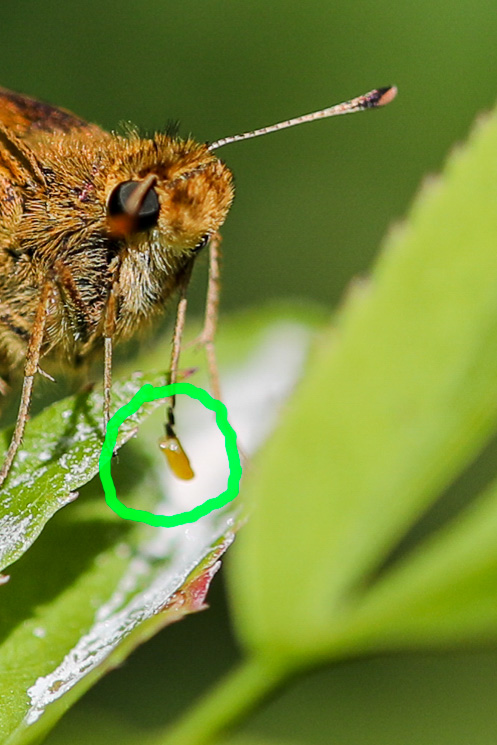
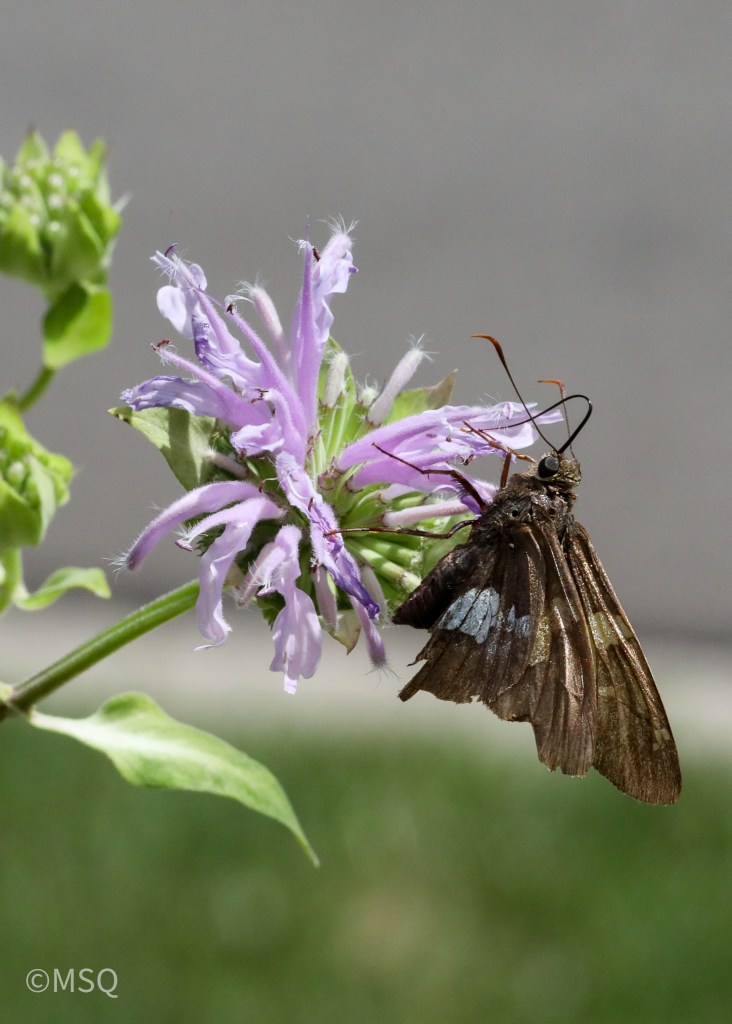
Butterflies, moths, and skippers forage for nectar at Monarda too.  The Xerces Society of Invertebrate Conservation suggests Monarda fistulosa in their Monarch Nectar Plant Guide – Midwest and for the other places it grows.  This is the Silver-Spotted Skipper, one of the most common skippers and a frequent visitor to my garden.  It’s impressive watching it maneuver its long proboscis into the Wild Bee Balm’s floret. 

Skippers are fascinating creatures!  Somewhere between a moth and a butterfly, they’re currently grouped with butterflies.  They have enormous round eyes and antennae that ending in clubs with hooks.  Some carry their wings together and raised like butterflies  The Silver-Spotted Skipper is one of these.  Others have folded wings at rest, looking like a colorful X-wing fighter.  Skippers have a rapid darting flight unlike the butterfly’s fluttering.  Some reach flight speeds of 30 mph.  They aren’t as colorful as the butterflies but usually have muted shades like moths.  They can have interesting patterns, reflective spots (like the Silver-Spotted) and include muted colors such as orange or pale blue.  Skippers fly day and night and many enjoy visiting the garden.  Keep a look out for them!

Monarda also serves as a larval host for several moths.  The Hermit Sphinx Moth Lintneria eremitus and Gray Marvel Moth caterpillars feed on Wild Bee Balm.  It also supports several mint moths including Orange Mint Moth Pyrausta orphisalis and Raspberry Pyrausta Moth P. signatalis.  We’re learning more and more about moths and their roles in the natural world.  Only a small fraction are pests.  They provide valuable food for songbirds, mammals, and other insects.  A study from the UK found that they visit more plants at night than bees do during the day.  Like bees, some moths focus on one plant species (“specialists”) while others forage on a variety of different plants (“generalists”).  (Fallon, Candace, “For the Love of Moths”, Web Blog Post, Xerces Blog, Xerces Society for Invertebrate Conservation, 14 July 2021)  Supporting moth reproduction in the garden, may be as important as supporting bees and other better known pollinators.

So, it turns out my initial concerns have disappeared in a flutter of wings!  Monarda’s role supporting insect life in all its phases is astonishing.  I just keep finding new creatures in the Wild Bee Balm bed.

Do you have Monarda in your garden? Please send me your stories and any thoughts on the blog. I’d love to hear about it!

Happy Gardening!

Mary

Categories
native plants Pollinator gardening

The Magnificent Month of May—and June

Or when we’re ready for Summer but it’s not ready for us

Late Spring and the first burst of flowers has come and gone.  Delicate and lovely, these early flowers always warm our hearts after Winter but it’s still a long wait for the wild, abundant bloom of summer.  While we wait, let’s fill these late Spring days with more flowers.  And for those flowers, enter my next two plants—Baptisia australis and Parthenocissus vitacea.  

These two stars of late Spring and early Summer are big, bold, and versatile but very different.  And as I wrote I realized they’re too big to share one post.  Today’s post is about Baptisia australis and I’ll save Parthenocissus vitacea for next time.  Baptisia australis is a beloved, award-winning garden plant.  As well behaved, as it is beautiful, it’s perfect for any garden with enough space and sun.

Baptisia australis, (Baptisia), also called False Indigo or Wild Indigo, gives a glorious burst of late Spring bloom beginning at the end May and extending into early June.  Truly a special plant, Baptisia australis was the first straight species native (non-hybrid) chosen as Perennial of the Year in 2010 by the Perennial Plant Association.  This award draws a lot of interest because the chosen plant must be low maintenance, grow in a wide range of climates, be interesting in several seasons and relatively pest and disease-free.  B. australis manages to do all that naturally.

A plant so large it could be a shrub, Wild Indigo serves as a stunning accent plant!  It grows three to four feet wide and high.  Unlike its cousins the lupines, Baptisia isn’t picky about growing conditions.  Give it sun and some water and you can expect beautiful full growth and lush flowers.  It’s also deer resistant, salt tolerant and suitable for xeriscaping once established.

Xeriscaping is landscaping using little or no water from irrigation.  Some people extend the definition to include little to no maintenance.  If your Baptisia breaks off and rolls way to have its own adventure, then it’s absolutely no upkeep.

The Baptisia does have to become established in the garden before it’s fully resistant.  As it grows, Baptisia develops an extensive root system.  The roots can grow up to 12 feet deep and 3 to 4 feet wide.  Choose its location carefully, Baptisia does not take transplanting well.

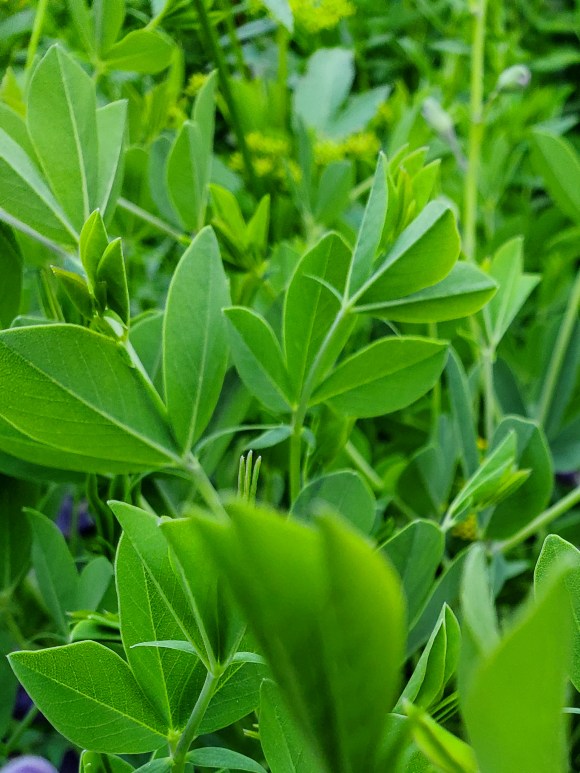
Baptisia’s leaves are three part and slightly creased at the center vein.  Light green with a slightly bluish tinge, the foliage provides a highlight in the garden.  Some Baptisias, like B. australis, have a rounded form down to the grown.  Other Baptisias are vase shaped with bare stems at the base of the plant.  

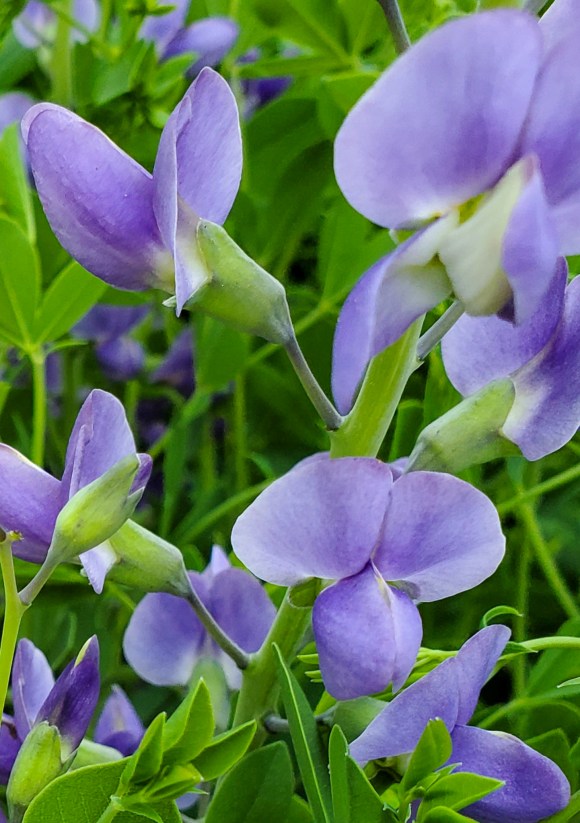
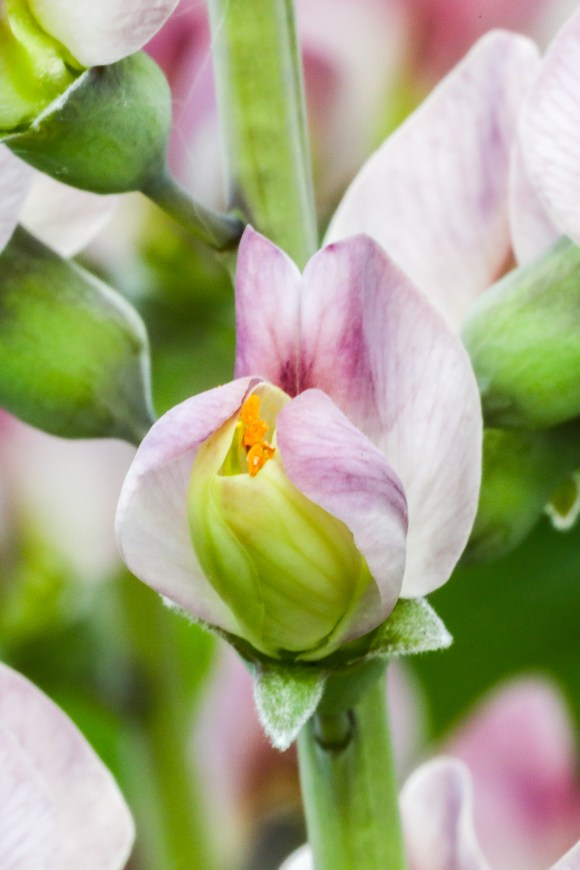
Flower spikes rise over the foliage.  Spikes are 4” to 16” and densely packed with blue-purple blooms.  Blossoms open from the base to the top.  Once pollinated, large oval pods form.  They turn from yellow green to black when ripe.  The pods can be pruned off, especially if weighing down the plant. One year, after an especially heavy bloom, my Wild Indigo ended up about one foot tall under the weight of the seed pods.  I’ve also partially pruned to enjoy the effect of black pods against the green foliage without all the weight.  In Fall, the leaves turn to gray or black and curl but remain on the plant.  If the Baptisia is growing in an exposed location, it can break off at the base and roll away like a tumbleweed.  I have one plant at the top of a hill which does this every year.  The remaining stalks look like a very clean pruning.

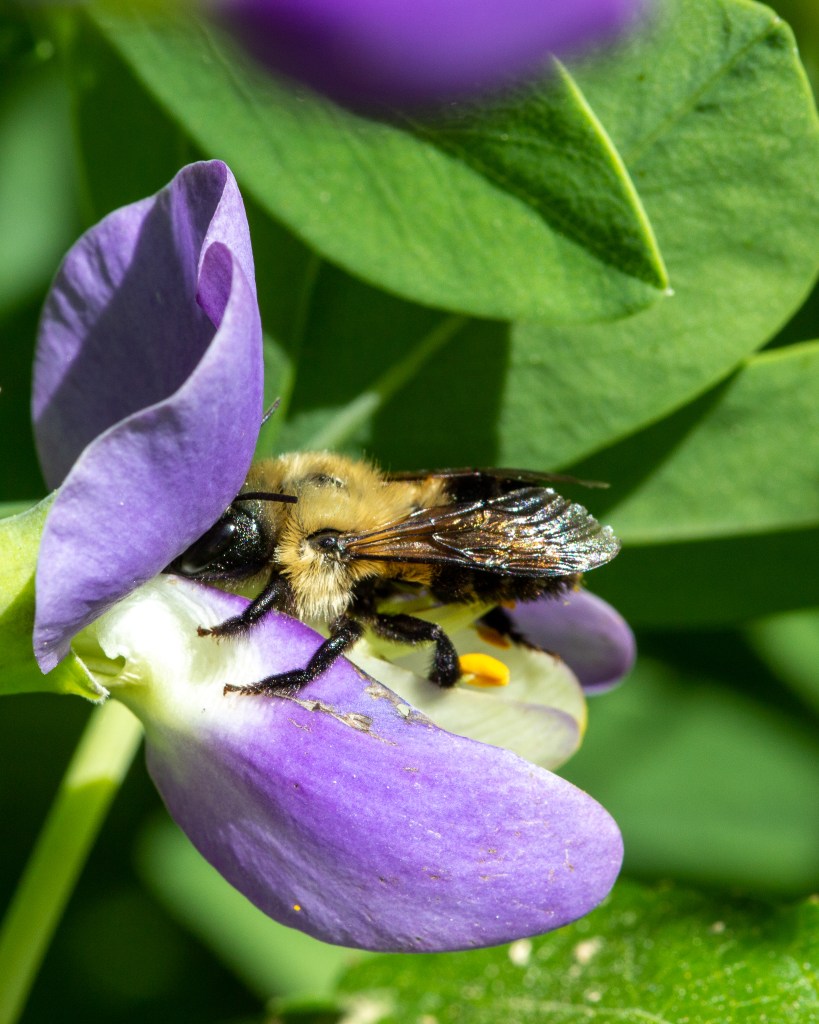
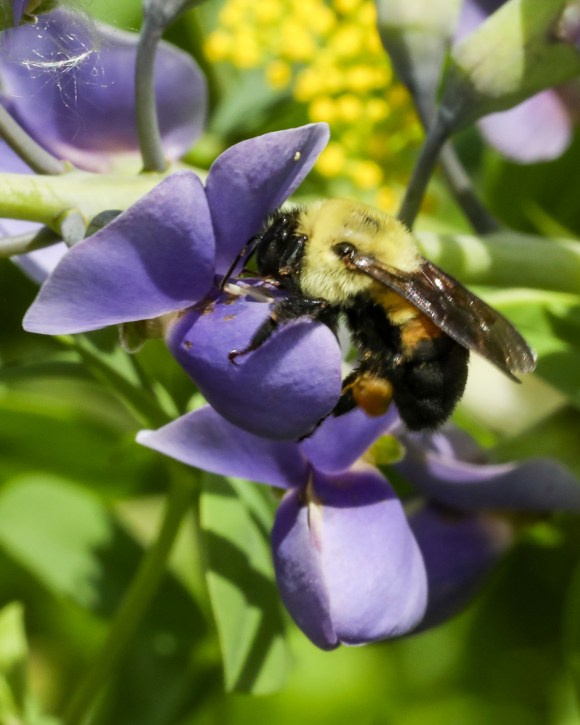
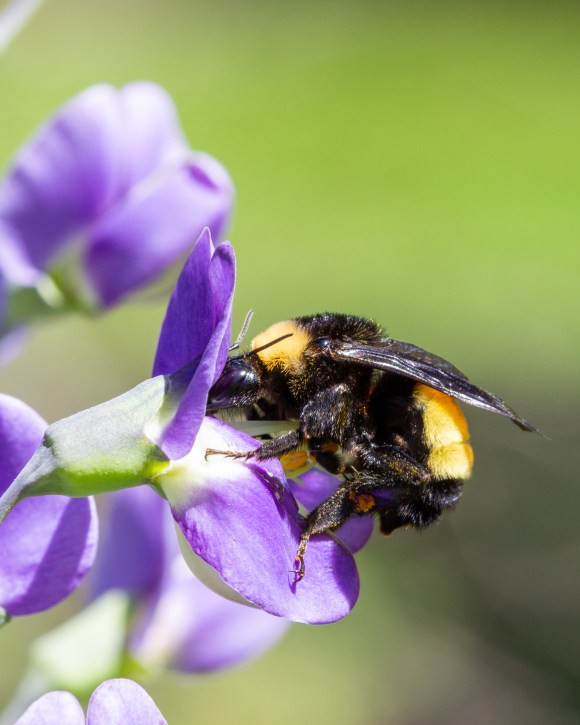
Baptisia is best known for supporting bumblebees especially the newly emerged Queens.   Many kinds of Bumblebees visit these plants looking for nectar.  

Each bloom has a nectary deep in its base.  The location is part of a remarkable pollination system.  Baptisias try to avoid self-pollination.  Its strategy depends on the physical structure of the flower and the timing of bud opening.  Each blossom has a petal that the stands up (the banner) and two petals that stick out like a dog’s muzzle (the keel).  The keel holds the pistil (female part) and stamens (male parts with pollen).   Between the banner and keep, inside the flower is the nectar.  The bumblebee holds the keel with her mid- and hind legs and pushes her way deep into the flower to get to the nectar.  When held, the keel opens and its pollen sticks to the bee’s fuzzy belly.

When it comes to reproducing, plants have all different structures and methods to regulate when and how fertilization happens.  Why?  It gives plants some ability to control self-pollination vs cross pollination.  Self-pollination won’t change the gene pool in a population (ignoring mutations!)  But cross pollination increases chances of introducing different genes and more diversity into a population.  This is usually considered a good thing.

Baptisia has a fascinating system for reducing self-pollination.  When the bumblebees begin feeding at a bloom spike, they start at the bottom.  These lower flowers have more nectar and the female part is extended.  But the bumblebee doesn’t have much pollen at this point.  As she goes up the bloom spike, there is less nectar and more pollen.  When the bumblebee finishes and flies to the next stalk, she’ll start at the bottom again.  

As before, she finds more nectar and the pistil (female part) available on the lower flowers.  But this time, the bee has lots of pollen and there’s a higher chance of pollination.  The first plant “hopes” that the bee flew to a second plant with the pollen and cross pollination occurred!

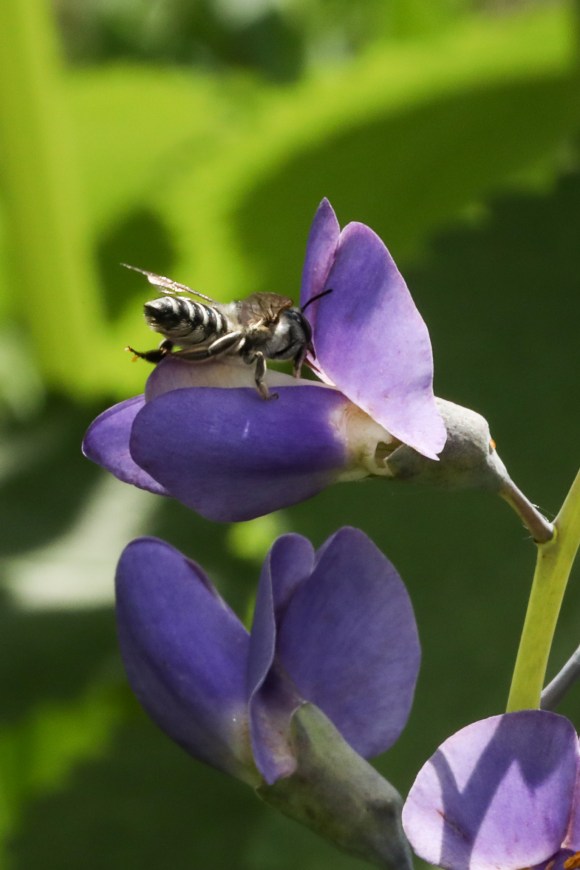
Megachile, Leaf-Cutter Bees, a medium-sized bee also drinks nectar from Baptisia.  These medium-sized bees clearly have the strength to reach and enjoy B. australis’ floral rewards.  The Leaf-Cutter Bees use a method similar to Bumblebees when opening the flower.

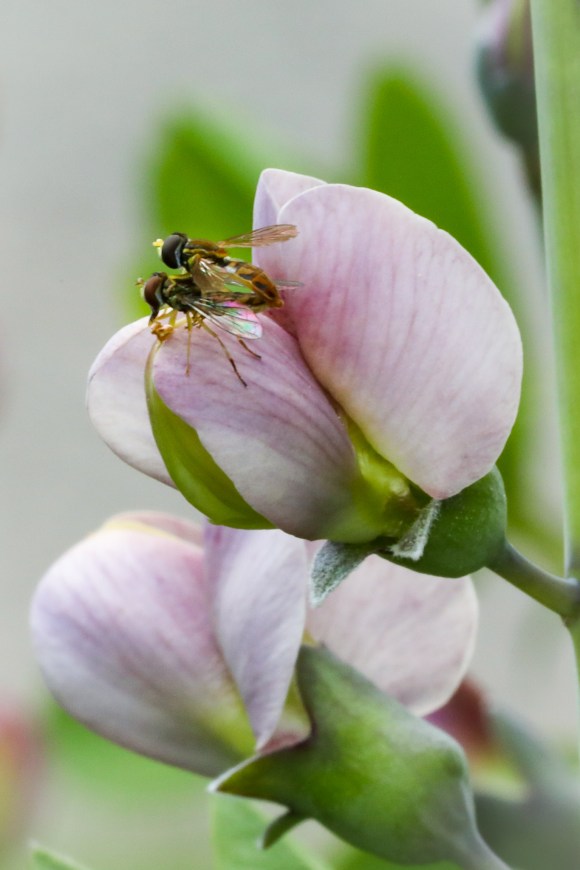
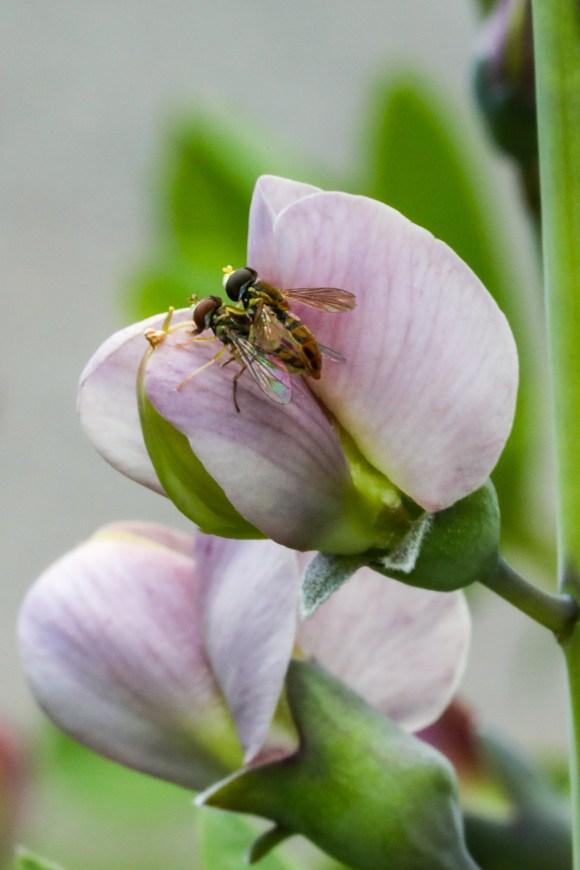
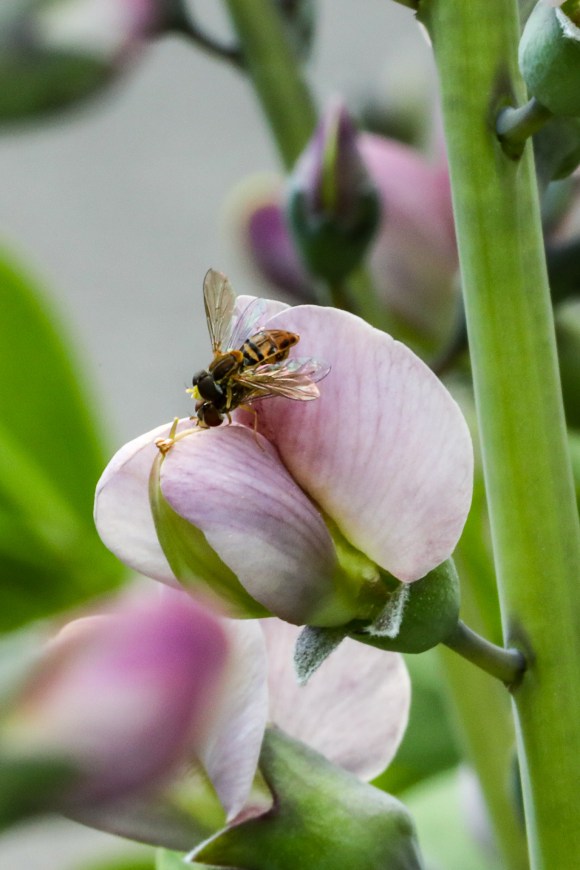
Amazingly, small bees and insects also visit Baptisias.  In my garden, I’ve included both native plants and nativars.  One afternoon, I spotted the following behavior on my ‘Pink Truffles’ Baptisia.  I observed a mating flight of syrphid flies (also called hoverflies or flower flies).  The pair landed on a Baptisia bloom and the female began teasing out the stamens from inside the keel!  Adult hoverflies feed on nectar and pollen.  They spent several minutes easing them out and feeding.  Not B. australis but an interesting behavior!

Depending on the species, the syrphid fly’s larvae (maggots) can eat a variety of food.  Some maggots eat decaying plant and animal matter.  But other larvae eat aphid, thrips, and other plant-sucking insects.

After the hoverflies, metallic green sweat bees arrived to eat the exposed pollen.  Once the stamens are uncovered, Lasioglossum, small sweat bees, also join these other pollinators using the Baptisia.

In addition to bees, Wild Indigo is a larval host for butterflies and skippers.  The Wild Indigo Duskywing (Erynnis baptisiae) and Hoary Edge (Achalarus lyciades) caterpillars both eat Baptisia.  The larvae of three butterflies, the Frosted Elfin (Callophrys irus), Marine Blue (Leptotes marina), and Orange Sulfur (Colias eurytheme) also use it.  Adult Frosted Elfin Butterflies and other butterflies nectar at B. australis.

I hope you enjoyed this adventure with Baptisia australis-a gorgeous plant for a wonderful time of year.  Next time, I’ll talk about Parthenocissus vitacea aka Virginia Creeper aka Woodbine.  A very different plant, it’s well known as a wild plant but not in the garden.  I plan to show the benefits of including Woodbine in the garden for the landscape and the pollinators.

Please contact me to share your stories, questions, and observations!

Thanks for reading,

Mary