Lilac blue spires of Great Blue Lobelia (Lobelia siphilitica) grace the late season garden. With vivid color and abundant resources, they lure pollinators. Their intricate, multi-lobed blooms offer both nectar and pollen.

Lobelia siphilitica enjoys moist to wet conditions in Zones 4 through 9. Fertile, loamy soil is best. Great Blue Lobelia grows in part sun to light shade. In general, the plant is one to four feet tall and has a one foot to eighteen inch spread.2,4
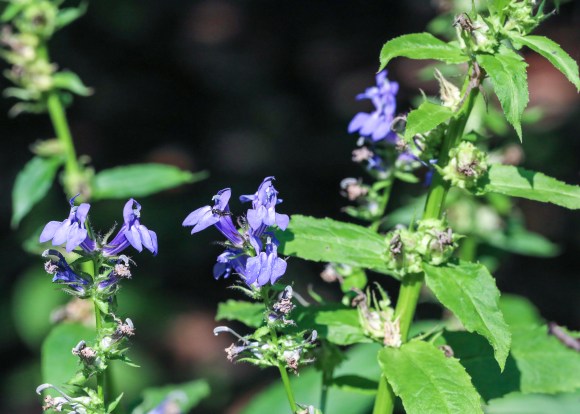
This lobelia adapts to many environments. It tolerates occasional flooding making it a good candidate for the rain garden. In northern climates, with consistently moist soil, it can grow in full sun. The height varies based on the growing conditions. If under too much stress, Lobelia siphilitica gets ragged.2
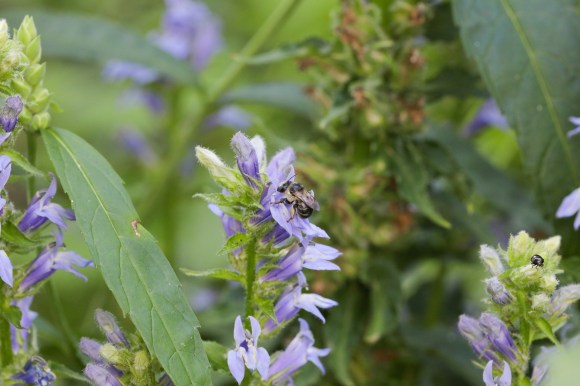
In natural habitats, L. siphilitica lives in disturbed areas and high-quality habitats. It’s found in moist black soil prairies, soggy meadows near rivers, low areas along rivers, ponds, floodplains, bottomland woodlands, woodland borders, bottoms of sandstone canyons, along streams, in swamps, fens, gravelly seeps and springs, ditches, and moist areas of pastures.2

Great Blue Lobelia plants form clumps that can be divided in Spring or Fall. In my garden, seedlings thrive in areas that flood. Otherwise, it doesn’t spread aggressively.4
The medium to dark green foliage forms a lovely background for the L. siphilitica’s striking blooms. Its leaves alternate along Great Blue Lobelia’s stem. They are ovate to lanceolate and lightly covered with short hairs.2
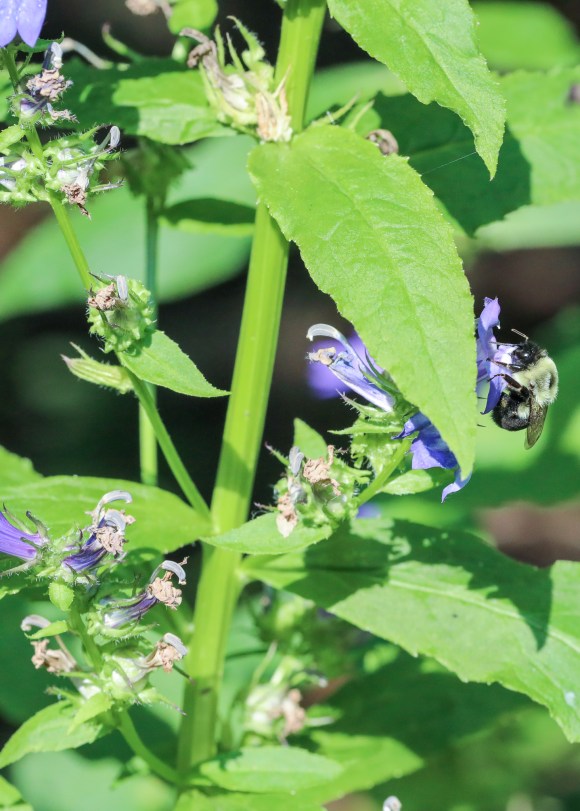
Foliage can grow up to five inches long and two inches wide. The bottom leaves can have a short stem. Leaves at the top of the plant are sessile (touching) to the stem.2
Lobelia siphilitica blooms for about two months from late summer into fall. The intense blue-violet (occasionally white) flowers are packed closely on the raceme. Each blossom is an inch to one and a half inches long.2
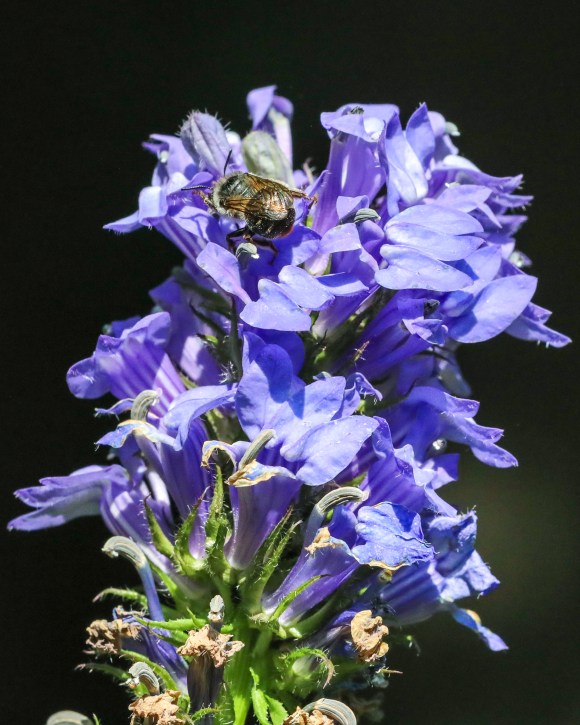
Flowers are two-lipped. The upper lip had two lobes while the lower lip had three. The lower lip offers a landing pad for pollinators.1,2,4
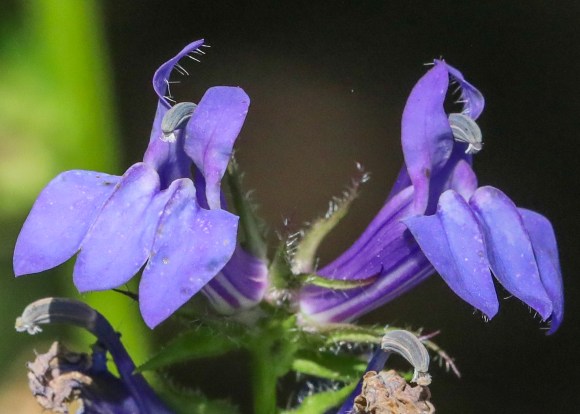
Its green calyx has five lance-shaped teeth. They are hairy, long and spreading. Individual blooms emerge from the upper leaf axils.2
Great Blue Lobelia serves numerous insects late in the growing season. The Xerces Society for Invertebrate Conservation designated it of Special Value to Native Bees and Special Value to Bumble Bees. It also Supports Conservation Biological Control according to the Xerces Society.6
Large to medium, long-tongued bees primarily serve as pollinators. Bumblebees (Bombus spp), Digger bees (Anthophora spp), Wool Carder Bees (Anthidium spp) and Long-horned bees (Melissodes spp and Svastra spp) all successfully pollinate this Lobelia. Additionally, these bees steal nectar from outside the flower sidestepping the pollination process.1,2,4
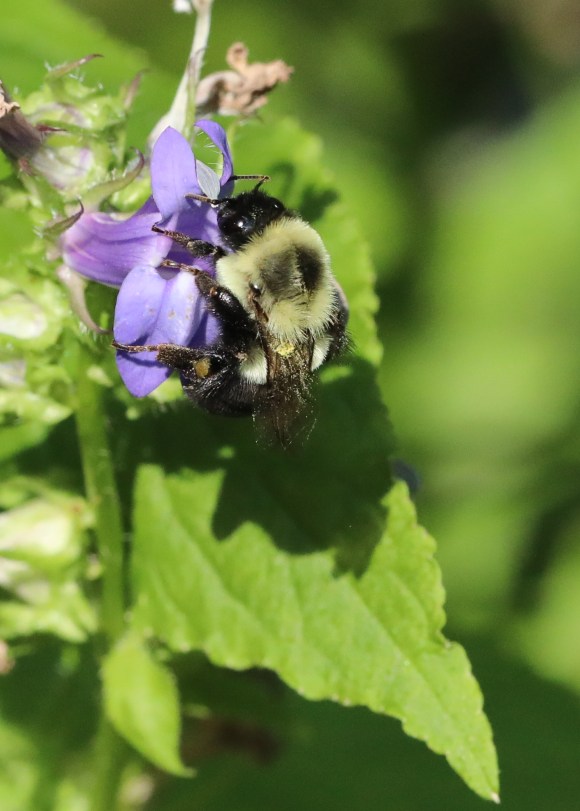
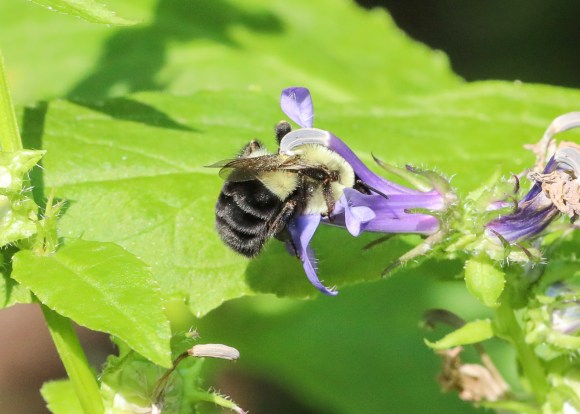
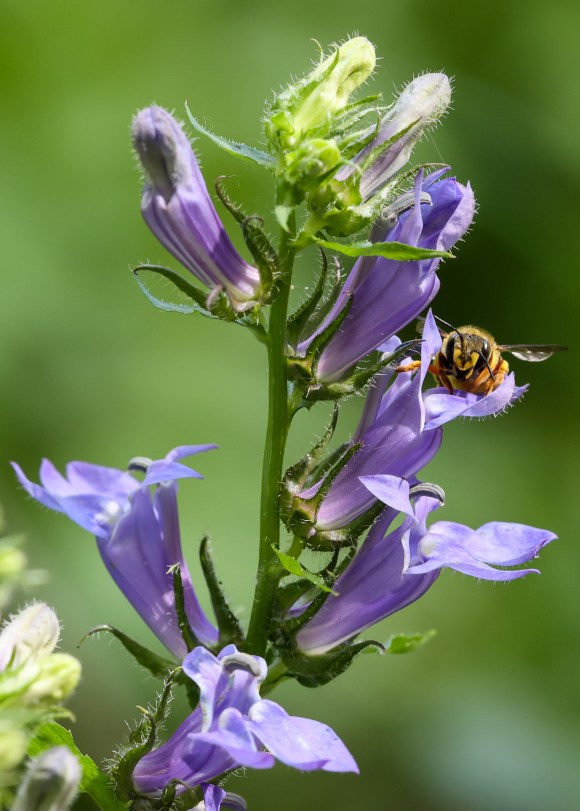
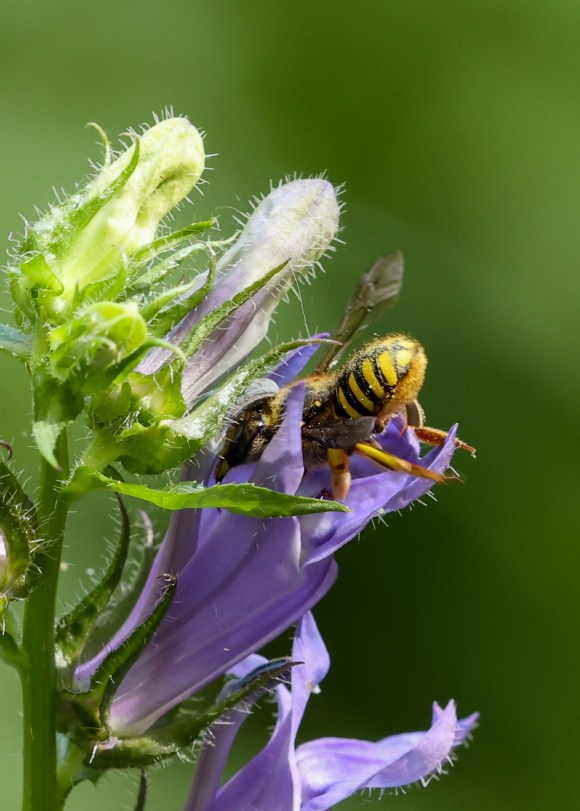
L. siphilitica uses a remarkable system for pollination. The five stamens (male parts) form a ring around the style (female part). This whole grouping runs along the inside top of the flower and curls down ending with the stigma (area for pollen deposit). It appears to be one structure.1
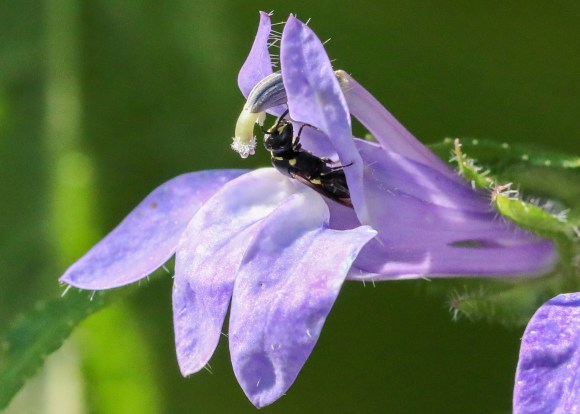
Lobelia flowers secrete nectar at the bottom to lure bees deep inside. Small bees can just climb down to it and drink. They may or may not get any pollen on their bodies.
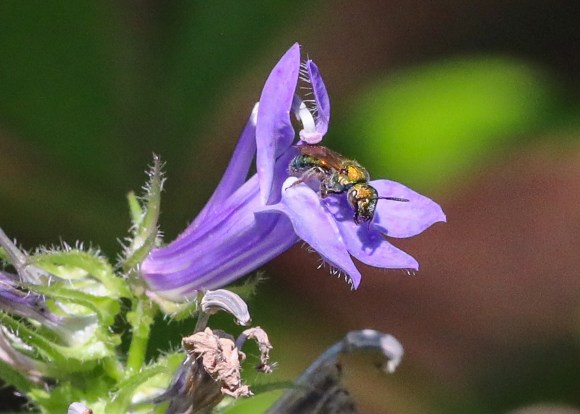
Medium and large bees need to wiggle their way inside the flower. It’s a tight fit and they invariable rub against the anthers. Pollen deposits on their backs.1,4
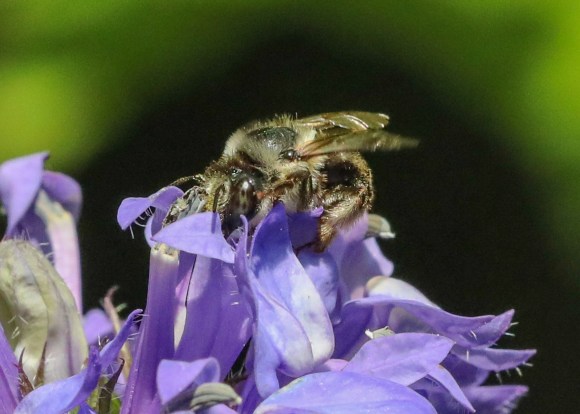
The weight of these bees causes several physical changes to the flower. The three lower lobes form a landing place. The bee’s weight pushes the lobes down and the style/anther structure arches down. The stigma, at the end, rubs against any pollen on the bee’s back successfully transferring it.1,4
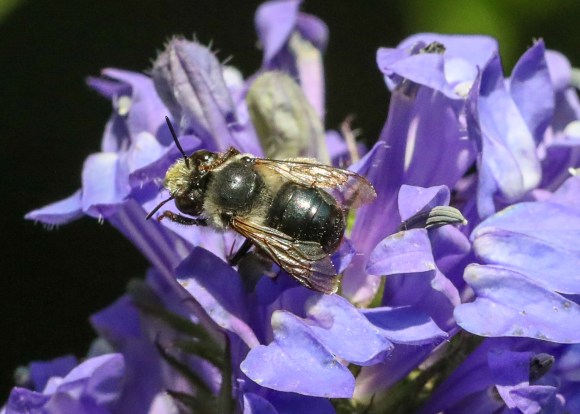
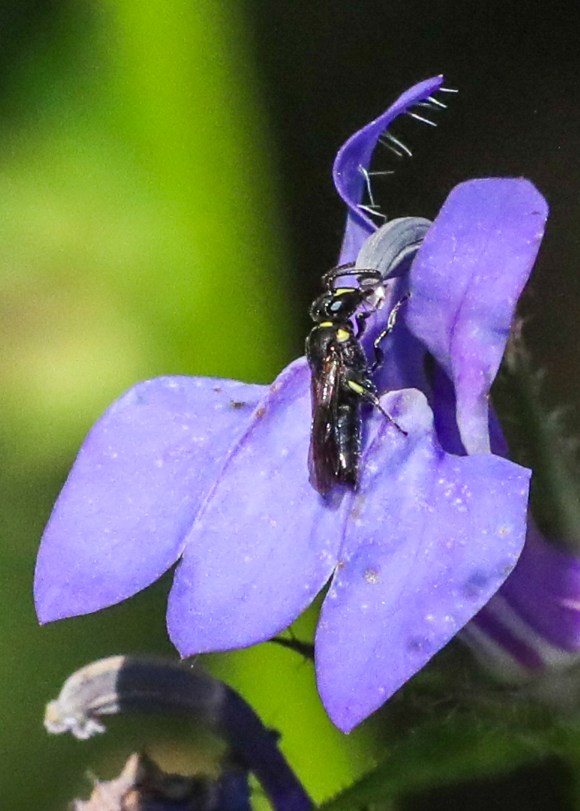
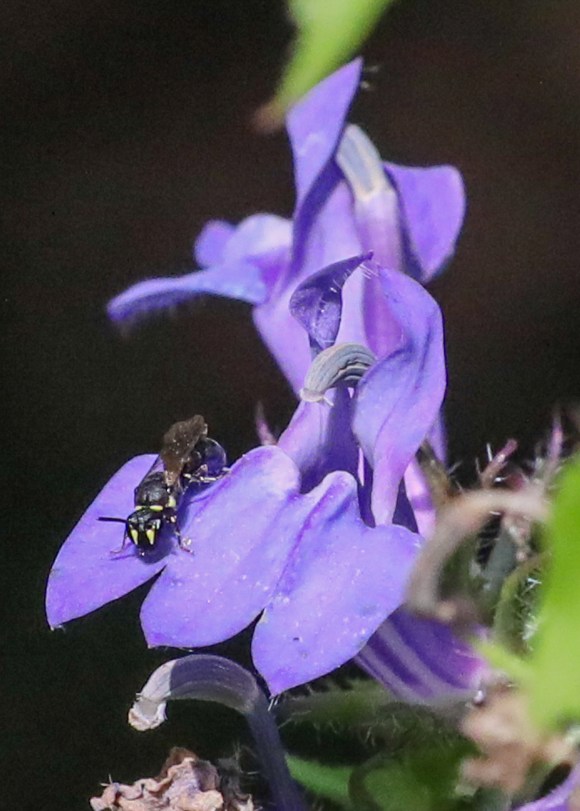
In addition to the medium and large bees, numerous small bees harvest nectar and pollen from Lobelia siphilitica. The Masked Bees (Hylaeus spp) and Halictid bees are frequent visitors. The Halictids include small dark sweat bees like Lasioglossum spp. and the green metallic sweat bees such as Agapostemon spp. and Augochlora spp.4
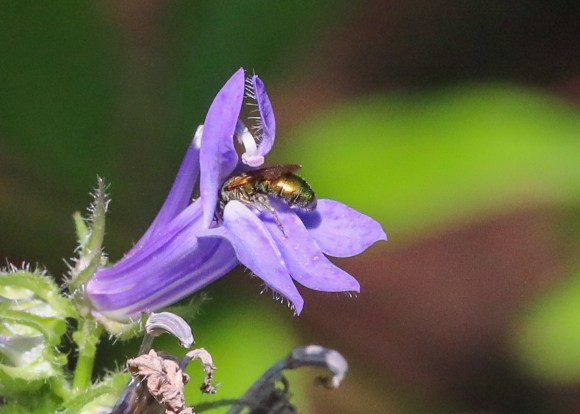
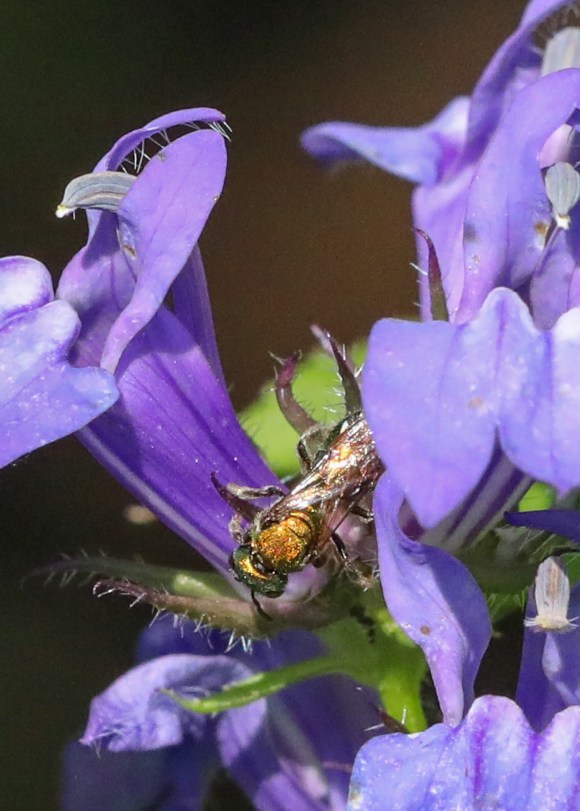
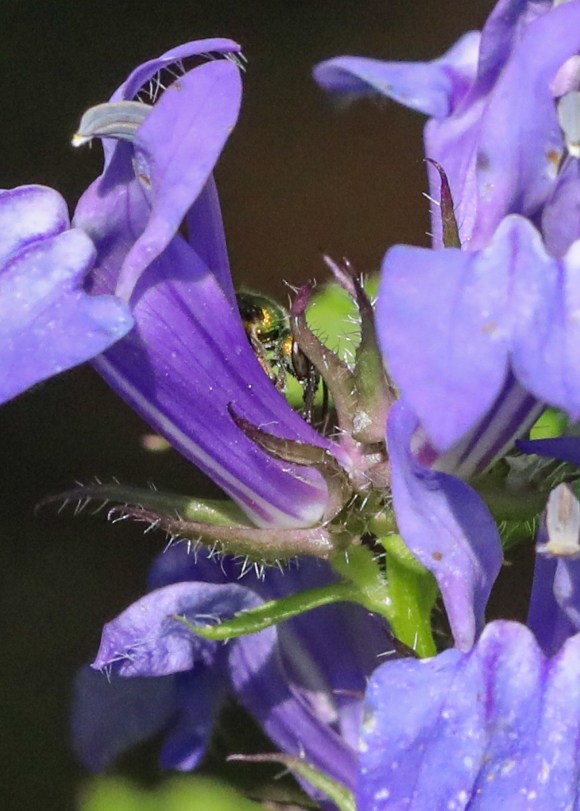
Augochlora pura is a stunning small bee that enjoys visiting this Lobelia. Augochlora pura means pure golden green. This metallic green sweat bee can be all green but can also have patches of copper, gold or very dark green that looks blue.7
With an extremely long active season, A. pura usually flies from April to October. In a warm year, you can see it from February to November. This tiny bee gathers resources from diverse flowers including Maple tree flowers (Acer spp.), the Rosaceae family (apples, strawberries, cherries, roses, etc.), the Asteraceae family (asters, goldenrods, coreopsis, etc.), milkweeds, hydrangeas, spiderworts, verbena and others.7
Augochlora pura has an unusual nesting strategy unlike the other Halictid bees. They nest under loose bark of fallen trees. Females glues together mud and debris from under the bark to make nesting cavities.7
She then gathers pollen on her hind legs and nectar. Back at the nest, the female mixes pollen with nectar and her saliva. The saliva may have antiseptic qualities.7
When there’s enough food in a cavity, she lays an egg. Each nest cell is lined with an impermeable lining produced by one of the bee’s glands. This lining protects the egg and developing larva from predators.7
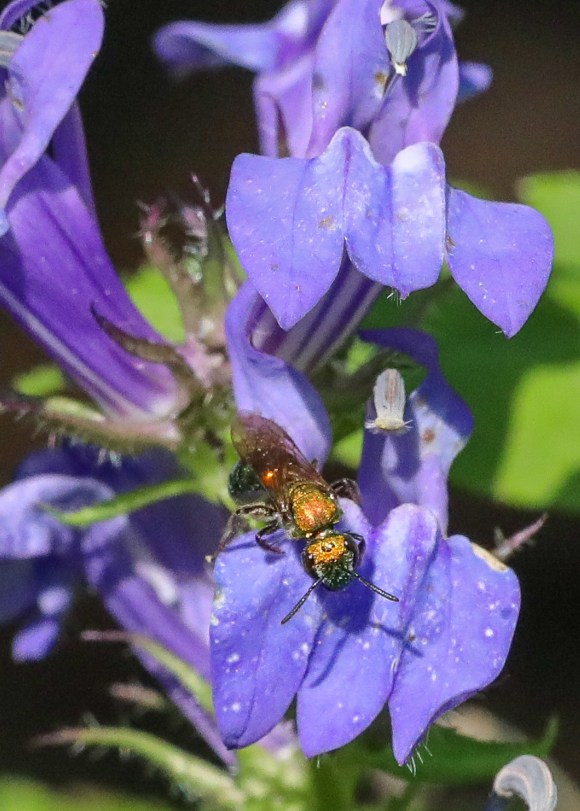
Augochlora pura may have more than one generation in a growing season. The final generation is in Fall. Males and females hatch and mate.7
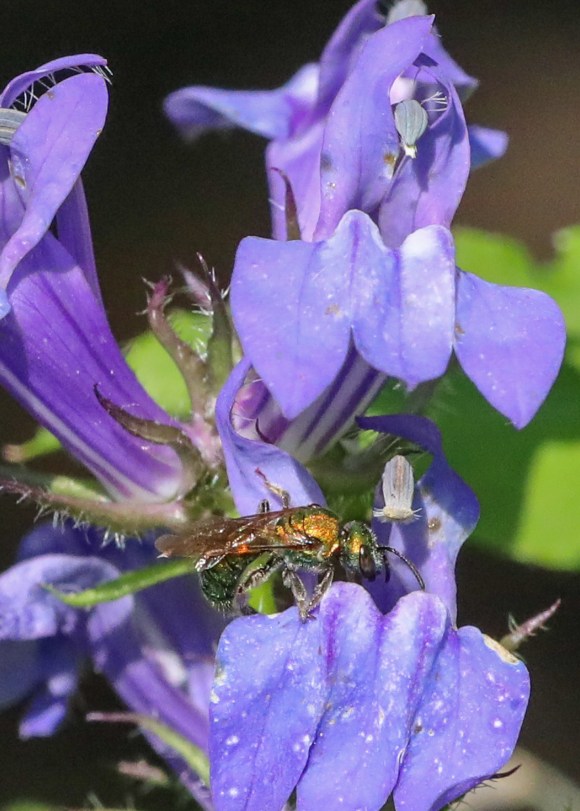
Males then die. The females continue gathering resources and eating. They build up fat to survive the long Winter hibernation. Augochlora pura females overwinter in existing cavities in fallen rotting logs or wood stumps.4,7
Less common visitors include Ruby Throated Hummingbirds and large butterflies. Although, in my garden, I often see hummingbirds nectaring at my Great Blue Lobelia.2
I hope you’ve enjoyed this deep dive into Great Blue Lobelia (Lobelia siphilitica). I’d love to hear about your plant adventures in the garden or the wild! Please feel free to contact me with a story, comment or question!
Happy Gardening,
Mary
Bibliography:
- “Great Blue Lobelia.” Accessed February 1, 2025. https://www.fs.usda.gov/wildflowers/plant-of-the-week/lobelia_siphilitica.shtml.
- “Great Blue Lobelia (Lobelia Siphilitica).” Accessed February 1, 2025. https://www.illinoiswildflowers.info/wetland/plants/gb_lobeliax.htm.
- “Great Blue Lobelia, Lobelia Siphilitica L.” Accessed February 1, 2025. https://friendsofeloisebutler.org/pages/plants/greatbluelobelia.html.
- Holm, Heather. Bees: An Identification and Native Plant Forage Guide. Minnetonka, MN: Pollination Press LLC, 2017.
- “Lobelia Siphilitica – Plant Finder.” Accessed February 1, 2025. https://www.missouribotanicalgarden.org/PlantFinder/PlantFinderDetails.aspx?kempercode=i460.
- “Lobelia Siphilitica (Great Blue Lobelia) | Native Plants of North America.” Accessed February 1, 2025. https://www.wildflower.org/plants/result.php?id_plant=losi.
- “The Pure Golden Green Sweat Bee.” Accessed February 1, 2025. https://www.fs.usda.gov/wildflowers/pollinators/pollinator-of-the-month/augochlora_pura.shtml.
 Wild Things in the Garden