Categories
Pollinator gardening

Plan for a Wet Day:

The Rain Garden

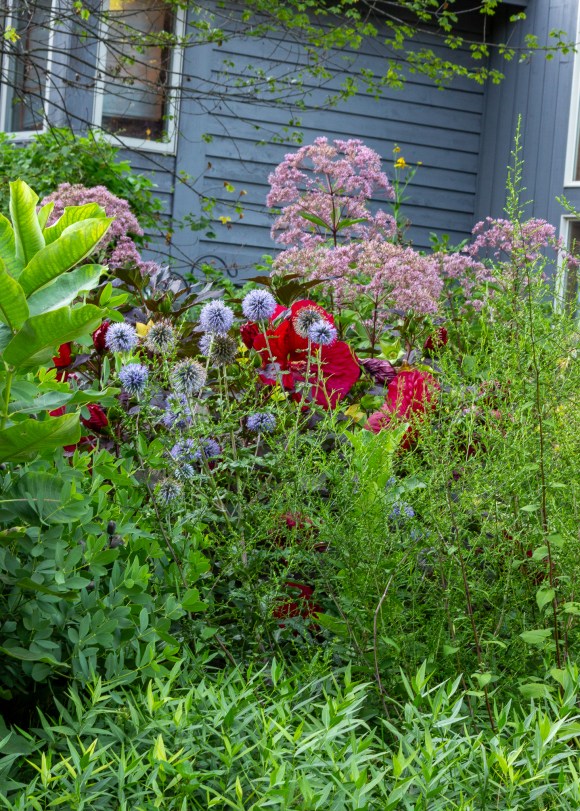
Why talk about rain gardens?  Different from my usual blogs, rain gardens are a wonderful application for native plants.  In my yard, there are several wet and soggy areas especially in spring.  I’ve installed several rain gardens since 2020. They move the water through quickly and make the space usable.  As a bonus, these gardens are beautiful and filled with life-butterflies, bees, other pollinators and birds.

Why do we need a special garden?  Before people, rain on land fell mostly over forests and grasslands. These ecosystems slowed it down before and after it hit the soil surface.  Instead of running rapidly into lakes, streams, and other bodies of water, it was absorbed into the soil.  The soil system filtered and cleaned it.  Then, the water returned to underground aquifers.  
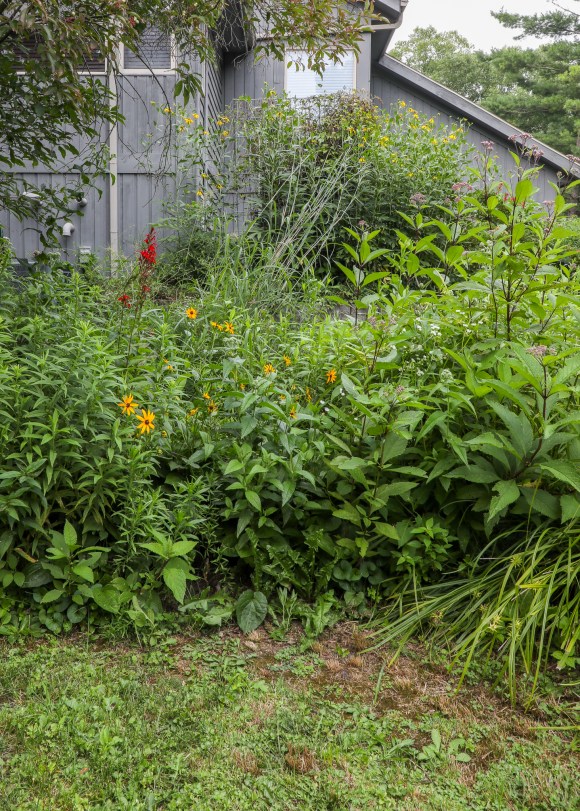

Now, many areas are impacted by humans.  Vehicle and foot traffic compacts the soil and hard rains runs off it.  Rainwater falls on hard surfaces such as roofs, pavement, even lawns.  As it runs across these, the water picks up dirt, oil, gas, other auto fluids and lawn fertilizers and pesticides.  It also gets warm.  

Once it enters the storm sewer it flows rapidly into rivers and lakes.  Once there, silt clogs creatures gills, fertilizers promote algae growth and pesticides, and other chemicals cause many problems.


But the good news!  Rain gardens can help.  Rain garden are specially constructed gardens that hold water for short periods of time (usually less than 24 hours and not more than 48 hours).  While it’s held, natural processes slow its path.
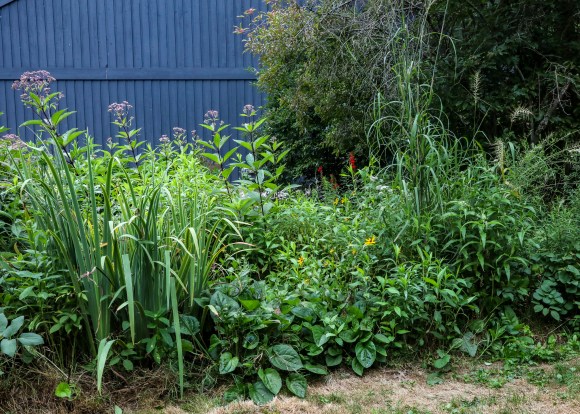

Thick vegetation catches and holds it.  In the soil, plant roots absorbed some of the water.  More water is held in small spaces in the soil.  These spaces are created by plant roots, fungi and other microorganisms, soil-dwelling animals and insects.  


Some chemicals adsorb to soil particles.  Certain soil microbes digest chemicals like those in gasoline converting them it carbon dioxide and water.  Through these pathways, the rainwater slowly works its way to the groundwater aquifer.  It arrives cleaner than it fell.


Designing and building a rain garden involves a detailed process.  Some features are specified by states.  Detailed plans are beyond this blog, but I’ll provide references for free resources.  


If you have questions, especially regarding garden placement near drinking water wells and septic fields, I suggest contacting local water quality officials for information.  In Michigan, this would be the Department of Environment, Great Lakes and Energy.


But here is some fun information. Again, check with your state for specifics.
*The rain garden location should be away from the house, sewer lines and underground utilities.  
*Keep away from drinking water wells and septic fields.
*The size depends on soil type as well as the size of the home, driveway, sidewalks and lawn.  Remember the garden probably won’t receive all the runoff.  It’s OK to design it to fit the amount received.
*A rain garden can handle runoff from an area 3 times its size.
* Soil test and drainage tests are important  These tests help determine the size of your garden and ensure it works.
*The garden must be located at a spot that drains well.  A functioning rain gardens absorbs water in 24 to 48 hours.


In addition to the benefits of rain gardens, now is the time to plan a new garden!  Late summer/early fall is a great time to plant.  Planting then allows plants to establish their roots before the winter season.  By next spring, it’s like an extra year has passed.  

What do I mean by “an extra year”?  There’s a saying about native plants, “They sleep, creep and then leap.”  The first year, the plant pretty much stays the same.  The second year, some slow growth happens.  The third year, the plant really takes off and grow by leaps and bounds.  When you plant in late summer/early fall, you get sleep and creep in 1 year.  The following spring should be time for the plant to put on a lot of growth (leap!).


What about choosing plants?  I like small plants—2” pots or plugs.  These tend to adapt well to a new site and, after 2 or 3 years, they look the same as quart-sized plants.  Look for shorter, compact plants.  More than one plant in a pot is fine if they all look healthy.  A few roots coming out the bottom shows good root development.  A tangle of roots means a pot-bound plant that may not grow well in its new home.

Which plants do well in a rain garden?  Surprisingly, all the plants need to tolerate dry periods.  That said, there are 3 zones in a raingarden.  Plants in the deepest zone tolerate recurring flooding or flow and dry spells.  These are usually tall to overcome the depth of the garden.

Intermediate zone plants thrive in average soil moisture but accept short periods of flooding or flow.  Finally, the plants on the edges grow well in dry conditions.  Edge plants are generally shorter.

As always, when planting a pollinator garden, choose a selection of plants that bloom from spring to fall.  In my rain gardens, I’ve used Golden Zizias (Zizia aurea), Black-Eyed Susans (Rudbeckia hirta), Rose Milkweed (Asclepias incarnata), Joe-Pye Weed (Eutrochium purpureum), and Smooth Aster (Symphyotrichum laeve).  I’ve discussed these plants before, but I thought I would discuss them as rain garden plants. 

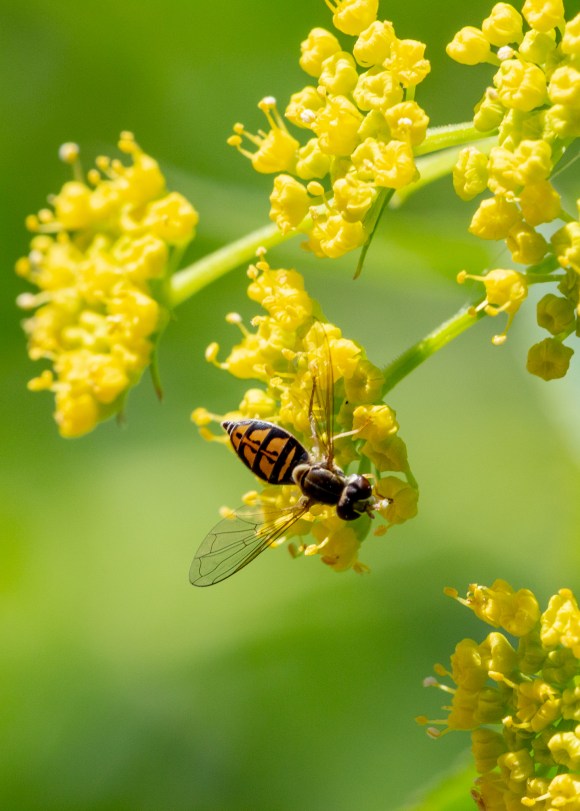
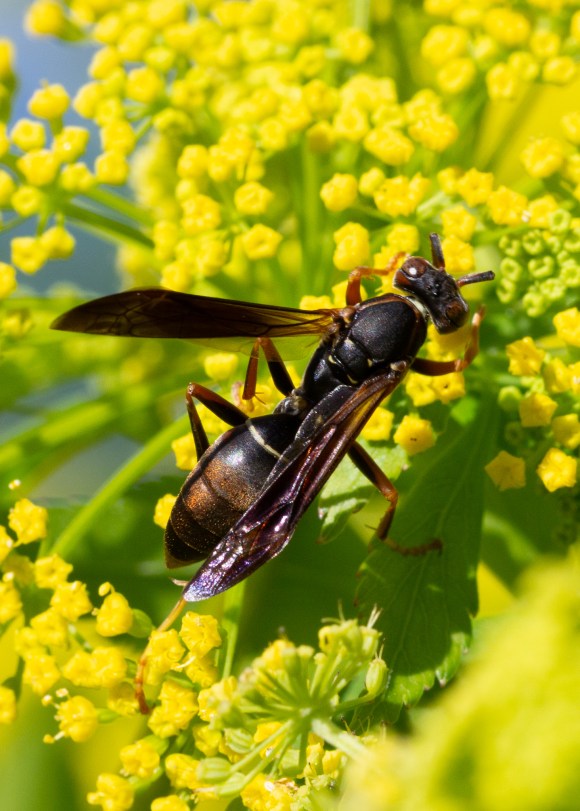
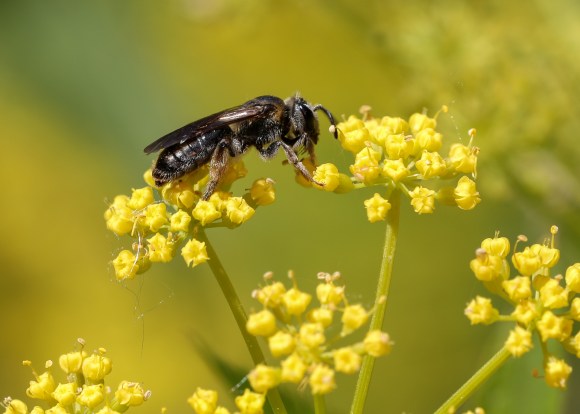
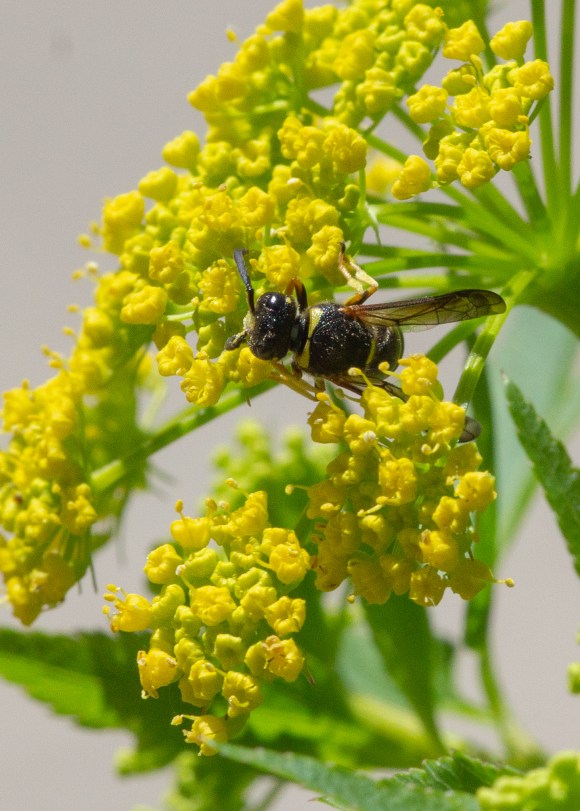
Spring in the rain garden starts with Golden Zizias or Zizia aurea (https://wildthingsinthe.garden/2024/02/29/golden-lace-for-spring/).  In late spring to early summer, these lacey golden flowers welcome bees, wasps and beneficial insects.  These plants thrive in the intermediate areas and on the edges of the rain garden.  
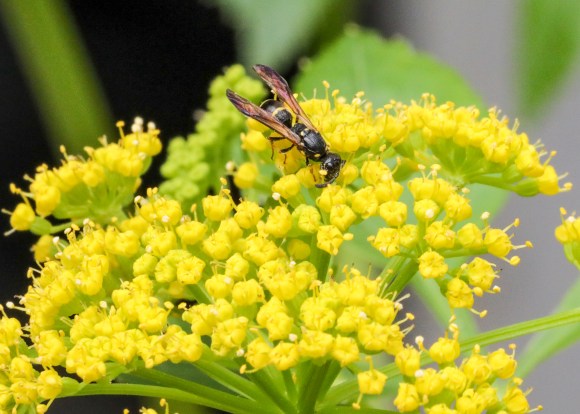
As an early bloomer,  Zizia provides resources before many other plants and are always busy.  Some of its visitors include:  Hylaeus (Yellow-faced bees), Andrenid bees, Ceratina (small carpenter bees),  Osmia (Mason bees), Halictid bees including Lasioglossum, green metallic bees, wasps and its specialist bee Andrena ziziae.

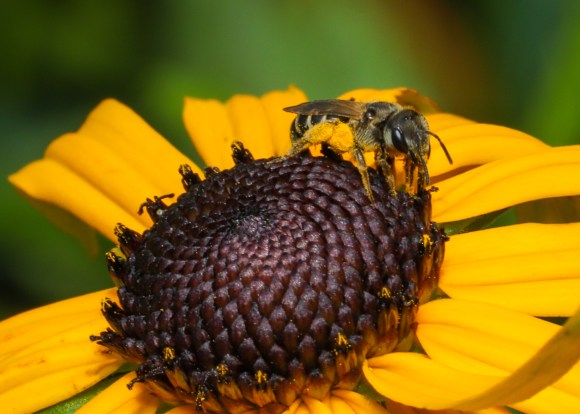
Black-Eyed Susans or Rudbeckia hirta (https://wildthingsinthe.garden/2025/03/05/sunny-faces/) open next and continue into early fall.  Black-Eyed Susans, also, grow well on the edges and in the intermediate areas of the rain garden.
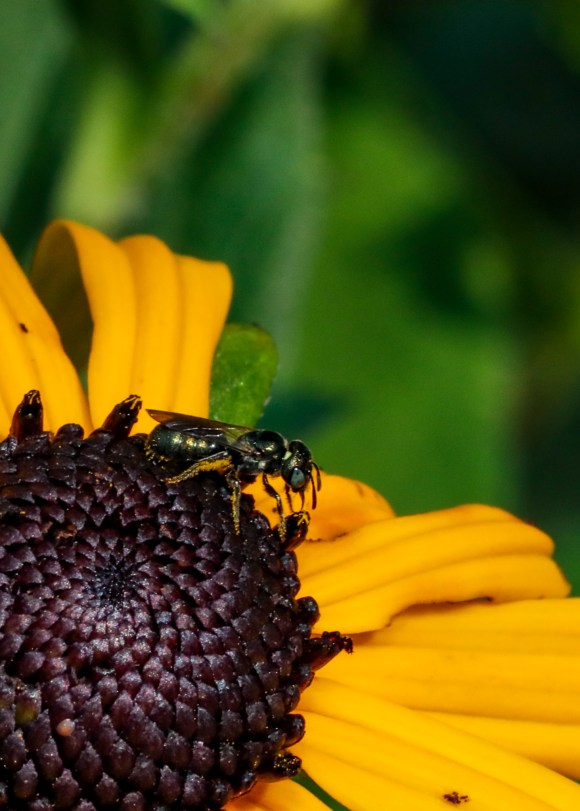
Numerous bees visit these cheerful flowers.  They include Honeybees (Apis spp.), Long-Horned Bees (Melissodes spp.), Leafcutter Bees (Megachile spp.), Cuckoo Bees (Coelioxys spp.), Sweat Bees (Halictus spp.), Green Sweat Bees (Agapostemon spp., Augochlorini Tribe), and Small Carpenter Bees (Ceratina spp.).  Rudbeckia hirta feeds several specialist bees, i.e.  including Andrena rudbeckiae, Pseudopanurgus albitarsis, P. rudbeckiae, Melissodes denticulatus, M. druriellus, M. illatus, Megachile pugnata, and M. xylocopoides.
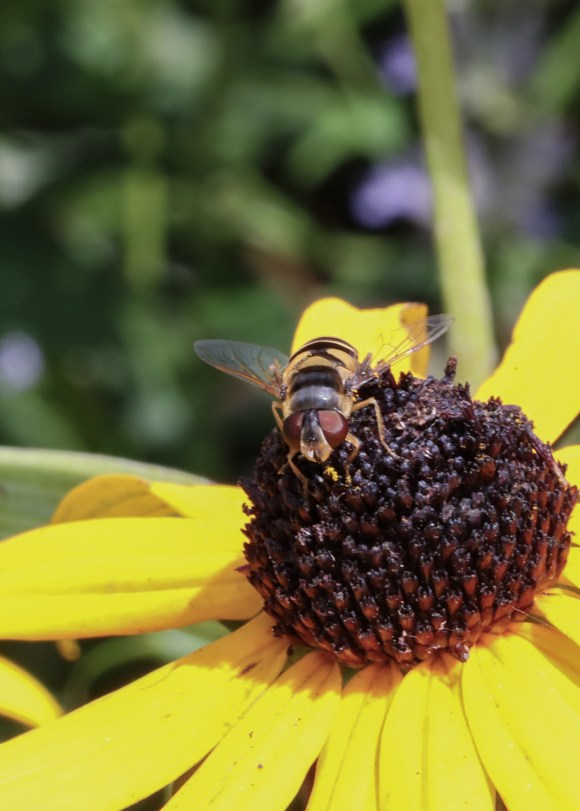
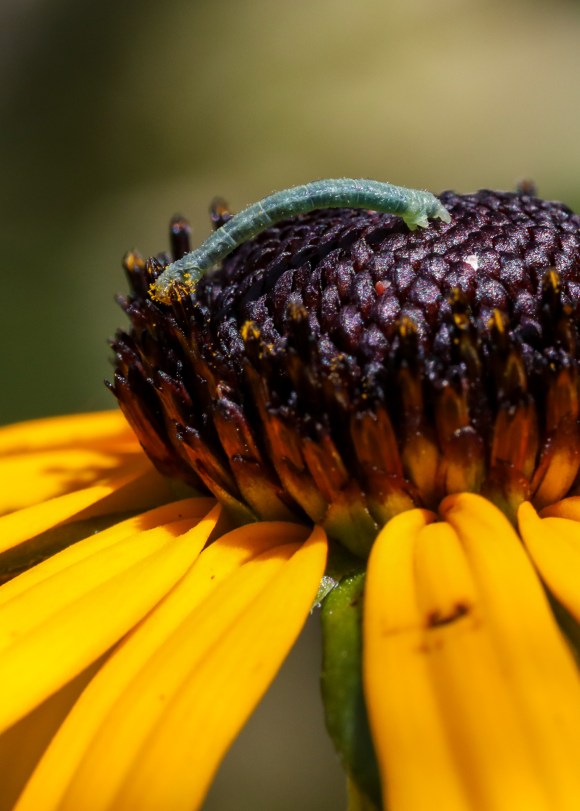
Black-Eye Susan serves as a larval host for both moths and butterflies.  Wavy-Lined Emerald Moth ( Synchlora aerata), Southern Emerald Moth (Synchlora frondaria),  Common Eupithecia (Eupithecia miserulata), Gorgone Checkerspot Butterfly (Chlosyne gorgone), Bordered Patch Butterfly (Chlosyne lacinia) and Silvery Checkerspot Butterfly (Chlosyne nycteis) all lay eggs on R. hirta, 
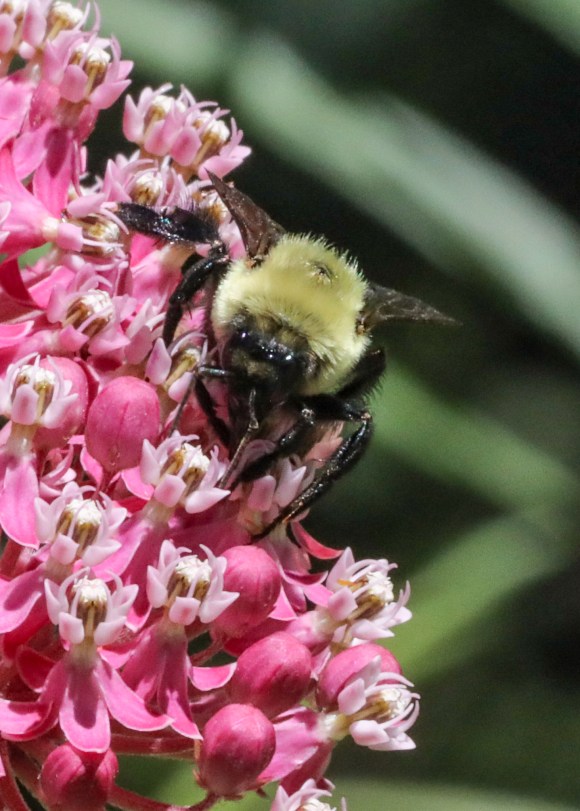
Rose Milkweed or Asclepias incarnata (https://wildthingsinthe.garden/2025/04/01/a-delicate-pink-star/) begins flowering slightly later than Black-Eyed Susans and continues into the early fall.  Rose Milkweed serves well in the intermediate and deep portions of the  rain garden.  
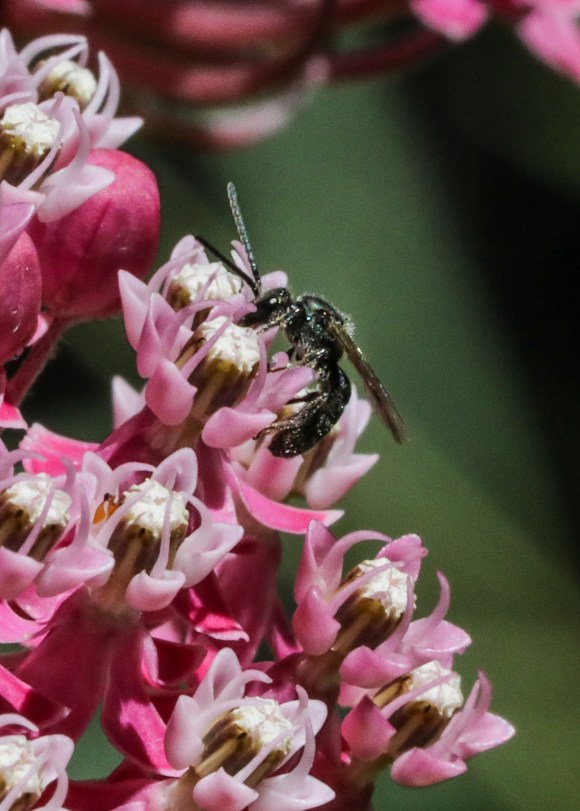
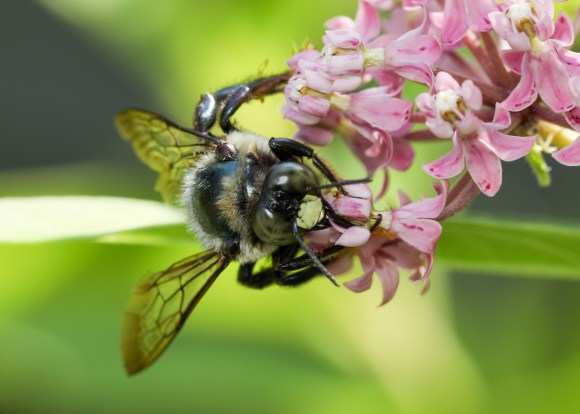
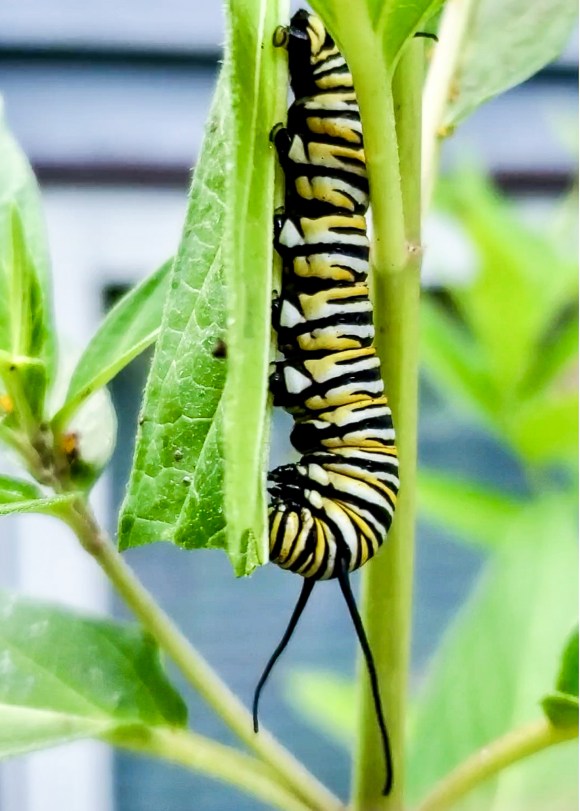
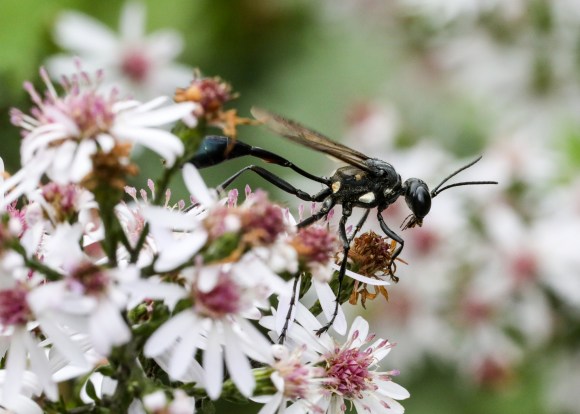
As a Milkweed, it hosts the adult Monarch Butterflies at its blooms and is also a larval host.  In addition to supporting Monarch Butterflies, Rose Milkweed provides resources to native bees, Bumble Bees, Honeybees, beneficial insects and wasps.  Some specific examples are Sphecid wasps including the Great Black Wasp (Sphex pensylvanicus) and Great Golden Digger Wasps (Sphex ichneumoneus), Vespid wasps (Vespula spp.), Tiphiid wasps, Spider wasps, Paper Wasps (Polistes spp.), Square-Headed Wasps (Tachytesspp.), Bumblebees, honeybees, long-horned bees (Melissodes ssp, Svastra spp.), Yellow-Faced Bees (Hylaeus spp.), Sweat Bees (Lasioglossum spp.), Halictid Bees, Green Sweat Bees (Augochlorini Tribe), and Small Resin Bees (Heriades spp.).
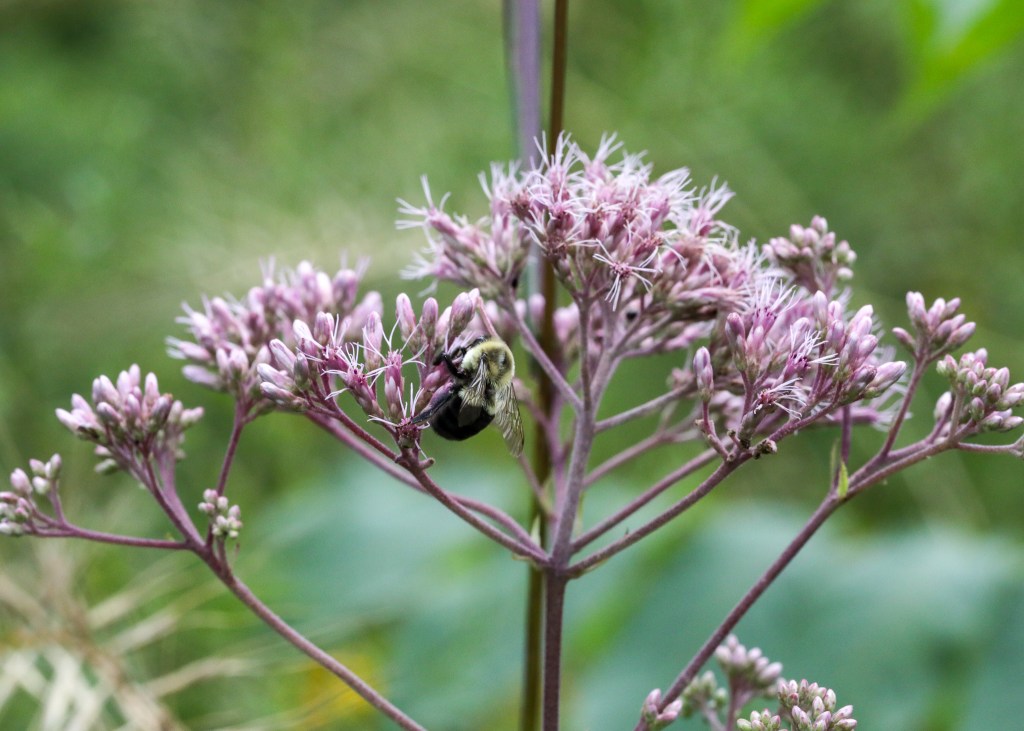
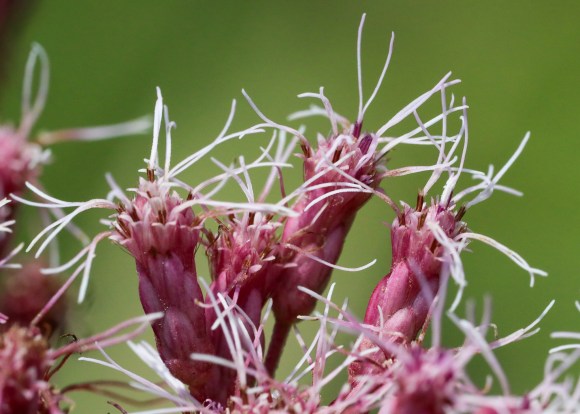
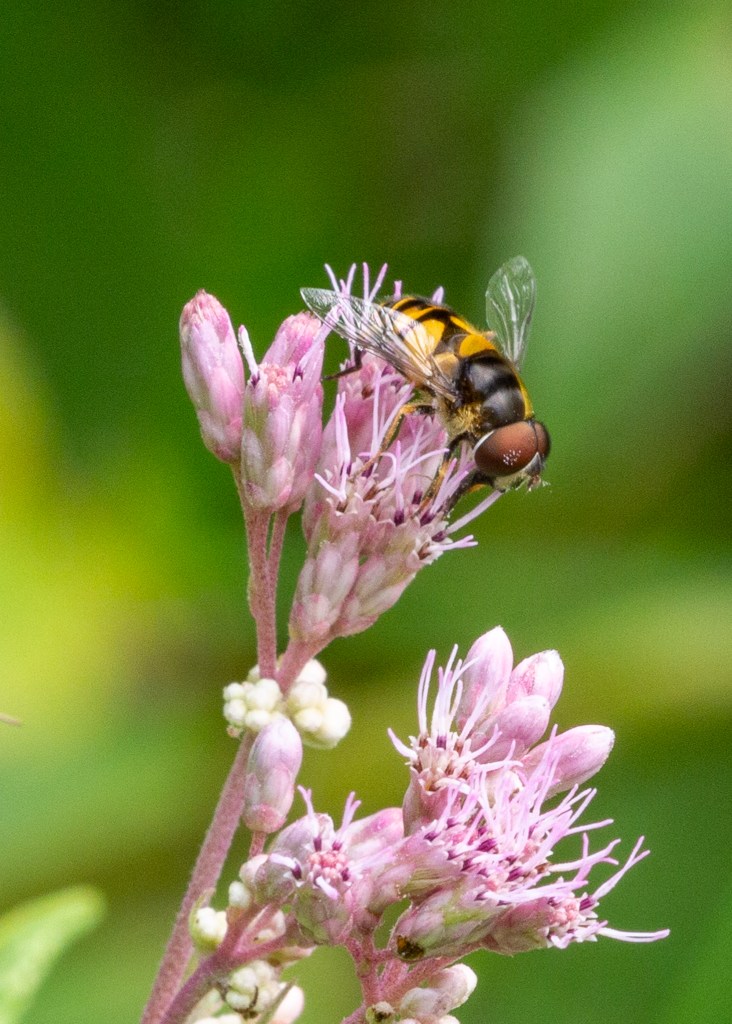
Joe-Pye Weed or Eutrochium purpureum (https://wildthingsinthe.garden/2024/10/31/a-fabulous-fuzzy-flower/) blooms from mid-summer to early fall adding an additional source of pollen and nectar during the height of the season.  Plant Joe-Pye Weed in the intermediate and deep areas of the rain garden. 
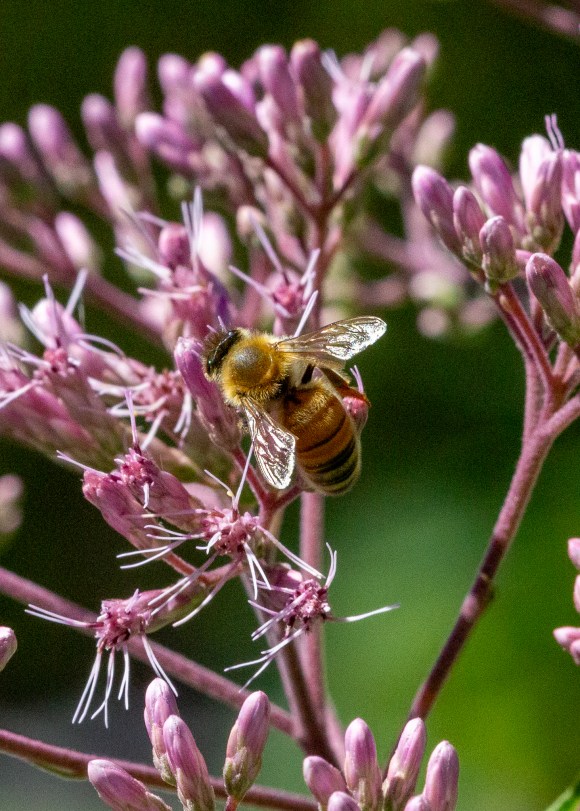
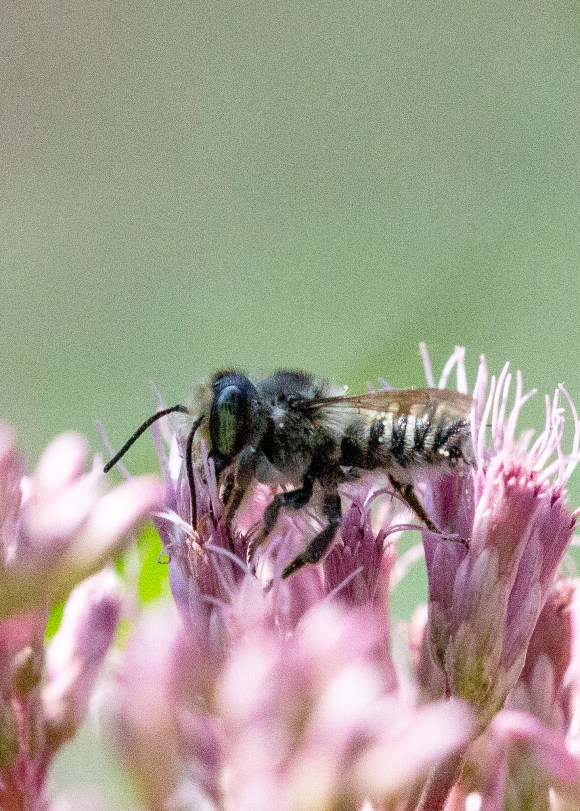
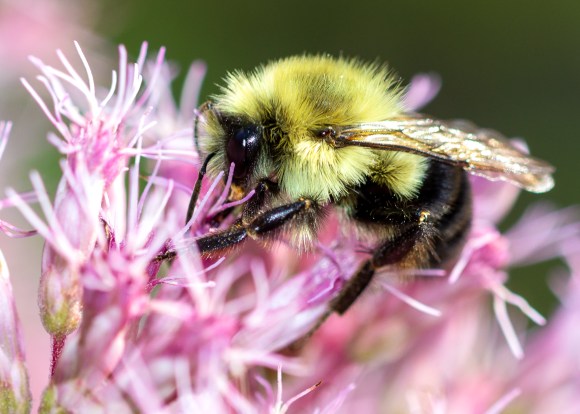
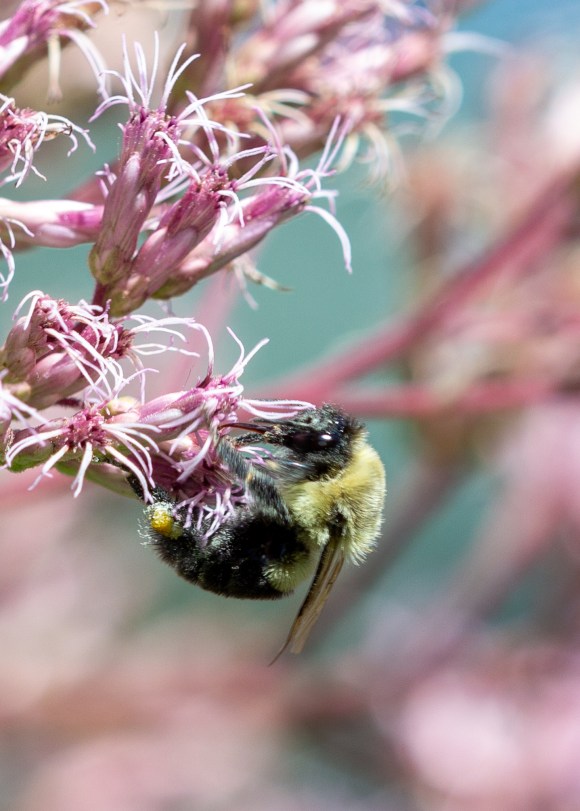
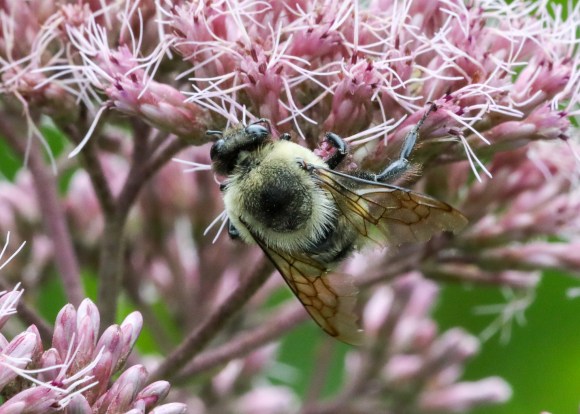
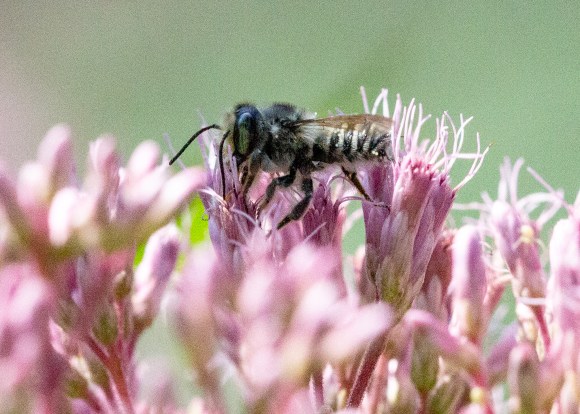
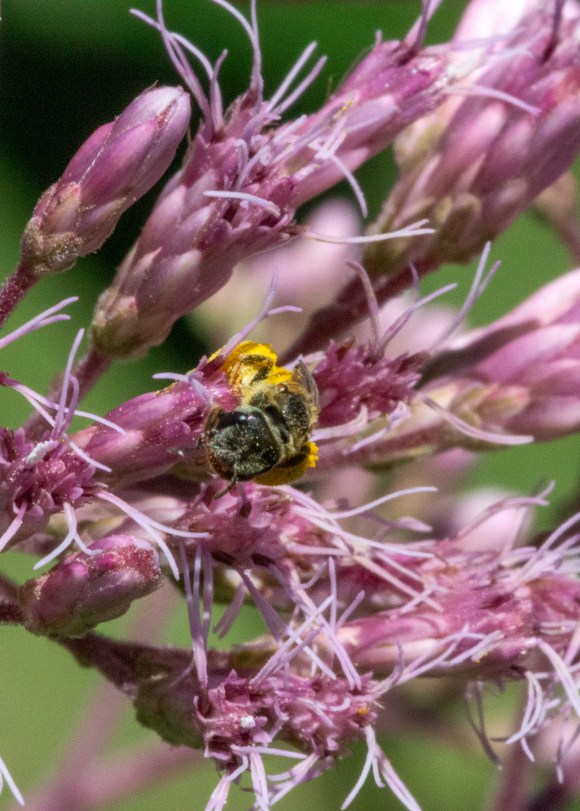
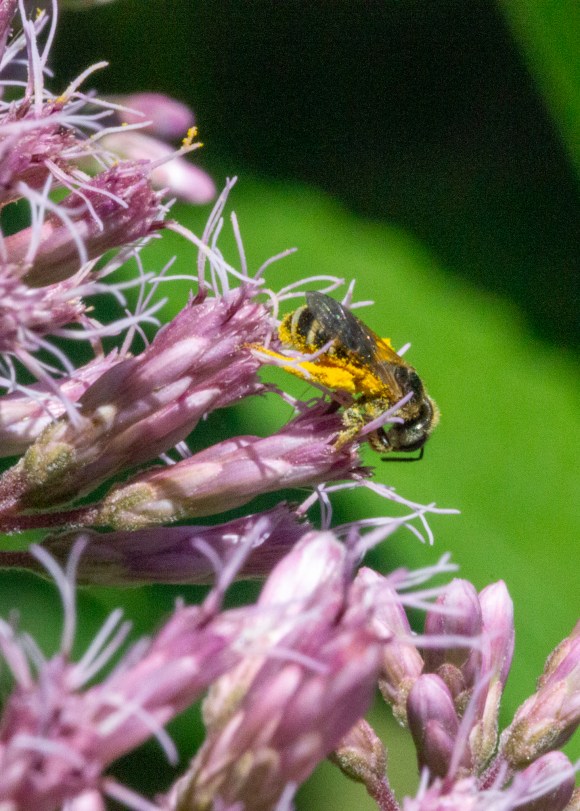
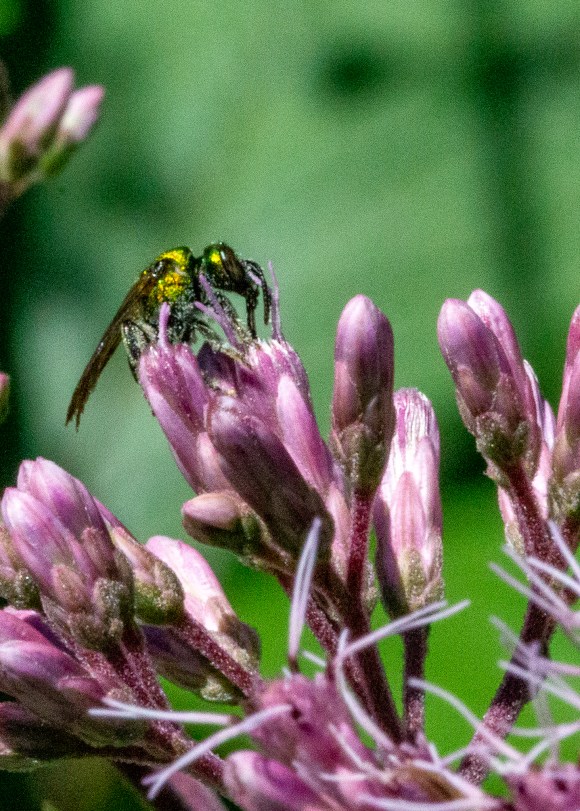
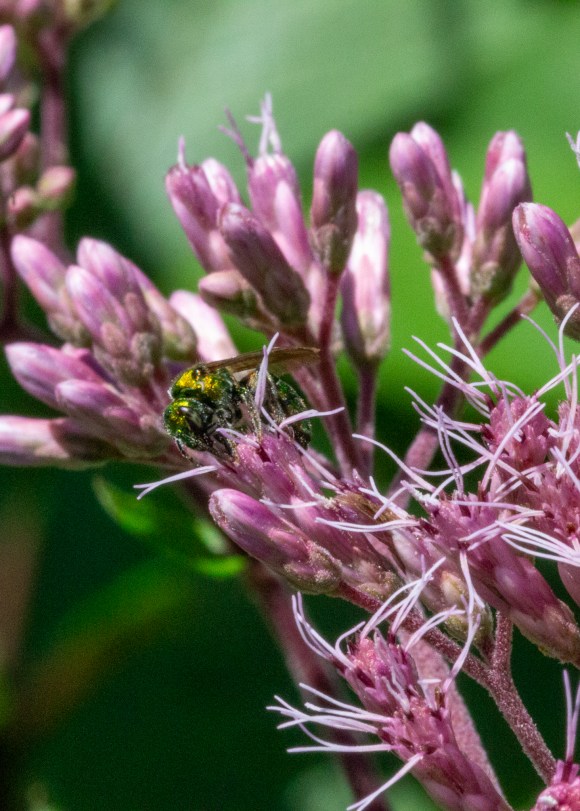
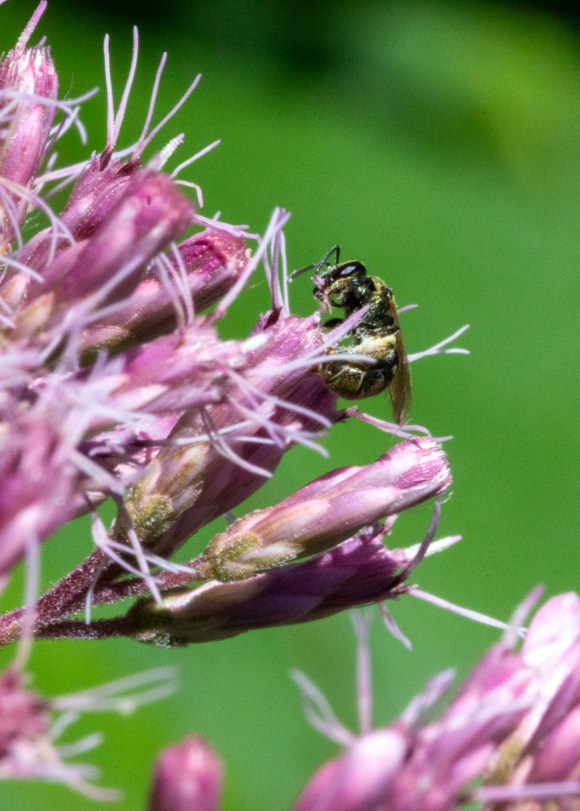
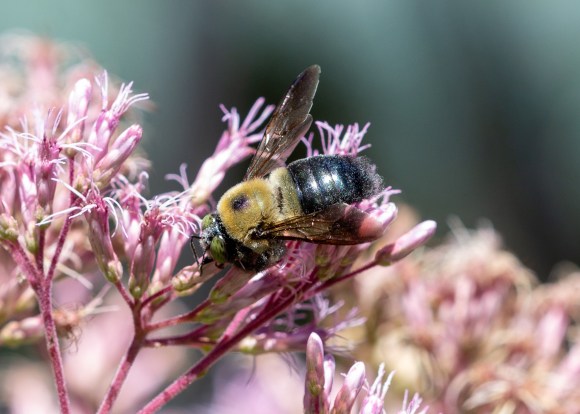
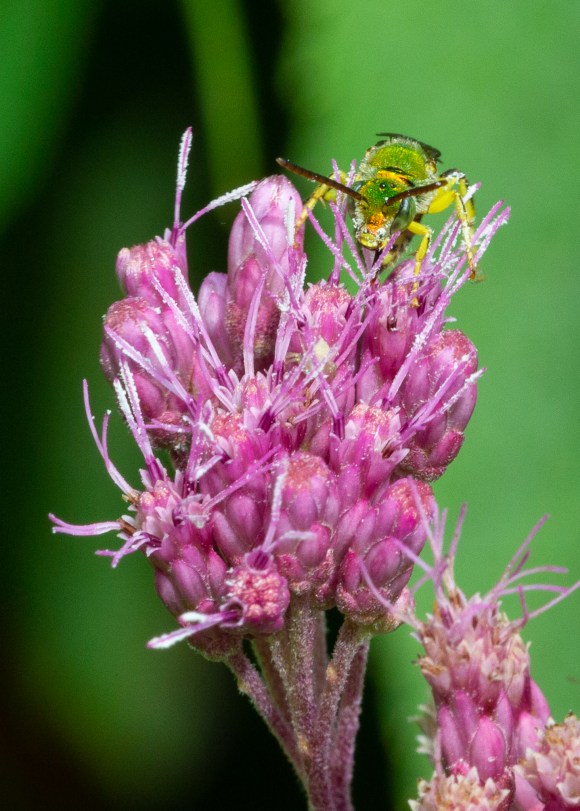
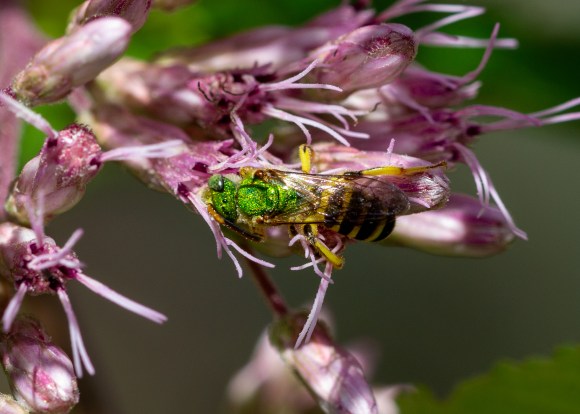
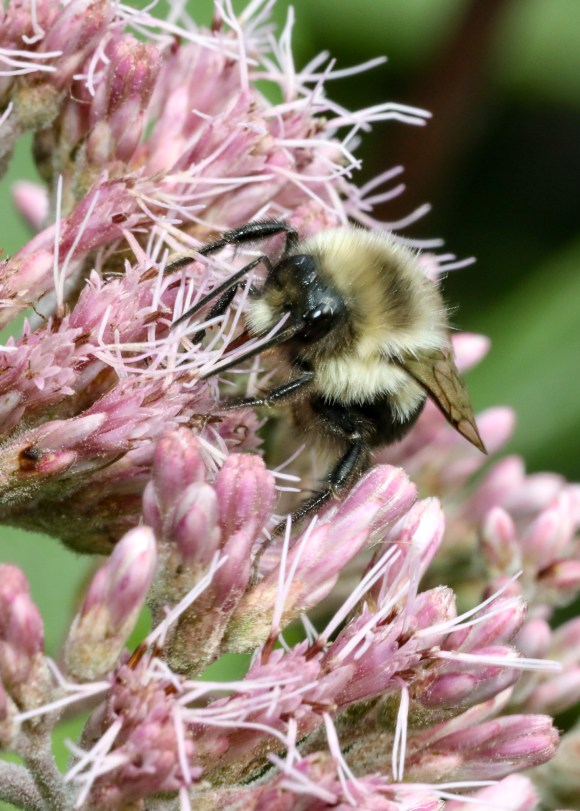
It’s especially beloved by bees.  The bee visitors include Bombus spp. (bumblebees), Melissodes spp. (miner bees), Coelioxys (cuckoo bees), Agapostemon (metallic green sweat bees), Megachile spp. (leaf-cutting bees), Halictus spp., honeybees (Apis app.) and large and small carpenter bees, Xylocopa spp. and Ceratina spp.,
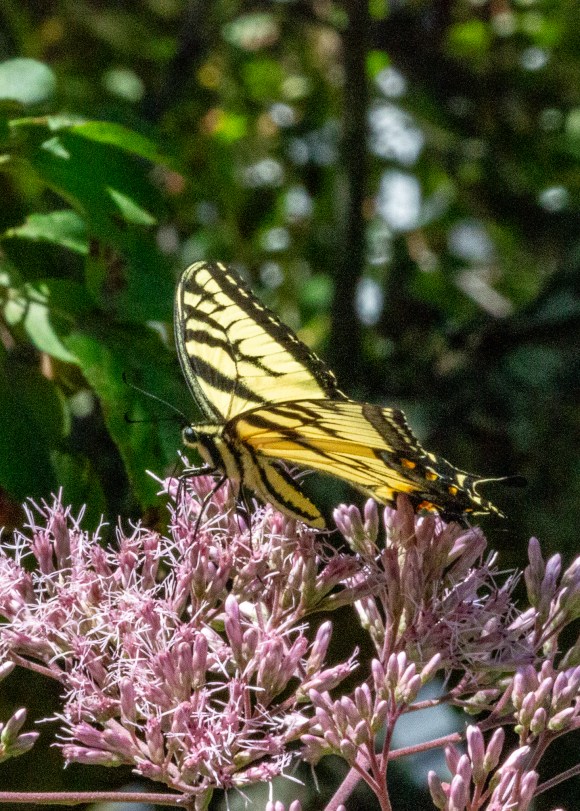
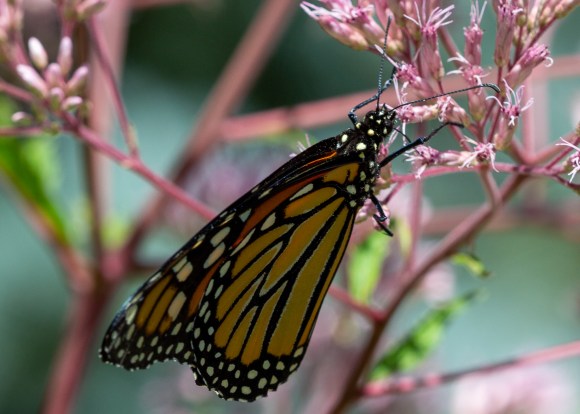
E. purpureum also invites a host of butterflies, moths, and skippers.  Celastrina (Azure Butterflies), Epargyreus clarus (Silver Spotted Skipper), Limenitis arthemis (White Admiral Butterflies), Nymphalis urticae (Milbert’s Tortoiseshell Butterflies), Papilio glaucus (Eastern Tiger Swallowtail Butterflies), and Danaus plexippus (Monarch Butterflies) sip the nectar from the fluffy, pink flowerheads

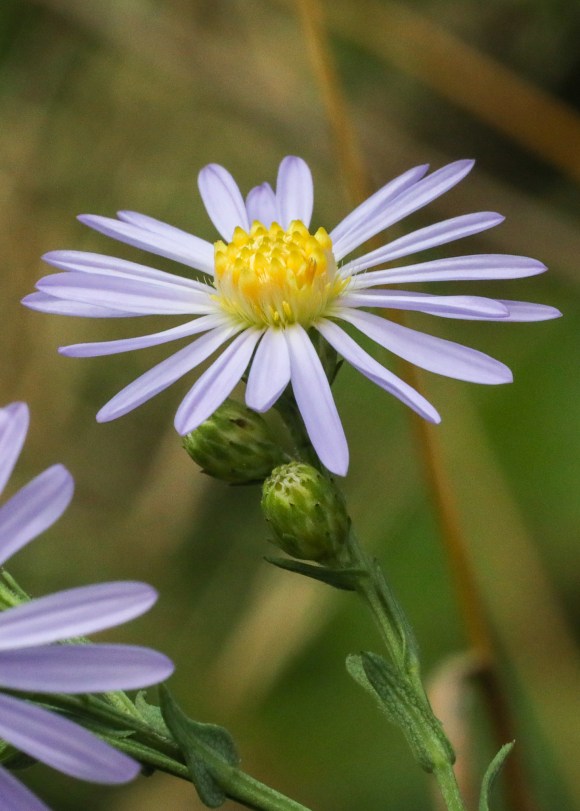
Smooth Blue Aster or Symphyotrichum laeve (https://wildthingsinthe.garden/2023/10/01/autumn-stars/) finish the growing season, blossoming from early to late fall.  Place this aster in the intermediate area or on the edge of a rain garden,
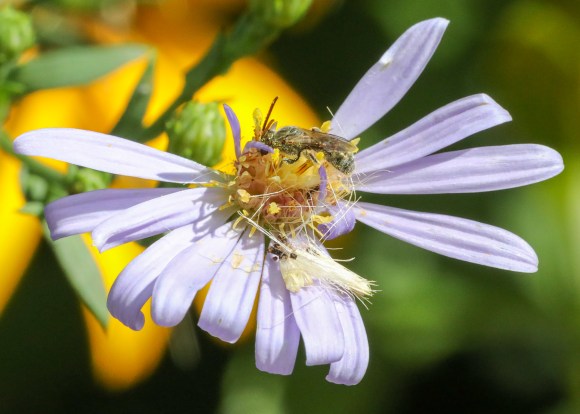
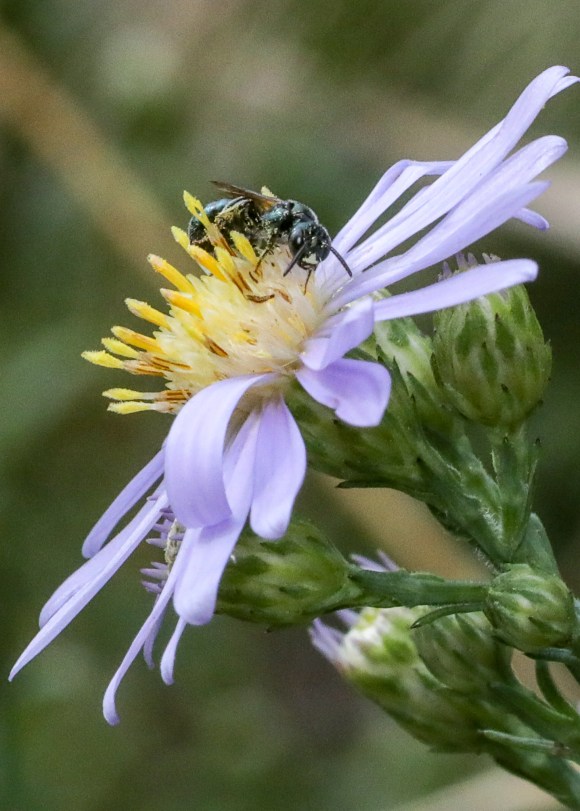
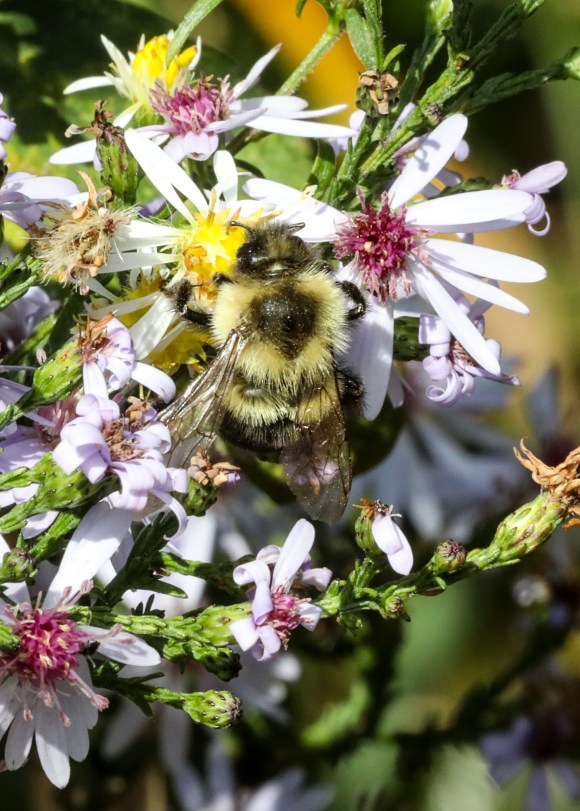
Enjoyed by native bees, this aster supplies nectar and pollen before the winter season.  Long- and short-tongued bees, honeybees, bumblebees, bee flies, wasps, butterflies, and beneficial insects all visit this plant.  Several specialist bees forage on Asteraceae plants including Andrena asteris, A. asteroides,  A. placata, A. simplex, Cnemidandrena hirtcincta, C. nubecula, and Colletes simulans.  
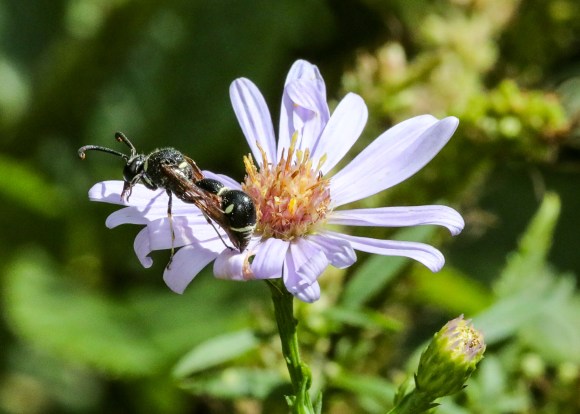
Soldier Beetles (Chauliognathus spp.), Insidious Flower Bug (Prius insidious), and chalcid wasps are beneficial insects that enjoy S. laeve.  Monarchs and other butterflies visit this aster for nectar during their fall migration.This aster also serves as a larval host for the Pearly Crescent Butterfly (Phyciodes thanos).
I hope you’ve enjoyed this application for your native plants.  It a wonderful time of year to begin a new garden area and rain gardens help your yard and the ecosystem!

Happy planting!

Mary

BIBIOGRAPHY:

  1. “Building a Rain Garden.” n.d. Accessed August 5, 2025. https://extension.umn.edu/landscape-design/rain-gardens.
  2. “Rain Gardens:  A Guide for Homeowners and Landscapers.” November 2018. Wisconsin Standards Oversight Council/Wisconsin Department of Natural Resources.
  3. Hinman, Curtis. June 2013. “Rain Garden Handbook for Western Washingtion:  A Guide for Design, Installation, and Maintenance.” Washington State Extension.
  4. Steiner, Lynn M. and Domm, Robert W. 2012. Rain Gardens:  Sustainable Landscaping for a Beautiful Yard and a Healthy World. Voyageur Press.
Categories
native plants Pollinator gardening

A Fabulous, Fuzzy Flower

Big, bold and filled with butterflies, Sweet Joe-Pye Weed (Eutrochium purpureum) stands out in any garden.  Large mauve-purple flowers feed masses of pollinators.  Not only do butterflies, moths and skippers nectar at the blooms but various caterpillars feed on it.10

Eutrochium purpureum grow in zones four to nine.  It usually ranges from three to seven feet tall.  In a drier location, it can flower at only one foot high and, in an ideal spot, can reach eight to ten feet.2,3,10  

It prefers partial shade to full sun and moist to medium, even moisture conditions.  Rich, loamy soil is ideal.  Eutrochium purpureum spreads by seeds and runners.  

In nature, it’s found in open woodlands, partially shaded seeps, savannas, partially shaded riverbanks and streambanks, thickets, in open woodlands, wet meadows, wooded slopes and low moist ground.2,3,8,10

Given these natural habitats, Sweet Joe-Pye weed easily adapts to wildflower gardens, naturalized landscapes and perennial borders.  Its moisture tolerance means  Eutrochium purpureum enjoys the edges of rain or water gardens.  Recently, Sweet Joe-Pye Weed began self-seeding near my rain gardens.  Finally, it suits both formal and informal settings.

Sweet Joe-Pye Weed will react to less-than-ideal conditions.  In full shade, it becomes leggy and may  fall over.  If it dries out, its leaves turn yellowish green.  

In my garden, it grows tallest in a rainy year.  In partial shade, the plants thrive even without extra water.  In full sun, the plants are more likely to need staking possibly from too little water. 1,2,3,10    

If a shorter plant is preferred, Sweet Joe-Pye Weed can be cut back to approximately two feet in late spring or early summer.  These plants usually bloom around the same time as those that haven’t been cut.  The flowers are a generally a little smaller than usual.1

Don’t give up on this one in the Spring!  It tends to sleep late and the stems develop randomly.  But it has been a very reliable grower in my garden—returning with full and abundant growth each year.

Chicago Botanic Garden grew a variety of Eutrochium spp. and related plants in an evaluative study between 2001 and 2013.  They trialed each genus between four and six years.  Eutrochium purpureum performed well each year with flowers up to twelve inches across.  It suffered from powdery mildew one year but not in others.1

Sweet Joe-Pye Weed has a straight, unbranched, light green stem giving the plant an outstanding erect habit.  The leaf nodes are enlarged and naturally purple.  Some plants have more purple on the stem than others. 2,3,10    

Shallow, fibrous roots support the plant.  Sweet Joe-Pye weed spreads as a clump as well as self-seeding.  If it grows in an unwanted place, the plants are easy to pull.

Eutrochium purpureum’s leaves form an attractive whorl around its stem.  Growing in groups of three to five, the medium green, the matte leaves are ovate to lanceolate with lightly serrated edges.  The lower surface is pale green and may be slightly hairy.  Some ecotypes have vanilla-scented foliage.10

In mid-summer to early fall, Sweet Joe-Pye Weed’s magnificent flowers grace the garden.  The main bloom sits  at the top of the stem.  On established plants, side blossoms form below this head adding to the show. 

Each compound head can measure up to 12 to 18 inches across and are made up of one or more panicles.  In my Southern Michigan garden,  Eutrochium purpureum’s flowerheads range from five inches to twelve inches across.  They are most often between five and eight inches.

Blooms range from whitish pink to purplish pink.  I find the more sun, the deeper the flower color.  Plants growing in deep shade have almost white flowers.  Flowers carry a vanilla scent.

These superb blooms have five to eight disk florets per panicle and no ray florets.  The overall flowerhead is slightly dome shaped. Each floret has a series of overlapping pink, oblong bracts.  As they open, a divided white style is strongly exerted (extended past the floret) giving the bloom a fuzzy look. 2,3,8,10  

Numerous pollinators forage on the compound flowerheads of Sweet Joe-Pye Weed.  Most seek out nectar.  Eutrochium purpureum secretes its nectar at the base of the style.  Each tiny, blooming floret offers a supply.2,3,8,10  

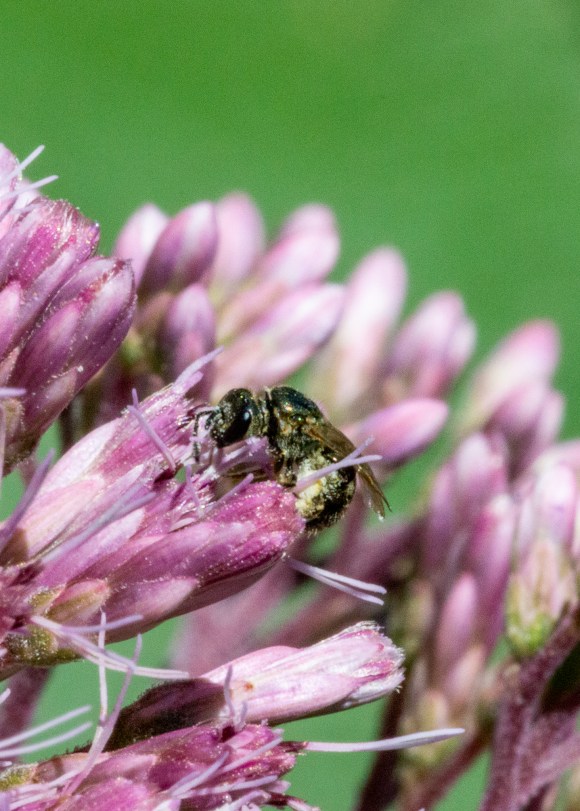
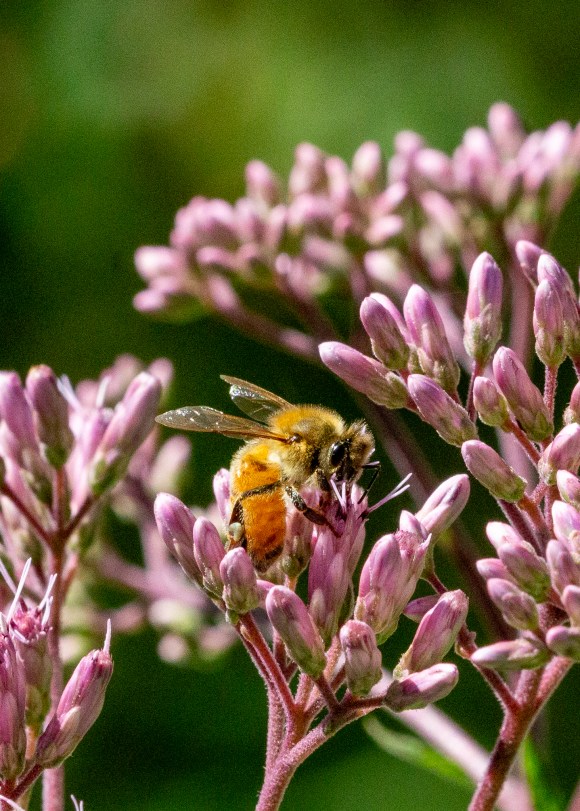
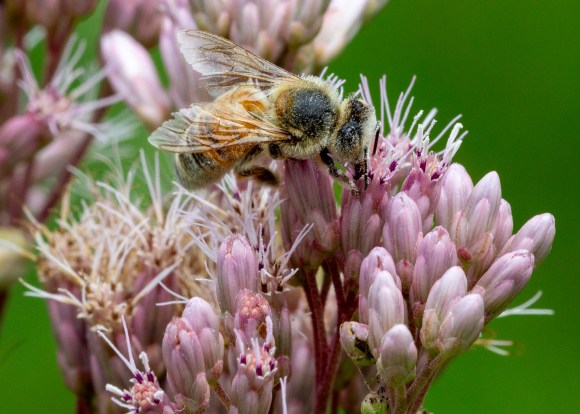
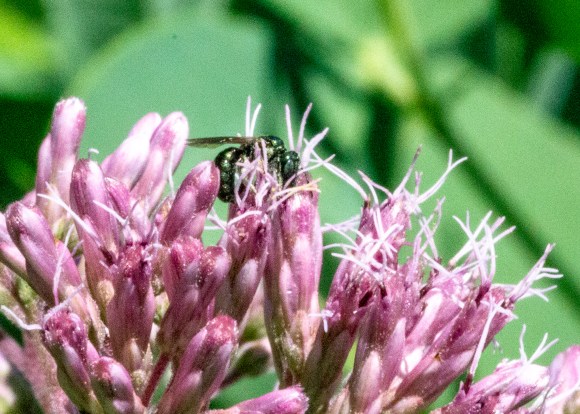
The Xerces Society for Invertebrate Conservation declared Eutrochium purpureum of Special Value to Native Bees.2  Visiting bees include Bombus spp. (bumblebees), Melissodes spp. (miner bees), Coelioxys (cuckoo bees), Agapostemon (metallic green sweat bees) and Megachile spp. (leaf-cutting bees).    In my garden, I’ve also seen other sweat bees like Halictus spp., honey bees (Apis app.) and large and small carpenter bees, Xylocopa spp. and Ceratina spp.

Most of these bees collect nectar.  But Bombus spp. (bumblebees) and Melissodes spp. (miner bees) also gather pollen.8,10

Butterflies, moth, and skippers seek out Sweet Joe-Pye Weed in the mid-summer to early fall.  Celastrina(Azure Butterflies), Epargyreus clarus (Silver Spotted Skipper), Limenitis arthemis arthemis (White Admiral Butterflies), Nymphalis urticae (Milbert’s Tortoiseshell Butterflies), Papilio glaucus (Eastern Tiger Swallowtail Butterflies), and Danaus plexippus (Monarch Butterflies) sip the nectar from the fluffy, pink flowerheads.

Eutrochium purpureum is also a larval host supporting several moth caterpillars.  These eat its leaves and other parts.  Emmelina monodactyla (Common Plume Moth), Perigea xanthioides (Red Groundling), Phragmatobia fuliginosa (Ruby Tiger Moth), and Eupithecia miserulata (Common Pug) all feed on Sweet Joe-Pye Weed’s leaves. Carmenta bassiformis (Eupatorium Borer Moth) consumes the roots.  Schinia trifasciata (Three-Lined Flower Moth) relies on its flowers. 4,5,6,8,9,10

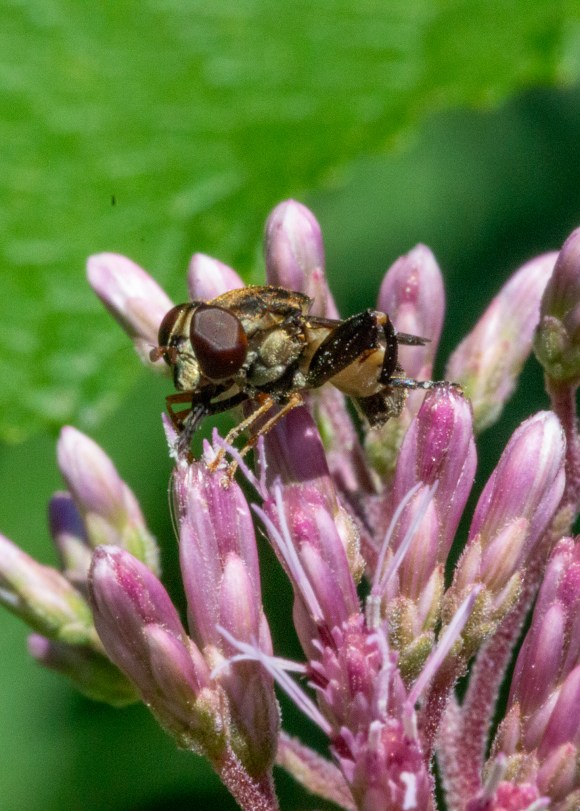
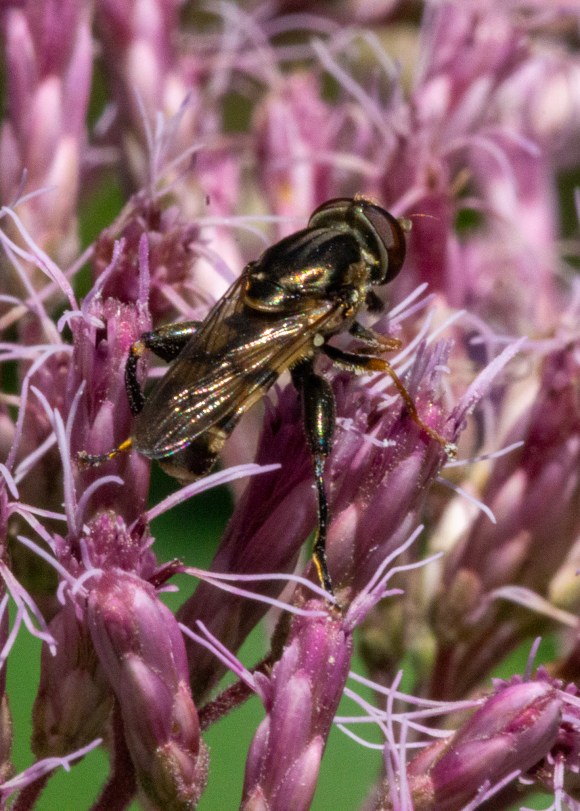
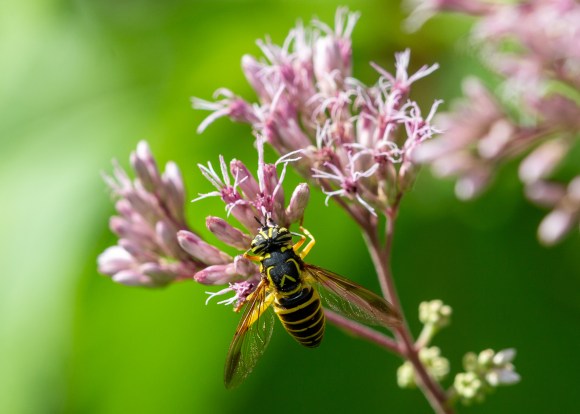
Beneficial insects are not particularly attracted to Eutrochium purpureum.  Flies, thread-waisted and sand wasps occasionally visit. Instead, these short-tongued beneficials flock to another Eutrochium—the white blooming Boneset (Eupatorium perfoliatum).8 But that’s the subject for another blog!

I hope you’ve enjoyed hearing about Sweet Joe-Pye weed—a stunning, versatile and useful plant.  Eutrochium purpureum is easily available at most native plant nurseries.  Next year those big, fuzzy flowers could be blooming in your garden!

If you’ve enjoyed this blog and would like to leave a comment or share a story, please contact me in the box below!

Warm Regards,

Mary

References:

  1. Hawke, Richard. “A Comparative Study of Joe-Pye Weeds (Eutrochium Spp.) and Their Relatives,” n.d.
  2. “Eutrochium Purpureum (Gravel Weed, Indian Sage, Joe-Pye Weed, Marsh Milkweed, Motherwort, Pride of the Meadow, Purple Joe-Pye Weed, Sweet Joepyeweed) | North Carolina Extension Gardener Plant Toolbox.” Accessed October 20, 2024. https://plants.ces.ncsu.edu/plants/eutrochium-purpureum/.
  3. “Eutrochium Purpureum (Purple Joepyeweed) | Native Plants of North America.” Accessed October 20, 2024. https://www.wildflower.org/plants/result.php?id_plant=eupu21.
  4. “Minnesota Seasons – Common Eupithecia.” Accessed October 30, 2024. http://www.minnesotaseasons.com/Insects/common_eupithecia.html.
  5. Missouri Department of Conservation. “Plume Moths.” Accessed October 30, 2024. https://mdc.mo.gov/discover-nature/field-guide/plume-moths.
  6. Missouri Department of Conservation. “Three-Lined Flower Moth.” Accessed October 30, 2024. https://mdc.mo.gov/discover-nature/field-guide/three-lined-flower-moth.
  7. Perigea Xanthioides.” In Wikipedia, January 8, 2023. https://en.wikipedia.org/w/index.php?title=Perigea_xanthioides&oldid=1132346411
  8. Holm, Heather. Pollinators of Native Plants:  Attract, Observe and Identify Pollinators and Beneficial Insects with Native Plants. Minnesota: Pollination Press LLC, 2014.
  9. “Species Phragmatobia Fuliginosa – Ruby Tiger Moth – Hodges#8156.” Accessed October 30, 2024. https://bugguide.net/node/view/41933.
  10. “Sweet Joe-Pye Weed (Eutrochium Purpureum).” Accessed October 20, 2024. https://www.illinoiswildflowers.info/savanna/plants/sw_joepye.htm.
Categories
Pollinator gardening

A Froth of White

In late Spring, the parasol blooms of Yarrow (Achillea millefolium) open.  The intricate creamy-white flowerheads draw every type of pollinator offering nectar and pollen to active insects.  An assortment of caterpillars nibble on its stem, leaves, and flowers.

While yarrow grows in a range of habitats, it prefers full or part sun and medium to dry soils.  It’s not picky about soil type if the soils are well drained.  Yarrow likes disturbed areas.  In nature, soil disturbances happens where water rises or falls (for example, lakes and rivers) and where large animals gather (such as, at a watering hole).  Humans, of course, add to land disturbance.  Habitats with yarrow include medium to dry prairies, pastures, unused fields, grassy waste areas, and edges of paths, yards, or hedges.1,2

Like so many native plants, yarrow reseeds freely when happy.  You can limit this by cutting off seedheads and weeding out seedlings.  Its seedlings are distinctive with their delicate, lacy foliage. Beware the rhizomes.  Yarrow can form large colonies from spreading rhizomes.  Root prune a clump with a sharp shovel or pull the shoots to keep it in check.

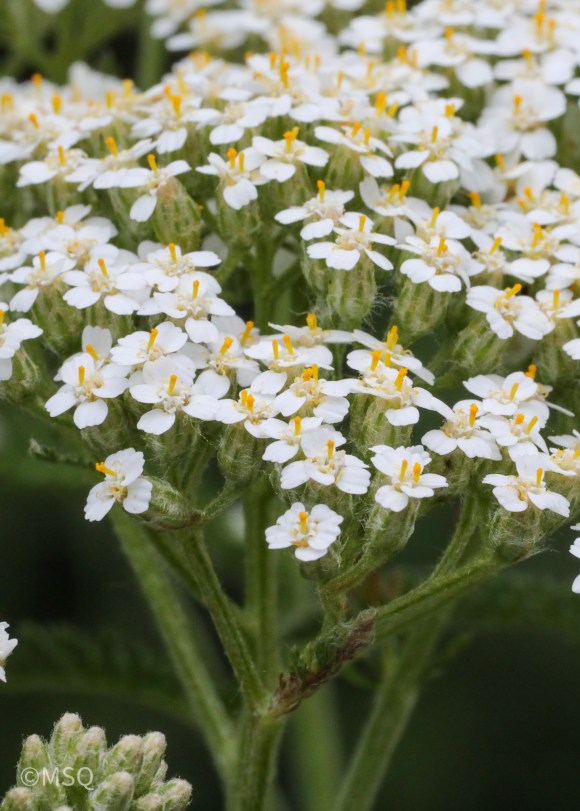
Achillea millefolium is all about multiples with compound flowers and doubly divided leaves.  The elaborate, ruffled “flowerheads” are held on single stems.  What looks a flowerhead is really a group of smaller flower heads called pedicels.  These pedicels together form a compound corymb and that’s what we see as a flower.  Yarrow’s corymbs can have 150 to 200+ individual florets! (Arkansas native plant society)  Each floret is about of a quarter inch across and has ray and disk parts.  It has three to eight ray florets around the edge and six to forty disk florets in the center.  Florets begin opening in May and can last as late as August.1,2,3.4.5

Yarrow’s foliage adds a fine, lacy note to the garden.  It ranges from pale to medium green.  The leaves are approximately six inches long and one inch wide becoming smaller toward the top of the stem.  Their overall outline is elliptical but each pointed leaf is divided and subdivided.  Leaflets and sub-leaflets curve and turn in different directions creating a soft and delicate appearance.  The sessile (leaves touch the stem) or almost sessile leaves grow in a spiral along the stem.  They can have fine hairs or be smooth.

Achillea millefolium is listed as native and introduced in most of the United States.4  It’s also called a species complex not a species.  But what does that mean?  Let’s talk about why this yarrow is so diverse and, briefly, what is says about the classification system.  If that doesn’t interest you, please skip down to the section labeled POLLINATORS.

Part of Yarrow’s story stems from a long history of human use going back thousands of years.  Yarrow’s been found in Neanderthal burial sites dating back as far as 65,000 years.  Although it probably originated in Asia, peoples in Europe, the Americas and Asia have used it for millennia.  Like any useful plant, it was transported and planted wherever people went.  So now we have Yarrow in Asia, throughout Europe, throughout the Americas, as well as on distant islands like Greenland, Patagonia, New Zealand, and Hawaii.

To make matters more difficult, Achillea millefolium is complicated genetically.  It adapts expertly to different environments and so changes its genes.  Yarrow is also one of many plants that can increase its number of genes.  For instances, humans have two sets of genes or are diploid.  Yarrow can double that-tetraploid and sometimes add one more set-hexaploid and again-octoploid.  All those variations can successfully breed together producing more Achillea millefolium.  (Animals with different polyploidy can’t usually breed together.)  All this genetic diversity doesn’t change the appearance very much—some are taller or shorter or have more petals (ray flower) or less.  It does matter to the insects that use Yarrow either.

The species complex designation allows for one species with a lot of diversity in morphology (physical characteristics) and genetics.  It acknowledges that those differences aren’t enough to indicate separate species.  
So, what does this have to do with native plants and pollinators?  Only that, things are sometime more complicated than they seem.  Botanists trying to classify plants are applying human rules to a system not controlled by humans.  This blog (https://khkeeler.blogspot.com/2014/04/plant-story-yarrow-achillea-millefolium.html) is a great read by a botanist about Yarrow’s history and botanical classification.

POLLINATORS

Achillea millefolium cannot pollinate itself and relies on insects.  The Pollinator Program at The Xerces Society for Invertebrate Conservation declared it Supports Conservation Biological Control and of Special Value to Native Bees.  The Biological Control designations means it provides resource to beneficial insects. Its visitors include bees, wasps, beetles, butterflies, moths, true bugs, and others.1

All parts of Achillea millefolium have a distinct scent.  It’s been described as resinous, like fresh pine needles, a combination of chamomile and thyme, a mixture of rosemary, oregano, and other cooking herbs and, finally, soapy and astringent.  All these descriptions hint at how different people perceive smells but none of them mention sweet or flowery.  The fragrance of a plant or flower affects which pollinators it attracts.  Generally, more savory ranging to rotting odors attract flies and beetles.  Information about yarrow mentions many different flies visiting the flowers.6

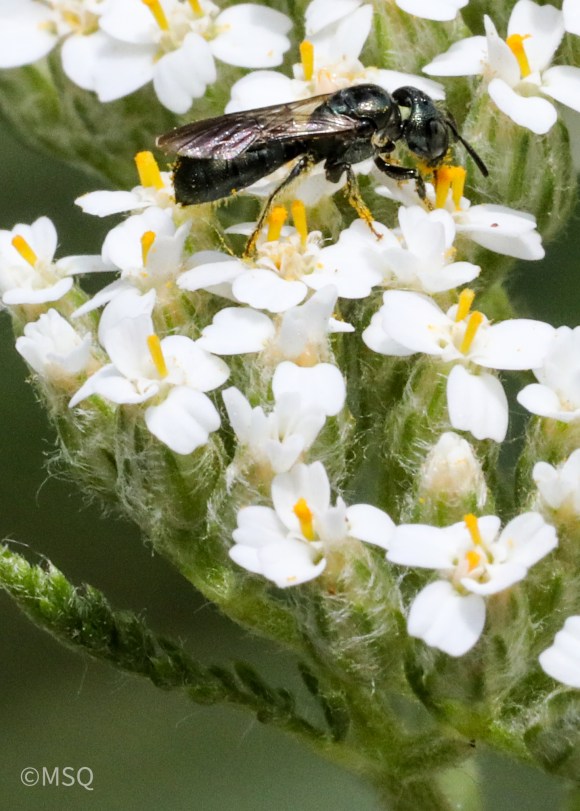
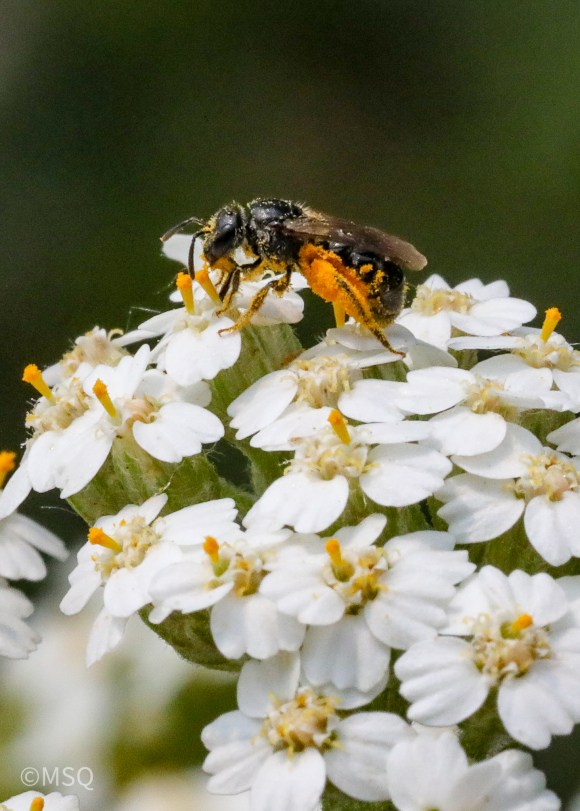
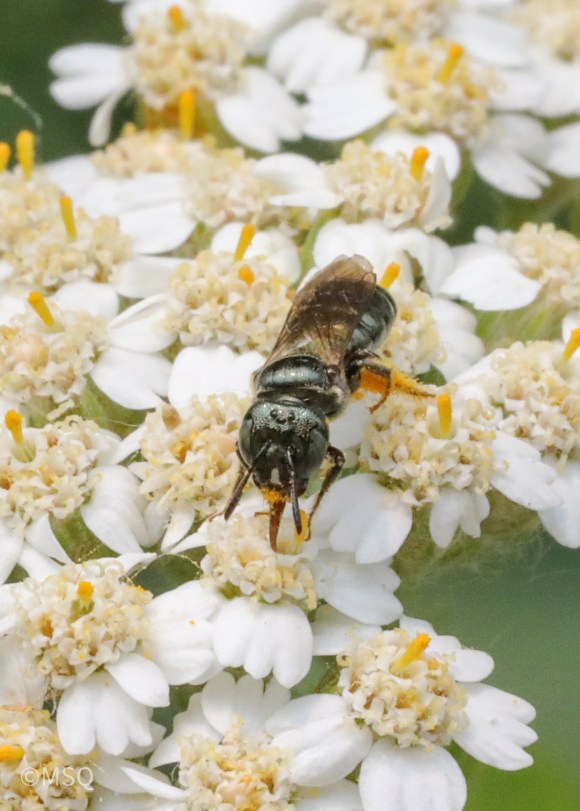
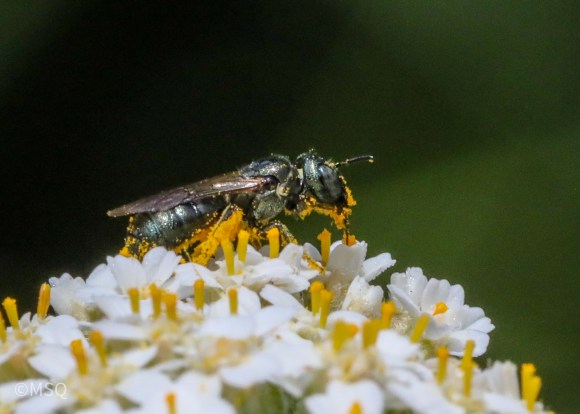
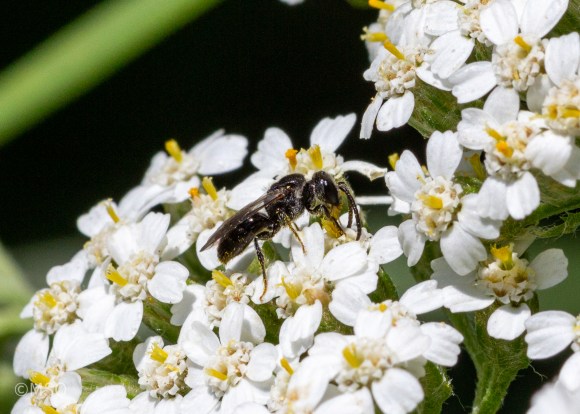
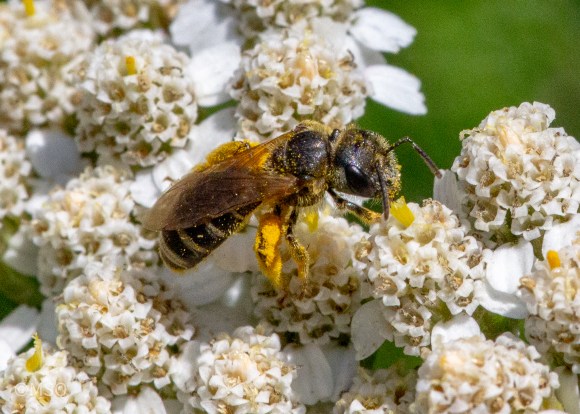
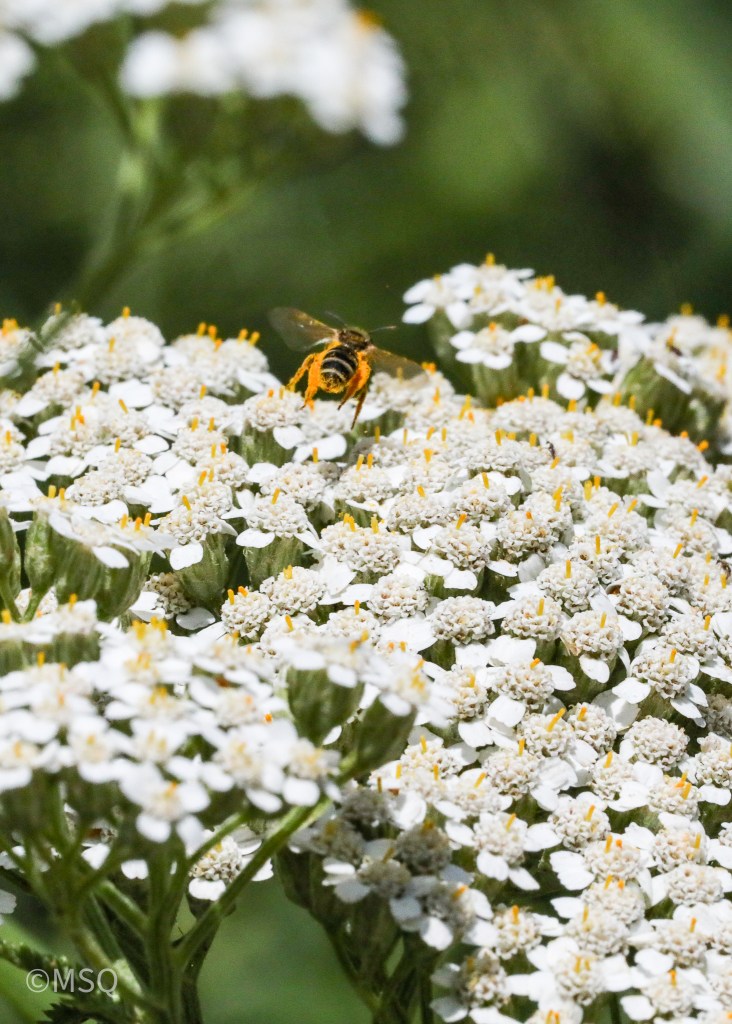
In my garden, I see many small bees gathering pollen and nectar.  Ceratina (small carpenter bee), Lasioglossum (small sweat bee), Megachile (leafcutter bee), Andrena (mining bee), and Nomada (cuckoo bee) collect resources on Yarrow.  These small bees visit the flowers throughout the summer.  Even when the Yarrow flowerheads seem finished, bees continue to visit harvesting every last bit of pollen and nectar.

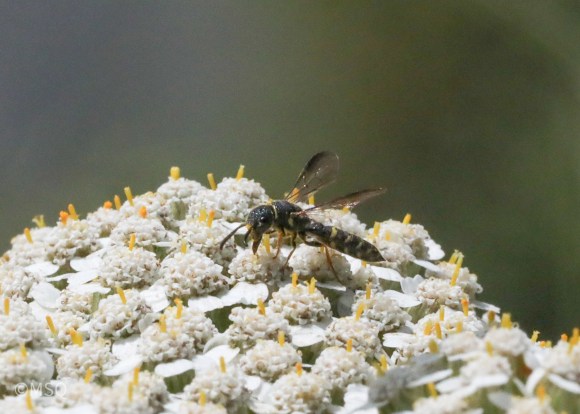
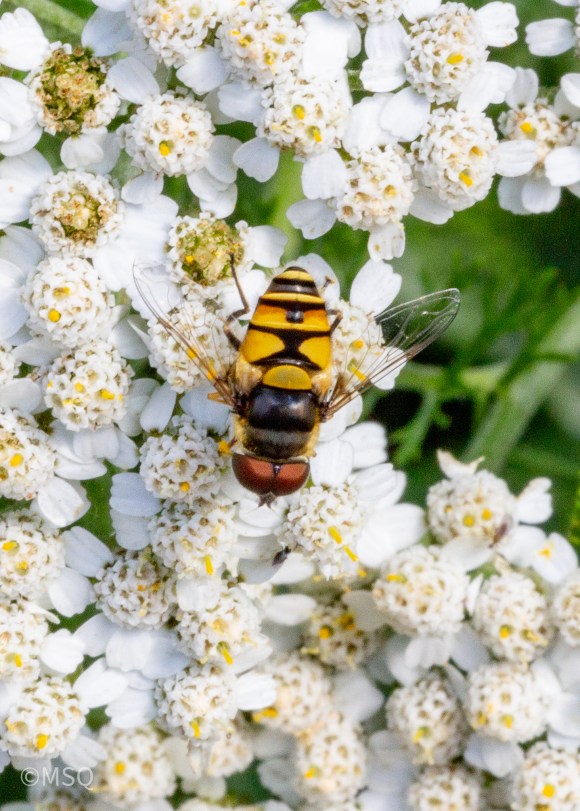
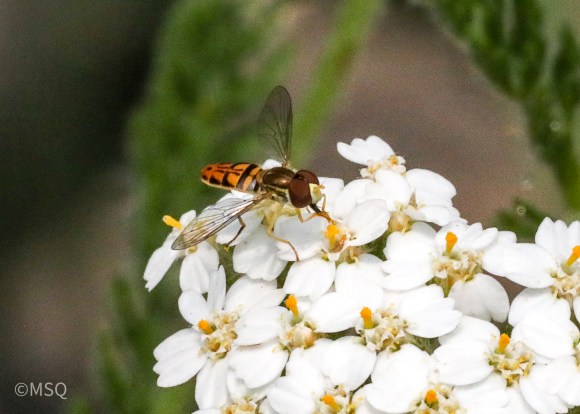
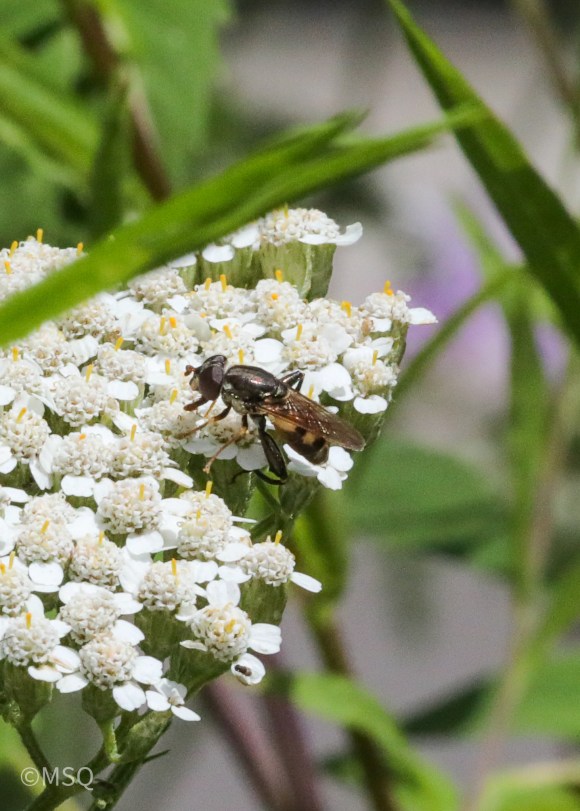
Beneficial insects enjoy Achillea millefolium throughout the blooming season.  Green lace wings, lady beetles, and a variety of flies harvest resources on Yarrow.  The flies include bee flies (Bombyliidae), soldier flies (Stratiomyidae), Syrphid flies,  Tachinid flies, thick-headed flies (Conopidae), flesh flies (Sarcophagidae), blow flies (Calliphoridae), Muscid flies, and Anthomyiid flies.

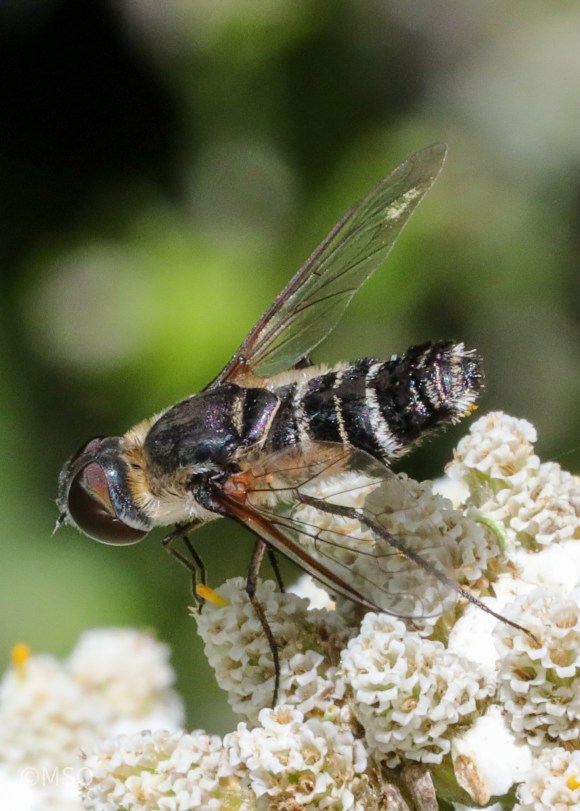
Adult bee flies gather nectar while their larvae act as beneficial insects.  This is Villa lateralis.  Specific studies of V. lateralis are difficult to find.  However, several species of Villa destroy grasshopper eggs in the larva stage.  Others parasitize caterpillars.8

Butterflies and moths use Yarrow as well.  Numerous butterflies nectar at the flowers including blue copper butterflies (Lycaena heteronea heteronea).  Achillea millefolium is a larval host for many moth species. Some eat the leaves while others bore through its stem or feed on the flowerhead.  Papaipema nebris (Stalk borer Moth) is a stem borer.  Flower eaters include Chlorochlamys chloroleucaria (Blackberry Looper Moth), Eupithecia absinthiata (Wormwood Pug), Eupithecia miserulata (Common Pug), Synchlora aerate (Wavy-lined Emerald), Heliothis phloxiphaga (Darker-spotted Straw), and Depressaria alienella (no common name).  Moths and a butterfly that feed on leaves include the American Painted Lady (Vanessa virginiensis), Agrotis volubilis
(Voluble Dart), Cryptocala acadiensis (Catocaline Dart), Lacinipolia olivacea (Olive Arches), Orthodes cynica (Cynical Quaker), Paradiarsia littoralis (Labrador Dart), Pseudorthodes vecors (Small Brown Quaker), Trichordestra legitima (Striped Garden Caterpillar) and Gillmeria pallidactyla (Yarrow Plume Moth).

I hope you enjoyed this journey into Achillea millefolium or Yarrow.  If you don’t have it in your garden, take a look at it in nature.  See who’s visiting those adaptable plants that have traveled so far!

Bye now,

Mary


REFERENCES: