Categories
native plants Pollinator gardening

A Constellation of Blue

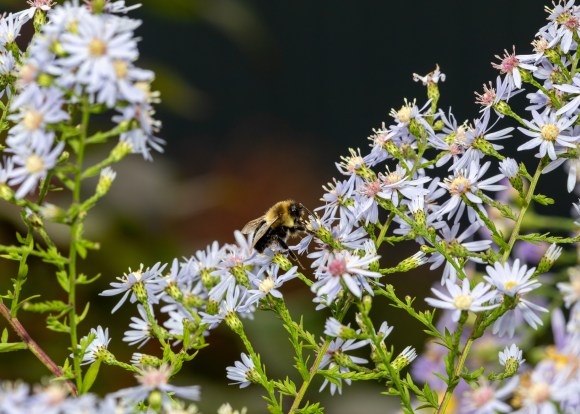
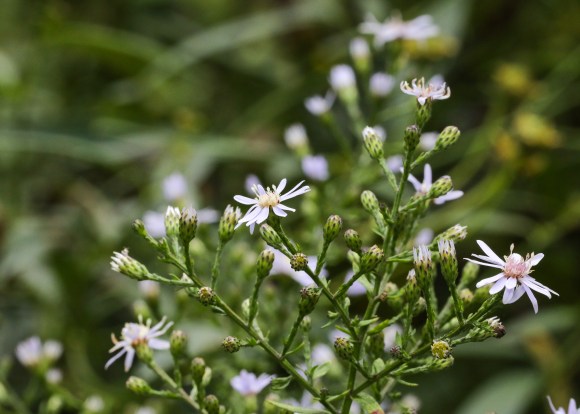
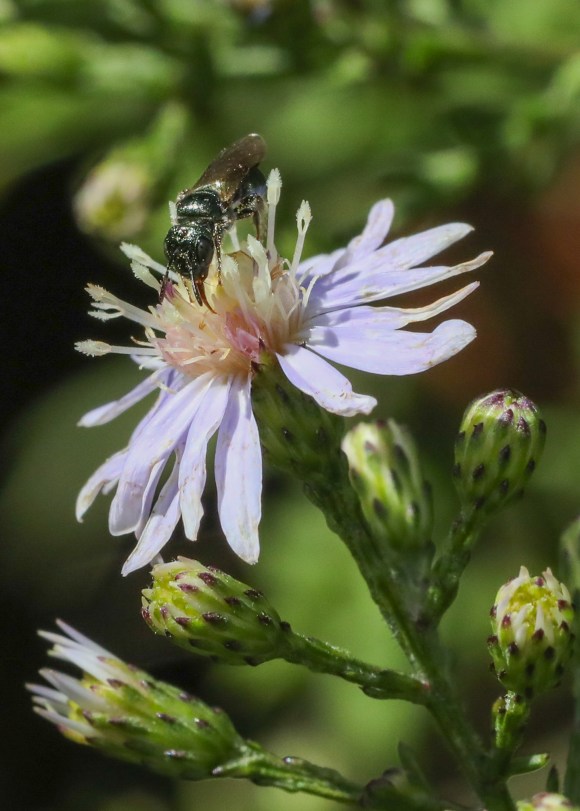
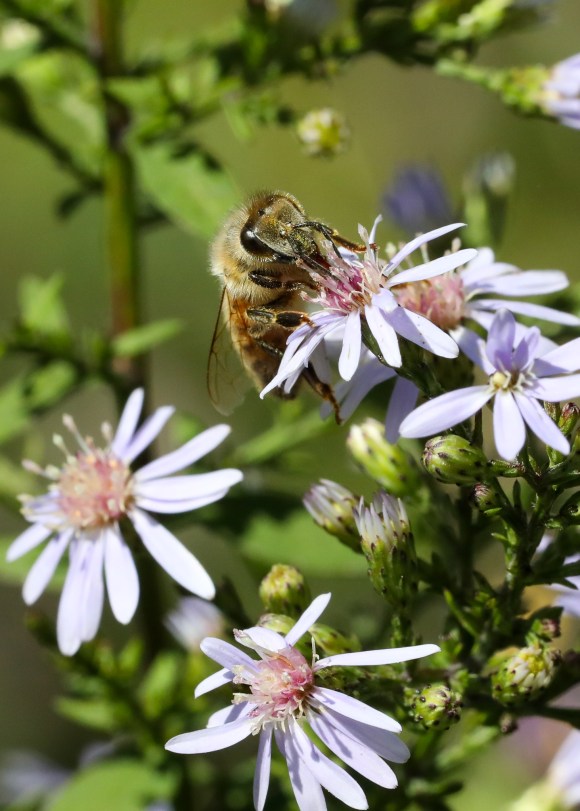
A constellation of pale blue flowers tops each Heart-Leaved Aster (AKA Blue Wood Aster or Symphyotrichum cordifolium).  Like all asters, it offers precious pollen and nectar to pollinators and beneficial insects at summer’s end.  The plant itself is a larval host for butterflies and moths.1

In nature, Heart-Leaved Aster grows in moist to dry deciduous woodlands, woodland borders, next to woodland paths, rocky wooded slopes, upland meadows, thinly wooded bluffs, shaded stream banks, and upland forests.1,5

Highly adaptable, Symphyotrichum cordifolium accepts clay, loam and sandy soils.  It grows from one to three feet tall and spreads from eighteen inches to two feet.  This aster thrives in zones three to eight.  It grows in light shade to part sun and moist to dry conditions.1

The leaves of Symphyotrichum cordifolium are highlighted by its scientific name.  Unlike the thin, lance-shaped leaves of most asters, this plant has broader, heart shaped ones.  Cordifolium  means heart-shaped and (cordi-)  means leaves (folium).  And so, the Heart-Leaved Aster!  

The leaves can reach five inches long and three inches across.  They become smaller moving up the plant. The lower leaves are fully heart-shaped (or cordate).  But the upper leaves become more oval and may be fully ovate.  They are medium green and smooth.1

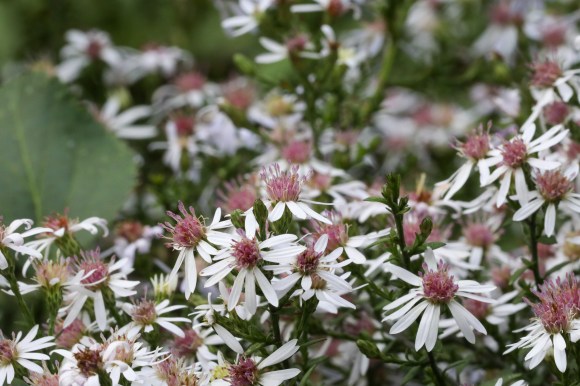
The flowerheads are the highlight of the Heart-Leaved Aster!  Ranging from six inches to eighteen inches long, these conical heads shine with lavender, light-blue violet or white florets.  Each of these half inch florets has seven to fifteen petals (ray florets) and a yellow center of disc florets.1  

Once the disc florets are fertilized, the center turns a mauve pink adding visual interest to the flowerhead.  Floral bracts cover the base of each floret.  The bracts are pale with dark green tips.1

One of the first natives in my garden, I’ve grown this plant for close to 20 years.  I’ve always found is covered with flowers, pollinators and beneficials of all kinds.  That said, it has a few challenges.

It spreads by runners and by self-seeding.  When Heart-Leaved Aster’s happy, it can really colonize a garden.  It is easy to pull, and you can clip the seed heads to prevent self-seeding.1

Poorly drained soil can lead to powdery mildew, leaf spots and rust.  If the weather is too hot and dry, this aster often loses its lower leaves.  I plant it in the middle of the bed.  This location hides leaf loss and helps cover any trouble on the other leaves.4

Finally, like other asters, herbivores love it.  Rabbits, deer, ground hogs, etc., eat it, especially in the Spring.  Use whatever repellents preferred.  I also plant asters among plants animal don’t like, such as, iris.

The free herbivore pruning helps later in season though.  In fact, Symphyotrichum cordifolium benefits from pruning back several times before mid-summer.  This attention helps increases bushiness, controls height and might even eliminate the need to stake it!4

Heart-Leaved Aster draws crowds of pollinators and beneficial insects.  Like all Symphyotrichum, it is a keystone plant.  There are two types of keystone species:  one type acts as hosts for butterfly and moth caterpillars and the other feeds specialist bees.  The bee associated keystone plants also serves generalist bees.  Asters are both.2

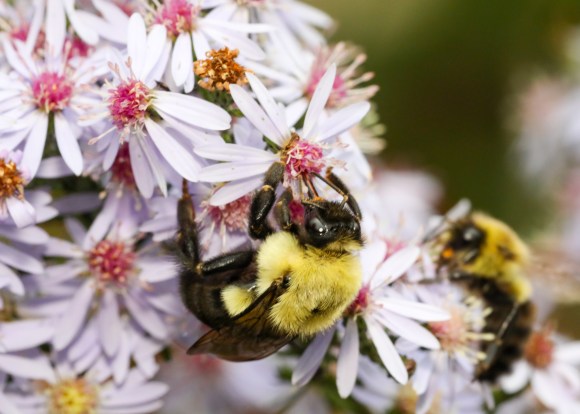
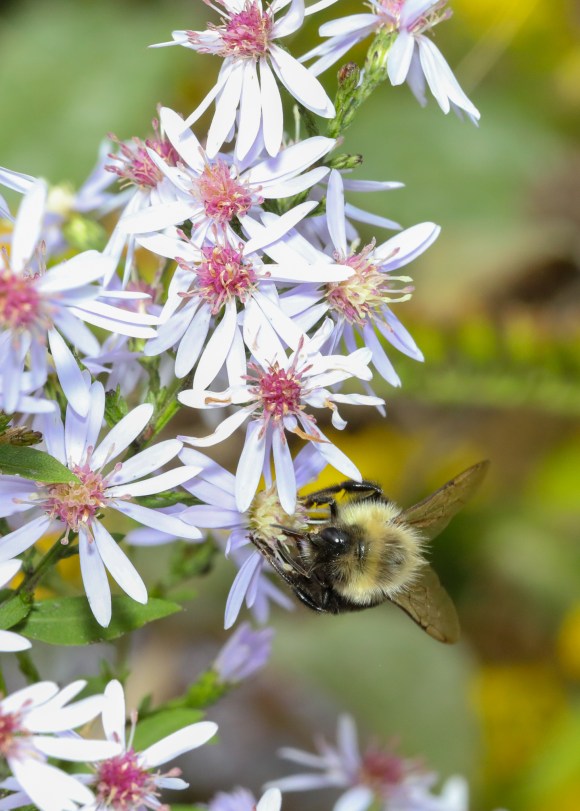
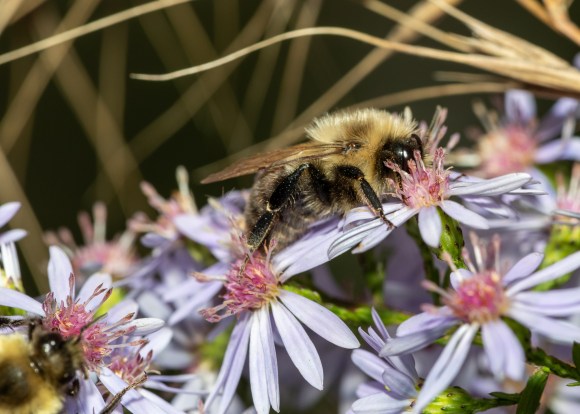
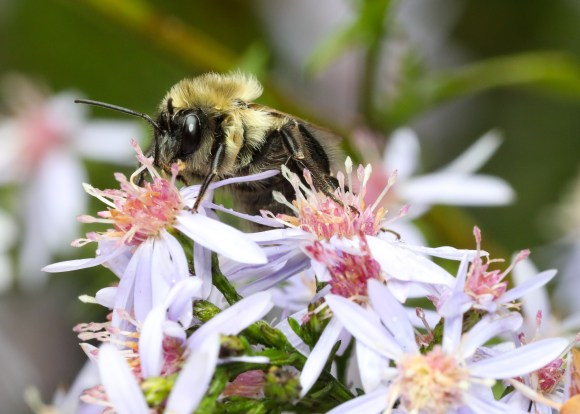
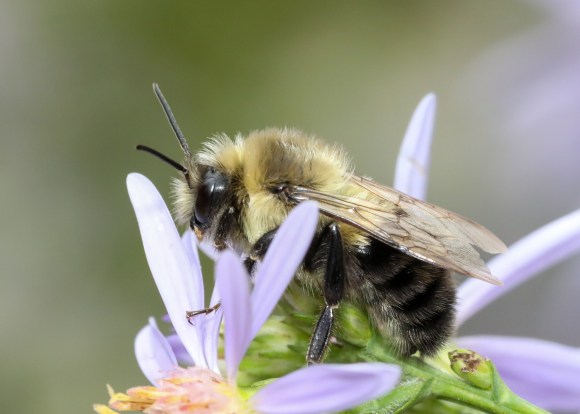
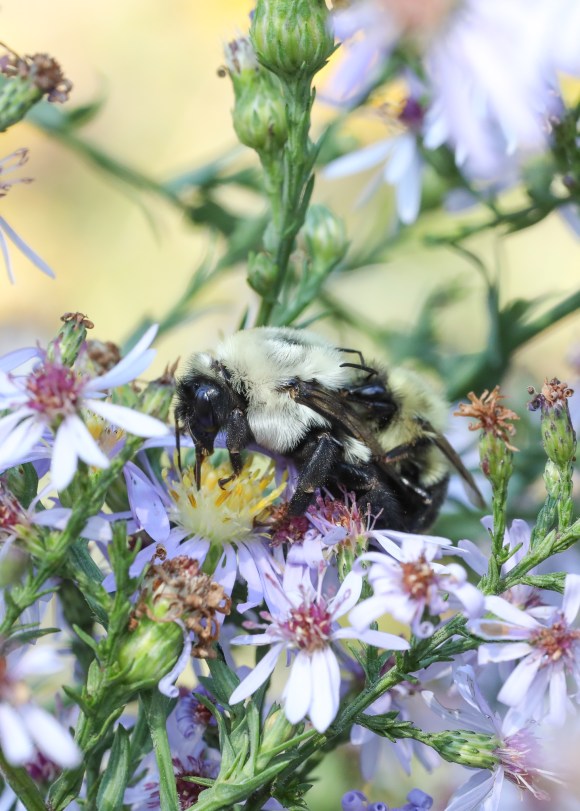
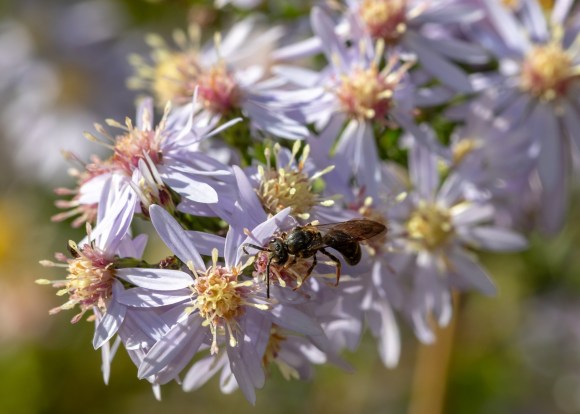
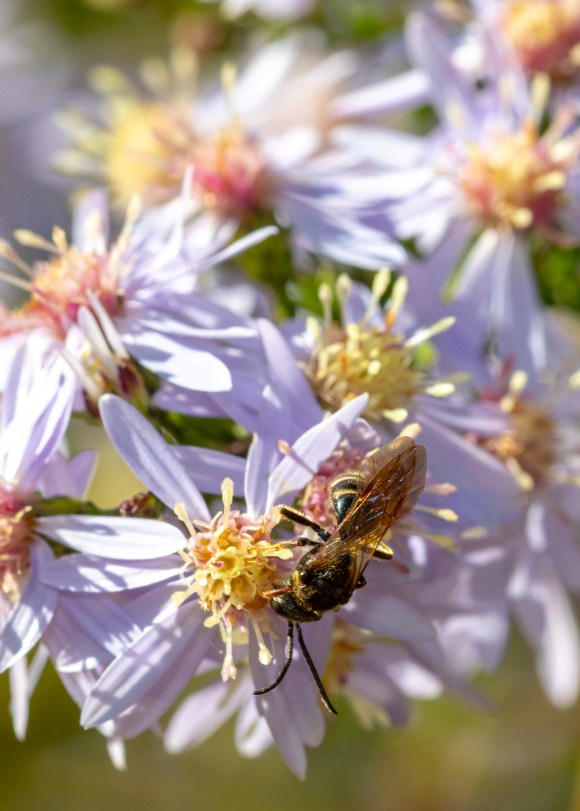
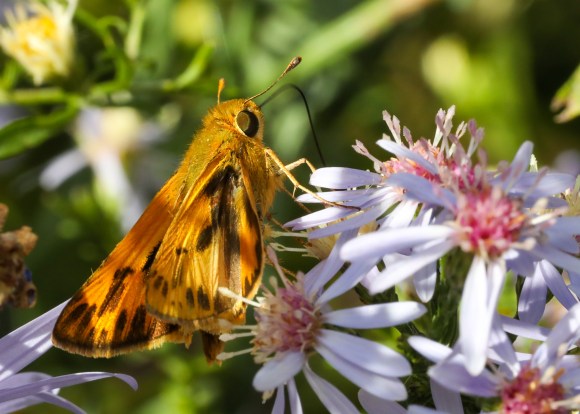
Long-tongued bees, short-tongued bees, butterflies, moths, skippers, wasps and beetles all seek out its nectar and pollen.  The Xerces Society for Invertebrate Conservation designate Symphyotrichum cordifoliumof Special Value to Native Bees and state it Supports Conservation Biological Control.  Bumblebees find it especially helpful.1,6 

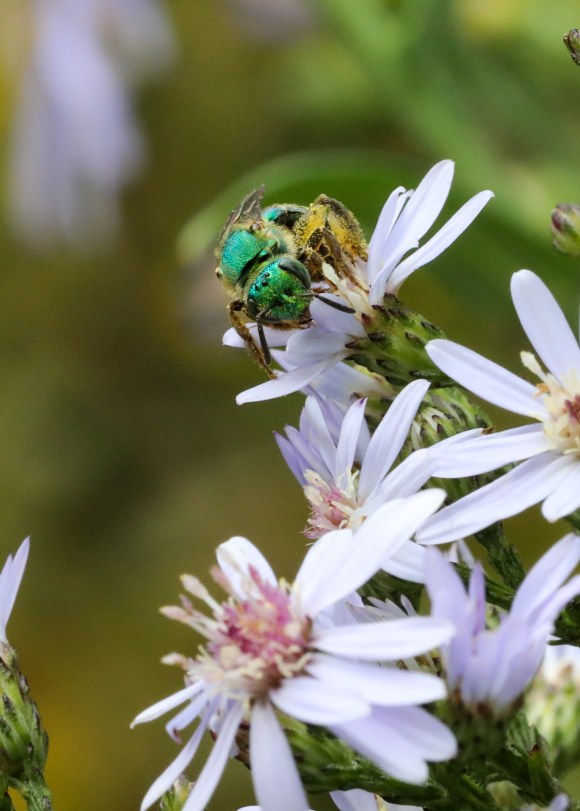
S. cordifolium blooms when new bumblebee queens emerge, males hatch and mating flights occur.  I find males sleeping on the plants on cool late summer and early autumn mornings.  The flowers provide important energy resources for successful mating flights and overwintering queens.

Heart-Leaved Aster support many specialist bees.  As a keystone plant for pollen specialist bees, the Symphyotrichum genus feeds several mining bees in the Andrena genus.   Specifically, these include Andrena (Callandrena s.l.) asteris, Andrena (Callandrena s.l.) asteroides, Andrena (Cnemidandrena)hirticincta, Andrena (Cnemidandrena) nubecula, Andrena (Callandrena s.l.) placata, Andrena (Callandrena s.l.simplex, and Colletes simulans.5

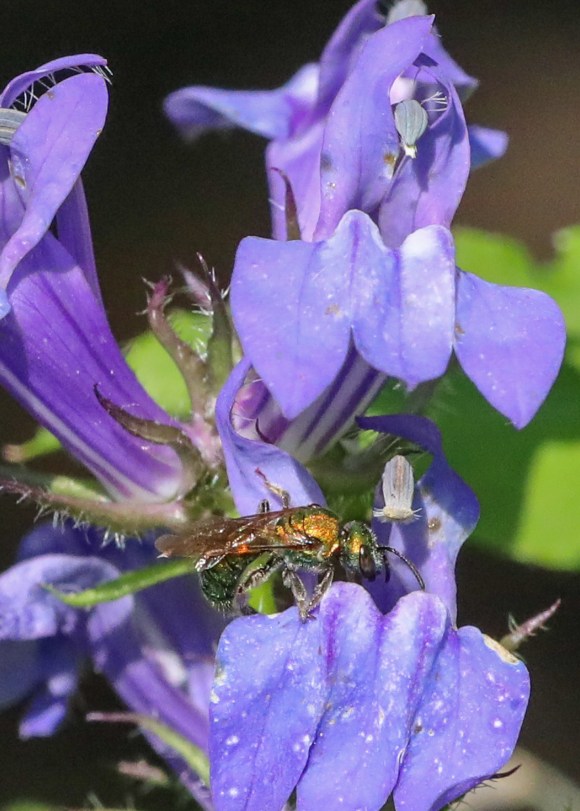
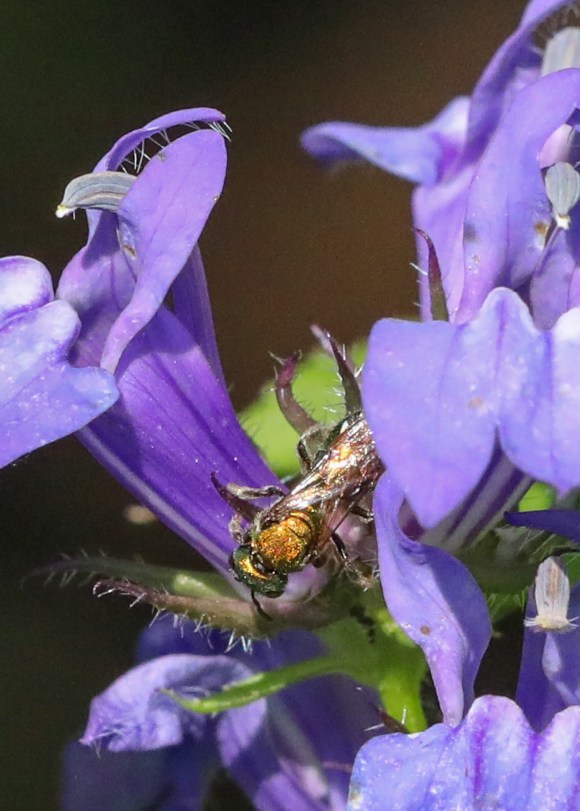
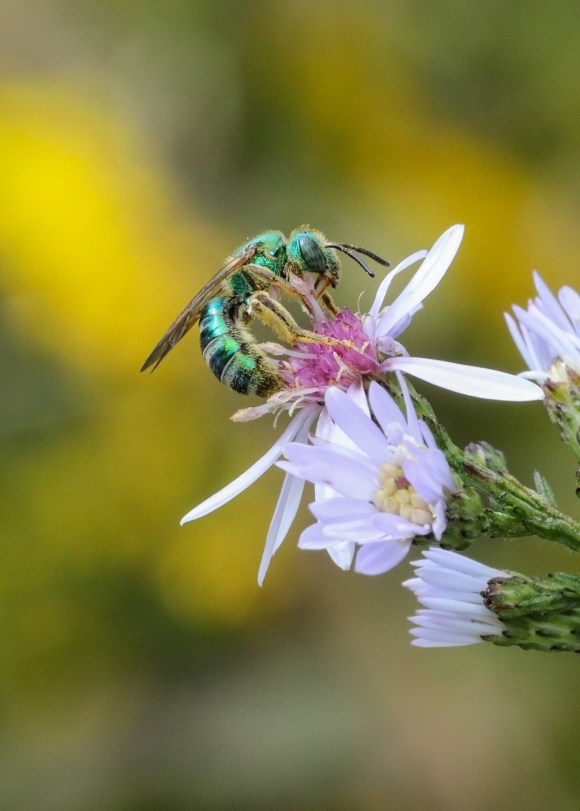
Heart-Leaved Aster is also visited by metallic green sweat bees, Halictus (sweat bees), Ceratina (small carpenter bees) and honeybees (Apis).

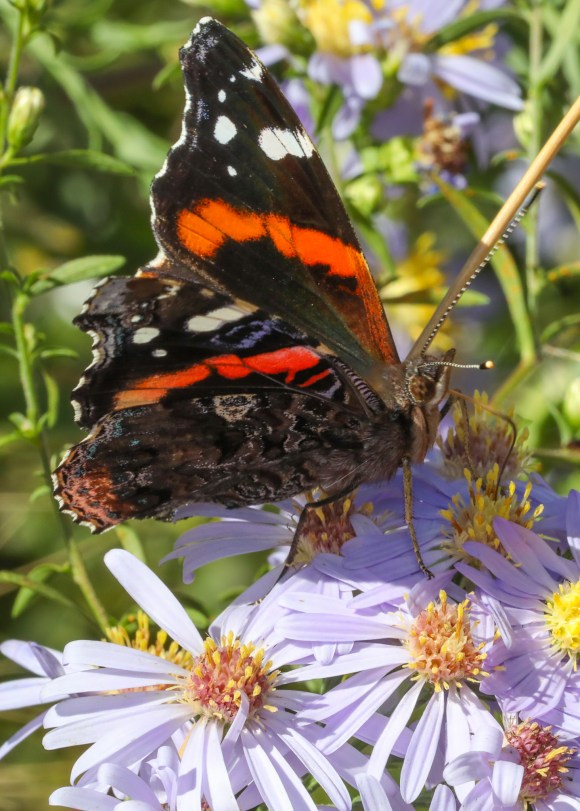
Numerous adult butterflies and skippers nectar at the Heart-Leaved Asters including migrating Monarchs (Danaus plexippus) and Red Admirals (Vanessa atalanta).  In its role as a keystone plant, it feeds many caterpillars from butterflies and, especially, moths.  Different larvae eat every part of the plant.1

By supporting moths, Symphyotrichum cordifolium contributes to pollination of wild plants overall.  Some flowers evolved a plant pollinator relationship with moths.  These flowers usually open at night, are white or pale, and have a stronger fragrance at night.  Moths use scent to find food and mates.  Yucca is a well-known example.7  

However, moths provide much more extensive pollination services.  Like generalist bees, some moths also visit different types of flowers.  Most of these plants aren’t larval hosts.  Some are also pollinated by bees.  When they’re bee pollinated, moths supplement the bee’s work.7

In addition, moths are more efficient than bees in some cases.  In the past, studies only measured pollen on mouthparts.  But moths carry a lot of pollen on their hairy underbelly.  When they land on a flower, their belly presses against the stigma to transfer pollen.7,8

Moths usually fly over longer distances than bees.  Bees tend to stay near their nest when possible.  Moths add genetic diversity by bringing pollen from distant plant populations.7

A variety of moth and butterfly caterpillars use Symphyotrichum cordifolium.  Different larvae eat flowers, seeds, and leaves while others bore through stems and/or roots.  I’ve detailed some different species and which plant parts they eat in the next few paragraphs.3

Chlosyne nycteis (Silvery Checkerspot butterflies) and Phyciodes tharos (Pearl Crescent butterflies) consume foliage.  Some moths also devour the leaves, such as, Pale-Banded Dart (Agnorisma badinodis(syn. Xestia badinodis)), Sharp-Stigma Looper Moth (Ctenoplusia oxygramma (syn. Agrapha oxygramma)), Halloween Paint (Cucullia alfarata), Rusted Paint (Cucullia postera), Confused Eusarca (Eupithecia confusaria), Lost Sallow (Euplexia devia), Green Leuconycta (Leuconycta diphteroides), Small Brown Quaker (Pseudorthodes vecors) and Dimorphic Gray (Tornos scolopacinarius).3

Leaf miners include Gracillarlid Moth sp. (Acrocercops astericola), Tischeriid Moth sp. (Astrotischeria astericolaI), Scythridid Moth sp. (Landryia impositellaI) and Bucculatricid Moth sp. (Bucculatrix staintonella).3

Some feed on developing seeds and/or flowers including Blackberry Looper (Chlorochlamys chloroleucaria), White-Dotted Groundling (Condica videns (syn. Platysenta videns)), Common Pug (Eupithecia miserulata), Spotted Straw (HeIliothis turbatus), Tortricid Moth sp. (Phaneta parmatana), Tortricid Moth sp. (Phaneta tomonana), Common Tan Wave (Pleuroprucha insulsaria), Arcigera Flower Moth (Schinia arcigera), Goldenrod Flower Moth (Schinia nundina), Northern Flower Moth (Schinia septentrionalis), Wavy-Lined Emerald (Synchlora aerate) and Striped Garden Caterpillar (Trichordestra legitima).  Some moths consume foliage in addition to developing seeds and/or flowers.  These include Black Arches (Melanchra assimilis) and Dark-Spotted Palthis (Palthis angulalis).3

And finally, moth larva that bore through stems and/or roots are  Aster Borer Moth (Carmenta corn) , Tortricid Moth sp. (Eucosma robinsonana), Burdock Borer Moth (Papaipema cataphracta), Aster Borer Moth (Papaipema impecuniosa), Tortricid Moth sp. (Phaneta essexana) and Tortricid Moth sp. (Sonia canadana).3 

I hope you enjoyed this look at the Heart-Leaved Aster as much as I have.  I’d love to hear about your plant adventures in the garden or the wild!  Please feel free to contact me with a story, comment or question!

Happy Gardening,

Mary

Bibliography:

  1. “Blue Wood Aster (Symphyotrichum Cordifolium).” Accessed December 1, 2024. https://www.illinoiswildflowers.info/woodland/plants/bl_woodaster.htm. Accessed December 1, 2024.
  2. “Keystone Native Plants:  Eastern Temperate Forests-Ecoregion 8.” https://www.nwf.org/-/media/Documents/PDFs/Garden-for-Wildlife/Keystone-Plants/NWF-GFW-keystone-plant-list-ecoregion-8-eastern-temperate-forests.ashx?la=en&hash=1E180E2E5F2B06EB9ADF28882353B3BC7B3B247D
  3. “Moth Table (Symphyotrichum Spp.).” Accessed December 1, 2024. https://www.illinoiswildflowers.info/woodland/tables/table29.html.
  4. “Symphyotrichum Cordifolium – Plant Finder.” Accessed December 1, 2024. https://www.missouribotanicalgarden.org/PlantFinder/PlantFinderDetails.aspx?kempercode=a788.
  5. “Symphyotrichum Cordifolium (Blue Wood Aster, Common Blue Wood Aster, Heart-Leaved Aster) | North Carolina Extension Gardener Plant Toolbox.” Accessed December 1, 2024. https://plants.ces.ncsu.edu/plants/symphyotrichum-cordifolium/.
  6. “Symphyotrichum Cordifolium (Broad-Leaved Aster) | Native Plants of North America.” Accessed December 1, 2024. https://www.wildflower.org/plants/result.php?id_plant=syco4.
  7. Xerces Society. “The Night Shift: Moths as Nocturnal Pollinators.” Accessed December 1, 2024. https://xerces.org/blog/the-night-shift-moths-as-nocturnal-pollinators.
  8. “Moths are more efficient pollinators than bees, shows new research.”  Accessed December 1, 2024. Ellis, Lauren, https://www.sussex.ac.uk/broadcast/read/60568.
Categories
native plants Pollinator gardening

A Fabulous, Fuzzy Flower

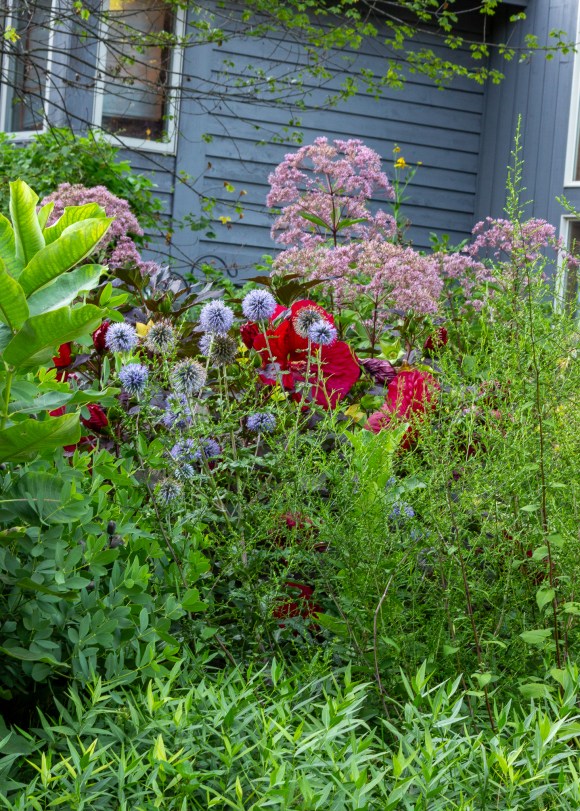
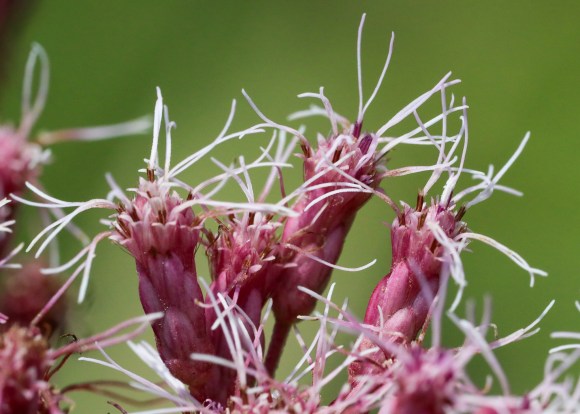
Big, bold and filled with butterflies, Sweet Joe-Pye Weed (Eutrochium purpureum) stands out in any garden.  Large mauve-purple flowers feed masses of pollinators.  Not only do butterflies, moths and skippers nectar at the blooms but various caterpillars feed on it.10

Eutrochium purpureum grow in zones four to nine.  It usually ranges from three to seven feet tall.  In a drier location, it can flower at only one foot high and, in an ideal spot, can reach eight to ten feet.2,3,10  

It prefers partial shade to full sun and moist to medium, even moisture conditions.  Rich, loamy soil is ideal.  Eutrochium purpureum spreads by seeds and runners.  

In nature, it’s found in open woodlands, partially shaded seeps, savannas, partially shaded riverbanks and streambanks, thickets, in open woodlands, wet meadows, wooded slopes and low moist ground.2,3,8,10

Given these natural habitats, Sweet Joe-Pye weed easily adapts to wildflower gardens, naturalized landscapes and perennial borders.  Its moisture tolerance means  Eutrochium purpureum enjoys the edges of rain or water gardens.  Recently, Sweet Joe-Pye Weed began self-seeding near my rain gardens.  Finally, it suits both formal and informal settings.

Sweet Joe-Pye Weed will react to less-than-ideal conditions.  In full shade, it becomes leggy and may  fall over.  If it dries out, its leaves turn yellowish green.  

In my garden, it grows tallest in a rainy year.  In partial shade, the plants thrive even without extra water.  In full sun, the plants are more likely to need staking possibly from too little water. 1,2,3,10    

If a shorter plant is preferred, Sweet Joe-Pye Weed can be cut back to approximately two feet in late spring or early summer.  These plants usually bloom around the same time as those that haven’t been cut.  The flowers are a generally a little smaller than usual.1

Don’t give up on this one in the Spring!  It tends to sleep late and the stems develop randomly.  But it has been a very reliable grower in my garden—returning with full and abundant growth each year.

Chicago Botanic Garden grew a variety of Eutrochium spp. and related plants in an evaluative study between 2001 and 2013.  They trialed each genus between four and six years.  Eutrochium purpureum performed well each year with flowers up to twelve inches across.  It suffered from powdery mildew one year but not in others.1

Sweet Joe-Pye Weed has a straight, unbranched, light green stem giving the plant an outstanding erect habit.  The leaf nodes are enlarged and naturally purple.  Some plants have more purple on the stem than others. 2,3,10    

Shallow, fibrous roots support the plant.  Sweet Joe-Pye weed spreads as a clump as well as self-seeding.  If it grows in an unwanted place, the plants are easy to pull.

Eutrochium purpureum’s leaves form an attractive whorl around its stem.  Growing in groups of three to five, the medium green, the matte leaves are ovate to lanceolate with lightly serrated edges.  The lower surface is pale green and may be slightly hairy.  Some ecotypes have vanilla-scented foliage.10

In mid-summer to early fall, Sweet Joe-Pye Weed’s magnificent flowers grace the garden.  The main bloom sits  at the top of the stem.  On established plants, side blossoms form below this head adding to the show. 

Each compound head can measure up to 12 to 18 inches across and are made up of one or more panicles.  In my Southern Michigan garden,  Eutrochium purpureum’s flowerheads range from five inches to twelve inches across.  They are most often between five and eight inches.

Blooms range from whitish pink to purplish pink.  I find the more sun, the deeper the flower color.  Plants growing in deep shade have almost white flowers.  Flowers carry a vanilla scent.

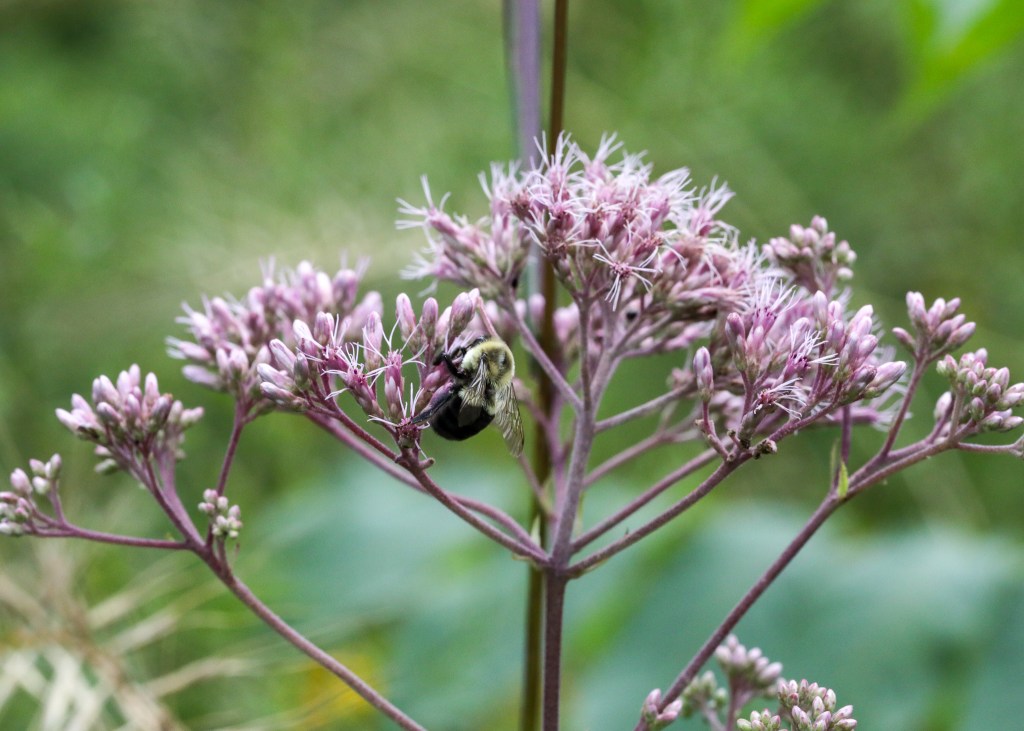
These superb blooms have five to eight disk florets per panicle and no ray florets.  The overall flowerhead is slightly dome shaped. Each floret has a series of overlapping pink, oblong bracts.  As they open, a divided white style is strongly exerted (extended past the floret) giving the bloom a fuzzy look. 2,3,8,10  

Numerous pollinators forage on the compound flowerheads of Sweet Joe-Pye Weed.  Most seek out nectar.  Eutrochium purpureum secretes its nectar at the base of the style.  Each tiny, blooming floret offers a supply.2,3,8,10  

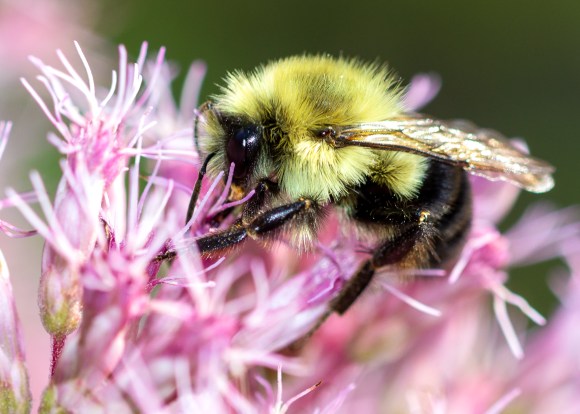
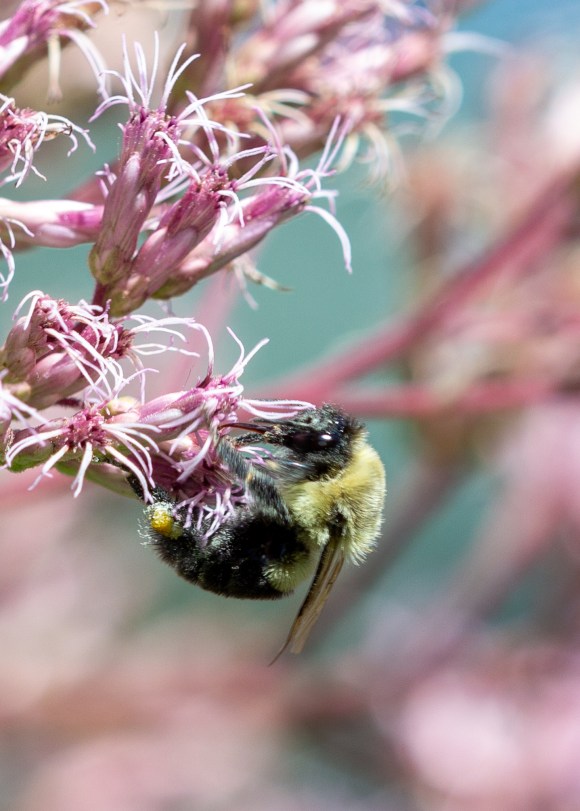
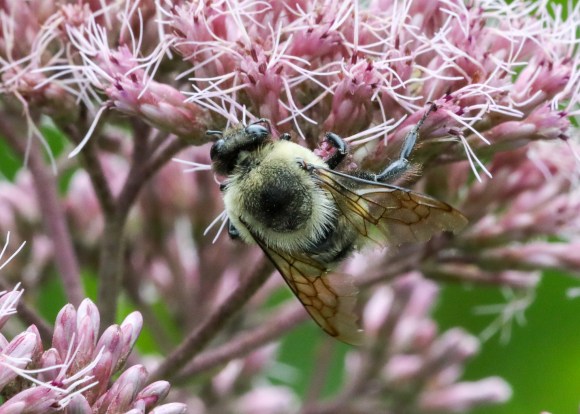
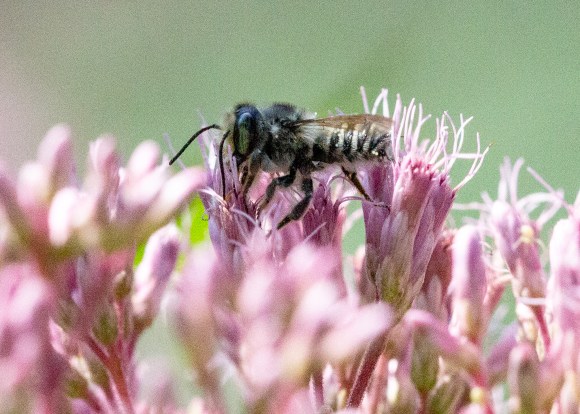
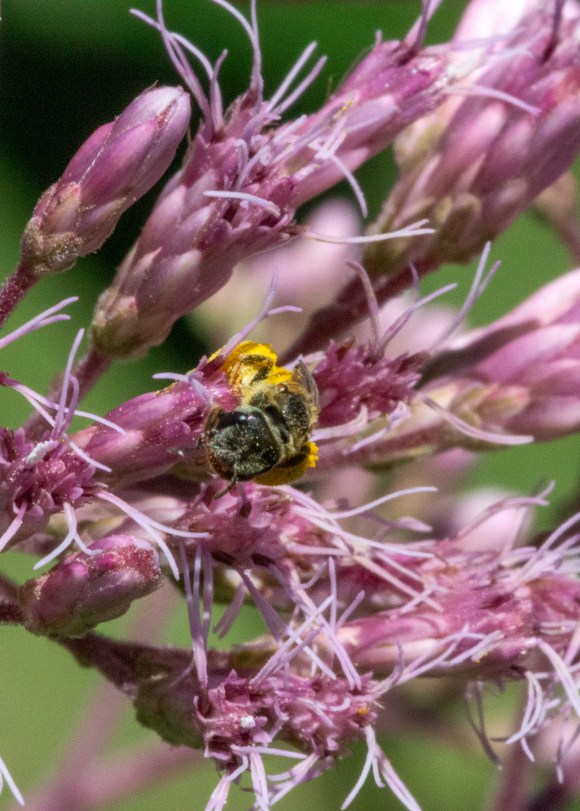
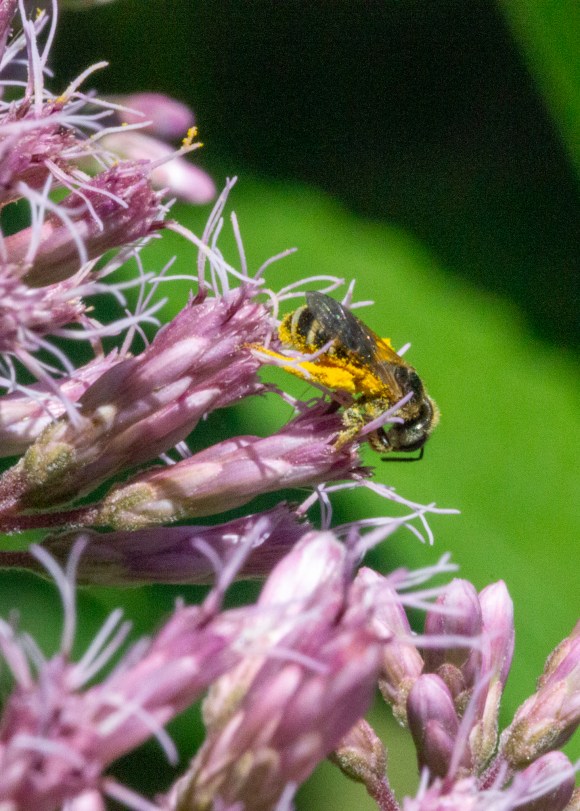
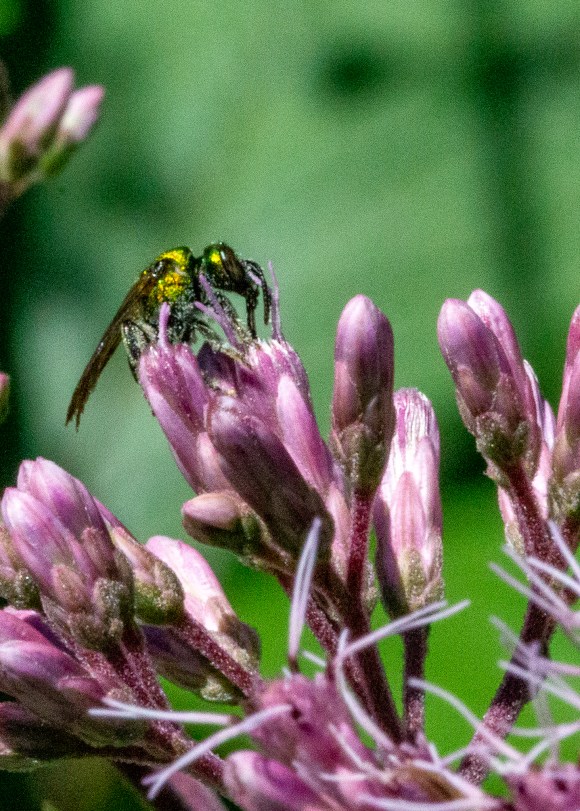
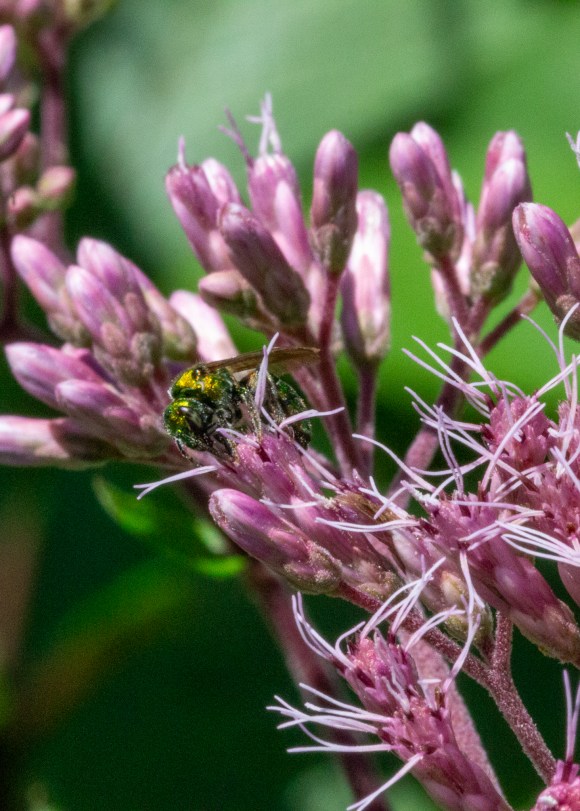
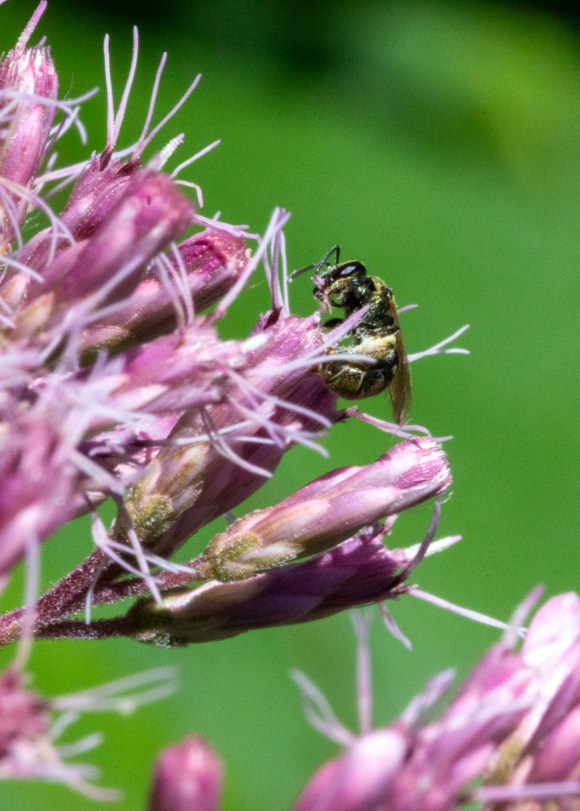
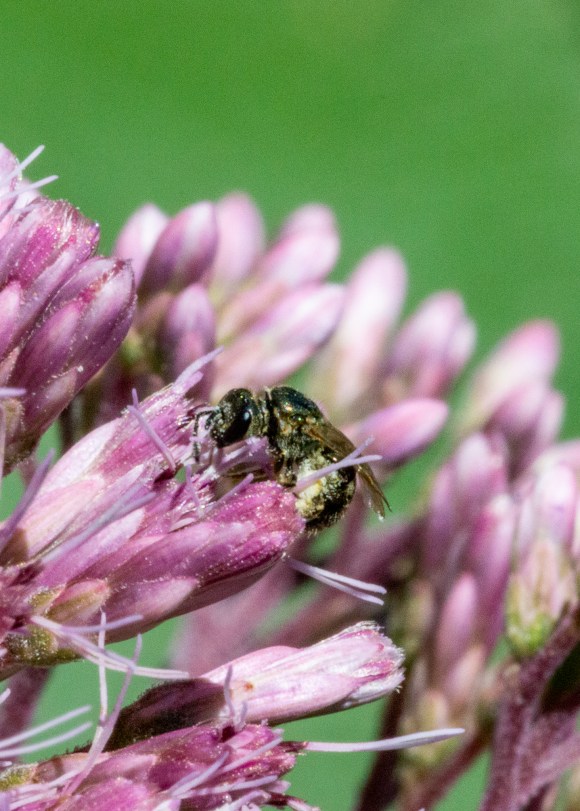
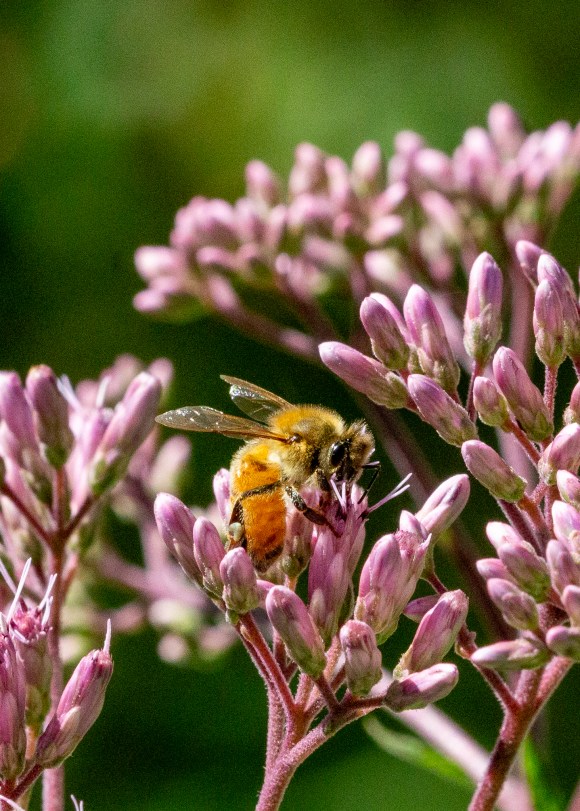
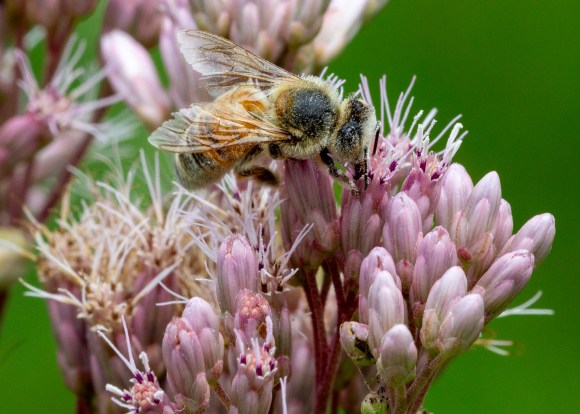
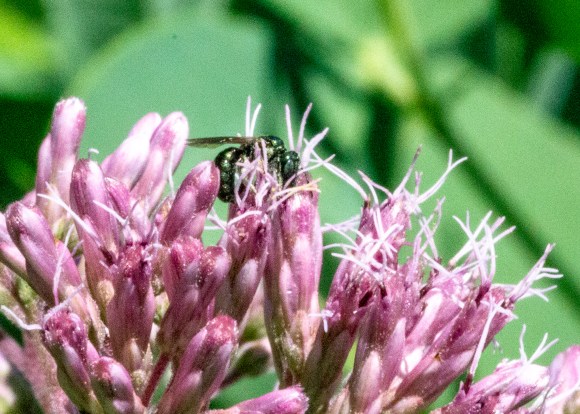
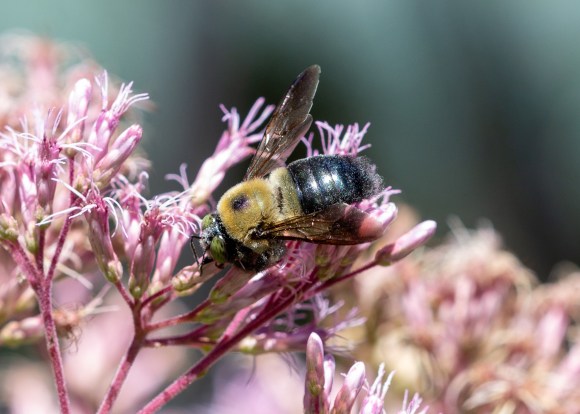
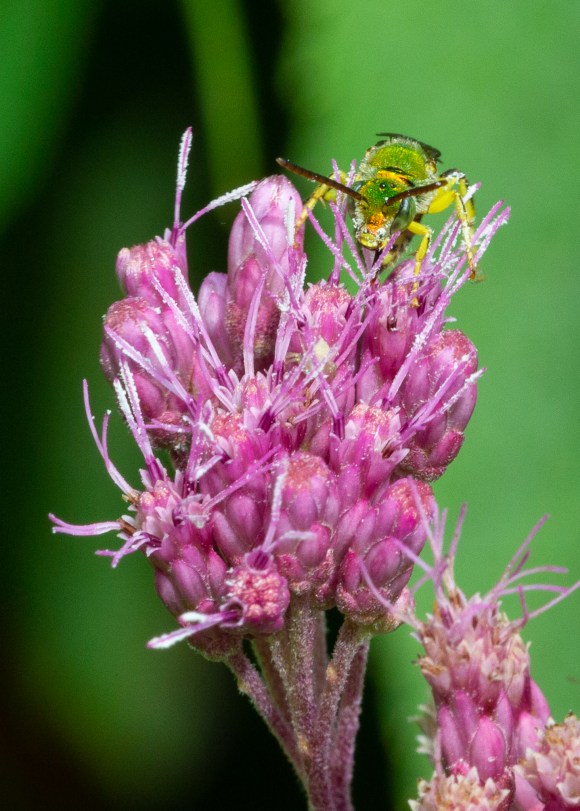
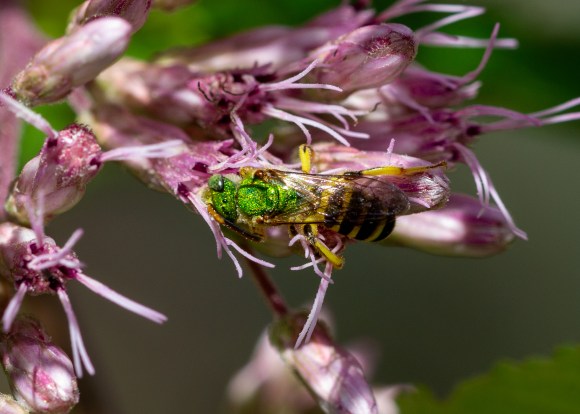
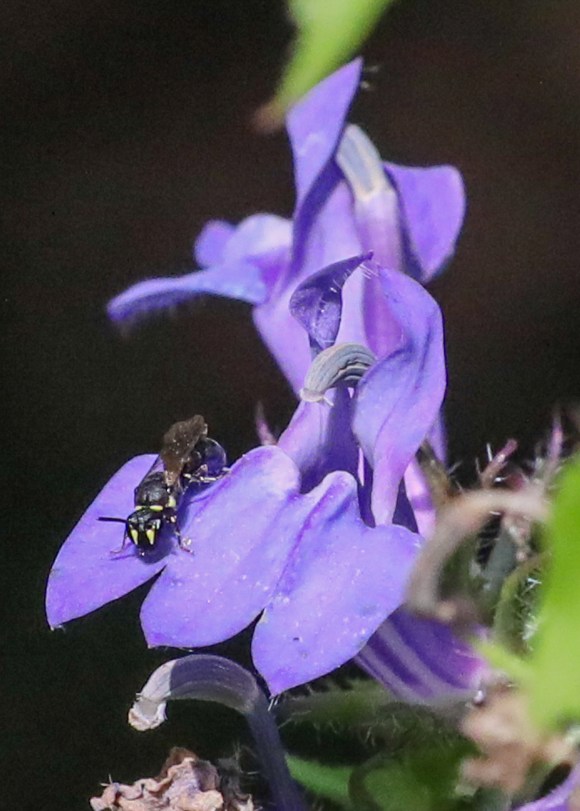
The Xerces Society for Invertebrate Conservation declared Eutrochium purpureum of Special Value to Native Bees.2  Visiting bees include Bombus spp. (bumblebees), Melissodes spp. (miner bees), Coelioxys (cuckoo bees), Agapostemon (metallic green sweat bees) and Megachile spp. (leaf-cutting bees).    In my garden, I’ve also seen other sweat bees like Halictus spp., honey bees (Apis app.) and large and small carpenter bees, Xylocopa spp. and Ceratina spp.

Most of these bees collect nectar.  But Bombus spp. (bumblebees) and Melissodes spp. (miner bees) also gather pollen.8,10

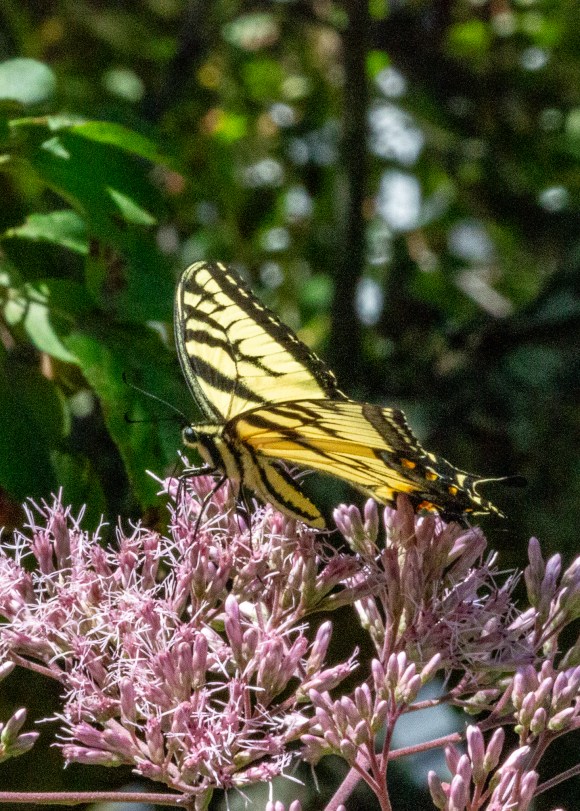
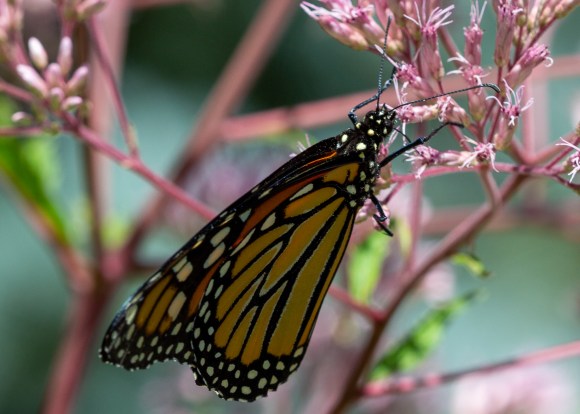
Butterflies, moth, and skippers seek out Sweet Joe-Pye Weed in the mid-summer to early fall.  Celastrina(Azure Butterflies), Epargyreus clarus (Silver Spotted Skipper), Limenitis arthemis arthemis (White Admiral Butterflies), Nymphalis urticae (Milbert’s Tortoiseshell Butterflies), Papilio glaucus (Eastern Tiger Swallowtail Butterflies), and Danaus plexippus (Monarch Butterflies) sip the nectar from the fluffy, pink flowerheads.

Eutrochium purpureum is also a larval host supporting several moth caterpillars.  These eat its leaves and other parts.  Emmelina monodactyla (Common Plume Moth), Perigea xanthioides (Red Groundling), Phragmatobia fuliginosa (Ruby Tiger Moth), and Eupithecia miserulata (Common Pug) all feed on Sweet Joe-Pye Weed’s leaves. Carmenta bassiformis (Eupatorium Borer Moth) consumes the roots.  Schinia trifasciata (Three-Lined Flower Moth) relies on its flowers. 4,5,6,8,9,10

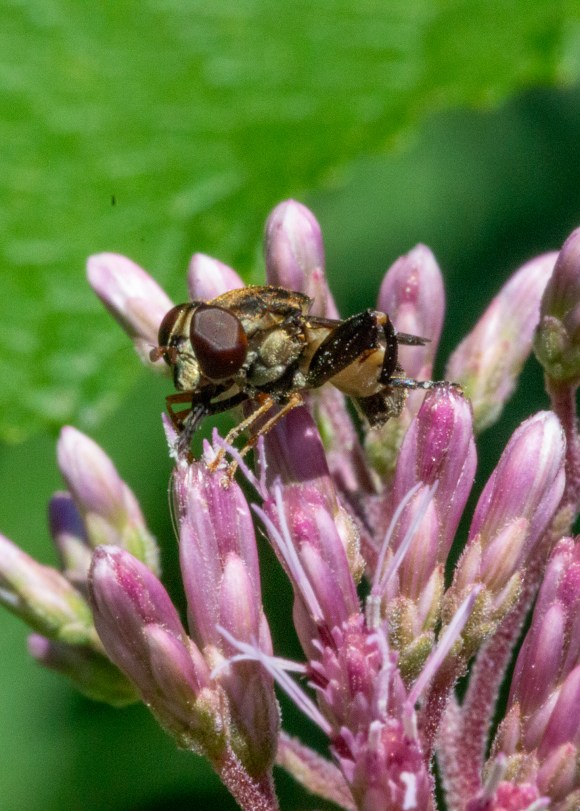
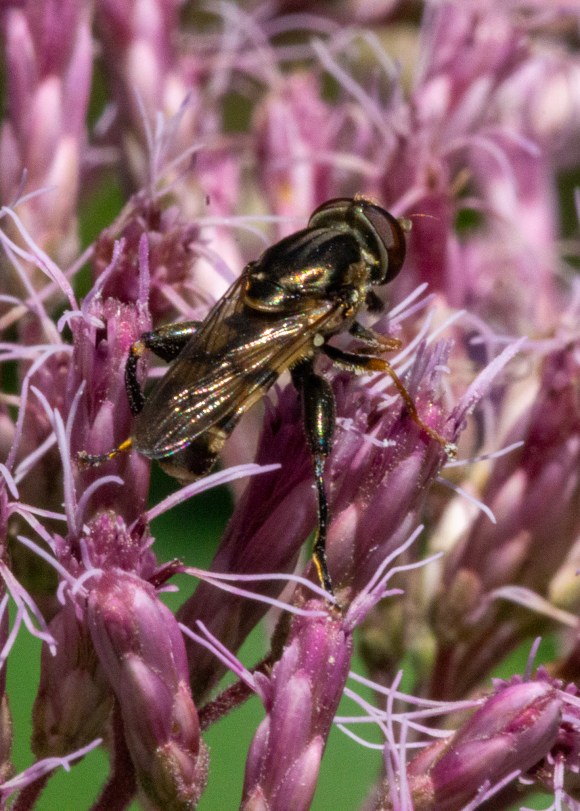
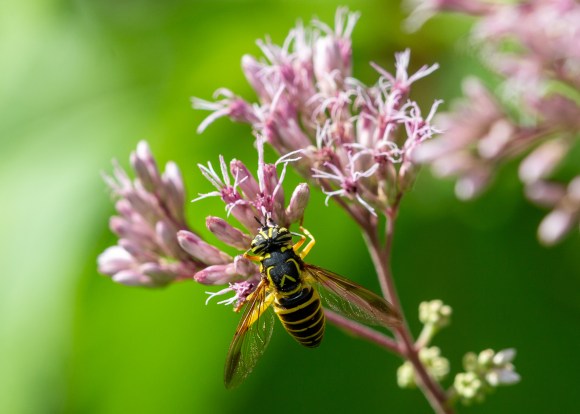
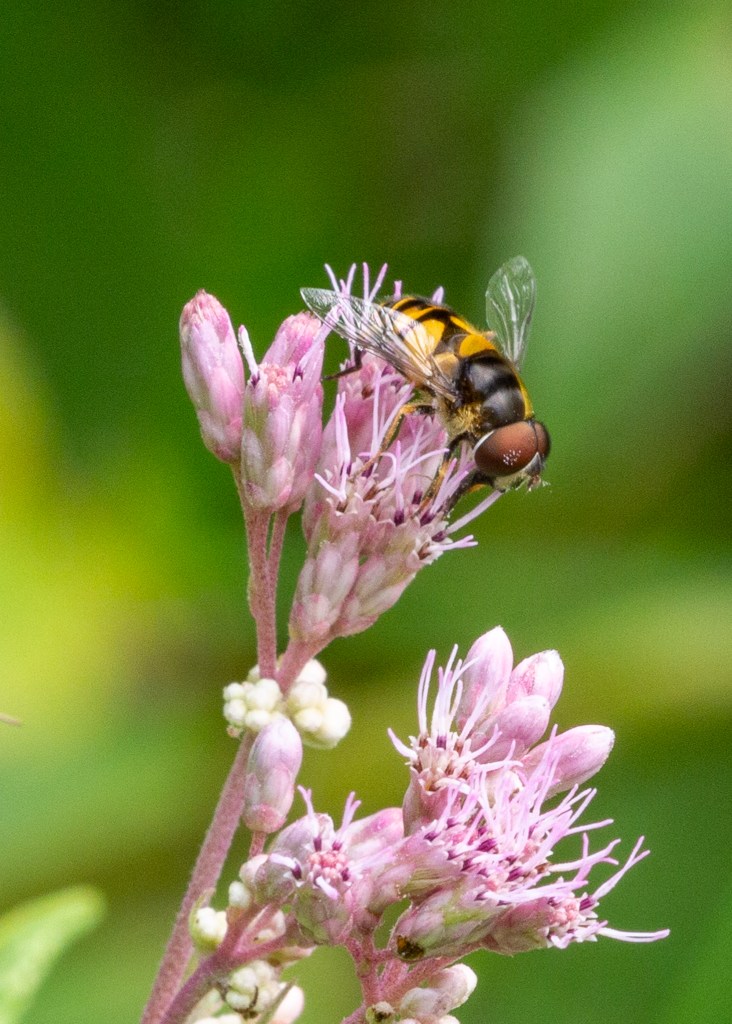
Beneficial insects are not particularly attracted to Eutrochium purpureum.  Flies, thread-waisted and sand wasps occasionally visit. Instead, these short-tongued beneficials flock to another Eutrochium—the white blooming Boneset (Eupatorium perfoliatum).8 But that’s the subject for another blog!

I hope you’ve enjoyed hearing about Sweet Joe-Pye weed—a stunning, versatile and useful plant.  Eutrochium purpureum is easily available at most native plant nurseries.  Next year those big, fuzzy flowers could be blooming in your garden!

If you’ve enjoyed this blog and would like to leave a comment or share a story, please contact me in the box below!

Warm Regards,

Mary

References:

  1. Hawke, Richard. “A Comparative Study of Joe-Pye Weeds (Eutrochium Spp.) and Their Relatives,” n.d.
  2. “Eutrochium Purpureum (Gravel Weed, Indian Sage, Joe-Pye Weed, Marsh Milkweed, Motherwort, Pride of the Meadow, Purple Joe-Pye Weed, Sweet Joepyeweed) | North Carolina Extension Gardener Plant Toolbox.” Accessed October 20, 2024. https://plants.ces.ncsu.edu/plants/eutrochium-purpureum/.
  3. “Eutrochium Purpureum (Purple Joepyeweed) | Native Plants of North America.” Accessed October 20, 2024. https://www.wildflower.org/plants/result.php?id_plant=eupu21.
  4. “Minnesota Seasons – Common Eupithecia.” Accessed October 30, 2024. http://www.minnesotaseasons.com/Insects/common_eupithecia.html.
  5. Missouri Department of Conservation. “Plume Moths.” Accessed October 30, 2024. https://mdc.mo.gov/discover-nature/field-guide/plume-moths.
  6. Missouri Department of Conservation. “Three-Lined Flower Moth.” Accessed October 30, 2024. https://mdc.mo.gov/discover-nature/field-guide/three-lined-flower-moth.
  7. Perigea Xanthioides.” In Wikipedia, January 8, 2023. https://en.wikipedia.org/w/index.php?title=Perigea_xanthioides&oldid=1132346411
  8. Holm, Heather. Pollinators of Native Plants:  Attract, Observe and Identify Pollinators and Beneficial Insects with Native Plants. Minnesota: Pollination Press LLC, 2014.
  9. “Species Phragmatobia Fuliginosa – Ruby Tiger Moth – Hodges#8156.” Accessed October 30, 2024. https://bugguide.net/node/view/41933.
  10. “Sweet Joe-Pye Weed (Eutrochium Purpureum).” Accessed October 20, 2024. https://www.illinoiswildflowers.info/savanna/plants/sw_joepye.htm.
Categories
Pollinator gardening

A Froth of White

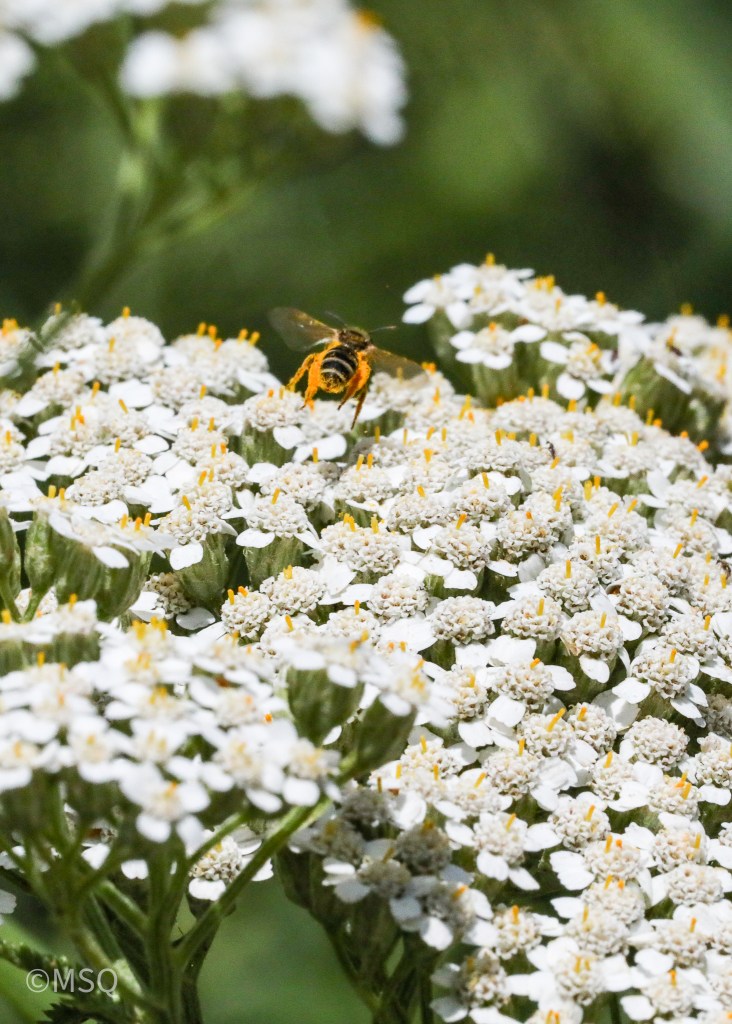
In late Spring, the parasol blooms of Yarrow (Achillea millefolium) open.  The intricate creamy-white flowerheads draw every type of pollinator offering nectar and pollen to active insects.  An assortment of caterpillars nibble on its stem, leaves, and flowers.

While yarrow grows in a range of habitats, it prefers full or part sun and medium to dry soils.  It’s not picky about soil type if the soils are well drained.  Yarrow likes disturbed areas.  In nature, soil disturbances happens where water rises or falls (for example, lakes and rivers) and where large animals gather (such as, at a watering hole).  Humans, of course, add to land disturbance.  Habitats with yarrow include medium to dry prairies, pastures, unused fields, grassy waste areas, and edges of paths, yards, or hedges.1,2

Like so many native plants, yarrow reseeds freely when happy.  You can limit this by cutting off seedheads and weeding out seedlings.  Its seedlings are distinctive with their delicate, lacy foliage. Beware the rhizomes.  Yarrow can form large colonies from spreading rhizomes.  Root prune a clump with a sharp shovel or pull the shoots to keep it in check.

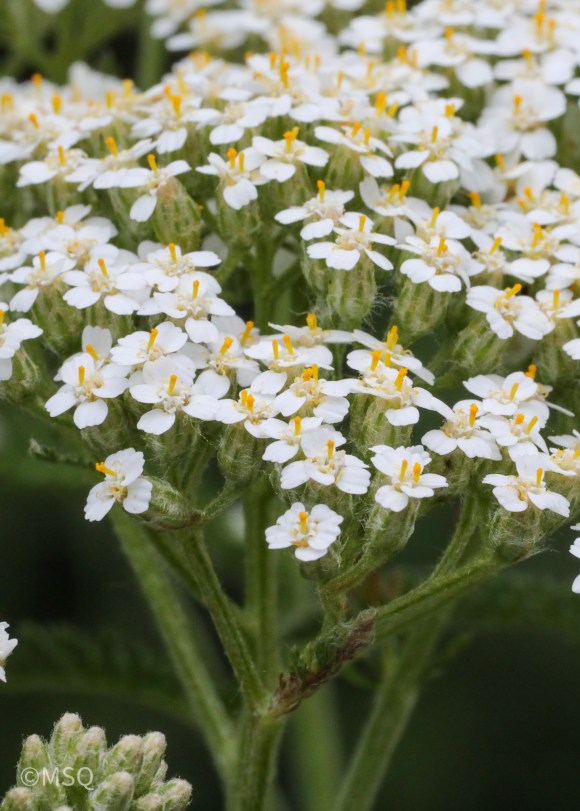
Achillea millefolium is all about multiples with compound flowers and doubly divided leaves.  The elaborate, ruffled “flowerheads” are held on single stems.  What looks a flowerhead is really a group of smaller flower heads called pedicels.  These pedicels together form a compound corymb and that’s what we see as a flower.  Yarrow’s corymbs can have 150 to 200+ individual florets! (Arkansas native plant society)  Each floret is about of a quarter inch across and has ray and disk parts.  It has three to eight ray florets around the edge and six to forty disk florets in the center.  Florets begin opening in May and can last as late as August.1,2,3.4.5

Yarrow’s foliage adds a fine, lacy note to the garden.  It ranges from pale to medium green.  The leaves are approximately six inches long and one inch wide becoming smaller toward the top of the stem.  Their overall outline is elliptical but each pointed leaf is divided and subdivided.  Leaflets and sub-leaflets curve and turn in different directions creating a soft and delicate appearance.  The sessile (leaves touch the stem) or almost sessile leaves grow in a spiral along the stem.  They can have fine hairs or be smooth.

Achillea millefolium is listed as native and introduced in most of the United States.4  It’s also called a species complex not a species.  But what does that mean?  Let’s talk about why this yarrow is so diverse and, briefly, what is says about the classification system.  If that doesn’t interest you, please skip down to the section labeled POLLINATORS.

Part of Yarrow’s story stems from a long history of human use going back thousands of years.  Yarrow’s been found in Neanderthal burial sites dating back as far as 65,000 years.  Although it probably originated in Asia, peoples in Europe, the Americas and Asia have used it for millennia.  Like any useful plant, it was transported and planted wherever people went.  So now we have Yarrow in Asia, throughout Europe, throughout the Americas, as well as on distant islands like Greenland, Patagonia, New Zealand, and Hawaii.

To make matters more difficult, Achillea millefolium is complicated genetically.  It adapts expertly to different environments and so changes its genes.  Yarrow is also one of many plants that can increase its number of genes.  For instances, humans have two sets of genes or are diploid.  Yarrow can double that-tetraploid and sometimes add one more set-hexaploid and again-octoploid.  All those variations can successfully breed together producing more Achillea millefolium.  (Animals with different polyploidy can’t usually breed together.)  All this genetic diversity doesn’t change the appearance very much—some are taller or shorter or have more petals (ray flower) or less.  It does matter to the insects that use Yarrow either.

The species complex designation allows for one species with a lot of diversity in morphology (physical characteristics) and genetics.  It acknowledges that those differences aren’t enough to indicate separate species.  

So, what does this have to do with native plants and pollinators?  Only that, things are sometime more complicated than they seem.  Botanists trying to classify plants are applying human rules to a system not controlled by humans.  This blog (https://khkeeler.blogspot.com/2014/04/plant-story-yarrow-achillea-millefolium.html) is a great read by a botanist about Yarrow’s history and botanical classification.

POLLINATORS

Achillea millefolium cannot pollinate itself and relies on insects.  The Pollinator Program at The Xerces Society for Invertebrate Conservation declared it Supports Conservation Biological Control and of Special Value to Native Bees.  The Biological Control designations means it provides resource to beneficial insects. Its visitors include bees, wasps, beetles, butterflies, moths, true bugs, and others.1

All parts of Achillea millefolium have a distinct scent.  It’s been described as resinous, like fresh pine needles, a combination of chamomile and thyme, a mixture of rosemary, oregano, and other cooking herbs and, finally, soapy and astringent.  All these descriptions hint at how different people perceive smells but none of them mention sweet or flowery.  The fragrance of a plant or flower affects which pollinators it attracts.  Generally, more savory ranging to rotting odors attract flies and beetles.  Information about yarrow mentions many different flies visiting the flowers.6

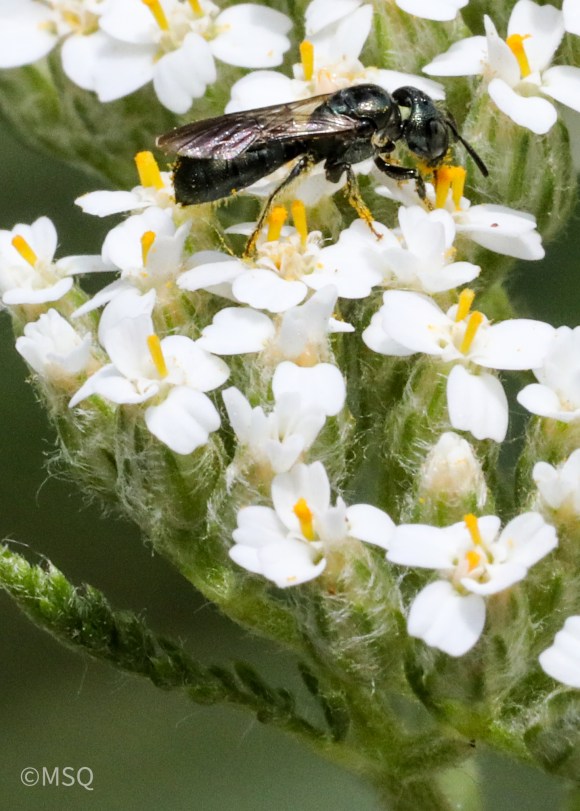
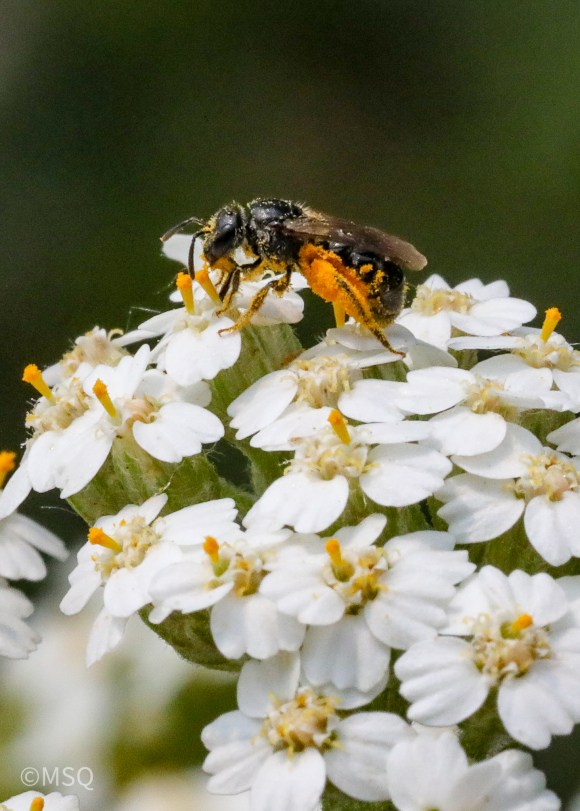
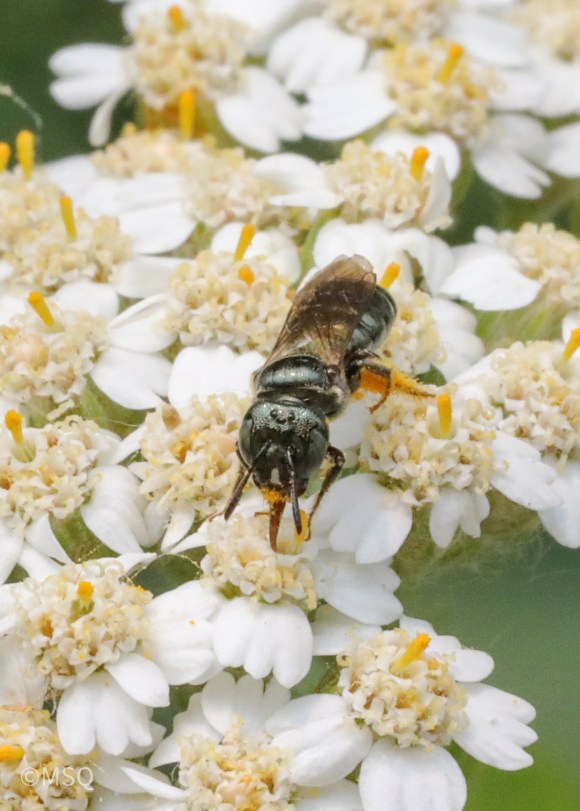
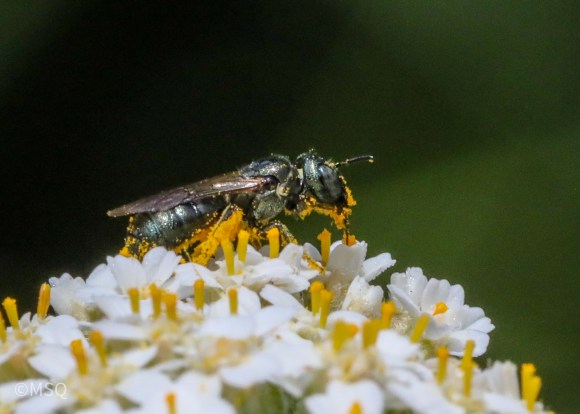
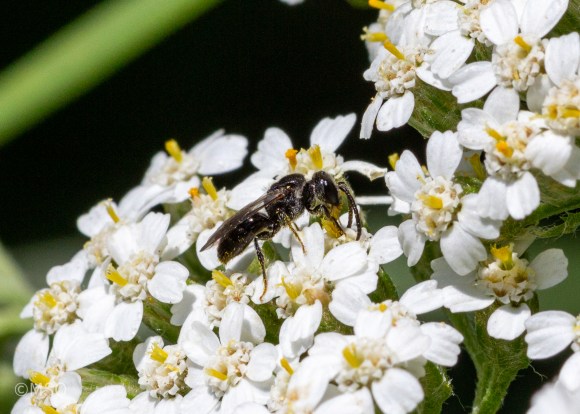
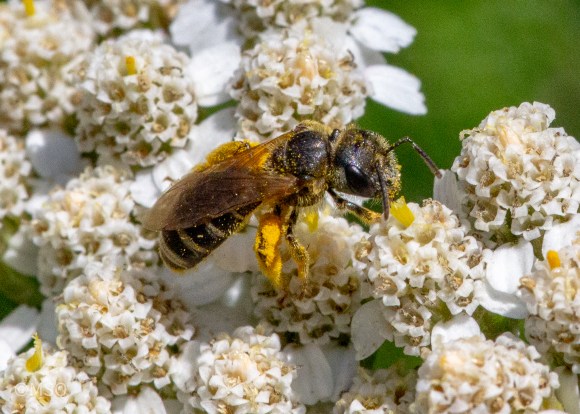
In my garden, I see many small bees gathering pollen and nectar.  Ceratina (small carpenter bee), Lasioglossum (small sweat bee), Megachile (leafcutter bee), Andrena (mining bee), and Nomada (cuckoo bee) collect resources on Yarrow.  These small bees visit the flowers throughout the summer.  Even when the Yarrow flowerheads seem finished, bees continue to visit harvesting every last bit of pollen and nectar.

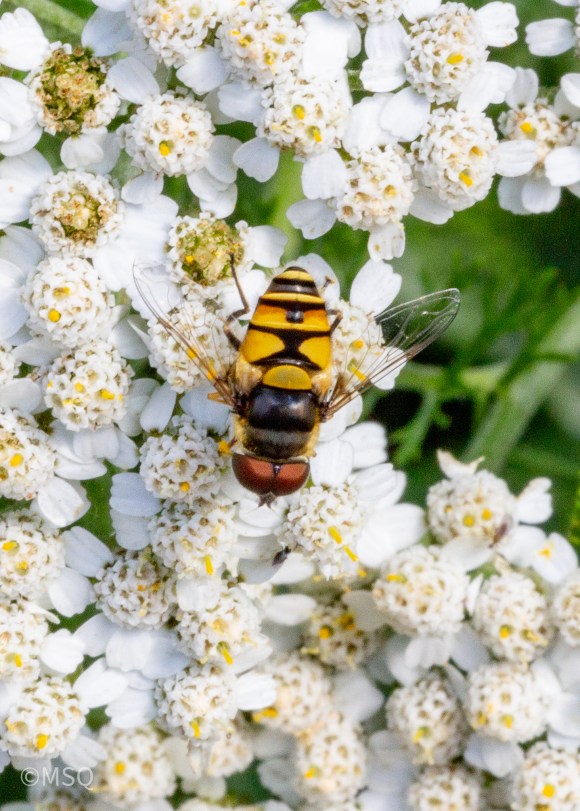
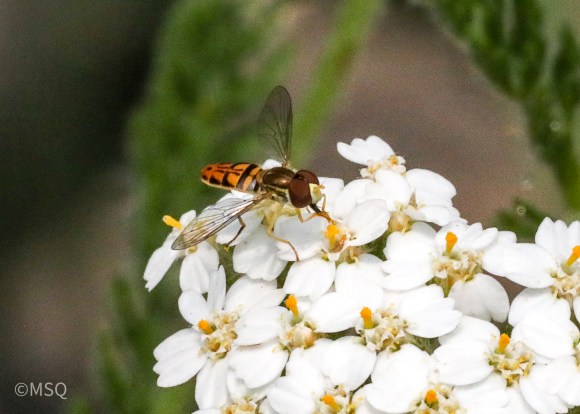
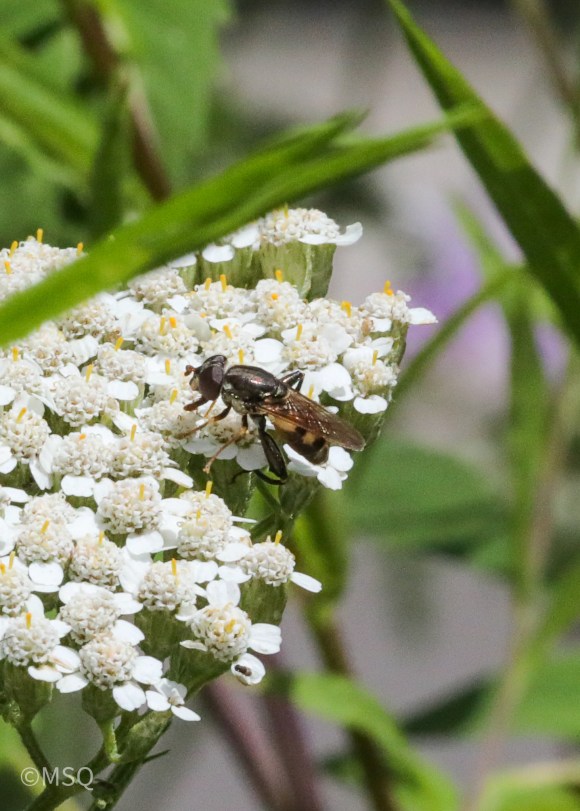
Beneficial insects enjoy Achillea millefolium throughout the blooming season.  Green lace wings, lady beetles, and a variety of flies harvest resources on Yarrow.  The flies include bee flies (Bombyliidae), soldier flies (Stratiomyidae), Syrphid flies,  Tachinid flies, thick-headed flies (Conopidae), flesh flies (Sarcophagidae), blow flies (Calliphoridae), Muscid flies, and Anthomyiid flies.

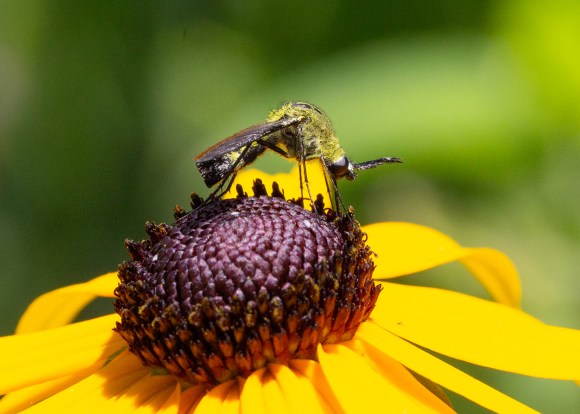
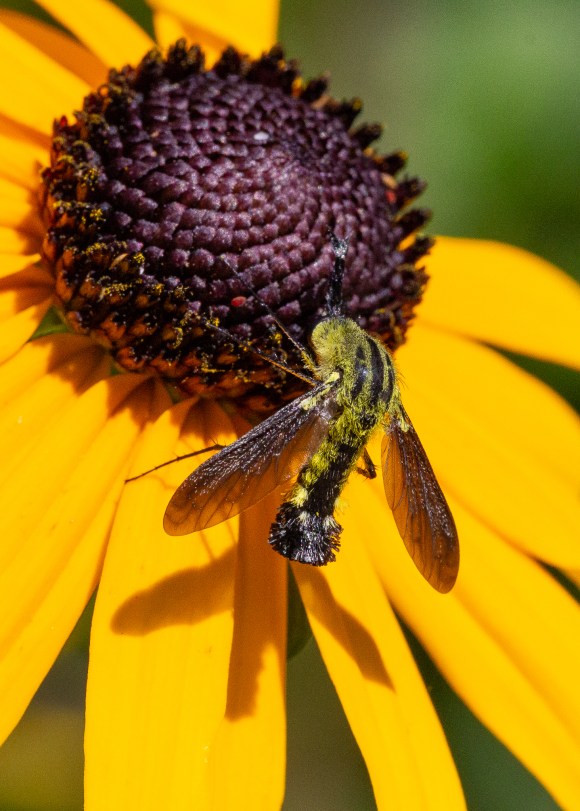
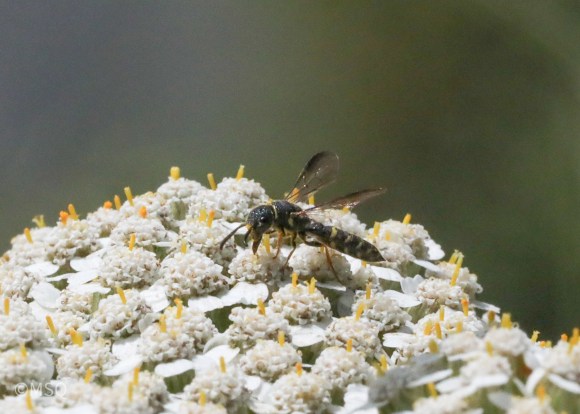
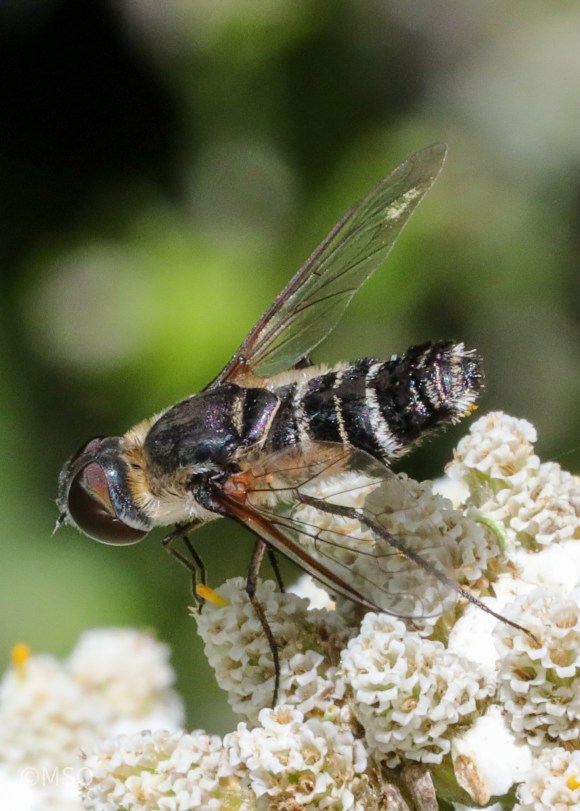
Adult bee flies gather nectar while their larvae act as beneficial insects.  This is Villa lateralis.  Specific studies of V. lateralis are difficult to find.  However, several species of Villa destroy grasshopper eggs in the larva stage.  Others parasitize caterpillars.8

Butterflies and moths use Yarrow as well.  Numerous butterflies nectar at the flowers including blue copper butterflies (Lycaena heteronea heteronea).  Achillea millefolium is a larval host for many moth species. Some eat the leaves while others bore through its stem or feed on the flowerhead.  Papaipema nebris (Stalk borer Moth) is a stem borer.  Flower eaters include Chlorochlamys chloroleucaria (Blackberry Looper Moth), Eupithecia absinthiata (Wormwood Pug), Eupithecia miserulata (Common Pug), Synchlora aerate (Wavy-lined Emerald), Heliothis phloxiphaga (Darker-spotted Straw), and Depressaria alienella (no common name).  Moths and a butterfly that feed on leaves include the American Painted Lady (Vanessa virginiensis), Agrotis volubilis
(Voluble Dart), Cryptocala acadiensis (Catocaline Dart), Lacinipolia olivacea (Olive Arches), Orthodes cynica (Cynical Quaker), Paradiarsia littoralis (Labrador Dart), Pseudorthodes vecors (Small Brown Quaker), Trichordestra legitima (Striped Garden Caterpillar) and Gillmeria pallidactyla (Yarrow Plume Moth).

I hope you enjoyed this journey into Achillea millefolium or Yarrow.  If you don’t have it in your garden, take a look at it in nature.  See who’s visiting those adaptable plants that have traveled so far!

Bye now,

Mary


REFERENCES:

Categories
Pollinator gardening

A Dynamic Duo for Spring,

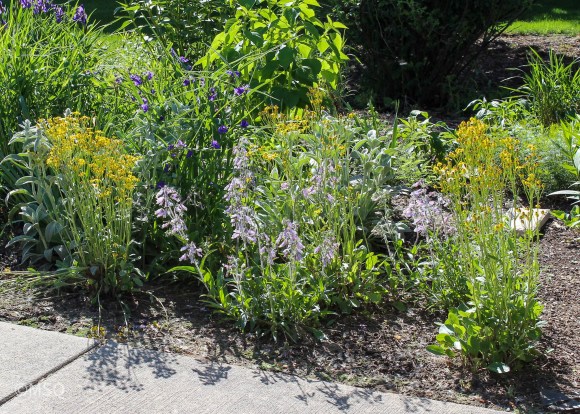
New Year’s has past, plants and pollinators are sleeping but gardeners dream of flowers and foliage!  Today, I’ll talk about two of the first native plants to bloom in my garden.  Together they blossom from early spring to early summer.  They support emerging beneficial insects and pollinators including early queen bumblebees and native bee queens starting their nests.  In addition, these versatile plants thrive under a variety of conditions even green roofs!

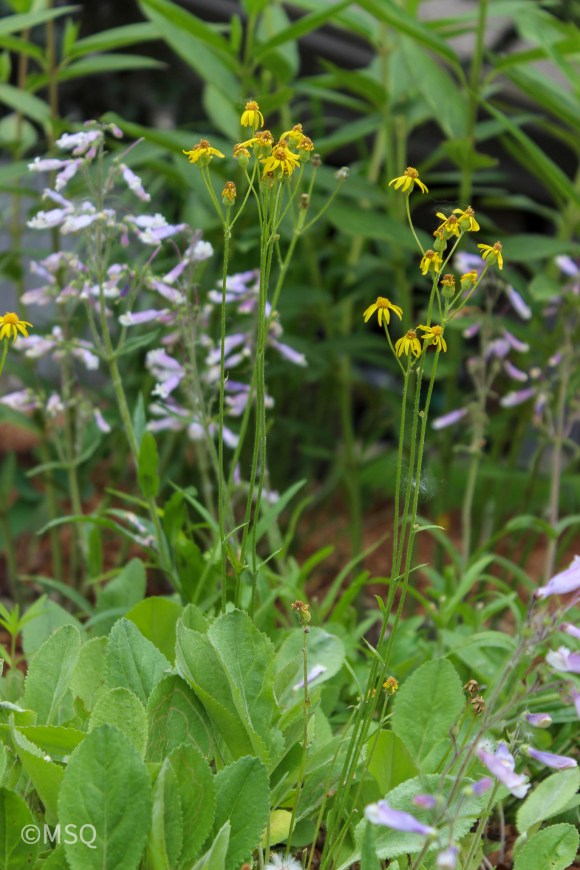
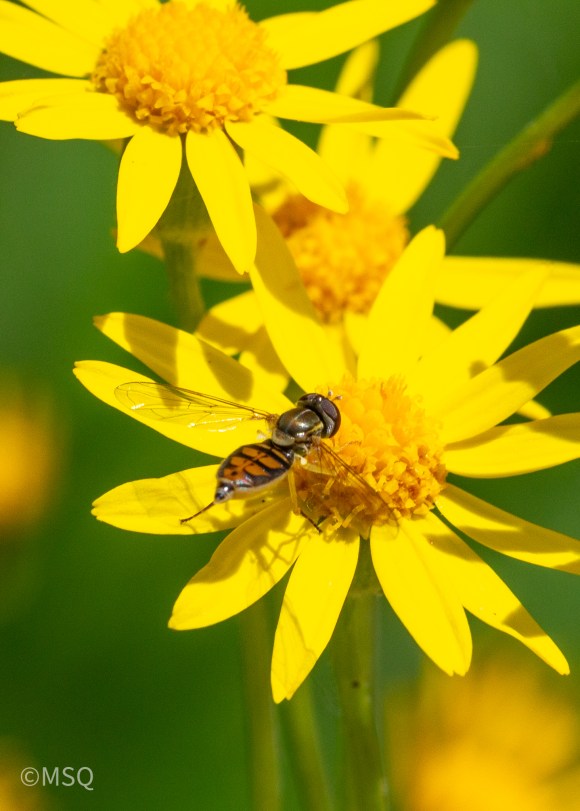
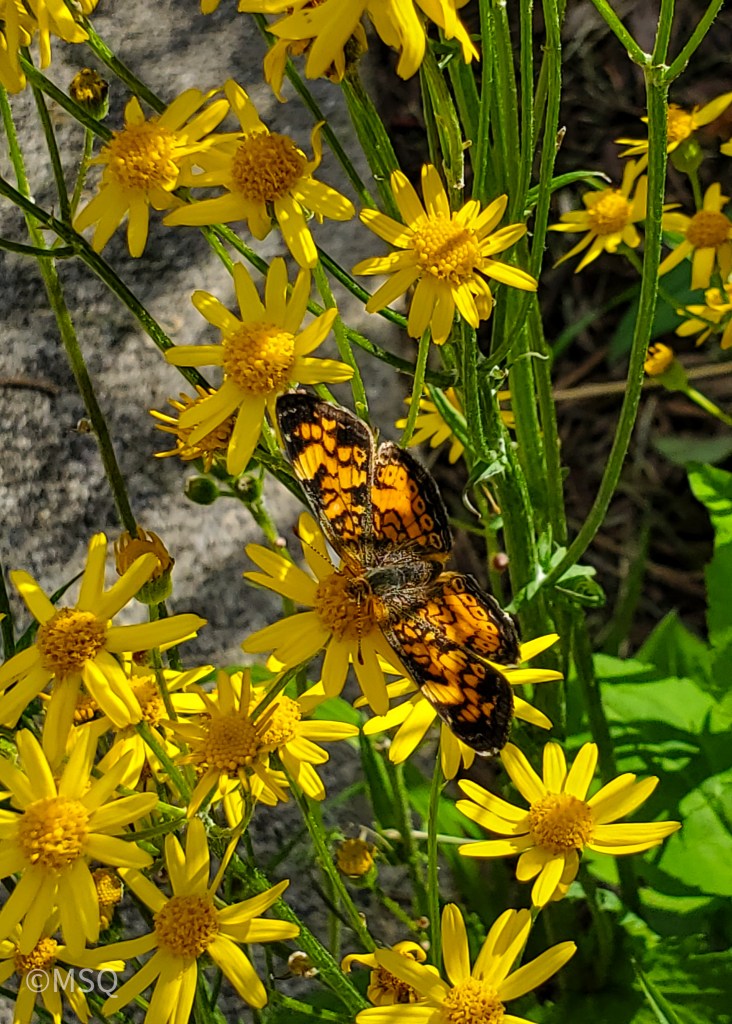
In my garden, Spring starts with Round-leaved Ragwort (Packera obovata), also called Round-leaved groundsel.  Round-leaved Ragwort blooms as early as April and can continue until June.  The petite, yellow flowers are half to three-quarters inch in diameter.  They develop on  one- to two-foot-tall stalks, arranged in flat-topped clusters called corymbs.

After blossoming, Packera obovata keeps its basal rosette.  This smooth, medium green foliage has three-to-six-inch leaves.  The leaves are round to oval and serrated and remain throughout the growing season.

Round-leaved Ragwort enjoys full to part sun and dry to average soil moisture.  It’s not picky about soils and will grow in loam, sand, or rocky material.  Ragwort doesn’t like to have its feet wet and won’t thrive in rain gardens.

I’ve used this plant in my home garden and in the public garden where I volunteer. It is tremendously tough and easily outcompetes weeds–spreading by both rhizomes and abundant seeds.  It can be a nuisance plant because of its competitive nature.  

In the public garden, I’ve declared a truce with the Packera obovata.  We’re using it as a living mulch.  Packera easily withstands the light foot traffic we have on our mulched areas.  In the beds, we hope it shades out the invasive weeds but doesn’t interfere with the actual plantings.  Packera overpowers some native plants.  If you do try it as a living mulch, be aware you may need to remove it near slower growing plants.

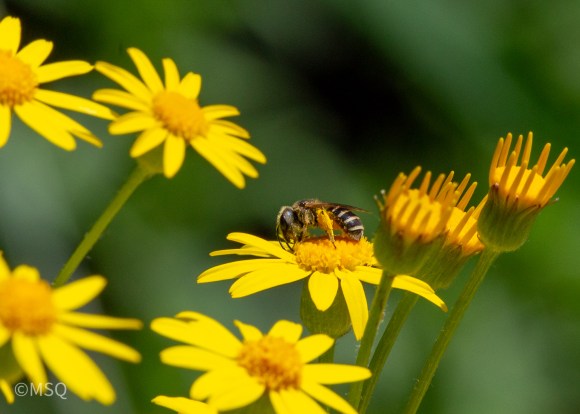
Loads of pollinators visit Round-leaved Ragwort blooms1,2.  Numerous Halictid sweat bees use it including Augochlorella spp., Halictus spp., and Lasioglossum spp.  The Andrenid mining bee visitors include a specialist pollinator or oligolege.  An oligolege requires a particular plant or group of plants for its food source.  Andrena gardineri needs flowers in the Packera spp. for its food.  Various cuckoo bees, including Nomada spp., also use this plant.

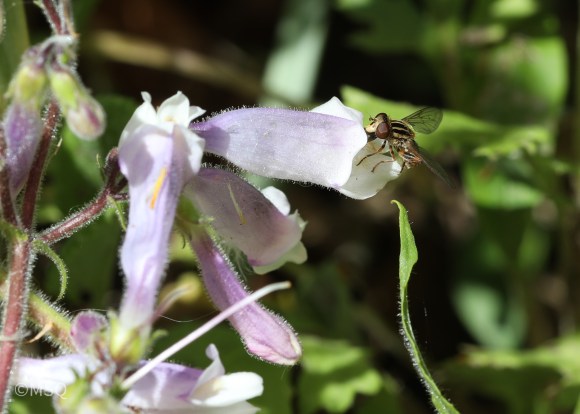
Beneficial insects also use Packera obovata.  Adult Syrphid flies feed on nectar and pollen.  Their larval eat insect pests such as aphids.  Tachinid flies also visit this Packera.  Tachinid flies lay their eggs near, on or in caterpillars and adult and larval beetles.  The eggs hatch and the maggots consume the target insect.

Butterflies, skippers and moths nectar at Round-leaved Ragwort.  It also supports the caterpillar of the Northern Metalmark butterflies (Calephelis borealis).  This butterfly is considered very rare or local throughout its range.

Packera obovata isn’t recommended in pastures.  It’s toxic to almost all grazing animals.  The only exception is sheep who don’t seem to be as sensitive.

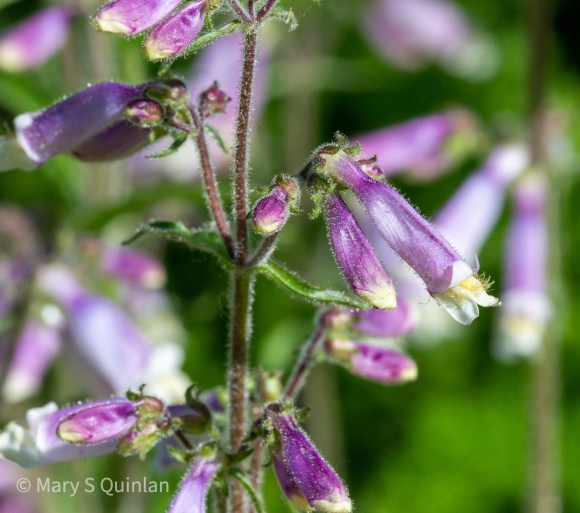
Shortly before Ragwort finishes bloom, Hairy Beardtongue, Penstemon hirsutus begins. The name Penstemon means five stamens and hirsutus means hairy.  Hairy Beardtongue has four fertile stamens and a fifth, infertile, hairy stamen–hence the name “Hairy”.  

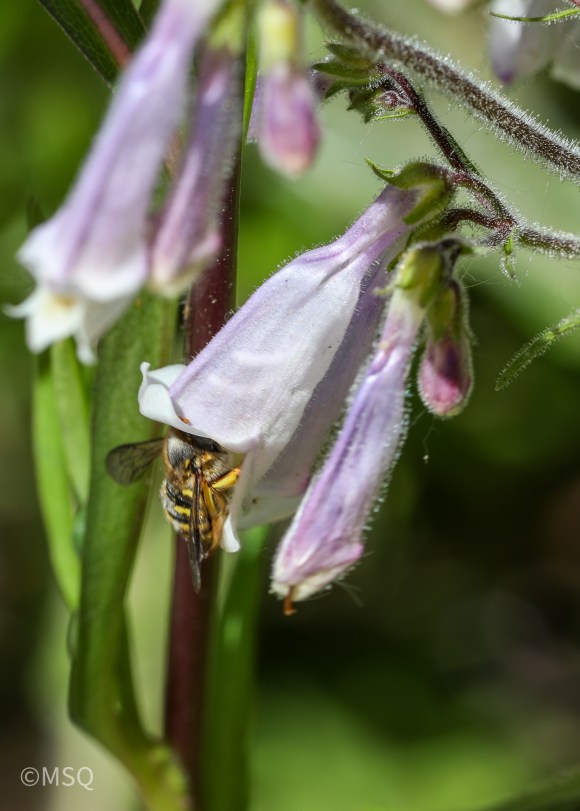
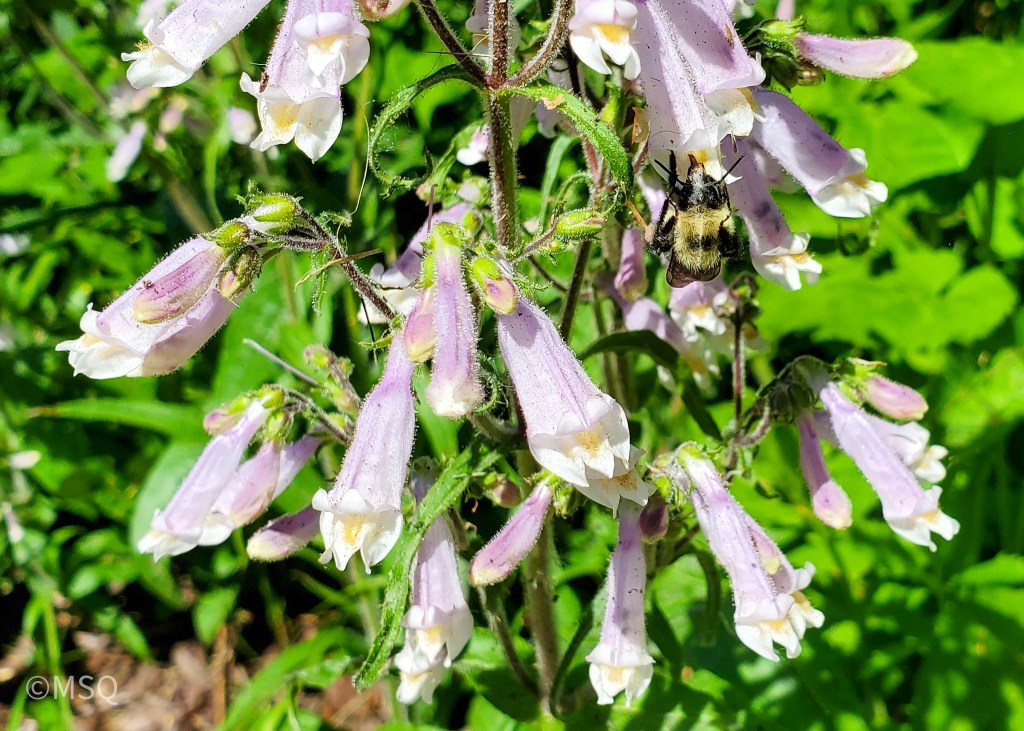
This charming plant has dainty stalks of lavender and white tubular blossoms.  Its blooms are lipped and about an inch long.  Unlike its relative Penstemon digitalis, Penstemon hirsutus’  flowers are almost closed. The one- to two-foot stalks make a lovely contrast to Ragwort’s golden sunbursts. This flower stem can be windblown and needs support.

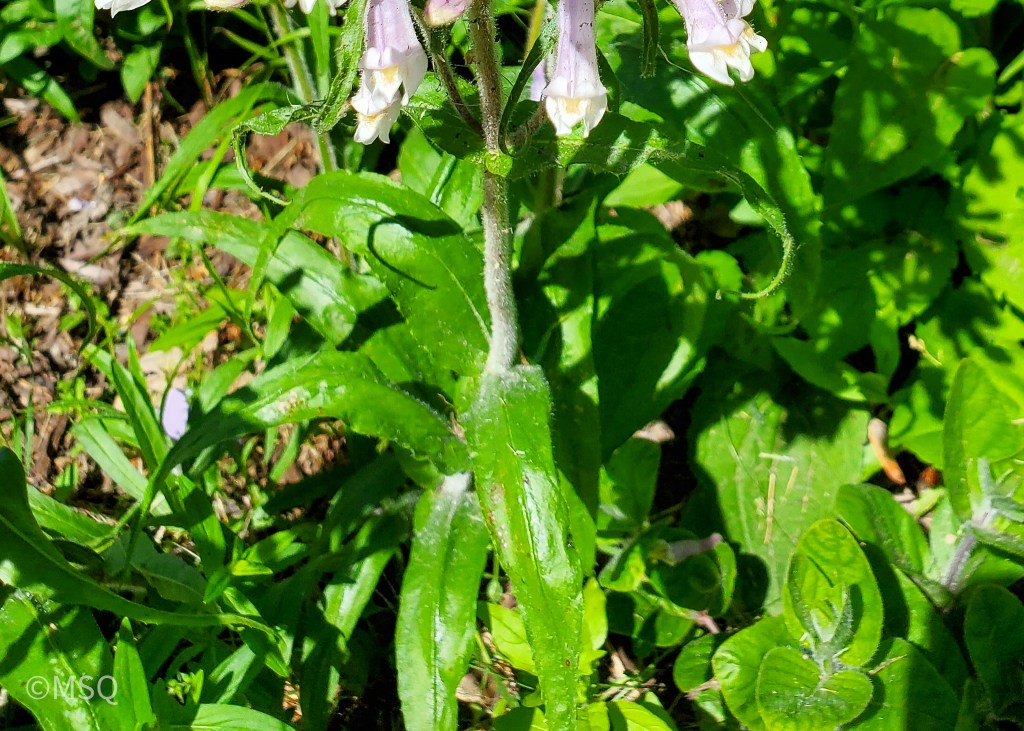
Hairy Beardtongue’s leaves are medium-green and lanceolate. The stem pierces the paired leaves which are two to three inches long. When the blossoms are spent, trim it back to healthy lower leaves and Beardtongue may rebloom. 

This Beardtongue grows in full sun to full shade.  I find that plants in partial shade are more likely to rebloom.  It enjoys dry to average conditions and well-drained sand to loam.  Hairy Beardtongue grows naturally in dry woodlands and open fields.

One caution with this plant, it does not grow or spread aggressively. It looks lovely blooming with the Ragwort but cannot compete with it. Years ago, I  planted them together and lost my Hairy Beardtongue.  The Round-leaved Ragwort completely overran it. Now, I clear a circle around each grouping of the Beardtongue to give it some breathing room. It’s a bit of extra work but I do enjoy them.

Hairy Beardtongue serves numerous pollinator while in bloom. The Pollinator Program at The Xerces Society of Invertebrate Conservation recognized it to be of Special Value to Native Bees and Special Value to Bumble Bees3. The flower structure encourages pollinators to enter and also helps complete pollination.  The extended lower lip offers a sturdy landing pad, an area to move and rest for the bees.  Penstemons as a group often have hairs inside the lower petals that urge the insect forward.  Penstemon hirsutus has these.  In addition, some penstemons have hook-like structures that give a light squeeze.  As the bee wiggles, the anthers wrap around it and transfer pollen.  This pollen sticks to where the bee’s body is most likely to touch the stamen and fertilize it.  Amazing how all these parts work together!4

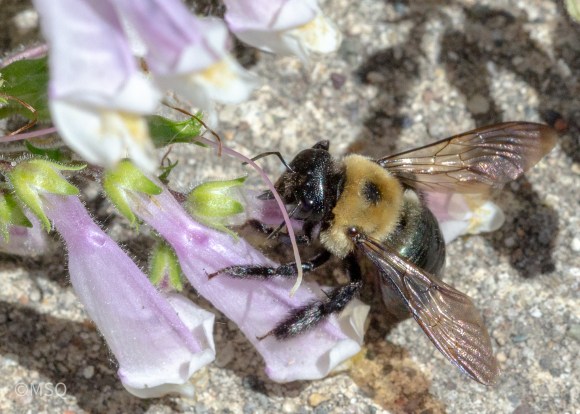
Hairy Beardtongue draws a variety of pollinators5,6.  The tubular flowers attract creatures with long tongues such as Hummingbirds and long-tongued bees. Long-tongued bees include bumblebees (Bombus spp.).  Digger bees (Anthophora spp.), Long-Horned bees (Synhalonia spp.), Wool-carder bees (Anthidium manicatum), Mason bees (Osmia spp.), Melecta thoracica (a cleptoparasite) and Leaf-cutter bees (Megachile spp.) also visit these blossoms.

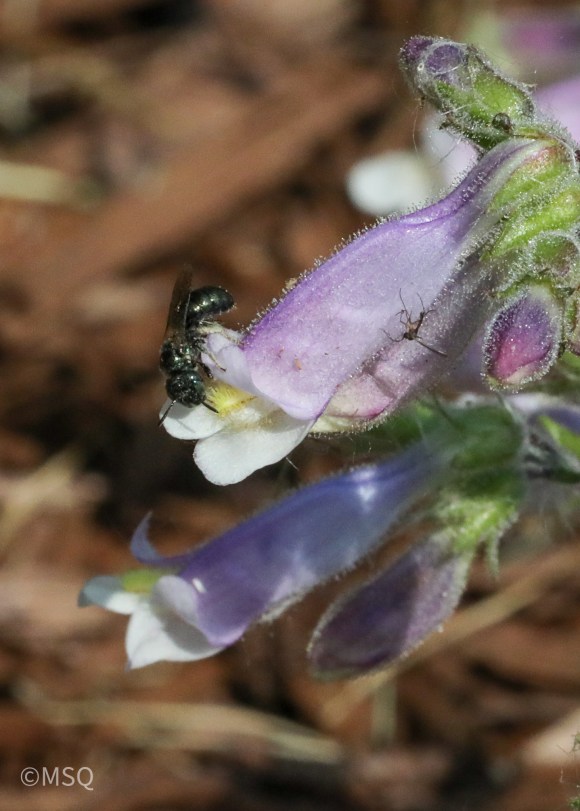
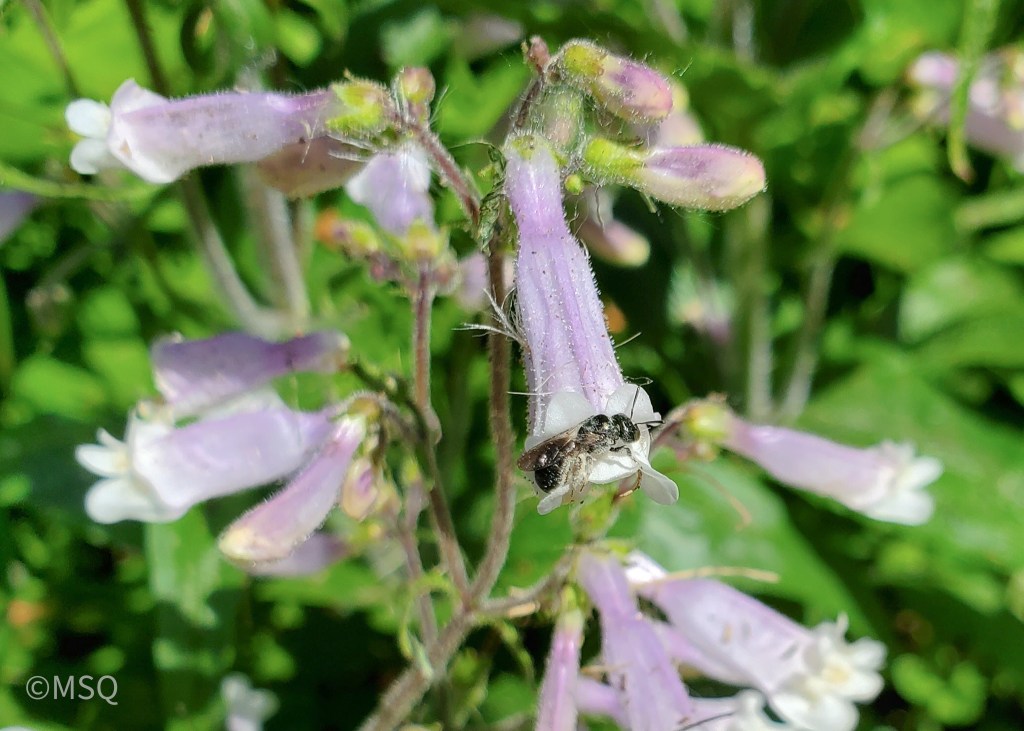
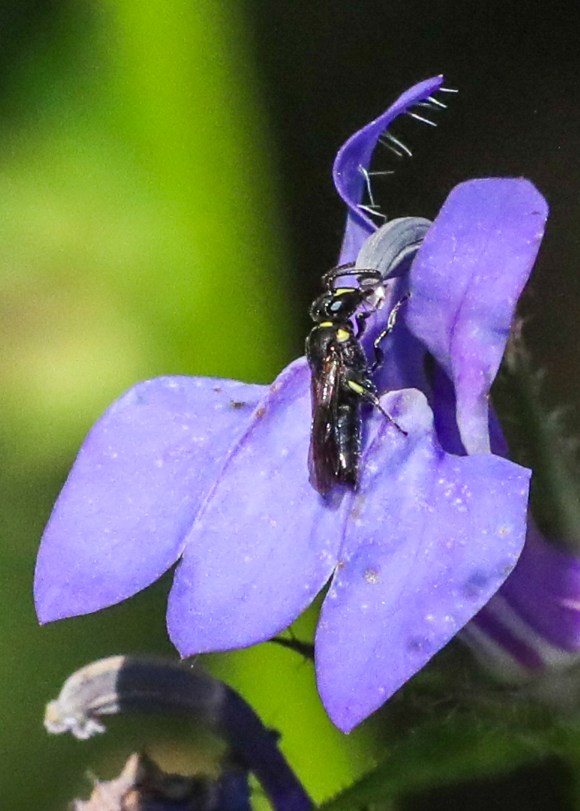
Short-tongued bees and small bees have found ways to use the food in Penstemon hirsutus.  Some small solitary bees, including sweat bees like Lasioglossum spp., simply crawl into the flower and collect its resources.  A small carpenter bee, Ceratina spp., is one of the main pollinators of Hairy Beardtongue.  Another small bee is Hoplitis spp., a small Mason bee.

Wasps and some large bees steal nectar.  Large carpenter bees (Xylocopa spp.) chew a hole at the base of the flower and drink nectar from the nectaries.  Nectar stealing doesn’t pollinate the plant but does provide the insect with food.

Several beneficial insects visit Hairy Beardtongue while it is blooming.  All of them use its nectar for fuel while going about their work.  Chalcidoidea is a group of small wasps.  They control both agricultural and natural pests.  Orius insidiosus or the Insidious Flower Bug or the Minute Pirate Bug hunts soft-bodied insects including spider mites, aphids, and thrips.  Braconidae are a family of parasitic wasp that prey on soft-bodied insects including aphids.  They also parasitize agricultural pests and caterpillars including the Tomato Horn Worm!  Aeolothripidae are thrips but predatory thrips.  They usually hunt small, soft-bodied insects.  Cynipoidea are parasitic wasps.  Empididae are predatory flies sometimes called dagger flies.

For readers looking for a new adventure, both Packera obovata and Penstemon hirsutus grow on green roofs!  Both grow well in the Midwest.  In Kansas, a trial tested a plot of the standard mixed sedums against a plot of sedums and grasses and a one of Packera obovata, other native plants and grasses.  Both mixed plots outperformed the sedums throughout the two-year trial7.

Chicago Botanic Garden studied the performance of a mix of native and non-native plants on green roofs.  Penstemon hirsutus received a five-star rating.  It established early and was healthy throughout the trial.  Its flowering was excellent, reseeding moderate and was only mildly affected by heat and drought.  Chicago Botanic Garden also observed both birds and a variety of insects on their roofs.  The insects included bees, butterflies, ants and more.  In addition to visiting mallard ducks, robins, sparrows, swallows, hummingbirds, and mourning doves, killdeer nested on the roof every year8.

Another study examined genetic diversity and pollen movement between urban green roof populations of Penstemon hirsutus.  The results showed that twenty-five percent of the plants were pollinated by plants on different roofs.  The authors found these green roofs contributed significantly to connection between the scattered populations.  Using native plants on green roof, is an interesting idea and new exciting new way add to contribute to native habit9.

I hope you enjoyed your trip through my Spring garden.  I’d love to hear about your garden or any questions you have!  Please contact me through the contact page with your stories and questions.

Mary

References:

  1. Hilty, J., n.d., Spoon-Leaved Ragwort, illinoiswildflowers.info, https://www.illinoiswildflowers.info/savanna/plants/rl_ragwort.html#:~:text=One%20bee%20species%2C%20Andrena%20gardineri,(ragworts).
  2. No author, n.d., Round-leaved Ragwort, https://www.canr.msu.edu/nativeplants/plant_facts/round_leaved_ragwort
  3. No author, n.d., Penstemon hirsutus, Lady Bird Johnson Wildflower Center, https://www.wildflower.org/plants/result.php?id_plant=PEHI
  4. Wheeler, Justin, 06/08/2017, Plants for Pollinators:Beardtongue, https://www.xerces.org/blog/plants-for-pollinators-beardtongue
  5. Hilty, J., n.d., Flower-Visiting Insects of Hairy Penstemon, https://www.illinoiswildflowers.info/flower_insects/plants/hry_penstemon.htm
  6. No author, n.d., Penstemon, Hairy Beardtongue, https://www.canr.msu.edu/nativeplants/plant_facts/penstemon_hairy_beardtongue#:~:text=Pollinators%20attracted,carpenter%20bees%2C%20and%20bumble%20bees.
  7. Decker, A. & Skabelund, L.R., 11/8-11/2021, Investigating the Effect of Substrate Type and Species Mix on Plant Cover on a Manhattan, Kansas Green Roof, Cities Alive Virtual conference, https://www.k-state.edu/greenroofs/images/pdf_docs/CitiesAlive%20Research_Paper_Sep2021_Decker_Skabelund.pdf
  8. Hawke, Richard, 2015, An Evaluation Study of Plant for Use on Green Roofs, Plant Evaluation Notes Issue, (38)2015, https://www.chicagobotanic.org/downloads/planteval_notes/no38_greenroofplants.pdf
  9. Ksiazek-Mikenas, K., Fant, J.B., & Skogen, K.A., 08/07/2019, Pollinator-Mediated Gene Flow Connects Green Roof Populations Across the Urban Matrix: A Paternity Analysis of the Self-Compatible Form Penstemon hirsutus, Frontiers in Ecology and Evolution, (7)2019, https://www.frontiersin.org/articles/10.3389/fevo.2019.00299/full#:~:text=Genetic%20Diversity%20of%20Green%20Roof%20vs.&text=The%20natural%20prairie%20populations%20of,genetic%20diversity%20(Table%202).