The glowing spheres of Buttonbush blooms shine in its dark foliage. The 2023 North Carolina Wildflower of the Year, Buttonbush (Cephalanthus occidentalis) thrives in difficult wet, low spots, even shallow standing water. It supports pollinators, beneficial insects and is a larval host. Cephalanthus occidentalis is also a rare mid-summer blooming shrub.
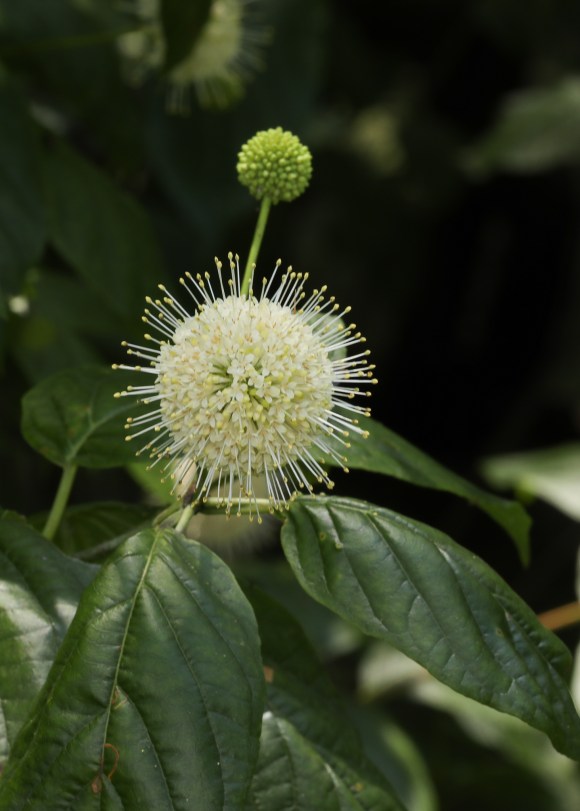
Buttonbush grows in zones 4-8. It generally measures between 4 and 8 feet tall and spreads between 4 and 8 feet. C. occidentalis enjoys full sun to part shade. It flourishes in medium moisture to wet soils including shallow standing water and areas with occasional flooding. Humusy soils, clay, loam, sand, shallow rocky soil, limestone soil, sandy loam, medium loam and clay loam all support Buttonbush.2, 3

Buttonbush grows in diverse wet habitats in nature. These locations include wet open areas, low woods, floodplain forests, vernal pools in wooded areas, wet thickets, shrubby swamps, upland sinkholes, wet depressions in black soil prairies, marshes, bogs, seeps, seasonal wetlands, ponds, pond margins, lakes-often in water up to 3 inches, prairie swales, dry limestone bluffs, ditches, and borders of rivers, and streams.2,4

In addition to flourishing in wet conditions, Buttonbush tolerates various challenges. It’s moderately deer resistant since its foliage contains a toxin. This shrub works for erosion control. Its swollen base stabilizes the plant. It also survives competition, fire, and heat.4,12
If the species shrub becomes too big, rejuvenation pruning in early spring makes it more manageable. Rejuvenation pruning is a technique used on multi-stemmed, twiggy shrubs. The shrub is cut back to between 6 and 12 inches above the ground. The individual stems are cut ¼ inch above a bud. Cuts slope down and away from the bud at a 450 angle. Remove dead wood as close to the ground as possible. This method also works well Red-Twig Dogwood (Cornus sericea) and Pussy Willows (Salix discolor).7
If the species Cephalanthus occidentalis is still too large or unruly for your space, there is a smaller nativar. Buttonbush Sugar Shack grows to approximately 5 feet by 5 feet at maturity. Sugar Shack is ball-shaped with compact growth.6
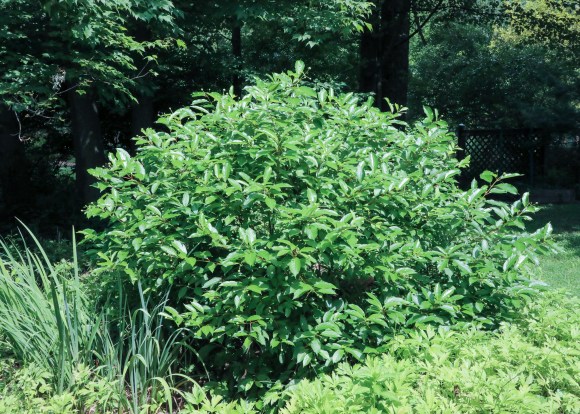
It enjoys the same conditions as the species-full to part sun and moist to wet soils. The white flowers are similar in size and bloom from early to late summer (beginning to last blossom). The seeds pods are red, becoming brown over the winter. The foliage changes to burgundy in the fall.6
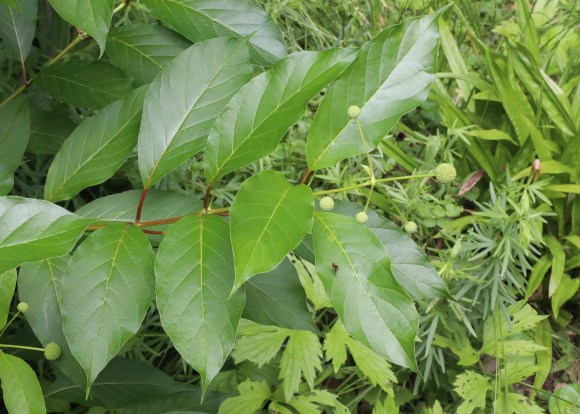
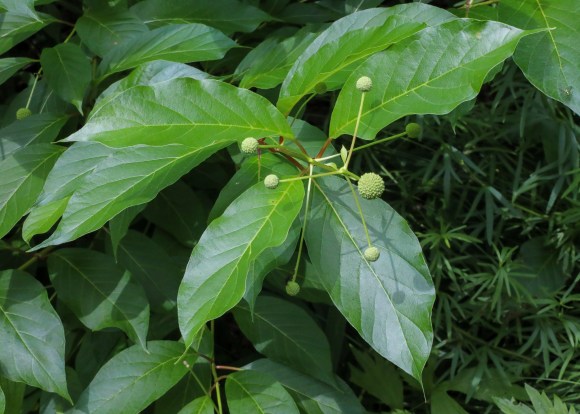
Foliage of Cephalanthus occidentalis is medium to dark green. The leaves sit opposite each other in pairs or, occasionally, in whorls of 3. They grow up to 6 inches long and 2.5 inches across.2
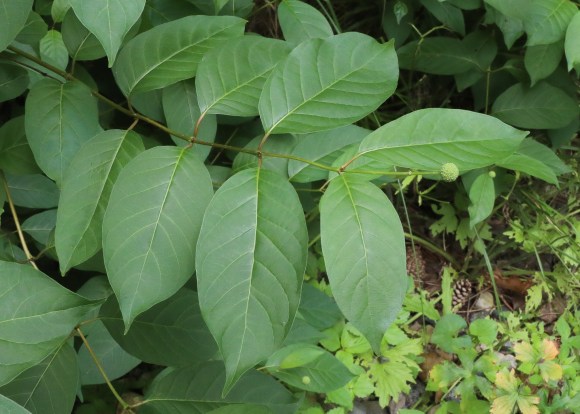
Each leaf has a smooth margin and an ovate or ovate-oblong shape. Their upper surface is glossy, and the most common variety is hairless. A pubescent (covered with soft, short hairs) variety also exists. The foliage changes to yellow in the autumn.2
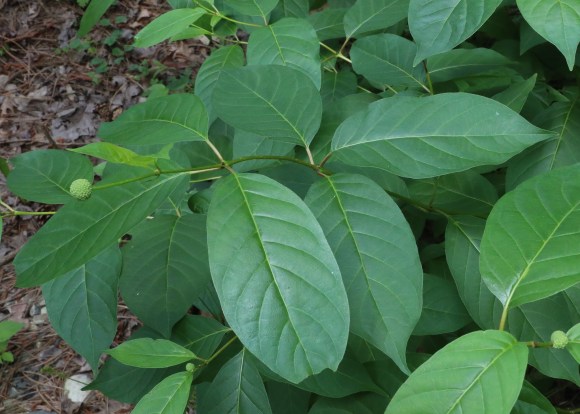
The spherical flowers start the show with Buttonbush. They’re located at the top of branches or emerge from leaf axils. These flowerheads grow from 1 to 2 inches across and are white or cream colored.2
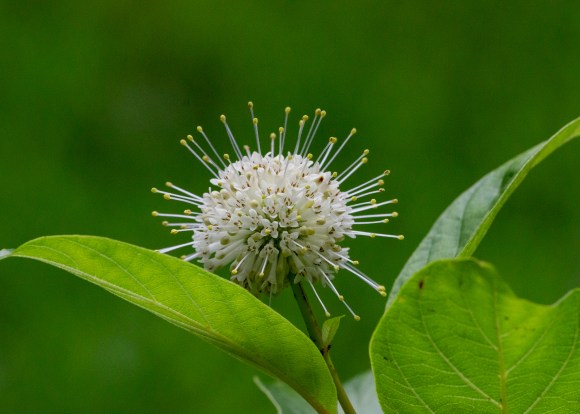
Within the flowerhead, each floret consists of an approximately 1/3-inch-long corolla. It has 4 lobes at the opening. There are 4 stamens and 1 undivided, white style. The style extends beyond the floret opening.2
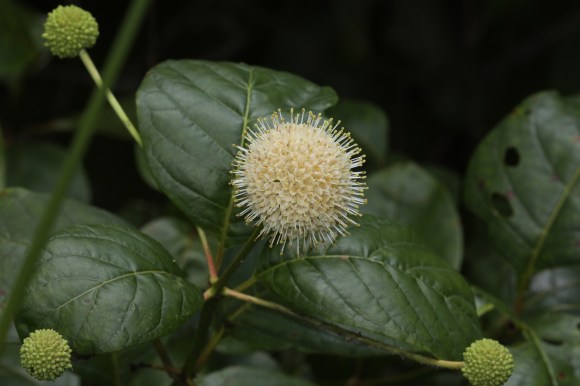
Buttonbush is self-incompatible and has an unusual way of releasing its pollen. The stamens emerge first. They shed pollen while the florets are still closed. Then the florets open. While the style elongates, it carries along the pollen and makes it accessible to bees and insects.
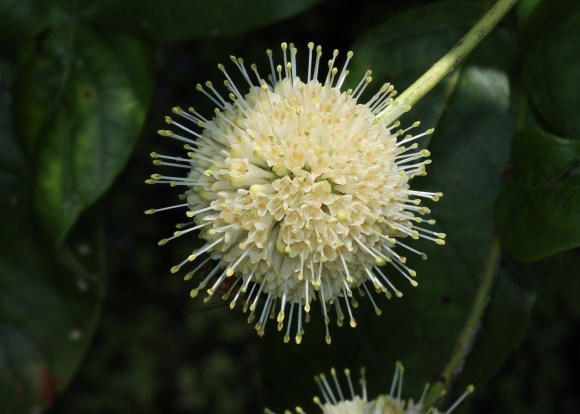
Cephalanthus occidentalis blooms for about 1 month. The flowers are followed by red, round seedheads. These remain throughout the winter turning brown and giving winter interest.2
Buttonbush feeds numerous creatures. For the insects, C. occidentalis provides nectar and pollen and is of Special Value to Native Bees, of Special Value to Bumble Bees and Special Value to Honey Bees. XERCES Butterflies, moths and skippers, also, harvest resources from the flowers as well as wasps and flies. It’s also a larval host for many moths including the spectacular Titan Sphinx Moth (Aellops titan).2
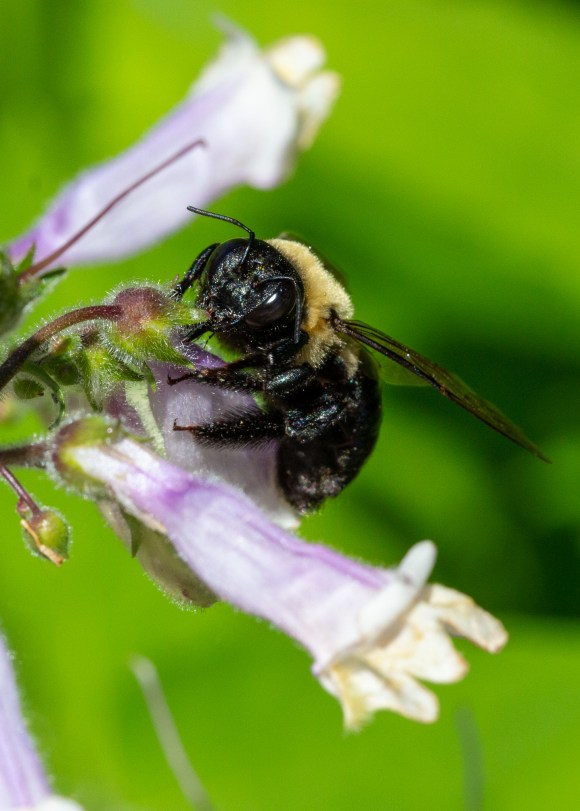
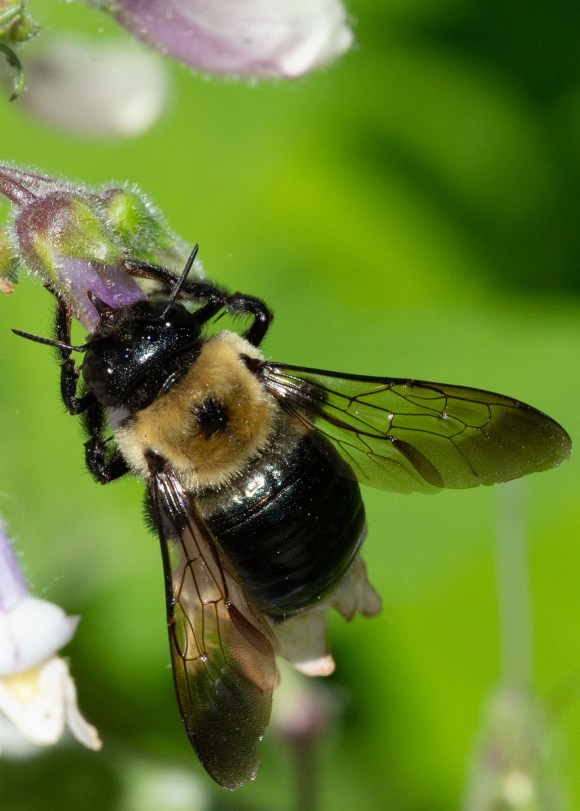
Many different bees gather nectar from Cephalanthus occidentalis. These include Honeybees (Apis mellifera), bumblebees (Bombus), cuckoo bees (Triepeolus spp.), long-horned bees (Melissodes spp.), leaf-cutting bees (Megachile spp.), green metallic bees (Agapostemon spp.), small carpenter bees (Ceratina spp.), yellow-faced bees (Hylaeus spp.) and large carpenter bees (Xylocopa spp.).2
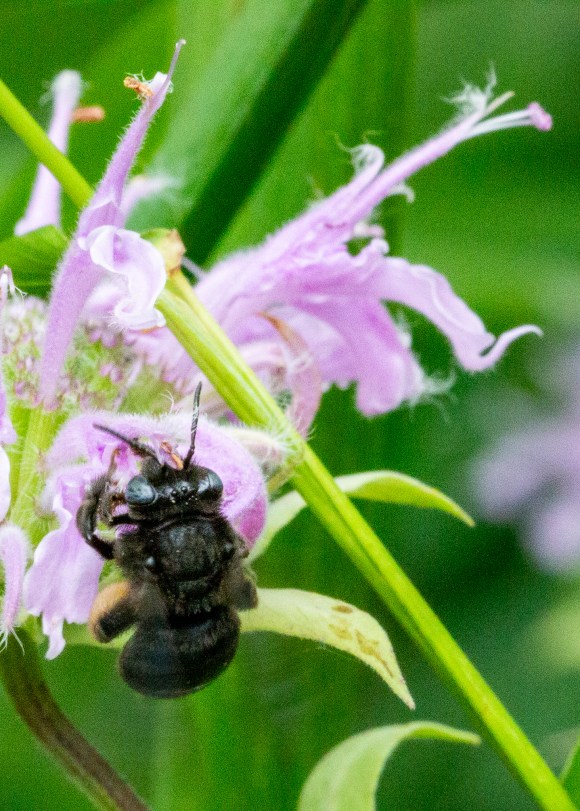
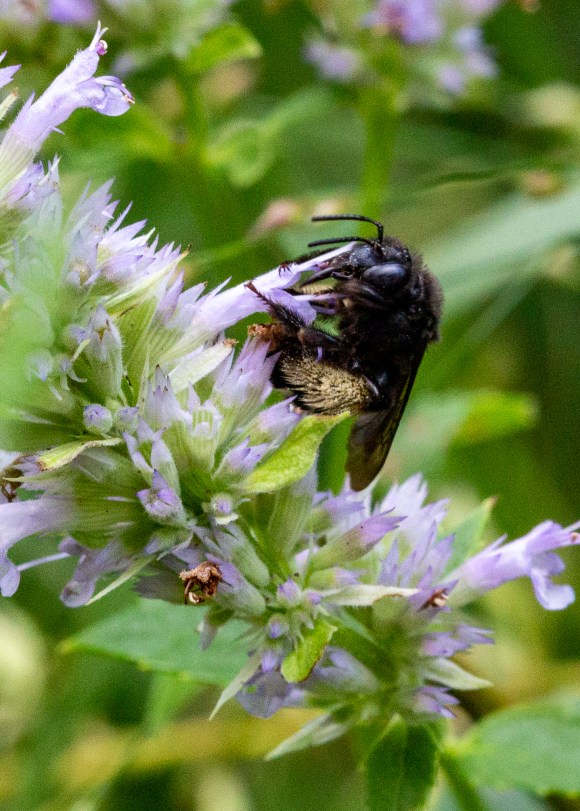
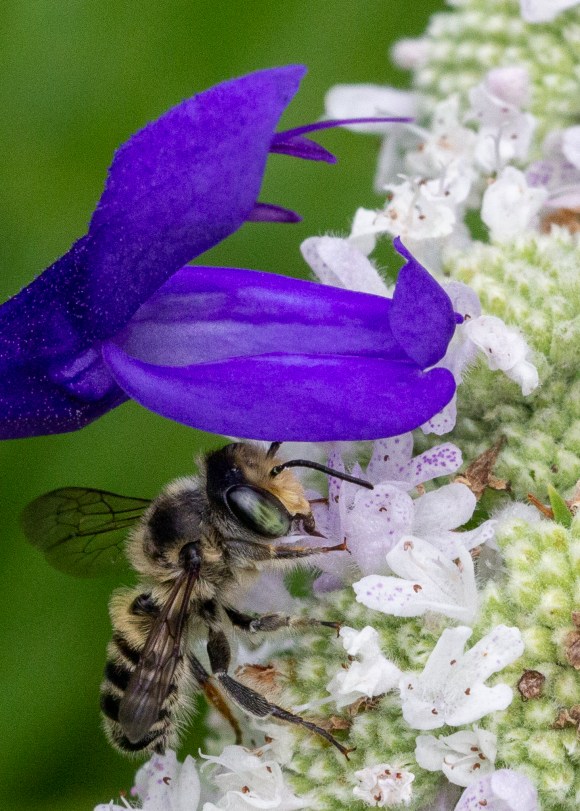
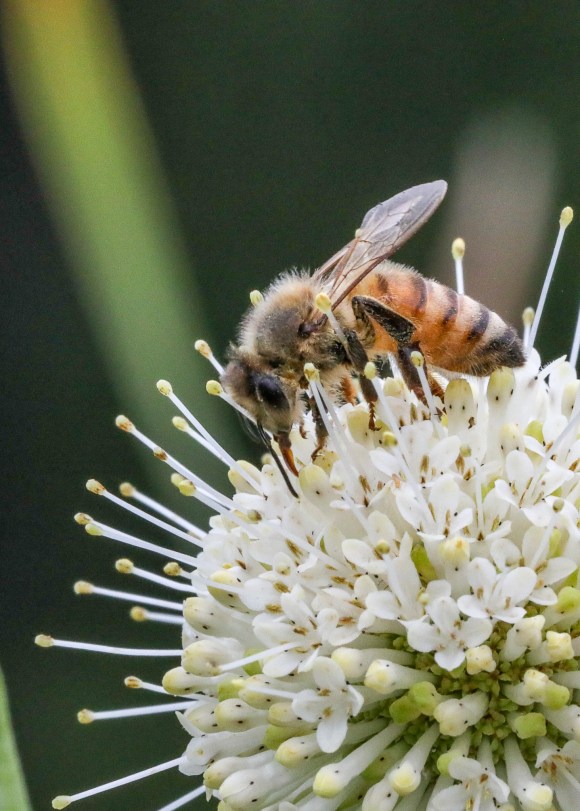
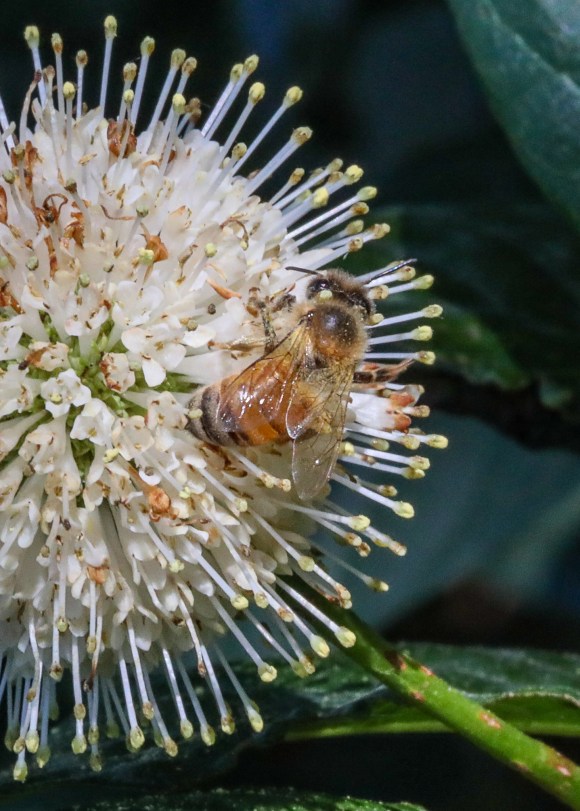
In the past, Buttonbush support a large beekeeping industry along the lower Mississippi River floodplain where the shrub thrived. It’s still known by the common names of Honeybush, Honeybells and Honeyballs. Honeybees continue to seek out its nectar and pollen.13
Bumble bees frequently visit C. occidentalis when it’s flowering.
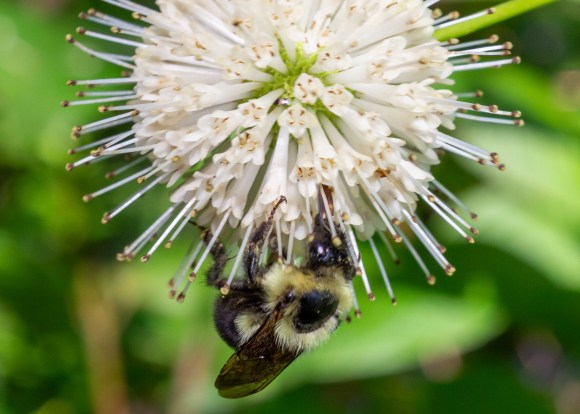
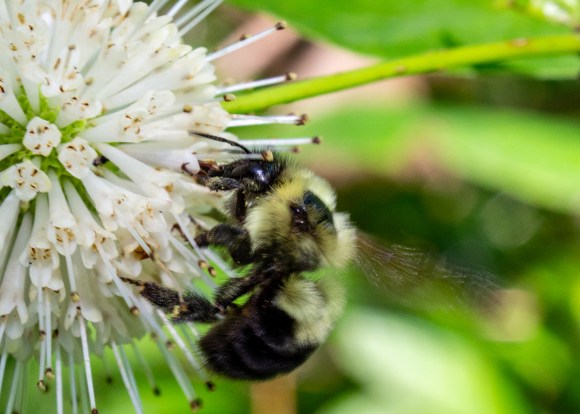
Small bees gather resources at Buttonbush, climbing in and out of the florets. These pollinators include small carpenter bees (Ceratina spp.), green metallic bees (Agapostemon spp.), and yellow-faced bees (Hylaeus spp.).
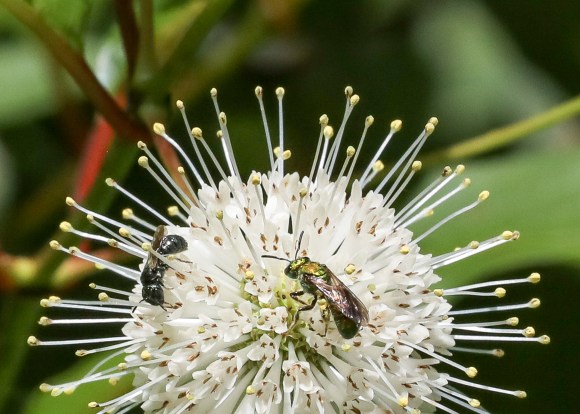
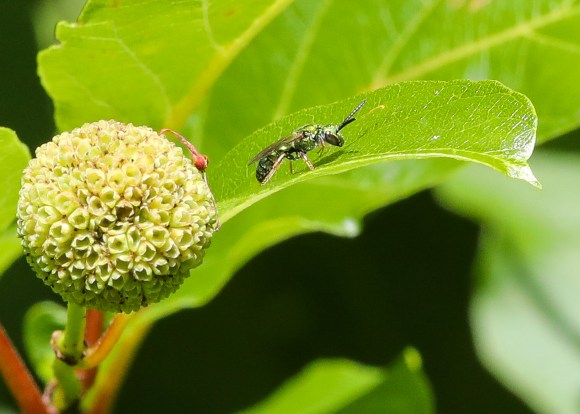
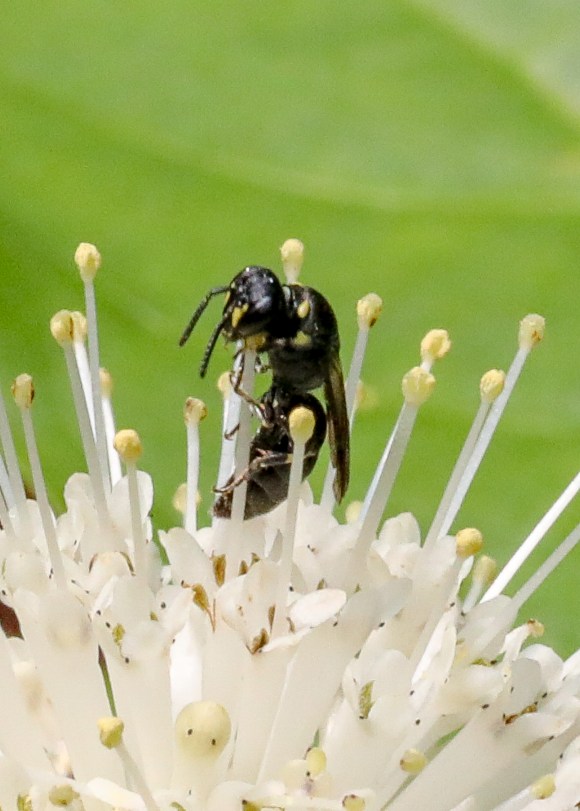
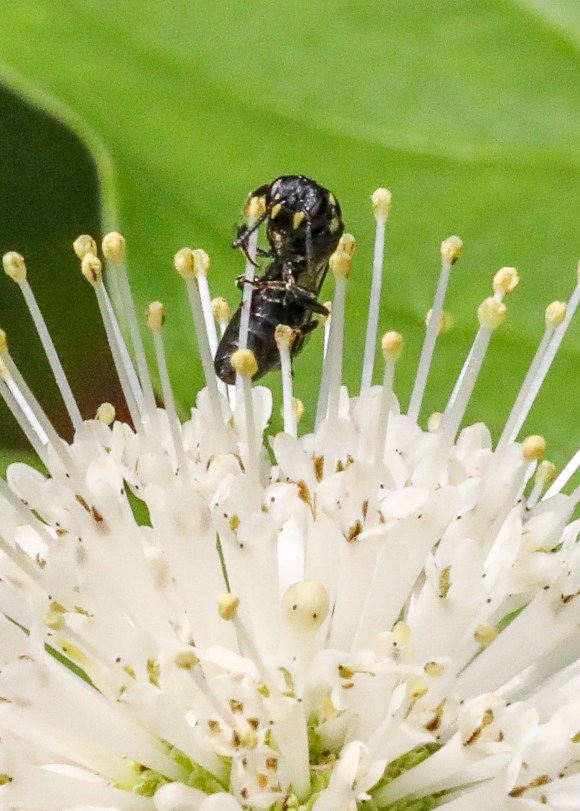
There are 366 species of small carpenter bees (Ceratina spp.) throughout the world (except Oceania). 27 species live in the United States with 5 in the Eastern US and Canada.8,11 Despite their name, they’re not closely related to the carpenter bee, Xylocopa.

Ceratina are stem nesting bees that need pithy centers. They nest in perennials and woody stems. The female excavates a long nesting tunnel and uses the stem pith to create cell divisions. Once the nest is full, the female guards the entrance. She makes a yellow, strongly citral-scented secretion that is excreted from her mandibles (“jaws”). The mother smears this on the nest entrance to repel predators.8,11

Ceratina show some unusual and fascinating social behaviors. Unlike other bees, small carpenter bees live a long time, 12 to 16 months. In temperate climates like the Northeast and Great Lake, this means through the winter.
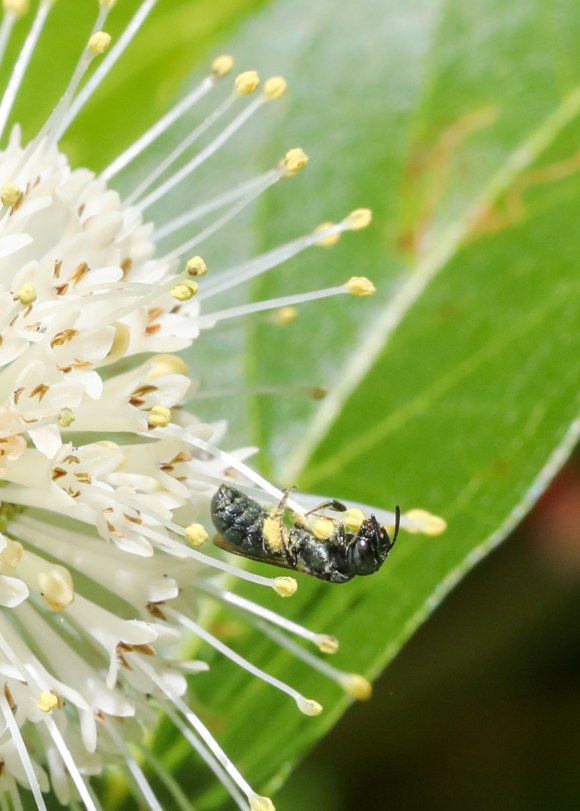
These bees care for their young throughout this time. The mother removes the nest partitions each evening and grooms her young. This behavior is believed to reduce parasites and remove any developing fungal infections from the nest. These mother-offspring interactions separate Ceratina from other solitary bees and are considered subsocial.8,11

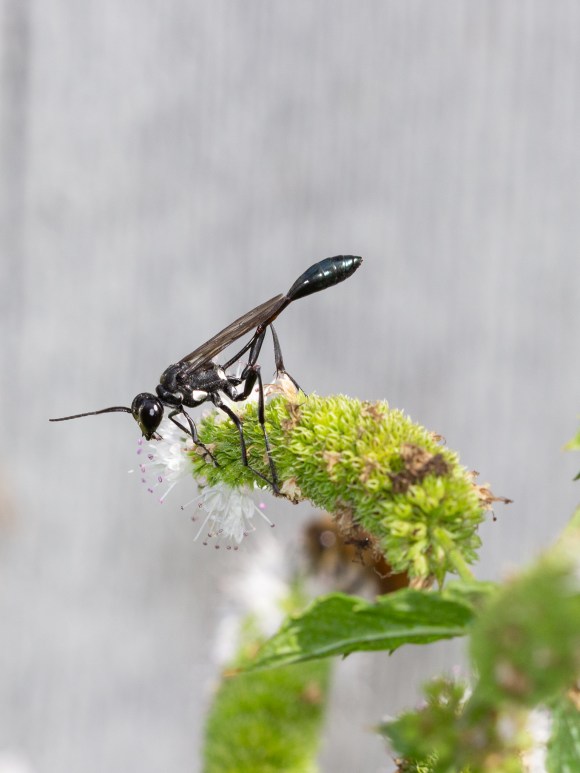
Various wasps drink nectar from Cephalanthus occidentalis. Scoliid wasps (Dielis spp.), Carrot or Gasteruption wasps (Gasteruption spp.), and Thynnid Flower wasps (Myzinum spp.) are solitary, parasitic or parasitoid wasps which visit Buttonbush. In addition, the solitary wasps, Mason wasps (Monobia spp.), Cuckoo wasps (Parnopes spp.), (Pseudodynerus spp.), and Thread-Waisted wasp (Sphex spp). also use C. occidentalis. Finally, the very social yellow jacket, (Vespula spp.) gathers nectar from this shrub.9
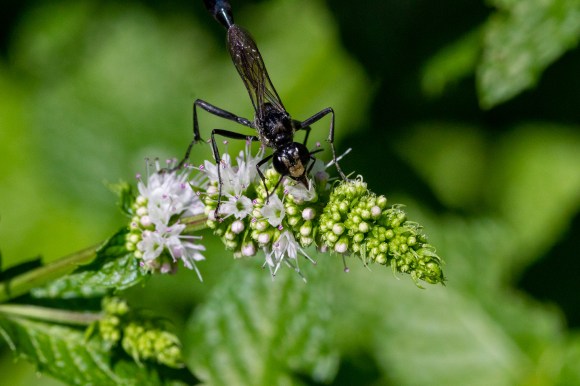
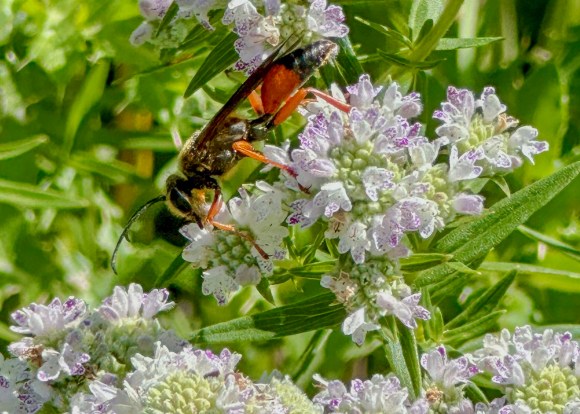
The Great Golden Sand Digger Wasp (Sphex ichneumoneus) is a beautiful, beneficial wasp. This digger wasp hunts cicadas and true crickets to provision its nests. The female constructs a vertical nest with 2 or 3 side cells for eggs. She lays her egg on the first prey and adds 1 to 5 more. The number of nests per year vary depending on the length of growing season. Like other solitary wasps, the Great Golden Sand Digger Wasp is not aggressive, and, in fact, the male doesn’t have a stinger.9,10
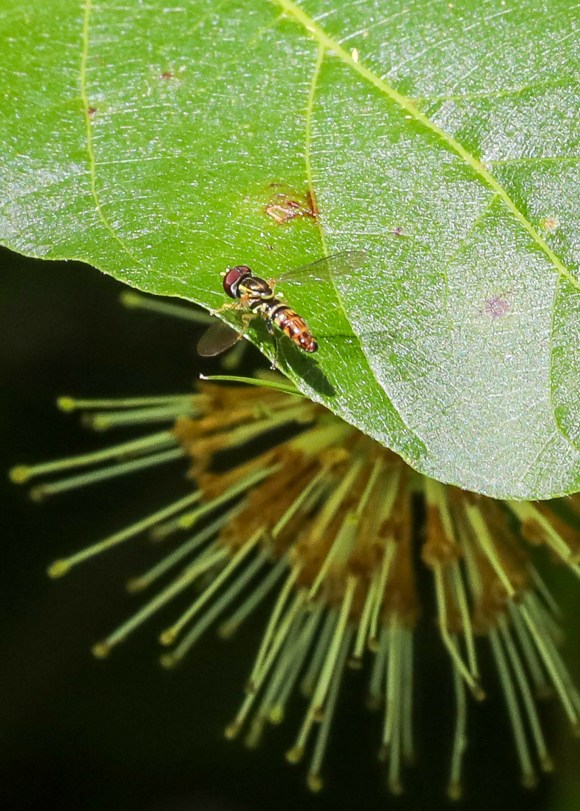
Thick-headed flies and Syrphid flies gather nectar from Buttonbush flowers.2
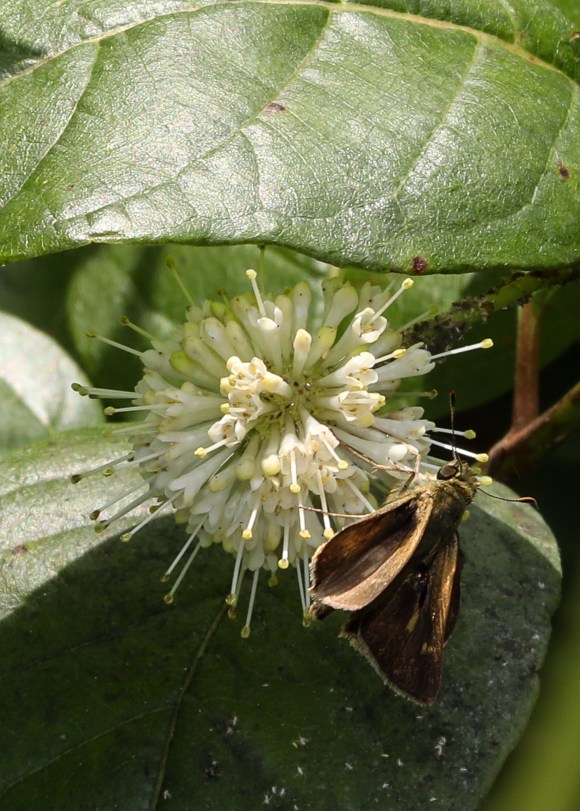
Buttonbush serves adult butterflies, moths and skippers.2,5,13 They visit its blooms for nectar.
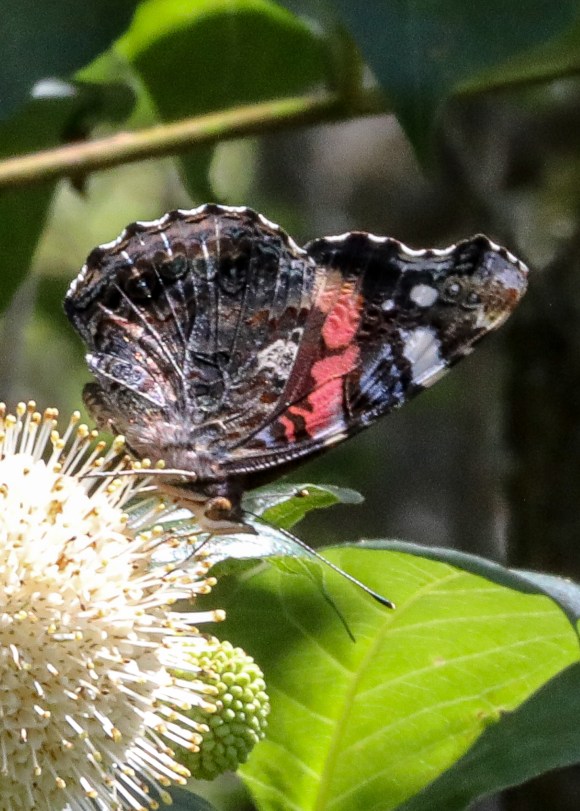
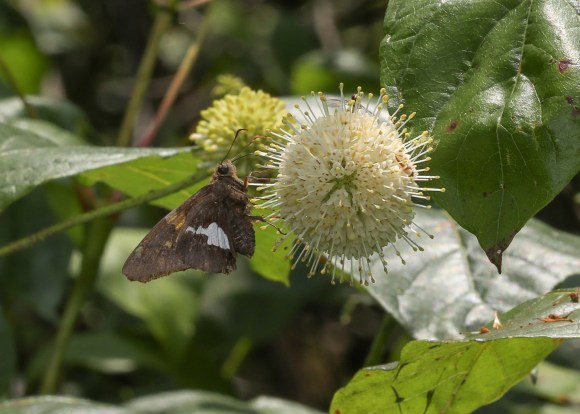
Several moths use this shrub as a larval host including some spectacular ones. The Titan Sphinx (Aellops titan), the Hydrangea Sphinx (Darapsa versicolor), and the Royal Walnut Moth (Cithermia regalis) larvae all feed off the Cephalanthus occidentalis plant.2,5,13
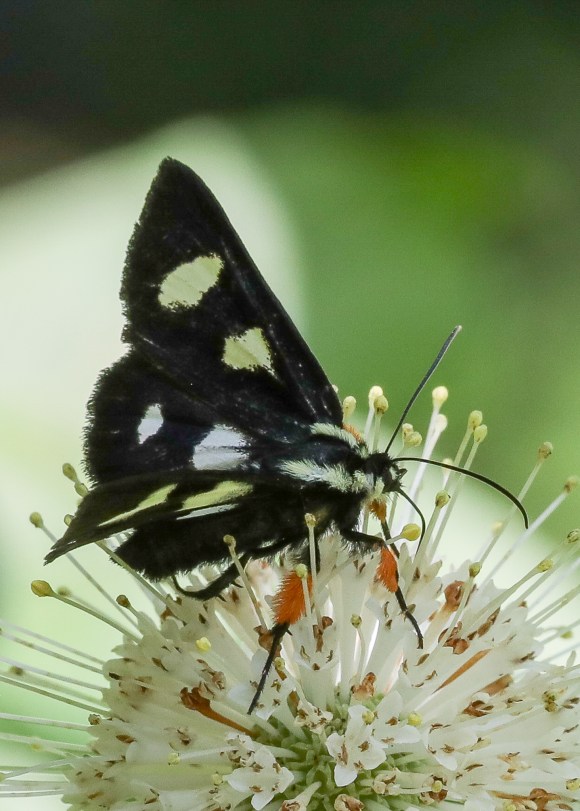
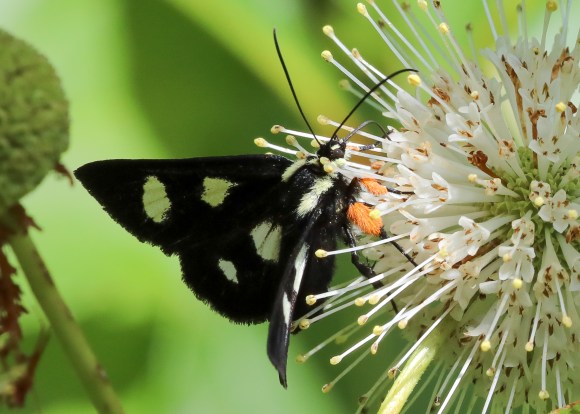
Hope you’ve enjoyed this dive into Cephalanthus occidentalis! Look for it blooming when you’re near water. Check for it at the edges of wetlands by roadside ditches.
Enjoy Summer and Happy Gardening,
Mary
BIBLIOGRAPHY:
- “Bird Table (Cephalanthus Occidentalis).” Accessed July 1, 2025. https://www.illinoiswildflowers.info/trees/tables/table283.html.
- “Buttonbush (Cephalanthus Occidentalis).” Accessed July 1, 2025. https://www.illinoiswildflowers.info/trees/plants/buttonbush.htm.
- “Cephalanthus Occidentalis – Plant Finder.” Accessed July 1, 2025. https://www.missouribotanicalgarden.org/PlantFinder/PlantFinderDetails.aspx?kempercode=g830.
- “Cephalanthus Occidentalis (Buttonbush, Button Bush) | North Carolina Extension Gardener Plant Toolbox.” Accessed July 1, 2025. https://plants.ces.ncsu.edu/plants/cephalanthus-occidentalis/.
- “Cephalanthus Occidentalis (Common Buttonbush) | Native Plants of North America.” Accessed July 1, 2025. https://www.wildflower.org/plants/result.php?id_plant=ceoc2.
- “Cephalanthus Occidentalis ‘SMCOSS’ SUGAR SHACK – Plant Finder.” Accessed July 1, 2025. https://www.missouribotanicalgarden.org/PlantFinder/PlantFinderDetails.aspx?taxonid=443503&isprofile=0&.
- Fogerty, Elane, New Jersey Agricultural Experiment Station. Pruning Flowering Shrubs. Cooperative Extension Fact Sheet FS1221. December 2013.
- Holm, Heather. Bees: An Identification and Native Plant Forage Guide. Minnetonka, MN: Pollination Press LLC, 2017.
- Holm, Heather. Wasps: Their Biology, Diversity, and Role as Beneficial Insects and Pollinators of Native Plants. Minnesota: Pollination Press LLC, 2021.
- Missouri Department of Conservation. “Great Golden Digger Wasp.” Accessed July 1, 2025. https://mdc.mo.gov/discover-nature/field-guide/great-golden-digger-wasp.
- Rehan, Sandra M. “Small Carpenter Bees (Ceratina).” In Encyclopedia of Social Insects, edited by Christopher K. Starr, 1–4. Cham: Springer International Publishing, 2020. https://doi.org/10.1007/978-3-319-90306-4_106-1.
- Wennerberg, Sarah. USDA NRCS. Plant Guide: Common Buttonbush, Cephalanthus occidentalis L. Plant Symbol=CEOC2, Last edit: 05 June 2006, https://plants.usda.gov/DocumentLibrary/plantguide/pdf/pg_ceoc2.pdf
- Xerces Society. “Planting for Pollinators: Button Bush.” Accessed July 1, 2025. https://www.xerces.org/blog/planting-for-pollinators-button-bush.
 Wild Things in the Garden