Dedicated to Dad who taught me the names of all the wildflowers.
Sunny faces shine from summer into fall on the Black-eyed Susans (Rudbeckia hirta). Their long bloom season and tidy habit makes them a super star of the native plant world. R. hirta has long been popular in landscaping but works well in the wild garden and in land restorations. On top of all this, it supports pollinators and beneficial insects with its pollen and nectar and serves as a larval host.
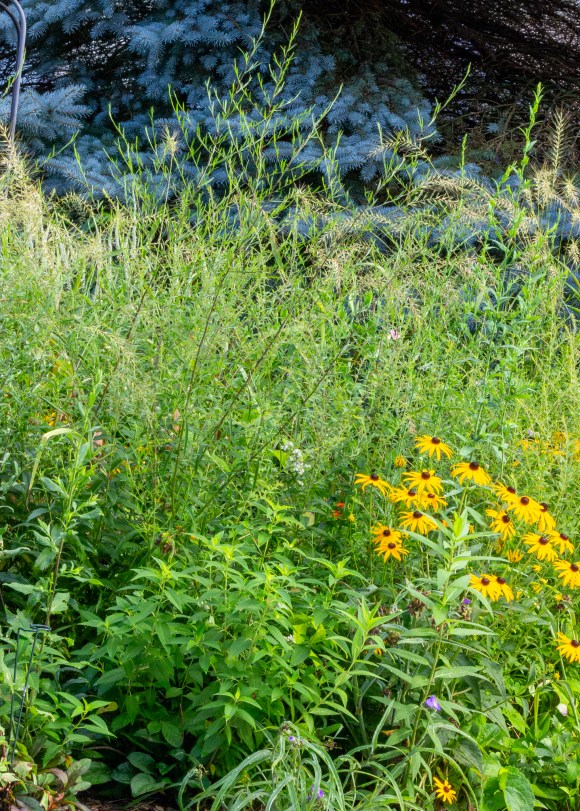
Rudbeckia hirta grows in Zones 3 through 8. It reaches from one to three feet and spreads between one and two feet. R. hirta’s height is a real bonus. It’s difficult to find native plants in that middle height range. Another reason to use it in a planned garden.2,3,4
Black-eyed Susans adapts to a variety of conditions but does enjoy some ideal conditions. Full sun and slightly moist to moderately dry soil with moderate fertility gives the best bloom to foliage ratio.3
But Black-eyed Susans also grow in moist, well-drained clay, loam or sandy soil. Any fairly fertile soil will do. Too many nutrients, such as near a fertilized lawn, encourage leaves over flowers.
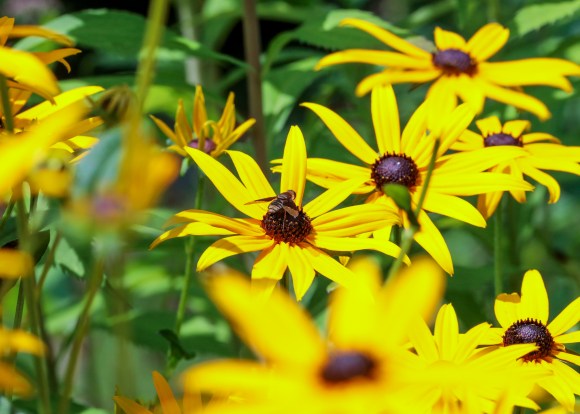
In natural areas, Rudbeckia hirta lives in mesic to dry prairies, woodland edges and openings, mesic to dry upland forests–particularly rocky areas, meadows, limestone glades, plains and savannas. In developed areas, Black-eyed Susans grow along railroads and roadsides, in waste areas, on eroded clay slopes, pastures, abandoned fields and assorted waste areas. They thrive on disturbed sites and recover well from fire.4
In the garden, Rudbeckia hirta grows quickly from seed and often flowers the first year. Each plant is short-lived acting as an annual, biennial or short-lived perennial depending on the growing conditions. Black-eyed Susans remain in the garden by reseeding. They don’t reproduce by rhizomes.
It’s a good plant for prairie restorations and wildflower gardens since it blooms the first year. In the beginning, R. hirta appears to dominate the plantings. Longer lived perennials generally outcompete it for a better balance.
For those interested is in restoration or land management, the USDA-Forest Service has excellent resources in their Fire Effects Information System (FEIS). The publications are peer-reviewed. Four types of publications are created at the USDA-FS with information drawn from peer-reviewed sources. Lists of reference articles are available.1
Two document types help when looking for information on a specific species. I used a Species Review to find associate plants for Black-eyed Susans in natural ecosystems. There are 1,100 Species Reviews available.1
In addition, FEIS has Fire Studies. These contain much information on the fire itself but also how different species react to fire. The best way to find information is to search the species name on the FEIS home page. It’s also possible to do an advance search for the species in the Species Reviews or Fire Studies.1
The Species Reviews have a section on Habitat Types and Plant Communities that provides lists for plant associates. This information could be useful for creating more natural wild gardens, restorations and in land managements. One example is a wet prairie in southwest Michigan included Black-eyed Susans with goldenrods (Solidago spp.), sedges (Carex spp.), Indian grass (Sorghastrum nutans), marsh fern (Thelypteris palustris), queen-of-the-prairie (Filipendula rubra), purple meadowrue (Thalictrum dasycarpum), prairie cordgrass (Spartina pectinata), and cowbane (Oxypolis pectinata).1
In addition to natural communities, the USDA-Forest Service FEIS document discusses several restorations using R. hirta. It covers this plants’ reactions to pollutants like ozone and cadmium and a great deal more. The FEIS material is an excellent resource for anyone interested in Rudbeckia hirta either in the garden, in managing lands or in a nature area.1
Disease and pests don’t usually bother Black-eyed Susans. They may have powdery mildew especially when planted in moist places and in the Fall. Slugs and snails are also occasionally a problem. Deer and other herbivore rarely eat it since the stems, leaves and phyllaries are covered in tiny hairs and it has little food value.
The greyish-green leaves of Rudbeckia hirta alternate along the stem. Covered in stiff, short hairs, they grow up to 7 inches long and 2 inches wide. These hairs provide part of its name. Hirta means hairy.

The foliage is lanceolate, oblanceolate or ovate in shape. Leaf margins may or may not have blunt teeth and are fringed with tiny hairs. Long petioles attach lower leaves while middle and upper leaves have short petioles or clasp the stem.
Black-eyed Susans blooms from early Summer into the Fall and blooms are carried singly on each stem. As composite flowers, each is made up of disc florets and ray florets. Many dark brown disc florets fill the center of each flower. They start out as a tightly packed, flattened disc. As each one opens, the anthers appear. The yellow pollen creates a ring that moves up as the florets open. The disc of florets expands until it forms a cone.
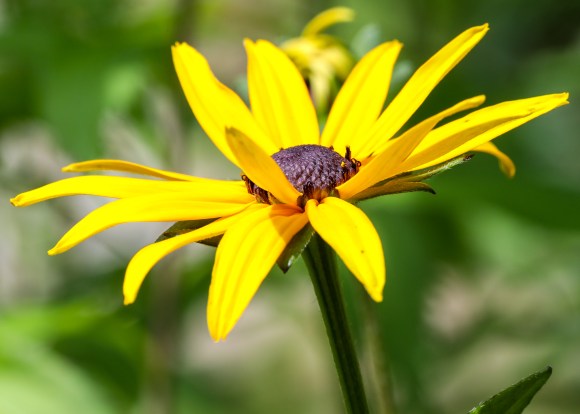
Each bloom has 8 to 20 bright yellow ray florets a.k.a. The whole flower is 2 to 3 inches across. They last a long time since the bright yellow petals continue after the disc florets finish blooming. In hot areas, plants flower longer with some afternoon sun.
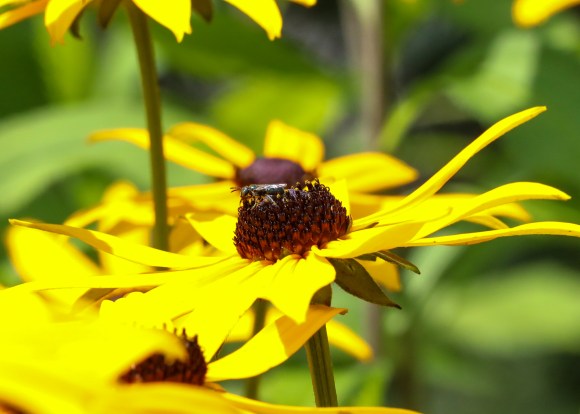
Black-eyed Susans host numerous insects providing pollen and nectar. It serves as a larval host. Bees and flies, some wasps, beetles and butterflies visit it.5,6
Rudbeckia hirta is one of those flowers with nectar guides or landing zones for bees. Bees see into the ultraviolet zone unlike humans. Certain flowers have special marking to lead the bees to their resources.5,6
Possible markings include lines going to the flower center or spots near the center. R. hirta has patches forming a ring around the center. This area absorbs UV and has a dark brown color in UV light. This visual clue can be seen from a distance to advertise the floral resources.5,6
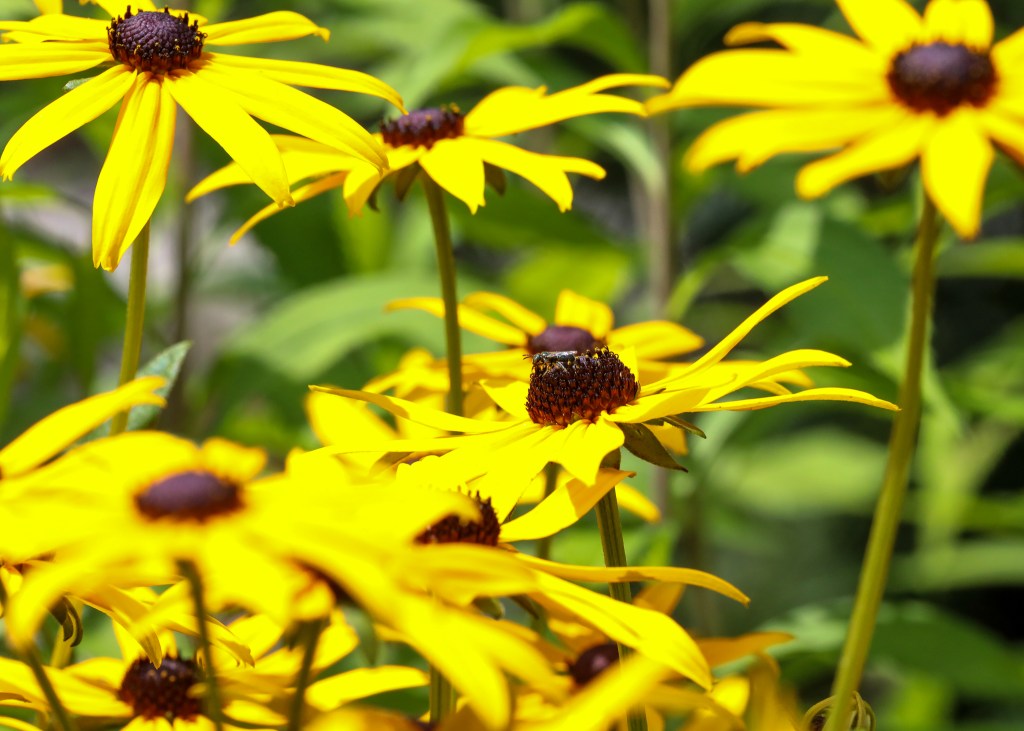
Numerous middle-sized bees visit the Black-eyed Susans. These include Honeybees (Apis spp.), Long-Horned Bees (Melissodes spp.), Leafcutter Bees (Megachile spp.), and Cuckoo Bees (Coelioxys spp.) Long-Horned Bees (and others) collect pollen by following the ring of open florets around the cone.5,6
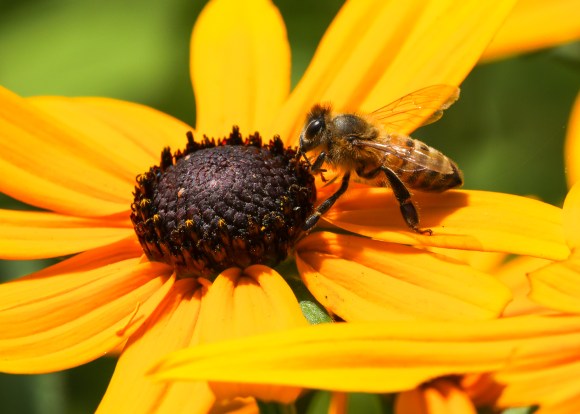
It also has several specialist bees including Andrena rudbeckiae, Pseudopanurgus albitarsis, P. rudbeckiae, Melissodes denticulatus, M. druriellus, M. illatus, Megachile pugnata, and M. xylocopoides.
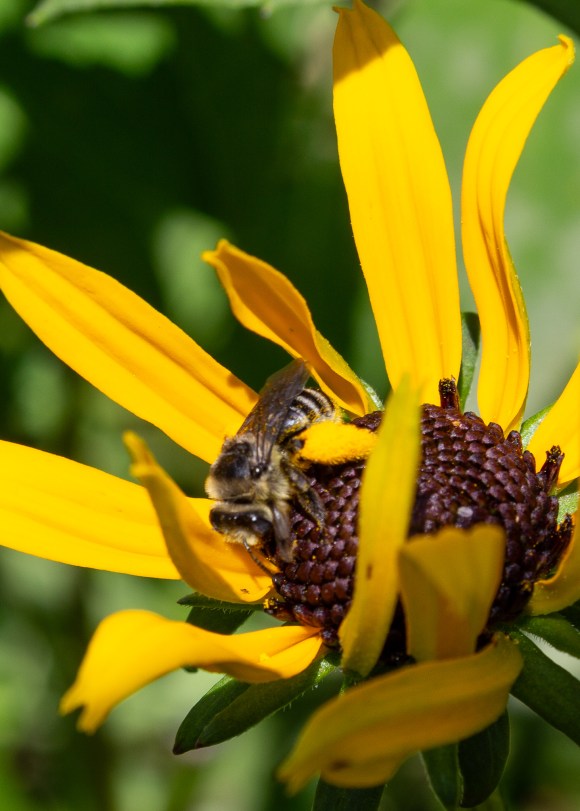
Many references list Bumble Bees (Bombus spp.) using Rudbeckia hirta. In my garden, I see mostly small bees and flies. I wonder if this because I have Bumble bee magnets like Coreopsis, Silphium, Monarda, Veronicastrum, Agastache and Rudbeckia lanciata.5,6
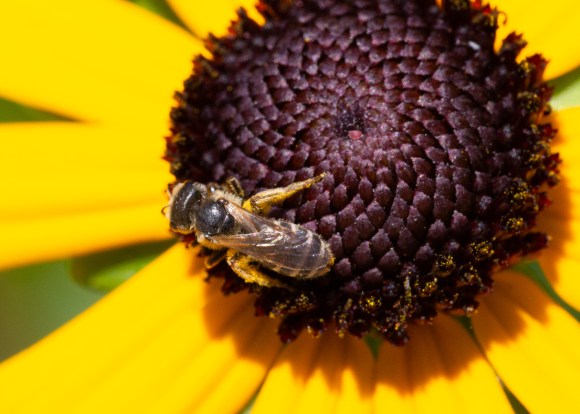
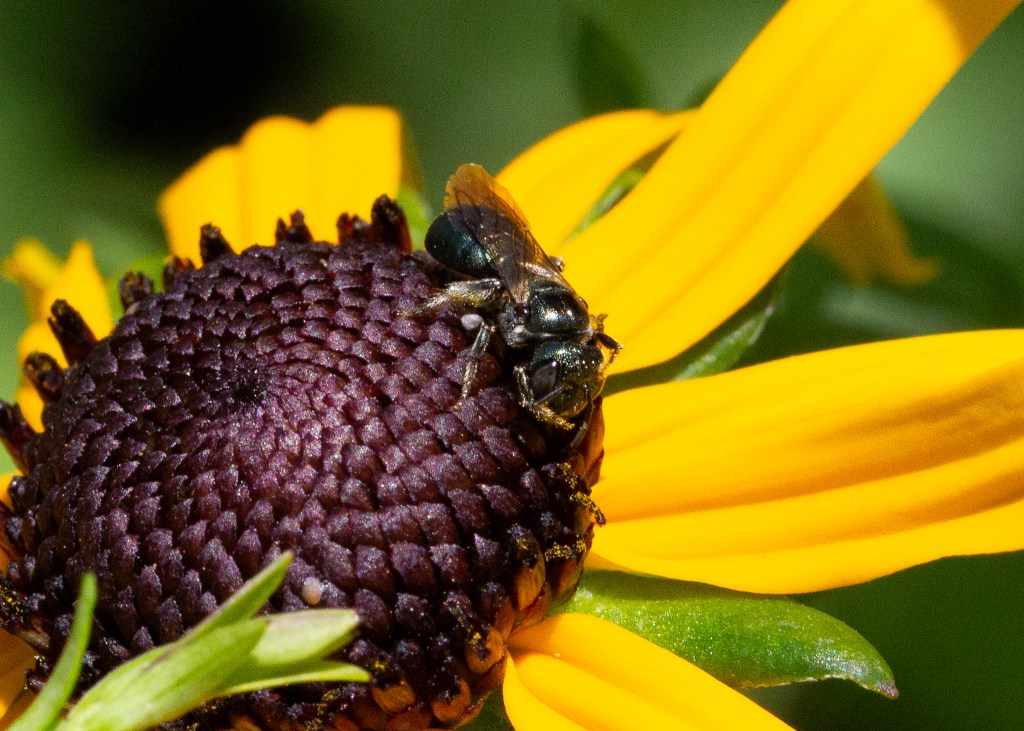
The small bees visiting Black-eyed Susans included Sweat Bees (Halictus spp.), Green Sweat Bees (Agapostemon spp., Augochlorini Tribe), and Small Carpenter Bees (Ceratina spp.).5,6
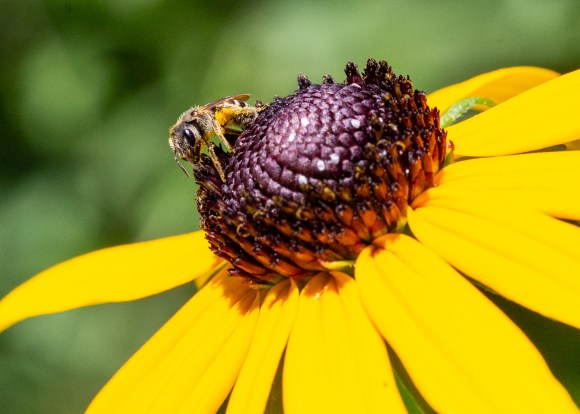
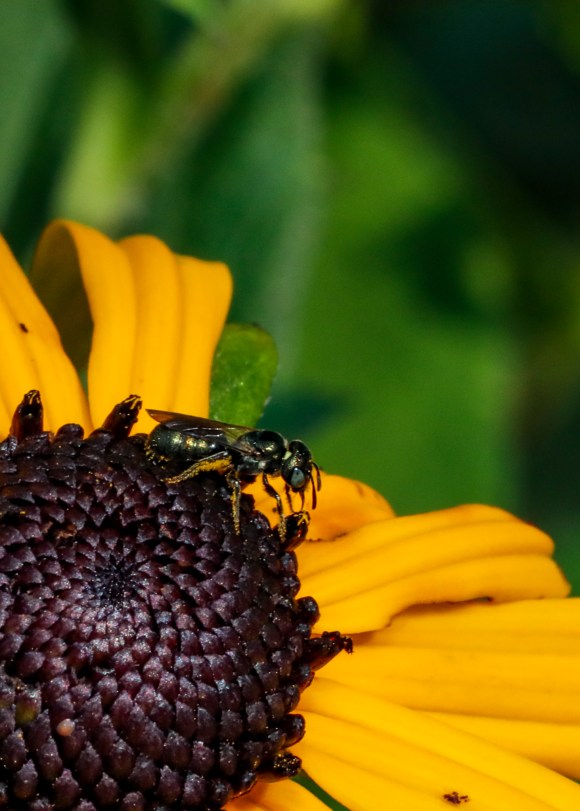
Many wasps use Rudbeckia hirta including Bee Wolves (Philanthes spp.), sand wasps, mason wasps, thread-waisted wasps .6
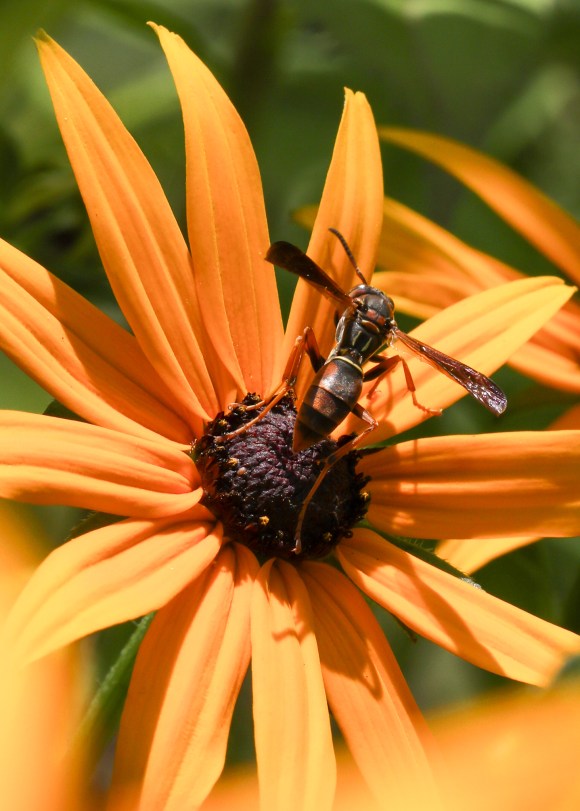
Bee flies visit Black-eyed Susans especially those from the family Bombyliidae. They gather both pollen and nectar.6
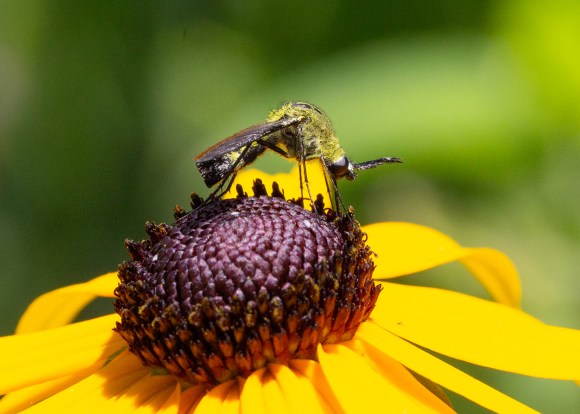
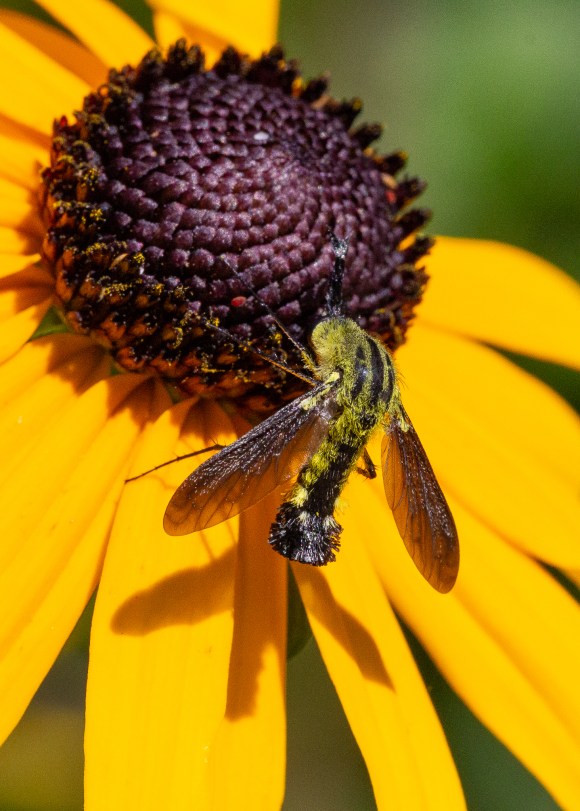
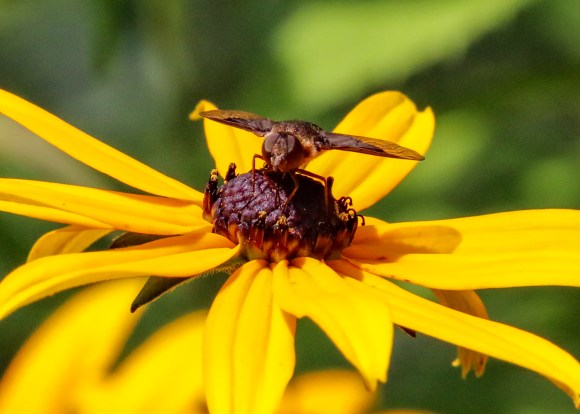
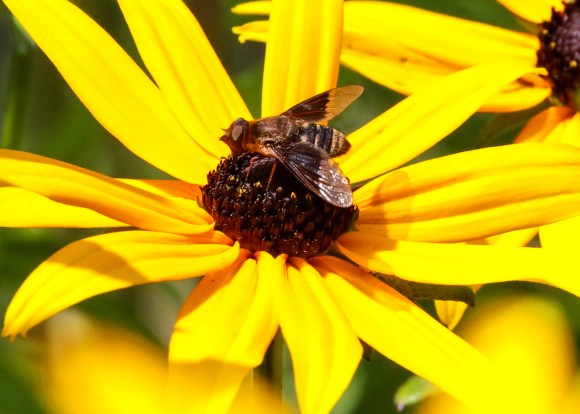
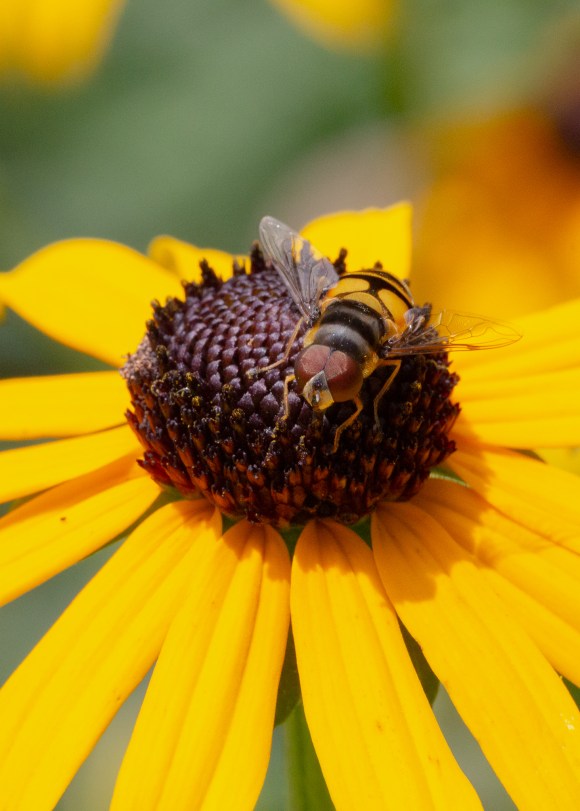
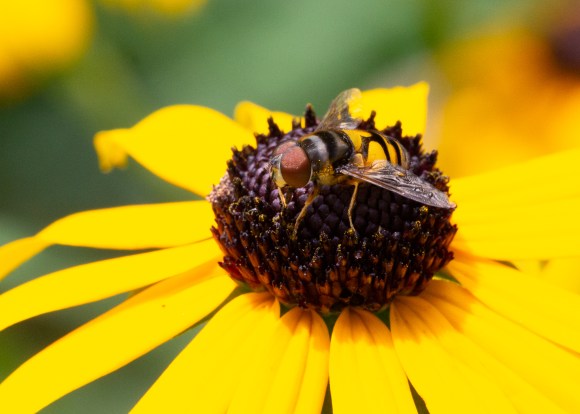
In addition, Syrphid flies harvest pollen and nectar. They use their front legs to hold the anthers. Then they lap up the pollen with their mouthparts.6
Rudbeckia hirta serves as a larval host for both moths and butterflies. Wavy-Lined Emerald Moth ( Synchlora aerata) and Southern Emerald Moth (Synchlora frondaria), Common Eupithecia (Eupithecia miserulata), Gorgone Checkerspot Butterfly (Chlosyne gorgone), Bordered Patch Butterfly (Chlosyne lacinia) and Silvery Checkerspot Butterfly (Chlosyne nycteis) all lay eggs on R. hirta.4,6
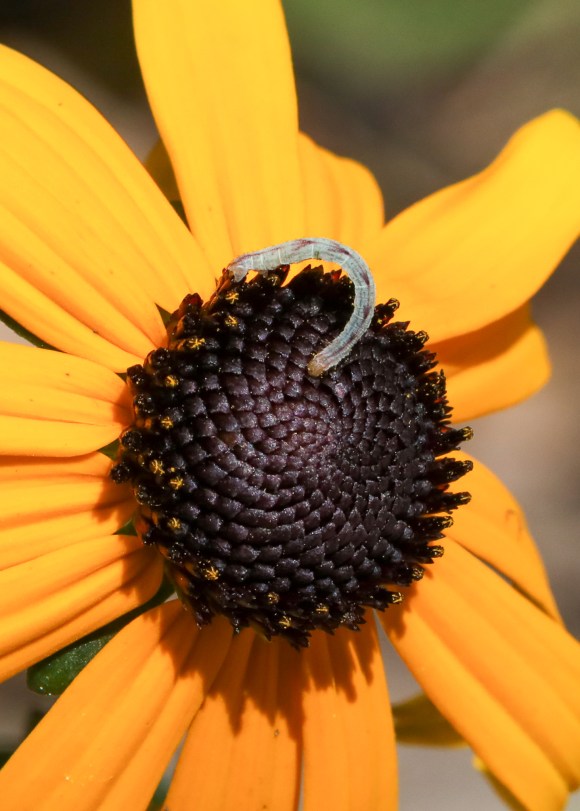

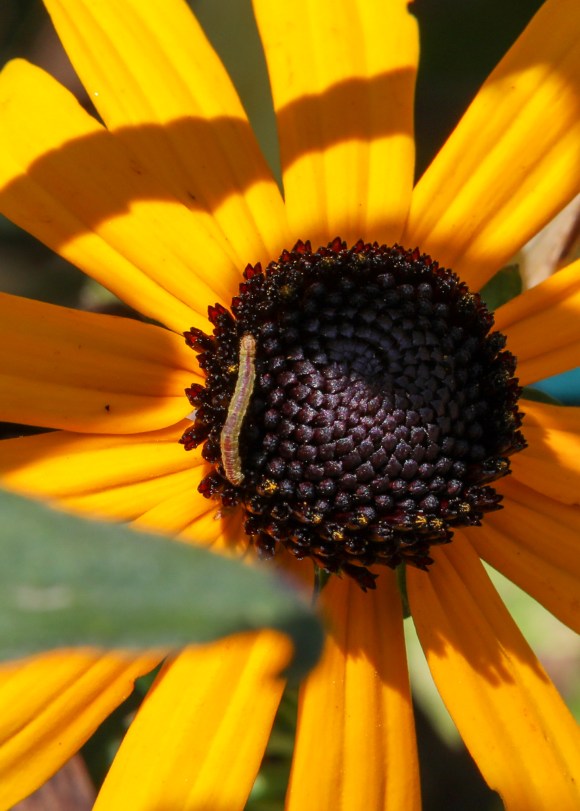
The Silvery Checkerspot Butterfly is an intricately marked, 1.25- to 2-inch-wide butterfly. It’s part of the Brush-footed family (Nymphalidae)—the largest family of butterflies in the world. Brush-footed butterflies include monarchs, fritillaries, crescents, anglewings, ladies, admirals, emperors, satyrs, and more.7
The name comes from the brush-like hairs on their short forelegs. These hairs are sensitive to taste and touch. Females use them to find larval host plants. These brush feet also locate nectar and other high sugar liquids the adult butterflies need for food.7
The Silvery Checkerspot Butterfly uses many members of the aster family for larval hosts including Black-eyed Susans, native asters (Symphyotrichum), and sunflowers (Helianthus). Females lay eggs on the bottoms of leaves.
Young caterpillars stay in groups with up to 50 on a leaf. They eat the entire leaf except the veins and then move on. The third-instar larvae winter over.7
I hope you enjoyed reading about Black-eyed Susans as much as I have. I’d love to hear about your plant adventures in the garden or the wild! Please feel free to contact me with a story, comment or question!
Happy Gardening,
Mary
BIBLIOGRAPHY:
- “Rudbeckia Hirta.” Accessed March 4, 2025. https://www.fs.usda.gov/database/feis/plants/forb/rudhir/all.html.
- “Rudbeckia Hirta – Plant Finder.” Accessed March 4, 2025. https://www.missouribotanicalgarden.org/PlantFinder/PlantFinderDetails.aspx?taxonid=277225.
- “Rudbeckia Hirta (Black Eyed Susan, Black-Eyed Susan, Gloriosa Daisy) | North Carolina Extension Gardener Plant Toolbox.” Accessed March 4, 2025. https://plants.ces.ncsu.edu/plants/rudbeckia-hirta/.
- “Rudbeckia Hirta (Black-Eyed Susan) | Native Plants of North America.” Accessed March 4, 2025. https://www.wildflower.org/plants/result.php?id_plant=ruhi2.
- Holm, Heather. Bees: An Identification and Native Plant Forage Guide. Minnetonka, MN: Pollination Press LLC, 2017.
- Holm, Heather. Pollinators of Native Plants: Attract, Observe and Identify Pollinators and Beneficial Insects with Native Plants. Minnesota: Pollination Press LLC, 2014.
- Missouri Department of Conservation. “Silvery Checkerspot,” January 31, 2024. https://mdc.mo.gov/discover-nature/field-guide/silvery-checkerspot.
- NC State News. “What Colors Do Bees See? And How Do We Know?,” July 27, 2024. https://news.ncsu.edu/2024/07/27/wms-what-bees-see/
 Wild Things in the Garden