Big, bold and filled with butterflies, Sweet Joe-Pye Weed (Eutrochium purpureum) stands out in any garden. Large mauve-purple flowers feed masses of pollinators. Not only do butterflies, moths and skippers nectar at the blooms but various caterpillars feed on it.10
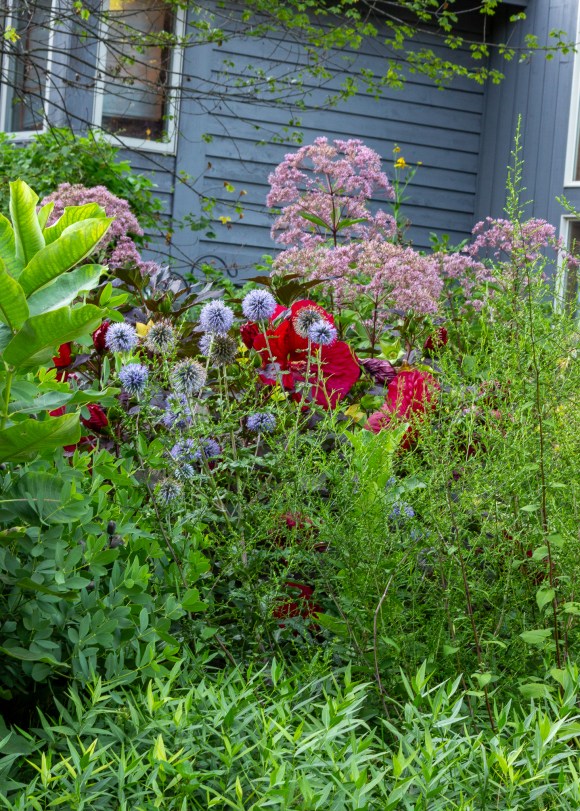
Eutrochium purpureum grow in zones four to nine. It usually ranges from three to seven feet tall. In a drier location, it can flower at only one foot high and, in an ideal spot, can reach eight to ten feet.2,3,10
It prefers partial shade to full sun and moist to medium, even moisture conditions. Rich, loamy soil is ideal. Eutrochium purpureum spreads by seeds and runners.
In nature, it’s found in open woodlands, partially shaded seeps, savannas, partially shaded riverbanks and streambanks, thickets, in open woodlands, wet meadows, wooded slopes and low moist ground.2,3,8,10
Given these natural habitats, Sweet Joe-Pye weed easily adapts to wildflower gardens, naturalized landscapes and perennial borders. Its moisture tolerance means Eutrochium purpureum enjoys the edges of rain or water gardens. Recently, Sweet Joe-Pye Weed began self-seeding near my rain gardens. Finally, it suits both formal and informal settings.
Sweet Joe-Pye Weed will react to less-than-ideal conditions. In full shade, it becomes leggy and may fall over. If it dries out, its leaves turn yellowish green.
In my garden, it grows tallest in a rainy year. In partial shade, the plants thrive even without extra water. In full sun, the plants are more likely to need staking possibly from too little water. 1,2,3,10
If a shorter plant is preferred, Sweet Joe-Pye Weed can be cut back to approximately two feet in late spring or early summer. These plants usually bloom around the same time as those that haven’t been cut. The flowers are a generally a little smaller than usual.1
Don’t give up on this one in the Spring! It tends to sleep late and the stems develop randomly. But it has been a very reliable grower in my garden—returning with full and abundant growth each year.
Chicago Botanic Garden grew a variety of Eutrochium spp. and related plants in an evaluative study between 2001 and 2013. They trialed each genus between four and six years. Eutrochium purpureum performed well each year with flowers up to twelve inches across. It suffered from powdery mildew one year but not in others.1
Sweet Joe-Pye Weed has a straight, unbranched, light green stem giving the plant an outstanding erect habit. The leaf nodes are enlarged and naturally purple. Some plants have more purple on the stem than others. 2,3,10
Shallow, fibrous roots support the plant. Sweet Joe-Pye weed spreads as a clump as well as self-seeding. If it grows in an unwanted place, the plants are easy to pull.
Eutrochium purpureum’s leaves form an attractive whorl around its stem. Growing in groups of three to five, the medium green, the matte leaves are ovate to lanceolate with lightly serrated edges. The lower surface is pale green and may be slightly hairy. Some ecotypes have vanilla-scented foliage.10
In mid-summer to early fall, Sweet Joe-Pye Weed’s magnificent flowers grace the garden. The main bloom sits at the top of the stem. On established plants, side blossoms form below this head adding to the show.
Each compound head can measure up to 12 to 18 inches across and are made up of one or more panicles. In my Southern Michigan garden, Eutrochium purpureum’s flowerheads range from five inches to twelve inches across. They are most often between five and eight inches.
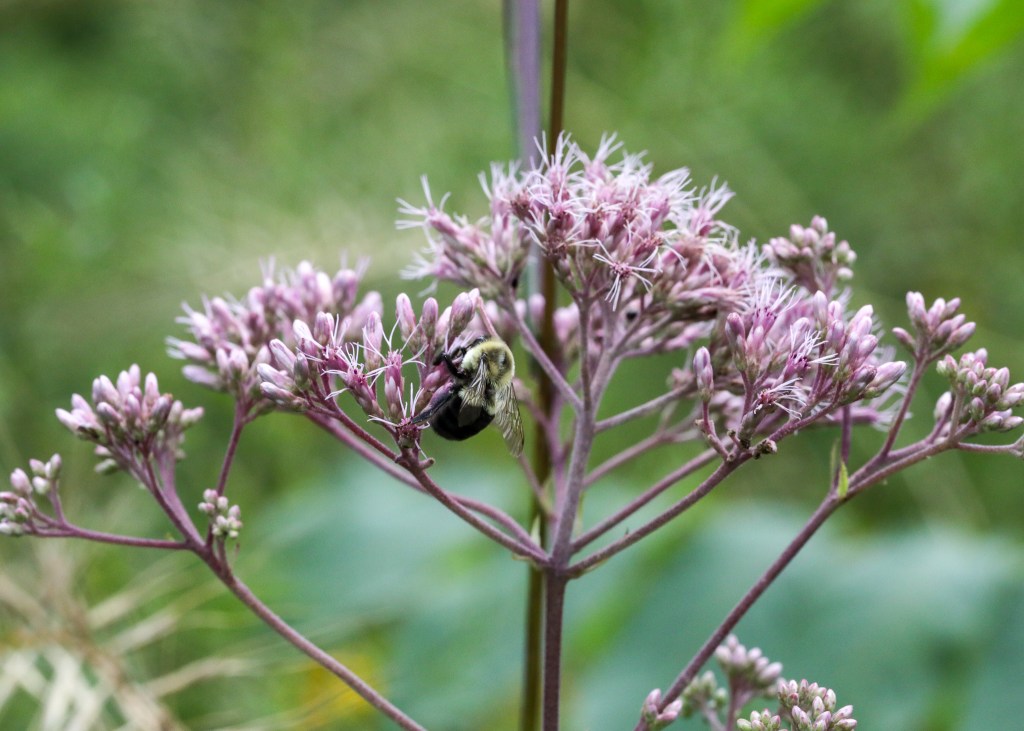
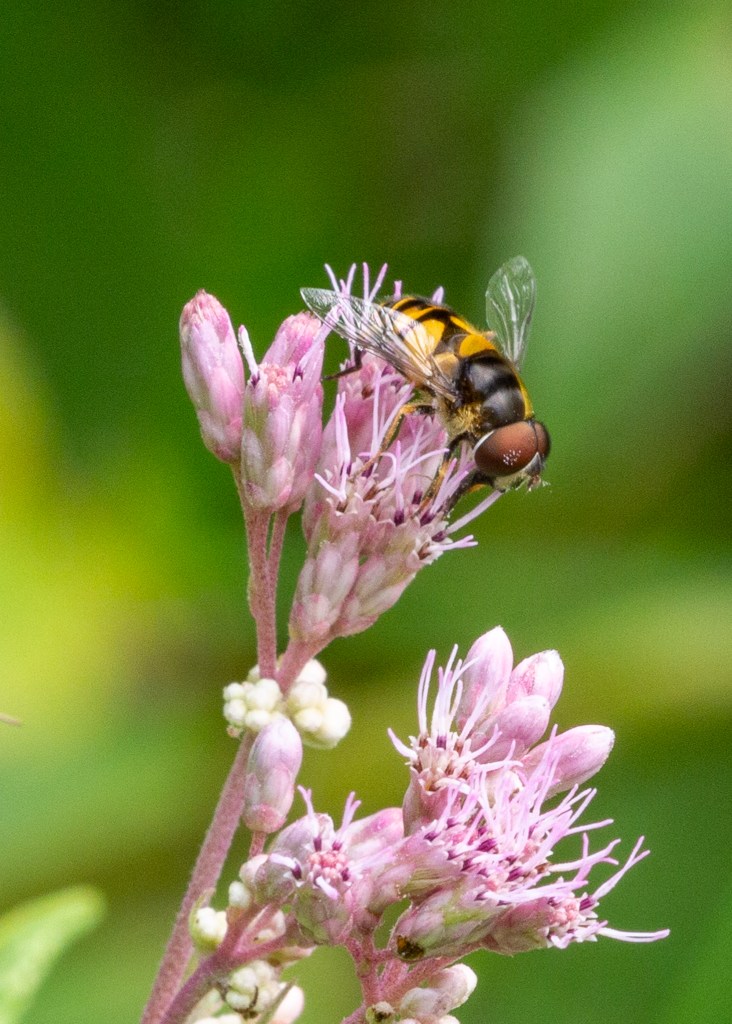
Blooms range from whitish pink to purplish pink. I find the more sun, the deeper the flower color. Plants growing in deep shade have almost white flowers. Flowers carry a vanilla scent.
These superb blooms have five to eight disk florets per panicle and no ray florets. The overall flowerhead is slightly dome shaped. Each floret has a series of overlapping pink, oblong bracts. As they open, a divided white style is strongly exerted (extended past the floret) giving the bloom a fuzzy look. 2,3,8,10
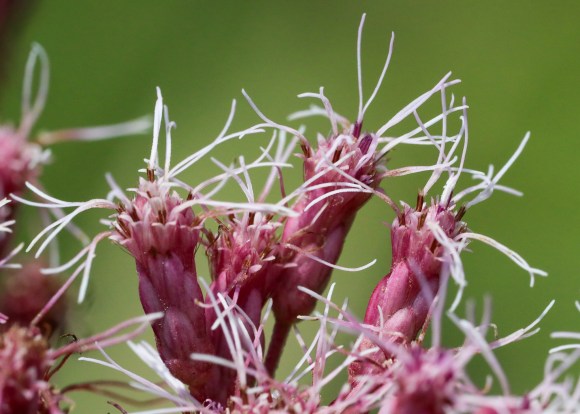
Numerous pollinators forage on the compound flowerheads of Sweet Joe-Pye Weed. Most seek out nectar. Eutrochium purpureum secretes its nectar at the base of the style. Each tiny, blooming floret offers a supply.2,3,8,10
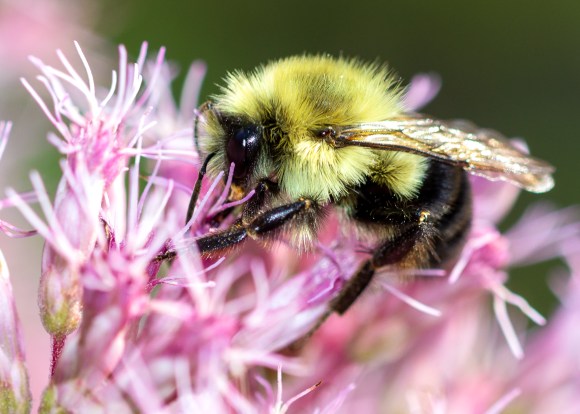
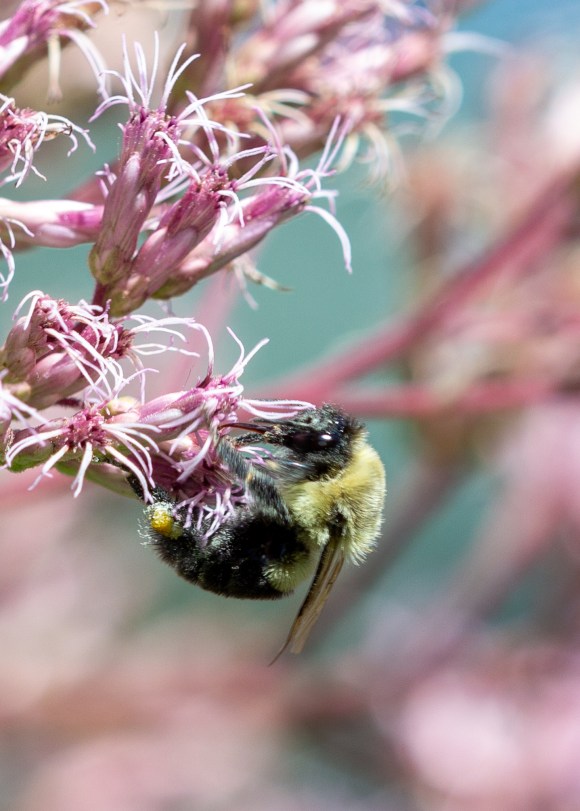
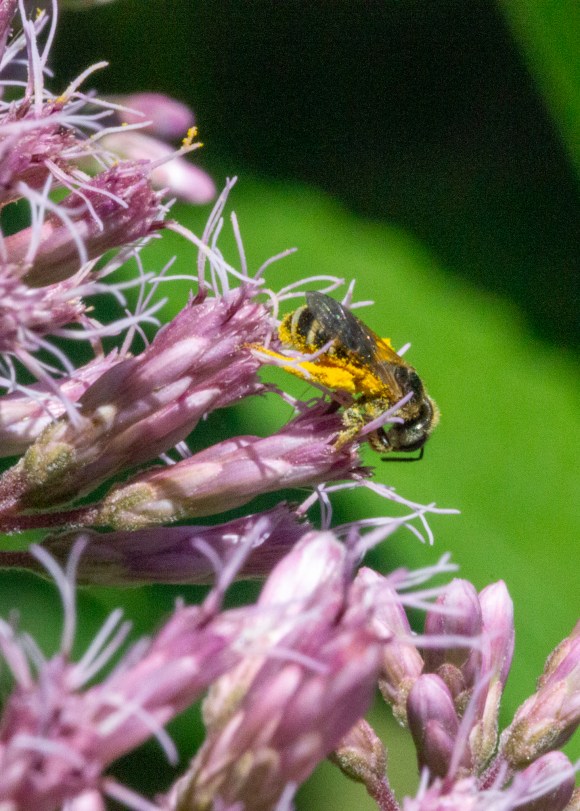
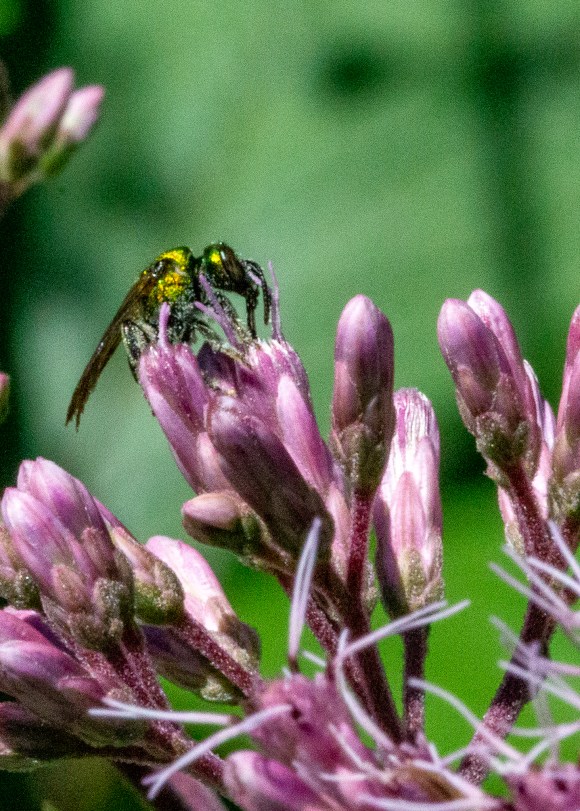
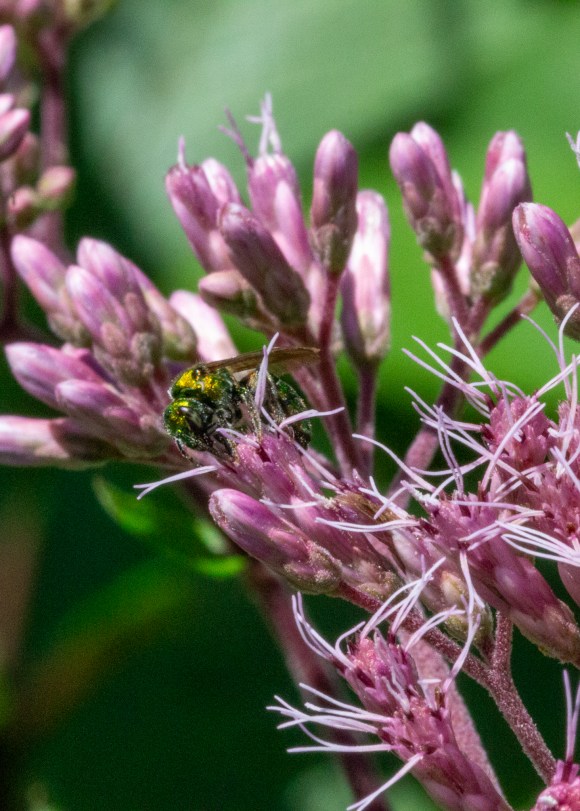
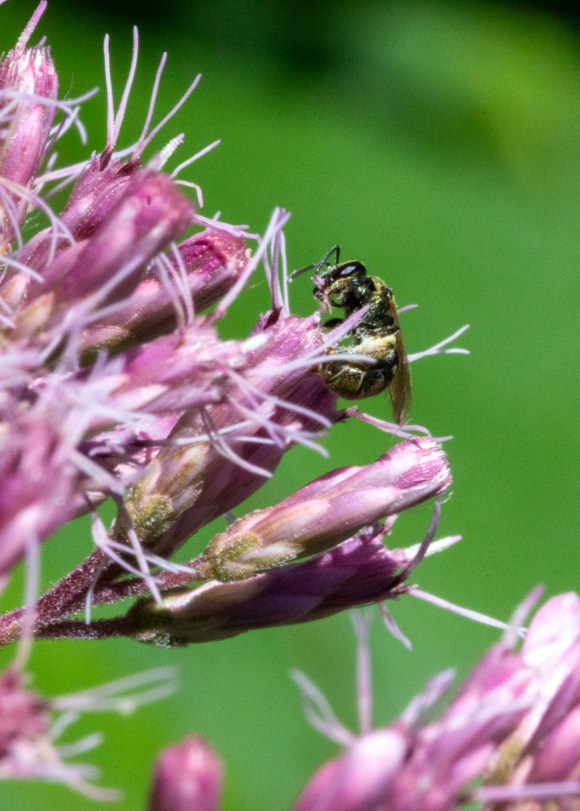
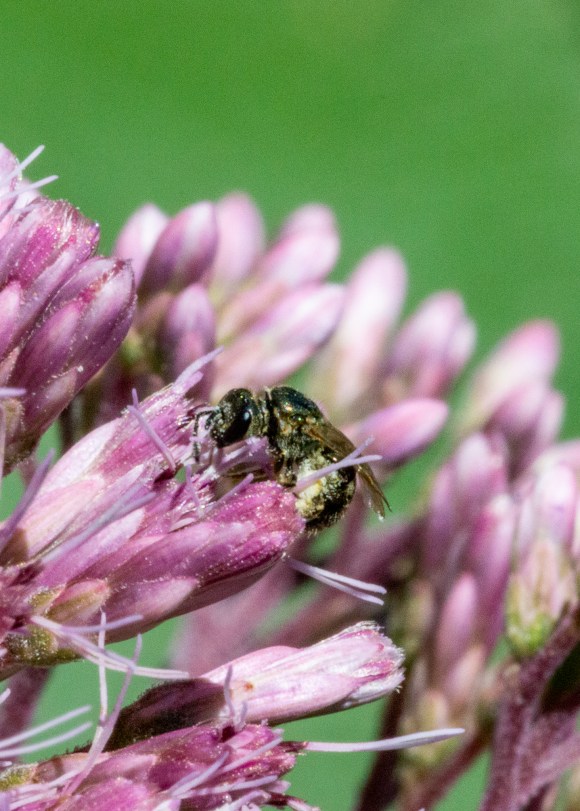
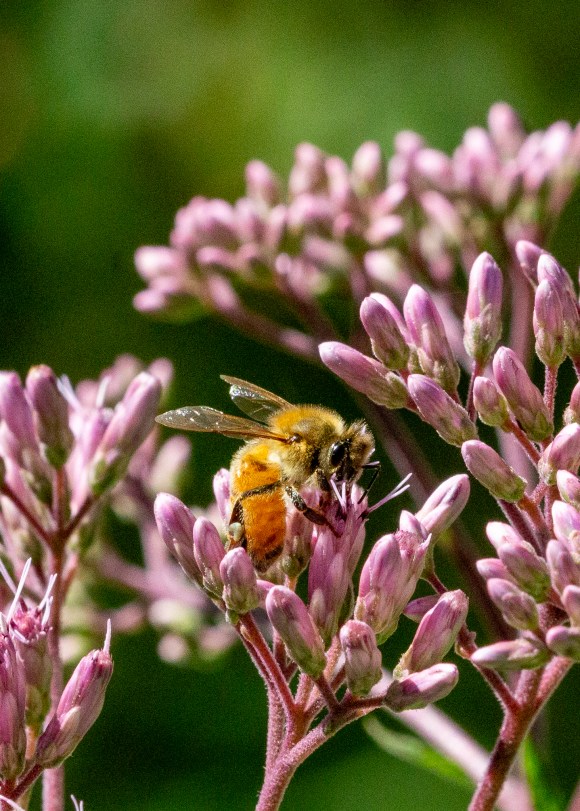
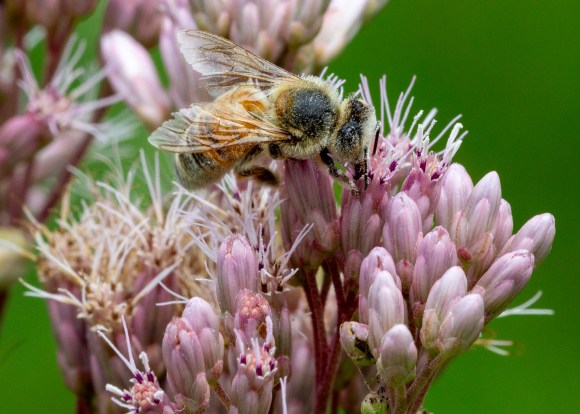
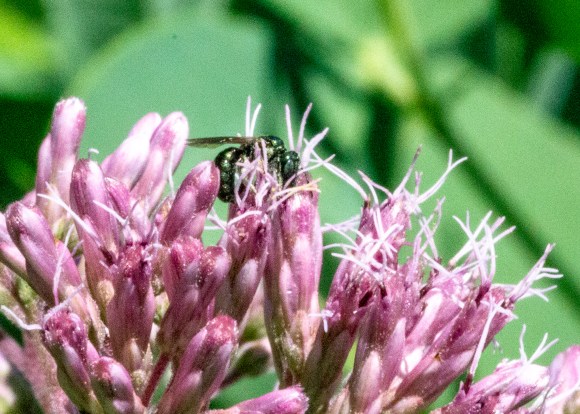
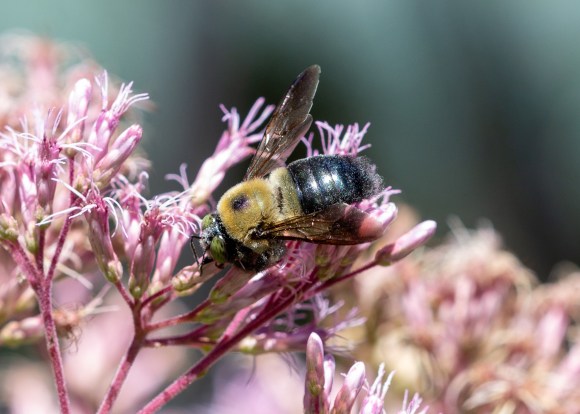
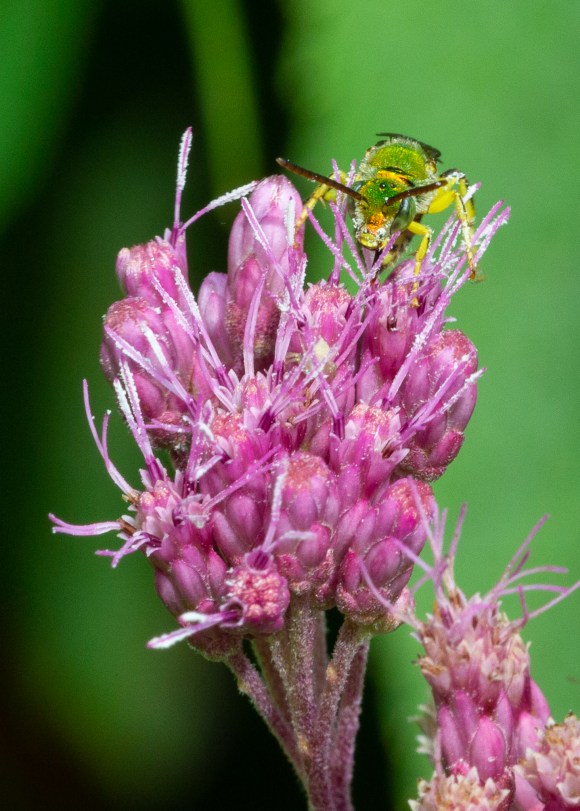
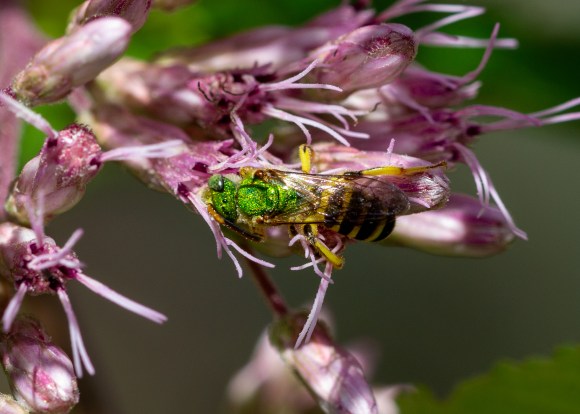
The Xerces Society for Invertebrate Conservation declared Eutrochium purpureum of Special Value to Native Bees.2 Visiting bees include Bombus spp. (bumblebees), Melissodes spp. (miner bees), Coelioxys (cuckoo bees), Agapostemon (metallic green sweat bees) and Megachile spp. (leaf-cutting bees). In my garden, I’ve also seen other sweat bees like Halictus spp., honey bees (Apis app.) and large and small carpenter bees, Xylocopa spp. and Ceratina spp.
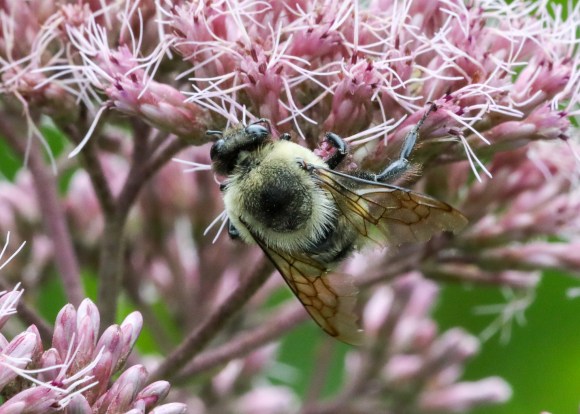
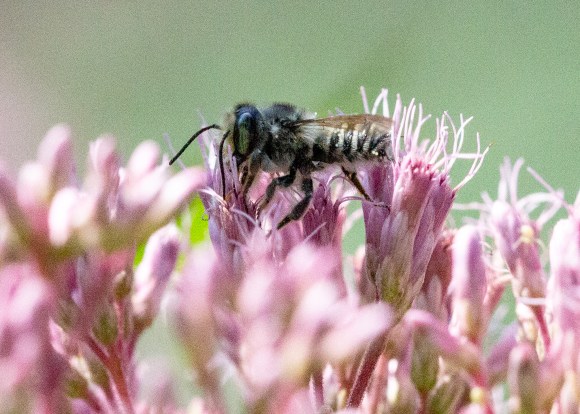
Most of these bees collect nectar. But Bombus spp. (bumblebees) and Melissodes spp. (miner bees) also gather pollen.8,10
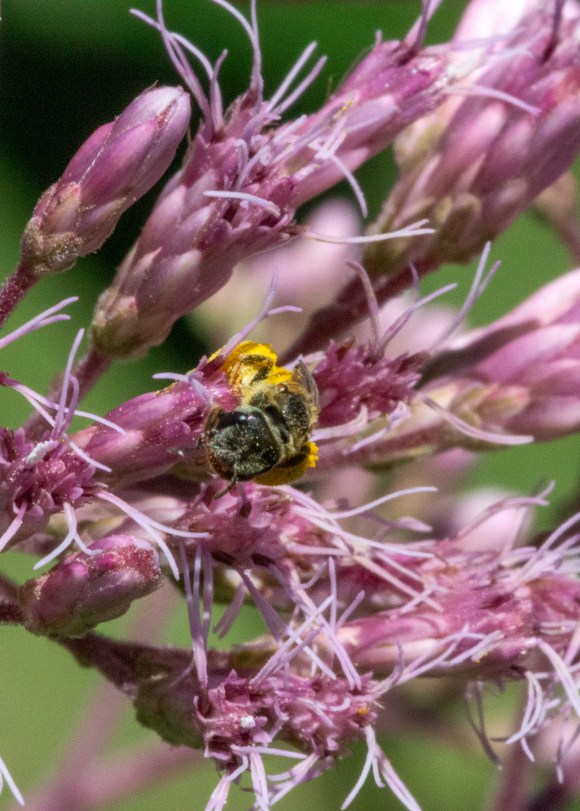
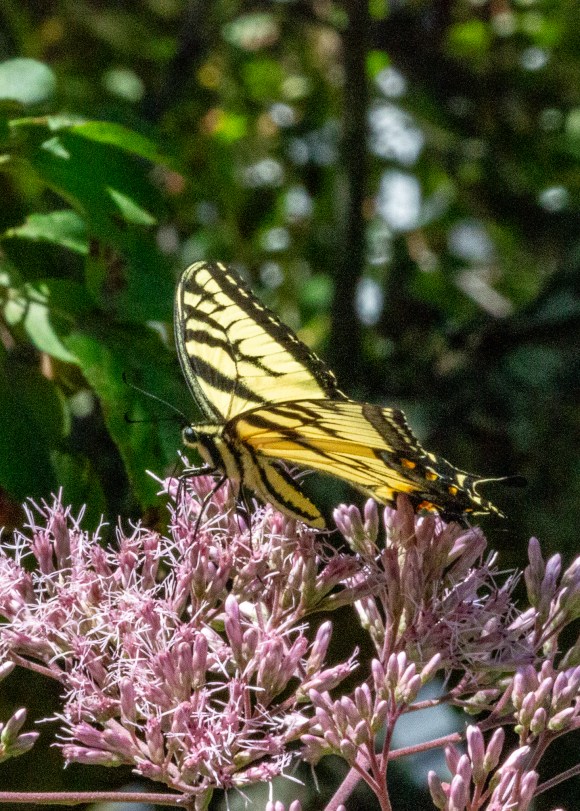
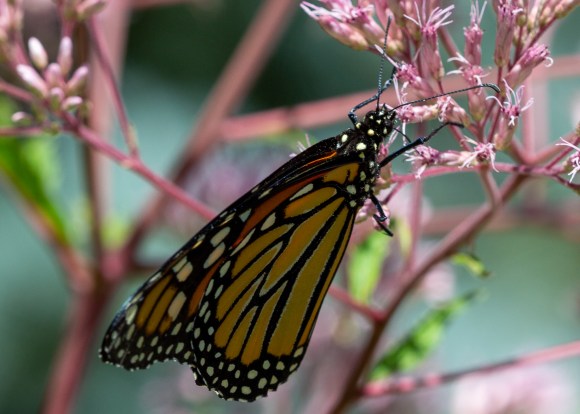
Butterflies, moth, and skippers seek out Sweet Joe-Pye Weed in the mid-summer to early fall. Celastrina(Azure Butterflies), Epargyreus clarus (Silver Spotted Skipper), Limenitis arthemis arthemis (White Admiral Butterflies), Nymphalis urticae (Milbert’s Tortoiseshell Butterflies), Papilio glaucus (Eastern Tiger Swallowtail Butterflies), and Danaus plexippus (Monarch Butterflies) sip the nectar from the fluffy, pink flowerheads.
Eutrochium purpureum is also a larval host supporting several moth caterpillars. These eat its leaves and other parts. Emmelina monodactyla (Common Plume Moth), Perigea xanthioides (Red Groundling), Phragmatobia fuliginosa (Ruby Tiger Moth), and Eupithecia miserulata (Common Pug) all feed on Sweet Joe-Pye Weed’s leaves. Carmenta bassiformis (Eupatorium Borer Moth) consumes the roots. Schinia trifasciata (Three-Lined Flower Moth) relies on its flowers. 4,5,6,8,9,10
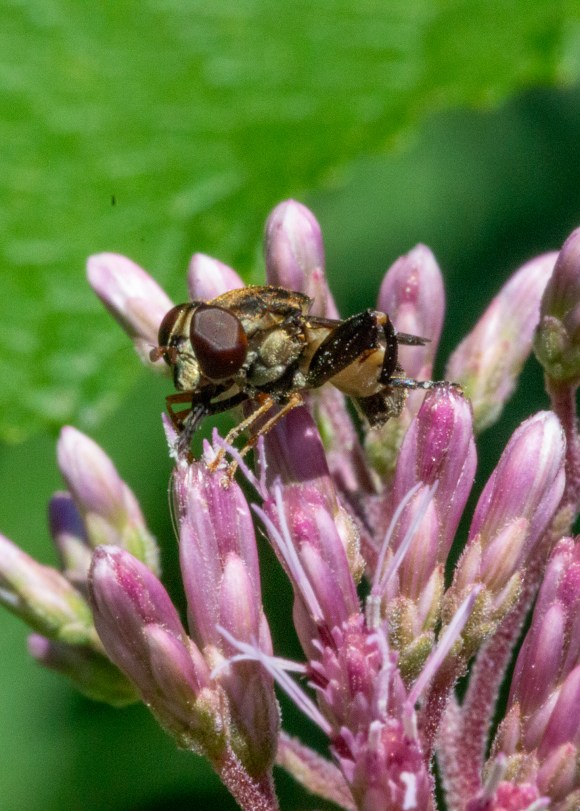
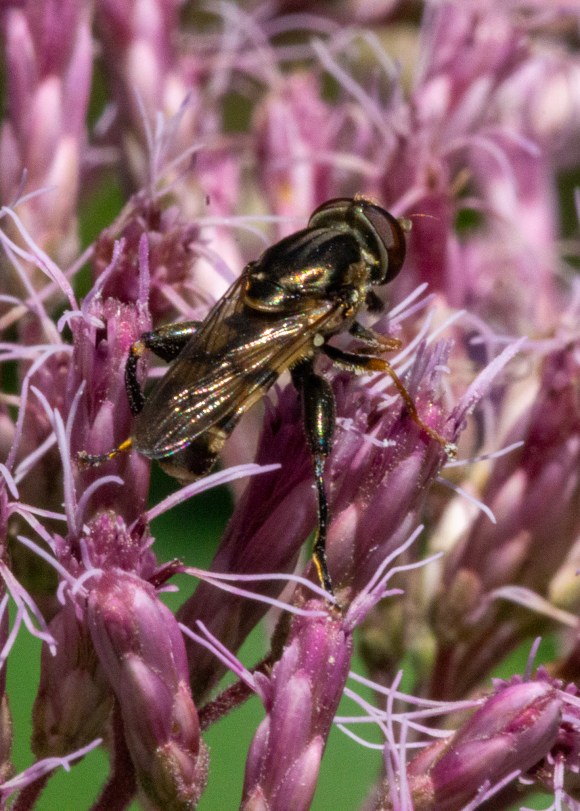
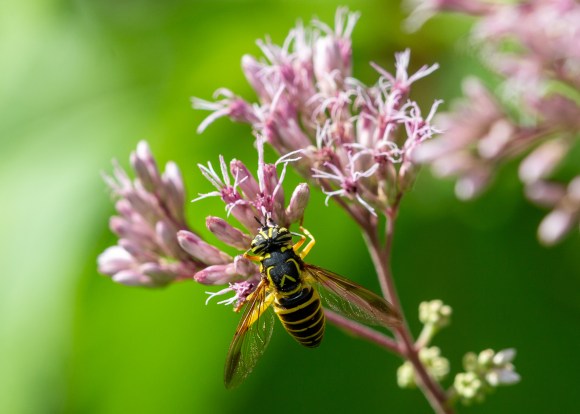
Beneficial insects are not particularly attracted to Eutrochium purpureum. Flies, thread-waisted and sand wasps occasionally visit. Instead, these short-tongued beneficials flock to another Eutrochium—the white blooming Boneset (Eupatorium perfoliatum).8 But that’s the subject for another blog!
I hope you’ve enjoyed hearing about Sweet Joe-Pye weed—a stunning, versatile and useful plant. Eutrochium purpureum is easily available at most native plant nurseries. Next year those big, fuzzy flowers could be blooming in your garden!
If you’ve enjoyed this blog and would like to leave a comment or share a story, please contact me in the box below!
Warm Regards,
Mary
References:
- Hawke, Richard. “A Comparative Study of Joe-Pye Weeds (Eutrochium Spp.) and Their Relatives,” n.d.
- “Eutrochium Purpureum (Gravel Weed, Indian Sage, Joe-Pye Weed, Marsh Milkweed, Motherwort, Pride of the Meadow, Purple Joe-Pye Weed, Sweet Joepyeweed) | North Carolina Extension Gardener Plant Toolbox.” Accessed October 20, 2024. https://plants.ces.ncsu.edu/plants/eutrochium-purpureum/.
- “Eutrochium Purpureum (Purple Joepyeweed) | Native Plants of North America.” Accessed October 20, 2024. https://www.wildflower.org/plants/result.php?id_plant=eupu21.
- “Minnesota Seasons – Common Eupithecia.” Accessed October 30, 2024. http://www.minnesotaseasons.com/Insects/common_eupithecia.html.
- Missouri Department of Conservation. “Plume Moths.” Accessed October 30, 2024. https://mdc.mo.gov/discover-nature/field-guide/plume-moths.
- Missouri Department of Conservation. “Three-Lined Flower Moth.” Accessed October 30, 2024. https://mdc.mo.gov/discover-nature/field-guide/three-lined-flower-moth.
- “Perigea Xanthioides.” In Wikipedia, January 8, 2023. https://en.wikipedia.org/w/index.php?title=Perigea_xanthioides&oldid=1132346411
- Holm, Heather. Pollinators of Native Plants: Attract, Observe and Identify Pollinators and Beneficial Insects with Native Plants. Minnesota: Pollination Press LLC, 2014.
- “Species Phragmatobia Fuliginosa – Ruby Tiger Moth – Hodges#8156.” Accessed October 30, 2024. https://bugguide.net/node/view/41933.
- “Sweet Joe-Pye Weed (Eutrochium Purpureum).” Accessed October 20, 2024. https://www.illinoiswildflowers.info/savanna/plants/sw_joepye.htm.
 Wild Things in the Garden