From late Spring to mid-Summer, the blue-purple flowers of Spiderwort decorate the morning garden. These three petalled flowers offer pollen for pollinators and beneficial insects. While the flowers fade by afternoon, the lovely blue-green foliage graces the garden throughout the bloom period.
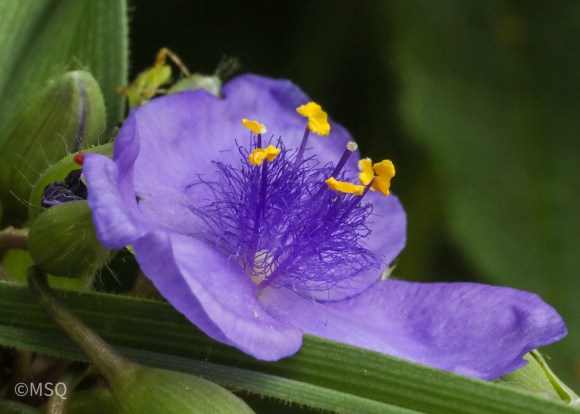
An adaptable plant, Tradescantia ohiensis thrives in acid-based, calcareous, limestone-based, sandy, sandy loam, medium loam and clay. It prefers full or part sun and the whole range from wet to dry conditions. The root system is not only fibrous but thick and fleshy.1
In natural settings, Spiderwort is widely scattered except in disturbed areas. It can create sizable colonies in these areas. Tradescantia ohiensis can be found in moist to mesic black soil prairies, sand prairies, thickets, limestone glades, woodland borders, Bur Oak savannas, sandy black oak savannas, roadside ditches, areas along railroads—including the ballast, and moist meadows near woods or rivers.1,3
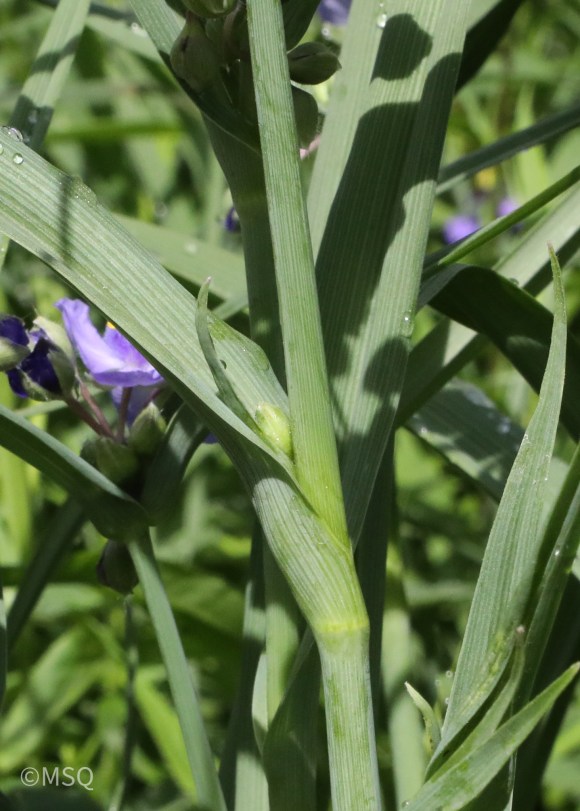
The foliage of Tradescantia ohiensis is vase-shaped with soft blue-green color. Its leaves wrap around the stems and then arch gently down narrowing to a point. Leaves are up to 15” long and one inch wide at the base. Stems are round. Both leaves and stems are usually glabrous (smooth with no hair or down).1
The charming flowers have three petals, an unusual number and shape combined with their unusual color. Blue is the rarest color bloom for native plants. These two features add to the plants’ garden appeal.
The top of the petals forms a rounded triangle. Each bloom has six bright, yellow anthers and fine hairy filaments under the anthers. The filaments are a slightly darker version of the flower color.1,3
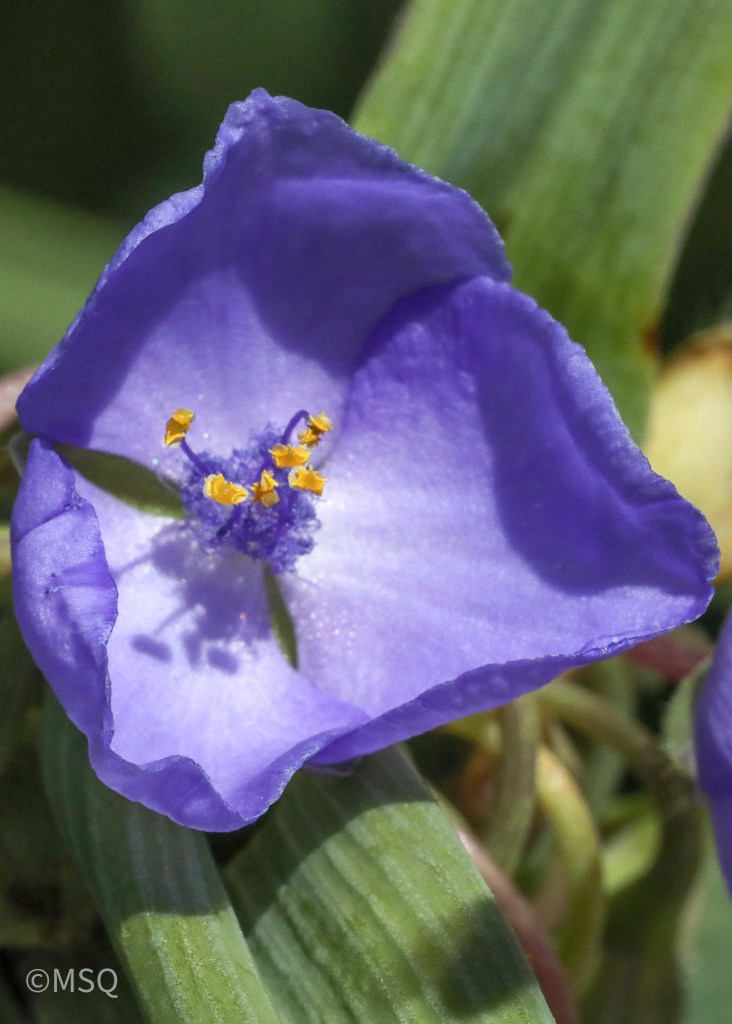
To avoid self-pollination, the anthers release their pollen first. Then they curve away from the style as it extends and becomes receptive. Essentially, the anthers move any remaining pollen away from the stigma (area on the top of the style).4
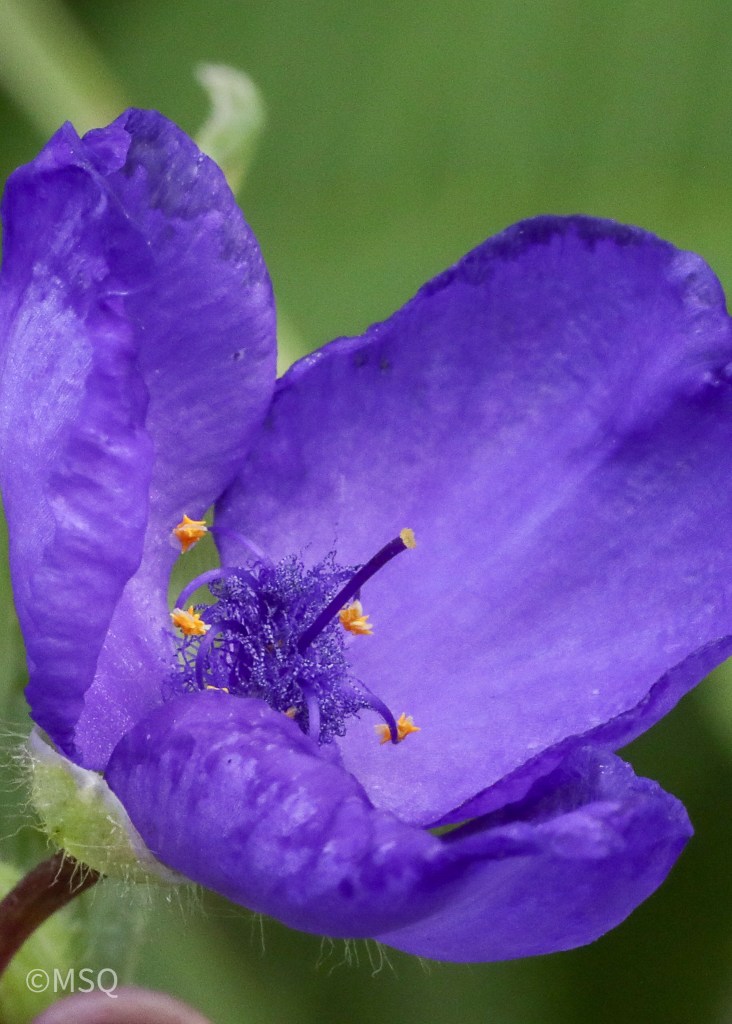
As it spreads and multiplies in the garden, color variations appear. In my garden, I have deep blue-purple flowers and blooms that are pale lavender with white centers.
The blossoms have unusual schedule. Each morning one to a few buds open from each group. They stay open until mid-day, sometimes longer on cloudy days. Then they wither and fade. All the buds finish by mid-summer.3
At that time, cut the plants back to between six and twelve inches. This pruning increases chances of a second bloom and helps keep the plants tidy.3,5
In some climates, Spiderwort dies back completely after blooming. This happens in my garden in the Great Lakes area. I have fall plants that fill in the space. This is similar to having perennials grow to cover where bulbs have faded. In the past, I’ve also used planters in the bare spots.
Managing Tradescantia ohiensis can be a bit of a challenge. In the garden, Spiderwort spreads easily to form large clumps. It can also self-seed when conditions are right. Sometimes considered a problem plant, Spiderwort is easily pulled.
Deer, rabbits and other herbivores eat Tradescantia ohiensis especially in the early Spring. I find this happens more when the plants are within the garden, away from foot traffic and people. A good herbivore deterrent helps.1
Xerces Society for Invertebrate Conservation declares Spiderwort of Special Value to Native Bees, Special Value to Bumblebees and (it) Attracts Beneficial Insects. Numerous bees, flies and beneficial insects visit these plants. Its long bloom season provides a reliable pollen source for many weeks. Bumblebees are primary pollinators for Tradescantia ohiensis.
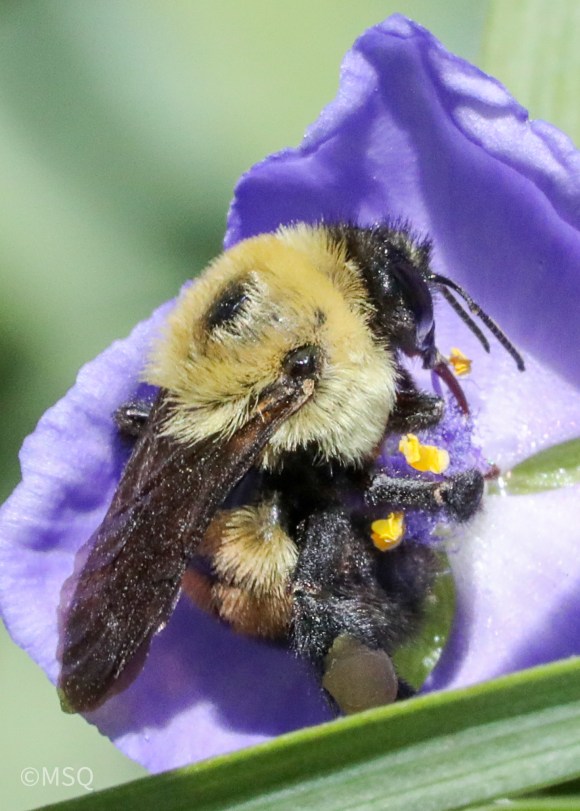
Bumblebees pollinate native and horticultural plants. They’re even used in some commercial agricultural settings. As a vital pollinator, I’ll be shining a spotlight on the lifecycle of one particular bumblebee–the Eastern Bumblebee (Bombus impatiens).6
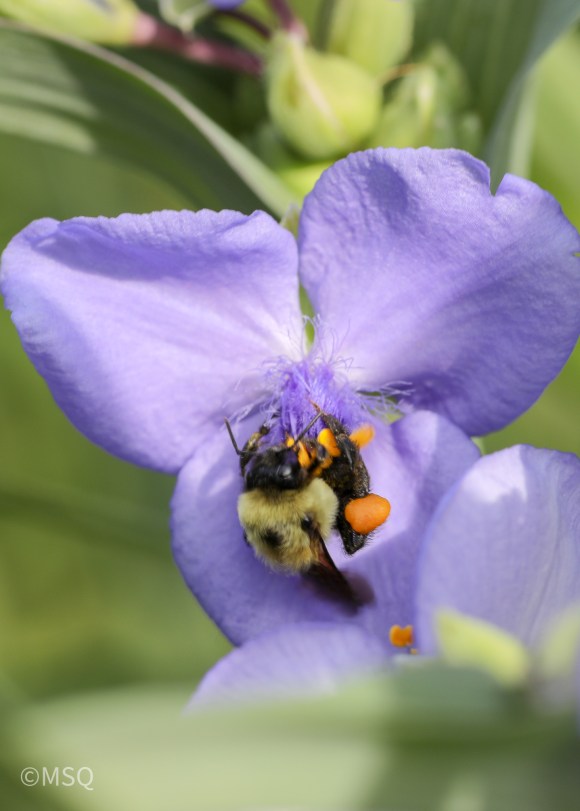
Bumblebees fly from early spring through fall and need resources for all this time. As generalists, they forage on many different flowers. The Eastern Bumblebee (Bombus impatiens) is a common visitor to Tradescantia ohiensis.
Bumblebees are social bees, living and raising their young in colonies. Colonies range from around 50 to hundreds of bees. The life of the colony begins in the Fall. Fertile female and male bumblebees hatch and go out to mate. The males search for females from a different colony.
After mating, the gynes (inseminated females) forage for about two weeks building up fat stores to support them for the winter. Then, they’ll look for a cozy place to overwinter. The gynes often choose old rodent holes or they burrow a few inches underground.
In Spring, the gynes emerge when the soil warms and flowers begin blooming. They search carefully for a nesting site. Possible spots include old rodent holes, spaces between two rocks, deep thatch in grass, tufts of dead grass, old bird feeders, and unused sheds or barns. The gyne looks for a sheltered, dry space for her colony.
I’ve followed several gynes in the Spring and I’ve yet to see one find her spot. The gyne spend a lot of time landing and exploring each area until she finds the perfect one.
Once the nesting spot is chosen, she creates a honey pot. The pot is made from wax secreted between her abdominal segments. The gyne fills this with nectar she has collected.
This nectar tides her over on cold, rainy Spring days when she can’t forage. The mature colony will maintain several honey pots for similar weather conditions and for workers who remain in the colony and don’t forage.
At this point, the gyne begins collecting pollen. She mixes the pollen with a little nectar and forms a ball. Multiple fertile (female) eggs are laid on the ball. Then she covers it with a wax coating.
The foundress (a gyne who has established a nest) continues foraging. When it is too cool to fly, she incubates her eggs by sitting on top of the wax and shivering. The eggs hatch in three to five days. If the foundress dies during this time, the larvae also die, and the nest will fail.
Once the eggs have become adult workers, the foundress at last becomes the queen. Unlike honeybees, the queen continues to gather food and the workers help her with harvesting and with caring for the larva. Also, unlike honeybees, workers can lay eggs. The queen suppresses this behavior with pheromones or aggression. If an egg is laid, the queen destroys it.
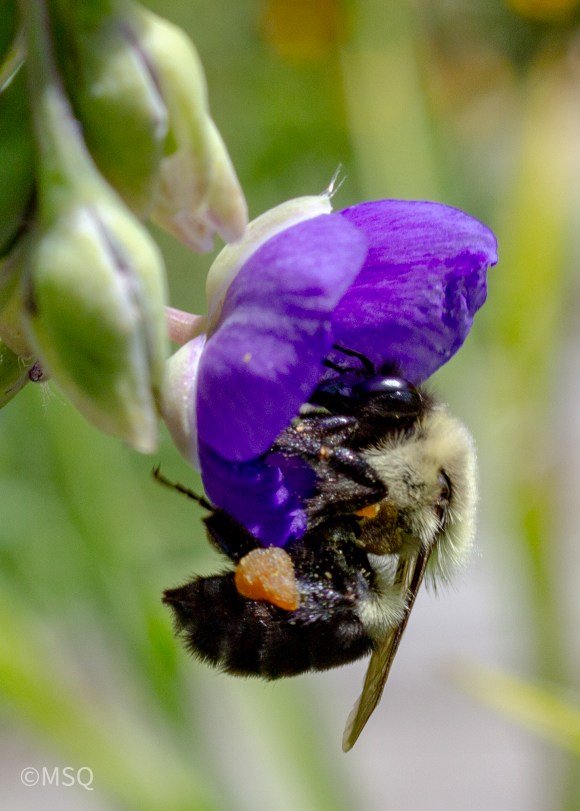
The colony life ends in late Summer or Fall. Close to this time, the queen lays unfertilized eggs which become male bumblebees. She also lays fertilized eggs that are feed additional pollen. These eggs become next year’s gynes.6
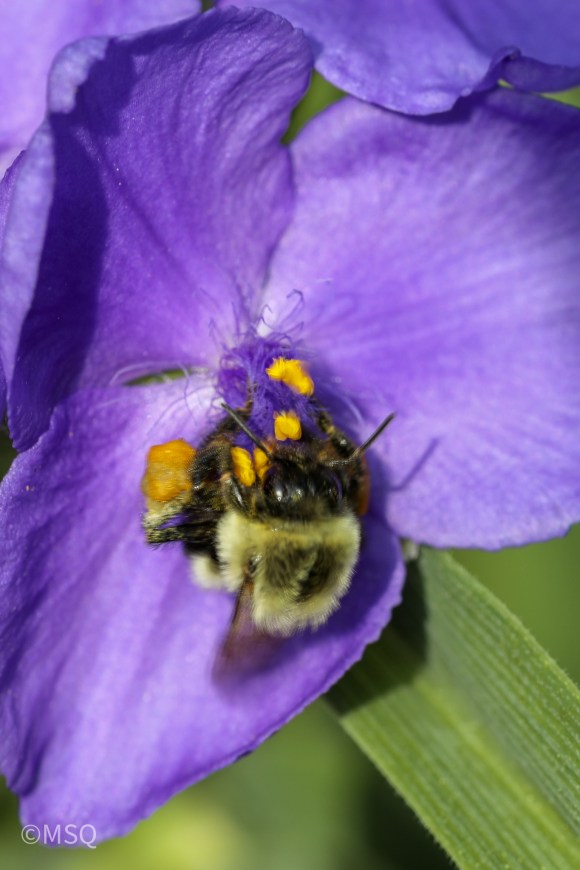
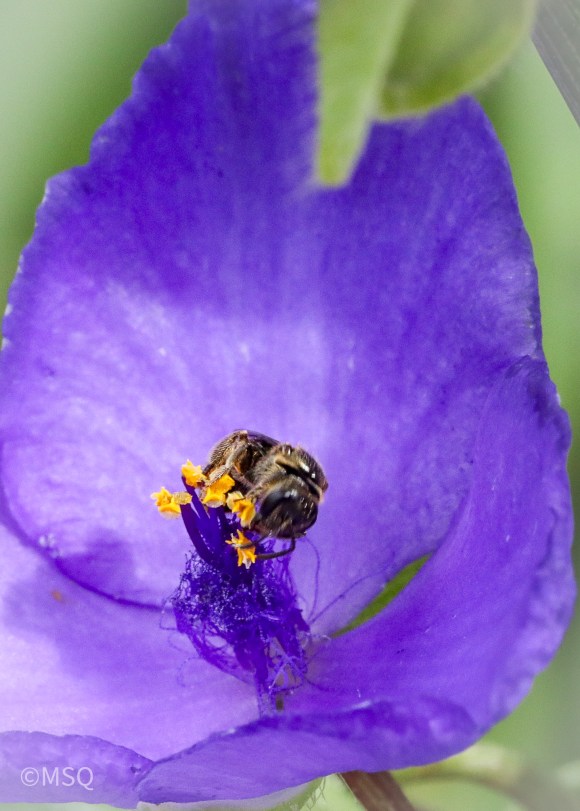
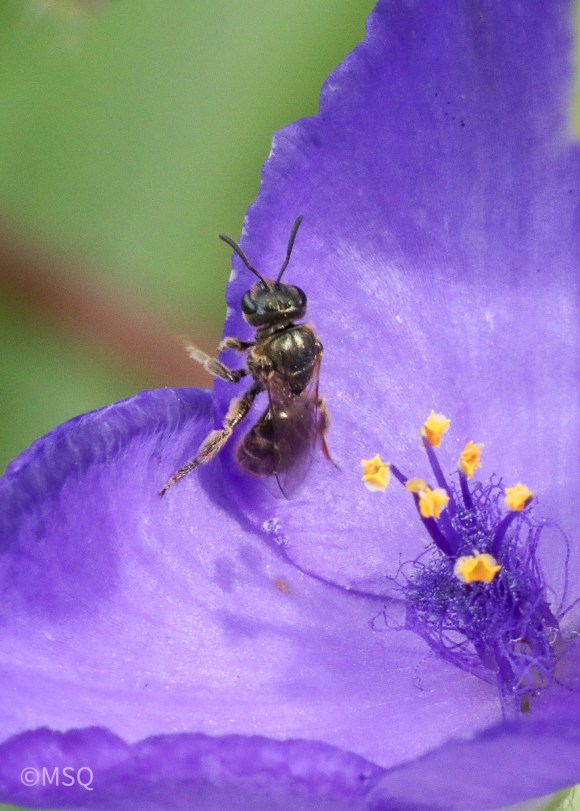
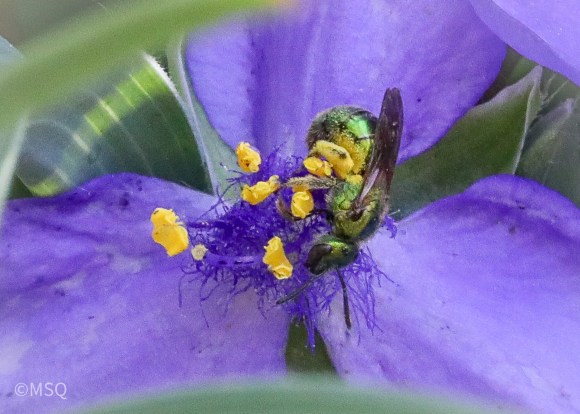
While Bumblebees, honeybees and other long tongued bees pollinate Spiderwort, numerous small bees and flies visit the flowers. The small bees include Sweat Bees (Lasioglossum spp.),
Green Sweat Bees (Agapostemon spp.),
small Carpenter bees (Ceratina),
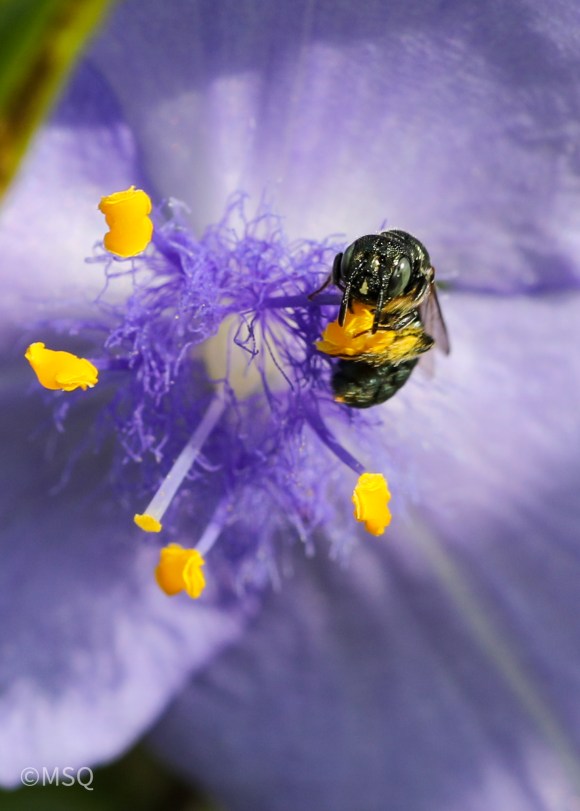
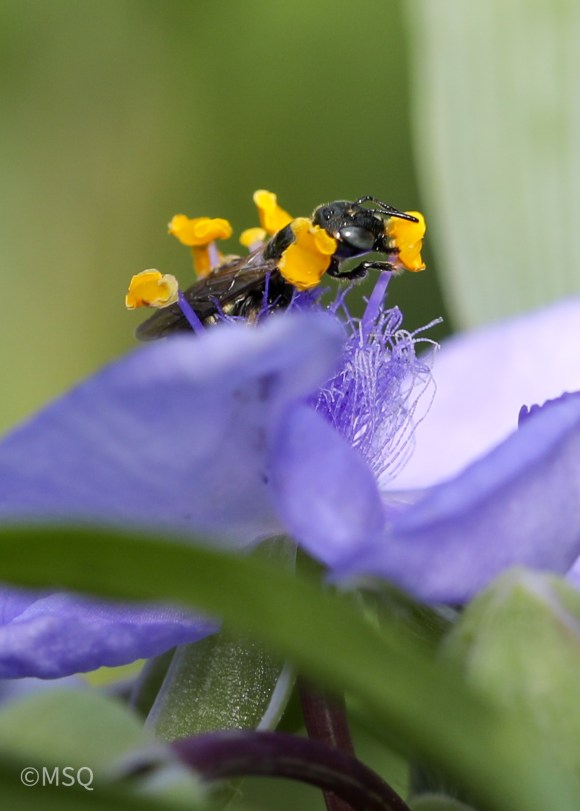
Mason Bees (Osmia spp.), European Wool Carder bee (Anthidium maculatum).1,4
Both syrphid flies and bee flies are among the fly visitors. I’ve mentioned syrphid flies in many posts. Their larvae consume huge numbers of aphids. Today let’s shine a spotlight on the insects themselves.1,4
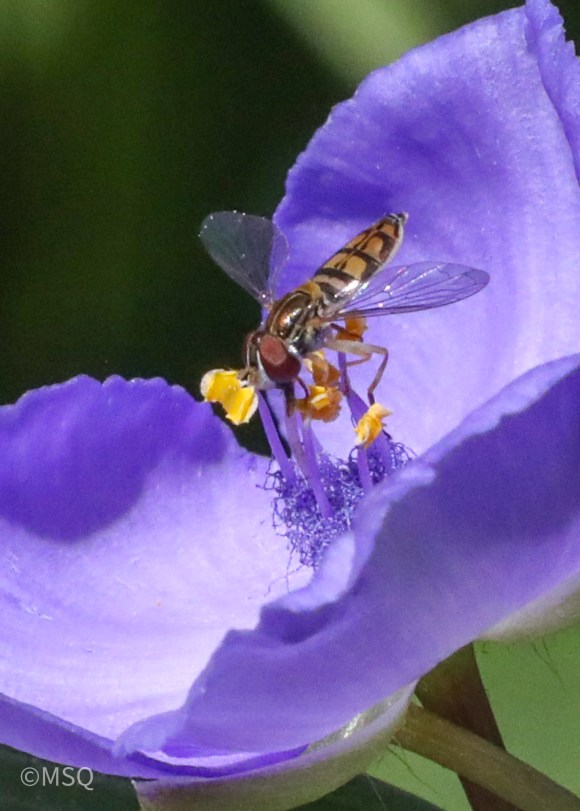
The names syrphid, hover or flower flies all mean the same group of insects—Syrphidae. Most have yellow and black stripes that make them resemble bees or wasps. Others are hairy with long thin abdomens. They range from less than a quarter of an inch to more than three-quarters of an inch. Their antennae are short.7
Adults seek out flowers for nectar and pollen. They’re particularly attracted to tiny flowers. Yarrow, wild mustard, fennel, coriander and sweet alyssum are all favorites.
Reproduction usually centers around aphid colonies. The female lays a single egg on a leaf near the colony. She may produce hundreds of eggs throughout the growing season.
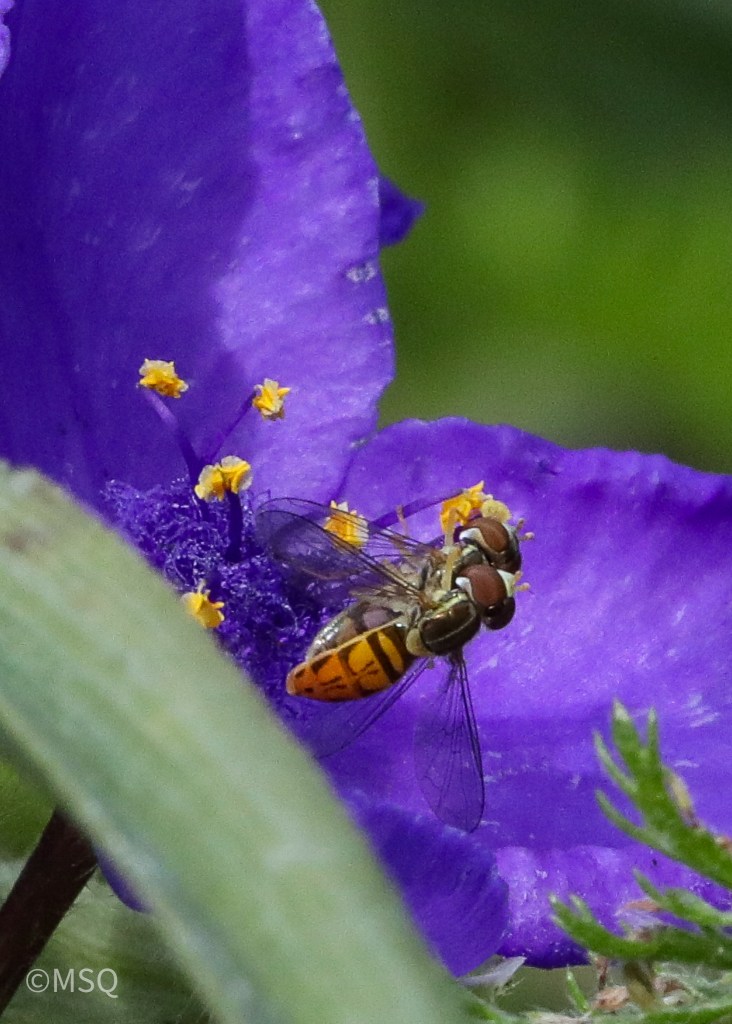
Eggs hatch into small, legless maggots varying in color from creamy-white to green to brown. With a slug-like appears, they taper near the head. The larvae mature in one to three weeks depending on the species, temperature, and amount of food. There are five to seven generation per year. The final generation overwinters as pupae either on a leaf or in the soil.
These larvae are the beneficial insects. A single larva can eat up to 400 aphids. They effectively control aphids in a mixed plot or in a garden. Although, syrphid fly larvae haven’t been studied commercially.
These larvae mostly hunt aphids. They can also consume small caterpillars, thrips and other slow-moving insects. In addition, syrphid fly larvae have been observed preying on small European corn borer and corn earworm larvae.7
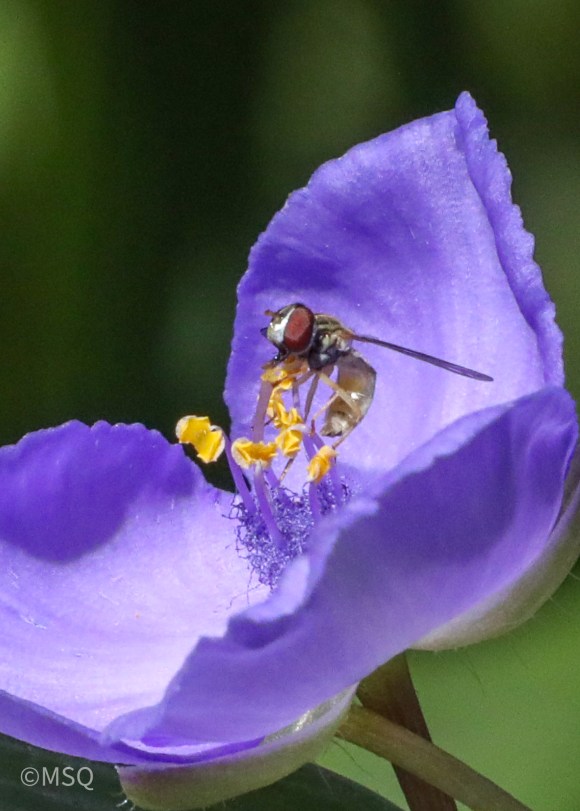
Thank you so much for joining me for this long look at Spiderwort, Tradescantia ohiensis. I hope you enjoyed the information on this beautiful and versatile plant and the spotlights on the life cycle of the Eastern Bumblebee, Bombus impatiens, and the Syrphid flies.
I’d love to answer questions or hear your stories! Please let me know what’s going on in your garden!
Warm Regards,
Mary
References
- Hilty, J., n.d., Ohio Spiderwort, Tradescantia ohiensis, Dayflower family (Commelinaceae), http://www.illinoiswildflowers.info/prairie/plantx/oh_spiderwortx.htm
- No author, n. d., Tradescantia ohiensis, Ohio Spiderwort, Bluejacket, Commelinaceae, (Spiderwort Family), https://www.wildflower.org/plants/result.php?id_plant=TROH
- No author, n. d., Tradescantia ohiensis, Bluejacket; Ohio Spiderwort; Smooth Spiderwort, https://plants.ces.ncsu.edu/plants/tradescantia-ohiensis/
- Holm, H., 2014, Pollinator of Native Plants: Attract, Observe and Identify Pollinators and Beneficial Insects with Native Plants, Pollination Press LLC., Minnesota
- No author, n. d., Tradescantia ohiensis,https://www.missouribotanicalgarden.org/PlantFinder/PlantFinderDetails.aspx?taxonid=279262&isprofile=1&basic=Tradescantia%20ohiensis
- Holm, Heather, 2017, Bees: An Identification and Native Plant Forage Guide, Pollination Press LLC, Minnesota
- Mahr, Susan, n.d., Hover, Flower or Syrphid Flies (Syrphidae), https://hort.extension.wisc.edu/articles/hover-flower-or-syrphid-flies-syrphidae/#:~:text=Hover%20flies%20(or%20flower%20flies,the%20flowers%20and%20darting%20around.
 Wild Things in the Garden