Golden Alexanders’ (Zizia aurea) blooms float above dense, bushy foliage. Pollinators flock to this early spring bounty. With its shallow flowers, Zizia appeals to bees, wasps, flies, and beetles. It also supports early butterflies with nectar and serves as a larval host. Golden Alexanders won Wildflower of the Year twice. First, North Carolina Botanical Gardens/the Garden Club of North Carolina, Inc.1,6 selected it in 2012 and then in 2016, Kansas Native Plant Society2 chose it. These awards, from such different areas, hint at its adaptability and appeal to people and pollinators alike.
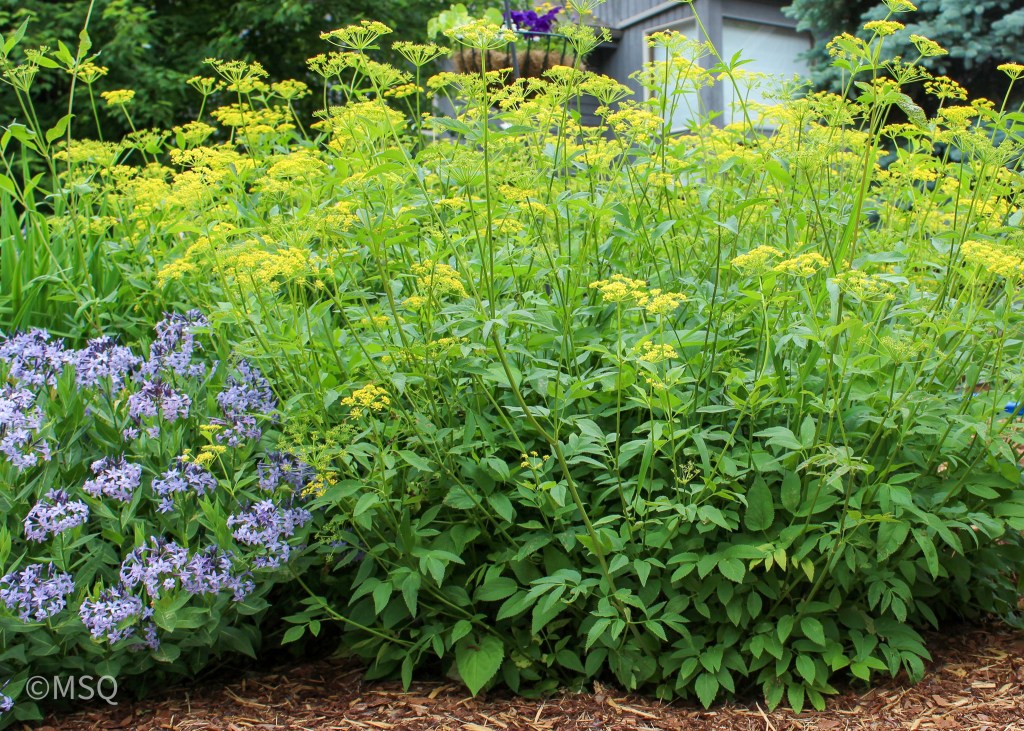
Zizia aurea thrives in many different conditions. In nature, it occurs in preserved natural areas and disturbed sites. It’s found in moist black soil prairies, savannahs, thickets, limestone glades, abandoned fields, on stream banks, in moist meadows and floodplains. Golden Alexanders is also found in openings of moist to mesic woodlands, areas along woodland paths, thinly wooded bluffs, and powerline clearances in wooded areas.3,6
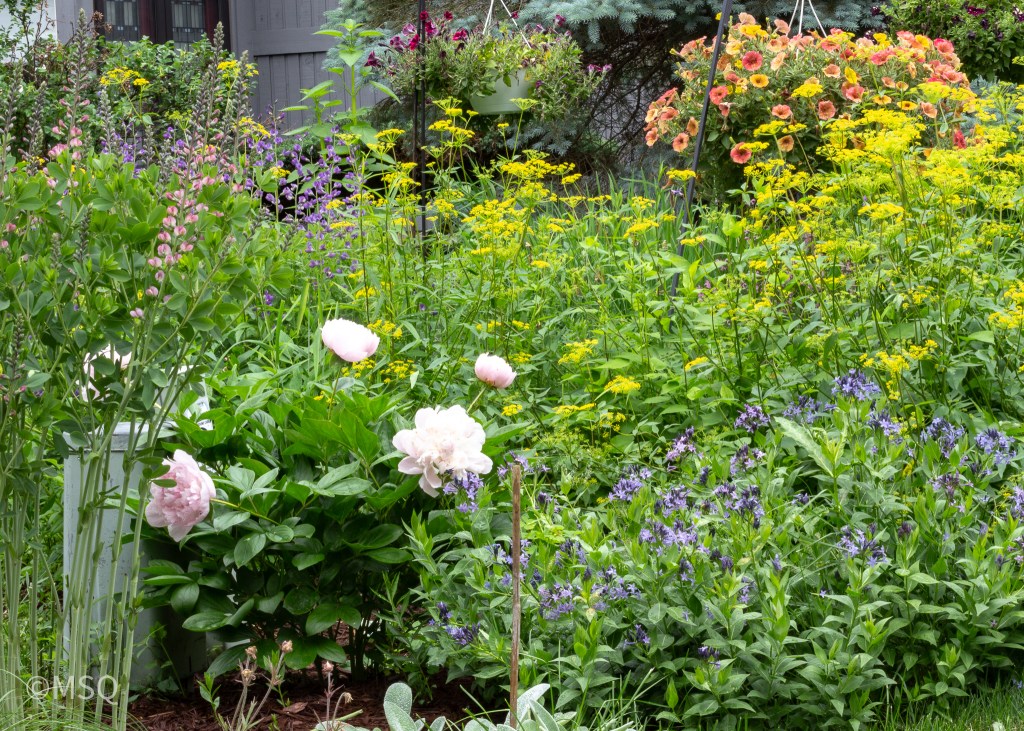
Full to partial sun is ideal for Golden Alexanders but it can grow in light shade. It loves moist, loamy soils and accepts some rocky material and some clay soils. The only place I’ve seen it fail is in deep shade.
An Extension Master Gardener Volunteer (EMGV) friend of mine tried growing this Zizia in a rain garden overshadowed by other plants. The plants just died. I have it in my own rain garden, in light shade and it does very well. So, I think it just needs some sun.
One caution with Zizia aurea, under ideal conditions, it reseeds heavily and spreads by rhizome. This lavish reproduction can be a challenge in a home garden and yard. The best solution is to cut off the spent blooms as quickly as possible. Zizia is very happy in my garden. If I don’t remove the seed heads, the seedlings sprout and they have six-inch, thick fibrous roots. These must be dug out, not pulled. In addition, watch for seedling growing in other plants. Remove them quickly. Otherwise, Zizia will establish itself in the perennial’s root system. Zizia usually only needs this post-bloom pruning.
Zizia is a stunning plant when in full bloom. Its flowers look like golden Queen Anne’s Lace (Daucus carota). Bloom time lasts for a full month. Each blossom is two to three inches across and made up of 12 umbellets. An umbellet is a grouping of small florets. In Golden Alexanders, each umbellet has 21 florets that are about one-eighth inch across. These florets have five deeply recurved petals, one pistil and five stamens. The flowers are unscented.
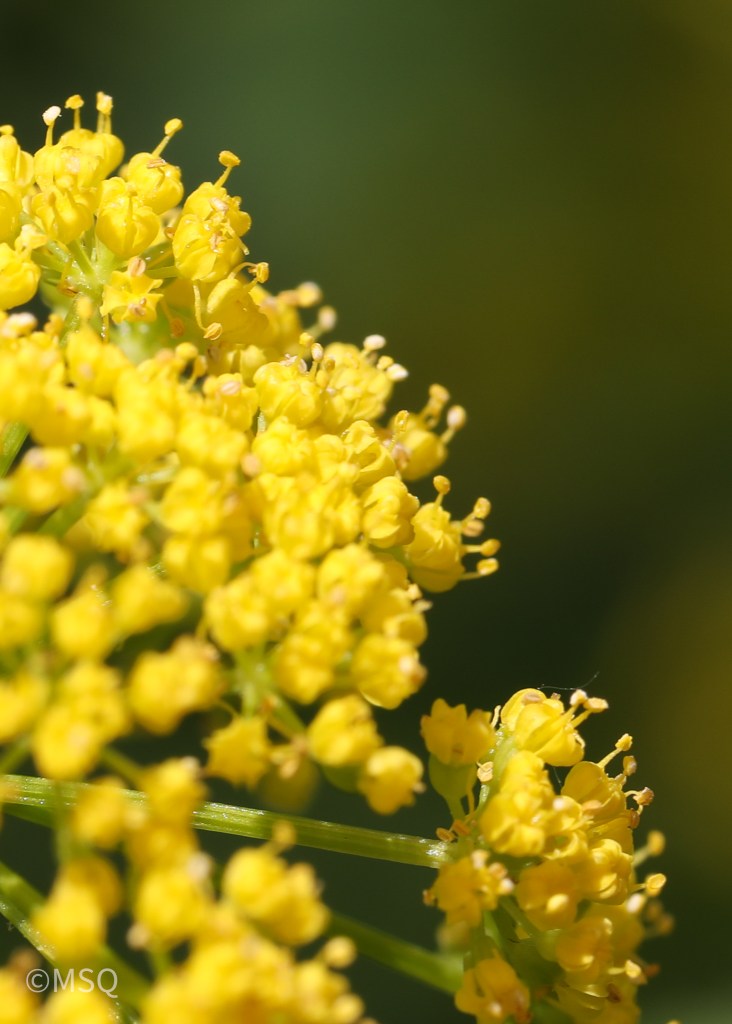
The middle flower is attached directly to the stem (sessile) or almost sessile. This sessile flower separates it from other members of the carrot family like Wild Parsnip (Pastinaca sativa). It’s use in plant identification.
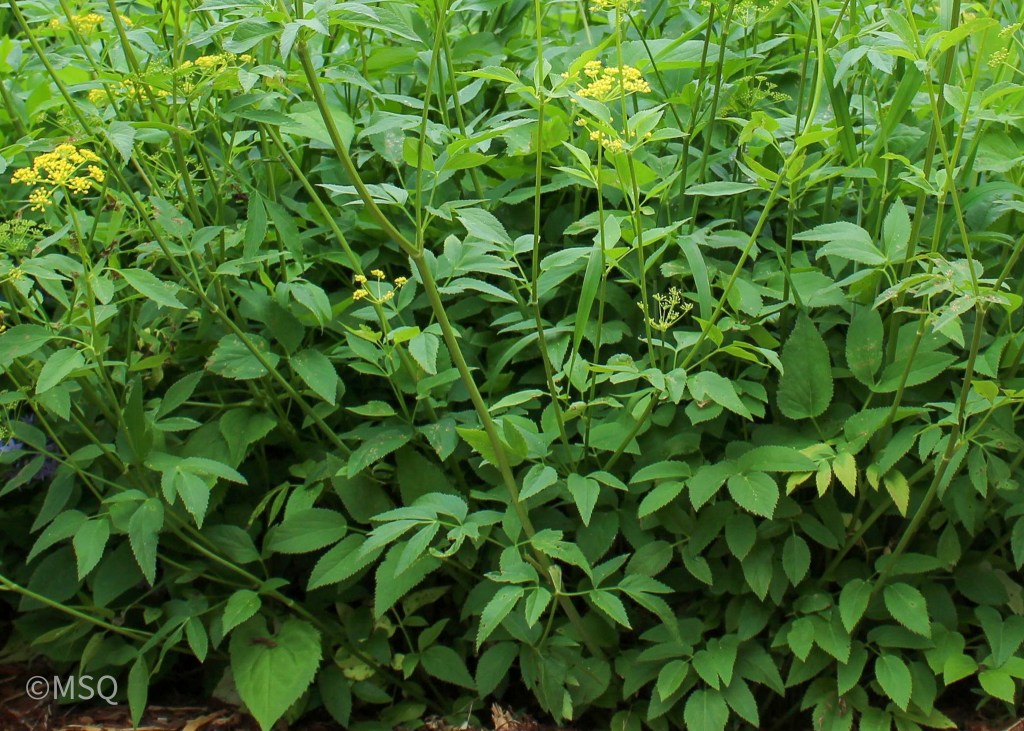
Golden Alexander’s leaves grow in a shiny, medium-green mounded shape. The greenery reaches one to two feet high and wide. Individual leaves are compound with three to five leaflets and are arranged alternately on the stem. The serrated leaflets are generally ovate in shape. This foliage provides all season interest, remaining tidy and healthy for the whole growing season.3
Insects flock to Zizia aurea for the early Spring bloom and shallow florets. At a time of year with limited resources, this plant supplies important nectar and pollen resources. The shallow structure means any insect can reach the nectar. Together these traits mean Zizia is always busy. It enjoys the designation of Special Value to Native Bees and Supports Conservation Biological Control by The Xerces Society for Invertebrate Conservation. The second title means, “A plant that attracts predatory or parasitoid insects that prey upon insect pests.”4
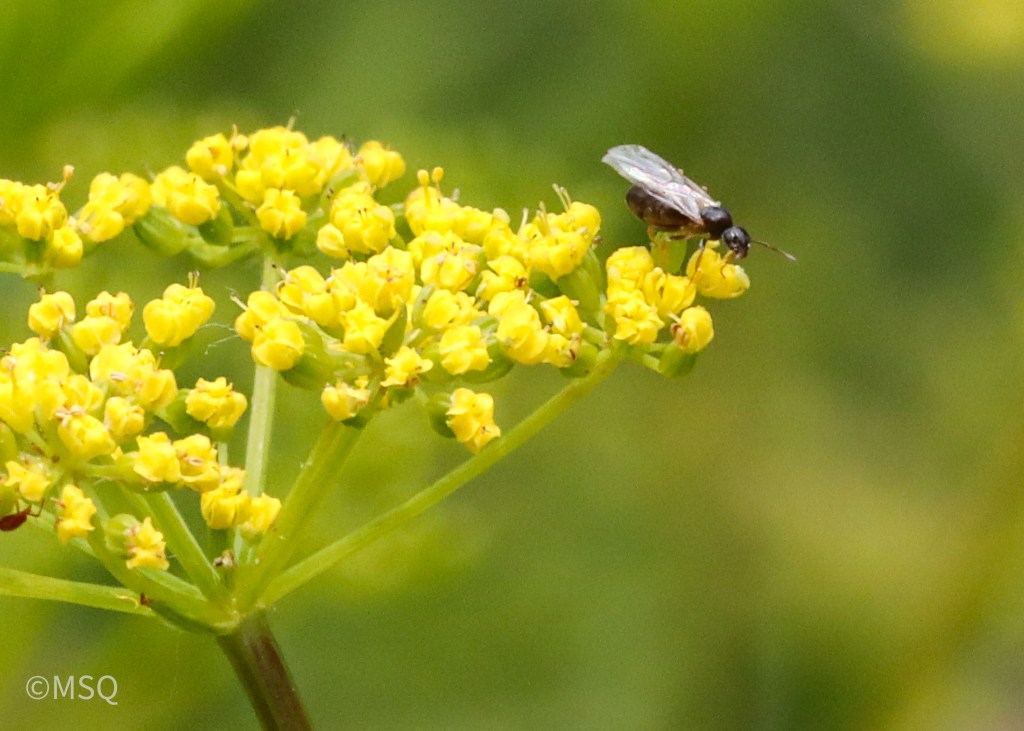
Short- and long-tongued bees crowd around it. The short-tongued bees include Hylaeus (Yellow-faced bees), Andrenid bees, Ceratina (small carpenter bees), Osmia (Mason bees),and Halictid bees including Lasioglossum and green metallic bees. Golden Alexanders has its own specialist bee (oligolege). Like many oligoleges, Andrena ziziae is an Andrenid bee. While most visitors gather nectar from Golden Alexanders, A. ziziae also collects pollen for its larva. Long-tongued bees visit Zizia and include bumblebees and cuckoo bees.
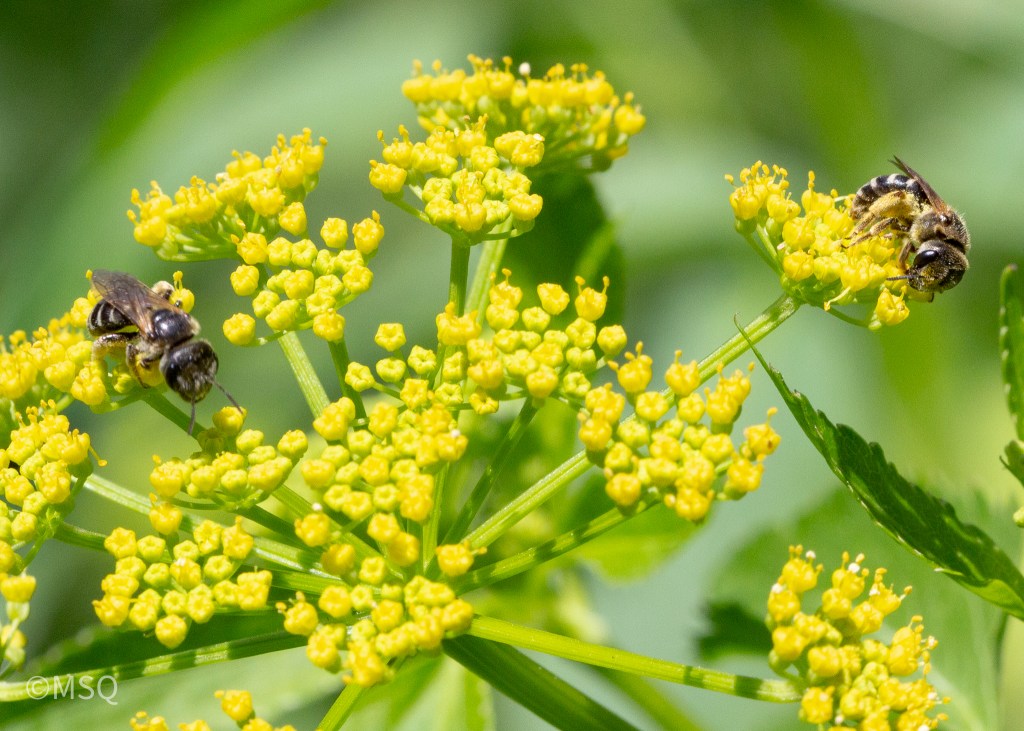
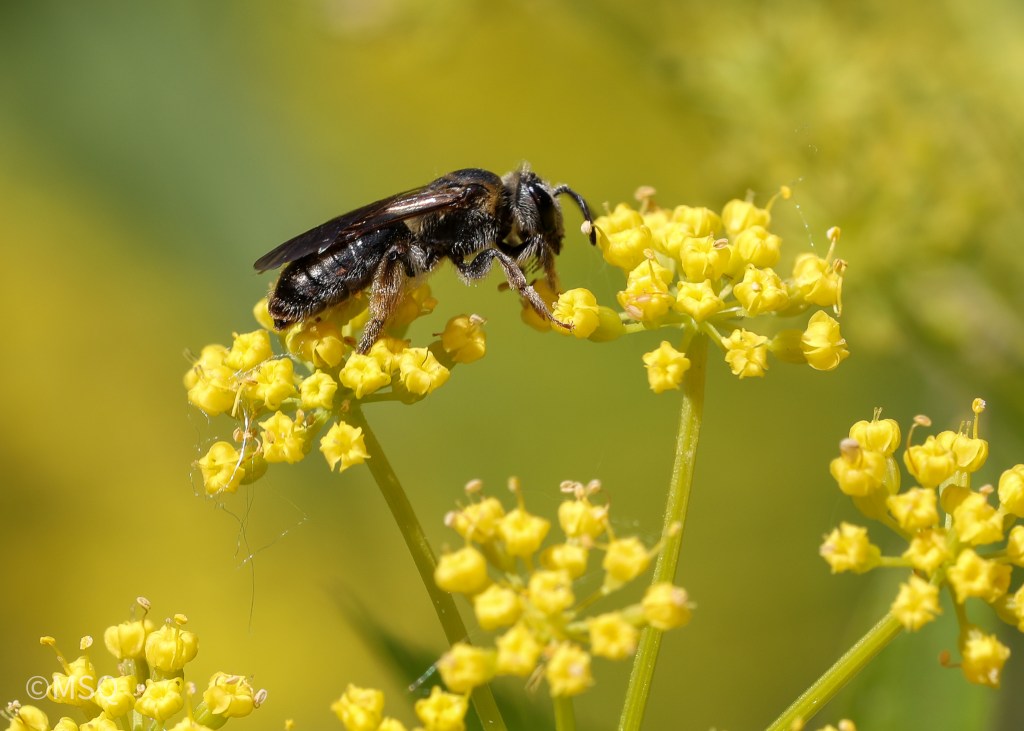
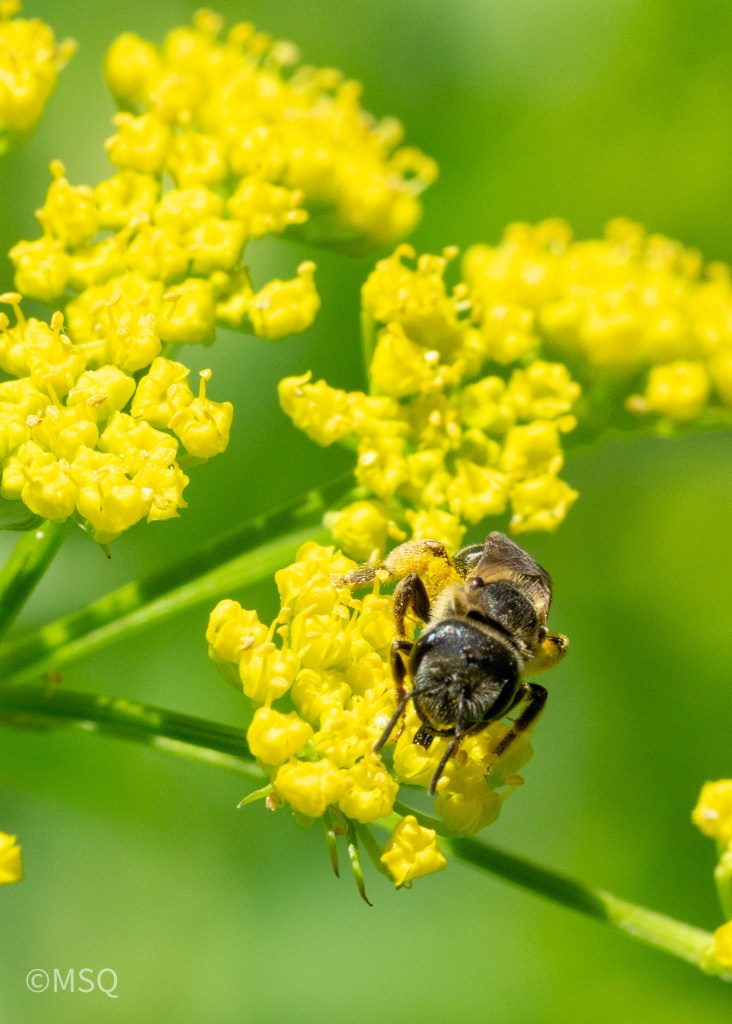
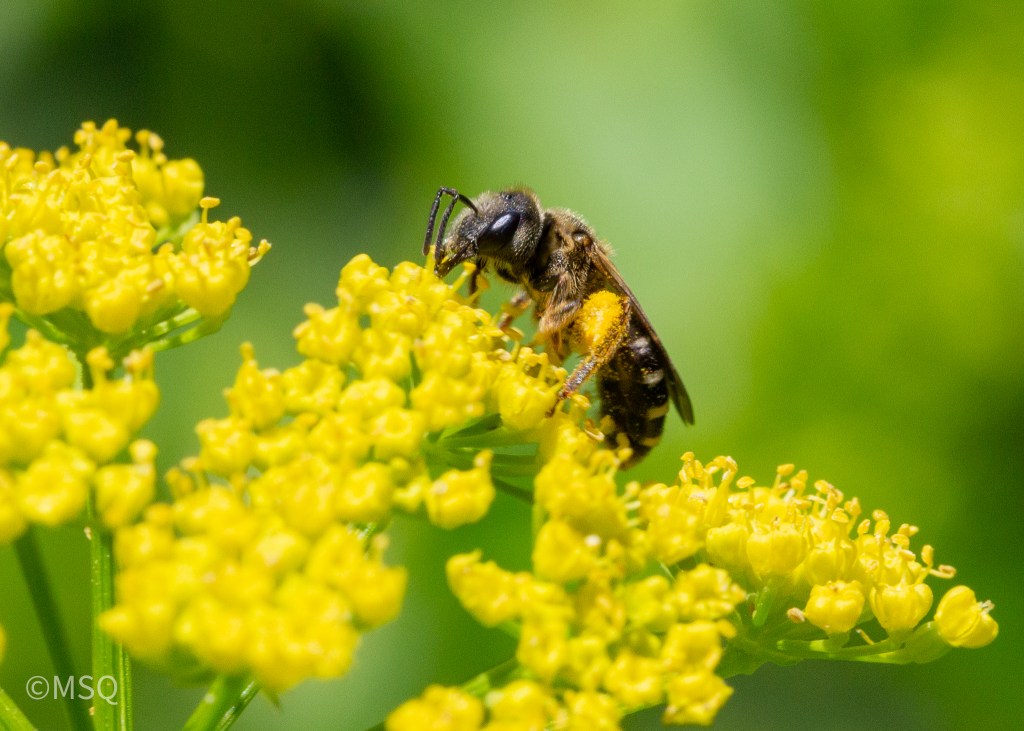

Zizia aurea is a big favorite of wasps with their short tongues. Many different types harvest its nectar including both predatory and parasitoid wasps. These include Chalcidoidea, Cynipoidea, Eumininae, Aplopus spp. (Spider wasps), Ichneumonidae and Crabroninea.3,4,5
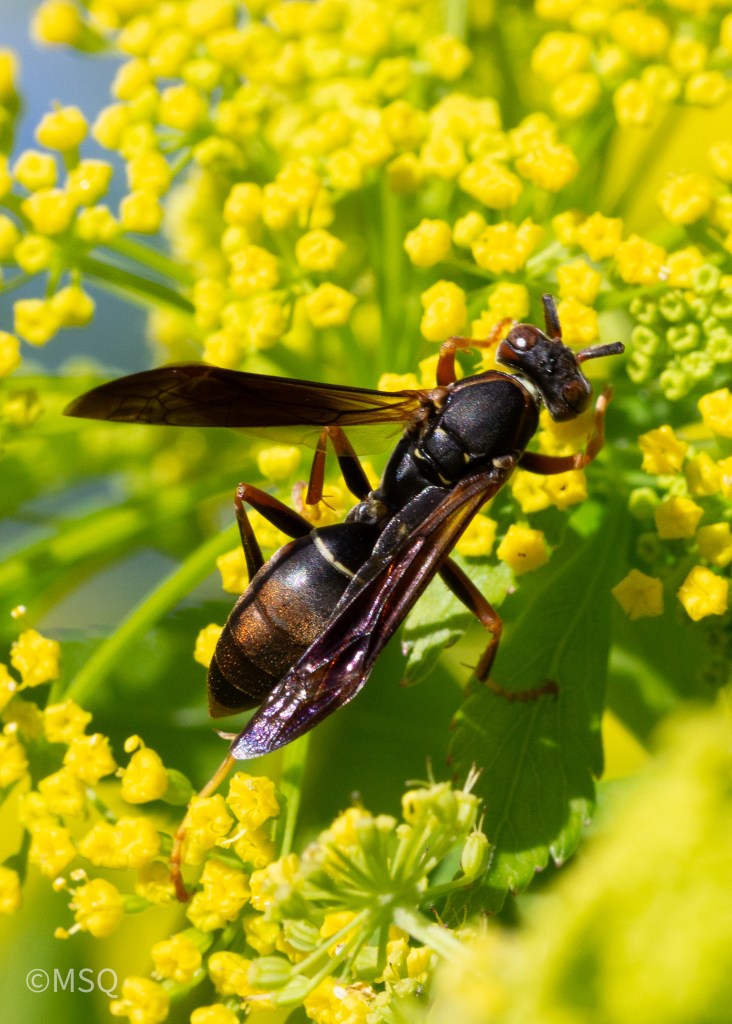
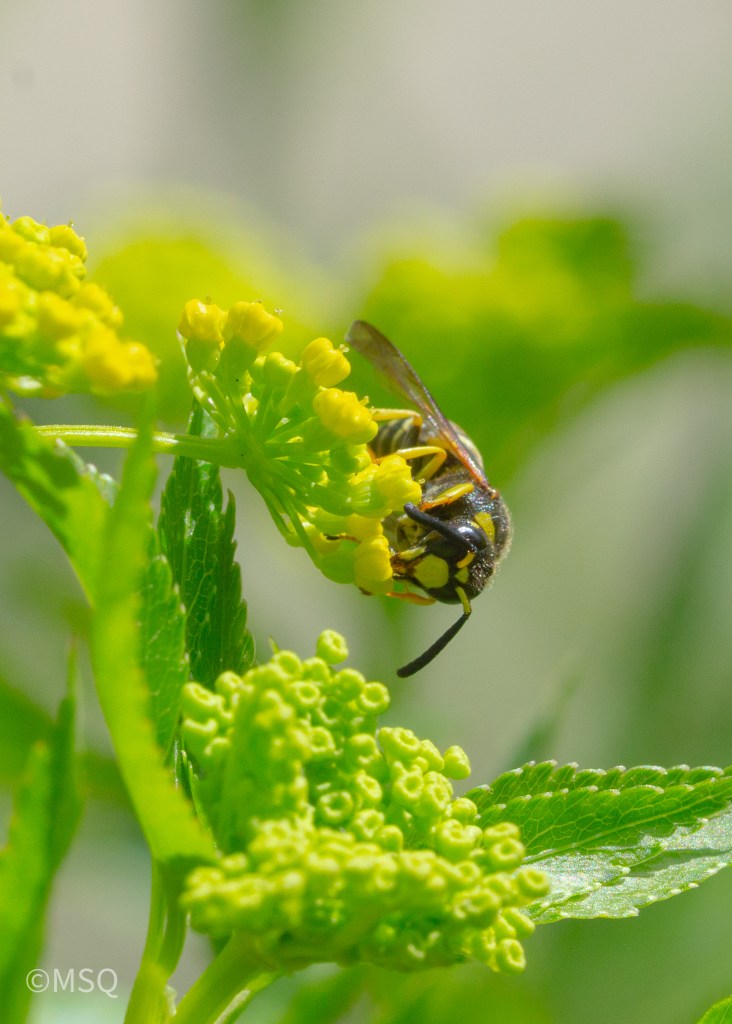

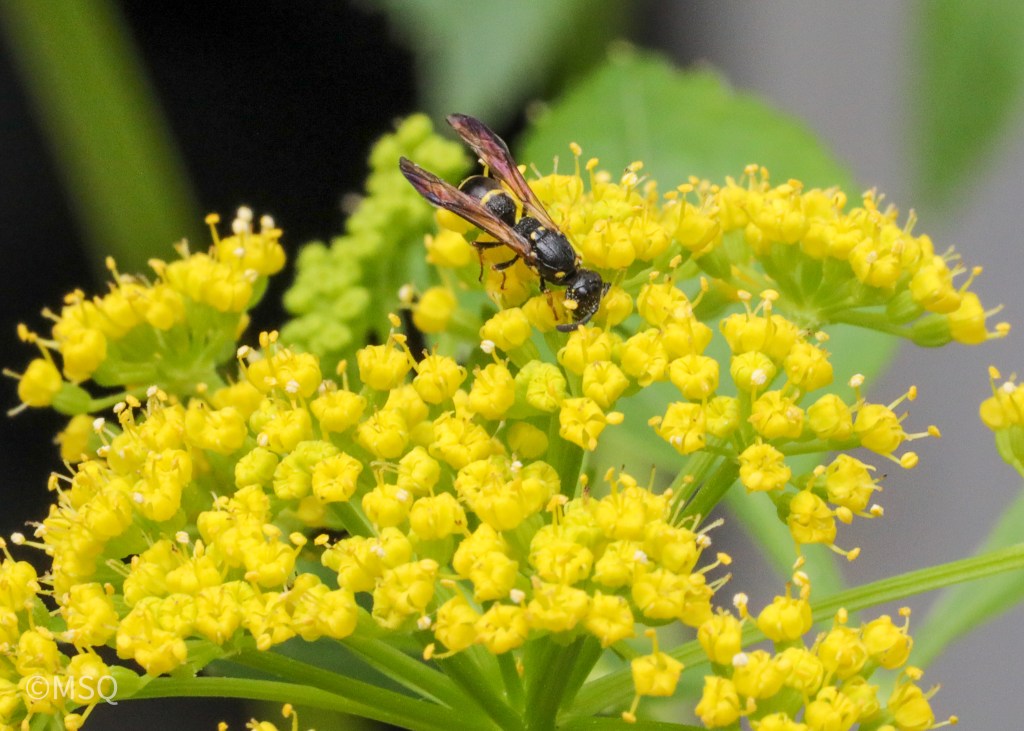
Both charming and fierce, jet-black Spider wasps fly with long hind legs dangling. On a flower or the ground, the sun glints off their wonderful bluish/turquoise sheen. These wasps flick their wings when not in the air.
They usually have red or orange warning colors. These bright shades signal the females’ painful sting and the males’ bad taste. In particular, many species have golden or reddish legs.
There are ten different Spider wasps in North America. Adults feed on nectar or juice from rotting fruit. They capture and use spiders to provision their nests. Each egg receives its own spider. Since only one spider is used, the adult wasp usually selects prey approximately its own size.
Spider wasps hunt free living (no web) spiders including (most famously!) tarantulas, wolf spiders crab spiders and jumping spiders. Others capture orb weavers, grass spiders (funnel web weavers) and others. In general, each kind of spider wasp specializes in one type of spider.7,8
In addition to wasps and bees, flies, beetles, and butterflies use Zizia aurea. Empididae, also called Dagger or Balloon flies, visit Zizia. These small- to medium-sized flies hunt other insects and are important natural and biological controls. Their larva lives in moist soil, rotten wood, dung or in aquatic habitats. The larva also seems to be predatory on other arthropod larva especially Diptera. Diptera is a large group of flies including houseflies, blow flies, mosquitoes, gnats, black flies, midges, fruit flies, and agricultural pests.9,10
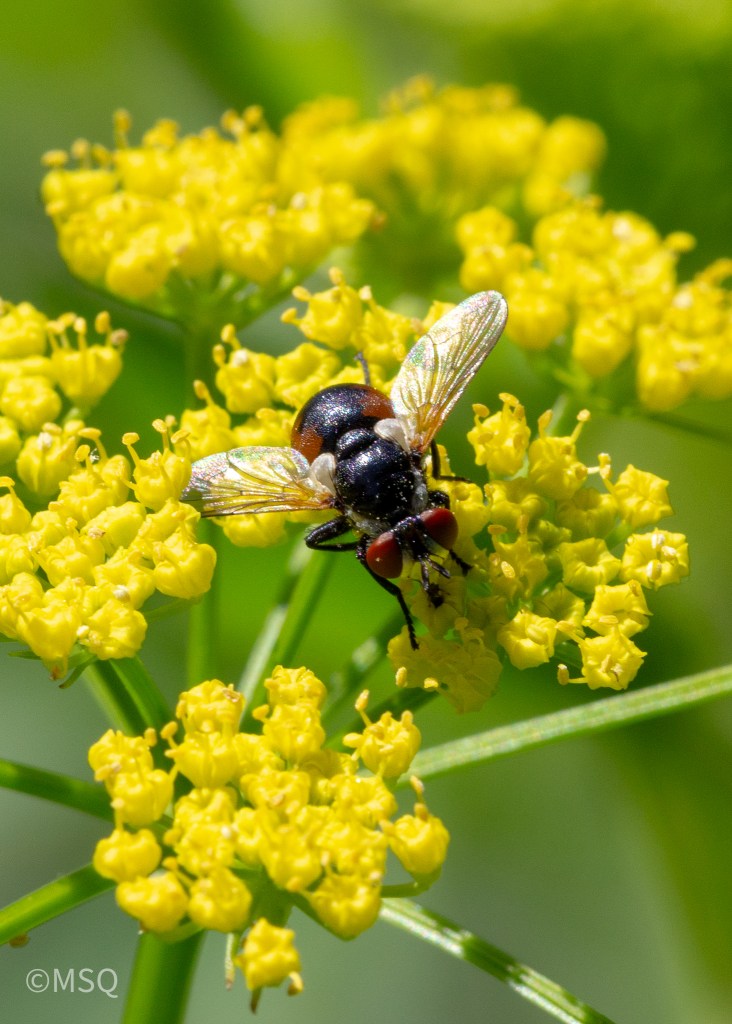
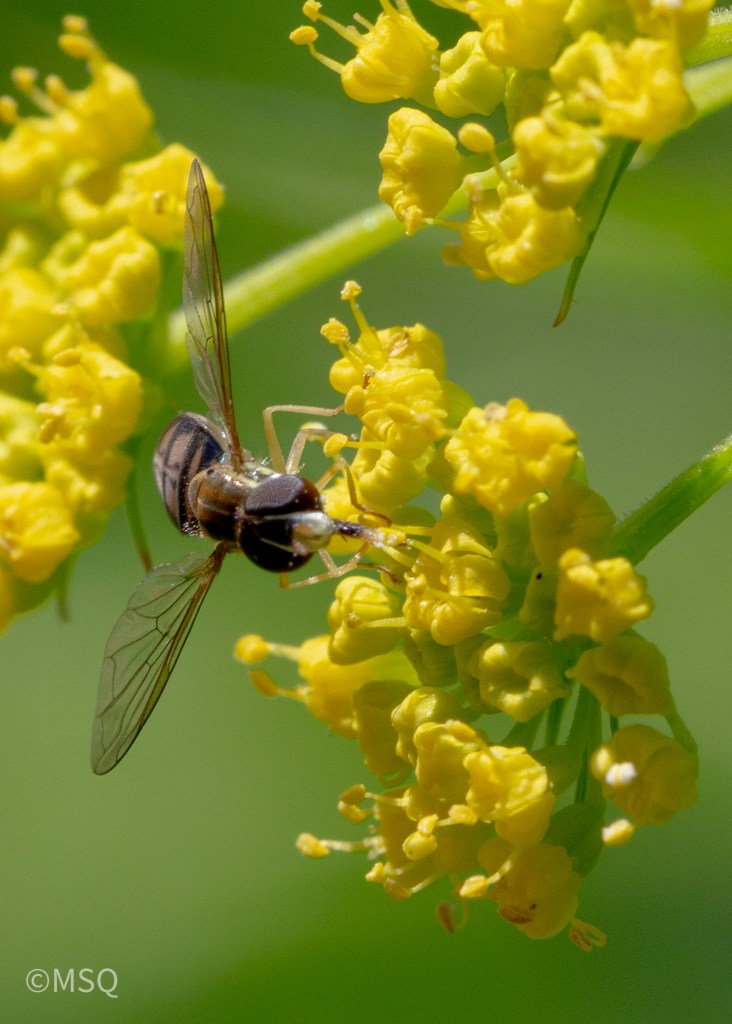
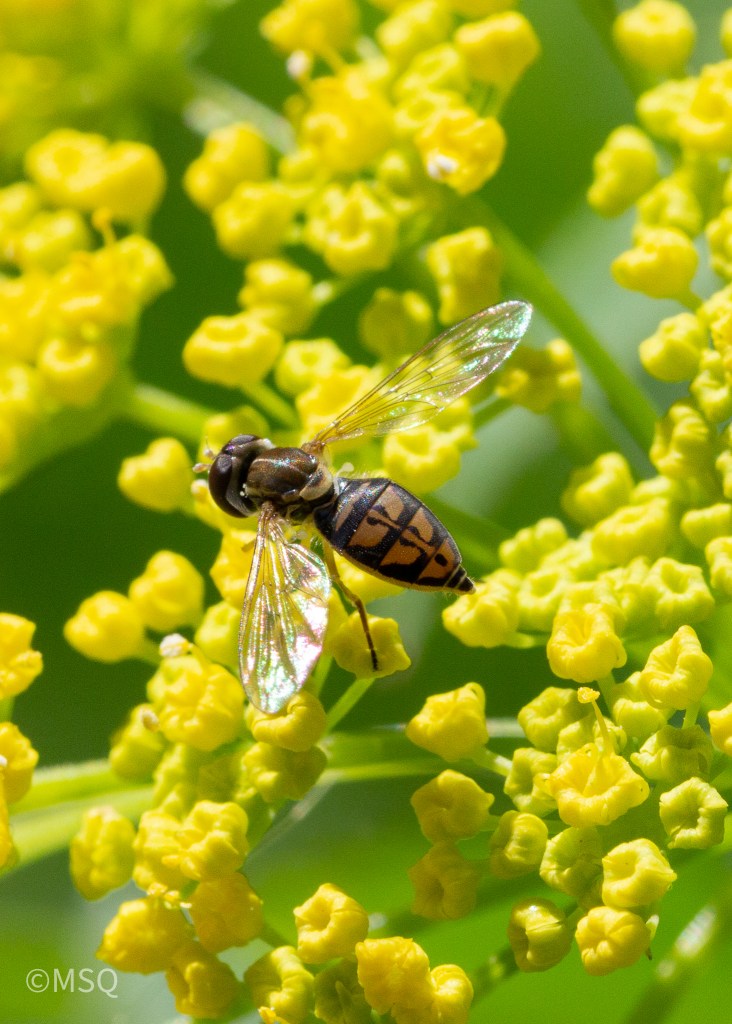
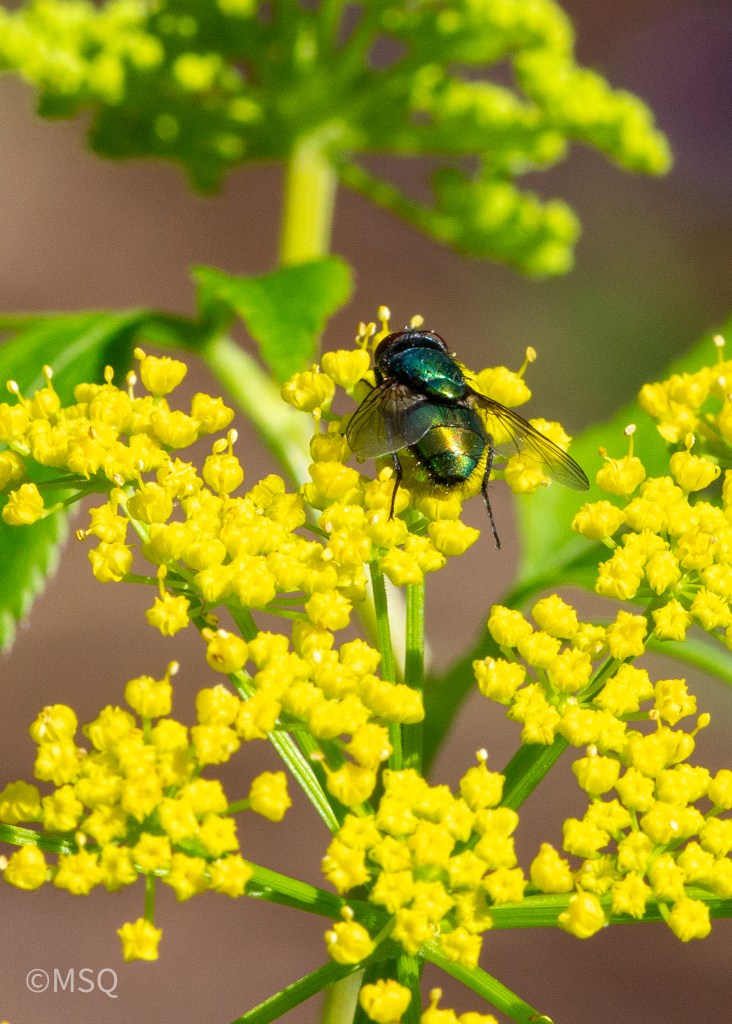
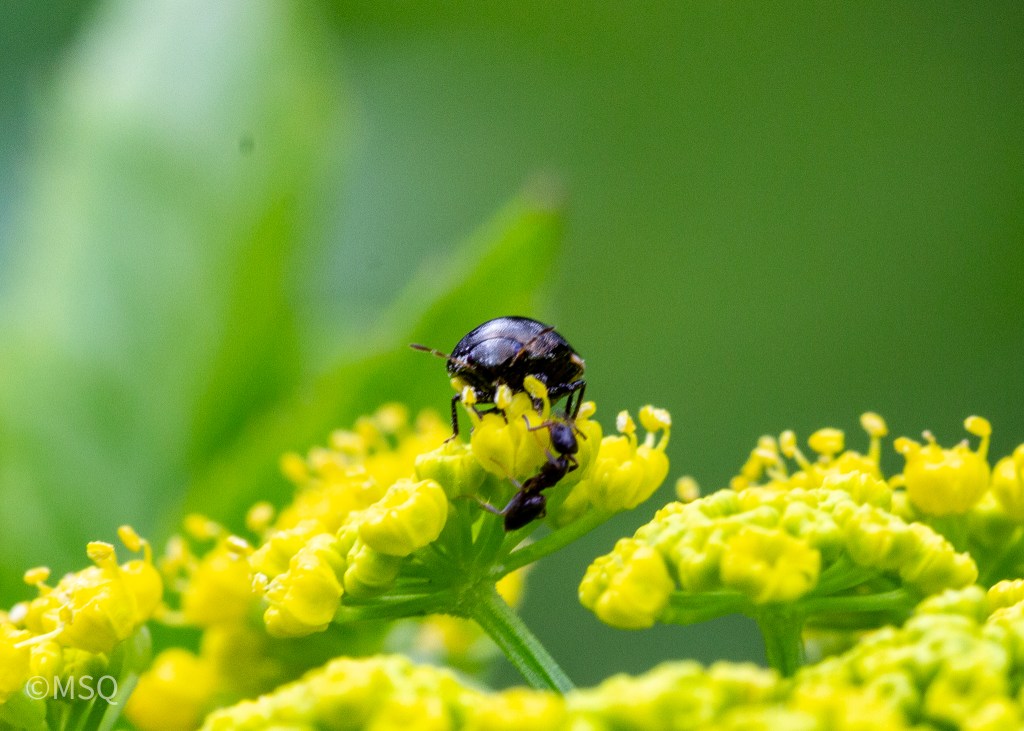
Early butterflies sip nectar from Golden Alexanders blooms. Later, this plant serves as a larval host to Eastern Black Swallowtails (Papilio polyxenes asterius) caterpillars. Golden Alexanders also support the Ozark Swallowtail (Papilio joanae) where both ranges overlap. The larvae of the Epermenia pimpinella moth mine its leaves3,4,11,12.
I hope you’ve enjoyed this journey into the life in and around Zizia aurea. This cheerful native blooms just as the garden is waking up every year and it’s lovely to watch. If you have stories about Zizia or questions, please send them to me. I’d love to hear from you!
References
- (2018, August 04). North Carolina Wildflower of the Year, http://www.floraquest.org/special_collections/show.php?collection=wfoy
- Vogt, S. (2016 June 15). Plant profile: Golden Alexander (Zizia aurea),https://dyckarboretum.org/plant-profile-golden-alexander-zizia-aurea/#:~:text=Golden%20alexander%20(Zizia%20aurea)%20is,surviving%20even%20the%20driest%20summers.
- No author, n.d. Golden Alexanders, Zizia aurea, Carrot family (Apiaceae), https://www.illinoiswildflowers.info/prairie/plantx/gld_alexanderx.htm
- No author, n.d. Zizia aurea, https://www.wildflower.org/plants/result.php?id_plant=ziau
- No author, n.d. Golden Alexanders, Zizia aurea (L.) Koch, https://www.canr.msu.edu/nativeplants/plant_facts/golden_alexanders
- No author, n.d. Zizia aurea, North Carolina Extension Gardener Toolbox, https://plants.ces.ncsu.edu/plants/zizia-aurea/
- No author, n.d. Aplopus Spider Wasps, Field Guide, https://mdc.mo.gov/discover-nature/field-guide/auplopus-spider-wasps
- No author, n.d. Spider Wasps, Field Wasps, https://mdc.mo.gov/discover-nature/field-guide/spider-wasps
- No author, n.d. Empididae, https://en.wikipedia.org/wiki/Empididae
- No author, n.d. Fly, https://en.wikipedia.org/wiki/Fly
- No author, n.d. Zizia aurea, https://www.missouribotanicalgarden.org/PlantFinder/PlantFinderDetails.aspx?kempercode=g710
- No author, n.d. Epermenia pimpinella (Murtfeldt, 1900), https://www.butterfliesandmoths.org/species/epermenia-pimpinella
 Wild Things in the Garden