New Year’s has past, plants and pollinators are sleeping but gardeners dream of flowers and foliage! Today, I’ll talk about two of the first native plants to bloom in my garden. Together they blossom from early spring to early summer. They support emerging beneficial insects and pollinators including early queen bumblebees and native bee queens starting their nests. In addition, these versatile plants thrive under a variety of conditions even green roofs!
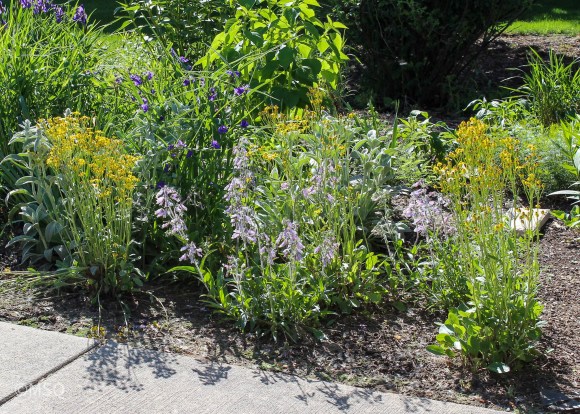
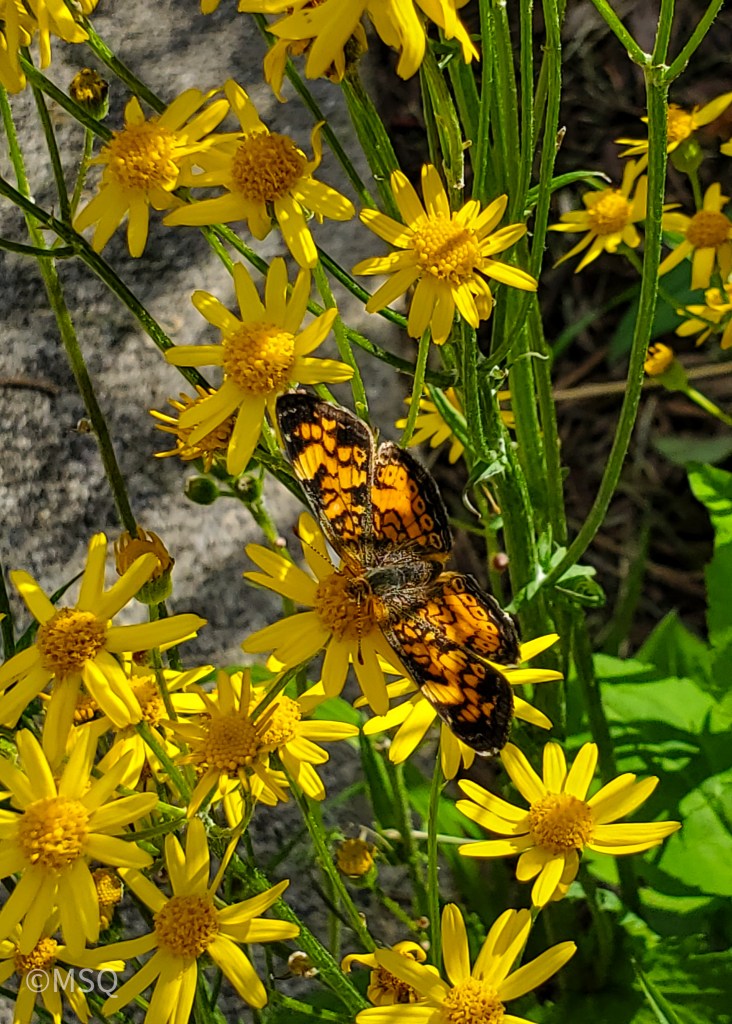
In my garden, Spring starts with Round-leaved Ragwort (Packera obovata), also called Round-leaved groundsel. Round-leaved Ragwort blooms as early as April and can continue until June. The petite, yellow flowers are half to three-quarters inch in diameter. They develop on one- to two-foot-tall stalks, arranged in flat-topped clusters called corymbs.
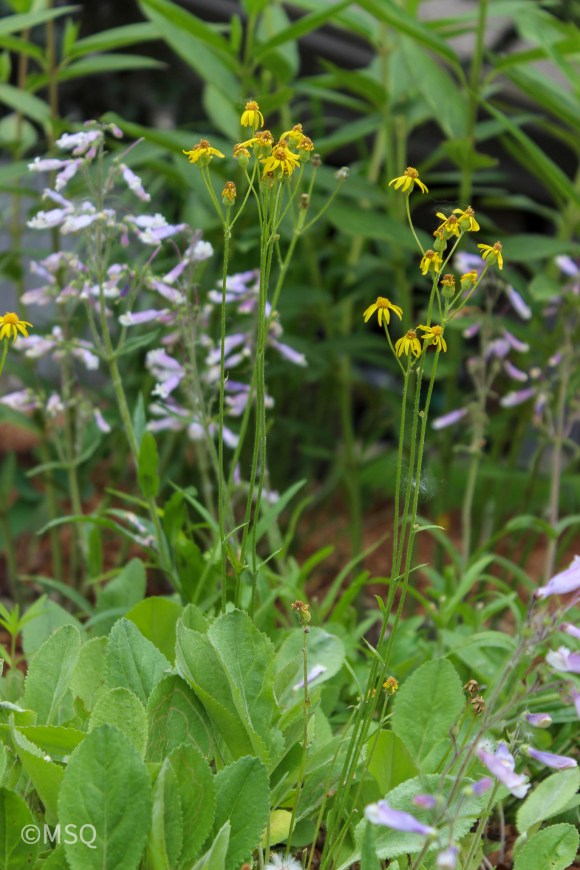
After blossoming, Packera obovata keeps its basal rosette. This smooth, medium green foliage has three-to-six-inch leaves. The leaves are round to oval and serrated and remain throughout the growing season.
Round-leaved Ragwort enjoys full to part sun and dry to average soil moisture. It’s not picky about soils and will grow in loam, sand, or rocky material. Ragwort doesn’t like to have its feet wet and won’t thrive in rain gardens.
I’ve used this plant in my home garden and in the public garden where I volunteer. It is tremendously tough and easily outcompetes weeds–spreading by both rhizomes and abundant seeds. It can be a nuisance plant because of its competitive nature.
In the public garden, I’ve declared a truce with the Packera obovata. We’re using it as a living mulch. Packera easily withstands the light foot traffic we have on our mulched areas. In the beds, we hope it shades out the invasive weeds but doesn’t interfere with the actual plantings. Packera overpowers some native plants. If you do try it as a living mulch, be aware you may need to remove it near slower growing plants.
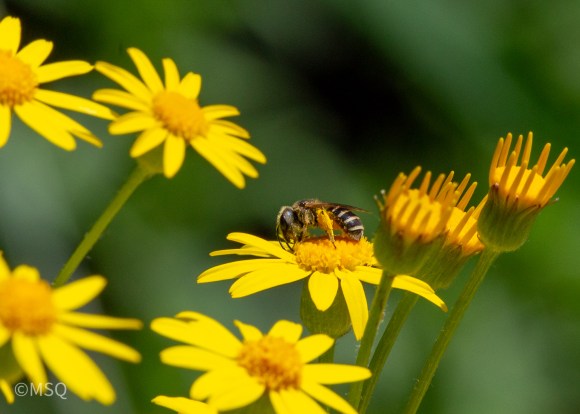
Loads of pollinators visit Round-leaved Ragwort blooms1,2. Numerous Halictid sweat bees use it including Augochlorella spp., Halictus spp., and Lasioglossum spp. The Andrenid mining bee visitors include a specialist pollinator or oligolege. An oligolege requires a particular plant or group of plants for its food source. Andrena gardineri needs flowers in the Packera spp. for its food. Various cuckoo bees, including Nomada spp., also use this plant.

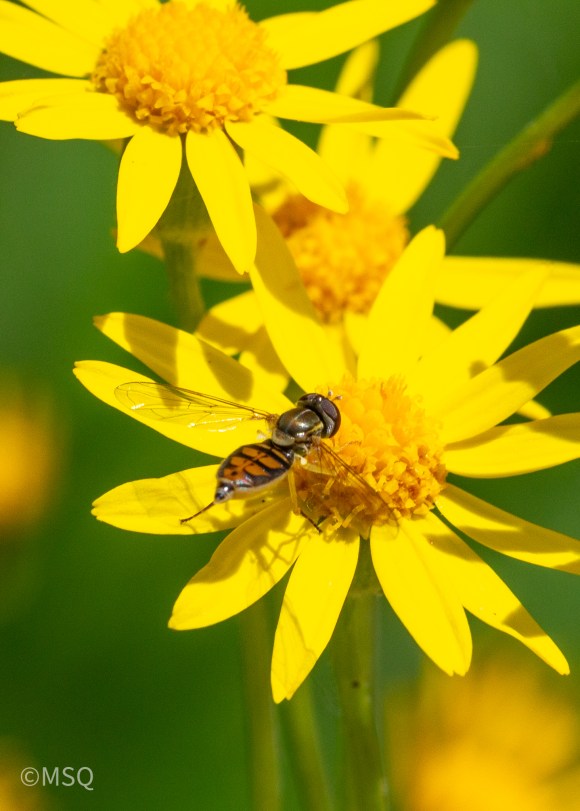
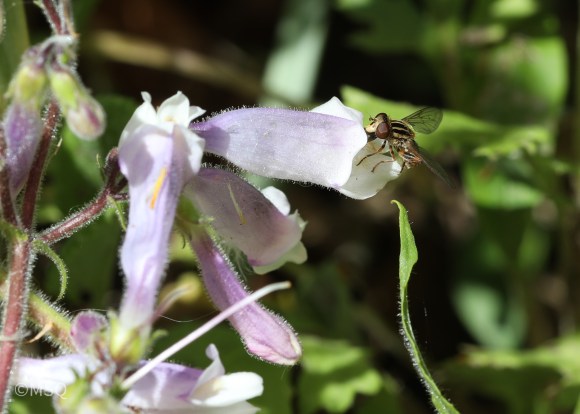
Beneficial insects also use Packera obovata. Adult Syrphid flies feed on nectar and pollen. Their larval eat insect pests such as aphids. Tachinid flies also visit this Packera. Tachinid flies lay their eggs near, on or in caterpillars and adult and larval beetles. The eggs hatch and the maggots consume the target insect.
Butterflies, skippers and moths nectar at Round-leaved Ragwort. It also supports the caterpillar of the Northern Metalmark butterflies (Calephelis borealis). This butterfly is considered very rare or local throughout its range.
Packera obovata isn’t recommended in pastures. It’s toxic to almost all grazing animals. The only exception is sheep who don’t seem to be as sensitive.
Shortly before Ragwort finishes bloom, Hairy Beardtongue, Penstemon hirsutus begins. The name Penstemon means five stamens and hirsutus means hairy. Hairy Beardtongue has four fertile stamens and a fifth, infertile, hairy stamen–hence the name “Hairy”.
This charming plant has dainty stalks of lavender and white tubular blossoms. Its blooms are lipped and about an inch long. Unlike its relative Penstemon digitalis, Penstemon hirsutus’ flowers are almost closed. The one- to two-foot stalks make a lovely contrast to Ragwort’s golden sunbursts. This flower stem can be windblown and needs support.
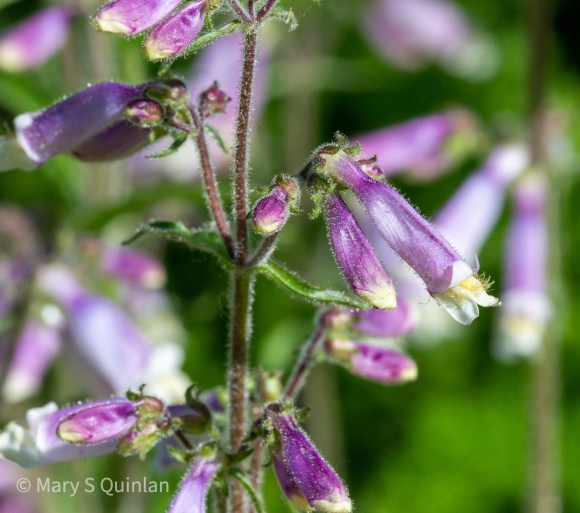
Hairy Beardtongue’s leaves are medium-green and lanceolate. The stem pierces the paired leaves which are two to three inches long. When the blossoms are spent, trim it back to healthy lower leaves and Beardtongue may rebloom.
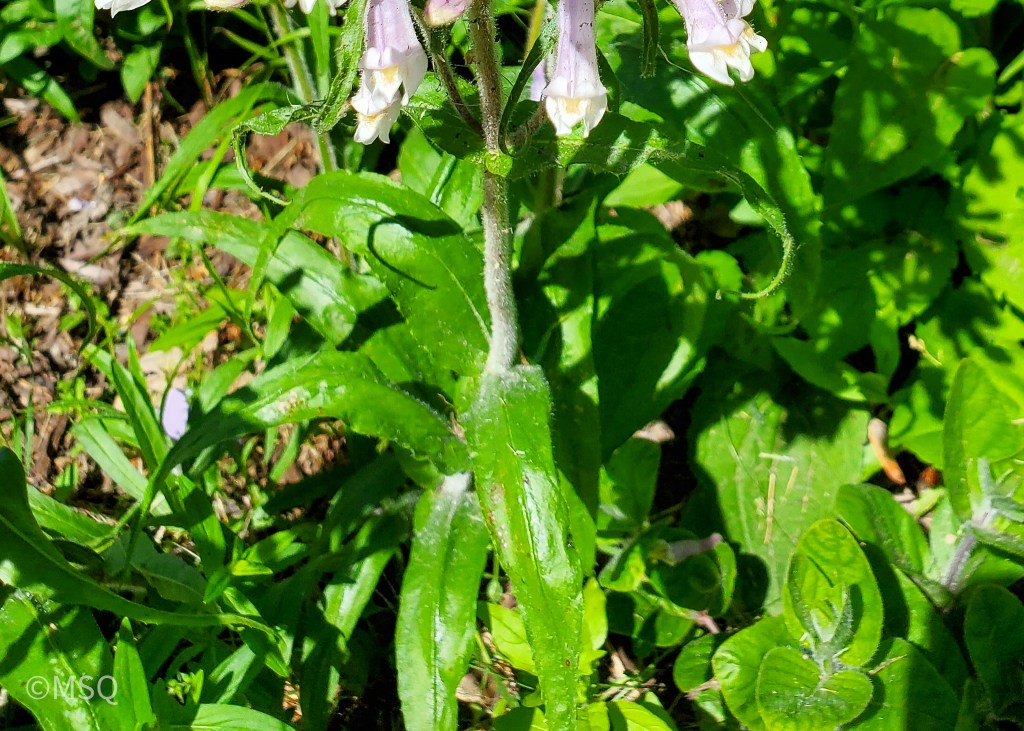
This Beardtongue grows in full sun to full shade. I find that plants in partial shade are more likely to rebloom. It enjoys dry to average conditions and well-drained sand to loam. Hairy Beardtongue grows naturally in dry woodlands and open fields.
One caution with this plant, it does not grow or spread aggressively. It looks lovely blooming with the Ragwort but cannot compete with it. Years ago, I planted them together and lost my Hairy Beardtongue. The Round-leaved Ragwort completely overran it. Now, I clear a circle around each grouping of the Beardtongue to give it some breathing room. It’s a bit of extra work but I do enjoy them.
Hairy Beardtongue serves numerous pollinator while in bloom. The Pollinator Program at The Xerces Society of Invertebrate Conservation recognized it to be of Special Value to Native Bees and Special Value to Bumble Bees3. The flower structure encourages pollinators to enter and also helps complete pollination. The extended lower lip offers a sturdy landing pad, an area to move and rest for the bees. Penstemons as a group often have hairs inside the lower petals that urge the insect forward. Penstemon hirsutus has these. In addition, some penstemons have hook-like structures that give a light squeeze. As the bee wiggles, the anthers wrap around it and transfer pollen. This pollen sticks to where the bee’s body is most likely to touch the stamen and fertilize it. Amazing how all these parts work together!4
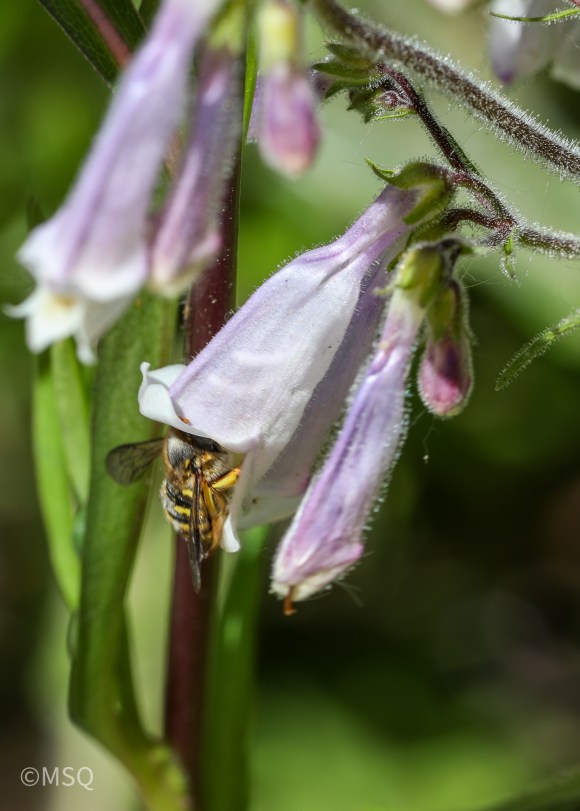
Hairy Beardtongue draws a variety of pollinators5,6. The tubular flowers attract creatures with long tongues such as Hummingbirds and long-tongued bees. Long-tongued bees include bumblebees (Bombus spp.). Digger bees (Anthophora spp.), Long-Horned bees (Synhalonia spp.), Wool-carder bees (Anthidium manicatum), Mason bees (Osmia spp.), Melecta thoracica (a cleptoparasite) and Leaf-cutter bees (Megachile spp.) also visit these blossoms.
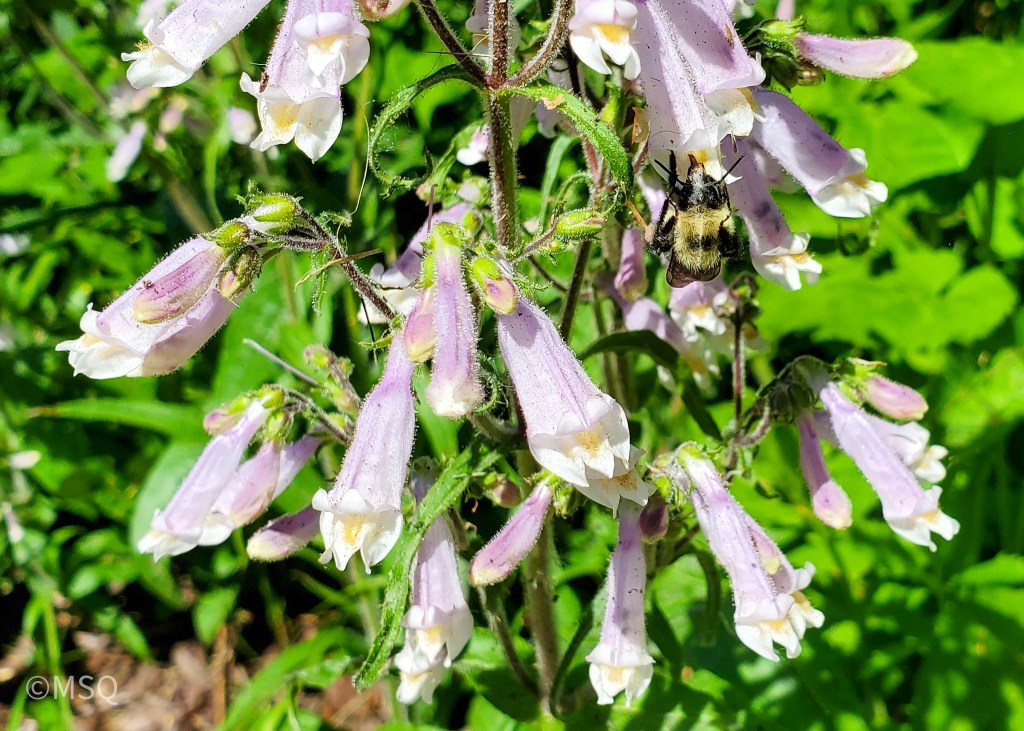

Short-tongued bees and small bees have found ways to use the food in Penstemon hirsutus. Some small solitary bees, including sweat bees like Lasioglossum spp., simply crawl into the flower and collect its resources. A small carpenter bee, Ceratina spp., is one of the main pollinators of Hairy Beardtongue. Another small bee is Hoplitis spp., a small Mason bee.
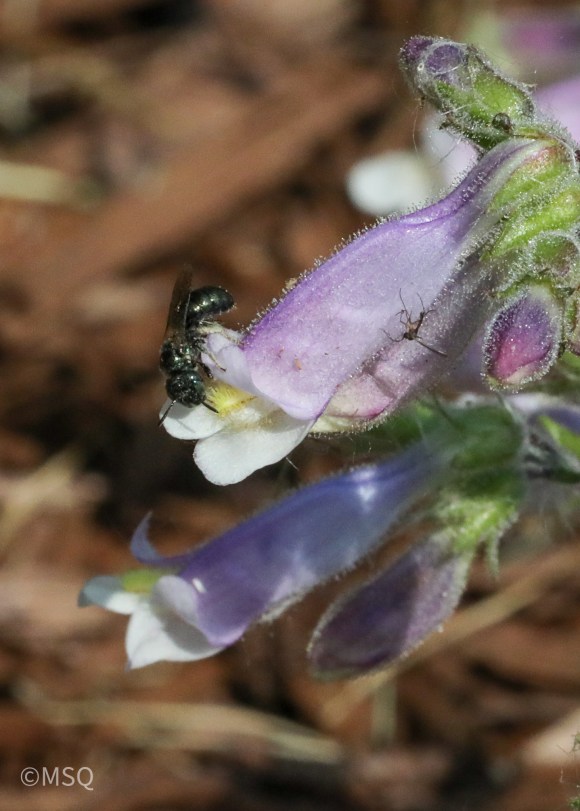
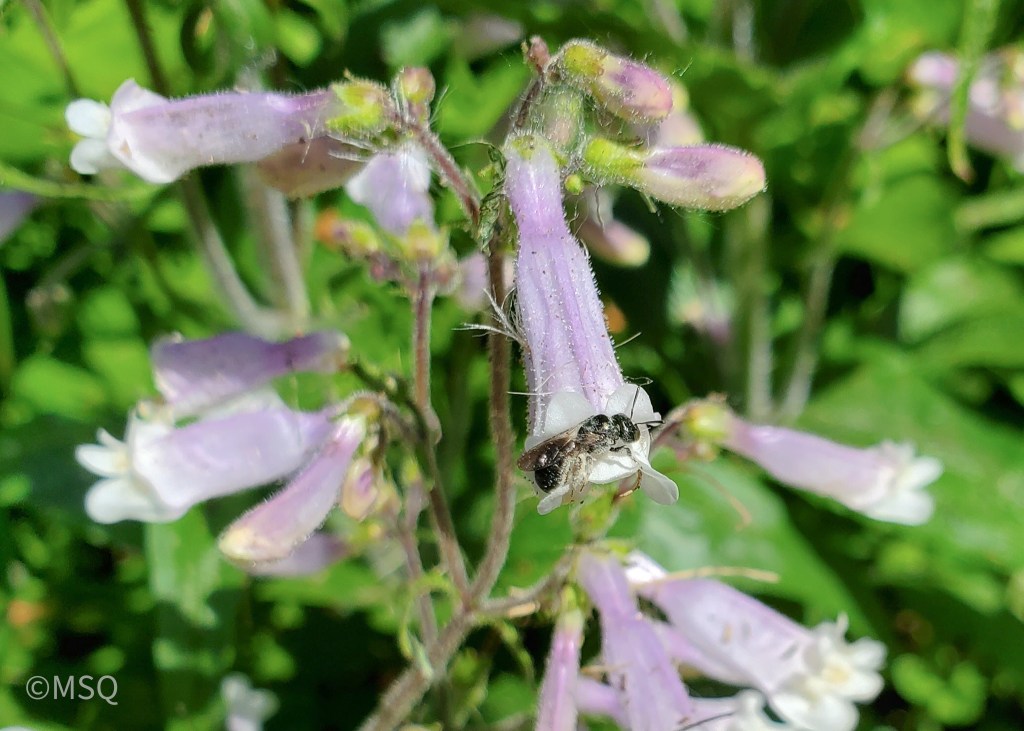
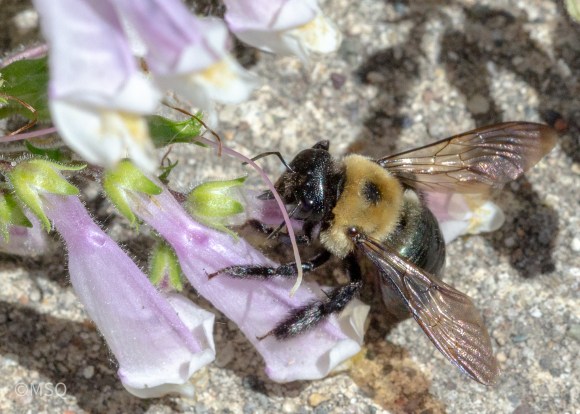
Wasps and some large bees steal nectar. Large carpenter bees (Xylocopa spp.) chew a hole at the base of the flower and drink nectar from the nectaries. Nectar stealing doesn’t pollinate the plant but does provide the insect with food.
Several beneficial insects visit Hairy Beardtongue while it is blooming. All of them use its nectar for fuel while going about their work. Chalcidoidea is a group of small wasps. They control both agricultural and natural pests. Orius insidiosus or the Insidious Flower Bug or the Minute Pirate Bug hunts soft-bodied insects including spider mites, aphids, and thrips. Braconidae are a family of parasitic wasp that prey on soft-bodied insects including aphids. They also parasitize agricultural pests and caterpillars including the Tomato Horn Worm! Aeolothripidae are thrips but predatory thrips. They usually hunt small, soft-bodied insects. Cynipoidea are parasitic wasps. Empididae are predatory flies sometimes called dagger flies.
For readers looking for a new adventure, both Packera obovata and Penstemon hirsutus grow on green roofs! Both grow well in the Midwest. In Kansas, a trial tested a plot of the standard mixed sedums against a plot of sedums and grasses and a one of Packera obovata, other native plants and grasses. Both mixed plots outperformed the sedums throughout the two-year trial7.
Chicago Botanic Garden studied the performance of a mix of native and non-native plants on green roofs. Penstemon hirsutus received a five-star rating. It established early and was healthy throughout the trial. Its flowering was excellent, reseeding moderate and was only mildly affected by heat and drought. Chicago Botanic Garden also observed both birds and a variety of insects on their roofs. The insects included bees, butterflies, ants and more. In addition to visiting mallard ducks, robins, sparrows, swallows, hummingbirds, and mourning doves, killdeer nested on the roof every year8.
Another study examined genetic diversity and pollen movement between urban green roof populations of Penstemon hirsutus. The results showed that twenty-five percent of the plants were pollinated by plants on different roofs. The authors found these green roofs contributed significantly to connection between the scattered populations. Using native plants on green roof, is an interesting idea and new exciting new way add to contribute to native habit9.
I hope you enjoyed your trip through my Spring garden. I’d love to hear about your garden or any questions you have! Please contact me through the contact page with your stories and questions.
Mary
References:
- Hilty, J., n.d., Spoon-Leaved Ragwort, illinoiswildflowers.info, https://www.illinoiswildflowers.info/savanna/plants/rl_ragwort.html#:~:text=One%20bee%20species%2C%20Andrena%20gardineri,(ragworts).
- No author, n.d., Round-leaved Ragwort, https://www.canr.msu.edu/nativeplants/plant_facts/round_leaved_ragwort
- No author, n.d., Penstemon hirsutus, Lady Bird Johnson Wildflower Center, https://www.wildflower.org/plants/result.php?id_plant=PEHI
- Wheeler, Justin, 06/08/2017, Plants for Pollinators: Beardtongue, https://www.xerces.org/blog/plants-for-pollinators-beardtongue
- Hilty, J., n.d., Flower-Visiting Insects of Hairy Penstemon, https://www.illinoiswildflowers.info/flower_insects/plants/hry_penstemon.htm
- No author, n.d., Penstemon, Hairy Beardtongue, https://www.canr.msu.edu/nativeplants/plant_facts/penstemon_hairy_beardtongue#:~:text=Pollinators%20attracted,carpenter%20bees%2C%20and%20bumble%20bees.
- Decker, A. & Skabelund, L.R., 11/8-11/2021, Investigating the Effect of Substrate Type and Species Mix on Plant Cover on a Manhattan, Kansas Green Roof, Cities Alive Virtual conference, https://www.k-state.edu/greenroofs/images/pdf_docs/CitiesAlive%20Research_Paper_Sep2021_Decker_Skabelund.pdf
- Hawke, Richard, 2015, An Evaluation Study of Plant for Use on Green Roofs, Plant Evaluation Notes Issue, (38)2015, https://www.chicagobotanic.org/downloads/planteval_notes/no38_greenroofplants.pdf
- Ksiazek-Mikenas, K., Fant, J.B., & Skogen, K.A., 08/07/2019, Pollinator-Mediated Gene Flow Connects Green Roof Populations Across the Urban Matrix: A Paternity Analysis of the Self-Compatible Form Penstemon hirsutus, Frontiers in Ecology and Evolution, (7)2019, https://www.frontiersin.org/articles/10.3389/fevo.2019.00299/full#:~:text=Genetic%20Diversity%20of%20Green%20Roof%20vs.&text=The%20natural%20prairie%20populations%20of,genetic%20diversity%20(Table%202).
 Wild Things in the Garden