Fluttering above the other garden flowers, the yellow faces of Coreopsis tripterous welcome multitudes of bees. This mid to late season bloomer supports an array of pollinators and beneficial insects, preparing them for the winter to come. In addition, Coreopsis tripteris or Tall Tickseed offers an erect accent in the garden resembling bamboo.
Tall Tickseed thrives in Zones 3 through 8. It grows from two to nine feet tall and spreads from two to eight feet. Spacing is four to eight feet. Coreopsis tripteris enjoys medium to moist soils but isn’t picky. It can tolerate loam, clay-loam, gravel, and sand. Poorly drained soils can encourage crown rot.
Established plants tolerate drought and dry conditions. In dry conditions, Tall Tickseed is shorter and more open. In ideal conditions, it will self-seed freely. Deadheading reduces this and may help rebloom. Unfortunately deadheading, also, reduces seeds for the birds.
Coreopsis tripteris does lean and often needs support. This is especially a problem in windy areas and wet areas. In 2024, I’m going to try a pruning technique called the ‘June haircut’ on my Tickseed. This technique is used on asters to reduce flopping and increase bloom. In mid-June, I’ll cut back a quarter to a third of each stem. I hope to reduce flopping. I’ll be sure to let you know what happens!

If pruning doesn’t appeal, there are Tall Tickseed nativars available. Coreopsis tripteris ‘Gold Standard’ and Coreopsis tripteris ‘Flower Tower’ are two options for the native Coreopsis tripteris. Both plants were originally found in wild populations. Mt. Cuba Center in Delaware performed the plant trials on the seeds.
Mt. Cuba is a wonderful botanical garden with a focus on native plants. In their own words, “Our mission is to inspire an appreciation for the beauty and value of native plants and a commitment to protect the habitats that sustain them.” As part of their mission, they perform plant trials and offer classes including a certification in Ecological Gardening.1
Coreopsis tripteris ‘Gold Standard’ is a shorter version of the native plant. It grows to about five and a half feet tall on sturdy stems. This plant maintains its upright habit throughout the growing season. It is a slow spreader and fills only two feet. Like the native, ‘Gold Standard’ has excellent resistance to powdery mildew and leaf spot. This nativar attracts bees, wasps, skippers, and butterflies.
Coreopsis tripteris ‘Flower Tower’ has all the native’s height, growing to eight feet tall. But it has sturdy stems for support, so it doesn’t lean or flop. Its flowers are the largest of these three plants at two and half inches. Unfortunately, those large, lovely flowers only last four to five weeks. In contrast, both Coreopsis tripteris and Coreopsis tripteris ‘Gold Standard’ bloom for eight to nine weeks. It spreads two feet over three years and is both hardy and disease resistant. The Mt. Cuba review didn’t mention insect visits.
Where does Coreopsis tripteris grow in the wild? It thrives in black soil prairies, cemetery prairies, sand prairies, typical savannas, and sandy savannas. It can also be found in thickets, edges of seeps, thinly wooded bluffs, meadows in wooded areas and limestone glades. In areas impacted by people, Tall Tickseed is found in abandoned fields, along railroads, along roadsides and in moderately disturbed areas. It responds well to fire.2
The leaves of Coreopsis tripteris are a fascinating feature of the plant. Most of the compound leaves are three parts, suggestive of bamboo. They even flutter in the wind like bamboo leaves. Combined with the vertical lines of this plant, it creates the impression of bamboo grass in the garden–at least until the flower bloom. It’s like two plants in one!
Aside from the three-part form, the leaves grow opposite each other the entire length of the stem. They are larger at the bottom where they have five parts. Individual leaflets extend up to five inches long and spread three-quarter inches wide and are elliptic in shape. The edges often have tiny hairs called ciliate. Leaves are medium green on top and light green underneath with very small hairs (pubescent).2
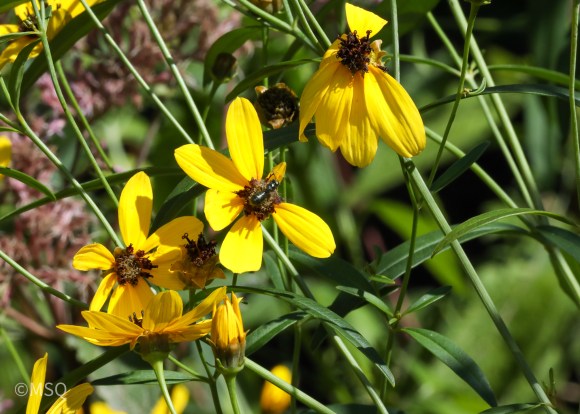
Tall Tickseeds begins blooming in mid-summer and continues through the summer, trailing off into Fall. Bright yellow flowers with flattened, velvety brown centers sit on top of the stems or emerge from upper leaf axils. The flowers are one to three inches across with rounded, widely spread petals. The petals give Tall Tickseed a lovely, Daisy-like form different from a Black-Eyed Susan
The blooms can be single or in a flat group resembling an open cyme—think yarrow with just a few large, yellow flowers. The center flowers open first. The petals are sterile ray florets while the center has disc florets. These disc florets form five millimeter long, tubular, four to five lobed, reddish-brown florets. The lobes’ edges have triangular shapes that are spreading to slightly recurved.
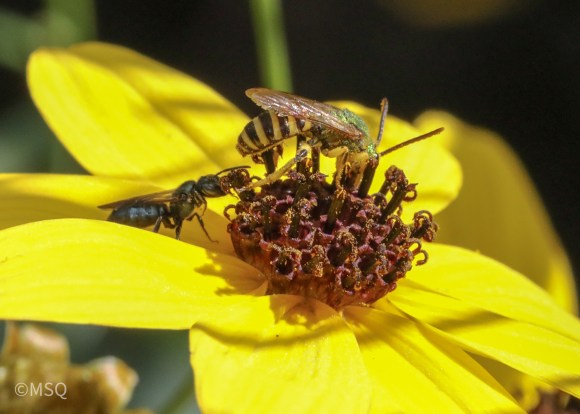
Like Solidago, Coreopsis is a keystone plant. There are two kinds of keystone plants. One type supports caterpillars from 90% of moths and butterflies. The other category has pollen used by specialist bees. These plants feed both specialist and generalist bees. Coreopsis is in the top 30 keystone plant genera for the Eastern Temperate Forests. It is seventh on the Top 30 Native Plants for Pollen Specialist Bees (also for the Eastern Temperate Forests—Ecoregion 8).3,4
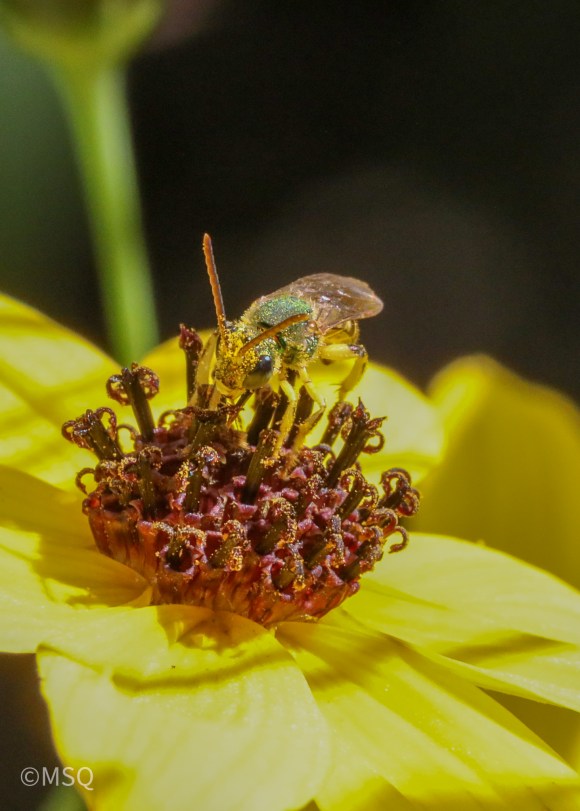
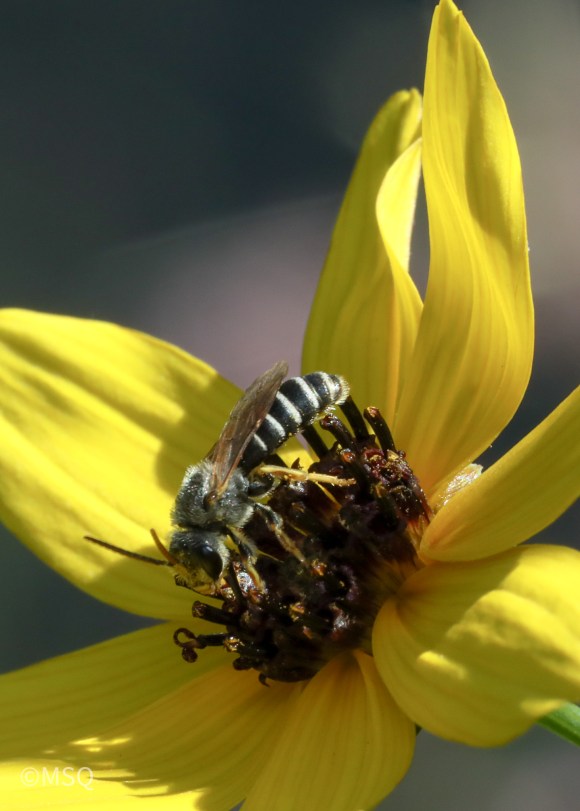
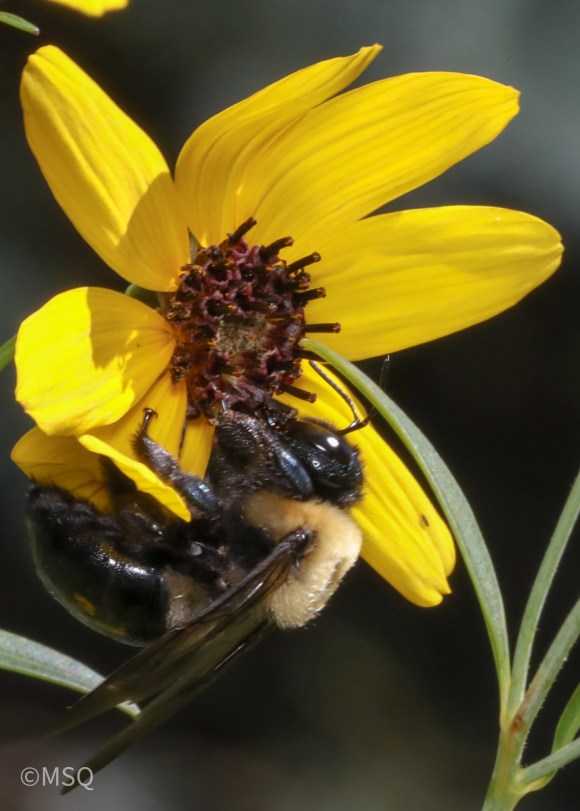
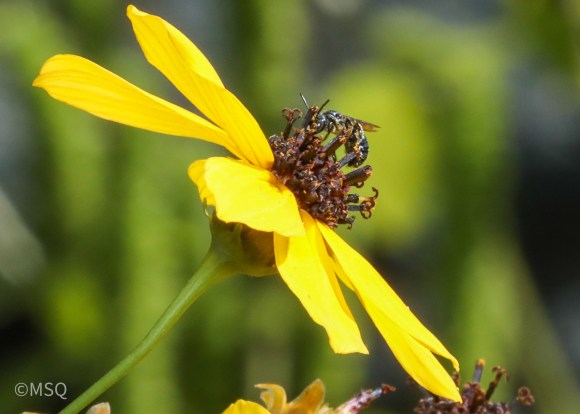
Tall Tickseed attracts numerous species of bees, butterflies, moth, skippers, and other beneficial insects. The Xerces Society for Invertebrate Conservation considers it of Special Value to Native Bees and states it, Supports Conservation Biological Control.5 Coreopsis tripteris draws Bumblebees,
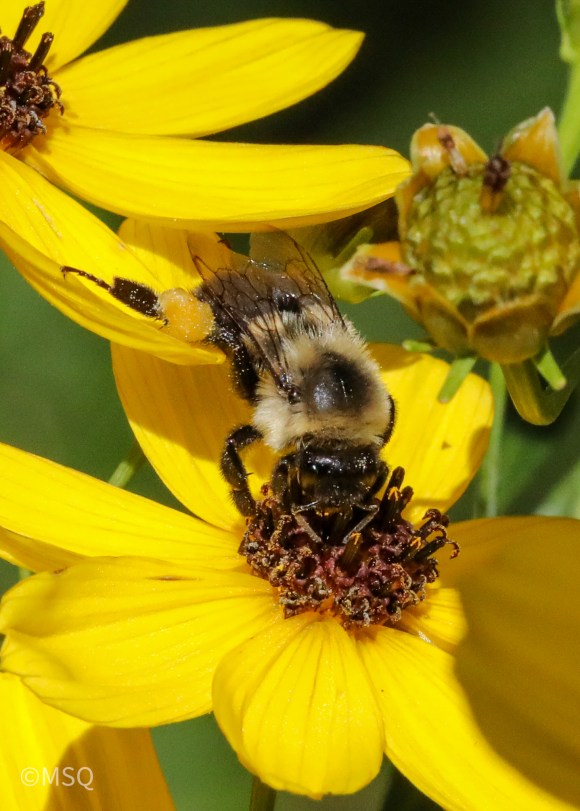
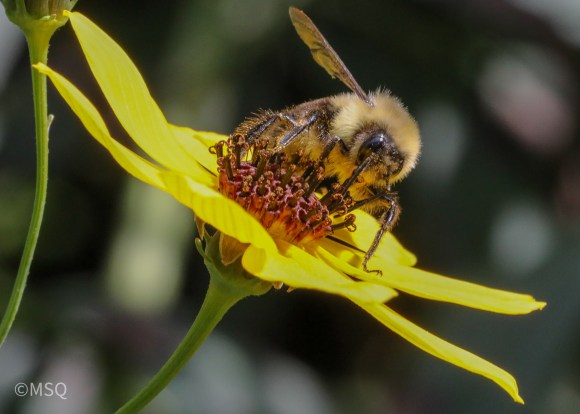
cuckoo bees, digger bees (Melissodes spp.), leaf-cutter bees (Megachile spp.), Halictid bees (Halictus spp., Lasioglossom spp.), small green sweat bees,
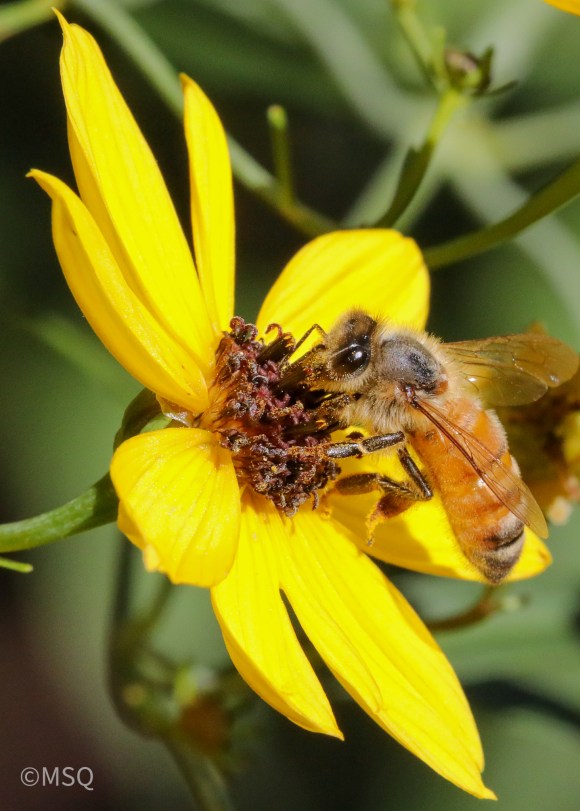
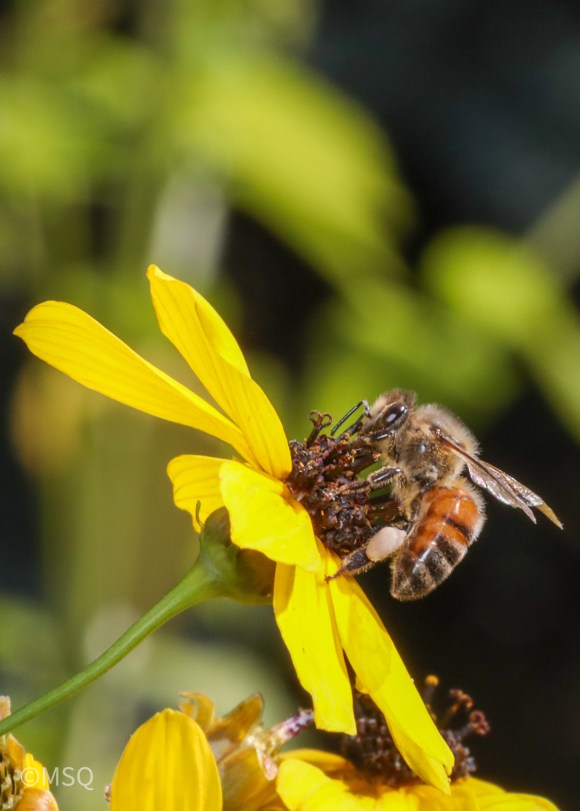
honey bees,
carpenter bees (Xylocopa spp. and Ceratina spp.) and dagger bees (Calliopsis spp., Heterosaurus spp.).2
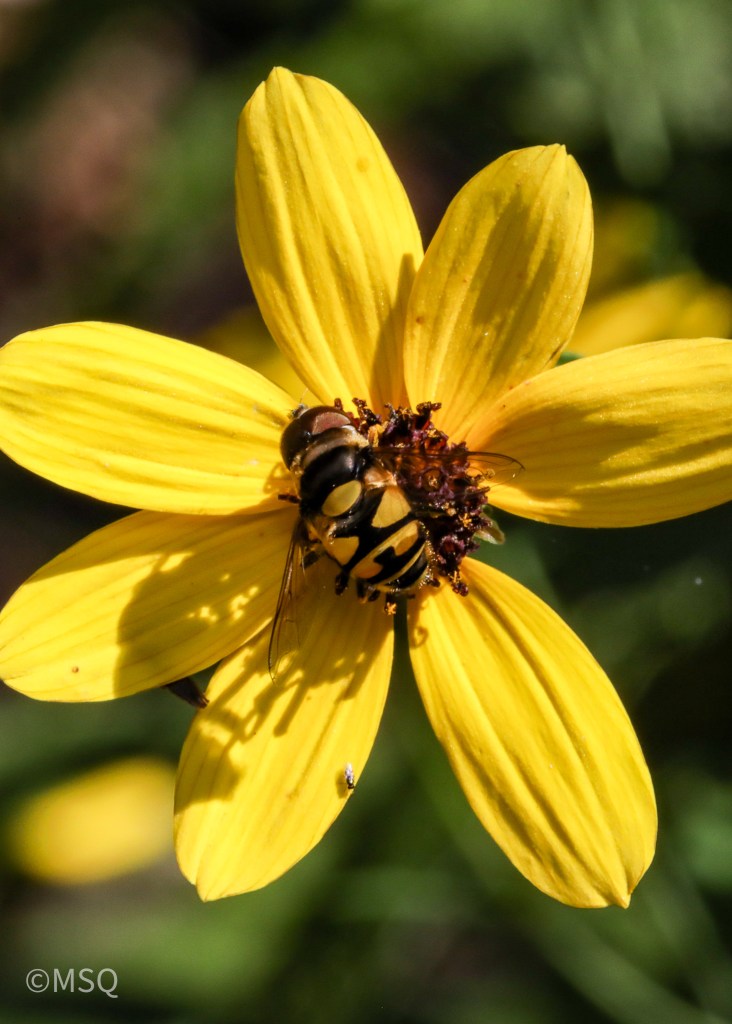
Flies also visit Tall Tickseed. Syrphid flies, Bee flies and Tachinid flies feed on nectar from the flowers. Both Syrphid flies and the Tachinid flies can be beneficial insects.
The Goldenrod Soldier Beetle (Chauliognathus pennsylvanicus), another beneficial insect, eats both pollen and nectar from the Coreopsis blooms. Over its life cycle, the Soldier beetle also preys on soil-dwelling invertebrates, aphids, and other soft-bodied insects.2
Butterflies, moths, and skippers gather resources from Coreopsis tripteris. Adults nectar at the flowers for summer and early fall fuel. Various moths use it as a larval host. The Dimorphic Gray Moth (Tornosscolopacinarius) consumes the leaves of the Tall Tickseed as a caterpillar. Both the Wavy-lined Emerald Moth (Synchlora aerata), and Common Tan Wave Moth (Pleuroprucha insulsaria) eat the flowers. The Wavy-lined Emerald larva, also called the Camouflage Looper, not only dines on the flowers but wears them. The larva use silk to attach pieces of the flower petals to its body. If it moves to a different type of flower, the caterpillar will change its ‘clothes’ to match its meal. In addition, it also seems to change clothes frequently since the observed petals are always fresh!6
I hope you’ve enjoyed this exploration into Coreopsis tripteris! If you have any comments or suggestions about the post, I would love to hear them! Enjoy your holiday season!
Warm Regards,
Mary
References:
- No author, (n.d.) Our Vision and Our Mission, Mt. Cuba Center, https://mtcubacenter.org/about/mission/#:~:text=Our%20mission%20is%20to%20inspire,the%20habitats%20that%20sustain%20them.
- Hilty, J., (n.d.) Tall Coreopsis, illinoiswildflowers.info, https://www.illinoiswildflowers.info/prairie/plantx/tl_coreopsisx.htm
- Keystone Plants by Ecoregion, The National Wildlife Federation, https://www.nwf.org/Garden-for-Wildlife/About/Native-Plants/keystone-plants-by-ecoregion
- National Wildlife Federation, Gardening for Wildlife, Keystone Native Plants Eastern Temperate Forests – Ecoregion 8, https://www.nwf.org/-/media/Documents/PDFs/Garden-for-Wildlife/Keystone-Plants/NWF-GFW-keystone-plant-list-ecoregion-8-eastern-temperate-forests.ashx?la=en&hash=1E180E2E5F2B06EB9ADF28882353B3BC7B3B247D
- No auther, n.d., Coreopsis tripteris, Lady Bird Johnson Wildflower Center, https://www.wildflower.org/plants/result.php?id_plant=cotr4
- Bzdyk, K., (2013, July 1), Wavy-lined Emerald Moth: Master of Disguise, Loudoun Wildlife Conservancy, https://loudounwildlife.org/2013/07/wavy-lined-emerald-moth-master-of-disguise/
 Wild Things in the Garden