Filling the lull between early Spring and Summer flowers
Virginia Creeper—people love it or hate it. When hated, it’s an invasive, woody vine that kills trees and is impossible to control. When lovable, Virginia Creeper is an adaptable climber with abundant dark green leaves that doubles as a ground cover. To add to the controversy, there are two plants commonly called Virginia Creeper-Parthenocissus inserta and Parthenocissus quinquefolia. P. inserta even has a Latin synonym of Parthenocissus vitacea. The two Virginia Creepers grow over essentially the same range and, except for subtle differences, look basically the same.
Today, I’m loving Parthenocissus inserta (Virginia Creeper or Woodbine) for the value of its late Spring flowers. Parthenocissus inserta begins blooming as Baptisia australis (False indigo, as discussed in my last blog post, https://wildthingsinthe.garden/2023/03/06/the-magnificent-month-of-may-and-june/) starts to fade and continues until early summer. In a sunny spot, the small blooms form lavish clusters available to mid- to late Spring native pollinators.
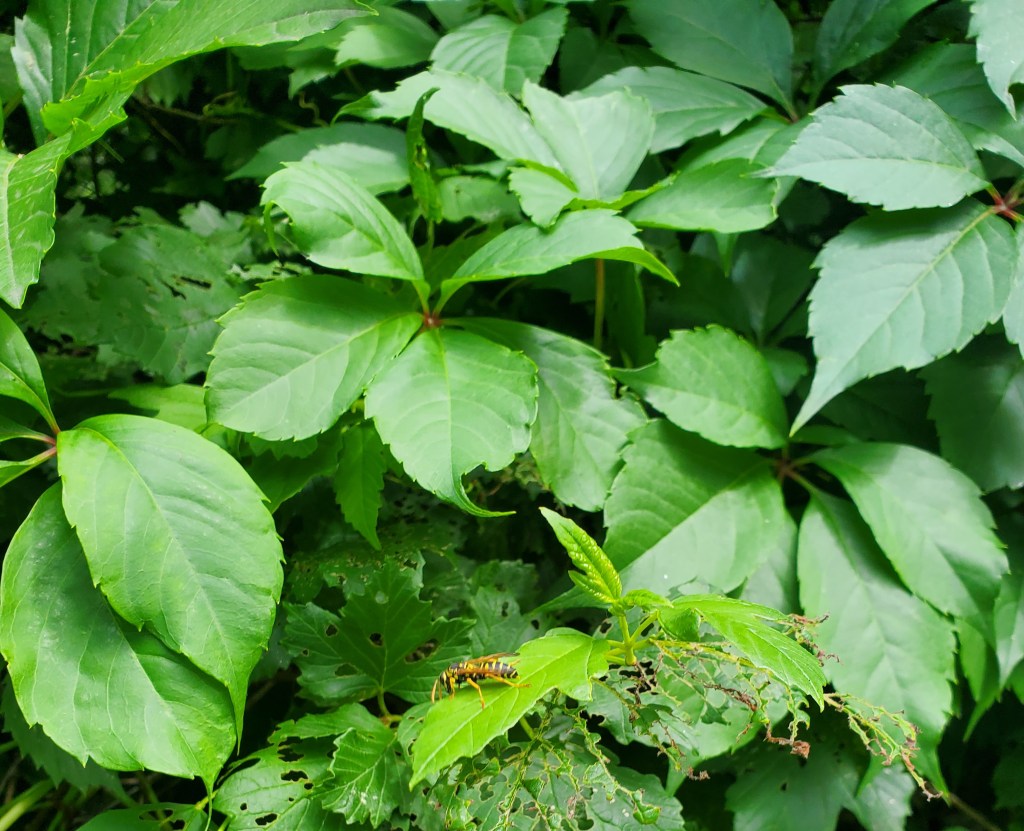
But there’s more! This vine is incredibly versatile. P. inserta climbs when given a little support for its twining tendrils. It works as a tough groundcover too. In the end, P. inserta rewards you with charming clusters of bloom and vibrant green leaves. These are followed by bright red fall color and blue-black berries enjoyed by birds and wildlife.
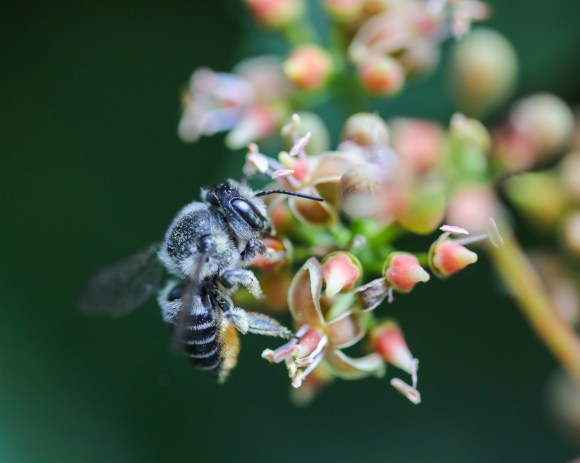
Virginia Creeper’s flowers appear in late Spring. Grouped in clusters, they begin as green buds. As they develop, these buds turn rosy. Then the petals open to bend completely backward against the base (or recurve). Petal color can vary from deep green with just a touch of yellow at the base to a deep reddish-brown fading slightly toward the center. In both cases, the petals have white to pale yellow edges. The stamens rise from a cone-shaped pistil. Yellow pollen rests on red anthers and these are held on white filaments. The bi-colored pistil has a red base tipped with yellow. Nectaries are located around the base of the pistil. Different insects explore this nectar supply and drink.
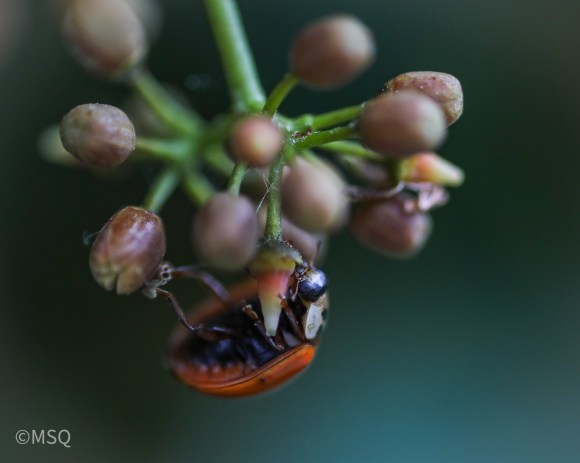
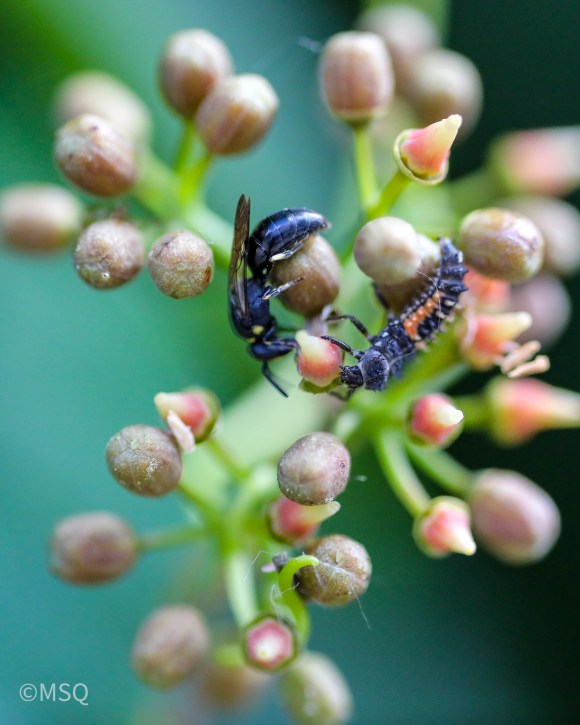
Once fertilized, the blooms change into 1/4-3/8”, blue-black berries with a slightly frosted exterior. They’re poisonous to most mammals – although deer do eat them and survive. Birds appreciate the berries. Woodpeckers, flycatchers, vireos, bluebirds, and thrush visit Woodbine.
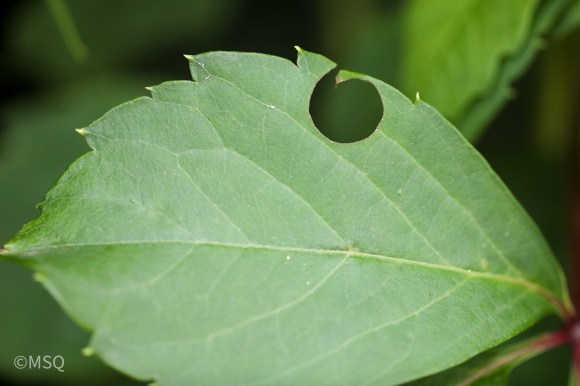
The leaves are really the main attraction of Woodbine for the gardener. They’re richly green all spring and summer, screening whatever is underneath or behind. Palmately compound, in five sections, each part is coarsely toothed. The upper part is medium green and more or less glossy, the lower side pale. Usually smooth, the lower leaf will sometimes have hairs along the veins. In early fall, they turn a brilliant scarlet.
Woodbine’s stalks and stem are hairless and green when young. They turn brown or reddish–brown and become woody as the plant grows. Length estimates range from 20 to almost 100 feet although most of them fall between 40 and 60 feet. The fall leaves often shine above the trees where the vines have grown up a dead tree trunk.
Woodbine climbs using single curling tendrils that wrap around a support. The tendrils develop opposite leaves and can have 2 to 3 branches. These tendrils separate P. inserta from Parthenocissus quinquefolia(the other Virginia creeper). P. quinquefolia has branching tendrils (up to 10 branches) with adhesive pads at the end of each. The curling tendrils of P. inserta mean it cannot grow on a smooth support like a pole. Woodbine can and does grow over rocks and shrubs. It will push its tendrils into crevices in rocks and wood to climb. The tendrils expand to help hold it in place.
P. inserta grows in full sun to full shade and dry to wet conditions. It tolerates all types of soil and pH. Woodbine can even be used as a xeriscape plant. In the garden, it can be used as a climbing vine or as a groundcover.
However it does require regular maintenance. Prune to keep vines in check. Pull and prune back groundcover. For best Fall leaf color and best chance of bloom, plant in a sunny location. Overall, the best growing conditions are part to full sun and moist, well-drained soil with high organic matter.
I’ve already talked about how Parthenocissus inserta looks like Parthenocissus quinquefolia and both have been called Virginia Creeper. When I searched for information on pollinators and/or beneficial insects using Woodbine or Virginia Creeper, there was confusion between the two plants. P. quinquefolia was listed with photos that looked like P. vitacea. For the insect facts, I’ll use information from sources where photos confirm P. inserta, sources listing P. vitacea or P. inserta or from my own photos.
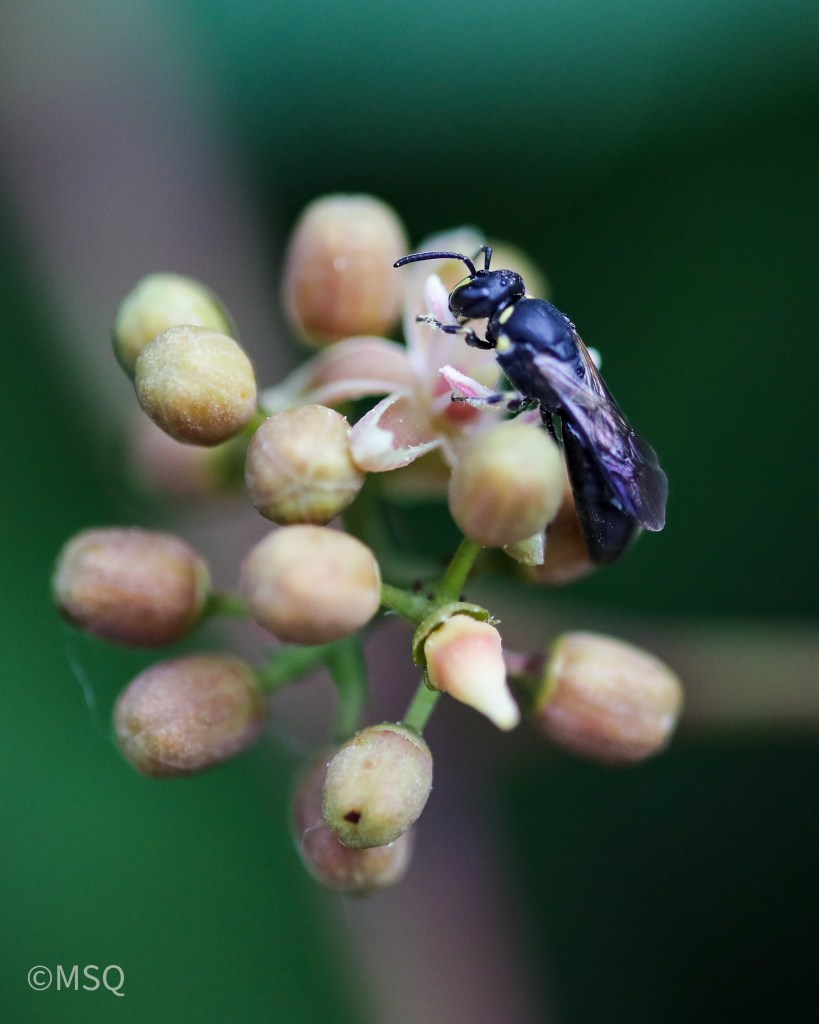

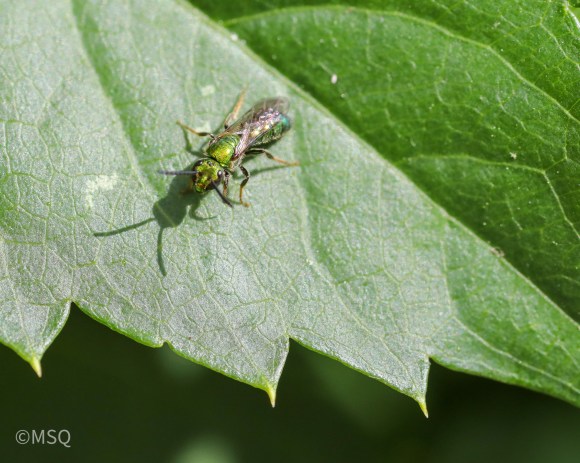
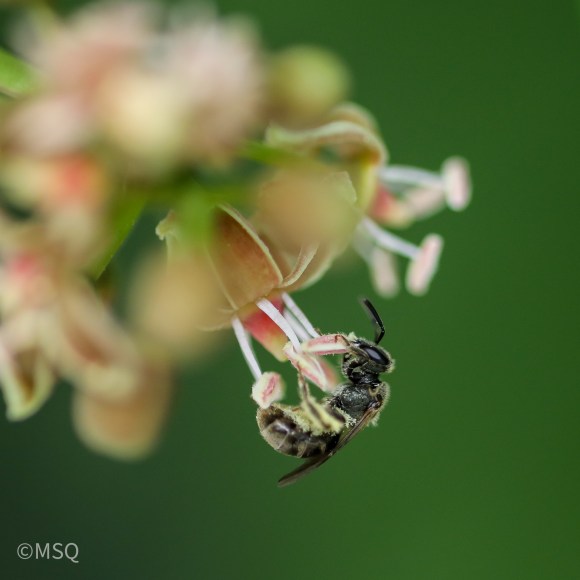
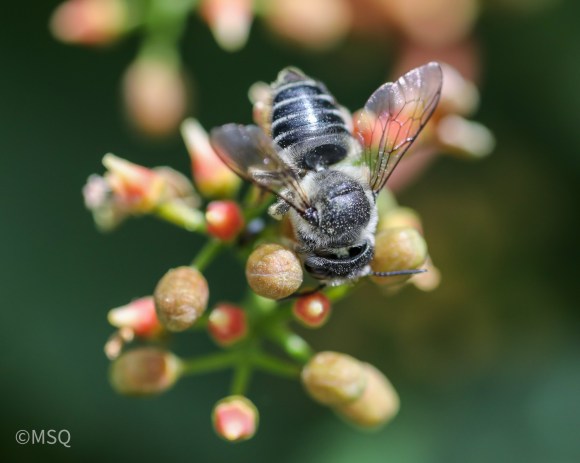
Many early pollinators visit P. inserta blooms. Small metallic sweat bees use pollen and nectar. Leafcutter bees, Megachile, use the flowers for food and cut pieces of the leaves to line their nest cells. Masked-face bees, Hylaeus, stop at Woodbine for pollen and nectar. Bumblebees and Honeybees also use its resources.
P. inserta is also a host for a variety of Sphinx moths including the Lettered Sphinx Moth (Deidamia inscriptum) and the Pandorus Sphinx Moth (Eumorpha pandorus). The Sphinx moths produce enormous larva followed by large adult moths. The Lettered Sphinx Moth has a 1 ¾” to 2 ¾’ wingspan while the Pandorus Sphinx Moth ranges from 3 ¼” to 4 ½”.
Sphinx moths serve as pollinators by chance. They often drink nectar by hovering in front of the plant and using their long proboscis. The proboscis is a very long mouth tube, the equivalent of the moth’s tongue. Pollen grains stick to the proboscis after nectaring. When the moth travels to another flower, it can transfer some pollen to the next bloom.
Virginia Creeper or Parthenocissus inserta supplies many resources to native pollinators. It’ll thrive in an abundance of locations and, as a vine, can be used in various ways in the garden. Enjoy this grand plant in Spring, Summer and Fall!
I hope you enjoyed reading my blog! Please contact me with any questions or to subscribe. I’d love to hear about your adventures with wild plants and pollinators!
 Wild Things in the Garden